


Iron Maiden Back Control DVD by Matt Darcy – A Masterpiece!

Iron Maiden Back Control DVD

The best-named DVD instructional in the history of Jiu-Jitsu is here! Matt Darcy got everything right with this one. The subject is one that’s universally important for BJJ since its inception – back control. Furthermore, the aspect of back control in this instructional is also crucially important – submission hunting. And the best thing about it is by far the name of the release – “The Iron Maiden Back Control DVD“.

This Matt Darcy product is available now, and I would’ve bought it because of the name itself. Since I also know that Darcy is a very good black belt as well it was a no-brainer. There’s no way to have too much material on back attacks in BJJ. However, you need to have the right quality of material for your purpose. Since I love choking people out, a prolific submission hunter’s release fits right in! Oh, and did I mention that the name is awesome?

ON SALE:
Matt Darcy – Iron Maiden Back Control
Iron Maiden Back Control DVD by Matt Darcy
Techniques List

Back Control And How Good It Really Is

Back control is a great spot to be in. What’s not to love? You have control, you have safety and you can submit your opponent at will. Well, okay, you have the first two. For the final part, submissions, you’re going to have to work a bit. The thing with back control is that it’s a very fiddle mistress. Once you start grip fighting for that choke, parts of the total control seize to work. In turn, this means that an experienced opponent can use the submission defense to get out of the position completely. Unless you know how to stop them. And the fun thing about the Iron Maiden Back Control DVD i that it will teach you how in the most unusual way.

For me, back control was an issue for a while. More precisely, finishing from the position was. I looked into it, first with my instructors and then with training partners who excel at the position. While I got great pointers and tips which did improve me, I still couldn’t make sense of it. I couldn’t come up with a cohesive system that has a universal application. At that time I started gathering digital instructionals on the subject. Things did improve but it was the Iron Maiden Back Control DVD that appears to have had a crucial impact on my game. It helped me organize all my understanding of submitting from back control. Since it is a fairly new instructional I still have much more to experiment with it. But if initial results are something to go by, I might’ve ended my search for a high-percentage submission system from the back.

Matt Darcy’s Back Attacking Philosophy

Most people involved in grappling are going to recognize the name Matt Darcy quite easily. After all, he is a fierce competitor who is very active in the scene. His style of grappling makes him one of the most exciting black belts out there. Darcy is the definition of submission hunter and is relentless in his pursuit. The back is his preferred position. When he claws himself there he turns into the most annoying, strangling human backpack in all of grappling martial arts.

Darcy is the owner and head instructor at Guerilla Jiu-Jitsu in San Jose. He is a second degree BJJ black belt under Dave Camarillo. As if that’s not enough, he also has a second-degree black belt in Judo. As far as complete grapplers go, he is right there with the best of them. Matt has a very technical and aggressive style of JIu-Jitsu, constantly hunting for the submission.

Darcy’s experience as a head instructor makes him a great teacher as well. Furthermore, he has experience in both teaching adults as well as children. If you’ve never taught a children’s’ class, you have no idea of the effort and patience it takes. All these qualities translate directly to his teaching method in the  Iron Maiden Back Control DVD. His instructions are clear and precise, leaving no question unanswered.

Iron Maiden Back Control DVD Content

The best named BJJ DVD instructional of all times is one very rich in specific content. In terms of organization, it’s all on one DVD. This gives you the ease of access to all of the incredible 39 sections of the instructional! Furthermore, all the sections are well organized into segments that cover a very specific subject. The level of explanation, as previously covered is exceptional. Matt stays focused on one task only – finishing from back control. there’s no going into different aspects of BJJ and losing the thread of the instructional. Quality-wise, you get a very clean product with a good sound and flawless camera work.

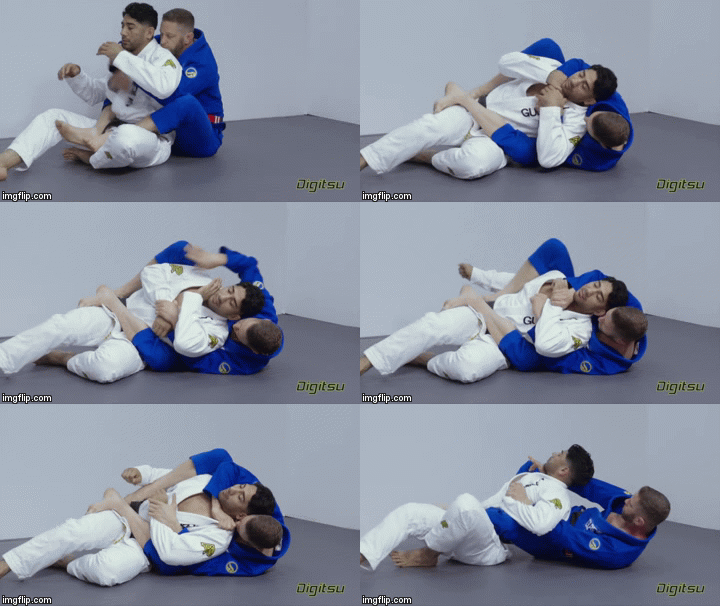
The system that Darcy presents in the Iron Maiden Back Control DVD is a very specific one. It involves using your legs in order to obtain control over the opponent’s arms and upper body. the interesting thing about it is that, unlike some other unsuccessful attempts before, he manages to keep control of the hips as well. the result is a completely tied up opponent even before grip fighting begins. And, with grip fighting out of the picture, finishing can be done with one hand only. Actually, Darcy offers plenty of one arm finishes in this instructional.

Iron Maiden Back Control

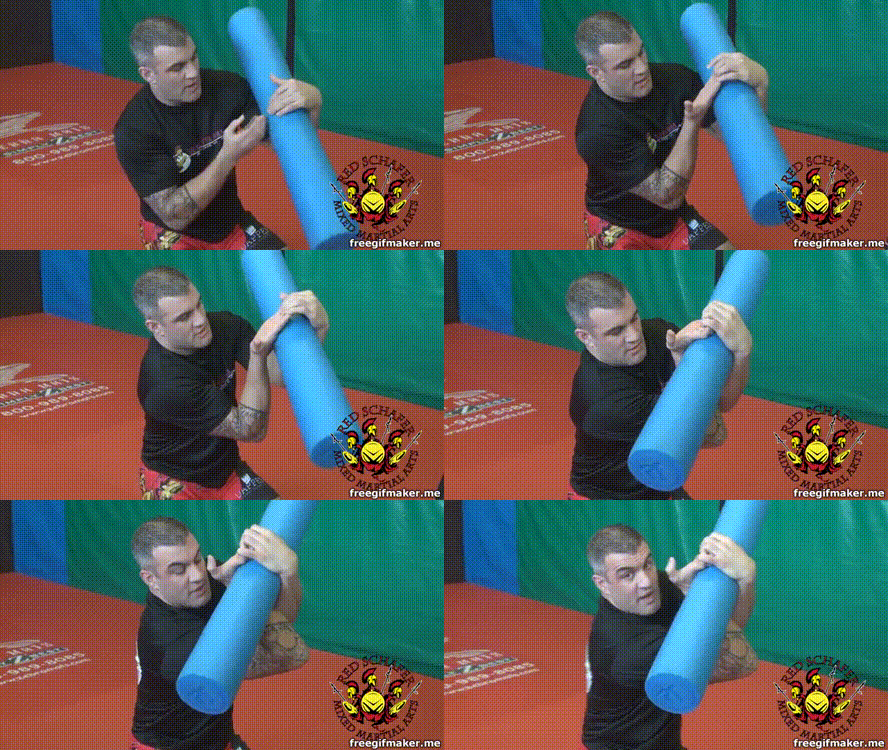
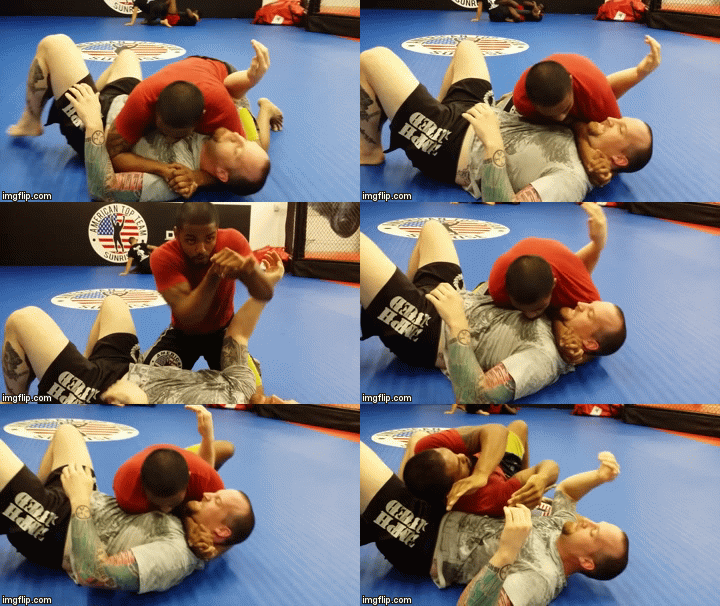
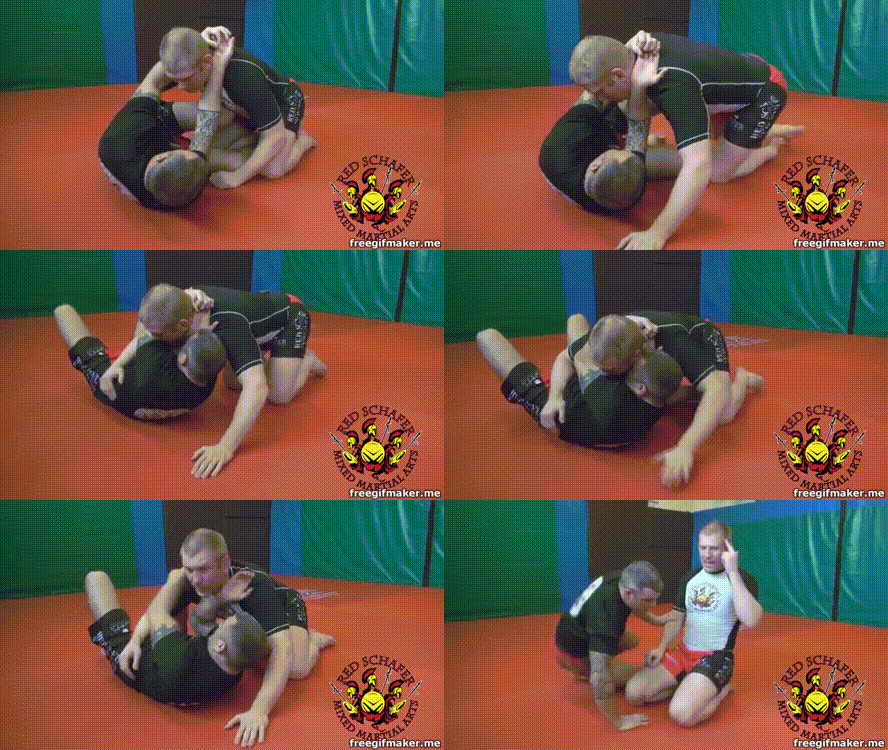
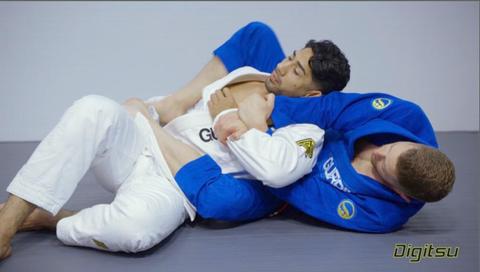
The first segment, right after a short introduction is the main one. After taking care of basic control checkpoints, Darcey goes straight into the Iron Maiden. The opportunities here are chokes, both for Gi and No-Gi. The one-arm rear-naked choke is as easy as choking from the back can get if you get the control points right. It is innovative, to say the least. There’s also a very cool take on the bow and arrow choke called the crossbow. It’ll skyrocket your finishing rate from the back for sure.

Flash Of The Blade

Another very cool name for a back attacking system. the Flash Of the Blade focuses on attacking the arms form the back. Both Kimura and straight armbar attacks area available without abandoning control. Once again, this is an area in which the Iron Maiden Back Control DVD easily beats any other similar instructional.

D.O.D Control & Necromancer
Iron Maiden Back Control DVDThe cool names continue as Darcy goes deep into his unusual yet brutally effective system. The D.O.D control is an option to go for from the Iron Maiden. it is a way to keep attacking from the back while switching to even more upper body control than before. Since this is a fairly advanced concept with lots of details, the Iron Maiden Back Control DVD provides answers to questions even before you think of them. There’s a big troubleshooting section that further explains moves like The Iron Maiden Transition, Reverse Guillotine and the intricate grip fighting system Darcy teaches.

Oh and the Necromancer is the funkiest rolling lapel choke from the back you’ll ever attempt!

Reverse Triangle

Why stop at choking with the arms and arm locks, when you can also choke with your legs from back control? The reverse triangle is the only hack you need to deal with extra-defensive opponents. Strong wrestlers or even unmovable Judokas are not going to be a problem anymore. Game-changing techniques like collar control and transitioning to and from the Iron Maiden are the mark of this section. Once again, there’s a troubleshooting portion to clarify everything even further.

The Crucifix

This is a portion of back control I’ve always struggled with. No matter how much I looked into the Crucifix, I never got the hang of it. turns out it was simple, all it took was the Iron Maiden Back Control DVD. Never thought of combining armbars, biceps slicers, chokes, and Omoplatas from the Crucifix? Neither have I, but luckily, Darcy has a system that fits them all in, and then some!

Flow Sequences

This is where everything covered so far starts making sense. It is the blueprint to getting to the Iron Maiden as well as transitioning between its different elements. The perfect ending comes in the form of a couple of drills you can do to truly master the best back control position in Jiu-Jitsu.

ON SALE:
Matt Darcy – Iron Maiden Back Control
Iron Maiden Back Control DVD by Matt Darcy
Techniques List

BJJ Sparring: Should Beginners Roll Live Straight Away?

Shoud Beginners Do Live BJJ Sparring?

How was your first BJJ sparring experience? If you’re like most people, it was nothing pleasant. Actually, if you did not enjoy it, yet somehow, you wanted more, you came out of it with the perfect experience. For me, it was the usual. I got destroyed despite my Judo background. Like a little child. As I went through the ranks, I often wondered about complete beginners doing full-blown rolling on their first day. I am constantly seeing people of all builds and backgrounds, come in enthusiastic and after an intro class get thrown right into the deep. Well, I used to, at least. A while ago my academy adopted a different approach to things in this regard. Now the beginners get a different experience, one that prepares them (as much as you can prepare someone) for the demands of BJJ sparring.

BJJ Sparring

For a lot of people involved in Brazilian Jiu-Jitsu, BJJ sparring is the most fun part. This is also the main reason why people rarely miss an open mat. Never noticed this? Have another look at it and you’ll see that people that often skip class, usually never skip open mat. The main reason is BJJ rolling and all the fun people are having even when losing. Now imagine having to tell someone they can’t roll. It’s happened to me (because of injuries) and I can tell you that it sucks big time! Being on the mat and not sparring is like a pint of beer without the beer. However, restrictions to sparring need to be in place, if not for everyone that for those that need it the most. In BJJ, these are injured, people and complete beginners.

But, what’s the deal with beginners not sparring? I did and everything went right. Well, in reality, things are not that easy. Beginners, regardless of any previous grappling martial arts experience, are simply not ready to jump straight into BJJ sparring .there are a lot of factors to consider here, from safety to the whole meaning of it. If you walked straight into a pharmaceutical laboratory today, would they let you start working right away? Most things that require you to apply a new practical skill, also require training. In most areas, such specific training with a specific duration is called orientation. This is exactly what Jiu-Jitsu lacks when it comes to absolute beginners and BJJ sparring.

The First BJJ Sparring Experience

No matter how ready you are, the first BJJ sparring experience is not going to be a pleasant one. During BJJ rolling, nothing much makes sense for a long while. It is absolute chaos with possible grave physical consequences. This, in itself, should be enough to warrant a more cautious way of introducing beginners to sparring. But, no, the generally accepted method is throwing them straight in. You show a beginner some intro stuff, like the closed guard with maybe a pass and a sweep and it’s a slap, bump, roll. Now, given enough time all chaos descends into some order. However, why even introduce a methodical and detail-orientated art like BJJ as chaos in the first place?

BJJ Sparring Beginners guide First and foremost, beginners lack the experience to understand where risks lie. It’s happened to me time and time again, to have to go and break up couples ready to roll at just the right time. There should be no way that a new student s does their first/second roll with someone that has a month or so more than them. That right there is the recipe for disaster.
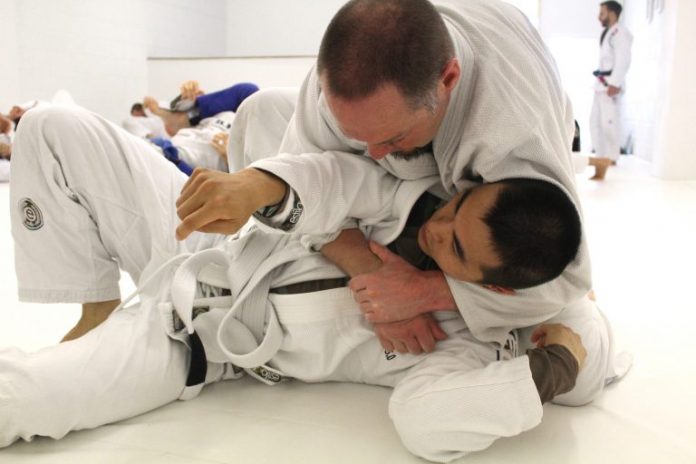
Furthermore, new people have no idea what’s going on. The positions, movement, techniques and everything going on is an alien world to them. Apart from some mental toughness, there’s not much they get from rolling so early. The potential for injury is sky high, and everyone has that brief moment of “this might not have been a good idea”. Now, I like the tough love method, but when it makes sense as a method. Throwing a beginner into live rolling does nothing for their progress or positive BJJ experience.

The Methodical Approach 

About a year ago, my academy decided to implement the Gracie Barra approach. We were as surprised as anyone at some of the training methodologies. Before that, we kind of work on our own curriculum in our own way. With GB, on the other hand, everything is tried and tested and organized in an impressive fashion. However, at first glance, it all seems illogical and useless. Until you give it a try.

Now, as much as I personally like it, I’m not going to endorse the GB philosophy here. I’m just going to present one aspect, which for me is crucial for any BJJ academy. As per the Gracie Barra philosophy, white belts with less than three stripes do not get to roll live. What is the point, you might ask? The point is easy – basic orientation. Beginners should know what they’re doing before they go and do it.

In order to learn what BJJ is, beginners spend the time of their first two stripes learning new techniques, doing drills and working on position sparring. Before they have an understand basic movement, moves and try them out in specific scenarios, there’s absolutely no need for live BJJ sparring. Positional sparring is more than enough to get them going.

If a student progresses faster than others, you might give them a promotion earlier, so that they can move toa group where they can roll live.

Open Mat 

The one glaring issue that arises with such a system is open mat. What happens when you get everyone together on an open mat day? Aren’t beginners with less than 2 stripes going to roll?

BJJ SparringWell, there are a few solutions that fit the bill here. Contrary to popular belief, the open mat is not just for BJJ sparring. People can also ask questions, drill or do position sparring. Those are just three possibilities of what beginners can do on the open mat.
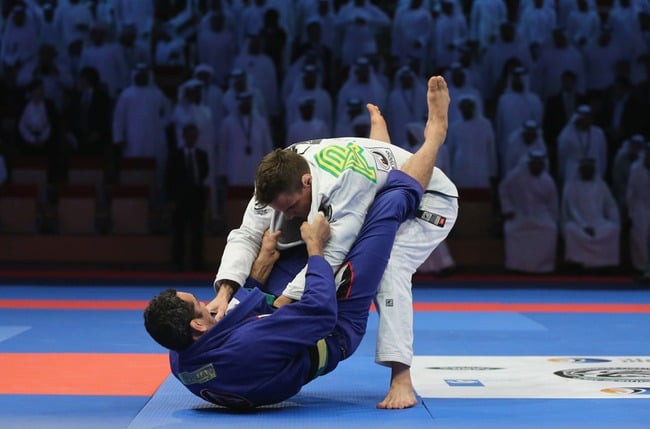
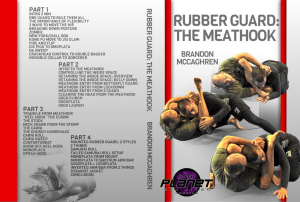
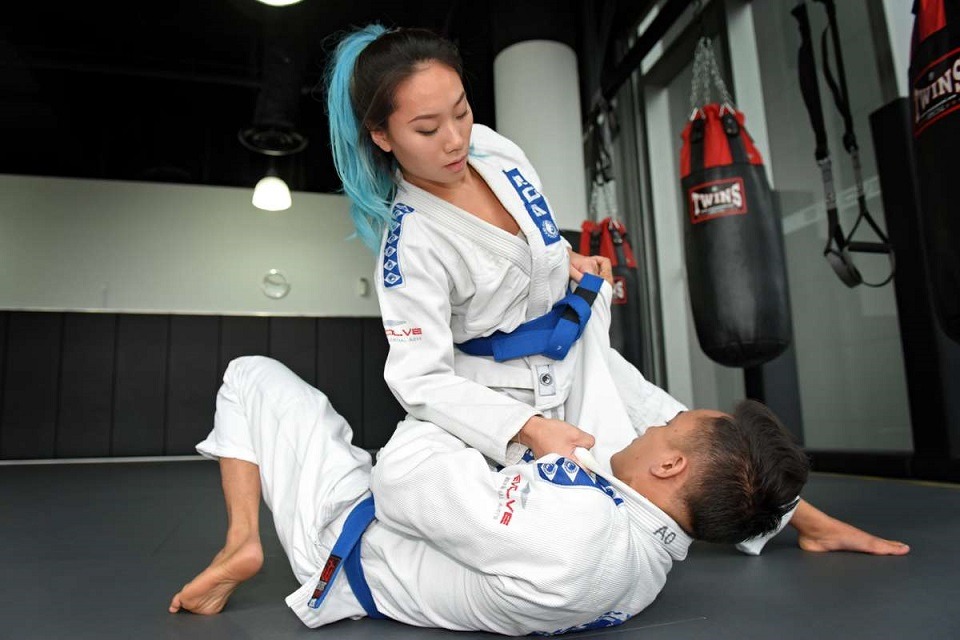
There’s also another, which is probably the best. Complete beginners should only work with instructors. They can get a “roll” or two in but only work with the coaches, who’ll know exactly how to guide them through a “live” roll. Those with a bit more experience can do the same with some of the older, more careful students. Again, the goal here is not to destroy them but give them a very limited taste of all the BJJ sparring that lays ahead. Think of it as position sparring with the shifting of the major positions every now and then. It is a surefire way to develop new students into many better-rounded grapplers in half the time!

Bernardo Faria DVD Foundations Of BJJA blueprint to the foundations of Brazilian Jiu-Jitsu is a surefire way of understanding what this sport is all about. if you’re a beginner who’s looking to start sparring ASAP then Bernardo Faria’s “Foundations Of Brazilian Jiu-Jitsu” DVD set is for you.


Why Every Academy Needs Intro BJJ Classes

Top Five Biggest Lies in BJJ You Will Hear Almost Every Day in Your Gym!

Jiu-Jitsu For Beginners: The First Month Of Training

Interesting BJJ Warm Ups To Get You Ready For Class

Pull Guard Much? Check Out These Crazy Variations

Pull Guard Options

BJJ has come to a state where every time someone goes to pull guard they’re ridiculed. This behavior is highly reminiscent of how people acted towards leg locks not so long ago. The BJJ community is the habit of constantly having a black ship among techniques. Pulling guard is actually something that is very specific to the sport, and should be something grapplers are proud of. Despite what some people might think, a guard pull is a highly technical movement, and there are more ways than one to do it. there are a few really fun and effective ways of pulling guard besides the regular one and the jump guard. Let’s explore those a little bit.

To Pull Guard or Not?

Deciding to pull guard as your number one move from the feet, is not a wrong thing. Pulling guard is a perfectly valid technique, especially in competition. Developing a takedown game takes time and dedication. On top of everything, not everyone that comes to Jiu-Jitsu has a background in other grappling martial arts. For those without Judo or Wrestling skills, the guard pull is the perfect option to get the fight to the ground. PPlus it is a BJJ-specific technique that no other arts have. As such, it is a great advantage over competitors with different backgrounds.

The takedown game in Jiu=Jitsu is a highly diverse one, due to how open the sport is. Apart from just a few moves that are forbidden only under certain rule sets, everything else is a go. You can grab the legs, you can manipulate collar, sleeves, work form a clinch, a headlock or do arm drags. As long as you’re comfortable and efficient with it, anything is going to work. So why should you be afraid to pull guard, even though it is perfectly legal at every level? The guard pull fits the takedown game perfectly, despite not being a move that results in points. Even though people do not see it as one, it is definitely a takedown that offers ample attacking opportunities.

Rubber Guard: the Meathook DVD ReviewSo, what do you do after you pull guard? Let Brandon McCaghren guide you through all possible attacking options. He has them all at your disposal, in the “Rubber Guard: The Meathook” DVD set. Learn attacks you’ve never seen before by a true master of the guard!

The Guard Pull’s Bad Reputation

Why You Need To Pull GuardIn the world of machismo culture, doing anything in a smart and risk-free fashion is regarded as not manly enough You would think that BJJ, wit hall it’s ego-taming properties is beyond such things. But, no, it seems there are certain aspects of the art that just can’t shake that negative vibe. Up until a while ago, it was leg locks, and mainly due to the same reason. they were seen as moves done by cowards, who do not know how to ass the guard.
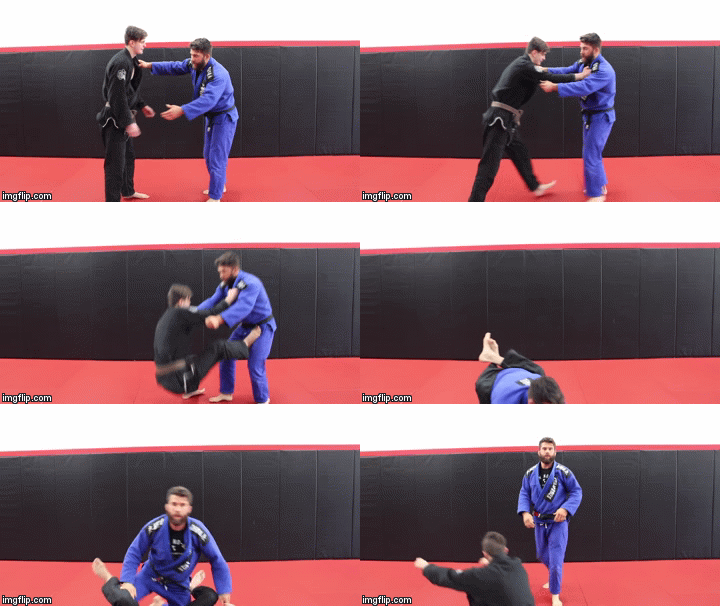
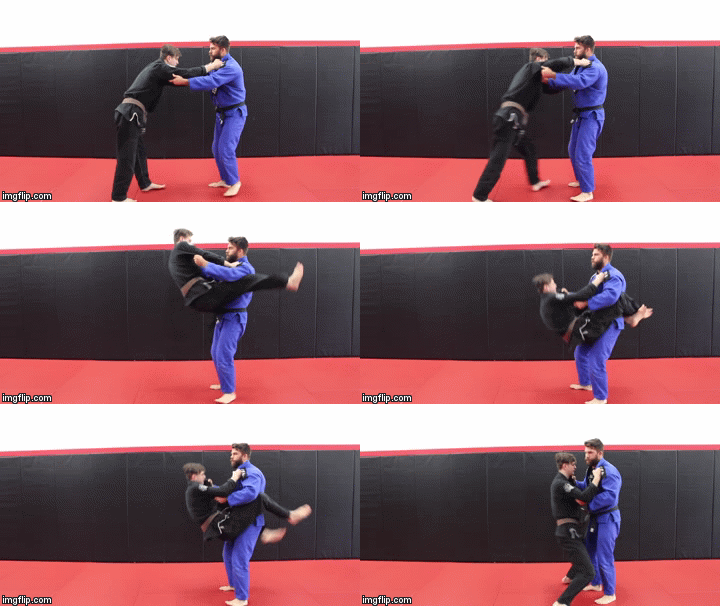
With the guard pull, it is pretty much the same situation. Attempting to pull guard as a main offensive option from the feet, is probably going to get you branded as a coward. However, doing the same move after attempting a takedown or throw, somehow makes it okay. It is one of the few idiosyncrasies of Brazilian Jiu-Jitsu that no one can explain.

In truth the bad name guard pulls have, just like with leg locks, is complete without merit. There is nothing cowardly about going to a specific attacking position when you’re grappling. The guard pull is just a way of entering the guard. So, even though it is not technically a takedown, it is still an efficient and high-percentage move to get the fight down to the mats.

Why You Need To Pull Guard

There are a bunch of reasons why you actually need to include guard pulls in your game. The first one is a very obvious one – they work. The beautiful thing about pulling guard is that it doesn’t take too long to learn. There’s nothing complicated about how you pull guard, so even beginners can master it quickly.,

Furthermore, it has plenty of variations for all you advanced people out there. While most people above blue belt are going to be savvy to the regular guard pull, variations give you the options to guide the match toward the desired direction. If you really like fighting off your back, then pulling guard should be your number one takedown option.

On the plus side, simply going for a guard pull setup allows you good control over a standing opponent. Your leg on their hips means they can’t get close to throw you. Plus, you can transition directly into throws like the Sumi Gaeshi, if you desire to spice things up a bit.

Regular Guard Pull

Pull GuardYour basic beginner guard pull is really easy to perform. Once you establish a collar and sleeve grip on your opponent you can go for it. The first thing to remember is which leg you need to place on their hip. Unless you want to get taken down, lift the leg that’s on the side where you control their arm. This is going to make it hard for them to brush your leg off.

Once the leg is on the hips, get you but as close to your heel as possible and sit down. However, instead of rolling backward, look to keep an extended leg on the hip and go slightly sideways. Your grips will all you break the opponent’s posture. The sideways angle makes it really easy to establish a closed guard. Or any open guard variation, for that matter.

Jump Guard

Pull GuardJumping guard is a potentially very dangerous move to go for. It is forbidden for white belts in all tournaments based on IBJJF rules, and even higher belts should be cautious. It is a good way of getting to an opponent who knows you’re about to pull guard. The same grips apply, only there’s no foot on the hips. Instead, you pull your upper body with your grips and jump, crossing your legs into closed guard the moment you reach your opponent.
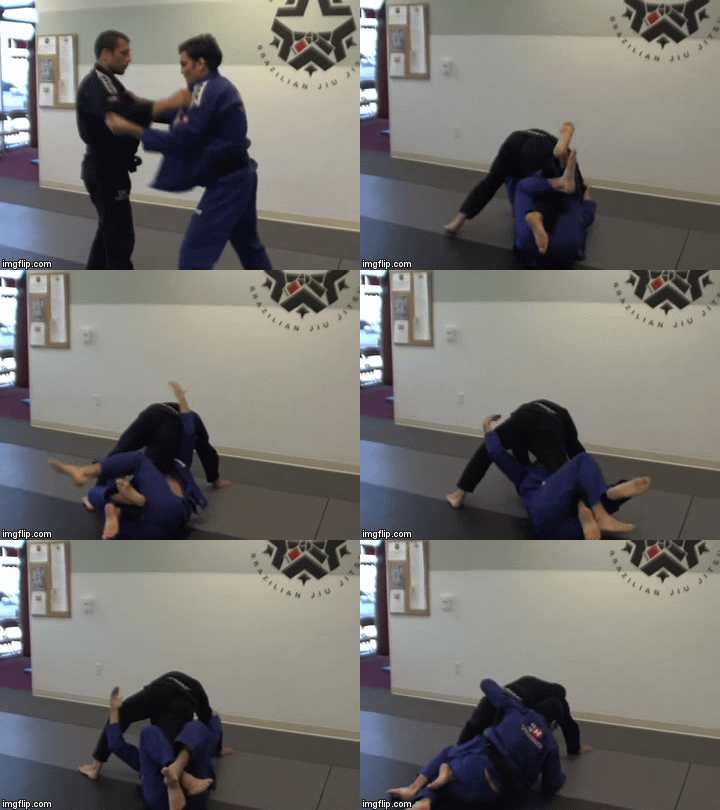
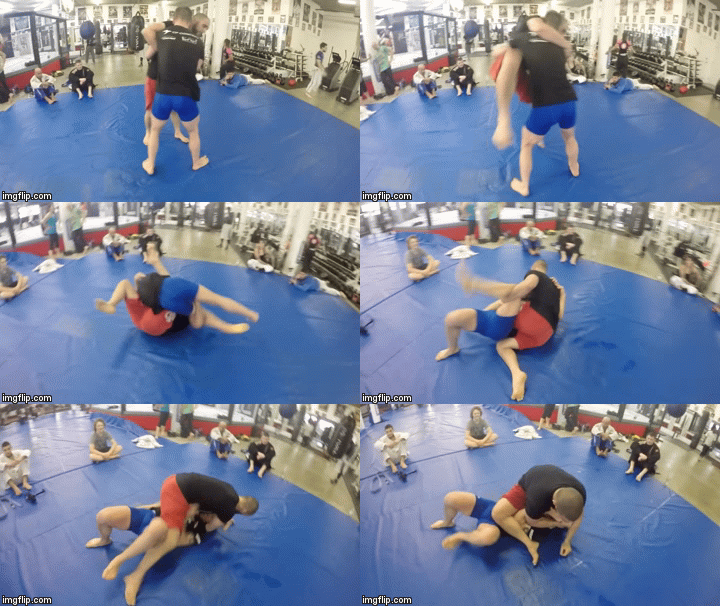
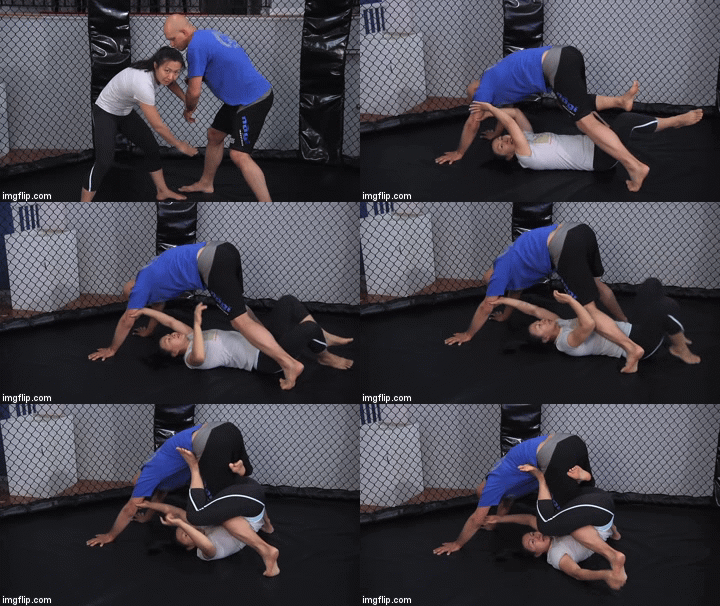
Half Guard Pull

Pull GUardPulling half guard is certainly a great way to end up ina top attacking position. For the half guard pull, though, you’ll need to change things a bit. Grips stay the same, but you’re going to approach at a different angle. Namely, in order to get the half guard, you’ll need to get one leg in between the opponent’s legs first. This both helps get you into position, and prevents passes if you mess things up along the way.

To pull half guard, you’ll need to step in with the leg on the collar control side. You’ll also want to fall a bit towards that side so that your leg can entangle theirs. Once down, lock your feet down and go for the underhook. From there you can go and play your favorite Z-guard, butterfly half or whatever variation you favor.

Web Guard Pull

The web guard is essentially the spider web position. Getting there when hunting for armbars is nothing new, but not many people think you can get to spiderweb by pulling guard. To be honest, I have no idea who came up with it. I saw it from Firas Zahabi first, so credit where credit’s due.

Pull GuardThis pull guard variation does flirt with the legality border under IBJJF rules. However, if you hit it right, it is a perfectly legal and viable option. What you need for this guard pull is the correct angle. You basically want to star with an overhook over your opponent’s arm. You also want to angle yourself towards that overhook side as much as possible. The goal is to do a jump guard, however from a sideways position. Instead of ending up in front of your opponent, you want to jump guard facing their side. From there, your main goal is to grab

Single Leg X Guard Pull

Pull Guard SetupTime to piss everyone off and pul guard in order to get a leg lock. While this is predominately a No-Gi setup, it works just as well in the Gi. The setup once again deviates from the regular collar and sleeve grip. This time, you go for a two-on-one grip, one of the staples of No-Gi. Just as a side note, the Gi material makes this grip even tighter. Once you have the grip, you’ll look to pull your opponent towards you, as if trying to go for the back. Their normal reaction is going to be to keep their hips back, which requires them to post a leg forward.

While holding the grip, you’re going to walk your feet in between their legs and get down on your back. USe the grip to pull the opponent over you so you expose their leg even further. From there, you simply shoot your hips up to establish a SIngle leg X guard. And, as you know, leg lock finishes are not very far away!

The Collar Guard – A Simple Guard For Advanced Grapplers

REVIEW: The Butterfly Half Guard DVD Instructional by Tom DeBlass

Purple Belt Guide To Developing A Mean Jiu-Jitsu Guard

BJJ Guard Game Basics – A Conceptual Approach

Smash Pass Defense Principles And Concepts

Smash Pass Defense Principles

One of the less fun aspects of Brazilian Jiu-Jitsu is being on the receiving end of certain moves. Ok, in all honesty, begin on the receiving end of all moves sucks. However, some things are certainly worse than others. For example, nobody likes tapping to an armbar, but once you’re past a certain point you’ll have to. Also accepting a pass or a sweep becomes inevitable at a certain point, although it is anything but fun. Despite all this, there’s one aspect of Jiu-Jitsu that makes most people cringe- pressure. And there’s hardly a time for more pressure than during a smash pass. Or more cringe during useless defense attempts.

The Art of Being Heavy on Your Opponent

The art of being heavy on your opponent is something that is not specific to Jiu-Jitsu only. All grappling martial arts have the pain of some kind. Keeping an opponent down is much easier when you can distribute your weight correctly. This is where BJJ starts to differ from other grappling martial arts though. Inj Jiu-Jitsu, the concept of pressure works dynamically as well as statically. The smash pass is the perfect example – it is a pin during which you can transition past the opponent’s legs. It is a sadistic tool that makes people’s will break and sometimes leads to taps because of too much pressure. Defending this monstrosity of a pass is rarely effective, and there’s a good reason for it.

Actually, this is exactly where the secret to successful defense lies. You need to understand why most common defenses fail so that you can focus on what works. The number on reason for failing to prevent a smash pass is discomfort. People focus on the points of discomfort too much and try to create space by using the wrong mechanics. Since nobody likes discomfort, especially coupled with pressure, people want a quick solution. The trouble with this is that they go for an instinctual defense, which only makes things worse. Luckily, there are concepts that work and work well. All you need is to follow a few simple steps to take all that pesky pressure away.

Neil Melanson DVD Advanced Guard SystemsNeil Melanson’s “Advanced Guard Systems” DVD is a great way to become extremely dangerous from your back. It won’t even give your opponent’s time to go for a pass before they’re tapping to a submission. Check out all he has to offer, or better yet, just buy the instructional!

Where Does All The Pressure Come From? 

Smash passing is more of a concept than it is a particular technique. Most people think about a cross-face half guard pass when they hear the phrase smash pass. This, however, is not the true definition. Smash passes are a category of moves that are technically different. their common thread is in the basic modality of getting past your legs.

Smash Pass Defense ConceptsTo begin with, passing via cross-face control from top half guard is definitely a smash pass. But, so is the now trendy over/under pass, as well as the knee slice/smash pass. Even the leg surf pass is a variation of a smash pass. Another really famous option is the leg drag as are some smashing options past the butterfly guard.
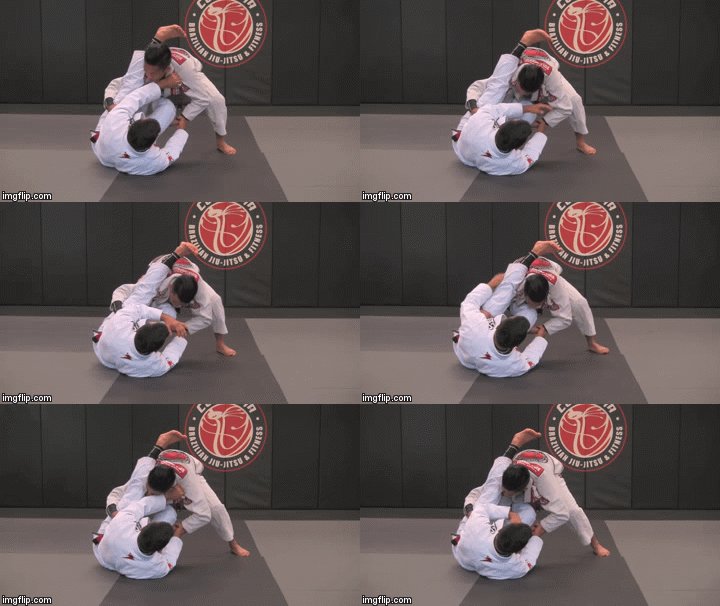
All in all, what defines a passing sequence as a smash pass are two things. First, it is pressure, which only works with the right weight distribution. Next up is direction, which depends on angles, body positioning, and structure. Furthermore, the goal of a smash pass is to put immense pressure on one of the two main areas of the body. The primary spot where most smash passes focus are the hips. The shoulders are the second point of control that is crucial for smash passing. the trick is that you usually can’t control both very well unless you’re past the opponent’s guard. Remember this point as it is going to be the base of a successful defense strategy.

Common Mistakes With Smash Passing

it is best if we bring some clarity int the picture first before we look at what you need to do. When trying to survive against a smash pass, what not to do is much more important. If you start making even small mistakes against a smash pass, two things are going to happen, and neither one is what you want.

The first problem is allowing your opponent to keep, or even increase the pressure. Regardless of the pass variation that the opponent employs, you can’t let your instinct take over. When there’s something pushing on us, the first instinct we have is to push back. This is a futile attempt, as the opponent’s weight distribution is going to make them feel like they weigh 300 lbs. Directly opposing a smash pass, regardless if it’s at hip or shoulder level, is only going to tire you out, and allow your opponent to exert even more pressure.

Secondly, you should not attempt your opponent from passing in the direction they want to. This means not clinging to a leg in half guard or the knee slice, or trying to keep them from moving. Once again this is only going to tire you out. Actually, working on pass prevention without dealing with the pressure first is never going to work. Instead of fighting losing battles, focus on fighting the correct ones.

Easy To Use Smash Pass Defense Principles

The first thing you need to understand about pressure is that it creates discomfort. A smash pass will either make you feel claustrophobic (if control is near the head) or feel that your spine is about to give way (if your hips are smashed). None of these fears is rea. As hard as it may seem during a smash pass, breathing is an absolute must. Otherwise, no defensive concept is going to work.

We’ll stay the course with pressure and direction. As far as pressure is concerned, you need to look to release it. After breathing, this is priority number one. All pressure in BJJ has a focal point, and a smash pass is no different. Once you figure it out, you’ll need to create a structure to make sure you redirect the pressure so that it becomes less powerful. This, inevitably, means creating space, which is exactly what guard passers do not want.

Smash Pass Defense Redirect PressureIn terms of dealing with direction, you’ll need to think a step ahead. Instead of thinking about preventing the pass from taking place in the desired direction, you should think about creating frames. Once you relive the pressure, you can use all the extra space to actually get away from your opponent, instead of trying to keep them close to you. When you place a frame, you can even let your opponent pass. They won’t be able to establish any controlling position before you re-guard or counter-attack.

As a final note, make sure you start with prevention instead of defense. Every smash pass has a focal point of pressure and a leading edge like the shin in the knee slice or the shoulder in the over/under. If you manage to block this leading edge from getting near you, you’ll disrupt smash passing even before it begins.

Purple Belt Guide To Developing A Mean Jiu-Jitsu Guard

A Shortcut to Passing The Guard – The Tozi Guard Pass

Double Leg Takedown – How to Do It & The Most Common Mistakes

BJJ Competition Tips: Absolute Division For Small People

BJJ Competition Absolute Division Tips

Weight classes are a source of much confusion in BJJ. What weight class is the perfect fit for you? should you go a weight class up or down? How about competing in the absolute division? It is not easy for most people to find their appropriate weight class, at least in the beginning. In terms of the absolute, for some, it never crosses their mind. For others, it is the reason they go to a BJJ competition and competing in their class is just a means to get to the absolute. This is an understandable trait o bigger people, but where do those tiny guys fit in the absolute? You’ll be surprised to know that smaller people win the absolute much more regularly than one would think, So, if you’re a light guy or girl, looking to conquer the absolute, make sure your’ea s ready as you can.

David vs Goliath is too Romantic for Smaller Grapplers

In modern Brazilian Jiu-Jitsu, there are usually 9 weight classes for adult male and female competitors. Each weight class has 4 medalists, (most often) which means there are 36 people ready for the absolute division at the end of a BJJ competition. This is the best case scenario, as not all people decide to go for the absolute. Whatever the case, there is more than enough competition for this division, which often turns out to be the most entertaining one. However, all cards are not stacked evenly as you might end up seeing a rooster-weight up against an ultra-heavyweight. While this might raise questions of safety and sanity in other sports, in BJJ it makes perfect sense. After all, this is the art in which the smaller person can easily deal with a larger one, right?

Despite the romantic notion of David vs. Goliath, going for the absolute division as one of the lighter competitors requires a smart approach. In an art where everyone is aiming to be heavy on top and where the crushing pressure is the norm, the weight difference is a huge factor. However, also in a BJJ sense, dealing with adversity is a huge part of the sport. As such, going recklessly against giants in the absolute division is a great way to end up injured. Goin to a BJJ competition with a sound absolute strategy, though, is what turns grapplers like Caio Terra into legends.

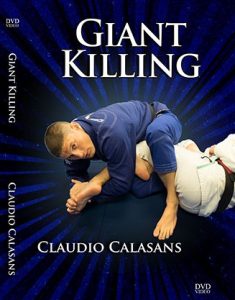
Claudio Calasans Killing a Giant DVDA great way to become a giant-killing specialist is to learn the trade from one. Claudio Calasans is one of the best in the world at beating bigger and stronger opponent’s. His formula on absolute division supremacy can be found in his “Giant Killing” DVD instructional. it is an absolute must-have for anyone that’s below middleweight!
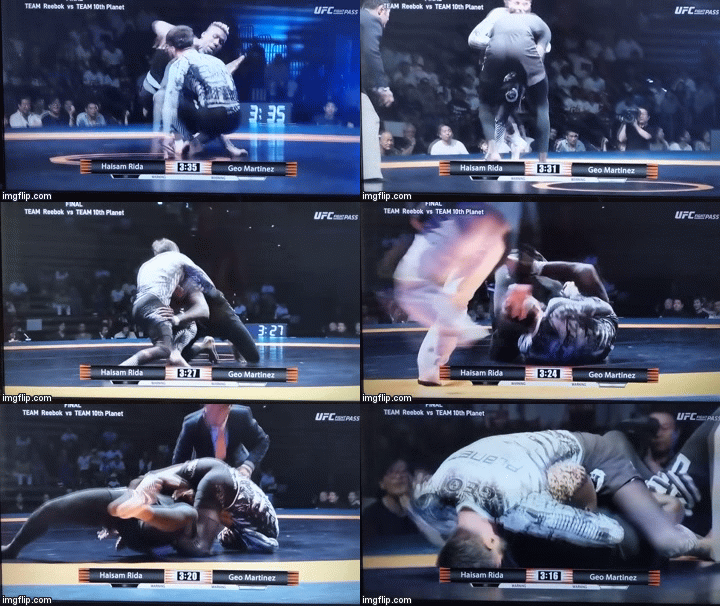
The Lure Of  The Absolute Division

You know how people say that there’s no ego in BJJ? Well, they’re wrong. We do not get rid of our egos when we go train, we just manage to re-channel them. We keep them at bay when we’re training, but we often turn into cowboys ina BJJ competition. There’s no clearer indication of this than going in for the absolute division without a sound gameplan. This holds true for all competitors, but especially those that are lightweights or below.

I can understand the lure of the absolute. You are here because you already proved that your Jiu-Jitsu game works. Whether it is a gold or a bronze medal that got you there, you were better than someone on your way there. Now you get to prove that your game is also good against opponents of different shapes and sizes. For lighter grapplers, the lure of beating everyone, or just one giant, in the absolute, is often too much of an opportunity to pass on. In a sport where we’re fighting for complete superiority over another person, the existence of such a weight class is an absolute necessity. However, there is a smart and dumb way to go about looking for glory. This stands true for lighter and giant grapplers, alike.

Should Smaller Grapplers Compete In The Absolute?

It is easy to answer this question. Obviously, if it was too dangerous, the absolute divisions would not exist. Or, they’d have a limit on what the lowest weight should be. Safety is not an issue as a given. The only person responsible for any harm is going to be yourself. As a smaller grappler, you need to battle against two opponents in every match in the absolute division. The first one is the person standing across from you. The second unless you’re really lucky, is their weight. And, by lucky, I mean getting a lighter weight opponent(s).

Absolute Division BJJ CompetitionIn my personal opinion, every grappler needs the experience of competing in the absolute. Even it in just one BJJ competition, it is a very humbling experience. It is unlike battling the bigger people in your gym, just like competing in your weight class is different from rolling. So, even if you do not really like it, give the absolute a try, at least once. Of course, do not do it in the spur of a moment, but be ready for it, if you get the opportunity.

Furthermore, with the rise of the tournament that uses different rule sets to those of the IBJJF you might not have a choice. As a competitor, you might end up battling in an absolute division the only tournament, like the EBI. Or, maybe you’ll be in a Quintet style competition, where you might end up against opponents of various sizes.

BJJ Competition Tips For The Absolute Division

If there’s anything we can learn from grapplers like Caio Terra, Cobrinha, Gary Tonon, Geo Martinez, Mackenzie Dern and a host of other giant killers, it is that even the smallest grappler has every chance of winning. The only condition is preparing for it correctly and specifically. The thing with larger people is that your A game might not be applicable. For that, you’ll need to have a reserve gameplan, one that’s exclusive for giant-killing.

The first thing to know is that you shouldn’t go head to head. Forget about power doubles and strength moves from your feet. Instead, look to pull guard, get behind your opponent, or catch a front headlock. Flying submissions are also out of the question, as larger opponents can shake you off with ease.

BJJ Competition Absolute Division Small PeopleOn the ground, you also need to know that it all boils down to movement and timing. There are a few positions that you, as a smaller grappler can use against big opponents. You’ll need to know which those positions are, a well as the best ways of getting there. In order to achieve them, you’ll need to work constantly and never stop moving. However, remember to move with purpose, because getting tired is going to get you beat.
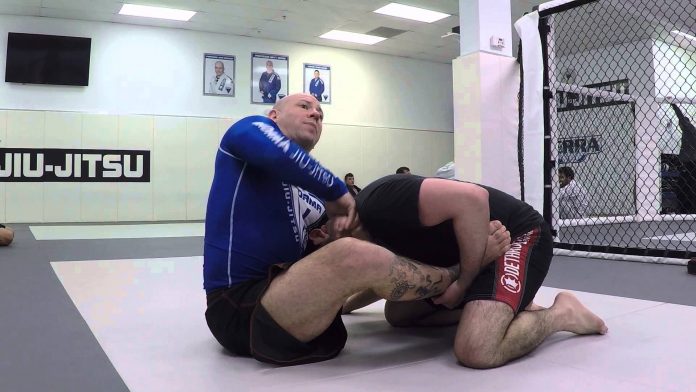
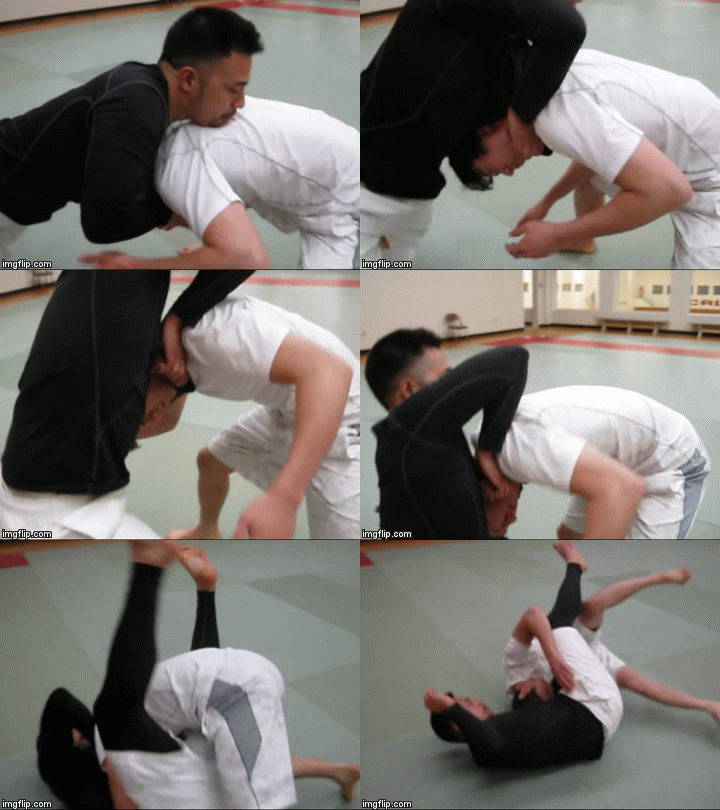
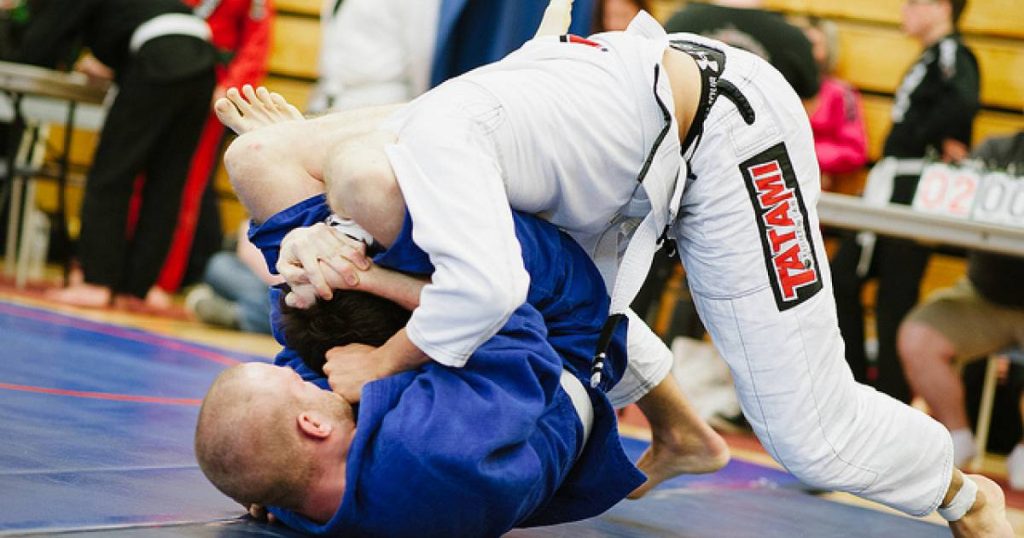
Timing is another huge factor. One bad decision and you’ll get stuck. Instead, be patient, move smart and time your attacks to perfection. The best strategy is getting a submission or a sweep/pass while your opponent is in transition. You’ll need to use every gap to your advantage, from positions that suit you. The best positions are back control and an Ashi Garami. Conversely, chokes and leg locks, especially heel hooks should be the only submissions you’re focusing on in the absolute division during a BJJ competition.

Best BJJ Submissions For Smaller Grapplers

BJJ For Small Guys: How To Beat Bigger Grapplers

Do You Have The Best BJJ Style For Your Body Type?

What Makes The Marcelotine Better Than A Regular Guillotine

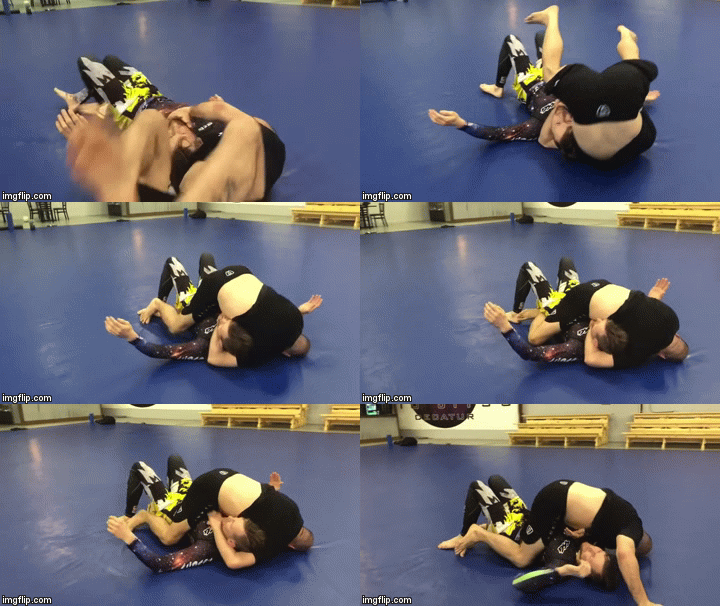
Marcelotine Choke details

Let’s pay attention to the one choke, I think is crucial for any BJJ student to know. The guillotine is a classic Brazilian Jiu-Jitsu move, one that has a high percentage success rate. That said, there are also a bunch of variations to the guillotine, along with different positions to get it from. All this means that it is becoming difficult for students to know what works best, and which variety fits better under the given circumstances. The solution is pretty easy, as there’s one variation out there that easily tops all others. It is not hard to learn, it is applicable at all levels, and works with the Gi as well as without it. It is the Marcelotine, the signature submission of legendary Marcelo Garcia.

Marcelo Garcia and Marcelotine

Marcelo Garcia is a very unique character. As a grappler, he is undoubtedly one of the best that ever graced the mats. As a teacher, he might even be better than he was a competitor. However, it is his take on certain BJJ techniques that makes him such a polarizing figure in the world of Jiu-Jitsu. Namely, Marcelo is quite notorious for claiming he simply doesn’t believe in certain techniques. For example, he doesn’t think that leg locks, Brabo chokes or Kimuras (to name a few) works in grappling. Despite a lot of evidence to the contrary, he decides to ignore there are moves in favor of focusing on others. His toolbox is by no means small and has a lot of sharp techniques in it. The Marcelotine is just one great example of that.

The Marcelotine is essentially a guillotine, done without the opponent’s arm. WHiel Marcelo also likes the arm-in guillotine, his take on the original move is groundbreaking. Just go back and watch his ADCC matches and you’ll see exactly what I’m talking about. The Marcelotine is the tightest guillotine variation I’ve ever felt, or done for that matter. IT works without using any strength, is available from almost everywhere and escaping it is virtually impossible. interested?

Heeadhunter Guillotine Neil Melanson DVDThe modern version of Marcelo Garcia, at least in terms of innovation and technique effectiveness is Neil Melanson. The scary looking catch-wrestling machine is a big fan of attacking with guillotines. So much so, that has a complete instructional on it. “The Headhunter Guillotine Series” DVD set focuses on guillotines from everywhere. He also has a unique take on the Marcelotine, if you’d like to expand your choking knowledge!

The Moves That Work According To Marcelo Garcia

We named a few of the moves that Marcelo thinks are not really effective for BJJ. So, what are the moves that work? Well, if you look at Marcelo’s game, you’ll definitely notice a pattern. His clear favorites are the X guard, the single leg X, the Guillotine/Marcelotine, the rear naked choke, and the crucifix position. Not a bad bunch of moves, right?

There are a few common threads among all these positions. Marcelo obviously doesn’t like to rely on strength when he’s grappling. Actually, one reason he dislikes the Kimura is that it is a “strong man move”. While many might disagree, it does take a certain to-and-forth when you’re battling for a Kimura. Marcelo likes to be brutally efficient with as little effort as possible. Plus, he likes the high percentage stuff.

Both X guard variations, for example, allows him to be underneath his opponent and in between the legs. This means that he doesn’t have to bear any weight and can sweep with ease. Plus, they open up a path to his other favorite positions like back control. In an attacking sense, he likes positions that keep him out of the reach of his opponent and maximize control at the same time. With the crucifix and back control, he is constantly behind the opponent. With the Marcelotine, he is also behind the head, having a very high degree of control over the neck.

The Marcelotine Vs The Guillotine

The difference between the Marcelotine and all other guillotines is the grip. Actually, it is the placement of the arms after the grip. Consequently, the choking mechanic is also slightly different. The last aspect is the amount of control you have over your opponent.

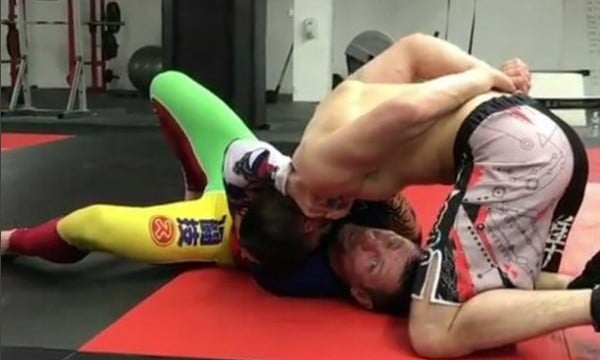
Marcelotine vs. GuillotineFor a Marcelotine, Garcia usually chooses the butterfly guard as his starting position. Marcelo likes to use head and arm control in order to get into position. He likes to pull himself up, trapping the head with a chin strap grip. So far, there’s nothing, unlike your usual guillotine setup. Once he has the chin strap, he goes for a ball in socket grip. This allows the bony part of his wrist, below the thumb, to apply immense pressure on the neck later on.

Which brings us to the fun part. Once everything is in place, it is time for the special finish. A regular guillotine would have you keep both your elbows back and crunch to the side. The Marcelotine, on the contrary, requires your”socket” arm (the one not around the neck) to go in a specific position. Once you have the grip in tightly, the goal is to get the elbow of the free arm and prop it up against the opponent’s shoulder. The closer you can get your elbow to their head the better. This will give you both the option to control with ease, and finish without any strength needed. The specific position of the elbow is why this move is also known as a high elbow guillotine.

Marcelotine Diversity

Marcelotine Guillotine GrapplingThe real value of the Marcelotine is not just in it’s choking prowess. Of course, that, paired with the crazy amount of control is a huge benefit. But what also makes this move perfect is the fact that it works just as well with the GI. Keeping your arm on the outside means you won’t get entangled in the Gi like with the arm-in guillotine. Also, the position of your elbow means your opponent can’t tug on your Gi to relieve the pressure. The perfect choke for any occasion.

As already covered, the Marcelotine is perfect for a bottom attack. Butterfly guard closed guard, half guard and a plethora of others all offer Marcelotine entries. Furthermore, even dealing with repeated passing attempts can be alleviated by getting the grips in.

Marcelotine BJJTransitioning is also very easy with a Marcelotine in place. If you want the top position, or something is not quite there for a finish, you can always sweep. the control you have over the head as a result of the frame with your arms means all you need is to tilt and you’ll end up on top.  And, the best thing is, that you’ll still have a fully locked choke to go for.

The Marcelotine is actually really easy to get and finish from the top as well. You can get it whenever an opponent sits in guard in front of you. You can also hunt for it from top half guard side control or mount. OF course, there’s the turtle and getting to the choke via the front headlock. You could start looking for it even while you’re on your feet.

The marcelotine Marcelo Garcia
Techniques List, Free Videos & More Info

The Highest Percentage No-Gi Chokes

High Elbow Guillotine Details From The Danaher Death Squad

The Story of Marcelo Garcia, the GOAT of Jiu-Jitsu

The Secret Of The No-Gi Baseball Choke

No-Gi baseball Choke Secrets

Don’t you just love it when people come up with creative ways to modify BJJ techniques? Especially when it is a move that everyone thought specific to Gi Jiu-Jitsu. There are a few examples of moves like this out there, but none is more legit than the baseball bat choke. When this brutal Gi choke made the jump to No-Gi people got really excited! However, something didn’t see to click for many, I included. There’s something very unnatural about the way you place your arms for the No-Gi baseball choke. It turns out the solutions is really easy, you just need to know where to look. Oh, and it works from both the bottom and top positions, just like its Gi counterpart!

Baseball Choke is So Powerful

One of the fastest-acting chokes in all grappling martial arts is the baseball bat choke. This lapel choke has probably put more people to sleep than any other BJJ choke. Well, apart from the Rear Naked Choke, perhaps. The beauty of the choke lies in its simplicity and its speed. getting the baseball bat choke up is not difficult, making it perfect for students of all levels. It also has the power to put people to sleep in an instant, especially from the bottom position. The only trouble with it was that you can’t do it in No-Gi. Well, you can. The No-Gi baseball choke is a legitimate and truly effective technique, not unlike the Gi version.

The way that I first learned about the baseball choke was as a counter to guard passes. I don’t even remember who showed it to me first, but it worked on everyone! At one point I’d just let people pass, in order to get the strangle. And, there was a good number of folks that ended in dreamland because of it. That’s how fast it works. the trouble was, I started over-relying on it, making my guard game in No-Gi worse than horrible. So, I made the mistake of abandoning the choke all together in favor of more “universal” techniques. A few years down the road, the No-Gi baseball choke became a thing, renewing my interest in an old submission.

Magid Hage Baseball ChokeThe creator of the baseball choke, Magid Hage has a very detailed DVD instructional on the subject. His talk of the baseball bat choke is with the Gi, but the details demonstrated in the Baseball Choke” DVD set are nothing short of astonishing! 

Solving The No-Gi Baseball Choke Grip

The baseball bat choke is an old choke, most likely with Judo origins. It works by allowing you to jam both forearms into the opponent’s neck. In an ideal scenario, it works by hitting both carotid arteries at once, leaving very little time for a tap. The reason you can do this is that you’re not squeezing, but using your whole body weight to tighten the choke. And this is all possible because of the grip you have on their lapel.

For the Gi baseball choke, you want one arm with four fingers in and the thumb out. it should go deep into the opponent’s collar on the far side of their neck. The other arm goes on the opposite side, with the thumb in. Ideally, both palms should touch at the back of the opponent’s head. This method of positioning the arms allows your elbows to go past each other, completely taking away all the space between them. Since the neck is trapped, the choke works instantly with brutal consequences.

No-Gi Baseball Choke SetupYou can see why people had difficulties with the No-Gi baseball choke at first. replicating the Gi grip in an effective manner seemed impossible for most. Along came a grappler by the name of Scott Sievewright. Scott found a way to modify the grip sot at it allows you the same tightness and range of motion in No-Gi.  First of all, forget about using palm-to-palm, finger-in, butterfly and other grips. All you need is an S-Grip and a shallow one at that. The trick is sneaking your choking arm under the palm of the other arm. From there, the key detail is the spin. This creates the angle you need to get your elbows past each other.

No-Gi baseball Choke Setups

With the Gi, the baseball choke works form bot the top and bottom positions. From the top, the knee slice position is the usual setting point. ti allows you to pass directly into a submission, and gets you to north-south, meaning even if you miss, you still have a great position and points for the pass. From the bottom. people usually get it from the half guard/ze-guard/knee shield. However, in order to make it work, you have to allow your opponent to pass to side control.

Top Position Setup

The No-Gi baseball choke is actually really easy to get from top Side Control. All you need is to make sure you get the grip, without your opponent knowing. If you enter a grip fighting battle, they’ll probably do all they can to stop you from getting it. So be sneaky about it. Since you already have an arm under their head, you’re not too far from the ideal grip. Use your other hand to establish the grip and immediately put your forearm over their neck. Aim to put both elbows as close as possible.

No-Gi Baseball Choke From Top The finish is actually much easier and works right there from the spot. There’s no need to go to north-south like with the Gi version. Once you have the forearm across, you’ll need to switch your hips to increase pressure and stabilize your position. For this, your hips need to be in a Kesa Gatame-like position, facing the opponent’s head. The tap (or nap) will come when you lie back, pulling their head towards their chest.

Baseball Chokes From The Bottom 

The bottom setup is actually not much unlike the Gi one. Starting from teh knee shield half guard, the first step is getting the grip. When you put the grips on, your opponent is not going to do much about it in most cases. There are not many people that’ll expect you to use an efficient choke from this position. Once you get the grip, do not be too obvious when letting your opponent pass the guard.

No-Gi Baseball Choke From Bottom Once they’re past your legs though, you need to make sure yo do two things. The first is to crunch up, so your head goes as close to theirs as possible. This will prevent them from using a forearm frame to create space. Next up is the turn. Make sure you turn away from your opponent in order to exert maximal pressure on the neck. In the rare case that they skip over in a desperate attempt to survive, simply follow them and finish with the No-Gi baseball choke from the top.

A Collection Of The Best No-Gi BJJ DVD Instructionals

A Tale Of Two Forgotten Jiu-Jitsu Chokes

No-Gi Ezekiel Choke From Top And Bottom

The Only Jiu-Jitsu Kettlebell Exercise That You Need!

Windmill Jiu-Jitsu Kettlebell Exercise

One of the best tools to use to get in shape for martial arts is by far the kettlebell. Or a couple or even a bunch of them, for that matter. They are the top utility for strength and conditioning for grapplers and are used worldwide. With kettlebells, things seem easy. The only thing you need now is a program and some exercises. That’s where most people hit a snag. As kettlebells gained popularity in the fitness world, training with them become more complicated. there are a bunch of pointless exercises out there now, some of them making the way into grappling conditioning as well. Since simplicity is key for grapplers, there are some exercises that fit the bill better than most (or all) others. And even among them, there’s one Jiu-Jitsu Kettlebell exercise that is an absolute winner when it comes to creating better grapplers.

Kettlebells Training and Brazilian Jiu-Jitsu

Training Brazilian Jiu-Jitsu is a very time-consuming activity. While you’re probably aware of the time it takes to train, you might not be factoring in commuting time. There’s also washing your equipment, packing for class and even meal prep. Plus, the one thing you’re surely not factoring in is the time you spend looking at DVDs or YouTube videos related to BJJ. Given that most people out there do have a few other things to do, like jobs, family etc, this leaves really little time for additional training. Especially strength and conditioning training, in a more “traditional” sense. This again demands preparation, commuting, training at a facility, monthly fees etc. A good way out of this is turning to kettlebells for conditioning training. An even better way is knowing what the one Jiu-Jitsu Kettlebell exercise that you truly need is.

I am probably going to take you by surprise with the exercise I’m about to focus on. It is not the Turkish get up, nor the kettlebell swing. Despite the popularity and effectiveness of both, there’s something much more important for grapplers. It is core training, one done in a way that really taxes the core in unusual positions. Because, as you know, these “unusual” positions are actually very usual for grapplers. While the Turkish get-ups are definitely a good choice, there’s a surprise contender that offers even more benefits. People rarely see kettlebell windmills as a strength building exercise. And it is even rarer to regard it as a Jiu-Jitsu Kettlebell exercise that is actually beneficial.

Understanding Core Training

When people think of the core, the usually only think about the abdominal muscles. In some cases, they also include the muscles of the small of the back too. However, the core is much more than just a group of muscles that are in direct touch with each other. The core encompasses a big part of our musculature. Moreover, all of these muscle groups have the task of working together in an optimal fashion. This is not easy at all, especially considering the modern lifestyle.

Best Jiu-Jitsu Kettlebell Exercise The core is actually made up of all the muscles we already mentioned. The abdominals and lumbar muscles to make a large chunk of the core. Other key components are the muscles of the upper back and the shoulders on one end. On the other end, it is the hip flexors, upper thighs, and hamstrings. As you can see, the core requires most of your torso musculature to put in some work. No wonder our top pick Jiu-Jitsu kettlebell exercise is one that targets the whole core.

The thing with training the core is that it helps you train most of your body all at once. This is a very important ability for Jiu-Jitsu. BJJ requires a very high level of coordination and the ability to adapt to sudden changes of direction. As such, training the core to be able to move in a full range of motion in each possible direction is crucial for grapplers. Doing that requires either a very complicated program or just one carefully picked kettlebell exercise.

The Ultimate Jiu-Jitsu Kettlebell Exercise – Windmills

The windmill is an exercise that you can do with one or two kettlebells. To begin with, remember two simple rules. The first I to start light, very light if you’ve never done it before. Second, do not work with two kettlebells unless you’re really advanced in kettlebell training.

The reason that the windmill is one (if not the) best Jiu-Jitsu kettlebell exercise is diversity. You can train pretty much your whole body with just one exercise. Plus, you get a lot of different physical benefits from it. You’ll get stronger without a doubt since you’re using an external resistance that you can increase at all times. Combining both gives you the ability to be strong at the ends of your range of motion. This is as key to BJJ as much as correctly executing techniques.

What you get from windmills is direct dynamic work of your oblique and side abdominals. During this, the front abdominal and the muscles on your back work hard to stabilize. Since the weight remains over your head, you also get a lot of shoulder mobility and stability work. And, your hip flexors and hamstrings, in particular, get to work a lot both concentrically and eccentrically. From a conditioning perspective, try going for time with just one kettlebell and tell us how you feel after 20 minutes non-stop. It is the one Jiu-Jitsu kettlebell exercise to rule them all!

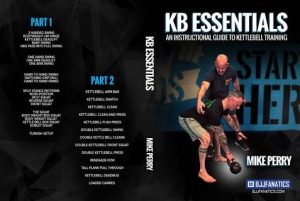
Mike Perry is an expert when it comes to training with kettlebells. Since he is also a solid grappler, he’d be my choice for a strength and conditioning trainer. Since I can’t get to him, I use his “KB Essentials Instructional Guide” DVD set to great success. Now you can too because this resource is available, cheap and full of information that lasts a lifetime!

Executing The Windmill

Let’s take a look at some of the technical aspects of executing a windmill. If you truly want to master kettlebells, look for a trainer. Or, pick up a good instructional DVD, like MIke Perry’s. This will ensure you’re safe from injury while training.

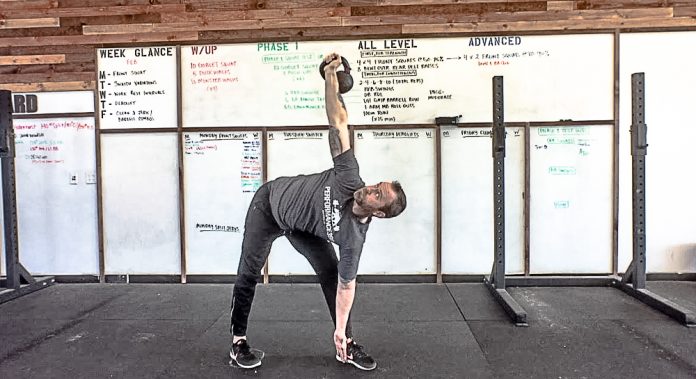
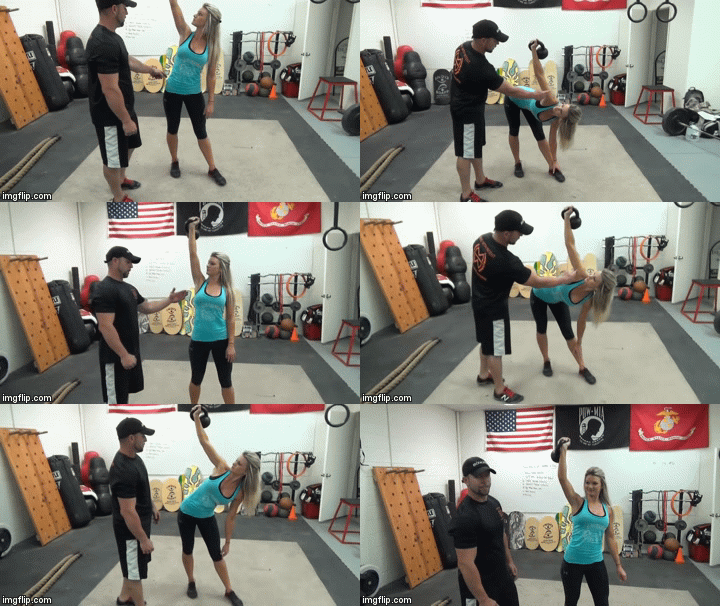
 Jiu-Jitsu Kettlebell Exercise WindmillsThe starting position of the windmill is with a kettlebell held over your head with one arm. Stat with a stance that is a little wider than shoulder width. From there, the aim is to bend sideways, aiming to touch the ground with your free hand. While you do that, you need to make sure you keep the kettlebell over your head at all times.

The key thing to remember about windmills is that you need to keep your joints straight. Keep your kettlebell arm straight at the elbow. This is the most important thing. Also, keep your spine and another arm straight, along with both your knees. Basically, you should be bending at the hip joint only along with rotating the shoulders. And, keep your eyes on the kettlebell at all times too. Once you go all the way down, get back up towards the starting position.

Once you master this particular Jiu-Jitsu kettlebell exercise, you can look to add in on ore two more to get an even tougher workout. The two I mentioned before, Turkish get-ups and swings are great choices.

How To Develop Crushing Grip Strength For BJJ

Can Ginastica Natural Help Your BJJ Conditioning

BJJ Mobility Drills For Flexible Hips

Why You Need Fish Oil Supplements For Jiu-Jitsu

Fish Oil Supplements For Jiu-Jitsu

Healthy joints, better recovery, fewer injuries, more cardio, more strength, bigger muscles, losing fat… All of these qualities are on the priority list of grapplers worldwide. They depend on a host of factors and are mainly down to the individual. In terms of achieving them, most people try to look for a shortcut. Who wants to spend 16 grueling weeks losing fat the old fashioned way? Instead, it is much easier to swallow a pull or dilute some powdered supplement and you’re all set. The only trouble is, you’ll probably spend more money achieving less than what you would otherwise. Well, in some cases, at least. While supplements do have their drawback and advantages, like everything else, some of them are actually really good for grapplers. Sadly, there are still no supplements for Jiu-Jitsu that’ll turn you into Gordon Ryan after a few weeks. There are some, though, that’ll give you a chance to become a world-class grappler because they help keep you on the mats. One example is fish oil.

Supplementing With Fish Oil

Supplementing with fish oil is nothing new. Every time you end up with a supplement that’s just an improved form of something used traditionally, you can be certain you have something that works. Back in the day, people used to gulp tablespoonsful of fish oil. I remember that experiences from when I was a kid, along with the gag reflex they caused. Today, thankfully, things are much simpler. Chugging down a few fish oil capsules is much more bearable. If you get high-quality ones, even your subsequent burps won’t have that old fish oil aftertaste. But why fish oil? Out of all the supplements for Jiu-Jitsu, it might seem like fish oil is a trivial thing to take. Well, perhaps you should reconsider.

As you’ll see further down this article, fish oil is anything but just another oil. it is so rich with nutrients that it could single-handedly make you a better athlete. The trouble is, most of the world’s population is deficient in some way. This means that even if you start taking fish oil regularly today, you’ll still need to catch up before you see certain benefits. that said, the moment you start taking this supplement, you’re going to feel positive changes. And, fro the battered grappler out there, fish oil should be the first one you buy when you’re putting together your supplements for Jiu-Jitsu.

Supplements That Work

During the course of this entire article, I’ll try and convince you why you need to include fish oil in your supplements for Jiu-Jitsu. However, before we go into fish oil, let’s briefly take a look at some other supplements that actually work.

Fish Oil Supplements For Jiu-JitsuMultivitamins should be the second thing you get (right after fish oil) if you’re serious about training. Actually, if you just want to be healthy, you’ll need to take them on a daily basis. There are too many different brands of multivitamins out there to choose from. Similarly to fish oil, most people are deficient in one or more, and overdosing isn’t really a thing for concern. So take the prescribed those early and enjoy a healthier life.
Next up for grapplers must be creatine. It is the one performance oriented supplement that does what it says. Creatine is going to increase your ability to work at a higher rate, for longer. This doesn’t mean you’ll have an endless gas tank, but you’ll be able to find the energy for that last push much more often. It also hast eh ability to increase muscle size, if that’s what you’re after. Be wary of only one thing though. Creatine binds water, so if you’re cutting weight for a competition, lay off it for a couple of weeks. It is the safest, effective supplement for Jiu-Jitsu out there, and a surprisingly cheap one at that!

Whey protein is more of a meal replacement than supplement nowadays. Still, it works perfectly and should also be an integral part of your supplement stack.

What’s The Deal With Fish Oil

Back to fish oil, then. Fish oil is mainly made up of two very important fatty acids. EPA and DHA are the main components in fish oil. The one thing you should know about them si ratio. When you’re choosing your fish oil supplement, make sure it has a 1.5:1 EPA: DHA ratio. Apart from Omega 3 fatty acids, fish oil also contains high levels of Omega 6 and 9 fatty acids. All these are essential for our bodies, and we have a distinct lack due to modern lifestyle.

Omega 3 fatty acids, in particular, cannot be produced by our own bodies. This means we must rely on food to get our daily dose of them. However, apart from leaving in Japan or perhaps the Mediterranean, this is a very hard and/or expensive thing to accomplish. This is exactly why fish oil supplements exist.

Fish oil has noticeable anti-inflammatory effects, boosts brain function, helps the immune system, provides energy and can lead to fat loss and even muscle gain. not this is not the same mumbo jumbo as you hear for all other supplements in the store. All this is actually backed by scientific research. It also won’t make you the Hulk in just 3 months but will have a gradual and continuous positive effect on your training. Supplements for Jiu-Jitsu must include fish oil, one with as high a dose of EPA and DHA as possible, along with the correct ratio.

George Lockhart Nutrition And Weight Management SystemGeorge Lockhart devotes a lot of attention to fish oil in his “Nutrition And Weight Management System” bundle. He has a whole DVD dedicated to supplements, as well as a large part of the accompanying e-book. Check it out for yourself and learn even more about the power of fish oil!

Fish Oil Supplements For Jiu-Jitsu

Let’s dwell a bit more on the positive effects of fish oil supplements for Jiu-Jitsu athletes. After all, we need specific benefits in terms of grappling, not just some general mumbo-jumbo.

The key benefit for athletes is the ability of fish oil to decrease muscle soreness. The way it works is by reducing inflammation. After rolling, all involved muscles (meaning all muscles) have a certain degree of inflammation. Fish oil helps reduce it massively and quickly, allowing your muscles much faster recovery.

Fish Oil Supplements For Jiu-JitsuThere’s also ample research out there that indicates how supplementing with fish oil can improve body composition. Fish oil affects the resting metabolic rate, fat oxidation, and cortisol excretion. They also have a boosting effect on muscle protein synthesis by improving the muscles’ anabolic response.
Fish oil is also a powerful tool in the prevention of a bunch of chronic and serious diseases. It improves heart function, lowering LDL cholesterol and triglycerides, as well as blood pressure. There’s also a notable anti-inflammatory effect on the blood vessels. Furthermore, fish oil provides a boost to the brain, especially memory.

In terms of dosage and taking, things are simple. Take 3 grams of fish oil daily, and always consume it around meal time, as it is best to take fish oil supplements along with food. The number of capsules you take per day will vary depending on the type of supplement you choose. You could also position them throughout the day instead of taking it all at once.

The Only Supplement You Need – Creatine For BJJ

Are Pre-Workout BJJ Supplements A Good Idea?

The 5 Best BJJ Supplements For High Level Performance

No-Gi Ezekiel Choke From Top And Bottom

No-Gi Ezekiel Choke

During the last couple of years, I really fell in love with No-Gi Jiu-Jitsu. Before that, I was doing mainly Gi BJJ, training and competing under IBJJF rules only. Then, as leg locks and front headlock chokes became a large part of my game, No-Gi started to emerge as a more interesting option.

Since I’m a part of an academy that’s still based on Gi Jiu-Jitsu, I decided to try and bridge the gap. To that extent, my strategy was (and still is) to work with No-Gi grips only, even when rolling with the Gi. It is much harder but much more fun that way! Also, I started looking into submissions that work as well in both worlds. Some were already there, and some, I had to research in order to adapt some Gi moves I really like to No-Gi. One such example is the Ezekiel Choke, or, better said, the No-Gi Ezekiel choke.

How No-Gi Ezekiel Choke Came to a Spotlight

It took me a while to get the hang of the No-Gi Ezekiel Choke, I must confess. As a Gi move, I had great success with it, so I simply had to take it over to No-Gi. It is such a reliable choice to have in your arsenal that it would be a shame if it was only confined to Gi. Luckily, there were a few options out there that guided me towards success with the No-Gi Ezekiel Choke. Now, it is a huge part of my game, fitting perfectly with back takes and front headlock chokes. Plus, it works from a few different positions, making it even more useful than the Gi version.

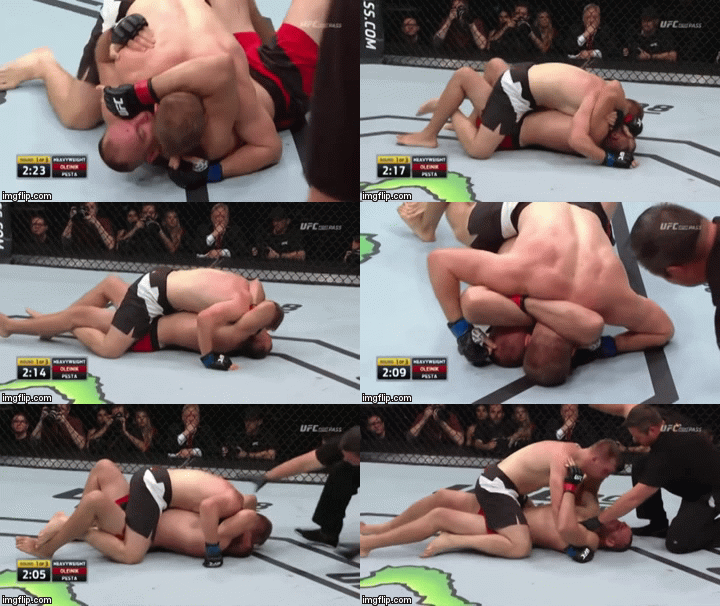
Lately, the No-Gi Ezekiel Choke came into the spotlight thanks to the efforts of a certain UFC fighter. Alex Oleynik managed to pull off a few successive Ezekiel Chokes inside the octagon. The impressive thing about it was not only the fact that he did it No-Gi, but that he caught it from the bottom. Yes from the bottom and from a bad position. Alex is a master at sinking in Ezekiel Chokes when he is mounted, something not many people can boast about. This just further demonstrates how versatile and useful the Ezekiel Choke can be, even without a Gi.

Lachlan Giles DVD ReviewThe Ezekiel Choke, both Gi and No-Gi is a submission with a high finishing rate. Pairing it with a few other is just going to increase your effectiveness with it. “High Percentage Chokes: No-Gi” is the DVD instructional you should reach for. Lachlan Giles is the man to turn to for the best instructional advice for choking people out.
The Ezekiel Choke

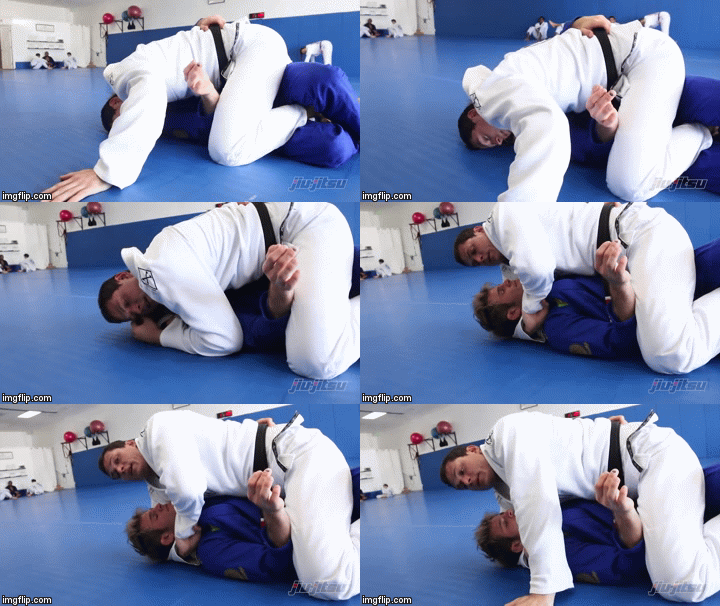
The basics of the Ezekiel choke (Gi version) are easy. The Ezekiel works primarily as an air choke, not dissimilar to an old-school Guillotine choke. For an Ezekiel choke with the Gi you need to be in a top position, either in half guard or mount.

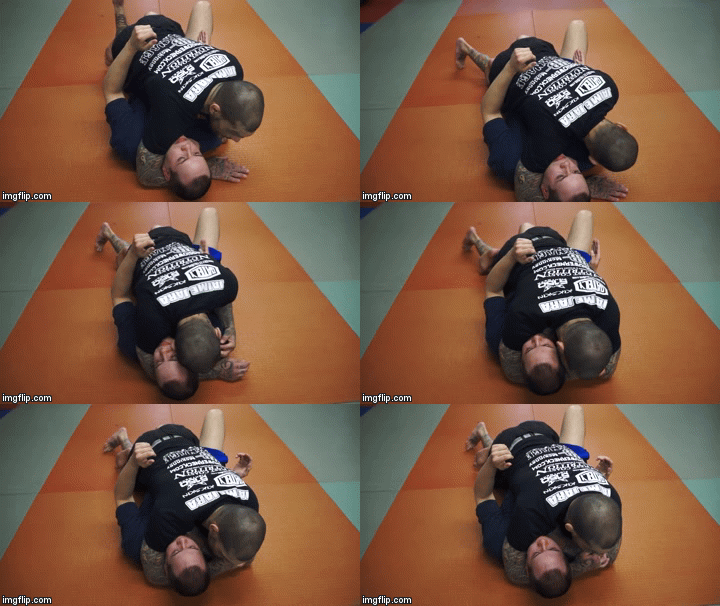
No-Gi Ezekiel ChokeThe choke begins with you placing an arm around the opponent’s head. YOU’ll want the arm to be as deep as possible so that you can control the choking lever better. The choking arm is your other arm. Form the mount, for example, you want to first insert four fingers of your arm around their head, into the Gi sleeve of your other arm. From there on, you want to thread the forearm of that arm across the opponent’s neck. The choking pressure is from the bottom arm pulling on the sleeve, the turning of the palm on the top arm, the turn is towards the opponent’s throat, closing up the trachea and putting immense pressure on it.

The main advantages of the Ezekiel choke are that it is really easy to set up. It is sneaky and you work to form a position people do not directly associate with submissions. The arm under the head is a mainstay when playing the top position, whether it is mount or half guard. Another key element is that the mechanics are fairly simple, once you get the hang of it. The choke is a good fit for students of all levels and works at every level as well.

No-Gi Ezekiel Choke From Top

From the top position setting up the Ezekiel, the choke is easy. In No-Gi, you’ll still use the basic setup, with one arm around the head. However, gripping is different, which is where most people fail with this. having longer limbs is going to help immensely in finishing the No-Gi Ezekiel Choke.

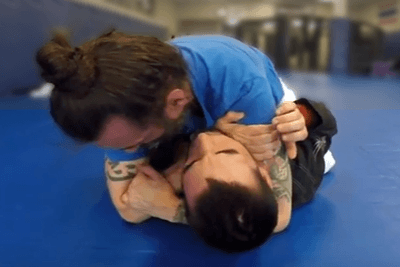
No-Gi Ezekiel Choke Half GuardFrom the top half guard position, You want to have a deep cross- face on the opponent. From there you’ll be looking to control the far side arm so that it doesn’t interfere. Once you have a clear path towards the neck, make a fist with your free arm. Then, place it across the opponent’s throat. Only after you place it there, use the bottom arm to establish a grip on the top arm. Depending on arm length, this grip will end somewhere between your elbow and the middle of your forearm. All you need to finish is stick your head close and lift the elbow of the choking arm while pulling with the other one.

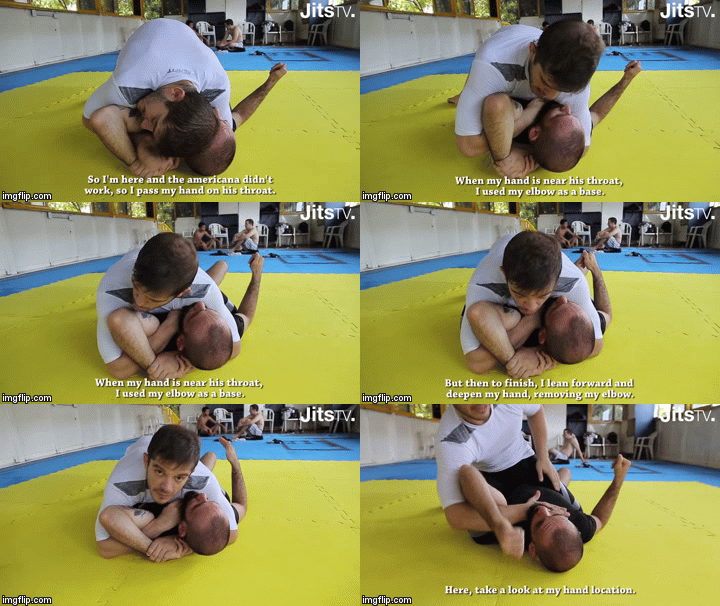
No-Gi Ezekiel ChokeFrom the mount, a great way to set up the No-Gi Ezekiel Choke is via an Americana. At the highest levels of the sport, you’ll need modifications to the Americana in order to get a tap. Or, even better, a pathway to another reliable submission. The starting position is an Americana grip from the mount, but with the head included in the grip. The goal is to release the top arm of figure four and thread it across the opponent’s neck. Now, you’ll have their arm looped around your choking arm. Actually, their arm plays the role of the Gi in this situation. Kee both elbows on the ground for a solid base and push forward with your torso. You’ll get incredible pressure and a really fast tap. Plus, there’s no need for long arms.

Sneaky No-Gi Ezekiel Choke From Bottom Mount

Before seeing Alex Oleinik doing this in the UFC I never even thought of submitting someone forms the bottom of the mount position. Now, it is a huge part of my game, despite having to work out a few kinks. Give it a try and you might end up working them out on your own. if so, let us know in the comments!

No-Gi Ezekiel Choke From BottomThe basic idea of the No-GI Ezekiel choke from the bottom mount is staying safe. In the UFC, Alex made sure he’s safe by wrapping an arm around the head of his opponent and keeping him close. he reinforces this arm with a Rear Naked choke grip, protecting the side of his head from punches. Once he sees an opening, he sneaks the arm in, and, since he already has the Rear-Naked choke configuration, the choke is instant and imminent. In Alex’s case, having MMA gloves actually helped him finish. In a purely BJJ setting, you’ll need to work out how much to twist your arm and in what direction, but it is not too hard to do.

This is a really cool choke that can surprise your opponents from the bottom. Even when they know it’s coming, they’ll either tap or completely abandon everything, giving you a way out of mount at the very least.

A Collection Of The Best No-Gi BJJ DVD Instructionals

The Best Guillotine Choke Escape Options And Counters

https://bjj-world.com/killer-ezekiel-choke-details/