


Stuck With Your BJJ Game? Here’s A Way Out!

BJJ Game Plateau Solutions

Developing a BJJ game is not an easy thing to do. First and foremost, you need to know at least some jiu-jitsu in order to create a successful game. So, dear white belt, with all due respect, come back to this article when you feel the need for it. All you blue belts and beyond, especially competitors, these hints will help you deal with plateaus much quicker than any other approach. Furthermore, you’ll be spared all the frustration that usually accompanies a period of no progress in your game.

Hitting a plateau in Brazilian Jiu-Jitsu is something everyone is going to go through. I don’t care how talented you are, at some point you’ll experience a standstill in your BJJ game. It is going to scare you the first time, and you’re going to be a bit more comfortable the next. However, you’ll need to go through a bunch of those at every level before you figure out how to solve them. And even then, you might just end up giving them time to go away. While this works, there are also a few more effective strategies.

Hitting a rut with your BJJ game means that all the things you’re good at doing stop working. It usually comes slowly, with a few frustrations here and there with one of your favorite moves. then, it seems to spread to all your other go-to techniques. Despite doing them countless times before, even on the same training partners, now, nothing seems to work. Yeah, your partners are improving, but you’ve also been regular in the gym as well. Doesn’t that mean that you’re improving as well? It is a normal way to think about this situation, as is the frustration that comes along with it. But what, if anything, can you do?

Usual Sticking Points In Your BJJ Game 

Everyone’s body and mind are different, meaning everyone’s BJJ game is going to be uniquely tailored to their own needs and capabilities. This is actually part of what makes the gentle Art so fun! The same move works very differently for different people. this is exactly why people tend to favor certain moves while dismissing others.
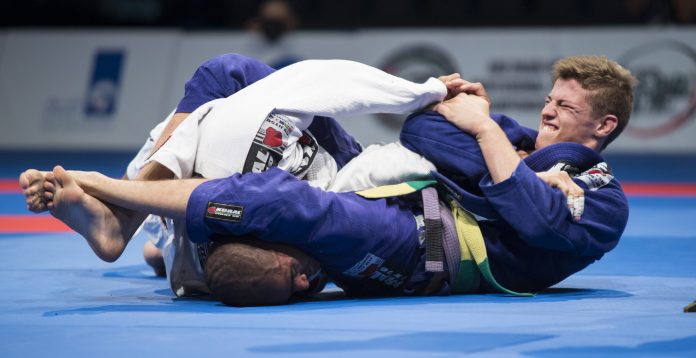
BJJ Game PlateauAs you progress through Jiu-Jitsu, one favorite move turns into two, then three, etc. The more complex your BJJ game becomes, the more sticking points it is going to have. First and foremost your submissions are going to stop working. it is not going to be in a blitz, but rather over time. People are going to find ways out or prevent you top choice moves even though you’re doing nothing wrong.

Next up are positions. Losing submissions means you’re going to be focused on either getting another one or more likely, coming back fro a second try of the first one. All this is going to result in tunnel vision, leading to you making lots of little mistakes in your positioning. the result is going to be even more frustrating because now you can’t even get to a position for the sub.

Switch Focus

So, what exactly are your options here? First and foremost, you need to understand the reason behind it all. The simple explanation is that you get so comfortable with your moves, that you start missing out on tiny, yet important details. When your opponent’s find that all-important wiggle space, you then replace technique with strength in order to maintain or finish your move. This is never a good idea in grappling, and your BJJ game is going to hit a wall.

One key strategy is switching focus. How do you do that? Well, the basics are easy. If you are a submission hunter than start looking for positions. If you’re a point grappler who thrives in certain positions, look to abandon them and go fro for a finish.

Going deeper, you might even look to wap moves with other moves. For example, give leg locks a rest and revisit chokes or arm locks. Focus on them for a while before returning to your favorite submission. Or, stop hunting for back control every time you slap and bump. Instead, start working on your mount or half guard game for a while. Even if you see back control while rolling, give it a pass and go for something else. It is a great way to refresh your BJJ game.

Flow During Live Rolling

This is a bit of an advanced strategy, better suited for experienced purple belts and above. Flow rolling is not an easy skill to master, which is why it is usually done slowly. Flow rolling ahs the very specific task of making you so comfortable, that you start to understand how Jiu-jitsu actually works.
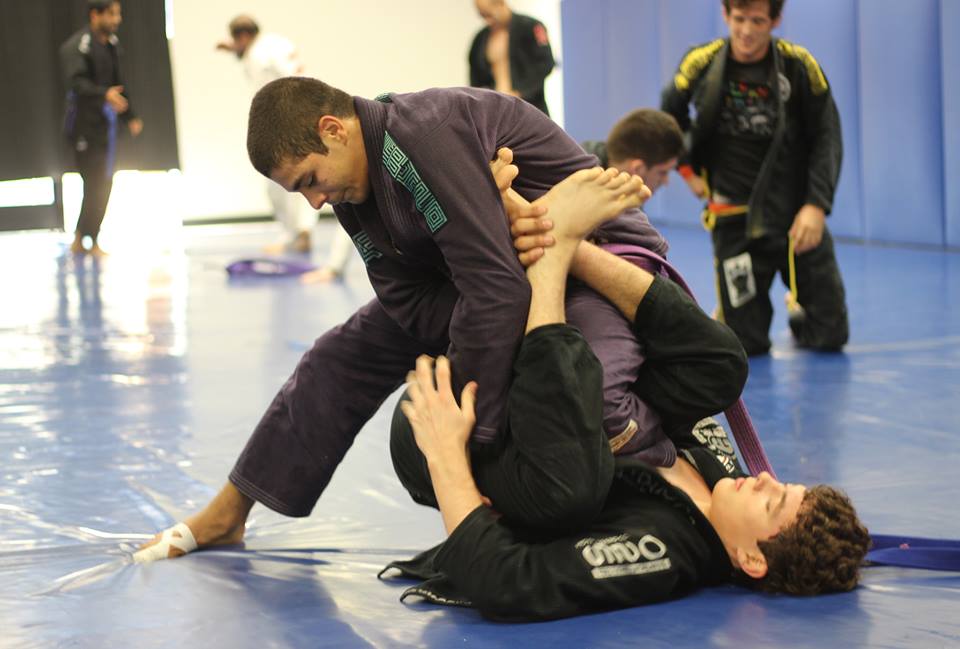
BJJ Game Plateau SolutionsIt takes time, experience and an equally or more experienced partner in order to successfully flow roll. However, you can take the mentality of a flow roll land to apply it to your live rolls when your BJJ game is stuck in rut. Simply abandon all goals during a roll land start flowing. it won’t be nearly as easy as when you’re doing it slowly, but it is going to provide much-needed rest for your body and mind.

Flowing without a particular purpose and exploiting everything in sight is going to do wonders for your BJJ game. It is going to allow you to take a break from your favorite moves and explore new directions. Even better, when you return to your game after a while, new opportunities are going to start popping out.

Take A Break

The final piece of the puzzle is the worst one. It is actually the one that makes the most sense but no grappler alive is going to consider it as their first option. Namely, if you’re really stuck and none of the above options work, you should simply take a rest. Either go somewhere or simply stop coming to the gym for a couple of weeks.

However, you can’t just stop coming. Leave all the YouTube BJJ videos, DVD instructions, and your UFC Fight Pass account as well. Remove BJJ  from your life on a temporary, two-three week basis. It is going to get your BJJ game back on track better than anything. It is just very hard to do.
Neil Melanson DVD Catch Wrestling Formula
Techniques List

Why not give catch wrestling a try to freshen up your game? Neil Melanson has the perfect DVD set to get you started. His ‘Catch Wrestling Formula” instructional is tailor-made to take your BJJ game to the next level. Check out what this release has to offer! 
REVIEW: Yuri Simoes DVD – High Efficiency No-Gi Top Game

Do You Train Jiu-Jitsu When You’re Sick? Stop Right Now!

Jiu-Jitsu For Beginners: The First Month Of Training

BJJ Guard Pass That Can Pass Any Guard – The Hip Switch

BJJ Guard Pass Hip Switch

With so many complex and diverse guards in Brazilian Jiu-Jitsu, passing is truly a nightmare. Even for proficient guard passers, getting past the opponent’s leg is never easy. ti can be fun, yeas, but it can also be highly annoying. All the diversity and innovation people put into guards means you need to find adjustments and/or new passes for each guard out there. If you only focused on that part of BJJ you wouldn’t be able to master it, in a lifetime, let alone work on anything else! The silver bullet solution would be a BJJ guard pass that you can successfully use against multiple (or all ) guards with a high rate of success. Sounds too good to be true. That’s because it is.

There is, however, a BJJ guard pass that can get you as close to this as possible. It is more of a key BJJ movement than technical guard pass per se, but it has the power to slice guards apart.

The concept of the perfect BJJ guard pass to kill all guards is an unattainable one in reality. With that option out of the way, you can either go and train a different pass for all different guards or find some reasonable common ground. A good way to do it is to look back at what connects all guards. Once you find a common starting point, you can address it from a passing perspective. Doing this against most open guards, as well as some closed guard variations, there’s one movement that seems to have a universal effect on all of them. It is the simple, yet crucial BJJ hip switch.

The “Art” of Hip Switching In Jiu-Jitsu 

Brazilian Jiu-Jitsu is a grappling martial art that places more focus on the hips than any other combat sport. All avenues of the hip movement have a huge role to play in Jiu-Jitsu. From flexibility to explosive power, the hips are the source of everything. Rarely any attack works without hip involvement, in one way or another. The same holds true for defensive work, where the hips are the main drive behind most escapes.

The movements which grapplers do with their hips are also very variable. Depending on the situation you could look to ship them away, open them up, rotate or switch them. This last one is a true staple of high-grade guard passing. Hardly any open guard BJJ pass is going to work without it as a starting point. But, what exactly makes this simple motion so potent?

The first thing you get when you switch your hips is a major change in weight distribution. The moment you start to shift your hips from one side to the other, your whole body weight is going to move in the same direction. This results in the creation of additional angles in a position where there aren’t any. These new angles mean less space for your opponent to work and more pressure for you. A guard passers dream combination.

next up is power. The hip switch is bot ha move anybody can easily do, and it is a very explosive move. Its power is only limited by the power of your hips, which is a highly trainable attribute. Explosion with your hips in a rotational manner means you can get past even the most flexible guard players. Furthermore, you gain a ton of stability in your final position, thanks to the hip switch.

The Hip Switch BJJ Guard Pass

As a BJJ guard pass, the hip switch is considered to be an advanced concept. The reason for this is that it won’t work unless you understand what we discussed above. Weight distribution, creating angles, the directionality of force and timing are essential. Unfortunately, there are all traits the take time to develop, so less experienced students need to take it easy and learn the basic guard passing sequences at first.

Against some open guard variations, like the butterfly or De La Riva guard, the hip switch is often the only way past. Form closed guard circuits it is a bit more difficult to use it, although not impossible. there are some really good passing options based on it, like the Tozi pass from closed guard, or several half guards passes.

Bernardo Faria Battle Tester Pressure Passing
Techniques List

Some people are simply better at passing the guard than others. One of them is Bernardo Faria, who has no trouble whatsoever passing anyone’s guard. His “Pressure Passing Encyclopedia” DVD has all passing essentials in it, including the hip switch. It is the perfect guide to get you through the door of advanced gaurd passing.


  • The Hip Switch BJJ Guard Pass Vs. Butterfly Guard

Passing the butterfly guard with the hip switch is probably the most useful use of this movement. The very nature of the butterfly guard means any BJJ guard pass is going to be difficult. Grapplers in butterfly guard have the ability to move in a 360-degree fashion as well as lift you up before they attack. It is precisely at that time, when your hips are off the floor, that you can utilize the hip switch.

BJJ Guard Pass Butterfly Guard The moment your opponent elevates you, they’re going to try to sweep you to one side. The direction of your hip switch should be in the opposite direction. You should do it explosively and as completely as possible, before rewinding the hips back for the pass. The hip switch against their outstretched leg allows you to completely nullify the force of the sweep. Even better, the motion gets rid of the leg between you, leaving no more obstacles to a pass.

If the opponent has you in the air with both butterfly hooks, even better for you. Now you can look to pass in both directions.

  • Passing The De La Riva Guard

Getting past the De La Riva guard when an opponent has good grips can be a real hassle. It is even worse when your opponent has crazy flexible hips that prevent all your passing attempts. The hip switch BJJ guard pass come to the rescue once again!

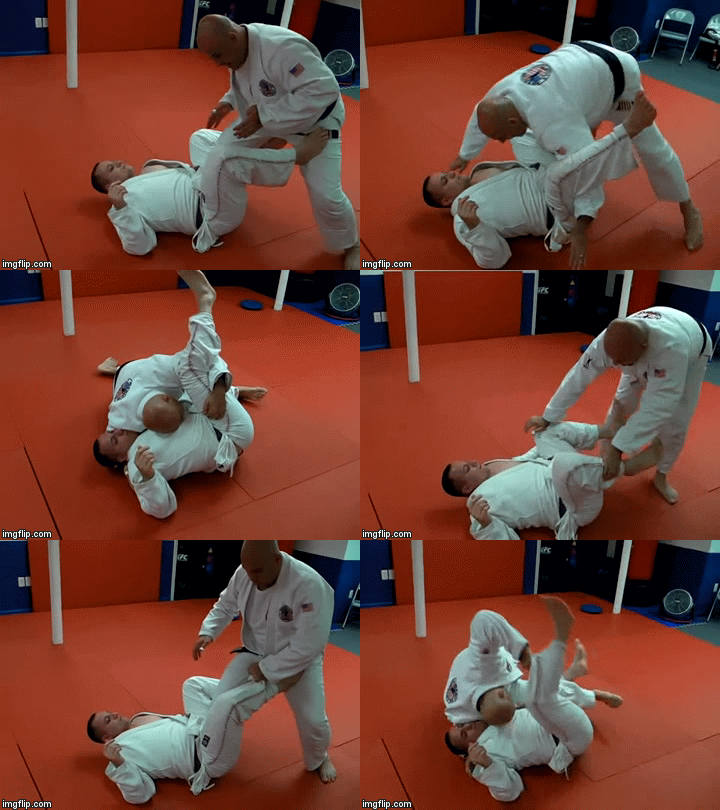
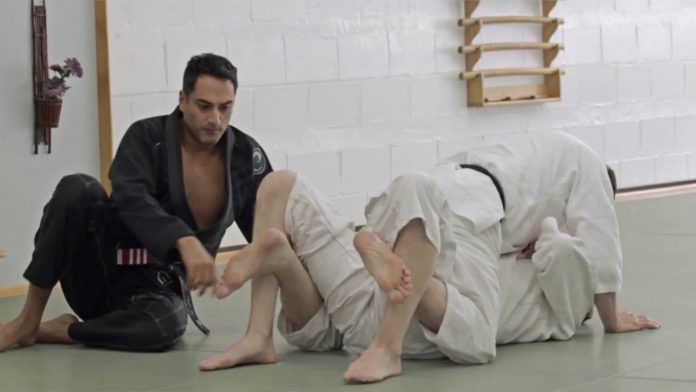
BJJ Guard Pass Hip SwitchForm the De La Riva, the direction of your hip switch is going to be towards the leg that has the De La Riva hook. However, you’ll need to also control the opposite leg if you want to be successful. In order to do that, an underhook against the free leg is going to do the trick. Once you have it, switch your hips while swinging your back leg in a big arch around the hooked leg. You’re going to end up in a reverse half guard, or, if you like it more, in the 4/11 leg locking position.

  • Hip Switch Against The Half Guard

Despite leaving it for last, this is where you need to start with your hip switch efforts. Messing it up from the half guard won’t cost you as much as doing so against open guards. So make sure that this is your starting point.

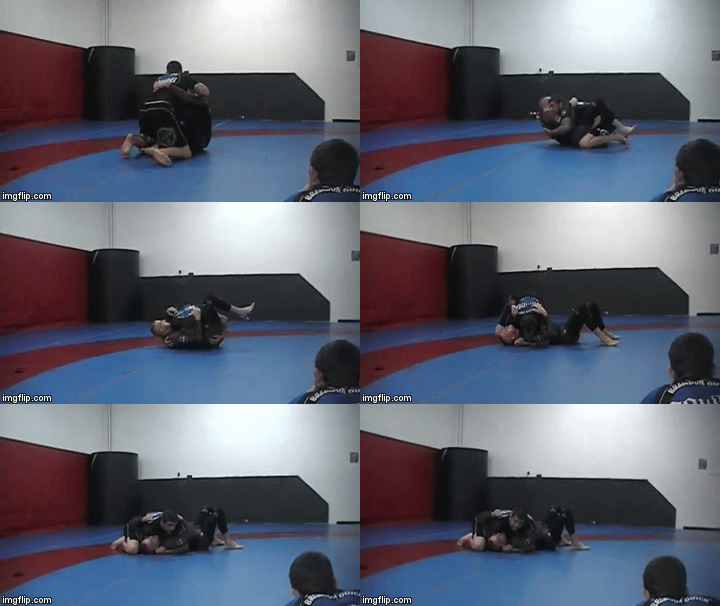
BJJ Guard Pass Half GuardThis is the easiest application of the hip switch for passing purposes. The reason you’re stuck in half guard is the fact the opponent has their legs locked, plus the knee shield to create space. In order to solve both, you simply need to switch your hips. this is going to get you past the knee shield and in a good position to establish a cross-face. Once you have that, wiggling your leg free is going to be easy.

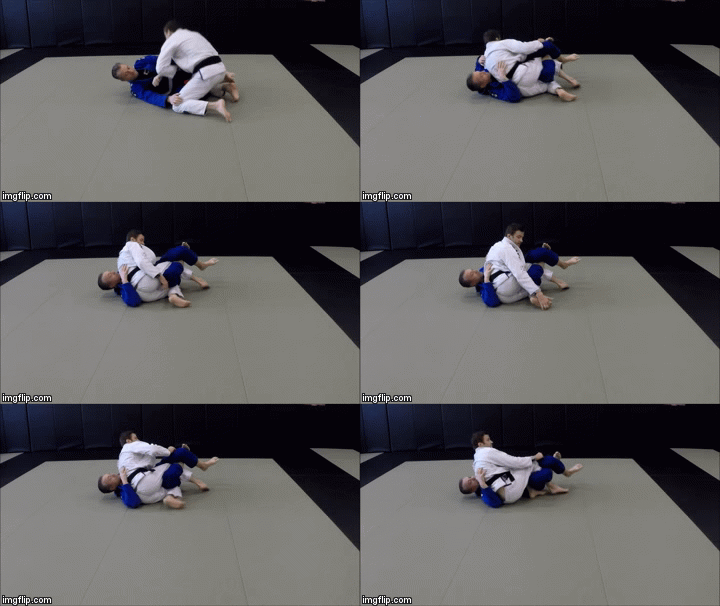
Or, if you like a more dynamic BJJ guard pass, you might opt to isolate the far side arm from the cross-face. From there on you switch the hips again, landing in the knee slice position with an underhook. Again you can pass or go for yet another hip switch, this time on the other side and land in reverse half/leg lock.

In Conclusion

The hip switch is not a complicated movement. In fact, some people do not perceive it as a technical move. The truth is that the hip switch is an advanced way of creating the best platform for any BJJ guard pass. Take a look at some of the world’s greatest guard passers. Do you notice how often and how explosively they switch their hips? The hips which not only helps with passing the guard but also with the retention of your newly acquired position. Although beginners might struggle with it, advanced students should aim to get this move down as soon as possible. It is the one move that opens the doors to a successful passing game. It is not a silver bullet but it is as close as a guard passing enthusiast can get.

If there is one BJJ guard pass you need to call your own, then you have to pick the hip switch pass. this simple motion can help you deal with just about any open guard variation, and a few closed ones as well. Make sure you do work on your hips, though, as explosiveness and flexibility can only further help your guard passing goals.

Review Of The Top 5 Guard Passing BJJ DVD Instructionals

REVIEW: Craig Jones DVD – The Z Guard Encyclopedia

Three Ways To Open Up The Closed Guard

The Leg Lasso Guard – A Masterclass On Playing And Passing

Jiu-Jitsu For Law Enforcement To Keep Our Officers Safe

Jiu-Jitsu For Law Enforcement

Martial arts are the backbone of people that are in the military or law enforcement. Or at least they should be. Sadly, nowadays, the image of the overweight police officer is much easier to connect to law enforcement that an in-shape grappler in uniform. While body weight has nothing to do with the ability to grapple, it does point to one’s character. Overall good health and good physical shape are absolutely mandatory for those that have chosen to protect and serve. Jiu-Jitsu for law enforcement is another must, arguably even more important than the former two. It has the ability to keep officers safe, allow them to control multiple different situations and even brings about health and fitness benefits. So why is this ultimate tool not thaught to the eery single person that puts the uniform on?

Jiu-Jitsu saved my life. This is a common statement we hear and read almost daily. However, very often this statement is taken well out of line. While I respect everyone’s story and how BJJ has positively influenced it, the phrase is not just a metaphorical one. In fact, for some people, it is as literal as it gets. There are countless examples of why Jiu-Jitsu for law enforcement should become something officers simply have to do on a regular basis. Multiple testimonies of people that have embraced the Gentle Art privately, show how useful it can be in difficult situations on the job. Brazilian Jiu-Jitsu can literally save lives and law enforcement members have the right to use the best tools at their disposal!

Grappling is considered by many to be the ultimate martial art. While there’s no such martial art out there, grappling martial arts certainly have an everyday application. As corny as it may sound, most fights really do end up on the ground. Take into account that the very reason BJJ was created was self-defense, and the case for grows even stronger. Furthermore, the art doesn’t have any particular strength requirements. It is also based on control, with various options of turning the intensity up or down. Grappling also gets people into shape while getting them ready to defend themselves and others. You can see why training Jiu-Jitsu for law enforcement members seems like a good idea. Let’s elaborate on that.

Jiu-Jitsu For Law Enforcement

Law enforcement officers are a community that gets exposed to physical and psychological stress on a daily basis. Throw in the air of uncertainty about what they’re walking into during each call and you have the definition of a difficult job. This is why law enforcement members receive (or should) very specific and efficient training. But is the training they go through enough?

Jiu-Jitsu For Law EnforcementBrazilian Jiu-Jitsu for law enforcement officers is one option to supplement regular training. It offers many different aspects of hand to hand combat, all of which are highly important for law enforcement. First and foremost, the formal training they receive is short and specific as it may be, definitely not enough (excluding elite units). Secondly, law enforcement officers are bound by law and rules when they enter violent altercations. The ability to methodically apply more intensity to their reactions is not available via non-grappling martial arts.
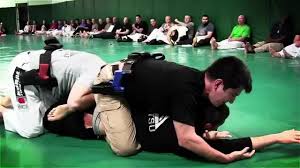
There is also the size/gender issue. While not taking anything away from women, or elderly people, size and strength really do make a difference. Going up against a 250 lbs grown man in an altered state of consciousness is a hard ask of anyone. Now imagine that a 120 lbs woman or an officer nearing retirement have to restrain such a person. Even worse, imagine the person is armed. It is a recipe for disaster and all those scenarios that officers go through in training rarely play off the same in real life.

Jiu-Jitsu for law enforcement brings a host of benefits that can make officers safer, calmer and better at executing their duties.

Control

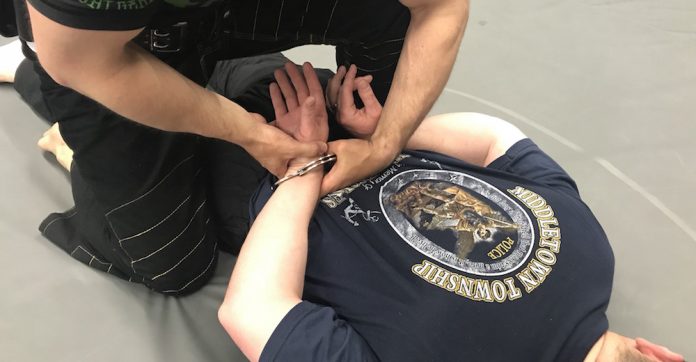
Obviously, a huge aspect of restraining someone is controlling. There are multiple videos out there that show how har controlling an unwilling person can be, even if an officer has a backup. Furthermore, there are people resisting arrest that do not merit the use of more power, like tasers or striking. This is where Jiu-Jitsu for law enforcement comes in. Subduing a suspect is not going to be easy, but it is going to be much faster and more efficient with a solid BJJ background.

Jiu-Jitsu For Law EnforcementAnother example of control is holding someone down until backup arrives. Obviously, the moment an altercation hits the ground, BJJ reigns supreme. If you know how to handle yourself on the ground, you’ll have no trouble keeping even a much larger person at bay. It may be until you get handcuffs on, or waiting for backup. It may even be in order to prevent them from accessing a weapon. Whatever the case, BJJ is the best tool you can use.
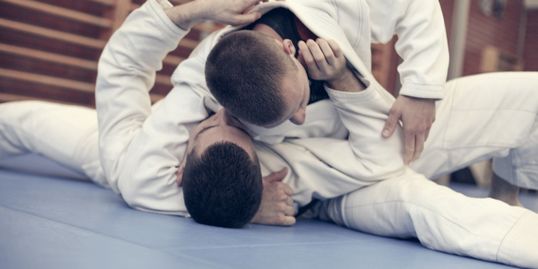
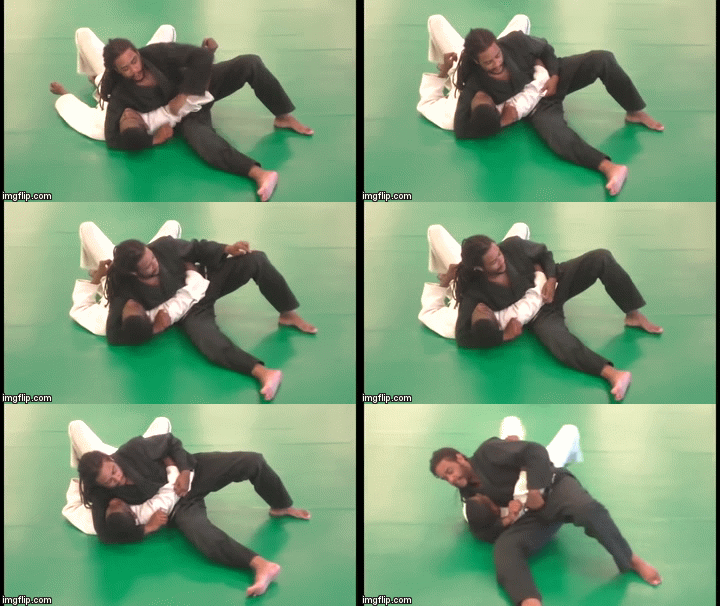
Very importantly, the control Jiu-jitsu offers is a dynamic one. It means you can transition between points of control, always begin a step ahead of the opponent.

Self-Defense

People often deem Jiu-Jitsu to be ineffective as a self-defense art. The reason for this is the perception of people. The image of BJJ today is that of sports Jiu-jitsu, laden with rules and formats. However, a simple look back at the roots of BJJ clearly shows that the art works. Another testament to the efficacy of Jiu-Jitsu is, of course, MMA, both the early days and now.

For law enforcement purposes, the most important thing is staying safe. Instead of going into an exchange of strikes, BJJ allows officers to counter strikes with grappling. This both keeps them safe and provides them with the upper hand. Knowing how to counter a strike and close the distance so that you gain control over an opponent and prevent further strikes is something everyone in BJJ learns. Why shouldn’t our officers know it too?

Shape And Response

Forma a fitness standpoint Jiu-Jitsu for law enforcement is a full package. Simply going through a good warmup and a series of drills is enough to maintain a good overall shape. Add to that rolling and you have the perfect way of both training practical self-defense and getting in top shape.

Jiu-Jitsu For Law EnforcementPsychologically speaking, BJJ helps people learn how to react calmly under stress. The unpredictability of the art places people under pressure in every roll, making them comfortable in discomfort. This means the decisions they make under pressure are not a rash one, but deliberate and precise.

Spending so much time rolling with people also sharpens instincts and reaction time. it is one thing to train Krav maga during your entry course, but a whole different thing to roll every other day. The more time you spend sparring, the better your response time is going to be, especially when things escalate quickly and unexpectedly.

A very helpful resource to supplement your Jiu-Jitsu training is Jay Wadsworth’s DVD “Police Self Defense Tactics For The Street”. It offers a grappling based way of dealing with common law enforcement situations as well as with unexpected ones. 

Police Officer Kristen Richmond Survived an Attack Thanks to BJJ & KM

Las Vegas POLICE Officer Uses JIU-JITSU to Control Larger Suspect (Gracie Breakdown)

The Worlds Worst Single Leg Takedown Attempt by Police Officer

BJJ Scarf Hold aka Kesa Gatame Submission Essentials For Grapplers

BJJ Scarf Hold

I will never ever forget my first Judo training session, Nor the first few weeks of training, for that matter. A huge reason for that is just one single, painful and annoying position. My nightmares are due to the fact I was on the receiving end of it. Later on, of course, knowing how powerful it can be, I became quite proficient at it. So normally, when Brazilian Jiu-Jitsu entered the frame, I thought I had a secret weapon. It turns out the position doesn’t really do well unless you go for a few simple, yet crucial modification. In Judo, the position is called Kesa Gatame. the subject of today’s article, though, is the BJJ scarf hold.

There are plenty of old-school grappling techniques that somehow found their way into BJJ. Especially when BJJ was on the rise, before a unified rule set and all that, people were experimenting constantly. Since BJJ still had no clear outline, the Gracies took everything in, from Judo to catch wrestling, as long as it worked. For a while there, BJJ went into a slight stagnation period, in terms of its openness towards moves from other grappling martial arts. Lately, though, Jiu-Jitsu is back on the evolution fast track. A huge factor here is the will to experiment with moves and/or positions coming from other arts. Things that did not work as well before might be killer techinques in modern Jiu-Jitsu. Like the BJJ scarf hold, for example.

Getting someone in a scarf hold is as instinctive as it can get. Well, not exactly in a BJJ scarf hold pers say, but still. Even children when they get in a scrape often go for a sort of a headlock that ultimately ends up in what we know as the playground scarf hold. There’s something about controlling the head of another person that guides us instinctively to look for it even under distress. So why not use such a natural instinct to our advantage? Especially when we’re already in a sport that involves controlling the head, neck and every other body part of another resisting person. The scar hold is a very useful position to use in BJJ. While it has no practical merit whatsoever as a takedown move (despite success on the playground), it does offer control and submission options suitable for all levels.

The Scarf Hold AKA Kesa Gatame

Let’s look at the basic Judo version of the BJJ scarf hold. The original Kesa Gatame position is, in essence, a side control variation. The goal is to use one arm to wrap the opponent’s head from the far side. The arm should fo as deep as possible around the neck, so that it comes out on the other side. The goal here is to have rotational control over the head, while also picking the head up. This bends the spine, making it almost impossible to move. As if this isn’t enough, pulling on the head of your opponent additionally bends the neck to the side, making the position extremely uncomfortable.

BJJ Scarf Hold Kesa GatameThe goal of the other arm is to control the near arm of the opponent. This is a key thing to remember if you want any success with the BJJ scarf hold. In particular, you need to keep the opponent’s elbow off the ground at all times. A C-grip on the back of the triceps, along with a closed elbow is more than enough to keep their arm trapped for good.

Your body should be facing the opponent, your ribs on the side of their ribcage. the hips should be low on the mats, with the bottom leg extended forward and the other one back. The further out your legs are, the heavier you’ll be.

Finally,  your head needs to be down low, right next to the opponent’s head. Aim to place your forehead on their near side shoulder, grinding the side of the face if need be.

Looking form ore information on the traiditonal Judo style Kesa Gatame? Check out the “The Judo Academy” DVD by Jimmy Pedro and Travis Stevens! Master it and nobody is going to escape your scarf hold ever again!

Controlling From the Scarf Hold

In terms of Judo, the Kesa game offers such complete control, that unless you know very specific escapes there’s no way out. This was exactly why I was so frustrated as a Judo beginner. The coach had me trying to escape Kesa Gatame fro close to a month before showing me a way out. The next couple of months were all about keeping the position and controlling an opponent.

The trouble with the Judo version is that in Judo, you can win by pinning an opponent for a short period of time. In BJJ, an opponent is going to find a way out eventually, or you’ll be penalized for stalling. Plus, there are a few more escapes than the standard Judo one. All this means that controlling the BJJ scarf hold is a dynamic effort, rather than a static one.

Since the scarf hold is a variation of side control, it doesn’t land you any points on its own but works perfectly to stabilize a pass, which brings 3 points. So keeping someone there is good for a while until you tire them out and make them uncomfortable. Ultimately, you’ll have to either transition or submit them. For control purposes, look to place the palm of the hand you have wrapped around the opponent’s head on the inner thigh of your bottom leg. This will torque the head even more and allow you to adjust your hips for transitioning without losing position.

Also, be wary of the positioning fo your legs. You’ll need to keep your back leg active and very low to the ground because a simple hook can open up a path to your back.

Easy Submissions

BJJ Scarf Hold ArmbarThe first and easiest submission is one from Judo. The one thing you can attack without sacrificing any of the control you have is the trapped arm. Since you already have control of the elbow and a good grip, hitting an armbar, is extremely easy. Simply extend their arm, using your bottom leg as a fulcrum. To finish, you can put your foot and press down, or use your leg to hook and pull back for a brutal and fast finish.

BJJ Scarf Hold Arm Triangle Choke Another really easy thing to get from the BJJ scarf hold is an arm triangle, Once again, the position is nearly set, as you have the arm around the head. You also have great control over the opposite side arm, requiring just a slight setup. Often times opponents make it easier by pushing on your head. All you need to do is brush their arms past and drop your head down to lock the choke in. From there, you go belly down and finish your arm triangle.

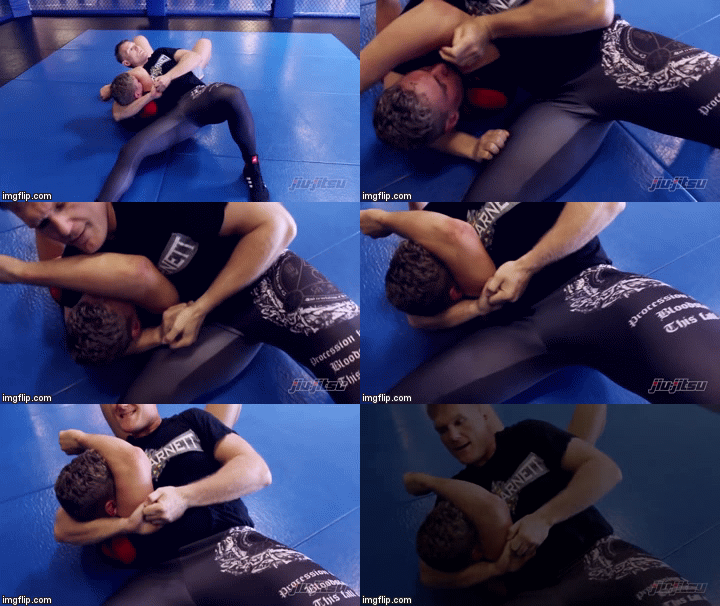
BJJ Scarf Hold Chest ChokeThe final submission is a slightly unusual, yet brutally effective one. It is a catch wrestling move that Josh Barnett used to submit Dean Lister at Metamoris. The chest choke is similar to an arm triangle, up to a point, After you get their arm to their neck, instead of dropping down you push with your hips and lift their head even further. The goal is to use your ribs to put pressure on their chest while pulling via an S-grip with your arms.

The Hidden Secrets Of The Reverse Triangle Choke

https://bjj-world.com/difference-japanese-jiu-jitsu-bjj/

Improve Back Control With The Body Triangle

Easy Omoplata Sweep Submission Follow-Ups

Omoplata Sweep Follow-Ups

There’s something about catching those “classic” Brazilian Jiu-Jitsu submissions. Those are the moves that gave BJJ its name, and the fact they still work today is simply amazing. However, very often these moves can either go wrong, putting us in defense mode, or they simply do not work. While giving up on submission and restarting is a legitimate strategy, a much better one is connecting other attacks to it.

The thing about all the “classics” is that they’ve been around for so long, the people have numerous follow-up options to keep their attacks going. One such move that grapplers often turn to is the Omoplata. This “basic” shoulder lock is so much more than just a one-dimensional finishing move. Turning to the Omoplata sweep when you’re initial submission is stuck is a surefire way to keep going and finish, maybe even with the Omoplata itself!

Back in my early blue belt days, I was a huge fan of Omoplatas. I discovered that the Omoplata works great when you combine it with an armbar and a triangle. SInce closed guard was my favorite position (big surprise there) this combo soon became my favorite. This meant that people knew what to expect, and higher ranked belts, in particular, defended my attacks fairly easily. This led me to the Omoplata sweep as the natural extension. At the time, just getting the sweep was immense for me. However, it soon became apparent that I had no direct threatening options after sweeping. And I didn’t like it at all.

The one big problem people usually run into with the Omoplata sweep is exactly this. The sweep lands you in a perfect position to continue attacking. Yet, most people settle for untangling their legs and going straight into side control. While this is a positionally sound strategy, going on the offensive from there is going to take a lot of work. While certain follow-up may come naturally to some people, usually it takes someone to unlock these paths for you. Today, our goal is to show you the next level of attacking with the Omoplata.

Bernardo Faria is a true virtuoso with the Omoplata. After numerous successful match victories via this shoulder lock, Faria revealed all his secrets. His “Omoplata Everyone” DVD set is available at a cut price. What do you mean you still do not have it?

The Omoplata Submission

The Omoplata is one of those cool looking submission specific to Brazilain Jiu-JItsu. It is a shoulder lock that is done from the bottom, usually from the closed guard. While closed guard setups are the most basic, there are also plenty of open guard setups, most notably form the Spider guard. The cool thing about the Omoplata is that it is a submission in which your legs do all the work.

Omoplata Sweep SubmissionStarting from the closed guard, you need to have one of your partner’s arms on the ground in order to go for an Omoplata. You could force him to plant it there or pull it yourself. Once the arm is extended, you open your guard and use the leg you have under the same side armpit to hook their shoulder. In order to do this, you’ll have to significantly change the angle of your hips, so that they’re now facing to the same side as your opponent. Locking a triangle in place, while keeping their hand as close as possible to their body gives you immense control. From there, you either go straight for the finish or for an Omoplata sweep.
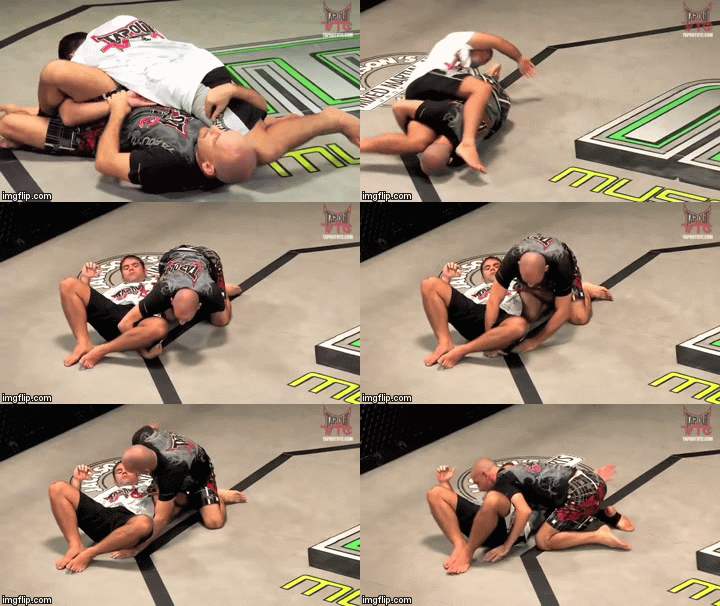
In order to finish, you’ll need to lay your opponent flat on the mats. This requires you to extend your legs forcefully so that their upper body goes to the floor. A few butt scoots to the side are all it takes to make their hips follow. Once the opponent is falt on the ground, you lean towards the opposite side shoulder, placing immense pressure on their trapped shoulder because of your legs.

The Omoplata Sweep

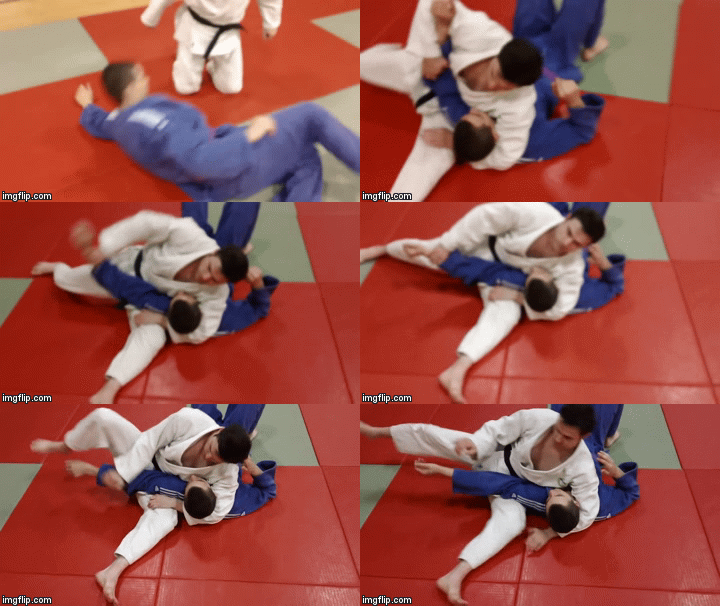
Gettin the Omoplata sweep is actually very easy. In most cases, people are going to give it to you themselves. If you do not control the opponent’s feet or belt when you first get into Omoplata position, they can roll out. While they can roll out of the submission itself, they do not necessarily leave the position, if you know how to follow up. Another great option is finishing the sweep itself.

Omoplata Sweep In the first instance, you have an opponent roll forward as you extend your legs to finish the Omoplata. Sometimes, even despite your best efforts to control their hips, opponents will find ways to roll out. Never ever untangle your Omoplata just because an opponent rolls out. Instead, make sure you go for a sweep and stabilize the position on top. Simply follow your opponent’s movement until you end up on top. The finishing position is going to be next to your opponent, with your legs still around their arm, along with sleeve control. This is a great position to be in, plus it lands you two points.
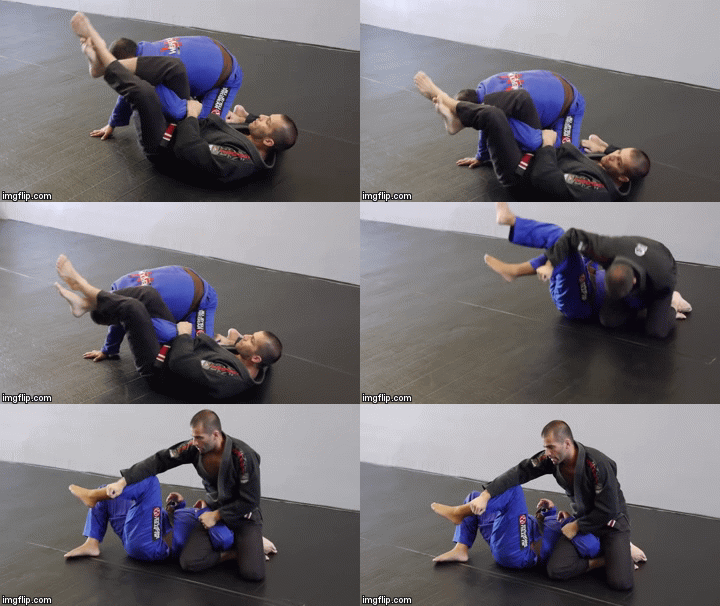
Omoplata Sweep From a more advanced perspective, you can use the Omoplata sweep when opponents intelligently defend Omoplata attacks. A knowledgeable opponent is either going to try to skip over you or try to open the shoulder lock up. In both instances, you yourself can turn to the Omoplata sweep to counter their defenses. Simply extend your legs while rolling forward with your body, so that your weight makes them roll over. Or, roll over behind you if the opponent is posturing up. Keep the shins of both legs on the mats as you get up, so that you keep the arm pinned and your opponent firmly in place.
The Follow Ups

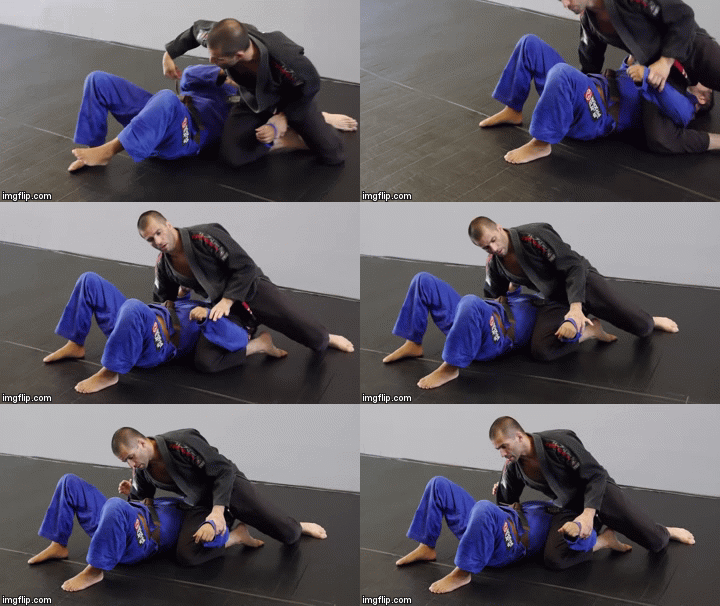
This is where the fun begins. Abandoning the arm configuration and simply going for side control is also a very legitimate strategy. However, going for a finish and much better positions is a better one.

Omoplata Sweep To ArmbarThe first and easiest option is a quick straight armlock. You already have everything in place, you just need to make a small adjustment. First, make sure you have the elbow of your opponent’s trapped arm between your legs. If that elbow slides out, go for side control. If you have the elbow, all it takes is to sit back, so that their arm is pinned between your hamstring and calf, and simply press down on their wrist for a straight armlock finish.
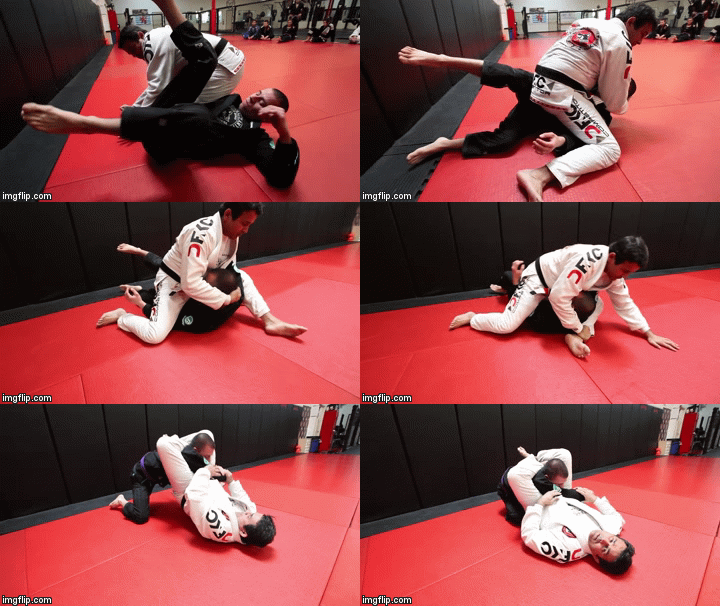
Omoplata Sweep To TriangleAnother cool looking and really good options are submitting from the mount. From an Omoplata sweep, backstep your free leg over the opponent and turn to face them. You’ll end up straight into a mounted triangle position. From there you should triangle your legs and settle in for a finish. Or, if you can’t squeeze the triangle right away, you can roll to you back, looking it up in transition, Your opponent won’t get any sweep points if you go on your back since you were in the mount. PLus if the triangle fails you can go from another Omoplata from there.
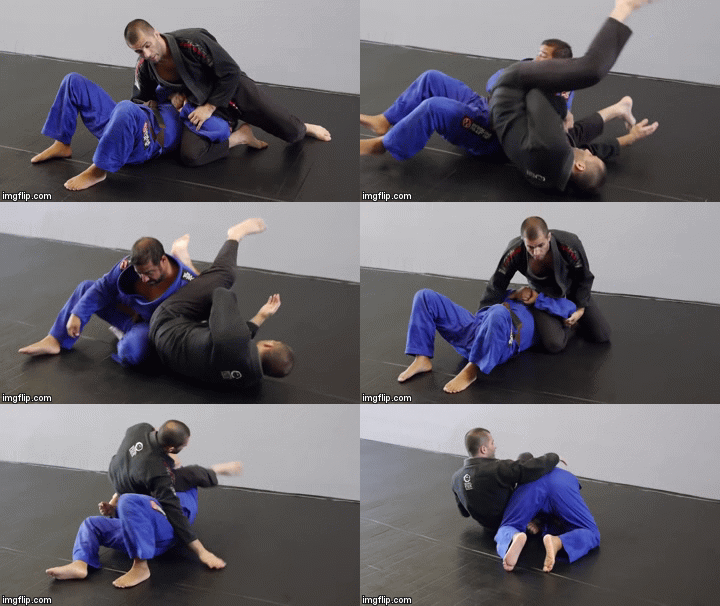
Omoplata Sweep SubmissionFinally, you can still finish with an Omoplata. Simply squeeze their elbow tight and roll over you near side shoulder. This time, though, make sure you control their hips better so that you can finish without them rolling out. Yeah, it is that easy, you only need to be aware it is there.
Source Videos:
1 Video
2 Video
3 Video
4 Video

Omoplata Explained – How to Make It Really Work

Kenan Corneliues Reverese Omoplata on Yuri Simoes Full Video and BreakDown – ACBJJ 13

The Annoying Side Of Training Jiu-Jitsu

Annoying Side Of Training Jiu-Jitsu

Wherever you are during the day, your mind is constantly bothering you about Jiu-Jitsu. You simply can’t wait to get on the mats and start rolling. You even spent an hour of your work time going through YouTube videos of tricky stuff you’ll do tonight. Your mood is on point, your backpack is packed right after the last training session and you’re raring to go! Then, you get on the mat and you run into one, or more, of the most annoying things that happen when training Jiu-Jitsu! There goes your mood and your joyful anticipation turns into frustration. Be aware of the common things that annoy people in BJJ so that you’re not the one causing frustration in others!

It is often said that how you behave in the gym and out of it has a major role to play in BJJ. Actually, this is very true and most instructors really pay attention to this. It is not only the technical aspect of your game that influences your progress. How you behave during training is also very important. That said, the more experienced you are as a grappler, the less of these common annoying traits should be associated with you. It may not be easy, as some of them are as much a part of your character as anything else. However, training Jiu-Jitsu, although not a team sport, does require other people. So, before you alienate people in the gym, make sure you’re not guilty of being the guy/girl with a painfully annoying trait.

Contrary to popular belief, annoying BJJ people is possible. Not only that, but you can annoy them really quickly and really hard. While laid back as possible, grapplers do tend to react when there’s something that annoys them on the mats. This is the one place where nothing else matters. Having to endure somebody doing a frustrating thing is a recipe for losing temper even for the mellowest of people. The trouble is that most people are usually not aware that they do something to annoy others. It may unintentional, or worse, intentional. Regardless, the solution is easy – be aware and do not do to others what you do not want to be done to yourself.

Gregor Gracie offers you an advanced insight into all the fundamentals of BJJ. With the help of his High-Level Fundamentals DVD set, you can easily become a highly technical and much less irritating grappler. Give it a try!

The Annoying Side Of Training Jiu-Jitsu 

Training Jiu-Jitsu requires you to come into contact with people. In fact, it requires close contact for extended periods of time. While being on the receiving end of some pressure passing or submissions should not cause you frustration, there are aspects of training that are universally upsetting for most. Sometimes it is the small things people do that can wire you to explode. Sometimes, it is glaringly obvious to everyone but the person doing it.

Training Jiu-JitsuDealing with annoying traits is not at all easy. While some, mostly those that refer to habits can be remedied, others are so deeply ingrained in people’s characters that changing them is next to impossible. In most cases, an instructor can really help by talking to the person and offering solutions.

The trouble with these annoying little facts of BJJ life is that they tend to come back with new members. Even if you manage to weed it out of someone, it won’t be long before another takes their place. Some are common to beginners, while others seem to surface as grapplers reach certain milestones. My take on it that if you know what annoys people, you’ll be able to make sure that you, at least, are not the source of it. If everyone did it, we’d be able to cut back on frustrating moments on the mats significantly. Well, apart from getting destroyed.

Hygiene

There’s simply no way to skip past this one. I’ve been in BJJ for nearly a decade and if there’s one recurring annoying thing it is bad hygiene. While it comes a given for most, some people seem to have trouble with the most basic concepts of it. Rolling with a partner that has a dump, smelly Gi takes all enjoyment out of BJJ in an instant! It is okay to leave your Gi at home and train in shorts and a t-shirt unless your Gi is ready. Leaving it in your gym bag after training and using it again next time is simply unforgivable!

Also, nails. People, easily take jewelry off or at least taping it up when training. It is unbelievable that they forget to take off weapons off their hands and feet. Going home with scratch marks all over our bodies is not what training Jiu-Jitsu is about.

Stopping A Roll

Unless you’re tapping out, or have an injury or another legitimate reason to stop, do not cut a roll short. Your partner doesn’t want you to congratulate them on a move, or go over how you did something. Nor do they want to go back and try it again. Those things should be done during drilling. Questions are also a no-go. You can ask after the roll, during open mat or during a Q&A period of class. However, asking someone to explains a move during a 5 5-minute roll is the definition of annoying.

Coaching Others

In relation to rolling, coaching others while you roll is hugely frustrating for anyone! Have you ever heard your instructor coach while you roll? NO, because they’re having the time of their life dismantling you piece by piece. So, never coach people during rolls, even if you’re formally a coach in the academy. Actually, unless you’re a coach, you shouldn’t be trying to coach others, period. When you’re advanced enough to be able to pass on knowledge, you’ll become a coach. Looking to teach to others what you do not know in the first place is frustrating as hell!

Another way to piss people off is by trying to guide them through a roll as if you’re cornering them. You have no idea if a person likes your advice, or is even in the right state of mind to roll competitively! Do not interfere with other people’s rolls, no matter how high your rank is.

Spazzing 

Training Jiu-Jitsu, Annoying TraitsDear white belts, if you’re training less than 6 months, disregard this one. But keep it in mind, regardless. All you other people of various ranks and experience, loosen up! Training Jiu-Jitsu is different from competing in Jiu-Jitsu. Keep the intensity appropriate, and do not act like you’re fighting for a world title! SPazing is useless, annoying and completely out of place in grappling. And this includes both spazzing when you’re attacking and when you’re defending. Nobody likes an elbow to the face because you can’t handle someone passing your guard!

Unwritten Etiquette

Brazilian Jiu-Jitsu is based very much on respect. You respect your training partners, your instructor, your opponents. It is all well when you say “Oss” 35 times in a class, but suddenly everything goes out the window once rolling starts. Unless you’re alone in the gym, make sure you take care of others around you. Practicing takedowns in a gym packed with people is disrespectful, annoying and potentially dangerous.

You should also pay attention to the people next to you. Of course, you need to follow the rule that lower ranked belts should make space for higher ranked ones. But if you’re a purple belt that just bumped fists and you don’t even have grips, you should be the one making space for a blue belt couple deeply entangled in a submission attempt. It is a common courtesy of training Jiu-Jitsu and a mark of respect.

Mindless Questions

This is one that annoys instructors, first and foremost and then everyone else in the class. Whenever an instructor demonstrates a technique, take it for granted and go attempt what they’re showing. Asking for a counter or a totally unrelated question even before you give the move a try is really really frustrating. Going off topic wastes everyone time, and disrupts the flow of the class. There are a time and place for questions, both ones on topic and unrelated ones. That time is not while you’re learning or drilling a move.

Creonte Culture – Loyalty, Disloyalty, and Traitors in BJJ

How Training BJJ Too Much Can Hurt Your Progress

9 Reasons Why You Are Annoying to Roll With

How To Advance In BJJ With Flow Rolling

The Most Annoying Kind Of BJJ Training Partner

BJJ Back Escapes And Counters That Can’t Fail

BJJ Back Escapes And Counters

There are not that many really high-level chess players that can get out of a checkmate position. In fact, only a few of the very best can pull it off, and it is going to be a gamble even then. In Brazilian Jiu-Jitsu, there are several positions that offer a classic checkmate. Still, just like in chess, there are still ways of getting out and even, ultimately, countering your opponent. An, if there’s on the position that is a true checkmate for grapplers, it is back controlling. The position offers incredible control and direct finishing options, as well as easy, follow up that might even eventually end up back in the starting version of the back control. BJJ back escapes that work is not that many, and direct counters are even less. Those that work are listed below.

Leg lockers aside, people that are really really good at back attacks are some of the toughest opponent’s you’ll face in Jiu-Jitsu! Even a beginner that gets a hold of your back can cause you trouble and make it difficult for you to escape. When the person on your back knows what they’re doing, and more importantly, what you’ll do, it becomes nearly impossible. BJJ back escapes are nothing new nor mysterious. People learn and drill them all the time. The only problem is, that most of them fail to work against truly high-level back takers. And it is precisely these people that we want off our backs when rolling/competing. The perfect scenario would be staying safe, getting out and directly countering your opponent. Yet, counters area even scarcer and work way less than Back escapes. So, when in back control, focus on getting out first.

The reason BJJ back escapes are so notoriously difficult to pull off is the nature of the back position. Unless you’re really aware of all the possibilities and dangers, you’ll probably choose an obvious escape option. This is only going to allow an experienced opponent to adjust into a better control position and be one step closer to a submission. Repeat this a few times and you’ve actually landed yourself in a choke by trying to escape. This is exactly what we’ll focus on today, exploring those few effective BJJ back escapes that work.

Tom DeBlass has not been submitted in years. As one of the leading competitors of today, he knows the most efficient ways to escape every submission and position in BJJ. Check out the “Submission Escapes DVD” by DeBlass for a way out of every sticky grappling situation!

Deconstructing Back Contol 

The biggest problem about back control si that your opponent is behind you. It offers a way for an opponent to be really compact while at the same time being hidden from your sight. This is the crucial problem people face when they get their bacs taken. So, in order to employ BJJ back escapes, you need to know which areas of back control you need to address.

Basically, there are three things you need to focus on when attempting to get rid of back control. The first two things to consider are hooks and the seatbelt grip. You need to regain control over at least half of your body. That means either getting rid of the hooks, which control your hips, or the seatbelt grip, which controls your torso. Unless you manage one completely, before attempting to get free of the other, you won’t be successful.

In order to obtain a good position to deconstruct either controlling mechanism, you need to slide your body up or down. UNless you change your positioning in relation to your opponent, no amount of technique or strength is going to get you out.

And most importantly, you need to address the biggest problem first and with complete attention. There is absolutely no point in trying to escape back control if your opponent already has a choke in place. Instead, preventing them from getting to a choke position should always be your number one concern. Stop the submission instead of panicking to get out in an attempt to deny your opponent points. Once they’re on the back, focus on protecting your neck, and forget about the points. Once you’re out, you can start getting them back.

BJJ Back Escapes

In terms of escapes, we’ll look at two BJJ back escapes that cover all the bases. The first one focuses on the escaping the hips first. It works perfectly when you are on the “weak” side for choking. The second one is a back escape that is going to get you out of the strong side. This one is going to start with grip breaks and freeing the torso first, before moving on to the hips.

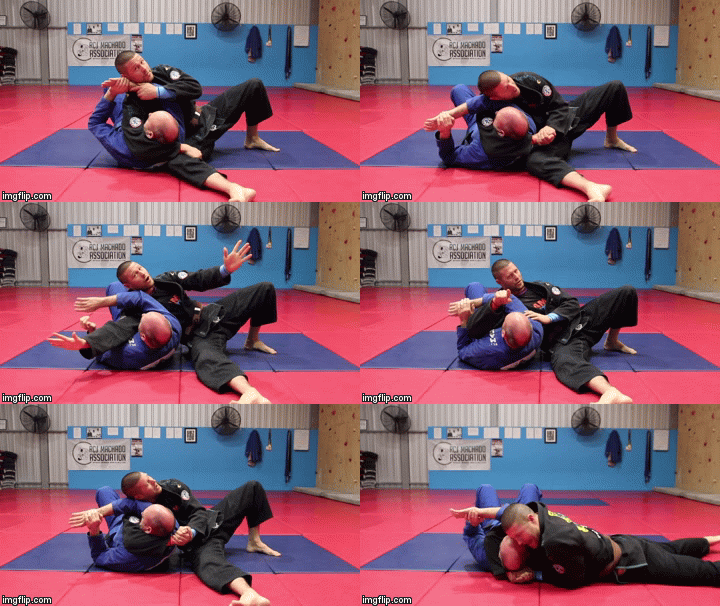
BJJ Back EscapesFor our first escape, we find ourselves in back control, seatbelt, and hooks in. The first thing to do is grip the overhook arm so that you prevent it from going into a position for chokes. The second thing to do immediately is to lie down on the underhook side. This the weak side for choking and it’s going to keep you relatively safe. Once there, you’ll look to extend your bottom leg, negating the hook control on that side. This will allow you to rotate and get the leg free, establishing a base. Now you can slide out to the side, freeing your hips completely. Getting rid of the seatbelt now is as easy as guiding the overhook arm over your head. To complete the escape, turn into your opponent.

BJJ Back EscapesWhen you’re late with going to the weak side, and your opponent gets you on their strong side, the first principle is the same – control the top arm with both of yours. Once you break the seatbelt grip, keep a 2 on 1 grip on their top arm and guide it over your head. Now, you can change your position, by going on your back, thus moving your hips sideways. To prevent mount, you’ll have to use your ar side leg to hook the opponent’s top leg, before you complete the escape.

Back Control Counters

BJJ back escapes are high percentage moves, when you go for the simple methods, like the tow above. Counters, on the other hand, are much more opportunistic and can work against less experienced opponents. As such, there are a few that might be worth your time.

BJJ Back Escapes Leg LockThe most basic one is preying off your opponent’s mistake. It is a simple one most of you should know, as it is a teaching moment. If and when your opponent crosses their feet in front of your while in back control, you can finish with a submission. All it takes is to cross your own feet over theirs for a nasty and very legal ankle lock. The only problem is, experienced opponents are never going to make that mistake. Also, your hip flexibility, or lack of it, places an important role here.

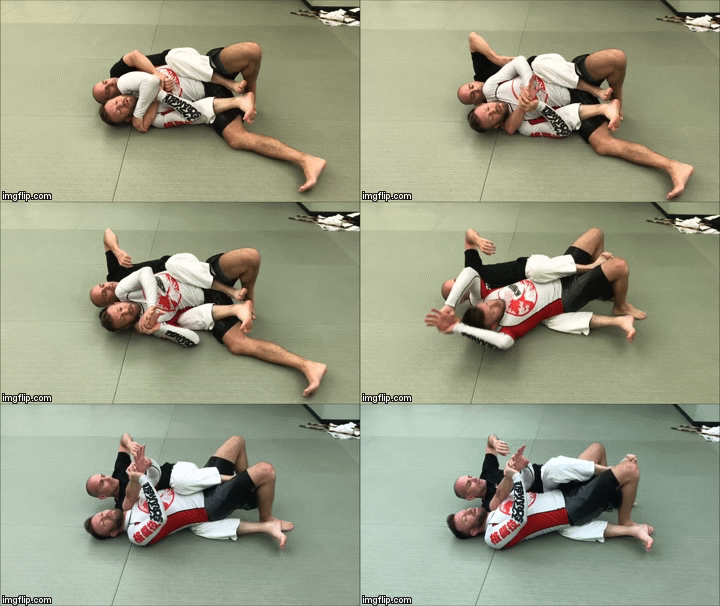
BJJ Back Escapes Kimura Counter Another countering option is looking for a Kimura. It is a bit risky but works well of the first defensive option we discussed. When escaping on the weak side, look to thread an arm in, so that both your opponent’s arms are now an underhook. There’s still control there, so immediately grab a Kimura grip on the top arm. Now proceed with the escape, getting an armlock in the process.

1 Video

2 Video

3 Video

The 4 Corner Front Headlock Takedown System

Front Headlock Takedown

Taking people down is an aspect of BJJ that offers as much variety as the ground game. Still, there are a lot of people that do not spend much time on takedowns. Or, like me, they start doing it later in their BJJ career leaving them much behind others. So, for both the people that are just starting and those that have ignored takedowns for a while, there is a solution. There are no shortcuts, but you can choose a different approach and thus ensure you catch up faster. The trick is to choose a subject of the takedown game and develop a system that suits you from there. For me, it turned out that the front headlock is a great position both standing and on the ground. So I went on to work on a front headlock takedown system, that is a perfect fit for me.

First things first. The following front headlock takedown system is not my invention. All the moves are based on wrestling. I only put together a few things as a concept and gave it a name for easy reference. To be honest, the goal was simp[licity. And there’s nothing simpler than “the 4 corners front headlock takedown system”. While we’re on the subject of clarifying things, I started working on this as a purple belt. So, it is not something you can do as a beginner unless you have some wrestling background, The reason for this is that there are other takedowns like ankle picks and the double leg as part of the system.

The main reason the front headlock is a perfect position for executing takedowns is control. ti offers a lot of control when standing. Furthermore, it allows you to transfer that controls once you hit the ground. POus, it opens up direct submission options without ever letting go of your grips. Plus, on top of all that getting it is fairly easy. Especially if you’re a tall and lanky guy, or if you’re good at takedown defense. The only trouble you might run into is with Judoka who tend to stand upright. Worry not, as I also have a Gi grips version of the system. First things first, however, let’s see what the 4 corner front headlock takedown system is all about.

Getting The Front Headlock 

Getting the front headlock depends on a few different things. There are basically there great ways of getting there for me, so I’m going to share them. These are the ones that work for me in different situations during the stand-up battles. There are many more, and arguably even better ones, so feel free to explore and get back to me!

The first one is probably the best for taller grapplers, which I am not. It is the snap-down, where you guide your opponent’s head down by jumping up slightly. Since I’m not very tall, I use it off an arm drag attempt, when the opponent looks to lean back forward after escaping.

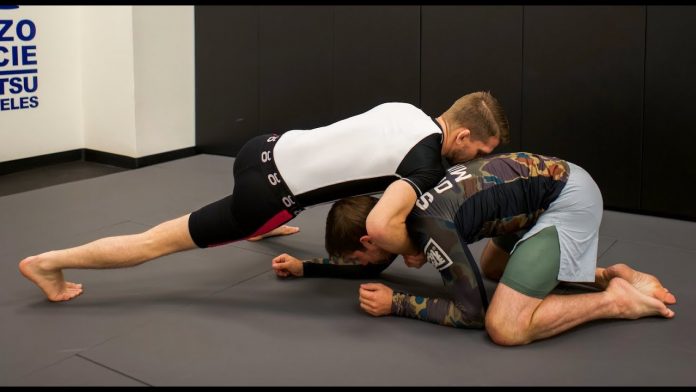
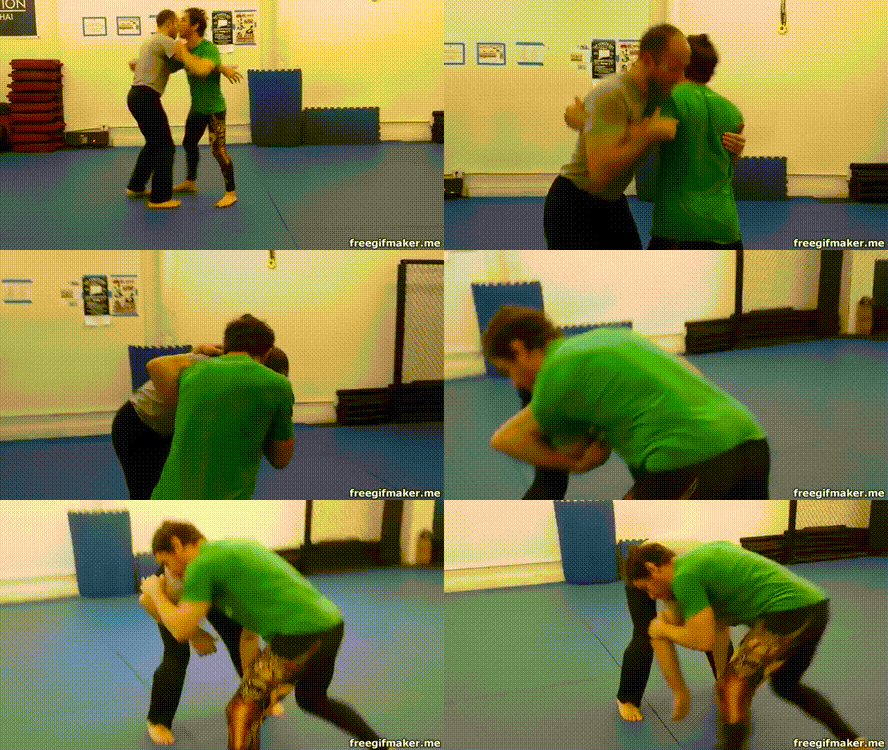
Front Headlock TakedownNext up is the over-under setup. This is a fairly technical one, that includes establishing grips first. For example, if you’re stuck in an endless pummeling exchange, you can actually use the pummel to get to the front headlock. Simply place the palm of your underhook arm up on their shoulder and use it as a hook. Step back and to the side with your opposite side leg to break your opponent’s posture. From there on simply go back to the front and slap on the grips.
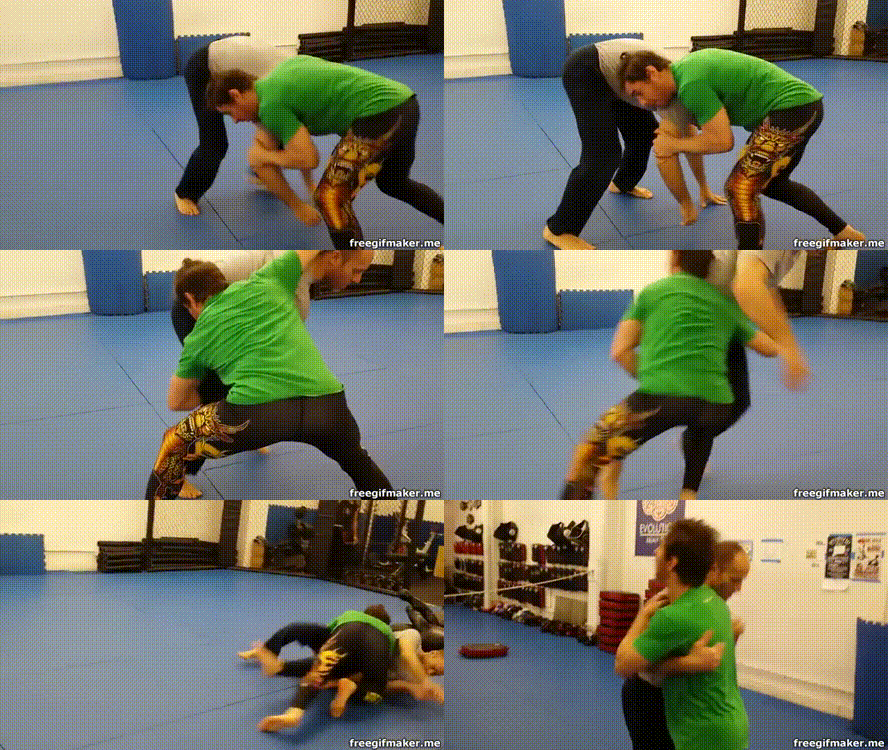
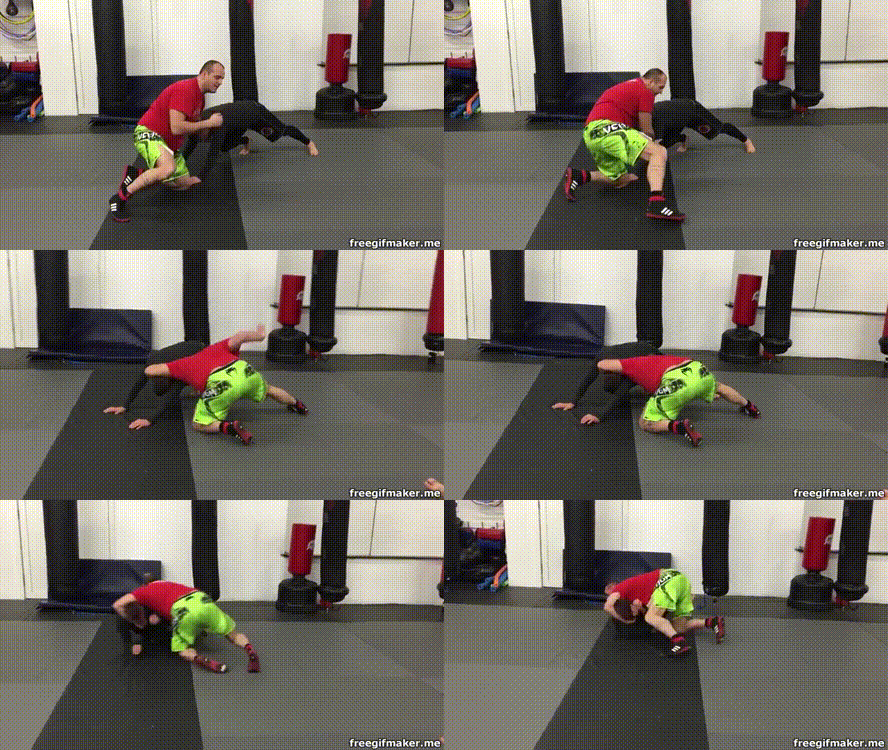
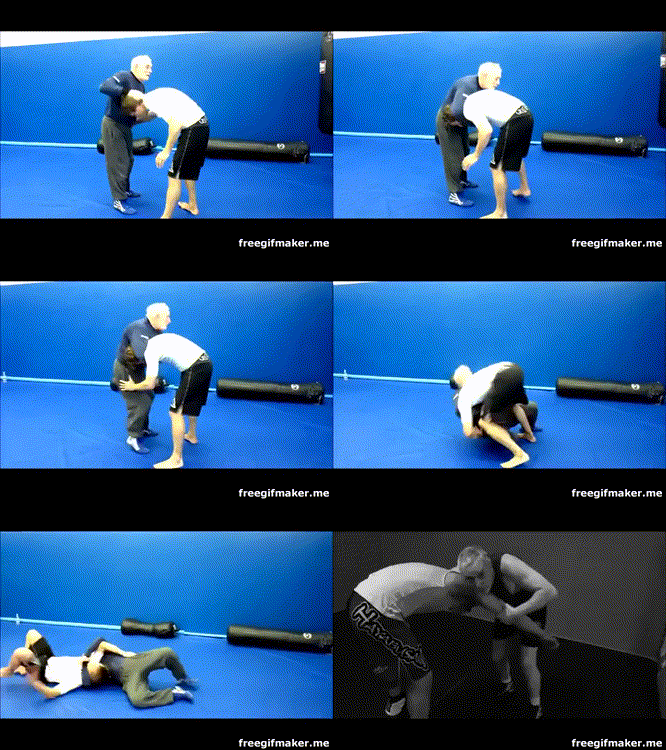
The final way of getting into the 4 corner front headlock takedown system is from a defensive position. Every time you’re up against a wrestler that keeps shooting for double or single leg takedowns, you can look to counter with a front headlock. This is the hardest one because you need a good sprawl as well as fast transitions And, most importantly, you need great timing and anticipation.

The 4 Corner Front Headlock Takedown System 

In order to be successful with the 4 corner front headlock takedown system, you’ll need to know how to retain control once you enter. There are two basic things to remember about the front headlock as a control position.

Look at it like this – one arm is for control, the other is to create openings. The arm that goes around the head should end up with a chin strap grip. The elbow should be close and you need to place the shoulder of that arm right on the middle of the back of the opponent’s neck. This is where control comes from, in a dynamic fashion.

The other arm has the task of controlling your opponent’s arm. As a basic rule, you need to have the opponent’s arm at an angle of 90 degrees or more in order to have an effective front headlock. The best place to grip is right above the elbow so that the opponent can’t pull ti back. having this grip both secures your position (prevents them from grabbing your leg) and opens up attacking options for you (helps keep their posture broken).

From there on you simply pick a side and start with the 4 corner front headlock takedown system!

Check out how to finish from the front headlock with Neil Melanson. THe catch-wrestling based grappler know everything there is about takedowns, finishes and other attacks from the front headlock. “The Headhunter Guillotine Series” DVD set explains them all, across 4 information-packed volumes.

Double Leg

First up, you have the double leg takedown. It is a power double so the takedown directions is to your opponent’s backside. Setting it up is easy because it is your opponent that’s actually going to set it up for you. Once you have perfect control, you’ll release their arm and place a grip right behind their knee, on the same side. This is the beginning grip for three out of four directions in the system.

Front Headlock TakedownThe double leg works best when your opponent manages to retain a bit of posture. This can be because you have weak control, or because they’re really strong. Or, perhaps, you might want to set them up there because they have an unusually strong base. Whatever the case, you need your opponent to get their head out and straighten their body. The grip you already have and your low base place you in the perfect position for a double leg.

As your opponent straightens their spine, simply place your head on their near side ribs and place your other hand behind their other knee. Their motion of straightening up is actually going to help you take them down. Simply step forward and drive to take them down to their back.

Ankle Pick

The ankle pick is the next option in the 4 corners front headlock takedown system. It is a takedown to the side where you control the opponent’s head. When you have good head control, this is the easiest side to take an opponent down to.

Front Headlock Takedown SystemTo begin with, you’ll go for the same grip behind the knee. This time, the opponent is going to pull their leg back, getting out of the grip. Once they do that, you’re all set. You’ll need to place your near side knee down so that you control their head even tighter. It also allows you to cut the angle and grab their far side leg’s ankle, as low to the mats as possible. From there you’re just a simple push away from side control.

Rolling Back

This is the most attractive takedown of the system. As the name suggests, you’re going backward for this. Note that simply pulling back forcefully (like sprawling) with good control is enough to get your opponent to their knees. Rolling back, on the other hand, is going to land you in the mount with a submission-ready to finish. So it is the better option, despite requiring more experience.

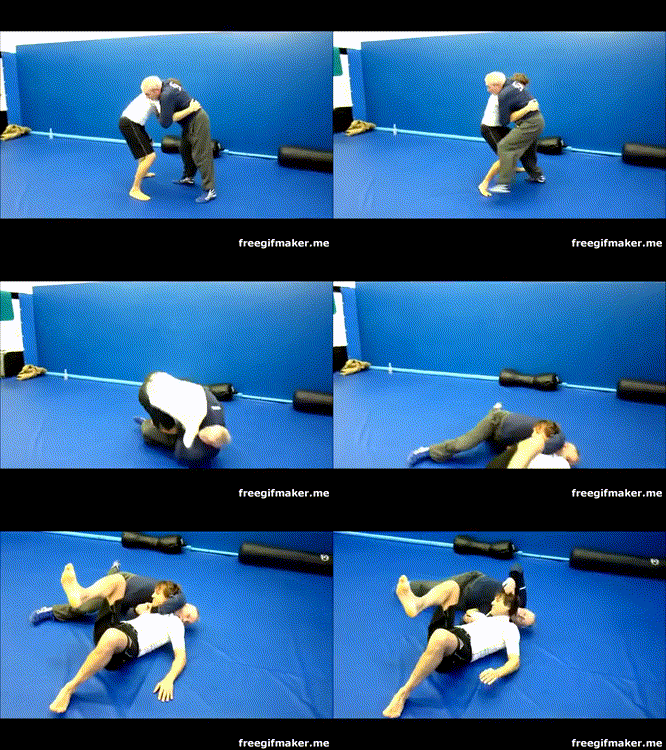
Front Headlock TakedownFor this takedown, you need to grip your arms together. A butterfly, palm to palm, or an S grip works perfectly. Once you have it. get as close as you can to your opponent with your feet, while compressing their head and neck. Once your feet are close to the opponent’s just sit down and do a backward break fall. Remember to maintain a tight grip at all times, because this is what’ll pull you on top of your opponent, and even offer you a mounted guillotine finish.

Outside Trip

Front Headlock TakedownThe outside trip works perfectly when you’re up against a really strong opponent. It is the final one in the 4 corner front headlock takedown system, as you can guess. The setup is similar to that of the double leg. Your opponent is going to try and regain their posture, only this time,  you’re not letting go of their head and neck.

Once they manage to get past their hips, it is time to go for the outside trip. make sure all your weight is on their neck and place your leg on the outside of their leg, on the opposite side of the front headlock. You then finish by falling to the same side, just as you would with an outside trip.

1 Video

2 Video

3 Video

Why Every Academy Needs Intro BJJ Classes

Intro BJJ Classes

Most Brazilian Jiu-Jitsu academies have a similar structure to their classes. Actually, it is a concept that is not dissimilar to other grappling martial arts. While the class structure is very important for the continuous progress of students, so are different BJJ classes. A kids class, for example, shouldn’t be the same as an adult class. Even among adult classes, there should be a clear distinction between different levels. The usual structure calls for beginner and advanced classes. Sometimes people also throw in a specific competitors-only class, dedicated to tournament preparation. However, lots of academies have nothing to offer people that come through the door apart from jumping straight into a beginners class.

The structure that most BJJ classes follow is all about giving students the opportunity to progress in a structured and methodical fashion. There is a reason why instructors pay so much attention to maintaining the structure. You won’t see many instructors promoting open mat classes over technical ones. The reason behind this is simple. As useful and crucial as rolling is for Jiu-Jitsu, it is also not a good learning tool. At least not in a technical manner. There is a reason why most schools do not elt complete beginners roll live straight away, but more on that later. For now, let’s focus on complete beginners and how class structure affects their perception of the sport as well as their eventual progress.

Incorporating the concept of an introductory class into your academy is going to take some work. It requires a lot of dedication and planning but it offers lots in return. First and foremost you’ll offer you, potential members, the absolute best way of learning what Jiu-Jitsu is. next, you’ll be able to precisely present your own brand of Brazilian Jiu-Jitsu, as well as your philosophy. Also, you’ll be able to increase the number of new students significantly, due to the fact that you’re starting off with very clear instructions and giving individual attention to new students. There are many ways to incorporate an intro lesson or lessons among your BJJ classes on a weekly basis.

The very basics of Brazilian Jiu-Jitsu are perfectly laid out in the “Foundations of Brazilian Jiu-Jitsu” DVD set by Bernardo Faria. It is the perfect DVD instructional for a new student to help fill in the gaps from training.

The Concept Of An Intro Class

When I first walked into a Brazilian Jiu-Jitsu academy, I got to roll straight away. Ok, it wasn’t right from the door, but it didn’t take long. After a short technical demonstration, it was all about rolling. The coach was a blue belt, and the academy was just starting. The few of us that were there, learned the hard way that there are far better ways of introducing someone to Jiu-Jitsu. That is why now, we have the intro class as a mandatory first experience for any new student.

What is the concept of an intro BJJ class? The best way to look at it is as a private class with new students, where you slowly and very methodically demonstrate what BJJ is. The reason the intro class is very similar to a private is that you will rarely have more than a few students in each one.

Intro BJJ classes need to be held in different time slots than regular classes. Otherwise, whatever is happening in the gym is going to take away the attention of the new students. An intro class is going to require a different structure from normal ones. It also takes some preparation as well. Namely, in Gi academies (which most academies out there are), you’ll need to have spare clean Gis to offer to new students. Wearing a Gi makes their first experience much more different and more exciting.

The goal of the intro class is to make students see that they can do Jiu-Jitsu and how fun it can be. For that, remember to be friendly, stick to demonstrating basic but effective things and do everything along with the students. The intro class needs to be a positive and encouraging experience that makes students want to come back.

1. Intensity And Length 

To begin with, make sure to keep the length of the class at around thirty minutes. Most new students are usually not in shape to go through more. Furthermore, if you do an hour-long class you’ll both exhaust them and give them too much information. So keep it short and sweet, keep it active but do not go overboard on the intensity.

Start the class by providing new students with a Gi and help them with tying the belt. Starting their first class ina clean uniform is going to do wonders for their enthusiasm.

2. Simple Warm-Up 

Intro BJJ ClassesAs far as the warm-up is concerned, you do not know how mobile, coordinated or agile your new students are. In order to make sure they can go through the warm-up successfully, go for things you know everyone can do. Squats, pushups, low impact jumps like jumping jacks and some abs are more than enough. Most people can execute them without too much difficulty, they’ll warm the students up an give them encouragement that hey can do whatever is asked of them. Also, remember to do everything along with them.
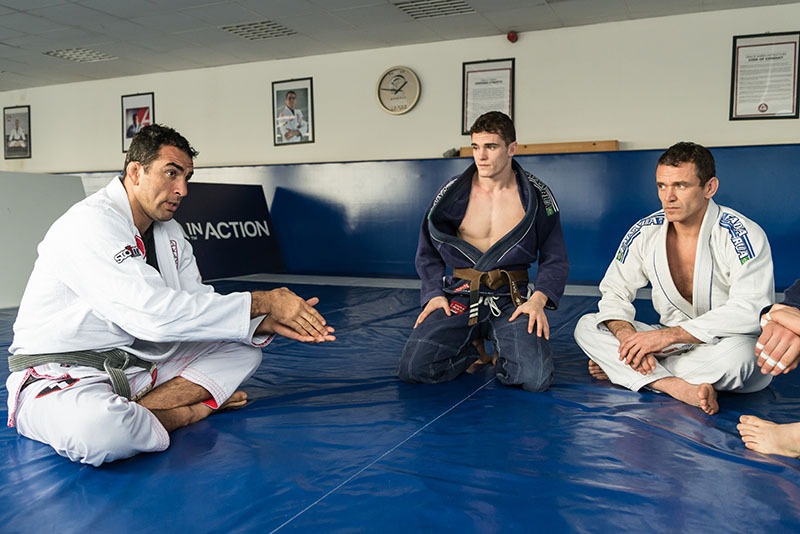
3. Movement

Some specific movement patterns should be the first thing you demonstrate after the warm-up. Unlike regular BJJ classes, stick to the simplest patterns in an intro class. Those are the hip escape and the bridge. Put things into perspective, showing students how these work practices, but have them do the movements without a partner. Instead, make sure you give them precise and detailed instruction on every step o the movement. Actually, break the movement up into a few steps and coach them all the way.

4. Self-Defense 

PResent Brazilian Jiu-Jitsu as a sport that has effective self-defense applications. Some people are going to sing up for this part only, and even those that don’t do not mind learning it. Do not try and go over complicated with self-defense things. Talk about distance, break falls and getting back up to the feet safely. If you notice that students are more advanced than that, or have some previous knowledge, demonstrate how the clinch works as well.

As far as groundwork goes, go for something simple that you can explain in the 30 minute time frame. A quick armlock from knee on belly or Americana from the mount are perfect techniques to introduce prospective students to what BJJ classes have to offer.

5. Tapping

While on the subject of submissions, make sure you really clear up what they are and how they work in training. Demonstrate tapping by letting a student get you in a submission, and explain the concept behind it. Make sure new students know that they can stop at any time, regardless if they’re in a submission hold or not, just by tapping or saying stop. having such a failproof safety network makes people feel comfortable with training a martial art like Brazilian Jiu-Jitsu.

6. Putting It All Together

Finally, try and put everything together for the students. Starting with break falls and getting back up and to the ground, via a simple takedown (trips work best here) where they finish from knee on belly or mount. Have them repeat the sequence a few times so that they see how different parts of BJJ connect as a whole.

7. Chat

Finish the intro class with a chat with the new students. Expect lot so questions and be ready to answer them in a simple yet informative fashion. Make sure the students have a pleasant first experience and are ready to come back for more. Finally, show them to the dressing rooms and great them before they leave the Academy.

Adding The Intro To Your BJJ Classes

Intro BJJ ClassesA very good time to hold an intro class is right before your beginner BJJ classes start. That way, you can invite new students to stay and see how training goes in the group they’ll be part of. That way, they get both the one-on-one experience for their first class as well as meet the people they’ll be training with.
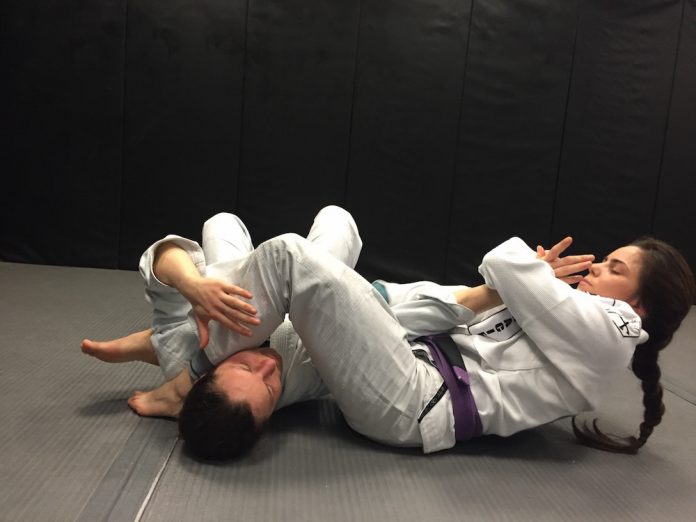
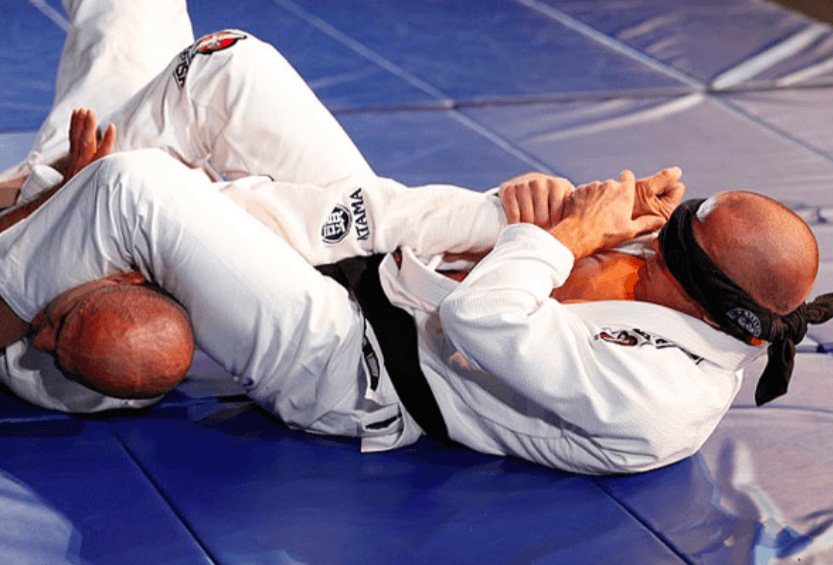
Also, explain the curriculum to them while the class is warming-up and give them an insight into the class structure before you start with the beginners class. Having an organized methodology tends to give people a positive impression of the Academy. They’ll know that they’re safe and that learning is guaranteed when everything is organized in such a fashion.

Finally, if those slots are not really available, an open mat is also a good thing for new students to see right after their first class. Make sure, however, that you stay by their side and explaining what rolling is all about and how it works. Also, let them know that they’ll only be doing position sparring for a while until they get the hang of things. Have them see a couple of students do a position sparring drill, so they have a reference.

Creonte Culture – Loyalty, Disloyalty, and Traitors in BJJ

OSS Meaning: Discover Its Origin, Usage, And Purport In Martial Arts

How Many Times A Week Should You Be Training BJJ?

Closing Your Eyes During A Jiu-Jitsu Roll – Valuable Or Not?

Jiu-Jitsu Roll With Closed Eyes

Rolling is the best part of Jiu-Jitsu, it is also the part that truly makes us good at the Gentle Art. As much as we can learn technique, do drills or even position sparring, we all need to live rolling in order to test things out. Rolling teaches us timing, sharpens our reflexes and helps us create and recognize patterns. It is the ritual of battle, or as close as we can get, without truly fighting. However, even live rolling is not just a simple scramble of who gets there first. It has ordered to all the chaos and has levels to it, just like everything in BJJ. Each and every Jiu-jitsu roll can teach us lots of different new things. However, there’s a very cool method to take rolling to a whole new level! You just need to close your eyes.

Going through a Jiu-Jitsu roll with your eyes closed is a great learning tool. However, not everyone can do it, and you also can’t’ do it with just anyone. You need a willing partner or otherwise, you’re very likely to be deemed a douche. For some reason, some people seem to take it very personally when you roll with them and your eyes are closed. It has to be an ego thing, but you can often find it listed among annoying things partners do. Personally, I never found it offensive as a lower belt. As I started implementing the method myself, I only developed an admiration for it. So, make sure you have a willing partner when you try this method out. Furthermore, do not give it a try in live rolling straight away.

Also, a bit of experience, like a blue belt, at least, is absolutely mandatory. Otherwise, you and your partner, or people near you, might end up with injuries. The closed eyes Jiu-Jitsu roll is the best tool to develop invisible Jiu-Jitsu. Yes, you can, and need to, train invisible Jiu-Jitsu in order to develop it. it is all about the finest details of movement and timing, as opposed to purely technical work. However, you need both solid technique and lots of rolling experience to truly reap the benefits. In this article, I’ll provide you with an experiment you can do in order to estimate if you’re ready or not to roll with your eyes closed.

Develop an insanely efficient top game by using the principles that legendary grappler Yuri Simoes lays out in his “High-Efficiency No-Gi Jiu-Jitsu: Top Game” DVD set. It is a video instructional that can take advanced students to a whole new level!

The Blind Jiu-Jitsu Roll

Rolling with a high-level black belt is always a humbling experience. Rolling with them is like rolling with someone that can read your mind. You know what I mean, no matter how elaborate you attacking schemes are, they seem to know them long before you do. It is a Wiley Coyote kind of thing, where you always end up paying for your efforts. The trick, or better said, the reason behind this is the experience.

Seasoned black belts base their reactions on the way their opponent’s body moves. They have som any hours of rolling that they act instinctively when certain opportunities arise. In both a defensive or an offensive manner, an efficient and properly timed movement is behind the success of many top-level grapplers. Nothing can make up for experience, so you’ll have to go through it all in order to obtain such abilities yourself, However, mastering the “blind” Jiu-Jitsu roll is a great way of consciously starting to develop these essential skills.

Rolling with your eyes closed means that you’re taking away a key sense. This, in turn, requires you to base your decisions on your remaining senses. In terms of rolling, this means using your sense of touch to determine your position in regards to your opponent. This brings a whole new level of demands to your reaction time. Without sufficient experience, you’ll end up making stupid mistakes and might even end up injured. However, if you know your way around rolling, you’ll soon discover how taking one sense away opens up new ways of learning BJJ!

The Experiment

A few years back, the instructor at my academy asked us all to bring a blindfold to class. Knowing that he is keen on jokes, I didn’t take him seriously. Others did, though, brought with them the required equipment. Luckily for me, I found some piece of cloth to do the trick, at least for that class. And it was worth it.

Jiu-Jitsu Roll With Closed EyesThe approach we took was rolling very very slowly, starting with specific positions only. Furthermore, only one partner had a blindfold on, so that the other could watch out for other rolling couples. Starting with position sparring was the right decision. The moment you remove the sight from the equation, you tend to slow down extremely significantly. And this is exactly why rolling with closed eyes is so beneficial.
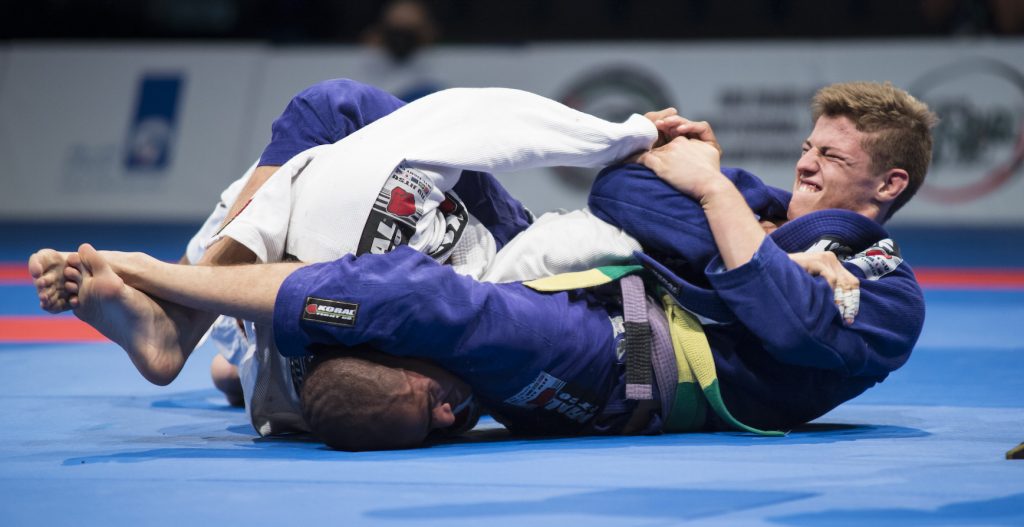
In the experiment we did, the partner that had no blindfold on could dictate the pace. This gave the blindfolded partner the opportunity to learn how to react and adjust based on other senses. It is an absolutely irreplaceable tool in developing a truly high level of Jiu-Jitsu. It is also the only way to go safely go for a Jiu-Jitsu roll without using your eyes. If you’ve never given closed eyes rolling a try, make sure your first time is via the methodology described above.

The Results

So what did I learn from our week-long, experiment of rolling with a blindfold on? I was a fresh purple belt at the time, and I gained valuable experience from that. Actually, I kept repeating it from time to time, in order to further sharpen my skill.

That first blindfolded Jiu-Jitsu roll was probably the slowest one I’ve had in all my years of training. I rolled with a solid blue belt and had my hands full. OF course, ti was just positional sparring but I messed everything up during my first few attempts. Later on, I discovered what I need to focus on. The movement of your opponent, distancing, space management and timing, all come to the forefront when you can’t see. Grips, frames, and hooks become so much more important than during regular rolling. Also, you tend to reduce risks and move very technically and in a very simple fashion. No berimbolos or tornado stuff, just your basic, simple grappling patterns.

Jiu-Jitsu Roll With Closed EyesAs you grow accustomed to rolling without looking, you can slowly start implementing it during regular rolls as well. Get the right partner, and make sure that they are using all their senses. Never do a blind roll with a person that also has their arms closed. ti is a recipe for disaster, as one of you should always control outside factors.

And no, it is not a douche move at all. It is a very valuable tool in learning BJJ and one that even those that hate it now, are going to grow to love as they progress through the ranks.

Why BJJ Black Belts Are Always One Step Ahead

Submissions From Guard: The Holy Trinity

Feeling Lost After Starting Jiu-Jitsu? Read This!