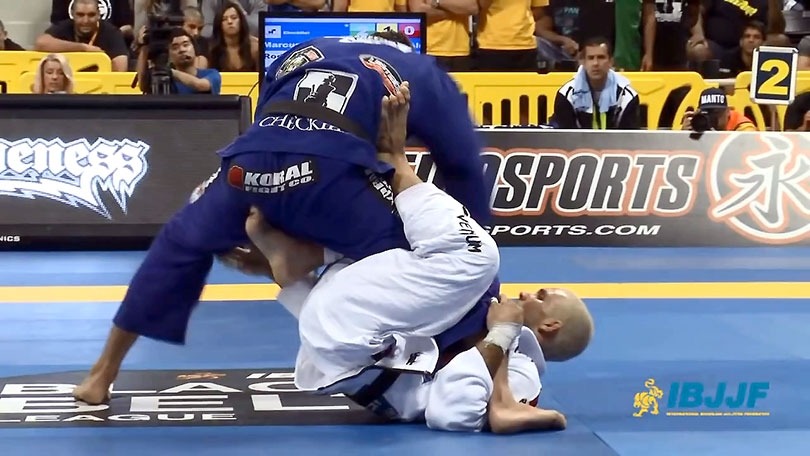




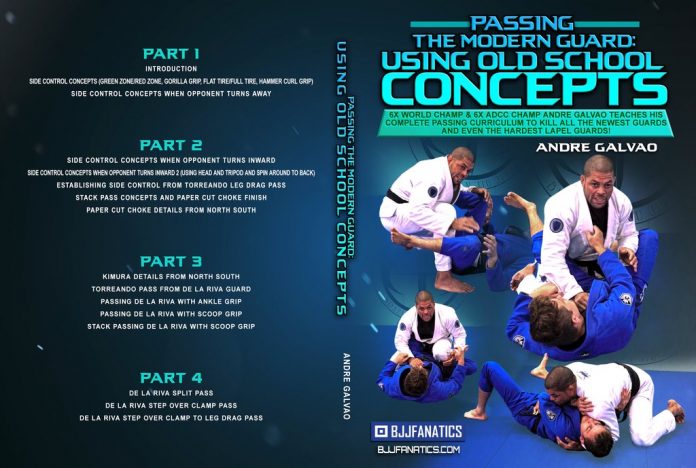
Andre Galvao DVD Review: Passing Modern Guards

Andre Galvao DVD: Passing Modern Guards Review

One of the first instructionals I ever had was an Andre Galvao DVD. I still remember the flower sweep details from that old BJJ instructional. In the meantime, apart from the odd YouTube video or tow, there hasn’t been much from Galvao in terms of DVDs. He is busy, leading on of the top competition teams in the world, and competing that he highest levels himself. However, his absence from the digital instructionals scene was baffling to me. Well, he seems to be back now, and with a bang. His brand new instructional, called “Passing Modern Guards Using Old School Concepts” is now out.

ON SALE HERE:
Andre Galvao – Passing Modern Guards
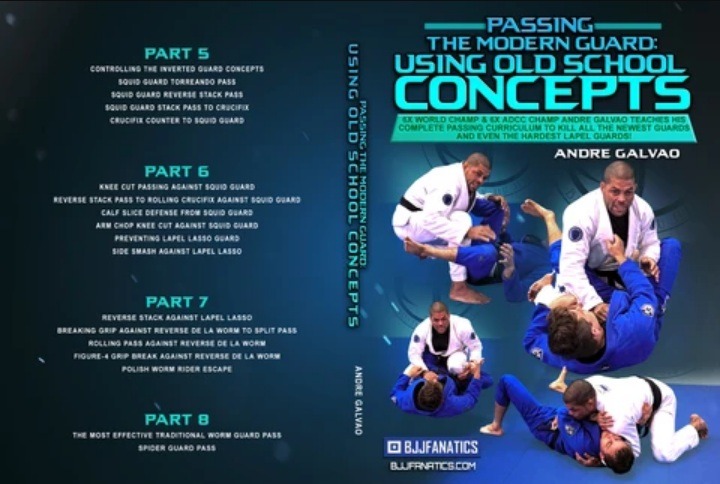
Andre Galvao DVD: Passing Modern Guards

There aren’t many heavyweights in the world that can battle the way Andre Galvao does. Moreover, there aren’t many that can actually show moves that are applicable to lighter people a well. Apart from Cyborg, I’d say that Galvao is the best at doing that in the world. When it comes to the Gi, there’s hardly a better resource for anything BJJ related than an Andre Galvao DVD. Whether it is guard, passing, submissions, takedowns, Galvao has it all down to a science. No wonder his Atos team is one of the most feared teams in Jiu-Jitsu today. And it is not just down to big-name competitors as the Mendes brothers being a part of it. After seeing the Passing Modern Guards DVS I see why even Atos blue belts are such a force to be reckoned with.

The ADCC King

When it comes to accomplishments, Galvao has them all. He has all the “usual” top grappler accolades like the IBJJF Worlds (7 titles), Pans (9), UAEJJF Abu Dhabi Pro (3), Europeans (2), and everything else you might think of.  However, it is the ADCC where his accomplishments are more than impressive. Apart from winning both division and absolute in 2007 and his division again in 2009, he is also the ADCC super-fight winner in the last three editions of the sport. In other words, he is the super-fight king in the last 6 years and will be for two more at least. Quite the reign right there.

Galvao is a black belt under Luis Dagmar of the Reyson Gracie lineage. He got his black belt in 2005, making him one of the OGs of BJJ nowadays. He also spent a lot of time training with Terere, before he set out to conquer the BJJ world. Galvao is known for competing literally everywhere, never skipping a tournament, particularly in his early competition years. IN 2008 he co-founded the Atos team with Ramon Lemos. He dabbled a bit in MMA after that but decided to stick with BJJ after his DREAM and Strikeforce outings. Hei s the head coach at Atos headquarters in San Diego nowadays.

Until the next edition of the ADCC, when he is slated to finally meet Gordon Ryan in the super-fight, Galvao is keeping busy with his team. It is great to see that he is thinking about instructionals once again. His Passing Modern guards Using Old School Concepts is one of those titles that I feel is going to become an instant classic. I guess it is enough that it is an Andre Galvao DVD, to begin with.

Atos-Style Guard Passing

The Atos team is one of the strongest out there in every sense of the word. Now, a good portion of the best of the best ever in BJJ are affiliated with this team, including the legendary Mendes brothers. The team also included Keenan Cornelius until last year, when a bust-up with Galvao saw the American prodigy leave.

The team is very focused on competition preparation and is notorious for utilizing drills as their best training tool. They became a part fo BJJ history almost immediately, with Gui Mendes becoming the first-ever BJJ world champion. The team’s pedigree is ultra-strong with the 50/50 position, the leg drag pass and back attacks their strongest weapons. However, the guard passing skills of the Atos team members does not end with the leg drag. On the contrary, they have proven over and over again they can pass any guard, Gi or NO-Gi, as has Galvao himself.

After both his and his blue belt student’s Tye Rutotolo impressive ADCC outings, this Andre Galvao DVD lands at a perfect time. Passing Modern Guards is just what we needed given that te Gi competition season is just about to kick off. There’s probably a dig at former team member Keenan Cornelius in there as well, give that he is a huge fan and innovator in the area of modern Gi Guards.

Andre Galvao DVD Review: Passing Modern Guards Using Old School Concepts

So what do we get with this latest Andre Galvao DVD? I did have quite high expectations going into the review in the first place. Suffice to say I dod not end up disappointed. Quite the contrary. Once more, Andre Galvao demonstrates that he has amazing teaching skills. Moreover, he knows how to teach from a DVD instructional which not all instructors and teachers do. It is the years of experience that make this instructional a special one. In any sense of the word.

The Passing Modern guards Using Old School Concepts instructional follows the modern-day format of a multiple part DVD set. However, as opposed to the usual four-part ones, this is an extended, eight-part set. As with everything that’s modern, it is available in both DVD and digital format. The instructional opens up with a series of side control details, in parts 1 & 2. The next two parts cover the de la Riva guard before all the modern lapel guards get a lot of attention in all the other volumes. All in all, the perfect formula to pass just about any Gi guard of today.

Side Control Series

This Andre Galvao DVD kicks off in an unusual way – with side control. Not something you’d expect from a Passing DVD, but highly effective nonetheless. The idea is that you end up in side control after most passes anyway, so why not know where you want to end up first? As I Said, this Andre Galvao DVD is a real treat.

The subjects covered in the first two volumes of the Instructional start with basic side control concepts, and go into dealing with common reactions. Options here include what to do when opponents turn, both outwards and inwards. There are also a couple of finishing options based on the paper cutter choke. A very cool North-South Kimura wraps it all up. All in all, a real side control clinic to kick the “Passing Modern Guards” DVD off.

De la Riva Passing
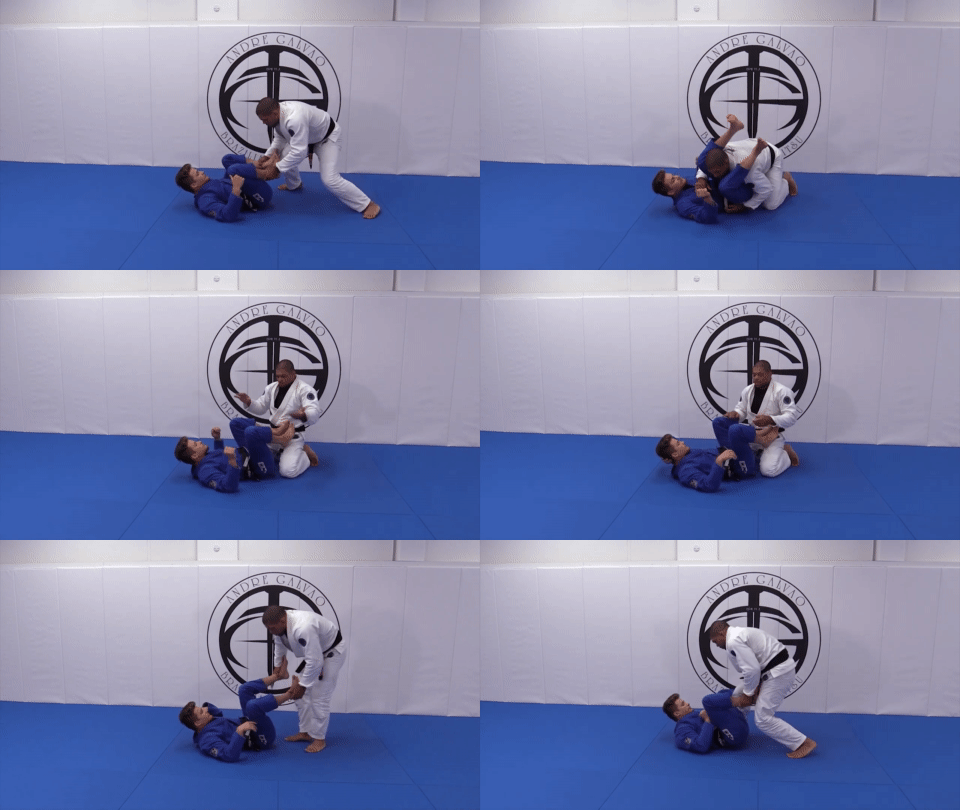
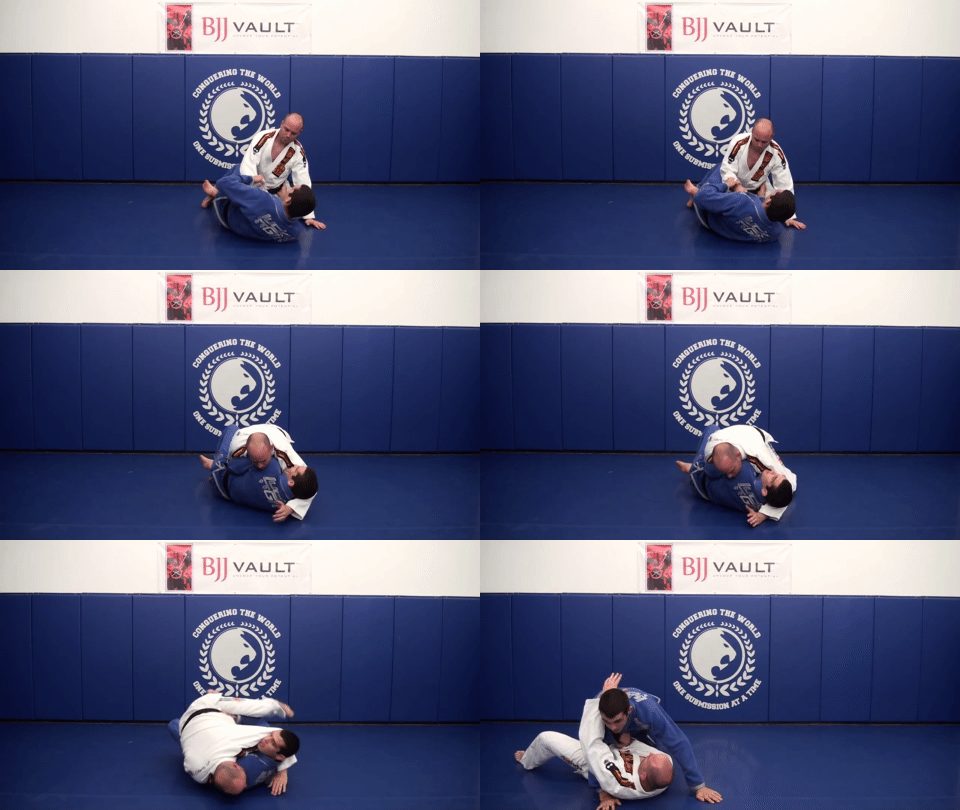
Andre Galvao DVD: Passing Modern Guards Sample 1On the subject of actual guard passing, the De La Riva guard is the first called to attention. The ways past the guars are different, which is exactly what the idea behind this Andre Galvao DVD is. The Torreando pass is first up, followed closely by some interesting innovative concepts. The Ankle and scoop grips seem to be ultra-effective ways to control guards that we’ve been ignoring for years. I have no explanation as to why. Thankfully, “Passing Modern Guards” has opened my eyes to alл the possibilities, not just for De la Riva passing.

Several more options follow, given that two entire volumes focus on the De La Riva. The stack pass against the De La Riva is not something most people expect, so it’s guaranteed to work. Moreover, there are a few clamp passes as well that are just as effective as they’re simple .the winner has to be the split pass, though, along with all the crazy details Galvao shares.

Modern Lapel Guards

The following three volumes can be seen as the counter to Keenan Cornelius’ Guard encyclopedia” DVD. Andre Galvao’s experience comes into focus here, as he provides option upon the option to counter every modern lapel based guard in JIu-JItsu.

Hе begins with the squid guard, identifying its weaknesses before going into actual passes. The methods are old-school once again, with Тorreando and stack passing the preferred options. Oh, and there’s a pass straight into the crucifix from there, just for good measure. The fun doesn’t end there; though, as the knee cut pass also makes an appearance int his portion of the Andrea Galvao DVD.
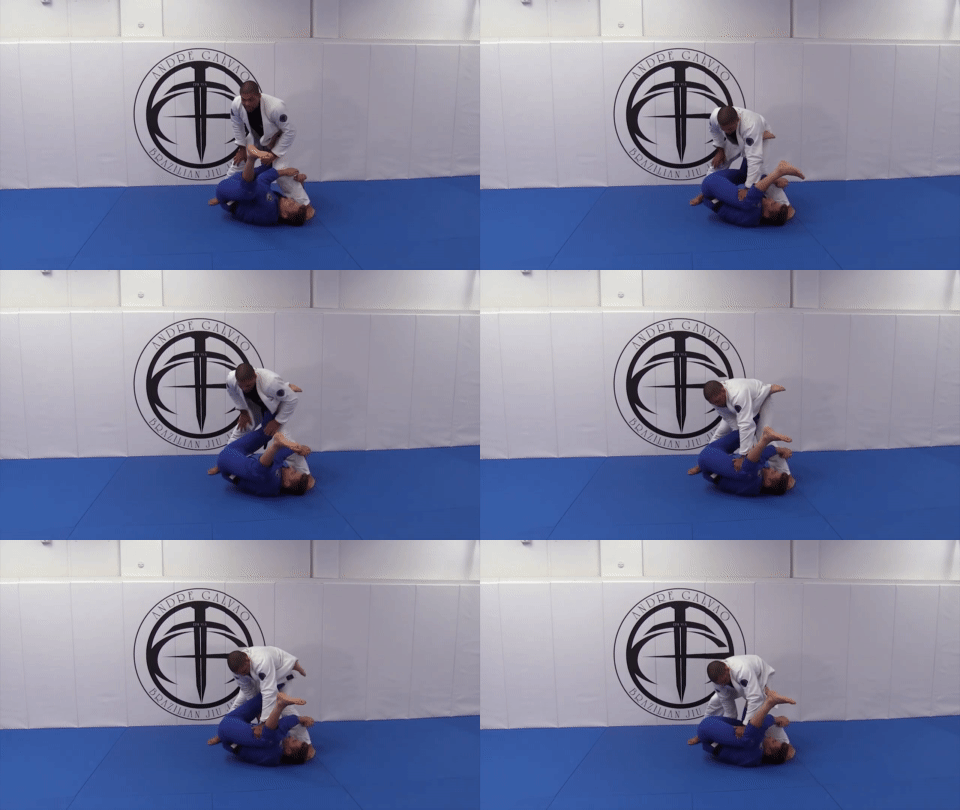
Andre Galvao DVD: Passing Modern Guards Sample 2Dedicated to really making the modern guard player’s life difficult, Galvao teaches counters to common squid guard submission attacks too. He also shares an entire system to prevent, disrupt, destroy and pass the lapel lasso guards. Speaking of annoying guards the De La Worm gets some attention here, acting as the perfect introduction to the final part of the “Passing Modern Guards” DVD.

Worm Guard Solutions

Finally, Kennan’s most famous guard, the worm guard gets an entire DVD to itself. In fact, Galvao goes as far as explaining how to pass the worm guard in one giant chapter that makes up most of this final volume. One more squid guard passing option concludes an amazing instructional on the tricky subject of Passing Modern guards in BJJ.

In Closing

An Andre Galvao DVD is something every grappler should watch at least once in their lives. If you haven’t had the pleasure of watching any of his previous stuff worry not. “Passing Moden Guards Using Old School Concepts” is the perfect one to start with. Just make sure you clear your schedule as you’ll need quite some time to get through it all.

ON SALE HERE:
Andre Galvao – Passing Modern Guards
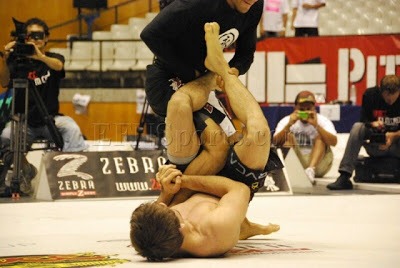
Andre Galvao DVD: Passing Modern Guards

Knee Reaping Explained: Staying Within Legal Boundaries

Knee Reaping What Is legal And What is Not

Knee Reaping. Everyone’s heard of it. It is the BJJ boogeyman for competitions, particularly those that are beginners. For a while there, when nobody was much the wiser as to what Ash Garami is, it wasn’t too hard to stay out of knee reaping positions. However, with the whole modern leg locking game and new positions becoming staples of JIu-Jitsu, reaping is back again as a major source of confusion. Regardless of how you roll in training, if you compete under roles that prohibit knee reaps, you need to be aware of what you can and cannot do.

Deconstructing the knee reap position is not hard. There are clear guidelines as to what is considered knee reaping. Anything outside of that is subject to a referee’s decision. That’s the main issue, basically, as people often use the stuff they think is safe, and end up DQ-ed for it. Asking an IBJJF referee is not going to help either, because they still haven’t gotten every possible knee reaping position down either. They’re covered by the rulebook, where it is stated that “the referee’s decision is final”. If you’re a competitor though, you want to use every advantage you have. So, let’s look at the knee reap, what it is, what does not consist of reaping, and how to use everything in your competition game plan.

What Is Knee Reaping?

Knee Reaping Explained : the COmplete GuideKnee reaping is a position that was made famous by the IBJJF, albeit for the wrong reasons. Before I go on, I have to confess I am not the biggest fan of the IBJJF / UAEJJF ruleset. That said, I’m aware that competing means I have to know it and play by the rules. So it is knowing and understanding the system where most of my focus is. You’d be surprised how many positions you might consider illegal are actually perfectly legal to use. Moreover, you can use them at most belt levels, as long as you understand the rules.

The knee reap is a position where you put pressure on the knee of an opponent in a very dangerous manner. I’m not going to stick to the controversy of things here, but this is exactly why many people think the rule is dumb. There are plenty of other moves, takedowns, and jumping guard in particular that can have much worse consequences on the knee. But enough of that for now. The basic knee reaping position, as the IBJJF defines it, is “when one of the athletes places his thigh behind the leg of his opponent and passes his calf on top of the opponent’s body above the knee, placing his foot beyond the vertical midline of the opponent’s body and applying pressure on his opponent’s knee from the outside.”

Let’ look at it through examples to figure out what not to do in competition. For once, the most basic rule is to never have your toes past the halfway line of your opponent when in the Single-leg X-guard. That’s the most used explanation of a knee reap. For some reason, the toes are important here, and not the entire foot. Go figure. Moreover, certain leg locking positions, like the Sambo Knot is obviously out of the question. Remember, though, that even when you’re defending a leg lock you can get into a knee reaping position. In other words, whenever you throw a leg outside the opponent’s knee and back in above it, you’re knee reaping.

What Is Not Knee Reaping

This is where the fun and confusion begin. What exactly is not knee reaping and how can you set up leg locks, or other attacks by doing what looks like an illegal move? Trust me IBJJF referees have got this down to a science, so you can bet they’re following everything your feet are doing. What most people often confuse in terms of knee reaping is the 50/50 position. Having your legs in a triangle outside the hip does not constitute a knee reap when you’re in the 50/50. The main reason for this is that your leg goes from the inside out, rather than the other way around.

Knee Reaping :Another key point is the 4/11 aka Honeyhole AKA Inside Snekaku position. Despite having a clear leg triangle above the knee of an opponent, this is not inherently a knee reaping position. You can turn it into one by way of grips, though. The position itself is just an inverted half guard, just done from the bottom. Well, sorts of. In any case, you are free to keep the position, triangled legs or not. What you have to look out for is gripping the same leg you have triangled. If you catch a simple ankle lock like grip, you’re knee reaping. That means you can hold the leg with your legs, but you can’t attack it. However, you’re free to grip and attack the other leg as much as you want.

As far as the single leg X guard goes, just keep your toes away from the centerline. Your heel goes as far as you want without entering a knee reap, at least according to the rules.

What to do with this information

First and foremost, do not fear knee reaping. Neither when you’re doing it, nor when someone’s doing it to you. It is only dangerous in terms of getting you DQ-ed. That said, as long as you know the positions you also have an element of surprise. While an opponent is trying to signal a referee that you’re in an illegal position (which you won’t be if you follow the rules above) you have all the time you want to set your attacks up

The best part about understanding knee reaping is that you can easily use positions others do not understand to your advantage. Of course, spots like the 50/50 guard or the Inside Senkaku leg locks are your go-to moves. However, given that you’re restricted to ankle locks and perhaps toe holds, sweeping and passing are actually perfect options as well. In fact, the 50/50 is one of the top sweeping spots. Plus, the Honey hole can actually get you not just a sweep but a pass to mount as well. All the while, you’ll be safe as long as you follow the rules.

Finally, if you’re feeling particularly mischievous, you might want to consider baiting your opponent into a knee reap if they don’t really know much about it. Of course, you can’t just take their leg and pull it into a knee reap position. This will get you DQ-ed instead. However, you might direct them to a position they do not consider knee reaping and get an easy way out of a fight if that’s your type of thing to do.

Wrap up

The knee aping positions in Jiu-Jitsu are no more dangerous than all other BJJ positions. If you do them incorrectly, you might injure someone. If someone’s bursting out of them in an unruly manner, they’ll also most likely injure themselves. That’s why you need to practice them. First, you’ll know how to use them correctly. Secondly, you’ll know exactly what not to do in competition, rather than having to figure it out as you go. No need to fear the knee reap!

10 Best Leg Locks DVDs and Digital Instructionals

Giggler Sweep – Giggle And Sweep From Half Guard

Half Guard Giggler Sweep

Sweeping people in Jiu-Jitsu is no easy business. Sometimes, it is easy for your opponents’ to figure out when a sweep is coming, meaning it is extremely difficult to get one. And, since from any guard in Jiu-Jitu, all you can do attack-wise is a sweep or submit, it doesn’t really leave you with a lot of options. Still, the same old rule applies that some sweeps work better than others. IN terms of high percentage sweeping positions, nothing can beat the half guard. IN terms of sweeps from the half guard, though, it can be hard to find something that works universally. There is one sweep out there that’s rather unknown that ticks all these boxes. It is called the Giggler sweep.

Funny enough, the Giggler weep is actually really easy to understand. It works for a simple reason – misdirection. When you attack with a sweep from the half guard or any guard, people can easily adjust base and you’re left with nothing. However, if you throw in a misdirection in there, your chances increase exponentially. Whether you go for a sweep or submission as a misdirection, though, there have to be rules, or nothing will work and you’re back to the drawing board.

Half Guard Sweeps

Doing pretty much anything from the half guard can be a difficult task. The half guard is one of the easiest guards to get to and stay into. However, when it comes to attacking, you might often find yourself in a situation where you have no idea what’s going on. The half guard is pretty much a 50/50 position, with the person on top having a slight advantage due to gravity. It is this advantage that you want to take away by manipulating their base. That’s when gravity starts working for you, and you get a sweep.

The main issue with half guard sweeps is that the base of the opponent is wide, and it is very adjustable because one leg is completely free. That means you’ll really need to work hard to get the opponent’s base narrow and end up on top. Or you can work smart, and deceive them into doing things for you. A great way to achieve that is to threaten them with something. In the situation of the giggler sweep, you’re actually threatening with a submission and a sweep in order to get a completely different sweep to work.

Although this might sound like a lot of work, essentially it is all very simple. All the attacks you’re doing, are in a direction you need to head to in order to use the Giggler sweep up anyway. And that is the big secret of success with BJJ sweeps. You need to set up attacks that are along the “route” of your main sweep, rather than try and do unrelated stuff and reset along the way. If you really want sweeps to work for you, you have to mask them with other stuff, and the Giggler sweep is the perfect example of how.

Gi Giggler Sweep

The Giggler sweep has a distinct advantage over most of the half guard sweeps – it works in both gi and No-gi. Moreover, it does not require you to “sacrifice” an underhook. Yeah, despite many people thinking underhooks are the ultimate goal of the half guard. They’re not. As a D’arc choke specialist, I can’t wait for people to go for an underhook from the bottom half and let me choke them. Despite the underhook being quite successful for many, it is not the silver bullet of half guard sweeps. What you want, is actually to control one of the limbs of the opponent.

However, you want to have complete control over it, in order to really disrupt the base. The electric chair sweep from lockdown is a great example of controlling the free leg in order to sweep .the Giggler sweep, on the other hand, is all about controlling one of the opponent’s arms.

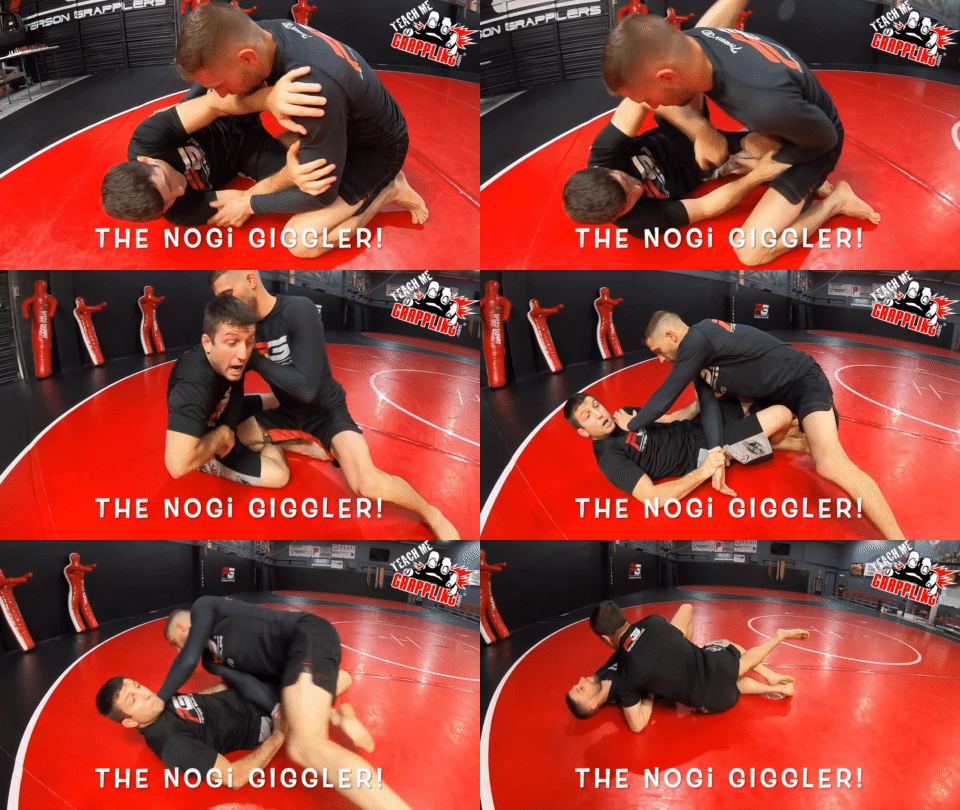
Giggler Sweep With The GiThe whole trick with this sweep is getting a Russian two on one on the far side arm. The basic notion here is that you want to have the far arm of your opponent at the centerline of your body, or near the floor. With the Gi, getting the Giggler is actually very easy. All you need to do is control the sleeve you’re the arm in question. The direction you want to push it in is towards the opponent’s crotch. They won’t think much of it as you do it, and might even end up in crossface. That’s perfectly okay, as they won’t be able to put any pressure on you. All you need to do is roll to the side away from your opponent and they’ll follow tumbling down.

The misdirection here is in allowing your opponent to get the crossface. Most people think that once they get there, they have you pinned. It would be true, if not for the key sleeve grip on their other arm. The grip lures them in toa sense of false security and you can sweep at will. In fact, sweeping them from a crossface is much easier than sweeping them with their posture intact.

Giggling In No-Gi

In No-Gi, the Giggler sweep gets really interesting. This is my preferred version, provided that it works in both Gi and No-Gi. That way, you actually get two Giggler sweep options in Gi. This is where you’re actually going for a Russian two on one. In this instance, you need control over the upper arm of the opponent, rather than just the wrist. However, you can sweep a postured up opponent this way, meaning you open up different opportunities.

Giggler Sweep No-GiThe misdirection here is twofold. First, you grip the nearside arm like you’re going for a Kimura, this opens up an underhook position from where you can go for the usual half guard stuff. However, smart opponents will look to actually get an underhook on you. And that’s exactly what you’re waiting for. The moment they pummel their arm in, you switch your grip from the wrist on one arm, to the wrist of the other. The pummel action in itself will provide you with the elbow grip.

Sweeping from there is as easy as lying on your back and rolling yo9ur opponent over to the side. Plus, you end up on top in a very good position, with the arm still trapped.

Conclusion

Sweeps are really fun and really challenging to pull off on experienced grapplers. If you want to control and sweep an experienced grappler, or someone with a crazy wrestling background, then half guard is your best bet. Moreover, from the half guard, nothing is going to ensure your success as much as the giggler sweep. Just make sure you’re not too obvious about what you’re doing and you’ll hit it every time you try.

BJJ Vocabulary: How to Speak Jiu-Jitsu

BJJ Vocabulary How to Speak Jiu-Jitsu Cover

Are you feeling like people are talking a different language when you’re on the mats? That’s because they are, for the most part. In that sense, the BJJ vocabulary is a vast and unique one. SO much so, in fact, that t can freely be seen as a language of its own. When you first go into BJJ, unless you can fluently speak Portuguese you’ll have a lot to learn. Even with a background in Portuguese, there’s so much more to learn from a technical and even social aspect that it takes time to master it all. However, certain stuff is more important than others, and we have the essentials all laid out for you, so you have an idea of what’s going on around you.

Learning BJJ vocabulary is a must. It is not only going to make your training easier, but it is also crucial for tournaments as well. Not just so you can understand what your own corner is peaking, but also what directions your opponent is receiving. To make things easier for everyone, we divided the most common BJJ words and phrases into categories. That way, you can remember more stuff in a shorter period of time. I remember how confusing it can be to hear all the stuff as a beginner. I still see how completely lost new people are, even those with almost a year of training under their belt. So, let’s make things easier – check out the bare essentials of the BJ Jvocabulary that you have to master.

The Intricate BJJ Vocabulary

There’s no word that describes the BJJ vocabulary better than intricate. Perhaps complicated. IN any case, it is not easy to include Portuguese and English phrases, in addition to words of your own language that are not quite clear to you. However, once you get the hang of it, you’ll be speaking BJJ in no time.

Of course, like every other martial art or sport, you need to know the specifics of Jiu-Jitsu in a technical sense. That means the names of techniques, movements, concepts, etc. The challenging part is organizing everything in a meaningful way. JIu-JItsu is both new and still evolving. Plus it has international roots, meaning you’ll run into a bunch of phrases and words from different languages. Grapplers take them for granted, but they’ll make no sense at the beginning. For example, you might run into a Japanese and Portuguese word in the same sentence, and it’s all going to end in an English phrase that seems completely out of context. A “Kimura to an Omoplata transition in order to obtain a sweep to S-mount” is a great example of this.

There are Japanese words in there because of the Eastern roots of Jiu-Jitsu. Of course, the “Brazilan”  part of BJJ is also huge, meaning you’ll run into stuff that people don’t or can’t translate. And then, there’s all the stuff in English that we take pretty much for granted around the world. And, if you’re throwing in another language to explain all of this, good luck to you! It’ll take time, but knowing the pillars of the BJJ vocabulary will certainly make things more understandable.

The Portuguese Terms

There’s simply no way to train Brazilian Jiu-Jitsu and not use Portuguese words or terms. After all, this modern version of Jiu-Jitsu we all love so much did originate in Brazil. As such, there are simply no substitutions for certain words and phrases that are deeply engrained in the essence of BJJ. To that extent, they are too many to cover here, but as far as the ten most important Portuguese terms of the BJJ vocabulary go, take a look below:

BJJ Vocabulary How to Speak Jiu-JitsuPosture

It may be understandable to most but still. This is something a Brazilian coach will shout simply out of a habit, particularly at tournaments. It means “posture” and refers to keeping a straight spine, most often in situations when you’re in someone’s guard.

Upa

This is one you’ll most definitely hear from a Brazilian coach on a regular basis. Since most people are shy of asking at first, instead of going a few months without really understanding what Upa is, let me help you. It means “bridge”, referring to lifting your hips in the air and turning to one side in a BJJ specific motion. Most often used in escapes.

Fugir de Quadril

Complicated, right? Not so much. This translates to “hip escape’. We’ll talk more about what hip escapes are in technical terms later on. For now, it is enough to know that it is one of the staple movement patterns of Brazilian Jiu-Jitsu.

“Botinha”


In modern days this is a must in anyone’s BJJ vocabulary. “Botinha” refers to leg locks, more commonly to an ankle lock. It is easy to shout at tournaments and quite a lot of people have no idea what it means. So, if you’re on the receiving end of a leg lock and someone shouts “Botinha” make sure you defend your ankles.

Mata-Leão

Out of all the Portuguese phrases in the BJJ vocabulary, this one is the most common. There’s also a good chance you already know what it means. In any case, Mata Leão translates as “lion Kille” and refers to the rear-naked choke. Supposedly, you could kill a lion by using it, although I personally wouldn’t test that claim.

Puxe / Empurre

Two staples of BJJ, particularly with Brazilian coaches. Since BJJ is a game of Push and Pull anyway, you simply have to know the Portuguese words for it. To that extent, “Puxe” is “pull” while “Emurre” is “push”. It might take time, particularly with the first one, as it sounds like push, but you’ll eventually get there.

Vamo Bora

This is simply a way to get people going. It translates as “Let’\s Go” and is something you’ll hear often at tournaments. Also, if a coach is looking at you during rolling, you can pretty much bet that at a certain point, they’ll use this phrase.

Tatame

there is plenty of stuff in Jiu-Jitsu with the word Tatami or Tatame, from brands to actually mats. The literal translation means mats, and “Tatame” is the Portuguese term for it. It derives from the original Japanese “tatami” (most likely). As such, it’s something you’ll hear Brazilian coaches use way more than “mats”.

Porra

This is a staple of BJJ and is guaranteed to be the one word in the BJJ vocabulary you hear more than anything else. Even though it has absolutely nothing to do with actual grappling. The easy translation would be “damn”. However, it means just about anything in BJJ, from being derogative to being a word of support and approval you shout out at tournaments. Don’t take it too seriously.

Creonte

Lastly, you might run into the phrase “Creonte”. There’s no real translation for it, and the closest thing to describe it would be “traitor”. It refers to those that spend a certain amount of time training in one gym, and then go to a rival gym. Switching alliances in BJJ is still frowned upon, but this is slowly becoming a thing of the past. Still, it is a label you want to avoid, if possible.

Technical BJJ Vocabulary

In a technical sense, you’ll probably never stop learning in JIu-Jitsu. Things evolve every day and people come up with stuff that they later name. That means that there’s no real rule about naming things and you end up with more technical words than a regular language might have words. Still, some stuff is pretty universal, and there’s simply no way you can train Jiu-Jitsu without knowing what the following ten words of the BJJ vocabulary mean.

Gi / No-Gi

First things first. Gi means the uniform people wear in BJJ, which is basically a kimono. Actually, Brazilians prefer the term Kimono to Gi anyway. In any case, it is the jacket and pants you wear, oftentimes along with the belt. No-Gi, on the other hand, means training without a Gi. It usually refers to wearing rashguards and spats in modern times, but for No-Gi there’s no defined attire. You can train in whatever you want, which usually boils down to shorts and a t-shirt for most.

Guard

This is a vast term meaning positions where you fight off your back. In any guard scenario, you’re using your legs to control the opponent. If your legs are wrapped around them, it is a closed guard variation. If the legs are not bound together, you’re in an open guard. As long as your legs are between you and the opponent in any situation when you’re laying on the ground, you’re playing guard. That’s all you need for now.

Mount

This is one of the positions everyone is aiming for in JIu-Jitsu. It is also one of the most used words in BJJ vocabulary. In essence, this is when you are on top of someone while they’re lying with their back on the ground .when you’re sitting with your butt at belt or chest level, you’re mounting them. Hence the name of the position.

BJJ Vocabulary Terms And PhrasesBack

the second position everyone wants to get to. It can be referred to as a “Back take”, “back mount” or simply “the back”. IN any case, it means you’re virtually a backpack on someone’s back. Your legs go inside their hips, while you place your arms like a seatbelt in a car diagonally around their torso. From there, you have the best spot to go for submissions while being 10)% safe from counters.

Pass

Remember that we defined the guard as any position where you use your legs in between you and your opponent while laying on the ground? Well, a pass would constitute the opponent getting past the legs of your guard. Once again, this is a phrase of the BJJ vocabulary that refers to a very wide area, given how many different guars there are.

Side Control

Once you pass the legs. One of the positions you’ll most likely find yourself in is side control. In essence, this is a pin, where an opponent is on the bottom, and you’re at a90 degree angle to them, looking to place your chest on theirs. Think about a basic wrestling pin and you’ll understand what it is right away. You’ll spend a lot of time both on the top and bottom in this position while grappling.

Submission

The ultimate way to win. A submission is anything that causes your opponent to surrender. In a tournament, this is the best way to win a match. Usually, submissions refer to moves that place pressure on the joints of the upper and/or lower limbs, or a variety of chokes and strangles we use in BJJ. Since these moves can cause a serious injury and even death, they’re done in a very controlled and careful manner.

Tap

How do you get out of these submissions then? By tapping, of course. How do you do that? When you find yourself in an uncomfortable situation, be it submission or not, all you have to do is tap with your arm or leg or verbally and you’ll be released immediately. Tapping is literally that when you usually use the palm to tap a few times to signal surrender.

Hip Escape

I told you we’d get back to this one. A hip escape often referred to as  “shrimping” is a movement you’ll do every time you train BJJ. It refers to pulling your hips away from man opponent when on the ground. Here are a bunch of ways of doing this, and the movement is also done as a drill, usually as part of warmups. There’s n Jiu-JItsu or a BJJ vocabulary without this one.

Sweeps

Sweeping someone means tripping them when you’re on the bottom and ending up on top. It is far more difficult than it sounds. In order for a sweep to bring you points though, you have to do it from a position of guard, just like we discussed earlier. You can get on top from a bad position like the bottom mount or side control too, but it is not a sweep because you weren’t in a guard position.

Everyday Stuff

Finally, there’s stuff in any BJJ academy out there that makes absolutely no sense to outsiders. Yet, people that train longer are communicating in their own weird way as it seems. What’s even weirder is that they can actually communicate great with people from other gyms or even countries by using the same BJJ vocabulary. Certain terms are just unique to BJJ and they’re the same everywhere. Here are a few extremely common ones:

Cauliflower Ears

What on earth might this mean? Cauliflower ears are something that’s not specific only to BJJ, but rather all grappling martial arts. It is a common chronic condition of the ears that causes them to look like cauliflower due to repeated trauma. As the cartilage in the ears deforms, they take on a specific look. It doesn’t happen to everyone, and it doesn’t need to happen at all, really. That’s why ear guards are for.

Ringworm

You might want to consider really paying attention if you hear this word around the gym. It may just be a discussion, but if it refers to cases from the academy, it’s time to stock up on BJJ soaps. That said, ringworm is a common fungal skin infection that plagues martial arts in general. It is quite hard to get rid of, both from the gym and yourself, so keep your hygiene levels high, and avoid gyms that have had issues with it in the past.

Rolling

Another staple of the BJJ vocabulary. I’ve never heard practitioners from any other martial art uses a different word for sparring other than “sparring”. In Jiu-Jitsu, though, the coolest possible term is used for this purpose – rolling. Since sparring means pretty much rolling on the ground for an allotted period of time, it is more than appropriate. Pretty much anything out outside of drilling and working on technique is referred to as rolling, and you’ll soon get the hang of it.

Let’s Flow

Something many people ay, but not many really mean. It’s just one of those things. Flowing means rolling with next to no resistance, while constantly changing positions and setups for submissions. It is something higher-level belts can pull off, while lower belts usually end up in a full-blown sparring match even when they have the best intentions. It’s an invaluable tool for learning though, and you’ll need to master it for sure. It takes two to pull it off, though, so if you’re learning to flow, choose an experienced partner.

Oss

The one term that’s everywhere in martial arts. In the BJJ vocabulary, this is one of the terms that are left from the Japanese origins of the sport. In Japan, it means anything, from “let’s train”, to “let’s learn” etc. BJJ-wise, it is used for just about anything, not dissimilar to “porra”. Mostly, we use it as a greeting, at the start and end of class, but saying it on any occasion is not considered wrong or out of context.

Porrada

“Porrada“ is huge lately. In fact, it is “everyday porrada” if we want to include the complete term. In Brazil, this phrase is nothing specific to BJJ, and means grinding it out on a daily basis, and putting in hard work constantly. However, in the BJJ community worldwide, this is a very BJJ thing to do, say or wear on a T-shirt. It is a cool concept, I have to admit, although not really applicable to everyone.

BJJ Vocabulary Words you Need to KnowStripes

Have you noticed how BJJ people have these white lines on the black portion of their belts? Well, those lines are stripes, and they signify the level of advancement within a certain belt level. There are four stripes you can get at any belt level before a black belt. After the black belt, other rules apply but stirpes are still a big part of the belt system. So, when someone talks about getting stipes, it means being recognized as advancing towards the next level.

Drill

There’s no way past this word into the BJJ vocabulary. Drilling refers to very specific training of techniques. It is not quite rolling, but at the same time, it is not practicing like you do a new move. Drilling is a short sequence of movements or moves that you repeat for repetitions or time in order to develop muscle memory for it. Most moves are practiced this way, particularly among competitors and drill sessions are something you’ll often run into in Jiu-JItsu.

Gracies

One thing that people often fail to understand completely who the heck are the Gracies? Simply put, the Gracie family is the one responsible for the development and emergence of Brazilian Jiu-Jitsu. However, they are a huge family, and I really mean huge. There are hundreds of them around the world and they all train and teach Jiu-Jitsu. There’s no need to learn all of their names or any for that matter. It is enough to know that they’re the folks responsible for BJJ.

IBJJF / ADCC

These abbreviations are also a big part of the BJJ Vocabulary. They refer t the two premier world promotions that organize Jiu-Jitsu tournaments. The IBJJF organizes both Gi and No-Gi tournaments, although Gi ones are their forte. ADCC, on the other hand, has a different ruleset and exclusively NO-Gi events that lead up to one huge, Olympic-like event every couple of years.

In Summary

The BJJ vocabulary is actually so vast that we probably need an entire dictionary to try and fit everything in. Certainly beyond the scope of any article. However, certain stuff is more important than others, and you’ll run into them regularly. So, of course, it is better if you know what’s going on, rather than just nodding your head in a confused manner.

High Rollerz Jiu-Jitsu Tournament – Third Edition Results

HIgh Rollerz Jiu-Jitsu tournament Cover

BJJ is changing, that’s for sure. Out of all the possible tournaments out there, from the craziness of EBI to the completely off the hook 5 vs. 5 Quintet style one, we’ve seen it all probably. Thre’s even tag team grappling at SUG events, something I never thought I’d witness. And yet, as it seems there’s more to come. I first took notice of the High Rollerz Jiu-Jitsu tournament last year, when their first even took place. What’s really satisfying is seeing it continue developing and growing. Last weekend, the third edition of the tournament took place and it was as fun and unique, perhaps even controversial as both previous ones.

The High Rollerz Jiu-Jitsu tournament is an invitation-only tournament that’s also quite exclusive when it comes to the audience as well. Why? Well, for starters, everyone is high. Literally. The tournament promotes cannabis use. In fact, ti takes things to a different level. Competitors actually smoke cannabis right before they step on the mat to compete. Of course, the crowd is encouraged to do much of the same. And finally, the winner of the tournament gets to take home the ultimate prize – a pound of high-quality cannabis. As I said, not your garden variety BJJ tournament for sure!

The High Rollerz Jiu-Jitsu Tournament

HIgh Rollerz Jiu-JItsu tournamentThe High Rollerz Jiu-Jitsu tournament is very appropriately, dubbed “The dopest martial arts tournament in the world”. We concur. Their explanation that High Rllerz is cannabis-infused BJJ Tournament is also spot on. COuldn’t have put it better myself. The folks behind the idea are “Big Lonn” Howard and “Mighty Matt” Staudt. They both train and compete a lot, and have come up with the best possible tournament format for JIu-JItsu.
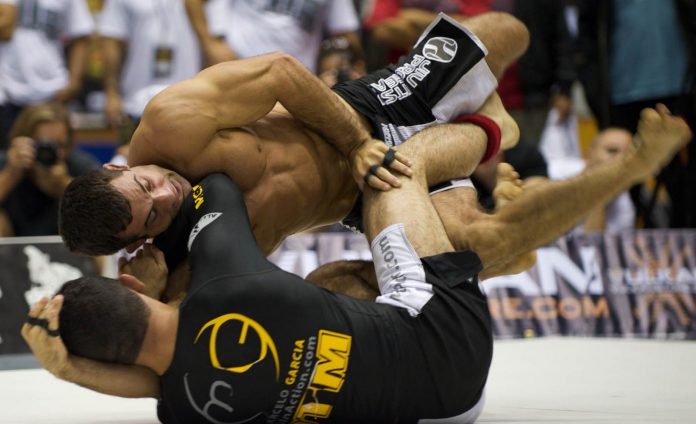
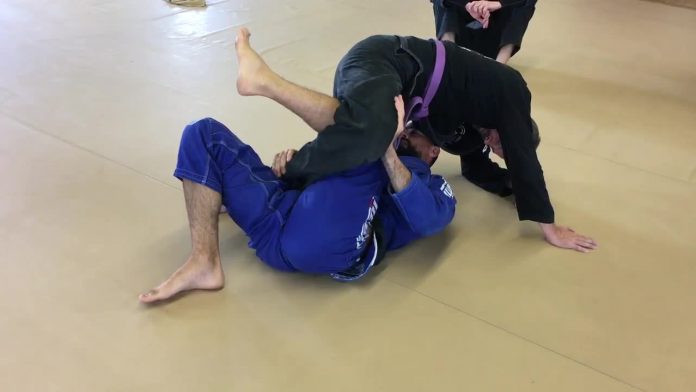
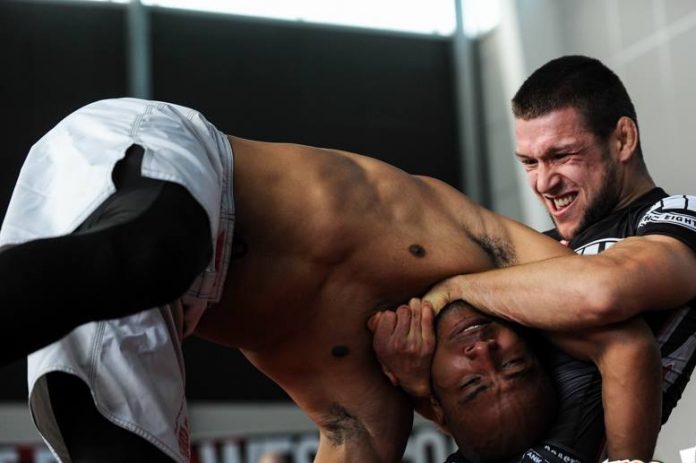
The whole idea behind their endeavor is to promote both things they really believe in and love – Jiu-Jitsu and cannabis. In terms of cannabis, of course, removing all stigmas and educating people to its real effects is their primary goal. However, at the base of it all is having fun, promoting martial arts and an alternative way to enjoy both cannabis and grappling. In that sense, they run a legitimate promotional one that actually features really big name grapplers at all of its events. Of course, the also have it spot on by having Eddie Bravo referee the matches.

The High Rollerz Jiu-Jitsu tournament is based out of L.A. They do their events around the US,m though. However, the best part about it si that the location of events is not publicly shared in order to keep huge crowds from gathering. That gives it an exclusive type of vibe about it, making the whole experience that much better. The show was also featured on Vice, with James Burns saying that it is one of a kind and praising the vision of Matt and Lonn. Of course, they also have the full support and endorsement of Joe Rogan as well.

What Happened At High Rollerz #3?

First, let me say a few words on the ruleset and format of the High Rollerz JIu-JItsu tournament. The rules are interesting, to say the least. Ther ruleset is a product of Jeff Glover who calls it “Ten Or tap”.  IN other words, the goal is to either get 10 points or submission. The point system is pretty logical, with a point for sweeps, reversals and takedowns, 2 points for passing and takedowns that lead to mount and 3 points for mount and back. Moreover, raping is allowed, although heel hooks are not (at white belt only). Forbidden stuff includes stalling, running from guard and neck cranks.

https://www.instagram.com/p/B555azLJzkn/?utm_source=ig_web_copy_link

They’ve got a great approach to draws, with the victory going to the competitor who scored first. In a 0-0 situation, it is down to the referee. Matches last 6 minutes, with the finals stretching out to ten. IN terms of format, there are both male and female competitors, ranging from white to black belt, and competing in Gi or NO-Gi. One thing I have to point out is that the High Rollerz Jiu-JItsu tournament gives the same prizes to both male and female winners, making it one of the few that employs this practice.

In terms of the third edition of the tournament, super-fight winners were Alanis Santiago, among the ladies in No-Gi, and Blake Troop in the male divisions. Santiago beat Chelsea chandler while Troop was better than Leonard Miller. IN the brown and black belt brackets, Breno A Bittencourt got the gold in the GI, while Kevin Crane got past the dangerous Kevin Berbrich for gold in No-Gi. Al lother matches at all levels were also highly exciting and showcased some emerging talent.

What Can We Expect In The Future?

IF you told me about a tournament where competitors share a joint before facing off a few years ago I’d have said it is just a pipe dream. Now, I’m not so sure I’d dismiss anything. For the time being, High Rollerz Jiu-Jitsu tournament have the perfect formula. My guess is the events will grow bigger in the future, drawing even more competitors and certainly more spectators. As usual, a greater frequency of these events would be great, but I’ll settle for what we have now.

In the past two editions, we saw some prominent BJJ and MMA notables. Jeff Glover even had his final match in competitive grappling at the first edition of the tournament. Having Renato Laranja on the microphone is also a great decision by the organizers of this event. Whatever they cook up in the future, I’m eager to see and I completely support this unusual format of BJJ tournament. Who knows we might even attempt to do a local one in my academy, providing we find key green sponsorship.

Conclusion

The BJJ World needs more tournaments like the High Rollerz Jiu-JItsu tournament. It features everything grapplers love – Jiu-Jitsu, fun, positive vibes and of course, ganja! Whoever came up with the idea is genius, and only took what’s happening ton the mats all the time and turned it into a tournament. Not to mention the extremely impressive lineups they feature each time. I certainly hope to see many more of these in the future!

BJJ Sweeps That Work Against Wrestlers

BJJ Sweeps That Beat Wrelsers

Have you ever tried to grapple with someone who has a strong wrestling background? If you have then you’ve probably noticed that BJJ sweeps seem to bounce off them like bullets off Ironman’s suit. Cheesy Marvel metaphors aside, sweeping wrestlers is a real pain. However, there is a way. Regardless of how great their base is, or how much pressure they can generate from the top, you can still send wrestlers flying around the training room. It won’t be easy, and it won’t be pretty but you have to learn it. Otherwise, when you meet a wrestler that knows BJJ in a tournament, you’ll discover a whole new world of pain.

The strategy for dealing with wrestlers is easy – do not let them pressure you. However, given their experience, and extreme tendency to stay on top, this might be harder than it sounds. To that extent, the closed guard is cool to relieve pressure, but you won’t sweep a wrestler from there. Given their immense base and posture, you won’t be able to look for submissions either. Instead, the one position that might offer hope of executing BJJ sweeps against wrestlers is the half guard. The reason behind this is very logical – why fight both their legs when you can isolate one and just deal with the remaining one?

THAT Wrestling base

So, all those people that train other types of grappling martial arts apart from BJJ have one thing in common – they like to be on top. Do not get me wrong, being on top is the desired outcome in Jiu-Jitsu as well. However, the guard game is so vast, that you can spend all your time working off your back and hunting for submissions. That said, when subs do not work, you’re only left with one option – sweep. And sweeping someone means you get on top. If you come to think about it, there’s not one bottom position that’ll earn you points in sports Jiu-JItsu. So, staying on top is key in BJJ too, just not as important as it is for wrestlers.

In Wrestling, the rules dictate that a match can be won by pinning someone to the ground, or by points. Since pinning means someone’s back is on the ground, wrestlers have it instilled in them to never let their backs touch the mats. That means they’ll do anything to stay on top. It also means their base is immense, and they might oftentimes give away a submission attempt but they’ll rarely succumb to BJJ sweeps. And this is the one key reason, apart from their immense top pressure, those high-level writers can toy with most BJJ guys/girls, even if they’re black belts.

The main problem isn’t hard to spot, it is just hard to solve – base. Wrestlers’ immense base means they stay on top constantly. At times, they might even do crazy acrobatics to keep their base. Throw in their explosive power and strength and you have a recipe for being extremely annoyed at your sweeping capabilities. Time to take a different approach, one that has been proven to help you sweep even the world-class wrestlers.

The Winning Formula

When it comes to completing BJJ sweeps against wrestlers, there’s a three-step formula. Of course, for it to work you need to be in the correct position in the first place. In our case, that’s the half guard. The first step when you get there and are looking for a sweep is to know what you actually need to think about when you’re looking to sweep. And the main thing you need to be thinking about is the wrestlers’ overhook, whether it is over your arm or over a leg. Since you can’t really deal with it easily, think about using it to aid your BJJ sweeps.

Next up, is what you actually want to do. Your only goal, before sweeping a wrestler, should be to get them on top of you. Of course, you’re not just going to pull them into a smash, but rather have a trap waiting. Whenever you pull wrestlers on top, they tend t follow, given their programming. This is what you use against them. With the correct half guard setups and follow up, once you get them on top of you, you can sweep in different directions.

However, the most important thing here, more important then what to do, is what you should never do. Never, ever even think about going for BJJ sweeps if a wrestler ahs ayn part of your body smashed, or under control. Any attempt on your part to pull them on will just result in more pressure and more smashing. Instead, make sure you get to a “position zero” where you’re safe to launch all your sweep attacks. Let’s look at this in-depth.

BJJ Sweeps To Send Wrestlers Tumbling

IN terms of which half guard to play, the knee shield, or any variation should be your first choice against a Wrestler. They’ll be looking to overhook something, either way, so you might just accept it and work from there. That said, there are a couple of BJJ sweeps from the knee shield half guard that is irreplaceable when it comes to sweeping strong and fast wrestlers.

First up, let’s talk about a situation in which the opponent had an overhook over your leg. Goal number one is always to prevent the smash. The best thing to do is to use a solid frame made up of a connected knee and elbow. Then it is time to bring your wrestler opponent forward, which is done by placing an underhook dee under their free leg. Form there you have options. You can get an underhook to play Coyote guard, you can go for deep half or simply, extend your legs and sweep with a pendulum style sweep. Personally I prefer a “coil” sweep from the underhook half guard.

Another scenario includes a wrestler having overhook control fo your ar, or a Whizzer, as they like to call it. In order to make sure you both kill the overhook and prevent D’arce choke attacks, you need to get a sneaky grip in. To do that, you get a writ grip on the overhook arm before you look to underhook their free leg yet again. You use that this is a common theme in all BJJ sweeps that work against wrestlers – get them to go forward. A simple hip shovel from there will get you a neat and quick sweep, settling you in top half guard.


Wrapping Up

Let’s make something painfully clear – sweeping wrestlers is never going to be easy. In many cases, they’ll try and counter everything you throw at them. However, if you set up your BJJ sweeps correctly, you will enjoy success. Moreover, working form the half guard means you have a safe spot to fall back to if your sweeps fail. That said, think about using the at wrestling base and love for overhooking against them, and keep puling wresters forward. At least if you want to end up being on top.

BJJ Bear Trap Leg Locks – The Forgotten Ashi Garami

BJJ Bear Trap Leg Locks And Setups

Outside Ashi Garami, straight Ashi Garami, 50/50, Honeyhole, Inside Sankaku, Game over, Truck… The list of leg locking positions just goes on and on and on. All of them work, although some work way better than others. For that reason, people usually flock to stuff like the Inside Sankaku AKA Honeyhole given the success rate and available submission from there. Well, there’s another one to add to the mix. The BJJ bear trap is not something most people associate with an Ashi Garmi. If you take a closer look, though, you’ll notice that it connects perfectly to any Ashi Garami positions, plus offer lots of leg locks. So far, you’ve probably just done it as a calf slicer, Now, it is time to start using it correctly.

The BJJ Bear Trap is one of those spots where you can actually chill out. It seems like it is unstable at first, but once you get someone there, there’s a predictable pattern of events. First, they’ll struggle like a fish on land trying to squeeze out. Then, when they realize they can’t slip out, they’ll settle down, trying to solve the position calmly. That’s exactly when you pair it with some attacks of your own, mostly in the leg lock department. It is a full-blown control position that you can use to both control a match, or transition into better spots, Ashi Garami or otherwise.

What Is The BJJ Bear Trap?

In essence, The BJ Bear Trap position is a calf slicer spot from the bottom, while the opponent is pretty much “hovering” over you. In most usual cases you can get to the position when someone uses rotational escapes against your Ashi Garami. It doesn’t matter which Ashi Garami it is, when someone rotates out, the Bear Trap is seen as the last resort way of tapping them with a leg lock. It doesn’t have to be that way since the position can actually be used to return you into tighter Ashi Garamis.

Let s use the Ashi Grami as an example. Whenever you’re hunting for leg locks, people will try to spin out. It is a common problem of paying the leg lock game. Unless you have a solid connection, in most cases, they’ll even succeed. So the solution is to use the shin of your leg to place it in the bend of their knee as they turn away from you. The goal is to cause the leg to bend and then lock up a triangle with your legs to keep it that way. You have two options from there. Either sit up and hug the opponent’s waist or let them come on top, not knowing they’ll only get stuck worse that way.

As far as the position goes, that’s it. You can pull it off in the Gi and No-Gi and there’s no real philosophy to it. The calf slicer is painfully obvious but what if you decide to hang there for a while? Well, that depends on your positioning. All you need to remember is that you need to use your arms to connect and stop your partner from simply sliding out. You might want to hug the hip, hug the opposite side thigh, control the foot or even use lapels to tie everything down. In any case, once you have the legs and grips in place you can have all the fun you want from the BJJ bear trap.

How to Get To The BJJ Bear Trap

The interesting part about the BJJ Bear Trap is not really what you can do from there, but how you get there. Entries are very versatile because they’re available from just about anywhere. You might get into it from any guard out there, although some work better than others. You might even consider going there if you’re’ on top, caught in the De la Riva guard, for example. Whatever the situation, you can easily rely on the bear trap.

Half Guard

The half guard is a great spot for launching the BJJ Bear Trap. To be more precise, the butterfly half guard is the preferred option. The main goal is to get your opponent on top of you by using the butterfly hook and underhooking their free leg with your arm.  How? Just lie on your beck and it’ll all fall into place. From there, the next step is lifting the far leg so that you can entangle it with your legs to get the Bear Trap. You already have a high grip on the other leg, so you can start having fun.

Ashi Garami

We did already cover how to get in the Ber trap from an Ashi Garami. What is important to know is that you can lock the BJJ Bear Trap both on the outside and the inside. That means that there’s no Ashi Garami variation out there that doesn’t eventually lead to the Bear Trap after an opponent spins. A cool trick is actually going to the Ber trap intentionally when an Ashi Garami isn’t tight or set up correctly. You can either work from the bear trap or, as you’ll see later on, move back to a proper Ashi Garmai and finish from there.

Butterfly Guard / X Guard

The butterfly guard is the most popular open guard among No-Gi players nowadays. Not that it was ever unpopular. That said, it is also the launching pad from a whole host of leg lock attacks. So much so, in fact, that people now try and use pummels and other counters to fend off leg locks. The BJJ Bear Trap is an easy solution to this particular conundrum. When you go for a standard butterfly sweep, regardless of side, orKuzushi, opponents often post to remain in balance. All you need is a brief moment of weightlessness for one leg, just enough to sneak your bottom leg out. Then you’ll use the hook to lift the hips and clamp the bear trap.

The same setup works pretty much from the X guard. In fact, you could go for the reverse X and try to get the Honey hole. If that fails, the Bera trap is already there, waiting.

50/50

The 50/50 guard is one of the most common options for getting the Ber trap. To be honest, it is also one of the best possible outcomes. Passing the 50/50 against a skilled ponent is a nightmare. You can just end up stuck there for ages. Instead, going to the BJJ Bear Trap will allow you to hunt for leg locks from a safe position. Or you could sweep and come on top without much fuss. All it takes is for your opponent to lift the entangled leg, which you can easily get by going for a leg lock. Once they do, spin halfway, clamp the legs and you’re in the Bear Trap.

What Can You Do Form There?

This is where things get really interesting. I’m sure lots of you have done the calf slicer, but there’s so much more to do from the BJJ Bear Trap. In fact, there’ a lot to unchartered territory there too. I have pulled off some crazy submissions by just experimenting. I’ll need to fine-tune some of them before writing about it, so instead, I’ll share a few proven ones here.

Calf Slicer

The calf slicer from the Bear Trap is extremely easy. In fact, sometimes it’ll just come on by itself, given that the position itself is more than half of the submission. To get a tap against stubborn opponents, you’ll need to apply a little more pressure. Hugging the hips is a great way of achieving that. One thing you can do si keep the opponent on top of you, and hug the hips, Another option is to let them get to their knees and sit up for the hug. The latter is a tighter option. However, one thing to look out for is a counter toe hold on your top leg, which makes option umber one the safer one. In any case, for a strong finish remember to rotate your shin outwards, rather than just try to squeeze. It’ll get a tap without failing.

Sweeps

Sweeping is easy in literally every direction with the BJJ bear trap. Just as an example I’ll use a very cool Gi sweep from the position. Once you have the opponent on top of you in the bear trap, you can start working on your sweeping grips. First up, you’ll need control of the far lapel. The aim is to loosen it up and thread it between you and the opponent. Then, you pass it to the arm that’s around the thigh of the free leg. But that’s not all, You actually want to pass the lapel back to the initial hand, once you’ve threaded that one underneath the thigh. From there you turn to your side, towards the opponent, and get up sweeping them with ease.

Heel Hook

Finally, if you’re looking to get a heel hook finish from a stronger Ashi Garami you can always use the Bera trap to re-enter, or as the initial entry point. The aim here is to actually attack the free leg. Form the BJJ bear trap, simply extend your hips .this will force the trapped leg, and the hips of the opponent away from you, allowing you aces to the free leg. Untangle the bear trap, throw your leg over theirs and you have an Ashi Garami. Whether you had to the Honeyhole, or slap on a triangle for Game Over is down to you. And you already know heel hooks from there, right?


In Conclusion

The BJJ Bear Trap is the long-forgotten Ashi Garami. It offers everything other Ashi Garami positions do: submissions, sweeps, and passes. Moreover, You can also transition everywhere from the bear trap, and get to it quite easily. The most interesting thing is that people often put themselves in a position without knowing the dangers. That just makes your job that much easier.

10 Best Leg Locks DVDs and Digital Instructionals

A Few Crazy BJJ Guillotine Variations To Brighten Your Day

Crazy BJJ Guillotine variations

The guillotine choke is a grappling classic and one that predates Brazilian Jiu-Jitsu by centuries. It is one of those moves you see even in old wrestling drawings. As such, it is highly effective both as a position and a submission. There aren’t many of those in grappling martial arts, so when they pop up, everyone turns to them. That’s the case with the guillotine as well, as this is one of the most utilized moves in JIu-Jitsu. That makes it predictable, and up to a point, not too hard to deal with. That’s where different BJJ Guillotine variations come into play, the more unorthodox, the better. And we have a real treat for you today!

I really love guillotine chokes! And not just chokes, but everything guillotine related. There are just so many things you can do with guillotines that you can easily base an entire top and bottom game around them. People at the highest levels have, with Daniel Strauss, in particular, coming to mind. There’s no need to confirm how successful they are, However, in order to be able to catch people off guard, you need more than just one guillotine. In fact, you need more than just the regular guillotine variations as well. That’s where strange and somewhat unusual submissions come into play. Of course, we’re talking only about tried and tested BJJ Guillotine variations that work, right?

Never Sleep On A Guillotine Choke

Pun intended. If you’re caught in a rally tight guillotine, it is nap time for sure. However, the sense I meant this in is to never skip over a guillotine choke opportunity. Precisely because it can put people to sleep with ease. There are in fact, plenty of ways to use guillotines to accomplish just about anything. Having trouble with takedowns? Snap an opponent down in toa guillotine and have your way with them. Suffering from a lack of takedown defense? Once again, go for a guillotine! Trouble passing the guard? A Guillotine rip will get you past any guard out there, Gi or No-Gi. And I haven’t even started talking about BJJ Guillotine variations!

When it comes to choking, most people in BJJ usually start off with the regular, low elbow guillotine. It is a difficult one to do, and one that people more or less know how to defend. So, this one is usually something people do not stick long with. The arm-in guillotine is the second most used variation. It is a more wrestling-style one and can be really devastating, but it requires a lot of understanding of the grips. Finally, there’s the High elbow guillotine, popularized by Marcelo Garcia and now enjoying his second coming thanks to Danaher. However, it too has run into some obstacles as of late.

This is where some unusual BJJ Guillotine variations enter the frame. The idea is to confuse opponents and get better control, faster taps and make them question what they think they know about guillotines. Then, If’ you really want to e high level, you take it full circle. You start using the nasty and unexpected guillotine choke to set up a “regular” higher percentage one, like the high elbow guillotine. It is a beautiful loop if you’re not the one caught in it.

Unorthodox BJJ Guillotine variations That You Can Pull Off On Anyone

We can measure the success of Guillotine chokes in one very obvious way – the rate of submission. The more people you tap with them, the better they are.  However. it is not just the submission rate. If you truly want t be a high-level guillotine artist you need to make sure you’re doing things right. The more blood chokes you have vs. air chokes, the better. Moreover, you have to factor in everything a guillotine choke opens, like passing or sweeping. A clear example is struggling to get a guillotine from the bottom, then doing a sweep and finishing with a mounted guillotine. You have pressure, you have the position, points (if you’re counting) plus a submission ready to go. There are countless situations like this where you can use BJJ Guillotine variations to advance through the hierarchy. And, the stranger the guillotine, the better the outcome.

  • Army Guillotine

The army guillotine is the perfect option to open up turtled opponents. The best part about the army guillotine is that it works off of a back attack setup against the turtle. Everyone knows how to defend seatbelt grips form turtle, meaning you can use their habits against them.

BJJ Guillotine variations Army GuillotineYour first order of business is to thread a hook inside one leg. IN this situation, you’ll rarely get an easy way to establish a seatbelt grip. However, they won’t be defending the opposite sidearm. That means you can thread it around and look to connect both your arms under the near side armpit. The grip is the standard guillotine grip, or whatever works for you. Then you want to fall on your back, connecting your ribs to the triceps. You end up in like an arm triangle – guillotine hybrid that;’s crazy effective. Remember to squeeze the legs, so that the opponent won’t tripod and try to defend.

  • Teabag guillotine

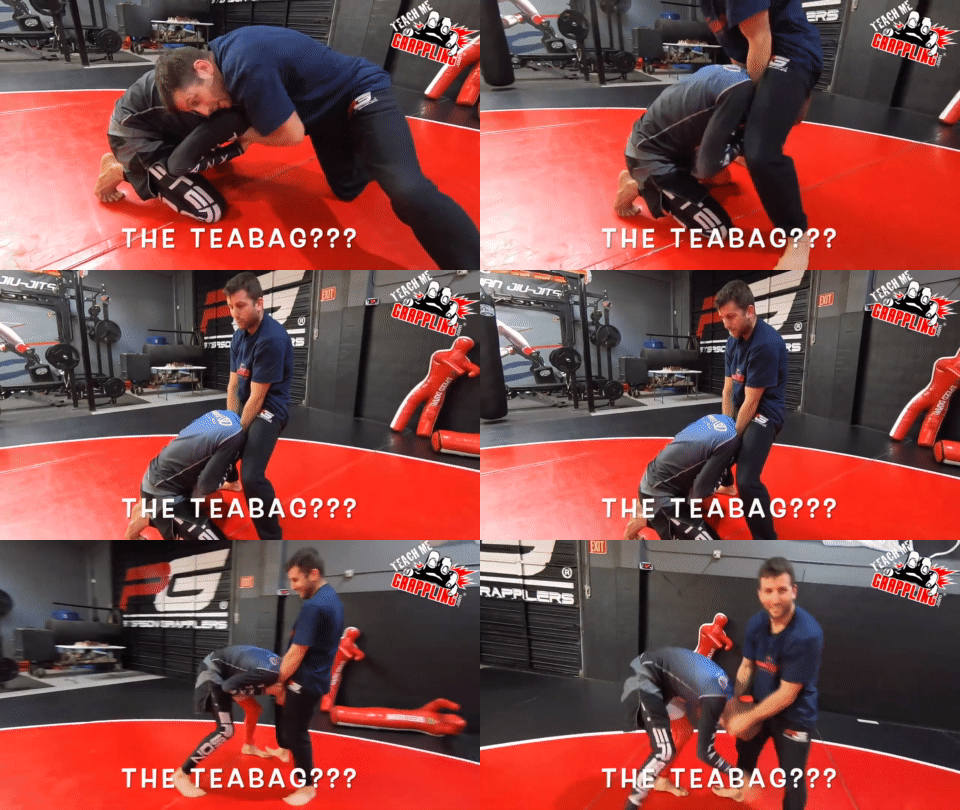
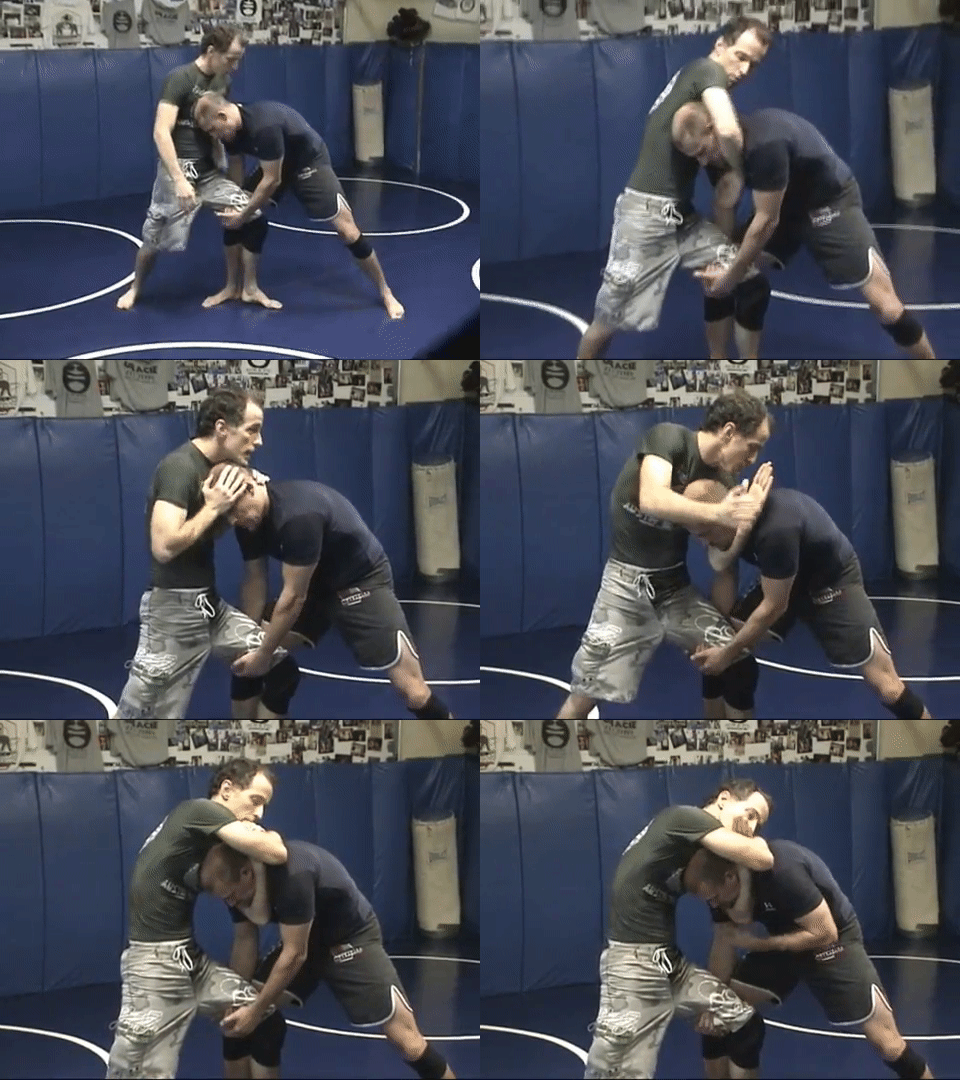
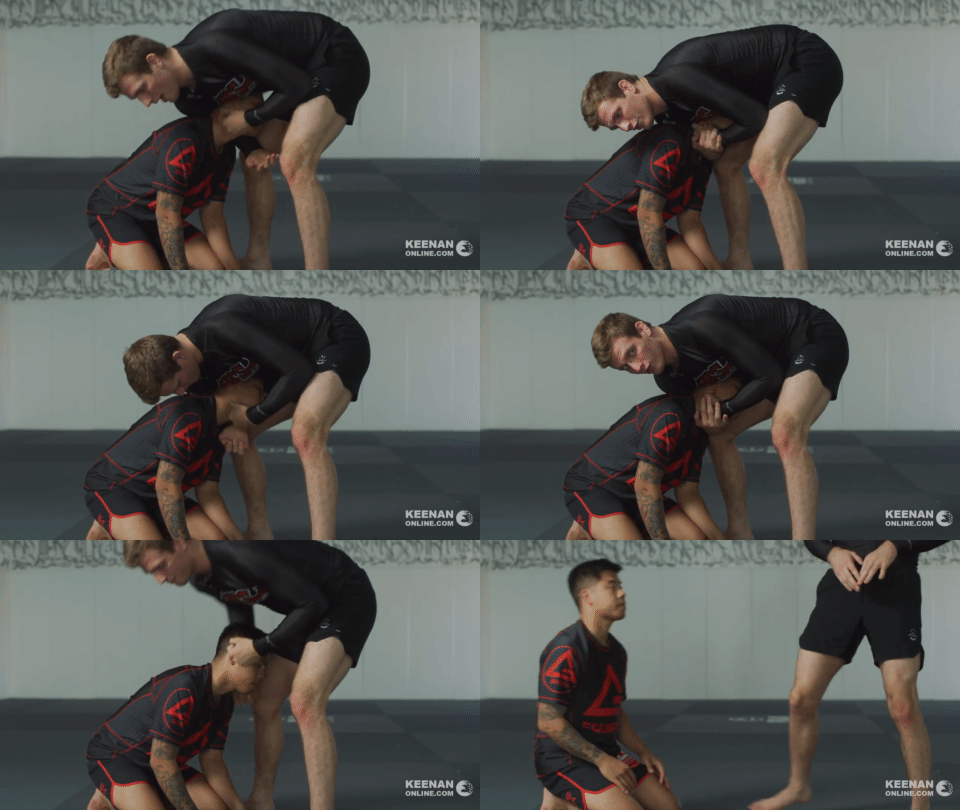
The teabag guillotine is one of those BJJ Guillotine variations you’ll immediately fall in love with. It works when people are trying to beat your guillotine grips from the front headlock. It is funny, innovative, and works like a charm! In essence, it is a guillotine – necktie combination put together perfectly.

BJJ Guillotine variations Teabag GuillotineYour one prerequisite here is a chin strap. In fact, you want to imitate grip fighting as your goal is very simple and S grip underneath the chin of an opponent. That’s it. Once you have an S grip you’re going to do what nobody, including you, expects – stand up. When you stand up though, the goal is to place your butt on the crown of the opponent’s head. Funny but ultra-effective, as they’ll never be able to recover posture, or sneak the head out. Squeeze and push your hips in and you’ll get the tap and a lot of laughs!

  • Reverse guillotine

BJJ Guillotine variations Reverse GuillotineYou might know this one, but it is still one of the most unexpected and effective variations of the guillotine out there. Plus, it works perfectly from standing, mostly in the sense of takedown defense. When an opponent has a single leg on you, first, twist the leg a bit, so that you gain stability for a moment. The twist will position your body sideways which is not really ideal for a guillotine choke. It is, however, perfect for the reverse guillotine. The way you set it up is easy – you go for a high elbow guillotine, but aiming to shoot the choking arm as far as possible.

The idea is that you’re not looking for the regular guillotine grip at all. Instead, think of this like a D’arce choke without an arm in. What you do is lock a figure four grip, in a rear-naked choke style. From there you have two options – squeeze n get a tap, or let them take you down and they’ll go to sleep in the process.

Figure four

The figure four guillotine is once again a front headlock attack that’s based in catch wrestling. It is an awesome way of getting a tap[, particularly if you have lankier arms. It is quick, takes people by surprise and nobody expects it. Moreover, the setup is pretty unorthodox but foolproof, and once you have it,  your opponents will have no way to break out.

BJJ Guillotine variations Figure four chokeFor this guillotine choke variation, you just need a front headlock position, standing or on all fours. Especially if you can’t really thread the choking arm through, this is the choke for you. People won’t go for your arm if it’s not in a chin strap, so you can let it dangle free as long as it is through. Then, you use the other arm to push on the shoulder, as far back as you can. The goal is to grab a low figure four, like a Kimura grip. Once you do, though, it’s all done and dusted. The choke is an air choke that’s brutally tight, and given the figure four and the shoulder control, there’s no way to break out. For a choke, just straighten the wrist of the arm that’s on the shoulder.

  • Diesel Squeezel

Finally, a look at something we’ve covered in detail before. It is also a very, very sneaky choke that works when people think there’s no more danger from BJJ Guillotine variations. In essence, it works like a power guillotine, but the best setup is when you make your opponents choke themselves.

BJJ Guillotine variations Diesel Squeezel ChokeIf you have the chin strap, or anything close to it, you’ll be able to choke people out even when they jump to the correct side when defending. To fend off most BJJ guillotine variations when someone’s passing your guard they go on the side opposite of their head. While for most guillotines this is the end, it is only the beginning fro the Diesel Squeezel choke. The goal is to thread a fist to the opponent’s neck with the harm that’s usually on top. In his instance, you use the choking arm to hold the fist of the other arm, which is going to do the actual choking. That’s all it takes.

In Summary

BJJ Guillotine variations come from everywhere. All you need to do is see them when the opportunities arise. The interesting thing is opportunities arise a lot more outside of those regular guillotine chokes we all love to do. So, when you think you have a guillotine, go fo it. Who knows,s you might just come up with the next big unorthodox guillotine choke that changes Jiu-Jitsu forever!

Testing For A BJJ Black Belt Promotion: Yes Or No?

BJJ Black Belt Promotion Testing: Yes Or No?

When I talk to people that are new to Brazilian Jiu-Jitsu, one of the things I see surprises them most is the approach to grading. They seem very surprised at the lack of ceremonies and tests when it comes to receiving your next belt. Okay, stripes are less important and not such a big deal after a while. A BJJ belt, however, is always aa big deal. So people end up surprised at how laid back the approach to grading is. How come they just tie a belt around your waist? Isn’t there a demonstration I need to do? I, for one, love this approach and wouldn’t change it. From white all the way to BJJ black belt, this is how things are done in most academies. However, is there any merit to actually testing for belts? If so, how exactly do we approach testing a BJJ black belt?

Getting a black belt in Brazilian Jiu-Jitsu is just like graduating from a difficult university. Nope, I stand corrected, it is much harder. And, I can pinpoint one thing that actually makes BJJ harder than learning at school – exams. To be more precise, the lack of exams. The way Jiu-Jitsu is usually set up, you can’t really rely on luck to pass an exam and get the next belt. Imagine a BJJ black belt who has sneaked through belt testing an is actually barely at the purple belt level? That’s bad for the sport, the person carrying the belt and all potential students. But is completely shunning tests the right way to go about things?

BJJ Belt Promotions

I guess one reason why the approach to grading in BJJ is different from other martial arts is the belt system, to begin with. Kids belt aside (and testing, we’ll talk about that in a different article), there are 5 adult belts. Ther go from white, through blue, purple and brown, all the way to BJJ black belt. After black, you have a couple of coral belts and a red belt, but I guess those “grandmaster” ones are beyond testing scope anyways.

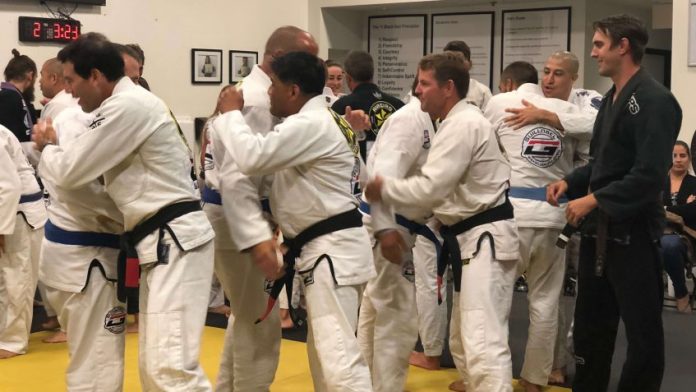
In terms of getting a belt in BJJ, the usual reference is a promotion. IN essence, these are “special”  classes in most academies, just because instructors like to do it all at once. With academies that don’t have their main professor training there, these is usually done in a seminar or camp style of event. In other academies, instructors just call up people randomly at the end of class when they feel they deserve to get to the next level. As such, there are two main indicators of progress in JIu-Jitsu, at least when it comes to visual cues.

  • Every belt has a black are on one end. This is where the stripes go, usually white in color. Every belt has four stripes before you can go to the next belt. Or so was the original idea. Nowadays, people progress at different rates given how many different types of people train. That means that some people get two or three stripes directly, or get the next belt wit just three stripes. Moreover, the approach of tying a belt around someone’s waste allows for a lot of leeways. With the right instructor, this is a proven method of promoting people only when they derive it. However, so much freedom does bring about some misconduct as well.

Do We Need Testing For Belts?

One of the ideas behind promoting people on the spot, without making to much of a fuss or testing is to really be sure that they’re at a  certain level. To that extent, instructors get to watch everyone train, roll, compete, interact with others, perhaps help with teaching, etc. In my opinion, there’s no better way to get a correct view of where people are in their BJJ journey. However, some people think that testing is the right way to go. And among those, there are standouts like Gracie family members that swear by testing for belts.

Speaking of tests, I’ve never had to do one. However, there are different types of tests, as far as I could gather from doing research and talking to people. In certain academies, testing is mandatory, even for BJJ black belts. That said, the approach I found most common is actually one of two things.

The first is getting people to showcase what they can do in “reality”. That means shark tanks of students in question in the middle with fresh partners coming in every round for a roll. This usually goes on for an hour or more, with no rest for those looking to get promoted. It does test technical knowledge, resilience, mental strength and so on. That said, it usually involves higher-level guys rolling with the “candidates” in order to really push them.

The other type of belt testing is the more traditional one. Those that are ready to go to the next belt, get to demonstrate a set of techniques and/or flows to show how much they know. In this case, the focus is on pure technical knowledge, usually without any rolling or faster-paced exchanges. It is not something too common to BJJ, but still, there are world-class academies that use this type of approach. That said, both approaches have their merits if we’re being honest. The real question is, whether or not they fit into the world of JIu-Jitsu?

BJJ Black Belt Tests

I guess we could agree that whether or not colored belts get tested is pretty much insignificant. It is still the professor’s call whether or not someone will get the chance of promotion. However, how do we approach BJJ black belt promotions? After all, there’s the fact that getting a BJJ black belt is aking to graduating from a university. It does take the better part of a decade, if not more for the average grappler to get a BJJ black belt. And I’m talking about dedicated, at least three times a week type of training. That’s a wealth of experience right there. Plus, as they say, if you’re doing something for more than 10 years, you become an expert at it.

Royce Gracie is one example of a Professor that does mandatory testing for his black belts. They do have quite a lot to demonstrate, plus go for rolls with world-class grapplers. Other gyms, like SBG for example, also test everyone. In the case of Thornton’s gym, though, it is the nastiest shark tank you’ll lever come across when a BJJ black belt promotion is at hand. However, I still think lots of it is unnecessary.

The real question here is whether or not someone is a legitimate BJJ black belt or not? The only way to know for sure is to know their lineage. Whether or not you test a grappler after ten years of regular training, they’re going to be at the black belt level. You can go froth with tests and other useless ceremonies, or just give them what they deserve. On the other hand, no amount of testing, regardless of the outcome, can justify giving someone a black belt before they deserve it. McDojos are notorious for it, taking away a lot of credibilities, testing or not.

Closing Thoughts

Unfortunately, in this modern world of grappling it, is not as much about getting a BJJ black belt, but rather getting a legitimate one. Of course, most instructors take black belts very seriously, and people that get the mare legit. For me, testing is redundant, as there’s no way an hour or more can paint a real picture of how much someone knows. Jiu-Jitsu is a lifetime thing, and promoting someone when they derve it, focusing on the fact they reach the next level rather than exams or competition – intensity rolling sessions is what I prefer. Let’s keep it laid back, and honor those that have gotten a BJJ black belt by not treating them as kids that train karate.

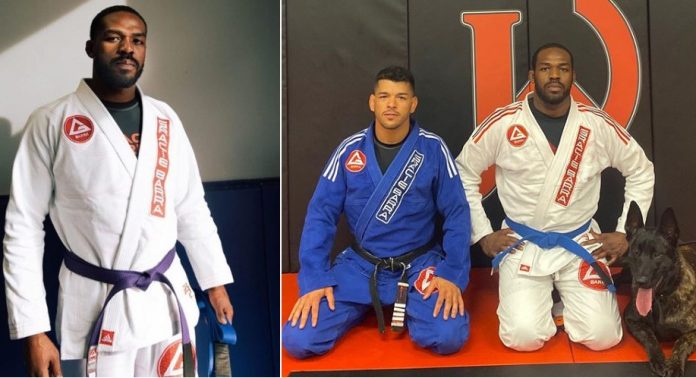
Jon Jones Promoted to BJJ Purple Belt

Jones Jones promoted to Purple Belt in BJJ

Coach Roberto Tussa Alencar just promoted UFC light heavyweight champion, Jon Jones, to purple belt in BJJ.
Jones was a blue belt from July 2017. What’s even more interesting is that Jones regularly trains in the GI.

Jon Jones stated:

“I haven’t felt this honored in a really long time. Thank you @graciebarra”

Jones’ Coach Tussa stated:

“I am very proud and honored to work alongside this extremely talented athlete. @jonnybones made a commitment and has dedicated some time with the GI after his last fight. I am a big believer that training with the GI on and off camps is #supernecessary to develop a deeper understanding of the ground game. I am excited to showcase the work we have been putting in.”

https://www.instagram.com/p/B5y39ZCFFYO/?utm_source=ig_embed