BJJ vs Wrestling – Firas Zahabi Mauls a Wrestler

BJJ vs Wrestling - Firas Zahabi Mauls a Wrestler

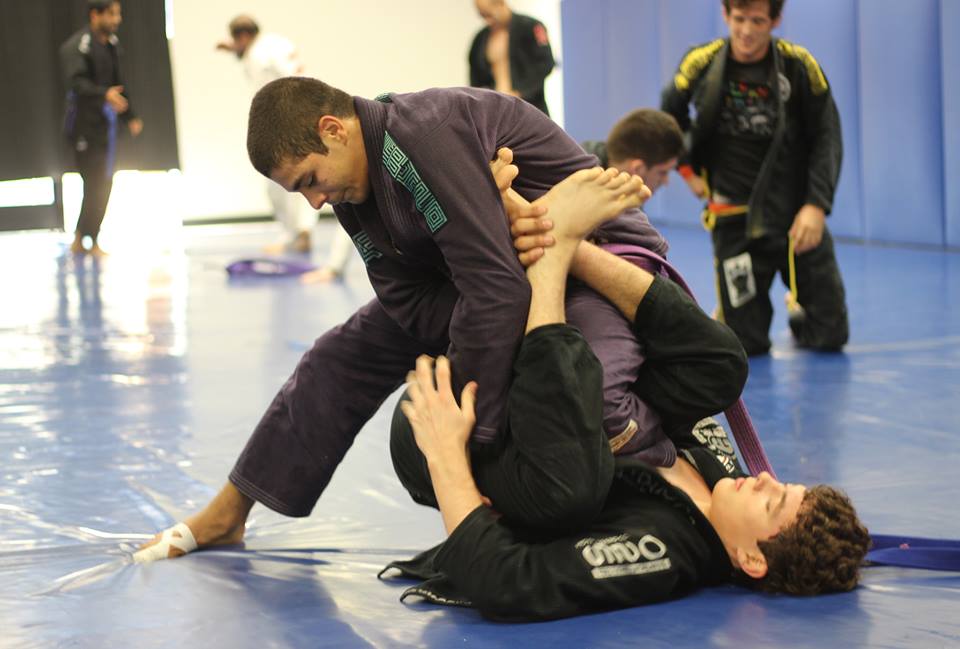
A lot of us remember rolling with a wrestler once we started training BJJ. And what’s even worse those rolls usually comes when we just started thinking we’re getting good. Most of the time people training BJJ for a short period of time get mauled by wrestlers because years and years of grappling must show some result. Luckily for BJJ beginners problems with rolling with wrestlers don’t last much. Most of the time everything you need is to get a solid guard game and problems are over for good. You’ll literally start playing with wrestlers with no BJJ experience.

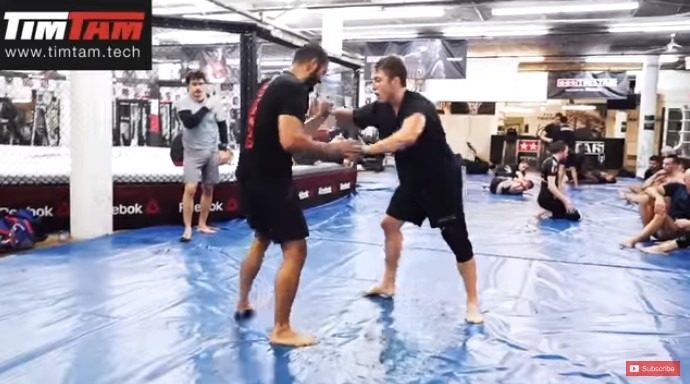
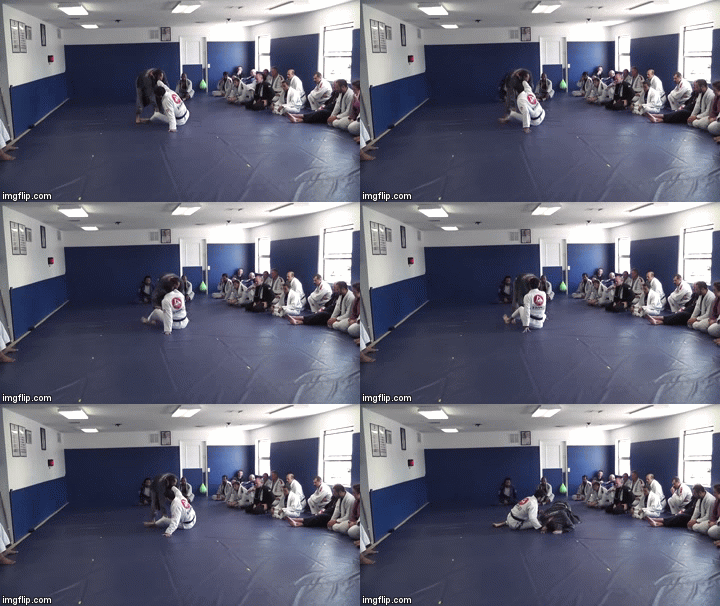
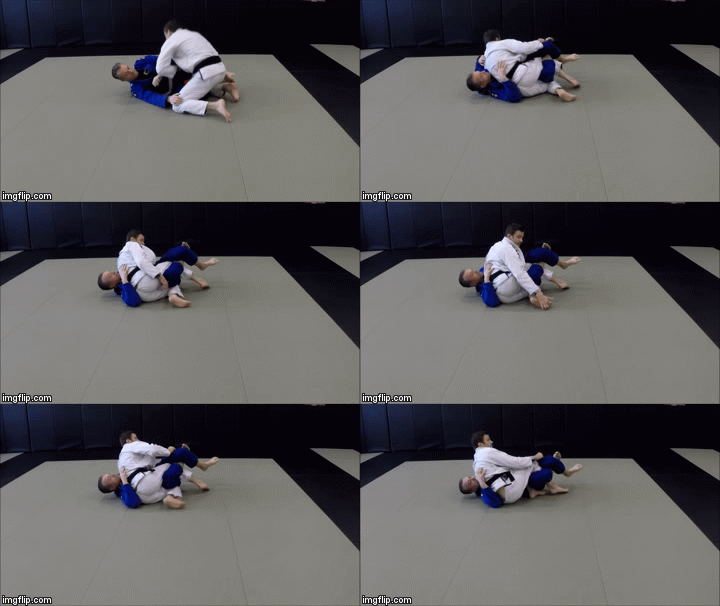
That’s exactly what Firas Zahabi showed in a video below at the Tristar Gym in Montreal. Firas is toying with a seasoned wrestler. Although Firas Zahabi is a BJJ Black Belt and a guy whose knowledge of Jiu-Jitsu is huge but you can get the picture of what should rolls with pure wrestlers look like.

Catch Wrestling vs BJJ and Which Art Has Better Submissions?

Wrestling Conditioning Drills For Brazilian Jiu-Jitsu

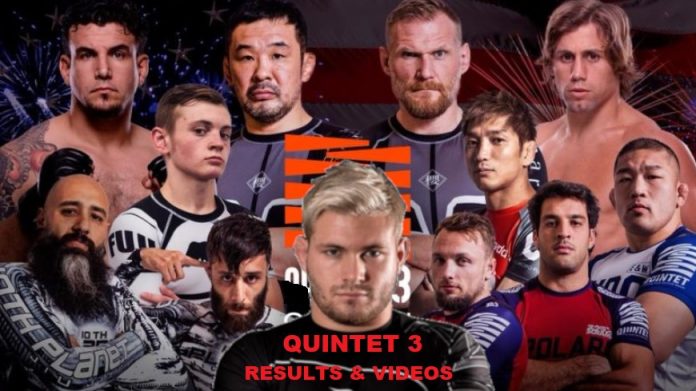
Quintet 3 Results & Videos – The Craziest BJJ Event In 2018

Quintet 3 Results Videos

Quintet 3 Results:

Special Matches

  • Nicky Ryan def. Hideo Tokoro (Rear Naked Choke)
  • Marcelo Nunes def. Haisam Rida (Head and Arm Choke)
  • Satoshi Ishii def. Frank Mir (Mir got DQ’d for Penalties )

Semi-Final 1 – Team Sakuraba vs. Team Alpha Male

  • Kazushi Sakuraba vs. Urijah Faber (DRAW)
  • Antoine Jaoude vs. Daisuke Nakamura (DRAW)
  • Gordon Ryan submits Josh Barnett (Triangle Choke)
  • Gordon Ryan submits Marcos Souza (Rear Naked Choke)
  • Gordon Ryan vs. Roberto Souza (DRAW)

Semi-Final 2 – Team 10th Planet vs. Team Polaris

  • PJ Barch def. Vitor “Shaolin” Ribeiro (Armbar)
  • Gregor Gracie def. PJ Barch (Kneebar)
  • Gregor Gracie def. Amir Allam (Kimura)
  • Geo Martinez def. Gregor Gracie (Kimura)
  • Marcin Held def. Geo Martinez (Kneebar)
  • Craig Jones def. Richie Martinez (Achilles lock)
  • Craig Jones def. Adam Sachnoff (Rear Naked Choke)

The Finals – Team Alpha Male vs. Team Polaris

  • Dustin Akbari vs. Dan Strauss (DRAW)
  • Mansher Khera vs. Marcin Held (DRAW)
  • Craig Jones def. Antoine Jaoude (Rear Naked Choke)
  • Gordon Ryan def. Craig Jones (Rear Naked Choke)
  • Gordon Ryan def. Vitor “Shaolin” Ribeiro (Armbar)
  • Gordon Ryan vs. Gregor Gracie (DRAW)

Quintet 3 Videos

Special Match

Nicky Ryan def. Hideo Tokoro ( via RNC)

The first match of the night was the special fight between Nicky Ryan, the younger brother of Gordon Ryan, and Hideo Tokoro.

Hideo Tokoro was able to get to the legs of Nicky with some nice looking rolling entry. He issued a leg entanglement but NIcy was the one to get better of it. After the scramble, Nicky was able to get to bac of Hideo Tokoro. Nicky did some great back control with body triangle on and that was enough for him to finish Tokoro with an RNC.

https://twitter.com/Maldobabo/status/1048398359164280832

Semi-Final 1 – Team Sakuraba vs. Team Alpha Male

Kazushi Sakuraba vs with Urijah Faber (DRAW)

The first match of Quintet 3 tournament was one between Kazushi Sakuraba and Urijah Faber, two MMA legends and UFC Hall Of Hamers.

At the beginning of the match there was some back and forth fight going on for a takedown. The referee wasn’t very happy with it so he issued a warning to both of the fighters.

After that Famanagedaged to get on top side control over Kazushi Sakuraba. Although lighter than Sakuraba Faber did some great pressure and managed to control Sakuraba. The Referee, again, issued a warning for stalling. Urijah then transitioned to a toehold but wasn’t successful with it. Sakuraba managed to get away for a short time and then after a lot of scrambling Urijah, again, managed to get to a toehold but Sakuraba was defending it nice and that’s how the match ended. Fast Paced and interesting match between two veterans ended in a draw.

Antoine Jaoude vs Daisuke Nakamura (DRAW)

The second match of the round was between Brazilian Antoine Jaoude and Japanese star Daisuke Nakamura.

Jaoude outweighed Nakamura significantly but that wasn’t enough for him to get the better of Nakamura as Nakamura was able to use his speed very well. He was able to have some really acrobatic attacks with some flying armbar attempts issuing a lot of scrambles.

At the end of the round, Nakamura was trying to take down Jaoude but ended up on the bottom in a half guard. That was the position where the match ended in a draw eliminating both of them from the tournament.

Gordon Ryan def. Josh Barnett (via submission, Triangle)

This is the match everyone wanted to see. Adcc medalist and John Danaher’s Black Belt Gordon Ryan vs Grappling and MMA legend Josh Barnett

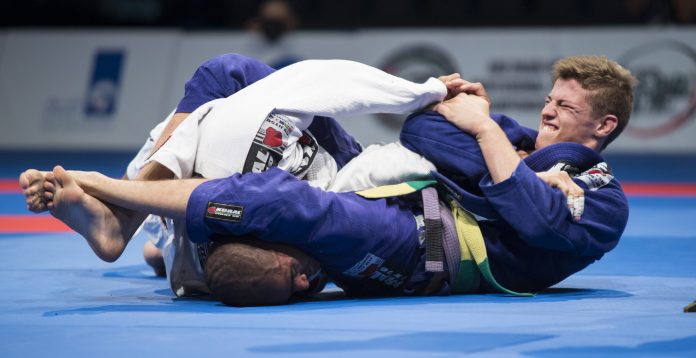
Gordon Ryan started a match with a butterfly Guard. He was very agressive with it trying to engage Josh Barnett as much as he could. After some time he managed to sweep Barnett with a beautiful butterfly sweep and get the top side control. Soon after the sweep Gordon got to full mount working his way to the top of Barnett’s body.

Barnett was able to bump Gordon but Gordon did a great move while Barnett was reversing the position. He pushed his leg over Barnett’s leg and secured a triangle. After a short time in a triangle choke, Barnett had no other options but to tap to a younger opponent.

https://twitter.com/Maldobabo/status/1048405066389102592

Gordon Ryan def. Marcos Souza (via submission, RNC)

Gordon Ryan’s second fight of the evening was one against Marcos Souza. After a lot of takedowns from Ryan, he managed to get to a top position with Souza on bottom playing butterfly guard.

Souza was really trying to prevent Gordon from passing his guard, but despite his efforts, Ryan was able to secure pass his guard and immediately transition to a full mount.

Ryan’s mount was seemed inactive to the referee so he stood both fighters up. Soon after Ryan was again able to get to the top. While trying to pass Souza’s guard he managed to get on his back. Ryan established a solid back control with a body triangle lock on that led to a rear naked choke and the tap fro Souza.

https://twitter.com/Maldobabo/status/1048406751425560576

Gordon Ryan draws with Roberto Souza (DRAW)

Gordon Ryan’s third match was against Roberto Souza. Roberto Souza started the match aggressively forcing Gordon Ryan to pull guard.

Souza was trying hard to pass Ryan’s open guard but with no success. After some time Ryan managed to get on his feet and he did a nice double leg takedown. They entangled their legs and Souza got better of it by scrambling his way on top.

The rest of the match passed in Souza’s trying to pass Ryan’s guard until referee decided to get the restart the position Souza got ryan’s back but was unable to secure the subission as time was up.

Although this match ended in a draw Team Alpha Male had more victories and proceeded to the finals.

Team Alpha Male DEF. Team Sakuraba and advanced to finals

Semi-Final 2 – Team 10th Planet vs. Team Polaris

PJ Barch def. Vitor “Shaolin” Ribeiro (via submission, Armbar)

The first match between Team 10th Planet and Team Polaris was between BJJ Legend Vitor “Shaolin” Ribeiro and former NCAA wrestler PJ Barch.

As Ribeiro knew that he’s facing a wrestler he immediately pulled a guard on PJ Barch. Shaolin’s half guard was unpassable for PJ. Shaolin managed to sweep PJ from half guard and get the to position.

Due to inactivity referee in referee’s eyes, he stood them up. Soon after, Barch was able to pass Ribeiro’s guard but Ribeiro but not for long. While in Ribeiro’s guard he tried to isolate his arm but with no success and he lost the position. On the bottom, Barch was very active with his knee bar and leg lock attempts and at one point he managed to get on Ribeiro’s back. While he was unable to choke Ribeiro he transitioned to arm attack rolling into the belly down armbar and that was enough to force the tap from Ribeiro.

https://twitter.com/Maldobabo/status/1048413042650832896

Gregor Gracie submits PJ Barch (Kneebar)

Gregor’s second match was against PJ Barch. WIth a use of foot sweep, Gregor Gracie did a nice takedown. After a series of leg attacks, he managed to secure a kneebar that immediately led to a tap from PJ Barch.

https://twitter.com/Maldobabo/status/1048414053494927360

Marcin Held submits Geo Martinez (Kneebar)

As soon as the match started the leg attack exchange has started. Kneebars to heel hook attempts were traded all the time. Marcin held got better of it as he was more aggressive and he managed to pull a tight kneebar forcing Martinez to a fast tap.

https://twitter.com/Maldobabo/status/1048418285912559616

Richie Martinez def. Marcin Held

The fast-paced action started from the beginning. Martinez did a very good use of rubber guard and threatened with a gogoplata with a quick transition to armlock variation and secured a tap for his team 10th Planet

https://twitter.com/Maldobabo/status/1048419016921010176

Craig Jones def. Richie Martinez (Straight Foot Lock)

Seconds after the match started Craig Jones did a nice Achilles lock.

https://twitter.com/Maldobabo/status/1048419695601360896

Craig Jones def. Adam Sachnoff (RNC)

https://twitter.com/Maldobabo/status/1048421486355255296

Marcelo Nunes def. Haisam Rida (Head and Arm Choke)

https://twitter.com/Maldobabo/status/1048425529718853632

Craig Jones def.Antoine Jaoude (submission RNC)

https://twitter.com/Maldobabo/status/1048436905342377989

Gordon Ryan def. Craig Jones (submission RNC)

https://twitter.com/Maldobabo/status/1048438194268774400

Gordon Ryan def. Vitor “Shaolin” Ribeiro (Submission Armbar)

https://twitter.com/Maldobabo/status/1048439740758994944

Quintet 3 Preview

It is going to be nuts! It is going to be exciting! And it is coming to the USA and is about to explode! Ladies and gentleman grapplers, the craziest grappling tournament is about to have a third edition. And this time, it comes all the way from Tokyo to the fight capital of the world – Las Vegas. Kazushi Sakuraba’s grappling promotion, featuring the weirdest ruleset so far, is about to go global. Despite being only the third edition, the event features names that are going to excite the grappling world, to say the least. Yeah, the teams are out, and it is going to be one of the most epic Jiu-Jitsu events ever held. Get ready for Quintet 3, the first and only 5 vs 5 grappling tournament!!!

As if Vegas didn’t have enough huge things happening in October. Just 24 hours before Conor Mcgregor and Khabib Nurmagomedov face of in the octagon, grappling fans will have a great way to warm up for the fight. Quintet 3 hits vegas o October 5th! Quintet is the latest submission only promotion to enter the stage of professional Jiu-Jitsu. However, there’s something different about it. Actually, there’s a lot different about it. It is a team tournament as opposed to the usual individual ones. it also features a crazy rule set, on we’ve never seen before. Plus, all the teams involved have so far provided incredible entertainment. Now, in Quintet 3, the roster of grapplers that’ll potentially face off is unlike anything we’ve seen before!

So far, the two Quintet events took place in Japan. This is unsurprising, given that he founded is MMA and grappling legend Kazushi Sakuraba. The first sign of craziness is the fact that Sakuraba himself, at the age of 49 is still competing against high-level opposition. So far, he competed at both Quitnet events and is not about to skip the third one. Speaking of which, the No-Gi sub -only Quintet 3 event, is not only switching continents but also increasing the quality of competitors. Below, we take a look at the four teams about to battle in the first ever Quintet event on US soil!

What Is Quintet? 
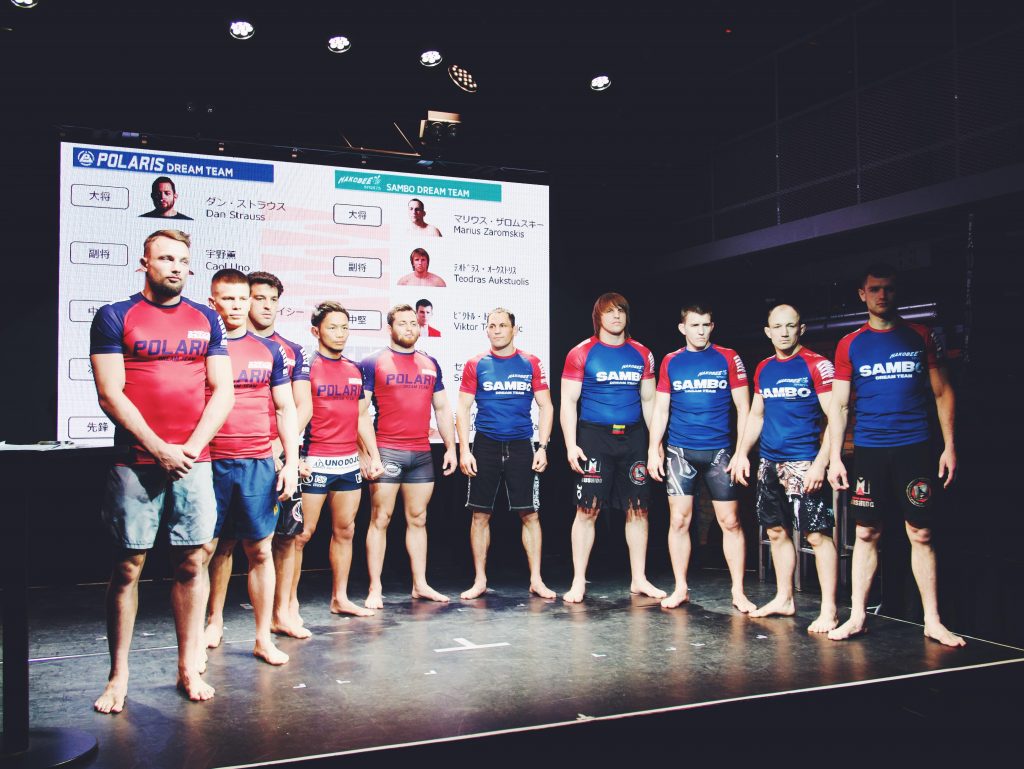
Quintet 3 Line Up Seriously, if you still have to ask this questions you must’ve been living under a rock. In all fairness, the Quintet tournament is pretty new, but it is anything but unnoticeable! a grappling tournament featuring 5 vs 5 teams? It is already enough to tickle the curiosity of every grappler out there. Throw in the unusual ruleset and you have what’s about to become the most anticipated grappling event in the world!

The Quintet tournament is based on an old wrestling competition system. TI includes teams of five grapplers that goe up against each other. There are no weight classes, meaning smaller grapplers can potentially face heavyweights. The only way to win is via a submission. UNless two people submit each other, it is a draw and they’re both eliminated. if one grappler wins, though, he stays on facing the next member of the opposite team. Oh, and there are no heel hooks. And there’s also no closed guard allowed.

So far the winners of the first Quintet event were team Polaris, featuring Craig Jones, Gregor Gracie, Dan Strauss, Caol Uno, and Marcin Held. The first event also saw 11 out of 17 matches end via a submission. At Quintet 2, ti was all about team 10th Planet, led by the enigmatic Martinez brothers. There were some memorable matches and some crazy submissions as the second event topped the first one, according to most! Now, it is time for Quintet 3 and I, for one, am truly excited about this one!

The Quintet 3 Line Up
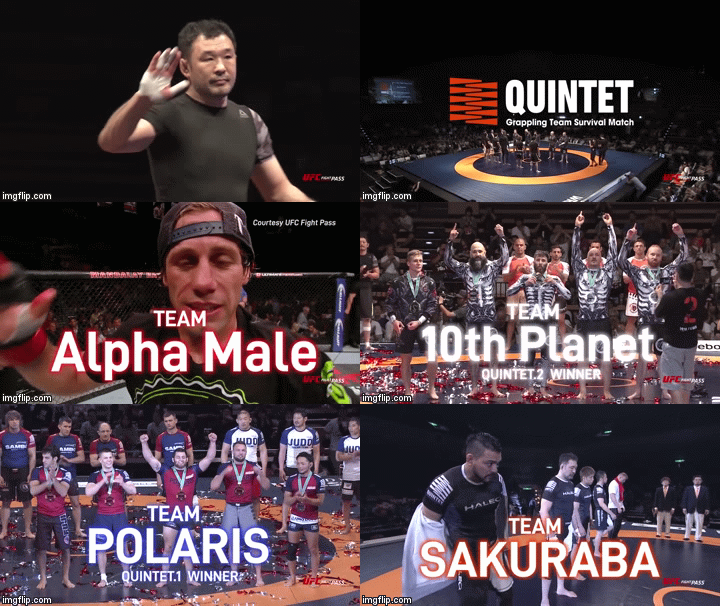
Quintet 3 Trailer So far, even the announcement of Quintet 3 has people anxious for the tournament! Polaris team, the winners of the inaugural event, and Quintet 2 victors 10th Planet Jiu-Jitsu will both feature. The remaining two teams are no joke either, with one of them, named led by Sakuraba himself once again. The final team for Quintet 3 is handpicked by Uriah Faber, unsurprisingly called team Alpha Male. Which team has the best chance of victory?

Team Sakuraba

First up it is the relentless founder of the tournament. kazushi Sakuraba might be almost 50, but he is still one very formidable grappler! So far his team got to the finals once. This time, he’ll be looking to go all the way and claim victory in his third attempt. And his teammates are no less well-rounded as grapplers! Pride and UFC legend Josh Barnett is going to look to introduce some high-level catch wrestling to the mix. Completing the team are Marcos Souza, and Roberto Satoshi Souza.

Team Polaris

Any team that features Craig Jones has probably the best odds at winning any tournament. However, when his teammates are also grapplers of the utmost quality, they turn into the clear favorite! As they already proved at the first ever Quintet event, they’re a very formidable bunch of grapplers. Energy demon Dan Strauss is also a member, bringing endless aggression and guillotines of hell to the game.  Gregor Gracie and Marcin Held are also back, with the fifth member still to be determined. Whoever it is, they can only get scarier, right?

Craig Jones is one of the best submission artists of today. He has a rich and versatile game but he’s particularly scary with his leg lock setups. Learn his leg locking ways with the help of his “Down Under Leg Attacks” DVD set. It is the ultimate resource for mastering both the offensive and defensive aspect of leg locking!

Team Alpha Male 

So far, team, Alpha Male have only three confirmed competitors. However, it seems like there would be more than enough to take on any other team in the tournament. Led by the founder, head coach and UFC veteran Uriah Faber, they’re going to be the smallest built team at the tournament. Given that they’re known as a gym of bantam, feather, and lightweights, this is not surprising. Supporting Uriah so far are Urijah two more UFC fighters in Dustin Akbari and Chris Holdsworth. Wonder who Uriah will ask to complete their starting five?

Team 10th Planet

Finally, Eddie bravo’s picks remain unchanged from last time out. Once again, Geo and Ritchie Martinez are the tips of the spear. Actually, Boogeyman got a memorable D’arce finish over Sakuraba, while Geo went into grappling folklore with his giant-killing submissions. PJ Barch, Amir Allam, and the guy who got the team to the finals last time, Adam Sachnoff are all back to prove they’re the undisputed champions.

Last time out, Boogyman did really well with the rubber guard. Learn the secrets of 10th Planet Jiu-Jitsu’s most famous system with Brandon McCaghren. “Rubber Guard: The Meathook” is a DVD instructional that explains the rubber guard system inside out. Even if you don’t like playing rubber guard, you need this DVD to learn how to try and defend it!

Who do you got winning Quitnet 3?

Grappling Strength Training – How To Train Isometric Strength

Isometric Grappling Strength

Grappling strength and conditioning training is a key part of training any grappling martial art. Despite BJJ people claiming that technique beats strength, they still go for strength when things don’t go as planned. Even at the highest levels of the sport, strength is a huge factor in deciding outcomes, even it is only used in a fraction of a second. The trouble with the perception of strength in Jiu-Jitsu is that people see it in black and white. They either think they do not need it at all, or they rely on it way too much. Strength and conditioning are just different aspects of the game that have their application in specific situations. It is just like with technique. There are certain points in every roll where strength does factor in significantly. However, there are different types of strength that actually have a practical use for grapplers.

Getting stronger for BJJ is not as easy as just supplementing with powerlifting. Grappling strength is much more complicated than what weightlifting requires, or has to offer. Don’t get me wrong, weight lifting has a huge place in grappling strength and conditioning programs. But so do bodyweight exercises, kettlebells, Yoga and a bunch of other things. Why? because all of them bring something different to the table. Combining each of them in a program that actually works is a whole other can of worms. For now, we’ll leave them all aside and focus only on strength. Actually, we’ll focus on only one aspect of strength training that is often not included in most people’s programs.

As far as strength goes, there is a dynamic and static portion to it.  Going deeper into things, strength can be explosive, speed-strength, strength-speed, isometric, eccentric and so forth. Categories are not as important for today’s article, but one specific aspect of grappling strength training is. That is an isometric strength. it is an aspect of strength and conditioning that is very often taken for granted in jiu-Jitsu, despite its extremely heavy use. There are a few sports out there that rely on isometric strength more than BJJ. So, how should you go about getting your isometric strength levels through the roof?

Isometrics For Grappling Strength And Conditioning

As a martial art, Brazilian Jiu-Jitsu is as much explosive and dynamic as it is static. As people get more experience and rise through the ranks, their Jiu-Jitsu game usually slows down. This is due to patience, experience, and advanced conceptual applications of techniques. To that extent, the more static nature of the game means a lot more time is spent holding on to people or holding them down. This is precisely where isometric strength has a role to play. Every time we go for a hold, be it a grip, a position, or a submission hold, we use our muscles isometrically. Simply put, whenever you have a muscle under tension, without subsequent movement, you’re using isometric strength.

Isometric Grappling StrengthYou can see why isometrics should be a big part of any grappling strength and conditioning program. They are the perfect tool to develop specific muscular endurance essential for BJJ. Working on isometric strength means you train both maximal static strength as well as improve strength endurance. This means you can hold tighter for longer, as opposed to not training. The reason is simple – isometric training recruits much more muscle fibers than dynamic training. This makes this type of strength much more reliable than others, at least in grappling terms.
If there is one thing you should know about isometric strength training it are angles. If you go for an isometric squat position, for example, and you go parallel, you’ll make your body really strong in that position. However, this newly acquired strength only extends to about 30-degree angles in both directions. Anything more than that, and you won’t have any real isometric strength benefits from that particular exercise .this is why you must do all isometric exercises at a few different angles of the same exercise.

A Few Basic Isometric Exercises

The reason we look to add isometric exercises to grappling strength training is to increase the functionality of our bodies. The more efficiently we can use our bodies in grappling exchanges, the easier they’ll be. Implementing isometric strength training into any routine is actually really easy. You can do it at the back end of BJJ class, your conditioning sessions or as a stand-alone workout. Hold times will vary from 10-20 seconds to a few minutes. Anything past 5 minutes has no real benefits and is much too time-consuming.

Lower Body

As far as exercises go, there’s nothing better than isometric squats for grapplers. Guard retention, passing, even takedowns all require leg dexterity and strength. Especially when you need to spend a lot of time in a specific grappling position. Bodyweight squats are the best to start with, Remember to do them above parallel, at parallel, and all the way down for a complete range of motion. As you progress you can progress to single leg squats or pistol squat holds.

Upper Body Push

Push UpFor your upper body, you’ll need to focus on one pushing motion (horizontal) and two pulling motions. The reason for this is that we use a lot more pulling in grappling as opposed to pushing. A simple push-up is going to do wonders for you if you train it isometrically. Hold it at three or four different levels, and throw in angle changes by doing incline and/or decline pushups as well.

Upper Body Pull

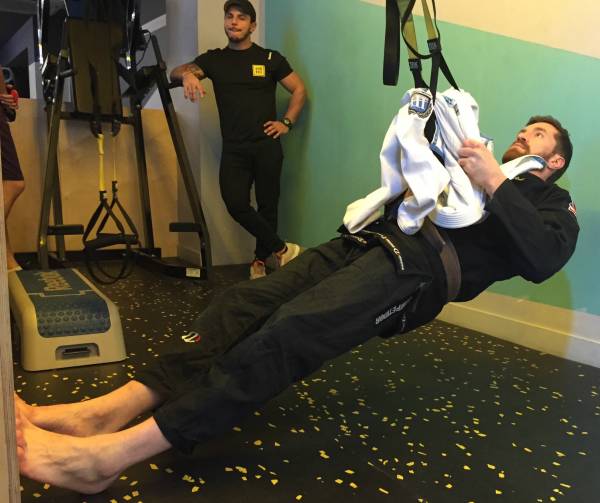
Isometric Grappling StrengthFor the upper body pulls, focus on pull-ups for the vertical, and rows for the horizontal. By rows, I mean doing bodyweight inverted rows as opposed to barbell rows. The same principles apply as you’ll need to hold a pull-up-position at a few different points of the motion. The same goes for rows. In the case of pull-ups, in particular, try to vary the grips you have on the bar. You could (and should) also use a Gi to hang on, as this is going to develop really specific grappling strength.
Core

Core training is arguably the most important part of Jiu-JItsu, Our cores get a real battering in grappling and we need to focus on them in particular during strength training. For that reason, there are three stand-out exercises you can use to hit your core. One of them is probably the most well-known isometric exercise of all times – the plank. Hold planks as long as you can, and do not forget to do side planks as well as the regular ones.

A couple of opposing gymnastics-based exercises also do wonders for Jiu-Jitsu athletes. The hollow body hold and the arch hold are two invaluable exercises for developing extreme levels of isometric core strength for grappling.

Specific Isometric Training

As a finishing touch, you can turn to some more specific grappling strength exercises. For example, get your hands on a foam roller, or a grappling dummy and go for an isometric chokehold. Hold a Rear Naked Choke, guillotine, D’arce, or whatever choke you want for as long as possible. You could do the same with triangle chokes as well, conditioning your legs. A good tool to train your inner thigh muscles is a stability ball. Get it between your legs and squeeze. It is going to do wonders for your closed guard game.

Get your conditioning to the next level with an easy program that combines both isometric and dynamic strength! Ethan Benda has one of the best grappling strength and conditioning programs out there. Check out his “Diamond Protocol” DVD set for a complete program and detailed exercise demonstrations.

The Best Strength & Conditioning DVD and Digital Instructionals

How To Develop Crushing Grip Strength For BJJ

Short And Brutal Grappling Conditioning With Complexes

Travis Stevens’ 3 weeks / 3x per Week Weight Lifting Program for Grapplers

Improving Jiu-Jitsu Drills With Ben Askren

Ben Askren on Jiu-Jitsu Drills

Jiu-Jitsu Drills are arguably the second most despised part of training BJJ apart from warm-ups. People tend to utterly hate doing drills for an extended period of time. it is probably down to rolling being so fun that every other aspect of Jiu-Jitsu fades in comparison. This is a real problem since most sports training is very much based on repetitive drilling. In most other sports, not just martial arts, drills are the foundation of most training sessions. Going over important movement patterns is what takes people to the next level. Just take a look at the Miyao and Mendes brothers and you’ll see the benefits of drilling. Normally, this drives most instructors crazy, along with an MMA and grappling legend in Ben Askren.

Ben Askren is as a high-level wrestler as they come. He is also an MMA veteran who based a lot of his game for the cage on wrestling. So, when he talks about grappling, and how people should train, the best thing you can do is listen. In his recent appearance on the world-famous Joe Rogan podcast, Askren revealed his discontent in regard to Jiu-Jitsu drills. Askren has some great points on the structure, lasting and type of drills BJJ people do, or better said, slack through on a regular basis. There’s no denying that his comments make sense, so we decided to try and find the solutions to the common problems Askren identified.

We all know that repetition is crucial to learning new skills. In art as diverse and deep as Brazilian Jiu-Jitsu, constantly polishing the most common movement patterns should be a priority. Instead, people like to turn to rolling, thinking that there’s nothing better than live sparring to refine their technique. The trouble with this approach is that people tend to learn stuff incorrectly. Subsequently, when they go compete they discover the hard way that they know a lot less than they think. What follows suit is shifting blame to others, instead of trying to focus on the problem. And the problem is easy – not enough Jiu-Jitsu drills.

The Curious Case Of Jiu-Jitsu Drills

Let’s say you’re dead set on learning the x-pass. This is one of the most fundamental Jiu-Jitsu techniques, one that works from white to black belt. It is a pass you can use against plenty f open guards and it is based on a simple, yet subtle movement pattern. If you go and work on it in the technique portion of the class, you’ll probably get about 10 to 15 minutes of time for both you and your partner to get some reps in. The moment you go roll, you’ won’t end up in a position to use it more than a few times per roll, if any. Even then, the circumstances are dynamic and unpredictable and you won’t be able to dedicate enough time to truly mastering the movement.

Ben Askren Jiu-Jitsu Drills FixThe usual length of specific technical training in Jiu-Jitsu is short, compared to other arts. This is ok as far as the fine technical aspects of the sport go. However, in order to reinforce the most basic movement patterns for every technique, drills should follow the technical part. The trouble with Jiu-JItsu drills is that, even when people go for them, they only do a couple of minutes each. Afterward, either the whole class goes to roll. or people start slacking off.
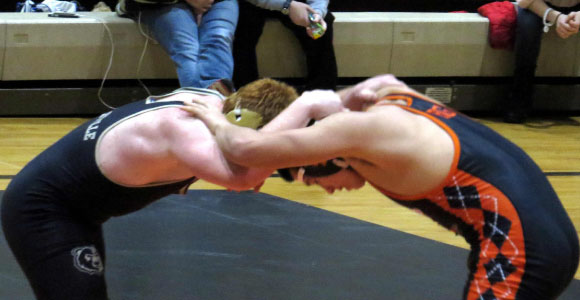
What rightfully frustrates Ben Askren is the fact that this is a common practice across BJJ academies worldwide. The trouble is in all of us, from students to instructors, for being selective in our learning approach. We take techniques that really work, like takedowns, for mother arts and incorporate them in BJJ. So why don’t we take some general training concepts as well, once that apply to the art, in order to really expand our proficiency? Here’s what Ben Askren thinks.

Ben Askren’s Take On Drills

The basic point Ben Aksren Made on the Joe Rogan podcast is about the daily grind that wrestlers go through. The basic idea behind wrestling training is pushing yourself more and more, each day. To that extent, wrestlers aim to work with everyone in the gym and look to have a go at the best guys constantly. They also organize practice in a way that exposes everyone to the very best, giving everyone the chance to progress.

Form a technical standpoint, Askren pointed out that wrestlers spend hours every day working only on specific techniques. This constant exposure to the same technique over and over allows wrestlers to truly focus on cleaning up their moves.

The system wrestlers use for drilling is simple. They choose a topic for the session (or week) and go through the technical nuances. Immediately after, they pair up and go for endless repetitions of the basic motions behind the technique. At first, they just go for reps on the move on an inactive opponent. Later, they introduce resistance to the drills, increasing the intensity of the drills. As far as Jiu-JItsu drills go, this is akin to position sparring. Unlike BJJ, though, this drill does not transform into full-blown rolls after a few reps.

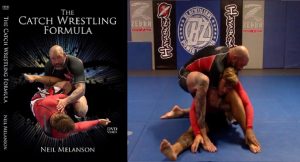
Neil Melanson DVD Catch Wrestling Formula
Techniques List

Speaking of wrestling, have you checked out Neil Melanson’s “Catch Wrestling Formula” DVD yet? ? It is a catch wrestling for BJJ instructional that is going to give you tons of techniques to drill in class. Plus, they move Neil demonstrates are more effective only than they are painful!

The Solutions

Ben Askren didn’t limit himself to only criticizing how BJJ classes are structured. he also offered up some suggestions, which we’ll only expand on further to find a winning formula.

The first thing we need to add to Jiu-Jitsu drills is time. Regardless if it is fundamentals class or competition training, drills need to make up most of the class. They need to last long and people need to put in as many repetitions as possible. And by repetitions, I mean clean and precise reps, not slacking. The sooner this becomes common practice, the sooner we’ll start seeing much better grapplers.

Ben Askren Jiu-Jitsu Drills Wrestling To remove the boredom factor from drilling, we can look to make some BJJ-specific adjustments. For example, we can mix things up by building upon drills. If we train the X-pass on Monday, for example, we’ll do a guard recovery on Wednesday. Now, when we drill one partner starts with the pass, and the other follows up with a recovery move. This turns to drill into a mini-scenario, where both partners get to work. PLus they have the chance to attempt a specific technique against resistance with another specific technique. The Friday session can build even further upon the moves, offering both variety and much-needed repetition.
In order to successfully implement this Ben Askren inspired take on Jiu-Jitsu drills, we’ll need to cut down on free rolling. AS huge and unimaginable sacrifice as this might seem to be, it is actually way more beneficial. Going for longer live drills more than free rolls are going to reduce injuries, improve conditioning and make rolling much more important

BJJ Break Falls: Why You Need To Train Them More

https://bjj-world.com/how-to-make-single-leg-takedown-work/

Bulldog Choke – BJJ Submission Explained In Details

The Chest Choke – Catch Wrestling Submission For BJJ

Chest Choke Catch Wrestling Submission

What is the best submission move in all of grappling martial arts? The answer to this question is tricky, despite being glaringly obvious. the best submission is the one that works. Or, more specifically, it is the one that works for you. For some people, it might be a Kimura. Others are really fond of hitting triangle chokes from all kinds of positions. Of course, we can’t skip over all the high-tech leg lockers that dominate the mats these days. Perhaps, you’re more of an old-school guy/girl and like to go for some “antiquated” Judo chokes or armlocks. You could also be a neck cranking, spine twisting 10th Planet Jiu-Jitsu die hard. Or, you could be a pressure grappler who enjoys going for a catch wrestling submission or two.

Before Brazilian Jiu-Jitsu, all grappling martial arts we’re significant low on submissions. Throwing an opponent down and proceeding to control them for a period of time, or points is still the norm for most grappling martial arts. Although Sambo in particular, and Judo to a lesser extent have submissions, the main focus lies elsewhere. In came BJJ, changing the submission grappling game forever. However, there’s one art that’s a predecessor of BJJ and was the ultimate submission grappling discipline before the Gracies. It is the brutal grappling martial art of Catch wrestling. Catch-as-a-catch-can wrestling is a variation of wrestling that’s unusually rich with innovative and painful submission holds. Even today, going for a catch wrestling submission can catch your opponent’s by surprise, regardless of their rank or experience. We’ve seen it happen more than once!

There’s no secret to why catch wrestling submission work. They’re designed to be effective, fast and above everything else, painful. It is the brutal nature of submission hunting in catch wrestling that had this art rule the submission grappling circuit for decades before BJJ. Now that Jiu-Jitsu is in the frame, submission grappling has a completely new look. However, turning back to the past, and throwing in a catch wrestling submission into your game is always a good idea. Since pressure based submissions are kind of rare today, the chest choke is certainly a good contender for any grappler.

Submission Wrestling

The rise of submission grappling, as we know it today, is largely a result of the development of catch wrestling. The crazy martial art of catch wrestling is a western based style, that goes as far back as the 1870s. Just to make things clear, wrestling existed long before that. However, submission wrestling was very rare and not developed at all.

Catch wrestling began as a pastime for sailors and dock workers in Britain. It provided both entertainment and a betting opportunity for people involved. Since it spread fast, the sailor took it aboard as they traveled. After all, they did have the time. Unsurprisingly, catch wrestling game to the states along with the British, way back when. This is where catch wrestling, actually got the form that is closest to that of today.

In the USA, most catch wrestlers worked in circuses or fairs. They had an open challenge for anyone to come and wrestle them for a prize. Since they never knew their prospective opponent’s they had to be ready for everyone. In order to ensure victory, they developed a system of chokes, neck cranks and joint locks that were certain ways of beating all kinds of opponents. The idea was that any catch wrestling submission goes you can get goes, the faster the better. Hence the name catch-as-a-catch-can.

Use catch wrestling to become much better at BJJ! All you need is to pick up the Neil Melanson DVD Collection and watch your opponents tap more times than ever before! He offers brutal finishing options from both top and bottom, with the collection boasting 5 DVD sets and counting!

A Surprise Contender

Nowadays, Brazilian Jiu-Jitsu tends to focus on control based submissions more than pain based ones. Since the sport is a very different one to catch wrestling, such an approach is more than fitting. However, there are certain gaps in BJJ, especially in the submissions department.

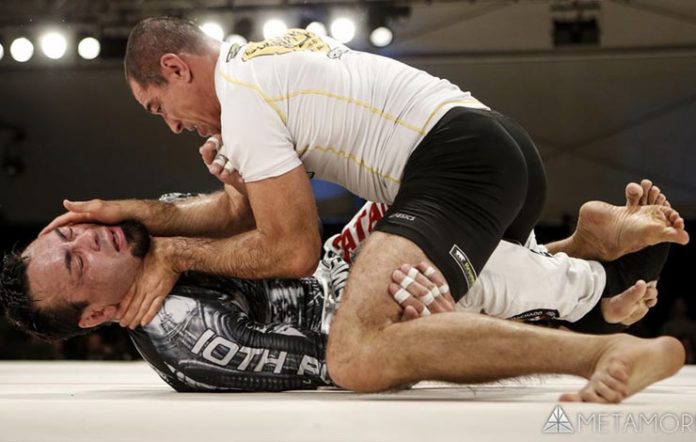
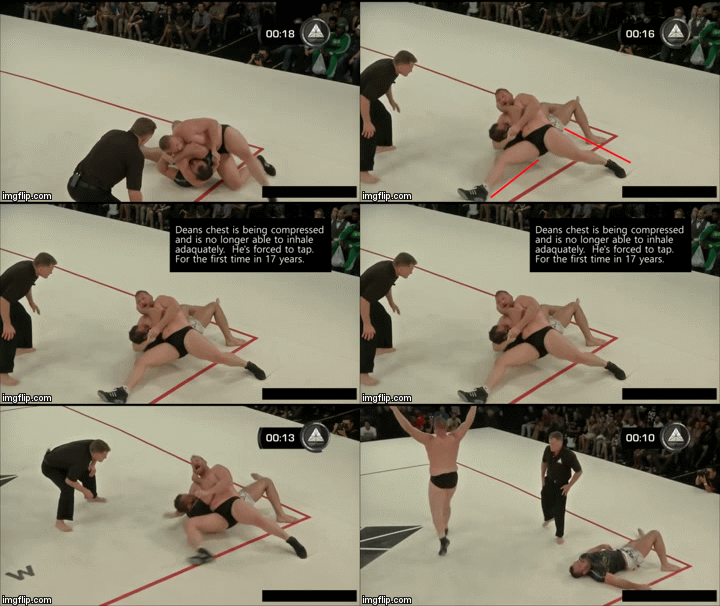
The odd catch wrestling submission or two can really boost your game and help you become much more well rounded as a grappler. Not all catch submissions are going to fit all grapples, that’s understandable. Some are a better fit for certain types of fighters than others. However, there are a few that are so simple and so reliable that they can work for everyone. Once such a move is the chest choke from scarf hold. It is the move Josh Barnett used to submit Dean Lister when they fought in Metamoris a few years back.

Catch Wrestling SubmissionIn all honesty, the scarf hold is not a position known for submission options in BJJ. In both Judo and Catch wrestling, the situation is the opposite. Granted, there are much more options for the bottom person to do in BJJ, but submissions are still scarce. The chest chokes allow you to better control the position, prevent all counters and finish with ease. Plus, it makes your opponent cringe with discomfort and pain.
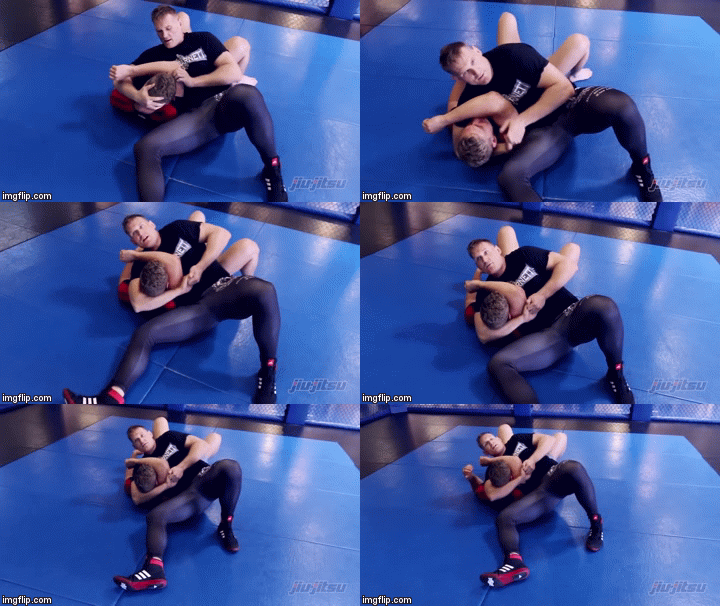
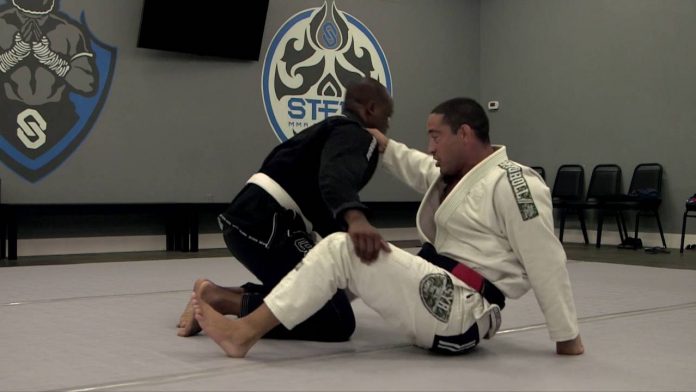
The Chest Choke Catch Wrestling Submission

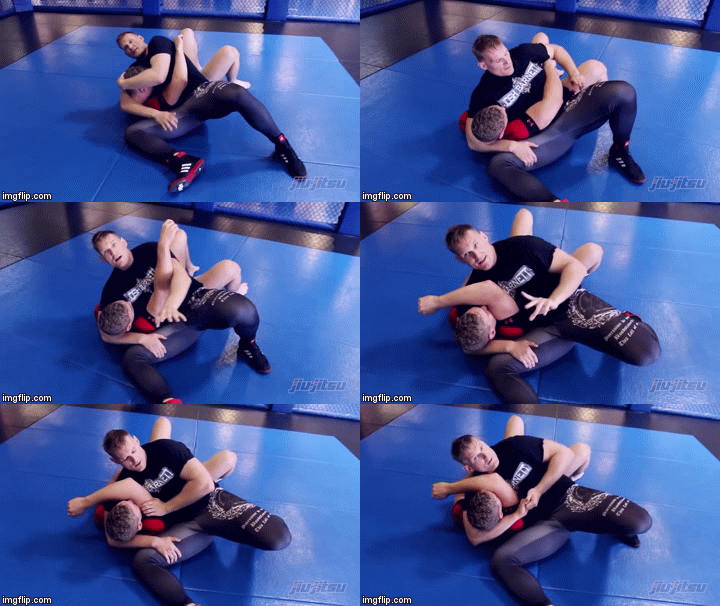
From the scarf hold position, AKA Kesa Gatame, getting the chest choke requires less set up than any other submission option. It is actually surprisingly control based for a catch wrestling submission.

Catch Wrestling SubmissionTo begin with, you need head control from the scarf hold. That means you being in side control with your hips facing the opponent’s head. From there you extend the bottom leg forward. The arm that goes around the opponent head is going to grab the thigh of that bottom leg, securing them in place. This is going to lift their head and near side shoulder up, breaking their posture and restricting movement. Proceed to bring the opponent’s near side arm over to the side, similar to an arm triangle position.

Catch Wrestling Submission Chest ChokeIn order to get the chest choke, use an S- grip to pull the arm you have around their head towards your chest as much as possible. This is an essential step in setting this submission up. Weight distribution is key for keeping the position, so remember to stay on your toes constantly, butt off the mats. The finish comes by leaning back while pulling on the head. The goal is to crunch up your opponent by forcing their head towards their chest.

The reason this move works as a choke is that it disrupts breathing. Unlike any BJJ choke though it doesn’t achieve this directly. Instead, It places enormous pressure on the diaphragm, preventing your opponent from successfully breathing in after the breath out. Cold and brutal, right?

DVD and DIGITAL Instructionals Related to Catch Wrestling :

  1. The Catch Wrestling Formula by Neil Melanson

  2. Championship Level Catch Wrestling by Josh Barnett

  3. Killer Catch Wrestling Combos by Erik Paulson

  4. Catch Wrestling Submissions by Jake Shannon

REVIEW: The Catch Wrestling Formula Neil Melanson DVD

Submission Wrestling

Double Leg Takedown – How to Do It & The Most Common Mistakes

The Collar Guard – A Simple Guard For Advanced Grapplers

Advanced Collar Guard Attacks

Playing guard in BJJ can be as simple or as complicated as you make it be. There’s a clear progression that we usually see here. At first, it is all about surviving so the closed and perhaps half guard are the options most people choose. As grapplers get to blue and purple belt, first they go into open guard variations and then straight into crazy land. After all the experimentation, once people get their brown belts they tend to look for simplistic ways to get what they want. Mind you, simply doesn’t necessarily mean boring, nor ineffective. On the contrary, there are certain guards that might seem like they do not even guard positions. Yet they work, especially at the highest levels of the game. One of those guards is the surprisingly simple collar guard. So, all you advanced purple belts and above, this one is meant for you.

Playing guard is fun! When if you’re not a fan of the guard, you still need to know how to deal with people when you’re n your back. With the collar guard, it’s mostly you on your butt, if we’re being honest. The original idea behind the closed guard was that of simplicity and control. While the closed guard offers both, it also requires quite a lot of work in order to set up attacks. namely, if you do not deal with the opponent’s posture and base, you’ll have a hard time doing anything. Open guards are usually more attacking in nature, but lack the control of the closed guard. Somewhere in between, is a simple guard that delivers on both. That said, do not expect closed guard-like control, nor spider guard-like attacks from the collar guard. Instead, expect safety, ease of movement and effortless sweeps.

To make things clear, the collar guard is far from the ultimate guard in BJJ. there’s no direct substitution for it without the Gi, making it useless in No-Gi.  However, with the Gi it has an unusually wide range of applications. It can work as a guard, it can lead into takedowns from the top and it offers direct control from the top after a successful sweep. Furthermore, the guard’s mechanics offers a way to prevent your opponent from passing, while creating pain and discomfort literally without doing anything. And, most importantly, it is very easy to enter into either a closed or open guard variation from there or get back up to your feet in case you’re looking for a transition.

The Collar Guard

The collar guard is painfully simple to get, yet works like no other bottom position. The hardest part is getting the collar. For this guard, all you need is a cross collar grip on your opponent’s lapel. It is smooth sailing from there on.

Collar Guard BJJFor one, you’ll need to be on your butt, with your legs either in a butterfly position or a seated combat stance. Whatever the starting position is, you’ll need to change it constantly. Since opponents are going to be looking for a pass, you’ll need to switch sides of your base in order to stay in front of your opponent. This is made really easy by the control you have with your arm.

The arm you have gripping the opposite side collar should remain straight at all times. This is a crucial detail to make the guard work! You need a locked out elbow in order to have a strong frame. Furthermore, your knuckles should be right up against their collarbone, grinding up and down. This produces pain and discomfort, making the grip notoriously difficult to break. It also helps prevent any flying armbar/triangle attacks your opponent might be thinking of due to the extended arm. Speaking of the extended arm, as long as you keep your weight back and your spine straight you’ll have absolutely nothing to worry about.

Finally, your other arm should either post behind you in order to provide support for your frame, or you could look for additional control. there’s a variation called the collar and sleeve guard. The name pretty much explains it all. The free arm goes on their sleeve, taking away all their passing options as well as their posture. This variation is slightly better suited when playing the collar guard against a kneeling opponent.

Effective Collar Guard Attacks

Let’s start looking at some attacking options. Remember that his article is simply an overview of all your attacking options from the collar guard. In the future, we’ll focus more on some of them, analyzing them in-depth. For now, let’s just look at the options.

Collar Guard SweepOne of the easiest things to do from the collar guard against a standing opponent is sweeping. Since opponents can’t pass because of your collarbone frame, they’ll be looking to try and circle around. This is where the collar guard is particularly effective, as the same frame keeps your opponent’s from passing while allowing you to attack, Once you have a leg in sight, all you need to do is grab the heel and do a technical stand up for an ankle pick sweep. Now you’re on top, controlling the leg and the collar.

Hunting for leg locks is also fairly easy from there. Standing opponents caught in the collar guard have no posture, so moving them into certain directions is easy. Just like before, when a leg presents itself, getting to an Ahsi Garami is only limited by your knowledge of entries from different angles.

Collar Guard Loop ChokeSubmission wise, it is best if your opponent is on their knees. This helps them get some posture back but opens up more attacks. Loop chokes, for example, are right there for the taking. As are armbars, triangle chokes and Omoplatas from the collar and sleeve variation. Furthermore, against a kneeling opponent, the configuration of your legs changes, as you should have a knee shield up, This makes sweeping with basics, like the scissor sweep really easy.

Transitions And The Collar Drag

The beautiful thing about the collar guard si that you can use it to transition if you do not like attacking directly. For example, having a collar and sleeve means arm drags are easy to get. Once you have an arm drag, you can easily get the back and finish from there. Once again, numerous leg lock positions are also right there. You can get there just by reacting to your opponent’s movements, without having to set anything up.

Adam Wardzinski DVD BUtterfly guard Re-Discovered
Techniques List

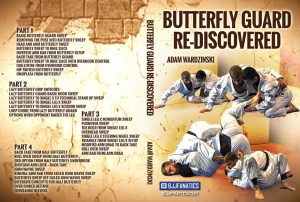
Adam Wardzinski is a Polish grappling phenom who has one of the nastiest guard games out there. His butterfly guard works because it is simple, effective and leads to his favorite submissions – leg locks. In his “Butterfly Guard Re-Discovered” DVD set, Adam shares all his knowledge of this powerful, yet easy to use, BJJ guard. Check it out and connect it to the collar guard for a killer guard game nobody can solve! 

Collar Guard DragA huge thing you can do is the collar drag. With, your hips open to the side of the collar you’re controlling, it is really easy to face plant your opponent on the mats. Just switch the hips explosively and pull with your arm. You’ll end up in side control, or in half guard, against half kneeling opponents. You could also use the collar grip to create space and get up and either hit a collar drag from standing (much more powerful) or go into a different takedown. The opportunities, as you can see, are endless.

3 Ways Of Passing The Half Guard Lockdown

Beating The Half Guard Lockdown

Certain positions in Brazilian Jiu-Jitsu seem to be designed just to annoy the living hell out of you. Just think about it. The lapel guards like the worm guard are just one obvious example of such hideously boring positions. However, even those tedious lapel guards have nothing on moves that work in both Gi and No-Gi. The moves that transcend the Gi border are usually those that people are after, especially those with more experience. Now, annoying positions do not necessarily mean ineffective positions. IF you’re playing them, then you can use them to stall, sweep, submit or simply transition, depending on the position. But if you’re caught in one and the opponent is defensive, be prepared for a long roll. Once such a position that makes guard passing a nightmare is the half guard lockdown.

The half guard lockdown is an old half guard position that, to this day, still presents a hard puzzle to solve. Whenever people are up against it, they seem to be at a loss for options. It is a half guard variation, but it seems that all the half guard passing principles do not work. Well, that is the point of the lockdown. it is a brainchild of the one and only Eddie Bravo, the founder of 10th Planet Jiu-Jitsu.  It is likely influenced by the work of his teacher, coral belt Jean Jacques Machado. The point of the half guard lockdown is exactly that – to lock you down in place. Once you’re all secure and have nowhere to go (read: pass), the opponent can start working on attacks.

You can see the Catch 22 here, right? Your opponent has you in a secure position which you can not pass, even if they’re simply holding you in place. Then, they add attacks which you need to fend off, on top of trying to solve the lockdown puzzle. it is an impossible position to be in, hence all the frustration when a very good lockdown player gets you there. But, this is Brazilian Jiu-Jitsu, and every “why” has a “because”. The half guard lockdown is no exception and there are some passes that people attempt out there. Some of them work better than others, and we made a selection of the three that have the best rate of effectiveness.

What to Expect From The Lockdown

The half guard lockdown is a half guard position that is fairly easy to establish. As such, even beginners can be a nuisance from there, in terms of keeping you in place. Attacking requires a bit more experience, though, and is a trait of more advanced grapplers.

The first and main difference between the half guard lockdowns and a regular half guard is the positioning of your legs. Namely, while your legs are on the outside of your opponent in most cases, with the lockdown they’re on the inside. Not just on the inside, but in a very specific position. The name is due to the fact that your legs are crossed, inside leg over the outside. In addition, the inside leg also hooks the opponent’s leg at the ankle, providing incredible holding mechanics.

So, what should you be wary of from the lockdown? Well, first and foremost the position of your hips. The higher your hips end up on the opponent’s body, the worse position you’re in. Moreover, you need to be careful of your free leg. Once the opponent gets an underhook with their arm on it, you’re past the point of no return and you’ll get swept with the electric chair. What’s worse is that, if rules allow it, you’ll end up tapping to a crotch ripper as well.

Passing The Half Gaurd Lockdown

The half guard lockdown seems fairly simple as a position, doesn’t it? Well, it is simple, but it also has a lot of components to it, making it a nasty trap. The lockdown is like a spider web – the more you fidget and move, the more you tangled up you get. Instead, passing the lockdown needs to be simple and minimal.

There are two main areas that you’ll notice in all three passing options that we have on offer today. First of all, your hips must never cross the hip line of your opponent. If they do, your primary and immediate task is to get back as low as possible. Next up, you will stay as still as possible and make minimal movements. The thing with the lockdown is that attacks are hard if you’re doing nothing. So move as little as possible to adjust your positioning and, even when you pass, avoid doing any excessive movements.

The Hip Switch

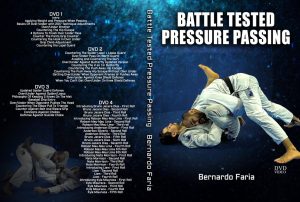
The hips switch pass is one that works for sure. How do we know it works? Well, it is the favorite way of passing the half guard lockdown of the legendary Bernardo Faria. And, if someone understands the half guard and passing, it is the 5 x World Champion.

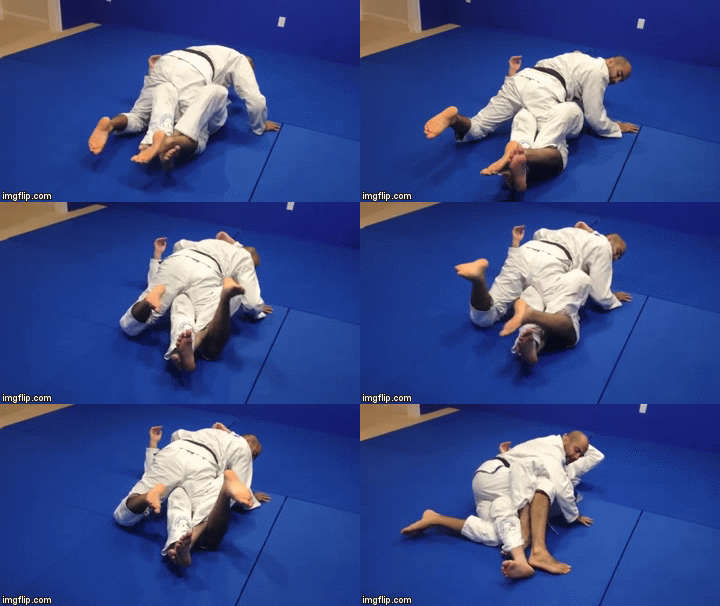
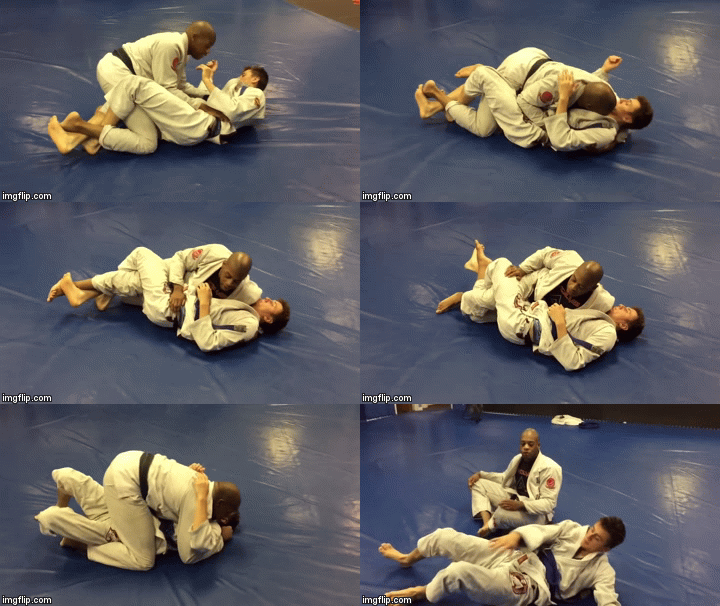
Half Guard Lockdown PassingThe hips switch pass works by rooting yourself into position until you deal with the lockdown. For that, there’s nothing more important than keeping the hips low and placing the knee fo your trapped leg on the mats. It is going to be the major pivot point so make sure it’s glued tight. This’ll give you enough space to neutralize their hook by simply lifting your foot towards your butt. From there. you have the space to maneuver into a pass by switching your hips and placing the foot between their legs and their butt. Now, your safe from the lockdown and ready to demolish what’s left, of their guard.

Bernardo Faria Battle Tester Pressure Passing
Techniques List

Bernardo Faria has a complete DVD set on how to pass each and every guard variation in BJJ. Check out the “Battle Tested Pressure Passing” DVD for a comprehensive guide into the art of brushing past your opponent’s guard with ease. Learn from the best, at a cut-price that’s available once in a lifetime!

The Scissor Pass

The scissor pass is one of the simplest ways of passing the half guard lockdown. Once again, it’s all about keeping the hips low and methodically untangling your feet. For this variation, though, you’re going to use a bit more movement than before.

Half Guard Lockdown PassesFor the scissor pass, the goal is to end up in hip switch position before you attempt to pass. Remember that if you do not establish a strong cross-face immediately, you’ll have to go back and try again or get swept. If you hit it right away, though, just stay there and work to unlock. Use your free arm to put pressure on their far side hip and scissor your legs. this is going to bring the locked leg behind, and the free leg (your bottom one) in front. The aim is to hook their leg with your bottom leg and strip their hook off. Scissor your legs back into the starting position and you’re free and clear of the lockdown.

The Shin Circle

The shin circle is probably the most well-known lockdown pass. However, most people are usually attempting it from a faulty position, ending up on their backs as they do. As with the previous two passes, the shin circle requires your hips to be as heavy as possible, as low as possible.

Half Guard Lockdown Pass Shin CircleFor this position, you start off just like with the scissor pass. Actually, this is a great option to sue if they’re lockdown is too tight for the scissor pass. Here, once you switch your hips and establish a cross-face, you want to use your free arm to push down on their knee. This is going to create enough space for you to simply circle your shin out of the lockdown. Once again, the lockdown is not a threat anymore, unless you pick your foot off the mats.

Review Of The Top 5 Guard Passing BJJ DVD Instructionals

Deep Half Guard in BJJ – Everything About

The Only Butterfly Guard Passes That You Need!

Stuck With Your BJJ Game? Here’s A Way Out!

BJJ Game Plateau Solutions

Developing a BJJ game is not an easy thing to do. First and foremost, you need to know at least some jiu-jitsu in order to create a successful game. So, dear white belt, with all due respect, come back to this article when you feel the need for it. All you blue belts and beyond, especially competitors, these hints will help you deal with plateaus much quicker than any other approach. Furthermore, you’ll be spared all the frustration that usually accompanies a period of no progress in your game.

Hitting a plateau in Brazilian Jiu-Jitsu is something everyone is going to go through. I don’t care how talented you are, at some point you’ll experience a standstill in your BJJ game. It is going to scare you the first time, and you’re going to be a bit more comfortable the next. However, you’ll need to go through a bunch of those at every level before you figure out how to solve them. And even then, you might just end up giving them time to go away. While this works, there are also a few more effective strategies.

Hitting a rut with your BJJ game means that all the things you’re good at doing stop working. It usually comes slowly, with a few frustrations here and there with one of your favorite moves. then, it seems to spread to all your other go-to techniques. Despite doing them countless times before, even on the same training partners, now, nothing seems to work. Yeah, your partners are improving, but you’ve also been regular in the gym as well. Doesn’t that mean that you’re improving as well? It is a normal way to think about this situation, as is the frustration that comes along with it. But what, if anything, can you do?

Usual Sticking Points In Your BJJ Game 

Everyone’s body and mind are different, meaning everyone’s BJJ game is going to be uniquely tailored to their own needs and capabilities. This is actually part of what makes the gentle Art so fun! The same move works very differently for different people. this is exactly why people tend to favor certain moves while dismissing others.

BJJ Game PlateauAs you progress through Jiu-Jitsu, one favorite move turns into two, then three, etc. The more complex your BJJ game becomes, the more sticking points it is going to have. First and foremost your submissions are going to stop working. it is not going to be in a blitz, but rather over time. People are going to find ways out or prevent you top choice moves even though you’re doing nothing wrong.
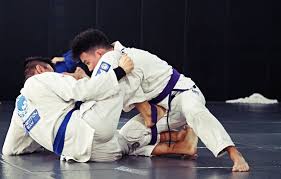
Next up are positions. Losing submissions means you’re going to be focused on either getting another one or more likely, coming back fro a second try of the first one. All this is going to result in tunnel vision, leading to you making lots of little mistakes in your positioning. the result is going to be even more frustrating because now you can’t even get to a position for the sub.

Switch Focus

So, what exactly are your options here? First and foremost, you need to understand the reason behind it all. The simple explanation is that you get so comfortable with your moves, that you start missing out on tiny, yet important details. When your opponent’s find that all-important wiggle space, you then replace technique with strength in order to maintain or finish your move. This is never a good idea in grappling, and your BJJ game is going to hit a wall.

One key strategy is switching focus. How do you do that? Well, the basics are easy. If you are a submission hunter than start looking for positions. If you’re a point grappler who thrives in certain positions, look to abandon them and go fro for a finish.

Going deeper, you might even look to wap moves with other moves. For example, give leg locks a rest and revisit chokes or arm locks. Focus on them for a while before returning to your favorite submission. Or, stop hunting for back control every time you slap and bump. Instead, start working on your mount or half guard game for a while. Even if you see back control while rolling, give it a pass and go for something else. It is a great way to refresh your BJJ game.

Flow During Live Rolling

This is a bit of an advanced strategy, better suited for experienced purple belts and above. Flow rolling is not an easy skill to master, which is why it is usually done slowly. Flow rolling ahs the very specific task of making you so comfortable, that you start to understand how Jiu-jitsu actually works.

BJJ Game Plateau SolutionsIt takes time, experience and an equally or more experienced partner in order to successfully flow roll. However, you can take the mentality of a flow roll land to apply it to your live rolls when your BJJ game is stuck in rut. Simply abandon all goals during a roll land start flowing. it won’t be nearly as easy as when you’re doing it slowly, but it is going to provide much-needed rest for your body and mind.
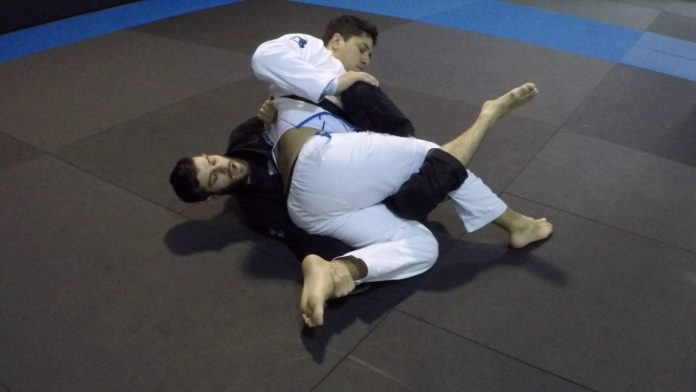
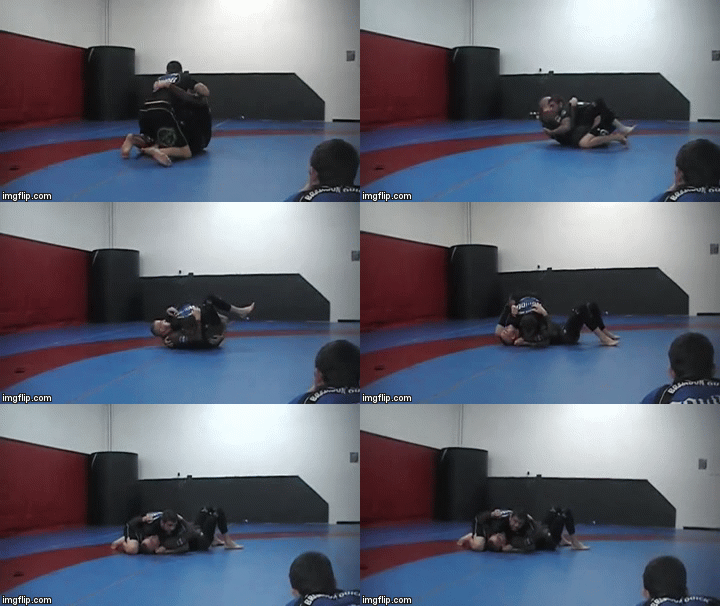
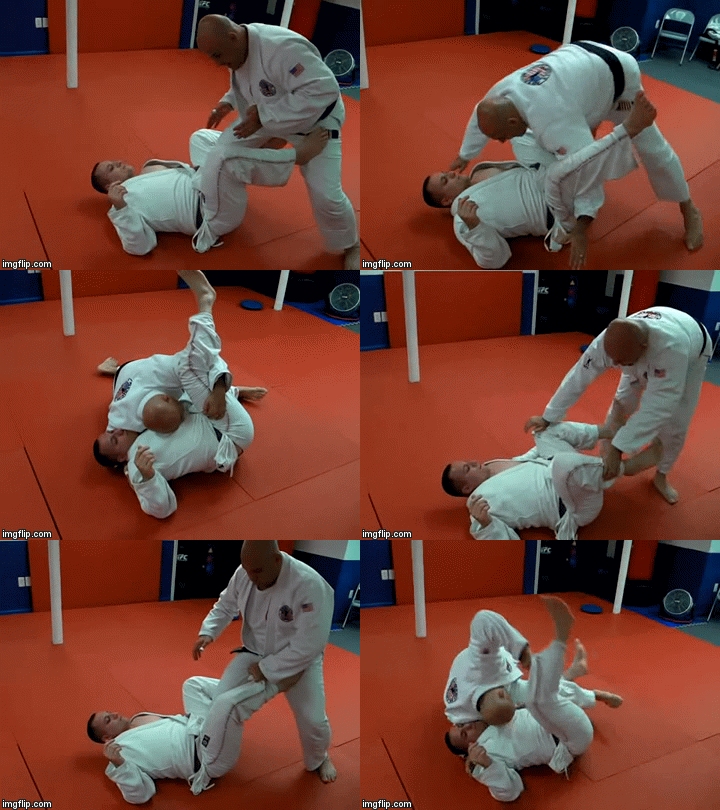
Flowing without a particular purpose and exploiting everything in sight is going to do wonders for your BJJ game. It is going to allow you to take a break from your favorite moves and explore new directions. Even better, when you return to your game after a while, new opportunities are going to start popping out.

Take A Break

The final piece of the puzzle is the worst one. It is actually the one that makes the most sense but no grappler alive is going to consider it as their first option. Namely, if you’re really stuck and none of the above options work, you should simply take a rest. Either go somewhere or simply stop coming to the gym for a couple of weeks.

However, you can’t just stop coming. Leave all the YouTube BJJ videos, DVD instructions, and your UFC Fight Pass account as well. Remove BJJ  from your life on a temporary, two-three week basis. It is going to get your BJJ game back on track better than anything. It is just very hard to do.

Neil Melanson DVD Catch Wrestling Formula
Techniques List

Why not give catch wrestling a try to freshen up your game? Neil Melanson has the perfect DVD set to get you started. His ‘Catch Wrestling Formula” instructional is tailor-made to take your BJJ game to the next level. Check out what this release has to offer! 

REVIEW: Yuri Simoes DVD – High Efficiency No-Gi Top Game

Do You Train Jiu-Jitsu When You’re Sick? Stop Right Now!

Jiu-Jitsu For Beginners: The First Month Of Training

BJJ Guard Pass That Can Pass Any Guard – The Hip Switch

BJJ Guard Pass Hip Switch

With so many complex and diverse guards in Brazilian Jiu-Jitsu, passing is truly a nightmare. Even for proficient guard passers, getting past the opponent’s leg is never easy. ti can be fun, yeas, but it can also be highly annoying. All the diversity and innovation people put into guards means you need to find adjustments and/or new passes for each guard out there. If you only focused on that part of BJJ you wouldn’t be able to master it, in a lifetime, let alone work on anything else! The silver bullet solution would be a BJJ guard pass that you can successfully use against multiple (or all ) guards with a high rate of success. Sounds too good to be true. That’s because it is.

There is, however, a BJJ guard pass that can get you as close to this as possible. It is more of a key BJJ movement than technical guard pass per se, but it has the power to slice guards apart.

The concept of the perfect BJJ guard pass to kill all guards is an unattainable one in reality. With that option out of the way, you can either go and train a different pass for all different guards or find some reasonable common ground. A good way to do it is to look back at what connects all guards. Once you find a common starting point, you can address it from a passing perspective. Doing this against most open guards, as well as some closed guard variations, there’s one movement that seems to have a universal effect on all of them. It is the simple, yet crucial BJJ hip switch.

The “Art” of Hip Switching In Jiu-Jitsu 

Brazilian Jiu-Jitsu is a grappling martial art that places more focus on the hips than any other combat sport. All avenues of the hip movement have a huge role to play in Jiu-Jitsu. From flexibility to explosive power, the hips are the source of everything. Rarely any attack works without hip involvement, in one way or another. The same holds true for defensive work, where the hips are the main drive behind most escapes.

The movements which grapplers do with their hips are also very variable. Depending on the situation you could look to ship them away, open them up, rotate or switch them. This last one is a true staple of high-grade guard passing. Hardly any open guard BJJ pass is going to work without it as a starting point. But, what exactly makes this simple motion so potent?

The first thing you get when you switch your hips is a major change in weight distribution. The moment you start to shift your hips from one side to the other, your whole body weight is going to move in the same direction. This results in the creation of additional angles in a position where there aren’t any. These new angles mean less space for your opponent to work and more pressure for you. A guard passers dream combination.

next up is power. The hip switch is bot ha move anybody can easily do, and it is a very explosive move. Its power is only limited by the power of your hips, which is a highly trainable attribute. Explosion with your hips in a rotational manner means you can get past even the most flexible guard players. Furthermore, you gain a ton of stability in your final position, thanks to the hip switch.

The Hip Switch BJJ Guard Pass

As a BJJ guard pass, the hip switch is considered to be an advanced concept. The reason for this is that it won’t work unless you understand what we discussed above. Weight distribution, creating angles, the directionality of force and timing are essential. Unfortunately, there are all traits the take time to develop, so less experienced students need to take it easy and learn the basic guard passing sequences at first.

Against some open guard variations, like the butterfly or De La Riva guard, the hip switch is often the only way past. Form closed guard circuits it is a bit more difficult to use it, although not impossible. there are some really good passing options based on it, like the Tozi pass from closed guard, or several half guards passes.

Bernardo Faria Battle Tester Pressure Passing
Techniques List

Some people are simply better at passing the guard than others. One of them is Bernardo Faria, who has no trouble whatsoever passing anyone’s guard. His “Pressure Passing Encyclopedia” DVD has all passing essentials in it, including the hip switch. It is the perfect guide to get you through the door of advanced gaurd passing.


  • The Hip Switch BJJ Guard Pass Vs. Butterfly Guard

Passing the butterfly guard with the hip switch is probably the most useful use of this movement. The very nature of the butterfly guard means any BJJ guard pass is going to be difficult. Grapplers in butterfly guard have the ability to move in a 360-degree fashion as well as lift you up before they attack. It is precisely at that time, when your hips are off the floor, that you can utilize the hip switch.

BJJ Guard Pass Butterfly Guard The moment your opponent elevates you, they’re going to try to sweep you to one side. The direction of your hip switch should be in the opposite direction. You should do it explosively and as completely as possible, before rewinding the hips back for the pass. The hip switch against their outstretched leg allows you to completely nullify the force of the sweep. Even better, the motion gets rid of the leg between you, leaving no more obstacles to a pass.

If the opponent has you in the air with both butterfly hooks, even better for you. Now you can look to pass in both directions.

  • Passing The De La Riva Guard

Getting past the De La Riva guard when an opponent has good grips can be a real hassle. It is even worse when your opponent has crazy flexible hips that prevent all your passing attempts. The hip switch BJJ guard pass come to the rescue once again!

BJJ Guard Pass Hip SwitchForm the De La Riva, the direction of your hip switch is going to be towards the leg that has the De La Riva hook. However, you’ll need to also control the opposite leg if you want to be successful. In order to do that, an underhook against the free leg is going to do the trick. Once you have it, switch your hips while swinging your back leg in a big arch around the hooked leg. You’re going to end up in a reverse half guard, or, if you like it more, in the 4/11 leg locking position.

  • Hip Switch Against The Half Guard

Despite leaving it for last, this is where you need to start with your hip switch efforts. Messing it up from the half guard won’t cost you as much as doing so against open guards. So make sure that this is your starting point.

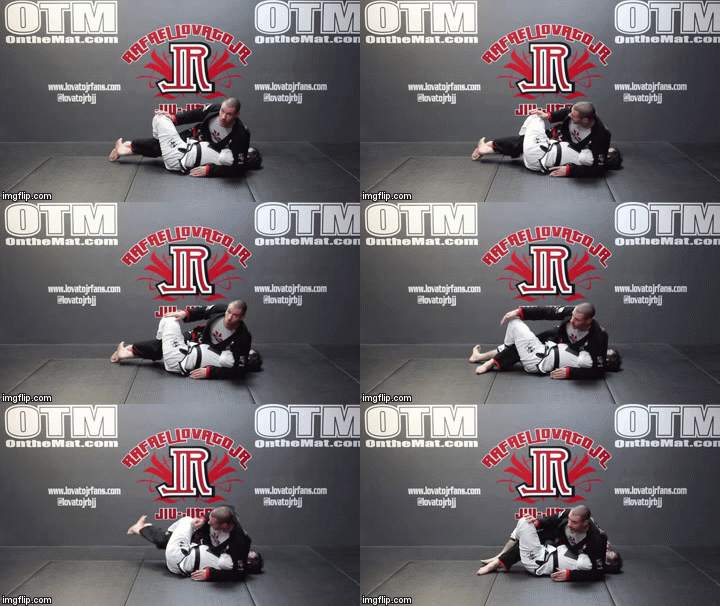
BJJ Guard Pass Half GuardThis is the easiest application of the hip switch for passing purposes. The reason you’re stuck in half guard is the fact the opponent has their legs locked, plus the knee shield to create space. In order to solve both, you simply need to switch your hips. this is going to get you past the knee shield and in a good position to establish a cross-face. Once you have that, wiggling your leg free is going to be easy.

Or, if you like a more dynamic BJJ guard pass, you might opt to isolate the far side arm from the cross-face. From there on you switch the hips again, landing in the knee slice position with an underhook. Again you can pass or go for yet another hip switch, this time on the other side and land in reverse half/leg lock.

In Conclusion

The hip switch is not a complicated movement. In fact, some people do not perceive it as a technical move. The truth is that the hip switch is an advanced way of creating the best platform for any BJJ guard pass. Take a look at some of the world’s greatest guard passers. Do you notice how often and how explosively they switch their hips? The hips which not only helps with passing the guard but also with the retention of your newly acquired position. Although beginners might struggle with it, advanced students should aim to get this move down as soon as possible. It is the one move that opens the doors to a successful passing game. It is not a silver bullet but it is as close as a guard passing enthusiast can get.

If there is one BJJ guard pass you need to call your own, then you have to pick the hip switch pass. this simple motion can help you deal with just about any open guard variation, and a few closed ones as well. Make sure you do work on your hips, though, as explosiveness and flexibility can only further help your guard passing goals.

Review Of The Top 5 Guard Passing BJJ DVD Instructionals

REVIEW: Craig Jones DVD – The Z Guard Encyclopedia

Three Ways To Open Up The Closed Guard

The Leg Lasso Guard – A Masterclass On Playing And Passing

Jiu-Jitsu For Law Enforcement To Keep Our Officers Safe

Jiu-Jitsu For Law Enforcement

Martial arts are the backbone of people that are in the military or law enforcement. Or at least they should be. Sadly, nowadays, the image of the overweight police officer is much easier to connect to law enforcement that an in-shape grappler in uniform. While body weight has nothing to do with the ability to grapple, it does point to one’s character. Overall good health and good physical shape are absolutely mandatory for those that have chosen to protect and serve. Jiu-Jitsu for law enforcement is another must, arguably even more important than the former two. It has the ability to keep officers safe, allow them to control multiple different situations and even brings about health and fitness benefits. So why is this ultimate tool not thaught to the eery single person that puts the uniform on?

Jiu-Jitsu saved my life. This is a common statement we hear and read almost daily. However, very often this statement is taken well out of line. While I respect everyone’s story and how BJJ has positively influenced it, the phrase is not just a metaphorical one. In fact, for some people, it is as literal as it gets. There are countless examples of why Jiu-Jitsu for law enforcement should become something officers simply have to do on a regular basis. Multiple testimonies of people that have embraced the Gentle Art privately, show how useful it can be in difficult situations on the job. Brazilian Jiu-Jitsu can literally save lives and law enforcement members have the right to use the best tools at their disposal!

Grappling is considered by many to be the ultimate martial art. While there’s no such martial art out there, grappling martial arts certainly have an everyday application. As corny as it may sound, most fights really do end up on the ground. Take into account that the very reason BJJ was created was self-defense, and the case for grows even stronger. Furthermore, the art doesn’t have any particular strength requirements. It is also based on control, with various options of turning the intensity up or down. Grappling also gets people into shape while getting them ready to defend themselves and others. You can see why training Jiu-Jitsu for law enforcement members seems like a good idea. Let’s elaborate on that.

Jiu-Jitsu For Law Enforcement

Law enforcement officers are a community that gets exposed to physical and psychological stress on a daily basis. Throw in the air of uncertainty about what they’re walking into during each call and you have the definition of a difficult job. This is why law enforcement members receive (or should) very specific and efficient training. But is the training they go through enough?

Jiu-Jitsu For Law EnforcementBrazilian Jiu-Jitsu for law enforcement officers is one option to supplement regular training. It offers many different aspects of hand to hand combat, all of which are highly important for law enforcement. First and foremost, the formal training they receive is short and specific as it may be, definitely not enough (excluding elite units). Secondly, law enforcement officers are bound by law and rules when they enter violent altercations. The ability to methodically apply more intensity to their reactions is not available via non-grappling martial arts.
There is also the size/gender issue. While not taking anything away from women, or elderly people, size and strength really do make a difference. Going up against a 250 lbs grown man in an altered state of consciousness is a hard ask of anyone. Now imagine that a 120 lbs woman or an officer nearing retirement have to restrain such a person. Even worse, imagine the person is armed. It is a recipe for disaster and all those scenarios that officers go through in training rarely play off the same in real life.

Jiu-Jitsu for law enforcement brings a host of benefits that can make officers safer, calmer and better at executing their duties.

Control

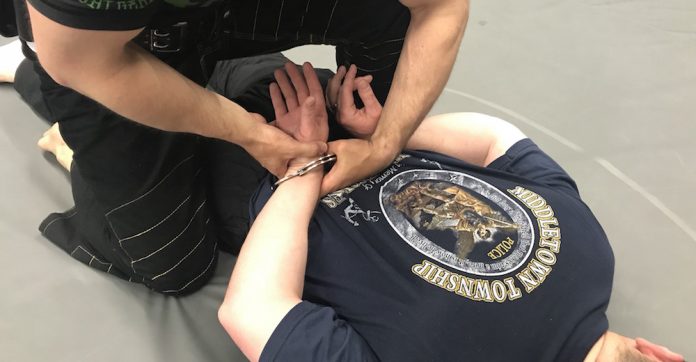
Obviously, a huge aspect of restraining someone is controlling. There are multiple videos out there that show how har controlling an unwilling person can be, even if an officer has a backup. Furthermore, there are people resisting arrest that do not merit the use of more power, like tasers or striking. This is where Jiu-Jitsu for law enforcement comes in. Subduing a suspect is not going to be easy, but it is going to be much faster and more efficient with a solid BJJ background.

Jiu-Jitsu For Law EnforcementAnother example of control is holding someone down until backup arrives. Obviously, the moment an altercation hits the ground, BJJ reigns supreme. If you know how to handle yourself on the ground, you’ll have no trouble keeping even a much larger person at bay. It may be until you get handcuffs on, or waiting for backup. It may even be in order to prevent them from accessing a weapon. Whatever the case, BJJ is the best tool you can use.

Very importantly, the control Jiu-jitsu offers is a dynamic one. It means you can transition between points of control, always begin a step ahead of the opponent.

Self-Defense

People often deem Jiu-Jitsu to be ineffective as a self-defense art. The reason for this is the perception of people. The image of BJJ today is that of sports Jiu-jitsu, laden with rules and formats. However, a simple look back at the roots of BJJ clearly shows that the art works. Another testament to the efficacy of Jiu-Jitsu is, of course, MMA, both the early days and now.

For law enforcement purposes, the most important thing is staying safe. Instead of going into an exchange of strikes, BJJ allows officers to counter strikes with grappling. This both keeps them safe and provides them with the upper hand. Knowing how to counter a strike and close the distance so that you gain control over an opponent and prevent further strikes is something everyone in BJJ learns. Why shouldn’t our officers know it too?

Shape And Response

Forma a fitness standpoint Jiu-Jitsu for law enforcement is a full package. Simply going through a good warmup and a series of drills is enough to maintain a good overall shape. Add to that rolling and you have the perfect way of both training practical self-defense and getting in top shape.

Jiu-Jitsu For Law EnforcementPsychologically speaking, BJJ helps people learn how to react calmly under stress. The unpredictability of the art places people under pressure in every roll, making them comfortable in discomfort. This means the decisions they make under pressure are not a rash one, but deliberate and precise.

Spending so much time rolling with people also sharpens instincts and reaction time. it is one thing to train Krav maga during your entry course, but a whole different thing to roll every other day. The more time you spend sparring, the better your response time is going to be, especially when things escalate quickly and unexpectedly.

A very helpful resource to supplement your Jiu-Jitsu training is Jay Wadsworth’s DVD “Police Self Defense Tactics For The Street”. It offers a grappling based way of dealing with common law enforcement situations as well as with unexpected ones. 

Police Officer Kristen Richmond Survived an Attack Thanks to BJJ & KM

Las Vegas POLICE Officer Uses JIU-JITSU to Control Larger Suspect (Gracie Breakdown)

The Worlds Worst Single Leg Takedown Attempt by Police Officer