



Academy Kings: Best Practices To Grow Your BJJ Academy Business

Academy Kings; BJJ Academy Business Guide And Framework

Here’s something for all you BJJ academy owners or managers out there. As one myself (both owner/manager) I can tell you what the main issues are. They have nothing to do with organizing classes, keeping people happy, or bringing in big-name professors for seminars. The issues are mostly in the things nobody sees – bills, taxes, laws, federation memberships, etc. In other words, the business side of things is where most of a BJJ academy owner’s energy goes (unfortunately). Well, you can now relax, as there is professional assistance in that area, thanks to Academy Kings.

Do you know why BJJ instructors are so good at BJJ? It is because of BJJ, yes, but not just in a technical sense. Running a BJJ academy offers just as many, if not more, challenges than a roll or a match does. It takes the same skills as in training to keep a martial arts school afloat and growing. You need to make decisions on the fly, adjust and adapt, get out of bad spots and remain calm even when it seems you’re about to tap. To that extent, training Jiu-Jitsu helps get skills to run an academy, but running an academy improves your BJJ even more. And it can be a pleasant and positive experience if you follow the amazing martial arts school growth formula by Academy Kings.

Running A Successful Martial Arts Academy

Doing Brazilian Jiu-Jitsu is the highlight of the day for most people. It represents a beautiful form of therapy, where you can forget about everything else, from a job to bills and family stuff, and focus on trying to simulate murder with other similarly dressed and like-minded people. Now imagine how fun it would be if all you had to do all day, every day was BJJ. Well, it is not quite all roses and butterflies, let me tell you that.

I’m not saying that owning an academy and teaching BJJ full-time is not fun or fulfilling. However, it does come with everything else that every other job brings, if not more. You get all the bills, challenges, stress, etc. that you would with any business. Because, as romantic as we want to be, let’s face the truth – running a BJJ academy is, first and foremost, a business. And, there’s no business model that is universally applicable to running a martial arts school at any given spot around the globe. Every spot in the world brings its own challenges about, and solving them requires some grit, Throw in the Covid-19 craziness and every academy owner faces a real struggle to figure things out.

While there’s no one model that can help people successfully run BJJ academies, just like there’s no one guard pass technique that can help you pass all guards, there are principles and concepts that can really help guide you to success. In fact, there’s a whole group of professionals that are dedicated to helping you achieve immense success in the business aspect of things. In other words, consulting with Academy Kings will allow you to really live life like the dream you expected teaching Brazilian Jiu-Jitsu and owning an academy would be.

A Different Approach To Running A BJJ Academy: The Academy Kings Framework

So, what exactly do Academy Kings offer? They have a so-called framework, consisting of 5 main pillars that they claim will help your BJJ academy grow fast, and beyond your expectations,. Only, as you’ll see later on from all the testimonials, these are not just claims. AS you’ll see further on, the main pillars of their framework not only make sense, but they are also widely applicable to any martial arts school. Moreover, it doesn’t take a bunch of different business consultants to figure out a model or strategy which will guide you in running and eventually, expanding your school. These business consultants know a lot about business, but rarely about Brazilian Jiu-Jitsu or martial arts. Unlike them, Academy Kings specialize in promoting martial arts schools and increasing their revenues based on very logical and simple parameters.

What I personally really enjoy about their approach is that they have a lot of free stuff to get you going and they do offer different types of assistance. For example, they ask you which area of running a martial arts academy is a sticking point for you, with several of the most common ones being available for quick selection. Not just that but they offer a ton of other benefits before you even get going, most of which I’ll cover after we take a look at their Fab 5 growth pillars.

Exploring The 5-part Framework

The approach by Academy Kings offers a very specific and sensible structure upon which you can expand the reach and revenue of your BJJ academy. Their system targets key areas in terms of student acquisition and retention systems. The main goal of the business is to give you a roadmap of predictability that you need to follow in order to grow. The 5 frameworks they provide help you set up that predictability, that you can use to further your academy’s reach.

1. The 5 Fab Pillars

The first framework of the Academy Kings system is the fab 5 pillars of growth. They are quite simple and refer to acquiring students, helping them settle in, retaining them, and allowing them to grow and develop as martial artists. The Academy Kings use a fishing analogy in describing their 5 pillars which do sound appropriate.
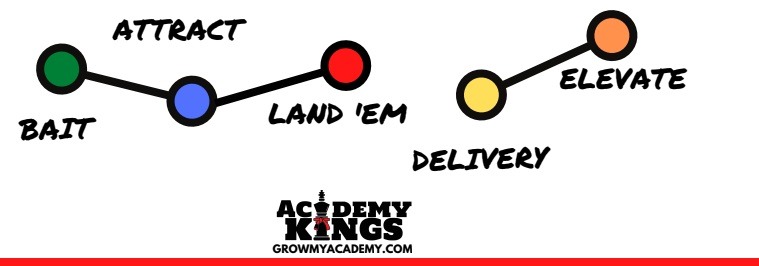
Academy Kings; BJJ Academy Business Guide Fab 5 Pillars

The first pillar is called the bait, which is more than clear, giving the fishing references. The second is attracting new students, or better put, reeling them in. Landing them is part three (the actual sales), which then leads to getting the fish to the plate (delivering on everything you promised students). The final part is elevating people, or in the fish analogy, making sure you use the leftovers to get another meal out of it.

2. Old vs. New

A really smart framework that addresses something we do take for granted as BJJ academy owners. The usual practice for most owners/managers is to provide something free for students that sign up, whether it is an intro class, a free week, or whatever. This is the “old” model that is meant to hook people with the free stuff and then transition them to some kind of a monthly subscription membership plan. Usually, this happens through social media or e-mail.

The new Academy Kings model would instead have owners, direct people, through social media to a landing page, where thy need to leave their information in order to book an appointment and commit to talking. There is no free class, but there is a 15-20 minute conversation in the format of a consolation meeting. This would lead to signing them up for a short term (6 weeks, for example) program to test their interest. It also means they pay for it upfront, earning you a fee even before new students ever step on the mats. Only after that program ends would you transition them into the monthly fee system you have for existing students. This part of the framework has a few more steps, which you can check out via the Academy Kings materials whenever you wish. More on where to access them later in this article.

3. Three Ways To Increase Academy Revenue

Academy Kings; BJJ Academy Business Guide FrameworksThis part of the framework addresses a purely business-oriented model, that actually will work, as long as you deliver on your promise son the mats. For most BJJ academy owners out there, this is not an issue as they do really invest all they have in their classes. With that in mind, the 3 part system that increases revenue goes like this:

First, you increase the amount of traffic that comes through the door. There are several Academy Kings strategies available to you in order to achieve this goal and everything is 100% customizable to your needs. Next, you need to sell higher-priced memberships (like the example of the 6-week intro course) in addition to your monthly subscriptions, and especially with new coming students. The final part of the system is to keep providing value in exchange for revenue. This refers to additional stuff like providing seminars, organizing camps, offering BJJ equipment and/or supplements, etc.

4. “Land ‘em”

The fourth framework is actually the one that will help you get people through the door. It is a 5 step process that has you answer people’s inquiries, gauge their interest, provide them with a “hook” to get them even more interested, close the deal and guide them to overcome any possible objections.

5. The Kings A.I. Model

This is a brand new approach based on research and direct experiences that have made plenty of BJJ academy owners achieve extreme success with their martial arts schools. It takes an entire class to explain how the model works, but luckily, Academy Kings have seen fit to release the class in full for free, so that you can gain a complete understanding of their innovative and groundbreaking model.

  • Bonus: Social Media Advice

Finally, there’s even a bonus framework included, that will be of immense befit to literally every BJJ academy owner. It has to do with social media marketing and how you can make the most out of all your accounts. Once again, Academy Kings have proven and simple formula, this time organized in 4 steps. They focus on high-covering video ads buy helping you solve who, what, why, and CTA (Call To Action).

Getting Started With Academy Kings

How do you get started with the Academy Kings frameworks? You have a very good guide available online, offering you a direct insight into what they’re providing. Moreover, they provide a ton of free content that will help you achieve success even before you dive deeper into their complete framework.

Academy Kings; BJJ Academy relaunch kitSome of the things you can get, just by taking a look into what Academy Kings offer include a free call, which you can schedule with just a couple of clicks. It will tell you everything you need to know about how they operate and how they can help you as an individual, or as an affiliation to attract more interest.

They also have a huge list of software recommendations that will help make your life as a BJJ academy owner a lot simpler. In fact, they don’t stop there but actually provide you with a really cool starts pack, dubbed “the relaunch kit’. The idea behind it is that it will help you relaunch your academy into new heights, which is actually a promise Academy Kings are more than able to deliver on. They also have a Facebook group you can join where you can get further info on what they’re all about.

Testimonials

Finally, it is always prudent to read a testimonial or two from folks that have had experiences with the Academy Kings framework. Of course, you could just take our word for it, but if you need further reasons to sign up for a consult with them, these should be more than enough to confirm it is a legitimate option for any MMA or BJJ academy owner.


Academy Kings; BJJ Academy Business Guide 4 Academy Kings; BJJ Academy Business Guide 3 Academy Kings; BJJ Academy Business Guide 2 Academy Kings; BJJ Academy Business Guide 1

Final Words

Academy Kings have truly done something wonderful with their framework system. They’ve gone past the business models people try to employ and have actually considered what students want, and how you, as an MMA or BJJ academy owner can increase your revenue, while providing them with the very thing they want. Everyone wins in this framework, and your academy will definitely thrive, even in COVID-stricken times like these!
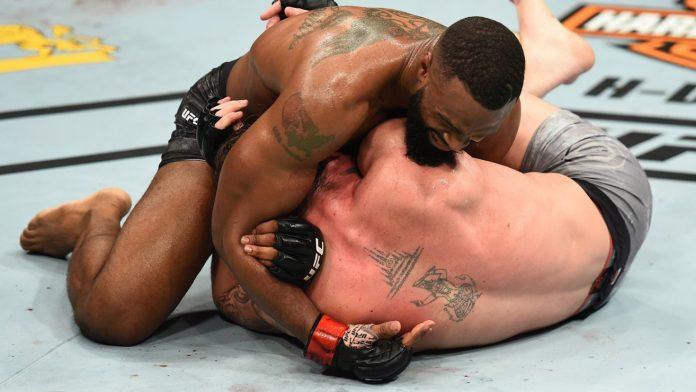
How To Finish A Darce Choke: Grip Variations

How To Finish A Darce Choke: Grip Variations

The hardest thing about a Darce choke is actually finishing with it. Despite the Darce being a submission hold, and an efficient one at that, it also doubles as a great controlling position too. In order to finish the Darce choke, though, you’ll have to go through several different grips. This is where the most important battles of the Darce happen. The good news is that you have several different grip variations to use and we’ll teach you how to finish a Darce choke with each one.

The grips involved in a Darce are versatile because of the position you are in when you’re hunting for a Darce. The Darce is an awkward choke to get used to, mostly because of the positioning of the arms. Angles and body positioning play a huge role in the choke’s mechanics. However, nothing is more important than using the right grip, at the right moment in time. Knowing more than one grip variation will help you not only in your quest how to finish a Darce choke, but also finish it against every kind of opponent, regardless of size or level.

A Positional Study Of The Darce Choke

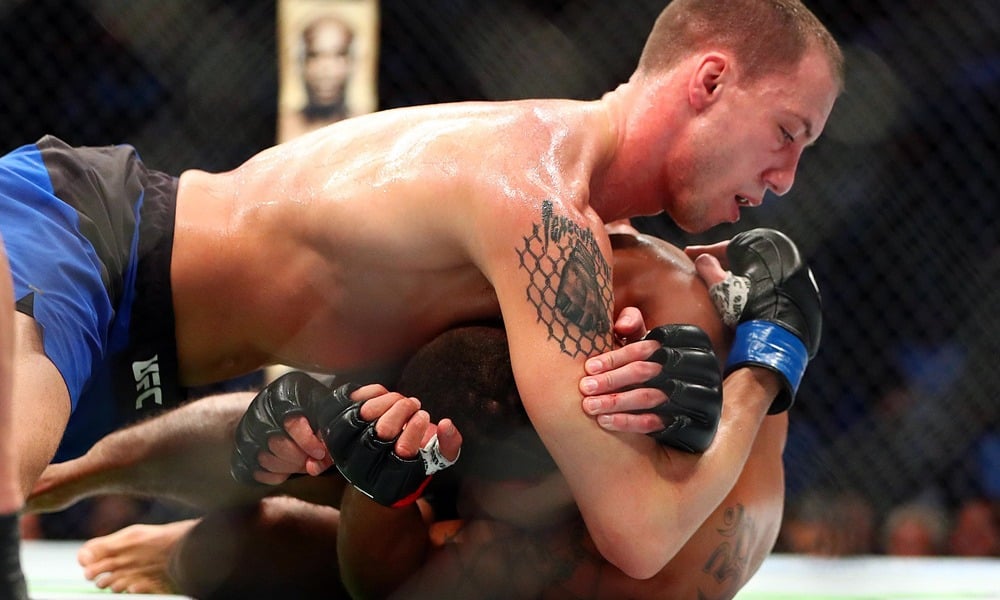
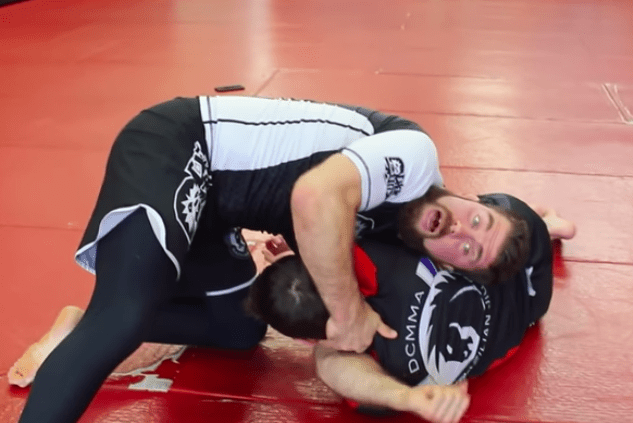
The Darce choke is an arm-triangle choke. It is actually a strangle since it uses the compression of the carotid arteries to cause loss of consciousness. To that extent, one artery is closed down by the biceps of your choking arm, and the other by the opponent’s own shoulder being pressed against their neck. The way to achieve this is by using a figure four grip. However, getting to the figure four grip is where most challenges with a Darce choke lie.

How To Finish A Darce Choke: GripsWhile the Darce choke can be done from both top and bottom, for high-percentage finishing you should always aim to be on top. This will allow you to place weight behind the shoulder that is supposed to put pressure on the artery. For that purpose, top side control, or even top half guard are the two positions where most people like to set up Darce chokes from. The focus here is on setting it up, though, because there’s no hope of a finish if your grips are not properly aligned.

Another position that ultimately leads to a Darce finish is the top turtle position, or better said, a front headlock against a turtled opponent. This sis where your grips become integral in getting the opponent to the position you want for a finish and the finish itself. Coming up against different people will require the use of different grips. For example, trying to break a wrestler down from this position.

So, how to finish a Darce choke?  Focus on the grips first and foremost and everything else will fall into place.

How To Finish A Darce Choke: Grips

There are plenty of ways to tie your hands together and hold an opponent in the Darce position before you aim to finish. For the finish itself, the figure four grip is the one that’s most utilized and go for a good reason – it is extremely tight. However, getting to that figure four grip is where most fail. Practically speaking, the grip that comes before the figure four is the one that is most important, as that is the grip that actually solidifies the Darce position.

  • The Figure Four Grip

How To Finish A Darce Choke: Figure Four GripStarting off our quest on how to finish a Darce choke, we’ll take a look at the actual finishing grip first. Knowing what your goal is, makes it much easier to use other grips that lead there, instead of trying to figure things out as you go. In terms of figure four, all you need to think about is trying to do the Macarena dance – touch both your palms to your shoulders. Granted, you won’t be able to touch your own shoulder with the locking arm, but you should aim to touch your opponent’s shoulder, rather than their back.
  • Gable Grip

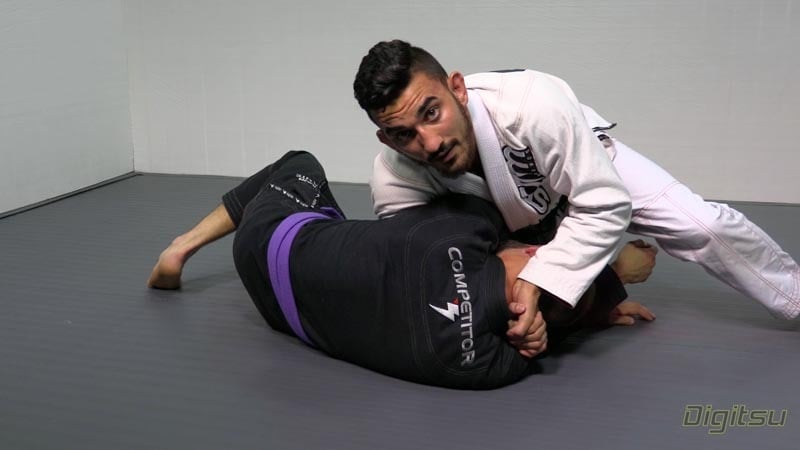
How To Finish A Darce Choke: Gable GripIn some instances, you can get directly to the figure four and adjust from there. However, most cases will require you to battle to break the turtle down or get a leg free from the top half guard in order to be able to position your body for a finishing grip. The Gable grip is usually the first grip you get when you manage to thread an arm inside for the Darce. This is a palm to palm grip, in which you clasp your palms together, keeping the thumbs inside the grip rather than engaging them actively. The grip is very quick to get and offers good strong control, but do not allow you to touch your elbows together.

Being able to touch your elbows together, or even have them go further than that (think of a scissoring motion is really helpful when you’re trying to keep someone still for a Darce. So, the gable grip is a good option when it comes to how to finish a Darce choke, mostly because it is quick to get and is instinctive. However, there are a few options that provide more control and make the position much more uncomfortable.

  • S-Grip

How To Finish A Darce Choke: S-GripThe S grip is an awesome option for controlling a Darce position, and even finishing the choke directly, without the figure four grip. It may be a bit uncomfortable though, and there is a trick to it that makes it nearly impenetrable. The original S-grip is when you place four fingers of each hand into each other, like the letter S. For the purposes of the Darce choke, the arm that you thread under the neck is the one that needs to have the thumb up. Otherwise, you won’t be able to close your hands together. This is one slight drawback of the S-grip, give that it takes tinkering and thinking about how to set it up, which takes time (at first).
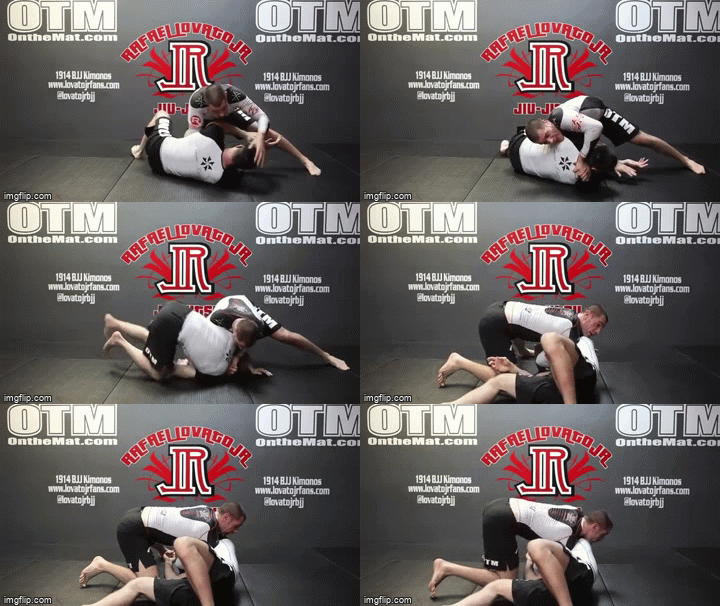
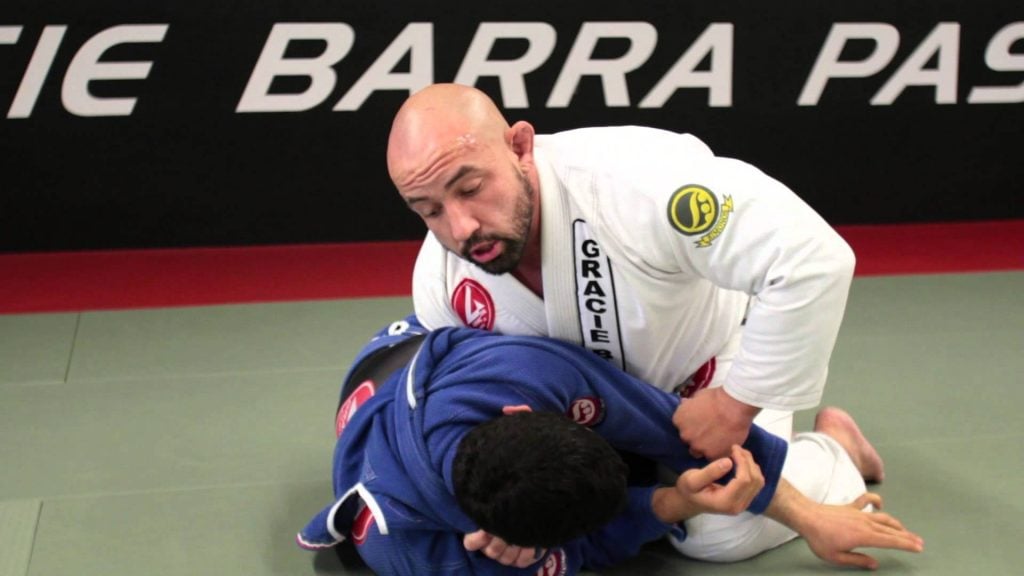
Improving your S-grip is easy. Instead of digging your fingers deep into each palm, try and place the tips of the four fingers of one arm on the tips of the fingers of the other. Now go for an S-grip and you’ll be surfside at how much tighter it is. Plus, you get an incredible range of motion of the elbows which is very important in finishing a Darce.

  • V-Grip

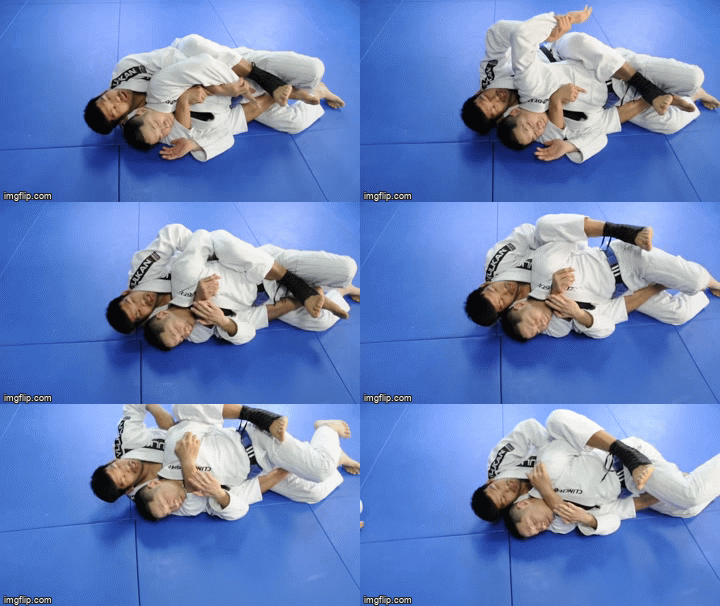
How To Finish A Darce Choke: V-GripThe absolute favorite of mine, one that, has completely transformed my Dace choke game. I learned this from Jeff Glover ages ago, and it is still my go-to these days. The grip works pretty much like the Gable grip with one crucial distinction. Instead of just having your fingers bunched together, you actually interlace them in a very specific way. The thumb of the bottom arm (the one under the neck) goes in between the forefinger and the middle finger of the other arm when placed in a Gable grip. The opening between these two fingers is why the grip si called the V-grip.

The V-grip allows you to finish a Drace right there and then. You can finish from the top half or even against a turtle without having to break them down to a hip or get to the figure four grip. Elbows move a lot, allowing for the bolt cutter Darce choke variation, as well as offering an extremely tight Japanese necktie follow up option. If you’re wondering how to finish a Darce choke, you should definitely look into this grip.

  • Lapel Grip (Brabo)

How To Finish A Darce Choke: Brabo Lapel GripThe lapel grip is another great way of finishing the Darce choke. In most cases, the lapel finish re-brands the choke as the Brabo, although it is the same submission hold. You can call it whatever you want. The idea is to get eh lapel of the opponent’ Gi loose on the top side. You then transfer the end across their back and look to grip it with the hand you’ve threaded under the neck. In essence, the lapel takes the place of your top arm, leaving you with an extra limb to tighten up the finish. Plus, it offers much tighter pressure on the artery on the bottom side of the neck.
Summary

The Darce choke is only as tight as your grips are. However, you can’t just assume that the figure four grip is the solution to everything, There are grips that open it up, as well as grips that you can fall back to if opponents are defending the figure four, In any case, have fun with all of the grips above and figure out different ways how to finish a Darce choke.

Pile Through Everyone With The Bulldozer Butterfly Guard Sweep

Bulldozer Butterfly Guard Sweep

he task of sweeping people in Jiu-Jitsu is a difficult one, particularly against seasoned grapplers that have spent years in the sport. Sweeps have underlying principles that whoever holds top position knows of, and can use to prevent the bottom person from sweeping. Moreover, different guards offer different sweeping directions and options, and that also factors in how effective a sweep can and will be. The butterfly guard is one of those guards that people expect you to sweep from. However, they won’t be expecting the Bulldozer butterfly guard sweep.

The butterfly guard is one of the most utilized guards today, and that makes it really hard to use. People know what’s coming – a sweep or a leg lock. For those that like to keep things more versatile, there are also back attacks and front headlocks available from the position. In terms of sweeps, though, we’re seeing people fly around less and less form this powerful guard. Some of that is due to the fact people have studied the guard and understand how to block. Most of the cases, though, involve people being reluctant to engage in the butterfly guard, to begin with. This is exactly where the Bulldozer butterfly guard sweep enters the frame.

The Paradox Of The Butterfly Guard

The butterfly guard is a very powerful position but has become somewhat less useful when it comes to sweeps lately. This is the big paradox of the butterfly guard, which is something it shares with all other famous BJJ guards. The better they become at getting you to the top or providing submissions, the less they will work. This is down to the fact that once something goes viral in the BJJ world, people start to try and figure out how to shut it all down. It will take time for that to happen, but eventually, options will emerge at shutting things down. The same thing is happening to the butterfly guard.

 Butterfly Guard SweepTo be fair to the butterfly guard it is in its second coming at the moment. Initially, Marcelo Garcia made it explode, sending people flying left and right. After a while though, most people figured out how to prevent it to an extent, especially with the Gi. Then, along came Danaher and his leg locking system that not just provided new submission options, but also brought back the threat of sweeps, in the form of dilemma attacks.

At the moment we’re seeing people come up with ways to try and counter this new threat from the butterfly guard. It is not really working too well, but eventually, someone will find a solution. Up until such time though, people do have a somewhat boring but still effective option – go to their knees and dig in. This can be extremely annoying for a butterfly guard player. Unless they know how to perform the Bulldozer butterfly guard sweep.

The Bulldozer Butterfly Guard Sweep

What is the Bulldozer butterfly guard sweep? It is a double leg takedown. Wait, what? Yup, theta’s right – you’ll use a takedown to get a sweep. Takedown work from the top because both people are standing. However, even if you’re on your knees, you can go for a takedown. Furthermore, even if you’re in guard and your partner is on their knees, you can set up to shoot for a takedown. It will just count as a sweep, given that no one is actually standing.

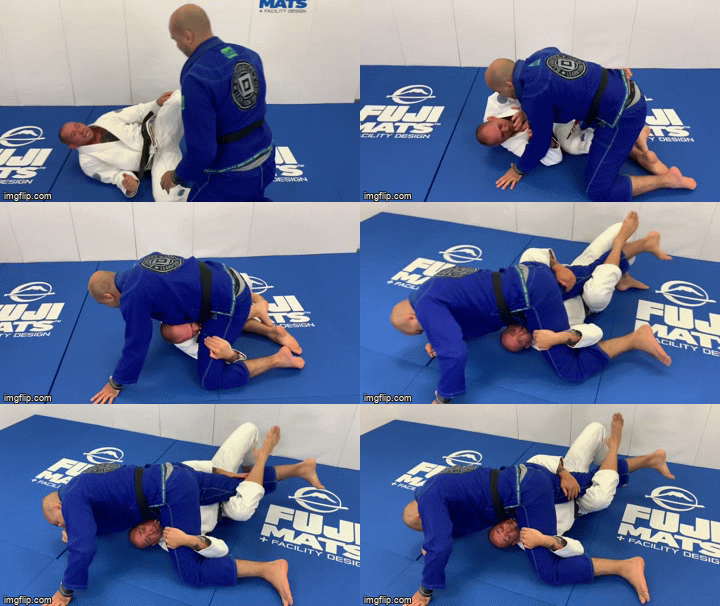
Bulldozer Butterfly Guard Sweep DetailsThe Bulldozer butterfly guard sweep is the perfect weapon to use when opponents dig in or shift their posture backward too much. All you need to do is switch your legs to one side, allowing you to go to your knees and get some drive out of the toes. From here on it is all about shooting into, head to the outside, and grabbing behind the butt to get a double leg. The sweep works like a charm, mostly because nobody is expecting it.
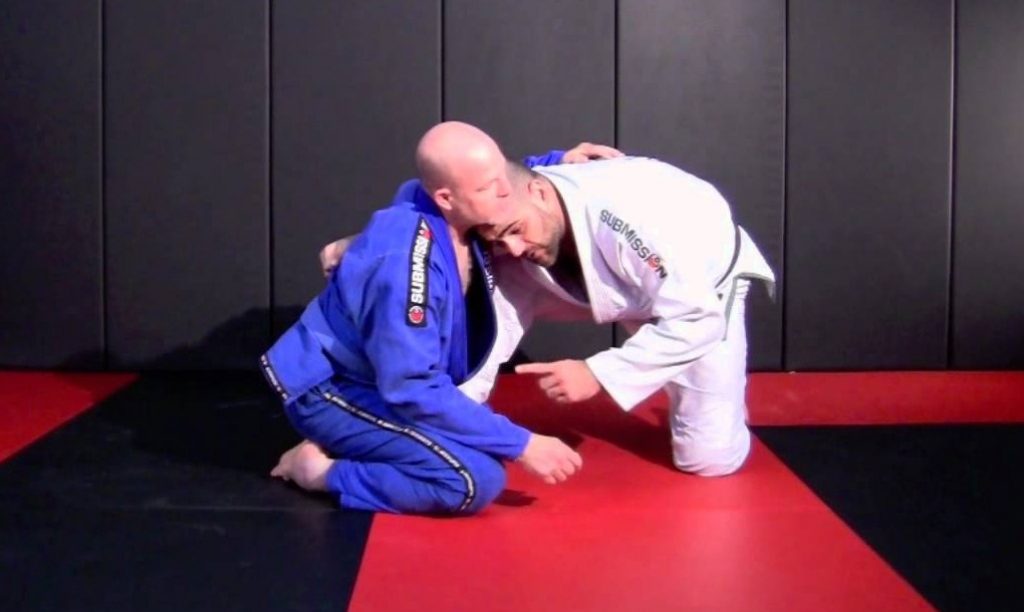
The important thing is that you need to keep one knee on the ground (the leg in between the opponent’s legs while the other is propped with the foot to the ground. Just like for a regular double leg. The sweep itself isn’t backward but to the side. This also has similarities to a double leg. The goal is to push back your opponent just far enough so they lose balance, and then you can take them to the side, finishing a butterfly guard sweep and ending up in a great position.

Jedi Mind Tricks

The secret behind the Bulldozer butterfly guard sweep is in Jedi mind tricks. The person on top usually expects you to sweep in three main directions, particularly form the butterfly guard. They either expect you to take them forward, to the sides or any combination of the above. They do not, however, foresee you taking them backward. That’s precisely why the sweep works so well against people that are dug-in.

Bulldozer Butterfly Guard Sweep Jedi Mind trickAnother reason is the positioning of the opponent’s hips and knees. When trying to dug-in against the butterfly guard, most people assume a position like that of the top person in a closed guard. That means their knees are a part, and their butt is sitting on their heels. The fact that their butt is not in line with their hips means you can sweep them in the direction of the butt with ease. In this case, that is behind them, which is exactly where you’re heading with the Bulldozer butterfly guard sweep.
There’s also the element of surprise. Not many people expect you to go for a takedown, let alone a double leg when you’re’ playing butterfly guard. This, along with the change in direction and the position the opponent is in creates the perfect opportunity to Bulldoze through them, forcing them to the ground.

Conclusion

The Bulldozer butterfly guard sweep is something I have been using for years now. Even if an opponent tries to defend it, they’ll have to switch their weight, opening up some of the other butterfly guard sweeps. Alternatively, failing at this sweep (which is very rare) opens up the front headlock for you, which is more than enough to deal with anyone.

Grappling Arts Of The World: Korean Wrestling (Ssireum)

Ssireum Korean wrestling

I really do enjoy exploring the different grappling martial arts of the world. Some of them are arts we know of, while others are such a part of local folklore that they remain unknown for most of the world. Grappling arts of the world are not just fun to explore, but also have interesting things to offer Brazilian Jiu-Jitsu. There’s always some tip or trick we can learn from anything. From Sambo to Sumo, from African Laamb wrestling to Korean wrestling, also known as Ssireum, they all have unique traits that might just have a role to play in BJJ.

Today’s focus is going to be on Korean wrestling or Ssireum. With taekwondo being the main martial art “export” of Korea, most people don’t really look into other styles that might originate in that part of the world. As it turns out, Koreans have a very interesting folks-style grappling based martial art that is a unique blend of wrestling and Sumo, with an even more unique set of rules and competition formats. AS such, it is not just entertaining to watch (I dare say more than Sumo, as it doesn’t have as many rituals, and has more action) and it has lots of interesting things to implement in your Jiu-Jitsu game.   

History And Origins Of Ssireum                                   

Korean wrestling dates back to the Goguryeo period, which extended between the 1st and 7th centuries. At the time, Ssireum was a pastime that quite a lot of people enjoyed, ranging from peasants to kings.

Ancioent Korean Wrestling SsireumThe activity itself also has a connection to the Korean holiday of Dano, or the fifth day of the fifth lunar month. This places most Korean wrestling tournaments in the summer and autumn, in accordance with the holiday. However, Ssireum is not just restricted to these holidays. The popularity of the art is such, that it plays a part in other Korean holidays as well, like the Buddhist All Souls’ day, for example.
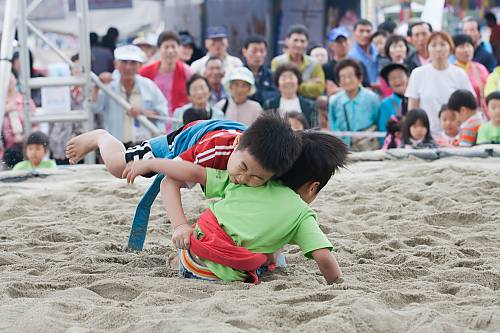
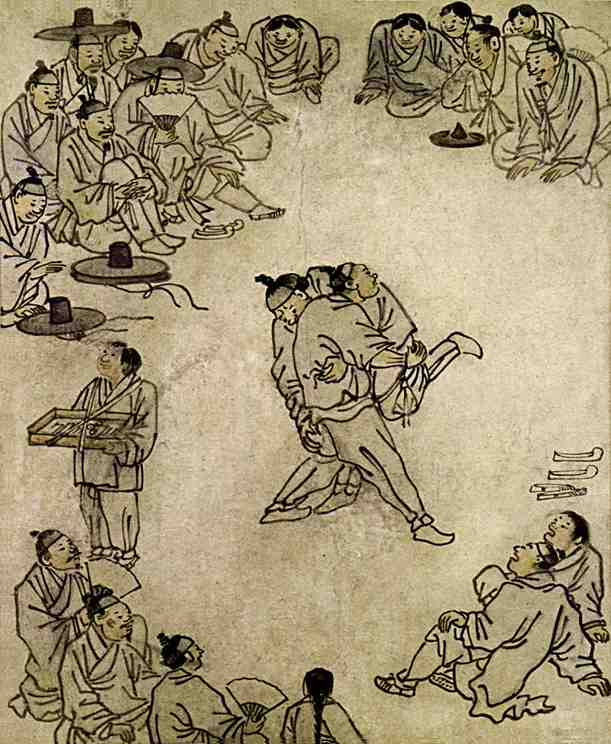
Ssireum developed naturally when ancient people had to figure out a way to survive against animals and other humans with their bare hands. As it evolved throughout the centuries, it slowly morphed into a sport and a pastime activity. Korean wrestling appears in many aspects of Korean history, from cave painting to more modern scriptures, outlining the art’s importance as part of the culture.

During the Dano, Ssireum tournaments were held on large patches of grass. Participants showed off their skills, by using pushing, pulling, twisting, trips, body locks, etc to force an opponent to the ground. Even from its earliest days, Ssireum had lots of spectators watching the matches. The winner got a bull as a prize. To this day, Korean wrestling matches are a part of the country’s holiday celebrations.

In 1927, the Pan Chosun Ssireum Federation was formed, as a governing body of the sport in Korea. Since 1947, they have been organizing a National Championship, with two distinct styles of Korean wrestling appearing throughout the years. In southern regions, the Ssirum style was referred to as “predominantly right-handed”, with the left-sided being favored in more northern regions. As of 1994, the left-handed style is the official Ssireum of Korea.

Korean Wrestling Rules And Competition

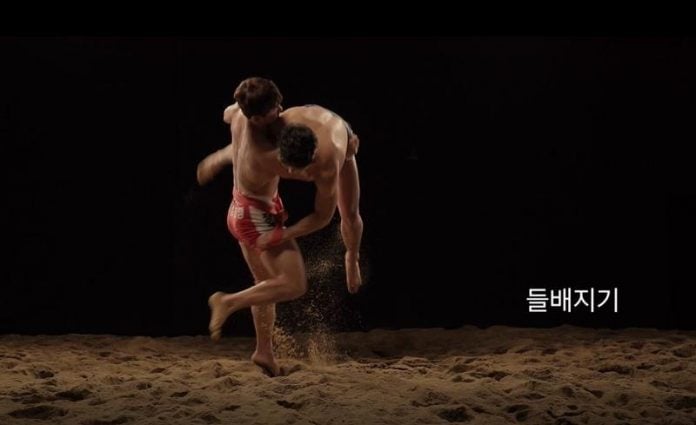
The way Korean wrestling works in a competitive setting does remind a lot of Sumo wrestling. The competitors face off in a circular ring, which is filled with sand. Also similar to Sumo, nothing but the feet can touch the ground. If any other body part touches the ground, the opponent gets an instant win.

From a more unique perspective, both grapplers start the match kneeling and with a grip on the opponent’s belt or satba. Sounds familiar, right?  Both competitors then rise to their feet, still holding on to the belt grip and the match can commence. Contrary to Sumo, leaving the designated ring area does not lose the match, but earns a restart in the middle instead.

Korean Wrestling Ssireum3 referees oversee Ssireum matches, a head referee, and two assistants. The head referee is inside the ring, while the two assistants are placed behind the competitors on either side of the ring. The assistant referees can contest a decision by the head referee if it is not correct, or he cannot render one. That merits either a rematch or a revocation of the original decision. Athletes cannot contest the referees’ decisions.
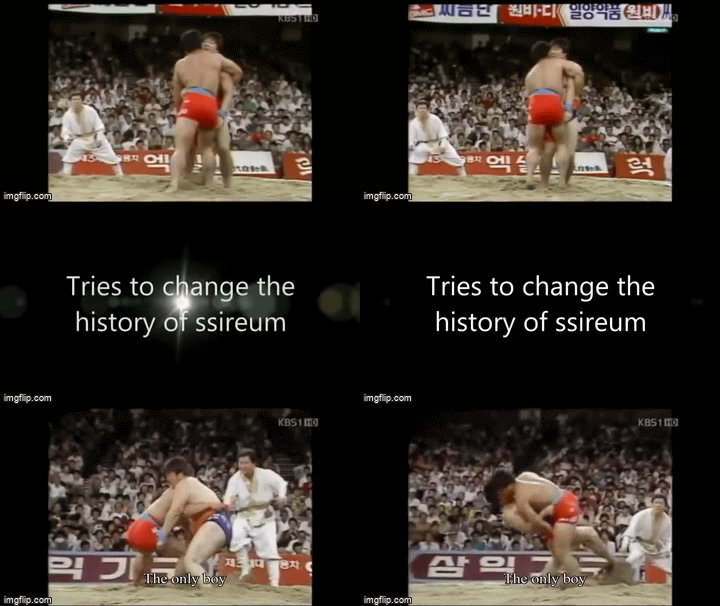
There are four official weight classes in the sport of Korean wrestling (flyweight, lightweight, middleweight, and heavyweight. Each of them is named after a famous mountain peak in South Korea. Today, there are also women Ssireum wrestlers that compete in Korea.

Further exploring the contrast between Sumo and Ssireum, slaps of any kind are not permitted in Korean wrestling. Also, Korean wrestlers, even the heavyweights (above 160 kg) tend to be leaner than Japanese Sumo wrestlers. The Korean Ssireum Organization, which is the official governing body is responsible for organizing events that include world championships as well.

Interesting Facts About Ssireum

As if the art itself, from origin to modern version is not interesting enough, there are some facts about Korean wrestling that are quite unique.

For starters, the ring they grappler in is 7 meters and filled with sand. In modern days, the satba (belt) is worn over short pants, which used to be long trousers in the past. There are some requests for getting the traditional trousers back as part of the sport, given that they provide a lot more gripping options and more entertaining matches.

SSireum Korean Wrestling highlightThe first televised Ssireum event was in the 1960s, and it brought the sport worldwide exposure. Although Koreans had Ssireum competitions since 1912 (the first was at the Dansongsa theater) the sport never really caught attention until it ended up on TV>
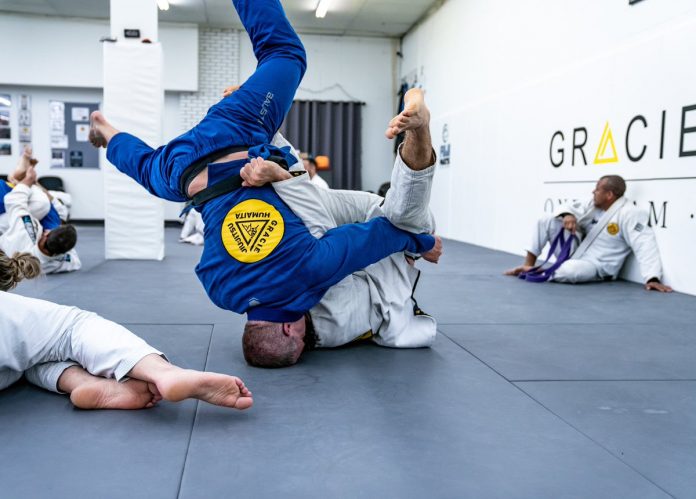

The first time an official Korean wrestling world championship took place was in 2015. Myanmar was the host country, with the Thuwana Indoor Stadium as the venue. The host country ended up winning the tournament, even though Ssireum is not their national grappling sport. It took Korea three tries to win the official World Championship, with Germany claiming the second-ever Ssireum tournament.

In Summary

Korean wrestling is an interesting blend of grappling rules that could really benefit Brazilian Jiu-Jitsu. It is a pure grappling style, for one, with no strikes available, and a lot of emphasis on grips. Plus, there’s a lot of twisting, shifting, and maneuvering on the feet, along with the belt and trouser grips that do offer a different and fresh perspective to stand up fighting in any grappling martial art.

Breakdance For BJJ – Possibly The Best Way To Improve Your Grappling

Breakdance For BJJ Cover

Back when I was a teenager, breakdancing was a thing. If you knew how to breakdance, you were in the center of attention. Being involved in martial arts since the age of 6, breakdancing didn’t’ really seem that challenging to me, so I learned how to do it. And it was fun. Fast forward a decade or so, and I signed up for BJJ. Suddenly, out of nowhere, some of those breakdancing skills started emerging and helping me whether out the toughest period of Jiu-Jitsu – those first few white belt months. The truth is, breakdance for BJJ is probably the best way to master unpredictable and high paced movement and become a better overall grappler.

When it comes to exploring breakdance for BJJ, that doesn’t mean that you need to start wearing baggy clothes, listening to hip hop, and becoming a full-fledged b-boy or b-girl. All it takes is training like one, given that there’s tremendous carryover in the skills you learn from breakdance to those you need in Brazilian Jiu-Jitsu. Of course, if you decide that the b-boy lifestyle is for you, by all means, keep dancing just for the sake of it. However, if you do BJJ, you need to at least give breakdancing a try, when it comes to cross-training in a fun way that doesn’t involve CrossFit or some other fad fitness trend.

Where Did Breakdancing Come From

WE wouldn’t be real grapplers if we didn’t nerd out every time we come across something even remotely BJJ-related. So, before we explore why breakdance for BJJ is a good idea, and look at some drills that are helpful, we need to know what breakdancing is, and where it originates from.

Breakdance For BJJBreakdancing is an NYC thing, historically speaking. During the late 1960s and early 1970s, this dancing style emerged among African Americans and Latinos in NYC. They combined dancing moves from different styles with gymnastics and even martial arts elements, creating a free-flowing and highly impressive dancing style. Breakdancing involves a lot of creativity, as there are no standard moves, or at least there were none at the beginning. It is all about being energetic, flowing, and freezing, doing dangerous acrobatics that ties into each other, and doing it all with a sense of rhythm.

The ”break” in breakdance refers to the rhythm of the music, produced by DJs mixing sounds to get the beat required for breakdancing. Kool Hertc is the DJ that came up with it, playing two percussion breaks from two records at the same time.

Later on, during the 80s, breakdancing became more mainstream, with moves like the moonwalk getting adopted by high profile stars, like Michael Jackson. Slowly, breakdancing moved from the streets and into the lives of everyone, mostly because of MTV and other music channels that popularized it. Interestingly enough, it took going mainstream for the term “breakdancing” to emerged, coined by the mainstream media. Speaking of going mainstream, break-dancers performed in front of the Pope in the Vatican in 2004.

The Relation Between Breakdancing and BJJ

The similarities between BJJ and breakdancing might not be completely obvious from first glance. One is a style of crazy dancing, while the other is a grappling match against another person that also knows how to grapple.  Moving past that, though, you can see how both employ unorthodox and specific patterns of movement which are not that far removed from one another. More importantly, al the same athletic qualities are required for both. Those include strength, flexibility, and mental toughness, as well as physical intelligence.

Breakdance For BJJ FlowThere are several reasons why breakdance for BJJ makes sense. A breakdance routine usually involves three things – standing movements, dynamic ground stuff (for lack of a better term), and “freezes” or static holds, usually done in the most impossible body positions imaginable. This is highly similar to what BJJ is all about. There’s a lot of emphasis on movement in break dancing, focusing on inertia, level changing, balancing, and reacting quickly. Moreover, the freeze poses help develop dexterity and isometric strength that is the same as that developed by gymnastics, only in the even harder body poses.

Another interesting aspect of breakdance for BJJ is the warrior mindset. In breakdancing, there are “battles” between B-boys and girls, where they take turns demonstrating their skills in order to determine a winner. If you truly like to embrace breakdancing, that this battle culture has a huge mental carryover to Brazilian Jiu-Jitsu which is all about competition 1005 of the time.

Breakdance For BJJ: Drills

Finally, let’s analyze how we can integrate breakdance for BJJ into drills that will make you better at both.  The way to use these drills is in any way you see fit. They can be mobility drills, movement drills, isometric drills, etc. You could dance to music, or just try and accomplish the maneuvers in order to get a better understanding of your body, and learn to control it in every possible plane of motion.

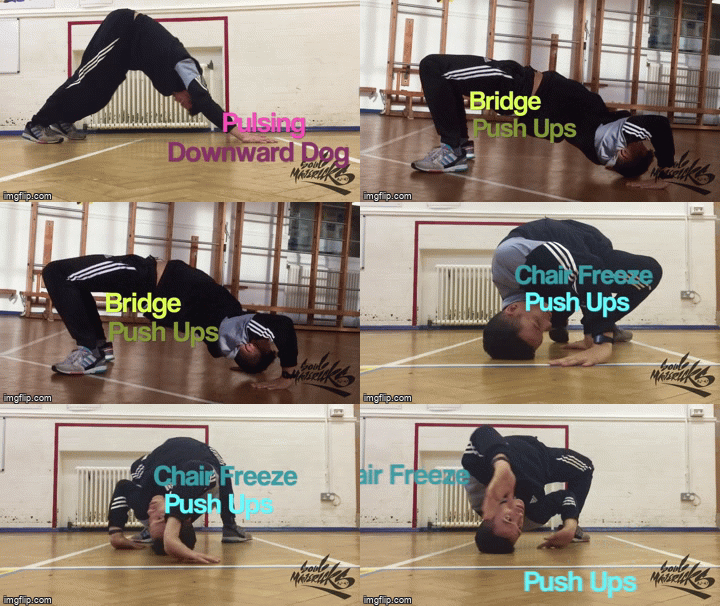
Breakdance For BJJ DrillaThere are interesting mobility drills that breakdancers use to get limber and loose for their main dancing flows. Apart from the usual warm-up stuff that targets joints, there’s a lot of spine work in breakdancing, like bridge pushups, chair freeze pushups, and twisting lower back drills. Also useful for Jiu-Jitsu are all the hip mobility and strengthening drills. From simple side to side rotations to squat rotations and “W” drills, expect a lot of improvement in your hips and knees.

Breakdance For BJJ DrillsAlso, you could always use full b-dancing flows to just get a better orientation in space, physical intelligence, and develop quick-reaction dexterity that will definitely help you Jiu-Jitsu. The folks at 10th Planet  Jiu-Jitsu are certainly having a lot of fun with breakdance for BJJ. Flows and even b-boy battles are a regular part of their warm-ups, and it certainly shows in their unique style when they compete.

In A Nutshell

AS proven by the likes of Geo and Ritchie Martinez, breakdance for BJJ is as useful as it sounds unorthodox. Given that Geo got his black belt in just over 3 years due to his breakdancing pedigree, you have to admit there is something to this breakdance for BJJ thing. Personally, I’ve never been near the level of the Martinez brothers or any respectable b-boys out there. However, a quick refresher course of my break dancing skills certainly helped and is still helping me in my Jiu-Jitsu journey. Why not give it a try? It can only be fun!

Try Something Different: “The Scientist” Half Guard Sweep

"The Scientist" Half Guard Sweep

Paul Schreiner is a real scientist when it comes to Brazilian Jiu-Jitsu. He might not be quite the mad scientist (yet), but what he is working on certainly makes sense. After all, he has been a black belt for a long time and has had exclusive access to Marcelo Garcia for decades. No wonder he constantly comes up with new and exciting ways to torture people in BJJ, mostly from his favorite half guard. Today, well analyze really cool half guard sweep he likes to use, which we dubbed “the Scientist“ sweep.

The Scientist sweep is not something that’s unseen in Jiu-Jitsu. It is just a combination of things we know, done from the half guard, in a manner that’s not usual. As such, it is very effective, easy t comprehend and not hard to master, once you get enough reps in. Paul Schreiner is certainly an aficionado of the half guard, and when he delivers on something form the position, you can bet it will work against all kinds of opposition. This half guard sweep is just one example of how you can think outside the box to achieve a goal in BJJ.

Anatomy Of The Half Guard

The half guard is the favorite position of many people around the world. It certainly captivates blue an brown belts a lot (more on that on a different occasion). However, there are also black belts that are extremely proficient at it. There’s a good reason why people turn to the half guard: it is easy to get to, retain, recover, and attack from. The perfect combination. Plus, there are plenty of half guard variations out there to fit everyone’s goals.

The one thing with the half guard is that it is a guard. As such, it is somewhat limited by the confines of all guards. What I mean by that is that the only things you can do from the half guard offensively is sweep and submit. Both are great attacking tools, but the catch is that your opponents know what’s coming. What can help you achieve your goal, despite it being somewhat obvious, is figuring out different and innovative ways of executing the techniques. And the half guard is the perfect position to achieve just that.

Unlike the closed gourd, the half guard offers much more mobility. The fact that you only have your legs closed around one leg gives you mobility, while still providing you with a great amount of control fever the opponent’s hips. Unlike open guards, having closed circuit control really helps limit the opponent’s movement options. In other words, the half guard has the best of both worlds. That is why just about any half guard sweep is hard to resist, and the guard itself is not easy to pass. However, there are solutions to how you set up half guard sweeps, which is where top players excel. The scientist half guard sweep will take that ability away.

“The Scientist” Half Guard Sweep

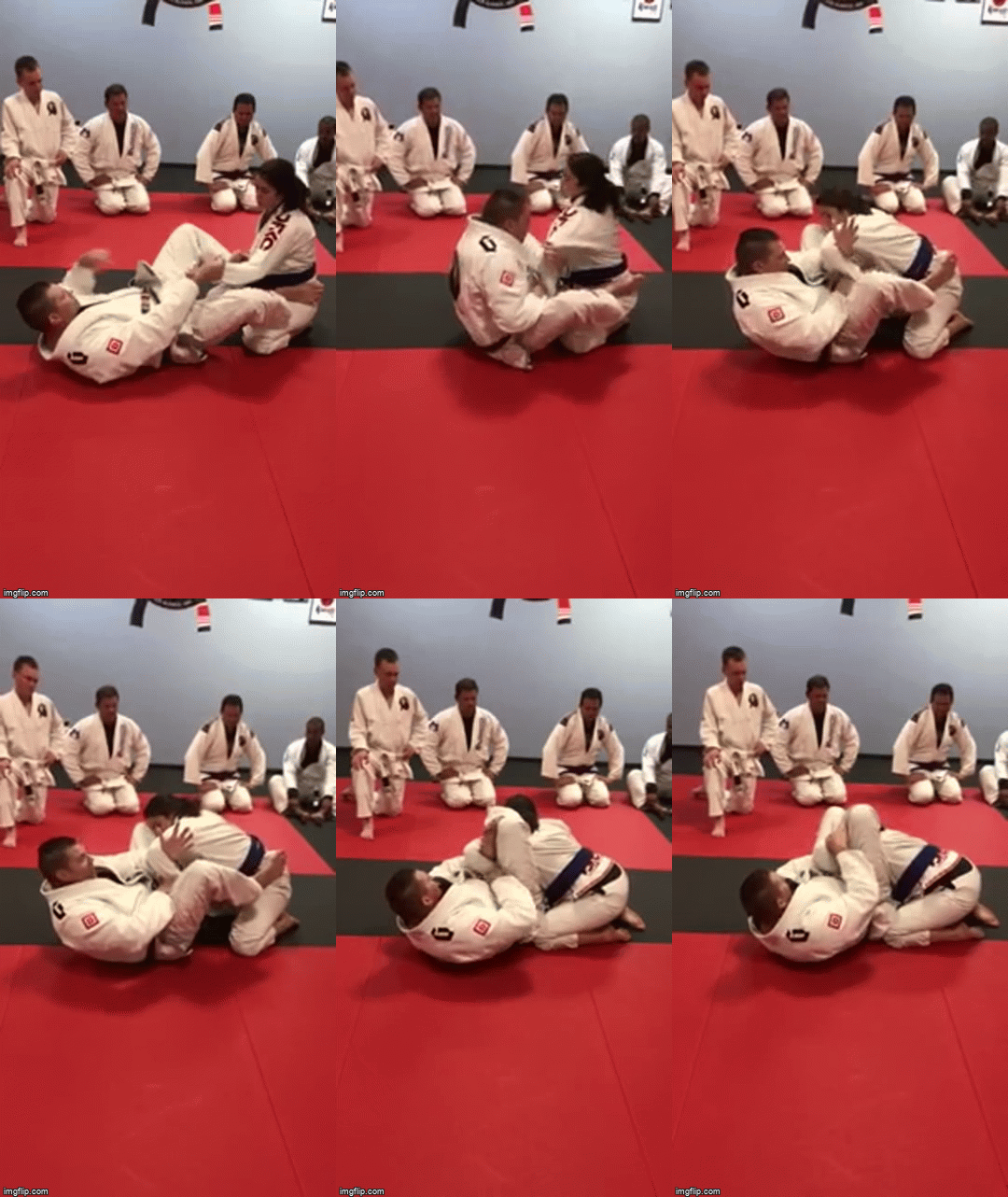
Half Guard Sweep entryFirst up, this half guard sweep, like many others, stars with an underhook. However, instead of going for the traditional underhook across the back, which often opens up Whizzers and D’arces, Paul likes to use a lower underhook. In fact, I usually call it an “underbutt” myself, for a lack of a better term. This provides great control over the trapped leg. It also opens up lots of space to shoot your other arm underneath the far side leg, in a similar “underbutt” position. Or a scoop-grip, if you will.
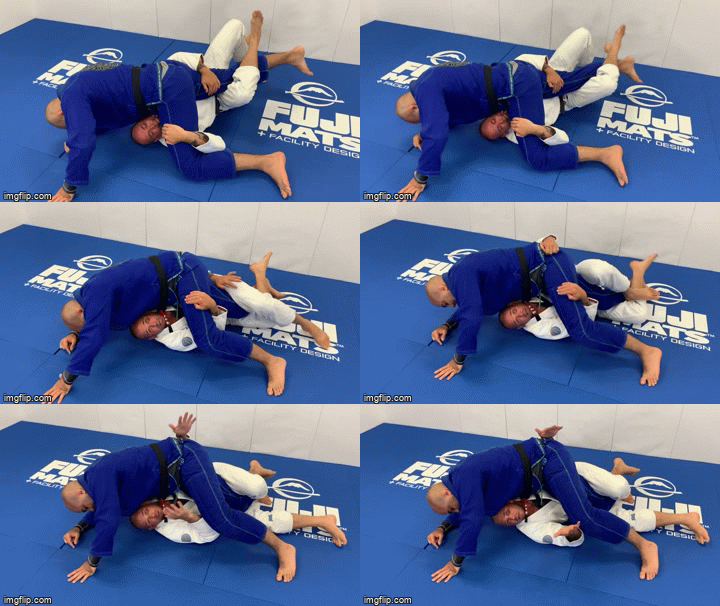
Half Guard Sweep coilThe next step is to get the weight of your opponent forward so that you get control of their center of balance. Lying back and pulling with both underhooks, plus extending your legs is going to get it done. However, this is a very precarious position to be in, so you’ll need to gain some control immediately. The way to do that is by extending your inside leg, so that the knee of the trapped leg twists, and you can switch hooks, trapping your opponent in a “coil”.
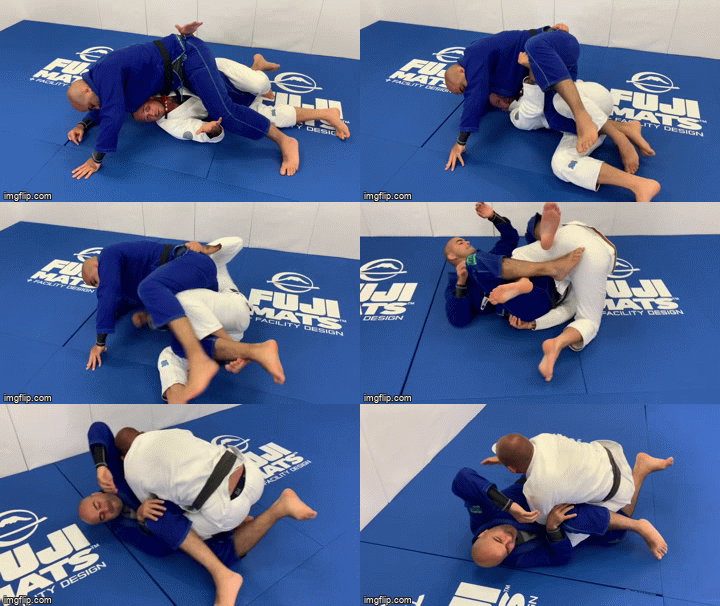
Before finishing this half guard sweep, Paul addresses something really important – leg lock counters. Oftentimes, when you try and sweep from the half guard, opponents use it to get to the 4/11 position and hunt for heel hooks. The way to prevent it is to use the leg controlling their trapped leg to hook from the outside, while you switch your grip to their hips. No spinning leg lock setups now!

Half Guard Sweep finishWhich brings us to actually sweeping. Instead of looking for the usual inertia based sweep, this half guard sweep is much more methodical. Al you want to do is move your upper body from underneath the opponent, ending up in a lying leg drag type of position. Paul shows a neat little trick to solidify the position here – grab the hip with your free arm by going in a half Granby. Now that you have full control, you can stand up directly in a leg drag position which opens up plenty of attacking opportunities.
The Value Of Trying Different Things In BJJ

Brazilian Jiu-Jitsu is all about experimenting. Certainly, most experiments fail miserably. But that’s expected. it is the same in science – people get things wrong over and over again until either they figure out how to get them right, or something else emerges completely by accident. There’s no point in dwelling in stuff that worked 20 years ago when the grappling game has changed so much in the meantime.

The half guard is a position that allows for lots of experimentation. It is a safe spot to launch sweep and submission attacks from, which means you can be as creative as you want, as long as you’re not doing dumb things that provide your opponent with effortless passes. The Scientist half guard sweep works like a charm, but it must’ve taken quite the while for Paul to iron out all the wrinkles.

The lesson here is simple – try new things, challenge existing dogmas and absolutes, but be prepared to pay the price. That price is losing. And no, I don’t believe in the old “you either win or you learn”, nor in “there’s no losing in training”. Losing is absolutely crucial to learning, evolving, and understanding BJJ. So, the next time you’re in half guard, play around with the Scientist half guard sweep. From there on, try and figure out your own way of setting it up, or try and explore other sweeps that might use the same principles. It’ll do you and your Jiu-Jitsu a world of good.

Wrapping Up 

The Scientist half guard sweep is powerful beyond measure. It keeps you safe throughout (no D’arce or leg lock counters), it is not hard to learn and it does open up a whole new direction of sweeping from the half guard. Paul has certainly done all us half guard players a big favor in opening this door, but now we have to keep exploring what’s beyond it. Happy hunting!

Chicken Wings To Die For: BJJ Chicken Wing Submissions

BJJ Chicken Wing Control And Submissions

Almost any 90s movie that has cops arresting people, aside from NFL-like flying tackles, shows that perpetrators surrender immediately when their arm gets twisted behind their back. The idea for this move comes out of wrestling. Chicken wings are staples of wrestling when it comes to controlling someone and forcing them into a position that lands you points. They have been looked down upon by other martial arts, though, and that’s mostly because all of the Hollywood nonsense we see in movies. Is there a viable BJJ chicken wing option, though, or is it a move that only wrestlers can use?

If there’s one thing I’ve figured out in Jiu-Jitsu, is that you can learn something from every grappling move in existence. It doesn’t have to be the same thing as in the original sport, mind you. Everything is open for adjustments and evolution. Just take a look at leg locks. A decade ago they were outlawed and thought to be ineffective until Danaher came out with a revised and evolved version of them. It is the same with any move, including BJJ chicken wing options. In fact, chicken wings offer a lot to BJJ, where not just control, but submission is a big part of the game.

Chicken Wing Basics

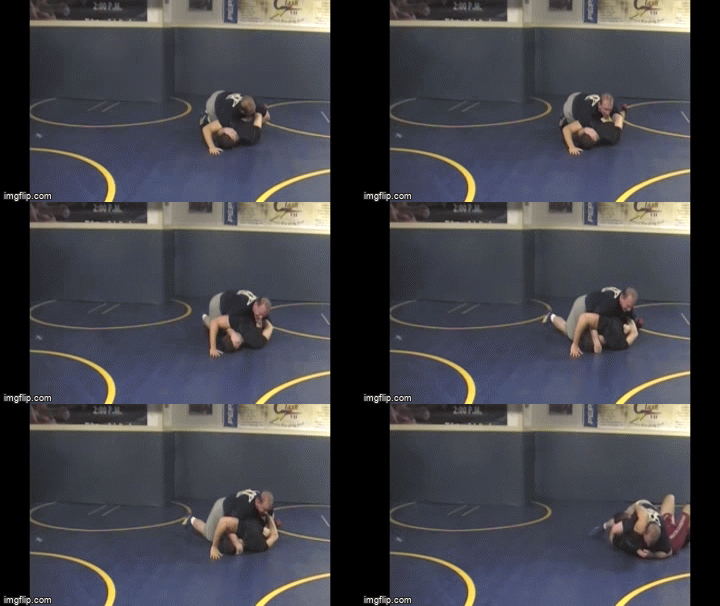
In wrestling, a chicken wing is a move that manipulates the opponent’s arm so that you gain control over them. Most often, wrestlers rely upon chicken wings to tire out an opponent, help get a pin, earn points, or finish a takedown from a scramble. AS you can see, the move is very versatile and has plenty of uses. In fact, it also acts as a submission, so much so that setting it up as one is illegal in wrestling, due to the move being “dangerous”.

BJJ Chicken Wing BasicsA chicken wing in wrestling is when you take the arm of an opponent and force their elbow backward so that you can thread your own arm towards their back. There are plenty of ways to set it up and you can use either arm to control the position. Having a hand behind in that manner incapacitates your opponent taking away a lot of movement options. Furthermore, there are double arm chicken wings that provide total control over the upper body. In terms of legality, the arm that you thread must not go towards the shoulder or the traps in wrestling because then it turns into a submission hold. In terms of BJJ chicken wing options, that’s exactly what we’re after.

The reason why a chicken wing is so efficient is that it utilizes a basic and very important grappling principle – the open elbow. A chicken wing position allows you to take the opponent’s elbow away from their ribcage, which is where they’re the strongest. This will weaken any opponent, allowing you o o further improve on the positioning or finish with a submission hold.

Controlling With Chicken Wings

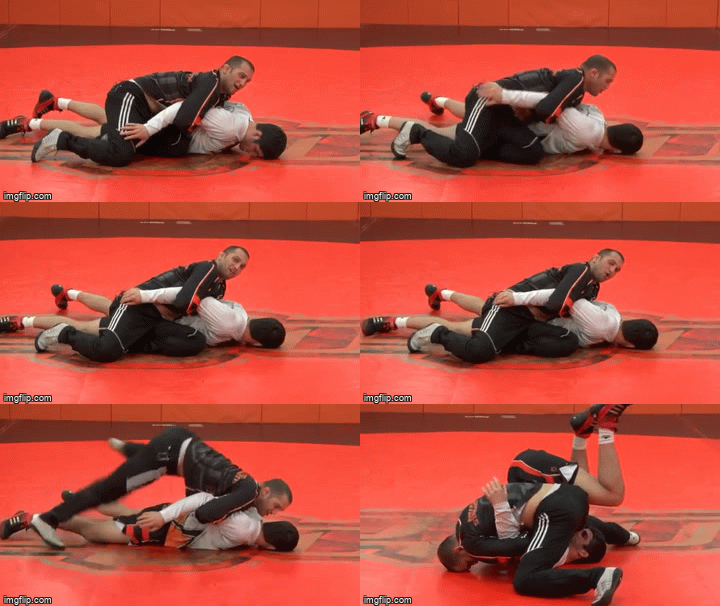
The chicken wing in wrestling is usually done when an opponent has their belly to the ground. IN wrestling, if both shoulder blades touch the ground, you get a pin and win the match. That is why wrestlers go belly down whenever they sense danger lurking. Chicken wings allow the top person to easily maneuver a bottom person to their back, due to the open elbow principle.

BJJ Chicken Wing: Double Wrestling Chicken WingsThe double chicken wing works even better. You get both arms, achieving total control over the body. Then you can maneuver in different ways to get the opponent’s back to the ground. In BJJ terms, that would mean either securing side control or even transitioning into more dominant positions like the Truck or back mount.

BJJ Chicken Wing Back ControlSpeaking of back control, that’s another position where chicken wings have a role to play,. Of course, now we’re going into BJJ chicken wing territory rather than the original wrestling ones. The idea is to eliminate the arm, similarly to Danaher’s straight jacket control, so that you can get to a choke easier. The goal is to place the top arm of an opponent behind their back, trapping it with your body and your leg when you have their back.

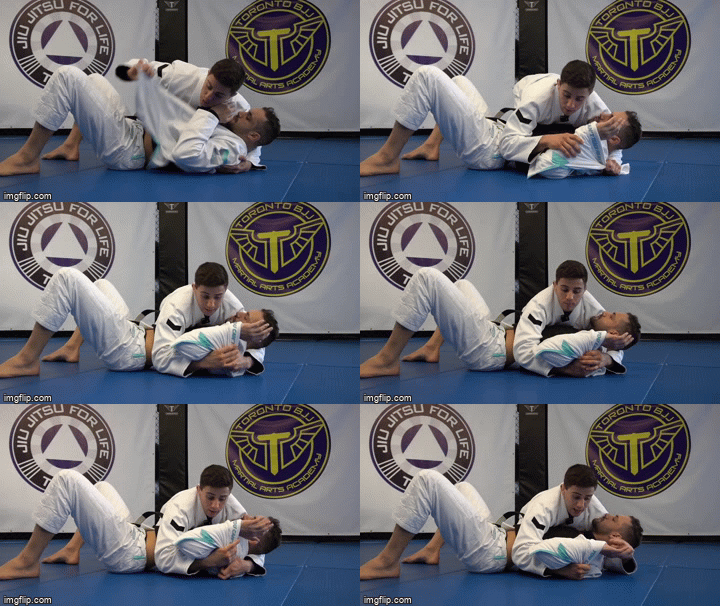
BJJ Chicken Wing With LapelAnother huge use of the BJJ chicken wing concept is from top side control. It is done with the GI and is one of the most uncomfortable positions you can put someone in. The direction of the chicken wing is different, with the arm trapped in an Americana-like position, but the principle is the same. The goal is to get the opponent’s own lapel over their wrist and grab the lapel with the cross-face arm, as tightly as possible. There are different finishes available, or just i9mmense control, depending on what you need at the moment.

BJJ Chicken Wing Submissions

On the subject of BJJ chicken wing submissions, as you might imagine, the opportunities are plentiful. As a submission, the chicken wing is practically a Kimura lock. However, the wrestling setups give it a different dimension, and combining it with BJJ principles makes for some really painful and uncomfortable submissions.

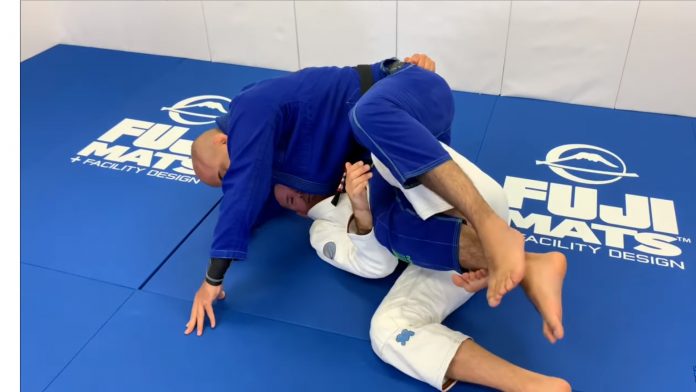
BJJ Chicken Wing Shoulder LockThere is a simple and painful BJJ chicken wing submission you can do from the closed guard. It involves you maneuvering the opponent’s arm with an arm drag so that you trap the wrist with your legs and your arm is inside like for a regular chicken wing. It looks like a modified biceps slicer but is actually a nasty shoulder lock.

BJJ Chicken Wing Wrist LockWrist locks are clearly another really available option when you’re messing around with chicken wings. Also form the guard, when you get a chicken wing position of the arm, and you can’t maneuver into the shoulder lock, you can transfer your attention to the wrist. As long as the elbow is pointing away from the opponent’s body, you’ll be able to tap them. Use the arm that is inside the chicken wing to bend the wrist, and the other arm to fix their forearm to your body.

BJJ Chicken Wing: EzekielFinally, a BJJ Chicken wing Ezekiel choke to provide some variety. The Ezekiel choke from her works when an opponent manages to wiggle their arm free from the side control lapel chicken wing. What you’re left with is a loop from the GI that can act as your bottom hand would in a regular Ezekiel choke. All you need to do is thread the choking arm in and finish.

Conclusion

The BJJ Chicken wing is not something that is going to take the grappling world by storm. It is one of those moves that will help you out of tight spots or help you finish people you normally can’t. It is far from a silver bullet solution to Jiu-Jitsu issues, but it is very helpful, annoying, and painful, which is usually the recipe for highly effective BJJ moves. All you need to do is start having fun with it.

Three Levels Of Open Guard Sweeps For BJJ

Three Levels Of BJJ Open Guard Sweeps

Sweeping in Jiu-Jitsu is fun. The looks on people’s faces when they’re powerless to stay up as they realize they’re tumbling to the ground are always priceless. However, sweeps are not an easy thing to get, particularly against skilled and seasoned opponents. In that sense, the majority of sweeps in Brazilian JIu-JItsu come from open guards, given all the variety that is available from there. So, open guard sweeps are the things to focus on, but which ones? There’s no simple answer that will provide two or three sweeps that will universally work against everyone. There is, however an answer to that question.

Open guard sweeps come in as many different variations as there are guards. That doesn’t really help the case for figuring out how to sweep everyone you roll or fight with. Sweeps do have common underlying principles that make them work, but that is a subject for another day. In terms of practicality, you need to focus on sweeping people that are constantly changing levels. It is easy to sweep someone who is not defending the sweep, but it is highly unlikely to expect such a scenario every time you try a sweep.

Why Do We Sweep?

The main question here is why do we need to sweep in the first place? In Brazilian Jiu-Jitsu, the guard is a signature position that everyone falls in love with at a certain point in time. However, there are only two things, offensively speaking, that you can do from the guard. You can submit an opponent, which would be the most desirable outcome. It also happens to be the headrest thing to accomplish in Jiu-Jitsu. Apart from submitting someone, all that you’re left with is sweeping. But what does a sweep get you, exactly?

Open Guard Sweeps for BJJIf you take a look at BJJ scoring or any grappling or MMA scoring systems for that matter, all positions that score you points are from the top. There’s absolutely no guard that scores you points. The reason for this is that despite BJJ offering so many different guards, it all boils down to the fact that you have to be on top to win a fight. This is just as true in MMA or a street fight as it is in a Jiu-Jitsu match or a roll. Given that in BJJ one person is on the bottom at all times, the goal of any exchange is all about getting top position. The top person wants to keep it and use it to submit, while the bottom person would prefer to come on top.
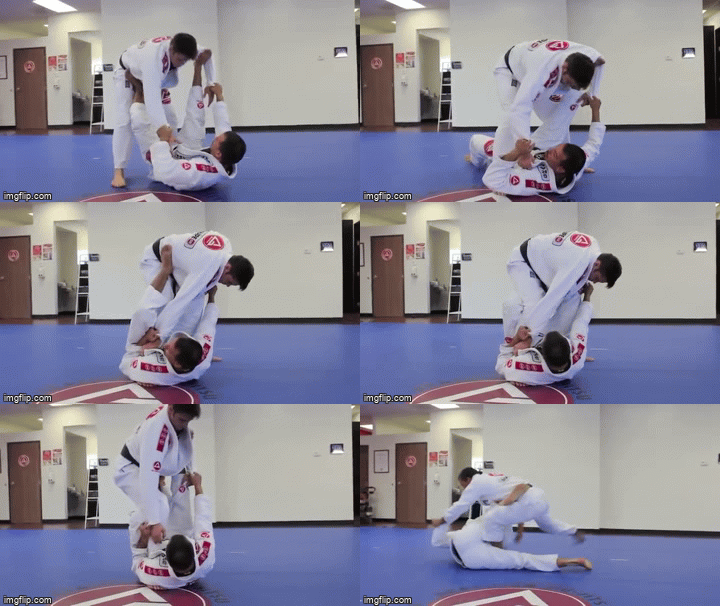
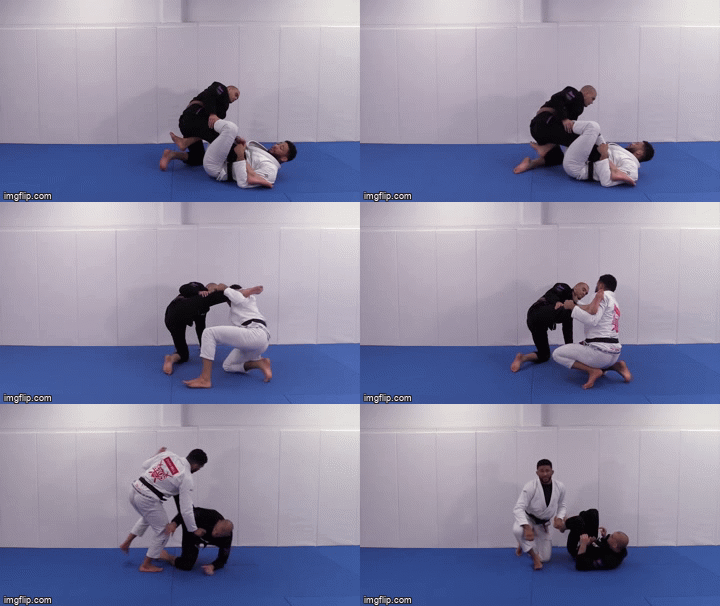
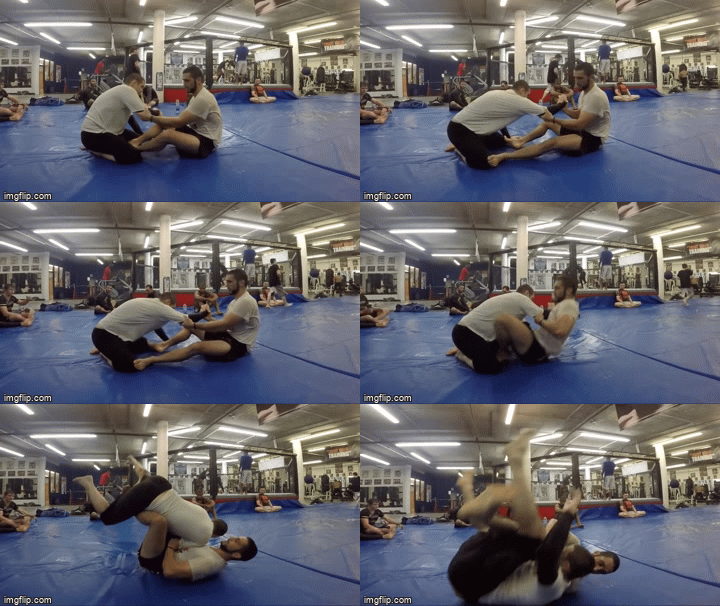
Open guard sweeps help you achieve this very thing – earn top position. Let’s face it; you won’t do much if you’re stuck on the bottom. Even in terms of submissions, finishing form top positions is far more high percentage than doing so from the guard. To that extent, as a general rule of thumb, you want to finish submissions from the top, even when you set them up from guards.

So, in short, sweeping allows you to actually be able to score, control, submit or strike by getting you the one thing we’re all after in grappling – top position.

Open Guard Sweeps

There are plenty of ways to try and categorize open guard sweeps. You could do so by type of guard, type of sweep, via general principles that certain sweeps share or any way you see fit. However, my proffered method is to organize them according to what the opponent does. In fact, it is not so much what they do, as where they are.

When you’re in guard, the top person has to pass the legs to do anything meaningful. To achieve that, they’ll have to fend off all your sweep and submission attacks. One of the most fundamental ways of trying to confuse a guard player, and force them to change their game is by changing levels.  What that means is that a top person can stand with both feet on the ground, half-kneel with one knee and one foot on the ground, or keep both knees on the ground. The thing with these levels is that no one sweep works against all there levels. So, organizing your open guard sweeps according to the level which the opponent is at is the best way to make sure you react on time, and with the appropriate move.

Level 1: Standing

First off, let’s see what happens when an opponent is standing. To be fair, in the modern BJJ game, people like to stand when they face a guard most of the time. This does provide them with a lot of different passing options, but it also has weaknesses that you can exploit when looking for open guard sweeps.

BJJ Open Guard Sweeps: StandingThere are two rules of thumb to sweep a standing opponent: break their posture and try to get underneath their center of gravity. The X-gaud is the most obvious culprit here, and it does work perfectly into our system. Starting off in the spider guard, you’ll easily achieve a broken posture. Moreover, you’ll be able to lead the opponent forward, forcing them into the X-guard. The X-guard itself places you right underneath the opponent’s center of gravity, thus fulfilling the second requirement. From there on, it is all about taking away their balance.

Grips are crucial in helping you keep the posture broken. The posture is key to the opponent’s balance, so make sure you use both hands to grip the Gi sleeves or the wrists in order to keep the posture broken. This will allow you to do a simple trip with your legs, whether it is backward or to the sides. More importantly, the grips you have will allow you to pull yourself up after the trip, thus completing the sweep and gaining top position.

Level 2: Half-Kneeling

Sweeping against a half-kneeling opponent is usually the hardest level to sweep from. The reason for this is the base of the opponent is very wide and low, and they have the option to switch back to either of the two other levels immediately.

BJJ Open Guard Sweeps: Half-kneelingThe single leg-X guard is a very common BJJ guard, and going into half kneeling is an even more common way to try and block it. Going into this level protects opponents from both sweeps and leg locks. The rule of thumb for this level is to try and isolate the leg that has the foot on the ground, as that one is easier to manipulate. Once again, going underneath is the preferred option, but far from the only one when it comes to open guard sweeps against a half-kneeling opponent.

Just as an example, we’ll go over the stand-up sweep from there. As long as you can get the leg that has the foot on the ground on your shoulder, all you really need to do is a technical stand up. The principle here is that you’re forcing them to balance only on the leg that has the knee down. Even if you’re not going for this sweep, or aren’t even in the Single leg-X, the same principle applies – lift the leg that you can manipulate, and force them to balance on their knee.

Level 3: Kneeling

BJJ Open Guard Sweeps: kneelingFinally, let’s talk about open guard sweeps versus the best base a top person can have – kneeling with both knees on the ground. This really does take away many of their passing options, but it also severely limits your open guard sweeps. That, though, does not mean you don’t have high-percentage options to send them flying across the mats.

The example is going to be a butterfly guard sweep (obviously). The goal is simple – try to shift the opponent’s weight wither forward or back, as far as possible. The way to achieve this is by using one of their arms as a lever – with an arm drag, overhook, underhook or a 2-on-1 grip. As long as you get the opponent’s center of gravity away from their knee line, you can easily transition to top position using any butterfly sweep you want.

Wrap Up

The above three sweeps are just an example of what you can do when an opponent is at a different level of the top position. The key thing to remember is that seasoned opponents will change between level. When you’re thinking about perfecting your open guard sweeps look to use weeps that easily tie into each other, depending on what level the opponent is at. The fewer adjustments it takes when an opponent changes levels, the easier it will be to gain that much-coveted top position.

Training For BJJ: Gymnastic Planche Progressions

Gymnastic Planche progressions training for BJJ Cover

We’ve all marveled at those chiseled out athletes that perform the famous bar workouts in parks and outdoor gyms. They do all kinds of crazy things, like human flags and crazy balancing exercises that seem impossible. Well, there’s nothing crazy about them when you look into it, because all those exercises are gymnastics exercises. As such, they are notoriously hard to master, but extremely beneficial, especially when it comes to training for BJJ. If I had to choose only one exercise to improve grappling performance, it would most definitely be the gymnastic planche.

The gymnastic planche position is a very weird one. It looks deceivingly easy until you decide to try it. The moment you do, you realize that there’s absolutely nothing easy about it and that you won’t be able to master it quickly. That is perfectly all right as this exercise is the perfect example of how you can train your body to be functionally strong in a mechanically inferior position. The planche has a set of progressions that will help you master it over time, as long as you train consistently. The good news is that going through the progressions when training for BJJ won’t just teach you how to do the planche, but also improve your grappling multifold.

Training For BJJ: Gymnastics

I’ve said it over and over again that I believe gymnastics is the absolute best way to train for grappling. In fact, I think it is the best way to rain for fighting in general, and especially combat sports. Despite all the fitness mumbo jumbo out there, fighting is pure chaos. This is especially true when it comes to MMA, BJJ, boxing, wrestling, etc. You can’t ever hope to predict the positions you’ll find yourself into, which means you need to be ready to deal with stuff on the fly. And technical knowledge can only get you so far.

Gymnastic Planche training for BJJAt a certain point in time, when two grapplers are evenly matched from a technical standpoint, athletic abilities will determine a match or a roll. And these abilities haven nothing to do with how much you can bench, or how many miles you’re able to run. They’ll have to do with bracing, balance, core strength, the ability to shift your weight, turn and move quickly, etc. It just so happens that there’s an entire sport revolving around those principles, and an Olympic one at that – gymnastics.
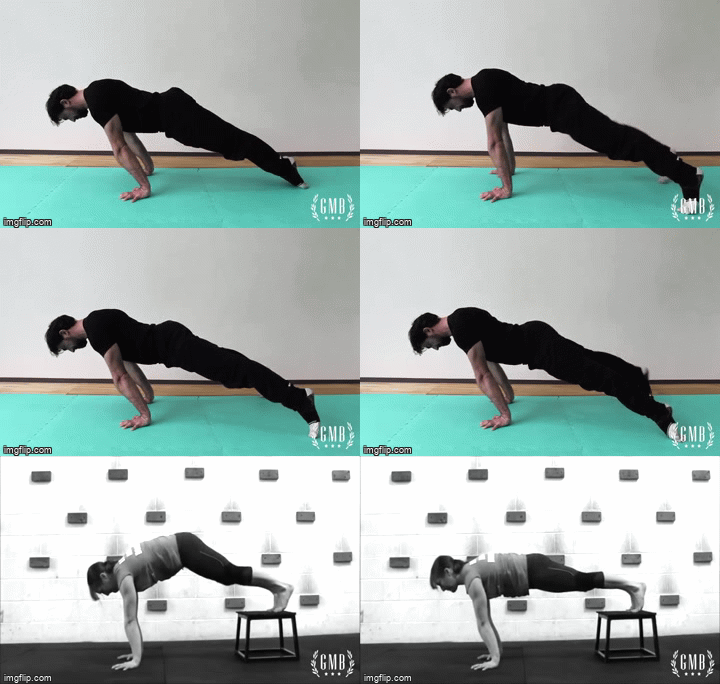
It would be dumb not to consider gymnastics as the perfect conditioning training for BJJ when it shares so many athletic qualities with grappling. Gymnastics is hard, and it does take more time to master the rally beneficial exercises, like the gymnastic planche. However, it is more than worth it, and it is a better long term option compared to running and weightlifting. Gymnastics offers biter recovery time and stresses the joints a lot less than other types of fitness training. Moreover, it builds connective tissue in addition to muscle tissue, which no other sport can achieve.

The Hardest No Equipment Exercise Ever

Okay, the gymnastic planche might not be everyone’s choice for the hardest no equipment exercise ever, but it certainly tops my list. I’ve barely been able to do it for a couple of seconds, and I’ve been working on it for nearly three years now. The benefits, though, of going through the progressions and trying to master it have impacted my Jiu-Jitsu in a very meaningful way.

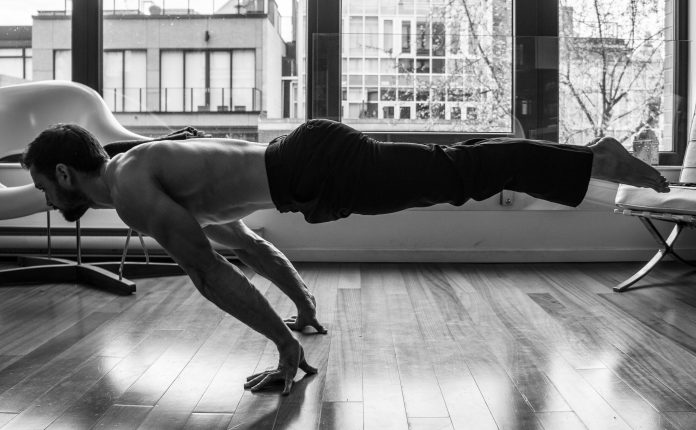
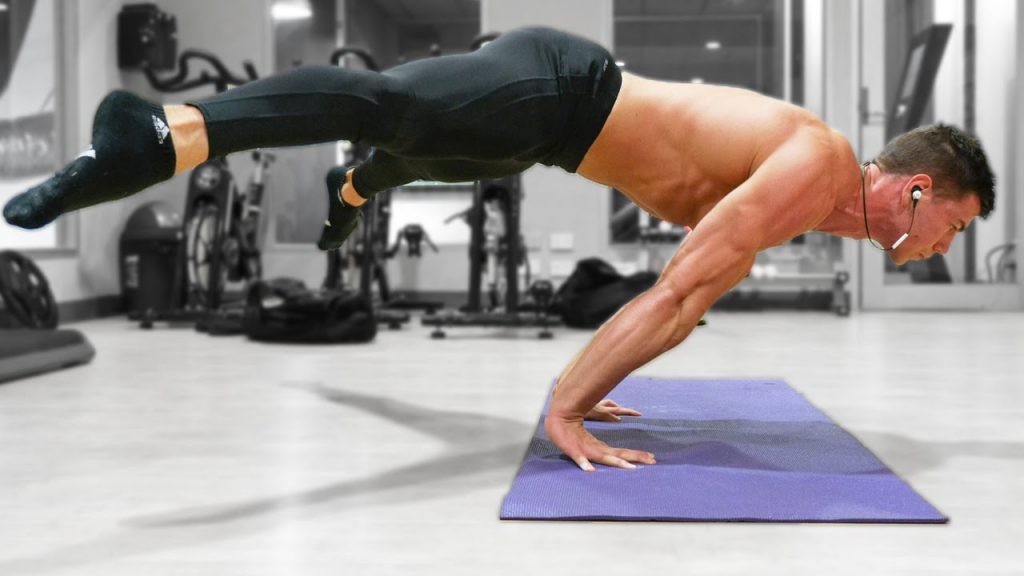
The gymnastic planche is an exercise where you keep your body in a position similar to a pushup. It is a static exercise in nature, but it does have a dynamic version as well. More on that later when we cover planche progressions. The difference between a pushup position and the planche is that both your legs are completely suspended in the air. Yeah, that’s right. You need to keep your entire body straight, parallel to the floor legs out wide, and only balance on your arms. I know it sounds impossible but it is entirely doable, and even more so, anyone can learn how to do it.

There are plenty of gymnastic planche variations. It is a position used in artistic gymnastics, where only two versions are credited, making those two the most common ones. Those versions are the straddle planche and the full planche. In gymnastics, the goal is to hold the planche for two seconds, which is a statement to how difficult a feat heat is on its own.

The muscles working during a planche include, but are not limited to the biceps, shoulders, lats, traps, hamstrings, glutes, lower back, wrist muscles, and others. You can see why doing this exercise and any of its variations make sense when training for BJJ.

Gymnastic Planche Progressions For Grapplers

The gymnastic planche progression starts easy – in the pushup position. If you’re’ unable to hold the pushup position for 5 minutes, then you should probably build up to it before including planches in your training for BJJ. Another prerequisite is flexible wrists, so make sure you work on that before you go into planches.

Gymnastic Planche training for BJJ: progressionsThat said, the first position to work on is the planche lean. In essence, it is a pushup position, where you shift your weight forward. Your arms need to be locked at the elbows. When you’re able to hold the position for 5 sets of 60 seconds with as little rest as possible in between, you can move to a gymnastic planche lean position with your feet elevated on a box. This will ultimately lead to you tucking your knees in, keeping just the top of your instep on the box, and finally, achieving a tuck planche, which is a huge milestone.
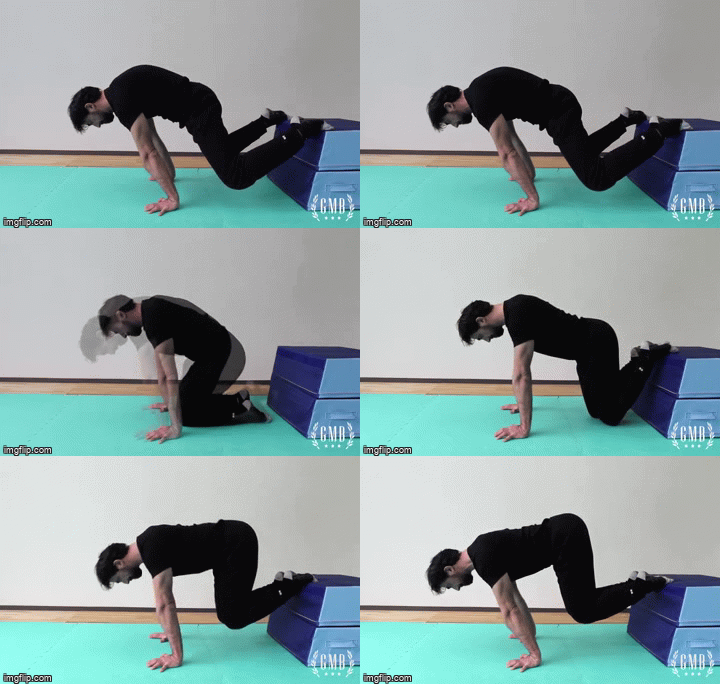
Gymnastic Planche training for BJJ: progressions 2Once you can do a tuck planche, you can start using parallel bars to get a better angle and start learning how to shift weight in the tuck planche. By this time, it will have become your main exercise when training for BJJ performance.
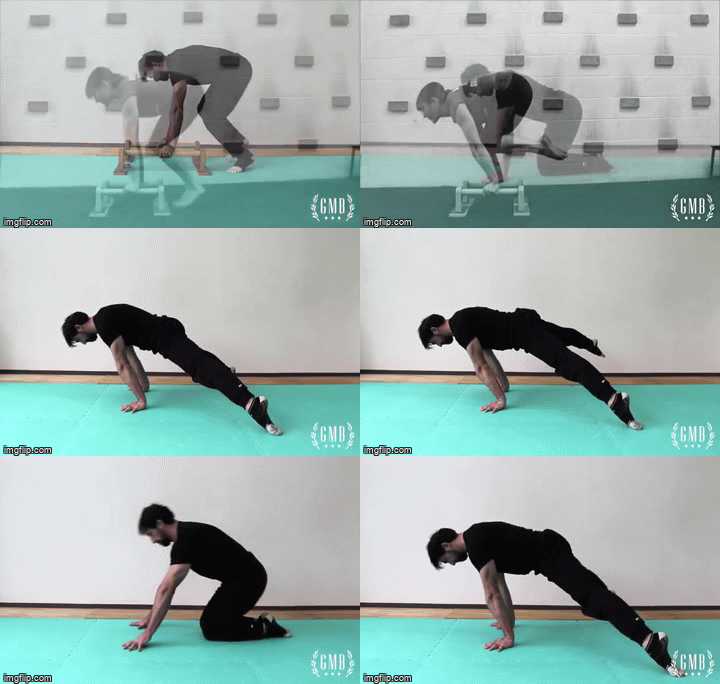
Gymnastic Planche training for BJJ: progressions 3The final progression sequence looks like the one you did initially. You’ll be aiming to hold a planche lean position, but with straddled legs, and you’ll be looking to lift one leg of the ground, positioning it in the straddle planche position.  The goal is to alternate legs for two-second holds. Then you move on to alternating pulling your knee towards your chest in a tuck planche-like fashion. The goal is to manage to pull both legs inside form the straddle lean into the tuck planche and back.
All In All

The gymnastic planche is a tremendous exercise when it comes to training for BJJ performance. It’ll teach you how to control your body, it will help you develop functional strength, it will make you injury-proof and it looks amazing when you’re doing it. Plus, with all the progressions it will take considerable time until you can achieve the full planche hold. Here’s the best part – the progressions above are just the fundamental ones – there are plenty of more advanced ways of performing the planche once you’re able to.

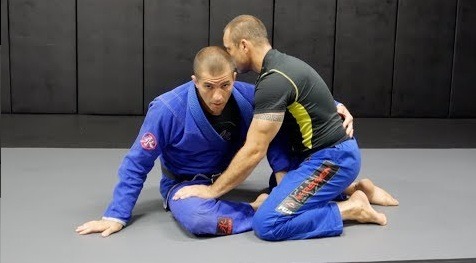
Defensive BJJ:  Exploring The Panda Position

The Panda: Defensive BJJ

There is a new stream in BJJ developing fast and it is something that we haven’t really seen so far. Defensive BJJ is growing rapidly, and it is kicking off yet another evolution milestone in Jiu-Jitsu. While the defense has always been a part of the game, people were always training things to form a very limited perspective. There are people, though, that have been taking defensive BJJ to new heights lately, and some of these innovative concepts are starting to really cause trouble and get noticed. One such brand new position is the Panda, coined by Estonian black belt Priit Mihkelson.

The Panda position is a clear mark of how far Brazilian Jiu-JItsu has come along during the last few years. Up until a while ago, turning you back to someone was considered to be a mortal sin in BJJ, one that would get you choked out in an instance. The same held true for the bottom of the mount, side control, etc. Well, the tide is shifting, and as the positional play develops, we’re seeing a very different take on defensive BJJ lately. Just like it took proper positioning to make leg locks the deadly tool they are today, positioning is helping people discover a whole new way of defending. How do I know it works? Well, let me put it this way: if it annoys people while you’re’ doing it, there has to be something to it.

Don’t Fear Bad Positions

If you’re to have any hope of really learning defensive BJJ concepts, you’ll have to overcome your fear of going into bad positions. And, let’s face it – we all hate being in a bad spot. However, there’s no learning how to get out, unless you put yourself there, and start suffering. It is as easy as that. Actually, it will be the hardest thing you do, but you will have to embrace the suffering and change your mindset in regard to bad positions and escapes.

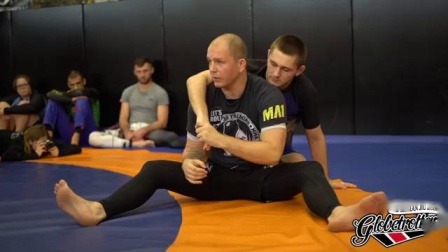
Defensive BJJTo that extent, there’s no more dogma about turning your back. I’ll stick to the back position as the example of the ultimate bad spot you can get caught into. Well, at least up until Priit’s stuff came along. Since the Panda addresses the back and turtle to some extent, I’ll just stick with this bad spot for now. Having someone behind you has always been considered a bad idea, regardless if it is grappling or striking martial arts there’s a lot of truth to that. Granted you don’t want to have someone behind you, but the fact of the matter is, in BJJ, someone is going to end up on your back at a certain point.
This is where the modern defensive BJJ concepts kick in. As long as you understand defensive postures you’ll do just fine, even with folks on your back. Think of every position, even a bad one as a guard in boxing. As long as you stick to the rules of keeping your chin down and hands up, you won’t get knocked out. From there on it is all about your own game. Well, defensive BJJ works just like that – you get a posture that acts as a safe spot, or a guard in every position, and deny all possible attacks to your opponent from there. The Panda is based on this principle and it works like a charm.

A Look At The Panda Position

What exactly is this panda position? I was amazed by the name at first, to be honest, and it is why I looked into it. If you’re’ interested in really getting to know the intricate details, check out Priit MIhkelson’s BJJ DVD on the subject. In the meantime,. I’ll try and explain it as best I can, given that I’ve been using it for almost a year now.

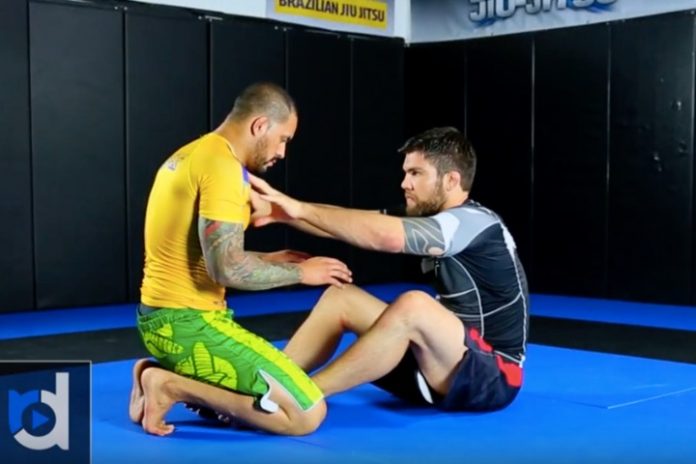
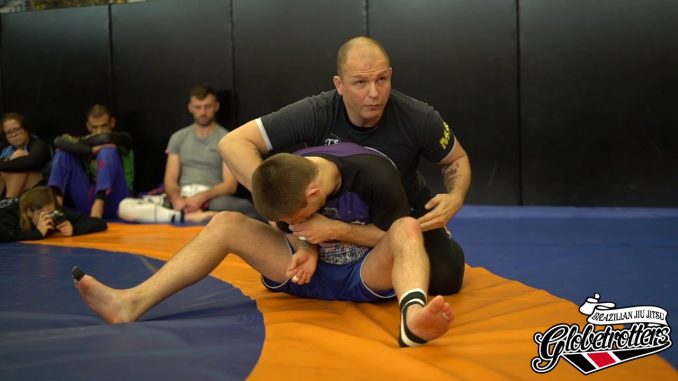
For the Panda, you want to be seated on the floor, and have your legs spread wide apart. This provides you with a base that makes moving you in any way that opens up attacks for the top person really difficult.

The positioning of your torso should be forward, leaning as far forward as possible without breaking your base that you established initially. It is best if you keep your spine rounded, but that’s not a rule set in stone.

Defensive BJJ Panda PositionThe thing that makes a real difference in this position is elbow positioning. Your elbows need to be glued to your body. In fact, they need to be glued to your hips, to be more precise while sticking out just slightly behind you. This will help give you that powerful defensive posture, as well as protect the inside space that anyone attacking your back will need to get to.

The panda position is a dynamic one, requiring constant light adjustments. When people try to pry open the elbows, you’ll have to adjust by changing posture slightly to make it harder for them to pull. When they try and attack your neck, you’ll keep your shoulders high and your back rounded, among other things. If they go for the legs you need to shift weight, or simply move out into guard (which will open up on its own). Finally, and most importantly, you need to keep your hand fighting all the time. Your palms are free anyway, and as long as you keep your elbows glued, you can use them to prevent, redirect, or manipulate the top person’s arms, and frustrate them even further.

Defensive BJJ Changing The Landscape

The above is just an exploration of the Pnadap position, and not an instructional in any way, shape, or form. For that, check out Priit’s stuff. It is a look into a position that is part of the new form of defensive BJJ and as such, is contributing to changing the JIu-Jitsu landscape and toward the evolution of the sport. A position such as the Panda allows the bottom person to be static, while being active, staying safe throughout. Moreover, it will lead up to an eventual escape to a guard or even top position. This is actually the most interesting aspect of it.

When you’re working with postures and concepts in order to defend, you don’t need to react with a technique to everything that the top person is doing. In other words,s you’ll actually manage to escape effortlessly because all you care about is keeping your defensive BJJ posture intact. The opponent’s actions, which become increasingly more desperate as time passes will lead you straight into an escape, without you even trying. This is what makes all these positions and innovative concepts really appealing to me.

While this aspect of BJJ still has to be developed, and catch on, we will be seeing more and more of it at the highest levels of the p[sort. Similar to leg locks, as people are introduced to this stuff, they’ll have no answer to it. That will prompt even more experimentation in trying to figure out ways to beat the Panda and all associated positions,s evolving BJJ further and further. Normally, the Panda will evolve as well, in a loop that feeds itself over and over again. Exciting times are ahead of us!

Final Thoughts

The Panda position is one of my absolute favorites when I roll. Yeah, it slows rolls down, and it annoys people but I don’t’ care. In order to work on something, you’ve got to do it over and over again. And defensive BJJ means that you’ve got to put yourself in bad spots, suffer the torture and figure out how you can make defensive postures work for you. Give the Panda a try and very soon you’ll jump about the defensive BJJ train.