


The 5 Main Reasons People Quit BJJ At Blue Belt

Reasons People Quit At Blue Belt

It sucks to be a beginner! This information is hardwired into our brains. It is an evolutionary trait that makes us look for progress in every aspect of life. Training Brazilian Jiu-Jitsu is not much different. People walk in, and straight away they look at blue belts with jealousy. They do not look the same way at purple, brown and black belts though, because they seem to be too far away. So, for every beginner in Jiu-Jitsu, that blue belt is the first major goal, one arguably even more important than the black belt. Everything to get you out of the beginner zone (seen as almost as bad as the friend zone).

However, there’s a very strange, yet common occurrence in BJJ once people get their blue belt. What happens is that fresh blue belts start slowly disappearing from the gym. All but those that are very near to a purple belt are susceptible to this syndrome. Even some of the greatest grapplers of all time admit to experiencing the blue belt blues. Tom DeBlass (Link FB) himself almost quit at blue belt. He didn’t though, and look at him now he’s one of the most influential grapplers in the world. But why does this syndrome happen? What is it that makes people quit exactly at this level, regardless of age, sex or location?

The Blue Belt Blues Syndrome

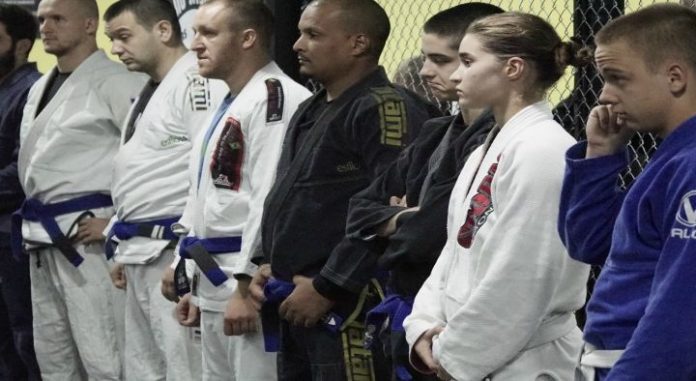
No matter what belt you are, you’ve seen at least one example of the blue belt syndrome at your academy. When you look at it, many people come and go from BJJ, but most either quit right away or at blue belt. The vast majority of people never make it past the blue belt. Only those that are most dedicated manage to reach the purple belt. There’ a saying that once you reach a purple belt, you’ll stay true to Jiu-Jitsu for life. There’s a statistic that points out to a number of only 1-3% as an indicator of how many people make it to black belt. Whether this number is true or not, the fact remains that people give up on BJJ in large numbers at certain points.

The white and blue belt periods are the most difficult in Jiu-Jitsu. This is understandable, as these are the survival belts. You get beat up on a regular basis as a beginner. Thing is, that when you get your blue belt, you won’t get better at BJJ overnight. That means you’re still going to be just food for purple belts and above. Furthermore, it takes a long time to earn a BJJ belt promotion. People work their ass off to get to blue and suddenly realize that they need to start all over again. It might even take more time to reach purple. Actually, the blue belt is very often the longest time someone spends at one belt level.

Reasons For Quitting At Blue Belt

The highest blue belt dropout rate is mostly due to a few major reasons. Before we look at them, let’s give Keith Owen credit for a saying of his. He claims that if you decide to consider quitting BJJ, you should at least wait until you’re a purple belt. At least by then, you know if you like BJJ or not. Chances are if you’re still there, you like the sport, no question about it. Despite this, there are valid reasons to feel that Jiu-Jitsu is not for you, and it is OK. All it takes is patience to discover if you truly like the art. After all, quitting after the first major milestone is not a very good show of character, is it?Blue Belt Dropout
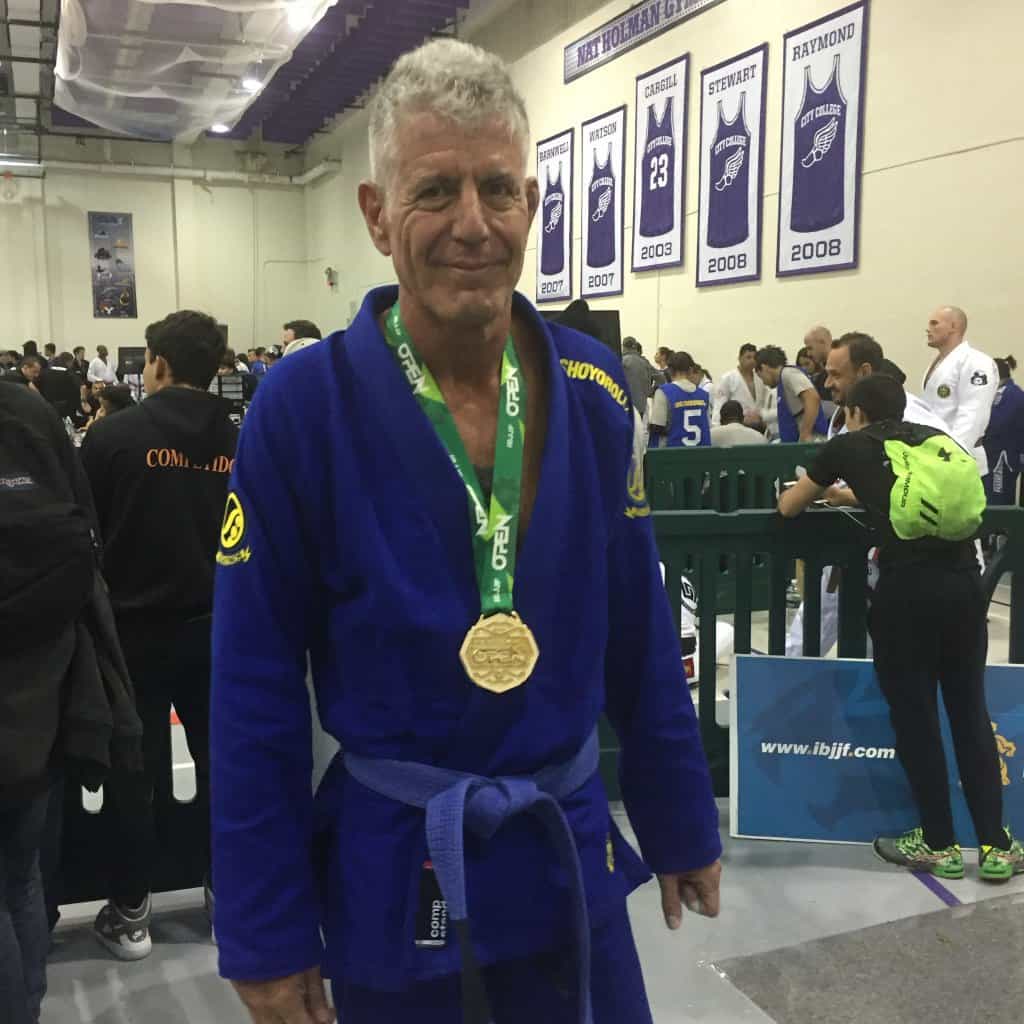
Out of the plenty of reasons why someone might give u on grappling, some occur way more regularly than others. Continuing below, we bring you the 5 most often cited reasons for giving up the gentle art as a blue belt:

  • Injury Trouble

One very sound and a very common reason why many people quit after getting their blue belt are injuries. In a combat sport that takes place across multiple levels, injuries are a given. Injuries are common at every belt level, but there’s something about blue belts that seems to attract them more.  There are a few reasons for this. One factor is the time most people spend at this level. To get to the blue belt you’re going to need at least a couple of years. Even with regular training, a couple more are certain before you can even think about purple. That’s about four years of grappling training, where you mostly have no idea what you’re doing.  It is a real recipe for injuries and they’re often a deciding factor in giving up.

In terms of injuries, it is not always serious ones that lead people to forget about BJJ. It is mostly the accumulation of small lagging ones that tend to reoccur. They’re a real nuisance in every aspect of life and often the culprit behind the blue belt dropout rate.

  • Time Requirements

Time also ranks high on our list of reasons. When we speak of time we mean time in two distinct aspects. The first is the time it takes to reach the purple belt. In truth, you might be able to shorten your beginner days if you train regularly and are athletic. A background in other grappling martial arts also helps a lot. However, getting to blue is almost a guaranteed 2-3 years of your life. This is with regular training, mind you. Some people, are not willing to sacrifice more time to reach the next step than they did to reach the first one.

From a second standpoint, BJJ requires a lot of time to train. Even if you don’t train every day, you’ll be at the academy for a few days out of the week. A regular class is at least an hour and a half long, and often even more. Add to that commuting time, and that’s already more than two hours of your time. Now, connect the need to fit BJJ in your life with the time it takes to reach the purple belt. Both these temporal reasons are a huge factor in people turning their back on Jiu-Jitsu.

  • Unreal Expectations

This one is closely connected to the “I don’t want to be a beginner” mindset. To make things clear from the start, this is not a wrong way to approach training Jiu-Jitsu. It is, however, a costly one, if you maintain it as you progress. After a year or so in BJJ, you’ll know that there’s no way that you’ll be able to take on all the blue belts once you get one yourself. Some of those guys are nearing purple belt, which means they have at least double the experience you have. So, people that expect to dominate every white and blue belt right off promotion are gravely mistaken. In fact, thinking like this often leads to feelings of self-doubt that ultimately result in a loss of the desire to train.

Ego is a dangerous thing, and this is especially true in BJJ. Funny enough, the time when the ego is most apparent is a blue belt. If you let it dominate you, though, you’ll most likely end up selling your Gi and moving on.

  • Everyday struggles

One very common reason, or better said, an excuse is that “life gets in the way”. Honestly, if you love something very much you can make time for it, as is demonstrated across the globe.  The fact is that most of us are not full-time grapplers. It is a hobby, an escape from everyday worries, and not an obligation that you need to go to. People that see it as such, tend to leave even if they seem like hardcore grapplers up to then.
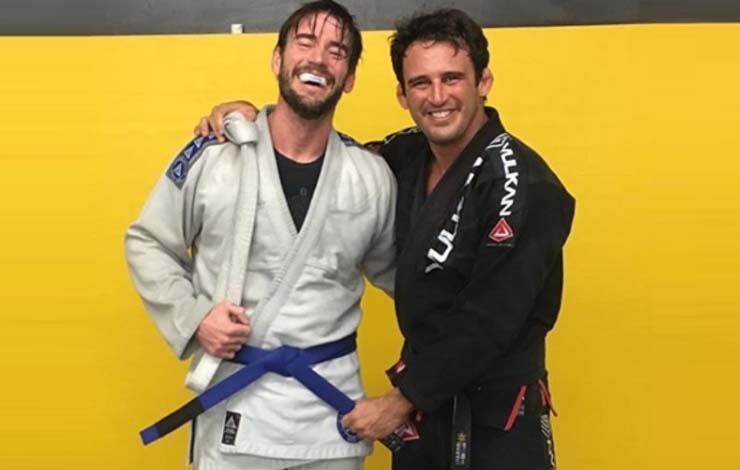
Blue Belt quit reasons

Many people nowadays did not start BJJ as kids. That means that by the time you get to blue, you’ll probably going to have major lifestyle changes. But marriage, a kid, a mortgage, you’re going to be pressed for time. it’s just a fact of everyday life. It is normal for people to prioritize life over the sport, but only when you look at BJJ like that. What people that push past blue belt realizes, is that Jiu-Jitsu is therapy, just one done on the mats instead of a chair. Too bad blue belt’s never had someone to explain this to them.

  • Hitting A Plateau

Finally, a more technical reason for giving up on BJJ is hitting a plateau. Remember how I already pointed out that getting a blue belt doesn’t mean you’re instantly better at BJJ? Well, the blue belt is the period when most people hit a snag or two. You know some grappling, but you’re far behind most advanced students. Actually, you’ll find out you’re nearer white belt level. This is the time when blue belts go all-out to improve and end up making lots of white belt mistakes. This seems like going backward and their will to train gets crushed.

The solution is simple and all blue belts know it. It is the same advice a beginner gets- tough it out. Just keep showing up and put the work in. Every purple belt and above was once a blue belt. They had their fair share of blue belt blues as well but just kept showing up. A little persistence is going to go a long way in making you a lifelong part of the BJJ community, instead of just another blue belt dropout.

You Might Also Like:

The Nastiest Armlock Submission in BJJ – The Squirrel Lock

The Squirrel Lock BJJ Submission

A few years back, when I was on the brink of promotion to blue belt, I had the opportunity to train with Oliver Gedde. Oli is definitely one hell of a black belt and has the power to keep you engaged for hours upon end. In a small-group seminar, the Roger Gracie black belt demonstrated pure half guard magic for us uninitiated beginners in the sport. From that moment on I became a vivid follower of the entertaining BJJ master.

Roger introduced me to some half guard concepts that I still use to this very day. What he did not show us, on that occasion was a very, very cool submission that he invented. Nope, he kept that one to himself and we had to learn the Squirrel lock from online videos, just like the rest of the world.

In short, the Squirrel lock is a Kimura variation. So, what’s so cool about this move? After all, there are a bunch of kimura variations from all kinds of top-level grapplers out there. Well, for starters it’s done from a position where most people only think about surviving. Furthermore, it is done with the help of your legs, instead of your arms. Yes, you read that right. A kimura from the bottom without using your arms. To be completely honest, I probably would’ve been skeptical of it too, if I hadn’t trained with Geddes previously. Knowing what I know about him I decided to give the Squirrel lock a try. Fast forward a few years in Jiu-Jitsu and it’s now a very formidable weapon that I tend to unleash given the opportunity.

A Bit Of Background On Oliver Geddes

As previously mentioned, Oliver Geddes is a Roger Gracie black belt. He comes from London, England, where he spent a long time of his BJJ career training directly with Roger. In fact, he spent so much time there that he eventually started teaching at Roger’s academy in London.

The 33-year old Scramble-sponsored grappler started training Brazilian Jiu-Jitsu in 2005. He enjoyed the Gentle art so much that he quit his job and dedicated full time to BJJ. For a while there he not only thaught at Roger’s London academy but also lived there.  He got a black belt from Roger in 2011, which is a lightning speed black belt promotion in BJJ terms.

Apart from being a great teacher and truly dedicated to the BJJ lifestyle, Geddes is also a very fierce competitor. He has hundreds of competition under his belt, medaling and winning a great number of them. Not only that, but he is a regular at most major IBJJF events as a referee as well as a competitor. In fact, he is the quintessential BJJ globetrotter, scouring the globe while disseminating the principles of the Gentle Art. Geddes is a huge fan of working from the half guard, which he has mastered to perfection. He also has a very strong submission game, that involves both upper and lower body attacks. Seeing how he enjoys battling from bottom positions and is always looking for the sub, you can see why the Squirrel lock deserves merit.

The Squirrel Lock – A Kimura With No Arms

So, finally, we have arrived at the submission itself. The Squirrel lock is probably one of the coolest submission you’ll ever attempt. It may frustrate you in the beginning or may even seem impossible to pull off in competition. Well, Oli Geddes has done it and here’s the video proof to corroborate his claims:

As you can see the Squirrel lock is set up from bottom side control. In fact, the harder your opponent attempts to keep you on your back, the worse it is going to be for them. The Squirrel lock begins with a good grip on the opponent’s sleeve. The idea is that you need to have the arm that’s near your opponent threaded all the way through towards your hips. You then use this arm to get a deep sleeve grip on the opponent’s far sidearm. Once the grip is established it is time to get your legs into proper position.

First, you’ll need to get your near side leg deep inside the crook of the opponent’s elbow. That way, in combination with the dep sleeve grip, you get a spider guard-like control. In order to be able to get into finishing position, you’ll need to use your leg to cause and maintain a bend in their elbow. Next, your opposite side leg goes over the trapped arm’s upper arm and hooks the forearm. From there, use your foot like your hooking in butterfly guard to secure the arm. In order to keep things even tighter, you can use your free arm to catch the opponent’s trapped arm over their back and secure it there.

All it takes is hip escaping toward your opponent in order to place massive pressure on their shoulder. In most instances, you’ll get the tap right then and there.

Attacking From Bad Positions

While most people usually tend to look for ways out of bottom positions like side control, sometimes going on the offensive is your best bet. The Squirrel lock is far from the only option from here. A baseball choke, some Americana variations, and even leg lock attempt area available if you have the right mindset. Oliver Geddes is a great example of how a world-class black belt with a well-defined game thinks about BJJ. Instead of just thinking about escaping and then looking for attacks, he starts with the attacks and in the worst case scenario, is going to get at least an escape.

Looking for the finish from the bottom is definitely an unexpected way to behave. In side-control, general behavior dictates that you take being on the defensive once you’re on the bottom. Even the opponent on top doesn’t really expect a direct attack from there. Often times you’ll have the Squirrel lock fully locked in and they won’t even try to prevent it because they haven o idea what’s going on. The lock is such a good move that when you get the hang of, you’ll be able to get even when it is apparent what you’re doing. That said, there’s a backup option that we didn’t cover above.

Every once in a while you’re going to go against a freakishly flexible opponent. The beauty of the Squirrel lock is that you can use it to flip your opponent over and not only gain side control for yourself, but also finish the lock from a dominant BJJ position. This submission is as good as it gets it only need you to give it the benefit of the doubt once. After that, it’ll serve you well for years to come!

Jiu-Jitsu Fundamentals By The King, Roger Gracie

A Few Crazy BJJ Armbars To Brighten Your Day

Double Trouble – Advanced BJJ Attack Tactics

VIDEO: Dillon Danis Guard Pull and Leg Lock on Kyle Walker in his MMA Debut

VIDEO: Dillon Danis Guard Pull and Leg Lock on Kyle Walker in his MMA Debut

Dillon Danis, 24 y-old Jiu-Jitsu standout from Newyork, Toe Holds his first opponent Kyle Walker in his (MMA) Mixed Martial Arts debut at Bellator 198 inside Allstate Arena in Rosemont, Illinois.

It was the great Performance by Dillon Danis against hometown fighter Kyle Walker who brought a record of 2 wins and 3 loses in this fight with Dillon Danis. Although it didn’t start that great for Dillon. It seemed like Dillon Danis wanted to enter in the octagon with a style like his training partner and UFC star Conor Mcgregor.

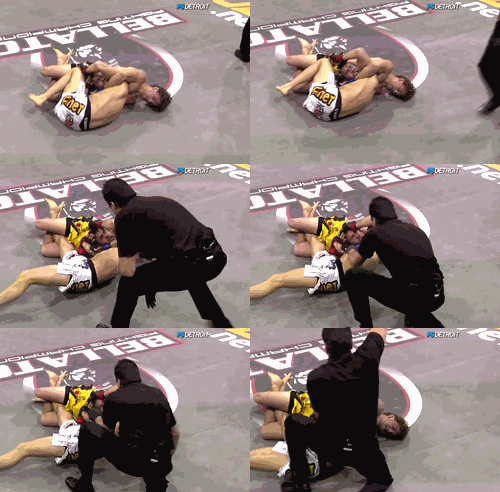
At the beginning of the fight, Dillon started in striking stance probably trying to outstrike his opponent Kyle Walker at first.  Very soon he figured out that wasn’t a very good choice for him as he was tagged twice. He tried to take Kyle down but wasn’t successful. The ended up in clinch and Dillon immediately figured out that guard pull can resolve the situation very fast so he did fast guard pull. After going to the floor Kyle walker tried to scramble out of the position, but with Dillon Danis under him, it was mission impossible. Dillon latched his leg and soon after he submitted Kyle with a toehold.

The stoppage came at 1:38 mark of the first round with Dillon Danis as a winner. He’s now 1-0 in MMA and with his first win, he became a legitimate contender in Bellator.

After the bout, Danis said he feels great, “I feel great, this is another level… “, Danis said. He said that he worked on his striking a lot before the fight, but Jiu-Jitsu is still something that he knows best and it got the job done.

Dillon Danis proved he wasn’t BSing before the fight when he said: “So, at the end of the day, questions, bull’s eyes, people talking shit, it’s all good. You could put as much pressure on me as you want. But when you’re this good, you don’t feel pressure.”
“I feel disrespected that people would think that I’m just going into this lightly or I’m just gonna train jiu-jitsu or something like that,” he continued. “I respect MMA a lot and I’m preparing for a world title. Because that’s how every fight should be treated. I just feel a little disrespected that people would think that I took this lightly.”

We can say that this is another win for BJJ so we congratulate Dillon Danis on his great Performance. You can watch the full fight in a video below:

Conor McGregor is very happy with his friend and training partner Dillon Danis winning his debut in Bellator. McGregor wasn’t going to keep quiet after Danis’ win. He Congratulated him on his Instagram profile: “Congrats to my brother Dillon Danis on winning his MMA debut tonight”.

It’s nothing weird since Dillon Danis is McGregor’s friend and training partner and he was the guy who bailed Conor McGregor out of jail in New York after a Bus Rampage.

https://www.instagram.com/p/BiItj0IHYPA/?utm_source=ig_embed

Bellator 198 results:

  • Dillon Danis def. Kyle Walker via submission (toehold) – Round 1, 1:38
  • Sultan Umar def. Tom Angeloff via unanimous decision (30-26, 30-27, 30-27)
  • Robert Morrow def. Adam Maciejewski via unanimous decision (29-28, 29-28, 29-28)
  • Adil Benjilany def. Corey Jackson via unanimous decision (29-28, 30-27, 30-27)
  • Mark Stoddard def. Dan Stittgen via submission (triangle choke) – Round 1, 4:43
  • Eric Wisely def. Morgan Sickinger via submission (armbar) – Round 1, 1:12
  • Joey Diehl def. Nate Williams via submission (triangle choke) – Round 1, 0:54
  • Asef Askar vs. Andrew Johnson ruled majority draw (27-28 Askar, 28-28, 28-28)
  • R’Mandel Cameron def. P.J. Cajigas via unanimous decision (30-27, 29-28, 29-28)


Is The Japanese Necktie The Tightest BJJ Choke Ever?

Japanese Necktie the tightest choke ever

As far as unique choke setups go, the Japanese necktie is one of the top contenders. It is a very cool choking option, one that is very specific to do.  The positioning of the Japanese necktie is such that those on the receiving end usually have no idea they’re even at risk. It is a very good option to catch even more experienced opponents off guard. Furthermore, it is a submission that is extremely tight and just as uncomfortable. Despite all that, the Japanese necktie is, for some inexplicable reason, a very underutilized submission. This is good news for you, though as you have the chance to learn a devastating submission that is going to bring you numerous victories.

One very important thing to know about the Japanese Necktie is that it is often not a very clear choke. Of course, when everything is in order, there’s no disputing the choke. However, it doesn’t take much to end up with a neck crank instead. In fact, your first few attempts area all but guaranteed to end up as a crank. Relax, though, as it is an IBJJF legal position as cranking from there is unintentional. In comparison, it is like finishing with a bad rear naked choke that is more of a crank from the back. That said, if you are going for cranks in addition to your chokes than the Japanese necktie is the perfect double attack. You get both a choke and a neck crank from the same exact position. All it takes is just minor adjustments to the grip and body position.

How To Do The Japanese Necktie

The execution of the Japanese necktie includes a few very important steps. First of all, is initial body positioning. You have to put your body in the correct alignment to even think about performing a Japanese Necktie. This opens up the opportunity to set up the correct grip. Although the grip might seem odd and even uncomfortable at the beginning, you’ll get used to it. Furthermore, you’ll need to significantly change the position of your body, in order to be able to have enough leverage for the finish. This is arguable, the most important part of the technique. Finally, it is all about how you squeeze and key finishing details that’ll bring you a fast and very panicky tap.

  1. Initial Body Positioning 

    In order to set up the choke, you need to be in a position to prepare the correct grip. The Japanese necktie is most effective from the top since you need to thread an arm through for a modified head and arm control. If you know how to perform a D’arce choke, you won’t have any trouble doing so. This means that from top half guard, for example, you’ll need to thread the same side arm under the opponent’s top arm and around their head. This is very contrary to the usual step of just using your far side arm to control the head. However, it is absolutely crucial to setting up a necktie. To get your arm in this position, you’ll need to open your torso away from your opponent. In order to avoid giving up the back, a top hint is to have a Whizzer on.

  2. Grip Structure

    Once the arm is true you can think about setting up the grip. The basic idea is to connect the bottom arm to the top one via a modified Vice grip. A regular Vice grip is also going to do the trick, but a small modification makes it much more effective. Once the bottom arm is deep behind the neck, connect a Vice grip with your top arm. Look to place the forearm on the top arm as near the base of the skull of the opponent as possible. The goal here is to connect your elbows. However, the Vice grip is less than ideal to allow this to happen.

    Japanese necktie BJJ Grip

    The modification you need to do is place the thumb of your bottom arm (the one trapping the arm and the neck) between the index and middle fingers of your top arm. This allows your elbows to not only connect but also past each other in a scissor-like fashion.

  3. Shifting Your Bodyweight

    To finish the necktie you’ll need to trap the head of your opponent with your body before finishing the choke. The most important thing in finishing the necktie is trapping a leg. If you’re still in half guard, just trap the bottom leg since you’re already in position. If however, you have passed the half guard while setting up the necktie (which is often going to happen) you’ll need to work a bit more. In that case, simply go for the opponent’s top leg and trap it in between yours. Once you have a leg, look to lie to your far side, but mind the direction. You want to end up with your belly covering the back of the opponent’s head. This means you’ll have to squeeze your elbows tightly together and look to place your cheek between the opponent’s shoulder blades while looking up.

  4. Finishing The Japanese Necktie

    Once you’re in position, finishing the Japanese necktie takes very little effort. Namely, all you need to do is use the triangle you have on one of the opponent’s leg to pull it towards their head. As you do that, pull both your arms towards your torso, squeezing tightly at the same time. In most cases, this is where you’ll get the tap. If not, continue to rotate the head of the opponent towards the ceiling. This is going to finish the move for sure. Speaking of rotating, doing this without applying a tight squeeze, or in a less than optimal body position is how you get a straight neck crank.

Positional Necktie Attacks 

As you can see from the example above, the top half guard is one of the best positions to attack with a Japanese Necktie. As a natural continuation of the half guard, if/when you pass you can still look to set up the choke. When you’re in the side control all you need to do to make your opponent turn towards you. If you still have a Whizzer or overlook on their far side arm, perfect. If not, you’ll sneak it in as the turn, allowing you to look for the modified Vice grip. From there, trap the to leg and just finish the necktie as before.

Japanese Necktie Finish

One other very potent way to set the Japanese necktie up is from the turtle. First of all, focus on attacking the turtle from a classic front headlock. From this position, initial body positioning should be from the front headlock, but you’ll have to switch to one side for the head and arm control. The arm that traps both the head and the arms dictates which side to go to. The modified Vice grip is extremely powerful for controlling this position. For a full necktie, first trap the near side leg, by inserting your foot behind the opponent’s knee. Next, use the grip to force their forehead towards their own belly, This is going to result in them falling over, and the hook you put in earlier is going to allow you to trap the leg. Now, you’re in a familiar position for an easy finish.

How To Chain Together Front Headlock Attacks 

One more Japanese necktie aspect to consider is the positional location of the submission. If you think about it, the Japanese Necktie is the perfect pit stop for front headlock attacks. It is exactly halfway between a Guillotine and a D’arce choke. These two chokes often make up successful attacking combinations. Transitioning between them, though, often leaves a gap. The Japanese necktie is the perfect plug for this gap.

Whether you’re going from a guillotine to a D’arce or back, having the option to finish halfway is something most people miss. With the necktie, you have a double gain. First, you shorten the transition by adding another stop, which translates to better overall control. Secondly, you add a submission option. For example, it is very easy to turn a failed D’arce into a necktie, and then go into a guillotine or an Anaconda choke. The same holds true in reverse, though you’ll need a bit more positional adjustments to get a Japanese necktie off a Guillotine. Whatever the case is, though, it is the perfect go-between to surprise even the highest level, opponents. Give it a try!

You Might Also Like:

Deconstructing the Mechanics of the D’arce Choke
Guillotine Choke – Basics, Secrets, and Variations to make it perfect
The Hidden Secrets of the Reverse Triangle Choke
Peruvian Necktie – A Tight Choke and Brutal Neck Crank
The Highest Percentage No Gi Chokes
Top And Bottom Baseball Choke Setups For Jiu-Jitsu
The Arm Triangle Choke Encyclopedia For Grapplers

Bernardo Faria Over-Under Pass And Common Mistakes

Over Under Pass Pressure Faria

Pressure passing revolutionized the game of passing the BJJ guard. In the modern Jiu-Jitsu game, putting your opponent under as much pressure as possible is becoming mandatory. It is difficult to imagine a high-level competitive event without a great example of the efficacy of pressure passing. As this type of passing develops, different positions become more and more prominent. With all the BJJ techniques at our disposal, it is no wonder that only the best is going to work against the best. And for pressure passes, it hardly gets better than the over-under pass.

Originally, the over-under pass is a product of the Gracie Barra competitor Renato Miragaia. In modern Jiu-Jitsu, the owner of the best over-under pass technique is, of course, Bernardo Faria. The over-under pass works on the principle of complete immobilization of the opponent on the bottom. In true pressure passing style, the goal of this pass is to firmly isolate both legs, while keeping them apart at the same time. Furthermore, the success of the over-under pass is due to the fact that your whole body is exerting pressure on the opponent. Add to that the hip control and you have the perfect passing scenario. However you look at it, the over-under pass is the perfect tool. It is safe, it works at the highest levels and it fits both Gi and No-Gi.

The Pressure Of The Over-Under Pass

The over-under pass in BJJ is a virtually unstoppable guard pass.  It’s predecessors, the double and single-under passes are no longer as effective as before. It is completely understandable, as most people today know a bunch of different defenses and one is bound to work. That’s where the over-under pass comes in. It is the perfect pass to do against most guards and even the most flexible guard players. The reason behind this lies in the guard’s mechanics.

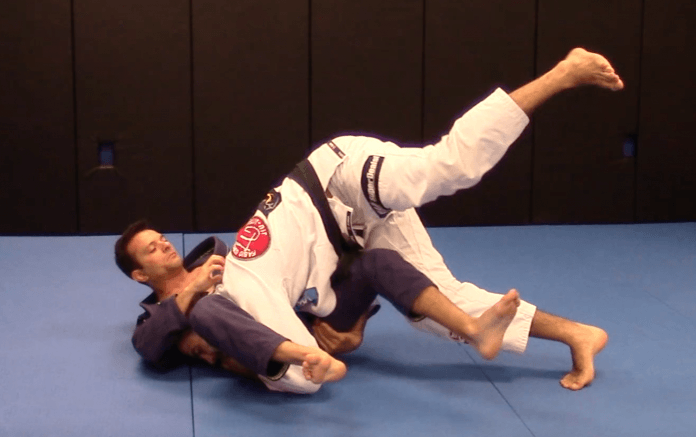
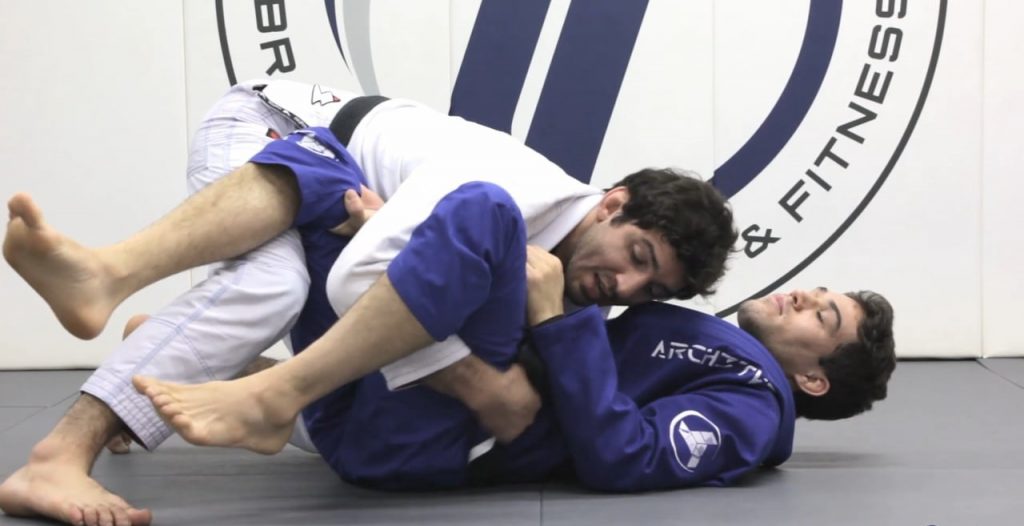
The basic notion behind the over-under pass is to control both legs of the opponent while keeping them apart. This is a very powerful configuration that easily renders the opponent’s hips powerless. The basic over under position means that you are free to move your hips. One of your arms is wrapped around one leg from an ‘under’ position. The other goes over the opposite thigh, preferably reaching for the foot. This creates a bend in the leg that makes it useless. From there, the best direction to do so is up. This motion is what turns the over-under pass into a pressure pass.

Bernardo Faria Over Under Pass Pressure

What happens is that your shoulder goes directly into the opponent’s belly, causing enormous discomfort. Controlling both legs means their hips can’t move and there’s not much that they can do defensively. The pressure makes the position even worse while you’re safe and not wasting energy. Feel free to stay in this position for a while, tiring out your opponent before you eventually pass. For the pass, push to ‘over’ leg towards the middle, circling your way to side control.

  • Passing in the Gi

When passing the guard in the Gi, all the available handles make it a perfect environment for pressure passing. Even before you begin, you can control the opponent’s hips on the ‘over’ side via their lapel. Furthermore, you can use the whole length of the pants in order to establish strong rip control. For the over-under, the Gi provides a great anchoring point for the ‘under’ arm. Even if you decide not to grip the pants, (why, though?) you’ll still have a great surface to hold on to. Just remember to keep your elbows in.

For the ‘over’ leg, the Gi makes a world of difference. The ability to grip the pants means you don’t have to go for the foot. This is perfect for larger or stronger opponents. Instead, just grip somewhere along the shin-bone section of the pants. The lower the better. Finishing the pass is the same as before.

The over-under pass puts a tremendous amount of weight onto your opponent. Even if they manage to block you, it’s just temporary. Just stay there, tire their legs out a little more, and try again. Eventually, you’ll manage to pass the guard.

  •  Over/under passing in No-Gi

Performing the over-under pass in No-Gi is a bit more challenging. The lack of grips and increasingly slippery surfaces provide a terrible environment for control. There are a few pointers, however, that’ll help you achieve your passing goal.

First of all, remember to go as deep as possible with the ‘under’ arm. That way, the grip is going to end up almost a full way around. Also, make sure that your shoulder is right under their knee. This is going to enable you to create leg-splitting pressure once you move in for the kill. Moreover, pressuring the opponent with your free shoulder is even more important in No-Gi. This is the main pivot point for the pass so you’ll need to be as heavy as possible. To achieve this, push off with your feet once your hips are in the air. Make sure to always stay on the balls of your feet, in order to provide increased tension on their abdomen.

In regard to the “over’ leg, trapping the foot plays is crucial. You can’t really control the leg unless you have their foot close to their butt. The best way to do it is to look for the toes. The lower you are on the foot, the better your control. Remember to keep the pressure on and not release the foot until the last moment. When you decide to circle around for the pass, use the ‘over’ arm to push the leg towards the middle, opening up the necessary space. Stay heavy on the abdomen all the way through to side control.

  • Correcting Common Mistakes

The over-under pass takes time to learn. Mastering it the way Faria has, takes decades. So, to make sure you maximize your efficiency with the pass, you have to be aware of the most common mistakes.

One thing that tends to happen over and over again is the safety of the passer. Two major questions usually arise on this front. The first is dealing with a possible Kimura attempt on your ‘over’ arm. This one is easy. Remember the foot grab tip from before? Well, as long as you’re holding their foot/pants with a tight grip, and your elbow in, there’s no Kimura. Trying to do one, your opponent is only going to make it easier to pass. Furthermore, if you distribute your weight correctly they won’t even be able to think about attacking.Pressure Pass Over Under Pass

Secondly, many people end up giving up on the over-under pass because their opponents post on their head or body, preventing the pass. The trouble with the head is that you have it up. If your shoulder is on their belly in a correct position, then your head won’t be able to come up. That means any attempt to redirect you is going to be futile. Even more so, attempting a post on your body is not the smartest move anyway. When they have their arm out on your body, stopping the pass is impossible because of the pressure and your positioning. Just remember, the over-under pass is a pressure pass, meaning you need to take things slowly and patiently.

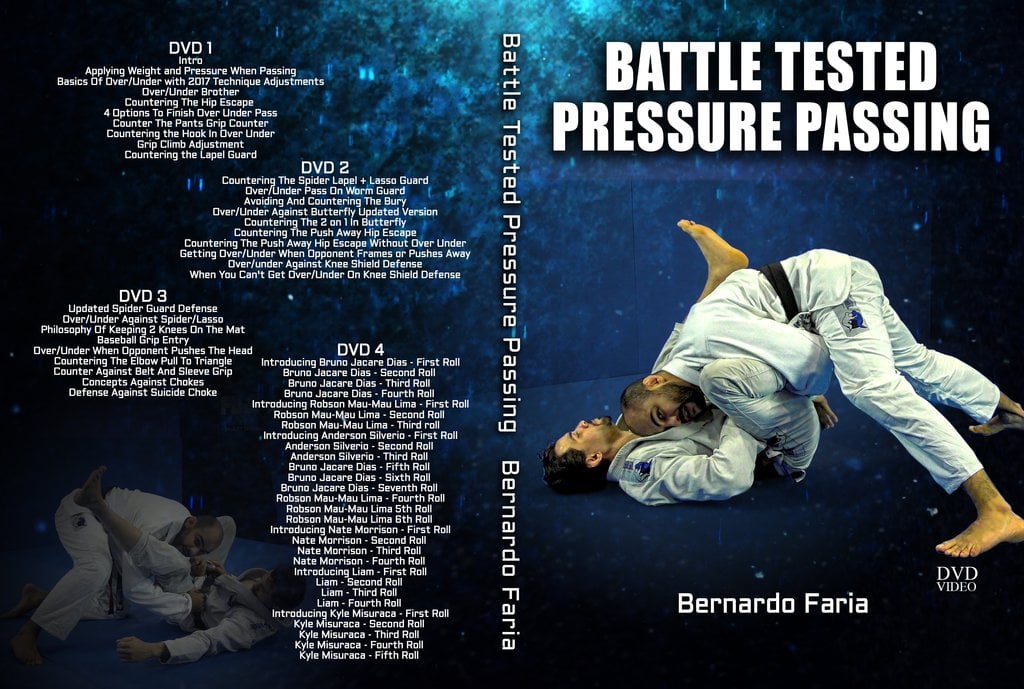
Bernardo Faria DVD Review

Related:

One More Pressure Passing Option Perfect For Any Situation

The Perfect Strength And Conditioning Workout For BJJ

Ultimate Conditioning Workout For BJJ

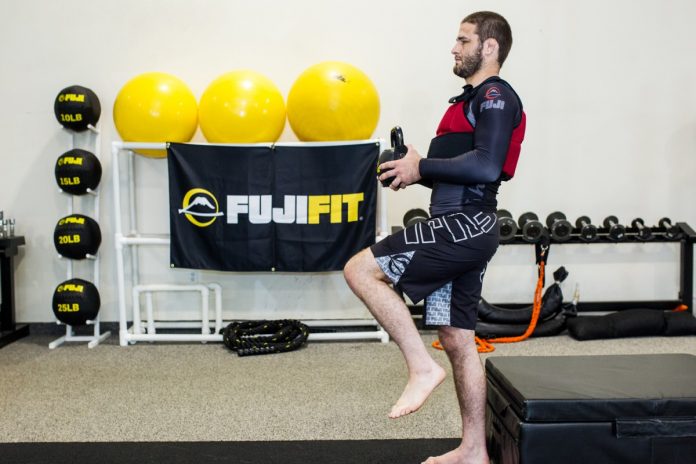
My master always says that doing strength and conditioning is our homework as grapplers. When we go to class we’re attending school, learning everything that requires the presence of a teacher. When we’re at a Jiu-Jitsu academy, we should focus on training Jiu-Jitsu. However, BJJ greatly benefits from improved athletic abilities. It doesn’t matter if you compete or not. Complementary strength and conditioning is great for a better gas tank, injury prevention, and overall health. However, with limited time and the physical demands of grappling, you have to be careful when picking a routine. Luckily for you, we have the perfect workout for BJJ all ready to go. And wait until you hear who the author of it is!

Gordon Ryan Strength and Conditioning

Most (apart from Marcelo Garcia, apparently) competitive grapplers take part in some form of strength and conditioning training. While BJJ guys are not always the picture of perfect fitness, the opposite I true for Judokas. Judo athletes are some of the strongest, well-conditioned, ripped grappling machines out there! So, when a Judo and BJJ black belt develops a highly specific workout for BJJ you do not question it. You just pick a gym and listen to Travis Stevens. You won’t become as good as him just by following his routine. What you’ll get is faster, stronger and better at grappling than you are now. Isn’t that what we’re all looking for?

Travis Stevens’ Workout For BJJ

What Travis Stevens did with this program is amazing. He took all the hard work principles of Judo strength training and adopted them to Jiu-Jitsu. The program is a very simple, yet diverse one. It includes every movement pattern and muscle group that we use in BJJ. Furthermore, it doesn’t take long to complete, nor is it going to leave you destroyed for days after. This is a program that is highly adjustable so that it fits both the recreational and professional grappler alike. Let’s talk a bit about the programming behind this workout for BJJ before we jump to the exercises.

1. Periodization

Most people that train BJJ, do so at least three times a week. Anything less and you’re going to have trouble progressing. Now, if you go to BJJ three days in a row, you have three more left to train. No, I didn’t skip over a day there. At least one day of the week needs to be dedicated to rest and recovery only. And Travis knows this perfectly, which is why his program has a three-day-split structure. Training three days a week leaves ample space for Jiu-Jitsu, as well as some time off. For the more adventurous grapplers that train more often, these workouts are even applicable in a two-a-day manner. Just do not do it more than once a week, unless you’re a full-blown professional.

2. Structure Of The Workouts

In terms of structure, this BJJ workout utilizes a great system – circuit training. Circuit training means you do an exercise, then move to the next without resting, then the next, and so on. After you complete them all, you get a breather and go through it again. Travis Stevens’s circuits are three exercises long. There are three different circuits like this in a day’s workout for BJJ. Before you start complaining that it isn’t enough, give it a try. The choice of exercises covers every muscle that you need to condition for Jiu-Jitsu. The key here is effectiveness, not complete destruction. If you’re looking for workouts that’ll make you puke, go do Crossfit. Just don’t expect your BJJ to improve as a result. Quite the contrary.

3. Volume And Intensity

Travis Stevens is a Judo Olympian and knows a thing or two about intensity. His program does not include any unnecessary elements. In truth, the number of sets is surprisingly low at first sight. When you look into it, however, you’ll notice that he has a combination of dynamic and isometric exercises. Moreover, he sticks to compound exercises that give you the best bang for your buck.

Each circuit is done twice, with a short rest before moving to the next. That brings the total of sets per workout to 6, which is ideal. The number of repetitions of dynamic movements varies between 5 and 8. This is the sweet spot for developing both strength and endurance. If you look to improve your bench press, you’re looking at the wrong program. If you want to win a grappling competition though then this workout for BJJ is a perfect choice.

4. Equipment

In terms of equipment, Travis’ keeps things simple. You’ll be able to do the workout at any commercial gym, or even at home if you prefer. A gym is a better option because you can vary the weight on different exercises. All you need are a pair of kettlebells, a pair of dumbbells, a pull-up bar, an Olympic weight plate, and a TRX suspension trainer (or gymnastic rings). A bench that can go incline is optional, though access to one is going to make things simpler. That’s it.

Quick Workouts For BJJ Globetrotters

The 3 x Week Lifting Program For BJJ Strength and Conditioning

Now, let’s get into the meat and potatoes of this workout for BJJ. Travis’s plan does not include a warm-up, so I’m going to make a point to mention it. Never skip the warm-up, be it a BJJ class or doing fitness homework. As boring as it may be, it is going to keep you safe and help you perform better.

  • Day 1

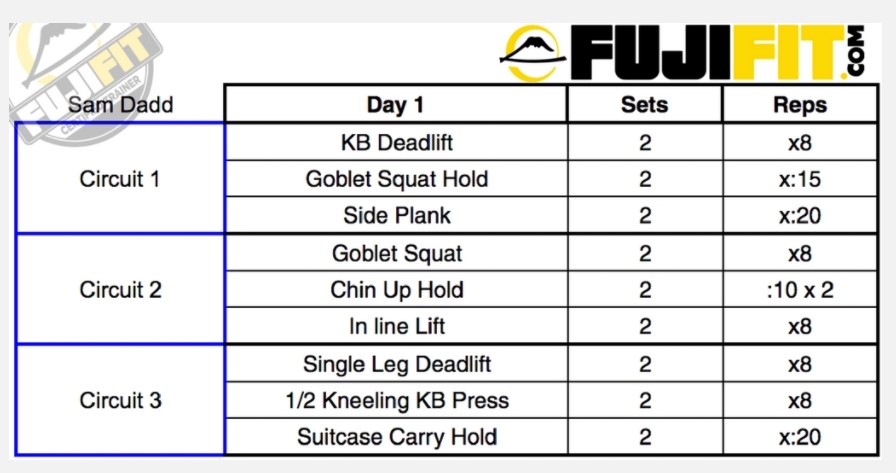
The first day starts with a kettlebell and bodyweight circuit. Remember, you should go through each circuit twice before moving to the next. First, you pump put 8 reps of kettlebell deadlifts, before going for an isometric goblet squat hold for 15 seconds. Immediately after, you’ll hit a side plank for 20 seconds on each side.

The second circuit starts with a goblet squat again and moves on to an isometric chin-up hold. After hanging from the bar for 10 seconds twice in a row, you do an inline lift to complete the circuit.

Finally, it’s single leg deadlifts and single-arm kettlebell presses for 8 reps each and a suitcase carry for the finish. This is how the circuit looks:

Workout For BJJ Circuits

  • Day 2

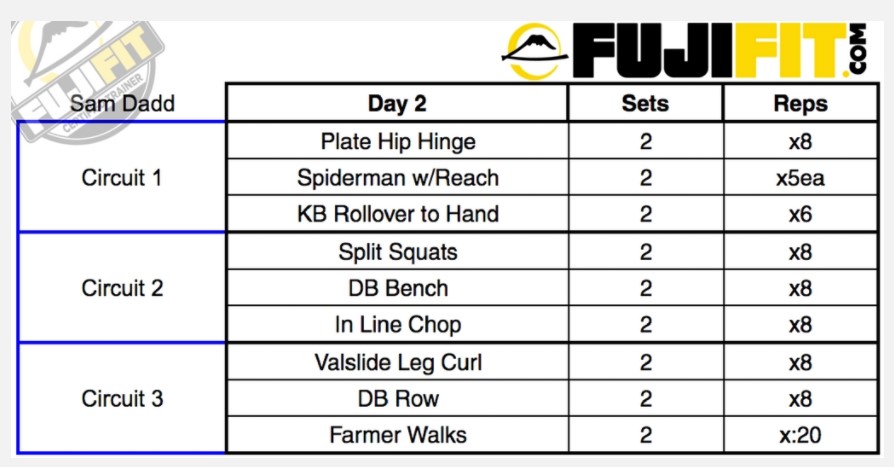
For the second session of the workout for BJJ, you start off with plate hip hinges, again for 8 reps. Spidermen with reach are up next, reducing the reps to 5 each. To finish it off, you’ll do a kettlebell rollover for 6 reps.

The next circuit starts with split squats, goes over to a double dumbbell bench press, and ends with an inline chop. 8 reps for every exercise is the norm.

The third and final circuit hits the legs from behind with the Wall slide leg curl. 8 reps of dumbbell rows precede 20 20-second farmer’s walks with as much weight as you can handle. Once again, two sets of each circuit.

Circuit Workout For BJJ

  • Day 3

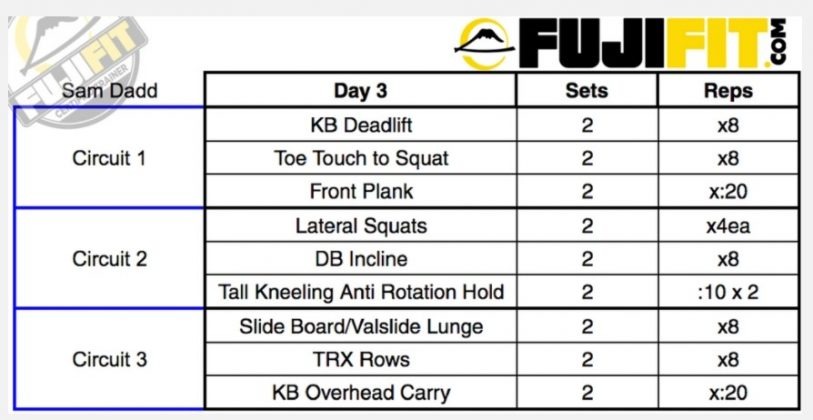
The final workout day of the week starts with a kettlebell deadlift once again. The next exercises, toe touches to squats are going to test your mobility as well as your endurance.  Both of these exercises go for 8 reps each before holding a plank for 20 seconds.

Going forward, it’s time for lateral squats (4 on each side) followed by an incline dumbbell bench press for 8 reps. A core crushing 10-second holds (2 in a row) of kneeling anti-rotation holds wrap this circuit up.

For the final circuit of the week, go for 8 reps of wall-slide squats. 8 reps of those earn you a transition to the TRX for 8 reps of rows. End the week in a strong fashion with kettlebell overhead carries for 20 seconds each set.

Lifting And Bodyweight Workout For BJJ

There you have it. A complete workout for BJJ that is going to transform you into a better grappler in a very short time. Stick to the programming and you’ll see results straight away, both in the mirror and on the mats.

Quick Jiu-Jitsu Conditioning Workouts For Busy People

Bodyweight Workout for BJJ

The Best Strength & Conditioning DVD and Digital Instructionals

Want The Jiu-Jitsu Body Of Gordon Ryan? Train Like This To get It!

Teacher Puts a Kid in A leg Lock After Being Knocked Down

Teacher Puts a Kid in A leg Lock After Being Knocked Down

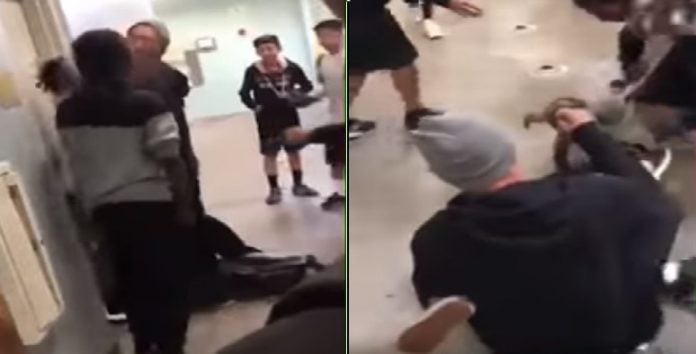
This teacher is probably a practitioner of BJJ or some other grappling martial art.

After one kid punched him in a face knocking him down he managed to entangle him from the ground putting him in a leg lock.

The teacher was trying break the fight between two kids arguing in the school. One kid trying to punch another kid, probably, accidentally punched a teacher knocking him down. A few seconds later teacher managed to take the kid down and put him in a leg lock making the kid unable to move.

https://youtu.be/ZzAtg_qtiIc

Double Leg Takedown – How to Do It & The Most Common Mistakes

How to do Double Leg Takedown and the most common mistakes

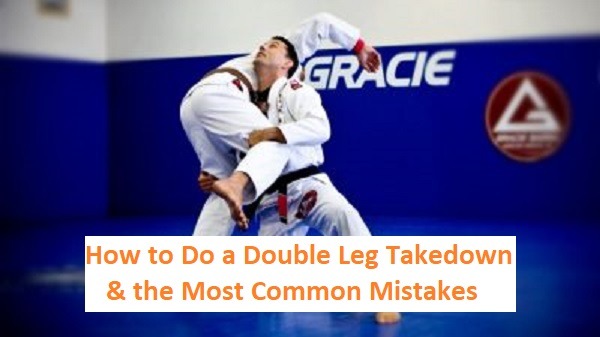
Double Leg takedown is one of the most reliable techniques in grappling martial arts in general. It is one of the best and safest ways to take the fight to the ground. When done correctly, it is a low-risk high-return move that lands you in a dominant top position on the ground. It requires very high technical knowledge of the move in order to use it against another trained grapplers so mistakes are very common. And Double Leg Takedown for BJJ is a whole another story.

Have you ever watched a wrestling match? Be it at the gym or in competition, there’s one move you’re going to see most of the wrestlers’ attempt. It is the staple of the takedown game and real wrestling classic. Not only that, but it is a large part of Brazilian Jiu-Jitsu as well. While it is more useful in No-Gi, it can also be brutally effective in the Gi too.

Double leg takedown technique takes years to master, in both wrestling and BJJ. There are a few main aspects that make this move a complex one. While the notion is easy, grab both legs from a lower-level position, getting there, staying safe and finishing takes experience and the ability to adjust. There are plenty of different variations of the move that often times need to be connected while attempting to execute it. All in all, here’s a reason why wrestlers spend countless hours polishing up one of the very basic techniques of the sport. As Jiu-Jitsu practitioners, we shouldn’t take this move for granted. We need to respect the king of takedowns and put the reps in to achieve mastery of the move.

The Wrestling Version Double Leg Takedown

Double leg takedown is as old as the sport of wrestling itself. The move can probably be traced all the way back to the first Olympic games. As effective a move as it is, it is not limited to wrestling, though, Historically, before the change of rules, this technique was also a part of Kodokan Judo as well, where it was known as Morote Gari.

For the DLT, a grappler needs to have both their arms around an opponent’s legs. The basic idea is to lift the opponent off the ground in order to take them down on their back. There are a few very important elements to the traditional wrestling double leg takedown. First and foremost, you have to change your level in order to be able to get to the opponent’s legs.  Going as low as possible without blocking your movement is highly advisable. next, you’ll need to “shoot in” towards the opponent, shortening the distance. The shoot is what gets you in position to put together the structural components of the DLT.

How to Do Double Leg Takedown Effectively

  1. Go below your opponents level.

    Keep your back straight slightly leaning forward. The position is similar to one when you’re doing squat.

  2. Propel yourself forward

    Shoot in with your rear leg pushing your whole body without being concentrated only on fishing for your opponent’s legs with your arms. After you shoot in, simultaneously drop down to your lead knee between your opponent’s legs because it’s the lowest position you can be and still maintain power. Of Course, if you’re doing double leg takedown in a street fight on concrete or any other hard surface don’t drop on your knee.

  3. Wrap your arms around your opponent’s thighs.

    After wrapping your arms try to squeeze your opponent’s legs as much as possible.

  4. Stay tight with your head and shoulders tight against your opponent’s torso.

    By staying tight you’ll be able to avoid guillotine choke and other counters with people pushing their arms between you and them.

  5. Step in pretty deep with your rear leg to the outside of your opponent’s legs and turn the corner.

    If you don’t step in deep with your rear leg you won’t be able to turn the corner to outside destabilizing your opponent. The whole stress will be on your lead leg and you won’t have the power to continue going forward.

  6. Drive Up, Go Forward and Pivot

    You don’t have to pick your opponent on your shoulders. Picking up an opponent in the air is only done when driving forwards gets countered. Once you get in position and turn the corner your opponent will already be destabilized what will allow you to drive them to the ground. So, once you’re in the position with a secured hold drive them to the side by using your legs and “wheeling them your head. You will simultaneously squeeze their legs into the opposite direction.

  7. DO NOT land in guard.

    Even if you land in your opponent’s guard you still have legs control to immobilize his hip movement and get to side control. This is especially important if they have their hands around your neck trying to apply a guillotine. You want to use the control of their legs to get to a position with a guillotine choke on the opposite side of you in side control.

Avoiding The Most Common Mistakes

Learning the double leg takedown is a definite must for anyone involved in grappling martial arts. That said, learning it mistake-free often presents a real challenge. However, if you are aware of the possible mistakes, while you’re learning the move, you have a much better chance of weeding them out before they become a bad habit. So, the most common mistakes when doing DLT are:

  1. Distance management

    We already pointed out the importance of the penetration step. Shooting in too short means that your opponent doesn’t even need to sprawl. They can just lay on top of you, as you won’t be able to reach their legs. A good rule of thumb is being at an arm’s length of your opponent.

  2. Bad posture

    Not only does this put you at risk of guillotines, but it also weakens your takedown efficiency. Good posture means no space and a firm structure to finish the move. You should keep your back straight slightly leaning forward. Just like when you’re starting to deadlift. You want to avoid being full straight because you will lose power once you make a contact. But also you want to avoid being too bent forward because it’s easier to sprawl on you. Once you shoot for Double Leg Takedown make sure your head is not pressuring down, but sideways. If your head is pressuring down it will be easy to manipulate with you, sprawl, push your head and eventually guillotine you.

  3. Fishing for the legs with your arms

    The usual thing that practitioners do is concentrating on grabbing your opponents legs with your arms without worrying about chest and shoulders penetrating into your opponent. Your main focus should be on your chests and shoulders penetration and your arms should be there just to trap your opponent’s legs.

  4. The position of the lead leg

    In terms of the penetration step, the position of the lead leg is where things can go wrong. Thumping down on your knee is only going to take all of the inertia away. You need to make sure that you use your knee to penetrate in, not stop the movement. Always aim to slide the knee in between your opponent’s legs, as opposed to going down on the mat with all your weight.

  5. The Power of shoot

    Unlike other positions in BJJ, takedowns require the component that is power. This means once you shoot, there’s no going back. You need to commit yourself to get it! That said, always look to go through your opponent when you’re driving forward, not just enough so that they fall. The goal is to make them fly back as far and as hard as possible.

  6. Not Committing to the double leg takedown

    Once you decide to go for a takedown make sure you’re “ALL IN”. This rule is important for all kind of takedowns in all sports. If you decide to go, you should fully commit to it without hesitation. This problem occurs when you start thinking too much about your opponent’s sprawling with you finishing in the turtle position. Or when you start thinking too much about any other counter. Don’t think just do it. As we said before, a lot of drilling will make sure you do this takedown without hesitation.

Double Leg Takedown For BJJ

If there’s one thing that BJJ athletes need to do to improve their takedown, it’s drilling. Wrestlers spend countless hours drilling any wrestling technique or its specific elements. In BJJ, people tend to be sloppy with a lot of techniques, diminishing its effectiveness. The first thing that needs focused attention is shortening the distance. The best way is to learn the proper technique behind the penetration step. This is a move that is designed to change the level, bring you in close and offer an opportunity to use inertia to your advantage.

In BJJ, due to the versatility and rules of the sport, DLT is much more important than in wrestling. When doing Jiu-Jitsu, this move can be done from both standings or from a bottom position, given the circumstances. From the top, the penetration step makes all the difference. Furthermore, finishing by going for a lift might be a better option here. When grappling with a Gi, allowing the opponent to establish grips can be very dangerous. The Gi opens up a lot more choking and countering options than just the Guillotine chokes, so you have to finish the move as fast as possible. All the other basics apply, just remember to get in fast and finish powerfully.

Double Leg Takedown from the Bottom in BJJ

DLT in BJJ can also be done from the bottom, in a low-double variation. This takedown is accessible from a wide variety of open guards common to Jiu-Jitsu. Due to its mechanics, the Half Guard is the best position to attack from. A good underhook from the bottom half guard is crucial to transitioning into a low double. Finishing requires you to pick your opponent up or move in a circular motion to complete the takedown.

https://youtu.be/ItgLxy0M1sA

You Might Like:

The Top Throws And Takedowns In BJJ
30 No Gi Takedowns
Throws And Takedowns For BJJ That Really Work
Interesting:
Watch Benson Henderson’s Taking Down AJ Agazarm and the Referee off the stage

Swedish BJJ Cop Takedown to Kimura
Small Guy did Takedown on a Big Bully

Breakdown Of The Best Single Leg X Guard Attacks

BJJ Single Leg X Guard guide

While the closed guard in BJJ is the most secure option from the bottom it is also the most limited one. It is by al lemans very effective but it does not offer plenty of directions to move in. This is due to the fact that when the legs are closed lots of options remain unavailable. The open guard though is far more versatile when you’re looking to attack from the bottom. That said, it is not as secure defensively as the closed guard, depending on which variation you’re using.

There are numerous open guards, each with its own pros and cons. So, when looking to have ultimate control along with plentiful attacking options, open guards that resemble the closed guard are clear winners. One of the most proficient open guards is by far the Single leg X guard, a sort of “hybrid” between the closed and open guards.

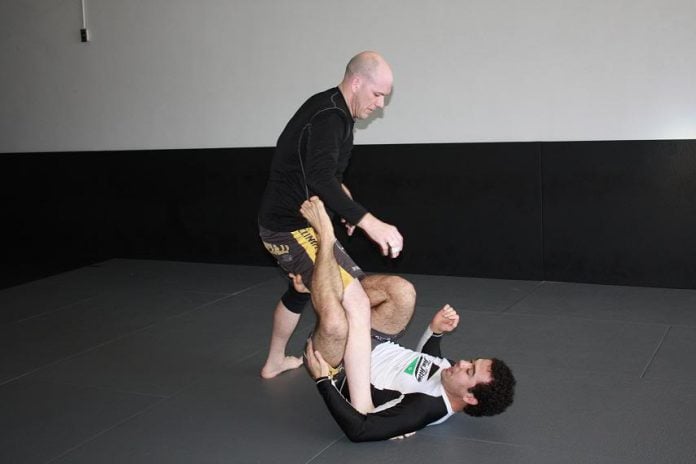
The Single leg X guard definitely is a member of the open guard’s category. However, the proximity of the legs means that it can utilize some of the closed guard’s advantages while remaining fairly versatile. The basic principle behind the Single leg X guard is one of the pillars of BJJ – isolation. The configuration of this guard completely isolates one limb, opposed to most other open guard variations. Using the whole body against a single limb is always a winning combination, which is why this guard is so effective. Formerly popular as a top sweeping position, the rise of leg locks have transformed this guard into a very dangerous attacking position as well.

Single Leg X Guard Structure

The single leg X guard is a snake-like guard that focuses on limb isolation. The basic notion is using all of your body’s power against one of your opponent’s legs. In order for the guard to be effective, it is of the utmost importance to be able to control the whole limb, much like with leg locks. To do so, every joint of the leg must be under complete control.

Starting from the top, the hip of the opponent is controlled with the help of our legs. Basically, one leg is placed in and around one of the opponent’s legs, with the heel of the foot ending up on their hip. The other leg is placed with the shin on the inside of the opponent’s thigh, hooking the butt with the foot. To control the hip, The outer foot needs to be deep in the opponent’s hip fold. The most crucial aspect of Single leg X guard control is keeping the hips as high as possible on the opponent’s trapped leg. Furthermore, both knees have to be clamped tightly together. Also, remember that the outer foot must have the fingers pointing out. This is mostly due to the IBJJF knee-reap rule, but in fact, it does offer better control of the position.

Usually, it only takes one arm to successfully control the SIngle leg X guard. this leaves a lot of room to work with the other, which is essential to starting attacking sequences. The near side arm can control the opponent’s leg in two ways. One is with an ankle lock-like grip that goes around the ankle ending up with your palm on the chest. The other option is reinforcing your outer leg by grabbing your own thigh.

Single Leg X Guard Retention

Controlling the Single leg X guard comes from correct weight distribution. The structure of the guard allows for controlling and attacking in multiple directions. In order to do so, though, you must make sure that you can stay in the position successfully. Apart from keeping the hips up and your knees together, you’ll need to utilize both feet as well. The foot on the hip needs to pull instead of pushing. If you use it to push, which is instinctive, you’ll open up space for your opponent’s defense. When you pull, on the other hand, you’re going to block the hip even further because their leg has to carry all your weight.

Correct weight distribution makes all the difference in controlling the Single leg X guard. IN that sense, once you know that you need to pull instead of push, it is all about the correct angle. When controlling the position, you need to make sure you’re putting pressure on the opponent’s inside thigh by pressing your shinbone in and slightly downwards. To achieve this just remember to constantly try and connect your inner leg knee to the shin of your outer leg. This is going to provide you with the right direction while the pulling motion is going to create the right angle.

The Single leg X guard is a close-distance guard that is played with the opponent basically on top of you. Your opponent is either going to remain standing or kneel with their free leg. Whatever your opponent attempts, you need to constantly keep the connection to the hip and the correct weight distribution.

In situations when the opponent manages to take your outer foot off, you can either go to the X guard or transition right back to the Single leg X.

Single Leg  X Guard Sweeps

First and foremost, there is more than one sweep available from this position. However, we’re only going to focus on the twisting sweep for now. This sweep is unstoppable, once you figure out how to maintain complete control from the Single leg X guard. The position of the guard itself is the reason for the sweep’s success.

Namely, the twisting sweep feeds of the guard’s positioning and mechanics. The angle of weight distribution means you can use the Single leg X guard to sweep in every direction. Normally, sweeping to the back, where your opponent has no posting options is the best. In order to execute the twisting sweep you;r going to have to take your hips even further up. This is going to result in even more weight on your opponent’s trapped leg, which in turn causes them to shift weight off their free leg. What this creates is an axis that you can use to take your opponent down. From the basic Single leg X position, lift your hips and do a twisting motion to the outside, while redirecting your weight in the same direction.

In most instances, you’ll complete the sweep without much effort. Against taller, or more experienced opponent’s though, you might need a bit more push. This is where the second arm comes in. Once in full hip extension and torque, if you still need more power, place your free arm on the mat. You then use it to push off the mats until your opponent crumbles to the floor. You’ll end up in a position very similar to the straight Ashi Garami, meaning you can choose your next step. You could either go for a submission or use a technical standup to get on top.

Single Leg X Guard Submissions

Since the Single leg X is so similar to the straight Ashi Garami, the logical attacking options are leg locks. The only factor that determines which attack you’re going to use, are the rules. Under IBJJF rules, where knee reaps are forbidden, attacking options are limited to a straight ankle lock or toe hold. The straight bottom Ashi Garami is the top ankle locking position. For toe holds you’ll need to transition into the top Ashi Garami.

When rules are not so restrictive, you can have more freedom with your attacks. Once again the straight Ashi Garami is a viable option for heel hooks as well as ankle locks. Furthermore, you might go into a full knee-reaping position (Inside Ashi) or attack directly from the bottom.

In terms of directions, you can use the twisting sweep to land into straight Ashi or go a different way. One option is to go for an Omoplata-like movement of the leg, which is, once again, going to land you in straight Ashi. Furthermore, when reaping is allowed you can look to insert your outside leg in between the opponent’s legs, getting to top Inside Ashi. this is especially effective against seated opponents/

Transitionally, the Outside Ashi and the 50/50 are also very close to the Single leg X guard. In both cases, it is a combination of your opponent’s reactions and your attacking direction that determines which one is the better option.

You Might Also Like:

The Most Comprehensive Guide To Leg Locks Ever Put Together
Craig Jones Down Under Leg Attacks DVD Review
The 9 Best Leg Lock DVD Instructionals For Grapplers

10 Best Leg Locks DVDs and Digital Instructionals

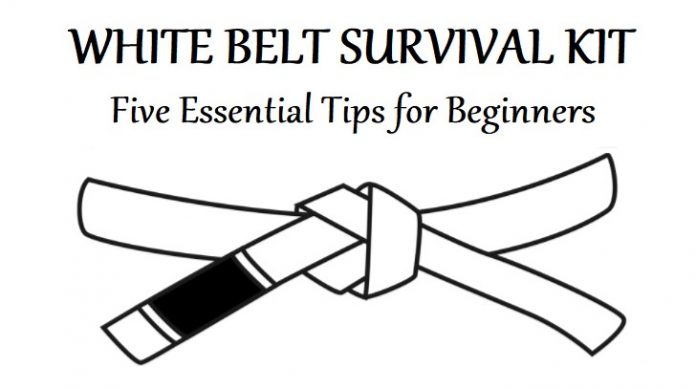
BJJ White Belt Survival Kit: 5 Essential Tips For Beginners

BJJ White Belt Survival Kit: 5 Essential Tips For Beginners

Back when I was a BJJ white belt, tips were pretty much hard to come by. What I got was the usual “just keep showing up” encouragement and that was about it. In training, I had no idea what I was doing most of the time and I was getting smashed every training session. Even after a while, when I discovered how to survive here and there, I often did stupid mistakes that most white belts these days do not often commit. Back then, it was harder to have a guide, let alone simple steps to make the BJJ white belt life easier. today, however, things are much different.

First of all, we have the ultimate communication platform via the internet. Secondly, more and more people train Brazilian Jiu-Jitsu as the art spreads to the farthest corners of the world. This means that with every passing year, you have exponentially more experiences being shared online. Combining personal experiences with the most common experiences shared by other fellow grapplers, we’ve come u with the one list of tips that every BJJ white belt needs to read. Even if you decide not to follow all, or any, of our recommendations, you’ll have all the information you need to make your Jiu-Jitsu journey much more pleasurable.

The Struggles Of A BJJ White Belt

The main struggles of a white belt are as much psychological as they are physical. First of all, you’re a first-grader all over again. You’re thrown into a new environment, full of new people who already have strong bonds between themselves. As if that wasn’t enough, you’re there trying to do one of the hardest sports in the world, without any clue to what you’re doing. And yes, this stands true even if you have a background in other grappling martial arts. Furthermore, the nature of the sport means that you’ll be forced to admit defeat multiple times in an hour, let alone a long time period. It is a feeling nobody likes, and as human beings, we’re wired to stay away from it. So, returning to training over and over again, knowing what to expect goes against basic human psychology. At least at first.

Physically, expect to be tested in ways you’ve never been tested before. It doesn’t matter if you’re a Crossfit champion, marathon runner or an experienced kickboxer. Once you try rolling, you’re going to suffer. First of all, you’re going to get gassed, no matter how well conditioned you might be. Muscles that you never knew existed are going to ache, and you’ll soon discover how actually weak you are. But worry not, it gets better.

Rest assured, these obstacles are there for everyone. The thing is, you might have an easier time coping with them, by learning from the experiences of others. Namely, most people have certain aspects of grappling training as beginners that are common for them all. Figuring these out takes time, and while it is always good to learn from your experiences, learning from those of other’s is much painless.

Accept Your Status

Before you even think about attempting Jiu-jitsu, you’re going to need to understand one thing. No matter your martial arts experience, you’ll have to start at the very beginning. This means that you need to accept the fact that you know nothing. You need to become comfortable with the fact that you’ll be lost.

Pretending that you know what’s going on is just going to make it harder to learn. Brazilian Jiu-Jitsu is a very complex grappling martial art that takes years to get good at. Actually, it takes about a decade, on average, to get to black belt. You could finish college in such a time or even develop a small (or large) business. It’ll take patience to learn, but you won’t remain a BJJ white belt forever. However, while you are, learn all the time and never attempt to coach others about what you do not know!

Injury Prevention

No matter how fast and hard you fall in love with Brazilian Jiu-Jitsu, you can’t train injured. Furthermore, you also can’t train alone. Acting like a spaz on the mats is not good for both of them. Let me elaborate.

When you decide that you’re not going to tap to that purple belt that’s destroying everyone, you’re putting yourself in danger. First of all, not tapping is not a good idea in BJJ in general, let alone as a BJJ white belt. Now, the purple belt is probably not going to hurt you, as they’re experienced enough to know when you’ve had enough, No, your worst enemy is yourself. Deciding to tough it out or thrash around uncontrollably is going to get you injured. And you’ll only have yourself to blame. Go back up, read and read the first tip again. You do not know enough! A tap gives you a direct way out and allows you to regroup and reconsider. That is how you learn, injury-free.

An even worse way of stalling your progress through injury is by being the class spaz. What this means is that you’re injuring others while doing uncontrollable and unneeded moves while rolling. I understand that you want to win, but kneeing people in the face by accident is going to make them avoid you. And you can’t train BJJ by yourself, can you?

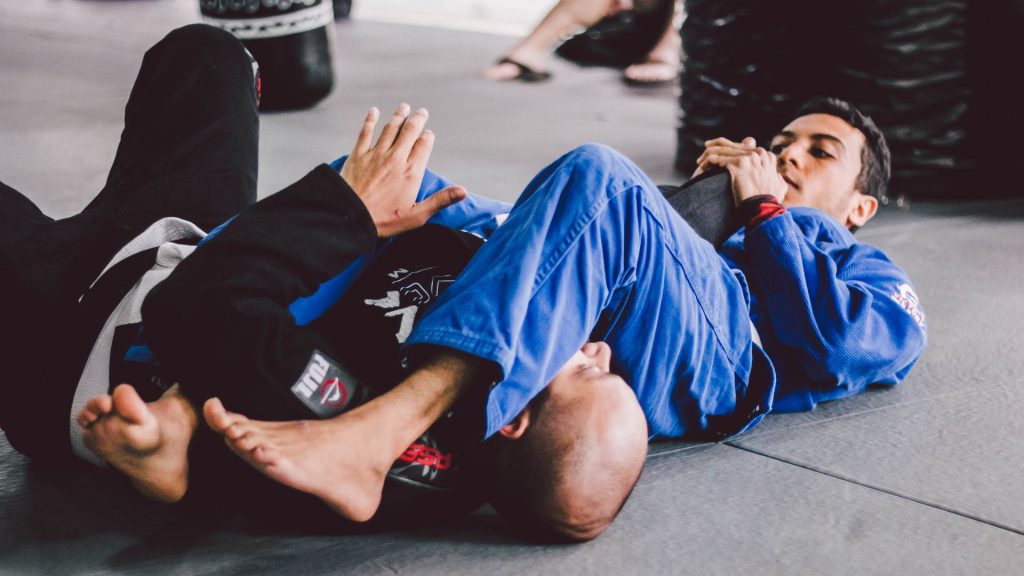
BJJ White Belt Tap

Respect The Academy

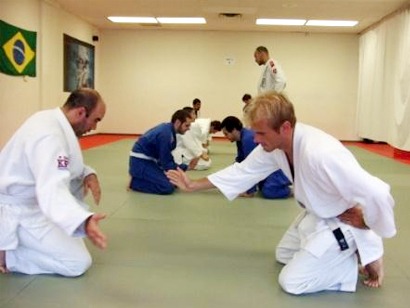
Wherever you decide to train, you’re going to be a part of a school. That means you’ll spend hours upon hours at a certain spot with a certain group of people. Not only that, but you’ll spend most your time in extremely close proximity to other people. This means that you need to be on your best behavior. No matter how you act outside the gym, on the mats you’ll have to respect the academy’s rules.

Among those rules, respect is the first one. Respect your training partners and your instructors when you’re in class. No need for unnecessary talking, teasing or remarks. If you’re thinking about slacking, you’re better off staying at home instead of wasting someone’s time. After all your partner came to learn something new today. Why should he/she have to suffer because of you?

The next big thing every BJJ white belt needs to understand is personal hygiene. Most BJJ academies spend a lot of time trying to keep the premises clean. After all, we are rolling around on the ground. Coming in smelly is going to leave you partnerless before you can say “Omoplata“. Keep yourself and your training gear, whether it is Gi or No-Gi clean and fresh. Moreover, find a way to get all your precious jewelry off. That piercing you’re so proud off can cause a serious injury to someone, or yourself. Finally, going in sick or with a skin condition should be a no-brainer, but I’ll mention it regardless. Stay at home until you heal up. Nobody wants to share your germs.

Dedicate Yourself To BJJ

If you’re really serious about training Jiu-Jitsu and living the lifestyle than dedicate yourself to the gentle art. This doesn’t mean dropping everything else and living in the gym. it means that you need to use every tool you have at your disposal to make you a better grappler. On such a tool is going to open mat sessions. Contrary to popular BJJ white belt belief, open mats are not just sparring sessions. During an open mat, you can do anything that’s appropriate for a BJJ academy. Ask older belts questions, drill with different partners or focus on some conditioning and/or flexibility. You’ll have plenty of time to roll, and you definitely need to do it, but you can learn so much more at an open mat.

Another huge aspect of Jiu-Jitsu is physical preparedness. You do not need to be a world-class athlete, but having a good gas tank and decent strength doesn’t hurt either. Look to improve your fitness by engaging in any kind of physical exercise apart from BJJ. Go for a run, or just bang out a few reps on the monkey bars. Or maybe hit the weights in a gym along with some academy friends. You could even go and just work on your flexibility by doing Yoga. Whatever you choose to do, it’ll help you get better at BJJ.

On a similar note, try to clean up your diet as well. Eating like s#&^ is going to make you bloated, tired and distracted. Make sure you develop some good eating habits. it won’t be hard, as all you need to do is just see what others in the academy are doing. Most grapplers tend to eat healthy(ish) so it won’t be hard to figure it out.BJJ White Belt Survival Tips

Ask And Write

Finally, from a technical perspective, Jiu-Jitsu is going to be confusing like nothing before. It is OK, as this is the same for anyone. What you need to do to ensure you constantly evolve and progress is to ask questions. Ask your instructors, as more experienced training partners, ask on internet forums… People in BJJ know that you only go forward if you ask what you do not understand. As a BJJ white belt, that is everything, So, everyone is going to expect questions from you, especially your instructors. They’re going to be happy to oblige, as long as it doesn’t interfere with the class too much. There are correct times to ask questions and wrong ones. Asking during rolling is not appropriate, but doing so at an open mat is perfectly OK.

 As we’ve already likened BJJ to college, just like in school a good idea is to write things down. Nobody can remember everything, let alone in a martial art that has no end. This is even more pronounced when you’re a BJJ white belt. Even the names of moves are going to be confusing, let alone the sheer volume of information. So get yourself a notebook and start writing things down, Both stuff you learn in class and stuff you ask about all need to go in there. This is going to help you immensely in your quest to turn that BJJ white belt into a blue one, and eventually, a black one.

You Might Also Like:

The Best DVD and Digital Instructionals For BJJ White Belts
Reasons Why You’re Still A White Belt
Unwritten BJJ Rules To Follow In Any Academy
7 Awesome Tips To make You Formidable White Belt