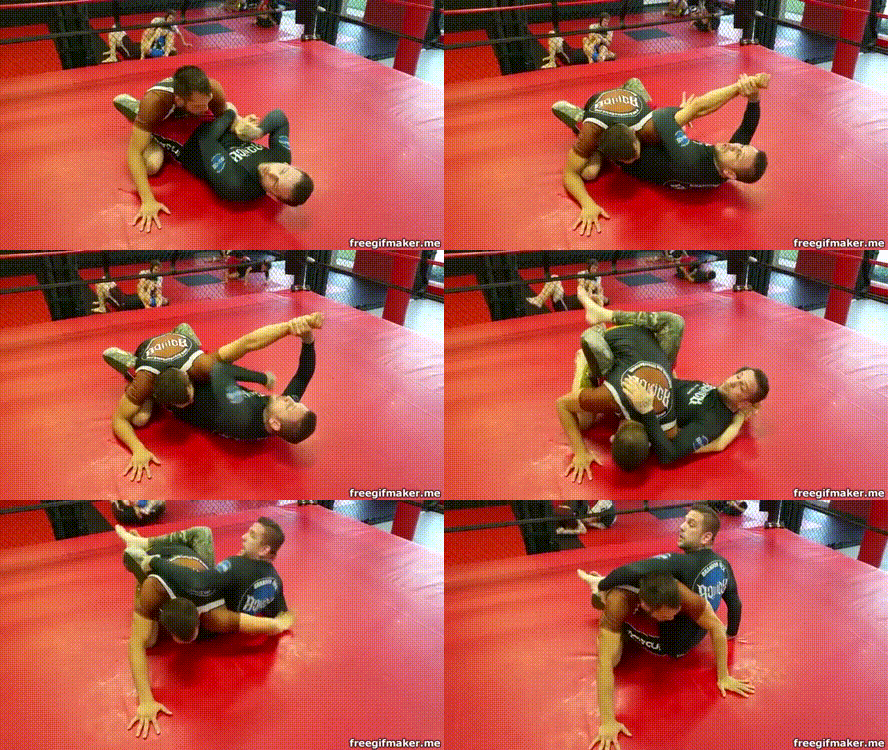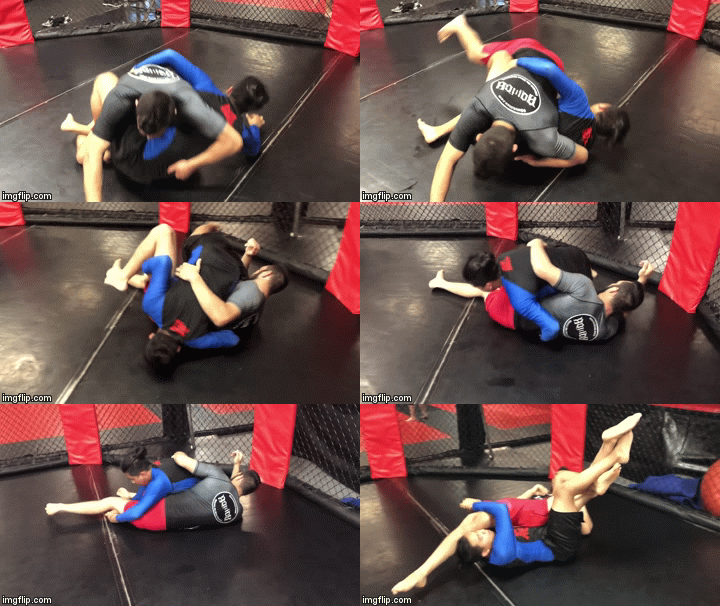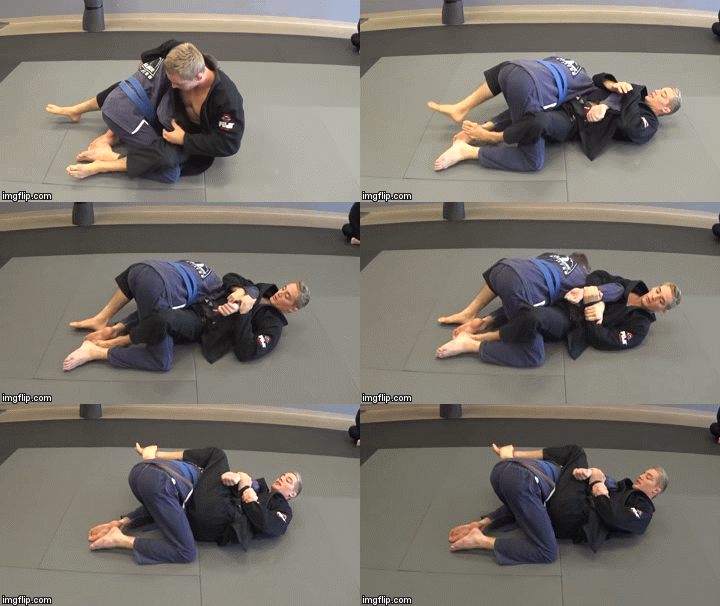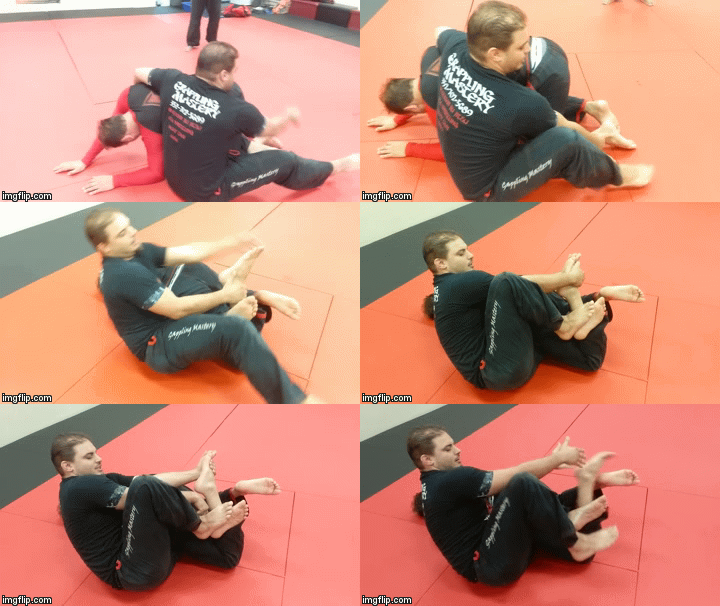



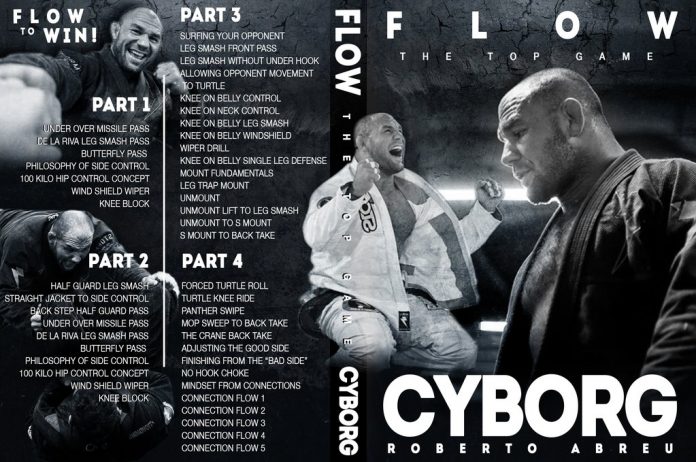
Brand New Roberto Cyborg Abreu “Flow: Top Game” DVD *UPDATED

Cyborg Abreu DVD Flow-The Top Game

Ah, those blue belt days. If there is one thing that marks my blue belt period, it is the tornado guard. Somehow, I came across a Roberto Cyborg Abreu DVD and that was it. It was actually one of my first BJJ DVD instructions. It did me a world of good If I’m being honest. My guard became unpassable very quickly, and I had absolutely no trouble sweeping people. Even when I started enjoying inversions a bit too much, I had great success with the tornado guard. Now, years later, there’s a brand new Roberto Cyborg DVD out. And I went out and got, for history’s sake if nothing else. 

ON SALE HERE:
Roberto Cyborg Abreu – Flow Top Game
Cyborg Abreu DVD Flow-The Top Game
Techniques List

Roberto Cyborg is one of the old school heavyweight grapplers that is surprisingly mobile for his weight. He manages to get the most out of his flexibility and strength by exploring some rather unorthodox avenues of Jiu-Jitsu. However, one thing is for sure – Cyborg’s stuff works! It worked for me as a blue belt, and, though I have some injuries that prevent me from using it now, it does work later on as well. After all, Cyborg has been using it for years against top-level grapplers of all generations. The Brazilian is one of those grapplers that have World titles in everything, from the IBJJF to the ADCC. This is exactly why you need to make the new Cyborg Abreu DVD a priority!

Roberto Cyborg Abreu

Roberto Cyborg Abreu is a super heavyweight grappler that was born in Campo Grande, Brazil. The 38-year-old came into the sport by joking around wrestling with his friends. The thing was, that one of the kids was way skinnier then Cyborg, yet managed to finish him a few times. The skinny kid knew BJJ. From that moment on, Cyborg made it his mission to pursue the Gentle Art. As we all know, he succeeded in his quest.
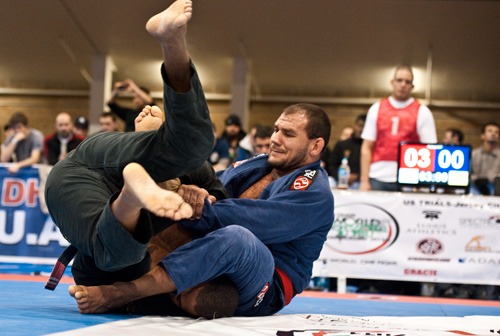
Roberto Cyborg Abreu DVDCyborg today leads the Fight Sports Academy, based in Miami, Florida. His nickname is a result of a very serious car accident he had like a blue belt in the early 2000s. Despite the doctor’s prognosis that he wouldn’t be able to use his left arm ever again, he managed to get silver in the Brazilian nationals only 4 months after the accident. He still carries the glass in the arm to this day, which is why his teammates named him Cyborg. His ‘godfather” was Isaias, a Carlson Gracie black belt.

If there’s one thing you need to know about Roberto Cyborg Abreu, it is that he enjoys the competition. This means that any information you get from a Roberto Cyborg Abreu DVD is going to be 100% legit for use in tournaments. Cyborg is actually a Francisco Albuquerque black belt, which only strengthens his pedigree as a top competitor. Cyborg got his black belt in an impressive 5 years. Afterward, Cyborg teamed up with Buchecha and Cavaca to form a deadly competition team. Even though the team fell apart after a few years, Cyborg still went on to compete everywhere he could, and still does to this day.

Cyborg’s Grappling Career

Overcoming a lot of adversity and harnessing his fierce competitor spirit, Cyborg managed to conquer a lot in the world of BJJ. Even before he earned his black belt in Jiu-Jitsu, Cyborg managed to get the world and national titles. However, it was the decade or so after getting the black belt that he truly excelled.

Some of Cyborg’s most notable titles include IBJJF European champion, Pans Champion and multiple IBJJF No-Gi World Champion (five times, to be precise). He is known for competing in both his weight class and the absolute. Actually, Cyborg has some of his most impressive competitive achievements precisely in the absolute division. The first thing that springs to mind is his 2013 ADCC performance. Ending up a runner-up in his weight division, Cyborg came back strong for the absolute. he defeated his former team-mate Buchecha in the finals, conquering the highest accolades possible in Jiu-Jitsu.

To this day, Cyborg is still an active competitor. Just recently, he won another world title, this time at the IBJJF World Masters. This time, however, he conquered the title with the G. Roberto overcame 5 very tough opponents in an impressive performance where his Tornado guard featured heavily. Seeing as his trademark stuff works at the highest level to this day, I’m certainly extremely excited about the new Cyborg Abreu DVD and the innovations it will bring!

“Flow: Top Game” Roberto Cyborg Abreu DVD Review

A defining trait of Cyborg as a grappler is his ability to move. At 38 and weighing somewhere in the neighborhood of 240 lbs, Cyborg moves like he’s 150 lbs and 20 years of age! This is down to how efficient and experienced he is in the sport, but is nonetheless impressive. Still, the way Cyborg flows from one position to another, threatening with submissions and never releasing pressure is something only high-level black belts can do. Until now.

This brand new Cyborg Abreu DVD explores exactly this breathtaking aspects of the Brazilian’s game – flowing. Moreover, he focuses on how fast-flowing BJJ works from the top. Basically, this is a DVD instructional like no other before it. Most people focus on moves, sequences or concepts and principles when they’re filming a DVD. Cyborg, unlike most, focused on an aspect of BJJ we’re all after but we have no idea how to train. Once again, just as he did with his original Tornado guard DVD years ago, Cyborg is changing the landscape of Jiu-Jitsu.

“Flow- The Top Game” is a Gi based instructional containing four volumes. Each volume covers an area of the top game in BJJ where you can apply the principles of the flow. Open guard passing, half guard passing, side control and mount philosophy, the ability to surf, a back taking masterclass and more are featured across the volumes in this Cyborg Abreu DVD. All in all, as a fan of Cyborg and his work, I can say that this DVD is miles better than any of his previous work. Furthermore, it is one of the best DVDs to ever come out, and certainly, a contender for the best DVD of 2019, even though we’re only less than a month in!

VOLUME 1 – Flowing Against Open Guards

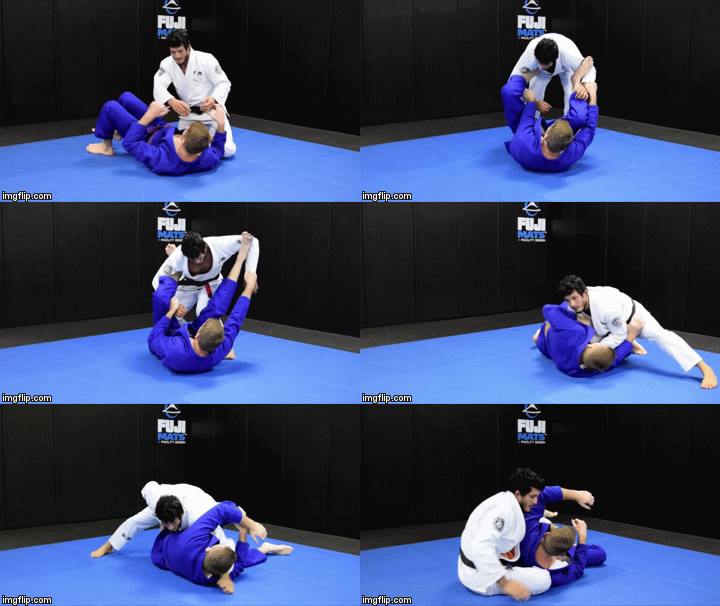
Cyborg kicks things off right from the opening minute. The man is built like a tank, so no wonder his opening move is named “the under over missile pass”. Not to be confused though, as the move is all about flowing, seamless movements as opposed to brute force. It’s a great variation to the usual over under pass we’re all used to.

Following closely are some great options for dealing with common open guards, like the De la Riva and the butterfly guard. The best thing about it is that you can connect all of them into one flow, basing your directions on the opponent’s reactions or lack of them.

Cyborg spends the second portion of Volume 1 on outlining his philosophy of controlling side control when on top. He starts with a long-winded explanation of his concepts and principles, which are the base of his flowing style. He also has revolutionary detailed concepts on the 100-kilos position, explaining exactly how to smash someone while you’re flowing on top. A knee block and some windshield wiper details round off the perfect start to a perfect BJJ DVD instructional.

VOLUME 2 – Top Half Guard Flow

In the second portion of this Cyborg Abreu DVD, the gears shift towards the half guard. it is also a distinctly longer DVD than the first one, filled with many more positions and flow concepts. The half guard smash is the opening move, flowing directly into things like a backstep half guard pass and once again, a missile pass variation. There’s also a very neat straight jacket to side control flow that’ll really help you up to your back talking game.

The DVD continues to connect the dots, now referring back to some of the open guards passes. He also covers how to make them work together with the half guard ones. Moreover, Cyborg connects side control to both passing sequences and back control. he does everything by showing you a very important concept- moving in both directions. Cyborg’s flows are not just one directional i.e. pass to side control to the back, but also work in reverse, in case you need to re-adjust and attack again. The point is to remain in control all the time and keep pressure while staying mobile.

VOLUME 3 – Side Control, Mounting, And Unmounting
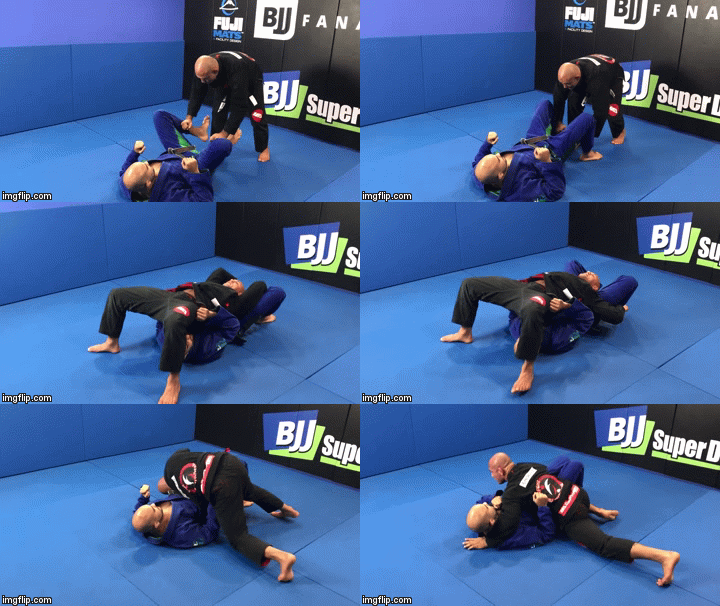
Cyborg Abreu DVD FlowA common thread of the “Flow-The top Game” Cyborg Abreu DVD seems to be the increasing length of every volume in the set. The third disc is once again a masterpiece, this time focusing me on positions. The opening concept is one that is crucial to a successful top game flow – surfing. The ability to use your opponent’s body to constantly shift your weight while pressuring them relentlessly is something that takes a long time to learn. In his DVD, cyborg offers a “shortcut” by explaining the principles behind the concept in-depth.

A few more passing sequences, in the form of leg smash pass variation, follow the surfing principles. From there on, Cyborg goes deep into the knee on belly, continuing the flows from previous volumes. The details here are about controlling knee on belly, getting it from side control and switching sides. There are the inevitable flows in every direction, with options for mount or the leg smash position.

The main goal of the knee on belly position is to open up the mount, of course. This is exactly what Cyborg covers next, again in a very unique fashion. First, he covers the usuals of staying on top and maintaining mount. What’s new here is that he also covers unmounting, which as a concept is not something most grapplers have in their arsenal. The unmount flows both backward (to leg smash) or forward (to S-mount). The closing sequence is all about transitioning to the back from the already established S-mount.

VOLUME 4 – Flowing Back Attacks 

Once again, a larger than before volume that helps you put everything together. However, Cyborg first goes over some slick back attacks and methods of dealing with turtled up opponents. Here, the flows have the task of opening up the turtle, whether via a forced roll, knee ride or some other innovative moves. Speaking of innovative moves, the crane back take is going to have you holding your head in disbelief. Good and bad side back attacks wrap up Cyborgs flows by showing you how to choke everyone.

As this amazing Cyborg Abreu DVD comes to an end, Cyborg goes into a very important subject – mindset. Here, he explains the principle of connection and the mindset behind creating connections in your game. There’s no flow without the ability to connect moves and techniques, regardless of how well you move. To reiterate what he explains here, Cyborg finishes the DVD with 5 connection flows that put everything together. His trademark style of going back and forth, spinning, rolling and turning while constantly being a treat really comes out here. the best thing about it is that he explains every step. If you’re after a free-flowing top game that nobody is able to stop, this is the DVD for you!

ON SALE HERE:
Roberto Cyborg Abreu – Flow Top Game
Cyborg Abreu DVD Flow-The Top Game
Techniques List

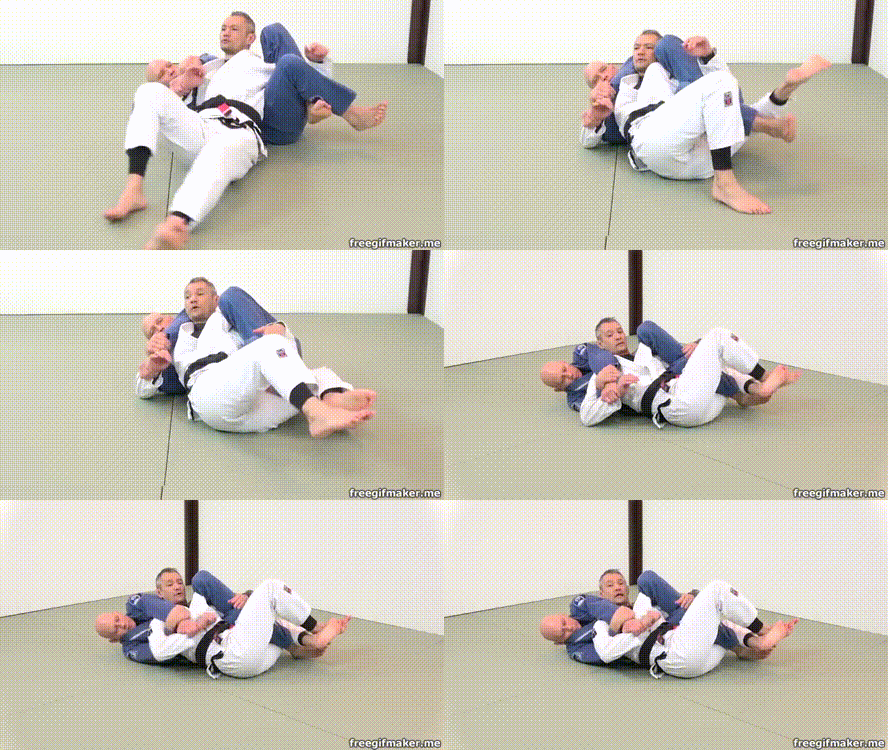
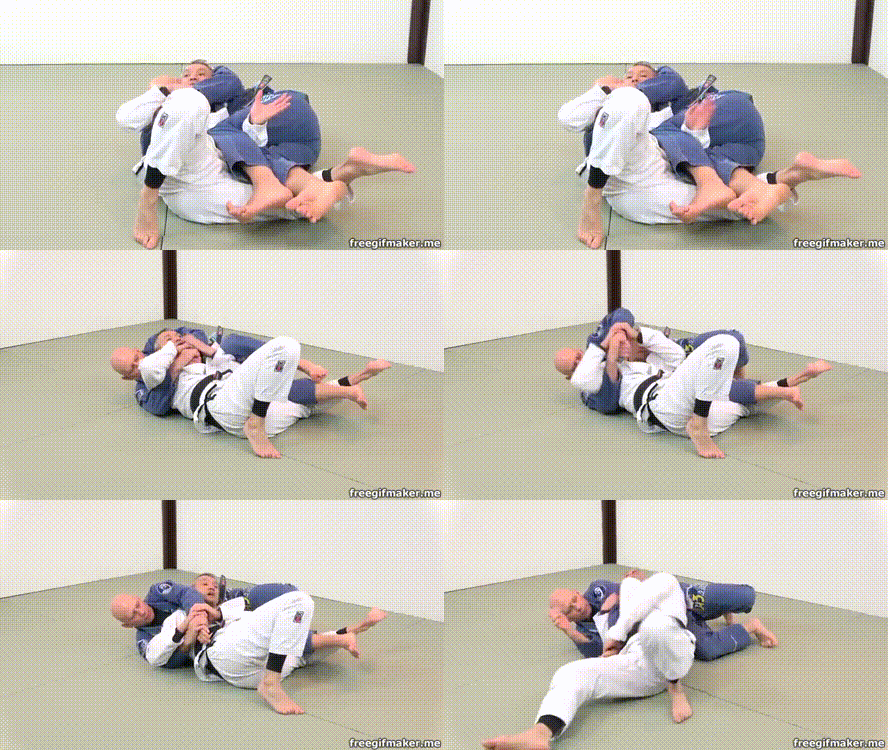
The “Grave” Wrestling Cradle System For Jiu-Jitsu

Wrestling Cradle BJJ Submissions The Grave

Just a glance at the recent victory Khabib Nurmagomedov won over Conor McGregor clearly demonstrates the importance of wrestling for MMA. With wrestling, you don’t just get techniques – you also get the mentality. And there’s no grappling martial art out there that’s more aggressive and relentless than wrestling. To make it as simple as possible, wrestling is a great addition to any martial art. And that includes Brazilian Jiu-Jitsu. However, wrestling for BJJ goes much deeper than just single and double leg takedowns. There are a lot of things BJJ athletes can take from wrestling, form positioning to the never-back-down mentality. One great example of something that works perfectly for BJJ is the wrestling cradle.

Catching someone in a cradle is nothing special for wrestlers. They’re doing it a lot and not paying too much attention to it. The reason for this is that it is a move that ties other moves together, like takedowns and pins. The cradle in itself is rarely a match-winning move in wrestling. However, applying the wrestling cradle to Brazilian Jiu-Jitsu offers much more possibilities. In an art where you have a lot of time to work on the ground, not to mention submissions, having complete control over someone’s upper and lower body is a dream come true.

If you like to explore the art of catch wrestling further, especially in a BJJ context, then one DVD set is all you need. Veteran grappler Neil Melanson has a DVD series named ‘The Catch Wrestling Formula” that covers everything you need to know about wrestling for BJJ. there’s a whole DVD in there dedicated to how you can modify the wrestling cradle as well. 

The Wrestling Cradle

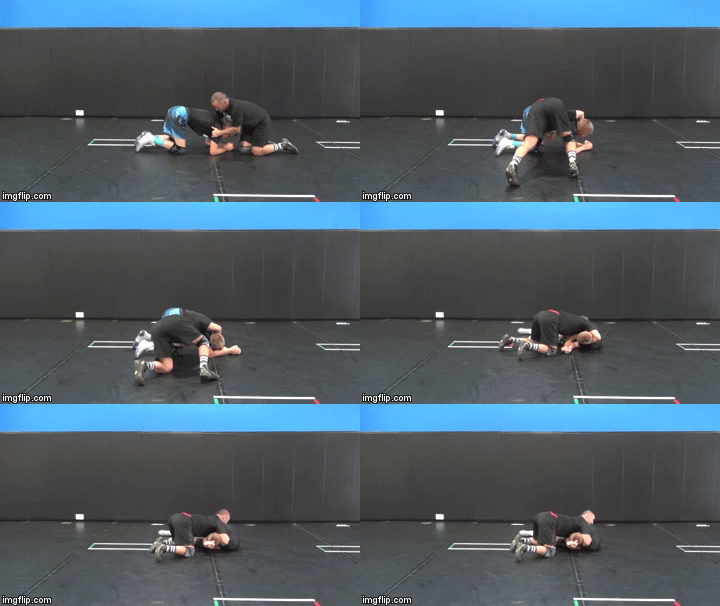
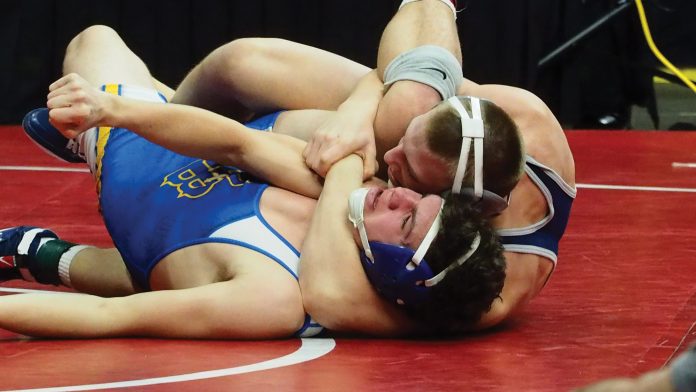
For those of you that have no idea what the wrestling cradle is, think about it this way. you take an opponent’s foot and put it all the way up to their head. Then, you wrap a headlock, including the leg in the loop. Finally, you put pressure on before you decide where to transition to next. On top of everything else, there are a few wrestling cradle positions, offering a lot of variety.

Wrestling Cradle For BJJLet’s look at two main version of the wrestling cradle. The first one is the near side cradle, where you find yourself in front of your opponent. while they’re lying on their side. imagine that an opponent turns towards you from bottom side control. That’s your starting point. From there, the aim is to place one arm around the head of the opponent, like you’re attacking a guillotine. Instead of going for a chin strap, the aim is to connect the arm to your other arm, which goes over the opponent’s top side leg at knee level. The grip that connects both hands is an S-grip. Sprawl back and enjoy your opponent’s misery.

The second version is the far side cradle.  To put it into perspective, imagine that the opponent is now turning away from you from bottom side control. WHiel this offers an avenue to the back, it is also one of the most anticipated transitions in Jiu-Jitsu. However, only a few might be expecting a cradle instead. here, the arm goes under the head in a classic style, just like with a back take. The other arm goes over the top leg again and they both meet in front of the opponent’s neck. This time, however, it is much more effective to grab a ball-in-socket grip instead of an S-grip.

Cradle For BJJ

The wrestling cradle offers to BJJ a very multidimensional appraoch. For one, it can be used from the top, to make takedowns much easier. It works great from any version of the standing front headlock, as well as many single leg attacks. Conversely, you can attack the cradle any time you find yourself in a kneeling front headlock as well.

wrestling cradle The cradle is also perfect for hunting for the back. Whenever you’re up against a turtled opponent, the easiest thing you can get is the wrestling cradle. Whether an opponent tries to turn toward you or away from you, you have a cradle ready to go. Even if they remain a Judo style turtle, blocking everything, you can set up a cradle. All it takes is pressuring the opponent to one side so that you get a push-back reaction.

The best use of the wrestling cradle for submission grappling, though, is the half guard. Whenever you find yourself in an opponent’s half guard, the cradle is right there for the taking. Simply control the top leg and go for the head. From the cradle, you can then go into pressure passing directly to mount or the back. Alternatively, you can look to finish in one of many ways you have available.

The beautiful thing about the near and far side cradle positions is that they’re easily interchangeable. You can go from one to the other at will, always keeping the opponent under constant pressure.

The Grave

Wrestling Cradle BJJThe “grave” position is the worst possible thing you can do to someone from the cradle. IT comes courtesy of a grappler by the name of Mike Tavares. You can find his complete instructional at the end of this article. As a big fan of the wrestling cradle,e I scoured the Internet for material. After discovering Mike’s instructional, my submission rate from the position skyrocketed like never before.

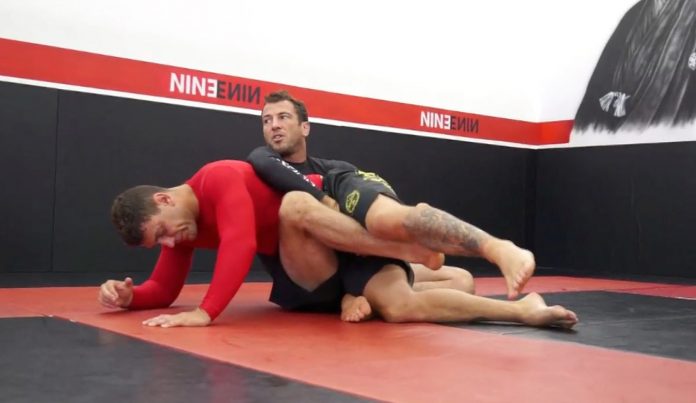
In terms of positioning, getting to the Grave is done via the far side cradle. From the basic far side wrestling cradle, you use your grip to place the arms in the opponent’s bottom side armpit. This allows you to open their arm towards their head, and insert your near side leg inside. Do the same with your other leg while you’re switching to a seated position. YOu’ll end up with both your legs on the far side of the opponent. where you need to cross the leg that’s near their head on top of the other leg. This offers both great control and a perfect attacking position.

Once in position, you have a multitude of attacks open for you. You can go for armlock attacks on both the near and far side arm. the near side arm is better for straight armlocks, with bent armlocks working for the far side arm. The choke is as simple as it gets – slams your knuckles into the near side of the neck, and pull the opposite side of their head towards the arm. Finally, you can hit anything, from heel hooks, through toe holds to Estima locks on the near side leg, without any risk fo the opponent countering.

The Hidden Secrets Of The Reverse Triangle Choke

Improving Jiu-Jitsu Drills With Ben Askren

A Few Interesting And Important BJJ Facts Of Life

“Top Game” – A Lucas Barbosa DVD Review

Lucas Barbosa DVD Top Game

Hulk Smash!!! If I had to bet, I’d say that nobody would like to go up against the Hulk in a BJJ match. On the other hand, who wouldn’t enjoy learning how to smash people from the Hulk himself? Well, not the green color barely comprehensible Marvel Hulk. I’m talking about BJJ’s very own Hulk, who just as scary as his green counterpart. Lucas Barbosa has certainly derived his scary nickname. There’s hardly anyone in grappling martial arts that scarier to be up against. Especially if you’re on the bottom. Conversely, the first Lucas Barbosa DVD is more than appropriately named “Top Game”. And we got it first to review it for you! 

Let’s put things into perspective for those that might not be too clear on who Lucas Barbosa is. If you’re expecting the BJJ Hulk to be an ultra-heavyweight, you’re in for a surprise. Barbosa is a medium-heavyweight and, arguably, the top one as well. Regardless of that, he can take down and dominate even the heaviest of grapplers. The versatility of Lucas Barbosa’s top game is evident in both gi and No-Gi, which makes him a truly difficult opponent to face. Or, a very experienced and versatile teacher to be learning from. I know that I’d choose the latter, at least for now. So, I choose the Lucas Barbosa DVD to start with.

ON SALE HERE:
Lucas Barbosa – Top Game (DVD / DIGITAL)

Lucas Barbosa DVD Top Game
Techniques List

Lucas ‘The Hulk” Barbosa

Lucas is a Brazilian Jiu-Jitsu black belt under Andre Fabiano. Fabiano himself is of the Reylson Gracie lineage, so it’s not hard to see why Barbosa has such an aggressive grappling style. Barbosa is one of the new breeds of BJJ black belts that are completely impossible to compete against.

The Brazilian started training in the Gentle Art in his native Boa Vista in Brazil. Involved in a multitude of sports since a very young age, Barbosa did everything, from basketball to swimming. At 15, he discovered grappling and fell victim to the addiction that is BJJ. His first teacher was Diego Lopes, and he switched coaches a lot until the purple belt. That is when the Hulk decided to move to Rio and become a professional full-time grappler, joining Marcio Rodrigues’ team. After he got his brown belt his career truly blossomed.

Hulk got his breakthrough in an unusual way for a grappler. Namely, he was part of a Copa Podio series, titled “The team”.  The goal of the series was to find a top-level challenger for a key event. Lucas’ performance was top notch and brought him to the pay-per-view event. From there on, he became a synonym for top game pressure.

Barbosa earned the nickname “Hulk”  when he moved to Rio. He had immense physical strength and knew how to use it to maximize his effectiveness with throws and pressure passing. In short, he smashed people in the gym, not unlike the Hulk on the TV screens. Now, all his knowledge can be found on the “Top Game” Lucas Barbosa DVD. For the physical side of things, you’ll need to hit the gym. A lot.

“Top Game” – Lucas Barbosa DVD:

To be honest, this Lucas Barbosa DVD set is unlike any other I currently own. And my collection is not a small one. The Hulk managed to release a true masterpiece, both in terms of quality of material and organization. You won’t get a comprehensive system that covers all bases, or just some random collection of techniques. You’ll get the only few tools you need to achieve two objectives – take the fight to the ground and dominate with a brutal submission-oriented top game.

Lucas Barbosa DVD Top Game
Techniques List

The key moment to note about this DVD is that it is split into two main parts. There’s a DVD for each of them. Both go over the same subject but do so in a very different fashion. The first DVD is all about Gi Jiu-Jitsu. In particular, the top game of Gi BJJ. The second one goes over the same subjects, only this time without the Gi. Conversely, the techniques vary and are not the same as those in the Gi. In both instances, he uses simple techniques that work for everyone. There are details inside to please both beginners and experienced grapplers alike.

Furthermore, each DVD is organized in a very precise and specific fashion. First up, there are takedowns that demonstrate how to get the fight to the mat. After a few options from the feet, Lucas turns to the top game essentials that will get you a pass and a submission.

The Gi Series

The first installment of the Lucas Barbosa DVD kicks things off with the Gi. The first thing Lucas goes over is the single leg. he offers a great set-up for entering into the takedown. it is by far the best way to get a single leg I’ve seen so far. Moreover, he pays special attention to his signature throw – the Seio Nage. he offers two great variations of the move, to keep your opponents guessing at all times.

Lucas Barbosa DVD Top GameAfter getting to the ground, it’s time for Hulk to truly smash. Barbosa goes over a few passes and a very cool Ezekiel choke variation. The best thing about this instructional is that Lucas, in true Hulk style, likes to start attacking from the so-called sides mash position. The passes he covers are the long step, leg drag and a couple of variations on the lasso pass. These last options are going to be useful to everyone that gets stuck in lapel guards. Even better, one of the lasso guard variations ends in the aforementioned Ezekiel choke.

This Lucas Barbosa DVD finishes with a couple of bonus moves. There are two drills that are going to take your pressure passing to the very next level. All you have to do is get the Top Game Lucas Barbosa DVD, learn the drills and put the repetitions in.

The No-Gi Series 

In the second DVD, Lucas is all about the No-Gi game. For all you No-gi only grapplers out there, this is a real must-have. Worried about leg locks while you’re passing? Time to forget all about those worries.

Lucas Barbosa DVD Top GameOnce again, Lucas goes over the essential takedowns that are going to get you to the top game. Again, the single-leg is in the focus at the beginning with a very cool footsweep variation to help you finish against someone who defends well. There’s also a takedown Lucas calls the supernova takedown. As far as ways to smash someone to the ground go, this is definitely on the top!

The No-Gi top game starts off wit ha takedown counter. Interestingly, Hulk demonstrates how to counter the single-leg takedown, and offers multiple transition options. The use of the guard that annoys everyone in no-Gi, the half guard knee shield, will definitely decline after this DVD. Hulks’ ways of passing are simply unstoppable and render the knee shield completely useless. While this DVD has no bonus mover, it contains two crucial techniques at the very end. Barbosa shows counters to the kiss of the dragon transition, along with some brutal passes.

In Conclusion

Barbosa’s DVD and Digital Instructional is really a masterpiece. The only thing that’s missing is more techniques but I guess that’s the reason why the price is also lower than usual. So, should you buy this Barbosa’s DVD or not? If you’re looking for top game instructional I would say YES, and that’s a big YES. First because of the lower price and second because Barbosa showed stuff that really works. No fooling around and no some “magic” techniques.

ON SALE HERE:
Lucas Barbosa – Top Game (DVD / DIGITAL)

Lucas Barbosa DVD Top Game
Techniques List

Octopus Guard – An Unorthodox Way Of Playing Guard

Octopus Guard

If there’s one area of BJJ where innovation never stops, it is the guard. There are literally hundreds of guard variation in BJJ that we know of at present. The variations that people across the world use and still haven’t presented to the world must be at least as much as those we know. That means that if you’re stuck with a particular guard variation, there are plenty of options for you to break through your plateau. Out of those, some include really effective closed guard variations. And, just to prove that not everything effective has to be new, we bring you an old but proven closed guard variation – the Octopus guard. 

The octopus guard is the brainchild of a veteran grappler by the name of Eduardo Telles. At first glance, it probably seems like this guard is only going to get you in trouble. As such, it is probably not a great idea for beginners to dabble with it. Well, at least not until they master some closed guard fundamentals first. The Octopus guard definitely offers something new, but it takes a bit of getting used to. That said, once you get used to it, you can be sure that your guard game is going to become the stuff of nightmares for any opponent, regardless of weight and size.

On the subject of innovative guards, be sure to check out the best explanation of the rubber guard there is. Brandon McCaghren, a 10th Planet black belt leaves no rubber guard stone unturned in his breakthrough “Rubber Guard: The Meathook” DVD set. From philosophy to setups and crazy submissions, Brandon goes over every bit of the rubber guard to give you a real edge over your opponents!

Eduardo Telles Octopus Guard

World champion Eduardo Telles is a Fabio Gurgel black belt, famous for his “weird” approach to Jiu-Jitsu. If there’s one signature move Telles is known for it is successfully fighting out of the turtle position. However, hi did not do it defensively, but chose to be there and attack from it. This is a strategy that no other grappler has used since, at least no effectively. It was this kind of efforts that gave birth to what later became known as the Eduardo Telles.

The training a partner of an in-form Terrere, Eduardo Telles had a lot of guidance and support in his Jiu-Jitsu experiments. Furthermore, he had high-level partners to try his innovation on. The Octopus guard is precisely the type of position you would expect from an unorthodox grappler like Telles. Essentially, the Octopus guard is a position right in the middle between the closed guard and a back take.

Imagine that you’ve managed to get one of your opponent’s arms across your center line from the closed guard. You might choose the arm drag, 2 on 1 or whatever method you want. The goal is to get the opponent’s both arms to the mats on one side of your torso. Once there, the logical step would be going for the back. However, instead, of doing that, you’ll simply crunch up and place your near side arm over the opponent’s back. The hips need to be as close to their hips as possible.

Getting The Guard

As you can see from the guard itself, the octopus guard is a very potent attacking position. It is really really simple, yet not suited for beginners. The reason for this is that you need a certain amount of guard awareness to be able to get into and maintain the guard. However, once you’re down with that, attacking becomes a breeze, especially sweeping.

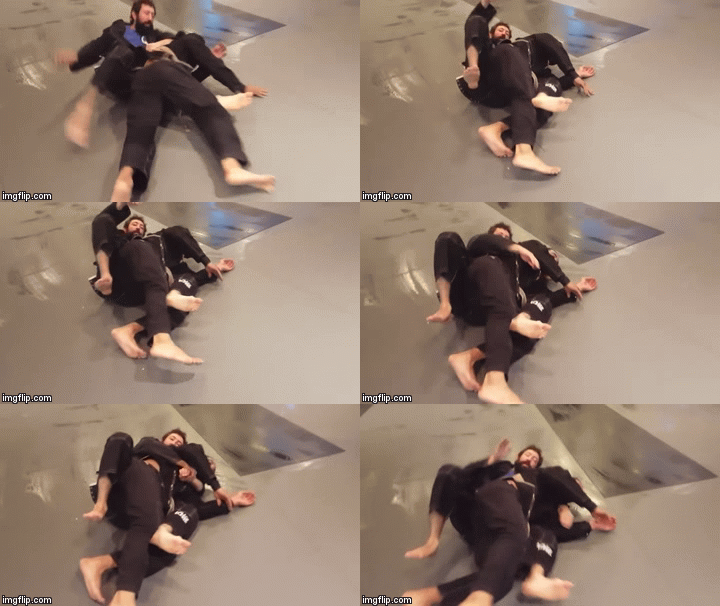
Octopus GuardThat said, the most important part of the Octopus guard is actually entering into the position. One great way of entering into the Octopus guard is by getting a 2 on 1 grip from the closed guard. Try to push the writ towards the opponent’s belly, while looking to pull their elbow towards you. This makes the position extremely difficult to escape, it also opens up a clear path to their back. A simple switch of the elbow to the opposite side of your center line and crunch up and you’re in the octopus guard.

Octopus GuardAnother great way to get the position is through a Kimura. When you go for a Kimura from the closed guard, the only option your opponent has is to bend the elbow towards their body. Whenever they do this, you’ll want to transfer their forearm over and behind your head. Swim your other arm through and you’ll be ready to play the octopus guard right away.
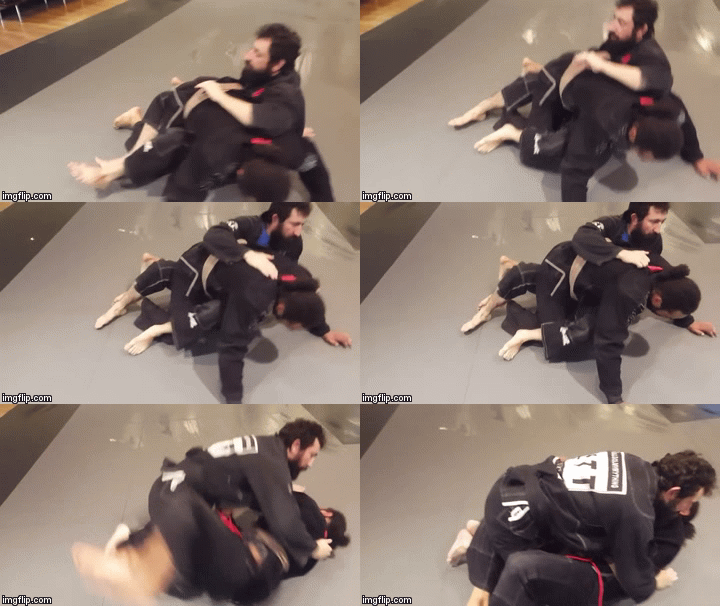
Sweeping Attacks

Octopus Guard sweepOnce you have the octopus guard, attacks are going to come instinctively to you. Still, the best option to go for sweeps. the position makes sweeping a real breeze, as you already have your opponent’s posture. In order to take away their base, the simplest thing to do is go for a sit-up sweep. Unlike a regular sit-up sweep, though, you have a much better position here. All you want to do is grip firmly over and on the other side of the opponent’s torso, and lift your hips, pushing to that same side. You’ll finish in the mount, ready to go for attacks immediately.

Octopus GuardAnother option to sweep is choosing the opposite direction. If an opponent manages to post an arm to prevent the sit-up sweep, you can switch directions with ease. Simply do a hip escape to open up your hips towards the other side. From there you’ll go for the same motion as before. Lift your hips, and topple the opponent over the shin of your far side leg. Once again, a great mount position to work from.

Transition Attacks

Octopus Guard transitions As far as going into a better position than the octopus guard, you have just about every option open. For now, we’ll focus on two that are truly readily available. the first one is the most obvious one – the back mount. When you’re in the octopus guard, you’re more than halfway to the back. All you need is a simple modification. Now, while going up is a viable thing to do, it’s better to stay on the ground. Simply use your far side leg to help you hip escape, while you use your opposite side arm to establish control over the shoulders. the opponent’s hips are going to “fall” into your hooks, and the seatbelt is just a move away.

 Octopus GuardGoing in a more unorthodox direction, you can always hunt for a truck entry from the octopus guard. there’s even side control along the way. First, use a sweep to get on top, but make sure you go into twister side control instead of mount. This gives you access to their top leg, which means you can twister roll straight to the truck. Anything, from crotch rippers to the twister is available from there. Oh, and another backtake, of course.

Submission Attacks

Octopus Guard Kimura LockFinally, the best way to attack from any position in grappling – submissions. As far as those go, there are plenty of opportunities form the octopus guard. One very clear option is a Kimura. The most common reaction you’re going to face from an opponent is the attempt to get an arm back in and across your body. In certain cases, you won’t be able to prevent it. While this move effectively gets you out of the octopus guard, it lands you in a kimura position straight away. It is as easy as getting the figure four grip in and falling to your back. From there, the most basic kimura setup applies. Or, you can use the kimura to re-enter into the guard.

Octopus GuardA very cool way to finish a match is hitting a calf slicer straight from the octopus guard. You’ll need to work a bit and transition into an octopus half guard, though. To do that, simply place one of your legs in between the opponent’s legs. Look to place the foot of that leg outside and ram your shin as close as you can into the back of their knee. Now, go to your back and lock your legs ina triangle, use both your arms to pull on.

The Hidden Secrets Of The Reverse Triangle Choke

Submissions From Guard: The Holy Trinity

The Basic Principles Of Attacking From The X-Guard

The Three Stages Of A Successful Submission Defense

Submission Defense: The Three Stage Concept

Submissions are the most satisfying way of winning in grappling. They are actually the ultimate way of victory in any sort of combat sports. Take MMA for example. It takes much more effort and risk to manage a knockout victory. Even under the best of circumstances, you ‘re not guaranteed you’re going to get it. Submissions, on the other hand, leave no doubt as to who was the better fighter. There are no lucky shots with submissions, which makes them notoriously difficult to work against. Submission defense is a huge part of Jiu-Jitsu and one that people should focus on much more than submissions themselves. Тhere’s a technical way of approaching submission defense, and there’s a conceptual one. 

In today’s grappling scene, it is redundant to go into a long-winded explanation of why a conceptual approach is better than the other option of using techniques only. Concepts allow you to get through any positional or technical threat or problem by utilizing some common principles that work universally. Of course, using technique is paramount, but only if you first find a correct context to apply it in. That is exactly where concepts come in, and there’s hardly a more important aspect to use them in than submission defense. That said, submission defense tactics can go in many different directions, depending on lots of things. Today, we’ll focus on two main concepts that will get you out of tough spots in rolling and competition.

For a true in-depth guide about dealing with submissions, there’s n need to look further than just one single DVD instructional. Tom DeBlass has a 4 DVD set that focuses on one thing only: Submission Escapes. Check out this awesome instructional and learn what has kept Tom safe from submissions in the last 17 years!

Submission Defense Concepts – Hierarchy

The thing with submissions is that defending and escaping them doesn’t really work the same as escaping positions. Namely, a solid placed submission carries multiple threats. Just like with positions, you need to address the problem of the inferior position you’re in. However, the submission also carries the added risk of transition, in case it’s not securely in place. Of course, there is also the threat of the submission itself, which should be the most obvious problem.

Submission Defense ConceptsWhat people usually get wrong is that they focus too much on a position escape, leaving enough space for one of the two other threats to materialize. A good example is a triangle. People get so caught up at getting their head out that the leave the arm in there for the taking. There’s also the threat of an Omoplata whenever you decide to turn away, as correct as that might be. The problem here is not addressing the most important problem first.
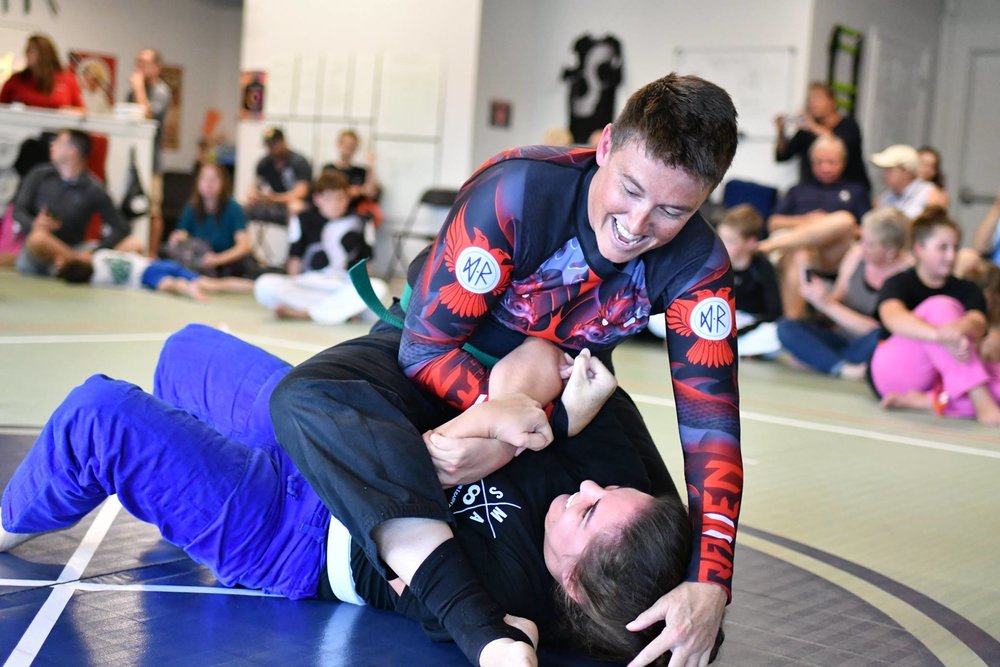
The hierarchy concept is, in essence, the action of addressing the most dangerous threat first. With submission defense, this means making sure you focus on preventing the submission itself. Forget about positions and points, unless you manage to fight off the choke or joint lock it won’t matter anyway. So, direct submission defense is the first thing you need to do. We’ll get into the specifics of this with the next principle. For now, remember the basic hierarchy – address submissions first, follow-ups second, and positional escapes last.

Submission Defense Concepts – The Three Stage Principle

This is the concept that will make the hierarchy concept make a lot more sense. Every submission has three stages when you look at it from an attacking standpoint. First, you want to enter into position to execute a submission. Next, you’ll be looking to solidify that position, so the opponent has no option to escape. Finally, you’ll get into the submission itself, putting the final details in place. Well, if you reverse engineer this, you get the three stages at which you need to apply your submission defense.

Submission Defense Concepts The first stage in any successful submission defense is prevention. Looking to prevent your opponent from even establishing a position is the most high-percentage submission defense you have at your disposal. We all know that fora rear naked choke, the opponent must have your back. Or, for a leg lock, they need a good Ashi Garami. No position means no way of attacking a submission with any chance of success.
Next up, it is the position itself. However, here’s where the hierarchy concept also ties in. If the opponent managed to start placing grips in immediately after acquiring position, you’re probably too late. You can address a position if you fail to prevent the entry. However, do not dwell on defending a position if the opponent is too fast to start working directly on a submission.

Which brings us to the last stage. If you mess this one up, all you’re left with is a tap. Last ditch submission defense means you have to do it all in reverse. Dealing with the submission attempt is now a top priority. Only then can you work back at deconstructing the position, and finally, getting out of it completely.

Practical Examples 

Let’s look at a couple of very specific examples that include both these submission defense concepts. The first one is going to be from a submission that is extremely popular at the moment – the inside heel hook from the 4/11 position. Let’s say you’re in quarter guard or even half guard. If you notice that your opponent is stepping back, make sure you never allow them to place one of your legs in between theirs. This is the first stage of submission defense – prevention. Hierarchically speaking, you want to prevent submission first, and worry about losing points second.

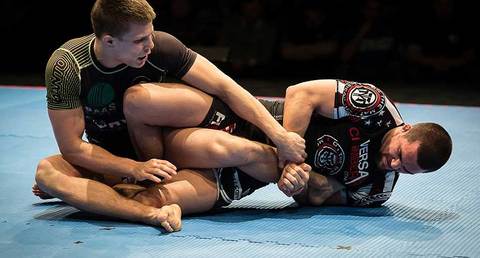
Submission Defense Heel HookIf you fail at preventing the entry, though, you’ll need to make sure the opponent doesn’t settle in the position. Clearing teh knee line is now your one main prerogative. Once you do it, though, make sure you improve on prevention and stop the opponent from re-entering. If you’re too late with this as well, all you’re left with is grip fighting. You absolutely have to win the grip fight, if you’re to ahve any hope of getting out of the 4/11. Looking to disentangle the legs instead of addressing the grips is a great way of giving away a free heel hook.
Another great example is the rear naked choke. People get so obsessed with having their backs taken that they forget all about the choke. If there’s a seatbelt grip or any kind of an arm across your neck, this should be your main focus! Here, you’re deep in stage three and need to address the most dangerous threat first! Only then can you look to slowly wiggle out of back control, and ultimately, free yourself completely.


Knee Bar Escapes And Key Defense Principles

Neil Melanson DVD Collection – A Submission Heaven

Two Easy North-South Escapes And A Cool Counter

REVIEW: No-Gi Pressure Passing DVD By Bernardo Faria

Review No-Gi Pressure Passing DVD Bernardo Faria

Passing the guard is a very demanding task in BJJ. As simple as it may seem, getting past someone’s legs is not an easy thing to accomplish. And this is with all the anchors and grips that Gi Jiu-Jitsu offers. In No-GI, the difficulty increases tenfold. Without a Gi, eve with spats and rashguards, grappling becomes a lot more slippery. On top of that, the opportunities for control are also greatly reduced. This shortens the list of successful passing techniques that you can use in No-Gi. That said, some passing concepts, like pressure passing, are more than enough to do the trick. Especially when the undisputed expert in the field, Bernardo Faria is explaining them. Finally, after all, his Gi BJJ instructional, Faria released a No-Gi Pressure Passing DVD.

ON SALE HERE:
No-Gi Pressure Passing DVD By Bernardo Faria (DVD / DIGITAL)

Review No-Gi Pressure Passing DVD Bernardo Faria
Techniques List

In general, passing the guard, Gi or No-GI can be done in one of four general directions. One is going through the legs, like passing with a knee cut pass. Another is going under the legs, like the double and single underhook pass. The third option requires you to go around the legs, with theTorreando and leg drag being the most notable representatives. Finally, you can take the acrobatic route and go over the legs, via a cartwheel passes or flips. All of them have their merit, but not all are applicable across the board. As the name suggests, Bernardo’s latest No-Gi Pressure Passing DVD focuses on pressure passing, which usually includes a combination of passes through and under the legs.

It is no secret that the over-under pass is Bernardo’s personal favorite. What you can expect from the No-Gi Pressure Passing DVD is a lot of focus on this pass and all possible variation. However, rest assured that Faria offers much more than just one passing sequence.

The World’s Premier Pressure Passer

If there’s one thing you should know about Bernardo Faria, it is that he is as well rounded as grapplers come. The 31-year-old is a 5 times World champ0ion with a very recognizable BJJ style. Despite his overall deep knowledge of Jiu-Jitsu, Faria has a few positions that he prefers above all others. Form the bottom, his signature position is the deep half guard. Its top position counterpart is the pressure passing staple, the over/under pass.

Why should you consider getting the No-Gi Pressure Passing DVD? Well, if you do not already own the pressure passing encyclopedia DVD by Faria, let me paint you a picture. In Bernardo Faria, you have what’s arguably the world’s absolute best passer. Why do I single him out? Because for Faria’s passes, weight divisions or opponent’s experiences make absolutely no difference. Fighting out of the Heavyweight / Super-Heavyweight divisions, Faria has passed the guard of every opponent that has stood against him. These include big names like Gabriel Barges, Leandro Lo, Raphael Lovato, Erberth Santos, and many others.

Faria’s passing skills are undoubtedly world-class, but the true value of his system lies in its principles. Faria knows everything there is about the over/under pass, and is a great teacher on top of it. When you listen to Bernardo deconstruct his methods of passing the guard, you’ll never struggle with it ever again. Of course, if you want to truly become unstoppable get both the No-Gi Pressure Passing DVD by Faria and its Gi counterpart, The Pressure Passing Encyclopedia DVD.

Bernardo Faria’s No-Gi Pressure Passing DVD – REVIEW

Strong production, impeccable presentation, thorough explanation, and top-shelf quality. That is what we’ve always got from Bernardo Faria in the pat. You can’t blame us for expecting the same out of the “No-Gi Pressure Passing” DVD. Well, we got all that, and then some. Four DVDs come in this set, organized better than anything we’ve seen before. Even the way the material is presented is layered very carefully and methodically.

Despite the title, there are no actual passes before the final DVD. Which, truth be said, is a positive thing. Faria takes the methodical route, building upon the very foundations of passing the guard without the Gi. From the introduction, through basic mechanics, prevention of counters and even re-counters, to attacks and passes, there’s a very clear path through this DVD instructional. A simple must-have for everyone, even those that never actually roll in No-Gi.

#1 Getting To The Position

If there’s anything you need to pay very close attention to, it is the first few chapters of the very first volume of this DVD. The introduction in itself is so full of crucial information, you’ll rewind it at least a few times before going forward. It is, however, the key if you really want to become at least a portion of the passer Bernardo Faia is.

Right after the introduction is the portion that for me, is the real game changer. This is where Bernardo maks up for the lack of control due to the absence of the Gi. The place of the shoulder and pivoting around it is the most important bit of the mechanics of the over/under pressure pass. These three chapters conclude the introductory portion of the No-Gi Pressure Passing DVD.

Following suit in the first volume, are entries into passing positions. To say the least, this is where things get interesting. Entries are not complicated, but Faria does provide half a dozen options of entering, all from different positions. Entries originate from everywhere, ranging from guard pulls, through open guards, all the way to the half guard. There is no guard powerful enough to prevent Faria’s pressure pass. In today’s leglock heavy BJJ game, a key component is passing the butterfly guard. If there’s one person that can teach you how it is Bernardo.

#2 Preventing Counters From The Bottom

If there’s one thing that is more annoying than not being able to pass a guard, it is getting past the legs only to end up back in the guard. This is a very common mistake most people make, and not just beginners. It is hard for grapplers to master the position that comes in between getting past the legs and establishing a solid controlling position.

The second volume of the No-Gi Pressure Passing DVD is all about troubleshooting. Here, you learn how to deal with the most common (and some uncommon) reactions that your opponents are going to have to your pass attempts. For example, a very often seen reaction is a hip escape just after you pass the legs. This opens up ample space for an opponent to re-guard. Not with Faria’s passing system. Regardless if it is a hip escape, strong man defense like a bench press or even a submission counter, nothing is going to work for your opponents any longer.

#3 Defending And Attacking

Prevention and troubleshooting spill slightly into the third volume, before taking a key turn. here, Bernardo goes into the nuances of setting yourself into the over/under pressure pass. This is akin to guard retention when you’re the one on the bottom. We could even go as far as calling it to pass retention.

Faria No-Gi Pressure Passing DVD ReviewOnce you enter into the over/under position and manage to prevent any early escapes and counters, you’ll need to solidify the position before passing. While there are some clear and present dangers here, there are also some options for you. Like abandoning the pass completely and hitting a crazy effective kneebar. Apart from that, it is all about staying safe from guillotine attempts and looking to place the pressure.

The pressure is the true game-changer here. Once you manage to elicit pressure upon your opponent, the position really sets in. After all, it is a pressure passing DVD! Pressure opens up plenty of opportunities apart from passing as well like back takes and more leg lock submissions.

#4 Passes, Passes And More Passes

Finally, the bread and butter of the No-Gi Pressure Passing DVD – the passes themselves. All of you expecting this to be just an overly elaborate over/under pass instructional are in for a surprise. In the final (and longest) volume of this instructional, Farai goes over no less than 15 passing sequences. These feature examples of passing using the Torreando, double under and double over passes, half guard pressure passes and even jump over passes.

As far as uniqueness goes, Faria manages to introduce pressure passing in all guard passing directions we mentioned at the beginning of this article. Regardless of the direction you choose, you can establish a pressure pass that’ll make your opponents beg for you to pass and release the pressure. As far as No-Gi control goes, you can hardly have anything more stable than Faria’s pressure passing system.

A recommendation for you is to check out the folding passes portion of this part of the instructional. You’ll learn a couple of different ways to utilize folding, as well as discover new ways of making your opponents miserable.

ON SALE HERE:
No-Gi Pressure Passing DVD By Bernardo Faria (DVD / DIGITAL)

Review No-Gi Pressure Passing DVD Bernardo Faria
Techniques List

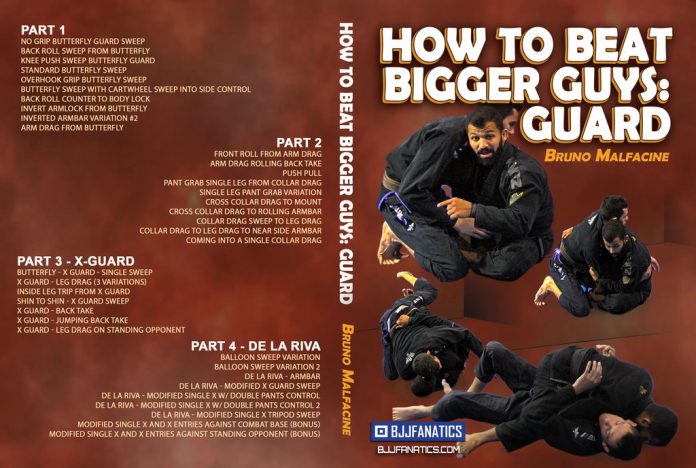
Bruno Malfacine DVD: How To Beat Bigger Guys: Guard

Bruno Malfacine DVD How to Beat Bigger Guys: Guard

There are world-class BJJ competitors out there, and then, there are legends. Some are already BJJ hall-of-fame mainstays, despite just recently ending their competitive careers. Others, however, are breaking all records and getting through every challenge at an unbelievable rate. They’re writing BJJ history as they go, and they’re not even in their prime yet! One such grappler that’s setting the world of Jiu-Jitsu alight is Bruno Malfacine. As such, the rooster-weight is as formidable as he is small. Explosive, lighting fast and skilled beyond comprehension, people are waiting for a chance to learn from Bruno Malfacine. Well, now you can, courtesy of a brand new  Bruno Malfacine DVD.

ON SALE:
Bruno Malfacine How To Beat Bigger Guys (DVD/DIGITAL)

Bruno Malfacine DVD How to Beat Bigger Guys: Guard
Techniques List

Anyone in the BJJ community is going to jump at the opportunity to train with a world champion. Most people that are not professional grapplers, white to black belt, rarely receive the chance to train and learn from world-class talents. Bruno Malfacine is one of those grapplers that probably have very little time to dedicate to everyone that would like to train with him. Apart from privates and/or seminars, you’re unlikely to get quality time with such a proficient and active grappler. the best course of action is to grab a video instructional, any video instructional by the best of the best. Like a Bruno Malfacine DVD.

A Bruno Malfacine DVD guarantees top-level instructions without the hassle of scheduling privates/seminars and at a fraction of the price. Malfacine can explain things as good as he can compete, which is a statement in itself. Here, at BJJ-world.com we did a review of the very first Bruno Malfacine DVD so you can have a sneak peek before you get it!

Bruno Malfacine Bio

Bruno Malfacine dvdWho exactly is Bruno Malfacine? Most people actually know very little about him, apart from his impressive performances at the highest levels of the sport. Well, there’s a lot more to Bruno than meets the eye. A Bruno Malfacine DVD is now a reality, but the best rooster-weight in the world almost gave up BJJ at one point.

Bruno Malfacine was born in 1986 in Duque de Caxias, Brazil. Malfacine had the good fortune of starting BJJ at the fairly young age of 11. He was a lively child, always scrapping, which earned him his nickname “Bad Boy”. AS he went through the kids’ ranks of Jiu-Jitsu, he hit a stumbling block at the orange belt. He couldn’t train with his childhood instructor so he almost gave up. The enthusiasm of his family got him to Vinicius Amaral, a Carlson Gracie black belt, who turned out to be just what Bruno needed. Under Amaral, Bruno got all his adult belts, including his black belt.

About a decade ago, Bruno got the chance to start training at Alliance. Training under the legendary Fabio Gurgel proved to be the right thing for Bruno’s career. Since then, he has dominated the world of BJJ, particularly in the lighter weight divisions.

Competition Career

As a competitor, Bruno has one of the most impressive records in the sport. He has 63 wins so far, 40 of which are via submissions. Conversely, he has only 9 loses, with just one of those being via a tap. A world champion at purple, brown and black belt, he recently broke a major IBJJF record.

Bruno Malfacine DVD
Click For Full Video

Namely, the 32-year-old just recently conquered his division once again, at the 2018 IBJJF Worlds. Nothing out of the ordinary, if you ask Bruno. However, his last victory brought him historic successes. Bruno just set a new milestone as he became the first-ever grappler to win the Worlds 10 times! Not only that, but he did so in a very impressive manner. Malfacine submitted the highly skilled Rodnei Barbosa via submission in the finals. Now looking to transition into MMA (already with a 3-0 professional record) Malfacine leaves the BJJ world with the ultimate parting gift – A Bruno Malfacine DVD.

Caio Terra’s main rival managed to lose the world title just twice so far, both times at the hands of Terra. Still, without 2008 and 2013, Malfacine got a staggering 10 world titles, after first breaking the duck in 2007. Another staggering statistic is the fact that he closed out his division at the 2018 Worlds with a 100% finishing rate. As far as submission masters go, Bruno tops all charts, regardless of weight.

Master Of the Flow

If there’s one recognizable trait of Malfacine’s grappling style, apart from lots of submissions, it is flow. The Brazilian manages to flow like he is rolling light even when he’s battling world-class opponents. His movement makes him extremely hard to pin, and virtually impossible to submit. That’s exactly the guy you’d like to be learning techniques from. Especially if you’re a lighter weight competitor.

Bruno is known for training Jiu-Jitsu three times a day at the Alliance Orlando Academy. Conveniently, he has Fabio Gurgel, and a host of other top grapplers there to provide him a challenge in training. Malfacine is also a huge proponent of drilling, which seems to be a common thread amongst lighter weight competitors. On top of training BJJ, he also works on his strength and conditioning twice a week, mostly via Crossfit training methods. Bruno also likes to do camps where he brings other top-level grapplers or goes to visit them, right before a big competition.

You can see why Bruno has no difficulty in applying his Jiu-Jitsu while he flows. After all, 7+ hours of hard training each day are surely going to sharpen anyone’s technique. A huge thing that he does, is focused on sleep and recovery after such grueling sessions. With such a crazy schedule, we’re lucky that he managed to release this Bruno Malfacine DVD!

Bruno Malfacine DVD Review – “How To Beat Bigger Guys: Guard”

Finally, down to the meat and potatoes of the Bruno Malfacine DVD “How To Beat Bigger Guys: Guard”. Who is this release intended for? Speaking of belts, grapplers of all levels will benefit greatly from this Bruno Malfacine DVD. In terms of weight classes, again, the DVD works for everyone but will be particularly useful to smaller grapplers. Bruno is a master of avoiding pressure, even when he’s up against stronger and bigger opponents. This is exactly the focus of his DVD.

Bruno Malfacine DVD
Click to Check Free Technique by Bruno Malfacine

Bruno’s favorite guard variation is the butterfly guard. He uses it to perfection, especially in terms of creating space. YOu’ll notice that there’s a whole volume dedicated to this guard variation. Malfacine’s specialty is space and disrupting the balance. He never lets an opponent put weight on him, regardless of size. To that extent, he uses the butterfly guard to create and retain space. His favorite means of off-balancing an opponent is via an arm drags, which he also covers in his instructional. This very simple concept is all it takes to stay safe while switching into your attacking game. And it’s all laid out as a simple blueprint in the Bruno Malfacine DVD.

Part #1 – Butterfly Guard 

As we already saw, Bruno is a huge fan of the butterfly guard. He kicks thing s off right away with a very unique sweep that totally changed my game. It is a no grips butterfly sweep which is going to work every time since your opponents won’t be expecting you to sweep without grips. Options for sweeping include sweeps in every direction, leaving no chance for your opponents to resist. The cartwheel sweep is nothing less than a thing of beauty.

The second portion of the first volume of this inaugural Bruno Malfacine DVD switches attention to submission attacks from the butterfly guard. The overhook grip Bruno likes to employ is a nice refreshment from the usual underhook game. Inverted armlocks are obviously Malfacine’s primary attack options, and they work like a charm. The inevitable signature move arm drag is also there, to wrap things up.

Part #2 – Arm Drags & Collar Guard

Speaking of arm drags, they also get their own slot in the “How To Beat Bigger Guys: Guard” Bruno Malfacine DVD. Bruno doesn’t just end things with the regular warm drag, and he offers innovative ways of attacking, as the front roll arm drag. there’s also a cool twist on the well known back take from the arm drag.

The second volume of the instructional has most of its time dedicated to the collar guard. For all people that enjoy working with Gi based guards out there, this is a must. People like Kron Gracie and Leandro Lo have already had immense success with this guard variation. Now, Bruno gives it a completely new dimension. He excels at the collar drag, using bigger opponents’ weight against them. You’ll learn innovative ways of collar dragging yourself to sweeps, leg drags, the mount as well as a couple of armbar options.

Part #3 – The X-Guard

Everyone’s favorite open guard variation, the X-guard is one of those guards that have been immensely exploited throughout the years. Even today, it is a huge part of most people’s games, especially those that are fans of leg locks. Bruno offers a great system to incorporate some X-guard variation that’ll catch most people off guard.

One key transition is getting into the X-Guard from the butterfly guard. Bruno goes over his take on it, by using the X-guard to transition from the butterfly guard to a 100 % effective sweep. There are also key leg drag transitions as well as lighting fastback attacks. One of them actually includes jumping straight onto your opponent’s back from the x-guard. And that’s not even the craziest part – Bruno knows how to leg drag a standing opponent, and you’ll learn it too after watching this Bruno Malfacine DVD.

Part #4 – De La Riva Guard Attacks

Finally, Bruno goes over some BJJ classics at the end. He offers a real De La Riva masterclass, yet with a unique twist as usual. The balloon sweep is the starting point, spinning off into stuff like modified x guard sweeps and armbars. One really cool variation is the hybrid De La Riva / Single Leg X guard variation with a double pants grip. Believe me, even higher ranked grapplers won’t know what hit them with this one.

A few bonus techniques wrap this amazing DVD up. here, you’ll discover a few ways to deal with opponents that change levels. While using the De La Riva against standing opponents it more or less regular, people in combat base usually pose a threat to the guard. Not anymore, thanks to the efforts of Bruno Malfacine!

ON SALE:
Bruno Malfacine How To Beat Bigger Guys (DVD/DIGITAL)

Bruno Malfacine DVD How to Beat Bigger Guys: Guard
Techniques List

Connor McGregor Very Honestly Breaks Down His Fight Vs Khabib Nurmagomedov

Conor Mcgregor Lost to Khabib Nurmagomedov pretty bad. Khabib was dominating all rounds tossing McGregor around and even outboxing him. That’s probably the reason why Conor wasn’t talking a lot about this fight. Maybe he was too busy traveling around the world promoting his “Proper Twelve” Whiskey

But, Conor McGregor Breaks the silence as he posted a very honest round-by-round breakdown of the fight. on his Instagram profile. He explained his major mistakes and took full responsibility for his loss. He even said that he’s ok with not getting a rematch immediately.
Is it maybe because he needs more time to prepare for Khabib? The time will tell.

Here is McGregors Full message:

“Thoughts on my last fight. 
Round 1. I believe from a sports standpoint, round 1 was his. Top position against the fence. Zero position advancement or damage inflicted. But the top position.
From a fight standpoint, the first round is mine. 
Actual shots landed and a willingness to engage. Straight left early. Knee to the head on the low shot. Elbows in any and all tie up scenarios. The opponent just holding the legs against the fence for almost the entire round. 
Round 2 he is running away around the cage before being blessed with a right hand that changed the course of the round, and the fight. 
It was a nice shot. 
After the shot, I bounced back up to engage instantly, but again he dipped under to disengage. That is the sport and it was a smart move that led to a dominant round, so no issue. Well played.
If I stay switched on and give his stand up even a little more respect, that right hand never gets close and we are talking completely different now.
I gave his upright fighting no respect in preparation. No specific stand up spars whatsoever. 
Attacking grapplers/wrestlers only.
That won’t happen again. 
I also gave my attacking grappling no respect. To defense minded. 
Lessons. 
Listen to nobody but yourself on your skill set. 
You are the master of your own universe. 
I am the master of this. 
I must take my own advice. 
Round 3. After the worst round of my fighting career, I come back and win this round. Again walking forward, walking him down, and willing to engage.
Round 4. My recovery was not where it could have been here. 
That is my fault. 
Although winning the early exchanges in 4, he dips under again and I end up in a bad position with over 3 on the clock. I work to regain position and end up upright, with my back to the fence. 
A stable position. 
Here, however, I made a critical error of abandoning my overhook at this crucial time, exposing the back, and I end up beaten fair and square. 
What can I say? 
It was a great fight and it was my pleasure. 
I will be back with my confidence high. 
Fully prepared.
If it is not the rematch right away, no problem. 
I will face the next in line.
It’s all me always, anyway.
See you soon my fighting fans I love you all ❤”

Well as you can see McGregor is pretty honest and, we can say, pretty humble in his breakdown. That’s something we’re not used to seeing from him. Obviously, good beating can make anyone humble 🙂

We won’t fool ourselves as in his next fight we’ll see the same notorious McGregor as we could see him before, but it’s nice to read something like this from him from time to time.

Escaping The Inescapable: Estima Lock Defense

Estima Lock Defense

Plenty of BJJ submissions have the potential to be truly devastating. However, it’s those “blitz” moves that usually result in the most damage. The thing is that most of these moves are rarely accompanied by a high degree of control, meaning injuries are not a given. Regardless, here are the few exceptions that can cripple you and your BJJ career. These are the moves that are surprising, work in a flash and leave no space for escapes or counters. Tap or snap is all your left with, and if you hesitate you might even end up too late to tap. Luckily, not many moves feet this exact description. Of those that do, though, one is a real contender for the undisputed inescapable move in Jiu-Jitsu. It is the dreaded Estima lock, the move which you can’t get out of. Up until now. We bring you a couple of Estima lock defense ideas to keep you safe and rolling!

The infective spread of the leg lock game means most people today are aware of the main dangers of these submission holds. In most instances, people know what to expect from any of the Ashi Garami variations. Calf slicer,s especially from the Truck position are still quite a gray area, despite being legal under IBJJF rules. However, blitz-style leg locks are nowhere to be seen in the modern leg locking game. It is all about control and slow methodical work. So, when somebody throws in a surprise blitz leg lock that is extremely painful and tight, you need to be ready. Especially when that move is legal for all levels of adult and master grapplers. To be honest there is not much out there on the subject of Estima Lock defense. The submission is so fast that even tapping out in time can be a problem. However, there are solutions.

The thing to remember with the Estima lock is that it works from a multitude of positions. Probably the biggest problem is that you can’t see it coming. There’s no elaborate setup, nor complicated games to bait you into position. In most cases, you’ll end up opening the attack fro your opponents yourself, not even knowing where you went wrong. This is precisely the spot where you need to focus your Estima lock defense strategy. Understand the lock so you do not give it away for free. Next up are the usual steps in escaping submissions- prevention, a last-ditch defense and tapping out. Yes, tapping does qualify as a defensive move.

What is the Estima Lock?

The Estima lock is the brainchild of a pair of BJJ’s most famous brothers. Braulio and Victor Estima are legends of the sport. Both are highly rated black belts that fight and teach under the Gracie Barra banner. They both have contributed to the spot immensely, in plenty of technical aspects. However, there’s one move that is probably the move of their careers – the Estima lock.

It was Victor who actually came up with the move by accident, during an ADCC training camp. Braulio, who has a wicked guard game ended up with a foot stuck on Victors hip/belly. His brother just slapped a figure four grip out of habit but ended up with as devastating a foot lock as there is in all of grappling martial arts. Further experimentation led to the move that brought Braulio an ADCC title.

Estima LockThe Estima lock is quite simple from a mechanical standpoint. The basic set up is against an open or half guard. The moment your opponent places the outer edge of their foot on your belly, you’re ready to submit them. One of your arms goes around and the other locks it in place via a figure four grip. From there you take space away by crouching and you finish by turning towards space in between your opponent’s legs.

Primary Estima Lock Defense: Prevention

As you can see, there’s not much to the Estima lock as a move. The trouble is that the figure four grip sticks your foot to their torso. besides the huge power of the torso, the position of the foot is a very awkward one resulting in an exceptionally painful submission. Which is where the first layer of Estima Lock defense comes in.

As with every defense in Jiu-Jitsu, and especially leg lock escapes, you need to make sure you’re never actually in trouble. A key problem is that the Estima is available against most open guard variations. If you can’t use your favorite guard(s) you won’t be able to apply your A game. The first way around is the angle of your foot. If you keep your fingers to the outside, much like with a single leg X guard, you can safely venture into Estima lock territory.

The second key aspect is the grip. For the submission to work the opponent needs to turn into you. While this is leaving it late somewhat, stripping off the near side arm is going to allow for space to wiggle your foot out of danger. The key is to hunt for that arm the moment you notice the grip setting into place. If you reach for the arm after the opponent turns, it will be to tap out. Instead, look to engage one arm if you can. Whenever you think about working from the open guard, rely on a sleeve or writ grip on one arm. There’s no Estima lock without the figure four.

Secondary Estima Lock Defense: A Last-Ditch Effort

This is where things really heat up. This is the one Estima lock defense that can safely get you out of trouble. Thre’s only one catch – you need to time it absolutely right. The principle of this defense is based on the ground rules for defending a toe hold. Since the Estima lock works pretty much like a toe hold, the same principle applies. IN order to relieve pressure off a toe hold, you need to turn in the direction of the force your opponent is applying.

Estima Lock Defense spinThis is the essence of this Estima lock defense. When your opponent goes for the lock, you have to immediately turn towards the opposite side of the trapped leg. The goal is to go for an inversion, but you must not stop where usual inversions do. Instead of simply inverting you’ll need to do a full circle on your back. If you remain inverted, the lock can still work, so you need to complete a full 360. However, remain wary of timing. If you start turning too late, your opponent can simply drop abase and you’ll be stuck for good. So, learn to recognize the Estima lock dangers and use prevention first and foremost. If you see the grip coming together, go for the roll under to relieve pressure and immediately look to grip an arm.

Since most people think they know and understand Ashi Garami and leg locks, it is time to throw them a curve ball. Check out the “Ashi Garami Seminar” DVD by the man who caught everybody by surprise, Eddie Cummings. “The Wolverine” does not only offer you key leg locking tips but also defensive concepts to escape even the most dreaded positions in Jiu-Jitsu. Get it while it is on sale! 

The Tap Out Defense

If you pass the point of no return of the Estima lock, which is the moment your opponent settles into base after turning their torso, you have just one option left for a defense. It is the one defense that universally works 100% of the time. COnsider tapping out as a defense instead of a defeat and you’ll discover a whole new level to Jiu-Jitsu. Plus, you’ll keep your feet together to train more and try a different defense.

The 9 Best Leg Lock DVD Instructionals For Grapplers

The Kneebar to Toe Hold and Vice Versa

The BJJ Ankle Lock – A Detailed Guide For Every Position

Craig Jones – Down Under Leg Attacks

Crucifix Defense – Surviving The Worst in BJJ

Crucifix Defense OPtions

If you asked me which position in really deeply hate defending against I’d have to say it was back control. Having someone behind you makes finding ways out that more difficult. Even leg locks are easier to deal with than having a human backpack trying to strangle you from behind. To this day, I do not particularly enjoy getting out of back control, so I try to prevent it the best I can. That said, there’s one back control variation that I’d bet most grapplers utterly hate. At least when they’re on the receiving end. Back control defense is not easy, and crucifix defense is even harder. In fact, getting out of the crucifix position might be the greatest Houdini act in Jiu-Jitsu! Now, it’s time for you to learn how to perform it!

If you take a look at some of the world’s most proficient grapplers, you’ll easily notice a common pattern. Marcelo Garcia, Felipe Pena, Cobrinha etc, all have the tendency to hunt for the back. Back control does bring an immense amount of control along with direct submission options. In fact, it also brings 4 points in most competition formats, which is the most you can get from a single position. Escaping is hard, even when you’re in the basic seatbelt and hooks control. Crucifix defense is a whole different can of worms, but it is absolutely necessary for you to know at least one.

Why should you be so focused on learning a crucifix defense? Well, first of all, the crucifix position is like back control on steroids. Secondly, even more, submissions and even striking options are readily available. And last but not least, even though your hips are free, getting out is nearly impossible against a well-versed opponent. So, figuring ways out of a position that has you trapped, powerless and gives your opponent multiple ways to finish you is not just a good idea, it is a priority!

The Power Of The Crucifix

The crucifix position is one of the most brutal positions in Brazilian Jiu-Jitsu. In fact, it is one of the most notorious positions in all of grappling martial arts and even MMA. The main problem with the crucifix position is the incredible amount of control over your upper body. Even though it may seem your opponent is barely hanging on, there’s absolutely no way to free your hands. Unless you create one, of course.

The crucifix position has you behind an opponent, controlling one arm with a Kimura grip, and the other with a triangle made with your legs. The power of the position lies in the fact that it offers control over both shoulders. The reason why control is so tight is that there’s no way to either pull or rotate your arms out. In fact, you’ll hardly even be able to bend or extend them unless the opponent allows it.

Getting there is also not hard at all. Feeling comfortable defending chokes from the back? Well, once you get caught in the crucifix a few times you’ll reconsider how comfortable you are. Getting there fro regular back control is a breeze. there are also very nasty ways of entering the crucifix from the turtle or the front headlock. In both cases, there are even more options for submission.

Speaking of submissions, name your favorite. the only thing missing are leg locks, and they’re actually not that far away. Arm locks and chokes are the usuals but there are also nasty neck cranks and ultra painful wrist locks. Now it is clear why you need a crucifix defense if you’re to become a good grappler.

High-Level Crucifix Defense Principles

Before we begin discussing crucifix defense, let’s make something clear. You can fight against the position until a certain point. Once you’re past the point of no return, you’ll get submitted, This is crucial to understand in order for you to know when you should tap. The crucifix defense options we’ll explore today work against the position, not fully locked submissions.

Learn some crucifix setups, attacks, and even defenses, from a true master of the position. Alexandre Vieira’s “Crucifix And Loop Chokes” DVD set is a unique piece of digital instructions. Get it while it is still on sale! 

An Ounce Of Prevention

In order to stay safe, you need to understand that the weak spot of the crucifix is only during its establishment. Since in most cases, people are going to have control over one arm. preventing them from getting the other is essential.

Crucifix DefenseFrom the back, people will usually control one of your arms with their arms in a Kimura grip. This means they’ll need to set up the triangle control on the other if they want the crucifix. Before the manage to get there, one good option is to roll out towards the side of your arm that’s trapped in a Kimura grip. This’ll both get you on top and keep you safe from submissions, at least for a while.

Crucifix DefenseAnother option, one that sometimes works if you’re late with the first is the roll out. You need to be careful with this crucifix defense though because you might end up neck cranking yourself. The goal is to slide forward until your head is on the mats and then simply roll behind before your opponent establishes rotational control over your arm. It is not a very high percentage move, but it works well if you time it right.

Last Gasp Crucifix Defense 

This crucifix defense is as last second as it can be. it utilizes the fact that your opponent releases one of your arms in order to get to your neck. At this point, an experienced opponent is already very near a choke so you’ll need to act really quick.

Crucifix Defense First and foremost you’ll want to turn towards their legs. This is going to both get you into position to work a defense and create space to deny the choke. Since a good crucifix requires correct leg positioning (outside leg goes over the arm) you’re going to use it to your advantage. Once you turn towards the legs you’ll look to hook the “dangling” leg with one of yours, preferably your bottom leg.

Crucifix Defense EscapeOnce you have the leg it’s time to worry about the seatbelt grip. Defend as you would from regular back control, looking to hip escape along the mats towards the opponent’ head. This will release the arm they’re controlling with their legs, so you can use it to remove their seatbelt grip completely and shimmy out to safety and top position.

Iron Maiden Back Control DVD by Matt Darcy – A Masterpiece!

All The BJJ Necktie Variations You Need To Choke Everyone!

Three Best Triangle Choke Defense Options For BJJ