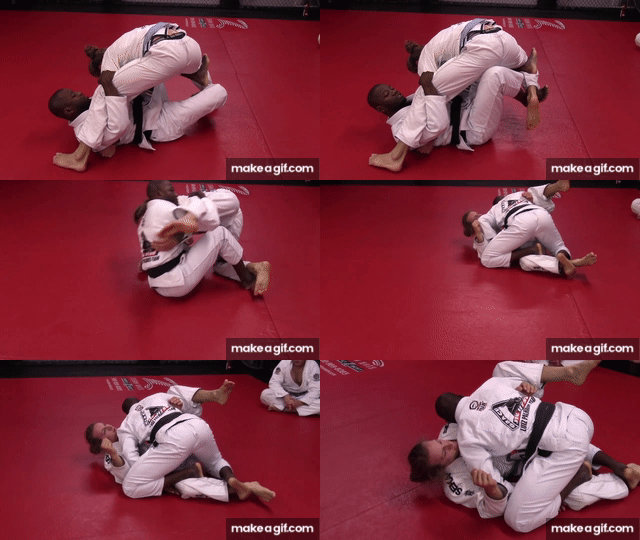
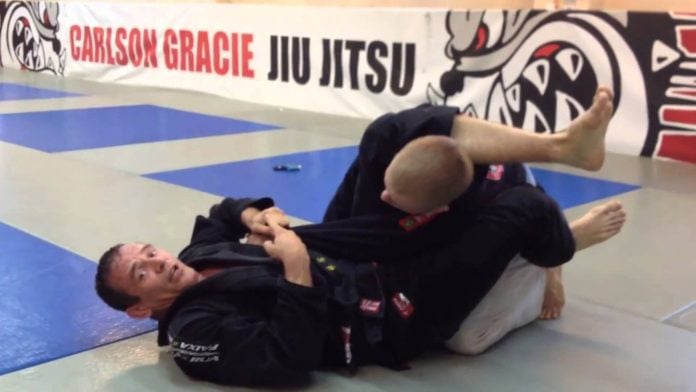
Never Pick A fight With a Trained Fighter. Here is Why!

Trained vs untrained in martial arts

Getting into any kind of fight on the street is bad, but it’s even worse if you pick a fight against a trained fighter, unless you’re trained too. Even then your chances of getting hurt are pretty high unless you’re Khabib or something.

In a video below we can see a guy fighting two untrained guys while it’s obvious he’s trained in MMA or some other effective martial art. As you can see untrained guys simply have no other options as their chances of winning are down to some lucky punch which is very unlikely to happen.

https://streamable.com/1zixn

Fallon Fox, Transgender MMA Fighter Who Broke The Skull of Her Opponent

https://bjj-world.com/bully-gets-slammed-and-knocked-out-after-punching-a-peaceful-guy/

Jiu Jitsu Fighter vs. Russian Karate Fighter

Jiu Jitsu Guy With No Takedown Skills in a Street Fight – FAIL

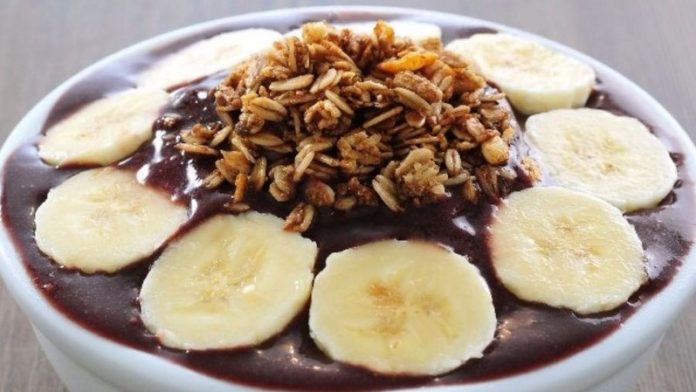
How to Build The Perfect BJJ Acai Bowl

How to Build The Perfect BJJ Acai Bowl

Training Brazilian Jiu-Jitsu extends far more than just the mats. With BJJ, you either get bitten by the bug or not. In most instances, it is the former and people jump headfirst into the world of grappling. This encompasses a full lifestyle change. Strength and conditioning training, clean eating, and all the associated apparel. And of course, a taste of Brazil to make everything stick together. And the community’s favorite to achieve this is acai! So, what is it, why do people like it so much and how can you make the perfect BJJ Acai bowl?

Brazil is a very cool place to live in. You have a warm climate, awesome beaches, top Jiu-Jitsu schools, and everything else you might wish for. And the food is out of this world. Brazilians like their meat which is something grapplers can easily relate to. Apart from never-ending rodizios, though, the people of Brazil also love their fruit. As such, they boast some fresh products that are as specific to the country as BJJ is. One of those is, without doubt, acai, or its most used form, the BJJ Acai bowl.

Basically, Acai is a berry that people like to eat frozen and mashed into a pulp, much like ice cream. Usually, people garnish it with granola, banana, and/or strawberries, but the opportunities are endless. It is the meal of choice for grapplers because of its great taste, Brazilian roots, and high nutritional value. The only drawback is, that you can’t find it in some parts of the world…yet. For those that find themselves in such a predicament, we’ll offer a great and just as tasty alternative!

The Lowdown On Acai

So let’s start with what Acai is. Found on palm trees all over Brazil and the rest of South America, Acai is a berry that looks very much like a grape. They have a similar color to that of blueberries. Acai is one of the most potent superfoods of today, especially in terms of antioxidant power. Acai is very rich in seeds, so much so that they take up 80% of the berry. The remaining 20% fall off to the skin and meat, which is what we’re after. This is where all the high-level nutritional value of Acai is located.

Nutritionally speaking, Acai berries are arguably the most potent source of antioxidants available. They have 5 times more antioxidants than blueberries, which are often compared to Acai. They are also packed with tons of vitamins, especially the skin, as well as fiber and plenty of minerals. Speaking of minerals, Acai is a very rich source of calcium. Acai also contains a high level of amino acids as well as fatty acids. Essentially it has everything you need jam-packed into one unassuming-looking berry.

If you live anywhere in South America, you’ll have no trouble finding Acai. The same holds true for the USA as well. If you find yourself in Europe, though, you might find it difficult to acquire it, depending on where you are. Even if you’re able to find it, it is very unlikely that you’ll get the berry itself in a raw form. The most common way is to get Acai pulp ina pureed form. This puree comes frozen in the shape of bricks and is ready to blend straight away. Other forms of Acai are in supplement form (capsules or powder) but that only gets you the nutritional benefits without any of the amazing taste.

Benefits of Acai

Before we go into the nuts and bolts of preparing a BJJ Acai bowl, let’s take a look at why you might want to consider adding Acai to your shopping list first. It’s probably clear from the nutritional profile that Acai is nothing but beneficial for our health. We’ll now focus on exactly what those health benefits are.

To begin with, Acai is great for your cholesterol. It helps to decrease the level of total and LDL cholesterol. this helps protect the heart and blood vessels. Furthermore, certain compounds in Acai prevent cholesterol from being absorbed, which keeps our blood levels steady.

Acai is thought to also have cancer-fighting properties. There are plenty of studies showing promising results, and even considerations for using Acai as a cure in the future. The antioxidants in Acai help reduce inflammation in our bodies, which is essential to athletes. they also help boost the brain and aid in its protection by stimulating autophagy. There are also immune-boosting properties to this amazing berry.

From a different standpoint, a huge benefit of Acai is energy. The berry is a great provider of energy making it a perfect fit to eat around BJJ class. Furthermore, the usual pairings with granola and banana only increase the energy value of Acai.

And of course, there’s no way we can go on without mentioning the taste. The frozen version is very tasty, especially when you combine it with the correct ingredients. Actually, it’s very easy to get a chocolate ice cream-like sensation while keeping the calories you consume surprisingly low.

A BJJ Acai Bowl To Die For

Yes, we said we’re going to provide a BJJ Acai bowl recipe. But we’re going to go further than that and give you a bonus smoothie recipe as well. This way, you can both enjoy your Acai as a bowl at any time of day, or directly post-workout. Whatever you prefer, we got you covered! Let’s get straight into it:

The Bowl

For the ultimate BJJ Acai bowl experience, you’ll need a banana, a few strawberries, some honey, a few cacao nibs or a bit of dark chocolate, shredded coconut, and of course, some frozen Acai pulp. Feel free to get creative with the fruit as all kinds of tropical fruits are great additions. Mangos, kiwis, papaya, and the like are just some great options to add to the taste.

How to Build The Perfect BJJ Acai BowlFor the best Acai bowl of your life, start by running the Acai bricks (2-3 bricks) underwater for a few seconds. Then,  break them apart straight into a blender and throw in half a banana as well. Blend until you get a smooth, creamy consistency. Next, spread a bit of honey over the walls of a bowl or a cup. Now, scoop a third of the Acai into the bowl. Next, go for a layer of cacao nibs/dark chocolate and some sliced strawberries. Line up the strawberries along the walls.

Scoop over the second third of the Acai and this time sprinkle some granola and line the walls with sliced bananas. Put the final part of the Acai and top it with a little bit of everything. Some granola, some cacao nibs, and finally, shredded coconut. This is the part where you can throw on some mango/papaya/kiwi pieces as well. Dig in and enjoy!

George Lockhart is the one man that every grappler should listen to in terms of nutrition. He is actually very big on using carbs post workout, so the BJJ acai bowl fits right in. Check out the “Nutrition And Weight Management System” bundle that features 3 DVDs plus a 100+ page E-book to learn all there is about grappling nutrition.

The Smoothie

For the Acai smoothie, all you need to do is make sure you have everything liquid enough to drink. While this isn’t the preferred method it is no less delicious by any means. Namely, the ingredients you need are Acai, coconut water, a banana, and some ground almonds.

Put all ingredients in a blender, except for the coconut water, and puls for a bit. Once you get things going, keep adding in coconut water until you reach the desired consistency. Transfer in a glass and enjoy!

4 Steps To Get Rid Of Sugar Cravings For Good

The Complete Guide To Intermittent Fasting For BJJ

BJJ Injury Prevention Manual – How To Break The Cycle

Things That Greatly Annoy Your BJJ Instructor

Things that Annoy your instructor

The life of a BJJ instructor is definitely not an easy one. Most of us do not have full-time careers in BJJ. As such it is the love of the sport and sheer enthusiasm that makes a BJJ instructor put hours on the mats, doing what they love. Furthermore, they’re the people guiding you through your BJJ journey, one step at a time. A BJJ instructor usually has at least one class to teach, and it is rarely just a small group of people. In many instances, instructors will have to teach back to back classes for hours at a time. While this is something they choose to do, paid or not, it is only courteous to make sure you’re not getting in the way of class and their efforts. After all, learning Jiu-Jitsu without an instructor is going to be an incredibly difficult task!

Do you pay enough respect to your BJJ instructor? Or are you the student who causes disruptions to classes? while you might hear your BJJ instructor talk to you about certain things you’re doing wrong, the truth is, they’ll keep most things they want to say to you to themselves. The reason for this is that they know that after a while, you’ll probably find yourself in their shoes. After all, some of them were also probably in your shoes not too long ago.

People across the world do not all have access to black belt instructors, and that is ok. The thing to know about BJJ instructors that they love what they’re doing. So, regardless if your BJJ instructor is a blue or black belt, make sure you’re not making their job more difficult with some of the small things that annoy even the coolest of coaches.

The Point Of View Of A BJJ Instructor

When a BJJ instructor walks through the doors of the academy, there’s usually nobody there. They always come in first, taking care of things before classes start. Lights, ventilation, heating, attendance cards, and various other small tasks that need attention. As students gather, a BJJ instructor is already on the mats, gi, or rashguard on, greeting them all.

BJJ Instructor When class starts, the goal of the instructor is to get everyone ready for the day’s training. This includes a short message at the start of class and a thorough warm-up. Depending on the schedule, there’s likely a class after that one, so everything needs to be on time. Next up, it is the technical portion of the class where instructors truly shine. After the meat and potatoes of class, an instructor needs to make sure students get to drill the moves they just learned. Of, course, at the very end, it is time to roll, where everyone likes to get around with an instructor.

When classes, if there’s time there are usually people asking all sorts of questions. there’s also the task of monthly fees and keeping up with the attendance log. And, in most cases, it’s right back to it for a few more classes, featuring everyone from 4-year olds to adult competitors. Now imagine how easy it is to interrupt class and the instructor’s rhythm. the thing is these interruptions usually cascade and will affect other classes as well. And it is all about the small things most instructors usually do not point out often.

Explaining Technique

If there’s one thing that’ll drive a BJJ instructor mad it is when white belts try to explain techniques. there’s actually a reason why there is an instructor, and it is not you, at least not at present. The explanation that the instructor gives when demonstrating is more than enough to train. There’s no need for your “expertise” on the move, especially when you’re looking to share it with all the others. Furthermore, if there’s anything more annoying than that, it is trying to give advice to your partner when the instructor is there correcting them during technique practice.

Talking over the instructor or trying to be one when you’re not fit is a cell sign of disrespect. BJJ is a martial art built on respect, and instructors are the ones that deserve most of it. So show some respect and keep your mouth closed unless it’s time to ask questions.

Walking Out And Talking

In terms of discipline, Jiu-Jitsu is much looser compared to some traditional martial arts. This, however, does not mean you have permission to act like a spoiled 5-year old kid. Talking at any point during class is something that you won’t get reprimanded a lot for in BJJ. However, it will annoy your BJJ instructor, often to a point where you might get warned. Keeping up with it, especially thinking whispering solves the situation is even more annoying.

Something that’s also completely disrespectful is leaving the mats without explanation. Your BJJ instructor is responsible for your well being, and that of everyone else on the mats Whether you’re sick, having to go to the toilet or whatever the cause, ask the instructor to leave. Simply walking off the mats leaves instructors annoyed and often times worried.

Intermittent Fasting by Tom DeBlass
List and Details

Tom DeBlass is one of the best instructors in the sport of BJJ. he has immense knowledge of grappling and can teach everyone how to be a world champion. Check out his ” High Tech BJJ In The Gi” DVD set, for instructions on setting up a wicked Gi game.

Lack Of Discipline

While there’s no need for bowing and kneeling on our knees without moving a hair in BJJ, some basic discipline is still required. For one, you need to make sure you come in on time and get ready and dressed. Being constantly late on purpose is not going to do or your BJJ instructor any good.

Speaking of which, neither is skipping warm-ups. We can all agree that warming up is the least interesting part of the class. However, your instructor probably did the same routine a few times that day already. They’re definitely more bored than you but still train correctly. So, do not skip over, or slack the warm-ups, if nothing else, than to spare your instructor.

As far as timing goes, apart from coming to class on time, try and pay your monthly fee on time as well. Running an academy is not an easy thing to do, and having fees sorted on time can help things a lot.

Finally, whenever you’re in class, and you’re learning a move “you know” demonstrate patience and work on that move. Stop doing stuff that you like to do, or think you need, when the technique of the day is something completely different.

Hygiene

Another thing that will annoy both training partners and instructors alike is hygiene. Or, better said, the lack of it. Remember to come into class clean and healthy. If you’re sick or have a skin condition of some sort, heal up first.

Also, make sure you’re always packing a clean Gi or rashguard and spats. Training with the same Gi as the previous class is a huge no-go. It is better to come in class wearing a T-shirt and a pair of shorts than a smelly Gi.

Communication

If there’s one thing your BJJ instructor does want you to do, it is to ask questions and talk to them. If there’s one thing no BJJ instructor can do, it is read minds. So, make sure you ask, talk and communicate with your instructors often. Go to them about anything and they’ll be more than happy to oblige. Just make sure you’re not interrupting class all the time. If you have a prudent question ask if shortly and precisely. Later on, during Q&A or open mat, you can go deeper into it with the instructor.

Easy on the white belts

BJJ Instructor Annoyed This one goes to every blue belt, and some older students as well. As people point out plenty of times, white belts are not food. Be mindful when rolling with beginners, or even more experienced white belts, for that matter. There’s no need to approach every roll like the finals of the World Championship. Take it easy and make sure new students get to learn from you, instead of getting hurt. This approach will help you learn as well, and it’ll make your instructor’s day much easier.

Future Instructors

Finally, remember that your BJJ instructor, no matter if they’re a blue or black belt, are also still learning. In BJJ everyone is learning all the time. Actually, teaching is one of the best means of learning there is. So whenever you’re being a nuisance, you’re actually stopping everyone, including your instructor, from learning and advancing.

The thing with Jiu-Jitsu is, that if you stick with it long enough, you’re going to end up on the opposite side one day. So, when you’re the one giving instructions not too long from now, you’ll learn how annoying you were. Give your instructors a break and start acting more responsibly on the mats. It is going to be your first serious step towards becoming a BJJ instructor yourself.

Never Say These 7 Things To Your BJJ Professor

Common Blue Belt Mistakes Caused By Bad White Belt Habits

Should Lower Belt Student be Able to Submit a Higher Belt in BJJ?

How Training BJJ Too Much Can Hurt Your Progress

The Complete Guide To Intermittent Fasting For BJJ

Intermittent Fasting For BJJ

The main thing people that train to compete for aim to get from their nutrition is energy and weight reduction. Since BJJ is a weight-classes sport, it is normal that weight cutting is a big part of it. As such, during competition season, grapplers like to stay within reach of their goal weight. Furthermore, they like to have the energy to train and eat in a way that doesn’t have them standing over the stove for hours.

What if I told you that all of this was possible? Not only that, but you can top it all off by eating really healthy as well. It is not a diet that can help you achieve this, but a protocol. Let’s look into intermittent fasting For BJJ and all the benefits it offers.

Out of the hundreds of diets, both regular ones and athlete-specific, I’ve probably tried about 70 % of them. From keto to calorie counting, Paleo to the Gracie Diet, I’ve done them all at one point or another. They all seemed to work, albeit some better than others.

Depending on my goals, I stuck with some diets for longer, while some didn’t make it past a couple of months. the one thing that did, though, and I still do to this day is intermittent fasting. While it may sound strange, or even scary when you first hear the concept, this nutrition model works like a charm.

As a medical professional, I did my due diligence and researched as much as I can. Now, three years in I feel great and can’t recommend intermittent fasting for BJJ athletes enough!

Intermittent Fasting 101

Do you know what intermittent fasting actually means? Let me make it as simple as possible in one sentence. It means going without food for a certain period of your day. And, depending on the protocol, the length of that part of your day can vary. Now, before you ask yourself why would anyone like to eat (or not eat) in such a manner let’s look a bit deeper at it.

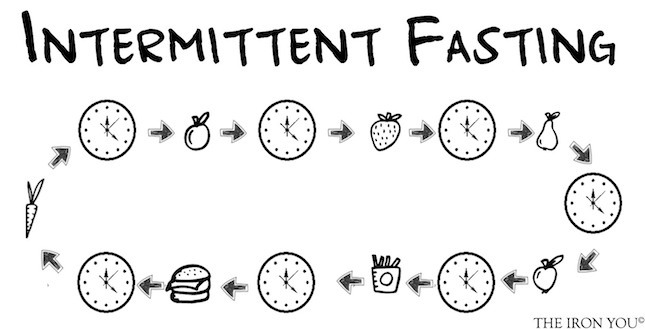
The usual intermittent fasting for BJJ protocol is one of time-restricted eating that goes something like this. You get up in the morning and forego your breakfast for just water and tea/coffee without any additions whatsoever. You extend this practice depending on the length of period you’d like to fast for. At a certain predetermined point of time, you start with your first meal.

Then, again depending on the protocol, you have your meals in another predetermined window. The basic principle of intermittent fasting is that the eating window must be smaller than the fasting one. That’s about it as far as the basics go.

Now, no matter how much you restrict your eating, know that nothing is going to work if you do not eat healthily. The fact that you do not have to control your portion size doesn’t mean you should eat in one meal the amount of food that a small village would eat in a day. Instead, stick to eating as simple as possible – fruit, vegetables, lean meat, nuts, seeds, and grains.

That’s about everything you need to be healthy, and have the energy to last you for days. Eating like this means you won’t have to measure anything, but instead, eat as much as you can during your eating window.

Intermittent Fasting Protocols

So, which is the best protocol for those looking into intermittent fasting for BJJ? There are plenty of versions out there, but only four stand out as useful for grapplers. If truth be told, there are favorites even among them, depending on training schedule and lifestyle. Let’s explore the main versions of intermittent fasting for BJJ athletes:

There are plenty of world-class grapplers that swear by intermittent fasting. Some examples include Edwin Najmi and Tom DeBlass. Tom has gone even as far as issuing a video instructional with a guide to intermittent fasting for BJJ. His “Ripped In 12 Weeks Intermittent Fasting & Bodyweight Conditioning” DVD set outlines his meal plan and even recipes that help him get ripped and ready for battle.

Tom DeBlass Intermittent fasting results

The Leangains Method

This is the most popular intermittent fasting protocol in the world. It is also the first thing people that have heard of the method think of when you mention time-restricted eating. The Leangains method is one developed by bodybuilder Martin Berkhan in order to help his physique goals.

The method revolves around an 8-hour eating window and a 16-hour fasting one. This is fairly simple for most people and has all the benefits of fasting without keeping you without food for too long.

For the Leangains method, most people tend to eat their last meal of the day at 8 pm. Afterward, it is only water and tea or coffee (optional) until 12 pm. For most people, this works great, since they sleep most of the time anyway.

However, this timeline is not set in stone and you can adjust it as much as you want as long as you keep the feeding/fasting windows the same. Since I train until fairly late at night I usually eat dinner at 11 pm, which puts my next meal at 3 pm the next day. For me, it is the perfect combination.

Remember that getting used to such a rhythm takes time, so start off easy. Try to fast for 10-12 hours the first few days, and gradually increase from there. Even if you can only take 14 hours, it is still going to provide you with most of the benefits.

The Warrior Diet

The warrior diet is a bit harder than the Leangains method, for the reason that you go without food for longer. Here, you only get 4 hours in which you’re supposed to eat all your meals. This one can be tough psychologically, so my recommendation is to try the Leangains method first, before “graduating” to this one. That said, I personally found it too hard for someone on a busy schedule that trains every day.
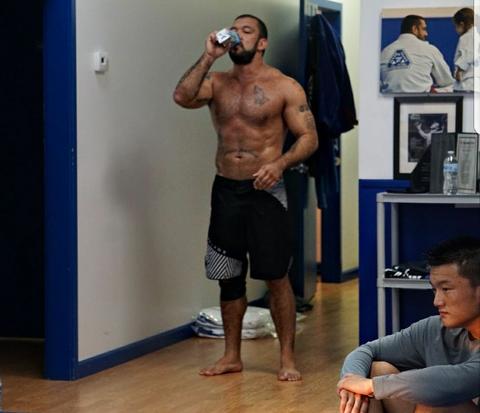
Intermittent Fasting For BJJ Tom DeBlass Most people tend to place their eating window at the end of the day when they have 4 hours to enjoy all the food they want. However, remember that four hours isn’t a lot. Despite the fact that fasting for 16 or 20 hours won’t make much of a difference in hunger once you’re used to it, the small eating window is simply insufficient for athletes. What you might look to do is use this at weekends, when you do not train, and especially if you have the tendency to binge or cheat. This protocol will allow you to minimize the damage before you get back into the Leangains method for the next 6 days.

Eat-Stop-Eat

The eat-stop-eat approach has you fasting for a full 24 hours. It is very important that you understand that you can’t and shouldn’t do this more than twice a week, although one is more than enough. Similar to the Warrior diet, you can use it on your rest day since it is not smart to train in a depleted state.

The usual approach is fasting from breakfast to breakfast, but you might choose any time that’s convenient for you. As far as intermittent fasting for BJJ goes, this one is the hardest, and least useful of all the methods.

Alternate Day Fasting

Alternate day fasting is for those that do not want to/can’t adhere to a daily protocol. The method has you fasting every second day. Let’s clear it up.

You start Monday with a 12-hour eating window. Once it ends, let’s say at 8 pm, you go on to fast for a full 36 hours and not eat again until 8 am on Wednesday. Then you repeat the cycle. This will have you without food more than any of the other intermittent fasting protocols. However, it ends with a period of time in which you can eat for quite a long time.

The trouble with this method is that it might have your training twice during a fasting window. Unless you have massive amounts of weight to lose, I do not recommend this, even sporadically.

Intermittent fasting for BJJ needs to help grapplers perform better, not worse. And as demanding as BJJ is, going hungry for 36 hours is hardly a good idea under any circumstances. if you’re on a hiatus though, due to injury or something else, you might want to toy with this method so that you keep your weight in check.

Health Benefits Of Intermittent Fasting 

  • Weight Loss without restricting the daily entrance of calories in your body.
  • Inflammation reduction
  • Reduces insulin resistance
  • Lowers Cancer Chance
  • Improves heart health
  • Improves brain health
  • Anti-aging benefits. Intermittent fasting rats were living 30-80% more.
  • Boosts metabolism

Intermittent fasting has been researched quite thoroughly, in both animals and humans. There are numerous studies out there providing precise data on the benefits of time-restricted eating. Even our ancestors found it useful as still witnessed by religious fasts in almost every religion available.

Among the main physiological benefits of fasting is gut health. Going without food for more than 12 hours allows your gut to empty completely and recover without having to work constantly. This also holds true for every other cell in your body. If the body isn’t busy digesting food, it can focus on repairing much more efficiently.
Intermittent Fasting For BJJStudies have also proven intermittent fasting to improve heart and brain health. Fasting reduces blood pressure, blood lipids, and overall markers of inflammation.

There are also indications that fasting reduces the risk of cancer. It also lowers the oxidative stress of the body, reducing cellular damage.

A major benefit of intermittent fasting for BJJ athletes is fat burning. It is beyond a doubt that your fat utilization is going to rise significantly when you start using the protocol. Your metabolic rate is also going to speed up and improve. Fasting also impacts hormones, from growth hormone, through testosterone to insulin.

Fasting also provides blood sugar stability as well as appetite control. Once you figure out that hunger is mostly psychological it’ll be easy to only eat in a short window during the day.

The Cons of intermittent fasting

  • In some cases, you can gain weight if you eat more calories than your body is able to burn, so what you eat is a crucial part of your diet
  • You may feel tired and moody because not eating for prolonged periods of time can negatively affect your psychological state and your cognitive functions
  • Not eating for a long period of time can cause Headaches, Dizziness, and Nausea.
  • Restrictive eating can lead to eating disorders

Intermittent Fasting For BJJ

Finally, let’s look at some of the ways in which intermittent fasting can help your Jiu-Jitsu. One major benefit is reducing inflammation. BJJ usually puts our bodies under a lot of stress. Not only that, but training sessions, especially pure rolling ones, tend to last quite long. That means inflammation is always high after training.

If you’re doing intermittent fasting for BJJ, your body will have a lot more strength to deal with inflammation due to the fact it is not digesting food all the time. This means your recovery time is going to be much better than before.

The hormonal boost and blood sugar stabilization are two aspects that also pertain to grappling a lot. Growth hormone is key to repairing muscle tissue that gets broken down during training. Stable blood sugar, on the other hand, means your body can manage energy consumption a lot more efficiently. This means your energy during training, and throughout the day is going to improve a lot.

Finally, intermittent fasting for BJJ provides a great way of maintaining weight throughout the season, or on a constant basis. You could even use a combination of the methods to further cut weight before a competition, without having to suffer. Your body is going to become much better at using food and converting it to energy, meaning small adjustments are going to go a long way to help you cut weight fast!

Things to keep in mind when intermittent fasting

  • Choose a simple diet at the start so you could stick to it as changing the habits drastically could affect your will to continue
  • Drink a lot of water and other non-caloric drinks like coffee or tea. While adding a bit of milk to coffee is ok adding sugar isn’t.
  • Don’t skip breakfast.
  • Try to balance your fasting time when you’re not very active if you can.
  • Exercise as before. It’s ok to workout while fasting. Some people recommend using BCAA (branched-chain amino acids) before a workout.
  • Avoid eating or snacking at night time. It will negatively impact your HGH and your insulin level.
  • Listen to your body no matter what. Nothing is more important than your health. If anything weird is going on for few days consider stopping intermittent fasting and visit a doctor.

Considerations

In terms of things, you need to know when deciding to try intermittent fasting for BJJ, there are a few. The two major mistakes people make are in regard to food choices. First and foremost, when people finish fasting they tend to go all-out during their eating window.

Combining binging with choosing poor food choices is going to render the fact that you’re fasting next to useless. Eat as much as you want, but apply common sense, and make sure you’re only eating unprocessed, real food.

Next, you might find yourself undereating during time-restricted diets. The thing is that you need to ingest a certain amount of calories each day, in order to function optimally. With fasting, you have a limited window in which to get all the calories in. Choosing high-caloric foods, like meat, and good fats is a great way of making sure you’re hitting your macros.

The one thing that is a major drawback of all intermittent fasting protocols is the fact they may not be applicable to females. Some studies and practical experiences point out hormonal disruptions when women take up one of the protocols, even the Leangains one. Since female hormones are also on a monthly cycle in addition to a daily one, a few tweaks are needed. One is reducing the fasting window and increasing the eating one. A 12:12 hours window or 13:11 is a good place to start.

Final Words

Keep in mind that intermittent fasting can be great for some people, but it’s definitely not for everyone. So, you have to try it before you decide which group of people you’re in,

Finally, make sure you consult your physician before you decide to give intermittent fasting for BJJ a try.

Performance Nutrition For Grapplers: 2 Things Everyone Gets Wrong

The 5 Best BJJ Supplements For High Level Performance

A Jiu-Jitsu Workout Program To Lose Fat And Improve Performance

Roberto Jimenez DVD – Attacking The Back Every Match

Roberto Jimenez DVD Review

Whenever a blue belt manages to submit a black belt in competition, the grappling world takes notice. Young Roberto Jimenez is one such example. To be honest, there aren’t many who have managed to get the better of multiple black belts the way Jimenez did. He took on no less than 5 black belt competitors as a blue belt and bested each and every one of them. But that is only the beginning of his story. A marvelous run at the 2018 worlds saw him quickly replace his purple belt with a brown. All at the ripe age of 18. Still, could we also see a Roberto Jimenez DVD before the prodigy turns 19? 

ON SALE HERE:
Roberto Jimenez – Attacking The Back

Roberto Jimenez Attacking the back
Techniques List & more info

I know that if I can get my hands on a Roberto Jimenez DVD I’m getting in in the blink of an eye. The recently promoted brown belt hooked up with Michael Zegna and Bernardo Faria a short while ago in Boston. And we all know what that means. Once you see people on those well known Fuji mats, you can expect a great instructional to follow not long after. But the real question is, what would a Roberto Jimenez DVD be all about? After all the young phenom is still relatively unknown.

Let’s try and figure some things out. To do that we’ll analyze some of Roberto’s earlier exploits that made people notice him. We’ll try to use all our knowledge of Roberto, to figure out what his DVD is going to be about. Unless he actually comes out with it in the meantime, in which case we’ll be the first to provide an in-depth review!

The Brown Belt Everyone’s Afraid Of

So, what makes the thought of a Roberto Jimenez DVD so attractive? Well, all it takes is just a glance at his history and his highlights and you’ll know. The teenager is grappling like a veteran grappler, and has only just become a brown belt! he conquered everything purple belt had to offer with apparent ease.

Roberto jimenez DVDLet’s be more precise. Roberto came out to the IBJJF Worlds in 2018 with the thought of becoming a world champion. he fulfilled his dream, not once, but two times at the same tournament. While winning both his division (purple belt, adult, heavyweight) as well as the absolute is not something that is uncommon at BJJ tournaments. However, submitting all ten opponents, from both your division and the absolute is, not something many people can boast with. Well, Roberto Jimenez can, and he did it at a purple belt!
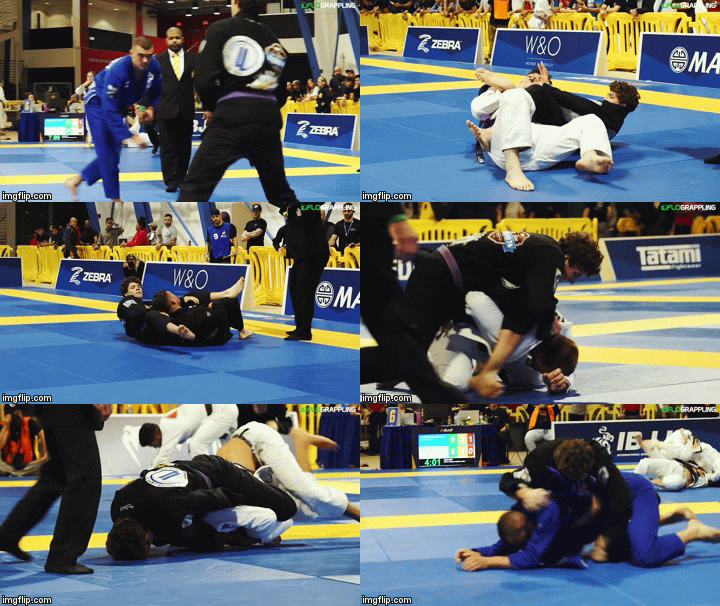
Training out of Alliance Team Gaucho, Jimenez received all his elts from his trainer and father, Raul Jimenez. This allowed the young phenom to start training very early, enrolling in a kids’ program at the age of 5. As expected, he rose through the ranks, turning into a competitor everyone was starting to fear. Now, Roberto is a brown belt, and every other male adult brown belt in the world is aware of the intensity and highly technical game Roberto Brings to the mats. It is going to be a real joy to watch him, both in future competitions and his debut Roberto Jimenez DVD instructional!

A Roberto Jimenez DVD Preview

Roberto jimenez DVDSo, knowing what Roberto enjoys the most, what should we expect from a Roberto Jimenez DVD? Well, if his past efforts are anything to go by, submissions are definitely going to be at the top of the list. What is his favorite submission? Well, he did manage a lot of chokes, especially the bow and arrow at the blue and purple belts. He definitely likes to stay on the back, and strangle people via lapel chokes. However, his chokes arsenal includes a lot more than just the bow and arrow. So, perhaps a submission DVD, focusing on lapel chokes?

Perhaps the debut Roberto Jimenez DVD is going to be a more positional one. After all, he does enjoy taking the back from virtually anywhere. Perhaps this would be something he’d share with the world. After all, he is known to train with Lucas Lepri and Rubens Charles “Cobrinha” on a regular basis. Both are extremely dangerous back takers and have influenced Roberto a lot.

Furthermore, there is his very technical Omoplata game, along with a variety of straight armlocks. Add to that his earlier use of triangle chokes and you can see why he’s taking the world by storm. As if all of this wasn’t enough, Roberto is also a formidable guard passer that wastes absolutely no time. The crucial aspect of his game is ho technical the young grappler is in each and every one of his matches. But will he be able to carry that knowledge over via a Roberto Jimenez DVD? Hopefully, we won’t have to wait long in order to find the answer.

Roberto Jimenez DVD Review – Attacking The Back Every Match

So, it seems I was right with my predictions before. Not that it is too difficult of a thing, given Roberto’s prowess with the bow and arrow and his slick back taking skills. The DVD is out and about and is just as amazing as we expected. The title says it all really: “Attack The Back Every Match”. It is refreshing for an 18-year-old to focus on a staple position of BJJ in modern times. While others are looking for the next big breakthrough move, Jiminez was instead working on his attacking skills from the highest percentage finishing position in Jiu-Jitsu. And the results are more than obvious – he turned into a black belt killer as early as a blue belt.

The back position, despite what people might think, is actually a difficult one to master. It takes a long time to really get the knack for the finer details of back control. Unless you have someone who has already put in the time showing you the tips and tricks to get you there sooner. Jimenez does exactly that in his inaugural DVD release. What you get in this instructional is unlike most back taking DVDs out there. Jimenez offers paths to the back from literally every possible position you find yourself in. He even has a strategy to expose the back from scrambles, making you comfortable all around.

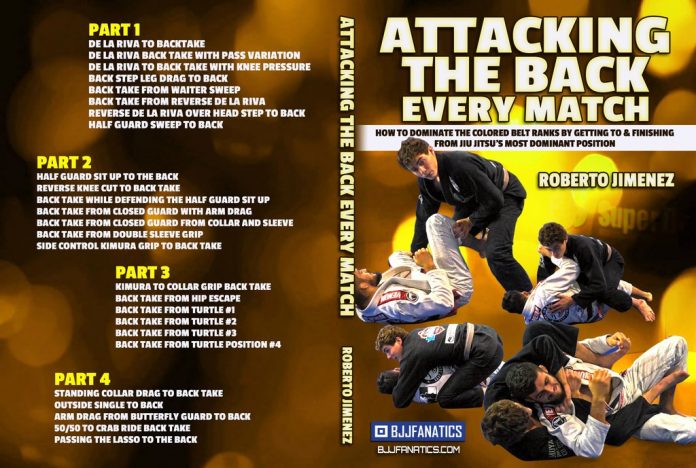
The DVD has a total of 4 volumes, each filled with extremely useful information. You won’t learn new pathways to the back or control. What you’ll learn are new takes on stuff you already think you know. However, the level of detail that Jimenez goes into is crazy, especially since its an 18-year-old brown belt doing the teaching. The first volume focuses mostly on the back takes from the open guard, featuring the De La Riva and Reverse De La Riva. Then, Jiminez mixes things, offering back take options from common both top and bottom. The closed guard series is particularly interesting. Part 3 focuses mostly on the turtle, while part four is reserved for some innovative moves.

DVD 1 – De la Riva Back Takes

This is one of those DVDs that does not spend too much time dwelling on general information. Roberto doesn’t even waste time on the introduction, not that he needs one. Instead, he jumps straight into the deep end, starting off in the De la Riva guard. From there, Roberto offers a few options to end up in back control from the popular open guard. Doing so, he includes both speed and pressure setups, allowing everyone to integrate the moves in their games instantly.

Roberto Jimenez DVD Back takeThe second part of this volume contains mixed moves, albeit still from the bottom. First up is a very smooth waiter sweep which solves a lot of issues. A couple of Reverse De La Riva back takes open up a lot more possibilities as well, before Jimenez moves on to the half guard. Finally, there’s also one portion of this volume dedicated to the top position, with a somewhat standard back take from the leg drag. A bunch of very precise details makes it really efficient, though.
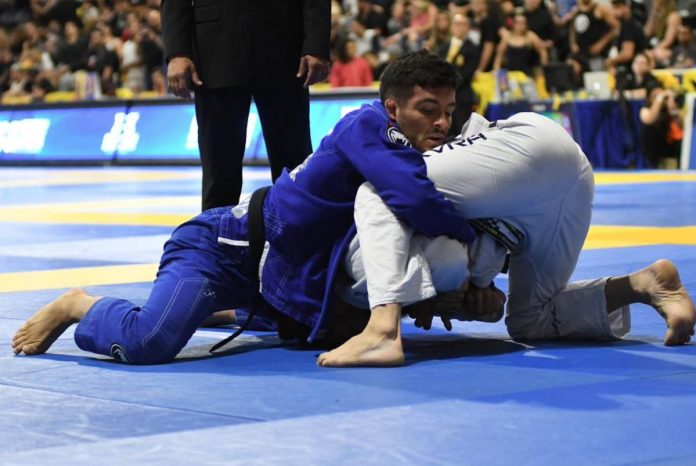
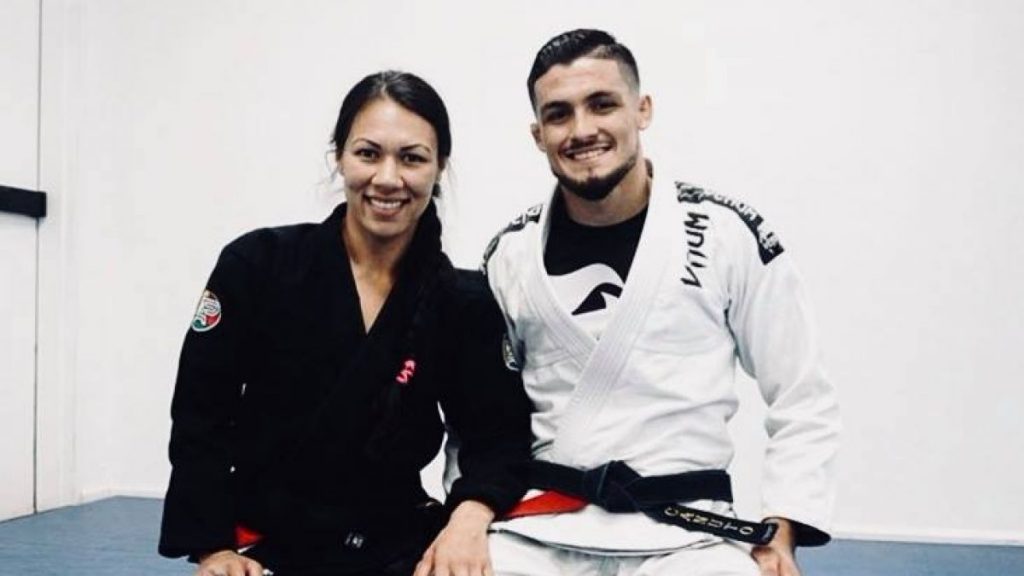
DVD 2 – Closed Guard To The Back

The closed guard is a position that’s on the decline lately. This does not mean that everyone’s abandoning it, but it is no longer the go-to bottom position everyone was gunning for. On top of that, back takes from the closed guard are very rare nowadays, giving more merit of the fact Jimenez addresses them here. The second portion of this Roberto Jimenez DVD spends a lot of time on the closed guard. This is a Gi DVD instructional first and foremost, but Jimenez offers options for No-Gi as well. In that sense, he has both collar and sleeve and arm drag setups to opening back control paths.

Jimenes then explores a few half guards to the back opportunities. Jimenez leaves no stone unturned, offering both offensives and, more importantly, counter-attacking back takes. that means you’ll easily flip the match when you manage to get the back off a defensive half guard game. At the very end, Roberto presents a kimura trap back take system, starting from side control. The best way to describe this is as the concept that’ll clear up the kimura – back control relationship for you.

DVD 3 – Back Control From The Turtle

The turtle is the position that most people use to get back. It is also the position that leads to more failed back takes than any other. The turtle position is quite easy to defend, especially when opponents know-how. Jimenez seems to have found the perfect hack, though, or rather 4 of them. The third volume of his “Attack The Back Every Match” DVD is all mostly about different ways of making sure the turtle position leads to inevitable back control. He starts simple and offers a few follow-up options that get progressively more complex. They all work though.

There are also a couple more techniques in this section of the Roberto Jimenez DVD. Something that’s a bit unusual in terms of back taking is going for it from the Kimura via a collar grip. This is one of those setups that’s glaringly obvious, yet we’ve been missing out on until Roberto pointed to it. Wrapping things up is a very neat little trick to help you get the back when you’re doing a hip escape. Even bad positions lead to the back with Roberto, and he spares no details demonstrating them all!

DVD4 – Roberto Jimenez Specials 

The final volume in the instructional contains seemingly unrelated chapters. Namely, this is the part where Roberto goes over some of his trademarks back takes, some of which are really crafty. For example, he uses the collar drag from standing to get to the back directly. This move is one of the best “shortcuts” you can do in Gi Jiu-Jitsu. It eliminates the need for takedowns and positional advancement as it takes you from zero to a hundred in just one sequence. A real gem for competitors. Moreover, Jimenez demonstrates how to use the single leg, to find your way to the outside, and, eventually, the back.

Sprinkling some No-Gi essentials here and there, Roberto’s butterfly guard arm drag back take is a classic with a new twist. It’s not only going to get you to the back every time,  but it’ll also transform how you execute arm drags. The 50/50 back take with a crab ride checkpoint is another one of those moves that work universally and will surprise most opponents. At the tail end of this Roberto Jimenez DVD is another original way of getting the back. This time, Jiminez dismantles the dreaded lasso guard on his way to back control. A move that’s so good, it’ll probably put the lasso guard out of commission.

ON SALE HERE:
Roberto Jimenez – Attacking The Back

Roberto Jimenez Attacking the back
Techniques List & more info

Renato Canuto DVD – Advanced Guard Passing

Renato Canuto DVD

Passing the guard is a real art form within the art of Jiu-Jitsu. There are plenty of people that prefer to work from the top and utilize passing as their main weapon. Not any of them, are able to pass everyone’s guard though. It takes a special breed of grappler to be able to pass the guard of some of the top guard players of today. There’s actually a simple trick to accomplish this. And, you can learn everything there is about guard passing from one of the world’s most exciting passers – Renato Canuto. We understand that there is a Renato Canuto DVD in the making, and chances are high that’s it’s going to be all about the top game in BJJ. 

Needless to say, if you’ve ever seen Renato Canuto compete, you’ll know why he should e your top choice for guard passing information. He is a true machine from the top, able to pass any guard that’s in front of him. even when it seems that no regular method of passing works, Renato can figure out the way. Having his concepts available is a massive opportunity to get a hang of modern-day unorthodox guard passing tactics. Ever thought you’ll be flipping over opponents in order to pass their guard? Well, if you have the guts to give it a try, the Renato Canuto DVD is going to provide the method!

Who Is Renato Canuto? 

Renato Canuto is a black belt in BJJ, currently fighting under the Checkmat team banner. The Brazilian is one of the most exciting black belts in the sport and is known as a formidable competitor in both Gi and No-Gi. He is a 22-year-old grappler who already has multiple world titles to his name. Renato is currently married to black belt world champion Raquel Canuto.

Renato Canuto DVDRenato began training in his hometown of Sao Paolo in Brazil. His father, Valdir “Tio Chico” is also a black belt and is Renato’s coach. However, BJJ was not Renato’s first encounter with grappling, as he started off with Judo. Later on, he naturally switched over, taking his father’s BJJ classes as a kid. Even as a kid, he showed great promise and talent and did particularly well in tournaments. Rising through the ranks, Renato had the opportunity to work with as some of the greatest grapplers of our time.
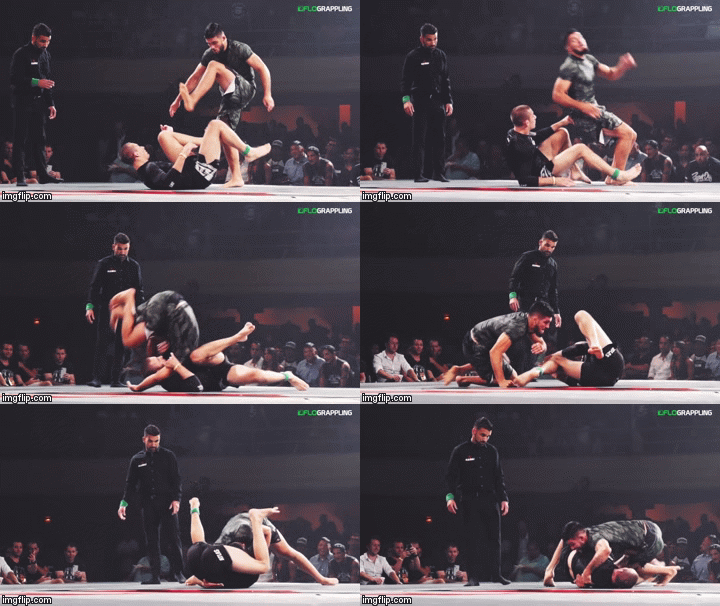
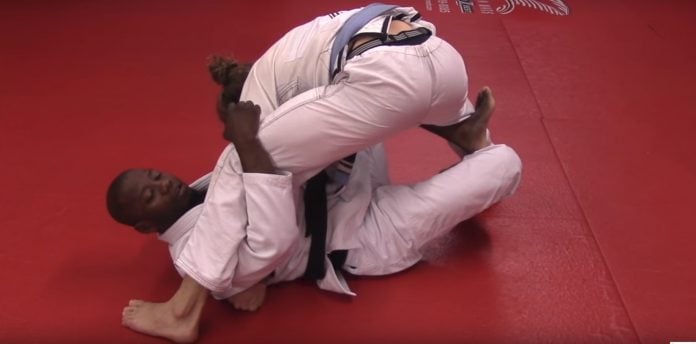

Originally, Renato joined the Zenith team under Robart Drysdale as a brown belt. His father went to the Zenith academy to award him his black belt in 2016. It was at Zenith that he met his future wife, Raquel. Not long after, they both decided to leave Zenith and join Leo Vieira at Checkmat.

Now he’s all ready to release a video instructional as well, featuring his trademark guard passing skills. Expect the debut Renato Canuto DVD to be at least as exciting as his matches are if not more!

The Exciting BJJ Style Of Renato Canuto

When talking about Canuto’s grappling style, a good place to start is his overall grappling record. So far, the lightweight has 40 wins, 9 of which are by means of submission. Form an opposite point of view, he has just one submission loss in 13 losses in his rich career. His record speaks in itself about the style Renato has. He is also very adept at grappling under all kinds of rulesets.

Renato Canuto DVDCanuto is one of the best submission hunters in Jiu-Jitsu. He seems to prefer armbars to other submissions but is no stranger to chokes or even wrist locks as well. Always with an eye on the spectacular, he also likes to mix in flying submissions, regardless of his opponent’s skill level or experience. And he gets most of them too! Another insight into Renato ‘s style is his take on stalling in BJJ matches. According to the Brazilian, people stalling are just sore winners. He also doesn’t like people who only execute one game plan throughout their career. There’s nothing exciting in being predictable and Renato is anything but.

The focus of the Renato Canuto DVD is going to be on the top game, but Renato didn’t start as a fan of it. Actually, he preferred the guard, until he got too comfortable there. He went on to study the top game, from takedowns to passes. Today, he is one of the most accomplished grapplers, comfortable in any position during a match. Which makes him one of the most entertaining grapplers in the sport!

Renato Canuto DVD

As he rose through the ranks, Renato spent a lot of time looking at matches of the to black belts around the world. He spent endless hours dissecting their moves and looking to apply them in training in competition. Now, with the Renato Canuto DVD, he offers a way for you to learn everything without spending years doing the research.

Canuto’s style is also heavily influenced by the grapplers he cites as his inspiration. Those include names like  Leandro Lo, Rafael Mendes, Gilbert Durinho, the Miyao brothers, Keenan Cornelius, Caio Terra, etc. Throw in the work he has done with Robert Drysdale and Leo Vieira on top of his father’s lifelong coaching and you’ve truly got a real grappling monster. Not only that but one that can backflip, but one that can hit flying submissions as well!

It’s a matter of Hours when Canuto’s DVD and Digital Instructional will be released. As soon as it’s out we’ll write a full review on it. Till then you can check HERE if it’s out.

Reverse X-Guard Masterclass On How To Attack Leg Locks

Reverse X-Guard

The X Guard is one of the most effective open guard positions in Brazilian Jiu-Jitsu. People usually discover the X-Guard fairly early, somewhere around a blue belt. Those that decide to stick with it, become virtually unstoppable up until they earn their black belt. The X-Guard offers great security, multiple sweep options, and easy entries and transitions. A lot of this is due to the fact that when in X-guard, you’re underneath your opponent, which makes their base really easy to control. However, if you like to use submissions, especially leg locks, there’s a better option than the regular X-Guard. It is called the Reverse X-Guard and it offers everything the regular X does, and then some. 

The Reverse X guard came into power after the leg lock game exploded. Actually, even with leg locks now considered a mainstay in Jiu-Jitsu, the use of the Reverse X-Guard is still very scarce. The reason for this is that most people find it a bit unusual to play. the main reason for this is that they are so used to playing the regular X, that building new habit is now extremely difficult. Yet it is not impossible and you can do it with ease, as long as you understand the position and its purposes.

The man responsible for shedding light on the Reverse X-Guard position is none other than grappling phenom Craig Jones. Known as one of the primer leg lockers of today, Craig first introduced the Reverse X-Guard in his “Down Under Leg Attacks” DVD set. In this instructional, Craig goes over every little detail that makes this guard so effective. There’s a large portion of the instructional dedicated to the  Reverse X, making it the best learning tool for this position so far!

The Reverse X-Guard Position

The Reverse X-POsition is actually very very similar to the regular X guard. There are only subtle changes in the placement of the feet, from a structural standpoint, Yet, these changes make the guard position that much more effective. The X guard is actually the best spot to get into the Reverse X from. Namely, you need to have a very traditional X-Guard, where you have the opponent’s leg on your shoulder, with an arm wrapped around their knee. If you can’t sweep from there, or want to go straight into high level eg attacks, it’s time to switch to a Reverse X-Guard.

Reverse X-GuardFor the Reverse X-Guard, the inside leg needs to be the one that is on the opponent’s hip, foot hooking behind their butt. The other leg (outside one) is going to go under the first leg and hook to the front of the hip. This is exactly reverse of how the legs are positioned in the regular X-guard. While the traditional version offers more balance, Reverse X provides immense power for off-balancing the opponent towards their front. This opens up many attacks, both in the form of sweeps and submissions.

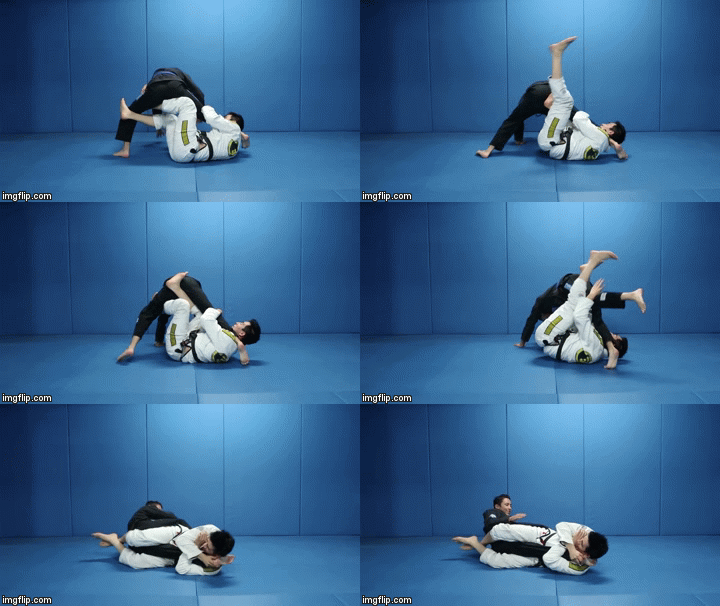
AS you’ll see further in this article, there’s also a version of low Reverse X-Guard which truly changes the dynamics of the position. Furthermore, getting into the guard is really easy from a multitude of other positions. Both the butterfly guard and Single leg-X guard are great transitioning positions. The Reverse X is also readily available form most half guard variations, in particularly the butterfly half.

Leg Lock Entries From The Reverse X-Guard

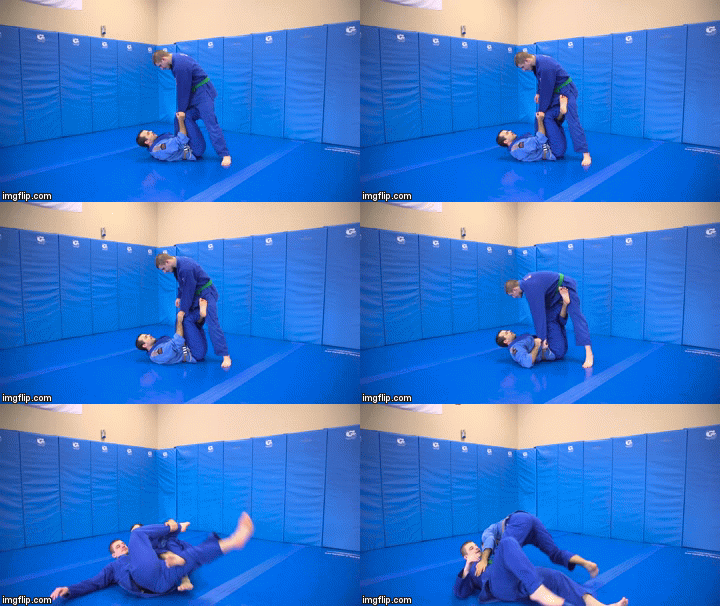
Getting leg locks to form the Reverse X-Guard is easy! Well, getting into Ashi Garami is, the rest is down to your leg locking abilities. The one most important thing to remember about leg locks from the Reverse X-Guard is a balance. The opponent has to have their arms on the ground for you to have any hope of attacking. The main goal of this is to gain access to the hips so that you can elevate them. This is where the Reverse X excels. The position of the legs means that you can lift the opponent in the air with ease, exposing both legs for attacks. However, it’s the far one you’re really after.

Reverse X-GuardThe position of your outside leg means you can use it to guide the leg towards your butt once the hips are in the air. This results in an opening for the Inside Senkaku position. All you need to do is kick your outside leg through and establish a triangle, Now you can lower your opponent to their hip whenever you want and get straight into heel hooks.

Reverse X-GuardIf you’re dead set on getting leg locks from the Reverse X, but can’t go for heel hooks, you still have “legal” options. Instead of trying to trap the far leg into an Inside Senkaku, you can always go for a kneebar. You need to do the same setup as before, up to the point of the triangle. Instead of locking one, simply kick your leg up. Then, switch to your side so that you’re trying to face the leg. This will land you in the perfect position for a kneebar, or a toe hold, depending on the opponent’s reactions.

Sweeps And Transitioning 

Reverse X-GuardSweeping from the Reverse X-Guard is usually the backup option. It goes into effect whenever you can’t execute a leg lock entry. the main reason for this is usually balanced. When an opponent manages to stay upright, you can’t get into leg locks. Since you can only unbalance an opponent forward with the Reverse X, you’re going to be looking to sweep there. However, instead of only unbalancing the opponent so that hey post, this time you take one of their posts away. This means you have to get a grip on the near side arm to prevent them from posting on it. Everything else is pretty straightforward. You lift their hips and switch your whole body so that they tilt forward. Without an arm to post on, they’ll fall straight down, giving you a sweep and top position.

Reverse X-GuardAnother great option is to utilize low Reverse X-Guard. Against really skillful opponents, you’ll need to abandon the position of your feet. As you do, the goal is to place the inside leg behind their knee. The outside leg goes in front of the ankle giving you a low Reverse X position. From there, you can now move forward and back in addition to each side. This means you can go for the usual technical get-up sweep or try any other variation you like. The low X is a very very high percentage sweep position. Additionally, it can also provide you with a door to leg locking positions.

10 Best Leg Locks DVDs and Digital Instructionals

The 9 Best Leg Lock DVD Instructionals For Grapplers

Leg Lock Counters To The Single Leg Takedown

The Three Stages Of A Successful Submission Defense

Double Trouble – Advanced BJJ Attack Tactics

Double trouble BJJ Attack

Brazilian Jiu-Jitsu is an art where you can choose to play countless tactical combinations. You could be an aggressive fighter, asserting dominance from the get-go. You can choose to be the explosive counter fighter that takes everyone by surprise. Perhaps, you like to be a more defensive player, and completely nullify your opponent’s game. Whatever your tactical plan, one thing is clear – at some point you’ll have to attack. Otherwise, you’ll lose the match, in one of many ways possible. To that extent, the BJJ attack tactics of advanced and beginner students are as different as black and white.

When beginners, even more, experienced ones, go for a BJJ attack, they tend to be clear and open about it. You could even say they’re obvious with it. There’s nothing wrong with that, as long as you know how to do it. With more advanced students, you get two main ways of approach. Either you have no idea what’s about to happen or you once again know, but there’s no way to prevent it. As you’ll see later on, this is due to a very underrated and simple BJJ attack principle. As such, this tactic is not reserved for advanced students and beginners can look to utilize it as well.

The true master of the double trouble principle, in more facets than one, is John Danaher. The BJJ guru has a bunch of exciting video instructionals out, but none is a better example of double trouble than his “Enter the System: Front Headlocks” DVD set. 8 DVDs full of amazing detail and strategies on how to attack with multiple threats at the same time, from the same position. Check it out while it’s still hot out of the oven! 

Double Trouble BJJ Attack Principle

A BJJ attack should be the simplest thing you do. Regardless if it is a sweep, pass, submission or any other offensive movement, it needs to be simple. This is the only way to guarantee effectiveness often and against a large variety of training partners. That, however, doesn’t mean that they need to be stand-alone attempts. Quite the contrary.

Double trouble BJJ Attack Principle The one thing that you can make to improve your BJJ attacks is making them best friends. By that, I mean combining the threat of one attack with another in order to have success with at least one. While this sounds pretty simple, think of it this way – you need to combine them in such a way that failing in one is ALWAYS going to lead into the other. Or, even, better into another BJJ attack, one that was previously not an obvious part of the threat. Intrigued yet? let’s explore some basic examples of how you might look to implement this principle.
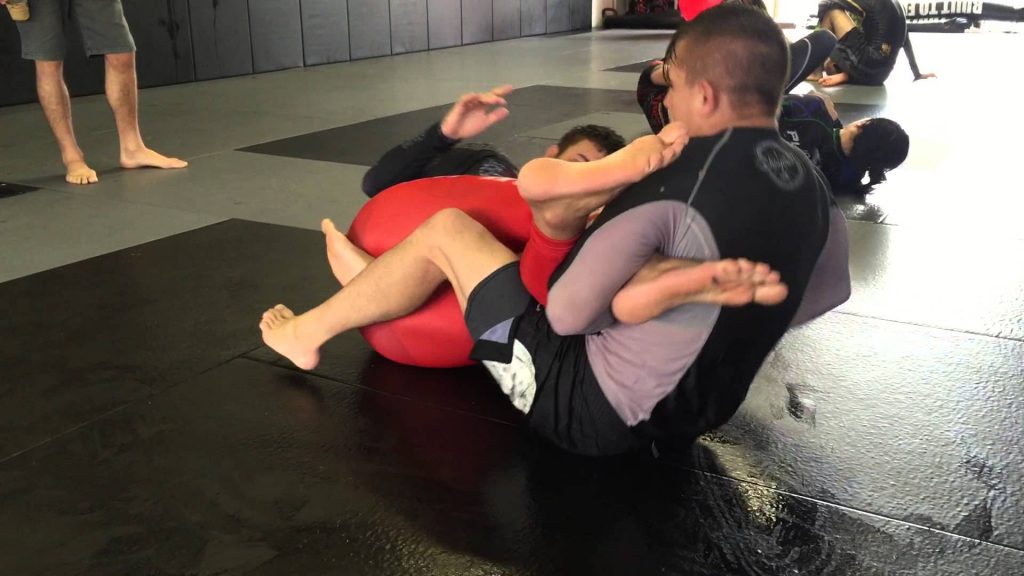
Let’s say you’re in a defensive position, like for example bottom side control. You can choose to remain calm and wait for a mistake, which is the least effective option you have. You could look to build your basic frames and get out of the position, which is what is expected of you. Or, you could look to find a way to attack from the position, even knowing that the attack might not be a high-percentage one. This last method, though, is one that’ll not only get you out for sure but offer you a great attacking position to fight from. This is the double trouble principle at its best.

Your Money Or Your Life

The idea with the double trouble is that you need to create a dilemma for your opponent. However, you need to create a dilemma that offers them only options they do not want. They’ll be forced to choose the lesser of two evils. thus allowing you to progress regardless of their choice. As Ryan Hall once put it, it is a “give me your money or your life” scenario. Let’s look at some further examples.

Double trouble BJJ Attack Leg locksThe inside sankaku position is a great way to look at the double trouble BJJ attack principle. When you have both legs under control, the first thing you have is total dominance over the opponent. there’s no way out. Apart from that you also have a certain tap. Namely, you can attack both legs with various leg locks from that position, without any effective means of defense for your opponent. Protecting one leg is going to open the other up for attacks, and this can go on infinitely. This example demonstrates how you can use a submission to pull off another submission.
It also works in a different way. you can use a submission threat, like that of a kimura or a D’arece choke, for example, to get to a better position. From guard, or even from the top, going for a Kimura attempt is certain to give you a sweep or pass, respectively, IF there’s no reaction from the opponent, you’ll get a tap with the original Kimura attack. The D’arce can work as a great tool to get you out of a bad position, one example being the bottom of side control we discussed earlier. Slapping on a D’arce gets you either out of side control, or a tap.

Even the old “position before submission” is a double trouble attack. Using pressure, like the S-mount to get a submission is also viable. This way, you’re using the position to open up a very obvious submission, that they can’t defend. Even if they go for all-out defense, you’ll use the position to make them uncomfortable or even get a better position.

A Few Very Nasty Submissions From Side Control

X Guard Submissions: Gi And No-Gi Leg Locks

Rolling Jiu-Jitsu Attacks: High-Percentage Moves

Coping With Daily Life When You Are Addicted To BJJ

Addicted To BJJ

In today’s world, it is hard for anyone to lead the life with no responsibilities. if you’re the average Joe this actually becomes life. From home management to work and personal relationships, not a lot of time remains for activities that make us happy. However, there’s BJJ on the other side of this spectrum. The one thing that’s common for grapplers is that they’re all addicted to BJJ. Given the people BJJ usually attracts, you can also bet that the majority also have all of the above-mentioned responsibilities. Actually, most people even have more. So, how do you balance your Jiu-Jitsu addiction with a responsible grown-up life? 

As far as people addicted to BJJ are concerned, I am certainly on top of the list. There’s hardly any other martial art, or sport for that matter, that gets people so hooked as BJJ does. And it is not just a one-time thing that happens to a certain category of people. Young and old, male and female, athletes and regular people, they all become addicted to BJJ very easy. There seems to be no rule about it, apart from the fact that grappling is going to become a large part of your life. If you let it, it may even become your whole life. However, this is not the ideal scenario for some people, or better said, most people. There are still the “small” matters of family, work and other grown-up responsibilities outside of the mats.

So, how do you approach daily life now that you’ve admitted you’re addicted to BJJ? COuld you keep up with your addiction while you remain a responsible parent, spouse, and friend? Fact is, there are certain things you can do to maximize what you get out of both worlds.

Are You Addicted To BJJ?

So, are you suffering from an addiction to Brazilian Jiu-Jitsu? the answer to that question, as with any addiction, may not be so obvious to you. However, it is going to be obvious to those surrounding you, especially the ones that do not train. That said, there are certain tell-tail signs that Jiu-Jitsu is the main focus of your life.

Addicted To BJJTo make things clear, there’s hardly any progress possible in BJJ without constant dedication. That said, too much dedication is not going to hurt your BJJ either. Bur it is going to affect your daily life. The first thing that might indicate your addiction is your browser. If your social media time timeline, your search history, and YouTube suggestions are all about BJJ, you’re definitely knee deep.
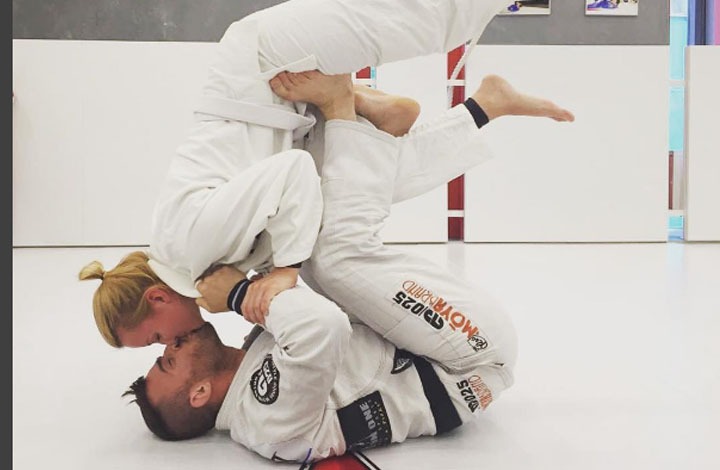
Furthermore, check your wardrobe. If there are more Gis than suites, and more rashguards than t-shirts, you can be sure you’re addicted to BJJ. If the t-shirts and hoodies you do own are all relate to BJJ or grappling tournaments, then you’re beyond a doubt trapped in the world of Jiu-JItsu for good. Apart from bailing out, you now need to find ways to integrate daily life into your BJJ life, instead of the other way around.

Oh, and social interactions are another major indicator of BJJ addiction. If your friends are sick and tired of your grappling stories, and yo light up whenever someone you meet turns out to grapple too, you’re most definitely a BJJholic!

Coping Mechanisms

So, what are some practical strategies to help you balance everything? First and foremost, you need to make sure you prioritize. While training might be all you care for, the family must come first. So, family obligations take precedence over anything else. In terms of lightening the load make sure you have a plan in motion along with our significant other, or your parents regarding everyone’s tasks. Next up, it’s work. you still have to pay for BJJ classes, right? Well, unless you bite down and put in a shift, you’ll be very hard-pressed for cash.

The thing with those addicted to BJJ is that once they sort out priorities, it turns out very little time is left for BJJ. Which is not true. One thing that’s actually important for BJJ progress is quality. When you train, make sure you give it your all, doing everything 110%. And by that, I really mean everything, including the warm-ups. It matters more how you train twice that if you train 5 times a week.

Furthermore, keep up with your habit of watching BJ jat every possible opportunity. However, make sure you have an idea of what you’re watching. Find an aspect of BJJ you’d like to improve and focus on instructionals and matches featuring those particular moves. Think of it like homework, and one that you can do virtually anywhere.

Looking to put in some extra sessions off-schedule is also a great way to keep up with your addiction. Either schedule some privates or make sure you get a partner to drill. It may be before work early in the morning or even after regular training. Whenever you can fit extra time on the mats, do it!

BJJ And Relationships

Finally, a few words on those younger grapplers addicted to BJJ. While you might not have the responsibilities adults have yet, there are certain aspects of social life that can really suffer. Out of those, relationships, and particularly new ones, might not be tolerant at all of BJJ.

Addicted To BJJ When in a new relationship, the main issue is time. Relationships, especially new ones, demand a lot of time if not a lot of it. Sounds familiar? Since the same things happen with BJJ, you need to quickly find the balance before you end up sacrificing one or the other. Look at it relationships this way – they’re all about boundaries. Make sure you know where your boundaries are, as well as those of your partner. Furthermore, make it clear that BJJ is your passion and not your obsession. So you now come into class a couple of times less than you did. So what? Look at what we wrote about the quality of the training before. Next up you need to make sure the partner understands how important Jiu-Jitsu is for you.
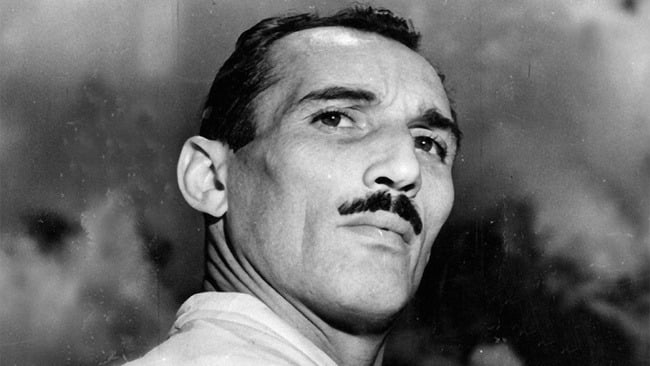
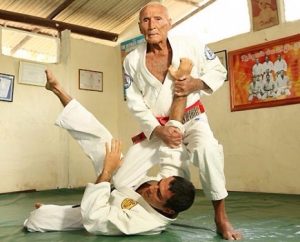
The similar thing about relationships and BJJ is that they’re really similar. Both require dedication, planning and lots of attention. While you can’t make one or the other exclusive, you can certainly find the balance, if your partner is willing to be open and understanding. After all, they probably also have an aspect of their life that they like to do as much as you do BJJ.

Become a triangle specialist with the help of Craig Jones! Use his “Triangle Machine” DVD set to take your choking game to a whole new level. What you can expect is flawless instruction and a lot of content from one of the best grapplers of today! Get it now!

Jiu-Jitsu Rules To Obey By When Rolling

Do You Train Jiu-Jitsu When You’re Sick? Stop Right Now!

https://bjj-world.com/gracie-vs-gracie-family-champions-explained-school-time/


Helio Gracie: Rules For Jiu-Jitsu And Life

Helio Gracie Rules

If it wasn’t for one man’s determination and dedication to learn the ancient art of Judo from Mitsuo Maeda, we wouldn’t be here today. Most of us would probably still be training some martial arts, but the world would be a much poorer place without Brazilian Jiu-Jitsu. Thanks to the efforts of a skinny kid from Brazill, today we are a part of something truly magical. We all owe gratitude to everyone in the Gracie family for paving the way. But even among the Gracies, one individual stands out as the forefather of Brazilian Jiu-Jitsu – Helio Gracie. 

Helio Gracie Life RulesHelio Gracie took upon himself the task of evolving Jiu-Jitsu back in its inception. While both he and his brother Carlos trained, Helio was the one with a more hands-on approach. He focused a lot on developing BJJ as an art, using the Judo fundamentals his brother and Maeda taught him. However, Helio Gracie didn’t just train and work on the technical part of Jiu-Jitsu. He also developed a code to live by, along with a winning mentality. Helio’s lifestyle of Jiu-Jitsu included training, eating in accordance with a very specific diet, and fighting to prove that BJJ can best any other martial art. This led him to the development of certain rules that greatly helped Helio have a structure that was necessary for his goals. Now, we’re going to take a look at these rules and how we can use them to become better at life and Jiu-Jitsu.
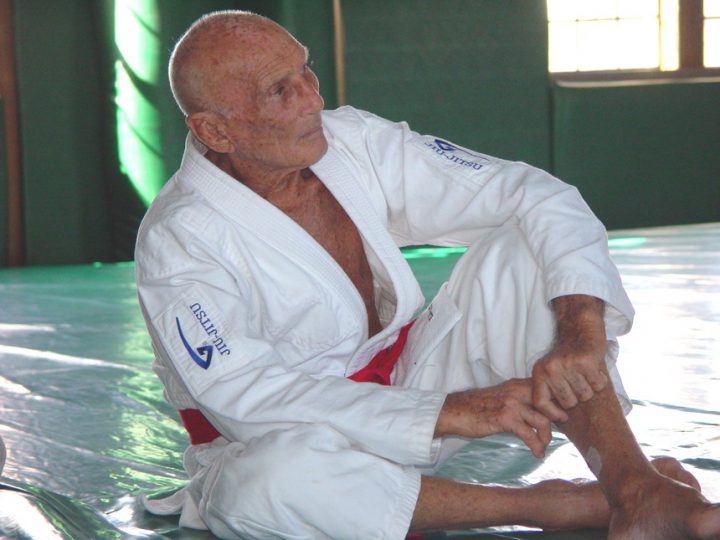
In terms of techniques, the Gracies were all about highly effective basics. As such, Gregor Gracie, in a true Gracie family fashion, offers an insight into the very fundamentals of the art. Pick up his “High-Level Fundamentals” DVD set for one of the best foundational video instructionals available!

Helio Gracie

Helio Gracie (1913-2009) was the youngest son of Gastao Gracie. Back as a child, he suffered from fragile health and was a very skinny kid. Before moving to Rio, his brother Carlos, who was a lot stronger, began training with Maeda. Mitsuyo “The Count” Maeda was a Kodokan Judo master, also versed in Japanese Jiu-Jitsu. Carlos later showed his brothers what he learned from Maeda, constantly sparring with them. While Helio learned from Carlos, he didn’t fight at all, because they deemed him to be skinny and sickly. So, he spent a lot of time watching his brother fight and figuring out how BJJ works.

Helio Gracie RulesOnly after he opened his own academy, Carlos invite Helio along with the other brothers to help out. That’s where Helio started really training and sparring. Slowly but surely, Helio became the top student, and Carlos soon put him in a Vale Tudo match. He choked his opponent in less than a minute and the Heli Gracie legacy began. He kept fighting for the family name and honor, defending their style of Jiu-Jitsu.

Helios fighting career includes legendary matches with Yukio Kato as well as Yukio’s master Masahiko Kimura. He beat Yukio but lost to Kimura by way of a Kimura lock. Helio Gracie also holds the record of the longest Vale Tudo fight in history, lasting almost 4 hours. Unfortunately, Helio lost that match to his former student Waldemar Santana.

Helio died on January 29, 2009, at the age of 95 as a 9th-degree red belt. He is the one that spent most of his time actually developing the art after his brother Carlos turned to the business side of things.

Lifestyle Rules

Helio liked to live by a certain set of what was more of principles than rules. They included thoughts and directions on multiple facets of life, apart from BJJ.

From a lifestyle perspective, Heli Gracie liked to “do the right things” According to him, doing a wrong thing was only ok when it was the result of ignorance. The way to achieve this was to live life by only having good intentions. Helio’s main rule of life was to remain humble and work to continuously improve yourself. The goal was to constantly pursue perfection. Helio claimed that if whatever you do is perfect, you’ll be easy to adapt it to any situation.

Helio also enjoyed being a quiet individual. He didn’t like to boast and brag, nor talk trash. As Helio said, “a tranquil man has peace and a quiet man is a tolerant man”.  Helio strived to use Jiu-Jitsu to increase confidence without being violent or power-hungry. As you can see, Gracie preferred to be calm and collected, going through life with a clear head. Just like he did when he was fighting in grappling or Vale Tudo.

Something the Gracies are very famous for is their dedication to what they eat. Carlos came up with the legendary Gracie Diet, which still works to this day. Helio followed the diet rigorously, setting up a few rules along the way. One thing he preached is to eat what you like as long as your body can deal with it. He thought that all ailments enter through the mouth. As a basic rule of thumb, Helio only ate what he had in the garden. This included fruits, vegetables, some grains, lots of cheese, and the occasional fish or chicken. Gracie also believed in indulging yourself every now and again.

BJJ Rules

When training the Gentle Art, Helio Gracie liked to adhere to some very common-sense rules that still hold true to this day. First and foremost Helio’s take on BJJ was that it is an art for everyone. ‘Everyone that wants to learn, can” said Helio. He also believed in his Jiu-Jitsu without reserve. According to him, this is the crucial trait every grappler should have. If you believe in your BJJ, you’ll be able to defeat any opponent in a calm and technical manner.

Helio Gracie BJJ Rules However, Helio still believed in staying alert to fear. There is a belief in Jiu-Jitsu and then, there is stupid and rash behavior. As Helio stated: “If you send me into a lion’s cage, I will not enter”. Helio Gracie’s take on Jiu-Jitsu was that you always have to be technical. The technique needs to replace force if you truly want to become hard to beat. This is the mantra that brought Helio Gracie countless submission victories throughout the years.

Finally, Helio states it is imperative that you transmit all the knowledge of Jiu-Jitsu that you have. Teach your training partners what you learn through training so that you can both grow as grapplers. Of course, Helio’s take on training was that you should never ever stop training. As he says” all it takes is a ring and a partner”.

Helio Gracie: Making Love is an Unnecessary Expenditure of Energy

Helio Vs. Carlos Gracie – Gracie Jiu-Jitsu History And Politics

https://bjj-world.com/difference-japanese-jiu-jitsu-bjj/