


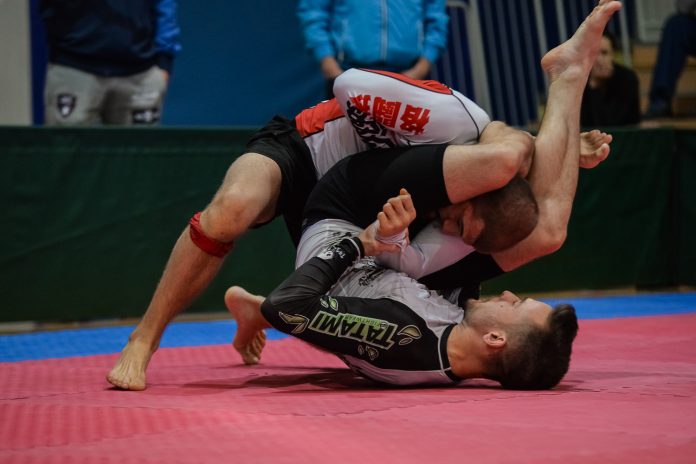
Three Best Triangle Choke Defense Options For BJJ

Triangle Choke Defense

Defending BJJ submissions and successfully escaping them is arguably the hardest part of Jiu-Jitsu. It takes a lot of patience and knowledge to get out of deep submission, but it is, by all means, possible. There’s no submission in grappling that you cannot defend against. The only thing that makes all the difference in the world is timing. If you know what’s about to happen, you can work to prevent it or disrupt it. Once you manage that you can just sit back and wait for the opponent to give up. or better, yet, you can go on a counteroffensive yourself. Today, we look at three very high-percentage triangle choke defense options.

The triangle choke is not an easy submission to defend against. It offers a lot of control over you and allows for multiple adjustments. This makes it a potent weapon across all belt levels. Actually, apart from the Rear Naked Choke and Armbar, it is the one submission in BJJ that works universally from white to black belt with a high degree of success. In order to mount a successful triangle choke defense, you need to know what you’re defending against. Even more importantly, you need to know which defense you need to use at a particular moment of the submission.

As with most other submissions, the best triangle choke defense is prevention. However, triangles are a favorite tool of many high-level grapples, meaning you’ll get stuck in one sooner or later. When that happens you need to know that you have three checkpoints before the point of no return. If you fail by then, your options get simpler. You can either use the best escape of them all – tap or you can go to sleep. In order to be able to recognize the points of defense, you’ll need to know a few basic things about the choke first.

The unsubmittable man in Brazilian Jiu-Jitsu, Tom DeBlass can help you get out of any tight spot in BJJ, including triangles. How? The simplest way is to pick up his “Submission Escapes” DVD set and start going volume by volume. You’ll not only learn triangle escapes but solutions to any submission that might be troubling you!

Know The Dangers

If we’re being obvious, the main threat with a triangle choke is the pressure on both your carotid arteries in the neck. The triangle choke is a blood choke, involving your own shoulder on one side and the thigh of an opponent’s leg on the other. If you’re there, with one arm across their body and no posture, the time for a triangle choke defense is long gone. Tap and restart.
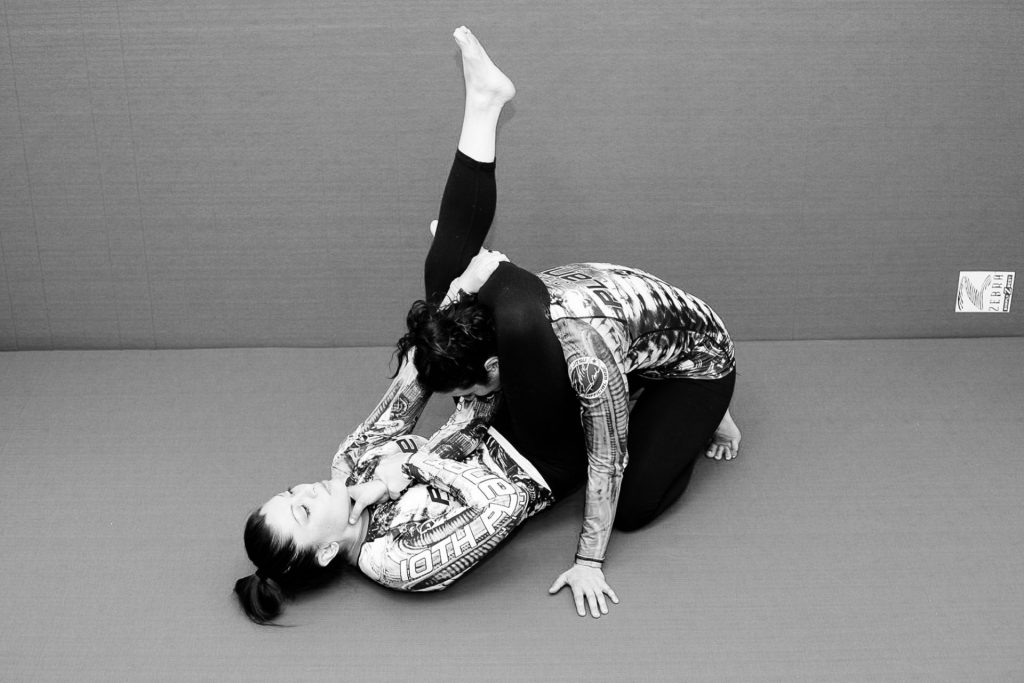
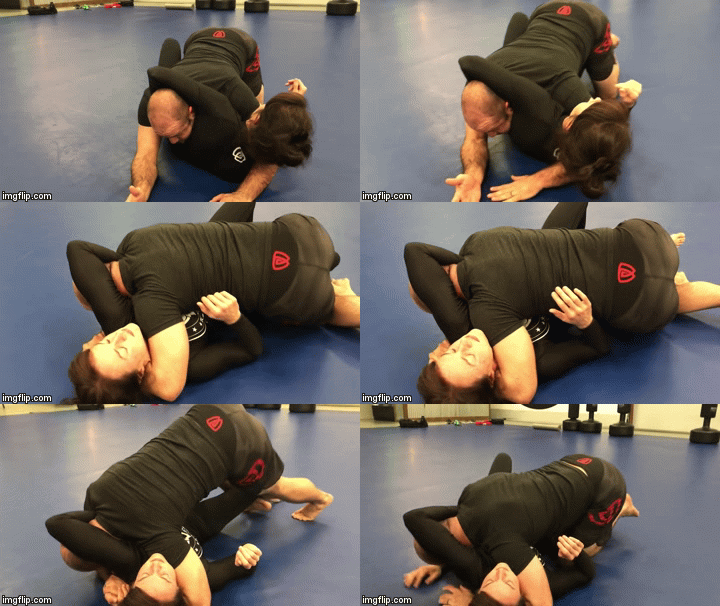
Triangle Choke DefenseBefore this point, though, you have a few options. The trouble with the triangle starts when an opponent has a leg on your shoulder and the other under the opposite side armpit. This, in itself, is not troubling until they cross their legs behind your back, like for a closed guard. this is the diamond position that’ll allow them to control your posture. In turn, they can use it to get into position to finish the choke. So, the diamond position is the first moment you need to react to a triangle choke.

Next up its posture. Even if the opponent manages to lock the triangle you need to make sure you have your posture. You won’t be able to keep it for long, but you that won’t matter if you know what you’re doing. The moment o use a triangle choke defense is here, while you still have the posture to resist.

Finally, once your posture goes, and their legs are in place, the last piece of the puzzle is your arm. If you allow your arm to cross their centerline, you’re done for. Luckily, there’s a last-gasp escape which is a bit unorthodox but does help defeat a fully locked triangle choke.

Defending The Triangle Choke 

Perhaps it sounds like defending the triangle choke is no hard thing, but nothing can be further from the truth. If you’ve ever been caught in one, you know. That said, know that it’s clear whether the dangers lurk, we can look to utilize specific defenses for each stage. The three triangle choke defense techniques we’ll cover today work just a well for the beginner as they do for advanced students. If you’re aware of what you’re doing, you’re going to be successful with them for sure. This means you need to stop panicking when a triangle choke is looming and think about your main problem and the solution to it. her area three great options:

Early Triangle Choke Defense 
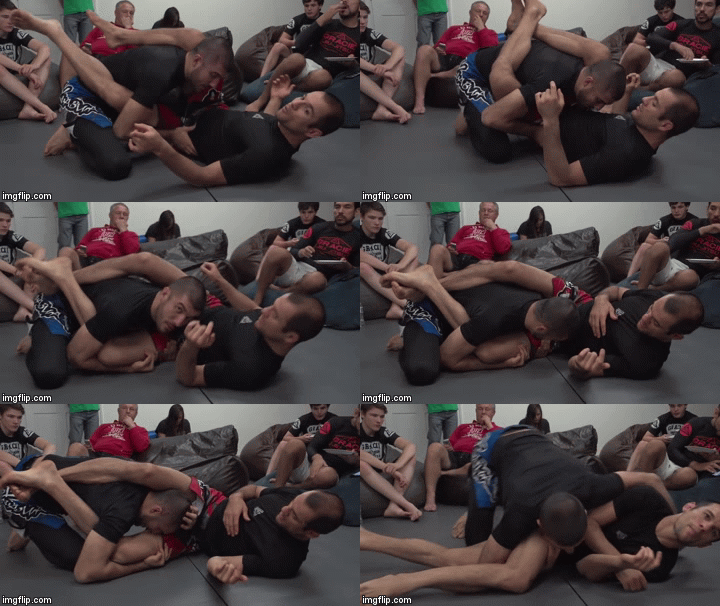
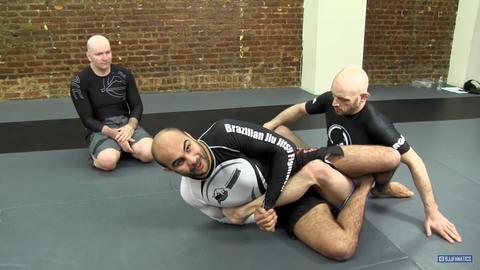
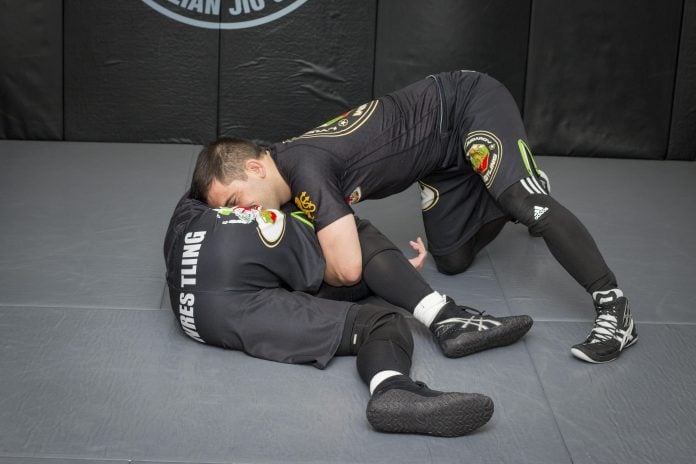
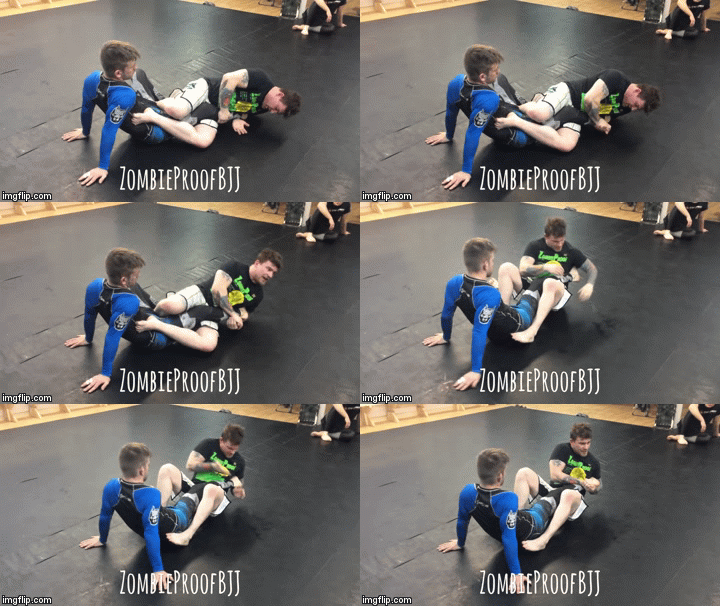
Triangle Choke DefenseThis defense comes into play the moment you feel your opponent has the legs in position. When they lock their legs fro the initial diamond, you can expect a pull on your head next. Before that happens, you’ll need to thread the outer arm underneath the opponent’s leg that’s under your arm. This will allow you to use your inside arm to wrap the knee of the same leg and pin it to the ground. You can stay there as long as you want because there’s no way for an opponent to finish you from there.

Once you’re ready to go, use the first arm and place the palm on top of your head, creating a frame. This frame will allow your head to slip out and you’ll end up in side control. Now, it’s time for some punishment!

Regaining Posture

The previous triangle choke defense requires quick thinking and recognizing where you are. Since in reality, you’ll often be late for that one, your next option is what I call the basic triangle defense. It is the most fundamental triangle defense that works against all levels of opponents.
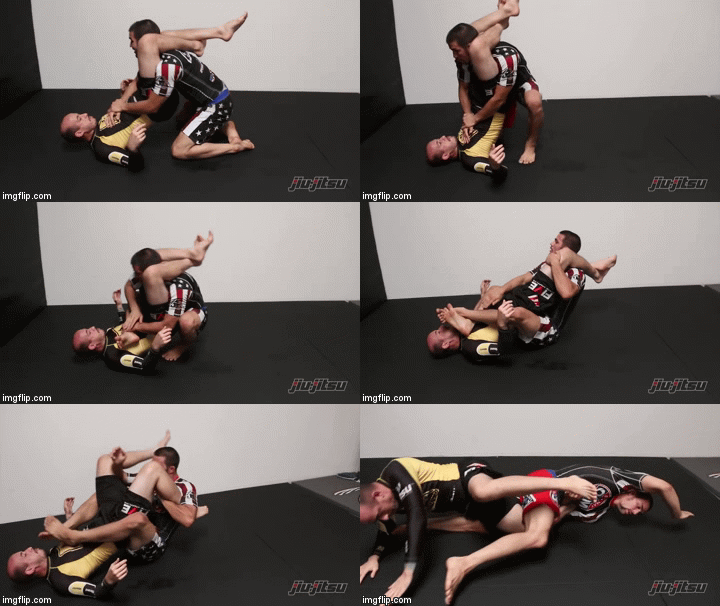
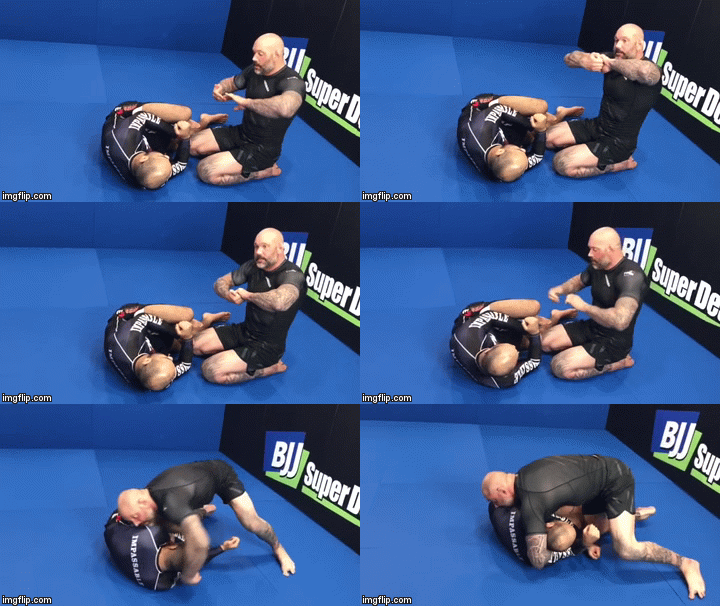
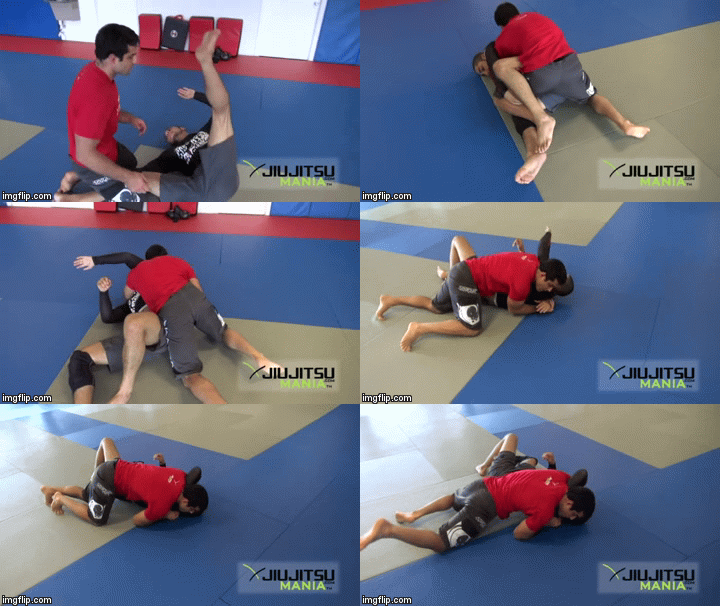
Triangle Choke DefenseFor this escape, you’ll need to react by going into super posture the moment you feel the opponent’s legs locking in a triangle. In order to get super posture, you’ll need to get up on your knees and drive upward as much as possible. The goal is to get eth opponent’s hips on your thighs while keeping your posture straight. From there; you stand up on your feet and throw one leg over the opponent’s waist. Sit back down and throw the other leg and you’re safe. A simple lean back is going to break their triangle now and expose their legs to leg lock counters.

An Unorthodox Last-Gasp Triangle Escape

This last one is a bit counter-intuitive, as it takes you towards the choking leg. However, once you’re deep in a triangle, and you can’t regain your posture, there’s actually not much else you can do. This triangle choke defense works great, you just need to stay calm enough to execute it. Luckily, it is a very simple one.
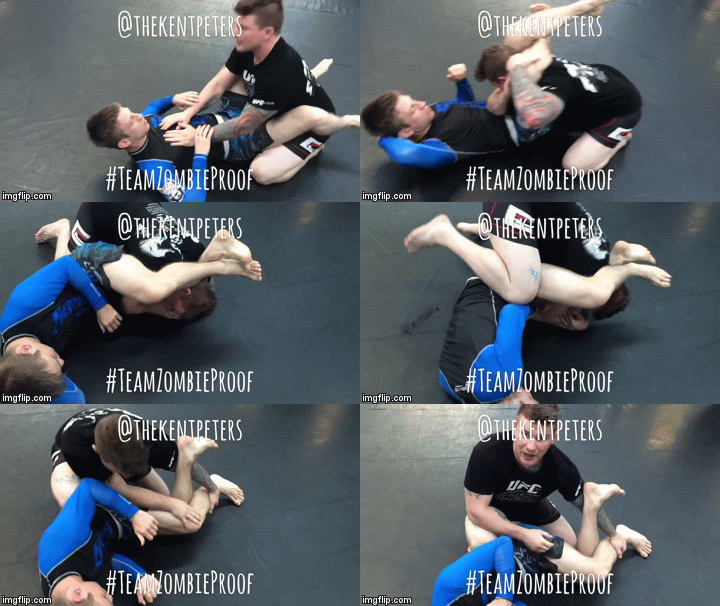
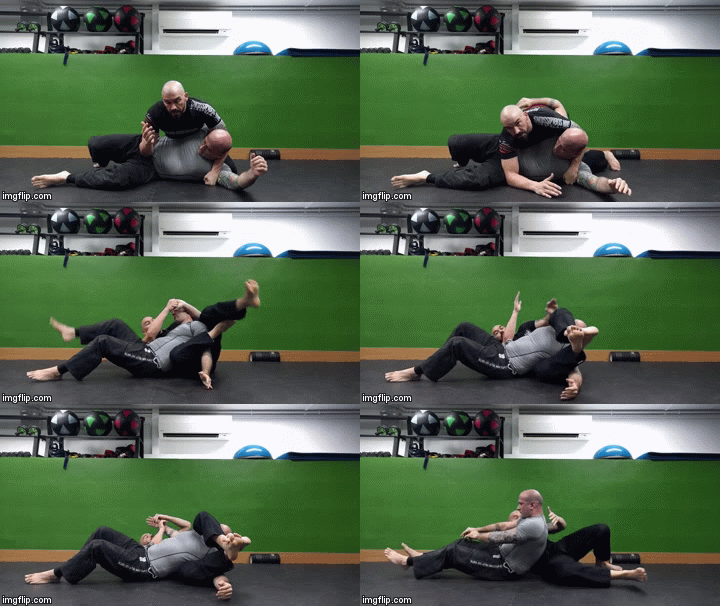
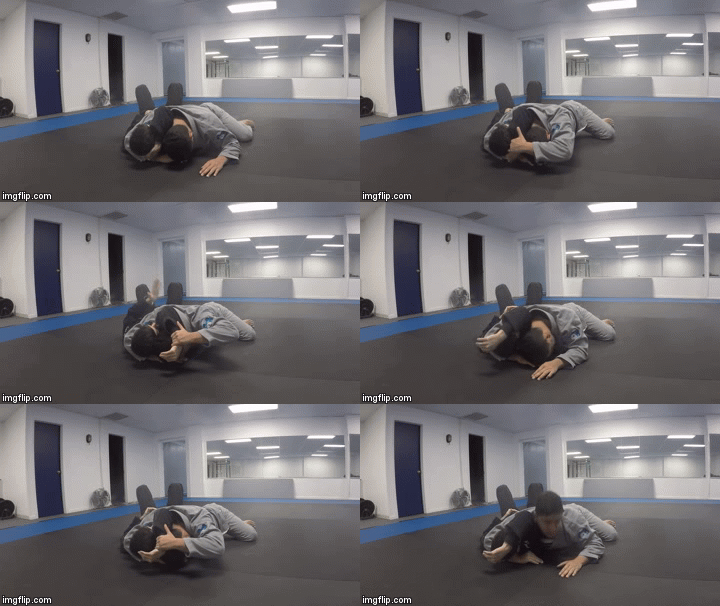
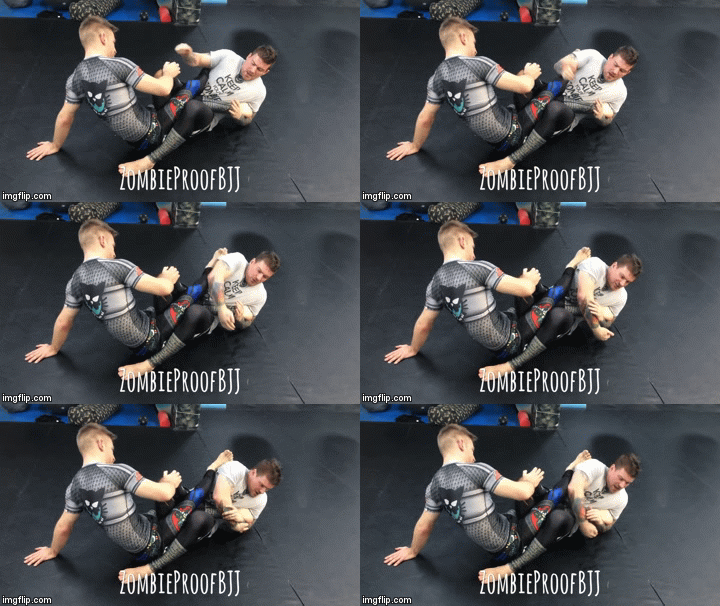
Triangle Choke DefenseFrom a full on the triangle, you need to try to get your trapped arm’s palm on the thigh of the choking leg. Use the other arm to grip the knee of the same leg. This is where the crucial moment happens. You’ll want to place the thigh of that leg on the ground by using both your arms. However, remember to also shift your hips towards the opposite side. If you simply put their thigh to the ground and remain static, your opponent can get you back, or just transition into a mounted triangle that’s a lot harder to escape.

Once you’re in proper position, use your shoulder to apply pressure on their calf. You can now use the near side knee to put pressure on their hip, thus opening up their triangle. AS a bonus, you’ll land in side control once again.

The Triangle Machine – Craig Jones DVD REVIEW

The Hidden Secrets Of The Reverse Triangle Choke

BJJ Scarf Hold aka Kesa Gatame Submission Essentials For Grapplers
Three Different Grips For Finishing Heel Hooks

Heel Hooks Grips

The devil is in the details. This is one of the truest statements you’ll ever here in regard to Brazilian Jiu-Jitsu. Speak of the devil, heel hooks are still the most notorious move in BJJ, despite all efforts to the contrary. Still, for those brave enough to accept them as just another powerful and reliable submission, they are a great grappling tool. There’s hardly a better lower body submission than a heel hook. SO far, positions for hunting heel hooks, as well as heel hook types have bee beaten to death. Yet, one very important aspect of heel hooking seems to go by unnoticed. Today, we’ll try to shed some light on the grips you need to finish a heel hook on anyone under any circumstances. 

As I go deeper into the world of grappling I definitely realize the importance of the small things in Jiu-Jitsu. There are plenty of things we take for granted at the beginning. Grips are high on the list of important things that people only address when they’re more advanced. Grips area actually the essential part of any BJJ exchange. They allow a connection, control, attacking or defensive actions and execution of submission holds. To that extent, most BJJ techniques have more than one grip position. Furthermore, grip positions tend to have a hierarchy, where some work a lot better than others. Heel hooks are no different and with a solid understanding of grips, you’re finishing rate is going to skyrocket.

The heel hook is a great submission to have in your toolbox, regardless if you’re training in the Gi or No-Gi. Heel hooks are very high percentage of submissions that have their place in BJJ. There’s no need to outlaw them for fear of injury if training and teaching are approached correctly.

Heel Hooks Overview

The heel hook is a twisting submission that puts your whole leg under tremendous pressure. It works much as a wrench does. The basic principle is one of leverage. You use the ankle joint as the wrench to a strong elicit twisting motion of the knee. The force from the trapped ankle joint travels along the shin, multiplying as it reaches the knee joint. The control over the ankle, as the name suggests, comes from “hooking” the heel. Damage occurs in different ligaments of the knee, depending on the variation.

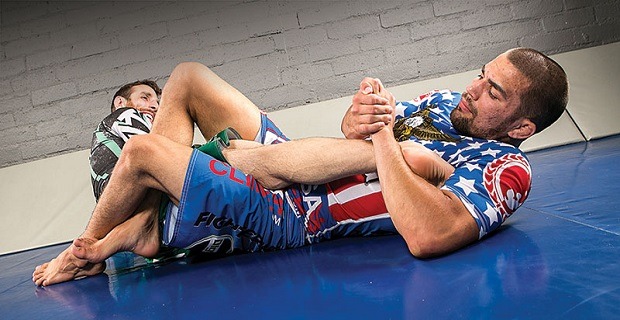
Outside Heel Hooks Grips For heel hooks, there are two main variations you need to be aware of. Those are the outside heel hook and the inside heel hook. The outside version is when you have your opponent in a straight Ashi Garami, for example. The goal is to place the heel of the opponent in your elbow crease while placing the toes of the foot under your armpit. From there, you grip and use braking mechanics (pull and twist) to tear the lateral ligaments of the knee.
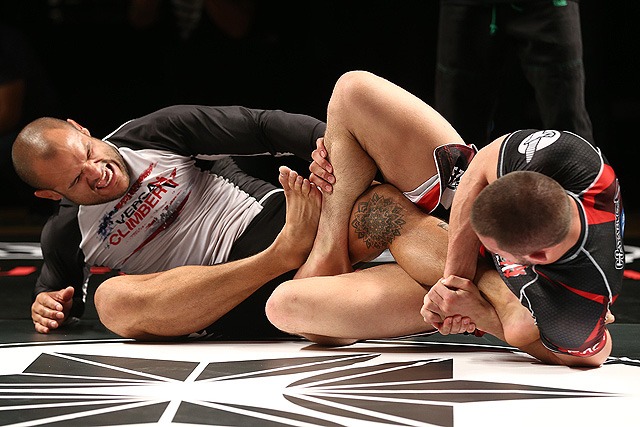
Inside Heel Hooks Grips While both heel hook variations can cause significant damage, the inside heel hook is considered to be the more dangerous one. This is mainly due to positioning, which dictates the move’s mechanics. The 4/11 position is the ultimate spot for inside heel hooks. For an inside heel hook, you have the inside of the opponent’s leg facing Up. This means that you need to hook the heel on the opposite side compared to an outside heel hook. This means that the pressure on the knee is much greater, due to the fact that your body is now to the side of the knee, as opposed to behind it. Placement of the foot and finishing is pretty much the same.
Grip Hierarchy

Even if you get everything right with positioning and placing the opponent’s foot between your elbow crease and armpit, you won’t get a submission unless you connect your hands. For heel hooks, there are three basic grip positions that pretty much guarantee you’ll get a tap.

The basic idea behind connecting your arms is to create a closed circuit situation where the foot can’t slip out. Furthermore, the arms help reinforce each other in a position of control. This means that even if you lack in hip control, your grip is going to allow you to stay connected until you adjust your overall position. Even if an opponent rolls, you can easily follow and decide where to finish the submission. While not something to be encouraged, you could also use grip variations to ensure a last-ditch tap when an opponent is already slipping out of both position and submission.

Craig Jones DVD Down Under Leg AttacksCraig Jones is a master of heel hooks that has no problem re-adjusting grips as he goes. Learn all the secrets of the heel hooking trade, along with crucial gripping information from the “Down Under Leg Attacks” DVD instructional.  It will answer all your leg locking questions, guaranteed!

There’s one more aspect of grip placement for heel hooks you have to consider. Usually, when opponent’s see that they can’t beat your Ashi Garami, they’ll focus all their attention on grip fighting. While grip fighting is not the subject today,  maintaining grips can spare you a lot of time and effort. A well-placed grip is going to be immensely difficult to break, especially those higher up the hierarchy.

Palm To Palm Grip

The most basic grip people usually associate with heel hooks is the palm to palm grip. Suffice to say, all grips we’ll cover today work on both the outside and inside heel hook. With the palm to a palm grip, the goal is to use the sharp part of your wrist, right below your thumb, to create a sort of a platform for the opponent’s heel. The bony part of this wrist area needs to come under the heel and prop it upwards towards your ribs. It also acts as a wedge to keep the foot stuck along with your armpit squeezing on the toes.

Heel Hooks Palm To Palm Grip The other arm is going to go over the shin and connect with the first one. For a palm to a palm grip, you need to remember that you need a thumbless grip. Keep both your thumbs tightly glued to your palm. Involving them in the grip is going to make it a lot weaker. To place the grip, make sure the thumb of the second arm goes to the pinky finger of the arm that is holding the leg. From there, interlock both palms and stick your elbows as close to your torso as possible. Now, you can think about finishing.

Butterfly Grip

The palm to palm grip is the first grip in the first one in the heel hooks gripping hierarchy. It is very effective and the easiest one to obtain. However, it is the least secure of all the grips and certainly not the tightest one. Second, on the ladder is the butterfly grip. it is essentially an extension of the palm to a palm grip, one that offers much more control and tension.

Heel Hooks Butterfly GripYou can get to the butterfly grip directly, or move up from the palm to palm grip. For this grip, you want to focus on the same part of the wrist you’re using to create a platform for the heel. This time, though, you want the same wrist area of the top arm, reinforcing the arm holding the heel. SImply place this part of the wrist right under the palm on the opposite side of the other arm. The Butterfly grip makes everything much tighter and requires less range of motion for you to finish a heel hook.

Reverse Butterfly Grip

The reverse butterfly grip is the ultimate heel hook finishing grip. Pair it with an inside heel hook attack form the 4/11 and you have an all but certain tap. The reverse butterfly grip in not only the tightest and deepest one, but it is also the most secure one. There’s no way of breaking this grip before a heel hook comes on.

Heel Hooks Reverse Butterfly GripGetting to the reverse butterfly is best done from a butterfly or palm to palm grip. However, there are direct setups as well, in case you need one. For the reverse butterfly grip, you want to use your far side arm as the hooking arm. This is opposite to both grips we saw before. Namely, you want to thread your far side arm under the heel, your fingers pointing toward the sole of their foot. The same area of the wrist creates a platform here, only your palm is facing towards you now. From there, you place the fingers of that palm on the biceps of your other arm. The goal is to get your arms in a rear naked choke-like configuration.

This one is the ultimate inescapable heel hook grip. Make sure you exercise real caution with it as it takes only the slightest of pressure to cause a major injury.

https://bjj-world.com/leg-locks-ultimate-guide-positions-submissions/

Safety Guidelines for Training BJJ Leg Locks

Two Faces Of The 50/50 Guard In BJJ

Khabib Meets Putin – Russian President With Some Kind Words For Khabib

Khabib Meets Putin - Russian President With Some Kind Words For Khabib

UFC lightweight champion Khabib Nurmagomedov has met Russian President Vladimir Putin.

Putin congratulated the undefeated UFC lightweight champion on his win adding that he’s proud of him. He described Khabib’s victory over Conor McGregor “worthy and convincing”.

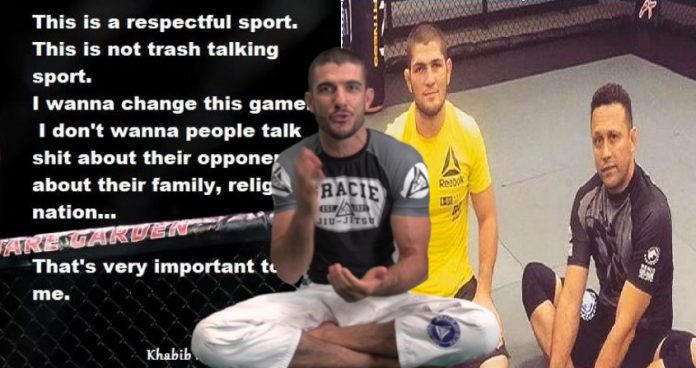
Together with Khabib was his father Abdulmanap Nurmagomedov and Putin asked Khabib’s father not to punish his son “too strictly” for the scenes which followed after the fight when Nurmagomedov leaped on Mcgregor’s Grappling coach and BJJ star Dillon Danis.

“My father teaches me, you have to be always respectful. I know my father is going to smash me when I go home.”
said Khabib Nurmagomedov at the post-fight press conference.

Abdulmanap confirmed to Putin that punishment was coming:

“I will impose a punishment tougher than the UFC’s. I warned him. For me, discipline comes first. You do whatever you want in the Octagon, [but] outside — this is the border of civilians, where there are children, women, strangers.”

Translation via RT

https://youtu.be/31-3IilTkNo

https://www.instagram.com/p/BovssXVHI8h/?taken-by=khabib_nurmagomedov

BJJ Attacks From The Wrestling Cradle Position

Wrestling Cradle BJJ Attacks

Brazilian Jiu-Jitsu still has a lot to learn from other grappling martial arts. Wrestling is just one example. When we mention wrestling in regard to Jiu-Jitsu, people usually think only about takedowns. While wrestling does offer a lot in the standing department it also has something to teach Jiu-Jitsu guys about the ground. Very often, we let rules impair our judgment on whether a move is effective for BJJ or not. The truth is that even positions that are used for pinning in wrestling can be great for BJJ attacks. One such position is the wrestling cradle. A few modifications here and there and you have a very powerful position to work from. 

The key to using positions from different grappling martial arts with success is precisely modification. However, you need to have a sense of how much to change. In the example of the wrestling cradle position, there’s absolutely no need to modify the entries or the controlling mechanics. The things to change are what you can do from there to improve your BJJ attacks. And options are plentiful if you know where to look. Immense control, quick transitions, pressure, and submissions are all there for the taking.

As a position, the wrestling cradle is a really uncomfortable spot to be in. This is just one of the characteristics that makes it a perfect fit for BJJ. In wrestling, the cradle is a way of completing certain takedowns and controlling an opponent on the ground. It also allows wrestlers to shift their partners into pins. In essence, the cradle is a top position which opens up every possible scenario in Brazilian Jiu-Jitsu. So far, not many people in BJJ have used it, which means you can have the upper hand if you truly dedicate to mastering it.

The Wrestling Cradle

The wrestling cradle is a position that allows you to get the legs of your opponent near their head. As far as core concepts go, this is bang in the middle of a huge BJJ principle. Whenever you have an opponent “cradled” as such, two main advantages spring to mind. First, you have them in an extremely uncomfortable position that’s hard to escape., Nobody feels good when their knee is jammed in their jaw. Next up, folding someone like that gives you not only control but submission options like chokes and leg locks from the same exact spot.

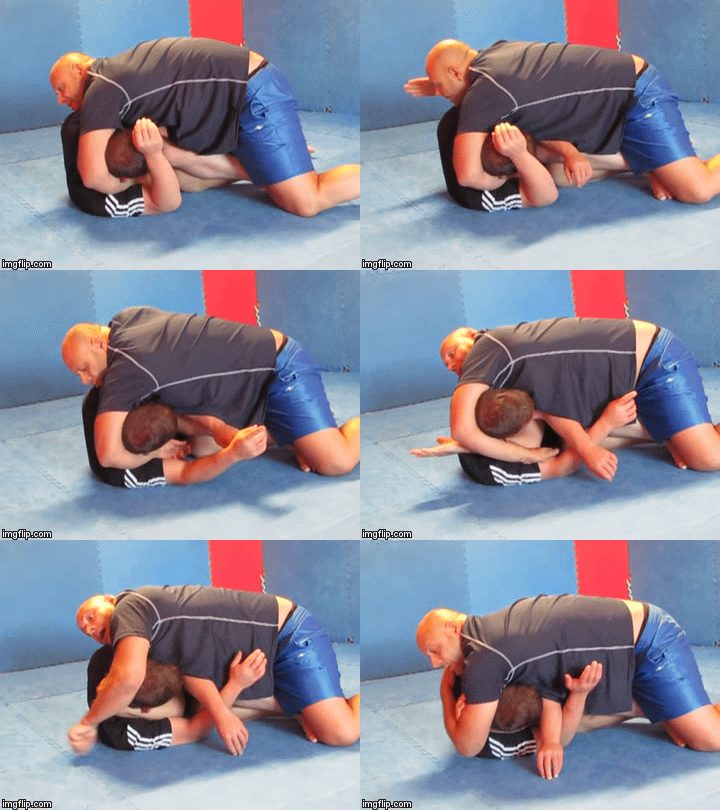
As an example, the wrestling cradle is best explained from side control. If you’re in side control and your opponent turns away, you place one arm behind their head, and the other behind their top side knee. Your goal is to connect your hands together, thus folding your opponent. This cradle position is known as the far side cradle and is a great position for launching various BJJ attacks. There are multiple grip variations you can use, but nothing beats the S-grip, at least for initial control. For the far side cradle, straightening your elbows are going to at least double the discomfort level.

If you have your opponent facing you instead of away from you, you can still get a cradle. the principle is the same, you overhook the head and the top side leg once again. This time, though, you’ll be to the front of your opponent, in the so-called near side cradle. This variation gives you more mobility and transitional power while the far side offers crazy control and pressure.

BJJ Attacks From The Wrestling Cradle Position

The cradle position offers one thing that is crucial for BJJ players – variety. The fact that it can work from both the near and far side, plus top and bottom, means you can attack in plenty of different directions. As such, the cradle can be a source of BJJ attacks as well as a great checkpoint in between them.

One great example of using the cradle for BJJ is the half guard. All it takes from the top half guard is to get the head, and you can dominate your opponent with ease. Once you have the cradle, you’ve effectively passed the half guard. All you need is to sprawl and circle to a near side cradle. From there, you could switch to a far side one, or choose whichever attacking avenue you want.

Another really crucial use of the wrestling cradle is the turtle position. This is actually the reason I started using it myself. People can really easily shut you down completely by staying turtled up as if their life depends on it. It is very hard to break open the turtle position via standard means like back takes or the front headlock. However, the cradle is right there for the taking. The head is already exposed enough and you can easily get a leg of your choosing to control. Once you get your arms in position the slightest pressure is going to open up scape to establish grips. Once you have a grip, you can tip, turn or roll your opponent to whatever position you like.

Control

As far as control goes, all you need from the cradle is to maintain your grip. For the near side cradle, you need your arms bent and you need an S-grip. For a far side cradle, your best bet is to start the same but switch to a ball in socket grip and straighten your elbows.  The ultimate goal is to cause your opponent massive discomfort. If you want to be particularly vicious, use a knee-on-ribs form the far side cradle. Aim for the floating ribs for maximum effect.

Wrestling Cradle BJJ AttacksA great way of maintaining cradle pressure is to switch back between the far and near side cradle. This allows you to stay on top of the opponent and take space away after every switch. At one point, there’ll be no more space to try and escape and you can start you BJJ attacks.
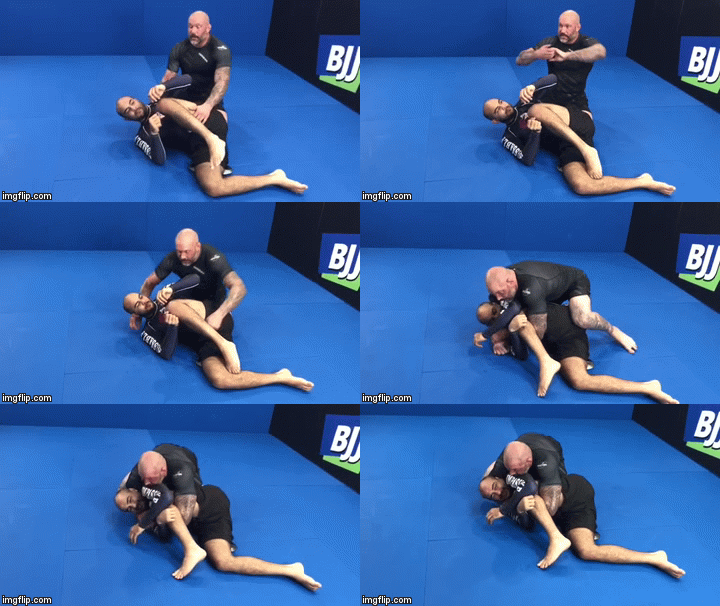
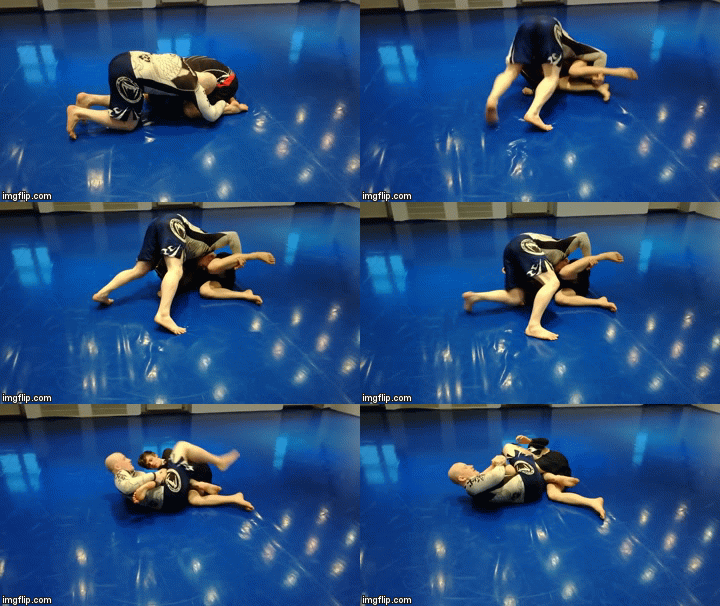
Getting into pressure passing positions is one great way of using the cradle to your advantage. From the near side cradle, you can easily switch your legs and place them in between those of the opponent. This gets you in a leg drag-like position with the cradle on. Getting your hips behind the trapped leg puts more pressure on even the most flexible of opponents. PLus you can either go to the far side wrestling cradle or pass to the back with ease.

Transitions

Transitioning between the two wrestling cradle positions are not the only options. From a cradle, you can transition into virtually every category of BJJ attacks you want. Form the near side cradle, it is extremely easy to go straight into a front headlock, with your opponent down on their shoulder. This will get you in prime position for multiple choke attacks. The transition also works vice versa, going from the headlock to a cradle.

Wrestling Cradle BJJ AttacksOn the subject of the near side cradle, there are multiple entries into Ashi Garami positions as well. While there are not many direct leg locks, getting the Ashi Garami all but ensures a submission victory.

The far side cradle, on the other hand, is essentially side control on itself. If you use the wrestling cradle to pass and end up in a far side cradle you’re already ahead. The best part of it is that the position gives you an easy path to the back, along with a few direct choking options.

Neil Melanson has a complete and very detailed series on the wrestling cradle for Jiu-Jitsu. Integral control concepts, easy submission attacks, and lightning fast transitions. Check out his “Catch Wrestling Formula” DVD instructional set for valuable cradle information as well as plenty of other painful and efficient BJJ attacks.

Submissions

Wrestling Cradle BJJ AttacksThe fun part of BJJ attacks from the wrestling cradle. Getting your opponent to tap right away. The most obvious attacks are, of course, the front headlock chokes. From the far side cradle, most D’arce lovers are going to recognize openings right away. And not just D’arce. You could get an Anaconda, guillotine or any other choke variation you need. All you need to do form the far side cradle is release the leg and sneak the arm under the neck. the D’arce is the easiest option, but far from the only one.

Wrestling Cradle BJJ AttacksGetting leg locks from the cradle is a bit more difficult. You need to get into a clear Ashi Ggarami position to finish with any success. The easiest path is from a near side cradle into a top straight Ashi Garami. However, the far side cradle can open up even better BJJ attacks by getting you int the 4/11 position.

Wrestling Cradle BJJ AttacksThere are also really cool neck cranking options for that that like to live on the dark side more. Form a far side cradle, use the arm under the head to control their bottom armpit. This gets you in a great position to release the leg and roll your opponent on top of you, trapping their far sidearm with your legs. Now, you’re in a twister-like position with many cranks available.

BJJ Bodylock Takedown, Pass And Back Control

The Chest Choke – Catch Wrestling Submission For BJJ

Catch Wrestling vs BJJ and Which Art Has Better Submissions?

The Conor McGregor Camp – Kavanagh, Lockhart And Portal

Conor McGregor Camp Coach Kavanagh, Lockhart

Conor McGregor is undoubtedly the biggest name in the fight game. While all martial arts have their superstars, Conor transcends the borders of just one art. In all fairness, there’s hardly a person alive that is not aware of who Conor is, regardless if they’re involved in martial arts or not. Not to take anything away from Conor as the super athlete he is, but such stardom doesn’t just happen out of nothing. It takes hard work, enormous dedication, a lot of sacrifices, and most importantly, a solid team behind the athlete. MMA is an unforgiving sport and the people that get fighters ready need to really know their job. The Conor McGregor camp is arguably one of the best possible MMA camps out there. Featuring the likes of John Kavanagh, George Lockhart, and Ido Portal, one would expect nothing less.

To most people that are not in the fight game, the Conor McGregor camp members are nothing more than just names. Even people that just follow martial arts “part-time” might not know much about John Kavanagh or George Lockhart. They’re not as famous in the martial arts world as Mike Dolce or Greg Jackson. Ido Portal is even more of a puzzle. And that’s exactly what Conor wants. He has surrounded himself with people that are more than capable of making him the best fighter in the world (at one time), but who are also somewhat under the radar. Today, we’ll shed some light on the names behind Conor McGregor’s crazy success.

The Conor McGregor Camp – SBG Ireland:

The Conor McGregor camp is definitely one of the best MMA camps put together today. Conor managed to get the best people in the three most important areas for any fight camp. Kavanagh leads the line as the head coach, while Lockhart And Portal follow closely, taking care of nutrition and conditioning, respectively. But who exactly are Conor’s coaches?

The three main areas that any fight camp needs are a head coach, weight management and strength and conditioning. Obviously, the most important out of the three is the head coach, the one who is going to pull all the strings and put the puzzle pieces together. Conor has one of the best in the game in every department. Not only that but each and every one of his top picks is far from your garden variety expert in their respective fields.

Ido Portal is the most unorthodox of them all, specializing in movement rather than weight lifting and/or traditional conditioning methods. Geroge Lockhart is the nutrition guru, the man who got Conor to featherweight with no problems. He has one of the most comprehensive nutrition systems for MMA in the world. John Kavanagh is the lead MMA and BJJ coach at SBG Ireland, Conor’s original base. He is the Notorious’ head coach and the man who makes the balance and comes up with the tactics and strategy. We all know how good Conor is at playing at his strengths. Well, the three people mentioned above are the driving force behind the multiple times UFC world champion.

Head Coach John Kavanagh

Let’s start with the mastermind behind the Conor McGregor camp. John Kavanagh is an Irish mixed martial artist who heads Straight Blast Gym Ireland. He has an extensive martial arts experience himself, as well a brilliant coaching mind.

Conor McGregor Camp Kavanagh, LockhartInvolved in martial arts from the young age of 5, Kavanagh never really did anything else apart from martial arts. He is the man who brought BJJ to Ireland as far back as 1996. As a grappler, he has plenty of accolades, including fantastic performances at the Euros. In addition to being Ireland’s first BJJ black belt, John is also the first Irishman to compete in MMA. As a coach he is true to the SBG approach of training everyone together, both professional fighters an recreational athletes alike. So far, he has relocated about half a dozen times across Ireland, each time growing his pool of athletes.

Some of the most notable names that John Kavanagh has worked with include BJ Penn, Xande and Saulo Ribeiro, Ryan Hall, Ricardo Liborio and plenty of others. This is before even mentioning the greatest superstar to come out of his gym – Conor McGregor.

Kavanagh is a coach who likes discipline from his students. The first encounter with an overzealous Conor ended up in his body punching the life out of McGregor for acting out. From there on Conor knew he had the best coach in the business. Kavanagh is also a top class fight analyst and puts together great tactical gameplans for his fighters. Even in the Khabib fight, you could see that there was a solid gameplan for Conor to follow.

Nutritionist Georges Lockhart

Apart from a head coach like Kavanagh, there’s nothing more important for a martial artist and fighter than a nutritionist that knows what they’re doing. MMA, BJJ and most high level competitive martial arts all take place in weight divisions. Today’s practice is to get as light as you can so that you can dominate a lower weight class. that means that fighters need to cut weight and perform at the highest level possible. Which is where George Lockhart comes in.

Conor McGregor Camp Lockhart and KavanaghLockhart is arguably the shrewdest addition to the Conor McGregor camp. He is actually an MMA fighter himself, which is something very few nutritionists can claim. The former Marine actually grew up as an obese kid, which led him towards nutrition and martial arts training. After coaching and helping fighters cut in smaller gyms, Lockhart landed fellow Marine and UFC star Brian Stann. After flawlessly taking Stann down to 185, a flood of UFC fighters came to Lockhart, looking for smooth weight cuts. So far, he has a 100% record with all his fighters making weight.

George is known for his science-based approach to dieting and nutrition. He stays as far away from bro-science as possible and likes to be thorough about his methods. Having worked with 11 UFC world champions so far is a statement on its own about how effective his nutrition system is. After all, he got Conor in perfect health as he won two belts in two different weight classes.

If you’re interested in further exploring George Lockhart’s nutrition and weight cutting secrets, you just need to grab his “Nutrition And Weight Management” bundle. It includes a 3 DVD set outlining all his methods, as well as a 100+ page E-book containing a number of great and easy recipes.

Movement Specialist Ido Portal

Leave to Conor to choose the best, yet most unusual methods of getting into shape for an MMA fight. The most unorthodox Conor McGregor camp member is Israeli “movement specialist” Ido Portal. Instead of looking at fitness and conditioning from a weight training and running perspective, Ido likes to ta take an alternative route.

Conor McGregor Camp do Portal, Kavanagh, Lockhart A martial artist himself, Ido trained traditional martial arts before discovering Brazilian Capoeira. This unique martial art led Ido to the realization that movement, as a practice, is not something athletes consider. And there’s no one that needs a maximal range of motion and flawless movement than professional fighters. Ido’s methods include principles and movements from gymnastics, martial arts, dance, acrobatics, and the like. They are all aimed at improving movement, range of motion, reaction time, overall strength and the ability of the body to work as a whole from mechanically inferior positions.

McGregor pioneered the inclusion of such methodology in MMA training. Adding Ido to Lockhart and Kavanagh was certainly a masterstroke by the Irishman. Conor is known for his impeccable timing and movement inside the cage. A lot of it is down to the methods Ido employs in preparing Conor for his fights. Is it unusual? For sure? BUt has it been effective for McGregor? Without a doubt!

Sparring Partners And Other Coaches

Of course, no MMA camp can be complete with just three members. While Kavanagh, Lockhart, and Portal make up the core of the Conor McGregor camp, others are just as important to his success. Some examples include striking coach Owen Roddy and his infamous Jiu-Jitsu coach, Dillon Danis.

McGregor also has a huge array of sparring partners that keep him sharp and at a world-class level. Some of them, like Artem Lobov, are also UFC fighters, while others specialize in different martial arts. Depending on opponents, Conor works with top level wrestlers, grapplers, boxers, etc.

https://bjj-world.com/george-lockhart-nutrition-dvd-book/

Related Articles:

George Lockhart Diet Tips For Grapplers And MMA Fighters
Conor McGregor’s Nutritionist George Lockhart on Joe Rogan Podcast
George Lockhart Nutrition & Weight Management System DVD/EBook
A George Lockhart Meal Plan For Brazilian Jiu-Jitsu

Gordon Ryan DVD/DIGITAL/EBOOK – Getting SWOLE As A Grappler

Gordon Ryan DVD Strength And Conditioning Secrets

There’s one name you’ll get from most people in the grappling world if you inquire about who the best grappler of today is. That name is, of course, Gordon Ryan, AKA the King. Gordon is definitely one of the most formidable grapplers to ever step on the mats. For now, he won everything he could have in No-Gi and is now aiming to repeat his efforts with the Gi. He is a supreme grappler on the mats and also one of the best-conditioned athletes in the game.  Given his young age, there is much we can expect from the NY phenom in years to come. One thing that’s certain to pop up is a Gordon Ryan DVD. 

Gordon Ryan’s DVD/Digital/EBOOK is OUT!!! Check it HERE.

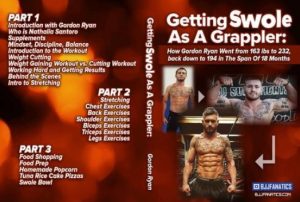
Gordon Ryan DVD/DIGITAL/EBOOK Getting Swole as A Grappler
Techniques and Programs List

Danaher was, of course, the first one out of the blue basement to produce video material on what made him famous – leg locks. Eddie Cummings, who in the meantime, left Renzo’s gym, also managed to produce some great Ashi Garami material. Even Gary Tonon got out some leg lock related content out there not long ago. It is just a question of time when a Gordon Ryan DVD is going to hit the shelves. However, in typical Gordon Ryan fashion, it is best to expect anything but leg locks from the King.

Lately, Ryan has been preparing to enter into battles with the top grapplers of the world wearing a Gi. However, until such a time comes in early 2019, Ryan is still destroying everyone left and right in No-Gi. During the few years that he’s been really active on the grappling scene, we’ve witnessed his Jiu-Jitsu evolution. A leg locking wizard himself, Ryan’s weapons of choice lately have been guillotines and rear naked chokes. He has also undergone a massive physical transformation onto one of the scariest heavyweights in martial arts!

The Early Years

Before any talk of a Gordon Ryan DVD, lets’ see how Gordon became such a household name in grappling. Born in New Jersy in 1995, Ryan started BJJ in his teens, thanks to Miguel Benitez. It didn’t take long for Ryan to end up under the tutelage of Tom DeBlass, the owner and head instructor of Ocean County BJJ. Tom himself is a Ricardo Almeida black belt and one of the top competitors and coaches in the sport. This helped shape Gordon into what he is from the early days of his BJJ training.

Gordon Ryan DVD Strength The real moment Gordon’s thriving grappling career got a real direction was when he met and befriended Gary Tonon. Tonon was already a brown belt at the time and one of De’Blass’ top students. The tow developed a great friendship and it was Tonon who ultimately gave Ryan his black belt, after 6 years of training. However, by this time, Ryan was a product of the coaching of not only DeBlass and Tonon but also John Danaher and Ricardo Almeida.

Actually, Ryan was a brown belt for only 6 months. His flawless performance at the IBJJF World No-Gi championship brought him his black belt after he destroyed absolutely everyone in his path. In just 4 years since then, we’re all expecting a Gordon Ryan DVD to go with his future competitive efforts.

Gordon’s Rise 

After his promotion to black belt, Gordon started his meteoric rise to the very top of the grappling world. At this time, he was already a professional grappler, training at both Ocean County and Renzo’s Academy. Aged just 20, he began grappling in invitation-only tournaments like Sapateiro. It was there that he got a notable submission victory over Enrico Coco. Not long after he beat 10th Planet Jiu-Jitsu standout Nathan Orchard announcing himself to the black belt division.

Gordon Ryan DVD It was Eddie Bravo’s EBI that truly launched Gordon into stardom. During the sixth installment of the tournament, due to an injury to then team-mate Eddie Cummings, Ryan got the chance to compete. He went on to beat everyone via submission. He also demonstrated his versatile game by defeating huge BJJ names with both chokes and leg locks to become EBI’s first absolute champion. Not bad for the underdog of the event.

Gordon went on to dominate the EBI scene, becoming the middleweight, welterweight and once again the absolute. During this time, Ryan also took part in super fights and challenges, beating everyone that stood opposite of him on the mats. The King was born, and he wasn’t even 22 yet.

On top of all these grappling accomplishments, Gordon is also known for his incredible physique. When he first competed at EBI 6 eh was a tall, yet not overly muscular kid. Look at him today, and you’ll see a Viking-like warrior ready to tear people’s head and legs off. Perhaps we might enjoy a strength-based Gordon Ryan DVD more than a technical one?

Gordon Ryan’s DVD/Digital/EBOOK is OUT!!! Check it HERE.

The Supremacy Of The King

The real pinnacle of Gordon Ryan’s reign came last year, at the ADCC in Finland. By then, everyone knew who they were up against in Danaher’s most famous pupil. Yet, it seemed that nobody was truly ready to deal with what Ryan brought to the table.

Gordon Ryan DVD Strength Secrets Competing in the 88 kg division, Ryan utterly destroyed everyone winning gold with apparent ease. He submitted each one of his opponents, including a huge star in Keenan Cornelius. Ryan went on to dominate the absolute division a well, beating Cyborg Abreu, Craig Jones, Mohamed Aly and eventually losing to Felipe Pena in the finals. To medals on his second ADCC is as good fo a result as possible for such a young, yet dominant grappler.

About a month ago, Ryan again confirmed his prowess in No-Gi. Busy preparing for his Gi campaign and hopefully, a Gordon Ryan DVD, he still managed to conquer gold at the 2018 No-Gi Pans. He just confirmed that he can beat top names under any ruleset and that he is far from a heel hooking one trick pony.

Currently, Ryan is popping up here and there as part of huge super fights in many organizations. We’re all anxiously expecting to see him compete in the Gi, opening up a whole new chapter to his outstanding grappling career. And, if his latest comments after the UFC 229 debacle brawl are anything to go by, MMA is also on the horizon for the King.

Upcoming Gordon Ryan DVD/DIGITAL/EBOOK

Yet, before he gets to compete in MMA, and even perhaps in the Gi, we’re going to get a real treat in the form of a Gordon Ryan DVD. The king is going to do a complete opposite of all his teammates and coaches, though. Just look at the body of Ryan, and you’ll understand that he has more to offer. He underwent an amazing physical transformation in a very short time. His training regiment outside the gym allows him to perform on the mats in the way that he does. You’ll never see Ryan gassed out, or having insufficient strength to deal with opponents of all weight classes. What is his secret?

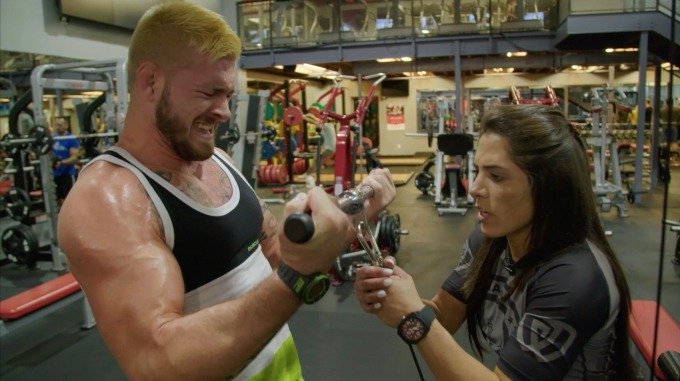
Gordon Ryan DVD Strength Training So far, there have been a few short insights into Ryan’s training regiment for strength and conditioning. What is apparent is that he works just as much as he does on the mats. His regiment is under the guidance of model/bodybuilder Nathalia Santoro, and now, we can get a sneak peek into his routine. Or perhaps an event the whole system!

As far as a Gordon Ryan DVD goes, know this – the King is currently working on one. And, we can confirm, it is going to be about strength and conditioning. More specifically, it is going to outline his strength and conditioning routine as well as his whole approach on the subject. Expect nutrition tips to be included as well, along with some weight management tips. We’re all excited about this release, and so should you!

Getting SWOLE As A Grappler: The Review

Well, the moment this Gordon Ryan DVD was announced, we hoped for a peek into The King’s routine, and perhaps a bit extra information. Well, he took us all by surprise by delivering a very detailed outline of how to train for grappling. Not only that, but he also includes something nobody expected – weight cutting trickery! Yeah, the knowledge of Nat Santoro truly shines in this release, which not only features DVDs but a very, very comprehensive EBook as well.

Gordon Ryan’s DVD/Digital/EBOOK is OUT!!! Check it HERE.

Gordon Ryan DVD/DIGITAL/EBOOK Getting Swole as A Grappler
Techniques and Programs List

As far as systematization goes, Ryan keeps things as simple as humanly possible. Three discs make up this DVD set and each tackles a very specific subject. The first one contains everything you need to know about the set and the basics of cutting weight and gaining it. The second is all about exercises that fit the bill for grapplers. And finally, it’s a volume that focuses on nutrition and easy to prepare recipes. And this is all before you even get to open the E-Book.

DVD 1 – The Basics

Kicking things off is an intro to the material that follows. While we do not really need an intro to how Gordon is, the information on his coach was more than welcome. it turns out that Nathalia Santoro is a real genius in the gym, on top of being an accomplished competitive bodybuilder. Still, the stuff she teaches Ryan is more than functional for grappling. After all, there’s no better testament to this than Ryan’s performances on the mats since his immense transformation.

Still, on the subject of introduction, the first Gordon Ryan DVD also covers supplements before it goes into training. AS you can see, Santoro has a very specific plan that’s based on quality and timing as opposed to quantity. Ryan and Santoro also outline the need for supplements that grappling and strength and conditioning imposed on athletes.

The training itself is split into a weight cutting phase and a building phase. The first thing to know is that it is going to take time. After all, Ryans own SWOLE journey lasted a year and a half. So, to begin with, the clearest explanation so far of how to train for bulking and cutting is right here. There are also some tips on how to approach your training from a mental attitude perspective. Before they move on to the specifics of the workouts, Santoro and Gordon share their tips on stretching for the competitive grappler.

DVD 2 – The Exercises

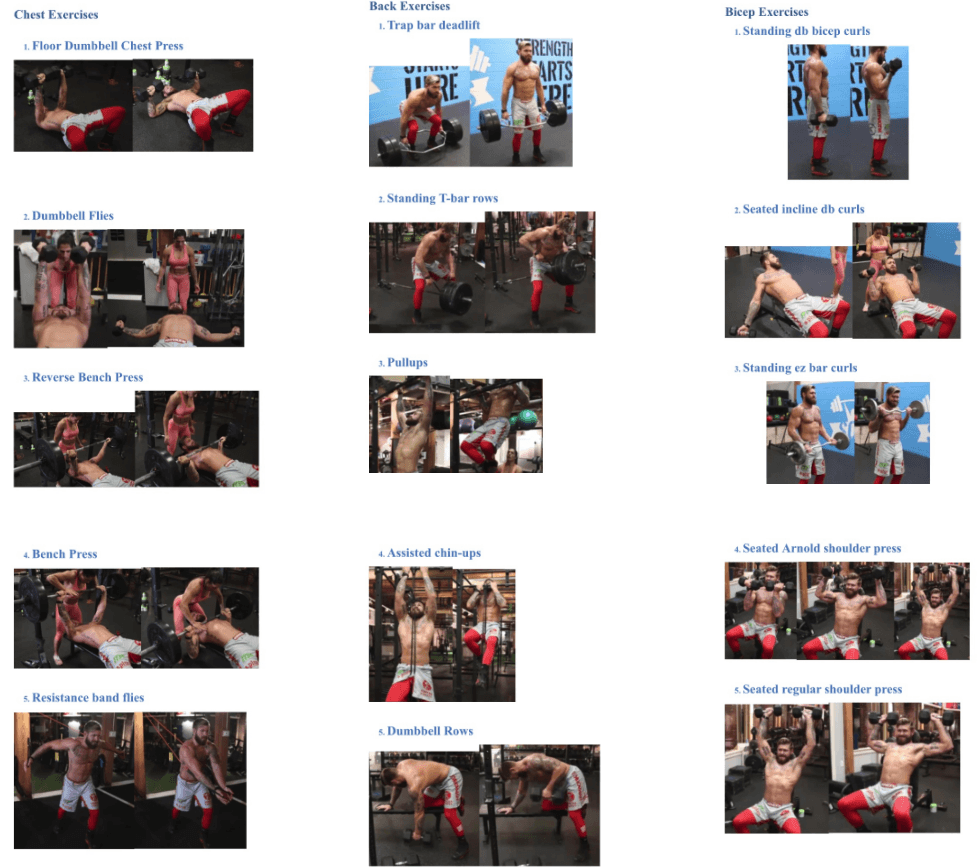
Gordon Ryan DVD Getting SWOLE as a grapplerWithout any needless wasting of time, Ryan and his coach go straight into the deep end. The second DVD is split in chapters, each dedicated to a specific body part or muscle group. Within each of these categories, Ryan demonstrates the best exercises that you can do to ensure you bulk up the right way.

The DVD begins with an overview of stretching, continuing right where DVD No.1 ended. Both pre and post workout stretches are covered in great detail, in a way that makes them accessible even for the most rigid grappler out there. After stretching, it is time for the exercises that cover the biggest muscle groups of the body. Categories include different chest and back exercises, as well as information on programming them. Still, on the subject of the upper body, Santoro goes over the best moves you can do for your arm and shoulder muscles, before moving on to the legs. At the same time, Ryan demonstrates everything with perfect precision, leaving nothing to the imagination.

DVD 3 – The Nutrition

The final volume of the Gordon Ryan DVD set completely switches lanes. Here, it’s time to talk about the fuel behind the process of bulking up and cutting down. But Ryan doesn\’t just jump in the kitchen and offer 5 minutes worth of information on recipes. Instead, he starts at the very first step – shopping.

This DVD takes you through Ryan’s shopping routine with a detailed explanation of what you need and how to get the very best. And, since Ryan is a professional grappler who literally spends his day on the mats and in the gym, there’s aslo information on how to efficiently prepare your food for the upcoming week. And that’s all before Santoro and the King even touch the subject of recipes.

SOme very delicious recipes are included in this DVD, but that’s not all of them. There are also plenty of recipes in the E-book. Just like with the exercises, they all follow a specific goal – either cutting weigh or


Want The Jiu-Jitsu Body Of Gordon Ryan? Train Like This To get It!

Conor McGregor’s Nutritionist George Lockhart on Joe Rogan Podcast

George Lockahrt, Conor Mcgregor, Dillon Danis

Very Interesting podcast with John Kavanagh and George Lockhart, Conor Mcgregor Nutritionist.

https://bjj-world.com/george-lockhart-nutrition-dvd-book/

Related Articles:

George Lockhart Diet Tips For Grapplers And MMA Fighters
George Lockhart Nutrition & Weight Management System DVD/EBook
The Conor McGregor Camp – Kavanagh, Lockhart And Portal
A George Lockhart Meal Plan For Brazilian Jiu-Jitsu

Gracie Breakdown of Khabib vs Conor – Khabib Won The Fight But He Lost the Night

Gracie Breakdown Khabib Nurmagomedov vs Conor Mcgregor

There was a lot going on in a fight and after the fight between Conor Mcgregor and Khabib Nurmagomedov. There’s a lot of opinions about both fighters. For some, it’s pretty hard to believe that Nurmagomedov did what he did with that jumping over the fence and attacking Dillon Danis, Conor’s grappling coach.

Rener Gracie said one interesting sentence that a lot of people will agree with. “Conor Lost The Fight, Khabib Lost the night.”

“How ironic that after 25 years of MMA, there is less honor, respect, and sportsmanship in a fight than there was in UFC 1 when there were no rules and MMA wasn’t even a sanctioned sport?” – Rener Gracie

Check what else Rener and Ryron have to say about the fight in a video below.

Conor Mcgregor Punched by a guy from Khabib's team
Conor Mcgregor Punched by a guy from Khabib’s team

Renzo Gracie on Khabib and his fight with Conor McGregor:

And our champion confirms once again… “A great friend doesn’t pull you out of a fight… He comes in with a flying kick.” @khabib_nurmagomedov is the man… Congratulations my brother on an amazing win, you never disappoint.

https://www.instagram.com/p/BoolDgnDnI4/?taken-by=renzograciebjj

Sneaky Submission Counters To Common Submissions

Getting a submission finish in grappling is the ultimate way of winning a match. Not only that, but it proves your technical superiority over another trained grappler. What grappling comes down to, essentially, is just that – proving who has better technique and cunning. That said, there’s something even better than getting a submission, although it might not be a match-winning endeavor. That is getting out of a really deep and tight submission attempt. It is a great way to prove that despite your opponent’s best efforts, your technique is superior. The ultimate victory, though, brings an escape and a submission finish together. When you use a submission counter to escape and submit your opponent right away, you’re not only going to beat them – you’ll completely demoralize them.

Submissions can be really fun and attractive, but they also carry risk with them. No matter how good your positioning is, once you go for a  finish, you risk an opening. it can be an extremely small one, but it is still going to be there. All submissions offer your opponent a chance to utilize counters and surprise you. Or, if you are the one stuck in submission, offer you submission counters. Going for a submission counter to submission is never a smart first strategy. You need to try and keep submission attempts as far away from you as possible. Prevention is the best cure, but sometimes it is just not available.

When this is the case, you need to make sure you have a silver bullet ready. Do all submissions have submission counters? Probably. Can we learn them all? Probably not. However, there are a few that have proven to work over the years. We’ll present four such concepts in this article, offering you a real life get out of jail free card. Some of the counters are so common you’ve probably heard of them, like the Von Flue choke. Some, however, are so sneaky and obscure you’ve never even thought of them, And, when you see how easy and simple they are, you’ll never forgive yourself for not discovering them earlier.

The Submission Game

The submission game in Brazilian Jiu-Jitsu is why BJJ is called the game of human chess. Looking to get a submission takes as much effort and focus as it does to avoid it. Despite other grappling martial arts having submission games of their own, none is as deep as the one Brazilian Jiu-Jitsu has. The number of positions you can get a submission from alone makes it impossible to have a defense ready for everything.

The trouble with submission counters in BJJ is that they usually run in a circular fashion. That means that every counter has a re-counter, and so on and so forth. For now, some moves do not have counters yet. However, that’s sure to change as the game tirelessly evolves at a great speed. In our selection today, we focused on submission counters that are, at the moment, the finishing point of a submission exchange sequence.

The one thing you need to remember about submissions in BJJ is that they’re not as secure as you might think. Despite the best positioning possible, each individual is different, which leaves space for resistance. Setting successful submissions up relies much more on deception and hiding in plain sight than it does in the correct positioning. To that extent, when you’re looking for submission counters, the same logic applies – you need to be sneaky and deceptive.

Simple And Sneaky Submission Counters 

The thing with counter submissions is that you have only two ways of getting them. One is to have perfect timing, which is in BJJ, next to impossible. The other one is to anticipate what’s going to happen and allow it to happen instead of blocking it. This is going to lure your opponent in a false sense of security. For example, if you decide to allow your opponent Kimura grips, they’ll think they can submit you with ease. Instead, your goal is to hit a sneaky submission counter using the structure they’ve established.

There another issue that arises when you’re focusing on submission counters. If you try and use overly elaborate moves to counter submissions, you’ll most likely fail. In order to have efficient counters, they need to be as simple as possible. When you’re caught in a submission, there’s no place for inversions or crazy jumps. Simple movements and a few sneaky techniques are all you need.

Dean Lister can help you become unsubmittable while you counter each and every submission thrown your way. He has an awesome instructional, the “Worry Free Escapes” DVD set, that can solve every position you get in. Yes, it includes heel hook escapes and counters as well! 

Von Flue Choke 2.0

We’ll start with the mother of all submission counters to a submission – the Von Flue choke. This is the top choice for people when they’re facing a guillotine from the bottom. For the choke to work, you’ll need to be deep in a guillotine though, which is anything but comfortable.

Submission Counters Von Flue Choke The key thing to remember is to relieve pressure as much as you can straight away. Once you feel the guillotine grips are closed, you need to get an arm on the wrist of the choking arm and pull down. Your other arm needs to go over the opponent’s shoulder and reach down their back. This is the crucial arm for the executing the Von Flue choke.

Let’s say that you’re caught in a guillotine from the half guard. For the classic Von Flue choke, once you get your grips, you’ll need to get your head on the mats and pass to the opposite side of the choke. This will get you in a position to get a choke yourself. However, you can also hit this submission counter from the top half guard as well. All you need to do is switch your hips back and forth, while you place all your weight in their neck, via your shoulder. If you can’t quite get it, passing to side control where you’re guaranteed to finish is much easier now.

Kneebar Arm Triangle 

In today’s BJJ game, it is quite common for someone to look to get a kneebar from the half guard. The usual setup involves them grabbing your free leg and inverting, thus getting it in between their legs. Form there kneebar finishing options are plentiful for your opponent. What you must do to avoid allowing them that is react fast. Once they invert, use your leg to hook their inside leg. This will prevent the roll and trap your opponent in an inverted position.

Submission Counters KneebarOnce you have that position, you can look to get into a sort of seatbelt control. The goal here is not getting the back, though, but going for submission of your own instead. The easiest thing to get is an arm triangle. All you need to do is open up your opponent towards the initial position they came from. Now, however, because of the hook, you’ll end up in the side control getting both pass points and a tight arm triangle finish.

Answering Machine

AS you should know by now, the common defense to an arm triangle choke is called answering the telephone. Instead of allowing you to finish the choke, the opponent looks to get their forearm in between you and their head. This creates breathing space because it keeps their shoulder away from their neck. The defense is known as “answering the telephone”. All the squeezing in the world won’t help you to finish, especially if the opponent is bigger than you.

Submission Counters Arm triangle This is when you turn to the next step. This is not really a counter submission but it is a great way to counter a counter of their own. Whenever the opponent looks to call the phone, you need to have your answering machine ready. The position of their arm means that you can go for an armlock. Use your head to trap their elbow in place and get a grip on their wrist. Then, simply pull their wrist to the outside for a really painful and fast finish.

A Kimura Counter Submission To A Kimura Attack

This is one of the best submission counters I’ve ever learned in my life. it works perfectly against everyone when you set it up right. The goal here is to counter a Kimura from the half guard when you’re on top. Whenever you post an arm from top half guard, the most likely outcome is that the bottom person is going to attempt a Kimura.

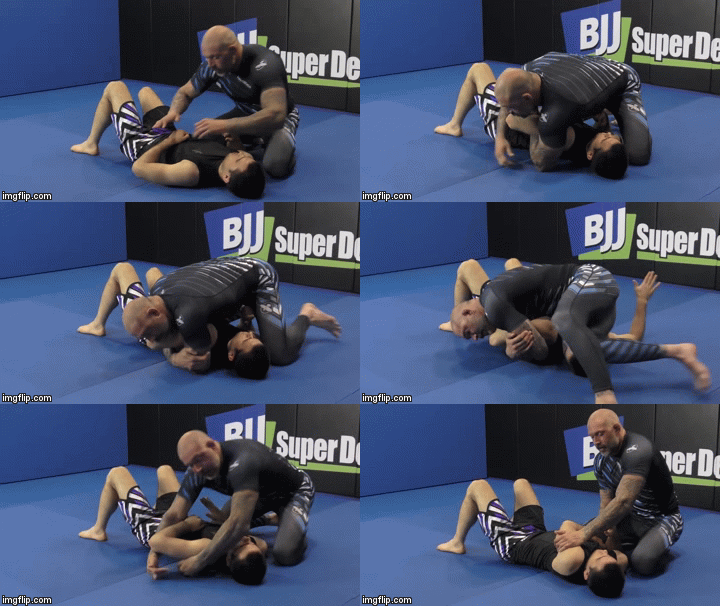
Submission Counters Kimura When they do, the worst thing you can do is panic. Instead, let them establish their grips, but do not allow them to put their weight behind the move. Instead, look to lift your arm and thread your palm between you and the opponent. This is a surprisingly strong position for you. However, the opponent won’t realize and they’ll look to hold on even stronger. This makes your counter submission that much easier. All you need to do is get a figure four grip yourself and pop their arm behind. Now, you are the one with the Kimura, but they can’t go back toward the mats without breaking their arm. Finish at will!

The Chest Choke – Catch Wrestling Submission For BJJ

Von Flue Choke – Sneaky And Powerful Submission

The Easiest North South Choke Setup

Filthy Kimura DVD – Brand New Neil Melanson Instructional

Filthy Kimura DVD by Neil Melanson

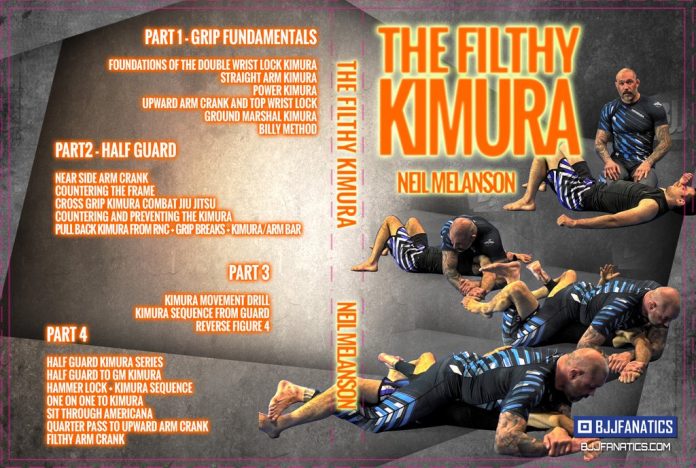
It is official – there are too many DVDs to effectively watch and learn from until the new year. 2018 has been all kinds of crazy in the ever-growing world of BJJ instructionals. Luckily, the increased quantity of instructional DVDs did not dilute the quality at all. A huge portion of the content in all DVDs that surfaced in 2018 is top-notch. A big reason for this is the choice of instructors that feature in each of them. A great example is Neil Melanson who took 2018 by a storm. The much sought-after coach released a bunch of top-class grappling DVDs this year. The Filthy Kimura DVD is his latest, and definitely one of the DVDs you won’t want to miss out on.

Paying the bills, drooling over new Gis and ending up buying a Neil Melanson DVD. I think this about sums up my bi-monthly activities. The world-class coach has certainly been busy in front of the camera lately. Neil has a whole collection of high-level ultra-useful BJJ DVDs out. And he doesn’t seem to know where the break is, much to our pleasure. His latest installment, though, caught me a bit by surprise. I had no idea it was even in the making, and the subject is something that takes Neil into different territory. So far, he displayed his love of chokes in each and every one of his releases. His latest, however, is all about breaking arms, in as many ways as possible. Given his catch wrestling background, the Filthy Kimura DVD thoroughly deserves its name.

ON SALE:
Neil Melanson – The Filthy Kimura DVD / DIGITAL

Filthy Kimura DVD by Neil Melanson
Techniques List

The Kimura is one of those submissions that people tend to discard as they gain more grappling experience. While it is taught early, it is by no means just a move for beginners. The Kimura offers as much variety as any submission, if not more. It is the best tool to teach people that submissions are also positions of control, not just simple moves. We all know by now that we can go in many different directions from a Kimura. What we didn’t know are some unexplored areas of this bent arm lock. Who better than Neil Melanson to give you a different taste of a Jiu-Jitsu classic? Time to get your hands dirty with the Filthy Kimura DVD!

Neil Melanson DVDs – What’s Not To Like? 

Neil Melanson is the man who does everything differently. And it works, in some cases even better than you’d expect! Neil doesn’t have formal grappling education, with belts lineage, etc. However, he has learned everything there is from different sources in the grappling community. And by sources, I mean grappling legends. His blend of grappling is one of BJJ, catch wrestling, Judo, all with a sprinkle of Sambo. You could say he is a grappling specialist.

Neil is much like a modern-day Bruce Lee, only focused exclusively on grappling. he likes to train a lot, and discover what actually works. Being the grappling coach of world-class MMA champions helps as well. As a catch wrestler, Neil doesn’t like to dwell on moves that might work. For him, simple is best, and the more painful it is, the happier he is going to be. Throw in some high-level understanding of Brazilian Jiu-Jitsu in there and you’ve got a winning formula!

The Filthy Kimura DVD hits the spot perfectly. It addresses a common subject in BJJ, from an uncommon perspective. As usual, Neil’s take on the subject of his DVDs is different than what you’d expect. It’s not just how to finish a Kimura from different positions. Neil uses every opportunity to advance within the submission itself, which is something others rarely address. It is simply an instructional that every grappler needs, regardless of the belt, experience or Gi/No-Gi preference.

The Filthy Kimura DVD Review:

Fitting the Kimura with Neil Melanson is not such a hard thing to do. After all, the Kimura is one of the staples of catch wrestling as well, known as the double wrist lock. While very versatile and often used in Jiu-Jitsu, there are “darker” aspects of the submission that still haven’t made their way into BJJ. Until now. The Filthy Kimura DVD by Neil Melanson is the bridge between the Kimura we know in BJJ and all the other viable Kimura options available to grapplers.

As with his previous instructionals, Neil likes to keep things simple and painful. He uses setups and positions that ensure there’s a minimum risk while you have a high percentage of success. He also goes into as much detail as humanly possible and doesn’t waste any time. As I said, a classic Neil Melanson DVD.

#1 All About The Grips

To get a Kimura, you need a figure four configuration on one of the opponent’ arms and a monkey grip. That is what we all know to look for. Well, in a grip-placement sense, there is a lot more to it. Like nobody before, Neil Melanson dedicates the first volume of his Filthy Kimura DVD to the science of grips behind the submission/position.

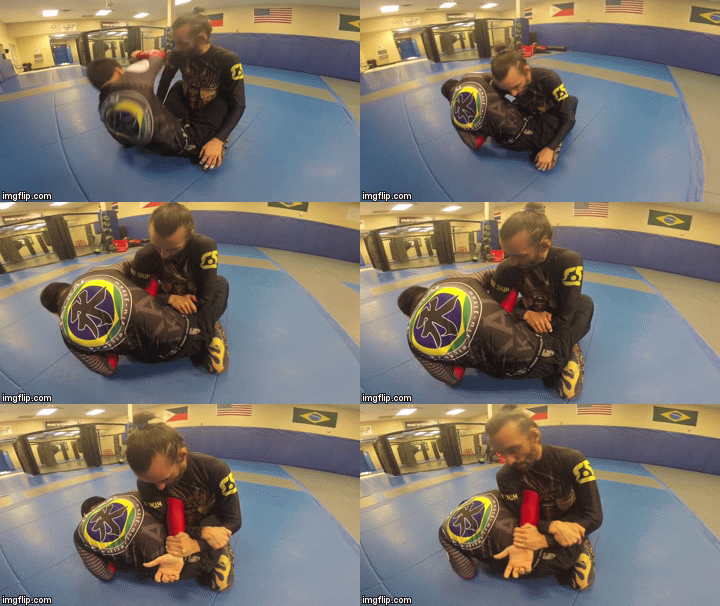
Filthy Kimura DVD Power Kimura
Click To Watch Full Video

Even in the very first chapter, he refers to the catch wrestling aspect of it, calling it the double wrist lock Kimura. While he does share some key details on the bent arm submission we all associate with the Kimura, he also goes way beyond that. He offers awesome ways of finishing the straight arm Kimura, as well as a power finish when nothing else gets the job done. And, despite the name, you won’t actually need a lot of power and strength to finish it. He also goes into ground marshall setups, which include his own wicked brand of a closed guard.

#2 Half Guard Setups

If there’s anything more common than a Kimura from bottom half guard, it has to be top half guard Kimuras. However, Neil starts with the bottom. The second volume of the Filthy Kimura DVD opens up with an arm crank submission that is completely new for BJJ guys. It is a high percentage move that’ll work like a charm for you, guaranteed.

The key moment from this volume, for me at least, was the concept of dealing with frames. You’ll have no more trouble countering any frame your opponents might try to establish. Also, for all you combat Jiu-Jitsu lovers out there, there’s a very cool way to get the Kimura with a really cool grip variation. there’s also some Kimura defense thrown in there.

The volume wraps up with a very nice sequence that involves attacking from the back. It starts with a rear-naked choke setup, that slowly morphs into a Kimura/armbar attack.

#3 Going Deep

The third volume is a true representative of a Neil Melanson DVD. It has a total of three chapters and a running time of over an hour. Neil spends a huge amount of time on crucial details that make or break the moves. If there’s one thing you should learn from the Filthy Kimura DVD, it is the kimura movement drill from this volume. Make it a mandatory drill every class and you’ll become a Kimura machine.

There is also a really efficient Kimura sequence that Melanson does from the guard. It has a bunch of moves that perfectly complement each other. Furthermore, everything starts and finishes with the Kimura. The reverse figure 4 is also an awesome upgrade to a regular Kimura finish. It is going to take some practicing though because it won’t come naturally.

#4 Top Position Kimuras

Filthy Kimura DVD Neil Melanson
Click To Watch Full Video

Finally, it is all about destroying people from the top. Once again, in usual Neil Melanson fashion, the final volume contains the craziest moves of the instructional. This volume a real Kimura lover’s dream. Form hammerlocks, through one arm Kimuras, all the way to weird arm cranks, and an Americana on top of it all. There’s no way I can do all these moves justice, as nobody can portray them the way Neil does. So go and pick up the Filthy Kimura DVD by Neil Melanson and enjoy the terror of your opponents!

ON SALE:
Neil Melanson – The Filthy Kimura DVD / DIGITAL

Filthy Kimura DVD by Neil Melanson
Techniques List