

Theodore Roosevelt’s Jiu-Jitsu Training and his view on Wrestling vs Jiu Jitsu

Theodore Roosevelt 1858 – 1919, served as the 26th President of the United States from 1901 to 1909.

The article that appeared in the New York World on March 20, 1902, revealed that President Roosevelt was training Jiu-Jitsu under Professor John J. O’Brien of Boston.
Theodore Rosevelt Jiu jitsu Training

The article notes:
“Prof. O’Brien learned the Jiu-Jitsu tricks in Nagasaki, Japan, where he was formerly an inspector of police. He has holds which can be used in all circumstances under which a man may be attacked.”

“Roosevelt hopes soon to be able to break the arms, legs or neck of any Anarchist or thug who may attack him.”

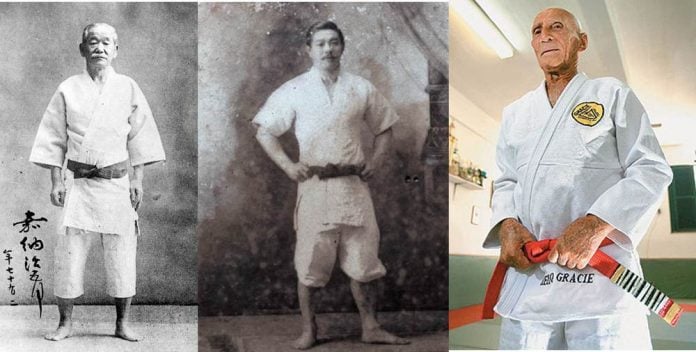
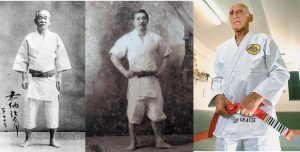
Not much after that president, Theodore Roosevelt trained Jiu-Jitsu under the most notable Japanese Jiu-Jitsu instructor Professor Yoshitsugu Yamashita. The pioneer of Judo in the US Yamashita was the first person awarded with a 10th-degree black belt in Kodokan Judo. He was also a direct student on a Judo Legend Jigaro Kano. The interesting part is that Roosevelt was taught the same Jiu-Jitsu that Mitsuyo Maeda was teaching Gracies.

Professor Yoshitsugu Yamashita

According to Yamashita Theodore Rosevelt was training Jiu-Jitsu for 3 years, 3 times per week. He also talked about Roosevelt for the New York Sun on September 27, 1914. He said that Roosevelt was his best student who was very heavy and impetuous and it cost him many bruisings and infinite pains during Theodore’s rushes.

Theodore Roosevelt’s letters to his children

According to Theodore Roosevelt’s letters to his children, we can see that he was training Boxing and Wrestling before he took classes from Jiu Jitsu. And in his letters, he made a comparison between wrestler Grant and Jiu-Jitsu Professor Yamashita. It’s a very interesting read as it’s probably something we know now and Roosevelt was saying that more than a hundred years ago.

Theodore Roosevelt on Jiu jitsu

The first Theodore’s Letter to his son Sturgis

White House, Jan. 14, 1905.

DEAR STURGIS:

Last year, when I had Professor Yamashita teach me the “Jiudo”—as they seem now to call Jiu-Jitsu—the naval attache here, Commander Takashita, used to come around here and bring a young lad, Kitgaki, who is now entering Annapolis. I used to wrestle with them both. They were very fond of Archie and were very good to him. This Christmas Kitgaki sent from Annapolis a little present to Archie, who wrote to thank him, and Kitgaki sent him a letter back that we like so much that I thought you might enjoy it, as it shows so nice a trait in the Japanese character. It runs as follows:

“My dearest boy:

“I received your nice letter. I thank you ever so much. I am very very glad that you have received my small present.

“I like you very very much. When I have been in Judo room with your father and you, your father was talking to us about the picture of the cavalry officer. At that time, I saw some expression on your face. Another remembering of you is your bravery when you stepped down from a tall chair. The two rememberings can’t leave my head.

“I returned here last Thursday and have plenty lessons, so my work is hard, hard, hard, more than Judo.

“I hope your good health.
“I am,
“Sincerely yours,
“A. KITGAKI.”
Isn’t it a nice letter?

Theodore Roosevelt as a young man

The Second Roosevelt’s letter to his children about Wrestling and Jiu-Jitsu

White House, Feb. 24, 1905.

Yesterday afternoon we had Professor Yamashita up here to wrestle with Grant. It was very interesting, but of course, jiu-jitsu and our wrestling are so far apart that it is difficult to make any comparison between them.

Wrestling is simply a sport with rules almost as conventional as those of tennis, while jiu-jitsu is really meant for practice in killing or disabling our adversary. In consequence, Grant did not know what to do except to put Yamashita on his back, and Yamashita was perfectly content to be on his back.

Inside of a minute, Yamashita had choked Grant, and inside of two minutes more he got an elbow hold on him that would have enabled him to break his arm; so that there is no question but that he could have put Grant out. So far this made it evident that the jiu-jitsu man could handle the ordinary wrestler.

But Grant, in the actual wrestling and throwing, was about as good as the Japanese, and he was so much stronger than he evidently hurt and wore out the Japanese. With a little practice in the art, I am sure that one of our big wrestlers or boxers, simply because of his greatly superior strength, would be able to kill any of those Japanese, who though very good men for their inches and pounds are altogether too small to hold their own against big, powerful, quick men who are as well trained.

The third letter from Roosevelt to his Son Ted

White House, April 9, 1904.

DEAR TED:

I am very glad I have been doing this Japanese wrestling, but when I am through with it this time I am not at all sure I shall ever try it again while I am so busy with other work as I am now. Often by the time I get to five o’clock in the afternoon, I will be feeling like a stewed owl, after an eight hours’ grapple with Senators, Congressmen, etc.; then I find the wrestling a trifle too vehement for mere rest.

My right ankle and my left wrist and one thumb and both great toes are swollen sufficiently to more or less impair their usefulness, and I am well mottled with bruises elsewhere. Still, I have made good progress, and since you left they have taught me three new throws that are perfect corkers.

As we can see in Theodore Roosevelts Letters to his children he made a clean statement on Jiu-Jitsu vs Wrestling. He said that Wrestlers are good enough to put any Jiu-Jitsu practitioner on his back but after they land wrestlers will be handled by Jiu-Jitsu practitioners.

The Difference Between Japanese (traditional) Jiu-Jitsu And BJJ

How To Practice Jiu-Jitsu As You Get Older

Actor Tom Hardy is Now a Head Ambassador of REORG Jiu-Jitsu Foundation

Hero Hoodie by Rener Gracie

Hero Hoodie Backpack Rener Gracie

Rener Gracie launched a new company named Hero Hoodie. It’s a company that will convert every garment like Hoodie or jacket into a functional backpack.

Rener Gracie’s first invention is Hero Hoodie. It is using Rener’s patent called “QuickFlip technology” which will turn your hoodie into a backpack.

If you want to buy Hero Hoodie check it here on AMAZON

Rener Gracie’s Hero Hoodie Backpack is Perfect For Any Outdoor Activity

The main reasons for this patent and Rener’s invention of Hero Hoodie are the fact that carrying your hoodie around once you’re not wearing it cause you a lot of problems. The most efficient ways till now were to carry your sweatshirt on your waist, over your shoulder or in your hand. All of those ways were problematic as the hoodie would be loose and would fall off when you move.

Rener Gracie was thinking a lot about it and came up with the best way to carry an unworn sweatshirt. He invented a patent and technology that really solve a lot of problems we all experience.

All you have to do is to flip your sweatshirt upside down. And in a few seconds the entire hoodie goes into it self creating a fully functional backpack.

Rener Gracie Hero Hoodie Backpack
Hero Hoodie on Eve Torres

For instance, if you’re engaging in any outdoor activity the Hero Hoodie is perfect for you. It solves your problems of carrying your sweatshirt once and for all. Either you’re skating, biking, climbing, running… the Hero Hoodie will be tight on your back.

The other impressive thing about Rener’s invention is that it contains extra space for your items. Besides that, you even have hidden pockets inside for your wallet, cellphone, jewelry or any other personal stuff.

Hero Hoodie Shirt Backpack
Hero Hoodie Shirt backpack on Rener Gracie

Rener Gracie Hero Hoodie Into a Backpack Video

In a video below Rener Gracie Shares his newest invention with random people on the streets near Venice Beach in California. As you can see, the reactions of people are great and a reason why you should really consider to buy Hero Hoodie for yourself HERE.

BJJ Fanatics Store
The Best Jiu-Jitsu Techniques store on the Internet

If you want to buy Hero Hoodie check it here on AMAZON

Swedish BJJ Cop Double Leg Takedown to Kimura

Swedish BJJ Cop Double Leg Takedown to Kimura

The first question about this video is, did a police officer use unnecessary and excessive force to take this woman down? But what else he could do? She was an obvious threat to him in this situation?

After the double leg takedown he went for kimura hold probably to bring her arm behind her back to keep control, detain and handcuff her. We were able to see a lot of videos where cops are having huge problems to detain people on the streets and this could be a good way to do it.

Check out a video where Police Officer is trying to arrest a BJJ Black Belt. It seems like mission impossible to him and it opens up a lot of questions on why Police officers should train Jiu Jitsu.

In the background of the main video scene you can see a woman using self defense groin kick on a cop. It doesn’t end very well for her.

https://vimeo.com/248261324

Todays “Modern” BJJ Guards Were Used in Kosen Judo Tournaments in 1952

Kosen Judo is a Variation of the Kodokan Judo competitive release that was developed by Kyoto Senman Gakko in the first half of the 20th century. It’s now mostly known as Judo Ne-waza. Ne-waza means “ground techniques” and it takes place in competitive Judo today.
Kosen Judo today is not popular, but it’s not “dead also. Kosen Judo is regaining its popularity mostly because of Brazilian Jiu Jitsu and the way that ground fighting is promoted today, as a super effective way of fighting and self defense. The sport, rules of Kosen Judo are similar with Brazilian Jiu Jitsu rules so today we can usually hear old school Judokas talking how Brazilian Jiu Jitsu is nothing more than Kosen Judo was at its best days.

We can’t really agree on that as BJJ today have much more practitioners than Kosen Judo ever had. So, with having more practitioners, more tournaments and being much more popular overall, BJJ are evolving very fast. There are new techniques popping out almost every day and it looks like it will never stop.

The only thing that BJJ practitioners can’t deny is that some “modern” techniques that are used in todays BJJ were very well known before almost a century. We just can’t say that some guards like De La Riva Guard or spider guard are BJJ specific moves. Even the names of techniques like “De La Riva guard” is suggesting that it’s BJJ specific guard because it’s named by Ricardo De La Riva who brought it to attention to the world around early 90’s.

We can be sure that, for example, De La Riva guard today, is probably much more versatile than it was ever before, but the base of most techniques today lies in the past.

In a video below, we can see a Kosen Judo tournament from 1952 where we can see many popular guards like Spider Guard, de La Riva Guard, Z guard etc.


How To Set Up A Rock Solid Game Plan For BJJ Competition

Competition game plan, Jiu Jitsu

So you decided that you’re ready to step on the mats and give it your all in a Brazilian Jiu Jitsu competition. Well, feeling ready is certainly a step in the right direction, but you might need a bit more to go from. There are two main components to the competition game plan of all the best competitors out there: the mental and the physical aspect. Interestingly, both of these aspects gave their roots in the technical aspect of your Jiu Jitsu.

Setting Up A Competition Game Plan

First and foremost, you must remember that competing in Jiu Jitsu is about fun and improvement, so make sure you stay safe before anything else. Most of us involved in BJJ will probably never get to earn substantial money from competing. With that in mind, the game plan should begin with staying safe while preparing and during the tournament itself. Before we get into the meat and potatoes of building a game plan, remember that your instructor is your best friend. Regardless of your belt level and experience, make sure your instructor is your closest collaborator.

Rule Set Knowledge

Before considering stepping on the mats to proudly represent your academy, get yourself acquainted with the rules format of the tournament you’ve chosen. The best way is to consult your instructor and go over the rules with him/her. Many tournaments have certain limitations in regard to techniques that can be used while competing. Belt level and age are important factors that often determine the finer aspects of competition rule sets.

It’s not smart to go to a tournament, having done everything correctly and get disqualified because you pulled off an illegal move. Study the rules carefully so that you can develop your A game accordingly.

BJJ

Precise Offensive Style

Hopefully you’re entering the tournament in order to win it. If not, maybe you’re just aiming to win one match. Unless you’re entering to lose (hardly viable, but who knows), you need to be ready to attack. Just going out and throwing techniques out randomly might actually work and get you a win or two, but it is not a legitimate way to go about. It might work at white belt level, or even win you a tournament at blue but that’s about it.

The first part of a competitive game plan is to fine tune your offensive options. Have your instructor help you develop an offensive game based around your strongest attributes. Let’s say that you’re really good at armbarring people. The armbar is your go to submission and you can hit it from both top and bottom positions. However, your takedowns still need work in order to be highly effective in a competition. IF you’re looking to utilize your best weapon you must make sure you have the best way of getting there. So, in our armbar example, you might decide to work on a takedown or two (depending on time) or make sure you’re the best guard puller at the tournament.

If you’re more of a control freak than a submission artist than your offensive training should revolve around positional dominance. Let’s say you have a judo background and your Harai Goshi is out of this world. Stay aware of where your favorite takedown is going to take you and how to get to where you want from there. Harai Goshi leads directly to either side control or knee belly. So, if staying on the back like a koala on a eucalyptus tree is your forte, make sure you know how to transition effectively.

Rock Solid Defense

It’s great to have immense self confidence and believe that you’re the best and you’re going to beat everyone. That’s certainly the attitude you want, but you need to stay grounded as well. Jiu Jitsu is a ruthless teacher of humility, and it will destroy your cockiness in less time than it takes to tap to a tight choke.  So be aware that there’s always someone who can beat you at any tournament.

Maybe someone is technically superior, you’ve made a mistake or just got caught. Freak situations aside, put in the time to develop a defensive base for the most common attacks. If you’re a seasoned competitor and know the game of your opponents this is an easy task. If you have no idea who you might face, then you need to cover all your bases.

A good defensive plan should be built around the ability to recognize bad positions before you’re caught in them. An ounce of prevention is worth a pound of cure, right? Positions are harder to prevent than submissions, so accept that you’ll be in a bad spot at some point during competition. As long as you know how to prevent attacking options from, let’s say mount you can stay relatively safe. From tapping out at least.

Escaping the position is a complete different ball game. A good training approach is to do lots of positional sparring from bad positions in order to get comfortable. The more time you spend looking for ways out during rolling, the easier it will be when you’re under the lights. Even if you’re the best submission artist in your category, a single slip can take you to a bad position. Know how to get out, so that you can apply your game and get the “W’.

Competition

Identify Weaknesses 

Be honest to yourself, and accept the weaknesses that your instructor might point out to you. As mentioned, you’ll most likely get punished for being too sure of yourself. Everyone has a weakness, no matter how well rounded we might think we are.

Identify your greatest weakness and make it the staple of your defensive training. If you have trouble getting out of side control, then make sure you drill it until you enjoy being there. If you have trouble passing the closed guard, on the other hand, you need a different approach. You’ll need to fine tune your offensive options and make sure you have at least one viable way of opening the guard.

Have your weaknesses determine your offensive and defensive competition game plan as much as your strengths do. Maybe even more, in fact.

Carefully Choose Your Corner

One more aspect of the competition game plan development is having a strong corner. Now, having your black belt instructor that works with you regularly is the ideal situation. However, this is not always possible and a team mate might have to step in and corner you. If that’s the case, try and find one that’s more experienced and familiar with your game. It’s important that your corner is able to identify precisely when and where you should use your game plan during the heat of battle.

The Mental Game

Without dwelling too much on the mental aspect (a complete article on the subject in-coming) we’ll cover the basics only. If you’ve decided to enter a competition, you must know why. A clear goal is essential for any athlete involved in competitive endeavours. Once again, your goals should be brave, but attainable and rooted in reality. Your technical knowledge should complement your goals. Your game plan should take you directly towards them without any space for deviations.

Manage expectations diligently and make sure your goals are realistic. They will grow and expand along  with your technical knowledge and game plan arsenal.

The Physical Game

You can only win as many matches as you can get through. As simple as this sounds, gassing out is the most common reason for losses in BJJ. It’s not just about how many rolls you can do in training. Add in weight cutting, nerves and adrenaline and suddenly your gas tank capacity is at half. Throw in a tough opponent who has the same level of technical knowledge as you and conditioning becomes the deciding factor.

If doing technical training, rolling and drilling is your main work, then straighten and conditioning is your homework. Apart from shark tank drills (position sparring with a fresh partner every round) it should be done off the mats. Proper prioritization is essential for a successful plan, tailored to a competitors needs.

Building a successful competition game plan is a complex puzzle that needs to be carefully put together. It requires balance as much as bravado and the experience of an instructor that can help you identify your best and worst traits. It’s only when you can put all of the above in a working system, that you can tart racking up the medals.

143 lbs Purple Belt Taps 300 lbs Black Belt In Competition

Transgender’s Letter to BJJ Community – I’m not a Male, I Want to Compete Without Stigma

European Black Belt Promoting A More Realistic Style Of Tournament Fighting

John Wick 2 Grappling Highlight and Techniques Breakdown

John Wick 2 Grappling Highlight and Techniques Breakdown

Check Out the Jiu Jitsu highlights from John Wick 2 Museum Scene and also check out the Breakdown of all techniques Keanu Revees used in these scenes.

Grappling Techniques:

1. Pulling Web Guard Part 1 – Firas Zahabi – Guard Pulling 2.0 Series Uploaded by Tristar – https://youtu.be/K2SvF6kXNGk

2. Koga Judo ● Seoi nage of a King Uploaded by Baki Martial Arts – https://youtu.be/Xmhu7zYVblE

3. Aikido – Shomen Uchi Sumi Otoshi ZoominMartialArts – https://youtu.be/sB1YdkVFcco

4. TONY “EL CUCUY” FERGUSON – MY TIME Pulse Vision – https://youtu.be/DIBDeJTIwp8

5. Te gaeshi Uploaded by zanzeoo – https://youtu.be/HPhrCxBg5L0

6. Behind The Back Guard Pass With Coach Neil Melanson (No-Gi) Uploaded by Hayabusa – https://youtu.be/mGmX014R4bE

7. How to Do the Basic Clock Choke (Plus Some Advanced Variations) Uploaded by Stephan Kesting – https://youtu.be/Hmz6VXltm9E

8. Kurt Osiander’s Move of the Week – Kata – Guruma Uploaded by Kurt Osiander Move of the Week – https://youtu.be/COdOiUrbxNs

9. Finalização Sergio Moraes x Neil Mangy Uploaded by Combate – https://youtu.be/zIbO3WrUGCs

10. Sode Tsuri Komi Goshi Compilation Uploaded by TheMilestone19 – https://youtu.be/4z9T4gBQ7UY

12 Weeks Transformation

Keanu Reeves: Deeper You Get into Jiu Jitsu The Less You Have Normal Life

Master Carlos Machado On Keanu Reeves, Chuck Norris, and Rickson Gracie’s Red Belt

The Elvis Choke – The Nastiest Little Choke in Jiu Jitsu

The nastiest little choke

It’s all about the movement. If you move like Elvis you get the choke. Otherwise, no chance.

It’s actually a choke from side control that is super easy to apply and something your opponent wouldn’t expect. Check out the choke in a video below.

Bernardo Faria Omoplata everyone

Transgender’s Letter to BJJ Community – I’m not a Male, I Want to Compete Without Stigma

Transgender's Letter to BJJ Community - I'm not a Male, I Want to Compete Without Stigma

This is an anonymous letter from a transgender person who trains BJJ. She’s talking about her life struggle, grappling training, and problems around competing in martial art she loves.

I grew up in North Carolina and moved to Oklahoma when I was 13. I started my wrestling career early on when I was 7. I then went to wrestle for my mid-school and my high school. It was when I was 16, in my sophomore year, I learned an adjective that would affect the rest of my life then after: transgender. I was assigned male at my birth, but I am not who my body may have to lead you to think I am; I am a woman, I use female pronouns she, her, and hers.

Transitioning can take a long time, but not everyone wants the same thing from it. I started my medical transition earlier in life than most people do, at 19 years old. As a transwoman, the medicine given to me is estradiol and spironolactone. Taking estradiol and spiro is where a lot of physical changes come from. In the 9 months since taking them the most notable effects for me have been my drop in weight, loss of muscle mass, loss of some bone density, wider hips, breast growth, and softer skin; I had already feminine features, to begin with, though the “results” are a little different from person to person depending on a multitude of factors, including age.

Early on I knew there was something about me that was different from my peers, but I wasn’t yet sure why. I knew how I was inclined to behave in certain mannerisms, but everywhere I went I was told that I am “strange”, “weird”, and even an “F*g” for doing so. I always felt shut out and put off to the side for only being myself. When I was 7 my home life got awful, my stepfather made us fear for everything, so I built up a shell and hid. I even went to wrestling practice the first time that year. There I found something I didn’t think I’d ever find. I found a sport that traditionally people would call masculine, so it was a great way for me to “conform” to a standard I was always told I needed to live up to, but I also found I love wrestling.

I would love to go to practice and compete whenever I could, and people never thought twice about who I was. I wrestled all the way up to being in high school, but when I moved to Oklahoma the social attitude about wrestling changed. It wasn’t just a masculine thing here, it was something the men did. That is when I felt the sudden dynamic about this sport I loved so much change, it seemed to me it was not going to be something I can enjoy dedicating myself to.

I have always been a feminine person, so going on the mats the first time I could feel the stares coming my way. Whenever we would go live I felt I could no longer be the me I once was. I couldn’t be too offensive or I might be seen as the “f*g” kid trying to force myself on someone and I couldn’t be too passive either as to be seen as willing submissive. Somehow me being me, was now more wrong here. I mainly watched and shadow practiced with myself to get better, and I had to now focus a lot on my defense and not let anyone throw me around. After my freshman year, I decided that wrestling may not be for me after all.

That summer, talking to one of my friends, they said a word that I never heard before: transgender. I looked it up to see what it meant, what I found was a whole community of people. I found people who were like me growing up. I found people who needed to hide. I found people I could open up to. I found a resource of self-discovery and the reasons behind why I ever felt weird or strange. I am transgender too.

Growing up wasn’t only wrestling. It was my family and the people around me saying these things I enjoyed are not things a “boy” should. I couldn’t play dress-up, learn how to apply to make up, design the fancy clothes I wanted to have, nor confide in anyone what I was feeling. I grew up with a diagnosis like major depression and anxiety without yet knowing why. Once I did come out at 17, my life went for a spin.

I could no longer stay with my parents and I had to move in with my uncle in Oklahoma City. There I was told I had to hide the fact I was trans, or I could not live there. What got me by day today wasn’t anything at home or school, it was the BJJ academy where I could learn and compete without questions. I just was who I was. But even there I felt the ever-present need to hide.

Being trans, you never know what your neighbor thinks. You don’t know what someone may want to do to you based on factors out of your control. The longer I hid, the more depressed I was. It wasn’t till I said no more that things got better. I was kicked out on my own, but on my own is where I learned to survive. I moved away from Oklahoma to get a new start, begin a new life as me, and start my transition.

Bjj is what helped me get through it all after I was on my own. I remember how I felt back home in martial arts, and I got the impression no matter where I went to train it was only going to be an unsupportive community. I found I couldn’t compete now that I am out and especially after I started HRT (hormone replacement therapy). The stigma behind trans athletes was everywhere following behind people like Fallon Fox, Chris Mosier, and Mack Beggs (another trans wrestler). One of my favorite things about wrestling was competition, but I found that it may no longer be something I can do.

I didn’t want to compete in the male division, I’m not a male, but I also couldn’t compete in the female division either. I felt like the kid off on the side again having to watch. And watch I’d see people compete at a weight category called “x” weight. People of various different sizes and weight classes would elect to compete against each other, the elegance that is BJJ was beautifully put on display with David vs Goliath type matches. I thought to myself if “x” weight can be a category of competition what possibility could there be of “x” gender competitions where any people of various different sizes and abilities could elect to compete against each other. Sadly I found no such competition in grappling where a similar format is proposed or used. It’s going to be some time till my hormone levels will be in a consistent range that I would be allowed to compete in the female division, so “x” gender competitions is something I look forward to seeing someday as an option for not only people like me to compete in without stigma, but anyone can test themselves against anyone willing.

Fallon Fox, Transgender MMA Fighter Who Broke The Skull of Her Opponent

Olympics To Allow Transgenders to Compete! Are We Becoming Too Politically Correct?

Joe Rogan on Female Transgender Athletes who Compete: It’s Bizzare and Ridicolous

An Interview with a GAY Guy BJJ Practitioner!

First BJJ Black Belt Awarded to Transgender BJJ Competitor

The Sloppy Choke – Great Trap to Setup an RNC

The Sloppy Choke - Great Trap to Setup an RNC

Quick – what is your first impression of this choke?

If you said it was a sloppy technique that you may have seen in some crappy action movie, I would have agreed with you before I knew better. Jason has shown me how this sloppy choke can be used as a feint and make your opponent defend it easily, which leaves him open for a real choke that will put his lights out. Another ingenious trap! You got to check this out to choke your buddies out!

https://bjj-world.com/danaher-back-attack-system/

Darce Choke Encyclopedia – Origins, Mechanics and Variations [2024]

Demian Maia vs Tiago Camilo Judo World Champion And Olympic Medalist

Demian Maia vs Tiago Camilo Judo World Champion And Olympic Medalist

This roll happened in Brazil in 2012.

Tiago Camilo is a well known Judoka. Olympic silver medalist in 2010 and Judo World Champion. Camilo is also knows as one of the best Judo Newaza practitioners in the world.

Maia’s comment on this roll:

“Truth is, it was really quick; we’d lifted some weights at the gym and decided to roll. Which was great, since he has excellent base and I had a hard time getting the sweep,” recounted Demian. “And it was even better because I was coming off a strength workout and was tired, so I could get a sense of what his strength was like, since the strength of judokas, wrestlers and Jiu-Jitsu players all feel different. The direction and feel his strength had, perhaps from the angle he’d hold each position, were really different; so it was cool to realize that.”

Renzo Gracie vs Paulo Miyao – Rolling