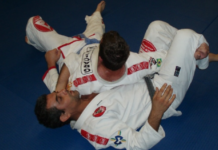
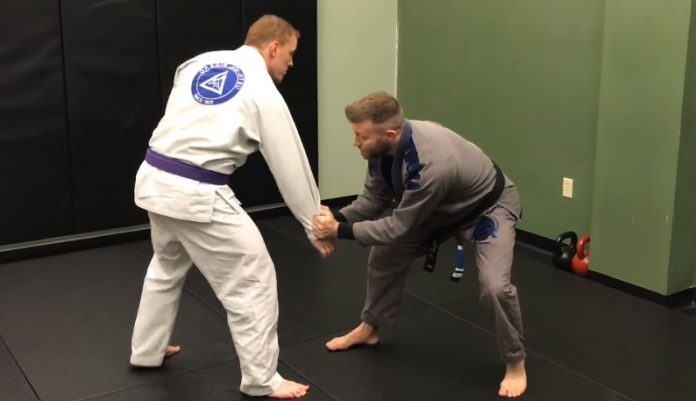
I am going to share with you today a technique I picked up from Pedro Sauer many years ago. Ezekiel Choke’s defense and Ezekiel Choke countered with a Wrist Lock.
I asked Pedro about Ezekiel Choke and defense and it’s really cool defense to the Ezekiel choke. Pedro Sauer is actually a wizard. He is an absolutely phenomenal technician and he had like five different answers for and this one stuck in my mind. I like a lot. I don’t go for as much I actually might prefer, but this one was pretty cool. It’s basically a late defense to the Ezekiel choke.
Number 1 defense is, you don’t want your neck to get wrapped.
Then the second step is blocking the second hand from coming in.
If you’re very late in the whole process this defense can work and I made it work before.
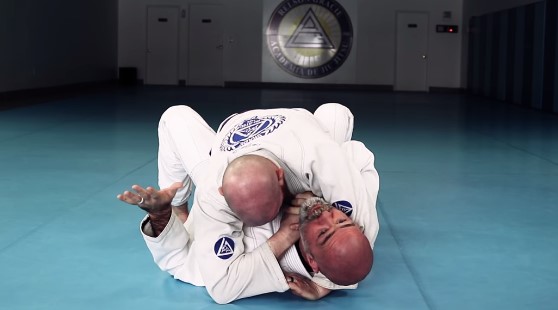
So looks like we’re here. He got this arm underneath, If my defense goes south it’s inside of this arm I’m in trouble. What I want to do is sneak my right hand in, on the side of my neck. I will hold this nice and tight here and I’m waiting for opponents second hand to come in. As it comes in I’m gonna catch it right there at the top of his fingers.
Now I’m gonna reach around above my shoulder so he can’t straighten the arm anymore. I lock it there and I bridge over my shoulder in assemblage and pushing down into the wrist.
He has to verbally tap here, so be careful because when you come up putting the weight down and you push his wrist to the floor.
So what I do is that I’m catching his hand and grabbing a hold of the fingers. I’m grabbing all four fingers on the over top of the knuckles to have better leverage. Then I wrap above the shoulder and I bridge. As I Bridge I push down into the pretty little wrist lock.
So, give it a try. Hope you like it. If you ever get a chance to train with Pedro Sauer. He’s an amazing technician and an amazing teacher. Thank you very much, Pedro, for the technique.
Have you ever heard of Oswaldo Fadda? He was a red belt of non-Gracie lineage that was among the pioneers of Brazilian Jiu Jitsu. He also managed to beat Helio Gracie’s academy after challenge the founder himself. Fadda’s students proved superior to the Gracie academy ones, winning the challenge fro Oswaldo. Their superiority over the Gracie academy students was due to their knowledge of foot locks. They utilized the BJJ ankle lock to great success, taking advantage of Helio’s contempt.
Although leg locks have remained vilified since the ankle lock managed to become a mainstay technique. It is a submission that is legal in all belts, in all competition formats. Even though the move is considered safer than toeholds and kneebars, it is just as effective if not more. Today’s modern leg lock game gave this submission even more option to shine. The positional approach of modern leglockers allows even more versatility when ankle locks are in question.
Execution Of The BJJ Ankle Lock
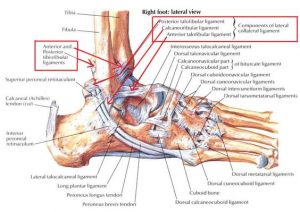
The ankle lock is far from a simple move in mechanical terms. The ankle is actually the most complicated joint in the human body. However, in relation to submission, the complex anatomy of the joint actually makes it weaker. The ankle consists of three main bones that are held together by a whole bunch of ligaments. It is these ligaments that are the main target of ankle locks, most of the time. In certain cases, a larger connective structure we know as the Achilles tendon is the focus of attacks.
Structurally, it is important to have a proper grip in order to exert maximal force on the ankle. The grip used for ankle locks is very similar to the one used for the guillotine choke. The arm that goes around the ankle is crucial for the submission. Namely, a very specific part of the arm is considered to be optimal for the lock. As Dean Lister states below, this is the part of the forearm right above the wrist. The palm of the locking hand should be kept at chest level, helped up by the other arm.
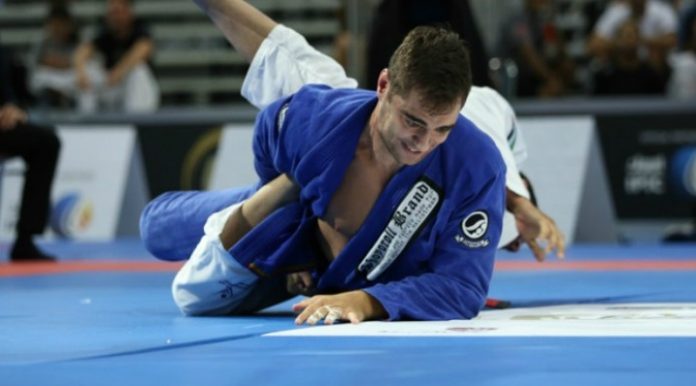
The BJJ ankle lock can be finished in a few different ways. Ultimately, the goal is to create the proper angle by lying on the ground and extending. But before the hip extension comes into play, there has to be pressure. The best way to place pressure on the foot, considering that grips are in order, is with the help of the lats. A shrug of the shoulders, while tightly gripping the ankle, is going to cause a bend in the foot that increases the force upon the joint. This way, all the connective structures of the ankle are put under strain, as opposed to just the Achilles tendon.
Positional Options
High positional control is essential for proper execution of an ankle lock. As we discussed, the ankle lock focuses on breaking the connection between the bones of the ankle. This is rarely the outcome, though, because pain usually causes the opponent to tap. Given that proper mechanics (grips and pressure) are applied there’s no escaping the BJJ ankle lock without injury. However, in order to be able to apply the breaking mechanics, one has to sufficiently control the opponent.
In terms of positional dominance, we’re going to focus on those positions legal in all competitions. Although not the most dominant among leg locking positions, the following provide ultimate finishing opportunities for the ankle lock. Remember, that control is crucial for a successful submission. In order to obtain control, positional dominance has to be acquired.
Ashi Garami
Translating as “leg entanglement’, the position has been named and made famous by John Danaher. The position is essentially a prone Single Leg X guard, with a few small but essential modifications. Namely, in the Single Leg X, the foot that’s on the inside is hooked around the same leg, whereas in Ashi Garami it hooks the opposite buttock. This allows for rotational control of the opponent’s hips. From there the same mechanics as above apply. A good grip and tight pressure should be applied, before going down on the shoulder and using the hips to finish the submission. Defense is scarcely successful once a strong Ashi Garami is obtained.
50/50
The 50/50 is still considered by some to be just a stalling position. However, it can be far more than just a sweep exchanging situation. In terms of leg locking, a very tight BJJ ankle lock can be applied from the 50/50 guard. The mechanics are a little bit different than with Ashi Garami, but the same principles apply. Since the leg is across the attacker’s body in 50/50 the locking arm goes around the ankle from the opposite side. In order to finish, the leg should be kept on the top side, and a twisting motion is done in place of a straight hip extension. Check it out below:
The tripod ankle lock is fast and effective, available from two main situations. Firstly, it is a great option to grab an ankle lock from the top position. Secondly, it offers a fast and effective counter to an opponent escaping Ashi Garami. In both situations, the point is to end up in a belly down situation, with the same grip as before. Both legs and an arm, or the head should be touching the ground, thus forming a tripod. The finish is the same as in a belly down armbar – a simple hip extension.
Like it or hate it, the belt system in Jiu-Jitsu has its advantages. When people get promoted properly, after achieving certain benchmarks, it makes a lot of sense. Belt buying incidents aside, a BJJ belt takes about 2 years on average. In those years the student is, probably, truly on the level the color indicates about halfway. Before that point, more maturity is needed, while after it the transition to the next level slowly begins. Every belt represents an important period in a grappler’s journey through BJJ, each with its own requirements. However, arguably, the purple belt is both the hardest the most fun of them all.
Despite some people thinking that the blue belt benchmark is the most important, I tend to disagree. Important as the transition from the white belt is, the blue belt is still considered the most likely period of quitting the art. Reaching purple, on the other hand, demonstrates resilience and true dedication to the art. Not unexpected, as it usually takes about 4-5 years of training to really reach the proper purple belt level.
The Road To Purple Belt
Although every school, or rather organization, has slightly different requirements regarding belts, in each one of them getting to purple belt requires hard work. When it comes to the requirements for someone to be promoted to purple belt, they are quite complex.
Receiving a blue belt marks one’s familiarity with Jiu Jitsu, the basic positions and moves. During the blue belt period, a practitioner starts to become aware of certain patterns of BJJ. For example, a kimura is not just a solitary move, as it can lead to armbars or the back. Even though moving between them is still difficult, the patterns are recognized for being there.
As a blue belt matures at that level, their game starts to change towards that of a purple belt’s. When an instructor sees an experienced blue belt roll with anticipation instead of aggression, they start to consider promotion. Replacing two or three move combos with more fluid movements that now connect dominant positions, signify maturity in one’s game. As soon as a blue belt starts thinking more conceptually and less of moves, they’re ready for promotion.
At this level, personality traits, mat attitude as well as behavior outside of the gym start to matter. A purple belt isn’t promoted merely by the level of technical knowledge. Reaching the upper tiers of Jiu-Jitsu requires a degree of stability and dedication to the BJJ lifestyle.
Developing Your BJJ Identity
A well-known quote in BJJ is that a purple belt knows all the techniques that a black belt does. The differences between the two are in the details. This actually describes this level really well. Purple is the time when a practitioner has the tools to start developing their own game. They have enough experience to know what works for them and should have an open mind for experimentation.
At the purple belt, movements become more important than just solitary moves. Stringing techniques together is a blue belt trait. Movement is fluid, smooth, and purposeful. Very little extra energy is spent when attacking or defending. The experience of a solid purple belt is very evident in their game. There is next to no panic defensively and purposeful aggression when a submission presents itself. It is not just the movement patterns that are fluid at this level, but so is the chaining of techniques. A purple belt doesn’t stop when something fails and should be able to recognize if and when they should go forward or return to a position.
Probably the most impressive ability of purple belts is their transitioning skills. They know more than enough to hold a position or attack submission. Despite not being aware of every little detail (brown and black belt level) they know how to get into a position. Or, out of one, for that matter. Seemingly effortless cat-like movement, while in total control, is a mark of a legit purple belt. Anticipation levels are very high in purple belts since they’ve spent countless hours on the mat. You know that mind-reading feeling you get when you roll with a black belt? Well, that gets developed mostly at purple belt, thanks to the experience and mindful rolling.
The Teaching Belt
Purple belt is the period when a student of BJJ makes another huge transition. This is the time when they are introduced to teaching. Whether it is kids’ classes or fundamentals, purple belts start to give back to the community. The benefits of learning are plentiful for them.
A purple belt teaching a class gains valuable teaching experience before anything else. A teaching style is just as important as a rolling one. Not everyone wants or can be a teacher, but everyone should try it, just like the competition. Another important aspect is that purple belts get to refine their technique through teaching. Repeatedly demonstrating moves allows them to discover new details and opportunities. These nuances are hard to find during the stress of rolling or competition, so teaching allows purple belts to slowly start climbing towards the next level – the detail-orientated brown belt.
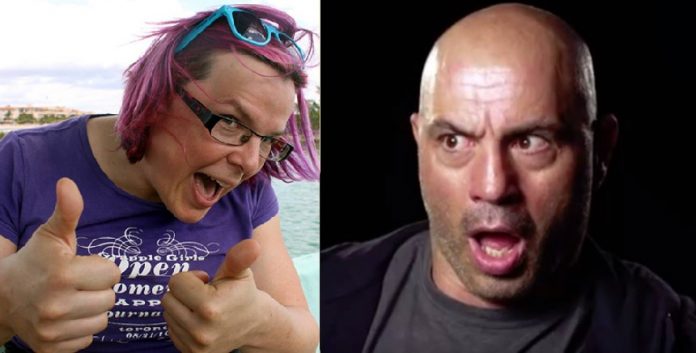
Joe Rogan and Tom Segura discuss whether they think male to female transgender athletes should be able to compete against women.
Joe Rogan and Tom Seguera obviously don’t support Female Transgender athletes who compete against other females and they have “thousands” of reasons for that.
Here are some of them and you can watch the video below for more.
“You have the right to live your life in play but like you have all those skills that you developed as a man and now you’re playing against frail or smaller is silly. And the fact that you can’t bring that up and that it’s offensive is ridiculous to me.”
“Well, especially when it comes to fighting. I really understood like how bizarre and offensive, cult-like this ideology is..”
“What if I transition to a woman and I do powerlifting.”
“You have people have done that and they’re winning and breaking all the records”
Can you imagine if you’re a biological woman who’s been training and working hard all her life and all of sudden you have to compete with “this”. The transgender female is like she’s a giant. Look at the size of her head, formerly male head. It’s a giant woman. It’s just a way to get medals. It’s sandbagging. That’s not fair.
We don’t even have to mention what Joe Rogan said about Fallon Fox as those were the most brutal words Joe Rogan actually said about anyone.
Gracies had a hard time spreading their art to the world. It took almost a century until the world found out what Brazilian Jiu-Jitsu really is and how effective it is. It took a lot of modifications to the previously known arts, a lot of challenging fights and above all, it took a lot of enthusiasm and belief in something. In something that will prove to the world that fighting is much more than just kicks and punches.
Helio Gracie’s Brazilian Jiu-Jitsu Legacy
Helio Gracie was learning Japanese Ju-jitsu from his older brother, Carlos Gracie. Carlos learned Japanese Jiu-Jitsu from a Japanese master Mitsuyo Maeda in the early 1900s. The thing is, Helio Gracie was very frail. As a young boy, doctors restricted him from involving himself in any type of physical activity because he would run up a flight of stairs and pass out from exhaustion. They didn’t know what it was, they just knew that he really couldn’t participate in anything strenuous.
When Helio Gracie learned Japanese Ju-Jitsu techniques as a young boy, he wasn’t as effective as his older brothers. He didn’t have the physical attributes that were required to make these techniques effective.
Out of necessity, Helio began modifying the techniques, reducing the amount of strength, power, and explosiveness necessary to make them work. And he began incorporating more leverage, timing, energy efficiency, and technique ultimately.
These modifications gave birth to what is now known as Gracie Jiu-Jitsu or Brazilian Jiu-Jitsu. Helio became so proficient in his modified version of the art that he surpassed his brother’s ineffectiveness.
Helio Gracie
The Beginnings of Gracie Jiu-Jitsu Challenge Fights in Brazil
At that point, he began engaging in challenge fights, Gracie challenge Fights in Brazil in the 1930s, 40s, and 50s. His whole goal was to fight as many martial artists of other disciplines as he could to prove the effectiveness of his style in real combat. His thought was if he is a small, week and unathletic guy and he’s able to defeat giants up to twice his size, the regular people who saw him effectively utilize these techniques would want to learn self-defense and Brazilian Jiu-Jitsu. Because they will think if this guy can learn it, so could they. And his strategy worked.
Soon, he became very popular in Brazil and everyone from politicians to presidents to businessmen and everyday men and women was learning Jiu-Jitsu from Grand Master Helio Gracie.
Rorion Gracie’s spreading of Brazilian Jiu-Jitsu to the USA
So, when Helio’s son Rorion Gracie was born in Gracie Jiu-Jitsu fighting family in the 1950s he was learning Brazilian Jiu-Jitsu from the first days he could walk. Eventually, Rorion got his black belt and graduated from law school in Brazil. At that point, he realized that even though Jiu-Jitsu had become very popular in Brazil it needed to be shared with the world. Rorion knew that if he could come to the USA and establish Gracie Jiu-Jitsu in the USA that eventually the rest of the world would catch on. And then Jiu-Jitsu would ultimately reach as many people as possible, so he went for it.
Rorion started teaching Gracie Jiu-Jitsu in his garage
Rorion Gracie Left Brazil in 1978 and came to America with nothing but a black belt and a dream to share his family’s techniques with the rest of the world. He established himself in Southern California, but he couldn’t find an academy to teach at because everyone was still in a Bruce Lee mode. They were all about the prettiest punches and kicks and no one had the respect for what Jiu-Jitsu represented. The close quarters’ grappling submission style of fighting that Jiu-Jitsu was. As he couldn’t find a place to teach, he had no choice but to open up a school in his garage in Hermosa Beach, California. At that point, he began teaching classes to everyone he met in his two-car garage.
Every student that Rorion has met, he would invite for a free class and if that student told a friend he would get another free class. And if their friend gets another friend to train he will also get a free class. If someone brought 10 friends he would get 10 free classes… So, little by little, the word of Brazilian Jiu-Jitsu spread and Rorion got to the point where he had 130 students training with him every week in his garage. There were also 80 people on the waiting list to get into Rorion’s garage.
Brazilian Jiu-Jitsu Challenge Fights in the USA
Several times throughout those 11 years in Rorion’s garage, students of Rorion who practice other disciplines like Karate, would go to their karate master to tell him about the teaching in the garage. The karate master would always shake it off and say the stuff like, “you know that doesn’t work on us.” And that was the beginning of the Gracie challenges that would take place in the US.
Every time someone shook off Gracie Jiu-Jitsu like that, the street would notify Rorion about it. So, Rorion opened up an invitation saying that if they believe in their punching and kicking they should come to the garage to try it out against Jiu-Jitsu practitioners to see what happens. So, these people would show up on a regular basis and these challenge matches went down. Karate, Tae Kwon Do, Kung Fu, Kickboxing and Boxing masters would come to the Gracie Jiu-Jitsu academy after practicing their art for 30 years and they would get choked out. Usually no less than a minute, maybe two minutes max.
To those martial arts masters, it was always a very eye-opening and shocking experience. They’ve been practicing for 30 years and against someone who’s smaller, weaker, less athletic they were not able to do anything. So, Brazilian Jiu-Jitsu started building a name on a very local level in California.
The Birth of UFC
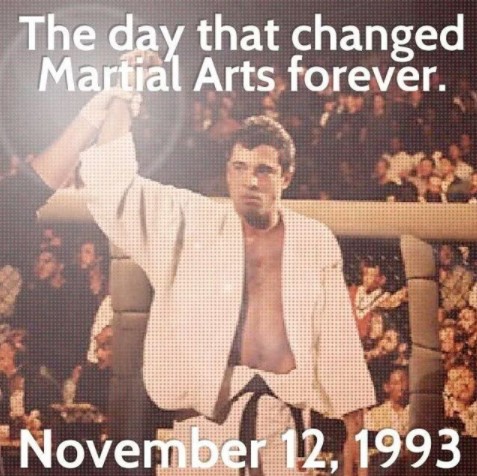
Rorion then realized that in order for the rest of the world to find out what Brazilian Jiu-Jitsu is it would have to go on television. That sparked the creation of the UFC, The Ultimate Fighting Championship.
The first UFC was in November 1993 and Rorion was very clever about fighters he’ll bring to UFC at that time. He sought out the toughest, worst, meanest, and most reputable martial artists he could find of various disciplines. Then he chooses his brother, Royce Gracie, to fight those beasts and represent the Gracie Jiu-Jitsu. He did so because he knew that Royce would be the smallest representative out of all the martial artists in the competition.
Rorion knew that it would be the greatest testament to the Brazilian Jiu-Jitsu art and not the individual using the art. If people saw Royce defeating larger opponents with nothing but skill, timing, patience, energy efficiency, distance management, and BJJ techniques they would be given hope that they too could be effective against a larger opponent. They would eventually figure out that they don’t need to be more athletic or stronger or bigger than their opponent in a real street fight to win. So, the Internet and the first few UFC’s are what put Gracie Jiu-Jitsu on the map.
It is well established that what we know today as Brazilian Jiu-Jitsu was founded by the Gracie family in Brazil in the past century. Carlos Gracie learned the art of Judo from Japanese master Mitsuyo Maeda. The system didn’t really work for Carlos and his brother, Helio so the modified it thus creating BJJ. Everyone involved in BJJ knows the story and the Judo origins. However, an even earlier predecessor, one bearing the same name, is rarely mentioned. Japanese Jiu-Jitsu has lots to do with BJJ and is an art still actively practiced today.
Just as Judo and BJJ, traditional Japanese Jiu-Jitsu has evolved a lot since it’s inception. The art is very popular among members of the Japanese military and police forces. It also has a highly spread competitive sports platform, offering competition in many different aspects. All in all Japanese Jiu Jitsu is the mother of most martial arts of today and even at present, is a fighting style that incorporates plenty of disciplines. Don’t believe us? Keep reading.
How It All Started
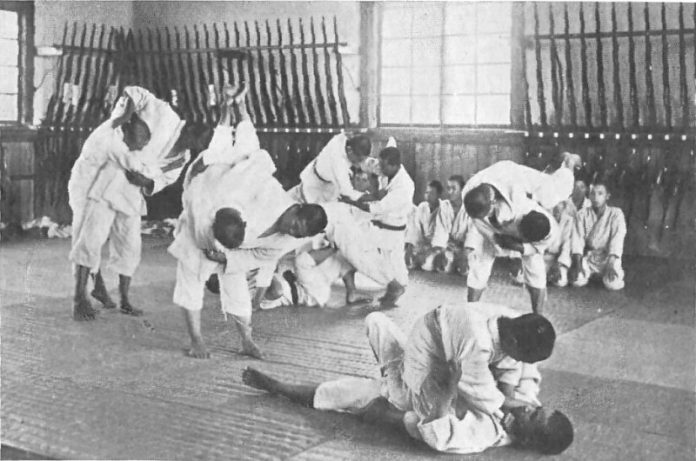
During the time known as the Muromachi period in Japan (between 1333 and 1573) battlefield requirements resulted in the formation of a fighting system. The system was known as Nihon koryu jujutsu. The focus of this style was to enable unarmed warriors to battle highly armored ones. The Japanese Samurai developed the art so that it consisted of grappling, throwing and restraining in order to be highly effective. Thus Japanese Jiu-Jitsu was born.
During the 17th century, Jiu-Jitsu evolved and became the most utilized art among the Samurai. “Ju (or Jiu)” means “gentle” in Japanese, while “Jitu” translates as “art” or “technique”. Japanese Jiu Jitsu was developed as a grappling style because striking had little to no effect on armored opponents. Later on, during the Edo period, strikes were introduced to the art, expanding it significantly. Thus, Japanese Jiu-Jitsu got the form still in use at competitions today. It incorporated Atemi Waza (or striking), Tachi Waza (or standing techniques – throw) and Ne Waza or (grappling on the ground). Modern tournaments still encompasses all of these disciplines in their format.
Brazilian Jiu Jitsu’s direct line to Japanese Jiu-Jitsu goes through Judo. Judo founder DR. Jigoro Kano, studied Jiu Jitsu while at University. He later modified the art, focusing on the Tachi Waza part to create modern Judo. This is exactly what the Gracie family later did to Judo, giving rise to BJJ.
The main goal of Japanese Jiu Jitsu was, and still is, to quickly and efficiently disarm and restrain an opponent. Sports competitors and practitioners wear traditional Gis and have a colored belt system.
Japanese Jiu-Jitsu vs. BJJ
In training terms, the main difference between BJJ and Japanese Jiu Jitsu is in the focus of the classes. While ground fighting is only a third of traditional Jiu-Jitsu, it is the main focus of BJJ. From a striking standpoint, BJJ offers a self-defense perspective in some curriculums, but not an offensive one. As such, the art focuses on quickly getting to a dominant position, preferably on the ground. From there, BJJ offers the ultimate control, allowing for restraint, striking or submission. Traditional Jiu Jitsu offers much more in terms of striking exchanges. In those terms, it is similar to MMA.
In the throwing department, traditional Jiu Jitsu is a lot closer to Judo and puts emphasis on lots of the same techniques. BJJ, on the other hand, borrows the most effective techniques from various grappling arts. Judo throws, wrestling takedowns and Sambo rolls are all included in BJJ’s curriculum. While effective, the traditional approach of Japanese Jiu Jitsu does seem to offer a deeper understanding of Tachi Waza. Or, at least the Judo aspect.
When it comes to Ne Waza, or the ground BJJ rules supreme. The depth of BJJ is unrivaled by any other art, it’s predecessor included. Traditional Jiu-Jitsu offers a lot in the ground fighting aspect, certainly more than Judo. In sports terms, it even has a distinct category of Ne Waza matches. However, it is way behind BJJ when it comes to depth and richness of techniques that are available.
Conor McGregor is a BJJ Brown Belt. He was promoted To BJJ Brown Belt After Knock Out win Over Dustin Poirier by his Instructor John Kavanagh.
John Kavanagh is the first Irish Black Belt. He’s the owner of the Straight Blast Gym in Ireland. He was also a an MMA fighter but, according to his words, he was fighting in MMA just to get the basic knowledge and experience in fighting before he moved into coaching people. He’s grappling instructor of many successful athlets like Gunnar Nelson, Paul Mcveigh and many others. That’s where McGregors grappling knowledge comes from and it’s solid.
Mcrgregor never showed so much BJJ in his fights because his stand up skills are fearsome but it doesn’t change the fact that he’s, actually, very good in BJJ.
Connor McGregor was also competing a lot in BJJ. You can check out His Video vs Kywan Gracie Behring Below:
Recently, Conor Mcgregor wrote a post on his Instagram profile expressing his view of Brazilian Jiu Jitsu:
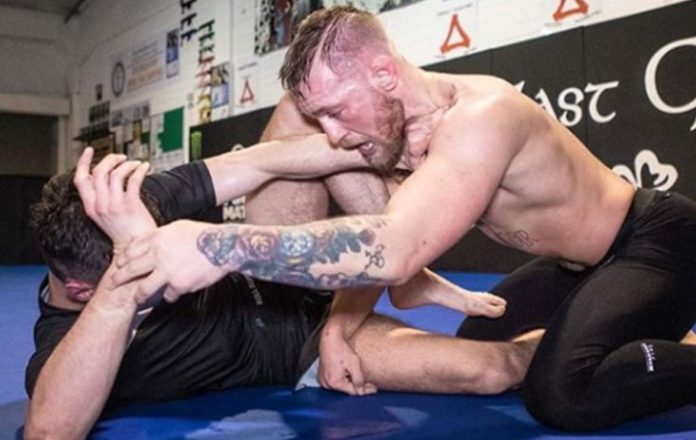
“This moment was survived. The arm was kept locked out straight as pictured, allowing the absolute smallest pocket of air in as possible. The blood will still supply to the brain and you stay breathing. If i move to side control here, the force of the strangle shifts to either side of the neck blocking the carotid arteries and crushing the trachea , stopping the blood supply to the brain and you are then dead. Jiu Jitsu is not designed to hurt you. It is designed to kill you. It is a mad game. You pay me multiple millions of dollars for this.”
Everyone who has ever been to a BJJ class can tell you that it is fun! Well, ok, maybe not at first, but after a couple of months it hooks most people. To be honest, what’s not to like? You get to meet people, learn useful techniques and try rolling them out. Usually, it is the rolling part that people really like and enjoy. There is also one part of a standard BJJ class that people seem to despise. Warranted or not, the warm up seems to be the least liked part of the class.
Most academies adhere to a common structure during practice. After the initial line up and a greeting, class starts off with a warm up. After the warm up, it’s time for the technical part of the class. Once the technique has been demonstrated and drilled, some schools tend to go straight to rolling, while others do a few rounds of positional sparring before. Cooldowns are optional in most schools. However, warm ups are not and there is a good reason why they shouldn’t be skipped. Read on.
Why We Need To Warm Up in BJJ
When we speak about warming up most people think about breaking a sweat and maybe increase their heart rate. While this is by all means, desirable, it is not the end product. Also, warming up isn’t about raising the temperature of the body, despite the term suggesting it.
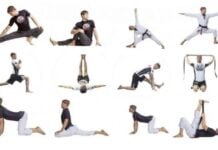
A good warm up is a preparation for physical training. Whether it is BJJ, lifting weights or even Yoga, a training session should start with a warm up. Of course, the warm up has to be structured in a way specific to the nature of the sport. But all warm ups have one thing in common – they act as prehab.
Prehab means a proactive approach to avoiding pain and injury. Warming up allows the body to get leaner and moving, so that the body is ready for physical exertion. BJJ is high on the spectrum of complex physical activity due to the nature of grappling. It is logical that BJJ warm ups have to be highly specific and thorough, given the tendency for injuries.
In BJJ people either come to class from work, home or from other training sessions. in every one of these instances, the body is in a state specific to the momentary activity levels. Although it can adapt fairly quickly, easing into more strenuous work needs adjustment. That’s exactly what a warm up offers – a way to adjust to higher energy demands.
The Issue With Warm Ups in BJJ
Warm ups routines differ greatly among schools, which is where the main problem arises. People tend to either slack through warm-ups on the account of them being too difficult or skip them entirely. It is understandable that everyone wants to get to the meat and potatoes of class, which is techniques and rolling. However, skipping a warm up can easily cause an injury leading to a premature end to a training session.
Some people tend to be continuously late for class and not all of them are justified to do so. Even though there is the minority that can’t get because of work or other obligations, most latecomers just want to skip warming up. By doing so they do a disservice to both themselves and their instructors. First and foremost, they put their health at risk by jumping straight into training. This holds especially true for older practitioners. Secondly, they disrespect the instructor by not being on time, and disrupt the flow of class by entering late. Finally, injuries that might stem from not warming up might give a bad reputation to the whole academy.
In terms of structure, the instructors have to make sure they get it right. A heavy conditioning session with countless push ups, squats and burpees is counterproductive. It will deter students from attaining and it will probably cause more harm than good. On the opposite end of the spectrum, doing arm circles for 3 minutes is not considered a warm up. Movements should be dynamic and specific to BJJ, while not taking up more than 10-15 minutes.
So, instructors, build a good warm up and remind students why it is important. And students, make sure you show up for it, so that you stay safe and show respect towards the art.
These are some takedowns that I personally feel don’t require you to have a ton of Judo or Wrestling proficiency. I have hit these takedowns on people that have much better takedown ability than I do, but because of the nature of how these are set up and executed, they are difficult to stop.
It should go without saying that these are obviously for a sportive context, but there are elements as always that are applicable beyond just sports competition.
Sydney Winder, 23, had her case dropped and now she has spoken six months after the incident she had with teacher Greg Turner. Immediately after charges against her were dropped.
Miss Sydney Winder was charged for beating Greg Turner at the petrol station in Brighton 6 months ago.
She said that teacher Greg Turner was abusing her from the car at the petrol station. He was beeping and yelling at her from his car. She said that soon after that he approached to her and started aggressively making obscene gestures.
Sydney winder says she was intimidated by Greg Turner’s behavior because she experienced the same trauma when her mother was abused by men in the past.
But as Sydney Winder trained Jiu-Jitsu for 2 years she was able to defend herself.
What happened there was that Sydney Winder punched Greg Turner in the face and was grappling with him there until the onlooker came and separated them.
When police arrived, Greg Turner was in tears, but Sydney winder was the one who was arrested.
The case against Sydney Winder was dropped due to lack of evidence of her attacking Greg Turner and this is what she said for The Argus about her martial arts training:
“I studied jiu jitsu from 2015 to 2017 and then did a women’s self-defence course which specialises in situations like that.”
“It teaches you how to analyse the situation you’re in with aggressive men. He was a prime example of the type of people you get in these kinds of situations.”
She also mentioned problems she encountered with this case and the problems in her family.
“My mum was diagnosed with severe pneumonia in October – she nearly died – and she has suffered septicaemia.”
“It should have been dealt with at the first hearing. I had to quit my job as an accounts assistant to care for my mum full time.
“It has been really stressful for me with the court case going on as well. I’ve had it dangling over my head, worrying my mum and my friends.
“I’m just happy this is all over now.”
She’s glad this is all behind her and, now, she’ll focus on her psychology studies.
“I didn’t want to have anything on my record,” she said. This could have really affected my future career. I’m not a bad person.”
She also sent a message to all women.
“I feel like it’s something that needs to be addressed,” she said.
“There are a lot of women going through this sort of thing. There are men that can be quite bullish.”