



Conditioning For BJJ – Competition Tips And Workout Programming

Bear Crawl for BJJ
Bear crawl / Crab Walk

Brazilian Jiu-Jitsu is a very physically demanding sport. People only looking to get in shape often choose BJJ as an alternative to boring fitness routines. The fact of the matter is that rolling around gets people into shape fast. However, for those looking to get more out of it in training or competition, it gets more complicated. When you start being serious about the sport and/or are looking to compete, every roll is tough. Because you see, now you’re in an environment where everyone is in shape. Now, you need help in order to get your performance to the best of your abilities. Now, you need to start training conditioning for BJJ.

It’s often said that when two top-level grapplers are evenly matched, the outcome is decided by their physical conditioning. We’ve seen it time and time again. Both on the mat and in the MMA cage(s), a huge gas tank goes a long way to ensuring victory. BJJ conditioning is a huge part of the competitive puzzle and should be taken very seriously. Even those just rolling for fun need to do some conditioning for BJJ in order to improve. Consider it your homework, something you do off the mats but that needs to have carryover to your actual grappling performance.

Is Conditioning For BJJ Necessary?

There are different schools of thought on whether or not you should train conditioning for BJJ in a specific fashion. While it is true that rolling is irreplaceable as a conditioning tool that gets you ready for the demands of the sport, it is also true that it is far from enough. So, the claim that as long as you roll hard, you’ll do fine in competition is way off the mark. Your opponents won’t be counting on just their rolls to get them through tough exchanges and matches so why should you?

When you are tired everything seems harder. No matter how good you are at a leg lock or a choke when you’re tired all you can think about is how to breathe. Add in an opponent on top of you and it gets downright uncomfortable. A good gas tank makes all of the above bearable. A great gas tank makes you get through a tough roll ready for the next one.

Conditioning For BJJ: programmingA brown belt is going to need a different conditioning approach than a white belt. The duration of a BJJ match for white belts is 5 minutes, while for brown belts it is 8. That’s more than half the length of a white belt match, not accounting for greater quality of movement and technical prowess. While white belts mostly stay in their weight divisions, more advanced students often look to part take in the absolute division as well. A lightweight brown belt has at least a couple of 8-minute matches against experienced opponents, to start with. If he wins all (or most) of them, he/she is up for the absolute division.

That means further matches against experienced and potentially heavier opponents. A good conditioning program can lead to double medals. Gassing out won’t get our brown belt past his own weight division, let alone the absolute. The same, though, applies to white, blue, purple, and especially, black belts.

How Conditioning Works

Conditioning for BJJ might be simple, but only if you understand it. The thing is that the bottom line is that conditioning is still a form of physical training that is there to help you accomplish a goal. Once you understand how the body accomplishes that goal, you can figure out your favorite method of training, and set up a program to target those specific conditioning goals.

The body has three energy systems that help it break down nutrients and transform them into energy that the muscles and organs can use. These three systems are the anaerobic system, the anaerobic lactic system, and the anaerobic alactic system.

The aerobic system is an energy system that allows your body to work for really long periods of time (think marathon running) but at a very low output (think marathon runners’ speed, or better said, lack of it). This is actually a foundational energy system, and you simply have to have it in order to even think about doing any type of athletic competition. If you are lacking in this department (a good test is actually making it through a 5 mile run without spitting your lungs out) your conditioning for BJJ should start there.

The anaerobic lactic system is the system that will provide you with less energy time-wise, but that energy will be at a higher output, It means, you can do more and harder, but you won’t be able to keep it up as long as with the aerobic system. The reason for this is that this system works in an environment without oxygen, and uses lactic acid, which is a product of the aerobic system, as a source of energy, among other things. In terms of running, this is a 400-meter sprint.

Finally, the anaerobic alactic system is the one that will allow you to explode like an Iranian wrestler but only for a very short period of time, 10-20 seconds at most. The system is not easy to develop but is extremely important for Brazilian Jiu-Jitsu. Since I used a running example above, the anaerobic alactic system is the one that allows you to sprint at maximum capacity for about 100 yards or so. The system utilizes a compound called ATP, or rather the dissolvent of it, which is a process that releases a lot of energy., Conversely, creating as a supplement help increase the storage of products required to form ATP and hence, improves alactic conditioning.

Sports Specific BJJ Conditioning

It is clear that grapplers need to train to condition for BJJ. However, routines shouldn’t be just blindly selected and followed. The latest Fitness Blender 10-minute-at-home-workout-for-great-glutes is one example of wasting time. Doing workouts that are not intended to improve your performance in a specific area is only counterproductive for grapplers. BJJ is a weight division sport with a precise match duration for each belt level. Specific BJJ conditioning means getting ready for a specific format of matches.

Conditioning For BJJ: bodyweightConditioning training for BJJ should match the requirements of the competition as close as possible. Duration, intensity, and volume of the conditioning workouts all play an essential part in a grappler’s performance. The hardest part of the conditioning puzzle is deciding what to do, for how long, and how hard. In other words, programming is a crucial part of a BJJ conditioning routine.

Someone looking to add conditioning to their schedule must have clear priorities. BJJ training comes first. Only after being able to go through a class without too much exertion should a student turn to extra conditioning. BJJ is the main priority and conditioning for BJJ is the homework. A great way to approach BJJ conditioning is the “First, Do No Harm” approach. It means that additional training shouldn’t take away from your time or ability to perform on the mats. Conditioning should make you better, not just tired.

Focus your conditioning efforts towards the time duration of your matches and work with the highest intensity that doesn’t take a negative toll on you. This will take some tinkering, and it is best if you employ the help of a strength and conditioning expert. However, as long as you’ve got some experience in fitness training, you’ll be able to set everything up yourself, and you can see how at the end of this article.

Some Conditioning Tools For BJJ

There are hundreds of options out there when looking at methods that can help your gas tank. Not all of them are efficient, though. Even less are actually helpful in terms of BJJ performance. Some, however, are better than others and offer the most bang for your buck. At the end of the day, conditioning for BJJ is similar to technical training – you know the moves but you need to figure out what works for yourself. You could go about learning how conditioning works (which I’ll explain further in this article) and build programs for yourself, based on your preferences, or access to training equipment and/or space. The bottom line is to be efficient and creative.

  • Bodyweight Conditioning

This should be on the top of anyone’s list. Moving around your own body weight is a great way to increase your gas tank without too much strain. Plenty of approaches are available and effective, from calisthenics, through suspension training to specialized gymnastics training. Not needing any equipment or facility makes this approach even better. Note that while bodyweight training does have certain restrictions when it comes to developing strength, it is virtually limitless in terms of conditioning. Depending on which energy systems you’re working with, you can actually really help improve balance, coordination, specific BJJ movement, etc. while also developing a crazy gas tank for grappling.

Bodyweight conditioning is actually a way in which you can have all your competitor’s work even during class. Given that most gyms use a warm-up they tend to repeat every class, simply add in a sprawl pyramid in between every exercise so of the warm-up. For example, you do arm circles, then 1 sprawl. The second exercise might be hip circles, you do 2 sprawls afterward. The goal is to get to ten sprawls, and then count back down again to 1.

  • “Odd” Objects

Next on the list, also near the top. Modern-day crazes in the form of kettlebells, medicine balls, ropes, and sandbags can actually do wonders for your BJJ game. There’s also specialized grappling gear that falls under this category, like the Bulgarian bag. Circuit training is the best approach and doesn’t require a gym or too much space. The only investment is buying the gear which is generally affordable and long-lasting. Of course, if you’re into strongman training, you can also use boulders, and those crazy contraptions they use for weighted walks, but that’s at your own risk. I’d recommend a kettlebell, as your safest and most efficient option.

  • Running

Conditioning For BJJ: ruinningThe time-tested and almost inevitable part of any conditioning plan. Marathons aside, all forms of running have an impact on BJJ conditioning. Running is highly effective in increasing the aerobic capacity of the lungs, thus improving general conditioning levels. Jogging, interval running, hill sprints, you do have lots of options. This makes things tricky as you need to understand conditioning and your needs in order to choose the best form of running to develop specific athletic capabilities. Conditioning for BJJ is not one-dimensional and you’ll need to be working on multiple qualities at once. In other words, simply running 5 k every day won’t really help too much with your conditioning.

  • Rolling

Has to be mentioned. Rolling is considered by some to be an effective conditioning tool for BJJ. Marcelo Garcia is known to do no extra conditioning outside of aggressive rolling on the mats. While it is as specific as it gets, I personally tend to disagree. In my experience, going all out in a conditioning sense while rolling takes away from the technical proficiency of a grappler. To me, sacrificing technical prowess for the sake of a gas tank is an unfavorable trade. That said, as long as you can maintain a high technical level during rolls, certainly do try and challenge yourself physically, especially with more experienced partners. Choosing stronger, faster or technically more experienced training partners will help you both in terms of conditioning for BJJ and grappling performance.

A Complete BJJ Conditioning Program

So, what is the BJJ conditioning program? It is the one you’re currently on.  But only as long as you complete it. The key thing to remember that doing an Andre Galvao conditioning for BJJ routine is not going to turn you into Andre, not in terms of gas tank, and certainly not in terms of BJJ performance. Each and every athlete that you see out there doing crazy routines, has had stuff tailored to them after countless physiological measurements and fitness tests. Unless you find someone to do that for you, you’ll need to figure out stuff for yourself. That is why I’ll provide you with all the building blocks of conditioning for BJJ program, and you can then do the necessary adjustments to make the perfect one for yourself.

Building The Base

The way you go about building a conditioning program is by developing the key elements first. Those would be the three energy systems we covered earlier. And yes, you need all three, despite the majority of BJJ requiring mostly the work of the anaerobic lactic system. First of all three’s no way to make only one system work, while the other two are idle. Secondly, you’ need all there in grappling, without an exception, because of the different demands throughout a match and the duration of a match.

AEROBIC SYSTEM DEVELOPMENT

There’s no need to run in order to develop impressive aerobic conditioning. Of course, you could go for road work and or jumping rope, but that is boring. Instead, lifting weights and doing bodyweight exercises will not only provide you with a greeter aerobic base, but it will also help you build a bit of strength in the process. Plus, you can do the workouts even when the weather sucks outside.

Here’s how you can set up a circuit that you should do for at least 3-6 weeks:

  • A1: Bench and Squat – 5 Mins x 1 rep each alternating (@60% of 1RM)
  • A2: 5 Mins mobility (do BJJ movements or related stretches)
  • B1: Pull-up and DB RDL 5 Mins x 1 rep each alternating (@60%)
  • B2: 5 Mins mobility (do BJJ movements or related stretches)
  • C1: Close Grip Bench and Chin-ups 5 Mins 1 rep each alternating (60%)
  • C2: 5 Mins mobility (do BJJ movements or related stretches)

ANAEROBIC LACTIC SYSTEM DEVELOPMENT

The anaerobic lactic system, or the one we use most of the time in Brazilian Jiu-Jitsu, grappling and MMA can also be set up in a similar fashion. With our goal being specific conditioning for BJJ, even when developing general qualities like energy systems, the way to set up anaerobic lactic circuits is like this:

  • A1: Bench and Ring Row – 5 Mins x 10 rep each alternating (@ 35-45% of 1RM)
  • A2: 5 Mins mobility (do BJJ movements or related stretches)
  • B1: Right Leg and Left leg Step-up 5 Mins x 10 rep each alternating (@35-45%)
  • B2: 5 Mins mobility (do BJJ movements or related stretches)
  • C1: Close Grip Push-up, Barbell Curl and OH sit-up 5 Mins x 10 rep each alternating (@35-45%)
  • C2: 5 Mins mobility (do BJJ movements or related stretches)

ANAEROBIC ALACTIC SYSTEM DEVELOPMENT

Conditioning For BJJ: anaerobic intervalsThe final piece of the conditioning for BJJ puzzle, the anaerobic alactic system requires a lot of dedication, and most importantly a lot of patience. You’ll be working hard, but also resting for long, which may sound counterproductive. It is not, as resting is key to actually being able to “recharge” and use your anaerobic alactic system over and over again. Similar to the previous two systems, training the system will yield results after 3-6 weeks.

First, though, let’s discuss training methods. Here you’ll be using the isometric and oscillatory methods. Isometric means holding the weight at the peak of the movement in a static fashion for a period of time. Oscillatory means “shaking” the weight with small range of motion movements in an explosive and repetitive fashion, as fast as you can.

The circuit looks something like this:

DAY 1 – 3 SETS OF EACH:

  1. Bench press @90% 10 seconds hold
  2. KB split Squat @90% 10 seconds hold Right Leg
  3. DB Bent over row @90% 10 seconds hold Right Arm

*Rest 4-8 Minutes

DAY 2 – 3 SETS OF EACH:                 

  1. Bench Press @70% 10seconds Oscillatory
  2. DB Split Squat @70% 10 seconds Oscillatory Right Leg
  3. RDL @70% 10 seconds Oscillatory

*Rest 4-8 Minutes


Preparing To Compete

When competition time comes, you should up your conditioning as well. The most important thing is identifying where your weakness lies and addressing it directly. If you’ve spent enough time (several months) building your conditioning base and energy systems, you can actually focus on training in a way that will mimic matches so that you build highly specific conditioning for BJJ.

Remember that “peaking” for a tournament will require you to be fresh and rested, not exhausted. That means that about 6 weeks out, you shouldn’t do more than 3 conditioning sessions per week, outside of mat technical training. Three weeks out, this should be reduced to two times per week, and in the final week, only use conditioning if you need help cutting weight.

Here’s an ideal circuit to really take things to the next level, and still have enough energy to train technically and roll hard:

Rounds 1 to 3: 10 minute round and each exercise is performed for 15 – 30 seconds

  1. Band Resisted Sprints
  2. Band Resisted Shuffle
  3. Clap Push-Ups
  4. Dumbbell Rows
  5. Back Peddles
  6. Burpees
  7. Kettlebell Swings
  8. Dumbell Snatch

Round 4: 10 minute round and each exercise is performed set number of reps with sprints or animal movements in between.

  1. Med Ball slams
  2. Clap Push-Ups
  3. Russian Twists
  4. Burpees
  5. Toe Touches

Maintaining Conditioning

Once you have a great base, and you’ve peaked for a tournament, there’ no need to use hard conditioning circuit training during the tournament season. Conditioning for BJJ takes a long time to develop but will last you if you only maintain it for as little as 40 minutes two times per week. Moreover, all you need is one kettlebell.

Conditioning For BJJ: kettlebellsTo begin with, pick up a kettlebell, and do twenty minutes of Turkish get-ups, alternating sides on each repetition. 24kg for men and 16kg for the ladies is more than respectable. You should aim to beat the number of reps you do per side every week. After you complete the twenty minutes, rest for a little (3-5 minutes) and move on to phase two.

For the second phase of the conditioning for BJJ maintenance workout, you’ll do Hindu push-ups and kettlebell swings. For the swings, you should go heavy, but if you only have access to one kettlebell it’ll still work. 10 repetitions of each for another block of twenty minutes will more than do the trick. Watch your breathing while you’re doing this as breath control is more important to BJJ conditioning than you could imagine.

Closing Thoughts

Conditioning for BJJ is simple, yet has plenty of moving parts. Sounds a lot like Jiu-Jitsu, right? That’s your proof that it will work! The caveats of conditioning for  BJJ are to avoid using other people’s programs and expect to see their results. Instead, either find an expert that will build a program for you, or better yet, understand how things work, and write your own conditioning programs! It will take a bit of research, but once you’ve figured it out, you’ll only need to make small adjustments. Spend the next 6 months trying out the program design presented in this article and see how things go.

The Best Strength & Conditioning DVD and Digital Instructionals

FIGHT VIDEO – Female MMA pro vs Internet Troll Kristopher Zylinski

As a reminder. In early December Kristopher Zylinski started posting how women are slow and weaker than man and they wouldn’t stand a chance against a man in an MMA fight.

Kristopher Zylinski wrote:

“99% of women are too weak and lack the reflexes ro do enough damage to stop 99% of men. Even if they knew BJJ they just don’t have the size or strength to use the holds. It’s dangerous to teach any woman to try and strike or fight a man. Just my 2 cents.”

While it is true that men have stronger upper body and reflexes than women on average Kris pointed out that there is a small chance of some women winning against men.

“by a man, yes. And I said 99% of women will lose to 99% of men. Me vs Female MMA pro fighter? Still 80/20 me.”

Kristopher Zylinski was also writing about his opinion on women training some Martial arts and self-defense martial arts.

“On a side note, reality note, if you teach women to try and fight a man off, you are giving delusional thoughts to them. The only way a woman will successfully defend herself against a man in most types of situations is with a gun. And if she gets confronted by a man her first reaction should be to try and get her gun. If he grabs her, her first reaction should still be to try and get her gun. There is no scenario in any situation where she should try and fight him instead of trying to get her gun. That is the point.”

After his words, McDojolife Facebook page was looking for a Female MMA Pro fighter. The first female MMA fighter was Anna Dempster.
Anna Dempster jumped in to show to Kristopher Zylinski that her MMA training and her MMA amateur fights worths a lot. Much more than Kristopher Zylinski Thinks. But, Anna got injured. And she was replaced by Sarah Patterson.

With a Pro MMA Record of 5-3-0, Sarah was ready to fight Internet Troll Kristopher Zylinski but as she got injured. Just like Anna Dempster, she suffered an eye injury and she was out.

That’s when Tara LaRosa Jumped in to fight Internet Troll Kristopher Zylinski.
Tara LaRosa as a PRO Female MMA fighter with a score of 22-5 is a former and first BodogFight Bantamweight, 135 lbs, Champion. She’s also a Purple belt in Brazilian jiu-jitsu under Royce Gracie andBrown belt in judo.

Tara La Rosa jumped in to prove to Kristopher that Woman vs Man makes sense. And especially if it’s a fight of MMA Trained Woman vs Untrained Man like Kristopher is. After Tara was picked to fight Kristopher she wrote on her Facebook profile:

“A friend tagged me in on the search for a replacement and I responded as a joke… well, I guess shit got real, so here I am! I feel like I should say something like “hey, hold my beer for a second” or “Hey Y’all, watch this” in my best redneck accent. It fits. I’m a part redneck. So, I guess… here we go!”

“If you don’t know me, I’ve been training in martial arts since 1995. I got into Shotokan karate in hs and then got involved with Judo in college. I placed 2nd at collegiate nationals in 2001. Shortly after, I started training in Brazilian Jiu-Jitsu and MMA (which was referred to as NHB back then). 
I had one amateur fight and my mom got scared, and said you’re moving with you’re auntie and uncle in Bel-Aire… wait no, that was Fresh Prince.”

“So I had an army fight Nov 2001, then went pro in April 2002. I’ve been training and fighting ever since. 
If you want more, check the wiki. Also, I’m on twitch almost every weekday from 2:30-5: 30 pm, so come in and ask me anything! Follow me on Twitter for better interaction, I’m not very good at FB lol 
Welp, that’s me! …so, here goes nothin’!”

While there were many speculations about Kristopher’s training we managed to ask him if he has any Martial Arts training in his life. Here is what he answered to us:

“I have never paid anyone to teach me fighting. I’ve watched boxing since I was 5 and boxed when I was 19. Again I never trained in a gym. I also roll with friends but again no formal training. I do watch MMA about 6 hours a day. I simply believe in my eyes and my abilities than I can beat Tara LaRosa. Not cause I’m a man, not cause she is a woman, but I have unconditional belief in myself.”

The fight against Tara LaRosa and Kristopher Zylinski that was scheduled for January 6, was canceled just an hour before the bout was expected to begin. According to McDojlife, Kristopher Zylinski and TaraLarosa the State Athletic Commission arrived at the venue along with the police and shut down the fight or “sparring” as they were calling it.

And, today, it Happened. Enjoy

Guillotine Choke – Basics, Secrets and Variations to Make it Perfect

Guillotine Choke BJJ

The guillotine choke has long been regarded as a strong man move. People involved in BJJ looked at it as just a one-off move useful mostly to MMA fighters. It was probably the emergence of Marcelo Garcia that started to change that impression. Marcelo managed to fine-tune and modify the guillotine to a deadly effect. That resulted in a greater awareness of the finer technical aspects of the choke. Today, guillotines can be seen in almost every competitive grappling environment done at every level of Jiu-Jitsu.

How many submissions do you know that you can get from both top and bottom positions as well as from standing? Arguably, there’s only one that ticks all these boxes. And it’s a tight one if the mechanics are in order. The guillotine choke is a mainstay in Jiu-Jitsu, granted, more on the No-GI side. It is, however, just as effective in the Gi. Actually, it might be even more effective, seeing how lots of people seem to disregard it on account of it being a No-Gi move. Check out Marcelo Garcia’s guillotine highlights to see how effective guillotines are.

What Is A Guillotine Choke? 

The guillotine choke is a very versatile technique used in submission grappling arts, most of all, in Brazilian Jiu-Jitsu. It works as a choke, blocking off air or blood supply by pressuring the neck. Different grip variations provide different choking options, although the basics are the same – you grab an opponent’s head from the front, placing it under an armpit, and then place the forearm of the same side arm on their neck. That is the gist of it, although it is the details that actually make it perfect. Before we move on to them, though, let’s answer some of the most common questions people ask about guillotine chokes:

  • Who Invented The Guillotine Choke?

The choke has been around for too long to pinpoint the person that has come up with it. It is a part of old Judo curriculums where it appears the “Mae Hadaka Jime”, or front naked choke.

There’s also evidence of it in early catch wrestling matches, as well as some of the wrestling matches in the first Olympic games in ancient Greece. In other words, the Guilltince choke has been about as long as grappling martial arts have. Bruce Lee helped popularize it among martial arts fans with his “Way Of the Dragon” movie.

  • Is The Guillotine A Blood Choke?

Yes and no depending on the way you’re holding the guillotine choke on your opponent. However, it is much more efficient when done as a blood choke than an air choke.

If you’re after a high-percentage finish, it is blood choke. Making the guillotine choke work as a blood choke will require a bit of fitness and more training because it involves very precise placement of your forearm. In fact, it is the most efficient done as a blood choke with a chest compression component (more on that later).

  • What Happens In Guillotine Choke?

During a guillotine choke, you first achieve control, by not allowing the person you’re attacking to pull their head out. What happens as a result of the initial grip on the chin (chin strap) and the placement of your armpit behind the crown of the head. That way, there’s no pulling out, or p[osturing up.

Secondly, you can apply choking pressure as a result of the specific positioning of your arms. The end goal should be pressure on the carotid arteries on both sides of the neck, along with forcing the chin of the head towards the opponent’s chest. This leaves the opponent in a painful position, and without enough oxygen to make the brain work, so they either tap or they will go to sleep.

  • Is The Guillotine Choke Legal in BJJ?

In terms of adult belt levels, the guillotine choke is legal for every white belt to black, with and without the Gi. It is, however, illegal for kids and teenagers, until the age of 16. In those cases, even getting into the position can lend a competitor in trouble. In Judo, only the arm-in guillotine is allowed, while the position is legal in wrestling for control, but not for finishing, as there are no submissions allowed.

How to Do A Guillotine Choke

The guillotine choke in Brazilian Jiu-Jitsu is fairly simple if you understand how it works. In order for you to execute any of the plenty variations available, you to understand how to set up. Let’s break it down into several steps that are essential to tapping people out with guillotine chokes.

1. Grips

First and foremost, you’ll need to get a hold of the head. I’ll cover grip variations in detail later on, but for now, you should know that each allows you to keep control of the head, and position the arms for a choke. For most guillotine choke variations, though, you’ll need to grab your palms together in order to finish. Grips come first in the hierarchy of guillotines.

2. Position

In terms of positioning, you can go for a guillotine from the bottom, mainly from the closed guard, half guard, and open guard. The half guard offers options for attacking from the top as well, as does the mount. Attacking against the turtle is one of the most common setups, and you can even look to set guillotines up from standing.

3. Angle

Guillotine choke angleThe angle at which you apply force for the choke is the “make it or break it” detail in every guillotine choke. Pulling like crazy with all your strength will not provide you with a finish. Instead, top, or bottom, you need to be looking to touch the elbow of the choking arm to your own hip on the same side. This provides the best possible angle for finishing any variation of the guillotine choke.

4. Application Of Force

This is the most versatile part of a guillotine. In every grip variation, there are slight differences in how you apply force. The general guidelines, though, are not to pull but rather to squeeze everything, which angling as previously described makes possible. Next up, you should look to “tack” the opponent, so that their hin goes to their chest, causing a chest compression effect. Also, remember that twisting the arms so that different parts of your arms press on the neck is also crucial to wrapping a guillotine choke up.

5. Adjustments And Combos

Finally, the guillotine is a high-control p[ostion and offers the option of switching between its many variations at will. For example, if an arm-in guillotine is not working for you, you can switch to a low elbow, and then perhaps, even a high-elbow variation. Or, you could “marry” the guillotine with other front headlock chokes like neckties, Darces, and Anacondas.

Follow these 5 steps and you’ll be able to develop an air-tight guillotine game that will be a puzzle for everyone to solve.

Guillotine Choke Grip Variations

As simple as it might seem, the guillotine choke is had complex mechanics that require long-term practice. This is opposite to it being a brute choke that can be learned in a few classes. Shocking, I know, but if you want a Daniel Strauss-like guillotine, you need to learn the technical nuances.

The guillotine choke has two “main” varieties when it comes to execution. The original version involves trapping the opponent’s arm while going for the choke. That’s the “arm-in guillotine”, which acts as an air choke. The second variation is done without the arm and can be both blood and an air choke.

Both guillotine variations revolve around the same basic principles. The most important part is to utilize the correct part of the arm for the choke. To avoid mistakes, it is best to place your thumb on the outside of the opponent’s neck. This allows for correct placement of the wrist and easy transitions between the two variations. Strapping the chin offers a very tight controlling position as well.

There are several grips available, with the Gable and S-grip as favorites.  Besides arm placement and grips, finishing relies on using the correct power source. A crucial principle of finishing a guillotine is to always push the crown of the opponent’s head towards their hips. To do so, one has to close both elbows towards their body and push with the hips while shrugging the shoulders. In the high elbow guillotine, the supporting arm’s elbow is placed upwards on the opponent’s shoulder.

The arm in guillotine requires an appropriate angle of the trapped arm. Namely, it should always extend past the head of the opponent. Opening up the arm allows the choking arm to correctly apply pressure on the windpipe.

Top Position Guillotines

The half guard and the mount are the two primary positions for executing a Guillotine choke. Since attacking it from the top half guard often leads to the mount transition, we’re going to focus on that.

In order to get into position for the guillotine from the top half, the hips have to be in the reverse Kesa Gatame position. This allows the knee of the bottom leg to control the opponent’s hips. At the same time, it positions the upper body correctly in order to wrap the head up. The torso is used to place pressure on the top of the head while the choking mechanics are applied. Although both versions of the guillotine can be done, the armless variation is used more often.

For the mounted guillotine, the focus should be on two main principles. First, the head has to be pulled towards the opponent’s hips. Secondly, you have to be placed in low mount, putting direct pressure on the opponent’s pelvis.

Attacking From The Bottom

The closed guard is the bread and butter position for the guillotine. It is a very strong finishing position due to the high control of the hips. Having both legs locked behind the opponent prevents any counters ensuring a high percentage finishing rate. Basically, the most important part of the closed guard set up for the Guillotine choke is breaking the posture. Once the head is placed in the armpit and forced back, it’s all about choking mechanics. And we already covered those, right?

In open guard environments, the butterfly guard is the best position for Guillotine hunting. Arm-dragging is the most usual route to setting up the butterfly guard guillotine. From there, having the control position can lead to a direct submission or a sweep. The sweep might even end up with you in position for a mounted guillotine finish. That way you get both the sweep and mount points as well as the sub.

Standing Guillotine Choke

Knowledge of the guillotine choke is going to solve a lot of your wrestling-related problems on the feet. It is the perfect double leg counter, both because it stuffs the takedown and leads to submission. The arm of variation is superior here, though both variations apply. The only extra detail that is crucial is timing. Even if the takedown is completed, the Guillotine has to be timed in order to land at the correct choking position.

In a more offensive manner, the Guillotine choke can be used from the snap-down or via an arm drag. The most direct route is the snap-down since it leads to greater control that can end in either a takedown or a finish. While going to the back is effective, looking to end up in the top half guard or mount is a more strategic approach. The choke can be finished while standing as well. Again, the emphasis is primarily on tight control by way of correct mechanics and secondly on finishing details.

Final Thoughts

The guillotine choke is one of the most powerful weapons available to you in all submission grappling martial arts. You can become a submission specialist by learning all its variations, or just become crazy good with only a single one of them. The choice is yours, but if you have any hope of progress in grappling, there’s no way forward without at least a decent guillotine choke.

Related Articles:

How to make the standing guillotine choke work for you
Blood vs air Jiu-Jitsu chokes: Which are better?
Subtle Tricks For Developing World Class BJJ Chokes
Different ways in which you can finish a Jiu-Jitsu Choke
Marcelo Garcia Guillotine Choke Review
High Percentage No Gi Chokes
The Best Guillotine Choke Escape Options And Counters
Standing Guillotine Defense Techniques You Must Know
A Few Crazy BJJ Guillotine Variations To Brighten Your Day
Everything about BJJ Chokes – Systematization, Anatomy, Efficiency

Fallon Fox, Transgender MMA Fighter Who Broke The Skull of Her Opponent

Transgender MMA Fighter Breaks Skull of Her Female Opponent

Fallon Fox is a retired transgender MMA fighter. She was born a man, but now lives as a woman and is still in the process of transitioning from male to female with hormone therapy. In addition to hormone therapy, Fox had gender reassignment surgery back in 2006.

Transgender Fighter Fallon Fox

Fallon Fox’s story has been very controversial because up until 2011 it was not known that she came from a life of being male. She fought several times before her gender history surfaced and became public. Since then there has been heavy debate about whether or not she should be able to fight women and some believe that it is an unfair advantage for Fallon who spent her physical prime as a man, whose bones and muscles were developed on testosterone.

However, on Fox’s side, she claims that since she has been taking female hormones, she is a woman just like all other women and that she should not be treated differently.

In an interview with Ariel Helwani from MMA Fighting, Fallon explained how she has been feeling throughout this gender change process:

      “I definitely feel like the chemistry and balance of hormones, and all that kind of stuff in my body just feels really good.”

Fallon Fox at Weigh Ins

This controversy raises many questions about gender equality and what rights transgender athletes should have.

Are we to assume that because someone was born a certain way they must always be that way for the rest of their life? Is it fair for Fallon who lived the majority of her youth as a man to fight against women? What do you think about transsexual women fighters being included in the Olympic games?

Early Life of Fallon Fox

Fox was born in Toledo, Ohio as a male. Her struggles with gender started as she became a teenager when at first she thought she was a gay person. At the age of 17, as she realized there are transgender people, she knew that being a woman is her only way. But as she said, it was a hard solution for her to change her gender so she continued to live as a heterosexual man. She even married her girlfriend at the age of 19 to become pregnant with her daughter a few years ago. 

“I was fighting a lot with my gender and my sexuality. Since I was a teenage boy I knew something was wrong with me, but I never wanted to admit it to myself. Everything I did, and the girls I was dating with, was just me trying to feel normal and accepted.” – said Fallon Fox for BJJ World.

Soon after she gave birth to her daughter she joined the US Navy to support her family and she served in the USS Enterprise as an operation specialist.

Fallon Fox before gender change
Fallon Fox before Gender Change

As she said it was a pretty hard time for her as she was constantly fighting with gender issues which caused ongoing psychological stress. She then dropped out of the USS Navy while trying to get enough money for her gender change

Gender Reassignment Surgery

She decided to do a sex reassignment surgery because she believed that was her only way to live a normal life. The only problem was its price and she didn’t have enough money. Therefore, she decided to get a job. Fallon found a job as a truck driver which enabled her to earn enough money for the operation.

Finally, in 2006, transgender female fighter Fallon Fox traveled to Bangkok together with her daughter and did all the necessary surgeries to become a woman. She got gender reassignment surgery and hormonal treatment at the Bangkok National Hospital.

During the gender change process, Fallon Fox had to go through a lot of hormone therapy which is still an ongoing process.  

     “It’s not easy for everyone to understand, but I hope that people could at least be supportive.” – said Fallon fox during an interview with BJJ World.

To get rid of all the masculinity she was born with, she had to take female hormones for about five years. Also, she had to go through some surgeries before finally looking like a woman later on.

Fallon Fox Before After

       “I’m doing this so I can live my life as who I am on the inside – not what people perceive me to be.” – said Fallon Fox in an interview with MMA Fighting.

After all these struggles and gender reassignment surgery she was finally able to get her gender change confirmed in court which allowed Fallon to legally become a woman in the state of Florida.

That was the time when she decided to fight. She chooses the combat sport of MMA to pursue her fighting career.

Fallon Fox

MMA licensing process

Fallono Fox MMA licensing Process

As we mentioned before there was a lot of controversy around Fallon Fox’s licensing process and many well-known fighters and commentators were against Fallon getting the license. She actually got it when they examined fox’s medical records. They noticed many differences in her bone mineral density, structure, and higher body fat mass. She also had significantly less muscle strength than an average male.

After some time and many discussions, Fallon Fox got a fighting license to fight in women’s divisions in Coral Gables which came as a surprise and shock to many people.

After her two professional fights, Fallon Fox came out publicly on March 5th, 2013 in an interview with OutSports writer Cyd Zeigler and sportsillustrated.com. The licensing procedure Fox chose to go through in Coral Gables caused controversy due to the California State Athletic Commission and Florida’s athletic commission.

Due to controversy and the licensing process, Fox’s April 20th bout with Fallon has been postponed by CFA co-founder Jorge De La Noval, who promoted the fight on March 2 in Florida. De La Voal went on saying that his group would not “turn our backs on her…”. “She’s welcome in our campaign so long as she’s licensed. We support her and give her all of our help.”

In a video interview with Cyd Zeigler, Fox stated that she was in compliance with IOC rules for post-surgical transsexuals and wanted to continue competing in MMA.

MMA Career of Fallon Fox

Once she turned into a woman, Fallon decided that she would like to use her physical strength for something good so she started training in MMA. She came out as a transgender MMA athlete on March 5, 2013, when Florida’s athletic commission issued the license for Fox.

Fallon Fox

She officially made her MMA debut in 2013 when she faced Allanna Jones at Championship Fighting Alliance 10 in Florida. She won the fight via TKO in 39 seconds of the first round, breaking her opponent’s nose with a kick.

After having three successful MMA fights against Allanna Jones, Ericka Newsome, and Elisha Helsper she was undefeated for two years until May 2015 when she faced Ashlee Evans-Smith during Championship Fighting Alliance 12.

Fox’s First loss in MMA vs Ashlee Evans Smith

Fallon Fox vs Ashlee Evans-Smith

She suffered her first loss against a relatively unknown female MMA fighter by the name of Ashlee Evans-Smith. Transgender fighter Fallon Fox lost in the third round by technical knockout for the featherweight title fight, which was ongoing during Saturday night’s Championship fighting Alliance 12 event. 

But Fox didn’t stop there. She continued to pursue her MMA career in the Xtreme fighting organization where she defeated Heather Bassett via armbar submission in 2014.

During an interview for Bloodyelbow about her next opponent, Fox said: “I want all the trannies on this planet and beyond to know, that you can be whoever it is that you want to be”.

“I’m on a mission of spreading the knowledge about transgenders.” – said Fallon Fox on Sherdog Forums.

In 2015 she fought Tamikka Brents in the most controversial match ever in MMA. She won the fight via TKO in just 44 seconds. That was the fight that brought the most controversies about Fallon Fox as she managed to break Brent’s skull in that fight.

Fight against Tamikka Brents

“I’ve never felt so overpowered!” – were the words of Tamikka Brents after Fallon Fox broke her skull during their MMA fight.

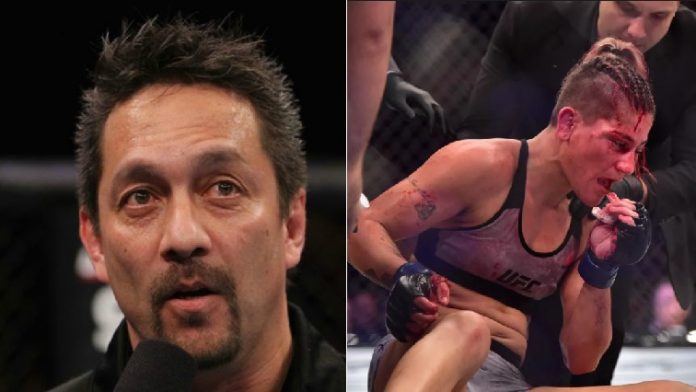
She defeated Tamikka Brents in a much-anticipated fight that left Tamikka Brents down for the count in the first round.  It was messy, it was bloody and it wasn’t easy viewing for everybody. Tamikka suffered a concussion and a broken skull. Fox wasn’t stopping until Tamikka Brents was finally TKO’d and the referee stopped it. Tamikka needed stitches and serious medical attention after the fight, which shows you how the fight went.

“I’ve fought a lot of women and have never felt the strength that I felt in a fight as I did today. I can’t answer whether it’s because she was born a man or not because I’m not a doctor. What I can is that I’ve never felt so overpowered ever in my life, and I am an abnormally strong female. I’m afraid I still have to disagree with Fox fighting. She can pursue any career but when it comes to a combat sport I think it just isn’t fair.” – Tamikka Brents said in an interview after the fight.

Retirement from MMA

Soon after the controversy in an MMA fight against Tamikka Brents, Fallon Fox decided to retire in 2014. As she said, she just couldn’t withstand all the negativity surrounding her appearance in MMA

Fallon Fox Professional MMA Record

6 fights, 5 wins, and 1 Loss. Fox has three wins via knockout and two wins via submission. Fallon fox losses are down to only one: against Ashley Evans Smith via TKO.

Professional MMA Fights Breakdown  
6 matches 5 wins 1 loss
By knockout 3 1
By submission 2 0
By decision 0 0

Where is Fallon Fox Today?

Fallon currently lives in Chicago, and you can check her out on social media on Twitter and Instagram.

As soon as she retired from MMA she got involved in LGBT activism to help other people with similar problems. She wanted young people to never face the problems she was facing. As she said, “Nobody deserves to be treated the way I was.”

Fallon Fox Today

ESPN did a documentary that covered Fallon Fox’s life and career called Game Face. You can watch it on ESPN+.

MMA Community Comments on Fallon Fox and Trans Women

Fox has made a lot of headlines throughout her career, emergence into the public eye sparked a tremendous amount of outrage. But, it’s been almost five years since she last fought. Her battle in 2014 vs. Brents, however, continues to haunt her today.

Ashley McGuire

Ashley Mcguire on fallon fox

Ashley McGuire, the author of Sex Scandal on the whole Fallon Fox drama: The Drive to Abolish Male and Female, said: Twenty years ago if a man hit a woman so hard that he sent her to the hospital, he’d be in prison. Now he can get paid for it. It makes no sense to fight women if you’re born a man.” 

In the video below, McGuire explains that the idea that gender is a personal choice is very ANTI-WOMEN and ANTI-SCIENTIFIC.

“That’s because the men-and-women-are-the-same argument invariably leads women to be judged against a male standard. Or, to put it another way, to be more of a woman, a woman has to be more like a man. As a transgender woman, you just can’t fight female athletes.”

“For the tiny percentage of people who experience gender dysphoria, we should have nothing but compassion. We should do everything we can to help them and protect their dignity, but we don’t need to overturn biologically defined sex differences to do so.” 

Joe Rogan

Joe Rogan Comments Fallon Fox

One of the people who were against giving Fox a license was famous: comedian, podcaster, and UFC commentator Joe Rogan. He gave some pretty solid arguments against her getting the license to fight, but that didn’t change anything.

‘First of all, Fallon Fox is not really a she. She’s a transgender, post-op person. The operation doesn’t shave down your bone structure density. It doesn’t change. You look at a man’s hands and you look at a woman’s hands and they’re built differently. They’re just thicker, they’re stronger, your wrists are thicker, your elbows are thicker, your joints are thicker. Just the mechanical function of punching, a man can do it much harder than a woman can, period.’ – Joe Rogan said in his podcast

She calls herself a woman but… I tend to disagree. And, uh, she, um… she used to be a man but now she has had, she’s a transgender which is (the) official term that means you’ve gone through it, right? And she wants to be able to fight women in MMA. I say no f***ing way. – Joe Rogan added

I say if you had a dick at one point in time, you also have all the bone structure that comes with having a dick. You have bigger hands, you have bigger shoulder joints. You’re a f***ing man. That’s a man, OK? You can’t have… that’s… I don’t care if you don’t have a dick anymore… – Said Joe Rogan in one of his later podcasts

Matt Mitrione

Matt Mitrione on Fallon Fox

While speaking with Ariel Helwani on “The MMA Hour” show in 2013 Matt Mitrione said that Fallon Fox is a “lying, sociopathic, sick and disgusting freak”.

Soon after his comment UFC suspended him and charged him with a fine amount of money.

But, as much as UFC is known for suspensions fighters who go against their public image, Mitrione still did an announced fight against Brendan Schaub. It actually means UFC wasn’t that upset with his comment. The reason probably lies in the fact that Dana White said he would never allow transgender women to fight in the UFC.

Dana White

Dana White on Fallon Fox

One of the most controversial interviews was with Dana White when he called Fox “He” and “Him” instead of “She” and “Her”. That’s even forbidden by the law in the US right now.

In an interview with MMA Junkie White said:

“He was a man and now he’s a woman. He’s fighting girls who have lost records. Before you get too crazy about him being in the UFC, he’s so freaking far from being in the UFC that it’s not even funny.” – said Dana White for Fallon Fox

Those words raised a huge controversy as many people referred to white telling him that “He’s a She”.

Ronda Rousey

Ronda Rousey on Fallon Fox

The most famous female MMA fighter and UFC star Ronda Rousey comment on Fallon Fox:

“I have a feeling that if you go through puberty as a man, it’s not something you can reverse. There’s no undo button for something like that”. – Ronda Rousey on Fallon Fox

Other Comments

“I don’t understand the problem with Fallon Fox. I’m told that men and women are equal and that gender is a social construct. I’m constantly shown “badass women” on TV and in movies that can beat up men easily. We’re told that woman can do anything a man can do. DOVE commercials show that girls can run, punch, and jump just as well as men. So… why shouldn’t men fight vs. women? Why segregate sports? If transgender people can use the bathroom, which matches their gender identity, why can’t they choose the UFC gender class that matches their gender identity? You’re not a transphobic/sexist bigot, are you?”

Today’s Society on Transgender Women in Combat Sports!

It’s really hard to find anyone today who would support the fact that a trans-MMA fighter beats a woman in a women’s sports competition. It seems like only transgender people and LGBT activists support it. Where ever you find any discussion about trans athletes you’ll find some great resistance to them. The comments are usually rude and full of “hate” with people saying “Go fight men”, “don’t destroy the careers of other females”, “they don’t have the same bone structure”, etc.

Unfortunately, it’s something hard to judge unless science proves those people wrong, and science isn’t doing it. Many medical experts and scientists actually agree with the overall opinion of society, and they have scientific evidence supporting the hormonal disadvantage of born female to transgender person. 

In today’s world and political correctness, it seems like people are saying to trans people that they’re different and immediately it seems wrong to any human being. But in reality, it seems like they really are different than many women they’re fighting against in the women’s division.

The only thing that would work for people is to form transgender divisions in MMA and it’s the only way for female transexuals to have a green light for fighting without controversy surrounding them. But, that’s something we’ll probably never see due to the low number of transgender female fighters in MMA, and other sports in general.

Fallon Fox Interview on Life as a transgender athlete

Fox gave an interview for Outsports in March 2013.

When she was asked about the situation of having to come out publicly so early in her career: “That sucked. I expected that someone was going to out me; you just can’t go through life with a microscope on your career without someone delving into your past a little bit,” she said. “But it’s something you really can’t prepare yourself for.” Her face grows serious. “The scope of anger and vitriol that I received initially … That was disheartening, and tragic. It was mind-blowing.”

This was not how Fallon Fox had planned her career to go. Her ideal narrative would have seen her enter the cage as any other competitor, winning fights and hopefully becoming one of the greatest female fighters on the planet. “I suppose I’d want all of that,” she muses thoughtfully. “But I also want to bring my family with me”

Fallon Fox Interview

Fox’s interest in MMA came from the fact that ladies competing in the sport were shattering traditional male/female regulations associated with combat sports. She discovered the career when a trainer advised her that if she really wanted to get in shape, she should accompany him to an MMA gym. “There, women were doing things that other women weren’t doing for the most part. They were aggressive. I needed to see that in my evolution as a woman. Transgender women especially feel like we have to fit the binary system to a T in order to not be recognized as trans.”

Do Transgender Women Have An Unfair Advantage?

The question of whether transgender athletes should be allowed to compete or not has been getting a lot of attention throughout the years. The most controversial case is the Fallon Fox fight. 

According to many scientists, men, and women are inherently different. Pretending that they’re equal is making some women pay a huge price for it. It doesn’t matter if a man transitioned into a woman, she still possesses some advantages over the cisgender women competitors. Therefore Fallon Fox had a physical advantage over her opponents.

According to many scientists, unfair advantages are:

  • bone density
  • bone structure
  • bigger shoulder joints
  • stronger and larger limbs
  • increased ability to generate power

Fallon-fox-weigh-in

In reality, it’s really hard to determine how much advantage one trans woman has over other non-trans women because it varies on many factors. For example their testosterone levels before gender-affirming hormone therapy. The more testosterone levels they had before they switched their gender the more advantage they’ll have.

Scientific Research on Trans Women by Dr. Timothy Roberts

This question raised many controversies once the Tokyo Games allowed transgender women to compete in the Olympics. As that was the first time that several trans women were allowed to compete in the Tokyo Games many scientists started their research.

We bring you the research of Dr. Timothy Roberts, a professor at the University of Missouri-Kansas City and a pediatrician.

The research clearly shows that trans women who went through hormone therapy for one year still outperform non-transgender women (cisgender women).

After two years of hormone therapy, the gap would close a bit, but still, trans women would outrun non-trans women by 12%.

The study suggests that for the first two years after the subjects started taking hormones, some things are changing. The trans women in the study were able to do 10 percent more pushups and 6 percent more sit-ups than their cisgender female counterparts. The biggest problem lies in the fact that all the bone structure remains the same for a long period of time.

After two years, Roberts told NBC News, “They were fairly equivalent to the cisgender women.”

Trans women athletic performance before and after hormone therapy
Trans women Athletic performance before and after hormone therapy

Another scientist’s comment on this subject was done by Dr. Eric Vilain, director of the UCLA, Institute for Society and Genetics. He helped the Association of Boxing to write their transgender policy and was examining Fox’s medical records. After examination, he told Time Magazine that “a male to female transsexual athlete has significantly less muscle strength and bone density, and higher fat mass, than males”.

Frequently Asked Questions:

What is Fallon Fox’s Real Name?

Fallon Fox was born Boyd Burton. She changed her name to Fallon Fox together with her Gender change.

What was Fallon Fox born as?

Fallon Fox was born as a male, named Boyd Burton. She started with hormone therapy in 2006 when she changed her gender in a hospital in Bangkok.

Who Did Fallon Fox Fight?

Fallow Fox fought Tamikka Brents and Brents suffered an orbital bone fracture and concussion.

Did Fallon Fox Fight in the UFC?

No, Fallon Fox never fought in the UFC women’s and men’s divisions.

Does Fallon Fox take female hormones?

Even today Fallon Fox continues to use oral estrogen and it was never considered a performance enhancer drug. Even if she stops taking it now her body would still remain the same. She would also enter the post-menopausal state.

Conclusion on Fallon Fox and transgender athletes in general.

Controversies about this topic are not discriminating against anyone or anything. It is just to ensure fighters’ safety, and not give any advantages to any fighters above the others.

Gender issues can be hard to deal with and it’s understandable, but we should draw a line in some cases. The fight between Fallon Fox and Tamikka Brents could have ended much worse and we should learn from it. If transgenders were allowed to fight in the women’s division, many other serious injuries would happen. Usually, non-transgender athletes get beaten no matter their experience, so some kind of a problem really is there.

There are many questions we must ask ourselves about this subject such as: Is it fair for Fallon who lived the majority of her youth as a man to fight against women? If I were born female but now identify as a male do I have the right to compete against men? Is it fair for Fallon to fight women since she lived her whole life as a man and has the body, bones, and muscles of one?

What do you think about transgender athletes competing in sports? Do we need gender equality across all sports or should there be separate categories, such as men and women? 

Why Does John Danaher Always Wear a Rashguard? Mystery Solved!

John Danaher Rashguard

John Danaher is always seen in a rashguard. Whether he’s traveling, shopping, giving interviews.. He was also wearing a rashguard on his friends wedding.

While many people find it pretty weird John Danaher has his own explanation about it. Actually it’s very simple. Read below what John Danaher said why he’s wearing a rashguard all the time.

Why Wearing A BJJ Rashguard Under The Gi in BJJ Is Important

Arguably the question I am asked more than any other has nothing to do with jiu jitsu. “Why do you always wear a rashguard?” First let me dispel a commonly voiced, but incorrect theory. It has nothing to do with fighting or being ready for fights. In my current physical state, an aggressive five year old could easily defeat me with a simple kick to the knee or hip or even a simple push – a rash guard isn’t going to save me! My reasons are purely practical. First, they are very comfortable, Second, they are easily washed and dried. Third, they are extremely low maintenance/wrinkle free/easily packed for travel etc. Fourth, being a low friction material, they are well adapted for wear under a jacket. Fifth, They enable me to comfortably demonstrate a technique in impromptu social situations to students. Sixth, they are warm in cold weather, yet cooling in hot summers due to wicking effects, and; if caught in rainstorm, they will dry in minutes even while being worn. Seventh, some clothing companies sponsor and support my athletes. I am proud to represent any company that supports my people. Eight, they are free as clothing companies are happy to see me wear their products. Nine, there is considerable variation in rashguard design that can vary from informal daily wear to more formal wear for dates/occasions. When it comes to comfort and utility and low maintenance, I have never seen an attire that can beat track pants, sneakers, rash guard and fanny pack. If i find something more comfortable in the future i will switch to that. It may not be aesthetically pleasing, but I am already rather ugly and odd looking so I don’t even bother with clothing aesthetics as my looks are a lost cause – if I had to rely on looks and charm for anything in my life I would be a homeless beggar already
Now it’s time for a rash guard story that may change the minds of some of rash guard doubters out there…I am an admirer of the great MMA fighter Jose Aldo – any time he fights, I’m watching. The night he fought Uriah Faber, I wanted to see it. I don’t own a television, so I suggested to a bunch of my students that we go to a sports bar on the upper east side of Manhattan and watch it live. As always, I was running a little late and came in wearing my usual attire and began looking around for our table. Now my students and I actively seek out every opportunity to prank/ridicule/make fun of each other, my general weirdness gives them lots of raw material to work with! The entire group of them had dressed in rash guards and Fanny packs! As I sat down there was a noticeable look from pretty much the entire bar as they all simultaneously asked the question, “who the f**k are these dorks and why are they dressed in those gimp outfits?” We all started laughing and started to watch the show. Out of nowhere groups of women started up to our table and started asking who we were and why were we dressed like that? Were we a sports team? Cyclists? Triathletes? Lunatics? Morons? Suddenly our table was neck deep in curious babes and hotties and the Jose Aldo fight was forgotten ?

Every single one of my students got multiple phone numbers and action out of that escapade! (I was the only failure)
The dudes at the bar were furious and could not understand how a bunch of dorks in wetsuits who looked like they had beamed down from the deck of the starship Enterprise had gotten all the female attention.


So, who knows…maybe you doubters ought to give it a try…my rash guard system worked as well for my students as my leg lock system…perhaps it can work for you too!

https://www.facebook.com/john.danaher.96/posts/429510340798022

Craig Jones – Down Under Leg Attacks

https://bjj-world.com/john-danahers-definiton-jiu-jitsu-four-steps-system/

Is No-Gi Jiu Jitsu More Fun Than GI?

Is No-Gi Jiu Jitsu More Fun Than GI?

In the modern world of BJJ, there are two main streams of practicing the art. One employs the use of a traditional Gi, along with a certain ruleset some frown upon. That is Gi Jiu-Jitsu. The other often deemed more fun and free-thinking, revolves around wrestling in spats and a rashguard. This is known as  No-Gi Jiu-Jitsu. Both of these streams have die-hard proponents who blatantly refuse to recognize the value of the other.

In the modern era, though, it is hard to present a certain thing in a negative sense. People have research tools at their disposal that weren’t there just a few decades ago. Back in the old days, No-Gi Jiu-Jitsu was often ostracized, thanks to propaganda. In fact, the original BJJ practitioners didn’t wear a Gi only when it was too hot to train in one. And, in some instances, while training or competing in Shoot Boxing. Since then, No-Gi has spread onto the BJJ scene, offering a new perspective for both amateur and professional athletes. Let’s put No-Gi Jiu-Jitsu on trial and decide whether it is really as fun and effective as presented?

The Case For No-Gi Jiu-Jitsu

First and foremost, let’s look at the very basics of No-Gi Jiu-Jitsu training. The most obvious difference compared to traditional BJJ is that of the training attire. Most people involved in No Gi nowadays favor wearing rash guards. Earlier in No Gi’s development, most people went for shorts and a shirt, or shorts only. As insignificant as this might seem, shedding the Gi actually changes the game a lot.

Namely, without the Gi, there are no more collars, sleeves, or pants to grab on to. Traditional BJJ is immensely dependent on these basic grip points for control. The whole game of GI BJJ is based around controlling, and even attacking an opponent with parts of the kimono.  The grips in No-Gi are closer to those of submission wrestling, for example. Head control, with one or two arms and gripping the wrists are the two main avenues of control in No-Gi. People like Jean Jacques Machado, who was born with four fingers missing on one of his arms, proved how effective these grips can be. Although seemingly not as tight as Gi grips, they do offer a different way of approaching BJJ.

Furthermore, the inherent ‘lack” of control leads to a higher pace of No-Gi matches. This means that people are sharper, more prone to quick transitioning, and have to be masters of weight distribution.

The rules, although variable from one organization to another, also revolves around the nature of the No-Gi game. No-Gi Jiu-Jitsu rulesets allow for a greater variety of techniques to be employed. Some of these techniques are forbidden under Gi rules, which is another point of disagreement. ADCC competition has proved how entertaining BJJ can be without the risk of added injuries. In recent years, EBI-style tournaments only confirmed that.

The Case Against No Gi Jiu Jitsu

The case against No-Gi Jiu-Jitsu starts with the absence of control. Since BJJ is essentially the game of controlling an opponent, it is understandable why some have this approach. the Gi does offer way more in terms of control, thus opening more opportunities for attack. While No-Gi revolves around wrestling-style controls, Gi Jiu-Jitsu allows for more creativity in this department. Just check out some of the latest lapel-based guard systems and you’ll see how deep BJJ can go.

Having greater control over an opponent means that you can attack from more positions. There are way more sweeps available in Gi Jiu Jitsu, as well as guard variations . The gripping practices of No Gi are transferable to Gi practice, while the opposite doesn’t hold true.

Thus, Gi Jiu-Jitsu is considered to be more technical than No-Gi, whose fast pace means that the style revolves around submission hunting rather than slow control. It is a fact that although the belt system is applicable to both streams, Gi Jiu-Jitsu is considered the best way to get a black belt. One can see why this holds merit, given the wealth of technical knowledge required to battle in the versatility of the Gi.

The Verdict

All in all, the case seems to be closely tied. The determining factors of the verdict come down to two aspects – persona preference and approach to BJJ. In the first category, personal preference dictates whether one will wear a Gi over their rash guard. Since personal preference can hardly be influenced, we come to the approach one has to Jiu-Jitsu. Here, before a student develops their own philosophy of BJJ, they are introduced to the basics by instructors. Instructors’ personal preferences do influence those of students a lot, so instructors have to be careful to present the art without bias.

Finally, I think that the best way to bring this to an end is through a settlement. Students should become as proficient in No-Gi, as they are in Gi Jiu-Jitsu. This is the only way to ensure that every Jiu-Jitsu match is fun and entertaining. As far as fun in training, if you think Gi Jiu-Jitsu is boring, apply No-Gi principles while rolling and create an environment that suits you.

30 NO GI Takedowns!

https://bjj-world.com/danaher-philosophy-jiu-jitsu/

Royce Gracie: I won’t Teach my Students Anything that Doesn’t Work on the Street

Everything about BJJ Chokes – Systematization, Anatomy, Efficiency

Everything about BJJ Chokes - Systematization, Anatomy, Efficiency

Although chokeholds are not specific to Brazilian Jiu-Jitsu, they have become so much associated with it, that they are considered to be hallmarks of the art. The Rear Naked Choke was perfected by BJJ to such detail, that it bears the name “Lion killer’. Ok, you can’t really kill a lion with it or any wild feline, but it does make a point. BJJ chokes are powerful against any kind of opposition and can be applied to anyone, given the right amount of training.

From another aspect, BJJ chokes are considered to be the ultimate submission holds. Yes, joint locks are painful and might cause injury, but a choke can be lethal. There’s no “I could’ve endured it’ talk with chokes. A properly applied choke leads to two outcomes, none of which leaves any doubt. One is to tap and acknowledge that the opponent got you. The other is to play hard-ass and go through the tunnel and into dreamland. The choice is yours, but do not forget, getting choked out (or tapping to a choke) means that you could’ve died. Such is the power of BJJ’s chokes.

Anatomy Of BJJ Chokes

Since BJJ is an art of control above anything else, it is natural that chokeholds are highly technical affairs. When a choke is applied, it is not just about squeezing tight and holding for dear life. Proper positioning is essential, but it is beyond the scope of this particular article. Let’s consider that you’re in the perfect position to apply a choke. What it is that you’re actually looking for?

BJJ chokes go one of two ways to render an opponent unconscious. Most chokes are “blood chokes”, cutting oxygen off by pressuring the blood vessels in the neck. A smaller group of chokes is one of the so-called ‘air chokes”, restricting airflow through the windpipe via direct pressure.

NO GI Chokes 6xDVD SET WITH BRANDON QUICK - FADE TO BLACK
NO-GI Chokes 6xDVD SET WITH BRANDON QUICK – FADE TO BLACK

When a blood choke is applied, there’s bilateral pressure on the neck. First in the “line of fire” are the jugular veins. They transport blood from the brain back to the heart. Once they’re compressed, there’s the retention of blood in the head, seen on the face as engorgement. Next, the pressure affects the carotid arteries, vessels that transport blood to the brain. Blood is the only way to transport oxygen to the brain, which is essential for function. Once oxygen is prevented from reaching the brain, consciousness is one of the first sacrifices the body makes in order to try and survive. That is why BJJ chokes result in quick pass-outs.  Although blood chokes do not compress the carotid arteries more than 90 %, it takes only 7-10 seconds to go out. Holding on to the choke for longer than a minute has lethal consequences.

BJJ chokes

Air chokes are “simpler” and a lot less comfortable than blood chokes.  They put pressure on Adam’s apple, compressing the windpipe. Since they block air instead of blood, it takes longer to choke someone out.

Choke Systems Of Brazilian Jiu-Jitsu

For the sake of clear categorizations, we’re going to divide BJJ chokes according to different systems. These systems are discernable according to body position and points of pressure. Both variables are included because we grouped BJJ chokes into systems that contain more than one move and can be interchanged in a complex game plan based on choking.

Arm Triangle Chokes 

Arm triangle chokes are chokes that utilize both a limb from the one applying the choke, and the one being choked. Usually, one side of the neck is under pressure from a part of the arm of the choker. The other side gets pressured by the arm and shoulder of the person on the receiving end.

The arm triangle choke (Kata Gatame) is a great example. It’s done from side control with one arm being placed around the opponent’s neck from the side. the key point is trapping the near side arm of the opponent in the loop in order to obtain bilateral pressure. The choke is tight and very effective.

Lots of chokes from the front headlock position fall into this category as well. The D’arce choke, the Anaconda, and neckties work together in a very effective system that is hard to get out of.

Rear Naked Chokes

Probably the most recognizable amongst chokes is the Rear Naked Choke. As far as BJJ chokes are concerned, this is the highest percentage choke in training and competitions. A lot of this choke’s success is down to the fact that it is done from the back. Considered the ultimate dominant position, the back is notoriously hard to get out of.

The Rear Naked Choke is applied when one arm is placed around the neck from behind. A key point is placing the chin into the crook of the elbow, so that pressure is distributed equally on both sides. The other arm is placed in a figure 4 configuration ending up behind the opponent’s head. It takes almost no strength to apply huge pressure that takes only seconds to put someone out.

The Rear Naked Chokes system does have a few variations, including an air choke one. When an opponent fights the grips with great success, it’s a good idea to switch to the forearm choke. In this variation, the forearm is placed across the neck, while both palms are firmly clasped over the opponent’s shoulder. Pressure is applied to the windpipe, disrupting airflow.

Leg Triangle Chokes

The leg triangle chokes system is an entertaining one, seeing as the chokes are performed using the legs instead of arms. The classic triangle choke is done from the bottom, by placing one leg through the armpit of an opponent and the other over the opposite shoulder. Pressure stems from the leg over the shoulder on one side, and the trapped arm on the other. The principle is the same as in arm triangles, with the notable difference of using the legs instead of arms.

Lots of variations are available, like the Inverted Triangle, The Reverse Triangle, and even an Arm Triangle Choke.

Lapel Chokes

A system specific to GI Jiu-Jitsu, lapel chokes are highly effective but require the use of a GI. In particular, the lapels of the Gi are used to entangle the neck of an opponent ending up with a blood choke. There are plenty of variations, available from almost every position in BJJ. Some can be done by wrapping one’s own lapel around their neck, while others require the lapel of the person performing the choke. Some, like the Brabo choke, fall under the arm triangle category, where the pressure on one side is replaced by a lapel. The best example of a highly effective lapel choke is the bow and arrow choke.

Guillotine Chokes

In regard to air chokes, the Guillotine choke is by far the most effective one. Also, a highly variable choke is applied mostly from the front headlock position. It involves placing the arm around an opponent’s neck from the front, keeping their head in your armpit. Depending on the variation, hands are clamped together on the side of the neck, or trapping one arm. In most instances, pressure is placed on Adam’s apple, resulting in reduced airflow. Apart from being able to put someone out, Guillotine chokes are very uncomfortable and offer a great degree of control.

All BJJ chokes are far from covered in this article. There’s great variety among chokes in Jiu-Jitsu. The North-South Choke, The Buggy Choke, Gogoplata, Paper Cutter choke…the list is endless. However, most of these cheeks can be placed in one of the above systems, whether positionally, anatomically or structurally.

Heeadhunter Guillotine Neil Melanson DVD
Headhunter Guillotine Neil Melanson DVD

You Might Be Interested In

Guillotine Choke – Basics, Secrets, and Variations to make it perfect Submission
Unorthodox Gi Chokes From Every BJJ Position
Catch Wrestling vs BJJ and Which Art Has Better Submissions
Peruvian Necktie – A Tight Choke And A Brutal Neck Crank
The Arm Triangle Choke Encyclopedia For Grapplers
Japanese Necktie – The Tightest Choke in BJJ
LOOP CHOKE – Surprise Your Opponents From Everywhere
Clock Choke Magic To Deal With Turtled Up Opponents

(Video) Erberth Santos Tapped by Tommy Langaker on BJJ Europeans

Tommy Langaker vs erberth santos

Looks like there’s a bright Career in front of the Tommy Langaker. He came to semi finals with a win over Renato Canuto. In Semi finals Tommy Langaker lost to Lucas Barbosa. Barbosa will face Keenan Cornelius tomorrow in Black Belt absolute division finals.

Check out Langaker’s submission and his celebration after he caught Erberth Santos!

https://www.instagram.com/p/BeLXPYiHJDY/?utm_source=ig_embed&utm_campaign=embed_legacy

BJJ Guard Game Basics – A Conceptual Approach

BJJ Guard

What would you describe as BJJ’s most defining characteristic? The one that makes this art different from other grappling arts? The answer is very easy and can be traced back to the reason BJJ exploded in the first place. During the first couple of UFC events, Royce Gracie amazed the world with his ground fighting abilities. Yes, him choking out huge half naked dudes was impressive, but not unheard of. What really caught the public’s eye was his ability to be deadly from his back. That is the one are that BJJ excels at more than any other art. So the answer to the question above would be the BJJ guard.

The BJJ guard is a very broad term that refers to a whole host of positions. From simple details to huge body positioning changes, the BJJ guard game is unrivaled in it’s efficacy. No other grappling art ever produced a system for offensive fighting from the back as the BJJ guard. For the purpose of this article, we’re going to look at the structure of the most common categories of guards specific to Jiu Jitsu.

The Closed BJJ Guard

The closed guard is perhaps the most recognizable of the guard categories. Who can forget Royce Gracie, and later many others in Pride FC, giving hell to everyone from the ground. The closed guard is one of the basic positions taught in the first few classes of BJJ. Although it’s efficiency is undisputed, the closed guard is not just one position. Is can be considered a whole subsystem of positions and moves, all part of the bigger system known as the BJj guard.

In terms of working from the closed guard in a Gi environment, the closed guard is a go-to for many grapplers. It works from white, all the way to black belt level, offering great control and plentiful attacking options. Sleeve and collar grips help a student control the upper body, while the crossed legs block the hips. From there, it’s all about sweeping or submitting, both done almost effortlessly with the right approach.

The closed BJJ guard for No-Gi gets a bit trickier, mainly because of the lack of high controlling grips. This leads to closed guard varieties that emphasize breaking the posture, to be considered more effective. Among the many variations the one that stands out is the rubber guard. Proven in both BJJ and MMA environments the only drawback of the rubber guard is that it requires a certain level of flexibility. Other, less demanding, but equally effective variations would be the Williams guard, Rat Guard and the Marshall guard.

The Open BJJ Guard

Probolay the most utilized and most varied position in BJJ, the open guard is by far the most entertaining system. Arguably, it offers less control than the closed guard, but is more offensive in a wider variety of ranges. For example, the closed guard can only be played while the opponent is on their knees. Playing open guard means that you can follow an opponent who is changing range, by switching among the many available options.

For example the butterfly guard is great for kneeling opponents. A half kneeling opponent might be kept at bay with the Single Leg X or regular X guard. Against a standing opponents one might go for any De La Riva guard variations when looking for lower body control, or choose spider guard for upper body control. The inverted guard is a story of it’s own, but it does fall under the open guard subsystem.

The BJJ Half Guard

The third big subsystem of the BJJ guard game is the half guard. Again, it is mostly effective against an opponent that is not standing, but it does offer more variety than the closed guard. The half guard has become one of the most powerful attacking positions in BJJ, favoured highly by some of the greatest competitiors at the highest levels. Caio Terra is one who has an unpassable and highly dangerous half guard.

The many varieties of the half guard range from “simple” stuff done off an underhook to highly attractive positions like Cyborg’s tornado guard. This subsystem offers both great controlling positions like the lockdown, as well as unstoppable sweeping variations like the underhook or deep half guard. The half guard game is a good backup for the open guard game as well. Let’s say an open guard gets passed. Instead of ending up in bottom side control, the half guard is right there, offering better options. It can be used as an attacking point of it self, or as a waypoint that can lead to both closed or open guard. the opportunities are endless, aren’t they?

 Keep Rollin’ 

BJJ guard

Xande Ribeiro – Half Guard Retention Philosophy

8 BJJ solo drills to improve your guard

The Best Open Guard Retention Concept video you will ever Watch!

Rener Gracie About a Student Who Passed Away: “I Wish I Would Have Done a Better Job”

Rener Gracie About a Student Who Passed Away: "I Wish I Would Have Done a Better Job"

Rener Gracie:

“It is with a heavy heart that we announce the passing of our long-time jiu-jitsu brother, Donnie Puliselich. Over 20 years ago, when I was just a teenager, Donnie was the strong 20-something year-old super dedicated student who could tap me with one hand, and I always wanted to be as good as him (something I wish I would have told him but never did).”

“Most people quit Jiu-Jitsu when their bodies begin to age, but Donnie didn’t, he simply kept modifying his approach and his definition of victory in order to keep enjoying his time on the mat. I always admired him for that, and I hope I can do the same.”

“Donnie battled with depression, something we weren’t aware of because it was never evident when he was on the mat. Unfortunately, he lost the battle last week. For me personally, this serves as an incredibly sad reminder of the many faces of depression, and that we never know what people are going through.”

“As I’m sure everyone has felt who has lost a loved one to depression, I wish I would have done a better job to let Donnie know that he could have come to me for help. To all my students, just because jiu-jitsu is the main reason we come together everyday, doesn’t mean that it’s the only reason. If you every need anything, me, Ryron, and the rest of our instructors are here for you.”

For those who knew Donnie, the funeral is Tuesday 1/23 at 11:30am at Green Hills Memorial (27501 S Western Ave, Rancho Palos Verdes, CA 90275).

https://www.facebook.com/photo.php?fbid=2135969959750123&set=a.261203013893503.81778.100000114196786&type=3