



BJJ Teams – Their Role, Mentality And Benefits For Competitors

BJJ Teams

When you first take a look at Brazilian Jiu-Jitsu, you get the impression that is a highly individual sport. Nothing can be further from the truth. Although individuality is a huge part of Jiu-Jitsu, it is not the defining trait of the sport. The most obvious moment is training. Unlike their striking counterparts, grappling martial arts cannot be trained alone. The only thing a grappler can do without a partner is drilling certain moves. However, in order to truly train grappling, you need a partner. Actually, you need more than one in order to progress. Competition-wise, the importance of having like-minded training partners is even more important. That’s the reason people usually congregate in BJJ teams for tournament preparation.

Even though competitive BJJ teams are mostly aimed at preparing for tournaments, they turn out to provide much bigger benefits for grapplers. In a competitive environment, teams usually stick together and corner every member for every match. Given enough time, people in teams inevitably become friends off the mats as well as on them. A strongly knit BJJ team usually means you have friends for life that offer support in every possible way. But what is it that makes a BJJ team such a positive influence? How do you know if you’re in the correct team environment for you? Is a bigger or smaller team a better fit for you? Let’s try and answer all of these questions.

The Role Of BJJ Teams

Despite individuality being the driving factor behind BJJ innovation, Jiu-Jitsu can be considered a team sport. Team presence is extremely notable at every BJJ tournament you go to. Everywhere you turn you’re exposed to t-shirts, hoodies, Gi patches etc. all demonstrating affiliation to different BJJ teams. Some of the major BJJ teams or those most enthusiastic about competing even have team flags that they proudly display. All these team “colors” are always passionately defended and relentlessly promoted.

The reasoning behind this mentality is the sense of belonging that a team environment offers. BJJ teams are friendly, family-like environments that offer inclusion and warmth. Team mentality can range from just a group of people that drill together to a cult-like devotion. Both have certain traits in common. For one, they offer consistency. Large teams with a worldwide reach, provide the option to train everywhere that you are and feel right at home. This is priceless for someone getting ready to grapple at a BJJ tournament. This kind of consistency that BJJ teams offer is the reason behind the success of many of the top world champions.

Furthermore, BJJ teams offer valuable resources to all members. Instructors, facilities, training partners and training schedules offer the opportunity to students of all levels to prepare as best as possible. The more people you train with on a regular basis, the better you’ll become. Now, if those people are like-minded in preparing for tournaments, you have the perfect environment to thrive. BJJ teams give access to more people that often turn to be valuable contacts off the mats.

BJJ Teams

Finally, there’s a feeling of loyalty. People are usually fiercely loyal to their teams which can be a double-edged sword. Loyalty can bring a team together or down, depending on the circumstances.

The BJJ Teams To Avoid

The defining characteristic of a BJJ team depends on the type of individuals in it. A BJJ team is only as good (or bad) as the people in it. Some of the same issues that trouble other groups in society are also present in BJJ teams. Despite the ability of Jiu-Jitsu to weed out bullies, they manage to make their way on the mats. Having a bully on the team, especially one that’s highly ranked can be a real problem. usually, the instructor is the one to deal with this, but in instances where he/she is the bully, the whole team is going to suffer.

One huge sign to stay away from a team is the “McDojo” mentality. To put it simply, if you find yourself having to pay for anything and everything, then you’re part of a scheme instead of a team. The most prevalent activity in McDojos is belt selling, which waters down the quality of a “team” from the start. Next, having to buy all kinds of training gear, from Gis to T-shirts just in order to train is not how a team should be organized. Remember that cult-like behavior we mentioned earlier? Well, that’s exactly the commitment that a McDojo is going to require from you. Stay away from McDojos if you’re really looking to become a fierce grappling competitor.

Another big and pressing issue is that of sexual harassment. There have been a few instances lately of this kind of behavior associated with Brazilian Jiu-Jitsu. To be clear, sexual harassment has no place in any kind of sport and should be condemned by everyone. Regardless of sex, if this happens in a team, you should leave immediately and consider going to the authorities.

The Relevance Of Team Size

With the growth of BJJ as a sport, teams around the world have also grown in size. today, you can find BJJ teams of all sizes around the globe. From a few men local teams to worldwide organizations like Gracie Barra, the team structure is present in grappling. Both these examples offer up different opportunities for people involved in the respective BJJ teams.

Smaller-sized BJJ teams are those that rarely have more than one gym, and have a total member count of a maximum of 50 people. They usually do not extend past a city or a country. To begin with, there’s no reason to think that smaller teams have fewer chances of winning at tournaments. A team built of good people is always going to have the chance to breed world champions, regardless of size or reach.

The good sides of a small team are that you can get a lot of attention from instructors since there aren’t that many people around. You also get to roll with the instructor on a regular basis, due to the same reason. Smaller teams are tight groups that offer a very strong bond. On a negative note, smaller teams have no affiliates for people that travel often to train with. Another downside is rolling with the same few people over and over again and not getting exposed to different styles.

Larger teams are those like Gracie Barra, Alliance, Athos, Checkmat GFT, etc. They extend across continents, having multiple academies per country and/or city and hundreds or even thousands of members. They offer experience, a huge network of resources, and lots of different training partners and styles. Where they lack is individual attention as well as ending up competing against teammates due to the overwhelming presence in numbers at tournaments.

In Summary

Choosing academies to train in can be a difficult job sometimes. Given that we live in an imperfect world where 90% of academies do not adhere to either the curriculum or the way techniques are done, nor do they follow the very principle of operation of academies that these same academies do not impose on them. An even bigger problem happens that belts are obtained on the basis that you see the person who gives you a black belt once or possibly twice in your life unless you train at their home academy. When you add it all up and subtract it, we come to the conclusion that a lot of academies, even over 90%, no matter what sign they have in front of the name, work as they please and do not reflect the position of their supreme academy whose name they bear.

Top 10 Signs of a McDojo Gym

Jiu-Jitsu Rules To Obey By When Rolling

https://bjj-world.com/the-best-jiu-jitsu-mats/

The Best DVD and Digital Instructionals For BJJ White Belts

Best DVD for White Belts

Just the other day I was explaining the very basics of BJJ to a brand new white belt beginner with no prior martial arts experience. After 7+ years in the sport, I caught myself self-taking a lot of things for granted. It is easy to forget how confusing it all was in the beginning, even though I had grappling martial arts experience. Stepping on the mats, a white belt’s expectations are very different from what they’ll get. Getting your limbs twisted and bent is not as nearly unsettling as the feeling of utter powerlessness when getting choked. getting around the confusing and difficult white belt period requires putting the hours in, both on and off the mat. Yes, digital instructionals can help, but no one has to be pickier than a beginner white belt. After all, not all instructionals are the best DVD for white belts to learn from.

The first priority of a white belt and any beginner in grappling martial arts is orientation. There’s no substitute for learning from an experienced instructor. The only way to learn BJJ is to do BJJ. However, you can’t be doing BJJ all day, every day. Even if you can, the instructors might not. So, how do you go about expanding your knowledge without getting lost in this very sensitive period? Grab yourself a few beginner DVDs, but be really careful. If you start off with Eddie Bravo’s stuff you’ll only get lost an nothing is going to make sense. When trying to figure out what the best DVD for white belts is, the most important criterion is simplicity. A white belt should look to expand knowledge only in the areas of BJJ they’re learning about on the mats. Period!

The Best DVD For White Belts and Beginners

Now that it is clear that nothing but the fundamentals should be the subject of choice for a white belt, let’s go deeper. Even amongst the basics, there are so many titles to choose from that even a black belt would be confused! So, to give beginners a fighting chance, we decided to dig through the digital mines and retrieve only what really makes sense. In order to reduce the clutter, we made a selection of the top white belt instructionals out there. Which one is the best DVD for white belts and beginners? We’ll expect to hear the verdict from you, once you’ve gone through all of them.

Digital learning is a valuable tool for any grappler, regardless of level. It is very important to know what you’re looking for when selecting an instructional. For one, skip the YouTube videos, webinars, and or partial instructions. To lessen the confusion go for structure. A DVD should make sense in terms of how stuff is presented. If you can keep up with it while understanding how things link up, you’ve struck gold. Just be sure to demonstrate patience and not watch the last disc straight away in search of cool techniques. There are no cutting corners in BJJ, whether in real life or digital!

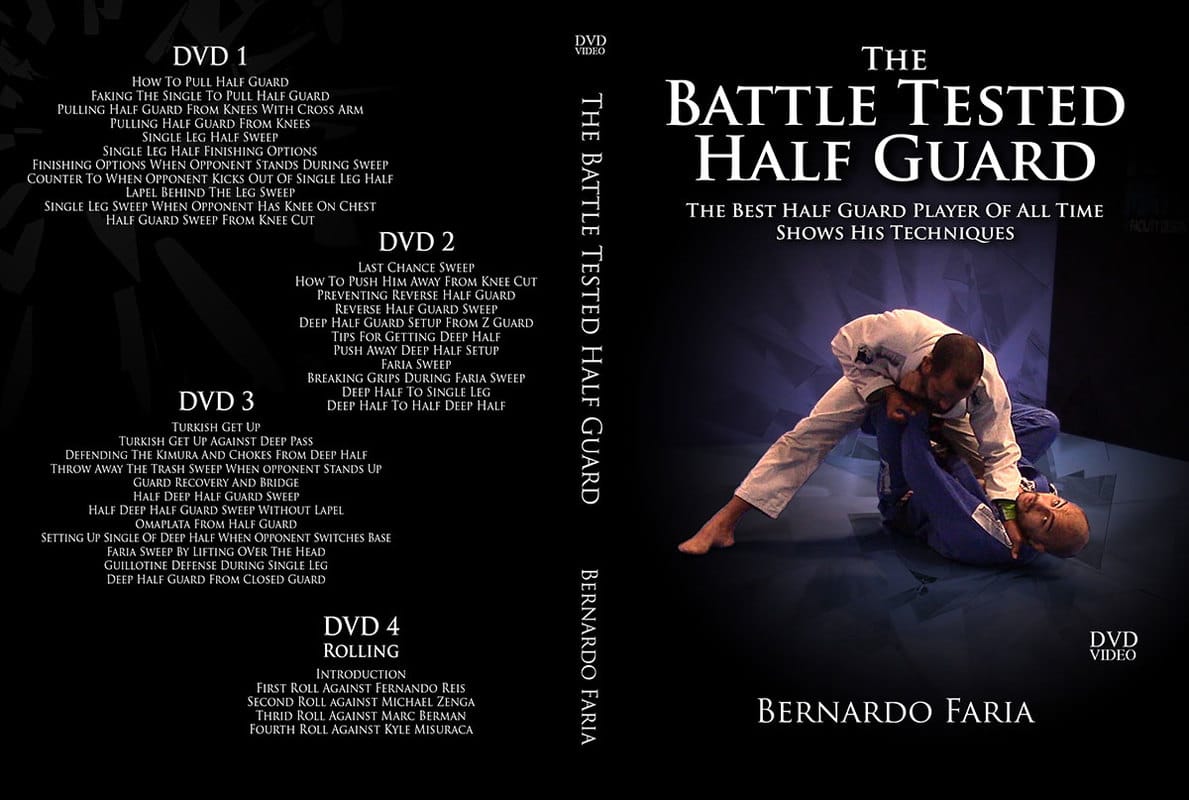
Closed Guard by Bernardo Faria

Closed Guard by Bernardo Faria

The staple of BJJ is the closed guard. The ability to fight off one’ back is what discerns Jiu-Jitsu from all other grappling martial arts. It is always involved in the first class in academies across the world. The closed guard is a very powerful position because it is very simple. As such, it has to be among the first things a white belt learns. It would be hard to skip over a good closed-guard instructional when looking for the best DVD for white belts!

When looking to reduce the clutter is always have a BJJ world champion as a major selection criterion. Since Bernardo Faria thicks that box (5 times, actually) we decided to put his closed guard instructional on top of the pile. And for a good reason! Faria’s material is comprehensive, understandable, and most importantly exactly as detailed as required for beginners He goes over every important point without causing confusion. Over 4 discs, Faria explains how to get to the guard, how to maintain it, and attack from it. Although there are some advanced moves thrown in the mix, you can look at them as a preview of what’s coming in BJJ. Stick to what Bernardo demonstrates along with what you learn in class, and you’ll progress to the next level in no time!

The Lower Belt Prescription by Vinicius “Trator” Ferreria

The Lower Belt Prescription by Vinicius “Trator” Ferreria

This one is a really cool one, to be honest. It is aimed at white, blue, and purple belts, so it contains moves that might just be out of the regular white belt’s reach. There’s a Catch-22, however. White belts are going to roll with all other belts in an academy. That’s given. So, when they get in a roll with a purple belt they’ll often find themselves in situations they do not understand. Well, Ferreira singled out two of these areas and made them simple.

In the series, Ferreira focuses on the leg lasso guard and the sit-up guard. While the former is a bit advanced, the latter is definitely in white belt territory. The trick is that he not only provides information on working with both guards but also how to deal with them. His passing of more complex guards is impressively put together so that anyone can understand the basic principles. Look at it as an investment – you’re learning how to deal with the more complex guards at the beginning of your Jiu-Jitsu journey so that you’ll know how to use them when you’re a blue belt.

Old School Efficient BJJ by Chris Haueter

Old School Efficient BJJ by Chris Haueter

Who better to learn the fundamentals from than a member of the Dirty Dozen? If you have no idea what I’m talking about, they’re the first 12 American black belts in the world. Chris Haueter is a distinct member of this group, which speaks volumes about his experience as a grappler. The Machado black belt has always been a fan of the root style of BJJ. He likes to keep things simple, efficient, and tight. And that is exactly what he delivers in his amazing DVD series. The best DVD for white belts? This might be the best DVD for grapplers overall!!!

Haueter has a self-defense thread running through all the moves he demonstrates, staying true to his old-school Jiu-Jitsu background. The obligatory closed guard is present yet again, albeit this time from a different perspective. Chris demonstrates only the basic attacks every white belt should know, like the armbar and cross-collar choke. For those that think the cross-collar choke is a waste of time, I’ll refer you to Roger Gracie‘s success with it. Point made. Apart from working from the guard, Chris Haueter demonstrates how to destroy it and various open guards in his passing instructional. Staying with the flow, he then reveals crucial secrets on how to dominate side control. Keeping side control is one of the crucial things a white belt has to learn and Haueter’s strategies are all you need to do so.

Pure Jiu-Jitsu by Luis Heredia

Pure Jiu-Jitsu by Luis Heredia

Luis Heredia is one of the pioneers of BJJ and an Helio Gracie student. That tells you all you need to know about his pedigree. Heredia still favors the old-school style of BJJ that Helio taught and his DVD reflect that. it’s a very strong contender for the best DVD for white belts that there is!

Heredia’s focus is on counters and escapes that’ll help every white belt survive its initiation period. Also, he explains some of the truly fundamental BJJ concepts like weight distribution from the top and knee on belly attacks. His knowledge of the guard, especially how to pass it, is very apparent and he explains it in depth. Going for this  DVD is certain to do one thing – make you better at Jiu-Jitsu.

High-Level Fundamentals by Gregor Gracie

High-Level Fundamentals by Gregor Gracie

No quest for the best DVD for white belts would be complete without a representative from the Gracie family. Gregor Gracie is an accomplished grappling competitor and Renzo Gracie’s black belt. His material is all about the very basics of BJJ. Guard passing, armbar details, choke mechanics, and powerful sweeps are all in there. Not just that, but Gracie explains each and every one of them in a very detailed and precise manner. It’s one DVD set that you simply can not miss out on!

You Might Also Be Interested in:

BJJ Crucifix Position – Attacks & Defense System

A System For Attacking From The BJJ Crucifix Position

The back control position is considered to be the most dominant one in Brazilian Jiu-Jitsu. While there, you have the opportunity to control both your opponent’s hips and shoulders from a position of total safety. It is also a great position to set up attacks that are very difficult to defend. In terms of back control, there are a few variations that offer either greater control or greater submission opportunities. One such position that is quite underrated in grappling is the BJJ crucifix position.

The BJJ crucifix position can be used as a great way to attack an opponent while he is in turtle. It can also be another way of attacking from the back position. The control and the easy submissions that come from that position make it that much more favorable. In terms of control, it lacks the hip control that the back position has, but doubles up on shoulder control instead. And, while there aren’t a ton of submissions from there compared to other positions such as closed guard or mount, the subs that are available work exceptionally well.

First of all, we’ll mention the NEW Alexandre Vieira DVD – The Crucifix and Loop Chokes. If you’re interested in loop chokes of all kind and also the crucifix position I must say there is no better instructional anywhere around then Alexandre Vieira DVD is. It’s an instructional with so many techniques (check techniques list) and so many options to get the loop choke from any position that it’s a real game changer. I won’t even mention the crucifix position because Alexandre showed the ways of getting there so easy that it’s almost impossible to defend it. Make sure you check it HERE if you’re interested in crucifix position and loop chokes. 

BJJ Crucifix Attack System

Before we get into the various submissions that can be launched from the BJJ crucifix, let’s look at some ways to enter into the position. There are a few common scenarios that you will find yourself and your opponent or training partner in, that will allow you to enter into the BJJ crucifix position.  In the simplest terms possible, the goal is to try to pin one side of the opponent’s body. To do so you’re going to use your legs and hips to control one side of their upper body. The opposing side of their upper body is under the control of your arms and your own upper body. Once the opponent is controlled, you can begin working the various submissions options like chokes and arm locks.

Like most every technique in Jiu-Jitsu, it’s important to have both your upper and lower body working in unison.  In the case when the opponent turtles up, you must think about what to do with both sides. The far leg, must trap the near side arm of the opponent and begin to separate it from their torso.  Simultaneously, you’ll need to secure control of the opponent’s other side to prevent escapes.  You can do this by controlling their wrist, which prevents them from making a strong base when you try to take them over. This also sets the stage for the upcoming submission attempts.

Crucifying The Turtle

The turtle position can be one of the most difficult positions to break through because of the ultra-defensive positioning the opponent is using.  Elbows are tight.  Many times there is no way to get a knee or hook into their hips. Without that, there’s no hope of breaking down the position.  Many BJJ players tend to focus on the lower half of the opponent’s body to try to control the hips and ultimately become frustrated when they can’t break through. By attacking the upper third of the opponent’s body with the BJJ crucifix position, you can open many new doors. From there, you can begin to submit your opponents. The BJJ crucifix is going to help you spend much less time beating your head against the impregnable shell of turtle defenses.

Submission Chains From The BJJ Crucifix

With the crucifix, you get what known as a dual attack. That’s where you’re applying two attacks at the same time. As you’re controlling the person with the crucifix, you have both armbar variations and choking options immediately available to you. The beautiful thing about a dual attack is that your training partner won’t know which attack to defend.

Crucifix Chokes

Since the BJJ crucifix is just another version of the back control, the first go to submission from there is obviously the rear naked choke. Once in the BJJ crucifix position, you must put your free hand into action right away. Taking your free hand, you must use the “blade” of your wrist and forearm to go underneath your opponent’s chin, going relatively deep in on the neck. When he goes to defend against your hand, take your hand that was controlling his shoulder and get a palm to palm grip, popularly known as a Dan Severn grip, and squeeze in. This is a strong choke that can end a match abruptly.

The setup and attack for this collar choke are the same as the rear naked choke. Usually done rolling from the turtle, you will control your opponent’s far shoulder with your legs, and his close shoulder with your arm. With your free hand, you must use the “blade” of your wrist and go underneath your opponent’s chin and get a deep grip on his collar. Once you have that grip, you must use your arm that is controlling his shoulder. Shoot that arm up and behind his head. Pull the collar and apply pressure with your hand behind his head. It’ll be time to tap.

This variation of a collar choke from crucifix position is called “Jigoku Jime” – translated as the Hell Strangle. It is a very powerful choke as you use your leg to apply big pressure.

Armlock Attacks

One way in which grappling martial arts practitioners can leverage this position is by attacking the opposition with an armbar.  What is normally a pretty effective hold, it gets a little more complicated when you begin to factor in the BJJ crucifix position. Let’s take a closer look as to how you can properly execute the crucifix armbar, and start scoring some slick looking submissions!

https://www.youtube.com/watch?v=tro4jq3oeqQ

Many experts say that the back position is the most offensive position in BJJ. However, there are certainly flaws in this position.  Many people find it difficult to finish the rear naked choke in the conventional back position.  In BJJ tournaments, taking the back and putting your hooks in is critical for getting points.

Like most positions in BJJ, there are many variations and many different ways to control an opponent and the back position is no different. The crucifix is a variation on the back take that takes both arms out of play so that the only thing the person can do to defend is to drop their chin in an attempt to protect their neck.

Keep learning and keep improving, and there’s no telling how quickly you will progress up the ranks in Jiu-Jitsu!  Now enough reading, go give the crucifix a try and let us know how it works!

BJJ Crucifix Defense System

If you asked me which position in really deeply hate defending against I’d have to say it was back controlled. Having someone behind you makes finding ways out that more difficult. Even leg locks are easier to deal with than having a human backpack trying to strangle you from behind. To this day, I do not particularly enjoy getting out of back control, so I try to prevent it the best I can. That said, there’s one back control variation that I’d bet most grapplers utterly hate. At least when they’re on the receiving end. Back control defense is not easy, and crucifix defense is even harder. In fact, getting out of the crucifix position might be the greatest Houdini act in Jiu-Jitsu! Now, it’s time for you to learn how to perform it!

If you take a look at some of the world’s most proficient grapplers, you’ll easily notice a common pattern. Marcelo Garcia, Felipe Pena, Cobrinha etc, all have the tendency to hunt for the back. Back control does bring an immense amount of control along with direct submission options. In fact, it also brings 4 points in most competition formats, which is the most you can get from a single position. Escaping is hard, even when you’re in the basic seatbelt and hooks control. Crucifix defense is a whole different can of worms, but it is absolutely necessary for you to know at least one.

Why should you be so focused on learning a crucifix defense? Well, first of all, the crucifix position is like back control on steroids. Secondly, even more, submissions and even striking options are readily available. And last but not least, even though your hips are free, getting out is nearly impossible against a well-versed opponent. So, figuring ways out of a position that has you trapped, powerless and gives your opponent multiple ways to finish you is not just a good idea, it is a priority!

The Power Of The Crucifix

The crucifix position is one of the most brutal positions in Brazilian Jiu-Jitsu. In fact, it is one of the most notorious positions in all of grappling martial arts and even MMA. The main problem with the crucifix position is the incredible amount of control over your upper body. Even though it may seem your opponent is barely hanging on, there’s absolutely no way to free your hands. Unless you create one, of course.

The crucifix position has you behind an opponent, controlling one arm with a Kimura grip, and the other with a triangle made with your legs. The power of the position lies in the fact that it offers control over both shoulders. The reason why control is so tight is that there’s no way to either pull or rotate your arms out. In fact, you’ll hardly even be able to bend or extend them unless the opponent allows it.

Getting there is also not hard at all. Feeling comfortable defending chokes from the back? Well, once you get caught in the crucifix a few times you’ll reconsider how comfortable you are. Getting there fro regular back control is a breeze. there are also very nasty ways of entering the crucifix from the turtle or the front headlock. In both cases, there are even more options for submission.

Speaking of submissions, name your favorite. the only thing missing are leg locks, and they’re actually not that far away. Arm locks and chokes are the usuals but there are also nasty neck cranks and ultra painful wrist locks. Now it is clear why you need a crucifix defense if you’re to become a good grappler.

High-Level Crucifix Defense Principles

Before we begin discussing crucifix defense, let’s make something clear. You can fight against the position until a certain point. Once you’re past the point of no return, you’ll get submitted, This is crucial to understand in order for you to know when you should tap. The crucifix defense options we’ll explore today work against the position, not fully locked submissions.

Learn some crucifix setups, attacks, and even defenses, from a true master of the position. Alexandre Vieira’s “Crucifix And Loop Chokes” DVD set is a unique piece of digital instructions. Get it while it is still on sale! 

An Ounce Of Prevention

In order to stay safe, you need to understand that the weak spot of the crucifix is only during its establishment. Since in most cases, people are going to have control over one arm. preventing them from getting the other is essential.

Crucifix DefenseFrom the back, people will usually control one of your arms with their arms in a Kimura grip. This means they’ll need to set up the triangle control on the other if they want the crucifix. Before they manage to get there, one good option is to roll out towards the side of your arm that’s trapped in a Kimura grip. This’ll both get you on top and keep you safe from submissions, at least for a while.

Crucifix DefenseAnother option, one that sometimes works if you’re late with the first is the rollout. You need to be careful with this crucifix defense though because you might end up neck cranking yourself. The goal is to slide forward until your head is on the mats and then simply roll behind before your opponent establishes rotational control over your arm. It is not a very high percentage move, but it works well if you time it right.

Last Gasp Crucifix Defense 

This crucifix defense is as last second as it can be. it utilizes the fact that your opponent releases one of your arms in order to get to your neck. At this point, an experienced opponent is already very near a choke so you’ll need to act really quick.

Crucifix Defense First and foremost you’ll want to turn towards their legs. This is going to both get you into position to work a defense and create space to deny the choke. Since a good crucifix requires correct leg positioning (outside leg goes over the arm) you’re going to use it to your advantage. Once you turn towards the legs you’ll look to hook the “dangling” leg with one of yours, preferably your bottom leg.

Crucifix Defense EscapeOnce you have the leg it’s time to worry about the seatbelt grip. Defend as you would from regular back control, looking to hip escape along the mats towards the opponent’ head. This will release the arm they’re controlling with their legs, so you can use it to remove their seatbelt grip completely and shimmy out to safety and top position.

A Comprehensive Guide To All BJJ Chokes
How To Choke The Turtle With A Peruvian Necktie
The Rear Naked Choke From Hell
Subtle Tricks For Developing World-Class BJJ Chokes

Brian Ortega Is The First Man to KO Frankie Edgar

Brian Ortega Is The First Man to KO Frankie Edgar

Brian Ortega (14-0-1) proved he’s the real deal once again. In the co-main event of UFC 222 Ortega took on Frankie Edgar.

In the first round, Brian Ortega managed to KO Frankie Edgar. Unfortunately for Edgar, Brian is the first to knock him out ever. Check the KO in a video below

https://www.instagram.com/p/Bf46kFbhlNS/?tagged=brianortega

Guy Walked into a 10th Planet Academy and Challenged Black Belt to a Fight

Guy Walked into a 10th Planet Academy and Challenged Black Belt to a Fight

Some random guy from the street interrupted class at 10th Planet Long Beach and challenged the instructor Chai Sirisute to a fight.

Check it out in a video below:

https://www.instagram.com/p/BTYgRWjl4Qd/?utm_source=ig_embed

Rener Gracie Challenged by 270lbs Guy convinced that BJJ wouldn’t Work on Him

Well-Known BJJ Black Belt Challenged Cocky Wrestler At The Beach

Jocko Willink Navy Seal Challenged by a Reporter to a Grappling Match

Wrestling For BJJ – How To Master The Arm Drag

Master the Arm Drag

Wrestling has always played a huge role in the development of BJJ. Much of the stand-up game is based on takedown systems that have been borrowed from wrestling. There are also a lot of the weight distribution principles that allow Jiu-Jitsu athletes to be so dominant on the ground. Technically speaking, no other grappling martial art, except for maybe Judo, has had such a big impact on BJJ as wrestling. The Arm Drag is a position and a takedown. it is a control and a pivot point for many transitions. All in all, it is a very versatile move that has successfully found fertile ground in the Gentle Art. Let’s look at how BJJ not only borrowed this move from wrestling but took it into completely new directions along the way.

Perhaps the most difficult but important aspect of the arm drag is understanding that as much as your goal is to quite literally drag your opponent in the direction in which you are pulling their arm is important, moving around that arm is equally crucial. It is a question of understanding how your weight moves the other person and remembering Newton’s Third Law: for every action, there is an equal and opposite reaction. Bearing this in mind one needs to remember that in pulling the opponent down they are potentially able to pull themselves up, and around.

Mechanics of The Arm Drag

There are many great competitors who have made use of this technique in their competition successes. Perhaps best known for this is Marcelo Garcia who used arm drags in many of his matches with fantastic effect. There are, of course, many others who use it successfully.

Part of what makes the arm drag so effective is that people are generally weak behind the elbow. That is to say if you grab someone behind their elbow and pull their arm forward their ability to stop you is likely to be less than the force you can apply. More importantly, the arm drag relies on the dragger’s ability to force the person being dragged to bear their weight for a short time, thus forcing them to fall forward. People who get really good at arm drags are able to manipulate opponents much larger than them by forcing them to use one of the weaker areas of their bodies to carry their weight.

The concept is relatively simple: Pulling even a relatively strong practitioner away from their center of gravity will likely force them to compensate. Add to that the fact that the opponent is off balance due to the mechanics of the position and you’ve got the upper hand for sure. During that compensation, whether or not it results in them falling, the arm-dragger can easily move around their opponent.

A crucial element of the arm drag is getting out of the opponent’s way.  Very often the rookie mistake is to drag an opponent down but to then be trapped under their weight rather than to move around them.  When hitting an arm drag, the most important part of the move is escaping one’s hips to the side of the arm being dragged.

Arm Drag Takedowns

Arm drags lead to various opportunities for positional improvement.  Even a failed arm drag can put the person attempting it in position for a takedown or another position change in their favor.  Resisting the arm drag requires a certain degree of off-balanced force by the resister.

On the feet, the arm drag sets up a variety of takedowns and trips. While on the ground, it sets up back takes sweeps and submissions. Since all matches start standing, let’s talk about how it sets up takedowns. One particularly effective takedown of an arm drag is the double leg. Though why does the arm drag work so well here? The first reason is that it gets rid of a possible frame (the opponent’s arm) of defense and the second reason is that it will put you at a subtle angle that will make the takedown work. Check out how Marcelo Garcia, master of the drag, uses it to set it up.

https://www.youtube.com/watch?v=m2xo4IBax58&w=640&h=380

Arm Dragging From Guard

When on the ground, the arm drag can be used with great effect from the half guard. In half guard one can initiate back takes with relative ease using an intelligently placed grip. The half guard pairs nicely with butterfly, making the arm drag extra potent from either position.

From the closed guard, the arm drag provides a great path to the back as well as entries to various submissions, depending on how an opponent reacts to the back take attempt. The more you play the arm drag game the more openings and opportunities you will find to use it.

https://www.youtube.com/watch?v=ItgLxy0M1sA&w=640&h=380

Arm Drag To The Back

Last, but certainly not least, is the ability to take the back from an arm drag. Taking the back from the drag can be done standing, off of your back and from a seated position just to name a few. From there, you can hit any technique that you like from your opponent’s back. In gi, you have plenty of gi chokes and in no gi, the rear naked choke is still king.

Hunting For Leg Locks

Since the arm drag works so well, it is a valuable tool to experiment with in training. If you find yourself in any of these spots, try it out. It could very well become one of your favorite techniques in Jiu Jitsu.

Long Island MMA fighter Rob Diggle shows how to enter into a leg lock position from an arm drag:

The more you play with the arm drag the more you’ll see opportunities to use it.  The more you understand it, the better you’ll be able to use it to further your own Jiu-Jitsu game.  The key to this move is to drill it.  No one wants to be dragged to the ground and choked, so grip placement is key to success with the move. Drilling aids in innately understanding grip placement.  The more you drill the move the better you’ll understand it.

https://bjj-world.com/leg-locks-ultimate-guide-positions-submissions/

https://bjj-world.com/2-things-never-bjj-wrestling/

Double Leg Takedown – How to Do It & The Most Common Mistakes

REVIEW: Craig Jones DVD – The Z Guard Encyclopedia

REVIEW: Craig Jones DVD - The Z Guard Encyclopedia

Craig Jones is fast becoming the latest huge star in the world of Grappling. The BJJ black belt emerged from relative obscurity to take the Jiu-Jitsu scene by storm. He trains at Absolute MMA in Melbourne under Lachlan Giles. Following impressive showings at the biggest stages of No-Gi Jiu-Jitsu, EBI and ADCC, the Aussie became a household name in terms of submission effectiveness. He is probably the only one to get near the efficiency of the Danaher Deat Squad leg lock system. As is the case with people who rise to glory via certain moves, he’s got way more tricks in his bag than just hell hooks. In that sense, Jones has just released another DVD instructional. We bring you a new Craig Jones DVD Review: The Z Guard Encyclopedia!

During our DVD Review: Craig Jones The Z Guard Encyclopedia, we just confirmed the fact that Craig is anything but a one-trick pony. While the level of his heel hooking game is beyond any doubt, his game is also a very well-rounded one, befitting of a high-level black belt. As a grappler who seems to favor the bottom position, it is no wonder he set off to demonstrate his knowledge of the Z guard. The best thing about it is that he decided to share his “secrets” with the grappling martial arts world.

DVD Review: Craig Jones The Z Guard Encyclopedia

The Z guard is an often underrated position in BJJ despite it’s proven effectiveness. Also known as the knee shield, this position offers both a high degree of control and lots of offensive options. In all honesty, the position is a fairly complicated one, requiring a high level of technical understanding of its fundamentals. One of the huge advantages of the Z guard is that it stops the opponent from advancing through a variety of guard passes.

Craig Jones demonstrates his most effective sweeps and sneaky effective attacks from the bottom. He shows how to turn this often defensive position into a true nightmare for your training partners and opponents. The DVD is an exclusive opportunity to also learn some of Craig’s devastating heel hook setups to have your opponents shiver with fear. Make no mistake, this system took a long time to develop. It’s been tested and tried across all kind of competition formats, always coming on top.

In case you need a testament to the effectiveness of Craig’s Z guard system you need to only look as far as the ADCC.  He uses a lot of the techniques he demonstrates to defeat both Leandro Lo and Murilo Santana at the latest edition of the ADCC. So, without further ado, let’s get into the meat and potatoes of our DVD Review: Craig Jones The Z Guard Encyclopedia.

Z guard essentials (Disc 1)

Starting off this series, Craig Jones starts off impressive. First and foremost, he teaches a unique way to enter the Z guard position. Instead of looking to enter Craig forces the opponent right into his Z guard via a very cool bait. He then proceeds to explain all the little tricks that allow you to control the position without much effort. He goes even further by offering a very viable defense against the weave pass, the most utilized pass against the Z guard. It is one of my favorite ways of passing the Z guard, but I’m now reconsidering my approach after witnessing how easy it is to stop it.

In an attacking sense, Craig starts things off with his favorite submission, and it is not the heel hook. Before adopting the dark side of BJJ, Craig was known for his devastating triangle chokes, mostly from the closed guard. His Z guard setup fo the triangle is a true masterpiece, hitting it from a very unexpected angle. Furthermore, he offers a cool armbar as well as a one-arm guillotine that has become a favorite of mine after the very first try! There’s also an Omoplata finish, which is not set up in any revolutionary fashion, but ends in a very unorthodox fashion!

Reverse De La Riva (Disc 2)

As you progress through the digital content, volume two kicks things off with the basics of the reverse De La Riva guard. Craig offers ways to integrate a very good reverse De La Riva game with the Z guard. After a long while on every aspect of the guard’s basics, Jones offers a couple of great sweeping options against a standing opponent. Both work really well against all levels of training partners, at least for me.

Since I was always a big fan of the Tornado guard, which is as inverted a guard as it gets, the next chapter really hit the spot for me. Craig offers a masterclass on how to invert, how to stay safe and how to attack from the position. All in all a really effective mini-course on one of BJJ’s most impressive and effective guard positions.

A Craig Jones DVD wouldn’t be complete without some heel hook setups and finishes. From the reverse De La Riva, Craig offers a very fast finishing standing heel hook. In an original fashion, he follows up with a scissor heel hook finish and transition to the 50/50 guard.

De La Riva Guard (Disc 3)

The final volume of the series is all about the De La Riva Guard. Controlling the guard with an underhook is certainly a novel approach that seems to really work. Craig explains how to utilize the De La Riva underhook to effortlessly sweep your opponent.  He also uses the underhook to gain entry to the Single Leg X guard. This, in turn, is a doorway towards X guard variations, most notably the reverse X. Reverse X guard is a favorite of Craig Jones, with multiple options for heel hooks or sweeps. His use of the Reverse X guard is what got him to the firework final against Gordon Ryan at EBI. To cap things off, he throws a Berimbolo entry into the system, again proving his grappling versatility.

The Verdict

What our DVD Review: Craig Jones’ The Z Guard Encyclopedia demonstrated is that Craig Jones managed to do exactly what – an encyclopedia. It offers options to control, sweep, or move into more elaborate positions to finish quick. Getting this instructional will accomplish two things. It’ll make you very dangerous off your back and it will raise your submission game to new heights. It did it for me and it was totally worth every penny!

You Might Also Be Interested in:

Tapping in Jiu Jitsu: Ways, Benefits and Misconceptions

Tapping Out

Submission Grappling. Catch Wrestling. Brazilian Jiu-Jitsu. Do you know what these grappling martial arts have in common? They all have one major goal – hunting for a submission. The submission is the proverbial cherry on top of the Jiu-Jitsu cake. The reason why the submission is the ultimate reward in grappling is that it is most often a fight-ending technique or even a lethal one. Submission either break a joint or a bone in the body or restrict the flow of air and/or blood to the brain. Whatever the case, they are debilitating moves that need to be practiced with care. That’s where tapping outcomes into the picture.

During submission-oriented grappling training, such as BJJ rolling, two athletes enter a contract of a sort. They agree to lend each other their bodies, while looking to dominate the other one, ending in a submission. The contractual obligation of the one submitting is not to take anyone fight-ending move even near to completion. On the other side of the contract, the grappler caught in the submission has the obligation of tapping out, once all logical defensive options are exhausted. As such, tapping out plays as significant a role (or more) as submission themselves in grappling martial arts.

Tapping Out In Jiu-Jitsu

Of all the techniques you learn in Jiu-Jitsu, the most important one is tapping out. The tap symbolizes death because you acknowledge your partner could’ve killed you with a move. If you put it like that, it does seem more important than ego, doesn’t it?

The tap, is first and foremost, not a measure of someone’s skill. No self-respecting instructor is ever going to measure your BJJ progress by it, so you shouldn’t either. It is the wrong mentality for grappling to see tapping out as a failure.

When to tap in Jiu-Jitsu?

A very important part of tapping is knowing when and how to tap. First, let’s look at how you should tap in order to make sure you’re understood clearly. Whenever you recognize that there’s no way out, be sure to have a limb (or three) available to tap. As far as tapping surface goes, ALWAYS try to place your tap on your training partner’s body. The next best surface is the mats. On top of that, do not just pat your partner once or twice. Always look to tap repeatedly and loudly. Remember that you can use your legs too when you’re tapping or you could do it verbally by yelling “tap”. Ideally, go for as many of the above as possible at the same tie.

Tapping a higher belt is no big deal

Let’s put it like this – how many times can you tap a blue belt to catch a brown belt? The likely answer is hardly a few. Does that mean the brown belt’s skill and knowledge suddenly disappeared? No, it just means they got caught or were intentionally putting themselves in a difficult position to figure something out. Tapping out means just one thing – they can start again and find the solution to the puzzle.

Should Lower Belts Be Able To Tap Higher Ones: https://bjj-world.com/lower-belt-student-submit-higher-belt-bjj/

Tapping Out To Learn BJJ

The Teaching Power Of The Tap

“There is no losing in jiu-jitsu. You either win or you learn!” This popular saying is actually not limited to BJJ. It transcends the boundaries of sports and has been used in every competitive environment out there. Although it is often an excuse, the original notion behind it is spot on. Using it as an excuse is born of frustration, which is a derivative of ego. As much as we say we “leave our ego at the door’ it is always present. As such, we need to find a way to deal with it. Tapping out is one great option. All we need is to perceive it correctly, as the powerful teaching tool that it is.

It is crucial to understand that everyone taps in training. Even those top-level grapplers you’re looking up to tap repeatedly when preparing for super fights. Do you know why? Because that’s a great way to learn really fast. Whenever you’re caught in submission of more than one, understand it as a puzzle needing to be solved. Do not get discouraged by tapping out to the same move. Talk to your partner and the instructor, and ask them to first, explain the move to you. Then you can either ask for defensive options or proceed to discover them on your own. Whichever path you take, be prepared for more taps before you figure it out. After all, tapping out provides you with the opportunity to try again. Not tapping is likely to injure you and rule you out for a while. You won’t be learning much from your couch, will you?

In addition, remember that there are more instances requiring a tap besides just submissions. Whenever you’re unable to breathe or are feeling serious discomfort tap fast and hard.

The “Brazilian Tap”

As far as respectful behavior on the mats goes, the “Brazilian” tap is as far from it as possible. The “Brazilian” tap is essentially a fake tap when someone caught tightly in a submission only slightly touches the opponent or makes an action as if they’re going to tap. It is a form of cheating and is highly frowned upon in BJJ.

It is an old trick originating from Brazil. In competition, it is a great way to fool a referee by tapping out of their field of vision. The use of this cheating move is not limited to Jiu-Jitsu only. There have been several instances of “Brazilian” taps in the UFC, the most notable being Matt Lindland’s. Lindland managed to fake tap his way out of a very tight armbar and keep on fighting. It was, luckily, of little consequence to the outcome, he got caught in a guillotine later on. If people learn that you favor the “Brazilian” tap, you’ll most likely end up injured because they won’t want to risk you getting out of anything. Not a really smart way to learn Jiu-Jitsu.

Some Unwritten BJJ Rules You Need To Obey: https://bjj-world.com/unwritten-bjj-rules/

Taping Out Higher Belts

There’s no need to worry whether you’re on the giving or receiving end of the tap. As I previously stated, being a higher belt does not render you immune to lower belts’ submissions. However, you should consider them as learning opportunities rather than ego bruises. You haven’t somehow lost all of your expertise as a black belt if a blue belt is able to submit you.

The same rule applies in reverse. If you tap out a higher or black belt, you’re not suddenly a world-class grappler. Of course, congratulations on the successful attacks, but don’t think you can use the same technique on everyone again and again.

Finally, while you’re rolling with your coach, don’t be afraid to attack. I’m talking as a full-time instructor and black belt, so go for it! Try to put us in any position possible. There are times when you should show your coaches respect, but holding back during training is not one of them.

Celebrating Taps

Whether you tap a lower belt, a peer, or a higher belt, acknowledging the fact that you were tapped is an indication of the type of individual you are. Rolling isn’t about winning and bragging about your victory makes you look ridiculous.

In competition, it’s a whole different story. If you were able to finish your opponent in the finals in just 30 seconds, that’s fantastic. In a highly competitive scenario where adrenaline is racing, though, you’re celebrating a victory rather than the tap itself.

In Conclusion

On a final note, even when you embrace the concept of tapping out, make sure your goals in that regard are clear. To clarify further, not tapping out to a certain move is not a legitimate BJJ goal. Running out the clock by holding for dear life while at the edge of a submission provides no learning experience whatsoever. You want attainable goals that lead to progress? Look to either escape in a technical manner or to tap out. You’ll learn more that way than by just surviving.

Science Behind Brian Ortega Chokes – 425 lbs Of Force On Triangle Choke

Science Behind Brian Ortega Chokes - 425 lbs Of Force On Triangle Choke

In the UFC Performance Institute, they were examining submission skills of Brian Ortega. Specifically his chokes.

There are two phases of this examination. They took a look at the high level of technique that Brian Possesses as well as forces that Brian can produce.

To measure Brian’s force they implanted the Force Dynamometer into neck region of the grappling dummy. So as Brian squeezes and compresses the dummy, the Force Dynamometer will calculate how much of the force Brian is producing with his chokes during every stage of the technique.

The first submission that is tested is Triangle choke. The first pressure point of the triangle is hips and the second are the knees. In this Brian’s signature submission he managed to produce 425 lbs of force. Which is a bit less than a bite of the wolf, which is 500 lbs.

The next submission they were examining was Brian Ortega’s Guillotine Choke. Brian successfully utilized two guillotine chokes in his UFC career. One against Cub Swanson and another against Renato Moicano.

Brian Ortega was able to produce 365 LBS of force. To put that in context, Ne England Patriot’s tackle man Marcus Cannon is 335 lbs. So, 365 lbs that Brian Ortega produce is basically the equivalent of an offensive liniment Marcus Cannon standing on your throat.

So, the interesting thing about choking techniques is not about how much force you can produce. It’s more often the direction of where the choke is held. There are needed only around 3-30 lbs to keep it for 10 seconds to render your opponent unconscious.

So what these results demonstrate is that Brian is one of the scariest submission martial artists in the UFC today.

BJJ Purple Belt Chokes Out Much Bigger Attacker

Top Jiu-Jitsu Gifts To Surprise A Grappler (Reviews Included)

Jiu-Jitsu Gifts For Grapplers

Brazilian Jiu-Jitsu is fa more than just a sport. it becomes a full-time lifestyle for most people involved in it, especially after the purple belt. Although the manic dedication looks puzzling to people outside of the sport, they soon learn to live with it. This holds especially true for those closest to us. BJJ is as much of a lifestyle for the immediate family and friends of grapplers, as it is to practitioners themselves. So it is not unusual to see those closest to us reach for Jiu-Jitsu gifts when such an occasion arises.

The catch here is, that despite BJJ having such a distinct place in our lives, it provides loved ones with an easy choice for a gift. Regardless of the reason, when the time comes to surprise a grappler, Jiu-Jitsu gifts are the best way to go. Whether it is Christmas, a birthday, Valentine’s day, or just an impromptu present, Jiu-Jitsu gifts are going to bring a smile to every cauliflower ears-framed face.

The Ultimate Jiu-Jitsu Gifts

When it comes to choosing Jiu Jitsu gifts, the only problem is which of the many to give to your loved one. There’s no problem when it comes to a BJJ practitioner. The sport is not really the most affordable one, with a lot of gear needed just to train on a regular basis. As a grappler gets more and more experienced, the easier it is to choose a BJJ-related gift for them. Firstly it is because people close to us know what we like. Secondly, the toll BJJ takes on our bodies makes it even simpler to choose a gift or two. Here’s a quite comprehensive list of Jiu-Jitsu gifts to choose from the next time it’s your turn to choose a present.

Jiu-Jitsu Clothing

Of course, we’re going to start with the most obvious. There’s nothing a BJJ athlete desires more than a new piece of training, competition or just everyday apparel.

Giving a BrazilianJiu-Jitsu practitioner a new Gi can never go wrong. And by never, I truly mean never. Even if you get the wrong size, they’ll still be very grateful and happy. After all, it is easy to exchange it with the vendor or in the academy. The sheer diversity of brands, colors, and designs means that you have a vast array to choose from. Trust me, no grappler is going to refuse a brand new Gi as a gift from a loved one. Unless they train at 10th Planet.

For all those die-hard No-Gi fans, there is always a very cool Gi alternative. Just look for the latest Rashguard and spats design and choose the desired size. But there’s no reason to stop there. Since you’re already buying No-Gi training gear, throw in a pair of shorts as well. The only downside of this is that you’re loved one is going to disappear out of your sight the moment you hand them the gift. Where to? Well to the academy, of course, first to brag and then test out the slick-looking gear.

Finally, as grappling martial arts grow in popularity, so does the associated apparel industry. Nowadays there’s no piece of clothing that you can think of, that’s not available in a Jiu-Jitsu-related way. From your compulsory t-shirts and hoodies, all the way to baby clothes and bedsheets, whatever you choose just make sure relates to BJJ and you’re on the right track!

Allow us to suggest a few items that will bring joy to any grappler:

Shogun Fight Jiu-Jitsu Gi Tao Premium BJJ

Jiu-JItsu GiftsAs far as Gi Jiu-Jitsu gifts go, Shogun Fight’s Tao Premium Gi is top of the list. The jacket is 450g Pearl Weave Cotton, coming in at a very lightweight. The Gi is available in black, white and blue color, and a large variety of sizes. The unique aspect of this Gi is the interior of the jacket. On the inside, the lining is completely covered in cool art. All the more, the lining itself is made from rashguard material. The lining extends to the sleeves, which makes this Gi the perfect rahguard+Gi combination. Reinforced ripstop pants complete the experience. 100% IBJJF legal. 

Enjoy A Choke BJJ T-Shirt 

Jiu-JItsu GiftsThis one works as both leisurewear and/or training wear, depending on the preferences of your loved one. In any case, it is a high-quality product, available in black color. the design of the T-shirt is with white letters, saying “Enjoy A Choke” in Coca-Cola style art. Comes in a variety of sizes from extra small to XXXL. The print is sublimated, meaning it won’t peel off or get damaged. Perfectly safe for the washing and drying machine. The material is 100% cotton and hypoallergenic. 

Anthem Athletics MIDNIGHT Ranked Rash Guard 

Jiu-JItsu GiftsLet’s not forget all our No-Gi exclusive significant others, though. One of the best Jiu-Jitsu gifts you can get for a No-Gi grappler is a cool and durable rashguard. This one is going to allow those wearing it to compete in both official IBJJF tournaments, as well as all others. Thre area five designs available, depending on belt rank. Sized from S to XXL, this long sleeves rashguard is perfect for No-Gi training as well as wearing under the Gi. Multi-panel construction, antimicrobial, moisture-wicking properties, and 4-way stretch technology. This rashguard really has it all! 

Grappling Gear

Next on the Jiu-Jitsu gifts shopping list are all the various pieces of training equipment a grappler needs. There are so many to choose from that you’ll be only limited by your imagination. And your budget.

A good, solid gm bag is almost as good as getting a BJJ loved one a Gi. You can go commercial and get a great gym bag for everyday use. But, if you want their face to really glow, go for BJJ specific bags or backpacks. There are plenty of brands out there that have great products designed especially for the need of BJJ athletes. Now your loved one can fit all those gifts you’ve already gotten for them in one place!

Supportive gear is also a big one, especially for more experienced (read injured) grapplers. Finger tape is a huge one for anyone who’s been involved in Jiu-Jitsu for more than a couple of years. Getting them a few rolls of different colored tape is a great way to surprise them! Knee pads are the next big essential thing for the “over 40” grappler. Competition essentials like mouthguards are also a top choice when it comes to Jiu-Jitsu gifts.

Finally, any kind of training equipment that can be used at home is an ideal BJJ present. Think more of kettlebells and grip strengthening equipment rather than squat racks and barbells.

Our suggestions include:

Twister Jiu-Jitsu Backpack

Jiu-JItsu GiftsThere’s no way we can skip over this incredible backpack when discussing JIu-Jitsu gifts! The Twister Jiu-JItsu backpack is a vented convertible duffel/backpack bag that offers both space and versatility. Plus, it is incredibly comfortable to wear because of its anatomical design. Switching between duffle and backpack is easily done in just seconds. Made from extra strong fabric used for motorcycle helmets.  Fully breathable and doesn’t retain odor. Fits two Gis. 

Finger and Toe Cold Gel Ice Pack

Jiu-JItsu GIftsIn terms of common injuries, there are hardly more troublesome ones that finger/toe injuries. In JIu-JItsu, they’re as common as they can get. Although not particularly debilitating, they are painful and take time to heal. The Penguin Fingers’ specialty Cold Gel Pack is a great way to ensure you resolve any finger/toe injury as soon as it happens! Just pull the gel on your finger and prevent the swelling from ever appearing! reusable and easy to carry around. 

Karma Jiu-JItsu Patch 

Jiu-JItsu GiftsEven if you’re totally lost in terms of choosing JIu-Jitsu gifts for your special someone, you can’t go wrong with a patch. And this patch is going to make anyone happy. It is simple, cool looking and easy to put on. Karma’s patch has the BJJ favorite shaka hand sign, along with teh writing “Keep On Rolling”. It looks great and is perfect for decorating a BJJ Gi, backpack or any other piece of equipment. 

Extra BJJ Classes

The whole point of being so deeply immersed in BJJ is the ability to practice BJJ on a regular basis. This means going to classes as much as possible. However, classes do not come cheap, depending on the school and your location on the globe. As such, paying a month’s worth of Jiu-Jitsu classes for a loved one is one way of making them adore you even more.

If you’re looking to make that extra step, say for Valentine or another holiday, instead of a monthly membership, buy a private class with a top instructor for your loved one. The amount of knowledge one can get from a private is only rivaled by the amount of happiness at receiving such a gift.

Digital Content

Still, on the subject of learning but in a completely different setting, digital gifts are also at your disposal. Many of the top-level world-class Brazilian Jiu-Jitsu athletes have online programs that require a monthly or yearly subscription. Get your loved one access to this content and they won’t know how to repay you. Just be wary that they’re going to spend as much time as they can in front of a computer while the subscription lasts.

Another great gift option is instructional DVDs. Most of the top fighters in the world have their content out on a disc, most of them more than one. I’m certain you’ve heard of your loved one’s favorite competitor countless times by now, so it is not going to be that hard to decide what to buy.

You can see a lot of DVD’s and DIGITAL Instructionals HERE.

Competition Fares

If your family member or friend that’s obsessed with BJJ is also a hardcore competitor then you have a direction to think about in regard to Jiu-Jitsu gifts. Competitions in BJJ are not cheap events. It might be baffling to you why instead of fighting for money, your loved one pays to fight, but such is life. So, paying for a tournament registration fee, or arranging travel expenses to a tournament is as great a gift as any. Again, you’re in the best position to know where your loved one is looking to compete. Take that to your advantage and surprise them with a gift!

BJJ Supplements

Last but not least, most of the people in BJJ are really careful about what they eat. Furthermore, they’re most likely using a supplement or two to help them stay on weight or just to stay healthy. If you’re familiar enough with their supplement stack, just look to refill the one that’s almost gone. On the off-chance that you have no idea what supplements to buy, just get a voucher from a supplement store. That way your gift is going to allow your favorite grappler to choose their protein, creatine, vitamins or whatever energy-boosting pre-workout they like to use.

Gold BJJ PreRoll

Jiu-JItsu GiftsIn terms of supplements, this one is a real game changer. It’s not only a great pre-workout supplement, but it’s also BJJ specific! It is a special formula designed to get you into third gear before you even step on the mats. Ingredients are very carefully blended and include caffeine, betaine and more!. The dose is carefully regulated and provides a great punch! Acai flavored for that complete JIu-Jitsu experience! 30 servings with less than 1 gram carbs per serving! 

Best BJJ Christmas Gifts & Presents For 2021