It’s been a couple of weeks since I got back from a BJJ Globetrotters camp. Suffice to say, it was a crazy and unforgettable experience. In fact, a full report about what happened there is already in the making, and it’ll be up shortly. However, before that happens I had to talk about one particular class and one position that is really a game-changer. – the inverted backmount. In short, the position is as nutty as it sounds, and I approached it with a bit of skepticism at first. I thought it’ll take massive amounts of crazy athletic abilities to pull off. It doesn’t. Even a “crippled’ grappler like me can do it and the returns are massive!
The Inverted backmount is a position invented by a black belt from Germany named Alexander Neufang. Suffice to say, he is one legitimate black belt, to begin with. That said, he is also a very clever thinker and likes to go for the unexpected and unorthodox. However, instead of only copying other people, he actually goes and develops stuff of his own. The inverted backmount is something he has used to win black belt matches before. The camp I was at was one of the first times he was showing it, so it was a real treat getting access to ist so early.
An Overview Of The Inverted Backmount
The position looks exactly as it sounds – like you’re upside down on someone’s back. As a first disclaimer, I am not sure if it would score you IBJJF points. In fact, as you’ll see later on, you might want to skip some of the attacks if you’re grappling under IBJJF rules. However, the position works like a charm, and it has everyone in my academy scratching their heads. Once you get there, people simply do not know how to act, or what to do. And that gives you a time to rest and consider your next move without being disturbed.
Another thing I have to mention is that the inverted backmount position is fairly new a concept. I think even Alexander himself only showed a bit of it, but still has more stuff to develop. Still, once you give it a try you’ll see that it offers plenty of options. As a position, it may be the finished product, but in terms of attacks, everything is still wide open. From spinal cranks and crotch rippers to leg locks, inverted triangles and a myriad of wristlocks, there’s no real limit to what you can do. Moreover, you can use it to transition to other positions with ease, while your opponents are still very confused.
How To Get There
Of course, the most important thing about the position is getting there. In that sense, the only thing I knew about it before that class was what Neufang had done in competition. And the footage shows him hanging upside down on another guy’s back before actually taking him down and submitting him. And that was footage from a black belt match. The moment I saw that I thought there’s no way I can pull stunts like that off on a regular basis. Well, that’s an extreme version of it and the position is actually much more “user-friendly”. At least for the guy/girl on top.
To make things easy, getting there doesn’t require that you have the back in the first place. On the contrary, getting it is extremely easy in several situations that occur in BJJ all the time. One example is the double-under pass. Whenever you’re there, and you have trouble passing the legs, simply sit down and you’ve got an uncontested way to the inverted backmount. The position is easy – legs crossed underneath both arms and in front of the chest. Arms with a gable grip at the level of the hips. That’s it!
Next up is the sprawl. Whenever you sprawl as a defense to a takedown, you can use it to get the inverted backmount. The same holds true for a front position against the turtle. All you need to do is sneak at least one leg under an arm, and the hand around the waist. Fall to the side of the leg hook and you’re pretty much there. You can even enter from the clsoed guard, by sitting back and crossing your legs over the opponent’s belt knot. Form there you hug the legs and lie back down to slide into the inverted backmount.
You Have The Inverted Backmount – What’s Next?
As fun as the position looks, ti is attacking from it that really makes it worth it. To attack from the inverted backmount, you want to be facing sideways. Iт provides great control still but also opens up everything, THe best thing si that you can switch from side to side at will. Right there from that spot you have a lot of options to play with leg locks and crotch rippers. Simply open the legs up and choose where you’re going to go. The 4/11 Ashi Garami is just a literal step away. And, if they stick one arm inside the legs, don’t worry – there’s a straight armbar on that arm right away!
The real gem here is a crazy position that’s like the source of all evil in BJJ. Form the “basic” inverted backmount you get control of one arm, and thread your leg over the shoulder, with the foot reaching behind the opponent’s neck. You then move them to the other side and repeat the process. Here’ you got neck cranks, wristlocks, spinal locks, and other evil stuff.
Last but not least, there’s the inverted triangle. When you only have one lag under the armpit for the originally invented backmount, you can think about the inverted triangle. Just pull the free arm across their body (easy given the positioн of your own hands) and the triangle will pop on virtually by itself.
Final Thoughts
To be completely forthcoming, the class had a lot more things than the ones I wrote about, Moreover, Alexander said it was only the most basic introduction to the position. I guess there’ a lot more to come from this one, and I can attest that it works like a charm. Give it a try, have some fun and surprise people Plus, keep your mind open as there arе many things you can add to the already impressive array of attacks from the inverted backmount!
One thing I love to tell people when they come for an intro class in our academy is the in Jiu-Jitsu, there’s no need to drill the same move on both your left and right side. First of all, the looks on their faces amuse me very much. Next, I really believe this notion to be true. Not only that, but I trust that this is the best way to progress through art. What confuses people about it is that in just about any other martial art, there’s a rule about training both sides equally, there’s merit to this, and by all means, you’re free to have your best moves work bilaterally,. However, the nature of BJJ techniques is different, and the entire sport works off of a much different concept, compared to traditional martial arts. And yes, I do consider Brazilian Jiu-Jitsu to be unorthodox.
No matter how you look at it, BJJ is not your garden variety of martial art. From its origins to its meteoric rise and spread, all the way to whatever craziness is happening nowadays, Jiu-Jitsu is unique, to say the least. It is something that universally and realistically works in self-defense, is the base on which MMA was developed and is one of the most perspective sports today. IN that sense, innovation and “unorthodox” approaches are pretty much the rules, rather than the exception .that’s why the art is so effective, and why BJJ techniques are too many to count, let alone master. In fact, you can’t even try all of them in a lifetime, even if you start training at the age of 4. However, there’s a way to include many different ones in your training.
Technical Brazilian Jiu-Jitsu Training
Technical Jiu-Jitsu training takes up the bulk of your training time on the mats. Yeah, rolling rounds might las longer than technical ones, but you learn BJJ techniques first, while you’re still fresh. Then you get to drill, which is also a part of technical training. To that extent, even positional sparring is considered part of technical training. Now let’s rewind all the way to the beginning of class and look at the warmup. Apart from some cardio and stretching, a large portion of the warm-up contains highly technical BJJ specific movements. So yo see how you actually spend most of your time actually training technique, albeit through different training modalities.
Without technical training, there’s no progress, and that’s the one thing that’s clear to everyone. But how do you make your BJJ techniques effective, while learning new ones at the same time? This is different for different belt levels, but the principle is the same – trial and error. That said, when you go into training a move, you almost universally start with your string side, whether it is left or right. This right there opens up the question of whether you should spend more time repeating a technique on one side only or try and incorporate both of them. There are different schools of thought on this one. The best part is that you’re free to use whichever one you want.
As far as my opinion goes, I believe you should drill any new move on one side only until you get comfortable with it. Then you can try and give it a go on the other side. Or, try and do a different mo e, whether it is a similar one or a completely different one that chains well together.
The Tactical Side Of Things
Apart from the technical aspect, there’s also a tactical component to BJJ training. The technique can only get you so far if you do not have a strategy during rolling and/or training. You might have the crispest technique in the world, and you’ll still lose out to anyone above blue belt more often than not. That’s why people develop tactical games that incorporate BJJ techniques, rather than the other way around.
Whatever game you have, you’re bound to end up using BJJ techniques you’re comfortable with, or good at. In that sense, people usually build their A-games around their best moves. What most people fail to take into account is the side on which they’re doing things. IN fact, many simply think they’re just a good with their top moves on their weaker side. However, competition is a bad time to figure out that you’re not. That means you need to take side preferences when building a tactical gameplan for yourself, or someone else. That said, think about actually doing a different thing on the other side, even it is completely unlike your favorite technique. That’s precisely why it’ll work and confuse just about everyone.
The Case For Different BJJ Techniques On Each Side
So let’s talk about incorporating this approach to Jiu-Jitsu Let’s say you’re thinking about passing someone’s guard. You’re pretty comfortable with the knee slice pass for example. You set it all up perfectly, but the opponent has incredible guard retention skills and you end up struggling. you can always switch sides and go for the knee slice pass, but the outcome probably won’t be much different. However, if you decide to switch to a leg drag, for example, on the opposite side, and keep doing it back and forth, you’ll almost certainly get a pass.
The same holds true for sweeps, reversals, escapes, top control, and even submissions. in terms of control, that might mean having a different type of control when sides are a part of the puzzle. Even when you’re in the mount or have back control, you can still opt to do different BJJ techniques on different sides of the opponent’s body. And the reason why all of this works is that you actually get to spread your attacks, or defenses, over a larger portion of the opponent’s body. Plus, there is the fact that your opponent probably won’t be as versed at defending moves on both sides equally. Particularly if those moves are completely different.
Let’s say that you’re building an armbar from the S-mount. You might be struggling to break open the grips against a very strong opponent. From the S-mount, you’re free to switch sides with ease to get an armbar on the opposite side arm. But, what if you opt for a triangle instead of an armbar when you switch? Now, the submission threat is different, and it even opens up that initial armbar even more. The examples of training different BJJ techniques on different sides of your body are endless. It takes a bit of getting used to and perhaps a change in mindset. However, once you’re comfortable with it, you’ll see that this approach really offers something different.
Wrap Up
Brazilian Jiu-Jitsu is highly unusual as a sport, in every sense. One of the things I love the most about it is that it is not bound by tradition like other martial arts. In that sense, BJJ just keeps evolving and growing, with everyone constantly contributing. This concept of training BJJ techniques asymmetrically is a higher-level one, but beginners might look into it as well. It is especially useful for competitors, who can actually limit the number of BJJ techniques they’re performing, and really get the hang of each on the appropriate side.
Let’s start this article off with a bang. Is No-Gi Jiu-Jitsu still BJJ, or is it just pure grappling. The question with a thousand answers, at the very least. As far as I am confirmed, everything that takes place outside of Judo, wrestling, Sambo or other grappling martial arts rules can pretty much be considered JIu-JItsu? Why? It simple – BJJ has no limits, nor loyalty to unneeded century-old traditions. It grows and develops constantly and yes, BJJ No-Gi is a real thing and it is a part of the vast martial art that is Brazilian Jiu-Ji+tsu. Very much so.
To be completely clear and honest right off the bat, I am a big proponent for No-Gi. That said, I do train and teach at a mostly Gi oriented Academy. So much so, in fact, that No-Gi sessions usually only take place during open mats. It is perhaps this Gi training that has me so fired up to train No-Gi. To that extent, the first time I gave No-Gi a try, I was a blue belt and it was humbling, to say the least. AS a very active Gi competitor at the time, I got gassed in the very first roll! BJJ No-Gi training is anything but easy, and competition is tenfold that.
There’s a good solid reason why the ADCC is considered to be the utmost test of JIu-Jitsu. That said, you can also become a very legitimate black belt by only training without the kimono. Let’s go deeper into it.
BJJ No-Gi FAQs
If we take a look around the world, there are very few academies that are purely No-Gi spots. Apart from Eddie Bravo’s 10th Planet, and all of its affiliates, I can’t’ really think of any other exclusively No-Gi academy. That said, most academies around the world do dabble with No-Gi classes more or less. Still, the majority of JIu-Jitsu academies across the world are Gi ones. That’s clearly apparent from the number of people competing in the Gi as opposed to BJJ No-Gi competitors. That, however, doesn’t mean people do not enjoy No-Gi.
The one main thing about going No-Gi for the first time is about a few dozen burning questions. In fact, taking up No-Gi is just like enrolling for BJJ for the first time. Even more so when you’re transitioning after training for a while in the Gi. No-Gi is confusing, slippery, fast and is much more scramble centered than Gi training. This is one reason why the No-Gi events are almost universally much more fun to watch compare to Gi tournaments. However, watching and training are two completely different animals.
So, it is time to look at some of the most FAQs in terms of BJJ No-Gi training. Regardless if you’re a complete Jiu-Jitsu beginner, or looking to introduce No-Gi into your training, you’ll need to clear up a few key things first. To that extent, for those that are aware of the answers to some of the more obvious questions, feel free to scroll further. The goal here is to answer the most fundamental No-Gi questions out there, the likes of grading when training solely without the Gi, what to wear, the differences with Gi Jiu-Jitsu, etc. In other words, this is the ultimate BJJ No-Gi manual to get you rolling at a faster pace.
What Is The Difference Between Gi and No-Gi BJJ?
The perfect question, to begin with, is what is the difference between Gi and No-Gi Jiu-Jitsu? Despite thinking that the answer is obvious, there are more parts to the answer than originally apparent. Of course, the name itself suggests that you’re training without a Gi, and therefore, without a belt as well. However, things go much deeper than just the choice of training apparel. Ther are plenty of key differences but he one thing that you absolutely have to keep in mind is grips.
BJJ No-Gi grips are a completely different ball game than regular Gi grips. With the Gi, it takes time to figure out grips, but when you’re stuck, you can go by instinct and still achieve whatever you’re after. In No-Gi things are much simpler but immensely more difficult as a result – you can’t grip if you do not know-how. Moreover, you’\re limited to gripping the limbs and /or neck only, with nothing in between to help you connect to your partner. Apart from really intricate knowledge fo grips, proper technical knowledge is also paramount in No-Gi. When things get sweaty and everything strat slipping you’ll need to know how to fight for, and get control.
Form a different perspective, there are also competition nuances that separate BJJ No-Gi from Gi. For example, the weight categories are a bit different, with one at every 10 kg (22 lbs). Rules wise there are also differences, but that’s a subject for competitors only and a different article. The one most notable “difference” is that what you learn in NO-Gi si easily applicable in Gi, but not vice versa.
Check out the best possible collection of No-Gi BJJ DVDs that’ll help you grow into a complete No-Gi grappler and champion. It includes only titles from the best of the best in the world!
Do I Need A Gi For BJJ?
This pretty much ties in with the previous question about the differences. However, in practice, things get a bit more complicated. That’s mostly because of Academy rules and BJJ etiquette. The short answer is you can train No-Gi while wearing a Gi, but you can’t do the same when things are reversed. However, in short, it all boils down to academy requirements. It is considered rude to show up to a Gi class, or in a Gi-only academy wearing BJJ NO-Gi gear. The notion behind it is logical, as you could be able to grab the Gi of a partner, while they have to grappler at a disadvantage.
So, the short answer would be, if you train at a Gi only academy, or at a mixed Gi –No GI one you need a Gi on top of your No-Gi gear. Of course, when No-Gi classes are on the schedule, you can leave it at home. The exception would be if your academy offers a No-Gi only classes curriculum, that’s not connected to the Gi one. Or, of course, if you end u pat 10th Planet or any other No-Gi exclusive academy, you can freely forget about purchasing a GI.
AS a side note, since traveling is a lot easier with just NO-Gi gear, make sure to always plan on going as a guest to a No-Gi class, so that you do not disrupt a regular Gi class. In certain spots, you might not even be allowed to join in for training.
What Do You Wear to No-Gi BJJ?
Well, the answer to this one is easy – BJJ No-Gi gear, of course. Jokes aside, there are pretty much no rules when it comes to NO-Gi training. In fact, before beginners acquire Gis, they get to train to wear whatever they want. In the No-Gi class, the commonly accepted attire is a rash guard and shorts. Another common addition to this basic apparel area spats. In certain cases, people even choose to forego shorts in favor of spats and rashguards only. Today, there are countless options and crazy designs that come in sets that include both and sometimes even matching shorts.
FO starters, though, a T-shirt and shorts are also fine, Given that BJJ No-Gi training is not about the gear, this is actually perfect for a long time, if you feel comfortable like that. Some people also seem to enjoy grappling with shorts only, and nothing to wear on top. This might be okay under certain tournament rules (like the ADCC) but is not really recommended for training. If you want to go “old school” like this, talk to the instructor to see I it is appropriate. Otherwise, out of T-shits, rashguards, spats, and shorts, you can choose any desired combination.
Does No-Gi Have Belts?
The belt system when ti comes to No-Gi si pretty much the same. In fact, even though people do not wear belts they still sue the term “belt” to precise rank. To that extent, there’s compete carry over between ranks in Gi and No-Gi Jiu-Jitsu. Remember when I said No-Gi was Jiu-JItsu as well? Think of this as a “proof”. So, the same ranking works in both gi and No-Gi BJJ. To that extent, in training, people usually do not wear anything to make their rank clear. At least not in academies that are anything alike 10th Planet. Still, there’s always the option of wearing ranked rashguards in order to clearly display your level.
Ranked rashguards have the appropriate belt color integrated into the design. One usual location is the sleeve, as this is required by certain tournament organizers like the IBJJF> In fact, competing in No-Gi under IBJJF rules requires you to have ranked rashguard and black shorts. The sleeves of the rashguards can freely vary between long and short, but you can’t’ use a sleeveless one in competition. In training, it is down to academy rules or personal discretion.
Which is Better, Gi or No-Gi Jiu-Jitsu?
This is the most subjective answer possible. The question is certainly one of the most frequent ones, but the answer is anything but easy. The easiest logical answer would bet o try both and figure out which one you like better. However, that also means training at least a year, in order to really understand what it is you’re taking up. Most people usually want an answer straight away, so I have a go-to recommendation, rather than a clear cut answer. BJJ NO-Gi training is for those that like to keep a fast pace while also looking to be highly technical. Gi jiu-JItsu is for people that like to take things a bit more slowly and play more of a chess game. These are al lonely recommendations, mind you.
One way of really figuring it out, for me, is to roll with people a few times and talk to them. That way, I can gauge their character and approach to things and let them know what I’d recommend them out of the two. Till, people sometimes opt for the different options, hence the highly individual character of this particular conundrum. In short, talk to your instructor, and give both a try. Even better, yet, and an academy that has both types of classes in their program. Problem solved.
Final thoughts
The answers above are far from all the answers to all BJJ No-Gi questions you might have. In fact, there are even more FAQs that we didn’t include. The reason for that is that we wanted to focus on nothing but those questions that might help you decide whether to give No-Gi a try or not. As I said before, my strong recommendation is that you do, the sooner, the better. You do not need to become the next Gordon Ryan in order to train No-Gi. Quite the contrary, you can train all the way to a black belt and not even compete. Pretty much lie with the Gi, in essence, only a lot more fun! Now go roll!
How do you escape a submission? Well, for starters you need to understand escapes, rather than submissions. Of course, you need to know what a heel hook is, but you do not need to be a member of Lachaln Giles’ gym in order to escape. It takes a bit of common sense, a concept of two, and plenty of reps. However, with heel hooks, there’s one more thing to consider – the psychological factor. They’ve been the boogeyman submission for so long, the people are often too afraid to actually try an escape a submission that’s easily defendable. Let’s demystify heel hook escapes, and look at several different options that will get you out of some of the tightest spots in Brazilian Jiu-Jitsu.
Yes, I know, heel hooks are scary! I agree, having one done to you, particularly by people that remind you of Toquinho is not fun. However, it is also not the end of the world. Yeah, Rousimar did not help the case against heel hooks, but then, they turned around and became an integral part of Jiu-Jitsu worldwide. It is hard to roll these days without having to fend off a leg attack or two. And leg locks, with heel hooks, in particular, are at that stage now, when everyone understands them, and they’re trying to figure out defenses.
The thing is, there’s nothing to figure out, There are easy ways of dealing with any leg lock imaginable, as we showed in a previous article. However, concepts are not always enough or appropriate for anyone. In that sense, let’s talk about submission escapes in general first, and then apply when we learn to heel hooks. A proven formula for success!
Leg Locks Are Not A Mystery Anymore
At a recent BJJ camp, I saw a white belt performing heel hooks at the level of a brown or black belt. It is obvious that he has only been doing one thing and one thing only. That said, what happens when he runs into someone who doesn’t tap? And I’m not talking about taking damage the way Miyao does, but rather, escaping in a Houdini-like fashion? You see, there’s a general formula for escapes that many people seem to disregard. Credits for this one go to Priit Mihkelson for explaining it so well.
When we learn defense we usually try and figure out how to escape while a move is taking place. Instead, at the highest level, this is where most escapes fail. What you need to focus on, if you want a solid escape plan against any and all submissions, is early and late defense. By early I mean not even getting in a position to defend in the first place. That was covered in an earlier article. By late, I mean an ultra-technical Hail Mary escape that works when everyone thinks you’re done for. This is exactly what we’ll be looking at today.
Let’s be honest, even though leg locks are not a mystery anymore, heel hook defenses and escapes are still hugely unknown. Of course, understanding how heel hooks work will help you figure out how to defend them. Still, you don’t have to know how they work in order to escape if you’re really not into it. All you need is to know when, how and what to focus on just when the opponent thinks you’ve got no way out. These are not just the most effective, but also the sweetest submission escapes you can do – they’ll leave everyone frustrated, and you safe.
Late Heel Hook Escapes: A Proven Formula
So, what’ this formula of late heel hook escapes that doesn’t fail? Well, it is all about knowing how to pressure the opponent’s grip, and when. To that extent, you do need to make sure you have an understanding of the types of heel hooks at the very least. As examples today, we’ll use an outside heel hook from the outside Ashi Grami position. Furthermore, we’ll look at an inside heel hook escape from the notorious 4/11 or Saddle. Finally, we’ll focus on the best way to beat the latest leg lock craze – Lachaln Giles’ 50/50 heel hook finish. In all of them, we’ll focus on late defense, meaning escaping at the very end of the motion. Risky, but extremely efficient and rewarding when you do it right.
1.Outside Heel Hook Escapes
Many people think the outside heel hook is inferior to the inside or inverted one. That’s a huge mistake. Remember that it is the position that makes the heel hooks, not the other way around. Speaking of the Outside Ashi, this position is really tough to deal with because the opponent can really pin your hip. Focusing on getting your hip out is a great way to forget all about the dangers of heel hooks and end up tapping in pain.
Instead, you need to accept that you’re deep into a bad position. Not only that, but you’re also about to get heel hooked. In order to execute effective heel hook escapes from here, you need to make sure you get the correct angle first. That means getting your heel outside of the opponent’s desired direction of motion. A simple extension of the toes will give you enough wiggle room to actually change the angle ever so slightly, more than enough to buy you time. From there on, You need to deal with the grip. And one thing not to do is grab with both arms. Instead, think about using your legs to defend.
In the case of the outside Ashi game, you always have a free leg. The first thing you want to do is change the angle, even more, this time at the level of your hips. Simply scoot forward to take away lots of the leverage. Then, you’ll place the foot of your free leg on the opponent.s wrist. You’re aiming for the arm that has the grip around your heel. This renders the arm useless and you’re free to escape in any direction you want. After you pop your heel free, of course, the preferred direction is taking the back.
2. Inside Heel Hook Defense
This is the one most people get stuck with. Yes, there are effective heel hook escapes against the inside heel hook. And yes, they do work perfectly even when you’re stuck in the 4/11. In fact, you can even proceed to hunt for counter-heel hooks yourself once you get your leg fee. It is true that his position gives the submission a lot of power here. Moreover, the inside or inverted heel hook does pose a greater threat to many structures inside your knee joint and even ankle. SO make sure you always retain the option to tap as you’re learning the timing of this particular escape.
Expect to feel uncomfortable when you’re stuck in the 4/11. It is the nature of the position. The moment the opponent gets grips, you’re in a world of trouble already. The most important thing is not to panic. The second most important thing is to change the angle once again. This time, you DO grab the arm with both your hands. However, your goal is not to break the grip, but rather change the Nagle of force on your heel. AS you can see, changing the angle is key in late defenses.
In this case, the angle doesn’t only release the tension on the submission but also allows you to thread the second leag through and do pretty much the same thing you did with the outside heel hook defense earlier. Once you’re out, the simplest solution is getting ga heel hook of your own, and you have both outside and inside options available.
3.50/50 Heel Hook Escape
After the 2019 ADCC, the 50/50 has to be the most dreaded position in leg locking. Granted, Lachlan has his own distinct setup, but I doubt many of you will go up against him any time soon .that said, it is the man himself with ha cure for this position, and it is a late one yet again. Here you actually try and start to fake a middle defense by trying to grab the second arm of the opponent. This is rarely going to work, but it gives you the opportunity to set up late heel hook escapes.
The first thing, once again, is the angle. This time though, you need to really be precise with it, because the heel hook comes strong, fast. The solution is simple- point your toes, like a ballerina towards the back. This pops the heel outside of your opponent’s grip. You then rotate and push with the leg in order to literally hide your foot behind their buttocks. From there on you can countre leg locks, try to go for a 50/50 pass or simply disengage from the position altogether.
If you want to learn the Lachaln Giles 50/50 heel hook setups (and defense) in detail check out his brand new DVD “Leg Lock Anthology: 50/50”. It is the best BJJ instructional ever released on leglocks from the 50/50 guard.
Conclusion
There’s no need to fear any submission in Brazilian Jiu-Jitsu. You always have a 100% certain backup option – tap! And if you hate doing that, then simply choose to learn how defenses work. Look into early and late defenses, instead of lingering in the middle where most people focus. Although late heel hook escapes might seem like a bad idea, they’re actually very easy to do once you figure out all the angles. It does take practice, though, so make sure you train with someone that won’t rip your legs out while you’re learning these escapes. I guess rolling with Palhares is not an option…for now.
What happens when people pass your guard? One option is accepting they’re now inside control or somewhere worse, and trying to run for your life. Not a really attractive option, is it? Next up, you have the option of guard recovery. However, that doesn’t mean that if you lost one guard, you need to get back in the same one straight away. On the contrary, the guard game has layers. And the perfect way to paint them clearly is through the full guard. Once you lost that, you most likely have a shot at the half guard. That’s one layer. Most often, when people pass the half guard, they think it is a job done. But it is not, there’s yet another layer that can get you out of plenty of trouble. That is the Quarter guard – the final frontier of BJJ guards.
The quarter guard is not a guard many people play often. There’s a simple reason behind this – they think it doesn’t work. If you take a look at white belts, they often end up there by instinct when they first start trolling. And sometimes, through sheer strength, they can clamp down there and give even higher belts headaches. However, when strength runs out, they inevitably give it up. What if I told you that you can use technique and mechanics to remain in the quarter guard as much as you want? Moreover, you can do pretty much everything you set your mind to form there. And yes, it will work at every level and in bothGi and No-Gi. In fact, it is surprisingly simple and effective. Plus, it comes in handy more than you can imagine!
When Half Guard Is Not Enough
What happens when you run out of guards? You get your guard passed, of course. Everyone is used to using the half guard as the last line of defense. Regardless if you’re mainly playing closed or open guard, the half guard is the last resort when someone’s trying to pass and you’ve messed up with your primary guard. And it is a logical destination as it offers literally everything, from sweeps to submissions and even the same spot to rest. But, it is subject to what I refer to as the “overuse syndrome”. That means people use it so often that there are a thousand ways to pass it nowadays.
At the moment, I’d call ti even with the options people have when it comes to playing half guard. That is in regard to the bottom and top person, of course. For everyone that likes to be highly efficient in BJJ, a 50/50 situation is never a good spot to be in. To that extent, the half guard is not enough to ensure your guard won’t get passed. Moreover, with the leg log game now in full effect, most half-guard variations are like an open invitation for people to look for heel hooks, toe holds, and kneebars. Granted, some variations like the lockdown and butterfly half guard can be more challenging to pass, but people are figuring them out fast.
Imagine if there was an extra layer of defense that came after the half guard. Moreover, what if it could be easy to work from and hard to pass at the same time? Well, there’s no need to look too far as the quarter guard is right under your nose! Just give this simple little guard a real try.
Inner Workings OF the Quarter Guard
What exactly is the quarter guard, then? It is simple – it is a closed guar on the ankle of an opponent. The easiest way to explain it is to imagine yourself in a knee slice pass position. In most cases, this is a point of no return for the grappler on the bottom. Well, this is where the quarter guard shines. The idea is to use your legs to wrap around the ankle of the opponent. The way you do it is to try and lift your bottom leg’s ankle as far up as possible and then reinforce it with the top leg by crossing your feet. If you can pull off a triangle that’s an even better wedge. The master level is getting a mini lockdown with your legs around the opponent’s ankle. Good luck getting out of that one.
The reason the quarter guard can be so annoying is that it can keep an opponent there with no way of attacking. The wedge you crate with your legs is actually really powerful and tight when done right. That means that slipping the ankle in the direction of the knee is literally impossible. Moreover, standing up won’t really yield great results either, since you have all the control over their leg. And here comes the best part: the knee slice position actually works in your favor when you have the quarter guard. The angle is horrible or the person on top to do anything and perfect for you to sweep in any direction you want.
Sweeping From The Quarter Guard
In fact, sweeps are so readily available you can easily make up your own. Of course, it depends a lot on the grip fighting, but you’ll figure that out quickly. Instead of trying to provide techniques, I’ll give you directly instead. Form the quarter guard, you can go upwards (kick the butt), downwards (push on the knee with your hands) or sideways (on th opposite side of your opponent). In the first case, you go out the back door and get th back or sweep. In the second one, a lockdown half guard transition before you sweep is my advice. The final one is a direct sweep that’ll open up further leg locking options.
3/4 Quarter Mount And Other Grappling Fractions
To be completely honest, I have no idea who came up with the quarter guard. Still, the best thing about it is that it does not end there. You see, you can’t just defend a guard pass with it – yo can also prevent people from mounting you. Whether it is from half guard or side control, the three-quarter mount is also a viable option. And it works just like the quarter guard does.
In fact, for the three-quarter mount, imagine you have a quarter guard and your opponent places their knee, along with your wedge on the opposite side of your body. This is for demonstration purposes only as you’ll need to switch the legs for it to work. In both the quarte guard and 3/4 mount, the principle is the same – place the mini lockdown, or any wedge you can get on the outside of the leg. That’s it. No points for the top person and not one of the usual mount submissions is going to work. Moreover, getting the back is going to be notoriously difficult, seeing as the leg is really trapped by your wedge. Once again, you have complete freedom to annoy your opponent for as long as you wish. Or go for some interesting attacks of your own.
One thing you can do with ease is a transfer back to the quarter guard. All you need to do is push the knee toward the other side. Even if the knee ends up in the middle, you’ve got great options as there’s no mount, nor knee slice anymore. Plus if you want to attack you can simply keep your knees to your chest, lay on your back, and then extend your legs. You actually end up in the single leg X guard.
Closing Arguments
Why does the quarter guard, and all other variations of it work? It is simple – because it is not a position for defending or escaping. In fact, it is not a bad spot to be in at all! It is a guard like any other, with the added benefit of people not knowing ho to get past it. Of course, there are passes that the top person can use, but in most cases, they’ll just open up more guard recovery options for you, it is a sneaky one, and whether you use it to attack, hold or just escape, it should be apart of your arsenal. Particularly if you’re already at a higher level and looking to compete.
Check out Lachlan Giles’ “Half Guard Anthology” DVD. It contains a staggering eight volumes filled with all the information you’ll ever need on the half guard, including the quarter guard.
The power of Jiu-Jitsu is immense. Reading this statement the first time, you’ll most likely connect it to the self-defense, or sports aspect of BJJ. You wouldn’t be wrong, as the art does offer great superiority in both instances. However, BJJ runs much deeper than that. I’ve said it a thousand times before, Brazilian Jiu-Jitsu is not just a sport, it is a lifestyle. That said, BJJ has a whole host of positive benefits, both on the individual and the community as a whole. In recent times, we see more and more integration of Jiu-Jitsu in different aspects of daily social activities. And the benefits are enormous. From providing much-needed training fro law enforcement, through BJJ college classes all the way to Jiu-Jitsu projects that change, and even save children’s lives. That’s how powerful Jiu-Jitsu can be.
Social projects nowadays are so numerous and widespread, that it is impossible to keep a track of them all. That allows a few rotten apples to sneak in among all the well-doers and cause a bad name and skepticism. That said, most social projects are run with the goal of helping a certain category of people. Among those in need, there’s no category that’s in greater need of attention than children. Regardless fo their life circumstances, social projects can give them purpose, motivation, and much-needed education. In that sense, it is not really important what they do, as long as they get a positive outcome. Among all the projects out there today, we are starting to see several Jiu-Jitsu social projects as well. And they’re not only changing the landscape of BJJ, but also the lives of children that are in need.
What Are Jiu-Jitsu Social Projects?
At the moment of writing this article, there are several Jiu-Jitsu social projects out there that are active. I will write a bit about each and everyone I could find while doing research on the subject. However, I am aware there are many more, so if anyone ikes to share their experience on the subject, feel free to voice your thoughts. That said, Jiu-Jitsu social projects work in the same manner other social projects do. They tend to improve every possible aspect of the lives of children that have unfortunate fates. Whether it is poverty, abusive parents, lack of parents or all of the above, JIu-JItsu can help steer kids in the right direction. Particularly in difficult living environments, like the favelas of Brazil, for example.
In regard to what was previously discussed, about the bad intentions behind some of these projects, the ones we’ll share today have been vetted and proven to be legitimate. One huge reason for this is that the people behind them all come from difficult backgrounds, just like the kids they’re trying to help. Knowing the power of Jiu-Jitsu, these people have selflessly ventured in teaching other kids a positive and sustainable way of life with the aid of the Gentle Art. As these projects gain in size, entire companies, brands, etc start to get involved, allowing the projects to widen their influence. The one thing they lack is exposure, which is the goal of this particular article.
I came by the fact that these Jiu-Jitsu projects exist purely by accident. I saw a story by BJJ World champion Claudia Do Val about one of them and started digging deeper. For such noble ventures, these projects get very little public recognition. And it is time to change that.
Raiz Jiu-Jitsu Social Project
The Raiz Jiu-JItsu project is centered in Salvador, the capital of the Brazilan state of Bahia. The man behind the project is Prof. Lilito Rocha of Raiz Jiu-JItsu. He himself had a tough upbringing, fighting a lot in school. That is when he discovered JIu-JItsu and his life of violence wen in a different direction. He found meaning in the Gentle Art and is now trying to make the same happen for vulnerable childrenRocha has been a part of the project for almost 5 years now, helping it grow and yielding amazing results. A non-profit organization called Renovacao is behind it.
With the help of the Bahia Jiu-Jitsu Federation, they are able to provide a lot for the children. They make sure there are food, much-needed medicine and even Gis for the children to train in. The children in question are usually orphans, victims of domestic abuse, kids of addict parents, etc. There are also those children that have been involved in drugs, alcohol, and gangs themselves, even as early as ten years old. The goal of this Jiu-Jitsu social project is to help the kids, provide them with a purpose and a way out through BJJ. IN short, this project is changing children’s lives and offers them a much-needed support system.
Filhos do Tatame (Portuguese for Children On The Mats) is actually an extension of the Raiz Jiu-JItsu project, run by purple belt instructor Marcão in Bahia. Marcão had to leave his team in order to pursue the project, but he fulfilled his dream. With the support of the Raiz Jiu-Jitsu team, he now has a full-fledged training center inside the Arena Forte center.
The Gaditas Project
This project is another one that addresses vulnerable categories of children in Brazil. This time, it is Rio Grande do Sul and the person in charge is Eduardo Oliveira. Similarly to Rocha, he grew up ina rough community that is heavily involved in drug dealing. Kids as young as 12 get into the world of drugs and there’s hardly a way out. Eduardo himself was saved by Jiu-JItsu and is now doing the same for others.
He started off using battered mats and old Gis in order to attract children to something different. His project now has a decade under its belt and now has 200 students in two different locations. Eduardo teaches for free and he even offers living space to 18 kids that he has basically adopted. He has had a lot of help from Jiu-Jitsu Tribe in particular, and they still have an active fundraiser if you’re interested in helping. Just go to https://jiujitsutribe.org/gaditas/.
The Terere Kids Project
Tererе is a legend of the sport and certainly one with lots of baggage. Coming from a favela himself, he had every imaginable problem that follows. He even had a really serious drug problem years into his JIu-JItsu journey, after receiving a black belt. IN his case, JIu-JItsu helped him twice. So, the Terere kids JIu-JItsu social project has been going on for more than a decade now. Terere’s own Cantalago community in Ipanema is the center of the project. There, children train for free, and the project provides everything through donations. IN fact, donations allow them not just to keep the project alive, but also compete at least once a month. Plus, Tereре has a legendary status in the community similarly to his status in BJJ and that helps a lot.
Credited College Classes – Liborio’s Resenha Series
I’ll only touch on this Jiu-Jitsu project briefly, as we already have an entire article on it. Ricardo Liborio has managed to introduce a Jiu-Jitsu class into the curriculum of the University Of Central Florida. The class is even credited with two points counting towards graduation. Inspired by earlier success stories of BJJ in education, mostly in the UAE, Liborio created the Resenha Series to try and do the same in the USA. Read more on the subject in our article HERE.
Final Thoughts
It is obvious that Jiu-Jitsu social projects havе a lot to offer, particularly to those most vulnerable Not to take anything away from all other social projects, but BJJ does offer something different. Moreover, it is the complete package, coming with physical activity, positive mental attitude, great lifestyle habits, etc. It may even offer a job in the future, whether in competing, teaching or carrying on with projects. The power of our sport is immense, and we need to keep spreading it around. Oss!
Being stuck in the closed guard sucks! There’s no need to trust me on it if you train Jiu-jitsu you already know that for sure. From day one, the closed guard is a spot that bothers people the most. And, it tends to haunt them for years to come, regardless of belt level. For most, the closed guard is extremely annoying. Yet for some, it is a puzzle they can’t solve. So much so, in fact, that they’d rather give away a sweep and scape mount rather than try and pry it open. Well, that’s pretty one-dimensional thinking. Why not try and think along the lines of “f***k it and go for a leg lock”. Yes, you can actually leg lock people from inside their own guard. And it is not a trick, but rather the science of Jiu-Jitsu.
There are several ways of passing the guard and we’ve covered most of the min earlier articles. For one, you have directions: under the legs, around them, through them, or over them. Next up, you have the stages of passing: secure a base, destroy the guard and pass the legs. Finally, you have the passing styles: loose passing, tight passing, and submission passing. Out of all of them, submission passing has to be the most fun, but the most challenging one to nail down. That’s why you need a bit of the “science of Jiu-Jitsu” to make it work. Particularly when you’re trying to pass the tightest guards of them all – the closed guard.
Closed Guard Issues
There are several things that make the closed guard a very difficult place to fight out of. Let’s break it down bit by bit, so that you can see where you can actually sneak in leg locking attacks. The power of the position comes from the bottom person’s legs. When you’re in the closed guard, the opponent hAs control over your hips with a wedge that has their strongest bodyparts involved – the legs. In other words, all they need to do is use their legs, and they’ll be able to take you wherever they want. Let’s go further and look at your upper and lower body inside the closed guard.
The issues with your lower body are in the form of the base. Unless you have the perfect width of your knees, you’re extremely easy to sweep. That said, even with a perfect base, moving is often difficult. That’s because the hips of the bottom person are over yours. If they know-how, they can make their hips and legs really heavy and pin you in place without even moving. Moreover, your upper body is extremely vulnerable when it comes to posture braking. The whole idea of the bottom person is to break your posture. With lower belts, it’s mostly pulling with grips, and that’s pretty easy to get out of, However, with higher belts, it is all about the legs and there’s no way to prevent that. Whichever way you move, your base, posture, or both are in danger.
So, how does the science of Jiu-Jitsu solve this particular puzzle? Easy – use misdirection. The trouble with the closed guard is that most people try to pass it straight away. Yet, you need to open it first. Of course, posture is the key here, but retaining it is not hard if you play your grips correctly. Speaking of grips, why not use the grips that your opponent places on you, to make them pay? In the sense of leg locks, you have two options. You can go for leg locks immediately after you open the closed guard. However, my preferred choice is the second option – opening the guard with leg locks directly.
Opening the Guard With Leg Locks
How do you go about opening the closed guard with leg locks without getting swept? To be honest it is not easy. As a disclaimer, it may not be the most “legal” way of opening the closed guard but it is effective. Plus, you do get a lot of options in terms of what type of leg lock you’re going to hunt for, legal or illegal. Or, you might just use this as your go-to guard opening, followed by some passes or back takes.
Let’s look at the first option. When your posture is broken, the one spot where you can keep your hand,s at least for a second, is the opponent’s biceps. So, when your posture gets broken, go for the biceps. Once you have them, you can pop your butt up and sneak in a knee in the middle. From here we know that sitting back down pops the guard open. However, passing is still some distance away. Leg locks, on the other hand, are easy to hit fright from the spot. The leg you have in between their legs is all you need to enter into an eery tight Ashi Garami. Simply throw your outside leg to the hip and you’re in the straight Ashi. Happy hunting form there.
My personal favorite option requires a bi more science of Jiu-Jitsu. Instead of opening, you’ll look to confuse and use the position against them. Start by getting a hold of one wrist, or the Gi sleeve. Then, its’ time to do the unthinkable – sit down on your butt. Don’t worry you won’t give a sweep away as you’ll e placing a spider hook with your leg on the arm you’re controlling. Now comes the fun part – cross both your legs around your opponent’s waist. In other words, get an inverted closed guard of sorts. From there it’s extremely easy to lie back, pop their legs open and choose and Ashi Garami you like. Just remember to keep a hold of that wrist/sleeve grip until the very last moment.
Science Of Jiu-Jitsu: Submission Passing
Before we wrap things up, let’s take a look at the science of Jiu-Jitsu in terms of submission passing. First of all, I do not believe you can pass a guard. Therefore, I don’t’ really like that phrase. A guard is a position of strength for the bottom person so how can we pass it? Instead, you should aim to pass the legs. That means, breaking apart the guard by any means necessary while staying safe in the process. And that is no easy feat to accomplish, especially with the closed guard.
Submission passing is the “shortcut” to solve this issue. With the closed guard, it takes care of opening the guard with the threat of submission. It is the same concept that applies to open guards, where the submission threat breaks apart the guard making the legs easy to pass. With the closed guard, threatening a submission opens the guard, bringing you to the same spot. Another example of passing like this is the Amassa Pao choke-pass vs the closed guard. However, with leg looks, you do not just have a threat, but rather a legitimate submission ready for the taking. Or a pass. Or, anything in between, if you’re’ feeling adventurous.
That’s the science of Jiu-Jitsu in a nutshell – use the positioning of your opponents against them, in order to provoke a reaction you want. With leg locks against ht closed guard, you’re also bringing in the element of surprise. Not many people will expect an outcome like this. Moreover, even if they do, there’s not much they can do when you set everything up correctly. And remember, it is not a sweep even if they get on top for a short while if they end up tapping to whatever you have in waiting in the shadows.
Final Words
It may have been guard passing that ended up costing leg locks years and years of Jiu-Jitsu progress. However, the tables are now turning, as even the most difficult guards become susceptible to lower limb submissions. The closed guard is no exception and this is just the tip of the iceberg when it comes to new ideas of tapping everyone with ease. Keep your mind open and develop this concept further on your own. We’d love to hear what your experiments have to bring to the science of Jiu-Jitsu when it comes to leg locking guard players.
Every time a high-level fight gets canceled, people try and figure out why it happened. I guess it helps cope with the fact that you’ve been hyping up to see a match or fight for months, only to have it scrapped shortly before it takes place. Nevermind if it is MMA or BJJ fighters, everyone pulls out of fights. The thing is, there are legitimate and very understandable reasons that can get a fight canceled. However, there are also unusual and unbelievable ones that can wreck an event in seconds. It is not that most of them are not legitimate aswell. It is their strange nature that really has people wondering how on Earth did that happen right before a fight?
Nobody likes to see a fight canceled on short notice. In fact, it doesn’t matter if it’s short or long notice if a fight does not materialize. Most of the high-level matchups nowadays, whether they are MMA, BJJ or boxing, are usually very promising. As fight fans look for entrainment, it is a heck of a job for fight promoters to produce the perfect matchup, However, when they do get it spot-on, which is quite often, it’s usually fireworks. However, boxers, MMA and BJJ fighters ara notorious at their fight pull out rate. Granted, some can’t seem to find a way past injuries or bad luck in general. But some of the reasons for pulling out are downright crazy, and we have the top 10 of all times below.
Why BJJ And MMA Fighters Usually Pull Out
Even if you competed as a total amateur in any martial arts discipline you know how tough it can be. It usually involves months of preparations that extend well past the mats. Form grueling technical and sparring sessions, through conditioning to figuring out weight cuts. Fighting has a lot of moving parts to figure out, which means it is extremely easy to mess it all up. However, at the highest levels, where fighting is a profession and huge paydays are in the balance, pulling out of a fight has massive consequences. Moreover, it affects both fighters, not just the one that pulls out.
When it comes to MMA and BJJ fighters in the pro ranks, luck, has just as much a role outside the mats/cage as it does inside. In most cases, we already know the reasons for canceling a fihgt. Of course, given the training frequency and intensity leading up to a fight, injuries are a major concern. Furthermore, people that already have an injury history are subject to issues of this type even more. But that’s far from the end of it. Illnesses can oftentimes render people so weak, that they need weeks to recover.
Apart from the injury bug, that seems to favor certain people more, there’s also the ever-present issue of weight cutting. Until we find a solution to weight cuts, we’ll be seeing lots of canceled flights. When it comes to cutting weight, it is usually the method, timing or a combination of both that can go wrong. It is exhaustion and a series of health effects that are really worrying. With people’s kidney’s shutting down and extreme levels of dehydration, three’s hardly a better reason for refusing to fight. This is, however, where most of the common reasons end, and where the craziness begins.
10 Highly Unusual Reasons That Have Gotten A Fight Canceled
Of course, you can trust MMA and BJJ fighters to do crazy stuff without thinking twice. It seems to be a norm of sorts. Still, oftentimes many of the things that come out of those “stunts” might cost fighters a high-profile matchup. In turn, that’s also bad for the paycheck, especially for people in the UFC or similar level organizations. That said, sometimes things are very unfortunate, other times they’re difficult to predict. Whatever the case, the fact remains that there are some crazy reasons that have forced fighters to pull out.
To be honest, there are a whole host of crazy stuff that have sidelined fighters throughout the years. We made sure to look at ten of the most unexpected, potentially serious and a few that probably won’t ever happen again. From grappling legends pulling out last minute to entire UFC headliners getting scrapped, below are some of the weirdest reasons that got a fight canceled.
1. Keenan’s Pink Eye
One very fresh example of a nasty reason behind a fighter’s reason for dropping out has to be Keenan Cornelius’ infection. You’d expect staph, MRSA, maybe even Ringworm complications to sideline a fighter. However, an eye infection doesn’t really bode high on the risk list. Still, this is exactly teh case with one of the best BJJ fighters around, Keenan Cornelius just before the 2019 ADCC. What happened to Keenan is known as Pink Eye and it is a serious and very contagious eye infection caused by a virus. It is so serious that it can even lead to loss of vision. So, as funny as Pink Eye might sound, it is actually legitimate, if extremely rare, reason to pull out of the highest level grappling competition there is. Tough luck for Keenan, as his division hosted some crazy matches this year!
2. Ferguson’s Freak Accident
Here’s one that UFC fans still can’t get over. Tony Ferguson got a torn ACL right before his UFC 223 matchup against Khabib Nurmagomedov. As we already concluded, injuries are part of a fighter’s life and one of the common reasons to pull out. However, in this case, it was the manner of the injury, rather than the injury itself. Tony did not get his injury preparing for the much-anticipated fight. On the contrary, he somehow tripped over some cables while doing a UFC media event.He ended up tangling so bad, that his knee got severely injured and required surgery. To make things worse, he had his interim lightweight belt taken away from him during his recovery. Talk about bad luck. Speaking of luck, Khabib also got the fight canceled once, by not making weight. Interestingly enough, we’re still waiting for that fight to happen.
3. The Spider Bite
This one is one of the weirdest reasons for pulling out of a high-level fight, It involves boxer Joseph Parker. The former Heavyweight world champion got a mysterious illness before his matchup with Derek Chisora. However, his illness turned out to be a lot more than just a common cold. The new Zealander contracted an illness as a result of a spider bite. The ailment is no joke, resulting in a mandatory three-week rest for the heavyweight. That’s yet another reason to avoid the continent of Australia before a high-level fight.
4. Tyson’s Incarceration
For this one, we’ll take a brief trip through recent boxing history. Although we have plenty of examples in our time of fighters ending up behind bars, none of them have had and imminent fight canceled because of it. Well, it happened to the boxing legend “Iron” Mike Tyson His match with Evander Holyfield had to wait in the sidelines while Mike ended up spending 3 years in prison on accusations of rape. The Tyson – Hollyfield fight did materialize years later, but it left us with the question of what would’ve been if that fight had taken place before Tyson’s incarceration?
5. Connor’s Bus Assault
Assault on professional MMA an BJJ fighters are not things that happen often. When they do, though, they usually end up in amusement and a great story for the fighter in question. However, when it is a UFC champion doing the assaulting, things can easily get out of hand. Michael Chiesa didn’t put a finger wrong and yet, had to pull out of a high-level UFC fight. It was all down to Conor McGregor’s craziness when he assaulted a bus with a trolley. Chiesa was the one worst off as a result of the mindless act. The shattered bus window caused cuts to his face that prevented him from fighting the following night. If there was ever something that’s beyond understanding, it has to be Conor’s mad actions that day. Luckily, Chiesa got off without any lasting injuries but he got his fight canceled.
6. Iaquinta’s Business Revelation
This is one that will probably make people laugh. It is also one of the reasons to pull out of a fight that’s right up there with the smartest ones. Al Iaquinta is not just a UFC fighter but also a real estate agent. At a certain point in his preparations for an upcoming bout with Justin Gaethje, he simply quit. He decided that his shoulder is not feeling 100%. Most pro MMA or BJJ fighters would not pull out of a main event unless their shoulder was torn off. Yet, Iaquinta, who has the best retirement plan ever, decided he’ll make more money selling real estate. Not your usual reason for pulling out of a main event, that’s for sure. I guess his opponent Gaethje does not feel the same, but AL certainly has his priorities right.
7. No Woman Left Standing
It is always hard for talented and hard-working up and coming MMA and BJJ fighters to find fights. At the highest levels, though, it is often easier to find someone to challenge them, even on short notice. Unless you’re UFC fighter Ariane Lipski. In 2018 he was all set to battle Maryna Moroz at UFC Argentina when her opponent pulled out injured. Lipski never thought about backing out and waited for the UFC to find her a replacement. Still, no other fighter wanted to accept the fight, even though it was not on short notice. It seems being tough can scare away even UFC fighters, and Argentinian Lipski will have to wait on a second chance to make her debut in front of a home crowd.
8. Brock’s Infamous Diverticulitis Issue
As far as health issues go, I guess nobody has had it as tough as Brock Lesnar. The man spent years battling a very sneaky illness called Diverticulitis, and he had to sacrifice a few fights in the process. It has been a few years since, but this remains one of the stranges illnesses to sideline a fighter for a long time. IN fact, it may have even cost Brock his MMA career.Thanks to Junior Dos Santos thought it wasn’t a case of flight canceled. However, it was a last-minute notice and it uncovered yet another unusual reason for canceling a fight. Brock ended up having a huge chunk of his intestines removed in a surgical procedure and made a brief UFC comeback years later. However, the disease and certainly taken a toll at the big guy.
9. The Holloway TBI Emergency
If Al Iaquinta’s pull-out is the smartest individual reason for getting a fight canceled, then Max Holloway’s withdrawal has to be the smartest forced decision so far. The UFC champion really did get everyone concerned while on media duty, when he was slurring words and acting strangely. As it turned out, he was later hospitalized with concussion-like symptoms and his fight with Brian Ortega got scrapped. It was Daniel Cormier in a now-famous interview that noticed how drowsy and disoriented Holloway was and asked if he was alright. It turned out he wasn’t and a fight might have been gravely serious for him. Talk about a timely intervention…
10. A Very Late Payment Dispute
Hre’s yet another amusing story of a fight canceled coming to us from boxing. Curtis Harper was set to meet Efe Ajagba in a heavyweight bout in 2018. As it seemed the fight was ready to take place, with both fighters in the ring and ready to go. Then, out of nowhere, in the first seconds of the match, Harper decided to leave the ring on his own and head out of the venue. He got a DQ as a result and Ajagba got an easy win. As it turns out, Harper was making his displeasure at certain payment disputes extremely well known by pulling this stunt. Well, he certainly proved a point, even though it cost him a fight and a spot on our list. Still, we have to admit, we can relate completely to Harper’s actions.
Conclusion
Despite our best efforts, we are aware we were not able to gather all of the crazy and unusual reasons why MMA and BJJ fighters pull out of fights. There are plenty more examples out there and we’ll be glad to hear your stories if you have them. I guess we’ll have enough information soon to update this article in the future given that there is a fight canceled almost every week. Until then, though, amuse yourself with our selection.
Is there really anything I can write in terms of a John Danaher DVD that’s not going to be words of praise? I certainly doubt it, and the man himself doesn’t make it easier. His latest release, number four in the Gi series titled “Go Further Faster” is now live and available! As usual, we got an early sneak peek and now I can offer my two cents about it. In short, this time around, it is a closed guard DVD instructional. As simple as that. Or complicated, given John’s history and teaching style. All in all, it is a much-welcomed addition to his rapidly growing collection of Gi Jiu-Jitsu fundamentals. As per usual with his DVD’s it is half a day long and organized to satisfy even those with severe OCD.
With this latest Closed Guard DVD instructional, Danaher’s collection has reached double digits. This is the 10th instructional by the BJJ mastermind so far. The first six were about his game-changing No-gi instructionals, while the last four are all about Gi fundamentals. As expected, the closed guard makes an appearance, and then some. Now, for all you DDS fanatics out there, there are two approaches to the system. Danaher has his brand new Gi one, and his star student Gordon Ryan has a No-Gi closed guard instructional. Take your pick (I’d go with Danaher’s if I were you).
The Jiu-JItsu Of John Danaher
The story of John ahs been beaten to death so many times up until now that there’s absolutely no point in repeating it. he came as a huge powerlifter with a weird choice of garments from New Zealand. In the US he studied philosophy while training martial arts and bouncing in night clubs. he then discovered BJJ, Signed up at Renzo’s and the rest is history. For competitors, he is a difficult puzzle to solve as he is crazy good but, yet, has never competed in BJJ. For coaches, he is the ultimate role model, demonstrating that you can be world-famous as a coach. Finally, for everyone in the Jiu-Jitsu community, he is simply unique, and in most cases, a real pleasure to watch and learn from.
When it comes to John’s DVDs I’m a bit of a sucker for them. They’ve helped e a lot, particularly the No-Gi series. It is not humanly possible to soak up all the stuff he has available, as that’s well over a 100 hours of really condensed ultra high-level material. If you choose your favorites though and start studying relentlessly, the returns are nothing short of miraculous. His Gi series is particularly awesome for beginners and advanced grapplers alike. That said, with the Gi stuff you don’t have to worry about illegal stuff. Instead, you get the fundamentals of Jiu-Jitsu explained to you from a completely different perspective.
The Jiu-Jitsu of Danaher is still the same BJJ we all love to do but do from an entirely different angle. John simply has the knack of identifying the key aspects of every move, no matter how small, This Closed Guard DVD is just another one in a long line of previous and future DVDs that follow this pattern.
Go Further Faster” Closed Guard DVD Review
The Go Further Faster John Danaher series has four DVD sets so far. Whether it is going to be yet another six par project, or John’s going to extend this one. When it comes to fundamentals, particularly Gi ones. there’s so much to cover. So far his “Go Further Faster” series has a set on the Half guard, A set on Guard Retention and the first one that covered Turtle And Pin Escapes. Needless to say, they’re all extremely useful, At this point in time, I was having fun with the guard retention one, patiently waiting for his closed guard DVD. That is a position I’m revisiting at the moment, and this instructional came with impeccable timing. As far as technical nuances go, the instructional is pristine. I guess after that very first one that was the Leg Locks DVD, John will never allow for shady production ever again.
In terms of content, there’s a lot, to put things bluntly. Once again, eight volumes are the norm. some running a bit shorter than an hour, and others extending near the two-hour mark. As per usual ti all depends on the level of depth John decides to go into. Moreover, each volume is a very logical part that progressively participates in making the entire closed guard system. It all starts with an introduction to the system that seemingly has little to do with the closed guard. Further along, John covers the closed guard position, from just about every angle and variation. About halfway through the real party starts, as he goes into sweeps, posture breaks and dealing with standing opponents.
Volume One – The Six Vulnerabilities
Leave it to John Danaher to think of a catchy name for an entire group of concepts. The “Go Further Faster” Closed Guard DVD kicks off with the central message of the instructional, as John calls it. It pretty much explains what his closed guard system is all about, in very broad terms. He then shares three initial abilities that anyone needs in order to successfully play a full guard.
As important as the central message is, it is actually even more important to understand the “deepest message”. In this case, it is the one that contains the six vulnerabilities of the closed guard. Of course, the message comes with clear solutions for each one of them, which pretty much covers all the following subjects of this instructional.
Volume Two – The Danaher Closed Guard
I guess there’s no easier way than just calling this the Danaher Closed guard. Speaking of the closed guard, this volume starts with John’s efforts to help everyone understand the position. That means covering everything, from the general aspects of it to all the fine details that only a select few can notice. Ther’s one notion that really got me thinking here – the question of who is really on top. after all, your just in an upside-down mount when it comes to hp position, right? That’s the perfect example of yet another of John’s unique insights.
Next up are the essentials of holding and controlling the closed guard. To that extent, grips are everything. That much we all know. However, what we do not know becomes apparent in how to set them up properly and use them correctly. that’s where this Closed Guard DVD comes in. A few words on the importance and role of angles and John wraps it all up with the concept of a strong first move from the full guard.
Volume Three – The Side Scissor
Side Guard, Scissor Guard, Closed guard, call ti whatever you want, the position is once again not new. the way Danaher plays it is. I’ve long claimed that this position is a really strong variation of the closed guard. I’m glad that there’s finally enough material to really help get the hang of it. From Push-pull dynamics to the greatest secret of the position, Danaher leaves no stone unturned.
This volume of the instructional is also where the first sweeps make an appearance. The wrist, and subsequently, elbow sweep open up the sweeping account. Following closely is a rolling armbar, which, explained by Danaher, now seems like a breeze to perform. Of course, more submissions and sweeps follow, like the rear triangle and flower sweep of the side scissor. As a Judoka, I particularly enjoyed the several Sumi Gasehi options included here. Troubleshooting entries form closed guard to the side scissor wrap volume three up.
Volume 4 – The Top Lock
Without exception, my favorite part of the Go Further Faster Closed Guard DVD. This is basically a really cool and ultra-effective variation of the high guard. As far as I’m concerned, that’s my go-to from the closed guard. Once again, Danaher goes as deep as possible into the position, making things crystal clear. From the top lock position as a control point to incredible armbar details. John lays it all out. Similarly to before, grips make all the difference, and the number one grip has a key role to play. Moreover, there are some incredible armbar finishing details here, that mak the halfway point of this instructional.
Still, before the armbar explanation, Danaher offers a concept of actually attacking with it form the top lock. Moreover, he shares a key new concept in the form of the 45 inside position. In short, this detail al but ensures you’ll position yourself for an armbar with next to no effort.
Volume 5 – Sweeps And Posture Breaking
When I first saw the technique list of this Danaher DVD, this volume did not particularly catch my eye. As I went through it, it ended up being a top contender along with the Top Lock one. It starts with a sweep I used to detest – the flower sweep. I could never really get it going at a white and blue belt and I gave up on it. Well, I’m more than glad I gave it a chance now, that Danaher went through all the trouble of breaking it down. That said, there’s another step that really gets attention in this volume – the hip sweep. This is the one John really goes into, from grip braking to posture control and the golden rule that makes it all come together.
That notwithstanding, the second half of this portion of the closed guard DVD focuses on posture. To be more precise, it focuses on how to break posture. Without a broken posture, there are no viable attacks at the highest levels. It is as simple as that. here. Danaher simply goes on from the previous content. he shares options from the flower sweep, and hip sweep, enriched with key gripping details.
Volume 6 – More Sweeps And Arm Traps
In volume six of the “Go Further Faster” Closed Guard DVD, John stays on track with sweeps, moving on to the scissor sweep. There are plenty of grips to choose from here, although the 2 on 1 is my preferred method. I’m glad Danaher clarified so many things on that front. The Pendulum sweep comes next, starting with a cuff grip. Just when you think it’s going to be all straightforward from there, John introduces another concept. Namely, he shows us how the pendulum sweep can actually be a great closed guard learning tool.
In order to help bring the pendulum sweep to light, he employs yet another very powerful closed guard method – trapping the arm. Thre are several chapters that go deep into this concept, bringing volume 6 to a close.
Volume 7 – The Clamp
This short and sweet volume only contains a handful of chapters. But what a handful it is! The Clamp concept Danaher uses has its roots in old catch wrestling. Of course, John’s version is refined, modified to fit Jiu-Jitsu’s needs and utilizes the Gi. Basic transitions into it form the closed guard, as well as essential attacks, make up the bulk of chapters here. A trap triangle and an overhead sweep area a couple of things to point out.
Volume 8 – Standing Opponent
One thing that kills the closed guard in a matter of seconds is a successful standing opening. No wonder everyone’s looking to utilize this particular method of opening. Well, it wouldn’t be a real Danaher DVD if it didn’t address all points and vulnerabilities. The final part of the “Go Further Faster Closed” Guard DVD contains only one principle – the principle of opportunity. However, it is spread across multiple chapters, so that it is more understandable. In other words. by applying this principle, you see what you can get and use it against your opponent. The usual suspects here are the scooping sweep, handstand sweep, and leg trap sweep.
A really sweet one is that Omoplata sweep, which is probably one of my personal favorites in this entire DVD set. the move that brings everything to an end is the double ankle sweep. A real classic way to finish.
In Conclusion
Most other coaches out there that produce a high number of DVD’s inevitably end up with hits and misses.With Danaher. it is hit after hit. Granted, people need to choose their favorite and stick with it, but everything works like a charm. This latest Closed Guard DVD is yet another one that will take months to decipher completely. Moreover, it works perfectly with Gordon’s No-Gi system in order to give you the best possible closed guard system ever!
Whenever we roll, unpredictable things happen. One of the best things about BJJ is exactly that – the unknown. Even if you’re up against a much more experienced grappler, you could end up getting something if you’re lucky. And it goes the other way around too. Anyone can catch you, and it will mostly be in situations we often refer to as the BJJ scramble. The name fits perfectly, but does it really offer a good explanation as to what happens when precise positioning turns to utter chaos? There are several schools of thought on the subject and we’ll look at some of them today.
Control is of the utmost importance in Brazilian Jiu-Jitu. In fact, if you look at all grappling martial arts, you’ll notice control is one of the main goals. As such a key factor we all turn to the @position before submission@ mantra quite often. Until such time as something unpredictable happens and you’re scrambling to find a familiar position. This is what the BJJ scramble is all about. But, when you take a more careful look at things, is the BJJ scramble really a chaotic situation or is there control to be found in the midst of all that craziness? As far as basic logics go, if you can get a submission form a scramble, then there has to be at least a bit of control, right?
The Notorious BJJ Scramble
Training Brazilian Jiu-Jisu is a humbling experience in many different ways. One such feeling is the first time you roll with someone that actually knows Jiu-Jitsu. You know what I mean, all the alien-like anticipation and various Jedi Mind tricks that render you powerless. Well, the first time you enter a BJJ scramble, it’s yet another of those humbling BJ Jexperiences everyone needs to go through.
While you’re scrambling, all the control of BJJ turns into chaos, and it is as close to an “anything goes” situation as you can get while grappling. One thing to know, especially if you’re a white/blue belt si that scrambles are also situations in which most of the BJJ injuries occur. Particularly when you’re caught in one with someone close to your level. In a scramble, apart from everyone looking to get at least a grip in, not to mention positional advantage, you also get quite a few hits or Gi burns. A lot of the busted lips, black eyes, and similar cuts and burns take place during scrambling.
The reason people enter scrambles is usually that both find themselves in a situation where they do not quite have what they want to. In such a case, the partner (or opponent if you’re competing) has enough space to try something of their own. The result is both people going for something form less than ideal spots. Given that there’s enough space, both can actually try and do something meaningful. However, in doing so, all hell seems to break loose. What spectators see is a fast-moving ball of limbs, similar to cartoon fights.
Is There Such A Thing As A Scramble?
Let’s now try and look at scrambles for a different perspective. While most people accept BJJ scrambles as facts of grappling life, including black belts, some think they do not exist at all. Or, rather, they do exist but are not as chaotic as we think. For example, some people subscribe to the theory that you can get a fair amount of control even when you’re not in a position that’s familiar to you, BJJ-wise.
If you’ve ever been in a BJJ scramble with a really high-level grappler, you might agree with this approach. There are those tiny glimpses of hope when you think you’ve forced a scramble and you can at least get ou of whatever the crazy stuff that’s happening to you is. However, you often discover that it is al la ploy. Whatever your actions are, you’ll end up deeper in the position you’re trying to flee from. Or, in most cases, an even worse spot. The thing is that while you think you have hope you have none. So, is the BJJ scramble really the biggest deception tactic of Jiu-Jitsu?
If you try and approach your next scramble with am mindset like this, you might finish in a very different spot than you usually do. For example, when you get to your next scramble, try and remain calm. When you’re not panicking and trying to catch a lapel, sleeve or a piece of your partner’s hair (unintentionally, of course), you might just see plenty of opportunities. The one universal truth with scrambles is that they do create openings for both players. However, they are very often situations of control, just like with other positions in JIu-Jitsu. The main difference is that they happen on the go, and transitional control is at the forefront.
Thriving In Chaos
If you take a look at some of the top grapplers in the world, you’ll see that some of them actually invite scrambles to happen. Paulo Miyao is one such example. Whatever happens to the little Brazilian, he’ll end up dominant, regardless of how much chaos preceded. This is mostly down to his style – he likes to attack in transition. That is a real hallmark of a true high-level grappler.
If you want to bring a bit of order to chaos, try and think of a BJJ scramble as an opportunity. During scrambles, accept that things are going to move, rather than be static. IN that sense, think more of wrestling pace rather than the usual BJJ one. Now, as that happens, instead of panicking and tensing up, try to relax. Once you do, you’ll actually see that things do open up. The reason is the fact that things happen in motion. This means your partner needs to work in order to obtain classical control. While that happens, you can get your hands on some transitional control and end the BJJ scramble when and how you want to.
This recipe is one that does the trick for me. I know it doesn’t make sense to relax during a scramble, but it is a life-changer. I did it after a highly skilled black belt advised me to, and I haven’t looked back since. So, instead of trying to bring order to chaos, thrive in it. That way, you’ll always have the upper hand.
Wrapping Up BJJ
The BJJ Scramble is an integral part of grappling life. Whether you like it or not, you need to accept that you’ll end up there at one point or another. When you inevitably do, it is better to have a strategy than simply try and fight out of it. Even better, become one of those grapplers that really enjoy going into a scramble because they see the order in chaos not many others can recognize!


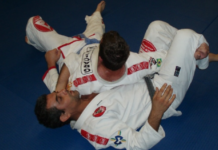




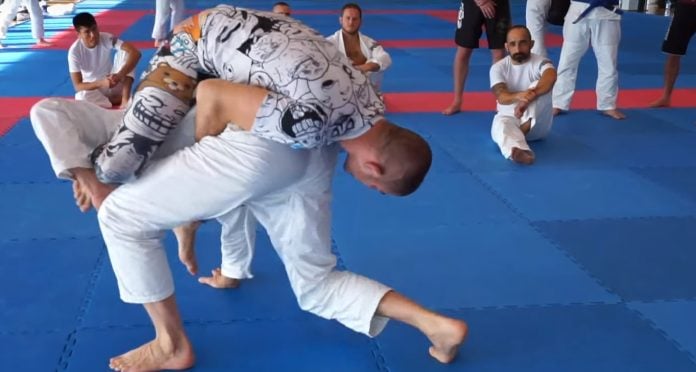
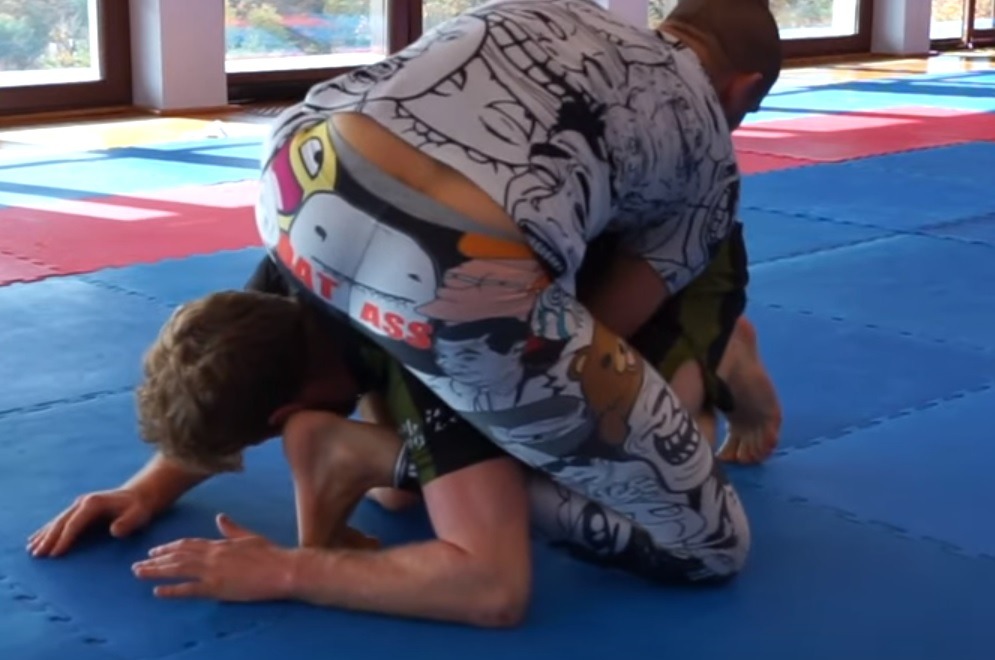 The position looks exactly as it sounds – like you’re upside down on someone’s back. As a first disclaimer, I am not sure if it would score you IBJJF points. In fact, as you’ll see later on, you might want to skip some of the attacks if you’re grappling under IBJJF rules. However, the position works like a charm, and it has everyone in my academy scratching their heads. Once you get there, people simply do not know how to act, or what to do. And that gives you a time to rest and consider your next move without being disturbed.
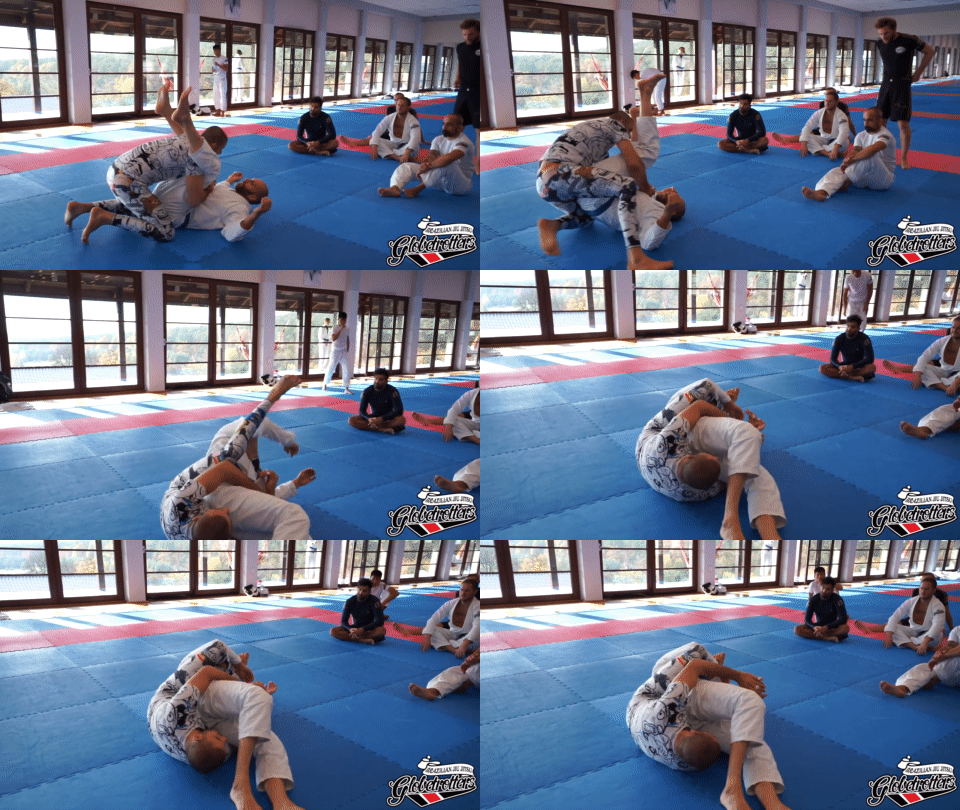 To make things easy, getting there doesn’t require that you have the back in the first place. On the contrary, getting it is extremely easy in several situations that occur in BJJ all the time. One example is the double-under pass. Whenever you’re there, and you have trouble passing the legs, simply sit down and you’ve got an uncontested way to the inverted backmount. The position is easy – legs crossed underneath both arms and in front of the chest. Arms with a gable grip at the level of the hips. That’s it!
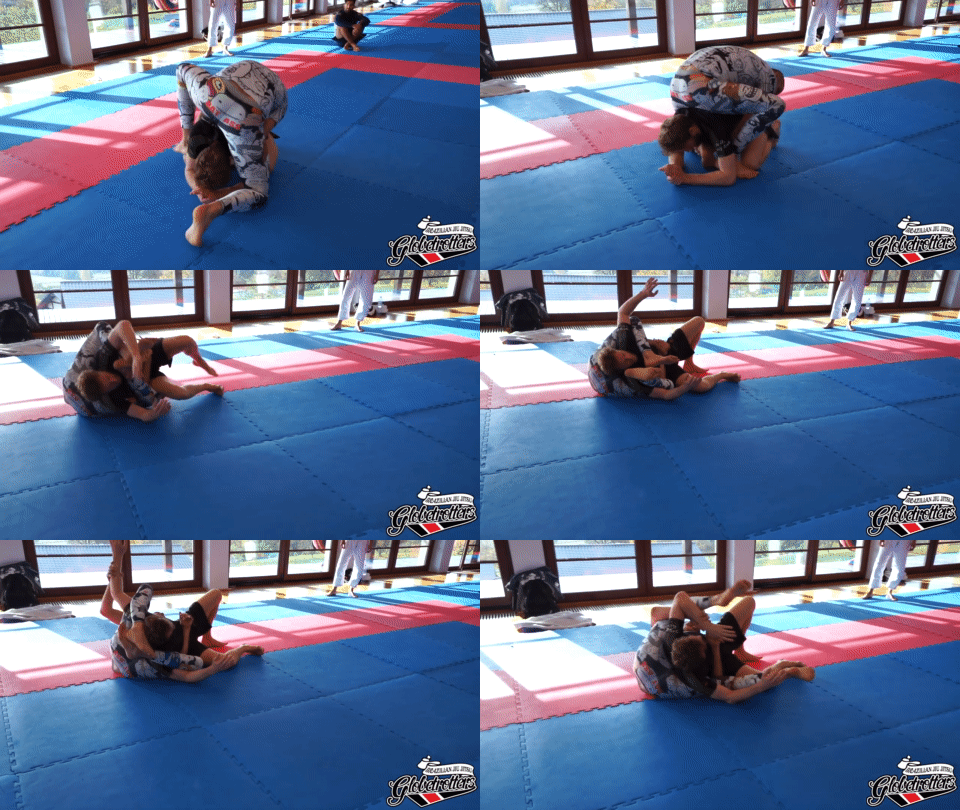 The real gem here is a crazy position that’s like the source of all evil in BJJ. Form the “basic” inverted backmount you get control of one arm, and thread your leg over the shoulder, with the foot reaching behind the opponent’s neck. You then move them to the other side and repeat the process. Here’ you got neck cranks, wristlocks, spinal locks, and other evil stuff.
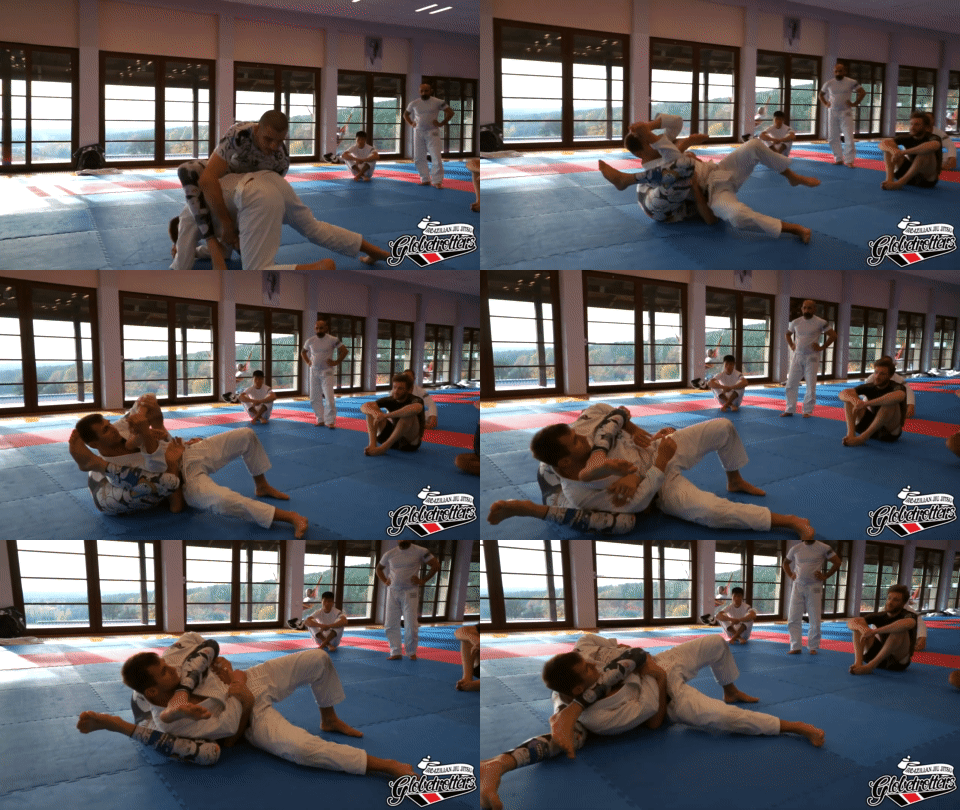 Last but not least, there’s the inverted triangle. When you only have one lag under the armpit for the originally invented backmount, you can think about the inverted triangle. Just pull the free arm across their body (easy given the positioн of your own hands) and the triangle will pop on virtually by itself.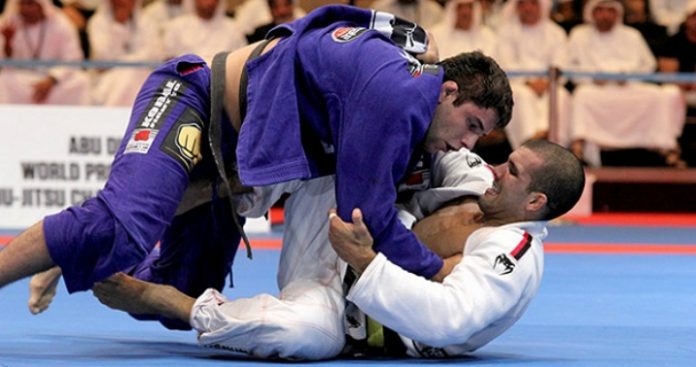
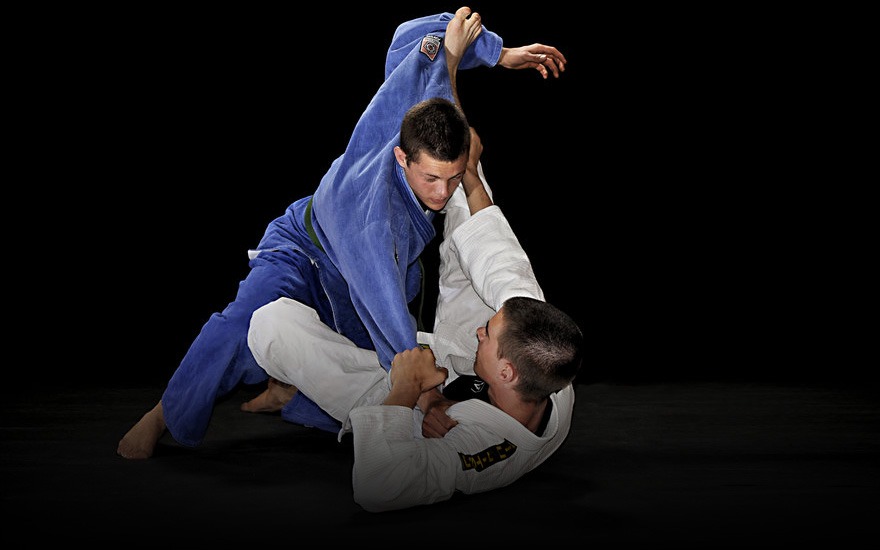 Technical Jiu-Jitsu training takes up the bulk of your training time on the mats. Yeah, rolling rounds might las longer than technical ones, but you learn BJJ techniques first, while you’re still fresh. Then you get to drill, which is also a part of technical training. To that extent, even positional sparring is considered part of technical training. Now let’s rewind all the way to the beginning of class and look at the warmup. Apart from some cardio and stretching, a large portion of the warm-up contains highly technical BJJ specific movements. So yo see how you actually spend most of your time actually training technique, albeit through different training modalities.
  The same holds true for sweeps, reversals, escapes, top control, and even submissions. in terms of control, that might mean having a different type of control when sides are a part of the puzzle. Even when you’re in the mount or have back control, you can still opt to do different BJJ techniques on different sides of the opponent’s body. And the reason why all of this works is that you actually get to spread your attacks, or defenses, over a larger portion of the opponent’s body. Plus, there is the fact that your opponent probably won’t be as versed at defending moves on both sides equally. Particularly if those moves are completely different.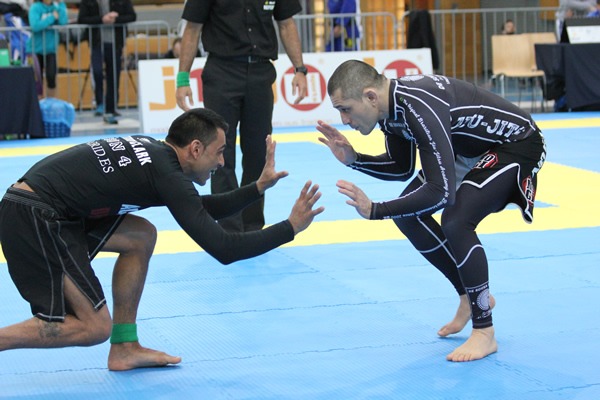
 Well, the answer to this one is easy – BJJ No-Gi gear, of course. Jokes aside, there are pretty much no rules when it comes to NO-Gi training. In fact, before beginners acquire Gis, they get to train to wear whatever they want. In the No-Gi class, the commonly accepted attire is a rash guard and shorts. Another common addition to this basic apparel area spats. In certain cases, people even choose to forego shorts in favor of spats and
  The belt system when ti comes to No-Gi si pretty much the same. In fact, even though people do not wear belts they still sue the term “belt” to precise rank. To that extent, there’s compete carry over between ranks in Gi and No-Gi Jiu-Jitsu. Remember when I said No-Gi was Jiu-JItsu as well? Think of this as a “proof”. So, the same ranking works in both gi and No-Gi BJJ. To that extent, in training, people usually do not wear anything to make their rank clear. At least not in academies that are anything alike 10th Planet. Still, there’s always the option of wearing ranked rashguards in order to clearly display your level.
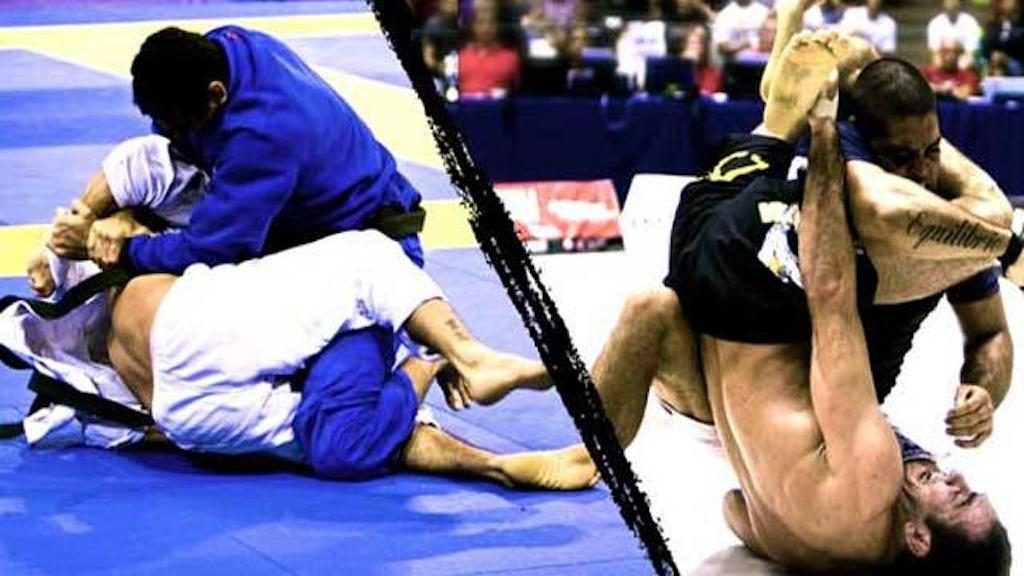 This is the most subjective answer possible. The question is certainly one of the most frequent ones, but the answer is anything but easy. The easiest logical answer would bet o try both and figure out which one you like better. However, that also means training at least a year, in order to really understand what it is you’re taking up. Most people usually want an answer straight away, so I have a go-to recommendation, rather than a clear cut answer. BJJ NO-Gi training is for those that like to keep a fast pace while also looking to be highly technical. Gi jiu-JItsu is for people that like to take things a bit more slowly and play more of a chess game. These are al lonely recommendations, mind you.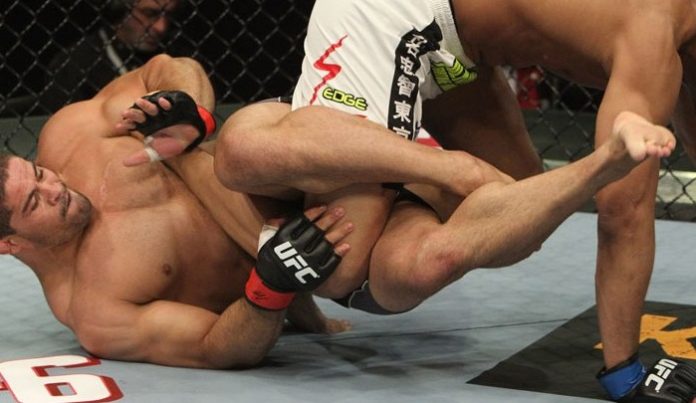
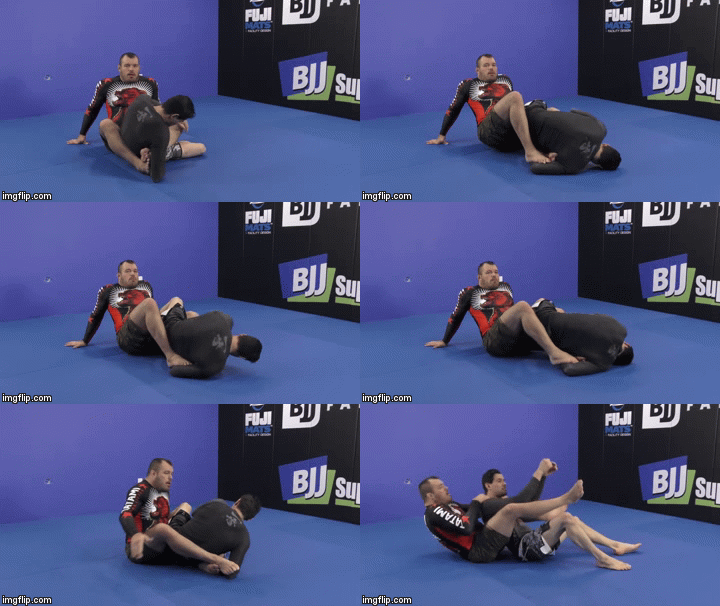
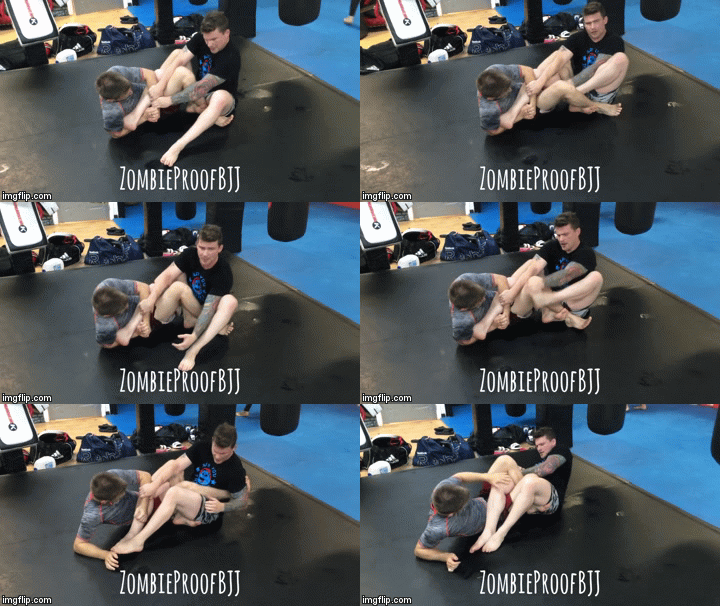
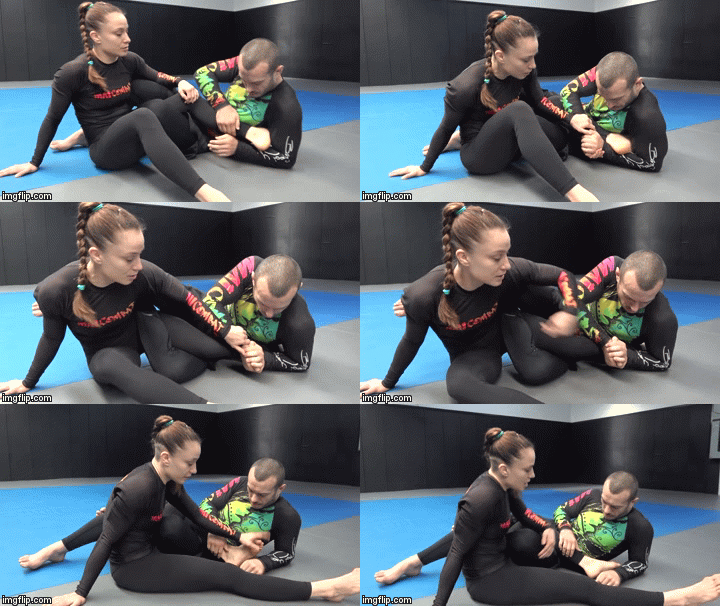

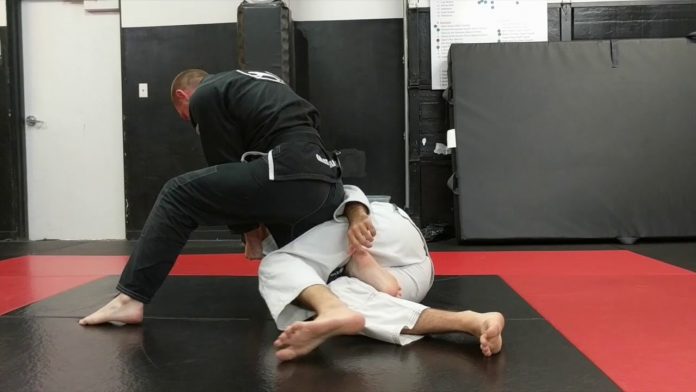
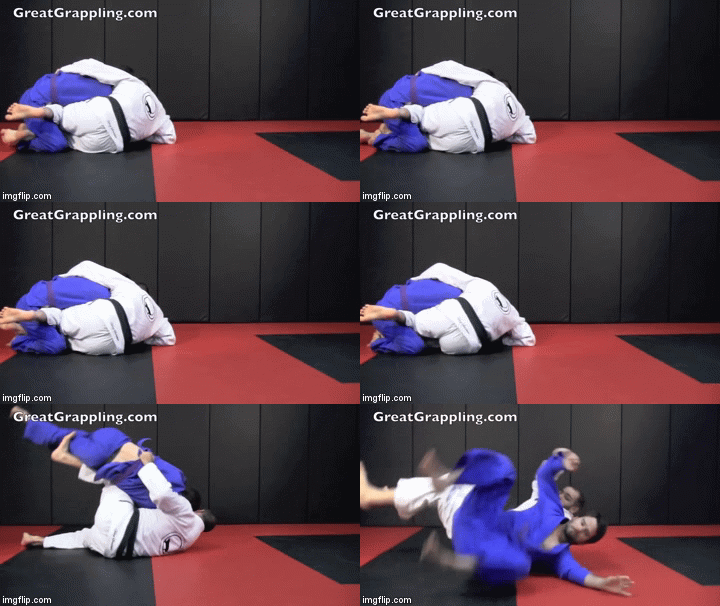
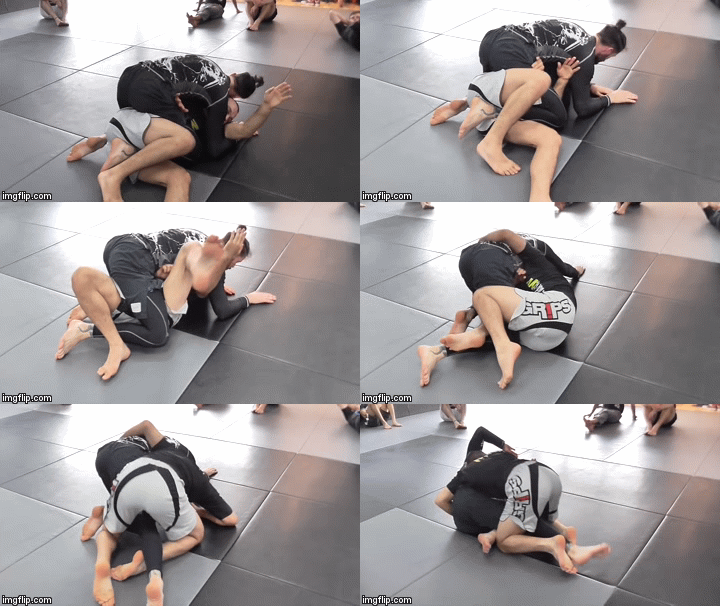

 At the moment of writing this article, there are several Jiu-Jitsu social projects out there that are active. I will write a bit about each and everyone I could find while doing research on the subject. However, I am aware there are many more, so if anyone ikes to share their experience on the subject, feel free to voice your thoughts. That said, Jiu-Jitsu social projects work in the same manner other social projects do. They tend to improve every possible aspect of the lives of children that have unfortunate fates. Whether it is poverty, abusive parents, lack of parents or all of the above, JIu-JItsu can help steer kids in the right direction. Particularly in difficult living environments, like the favelas of Brazil, for example.
 He started off using battered mats and old Gis in order to attract children to something different. His project now has a decade under its belt and now has 200 students in two different locations. Eduardo teaches for free and he even offers living space to 18 kids that he has basically adopted. He has had a lot of help from Jiu-Jitsu Tribe in particular, and they still have an active fundraiser if you’re interested in helping. Just go to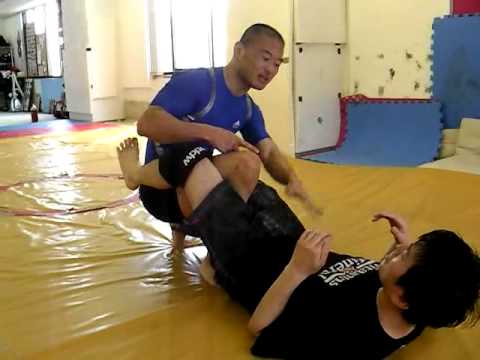

 That’s the science of Jiu-Jitsu in a nutshell – use the positioning of your opponents against them, in order to provoke a reaction you want. With leg locks against ht closed guard, you’re also bringing in the element of surprise. Not many people will expect an outcome like this. Moreover, even if they do, there’s not much they can do when you set everything up correctly. And remember, it is not a sweep even if they get on top for a short while if they end up tapping to whatever you have in waiting in the shadows.
 One very fresh example of a nasty reason behind a fighter’s reason for dropping out has to be Keenan Cornelius’ infection. You’d expect staph, MRSA, maybe even Ringworm complications to sideline a fighter. However, an eye infection doesn’t really bode high on the risk list. Still, this is exactly teh case with one of the best BJJ fighters around, Keenan Cornelius just before the 2019 ADCC. What happened to Keenan is known as Pink Eye and it is a serious and very contagious eye infection caused by a virus. It is so serious that it can even lead to loss of vision. So, as funny as Pink Eye might sound, it is actually legitimate, if extremely rare, reason to pull out of the highest level grappling competition there is. Tough luck for Keenan, as his division hosted some crazy matches this year!
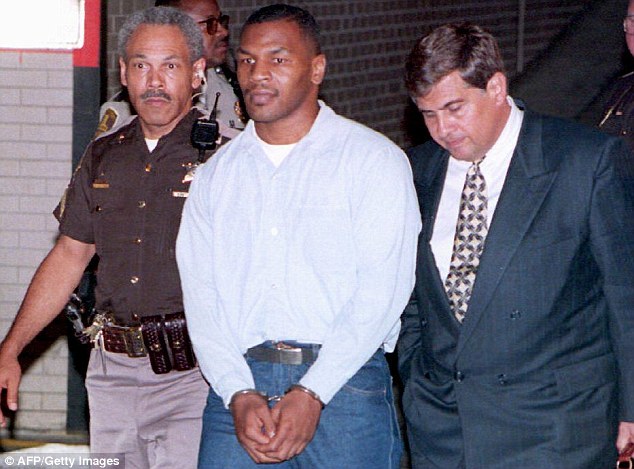 For this one, we’ll take a brief trip through recent boxing history. Although we have plenty of examples in our time of fighters ending up behind bars, none of them have had and imminent fight canceled because of it. Well, it happened to the boxing legend “Iron” Mike Tyson His match with Evander Holyfield had to wait in the sidelines while Mike ended up spending 3 years in prison on accusations of rape. The Tyson – Hollyfield fight did materialize years later, but it left us with the question of what would’ve been if that fight had taken place before Tyson’s incarceration?
 If Al Iaquinta’s pull-out is the smartest individual reason for getting a fight canceled, then Max Holloway’s withdrawal has to be the smartest forced decision so far. The UFC champion really did get everyone concerned while on media duty, when he was slurring words and acting strangely. As it turned out, he was later hospitalized with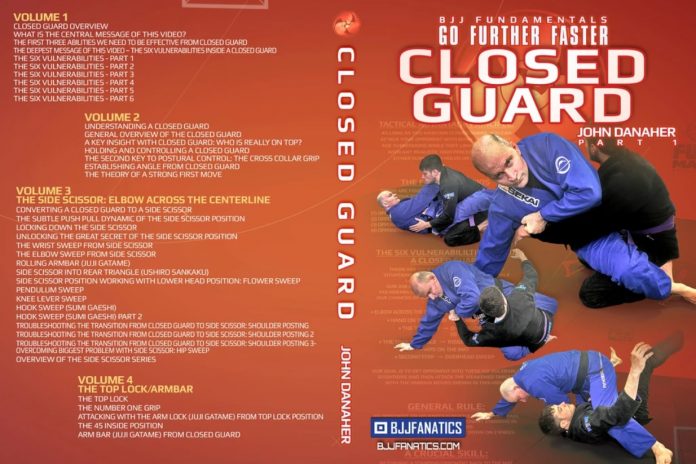
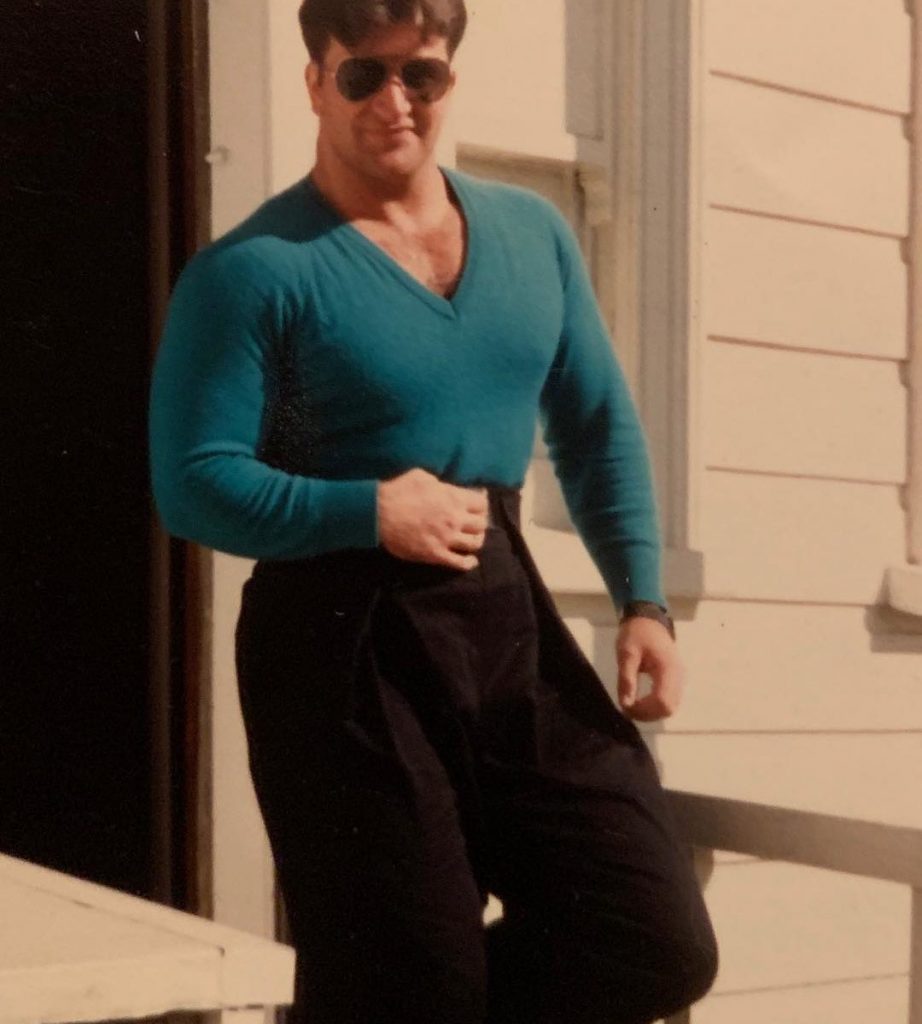 The story of John ahs been beaten to death so many times up until now that there’s absolutely no point in repeating it. he came as a huge powerlifter with a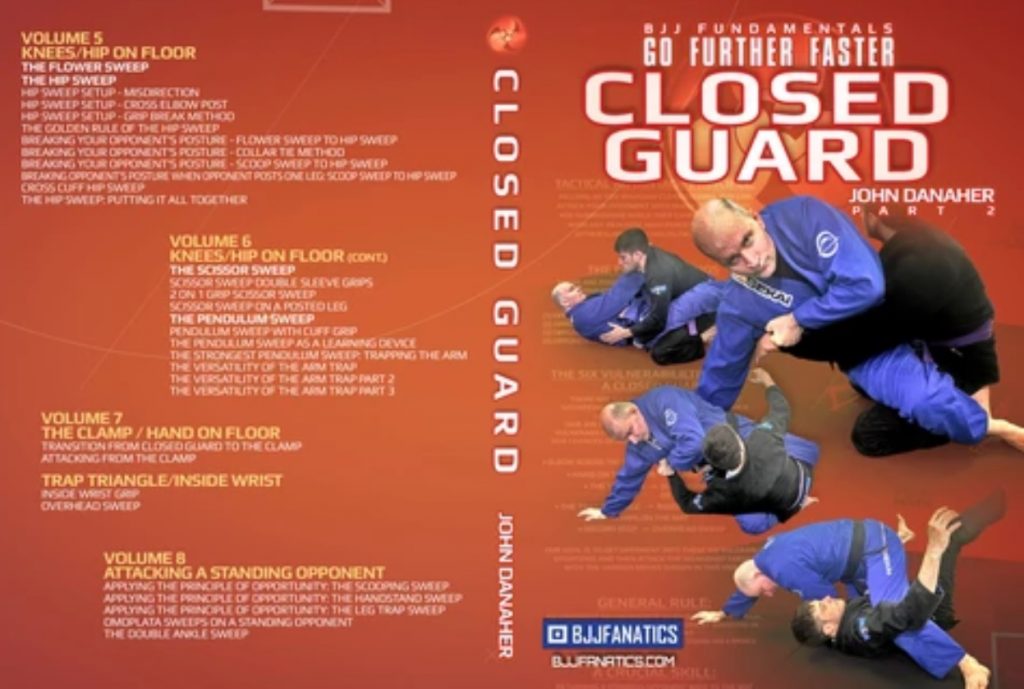
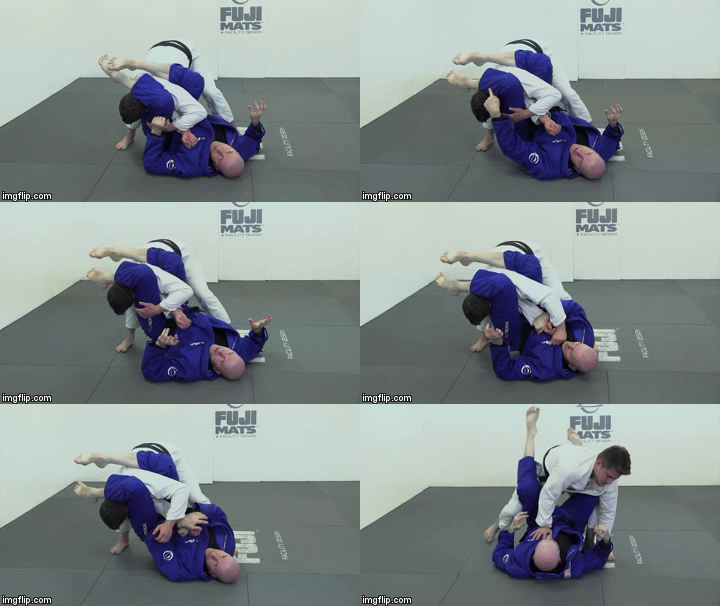 This volume of the instructional is also where the first sweeps make an appearance. The wrist, and subsequently, elbow sweep open up the sweeping account. Following closely is a rolling armbar, which, explained by Danaher, now seems like a breeze to perform. Of course, more submissions and sweeps follow, like the rear triangle and flower sweep of the side scissor. As a Judoka, I particularly enjoyed the several Sumi Gasehi options included here. Troubleshooting entries form closed guard to the side scissor wrap volume three up.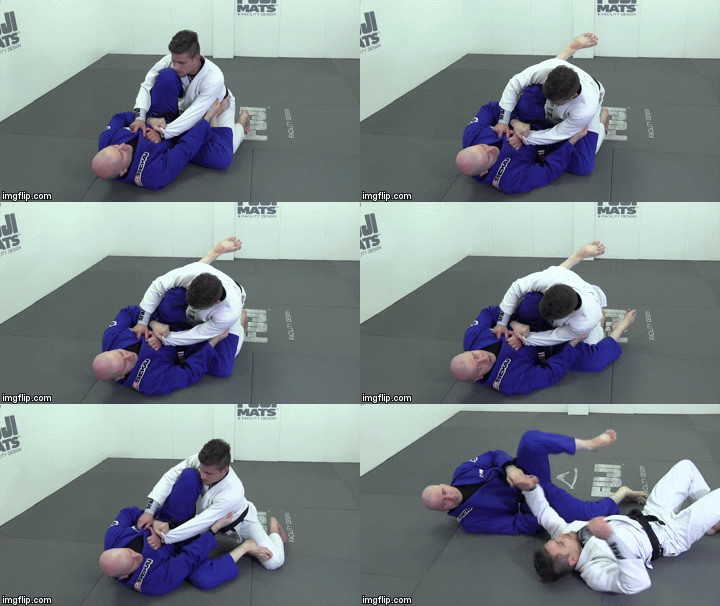
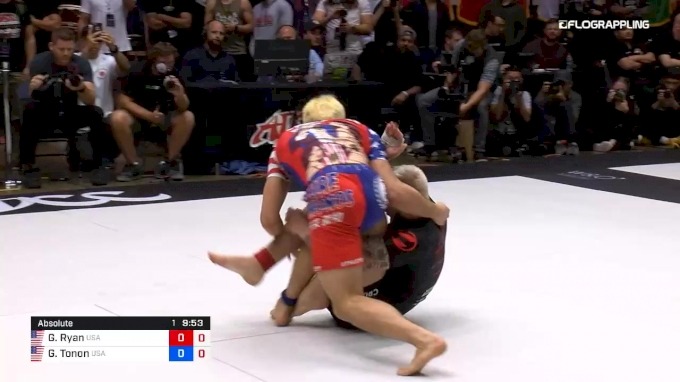
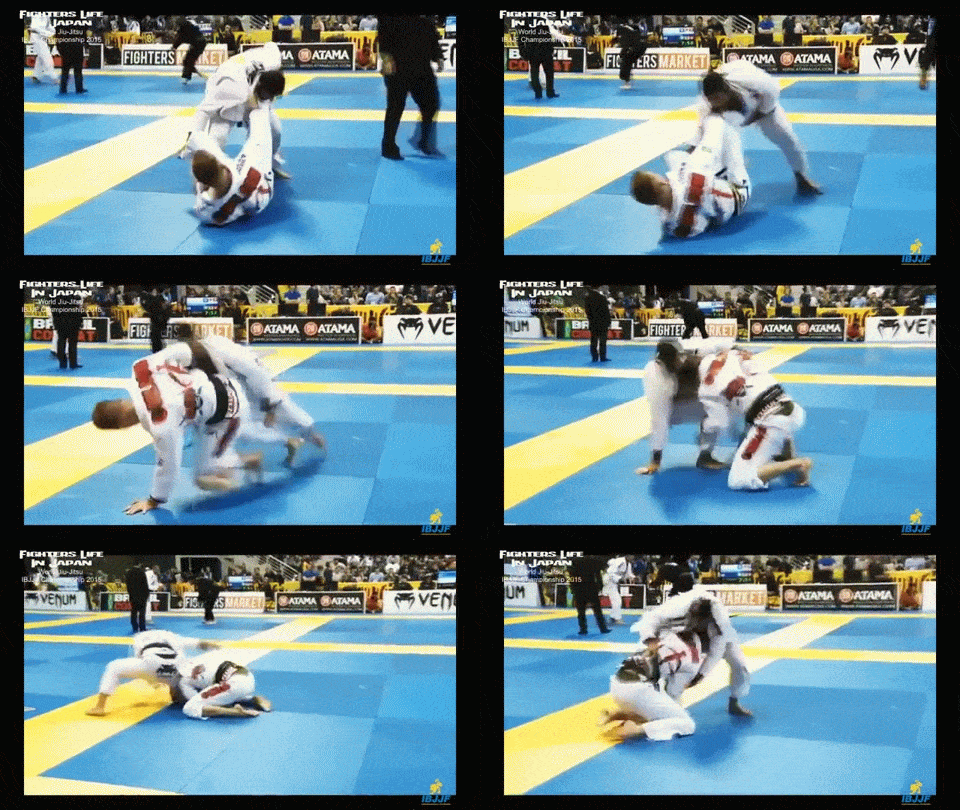 While you’re scrambling, all the control of BJJ turns into chaos, and it is as close to an “anything goes” situation as you can get while grappling. One thing to know, especially if you’re a white/blue belt si that scrambles are also situations in which most of the BJJ injuries occur. Particularly when you’re caught in one with someone close to your level. In a scramble, apart from everyone looking to get at least a grip in, not to mention positional advantage, you also get quite a few hits or Gi burns. A lot of the busted lips, black eyes, and similar cuts and burns take place during scrambling.
 If you want to bring a bit of order to chaos, try and think of a BJJ scramble as an opportunity. During scrambles, accept that things are going to move, rather than be static. IN that sense, think more of wrestling pace rather than the usual BJJ one. Now, as that happens, instead of panicking and tensing up, try to relax. Once you do, you’ll actually see that things do open up. The reason is the fact that things happen in motion. This means your partner needs to work in order to obtain classical control. While that happens, you can get your hands on some transitional control and end the BJJ scramble when and how you want to.