


The Mau Mau Kimura – Throwback To A Powerful Submission

The Mau Mau Kimura Explained

When it comes to BJJ submissions, it seems that every seasoned black belt out there has a variation of a move (or more) that’s unique to them. In certain cases, it can just a simple little detail that completely changes the move. In others, people introduce modifications from other grappling martial arts like catch wresting to double the effectiveness of creating BJ submissions. Some of these modifications are universally effective, while others will only work for the founders. One such variation, that falls under the universally effective submissions is the Mau Mau Kimura.

Robson Mau Mau Lima is a very interesting BJJ character, and he definitely has one of the keenest grappling minds in the sport. The Brazilian is constantly innovating, but few of his things come even close to the success of his Mau Mau Kimura variation. The GF Team legend has used his crazy signature move to secure plenty of victories. In fact, you could argue that he has fixed several drawbacks a “regular” Kimura has. Moreover, he provides options for Kimura hunting from positions not usually associated with this submission. What’s not to love?

Who Is Mau Mau?

Robson Lima is a Brazilian BJJ black belt under Julio Cesar and comes from the infamous Oswaldo Fadda lineage. In other words, he comes from the non-Gracie side of Brazilian Jiu-Jitsu, popularized by Luis Franca, a different student of Mitsuo Maeda.

Born as Robson de Lima Rodriguez, he got the nickname Mau Mau in relation to a Brazilian soap opera character who wore a headband, just like Robson did in training. Of course, the nickname stayed with him, and today is the synonym for a very effective Kimura variation developed by a BJJ world champion.

In his early days, Mau Mau trained Capoeira in his native Rio de Janeiro, which opened up the door to Jiu-Jitsu when he was 14. He trained under a few different instructors at the beginning, before ending up with Luiz Roberto Delvivo, who influenced him massively. As a blue belt, Mau Mau started training at Gama Filho (GFT) and he started competing a lot, on two sides of a 4-year hiatus. In fact, it was after his hiatus and some health issues that Mau Mau really burst on the competition scene.

A black belt since 2012, Mau Mau started establishing himself as the man to beat in the BJJ competition scene. He also got to teach in the Boston Academy of his master Julio Cesar. HE not only managed to turn Boston into the headquarters of the GF  Team outside Brazil but also managed to conquer a No-Gi world title and 6 Pans NO-Gi titles, along with countless other IBJJF tournament victories. During that time, he also became famous for the Mau Mau Kimura, a variation that is still effective to this day. In fact, it may just be more effective in modern Jiu-Jitsu than it was back then.

A Few Common Kimura Issues
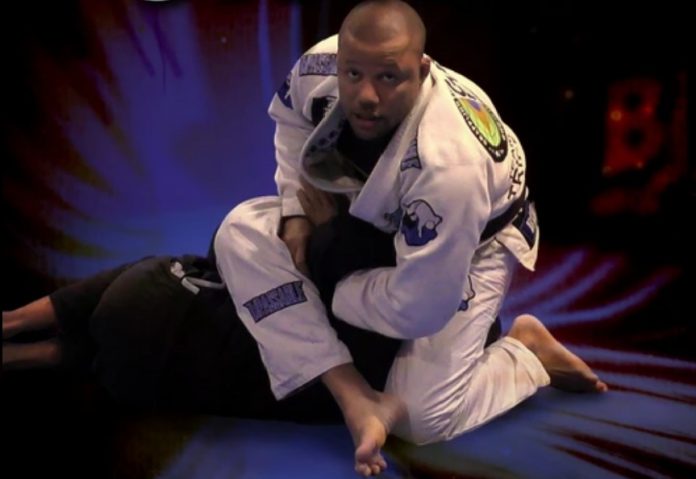
Mau Mau KimuraBefore we go on to the Mau Mau Kimura in detail. Let’s talk about a few issues people usually run into with the regular Kimura. The Kimura lock is an extremely versatile hold, that can work as a submission, a position, and even a transitioning checkpoint. Check out this piece on the Kimura Trap System to learn more about the different ways you can use a Kimura grip in Jiu-Jitsu.

However, when it comes to the submission aspect of the lock, people usually run into a few common issues. The first one is, dealing with the defensive grip. Whenever an opponent grips their own belt or Gi, they’re not really helping themselves as those are moving objects that can travel along with their wrist. However when they grab palm to palm their own sleeve r their leg, breaking the grip to finish the lock can become a real hassle.

Also, another thing that people sneakily do, is keeping their shoulders to the ground, or even rotate slightly towards a Kimura side, when they’re on the bottom. This makes it impossible to get the arm behind their back and usually requires a transition into straight armlocks which are much less effective. However, as the game evolves, the Mau Mau Kimura variation is something we need to revisits, as it solves both these issues and a few more. For example, you can execute the Mau Mau Kimura from the mount, which is not something other Kimura variations offer. Moreover, it involves your entire body in the lock, which really increases the power of the Kimura, and makes it a great move for everyone, regardless of size or muscle mass.

The Mau Mau Kimura Variation

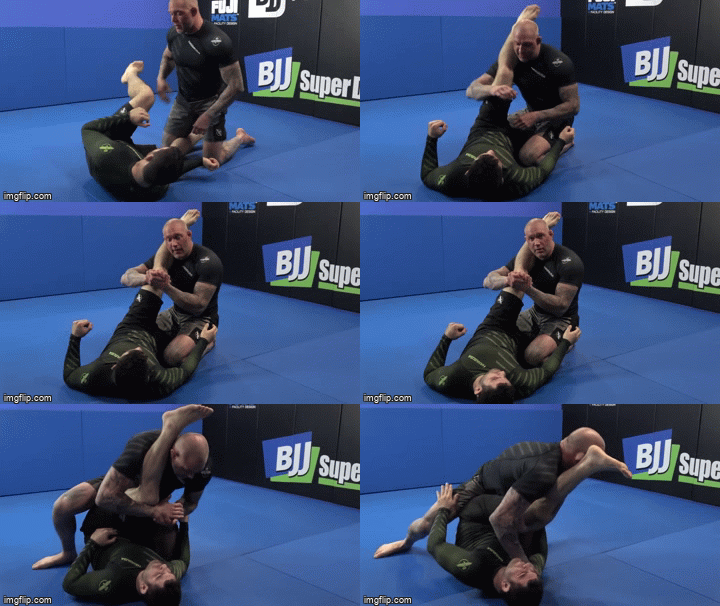
The Mau Mau Kimura is a variation that utilizes the use of your legs in order to finish the Kimura. However, unlike the Squirrel Lock, for example, which is only done with the legs, for the Mau Mau Kimura, you use all of your four limbs.

Mau Mau sets it up from the mount to make it all that even crazier. Actually, he uses a Kimura grip to end up in mount. Usually, this is not hard, as opponents will try and get you into the mount, given that the regular Kimura down’s t work from there. They’re trading points in order to escape a submission. Mau Mau likes to keep a hold of the Kimura grip, place his head on the mat, and pass one leg over the head of the opponent. Up to this point, things are easy.
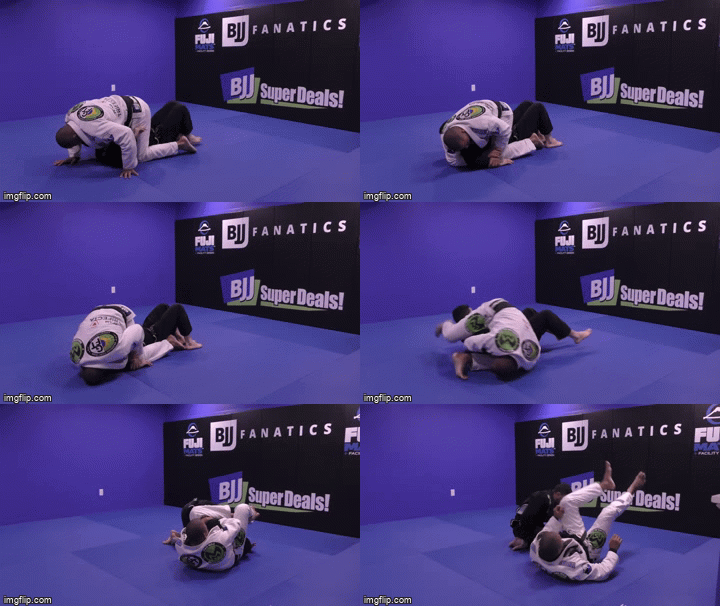
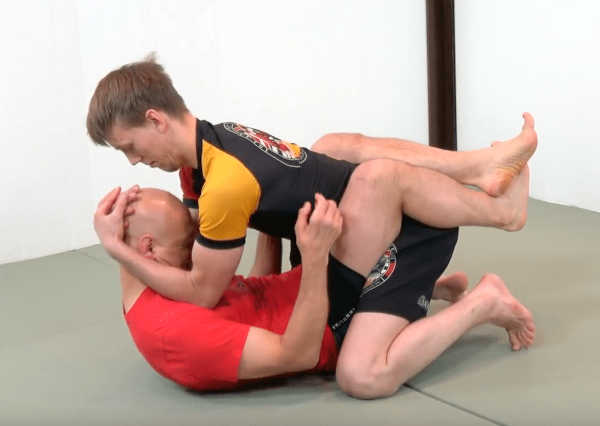
Mau Mau Kimura from mountMau Mau then lifts his other leg, so that the foot is flat on the mats. At this point, the leg that went over the head is on the knee, with the shin under the opponent’s head. In easier terms, he is doing an S-mount on the arm, while maintaining the figure four Kimura grip at all times. Then comes the hardest part – rolling. To make sure you can complete the roll remember to roll towards the opponent’s feet and not their head.

The goal of the roll is to close your legs into a triangle. This is only possible when you’re on your back. From there, it’s a wrap, given that the opponent can’t roll, posture, or do any sort of defense. All you have to do is squeeze the triangle and you’ll even have space to twist the arm if you need to. Which you won’t, because the Mau Mau Kimura is extremely tight and painful.

Final Thoughts

The Mau Mau Kimura works from everywhere. If you want to really get into the nitty-gritty of it all, check out Mau Mau’s dedicated instructional on the subject. You can read a complete review of his “Kimuras As A Way Of Doing BJJ” right here. It is sufficient to say that you’ll discover all the Mau Mau Kimura secrets in there if I managed to tickle your imagination with his mounted Kimura breakdown. Have fun!
The 10 Golden Rules Of Brazilian Jiu-Jitsu

What Are The 10 Golden Rules Of Brazilian JIu-Jitsu ?

I usually like to avoid the word “rules” in any shape or form during class. However, for the purposes of this article, there’s really no better way to put things into perspective. What I usually tell people on their first day is that there are no rules in Jiu-Jitsu, outside of competition. There are only logical guidelines that can make life easy if you follow them. My take on things is that I can’t teach anyone Jiu-Jitsu. You learn Jiu-Jitsu on your own, I just provide the venue and some general “driving” directions. However, if you’d like your Journey through the Gentle Art to be gentler, here are 10 golden rules of Brazilian Jiu-Jitsu to abide by.

The most important rules of Brazilian Jiu-Jitsu are actually the unwritten ones that concern etiquette. How you conduct yourself on the mats is crucial to you being accepted and thriving in the sport. Apart from those, everyone finds their own BJJ niche to follow. In those terms, there are not many universal rules that can apply to everyone, considering how individual the nature of Jiu-Jitsu is, to begin with. Still, there are several principles that can really help you put grappling into perspective. In fact, there are 10 golden rules that will certainly make BJJ life easier for everyone.

“Rules” In BJJ

Brazilian Jiu-Jitsu is a sport and/or art that doesn’t really like to conform by rules. I mean, the point of it all is to deceive another person who also knows moves you know, into falling behind with their game so that you can progress with your own game towards the final goal of submitting them. That right there shows how much creativity you need in order to really develop as a grappler in a significant way. And rules can only get in the way of personal growth and creativity.

Let me make one point clear. When I write about no rules in BJJ I don’t mean that anything is allowed. I just mean that there are no real rules that if you break, you can’t perform something. On the contrary, each move works a bit differently for everyone. The idea is to get people to talk and share about why things work for them. That way, they both share knowledge, van though they might not understand it yet, and a coach can point them in the right direction. But, unlike traditional martial arts, if the hand or foot is an inch to the right, or slightly rotated, it doesn’t mean that the move won’t work. On the contrary, it may just work better. This is precisely why rules in BJJ are more of a hindrance than a help.

That said, there are certain rules of Brazilian Jiu-Jitsu that we can look at as being golden rules of the sport/art. As such, they’re there to help us understand what BJJ is all about and help us develop our games and our personal style of grappling. These rules are nothing unbreakable (no rule is) but do serve a purpose. Moreover, they’ll help put things into perspective not just for new students, but also those with considerable experience in Jiu-Jitsu.

10 Golden Rules Of Brazilian Jiu-Jitsu

These rules are by no means the all-encompassing ten rules that universally apply everywhere. As I said, I’m not too big on talking about the rules of Brazilian Jiu-Jitsu. Id’ much prefer to use the word “guidelines”, or “principles”, but in my experience, talking about “rules” resonates better with people. The idea with these rules is to help you find reason behind everything you do on the mats, both technically and mentally.

1. Minimum Effort, Maximum Result

the 10 Golden Rules Of Brazilian JIu-JitsuPerhaps the most important rule of them all. If you want to be successful in BJJ, you’ll have to find a way to be lazy. It sounds counterintuitive, but it works. The more you can achieve by moving less, the better off you’ll be. In fact, that’s how you can really get to the bottom of things. This is in line with the philosophy that “leverage and technique beat strength”. In fact, it is a much more in-depth version of it, as you can apply it everywhere. Despite what most people think it is not as much about moving, and jumping around in BJJ, as it is about knowing when to move and doing so in a fully deliberate fashion.
IN simpler terms, if you can pass a guard or sweep with just a flick of your foot or hand wouldn’t you do it? How about submitting someone just by breathing in deeply? That’s what minimum effort is all about.

2. There Is Losing In Jiu-Jitsu

“You either win or you learn”. NO. As far as rules of Brazilian Jiu-Jitsu go, you can and will lose in BJJ. And you will lose a lot. There’s no way around it and there’s no need to sugar coat it behind statements like the one above. Lessons are everywhere, in both defeat and victory. Plus, the goal is to force someone to surrender, even in training, which is by definition, a loss when we look at it from a sports perspective. So you can lose in Jiu-Jitsu, and you actually need to. It is a good thing and one you need to find a way and deal with.

3. Control Is Everything

The old mantra of “position before submission” went out the window with Danaher’s in-depth philosophical approach. He changed it to “control before submission” precisely highlighting what the main focus of Jiu-Jitsu is. In fact, the DDS leg locking system is the perfect example of it. Before, people were just hunting leg locks as a submission. When Danaher introduced control into the mix, we suddenly saw a powerful weapon emerge in and are thought to be not worth exploring by the majority.

However, control in BJJ is tricky. You can’t just pin someone like on other grappling martial arts and hope for the best. Instead, you need to control your opponent in a way that restricts their movements in very specific terms. That way, every movement they can make actually works in your favor. (It takes a long time to figure out control, but it is more than worth it, as with it, you can freely submit anyone.

4. Embrace Suffering

For anyone walking into BJJ, this s not really optional. However it becomes something people run from after blue belt, and that is precisely why very often it takes people lots of time to progress in the sport. Suffering is a great way to really understand what is happening around you. And, since there’s always going to be someone infinitely better than you, you should embrace suffering and look forward to it. This is one of the golden rules of Brazilian Jiu-Jitsu.

Of course, this doesn’t mean you shouldn’t be trying to execute techniques and get taps every time you roll or fight. However, it does mean that you will learn more if you get yourself in really bad spots and endure the suffering that will follow. IN time, you’ll start to enjoy it and when your mind clears of all the panic, you’ll discover things nobody can teach you about Jiu-Jitsu.

5. The Holy Trinity Of Easy, Hard, And Dumb

This is a notion that I often use to introduce people to Brazilian Jiu-Jitsu. Since we already talked that being lazy is actually something you want and that there’s no real right or wrong way of doing things since everyone is different, this is how people can make sense out of those concepts.

This rule goes like this: there’s no right or wrong in Jiu-Jitsu. Anything you do, you can either do the easy way (which is the best), the hard way (which is where most of us spend most of our time trying to figure things out), or the dumb way (which is when we give our training partners/opponents presents). The goal, is understandable, the easy way. The moment you achieve it, you’ll also be in sync with the first rule, and will have to go through a lot of suffering to get ether. You see how they all tie in together.

6. Using Strength Vs. Strength

Since I’m talking about the golden rules of Brazilian Jiu-Jitsu, I’ll use the opportunity to also dispel a myth – the one that you don’t need any strength in BJJ. On the contrary, strength, power, explosiveness, and other athletic abilities have a huge role to play in grappling. However, the rule in Jiu-Jitsu is to never use that strength to fight against strength. Whenever you feel someone is forcing stuff or using strength against you, you have to become as loose as possible and actually try to go around the strength. Going head is never a guarantee that things will work. If you do not reply to the strength, but go around it, you’ll actually gain the upper hand in most exchanges of the sort.

7. You Need The Fundamentals

Remember the rule about control? Well, if you want to learn what control in Jiu-Jitsu is, you need to get a grasp of the fundamentals. And, even though they might not be as fun as some of the spinning, flying and rolling stuff you see, they’re way more reliable. Master the fundamentals first, focusing on both the offensive and defensive side of things. The truth of the matter is you’ll be polishing your fundamentals your entire life, but really giving them attention early on will provide you with the best bang for your buck.

8. Never Hold On A Submission After A Tap

Golden Rules Of Brazilian Jiu-Jitsu - respect the tapThis one is probably more than obvious, but for some reason, certain individuals fail to grasp it. A tap means that you let go, immediately, even if you don’t think you had everything as tight as you want. It may even be a cardio tap sometimes, or an unexpected tap from a position, Whenever that happens you don’t just go on, saying,” it’s nothing’. Respect the tap, and always, without exception, let go when you feel or hear someone tapping out. Out of all the rules of Brazilian Jiu-Jitsu, this is the one you don’t break. It is the exception to the rule that all rules have exceptions.
9. Respect

Respect in Jiu-Jitsu is a big thing. In some cases, like the curious one with Creonteism, it even goes too far. However, the fact remains that you need to respect everyone in the gym. You don’t have to like everyone, but you need to have respect for your training partners, coaches, opponents in tournaments, referees, etc. You’ll undoubtedly learn how if you really take to BJJ, but the important thing to know is that people in this sport give you their most valued material possession – their body, to play around with. Treat it with respect, because if you don’t, people won’t respect you either. That’s when injuries and bad stuff happens.

10. You Can Learn From Everyone

Golden Rules Of Brazilian JIu-Jitsu memeAs surprising as it may sound, I tend to learn a lot more from white belts and the occasional blue lately, rather than higher belts and instructors. The notion behind this rule is that everyone has something to teach you. When I show people a move, I encourage them to try and find subtle ways of making it their own. When they succeed, I ask them why they did it, and what was their thought process.

You’d be surprised at how many things you can learn from people that have a blank mind when it comes to Jiu-Jitsu. For example, a girl that trained for three months taught me a heel hook grip on her first-ever leg lock class, simply because she figured gripping a bit defiantly than what we’re used to, made more sense to her. It does, and that grip is extremely powerful, and one I haven’t seen before.

Conclusion

The golden rules of Brazilian jiu-jitsu are there to serve as a guide to what is easy. As discussed, begin lazy and looking for the easy way is actually what you want in this crazy sport of ours. Remember to bark all of the rules occasionally, though, apart from number 8. After all, the point is to explore things from our own perspective and teach ourselves the Gentle Art, in a  way that makes sense to us.

BJJ Mind Hack – How To Use Visualization For Better Grappling Results

BJJ Mind hack - Visualization and mental imagery

If you’ve ever competed in Brazilian Jiu-Jitsu, at least once, you know that going out there on the mats is a whole different thing to anything you might be doing in your academy. There’s just no way of substituting competition without actually competing. That said, as with everything else, competitions come with expectations. Most often we place them on ourselves, or sometimes, others do. In any case, getting your mind ready for competition is far more important than physical preparation. In fact, it can make all the difference in how you deal with the result, no matter if it is a positive or negative one. A great BJJ mind hack to use is to incorporate visualization techniques into your competition preparation.

Visualization and imagery are tools that athletes have been using quite a lot. Across all types of competitive sports, athletes need strong minds to go with the specialized physical attributes they develop. When it come stop combat sports, where you’re fighting against another human being, mindset becomes even more important and crucial. Simply thinking that you’re going to lose might bring about defeat in itself, even though you might be miles better than your opponent in terms of technique or strength. The BJJ mind, just like everything related to BJJ is something you can work on and develop, with the right tools. And visualization is one of the key tools for a competitive mindset and the development of mental toughness.

Visualization In Sports

Visualization is arguably the best tool to help you train your brain for a specific task. With athletes, it is usually a physical one that is a part of their spot. Visualization and mental imagery, as techniques have been researched quite a lot. Moreover, there’s proof that hey work, when done correctly.

BJJ Mind hack - VisualziationThe basic notion of visualization in sports psychology is that “what happens out there is a result of what happens in here”. Namely, visualizing things involves mentally rehearsing your performance. Now, you can focus on aspects of it, the entirety, the end result etc. The end goal is to spend time in your mind going over specific things that you expect will take place in a certain sporting event. Like a BJJ match for example.
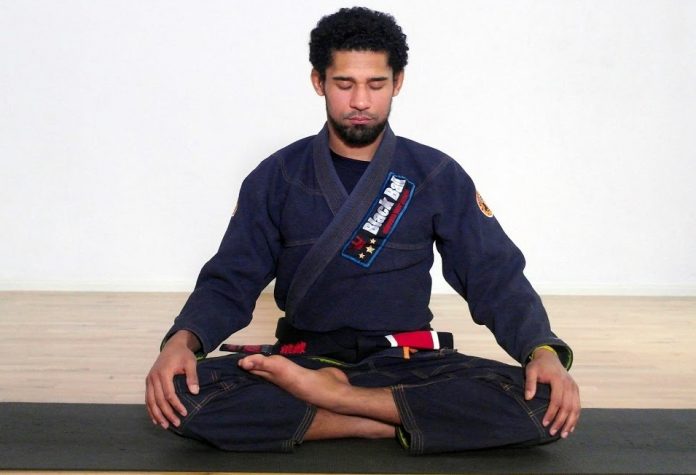
The science behind visualization and mental imagery shows that the brain is highly responsive to these tools on several different levels. A theory called the psycho-neuromuscular theory states that when athletes imagine they’re executing certain movements, they’re muscles are actually firing in the same manner as if they were physically doing them. This is a sort of mental conditioning that allows athletes to train their brains and their bodies in very specific patterns.

Another theory called the bio-informational theory explains that visualization activates a network of stimulus and response that helps things get stored in long term memory. In simple terms, visualization and mental imagery help develop self-regulation skills while programming our minds, muscles, and emotions to work in accomplishing a specific goal. In terms of the BJJ mind, think of it as a way to organize every variable out there in a meaningful system and be prepared for any outcome, desired or not. More on that later.

Some of the examples of Olympic athletes that regularly use visualization as part of their training include Canadian bobsledder Lyndon Rush, discus champion Al Oerter, tennis star Billie Jean King, and American Olympian in snowboard cross Jacqueline Hernandez. A whole host of MMA stars are also known to use visualization tools when preparing for fights.

BJJ Mind Hacks – Visualization Techniques For Combat Sports

When it comes to training the BJJ mind with imagery and visualization, Erickson Gracie is one of the greatest and earliest proponents of those techniques. As he says in the documentary Choke” “It’s the most beautiful movie, and every time I relive it I create images and nuances that I want to experience.”

When it comes to BJJ Mind training or combat sports in general, visualization goes much further than just seeing yourself win a gold medal, or make a move work. Of course, setting a goal is the very first step to engaging in meaningful visualization training. However given the nature of the sport of Jiu-Jitsu, visualization has to include everything, form everything going your way, to getting stuck in the worst possible positions.

Seeing yourself fail at everything you try, end up in the worst spot imaginable, and getting out of it, prepares your mind for the reality of all of those things actually happening. When it comes to that, you won’t panic or give up but instead, be calm and collected about it, because you’ve been there hundreds if not thousands of times in your mind. That’s just one example of how visualization can greatly impact your performance at a tournament.

BJJ Mind training - VisualizationWhen visualizing things, it is key to be as detailed as possible. In fact, going through everything that would happen at a tournament is a great way to approach it. Yes, it takes time, but that’s the point. You need to focus on everything, from how the venue feels to smells, the feel of the Gi, the noise that’s ubiquitous at any grappling tournament… Everything matters. Then, you go for the technical stuff, how you walk on the mats, how a match starts, and all the possible outcomes good and bad. Visualizing results can be tricky business, but seeing yourself with a medal, on the podium does work great in certain cases. What’s more important though, is the play by play action, rather than the end result.
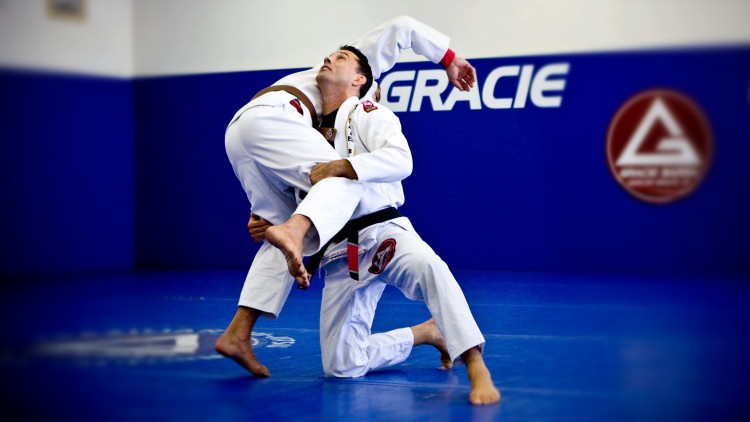
Three’s also guided visualization for those willing to give it a try. However, in those terms, I’d recommend working with an actual sports psychologist that tailors it all to your needs rather than just picking up something online and listening to it. After all, you wouldn’t train actual Jiu-Jitsu in that manner, so why train your BJJ mind like that?

Turning Visualization Into A Routine

When it comes to visualization as the ultimate BJJ mind hack, the thing to remember is that you’re competing in an individual sport. What it all boils down to is you and another grappler, standing opposite each other and showcasing what you know. So, when it comes to using visualization in your BJJ mind training, make sure you always visualize things in the first person. In other words, you need to transport yourself to the tournament in your mind. Just like I said before, you need to be as detailed as humanly possible about it, trying to involve all your sense into it. It is the best way to gain the most benefits from using visualization as a training tool.

Another thing to consider is that visualization and mental imagery won’t really do anything for you if you use theme sparingly, or just a few times before tournaments. You need to turn them into a routine, just like you do with your BJJ training, conditioning, and recovery. The key to success with visualization is in doing it all over and over again, as many times as possible.

One of the best moments to use visualization is in the morning. Right after you wake up from a good night’s sleep your mind is in prime condition for some training. This is a great time to really use all your brainpower to visualize your upcoming performance at a tournament. Just remember to get as comfortable as you can while doing it, and dO try not to fall asleep.

Final Thoughts

Visualization is a tool that top-level athletes have been using for the better part of 50 years in order to reach peak performance. IN combat sports, where the mind plays a much bigger role than the body, using BJJ mind hacks like this can incredibly increase the level of performance you have. Think of it like having the experience of hundreds of tournaments, over and over again. You’re just getting all the benefits, and more, without having to physically go through them all. Be sure to give it a try,  and let us know how it works for you!

How Long Does It Take To Really Master A Brazilian Jiu-Jitsu Technique?

How long does it take to master a Brazilian Jiu-Jitsu Technique

“I fear not the man who has practiced 10,000 kicks once, but I fear the man who has practiced one kick 10,000 times” – Bruce Lee. This is one of the most famous quotes related to martial arts. It is so often quoted, that the context has become contorted over time. As you’ll see later on, this is something that tends to happen when people simply repeat things they’ve heard, without giving them much thought. So, according to this quote by Bruce Lee, it would take any one of us 10.000 repetitions to learn an armbar, or a guard pass or any one particular Brazilian Jiu-Jitsu technique out there. And yet, somehow, we know that this isn’t the case. So, how long does it really take to master a grappling move?

There are different methods and views in regard to this subject. Of course, to each their own, but for me, I’ve found a method that really makes sense. In terms of Jiu-Jitsu, it is nearly perfect. What’s even more important it doesn’t use numbers that go into thousands, thus causing resistance before we even start. Let’s face it, we suck at appreciating delayed gratification and want everything here and now. That’s why the colored belt system was created in the first place! That said, learning any given Brazilian Jiu-Jitsu technique will require you a lot less than 10.000 repetitions, or 10.000 hours, for that matter.

The Era Of The Specialist

Before we go on to talk about how you can learn a Brazilian JIu-Jitsu technique quickly and efficiently, we need to consider the nature of the sport. It is extremely easy to think you can apply a method of learning to multiple techniques at ones. It will just take more time, right? The answer is “wrong”! If you really want to understand how a move works, you should dedicate your full attention to it.

How To Master Any Brazilian Jiu-Jitsu TechniqueThe question undoubtedly arising in your mind now is how can I focus on just one move, when every roll is made up of hundreds of moves that never really repeat themselves? Let me ask you this: “ How come some people are specialists in certain moves”? That mindset of either being a specialist or a broad game player in BJJ really makes no sense. You have to be both. There’s no specializing without actually being able to navigate the game of BJJ. But that doesn’t mean you can be an expert at every possible position or move JIu-Jitsu has to offer. Quite the contrary, nobody is a master of every BrazzilianJIu-Jitsu technique in existence.
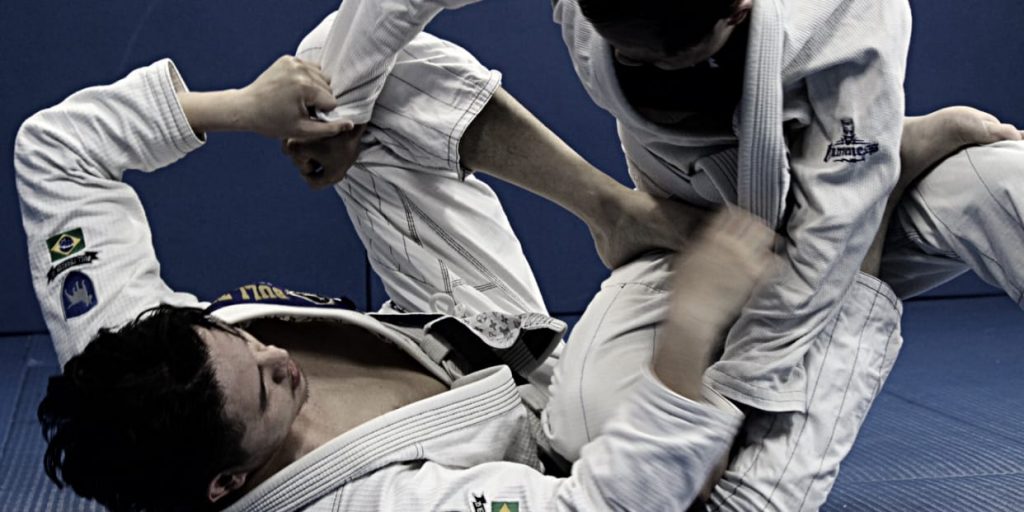
However, as it is evident by the best grapplers of today, we can be specialists at certain moves. Moreover, we can become specialists of more than one BJJ move, and use that knowledge to advance quickly through the ranks and in competition. In fact, that’s what today’s philosophy of BJ Jis, at least for competitors – how to become really good at the best stuff, really fast? Well, the first step is deciding to specialize in a certain move. Not an area, but a move. The next step is knowing how long it will take you and which learning method to use.

You Can’t Learn Everything

There’s something really curious about the minds of BJJ folks. We all want things to happen right away, despite begin aware that things don’t work like that. We want people to tap the moment we sink in a choke or joint lock, we want to be able to hold everyone indefinitely and win every exchange. Yet, we know it won’t happen. Which brings me to the greatest realization of all – we can’t ever hope to learn BJJ. Conversely, we can’t expect to be able to learn every Brazilian JIu-Jitsu technique. And that’s is perfectly ok.

How do you become a specialist in Jiu-Jitsu? Easy. TI doesn’t matter what level you are at. Just go for classes, and do your rolls. However, make sure your focus is on submissions. Any submission will do. If you have no idea what to specialize in, first focus on a submission hold. A choke, an arm lock, a leg lock, with or without the Gi, just pick one and start dissecting it.

Next, you should look to understand defense. Once you know how to submit people, you’ll already be more than halfway there with defending submissions. This is the time to figure out defensive postures and getting out of positions. Again, pick your poison and start specializing.

After this point, you can look for more external input. As your coach what they think you’re lacking, or talk to them about an aspect of BJJ that you might think about exploring. Moreover, start asking your Professors about the underlying concepts of BJJ. After you’re able to submit just about anyone, and roll without fear of ending up in a” bad spot” you can start to figure out the few underlying secrets of BJJ that are universally applicable to every Brazilian Jiu-Jitsu technique.

The 20–hour rule To Master Any Brazilian Jiu-Jitsu Technique

So, on to the rule. The fact of the matter is that to master a particular Brazilian Jiu-Jitsu technique, you’ll need no more than 20 hours. Yeah, that’s right, just 0 hours. Less than a day. But there’s a catch.

During those 20 hours, you need to have a complete focus on that particular Brazilian Jiu-Jitsu technique. If you want to break it down it comes down to about 45 minutes each day, for almost a month. That is not a lot. If we’re being honest, it will take you the better part of 3-4 months to really dedicate real 20 hours to any given BJJ move. However, that’s more than enough to learn that move and be ready to move on to the next.

Brazilian Jiu-Jitsu Technique MasteryWhen it comes to the learning process itself, you need to remember two things. The first is to break down the move to the tiniest possible detail. It doesn’t matter if it is a submission, an escape, a guard pass, or a sweep. Ask yourself shy, how, when it works, and all other associated questions. That will give you a starting point and a progressive way of learning that particular move.
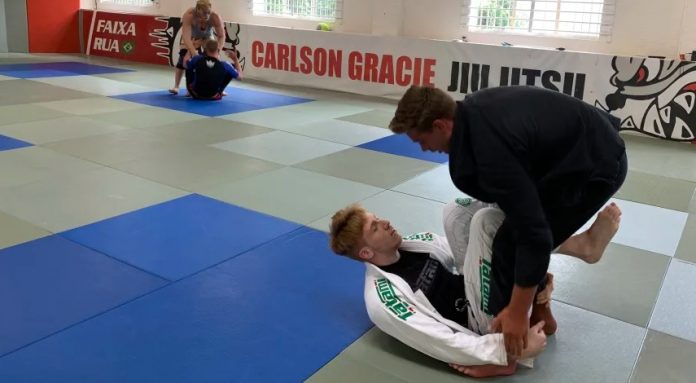
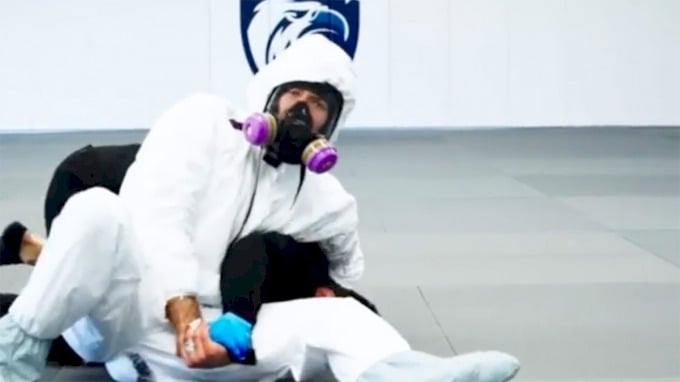
The second thing is to self-correct. Of course, your coach should be the first person you ask. However, don’t stop there. Ask the resident expert in the move you’re doing for pointers and tips. Find dedicated instructions and use them to go deeper into the Brazilian JIu-Jitsu move you’re trying to dedicate those crucial 20 hours to. Make sure you have at least 3 different sources of information on the move but don’t’ go over 5, or you’ll risk becoming overtaken by information.

Wrapping Up

The 10.000-hour rule of mastering a new skill came as a result of a scientist studying experts in different fields, like musicians, athletes, and chess masters. However, in reality, 10.000 hours is equal to doing a full-time job for 5 years 0- not the time you have to focus on just one Brazilian Jiu-Jitsu technique. Instead of trying to be an expert, it is more than enough to use the 20-hour rule and learn how a particular move works. BJJ is about connecting things together and applying them to different circumstances. You don’t need to be an expert to do that. You just need to know a lot about many moves in order to make the connections. And it doesn’t’ take a lot of time to become really good at it. In fact, it only takes 20 hours.

Intro To BJJ – How To Start People In The New Normal

How Will Intro to BJJ Look After Covid-19?

How do we go about introducing Brazilian Jiu-Jitsu to people after all this Covbid-19 madness dies down? For now, we’re all too focused on getting back to training and getting our fix, so most of us are not really thinking about the future of academies. When I say most of us, of course, I don’t mean the people that actually make a living from coaching. That said, think about it – how would you approach an intro to BJJ for folks that have never trained, after months of lockdowns and al governments suggesting that people stay several feet apart and wear face masks? How do you get people to engage in the closest contact sport there is?

Getting people to train Brazilian Jiu-Jitsu seemed to become easier and easier, right before the pandemic hit. The Academy I currently teach at was on a real rise, with new members coming in almost daily, and staying, which is the most important part. I guess having an intro to BJJ class set up really makes the difference, as I wrote in a previous article. However, in the aftermath of the virus, I doubt it will be as easy for both people to come and try things out, and us to welcome them without a grain of suspicion. Sure, there will be crazy measures for some time, but the fact remains that we might just need to figure out different ways to start people off in grappling.

How Covid-19 Changed Everything

To be honest, as a medical professional with experience in epidemiology, I did not take Covid-19 lightly, especially from the standpoint of re-0opening the Academy. That still hasn’t happened but it is not more than a couple of weeks away now. Apart from setting up classes for groups that are already full (which is a nightmare in itself in the new normal), there is the subject of organizing intro to BJJ for anyone interested. It just so happens that I have about a dozen new people on a “waiting list”, waiting for the gym to re-open so they have their first class.

Before the pandemic, I had everyone come for an intro to BJJ class. In other words, it is a private class with up to three new students and one or two coaches. This is a great way to ease people into everything, explaining how classes work, some positions, having them do some movement, and try stuff out while having your full attention and the option to ask anything. It is a great way of introducing people to the class, so that they don’t’ feel as lost in a regular class that has 30-40 people already training. In fact, after talking to several esteemed black belt coaches out there I also started thinking about doing an intro course that lasts a few weeks.

Intro to BJJ after the pandemicCovid-19 sure managed to throw a wrench into everything. As lockdowns and restrictions loosen up, people are still afraid. And they have every right o be The virus is no joke, and despite note begin overly dangerous to most athletes it does present a danger to people with other conditions. And, if there was ever a sport where everyone could train together, from high school kids to 60+ folks, it was BJJ. Sadly, I do think the Covid-19 pandemic will change that, which also means we need to change our approach to how we organize classes, both regular and introductory ones. But that doesn’t necessarily have to be a bad thing.
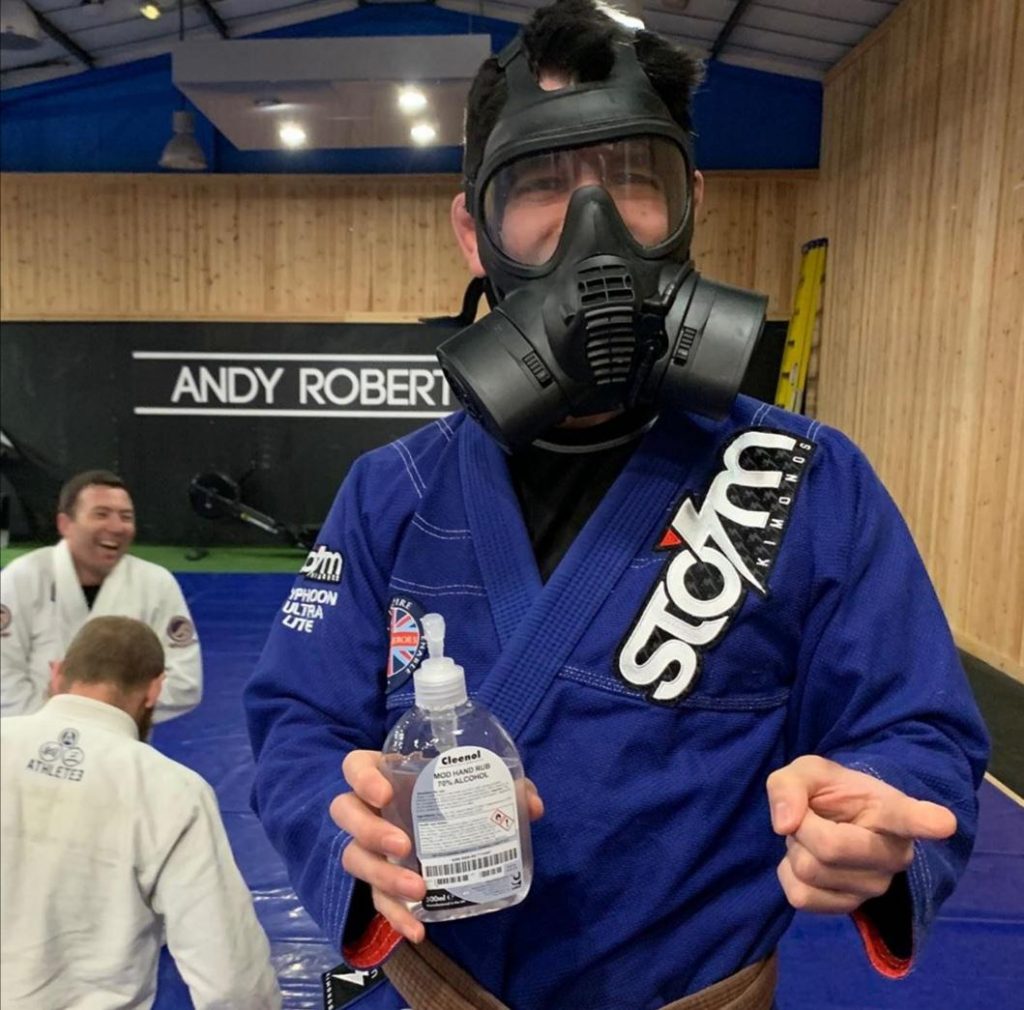
An Intro To BJJ In The New Normal

So, how would an intro to BJJ look in the new normal? More importantly, will it work? Let’s try and go through an intro class with all the Covid-19 preventative measures and see if it make sense.

Someone calls in to schedule an intro class. You set the time (outside of regular class, of course). Now, measures and guidelines for safety different from state to state and country to country. However, if we take the safest route, it would be something like this. Before a potential new member even comes they have to fulfill an online survey that deducts whether or not they were at risk of contracting the virus. When all goes well, they arrive at the second barrier – someone standing outside a gym with an infrared thermometer to take their temperature.

A couple of disinfection barriers and hand sanitizing stations later, they enter a dressing room that’s as sterile as a hospital floor. A quick change into whatever they’re wearing for training (providing them with a Gi is still out of the question) and they’re ready for class. Both the new student and instructor stand with face masks on, which makes communication difficult, to begin with.

During class, there’s no contact, and you try to demonstrate things on another coach. The only thing left for a student to try out are some movements, along the lines of hip escapes and technical standups. Not really the intro to BJJ class both they or you would’ve hoped for.

While installing measures like this for people that already train is no problem, given that everyone is addicted to Jiu-Jitsu, introducing the sport to new members is definitely going to become a chore. However, we don’t really have to use such a model, do we?

The Positive Side Of Things

There’s light at the end of the tunnel though. Personally, I see organizing Into to BJJ for new students as a challenge now. And, like with every challenge we face win Jiu-Jitsu, there has to be a solution. In fact, there are probably several. If nothing else, figuring out how to organize classes will evolve BJJ further, even if it is by force rather than our own choice.

Intro to BJJ fo nrew students during the pandemicSome of the ideas I’m having are grappling games. Everyone loves to play a game, even if contact is down to a minimum. And that is quite possible to pull off, providing people with some fun, laughter, and a sense of how rolling feels like, without having them be in extremely close proximity. Moreover, tying them together with a very specific demonstration of the fun side of training done by the coaches is also bound to represent your classes and teaching style much better than just going through motions with a face mask on.
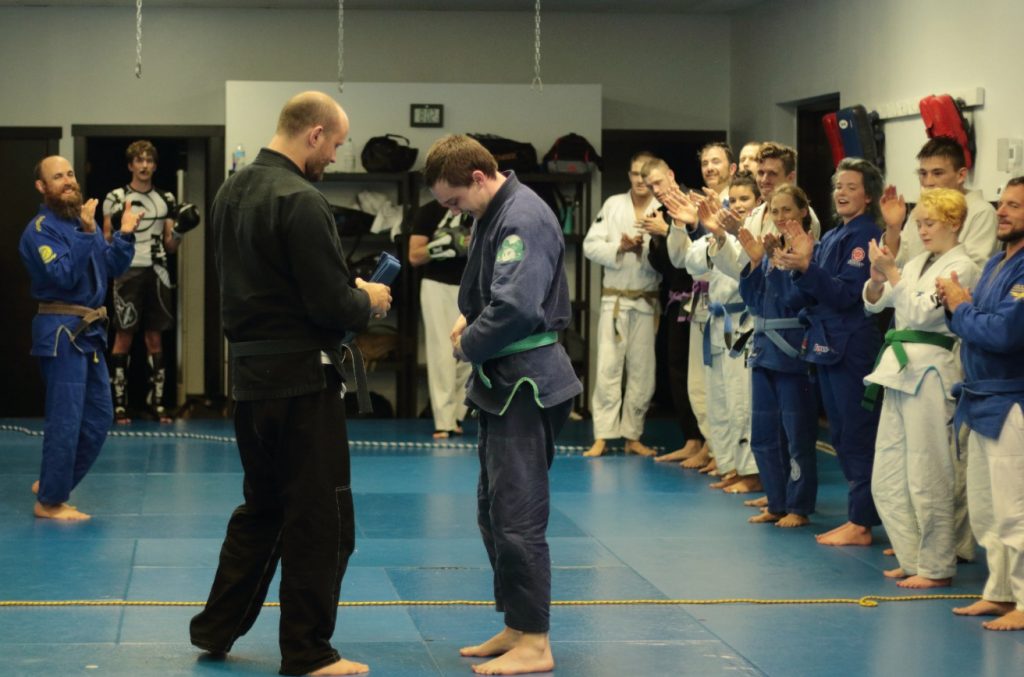
My own approach will definitely be to get folks that come in for an intro to BJJ class to also stat in a group of their own. There, they’ll focus on learning some basic movement and a few basic submissions. Now rolling, no extremely close contact or anything of the sort. Paired with the regular temperature readings and lack of symptoms, and the inevitable weakening and hopefully, the disappearance of the virus, we might just have a solid model there.

Oh, and you can even have them participate more in the intro class if you want to, but make sure people sign a legal waiver (which you should already have anyway).

Summary

These are just some random ideas from my brain that I’m trying to sound off. Obviously, we’re in a situation where nobody knows the logical next step. The trick is figuring things out without endangering the health of people. Intro to BJ is definitely going to change, but that doesn’t mean that people won’t be interested in training, nor that we can’t provide a safe environment for them to do it in. We just need to be creative and smart about it. What are your thoughts?

Blue Belt Blues – What Is It And How To Get Over It

Dealing with the Blue Belt Blues

Forget about the black belt in Brazilian Jiu-Jitsu. It is huge, of course, but it is far from the most desired belt in the sport. In fact, there’s another belt that I’d wager is the most desired one in all of martial arts. It has a lot to do with the nature of our sport. In BJJ, you won’t get to blue belt in at least a year, and in most cases, nearer to two years. That is a long time to be training and still be a white belt, which is the ultimate marker of being a beginner in anything. That’s is precisely why people crave the blue belt much more than they do any other belt, including the black. It is also of the reasons why a phenomenon known as the “blue belt blues” often occurs in BJJ.

It has happened to me. After proudly saying I was training BJJ for nearly two years, when asked what belt I was, most of that pride faded away and I used a hushed voice to mutter “white”. It is something most people have encountered. Inevitably, the blue belt came, and I have to admit I had a great time being one. However, the expectations of a blue belt in Brazilian Jiu-Jitsu are often so high, that people inevitably end up facing the dreaded “blue belt blues”. Now, all of these expectations are of our own making, and as such, are completely avoidable. But then again, so is the blue belt blues. Let’s try and get to the bottom of it.

The “Phenomenon” Of The Blue Belt Blues

The “blues” is a term that signifies feeling uninterested, down and toa degree depressed about something. It usually hits us after something we’ve been focusing on actually materializes. It may be a festival we’ve been looking forward to the entire year, or a wedding or some trip. After it is all over, no matter how great it was, we’re often left with a feeling of emptiness, often referred to as “having the blues”.

BJJ Blue Belt Blues in Jiu-JitsuWell, in JIu-JItsu, it is the blue belt blues. The reason it is named like this is easy to guess – it happens to lots of people, and almost always at blue belt level. In all honesty, I haven’t really seen it in other martial arts, but here’s a sound explanation for it. Other martial arts, grappling or striking, that employ belt systems, do not require people to spend years at a certain belt level. Conversely, the blue belt is a belt on which people spend the most time in their BJJ journey. Pair that with a year and a half (on average) as a white belt and that is a lot of time to be training with just one belt to speak of.
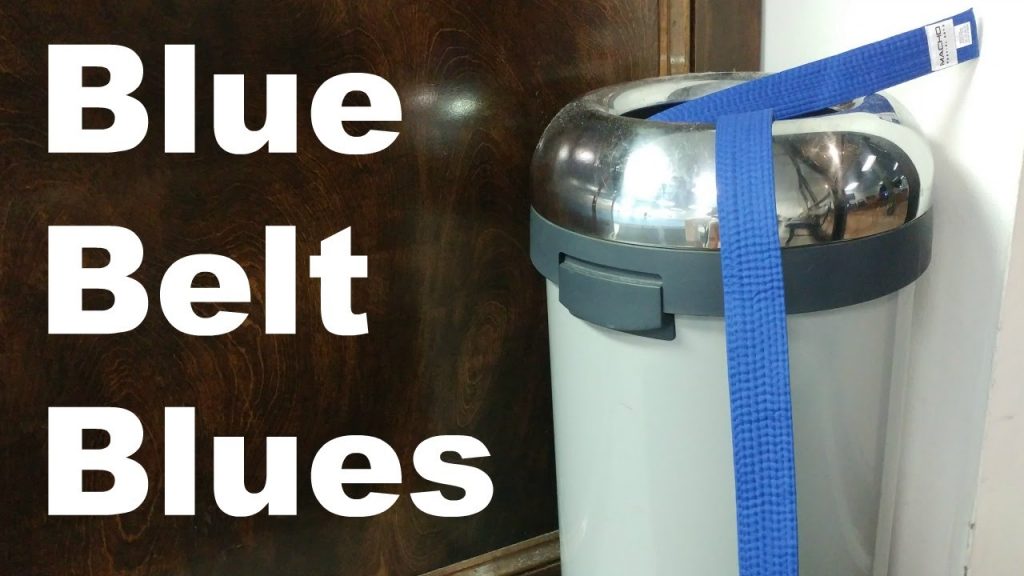
The facto of the matter is, the time we spend as blue blets, is one of the most important times in our Jiu-Jitsu journey. It just so happens to be the longest, if not toughest as well. Put all of this together with the unique nature of BJJ where there’s no end to speak of, and you’ve got the recipe for the blue belt blues. And, it is particularly the blue belt blues that make lots of people quit at a blue belt.

But what happens with those that somehow get to purple in a year, or maybe even less? Worry not, the blue belt blues hits everyone, they just might not be wearing a blue belt per se when it does. And in those cases, it may end up being worse than having to go through it like all other grapplers – like a blue belt.

What is Really Going On

In reality, the blue belt blues is nothing to dread. It may seem like there’s no point to BJJ and that no matter what you’re doing you’re not progressing at all. Often times, there are also questions about motivation to train, as well as an overall feeling of no measurable progress. Basically, in BJJ, like everything else, we have good days and bad days. Moreover, this is true for all belts, not just blue belts. It just so happens that in academies with lots of people and different blets, blue belts, especially those with about a year of experience under their belt, might just encounter a few more bad days than they do good for a period of time. It is something we all face in Jiu-JItsu, and in fact, it is a part of the learning process.

The blue belt being the longest time you spend at any belt level (arguably) means you have a lot on your plate. You’re not a beginner anymore, but that just piles on unneeded pressure that nobody that’s ranked lower should be able to do anything to you. It will be something you laugh at, but as a blue belt, it is not just a source of blue belt blues, but also a reason for hitting a plateau. And there are several different ways for busting out of one.

There аre plenty of other things to consider as reasons for the blue belt blues. Ego plays a huge role and inescapably leads toward injuries if you let it take control. Thre’s also the question of motivation when people just don’t know why they should keep showing up. Yeah, your’ not getting destroyed like white belts, but you’re’ also not able to touch any of the upper belts. At the same time, that D1 wrestler that just showed up sweeps the floor with your regularѕ in спарринг. Not to mention that you can’t sweep anyone no matter how hard you try. What’s the point?

How To Beat The Blue Belt Blues

The point is, you need to get through it. I really have no idea if it is al la deliberate psychological task of sorts, but it is definitely a hugely important one BJJ. Getting through the blue belt blues is just another thing you need to master in order to progress in Jiu-Jitsu. It is just on the mental, rather than the physical or tactical side.

The easiest way to get over the blue belt blues, and many plateaux you’ll inevitably run into, is to stop taking things seriously. Why all the pressure? So your sweeps don’t’ really work. Cool. Leave them aside, and start submitting people from guard. Then, a couple of years down the road, look back at sweeps and you’ll now be able to figure out were and why you got stuck as a blue belt.

BJJ Blue Belt BluesAlso, don’t expect BJJ to get easier. It never is. What becomes easier are your experiences as you start to understand the sport/art more and more. In fact, embrace all the blue belt hardship, as you might just end up longing for it later one when things start to became a lot clearer.
Form a more practical standpoint, regardless of why you’re deep into the blue belt blues, a good piece of advice is to reduce the clutter. Stop all the instructions, (okay, maybe keep one or two)  and is not what your coach is teaching. Even in rolling, focus on one thing and forget about trying to b good ate everything – you can’t. Luckily, the modern BJJ game is so full fo different concepts that you can now choose. You don’t’ just have to focus on passing the guard os submissions. You can explore escapes or ways to remain safe4 and untouchable in positions we often see as bad ones.

All in all, try to have fun on the mats. And no, not tapping out to everyone in class is not fun. DFItch all the pressure and relax. Start doing different things, looking into different grappler’s styes, maybe go to a seminar or a camp. Broaden your horizon and the blue belt blues will clear up faster than you were running the gauntlet at your blue belt promotion.

In Summary

BJJ is a wild ride. It is just as taxing psychologically as it is physically, and sometimes even more so. The blue blet blues area a great example of how you can come really close to hating what you love. However, there is a way out and it is not quitting. Sur, for some, it just may be the best option. However, for most, there are plenty of ways to deal with the blues and stay on course for the next, purple challenge. It will come, that much I can guarantee you!

BJJ Darce Choke Variations You Have To Know

BJJ Darce Choke Variations cover

The BJJ Darce choke is by far my personal favorite choke. Moreover, I believe everyone should use this highly versatile choke al to more than they are at the moment. The choke itself is not simple, but still, it is extremely powerful. Moreover, once you get into it, there are so many variations and adjustments to make, you’ll find it really hard to stop looking for the Darce from every possible position. Not to mention that it is actually available from more positions than any other choke.

Brazilian Jiu-Jitsu chokes work. In fact, they just might be the one submission that is universally successful. WE’ve all heard the “nobody can withstand a choke” claim. It is true to a p[oint, but then again, there are also different kinds of chokes. In this choke hierarchy, the BJJ Darce choke is most definitely in the top contenders, if not the undisputed champion in the flesh. And why wouldn’t it be? It works as a choke, it works as a crank, it works with the gi, you can get it from anywhere, you can use it as a position… the list goes on and on.

The Story Of The Darce Choke

The Darce choke has quite an interesting origin story, one made finally made clear by John Danaher. As with most things in Jiu-Jitsu, the real first moment when someone used this move to either control or submit someone is probably lost for all eternity. What we do know, though is that it falls within the category of triangle chokes. We also know that the BJJ Darce choke is done solely with the arms, making it an arm triangle. It is also usually associated with the front headlock position, although this is not a requirement to get to the strangle.

Brabo ChokeThe Name “Darce” is actually the last name of the person ‘responsible” for bringing the choke to the Jiu-JItsu public’s eye. Joe D’arce was a student of John Danaher and Renzo Gracie. The former actually spoke of stumbling across the choke along with Shawn Willimas as a blue belt, and asking Renzo if ti had any substance to it. It apparently had, and Danaher kept working on it, with Joe D’arce being the “guinea pig” who put it to competitive use in the 2000s. The name we use today is because of Joe’s prowess with the strangle.
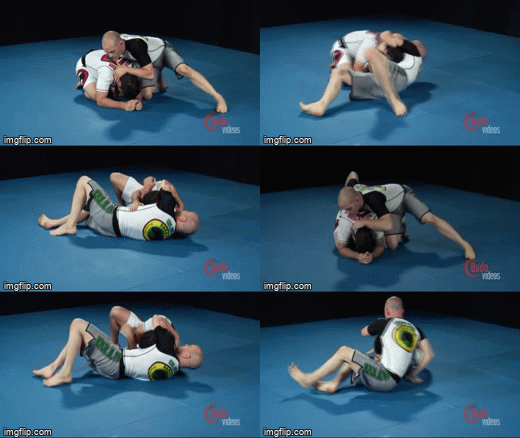
The real history of the choke goes way back, though. The founder of the anaconda choke, a Brazilian by the name of Milton Vieira often credits the choke to himself. He dubbed it the Brabo choke, a name that is still used to describe the BJJ Darcechokeeven today. In essence, they’re both the same choke, and it wasn’t really Milton that figured it out.

As history suggests, it was a Norwegian Luta Livre grappler named Björn Dag Lagerströmstubmoeled across the move when trying an Anaconda and getting it the other way around. The thing I,s that if he did it, so did others probably, that never truly claimed it. So, the real first origin of the Darce choke is hard to pinpoint, but we do know precisely where both the Darce and Brabo names came from. Furthermore, Bjorn called it the  BjörnTechnik, or simply the Bear Choke.

Little Known BJJ Darce Choke Details

The Darce choke is an arm triangle from the front headlock position. That is the simplest way to describe the position. It does little though to help out with how to actually perform the BJJ Darce choke. The choke works as an arm triangle but there are a bunch of things you need to do right in order to have a real strangle. If you want to learn the fundamentals of the Darce choke, check out this previous article on BJJ World.

Going deeper into the Darce choke, after 6 years of catching people left and right with it, I have several little tips and tricks to share here. For starters, the arm that goes inside for the choke doesn’t’ need to peak out all the way behind your opponent. Instead, a great rule of thumb is to actually use your thumb. If you can extend your thumb and it is behind the neck, you do not need to go any deeper. This is the perfect position to get the choke.

When it comes to grabbing the other arm, the first thing to focus on is actually making the opponent’s neck bend forward with the arm, before attempting to get a grip. This will allow you to grab deep, given that the triceps is where you want your palm to grip, and not the biceps. Extending the arm towards the back of the opponent and twisting it, palm to the ground will help you get that grip even better.

Finally, for the finish, don’t think about squeezing. Instead, try and get your elbows together, while you retract your shoulder blades. Then, puff out your chest as this will get you plenty of taps. If an opponent is still resisting, just got o knee on belly or mount without changing the configuration of the choke and you’ll quickly start putting folks to sleep.

BJJ Darce Choke Variations

Now, there are plenty of variations of the BJ JDarce choke out there, but I’ll focus on a few that really work. In that sense. I’ll be sharing variations of the choke itself, rather than different entries or setups from different positions. The thing you need to know is that it doesn’t matter how long your arms are, or how strong your grips are. None of that matters if you figure out the right Darce choke variation for you. Here are some of the best:

The Marce

BJJ Darce Choke Variations MarceJeff Glover is the man that named this variation, and according to him, it is because a guy named Mark showed him the move. In any case, the variation works perfectly and is going to do wonders for anyone that has trouble breaking people’s base from the turtle in order to get the choke. If you’ve ever tried to get the choke on a wrestler that’s in turtle, you know what I mean. The Marce is a way to get underneath and finish, with the mechanics being just slightly different from the original BJJ Darce choke.
The premise here is that you have the arm inside for the choke, but can’t really turn an opponent over with the palm to palm grip. When that happens, simply do a sit out, with your near side leg going underneath. The main thing here is to re-adjust, and actually lock up a Darce choke grip the moment you feel your opponent’s losing their base. In other words, that’s the moment your hip touches the floor. From there on, the finish will require you to think about crunching your opponent up, rather than squeezing. Just focus on trying to get their chin to touch their belly button and you’ll get taps every time.

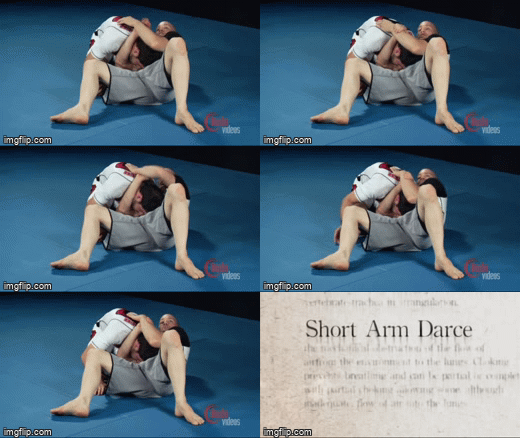
Short Arm Darce Strangle

This is the variation that actually helped me learn how the BJJ Darce chokes works. I, for one, do not have particularly long limbs, especially arms. However, even fro those that are, sometimes opponents just have shoulders that are too wide or necks that are too strong. The moment you realize you can’t get the triceps grip properly, you’re left with just one option – the short arm Darce.

BJJ Darce Choke Variations Short Arm DarceThis variation is simply – you grab the forearm instead of looking for the triceps. This will get you a solid anchor point, but also allow you wrist mobility to tighten up the choke without having to use strength or awkward and uncomfortable wrist positions. All you need to do is grab as close as you can to the elbow. For the finish, think about rolling your wrist, in a forward direction. Hteaesaisetwa to exp[lan it is to think about releasing the throttle on a motorcycle. That’s all it takes for people to give up.
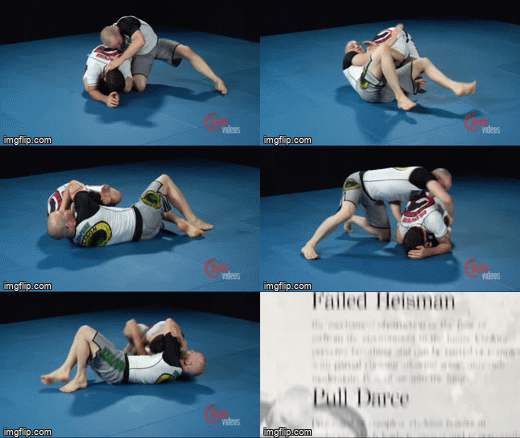
The Farce

BJJ Darce Choke Variations FarceThis is an abbreviation of the “far side Darce”. It is a variation of the BJJ Darce choke that’ll save you a lot of faieldDarce attempts, once people wise up to how dangerous your Darces are. Attacking a turtled up opponent once again, you’ll be looking to actually switch side by half throwing/half rolling yourself into a Marce. Just to make it clear, you need to know how to do the Marce variation fairly well before attempting this.
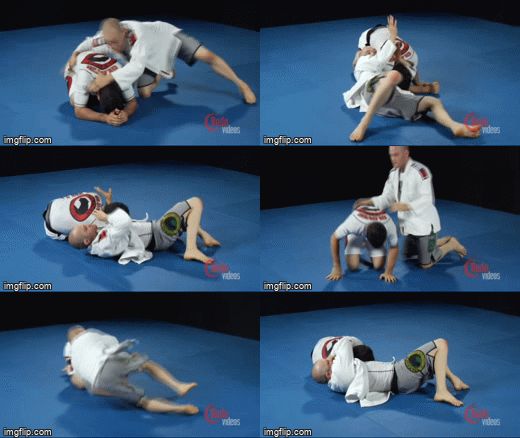
The idea is that the far side armpit is usually always open when opponents focus on defending a Darce. Instead of having to grip fight endlessly, you simply throw the top arm under the opposite side armpit, while jumping over and doing half a front roll, sticking your arm through and ending up straight into a Marce choke.

The Slarce

BJJ Darce Choke Variations SlarceThis is a GI variation of the BJJ Darce choke that’s actually a quick way of finishing when you can’t get everything set up right. When it comes to GiDarces, this is the ultimate short arm Darce variation. Moreover, it works form anywhere,. Top or bottom, as long as you have at least one arm inside the triangle. This version works just like an Ezekiel choke. You use the sleeve of the top arm to get a grip with the choking arm. In this instance, you’ll be aiming to touch the shoulder of the opponent with the top arm instead of tehri back. A simple squeeze usually gets the tap, but looking to get your elbows together and shoulder blades back also helps. A lot.
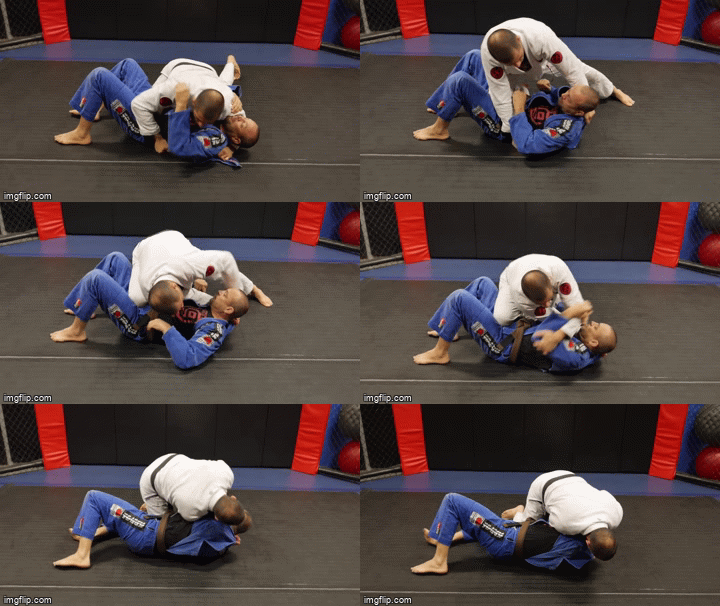
The Gi Brabo

The full Gi version of the choke works when you decide to use the lapel instead of your arm. This version of the choke allows you even more variety, as you can even set it up form the closed guard,.wich is not the case with No-Gi variations of the BJjDarce choke.

BJJ Darce Choke Variations Japanese Gi BraboThe goal is to get a lapel of the opponent’s Gi in the same spot your choking arm usually goes to. This allows you to have the choking arm in a much more shallow position while having the cloth as the choking edge, which greatly increases the finishing percentage. In this instance, you could finish the Darce with just one arm, but using the other arm to grip the lapel behind the opponent’s neck will ensure you get quick and panicked taps. Or naps.
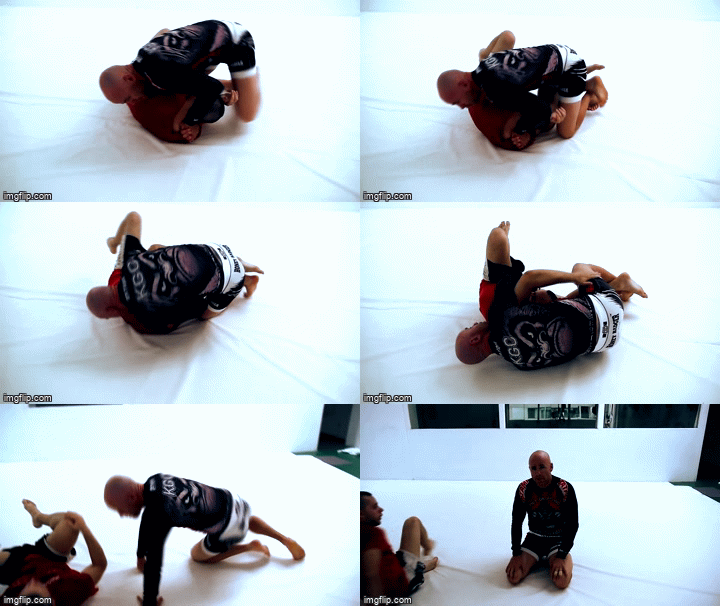
A Step Further: The Japanese Necktie

Last but not least, a throwback, if you will, to the moments when a BJJ Darce choke feels like a neck crank. The Japanese necktie ist the perfect gray area between a choke and a crank. It is legal, it is a choke when done right and a crank when done slightly differently. In any case, nobody is immune to it and it just os happens to be the BJJ Darce Choke’s best friend and neighbor.

BJJ Darce Choke Variations Japanese necktie Every time you’re stuck in the palm to palm grip with a Darce from top side control or half guard, you can opt instead to head for the Japanese necktie. Simply scoop the head in, and aim to fall with your torso behind the opponent’s head. A crucial detail to have either of the opponent’s legs hooked with yours so that you can crunch them up, like in the Marce finish.

What you get with this is two things – first, you can finish with the Japanese necktie, either via choke or crank. Alternatively, you can use the position to set up the Darce choke grip and return to finishing your initial attack. This combo works like a loop, meaning you don’t’ have to ever release an opponent in order to achieve a tap.

In Conclusion

The BJJ Darce choke is a powerful weapon to use. I discovered it as a way to deal with underhooks from people playing half guard. Suffice to say, it worked. It also got me interested in the choke, so I dug deeper. These variations of the Darce choke ara just some of the possibilities that you can mess around with when you’re looking to choke people from anywhere. And, by anywhere I do mean every possible BJJ position, from your closed guard to having someone on your back. But that is a subject for a future BJJ Darce choke article.

Sacrifice: A Documentary That Shows Why Cuban Wrestlers Are the Best

Sacrifice - a documentary about Cuban wrestlers

What is the craziest Joe Rogan Experience podcast episode you’ve heard? There are plenty of criteria upon which to choose, but from a grappling and combat sports standpoint, the one with Joey Diaz and Yoel Romero has to rank among the wildest ever. It was not just the fact that Diaz was translating since Romero can’t speak a word of English, but also the information that was divulged. In particular, I mean about Yoel’s account of how Cuban wrestlers train on a day to day basis. No wonder they’re the best in the world.

Cuban wrestlers have always been regarded as being among the best in the world. Of course, American and Russian wrestlers have had their say as well. However, given the difference in the economic and political situations between Cuba and the USA or Russia, achieving such a level of proficiency is definitely something to behold when it comes to Cuban wrestlers. We all know what their abilities are3, but we never really had an insight into what drives them, or how they train. And there are lessons in there that we can all use, particularly those of us that love to integrate everything grappling related to BJJ.

Wrestling in Cuba

Cuba – the dream destination. White beaches, beautiful people, and all the crazy times you can have. However, the Cuba that тхе locals see is much different than what movies, travel agencies, and postcards show. For people that live there, life really is a struggle. So much so, in fact, that being good at a sport might just mean a way for you to provide for your family, or even thieve if you’re really talented. To be honest, Cuba did the right thing at deciding to promote sports and help the most talented athletes achieve livelihood by competing. However, not all are that lucky, despite the incredible well of talent for particular sports in the century.

why Cuban wrestlers are the bestCombat sports, more precisely boxing and wrestling are among the most popular options someone can professionally do in Cuba as an athlete. The fact that they’re both Olympic level sports probably has a lot to do with that. But, then again, this is true for boxing and wrestling in every country. Why exactly do Cuban wrestlers, and boxers for that matter, stand out so much?

Going as far back as 1959, special academies were established in order to help talented athletes prepare for the Olympics. Those academies were followed by the formation of so-called national schools that all had the task of providing Cuban wrestlers, among other Olympic sport athletes with the best possible training, under the current socio-political circumstances.

Currently, Cuban wrestling is in a great state. There are plenty of young, hungry, and very talented Cuban wrestlers that have all the qualities to take not only the wrestling but also grappling and even MMA world by storm. At the 2019-2020 National Championship, we saw more than impressive displays of what Cuba has to offer in terms of wrestling. But what is it that makes all these Cuban wrestlers so dominant on the world stage?

Sacrifice: A Documentary About Cuban Wrestlers

Having the option to train at a specialized center for a specific sport can make a world of difference. However, with Cuban wrestlers, this is not a thing of prestige. In fact, it is a sacrifice and a big one at that.

Very often we hear about BJJ grapplers that live on the mats, some of them literally. The Miyao brothers were famously living in their gym for a while, and some members of the Danaher Death Squad, like Gordon Ryan, also come close. However, if you truly want to know what living on the mats and for the sole purpose of grappling is, then Cuban wrestlers are the ultimate example.

Cuban wrestlers all live in the academies or National Schools. They sleep there in Spartan-like conditions, eat scarcely, and dedicate all their time to training. The system is far from perfect but it does produce the best wrestlers with what they have at their disposal. As Romero said on the JRE podcast, whoever performs best will get the best meal, a better bed to sleep in, or some other thing we take for granted. No wonder all the wrestlers from Cuba come with not just the physical abilti9ies to beat anyone, but also the winning mentality that goes with it. It is a whole different level of everyday porrada, even though the term definitely applies!

The short documentary, fittingly named “Sacrifice” really demonstrates the conditions and dedication, as well as the crazy shape Cuban wrestlers, are in.

What can we learn from Cuban wrestling?

In Brazilian Jiu-Jitsu, we like to be lazy. And I’m not just talking about training. We like to find lazy ways of making things work, and we also like to “steal” knowledge from grappling martial arts around the world. Well, we might also try and steal something that’s not so lazy, like some of the training approaches of Cuban wrestlers.

Cuban wrestlersNow, I know that going to live in a dormitory and train nothing but BJJ all day every day for years might sound enticing to some if not all of us. However, the sport is not at a level where representing a country can help us earn a livelihood. For now, at least. Still, some of the concepts that wrestlers in Cuban academies use to train might actually be beneficial to Jiu-Jitsu. After some slight adjustments, of course. Motivating people n competition preparation with positive reinforcements might just be a method that really pushes everyone to be less lazy, and decide to push boundaries even further.
On a more personal note, it is the mentality of Cuban wrestlers that I really admire. Unless we’re in the same circumstances, we can’t even start to phantom what they must be going through on a daily basis. However, I don’t think that we necessarily need so much suffering in order to develop a mindset that will come close to that of the legendary wrestling machines from Cuba.

Summary

Cuban wrestlers are the epitome of powerful wrestlers you don’t want to come across on the mats or in a dark alley. Or do you? I wouldn’t mind going up against one in a grappling competition, if nothing else, just to figure out how much more I have to learn in terms of mindset, mentality, and embracing the grind. I guess we’ll never know how it is to train wrestling in Cuba, but we can definitely adopt some lessons to fit our lazy BJJ needs.

Most Painful BJJ Submissions From Grappling Expert Neil Melanson

Most Painful BJJ Submissions From Neil Melanson

When we talk about BJJ, especially in terms of mode4rn Jиu-Jиtsu, we often like to talk about concepts, leverage, technique, and effectiveness. All these are huge parts of BJJ and I am a big proponent of all of them. However, we can’t just focus on the modern aspect of the sport. That would be the same as only doing Gi or No=-Gi BJJ, without considering the other to be worthwhile. I’ve always claimed we need to open up our minds to everything grappling related and combine it into our JIu-Jitsu games. And, since the earliest days of combat sports and grappling martial arts, particularly those focused on submitting an opponent. Pain has been a great factor. To that extent, let’s look at some of the most painful BJJ submissions you can pull off while rolling or competing.

You can find all Neil Melanson Instructionals HERE.

Keeping things playful might be fun, but form time to time, keeping them painful is a lot more fun.  Not to mention that pain is a very effective way of convincing someone who is resisting doing what you want them to. And that right there is what jiu-jitsu is all about. Well in a nutshell. Luckily, BJJ still has some great minds like Neil Melanson that like to think outside all boundaries and bring us that more painful aspect of grappling that could get lost in all the focus on mechanics and geeky talk we are getting used to nowadays. Check out a few of the most painful BJJ submissions you can use to refresh your grappling toolbox.

Pain Is Always A Factor

While I am all for the scientific approach to Jiu-jitsu, let’s not forget that we’re still fighting when it comes to the gist of it. Given that the ultimate goal in BJJ is to make someone surrender while they’re doing everything to prevent it, we need to be creative. There are many schools of thought in BJJ, and they all have their merits. However, there are also some universal rules that apply to everyone. For example, nobody can withstand a properly placed strangle without going to sleep. In similar terms, despite what people say, pain will universally get you a reaction. And, at the highest levels of Jiu-Jitsu, a reaction is all it takes to decide a match.

Pain in grappling doesn’t just have to be the pain of submissions. Sure, the most painful BJJ submissions do happen to be some of the most effective s well. However, using pain as a “helpful hand” in grappling has a much broader use than just forcing people to tap. In fact, there are different types of pain, and each has a role in grappling. You could, for example simply cause people to pain from pressure on top. Along those lines, you could also focus all your weight on one spot, like a floating rib or the region behind the ear to make it sharp and unbearable. And, no, the goal here is not to injure anyone.

In grappling, whether it is for sport or self-defense, the rules are simple – control and submit. Well, for the control and submission part, pain can help you set everything up. Even those that claim they don’t tap to pain, feel pain. And as long as someone can feel pain, you can make them move, flinch, turn, push, pull or whatever you need to complete a match-ending move or transition. In other words, pain is just another technique you need to have at your disposal when you’re grappling. If you don’t you can bet someone else will, and they won’t hesitate to use it against you.

No Nonsense Grappling With Neil Melanson

If you want precision, scientific-based Jiu-Jitsu there are altos of options out there. If you want to learn techniques, then the majority of instructors will do the trick. However, if you want to learn all about the most painful BJJ submissions, you need a specialist. And there’s hardly anyone out there that fits the bill more than Neil Melanson.

Neil is not your garden variety BJJ black belt. He is a catch wrestler, Judo, Sambo, BJJ, grappling and God knows what expert with the mind of Danaher, and an underlying tendency to go for the pain that is akin to Toquinho. Neil is a man who has a no-nonsense approach to grappling and loves to go for the submission. That said, given that submissions are the hardest moves to get in BJJ, he found an edge. And that edge come is the form of pain and discomfort that has people’s minds too preoccupied to guess your true intentions. In other words, pain is the perfect way to fool people and mask your real goals.

In his years of training with the likes of Gokor Chivichyan and Gene Lebell, Melanson has developed plenty of positions and submissions that are not really known in BJJ. Out of them all, the ones that include the pain factor are the best, like the following few most painful BJJ submissions.

  • K-Guard Armbar

Most Painful BJJ Submissions K Guard ArmlockThe K-Guard is the signature position of Neil Melanson. Actually, he has an entire DVD instructional on the subject. The one takeaway for today’s purposes I the crazy armlock that he likes to perform from the guard. It all starts from a scissor sweep like position, from which Neil likes to underhook the leg on one side. He then likes to sneak the foot of the knee shield leg all the way through and out, under the armpit of an opponent, while controlling the arm.
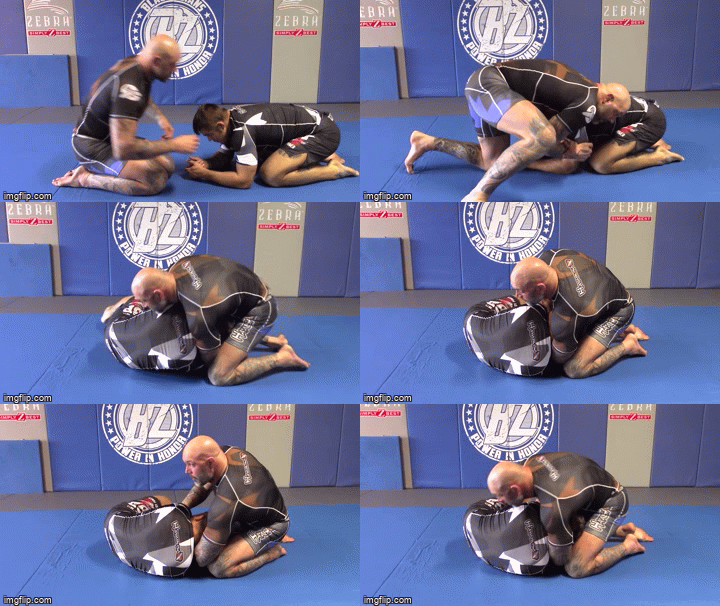
The position looks dubious when you first see it, but the goal is simple and unexpected. Throw the calf over the shoulder in order to hook under the chin of the opponent with your foot. Now you’re in cruise control and you can set up one of the tightest and most painful BJJ submissions in the form of a straight armlock.

  • Face Lock To Screw Choke

What is the screw choke? It is just Neil’s name for a D’arce choke. Since we’re looking into the most painful BJJ submissions, I like the Screw Choke name better. However, that’s not the painful part of this move. Well, not directly. The real pain comes from the face lock, which is a very nasty and extremely painful neck crank. And Neil doesn’t even use it to submit, but rather force an opponent into the Screw Choke.

Most Painful BJJ Submissions Face LockThe face lock works form a front headlock position. Instead of placing one arm under the chin and looking to connect the arms with an arm-in, you place the first arm across the ace and in front of the shoulder. Then, you figure four your arms for a neck crank that will either get a tap or make your opponent lie down. When they lie down, the screw choke is waiting for them, of course.

  • Power Kimura

Most Painful BJJ Submissions Power KimuraI’ve always loved this move, as it is the most painful version of a Kimura from topside control I know. However, Neil has some killer details that make it even more painful and therefore, effective. A big problem with the Kimura from side control is breaking the opponent’s grips. So, instead of getting into a tug-of-war with your opponent, you’ll use the painful way of getting a tap. For that purpose, you won’t use the figure four grip, but a rear-naked choke one. The top arm is going to peak out of the elbow and grab the biceps of your other arm. As you do that, you grab the elbow of the top arm as well, closing the circuit.
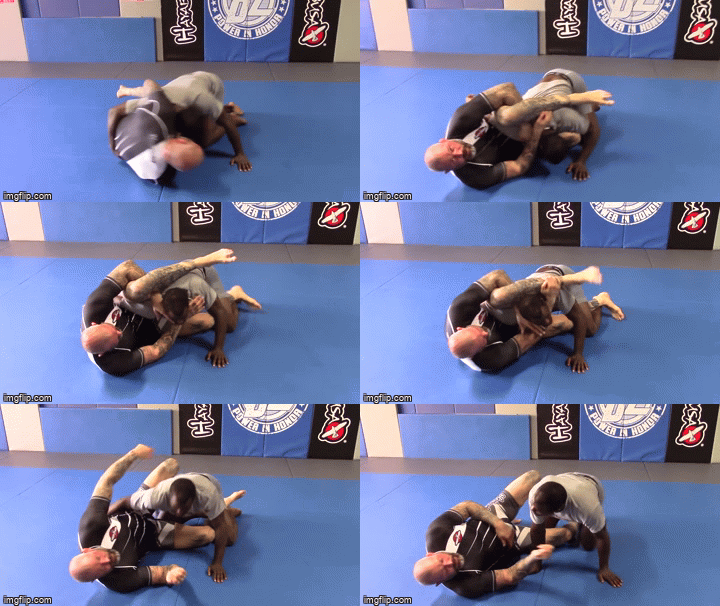
Consider any grip an opponent might have, Gi or No-Gi, gone at this point. For the finish, just hug everything closely and switch your hips so that you face towards their head. One of the most painful BJJ submission ever, and extremely easy and unassuming to set up.

  • The Neil Knot

This one is really nuts. The Neil Knot is yet another signature move by Melanson. It works from the Williams guard or at least a variation of it. In other words, from the closed guard, you get an overhook, place your leg high under the armpit (like for an Omoplata), and then underhook your own leg to close everything up. Neil calls the position the Pin guard.

Most Painful BJJ Submissions Neil Knot

The Neil Knot is a choke that you can set up by grabbing your own ankle with your forearm across the neck of the opponent. You then reinforce this by gripping a figure four grip with the hand of your other arm. The tap will come on extremely quickly, along with the usual complaints of the move being too painful.

  • Patella lock

Most Painful BJJ Submissions Patella LockArguably, my favorite of the bunch. As the name suggests, this is a leg lock and a legal one at that. It works from the top half guard, requires next to no setting up, and will tap everyone. You can use the bottom leg to pin their bottom leg on top or sneak it under. It is the top leg that you’re after, and the scoop grip is how you set things up. The goal is to get the top leg over your shoulder. The finish is like for a straight armlock – simply scoop with a palm to a palm grip, focusing on the Patella. Extremely painful for your opponents, and satisfying for you.
Closing Thoughts

If we’re being honest, we all have a tendency to enjoy causing others pain. It doesn’t have to be anything substantial as a little pain goes a long way in Jiu-Jitsu. In fact, it is all it takes when you pair it up with all the fancy concepts, tactics, and physics formulas that determine the best way to execute a submission. The most painful BJJ submissions come in many shapes and sizes, and the above ones are just an example of how you can include less known grappling moves into your game.

You can find all Neil Melanson Instructionals HERE

BJJ Can Opener Submission – Everything You Need to Know

How comfortable are you with “dirty” BJJ moves? Personally, I love them. Dirty is just a thing of perception if you ask me. Тhere are moves that are effective, and those that are less effective. And while all moves have the tendency to be dangerous, certain moves don’t really deserve the outlaw status they have in Jiu-Jitsu. it is subject ттхat has been beaten to death, but I really do think there’s a place for the BJJ can opener in every grappler’s toolbox.

The BJJ Can opener is one of those moves that are like something out of Harry Potter. Horrible analogy, I know, but bear with me. New folks come in, having seen something on YouTube, and ask the people in the gym about it. Suddenly they’re told to shut up and leave it alone. Иt is one of the “unspeakable” moves, that must never be mentioned, let alone done. Well, guess what? Demonizing moves actually makes them far more dangerous than teaching them.

What is Can Opener BJJ Submission?

So, what is the BJJ Can Opener? It is a spinal lock, in essence. The way it is used, though, is to make someone open a closed guard, as a result of pain. Not really the most technical way to open guard, but effective nonetheless. However, it is the spinal lock/neck crank thing that usually makes people resent it. To be honest, I have no idea if it will work, or to what extent at the highest levels. It is worth exploring, though.

How does Can Opener Works?

The way the can opener works is that you grab the back of the head of an opponent in what is basically a Thai clinch when you are the person caught in the closed guard. Simply pulling from there would get yo arm barred 9 times out of ten.

However, if your elbows are glued to the opponent’s chest, you’ll be able to cause quite the pressure on the spine, by pulling their chin to their chest. In most cases, people simply open the legs up and give up a pass. There are the few that think they can take it, and end up tapping to the can opener, although it is not a submission per see.

cano pener bjj submission

How to do Can Opener?

The way you can do it is either pulling directly from a base on your knees, or by stacking the opponent. Both have their merit, but the stack one can be particularly uncomfortable. Moreover, there’s the MMA/self-defense aspect of it, where this move is a really no-nonsense way to get rid of the closed guard. Moreover, the pressure on the spine is not that dangerous as it is pretty straightforward. In fact, passing with stuff like the Sao Paolo / Roger Gracie pass could be far worse for the bottom person’s spine.

How to defend Can Opener?

The first thing to have in mind is that if someone catches you with a Can Opener and you feel pain in your neck just tap. Tap early and tap often no matter if it’s legal or not in your gym.

The reason for tapping is pretty simple. Every time you don’t tap to any kind of neck crank it will come back to you later.

There are three main defenses are:

  • Counter Can Opener with an armbar. Trap one arm, put your other hand under near partner’s leg, turn your hips and go for an armbar.
  • Take your opponents head with your both arms and shove it below your head and push
  • Open your guard. It’s not very good as you’ll be opened to other attacks.

A “Legal Disclaimer”

The first thing you need to know, you can’t do a BJJ can opener in an IBJJF match, Gi or No-Gi, regardless of your belt. Actually, you can, but it will get you disqualified. That said, in a different ruleset you might just end up on the receiving end of one, and that won’t really end great for you. The fact remains that the move is a bit bully-ish and should be done with care. However, that is all the more reason to train it.

Will the BJJ can opener work in a high-level black belt match in the Gi? Who knows? the reason that we don’t is down to the approach we have. The IBJJF rules have really prevented a lot of grappling movers to really get tested and improved through their constant use in competition. The fact that the move is illegal means we’ll never know if it is something worth exploring. There are a few instances of it working (to an extent) in MMA, and people that train No-Gi tend to use it from time to time.

What I think is that our whole approach to moves like the BJ can opener is wrong. Ok, they’re illegal and potentially dangerous. I get that and agree. Al the more reason to teach them properly. And yes, that does mean teach them to new students as well. Feel free to outlaw the move in rolling, but do give your students the chance to learn how to do it correctly and more importantly, how to act if they ever get caught in it.

Thinking Outside The Box

There are two basic premises for not using the BJJ can opener. One is that it will cause immediate and devastating damage to the spine. We saw that it doesn’t really do that. The other is that people will easily defend it if they open the guard. What most fail to grasp is that the can opener is not a submission but, as the name suggests, actually a way to open the closed guard. It just happens to have neck cranking properties as well.

The reason the Can Opener works is because of the Thai clinch position. That said, the move is based on breaking posture – a fundamental Brazilian Jiu-Jitsu principle. The longer you can hold a broken posture, and the more you can cause a bend in the spine, the less an opponent can do. So, how can you take this knowledge and combine it with BJJ can opener to achieve other goals apart from opening the closed guard?

Here’s a radical idea courtesy of Priit Mihkelson – escape the mount. When you come to think about it, the mount is just a guard in reverse. Granted, the top person’s legs are not connected, meaning the Can opener / Thai clinch will serve merely as a posture break. Here’s another hint – it is not illegal. So, next time you’re in the bottom mount, and you can catch a Thai clinch without giving an armbar (you’d be surprised at how easy it is to get the clinch), do it. Then pull like your life depends on it, and only then go for your bridge and roll. Suddenly, escaping the mount becomes a lot easier. Not to mention you can pass the guard directly as you have a can opener in place that won’t allow your opponents to even close the guard.

Conclusion

Demonizing moves is never a good idea. Of course, not every move from other grappling martial arts is a good fit for BJJ. But then again, neither were Judo/Sambo leg locks, until John Danaher modified them. That just means we can, and should try and modify and play with as many different techniques as possible before even thinking about disregarding them. the BJJ can opener is a great one to have fun with, legal or not.