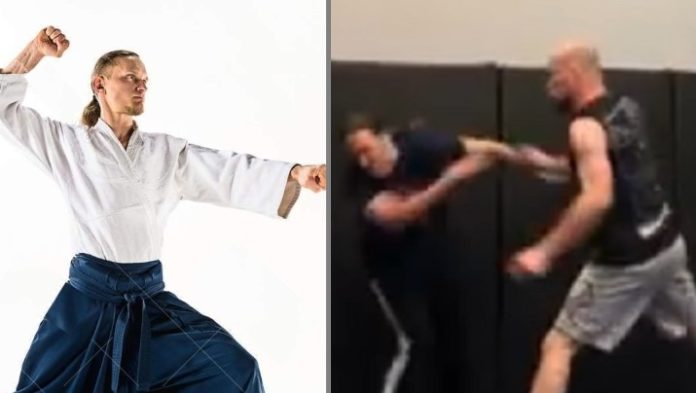
Aikido Practitioner Challenges BJJ/MMA Coach to an MMA Fight, Immediately Regrets it

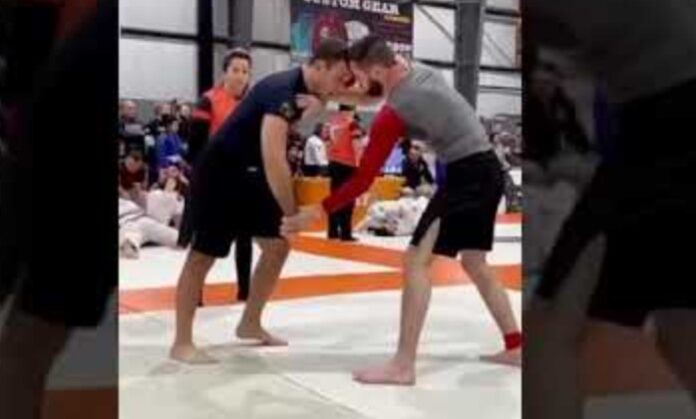
Aikido Practitioner challenges BJJ/MMA coach to an MMA fight

“Aikido teaches you to neutralize the threat as fast as possible. To reduce damage, to stay off the ground. Aikido teaches you more material to survive real-life altercation than BJJ does.” – says aikido practitioner

But, reality shows us something a lot different as we can’t really see he did anything in this fight.

Aikido vs Grappling – Fantasy vs Reality – Wrestler vs Aikidoka

Why is Aikido Hated By BJJ And MMA Practitioners?

Innovative Aikido Master and His Anti-Takedown System

Dumb Things People Say About Sport Jiu-Jitsu

We bring you the dumbest things people say about Jiu-Jitsu whether those people train in Jiu-Jitsu or not. All of the things written in this post are from our followers on social media. So, here they are:

  • “It’s not a martial art, it’s a lifestyle”
  • The “Gentle” art
  • “It’s gay”
  • “Leave the ego at the door”
  • “isn’t that like karate?”
  • “My kid is 10 years old and he is a black belt …y are u only a purple belt”
  • “my son started Tae Kwon do at age 4 and by 10 he was black belt and then retired as a black belt”
  • “”the Gracie’s are crybabies look at Royce he’s old and washed up it doesn’t work agains multiple attackers”
  • “Bruce Lee would destroy Royce Gracie because he punches faster than a machine gun”
  • “Just stand up”
  • “I don’t need takedowns. I’ll pull guard”
  • “It isn’t practical in a street fight”
  • “Jiu-Jitsu makes people more humble.”
  • “It makes you gay cause you like to choke other men”
  • “That it works in the streets”
  • “That the Gracie’s are still the best at Jiu-jitsu”
  • The tall guy who doesn’t train anything watching lightweights: “They have weight classes because I would fuck those small guys up.”
  • “Doesn’t work on me, if you can take me down I go crazy”
  • “BJJ is useless… I will K.O my opponent before it goes to the ground.”
  • “It’s stupid doesn’t work in real life”
  • “It’s only gay if you make eye contact”
  • “it doesn’t work on concrete”
  • “Bro, I can armbar a bear”
  • “When they do board chopping motions”
  • “That Jiu-Jitsu makes people more humble”
  • “If you go to the ground in a street fight then 12 NFL offensive linemen will suddenly appear and stomp your head with Timbs, it’s like the laws of physics bro.”
  • “It’s only gay if you make eye contact”
  • “Strenght and size don’t matter!”

Chewy:

Recently one of my newer White Belts competed in a BJJ competition. And while he was competing he made a few blunders with his guard pulling. Par for the course when it comes to a newer competitor trying to hit a technique in the intensity of sport Jiu-Jitsu.

What was funny though is as he won the match the people on the other team criticized his techniques because “it wouldn’t work on the streets.” And this my friend is one of the most annoying things I hear people in Brazilian Jiu-jitsu say about others who are competing in sport Jiu-Jitsu. Because of course, many sports moves won’t work in a self-defense situation or fight. That’s a given.

But during a competition we aren’t in a street fight, we are involved in a sport Jiu-jitsu match. I share my own ideas about the whole self-defense vs sport Jiu-Jitsu thing but I’d love to hear some of the things you hear said about Brazilian Jiu-Jitsu (whether from other BJJ players or other martial arts).

So leave a comment with something people say about BJJ that makes you just roll your eyes. Leave your comments down below and I’ll chime in and chat with you. -Chewy

Why is Aikido Hated By BJJ And MMA Practitioners?

Why Is Aikido Hated By BJJ And MMA Practitioners

Once, Aikido was a famous and respected martial art, but things have changed over time. Today this martial art often has a negative reputation, especially between BJJ and MMA practitioners.

What is Aikido?

Aikido is a modern Japanese martial art developed by Morihei Ueshiba, in the late 1920s. The main goal of Aikido is to defend the practitioner while also protecting their attacker from injury. Aikido is often translated as “the way of unifying life energy”. It is most often practiced with a partner, where one person functions as an attacker and the other person practices defensive Aikido techniques.

The art basically has techniques such as entering, turning movements, throws, and joint locks. You learn how to make redirection of the opponent’s attack momentum using simple turning movements of the body.
There are no competitions or tournaments, therefore Aikido is non-competitive.

aikido martial art

The hate from BJJ and MMA practitioners

Today, Aikido has a lot of negative reputation, especially among BJJ and MMA practitioners. Rokas is an Aikido Black Belt who had practiced Aikido for more than ten years. Through years of training, he was able to realize why is this happening and what is the real reason. This is something that dramatically changed his approach and understanding of Aikido.

When Rokas started running his own Dojo, he met a BJJ practitioner who convinced him to try rolling with them, and eventually to train together. He was able to see how vast and amazing the combat sports world is. The same happens with all other BJJ practitioners that he met. The question was, where are all those combat sport meatheads that he told about?

Another step was proving that Aikido doesn’t work in the ring, by recording an Aikido vs MMA video. He posted the video online to prove his point, expecting both the Aikido and MMA world to hate him. Most of the Aikido people blamed and hated him, not all of them, but the majority. But what’s with the MMA and BJJ practitioners?

The support and encouragement from them were enormous. They understand his message and saw this as a success and example of true martial arts spirit. Now, not to say that there were no negative opinions from some combat sports practitioners, but there are few out of many. Where was this whole world of negative combat sports meatheads in this situation?

Where was the Aikido peace and maturity philosophy from all the Aikido practitioners?

If the hatred and negativity from BJJ and MMA practitioners were not directly expressed to Aikido, then what causes them to have it? Rokas starts to ask questions and talks about the lack of Aikido. He got exposed to a lot of difficult conversations with Aikidokas, who were sure, that Aikido is the best practice.

The main critic actually is not toward the practice itself, yet to the mentality and false claims behind many of its practitioners.

Never Seen Before – “Standing Reverse NO GI Baseball Bat Choke” Hit in Expert Competition

never seen before standing no gi reverse baseball bat choke
Barry Connor is a black belt and he did this choke in an expert competition. This is what he wrote about it:
“The new choke I developed (as far as I know lol)…
It is just about a No-gi baseball choke but reversed. A standard baseball choke would not be possible to finish from a standing position. This choke enters front to back rather than back to front and uses “C“grips rather than an “s” grip.. the finish is similar to the baseball choke with an elbow to elbow, but I have never seen this one pulled off Or taught before”

BJJ Brown Belt Toys with White Belt Bodybuilder Bradley Martyn

Bradley Martyn is one of the most popular social media stars with over 2.7M subscribers on his YouTube channel. He’s also a fitness competitor, fitness guru, and online bodybuilding coach. He runs several social media profiles and where he shares his personal experience with training, supplementation, and dieting. His mission and moto are to help people get “awesome and lean”.

We can roll whenever you want brother. Rolling with you is just a warm-up.” That’s exactly what BJJ brown and judo black belt Sam Ehsan Rajabi told to Martin when he showed up for the class. The roll between the two was a pretty funny one where both Martin and Sam had fun.

As we can see in the video this isn’t Marti’s first class. He was training there before and came back after three months. But, according to what we can see in a video he probably came once before this training session. He stated he came back to BJJ training after three months.

More about Bradley Martyn

Bradley Martyn  started training in bodybuilding when he was only 15 years old. We can freely say that he dedicated his whole life to bodybuilding and gained a pretty respectable amount of knowledge about bodybuilding and everything around it. Following his dream, he opened up his own programs in early 2006. Although the real success of Martin when he was recognized in the world of fitness came in 2014.

That’s the year when Martyn opened up his fitness video channels and began showing his workout and nutrition videos. Over the years he gained a massive amount of followers on social media and became a social media sensation. That also made him one of the most recognized fitness gurus in the world.

Anyway, life wasn’t always good for Bradley. His father took his own life when Bradley was only 6-year-old. Maybe, that’s one of the reasons why Bradley learned to be successful and that made him what he is today.

Actor Tom Hardy Shows off his skills while grappling with Russians

Tom Hardy Grapples with russians in Siberia

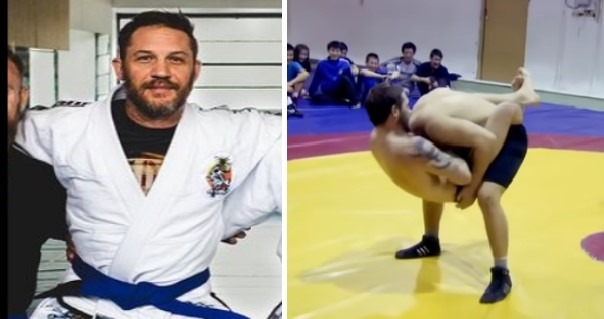
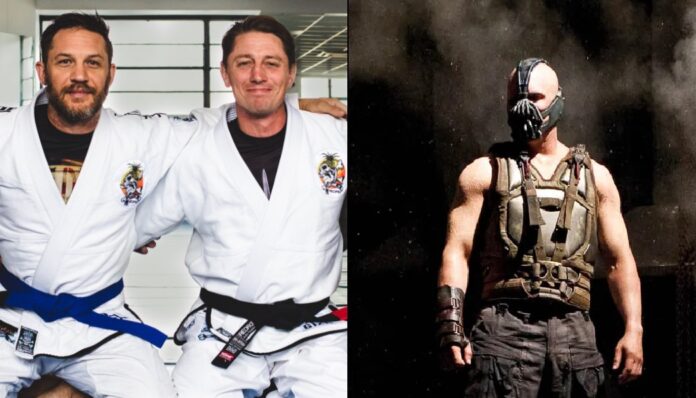
Actor Tom hardy was recently promoted to a BJJ Blue Belt almost 10 years after he started training in Jiu-jitsu. He started training in Jiu-Jitsu in 2011 when he was preparing for his role in a movie named Warrior in which he played an MMA fighter. Since then we could see Tom training in Jiu-Jitsu sporadically.

Some time ago 41-year-old Tom Hardy and former F1 Ferrari driver Mika Salo went on the toughest road trip imaginable. They went to eastern Siberia where winter temperatures plummet towards an inconceivable -70.

After 5 hours of driving through Siberia, they found the “institute of physical training”. The place where two Olympic gold medalists have been produced. Tom and his team were invited to take part in the training session to see how it is still possible to have fun in a harsh environment. The philosophy of this place is that physical activity is the route to happiness for everyone and it’s something a lot of us would agree with.

In the video below we can see Tom Hardy grappling with Russians in this form of ancient wrestling called Cap Sergei, the word for fragile. The idea behind this form of wrestling is to force any part of your opponent’s body to the ground.

After three serious rounds with a local wrestler, Tom Hardy said: “I’m done, he’s joking with me. He went really really easy on me. If you look at the territory and the terrain they live in you think about the strength and the patience that it takes to survive the place like this, it’s brilliant “.

Actor Tom Hardy Promoted to BJJ Blue Belt

Brazilian Jiu-Jitsu Symbols And The Triangle Meaning

Brazilian Jiu-Jitsu Symbols And The Triangle Meaning

Brazilian Jiu-Jitsu as one of the fastest-growing sports has its own recognizable symbols. You have certainly seen most of them so far, but you may not have known their true meaning or their origin. Now, we will talk about the famous symbols of Brazilian Jiu-Jitsu. About their origins and how they find their way into the sport.

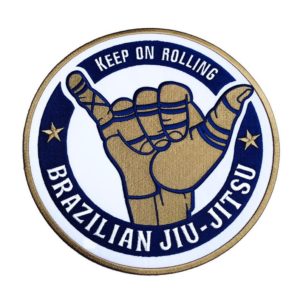
The main representing Jiu-Jitsu symbol, and the symbol found on the logos of most academies is the triangle. In addition to the triangle, we have other Jiu-Jitsu symbols that are popular today. One of these symbols is the BJJ Shaka which is very widespread and popular among BJJ practitioners today. And of course, there is another recognizable symbol, and that is the cauliflower ear.

The triangle symbol

Once you dive into the world of BJJ you will notice triangles literally everywhere, and mostly on the logos of clubs and academies and this is no coincidence. The history of the triangle in Brazilian Jiu-Jitsu dates back to the very beginnings of this sport and is an indispensable part of BJJ culture.

What does the triangle mean in Jiu-Jitsu?

The origin of the Triangle, as the most famous symbol of Jiu-Jitsu. The triangle represents the solid and stable base that a Jiu-Jitsu practitioner should have, the three sides represent the mind, body, and spirit, and these are the components of Gracie Jiu-Jitsu.

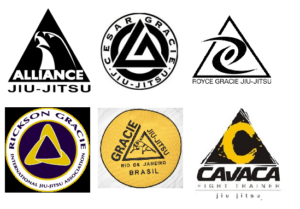
When you take a closer look at the logos of all the academies, you will notice that almost every one of them uses a triangle. So the triangle is certainly one of the most famous Jiu-Jitsu symbols. Of course, this Jiu-Jitsu symbol was not chosen by chance. It is a very powerful form with some principles that you can transfer to BJJ. These principles will help you in your BJJ journey, but also in life itself.
gracie bjj traingle

The origins of the Triangle symbol

The Triangle form was chosen and popularized by the Gracie family, hence the name Gracie Triangle. Brothers Helio and Carlos Gracie chose the triangle as a symbol of Jiu-Jitsu because it represented a solid and stable base that all BJJ practitioners should have.

As we know, a triangle has three vertices. Regardless of which side it rests on, the Gracie Triangle will always have a strong base. Three vertices represent the three components of what is known as Gracie Jiu-Jitsu. These are mind, body, and spirit. All of them together define a Brazilian Jiu-Jitsu practitioner.

A slight slope at the top of the triangle forms the letter G, which stands for Gracie.
Inside the logo, there are two Gracie Jiu-Jitsu practitioners who strive to master the mind, body, and spirit.

BJJ triangle symbols

Rickson Gracie about the triangle symbol

Rickson Gracie also explained this symbolism of the triangle as one of the most important Jiu-Jitsu symbols:

“In Jiu-jitsu, the triangle has a deep meaning. It comes from my father, Helio Gracie, and my uncles, and from my own efforts to develop the art.
We have realized that there is a kind of three-point base in every aspect of Jiu-Jitsu. The triangle reflects this meaning of a perfect base.
For example, if you mount your opponent, his body will be one point and your knees will the other points. There are always three points of contact.
This doesn’t mean you cannot be moved, rather it means that the ways you can move are predictable. The fact that they are predictable means you can find an extra element to create a new third point whenever you need to.

If you imagine a perfect triangle in three dimensions, in pyramid form you can see how you can push it to either side, and it will always be stable. Regaining its solid position every time. The application of this concept works that way.
When you mounted on your opponent and have three points of contact, he can move you around and you will easily find your third point again.
No matter how or where he moves you, you will be able to find his third point of support.”

The BJJ Shaka symbol

If you are familiar with the Brazilian Jiu-Jitsu world, you have probably seen this symbol by now. Most of us took pictures at least once in training with the Shaka symbol, right? For sure, we can say that Shaka, after the triangle, is one of the most represented Jiu-Jitsu symbols. However, most people do not know its true meaning, they have mostly seen it from other BJJ practitioners or professors. Actually, this symbol did not originate from BJJ, but there are stories of how the shaka came to BJJ.

bjj shaka symbolThe origin of the Shaka symbol

As we have already said the symbol Shaka is old, it is a hand gesture native to Hawaii.
This symbol actually represents a state of relaxation. One of the common translations for this gesture is “hanging”. There is no literal translation for “Shaka”. We can understand that it is a way of conveying the spirit of “aloha” and is often used as a greeting in Hawaii.
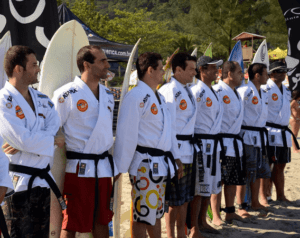
Also, this symbol is popular in Hawaii with surfers and divers. Whenever they pass each other or in the water, they make a Shaka gesture to say hello to each other.

A lot of legends and myths are associated with the origins of this symbol.
One Hawaiian legend says that Shaka’s origins tied to just one man, mythical resident of Laie reportedly lost three fingers while working in a sugar factory. After the accident, he went to guard the train with sugar, often waving with his mutilated hand. Children along the island often saw him doing so and adopted the sign.
Another myth is similar, it tells of a surfer who lost three middle fingers after encountering a shark.

How did the Shaka symbol come in BJJ?

Shaka symbol in Brazil is, as we know, closely related to Jiu-Jitsu. Brazilians, along with Hawaii, are among those who use the sign often.
How BJJ Shaka came into being is also not entirely clear. Similar to the stories that revolve around the origins of the Hawaiian Shaka, there are also several different stories about it.bjj surfers When Jiu-Jitsu appeared in Brazil the sign was already a big part of surfing culture. Back then, many surfers were training BJJ, and that they transferred this symbol to the sport. Rolls Gracie is the main connection because he was a surfer and grappler.
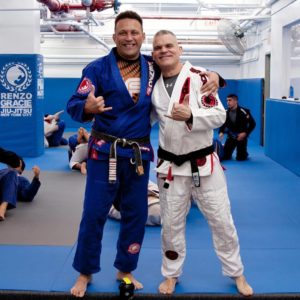
Renzo Gracie the BJJ shakaAnother version considers that Renzo Gracie has popularized BJJ Shake. Renzo fought Oleg Taktarov in a bare-knuckle fight and he has broken his arm. Legend says, that at the time, the guys from BJJ always used the “thumbs up” gesture. Posing for photos after the fight Renzo tried with a thumb that ended up like Shaka. According to Renzo, the community then accepted the gesture, and so this became one of the most popular  Jiu-Jitsu symbols to this day.

Cauliflower ears

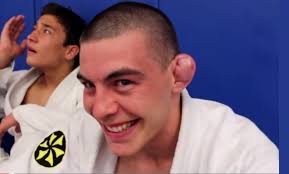
Cauliflower ear is an ear trauma that causes a buildup of fluid that eventually hardens if left untreated. Over time, the ears take on the appearance of cauliflower, hence the name.
To prevent trauma to the ears, students can often wear different headgear to protect them from the trauma.

Cauliflowers may or may not be a symbol of BJJ as the condition is mostly related to wrestling but with the increase in the number of people practicing BJJ, there is a high probability that when you see someone with cauliflower ears that he’s training or has trained BJJ.

Some consider this condition repulsive and disgusting. But there are people who accept it as the harsh reality of the sport and consider it as a badge of honor. And then again we have people stuffing themselves with cauliflower ears, so today it’s pretty safe to say that Cauliflowers really are a symbol of Jiu-Jitsu.

BJJ caulyflower ears

Actor Tom Hardy Promoted to BJJ Blue Belt

Tom Hardy Promoted to Blue Belt

Recently, actor Tom Hardy was promoted to blue belt in Brazilian Jiu-Jitsu. His training started back in 2011 when he was preparing for his role in the movie Warrior. Since then we can see Tom Hardy training occasionally as he’s posting a lot of photos from the gym on his Instagram profile.


View this post on Instagram


A post shared by Tom Hardy (@tomhardy)

He trains in REORG Jiu-Jitsu. Reorg was founded by Royal Marines physical training instructor C/Sgt Sam Sheriff as a way for serving personnel and veterans. The main mission of REORG is to helping military, emergency services & veterans to discover BJJ

View this post on Instagram


A post shared by REORG Jiu Jitsu (@reorgjiujitsu)

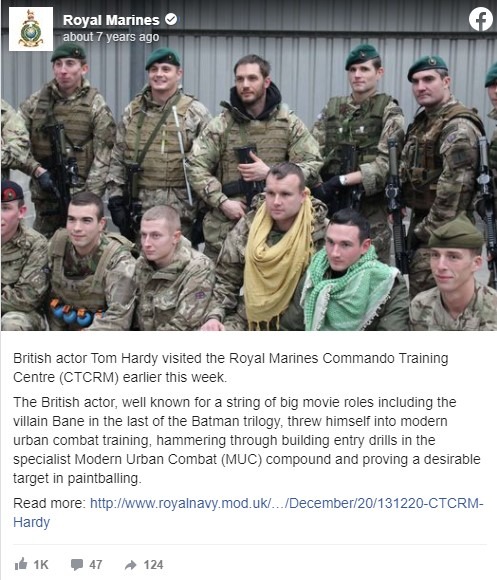
A few years ago Tom Hardy was spotted training Jiu-Jitsu together with British royal marines in an attempt to help them bring attention to a cause near and dear to their heart:

“Tom Hardy training Jiu-Jitsu in his REORG Kit! Doing an outstanding job of applying what he was taught and maintaining the top position! Great pressure! Are you a Veteran or serving wounded? REORG in association with We Defy Foundation is in place for you to help combat the psychological and physiological symptoms you may be dealing with. Everyone that has grappled on the mat knows the psychological and physiological benefits that can be attained, please help get the message out and help REORG help those in need. If your a Veteran and would like to get involved in Jiu-Jitsu please message REORG directly”@royalmarinesjiujitsu

Actor Tom Hardy Promoted to blue belt

The Rubber Guard: How To Play And Pass

Rubber Guard Guide - Pass And Play

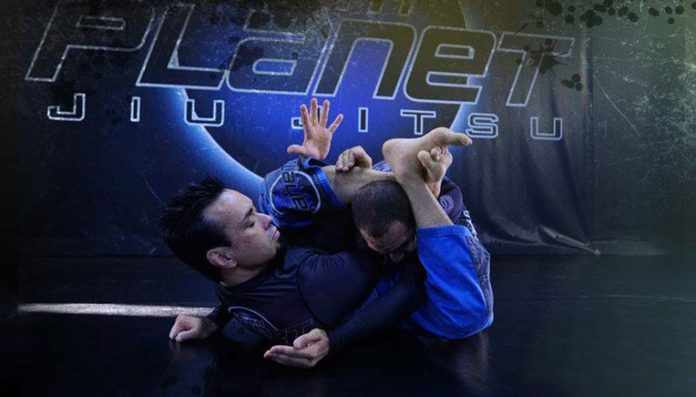
Rubber guard. A highly divisive topic in the BJJ world since its inception. Apart from the early Gracie vs. Eddie Bravo rivalry the whole Gi vs. No-Gi debate, later on, ensured this guard causes more discussions than training sessions. The fact of the matter is that the rubber guard is an unorthodox position. As such, though, it is far from ineffective. On the contrary, it is a great closed guard variation and, contrary to popular belief, works with the Gi as well.

The rubber guard is a guard that’s perhaps not suited for everyone. Then again, show me one guard that everyone can universally do with the same level of effectiveness. You can’t, I know. The rubber guard is a position that I’d place among advanced techniques, meaning that someone should at least be a high-level blue belt or a purple belt to start really learning it. Despite most 10th Planet grapplers disagreeing with this, I think that beginners can’t really benefit from it from the get-go.

The Rubber Guard Riddle

The rubber guard is not just a riddle for those looking to get past it. It is very often a hard position to figure out even for those that are playing it. That doesn’t mean, though, that it is an unsolvable one.

The one thing to remember about the rubber guard is that it is a very active position. Eddie Bravo developed it with MMA in mind. In that sense, the rubber guard was created to hold people with broken posture and in a position where they can’t strike until you can turn the tables on them. The key point here is “turn the tables” which means you have to move and progress through different rubber guard stages.

Rubber Guard GuideSolving the riddle of the rubber guard, from both top and bottom, means understanding the stage of the rubber guard. It begins ultra defensively, preventing people from obtaining the most important aspect of opening closed guards – posture. The configuration also makes passes like the Tozi difficult as well. At the same time, the rubber guard opens up plenty of attacking and transitioning options. What’s more important, those options come in a few different directions that can easily blend together. In other words, once you’re safe you need to know which direction you’re taking and don’t stop advancing until you have a tap, or atop position.

How To Set Up And Play the Rubber Guard

The rubber guard is essentially a form of high closed guard, but done with an emphasis on one of your legs, instead of both of them. Moreover, there’s a closed-loop system that really makes the position difficult to escape against skilled rubber guard players.

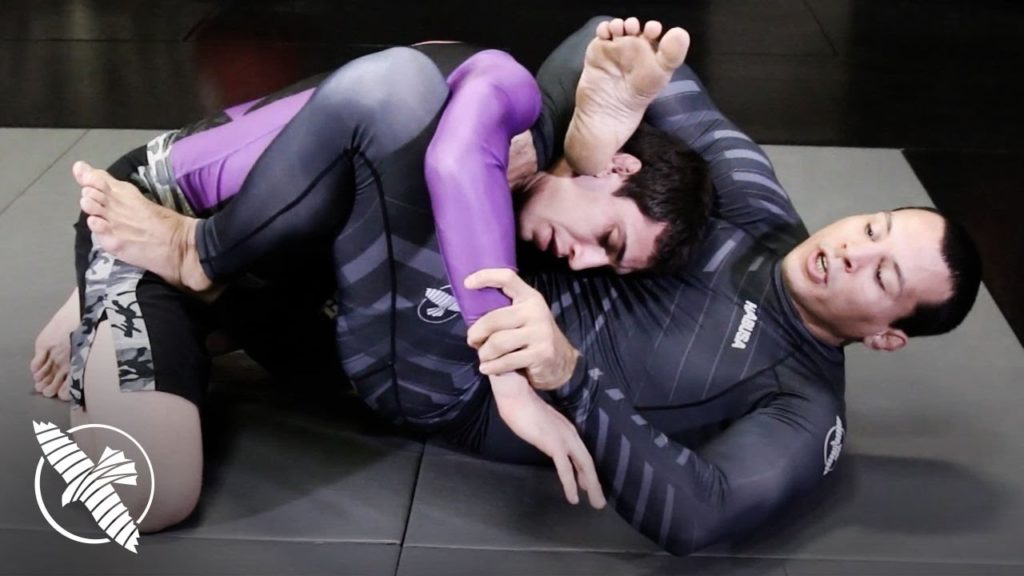
The position is available from any closed guard. The basic transition is to get the shin of one of your legs across the shoulders of an opponent, just like in a triangle. The difference is that this time, the leg stays underneath the armpit. Your other leg stays wrapped around the hip, at least in the initial moments of establishing a rubber guard.

The closed-loop enters the frame with the grips. Your arm should hook the ankle of the leg that goes over the shoulders, looking to grip with a unique grip from the inside out. The other arm then gets into one of several options, the most “basic” one being, and overhook position. However, the grip is not one of a usual overhook, but rather goes around the knee of the leg that is across the shoulders, further wedging it in place.

Attacking from the rubber guard si highly versatile and hat is where your flexibility comes into play as well. Namely, certain rubber guards move are only at the disposal of people that have very flexible hips, and pretty flexible knees. Other aspects, though, are up for grabs for anyone.

Attacks from the rubber guard include triangles, armlocks, guillotine choke variations, and even eh famous Gogoplata. Of course, the Omoplata is a highly obvious option as well. Back attacks and sweeps open up quite easily too, depending on how you progress with your grips, and, of course, your flexibility. The “meathook” rubber guard is one of the most efficient variations that anyone can use, regardless of age, flexibility, or the presence or absence of the Gi.

Passing The Rubber Guard

Getting past the rubber guard is also something every grappler should have in their arsenal. There are plenty of ways to deal with it, but I have to say that I’m a particular fan of Marcelo Garcia’s take on passing it.

Marcelo takes into account the movement and progressive offense that is available to the rubber guard player. In fact, he plays on the fact that they’ll go on the offense and uses it to set up a very cool frame that later on allows you to get out of the guard unscathed.

The play is to start moving the free arm’s elbow towards you. In most cases, this is a freebie triangle for the person playing the rubber guard. However, if you anticipate this, you can actually stop halfway, and use the fact that they’re swinging their leg around for a triangle to trap it with your forearm acting as a frame.

From there on, you need to be sneaky. The move is actually quite simple – turn the trapped hand with your thumb towards the opponent’s hips. This is crucial to recent any armlock attempts (armbar or Omoplata) when you finally decide to shake the guard off. In fact, you’re going to literally shake the person off you, by standing up and letting them slide out of the rubber guard. From there on, it is open season on any guard pass you like.

A Word On Prevention

Once again looking at the rubber guard from a passing perspective, dealing with it early is a much better option than having to pass it when ti si fully locked on. I that sense, prevention is key, and you need to be wary of the threat early.

The best way to prevent someone from ever catching you in the rubber guard is posture. When in someone’s closed guard, remain upright and battle to get up whenever they try and break it. Even if you just have your head above the line of your butt (like in a sprawl). it will help you to prevent them from placing the all-important shin across the shoulders which is actually your one main goal in rubber guard prevention. From there you can address the situation as you would a closed guard.

Final Thoughts

The rubber guard is a big part of Jiu-Jitsu, whether you like it or not. If you want to be all political about it, goa head and ignore it until someone entangles you so bad you’re going to feel like a white belt. The smart approach would be to learn the basics behind it, who it works, and how you can deal with, it. You never know when you’re going to need it!

Toreando Pass Mastery – Everything You Need To Know

Toreando Pass Mastery

What is your favorite BJJ pass? Actually, scratch that. What is your most effective BJJ pass? Plenty of people will either state the Toreando pass as their most effective one or at least count it in their top 5 BJJ passes. It is a universally effective way of getting past the legs in Brazilian Jiu-Jitsu,  particularly against open guards.  But why exactly is this guard pass so powerful? There are plenty of reasons for it, and we’ll explore all of them in our quest to provide you with the ultimate guide to passing BJJ guards with the Toreando pass.

The Toreando pass is such an effective and simple Jiu-Jitsu technique that I actually love to start the kids in my gym with it. It is easy for them to comprehend and it will work perfectly for them in competitions. That just means that it happens to also be a pass I favor with adult students as well. I believe everyone should at least have it in their toolbox, regardless if it not your favorite way to pass the guard. It comes in extremely handy from time to time.

What Is The Toreando Pass?

Before I got into the Toreando pass, let me try and categorize passes a bit, so that you know what type of pass we’re looking at. First of all, you have passes against open guards only. You can’t really pass the closed guard unless you open the legs. That just means that every pass that works against open guards will work against the closed guard as well, as long as you open it first.

Secondly, you have directions and methods of passing. In terms of directions, you can pass under the legs, around them, through them, or over them. In terms of methods, you have loose passing, pressure passing, and submission passing. These have all been discussed here on BJJ World previously.

The Toreando pass is a technique that makes you pass the legs by going around them, and is a loose pass, even though it has a pressure component during the finishing stages. Basically, the pass looks like you’re grabbing both legs of an opponent and you’re brushing them to the side while placing a shoulder in their belly. There are, of course, plenty of little details that actually make it work, from grip placement, to which leg goes in which direction and body movement, etc. But more on that later.

History Of The Toreando Pass

While most people do not have the impression that the Toreando pass is one of the old-school passes of Jiu-Jitsu, it has actually been around since the very beginning. A variation of it exists in Judo, in the Ne-Waza portion of the sport. The pass really came to prominence during the 90s, when people started standing up to open the closed guard. Grabbing the legs came naturally and the Toreando guard pass emerged as the most logical and efficient option from there.

It was Fabio Gurgel who really put the spotlight on the pass. In the 1996 Brazilian Nationals, he fought Roberto “Roleta” Magalhaes, who had one of the most unorthodox and difficult to deal with guards in the world at the time. Gurgel managed to shut Roleta’s dangerous guard down and pass it with apparent ease using nothing but the Toreando pass.

Afterward, the Toreando became a pass everyone reverted to, especially against flexible and dexterous guard players.

How Does It Work? 

The Toreando pass, as we already said, works by helping you go around the legs of an opponent. It doesn’t matter what guard they’re in, as the pass itself breaks any guard’s structure, opening up a direct route to side control, or sometimes, even the back.

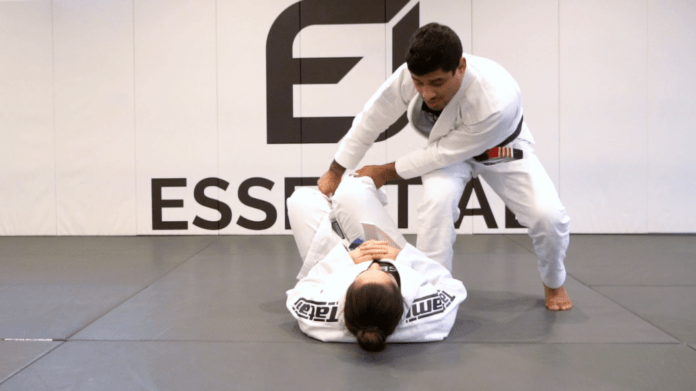
Setting up the pass starts with the grips. You need to grip the Gi pants, just underneath the knees. There are different schools of thought here, but the “old-school” version of gripping on the inside of the knee makes the most sense. The goal of these grips is to be able to manipulate the legs completely, which holding halfway (at knee level) helps you accomplish.

For the pass itself, you need to use the grips to place the feet of the opponent to the ground. Keeping stiff arms will help massively with this task. When the feet are planted on the ground you can start going around the legs. However, the Toreando pass will only work if you keep the legs firmly in place with your grips.

A helpful and key moment of the pass is placing the far side shoulder on the opponent’s belly/chest, depending on size. In fact, this is your goal, and you should be in a pushup like position, with all your weight on the opponent’s legs from the moment you plant their feet. The aim is to pivot around your stiff arms to the side, until such a time you can place the shoulder in place. From there, establishing side control is fairly easy.

Toreando Pass Details

The Toreando pass is a very quick pass, which should be something you consider, You can’t do this like a pressure pass, going slow and steady. The “loose” nature of the pass means you use it to pass in a blitz.

The first detail you should pay attention to in a tornado pass is to have both your arms in the inside space (in regard to their legs) before you start setting up the pass. As an example, you can’t start the pass from a Spider guard. You’ll have to get your elbow loose and get inside position first.

A second key tip is to actually put pressure on the opponent the moment you get your grips by pushing their knees into their chest. This will draw out a much welcome reaction of leg extension, which will only aid your passing.

Realistically, instead of expecting to be able to plant the feet, old-school-style without the opponent getting up, pressuring their legs into their torso is a much better option. In other words, the moment you pressure the legs you start moving around, using the pushup position to keep your weight on your opponent. The moment you get a good angle, you simply punch with your far side arm, looking to extend only the near side leg of the opponent, rather than plant both feet.

The punch is what will get your shoulder in place, as well as help you control the position and prevent re-guard maneuvers which you can bet are coming. Securing the pass is the final detail, and it has to do with a hip rewind motion – you walk your knee under their knee forcing the hips to look away from you so you can secure side control.

Toreando Pass Variations

As you might have noticed, we actually covered a couple of variations already – the old-school one with planting the feet and the more modern one with pressuring the knees into the chest. There are, however, several more variations and even follow up into other passes that stem from the Toreando pass. the mechanics of the pass are the same, most of the variations have to do with securing the pass, or staying upright instead of pushing the shoulder into the opponent.
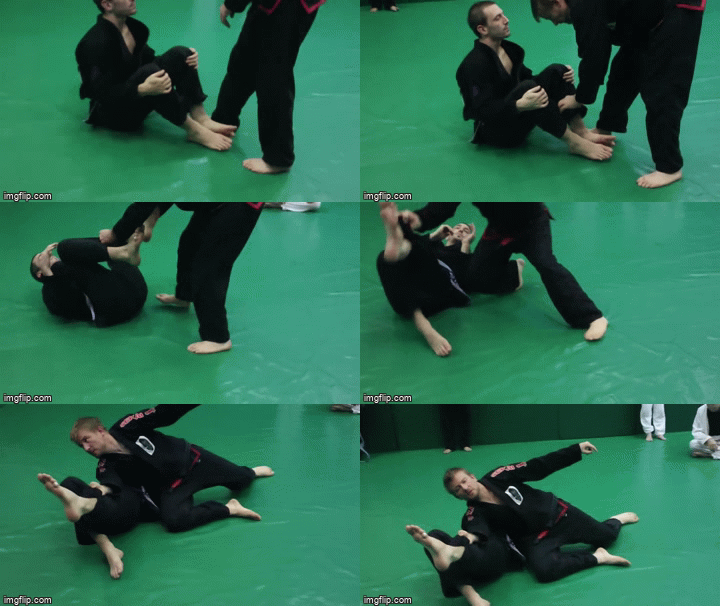
  • Hip Switch

Toreando Pass Mastery - hip switch VariationOne smooth variation is to forego the shoulder drop and instead go for a hip switch. This works perfectly well against people that are very quick with re-guarding and do a hip escape as you circle around their legs. The Toreando pass will work anyhow, but the hip switch means you’ll be able to secure the pass even against the most limber of opponents. The key point is not letting go of the grips.
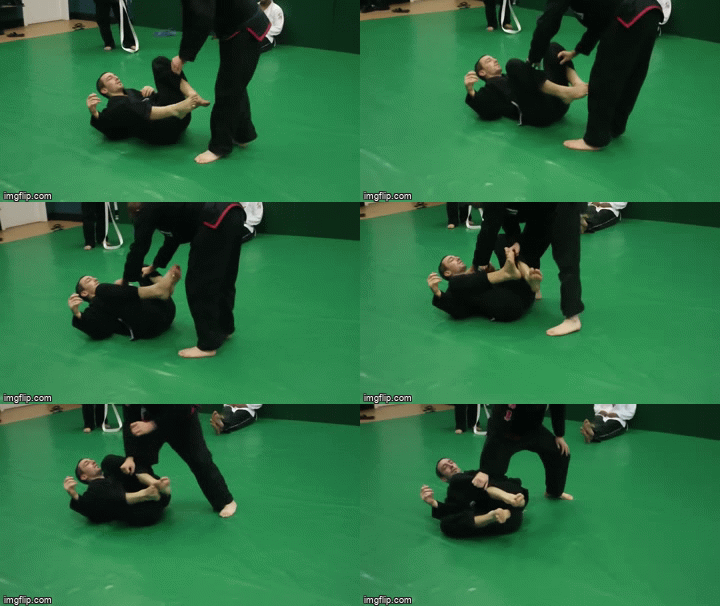
  • Reverse Knee On Belly

Toreando Pass Mastery - Reverse Knee On Belly VariationThe reverse knee on belly is another option not many people will expect. The Tornado pass actually places you in the perfect position to look for it. After a successful push and change of angle, if an opponent is difficult to break down or is moving away, you simply place the far side leg on their chest, into a reverse knee on belly position.
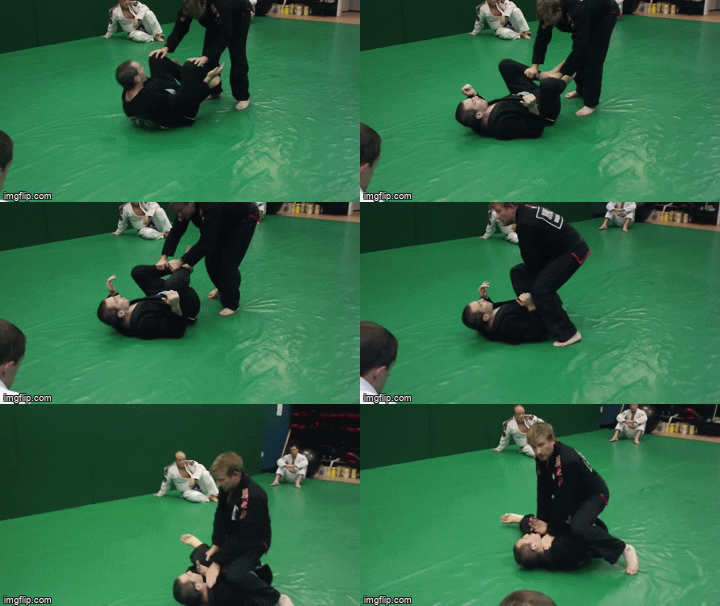
  • Leg Drag

Toreando Pass Mastery - Leg drag VariationLast but definitely not least, you can use the Toreando pass to set up other passes, like the leg drag. Since that is a pressure pass, you simply use the Tornado to get there quickly, and you can then take your time passing. You can use the initial knees-to-chest position to go directly for a leg drag or use it from the hip rewind position after you secure the initial pass.

The No-Gi Toreando 

If the Tornado pass did not work without the Gi, as well as with the Gi it wouldn’t really be one of the best passes in BJJ, would it? In No-Gi, obviously, you don’t have the Gi pants to establish the all-important grips, so the main modification is there. The best grips without a Gi are on both ankles.

From there, you want to pressure the knees into the chest once again. However, You won’t have the chance of turning and then securing the leg until you get hip rewind. In No-Gi, the Toreando pass works much faster than with the Gi. That just means that once you pressure the knees in, you need to simultaneously pull the near side leg and pivot around.

Most importantly, instead of looking to pressure with your shoulder, you’ll be looking to get the near side arm around the waist, exposing the back directly. At worst, you’ll get side control. At best, you’ll be on their back.

Conclusion

The only way to make sure you’re actually effective with the Toreando pass is to do drills. There are plenty of ways to drill the pass, but the one main constant is that you need to drill a lot and do it often. Once you get the hang of it, though (and it is not that difficult) you’ll be unstoppable against any guard, Gi or No-Gi.