
Ezekiel Choke – Gi and No Gi Details and Mechanics

Killer Ezekiel Choke

One of the simplest chokes in Jiu-Jitsu is also one of the most potent attacks you can do without any risk whatsoever! Not many moves in BJJ have these characteristics, so it’s baffling why the Ezekiel Choke doesn’t get more credit.

Gi chokes are a mighty weapon that Brazilian Jiu-Jitsu has taken to a different level. Other Gi-based grappling martial arts like Judo and Sambo tend to use them but not at the level that BJJ does. It is not just about the bow and arrow choke from the back. Gi chokes can be instigated from virtually every BJJ position, and they work exceptionally well. Especially when you hit them from a dominant position and in the simplest way possible.

There are plenty of Gi chokes that fit this description but there’s one that is particularly effective. As such it is so simple that it works most of the time once you get the hang of it. The reason is that many people often underestimate this choke, then turning it into a  brutally effective weapon. That said, how much attention do You pay to the Ezekiel Choke?

The Ezekiel Choke is not an original BJJ product, to be completely honest. The Sode Guruma Jime is a common submission in Judo as well.  The basic idea is to use the sleeve of your own Gi as leverage to choke an opponent. The choke became highly popular in Brazilian Jiu-Jitsu during the 1990s. Back then, it was an innovative move that was safe to apply from the top. Namely, it is one of the few chores that a grappler could safely attempt from inside the closed guard.

Today, attacking from within the BJJ full guard is not advisable, but the choke is still a strong threat from other top positions. The Ezekiel choke has many variations, all of them very common in the highest level competition.

What Is The Ezekiel Choke?

The name of this choke once again demonstrates the strong historical connection Judo and BJJ have. A Brazilian Olympian Judoka decided to tighten up his groundwork (Newaza) ahead of the Seoul Olympics in 1988. In order to do so, Ezequiel Paraguassú started cross-training at the Carlson Gracie Academy. Paraguassú was so good with the choke that he destroyed everyone during rolling. This resulted in the choke being named according to him. The true origins of the choke are unclear and may go well before the creation of Judo. However, as far as grapplers are concerned it is a Judo choke that was perfected at a BJJ academy.

Setting up the Ezekiel Choke takes time, as does g\finsihing it. It is one of those “slow chokes” that take time to set in. As such it not a great fit for Judo competition, where you only get a limited time to work once on the ground. In BJJ however, it is the perfect topside choke, especially from the mount and top half guard.

Since its initial success in Jiu-Jitsu, the Ezekiel Choke has evolved. The arm in Ezekiel is the most popular variation of the choke, still very effective in modern-day BJJ. That said, Ezekiel Choke is not exclusively done with the help of the Gi. There is a really effective  No-Gi variation as well, that uses the wrists for leverage.

How Ezekiel Choke Works

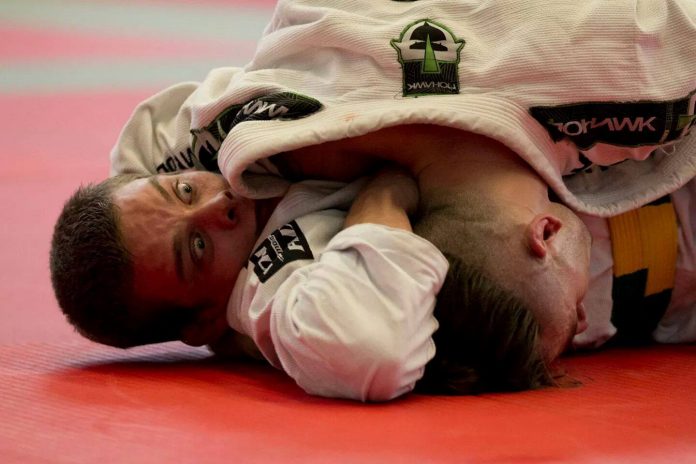
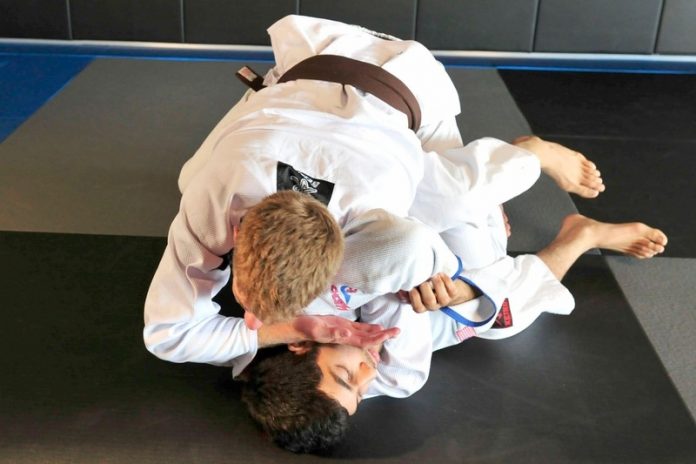
The Ezekiel Choke combines the use of a sleeve and the wrist. The mechanics behind the choke are in the scissoring-like motion that blocks the opponent’s trachea. In certain situations, the Ezekiel Choke can also be utilized as a blood choke.

A great way to really understand how it works is setting it up from the top half guard. Imagine that you are in a position with one arm underhooking your partner’s head. The other arm is going to have an underhook on his opposite side arm. Pretty much the best spot to be in for controlling the top of the half guard. First, you’ll need to use your underhook that’s under the opponent’s arm to control the biceps. To do so, slides the hand down and on top of the opponent’s bicep, pressing against the mat.  The next step is to open up the neck so that you can set the Ezekiel to choke up. Driving the top of your shoulder into their chin is one certain way to really open up the neck. Once the neck is exposed, you’ll need to thread the arm that’s on the biceps on top of the opponent’s neck.

Once you have your arm on their neck, you’ll need to use the arm under the head for leverage. To do so, you need to put four of your fingers (thumb excluded) deep inside the sleeve of the choking arm. Remember to grip really really deep.

There are two finishing arm configurations. One is with a fist that drives into the opponent’s throat. the second is with a “knife hand” open palm that puts pressure on the trachea with the blade of your palm. To apply more pressure, push the arms away from your body.

Attacking Ezekiel Choke From Different Positions

You can attack Ezekiel Choke from these positions:

  • Full Mount
  • Closed Guard (easily countered when done from inside of the closed guard)
  • Back Mount
  • Side Control (usually for transition to mount)
  • Half Guard (not so effective)

When mount attacks are in question, the Ezekiel Choke is an excellent weapon to add to your arsenal. It’s a very simple choke that doesn’t require having great strength or sacrificing position. It also works well as a counter when your opponent gets double underhooks. For the more advanced grapplers, it is a great weapon to open up other attacks, like armbars or Americanas.

A great aspect of the Ezekiel Choke is the opportunity to adjust at will. You can always switch back and forth or simply start another attack. One option involves transitioning into the gift wrap position, and/or taking the back. No matter how you set it up, the fundamental rules are holding the opponent’s head off the mat and staying as tight as possible.

From the closed guard, you can also use the Ezekiel Choke to really surprise your opponents. First, you have to break their posture by bringing them down with your thighs. A cross collar choke is the starting point. While looking to finish the choke, thrust one elbow upwards above their neck. Wrap the other hand around the back of their neck and grab the inside of our sleeve.  Apply pressure downward with your forearm to finish the choke.

No-Gi Ezekiel Choke

 For all the No-Gi die-hards there’s a very useful variation of the Ezekiel Choke. Granted, it doesn’t have the high percentage finishing rate of its Gi counterpart but it is effective nonetheless. For the No-Gi Ezekiel Choke, all the focus is on the wrists. That said, unless you have flexible wrists expect some discomfort while you get the hang of it.

For the No-Gi Ezekiel Choke, it is important to go as deep as possible with your choking hand and utilize the had to help you finish. The bottom arm (under the head) needs to be really deep too so that you can grab your wrist with your own arm. From there, the pressure principles remain the same. In No-Gi I suggest sticking to the first configuration because it has a better chance of finishing. Your head acts as an extra limb here, by limiting the movement of their head and closing down space on the opposite side of the choking arm. This is going to ensure a finish if you’re patient enough, Just count to 10 and in most instances, you’ll get the tap or a nap.

Frequently Asked Questions:

Why is it called Ezekiel Choke?

Ezekiel Choke is named by famous Judoka, Ezequiel Paraguassu, who started cross-training Jiu-Jitsu in Carlson Gracie academy in 1988. In Jiu-Jitsu gym Paraguassu managed to choke everyone with Ezekiel Choke. At the same time, he introduced the choke to MMA. That’s the reason why it’s named after him.

Is Ezekiel Choke Legal?

Yes. It’s legal in every Brazilian Jiu-Jitsu, Grappling, and MMA competition. It’s usually done as an airflow choke, but in some variations, it may be done as a blood choke. Both Blood and Airflow chokes are legal in most competitions.

Related Articles:

Ezekiel Choke From Guard: Reliable Or Just A Fairytale Move?
A Powerful Arm-In Ezekiel Choke Variation
No-Gi Ezekiel Choke From Top And Bottom
Ezekiel Choke Defense with a Wrist Lock as a Counter
Head And Arm Chokes In BJJ: Systematization

Want The Jiu-Jitsu Body Of Gordon Ryan? Train Like This To get It!

Loaded carries For The Perfect Jiu-Jitsu Body

Whenever you take a look at Kron Gracie, Rodolfo Vieira or Gordon Ryan, to name just a few, one thing catches the eye straight away. of course, they’re all very formidable grapplers who have dominated the highest levels of BJJ. Apart from that, what they have in common is an impressive physique.

No wonder most people involved in BJJ would like to look like those grappling monsters. Now, while it is not the main determinant of the outcome of a match physical fitness undoubtedly plays a major role in the success of these world-class grapplers. That said, their goal is usually mat performance and their chiseled physiques are only a welcomed side-effect. Now, we’re going to share with you a great conditioning secret that is going to get you the perfect Jiu-Jitsu body!

Gordon Ryan’s DVD/Digital/EBOOK is OUT!!! Check it HERE.

Gordon Ryan DVD/DIGITAL/EBOOK Getting Swole as A Grappler
Techniques and Programs List

Let’s make something very clear for the beginning. BJJ conditioning is not about the abs! That impressive Jiu-Jitsu body you’re after is a clear indication of elite level physical preparation. Now, most of the professional grapplers and fighters often use lots of state-of-the-art equipment. However, where they get the most bang for their buck is with good old basic exercises. And it doesn’t get more basic than picking something heavy and carrying it around. Hardly anyone that trains BJJ and competes at a high level is skipping over weighted carry exercises. And if you want the Jiu-Jitsu body that performs as good as it looks, you most certainly need them too!

Loaded Carries For The Ultimate Jiu-Jitsu Body

Carrying exercises are irreplaceable for developing a core of steel. The importance of the core in grappling cannot be overstated. The core consists of much more than just abs or lower back muscles. It includes all major muscle groups of the body and has a role in every complex movement it performs. The core is used for stabilization, flexion, extension, rotation, and anti-rotation. All of these movements are included in every roll or match a grappler does. Carrying heavy object in any of the manners I’m going to present further in this article, is a surefire way to get the core of a BJJ world champion.

Carrying exercises task the whole body in ways that are relatable to everyday activities. You’ve all heard the expression “farmer strong”. One look at Rousimar Palhares and you’ll know what it means. Loaded carries are often referred to as walks, due to the nature of the task. Now you can also get farmer strong but without the need to flip hay or wrestle cattle all day. That said, just picking something up and carrying it to exhaustion is not a very smart approach. Carries, just like all kinds of conditioning exercises, need proper programming in order for a maximal result. Furthermore, different types of the exercises need to be cycled at constant intervals in order to truly get you the perfect Jiu-jitsu body.

In terms of variation, it’s not only about the exercises. All aspect of conditioning training, like weight, duration, grip, loading style, equipment etc. need to be switched up. This is the only way to ensure your body adapts to as many different scenarios as possible. Just like in grappling.

How To Start Training Loaded Carries For BJJ

AS with all things BJJ, carries have a natural progression. Don’t just jump into the toughest variation possible unless you’re looking to get injured. Instead, the smart approach is to take it easy and allow the body enough time to adapt to imposed demand. After all the perfect Jiu-Jitsu body is not made in a month.

The first step of loaded carries is isometrics. The idea is that you pick up a weight in one arm and just stand with it. That way you train stabilization, correct posture and grip strength to name a few. Standing like this requires you to maintain a center of mass with a neutral posture against an external load. It is imperative that you know how to do this before going really heavy and starting to move around.

Begin by standing on one leg and holding a dumbbell on one side of your body. Standing in front of a mirror is perfect to get accustomed to the way it feels. You’ll also be able to track your posture through the exercise.  The goal is to avoid leaning either toward or away from the dumbbell. Oh, and one more crucial thing. There should be absolutely no contact between the weight and your body! Three to five sets of 30 seconds is a great place to start.

Gordon Ryan’s DVD/Digital/EBOOK is OUT!!! Check it HERE.

Once you’re comfortable with the isometric part of the movement, it’s time to introduce some dynamics. In that sense, the first look to add just movement before actually traveling with the weigh. The simplest way is to march in place, adhering to all the standards we set above. From there you can think about actually moving. The concept here is much the same, holding the load on one side of the body and performing a controlled walk while maintaining a neutral posture.

Two-Handed Loaded Carry Variations

Heavy bilateral carries are the meat and potatoes of any worthy carry program. They are perfect for increasing strength and conditioning, as well as building the ultimate Jiu-jitsu body.

The perfect tools here are very basic. Dumbbells and kettlebells are great, but long bars work exceptionally well too. Pick up a bar with each hand and take a walk. Furthermore, as you progress you might think about carrying sandbags or wrapping a Gi or towel around heavy kettlebells. That way you’ll add a grip training component that is very specific to Jiu-jitsu. In the beginning, stick to kettlebells, dumbbells, and a trap bar if you have access to one.

In terms of height, loaded carries can be performed high or low. This stands the same for both single-handed and bilateral carriesLet’s look at both of these groups of exercises.

Low Loaded Carries

To perform low carries you need to make sure you keep the weight at your waist, or lower. That way, you’ll really challenge your core in multiple e planes of motion. Trap bars are a great carry choice for overall core stability.T shape of the bar keeps the load off the body so the shoulders don’t have to do extra work. Furthermore, pick up a trap bar and switch its position so that the plates face forward. This challenges your wrist position and overall core stability by increasing the level of the load. Swiss bars or barbells are another great option for this both uni and bilaterally.

With dumbells and kettlebells, the focus is on the transverse and frontal planes. They’re both very effective in cases of hip collapse due to weak glute muscles. This also stands true for instances where you use two long barbells, each in every hand.

High BIlateral Carries

These are a great tool to use as a regression to the overhead press. Instead of battering your shoulders in a plane of movement you rarely us in BJJ, going for a high carry is much more worth your time. For the ultimate performing Jiu-Jitsu body, high carries are a must. They train the anti-extension quality in the frontal plane by applying a flexion force on the body. This means that the torso goes forward so that the erectors must work to keep it upright. At the same time, the anterior core must also activate to prevent the erectors from bringing the spine into hyperextension. This is essential for a multitude of grappling positions, especially when holding in an isometric fashion.

With high loaded carries, the goal is locking out barbells, dumbbells, kettlebells, or other weight overhead. Unlike front-loaded carries, they directly force the spine into hyperextension because the overhead lever is so long. This challenges you to maintain a tight rib-to-pelvis relationship. It also makes you stabilize an upward rotated position of the scapulae. However, just going overhead is not where these exercises end. Holding a weight in the goblet position is also a perfect option for grapplers.

https://www.youtube.com/watch?v=ycvAwDG0EfA

Final Thoughts

Finally, the reason why these are going to work long-term and help transform you into a beast is combinations. The possibilities here are endless. You can combine a high and a low carry, two highs, different bars, whatever you think about. You’re going to be tougher, quicker and have a better gas tank. And you’re going to look better than ever before in your high-performing Jiu-Jitsu body!

Gordon Ryan’s DVD/Digital/EBOOK is OUT!!! Check it HERE.

Gordon Ryan DVD/DIGITAL/EBOOK Getting Swole as A Grappler
Techniques and Programs List

Gordon Ryan DVD/DIGITAL/EBOOK – Getting SWOLE As A Grappler

Travis Stevens’ 3 weeks / 3x per Week Weight Lifting Program for Grapplers

A Jiu-Jitsu Workout Program To Lose Fat And Improve Performance

21 Strength and Conditioning Exercises For Jiu Jitsu!

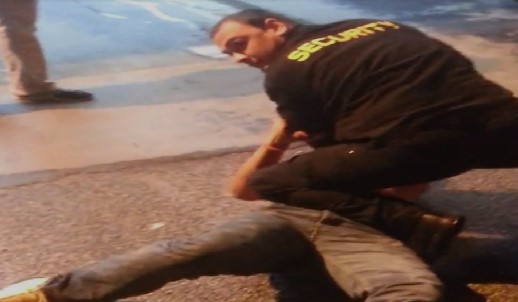
Security Guard With a Huge Takedown and Knee On Belly Control on the Attacker

It’s pretty nice to see a security guard who’s obviously trained in grappling martial arts without using excessive force.

In the video, you’ll see a security guard easily taking down a guy who tried to punch him. No punches, no kicks, just take down and control. Beautiful!

Jiu Jitsu Guy With No Takedown Skills in a Street Fight – FAIL

Small Guy Takes Down a Big Bully

Small Guy did Double Leg Takedown on a Big Bully

Unleash Unbearable Pressure With The BJJ CrossFace

Ultimate BJJ Cross Face Pressure

Even when we wrestled as kids, knowing absolutely nothing about grappling, we always have the tendency to be on top. The human instinct dictates that the top position is far more preferable than the bottom. Most grappling martial arts, like wrestling or Judo, are also based on this concept.

When you take someone down, the winning points come from holding them while on top. In that sense, BJJ is not very different. Despite having the option of fighting off your back, unlike other martial arts, Jiu-Jitsu still emphasizes the top position. One look at the point system of Brazilian Jiu-Jitsu and it is clear that everything leads to the top position. There’s a great reason behind this, other than our primal instinct. That reason is that from a top position new can exert pressure that can debilitate an opponent. And from the many kinds of pressure, none is more devastating than the BJJ Crossface.

The Crossface in Jiu-Jitsu is one of the fundamental concepts of top position pressure. It allows a grappler to pin the opponent by controlling their head. In Brazilian Jiu-Jitsu, the Crossface is the primary mechanism behind the success of plenty of top positions. Side control, full mount, top half guard, and plenty of other positions rely heavily on the BJJ Crossface. Knowing how to control the head of an opponent with extreme pressure is an extremely important aspect of passing any guard in Jiu-Jitsu. In certain instances, the BJJ Crossface might even elicit a tap out of an unrespecting opponent. In that sense, it is only a few details away from a very powerful choke that’ll put people to sleep in no time.

The Crushing Pressure Of The BJJ CrossFace

The BJJ Crossface position is one of the fundamental characteristics of the pressure game from the top position in grappling.  The most prevalent use is when you’re holding down someone in side control. However, this is no the full extent of this powerful pressure move.

 The mechanics of the Crossface are based on pressure and head control, two major Jiu-Jitsu principles. A properly structured Jiu Jitsu Crossface starts by placing your hand under your opponent’s neck, going as deep as you can. For the purpose of explaining it, let’s say you’re in top side control. From there, the goal is to turn your opponent’s head away from you. In order to do this, and keep the head there without overcommitting you’ll have to use proper weight distribution and pressure placement. What this means is putting your shoulder down on their jaw at a specific angle that elicits maximal pressure.

In terms of keeping a safe position while going for a BJJ Cross face, remember that pushing forward with the shoulder is likely going to help your opponent reverse the situation. So when you have the arm deep and shoulder in place, pull the opponent inside towards you instead of only projecting your weight forward. This is when you feel the true power of the Cross face.

Controlling the head means that you easily control the body. The body’s movement is severely limited when the spine is not aligned. it is \, put simply, a way to break your opponent’s posture. , As you should know by now, controlling posture very often means you control where an opponent can go. A solid BJJ Crossface is a crucial piece in applying pressure on your opponent from the top.

Crossface Torture From The Top

The Crossface is also one of the staples of mount control.  The mount is a tricky position to control in the first place, with complex mechanics.  Usually, beginners are not able to maintain it for long due to incorrect weight distribution and balance. What happens is they get rolled back to guard, or pushed back into half guard. One of the key components to maintaining mount is having a brutally painful Crossface pressure.

Just like in side control, the focus is on head and neck control.  The BJJ Crossface completely neutralizes one of your opponent’s sides, making escapes impossible. From a solid chest to chest pressure, you need to go under their neck and turn their head in one direction, just like in side control. Once again the goal is a misalignment of the spine.  From the mount, you could also use the Crossface to set up submissions. Namely, it can be used to distract your opponent while you work on a submission.

When you’re passing the half guard you’ll need to employ the Crossface once again. It is a crucial concept in passing the half guard. When passing the goal is to flatten your opponent, both their shoulders firmly on the mat.  There are two ways to do this. First, use a BJJ Cross face to force their head and neck in one direction. Secondly, you could utilize an underhook. For the best control, however, you go for both an underhook and Cross face pressure. There are various ways to apply the Cross face from passing the half guard.

BJJ CrossFace To Von Flue Choke

Have you ever heard of the Von Flue choke? This choke is the perfect guillotine counter. At least that’s how it came to be.  Lately, UFC vet Ovince St.Preux has become hugely popular due to using it in MMA fights. Whenever someone stubbornly holds onto a guillotine choke even when you have passed their guard, it’s time to teach them an unforgettable lesson. The Von Flue choke It’s a highly effective and unorthodox technique. Even better, it doesn’t have to be set up from a guillotine defense. Instead, you could go for it straight off a Crossface.

The mechanism of the choke is similar to a triangle choke. On one side, you force the shoulder of the opponent’s far arm to block the arteries on one side. This is done by forcing the opponent to angle towards the ground. This puts their shoulder straight up against the side of their neck. To complete the choke, you need to drive your shoulder into the top side of their neck. From a strong Crossface, the shoulder is already there. All it takes is some pressure and you get the tap.

The Von Flue choke is a really fast one so be advised that your opponent might go to sleep before they get the option to tap. As such be careful both in training and competition and especially while rolling. In competition, there is a referee to monitor the situation. In rolling, you need to be careful not to hurt someone with the power of your Crossface!

VIDEO: Carlos Condit KO’s US SF Soldier After Sucker Punch

Carlos Condit KO Soldier

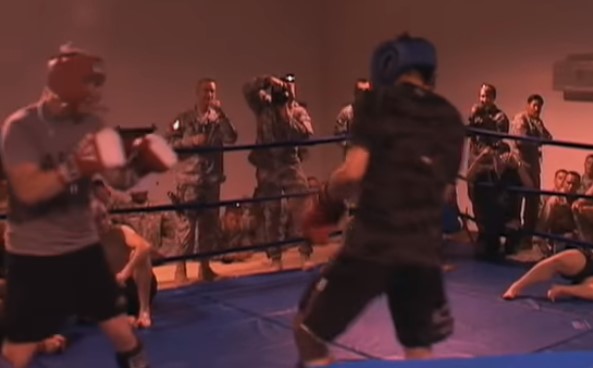
Carlos Condit was sucker punched by US Special Forces soldier and that was enough for Carlos Condit to Knock him out.

The story came from Michael Bisping and now here is footage of it. Something that was supposed to be soft sparring turned out in a huge knockout. As Bisping explains it, the soldier was the cool guy but suddenly he went pretty hard on Carlos Condit. Carlos was suddenly sucker punched by a soldier and when he recovered he went had on the soldier. Carlos had clear attention to drop him down and he did it.

In the footage of that sparring, you’ll see that Carlos was first light rolling with US soldier and after that, they went into light kickboxing sparring. The footage clearly shows everything that Michael Bisping said in a podcast.

“We did some very cool stuff. And one of the things we did was go to an out-base where there was a very small camp set up, very little people and it was where some special force — badasses basically — a small group of hardcore special forces guys and they had a tiny little gym set up.

“In that gym was a boxing ring and we went in there and we were meeting these guys and just shooting the shit, talking to them, and then one of them says ‘would you like to spar?’ I was like ‘alright cool. I’ll spar with you.’ So we put the gloves on and I’m just messing with the guy throwing out a couple of light jabs.

“To be fair, the guy was cool. We had a nice friendly spar and I threw a few jabs and I took it easy and that was that we finished. One guy then says to Carlos Condit — another one of the special forces guys — ‘do you want to spar’ and Carlos Condit says ‘yeah, sure, no problem’. Oh, and by the way, they call him the Natural Born Killer, that guy is cool as fuck. He never raises his voice and he’s super mellow. They put the gloves on and the special forces guy says ‘how hard do you want to spar?’

“Carlos replies ‘I’ll hit you, as hard as you hit me,’ which is a fair answer, but it was a very cool answer because he was [saying] ‘if you want to go hard motherfucker, we will go hard, but if you want to keep it light and friendly then we can go light and friendly, the ball is in your court’.

“So the guy says ‘cool’ but then all of a sudden, right then and there the special forces guy: bang … he suckers punches [Condit] as hard as he can. And I mean a fucking hard shot. And Carlos goes down to the floor.

“It was a big heavy shot, but Carlos gets up, shakes his head, gets his shit together, and then just goes at the guy. Jab, the right hand, left head kick, boom, knocks the special forces guy straight through the ropes onto the floor, unconscious, out cold. Everyone in the room was looking around like holy shit.

“I was like ‘oh Carlos, I’m not sure that was the best thing to do,’ but fair play, ever since I saw that I was like he’s a bad motherfucker man. He’s a great guy.”

Carlos Condit actually said one very interesting sentence to a soldier, “it’s up to you man, hit me as hard as you want to get hit”.
Well, the soldier got what he was looking for.

Check out the video of Carlos Condit knocking out soldier.

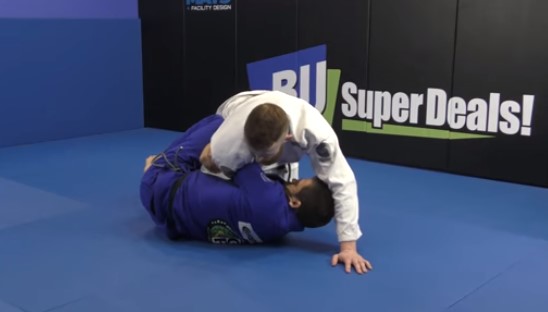
Make sure you don’t miss the opportunity, the Special offer from BJJ Fanatics and their Super Deals with discounts going up to 70% RIGHT NOW.
You can find the newest instructionals from Craig Jones, Tom DeBlass, Bernardo Faria and many others. If you decide to upgrade your BJJ don’t forget to use code “FANOM10” for 10% discount more!

Renzo Gracie B**chslapped a guy who blew an air horn in His Ear

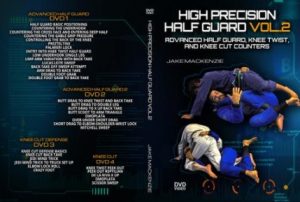
REVIEW: High Precision Half Guard 2.0 – Jake Mackenzie DVD

Armdrag to back take by Jake MacKenzie

Fighting off the back is Brazilian Jiu-Jitsu’s one characteristic trait that has prolled the art to stardom. Okay, it is not the only one but it is a major aspect of BJJ that amazes people to this day. Understandably, everyone wants to be on top, as it makes the opponent work against gravity as well as yourself. However, when you’re on the bottom, having great attacking options is a must. While the closed guard is the safest position there is, there’s one position that comes to people instinctively, even if they’ve never done grappling martial arts before. It is the half guard position and hardly anybody does it better than Jake Mackenzie. If you want to be as proficient as him in it, picking up a copy of the High Precision Half Guard 2.0 Jake Mackenzie DVD is a no-brainer.

ON SALE:
Jake Mackenzie – High Precision Half Guard 2.0 DVD / DIGITAL
Jake Mackenzie – High Precision Half Guard 2.0 Techniques List

Jake Mackenzie high precision half Guard
Techniques List

Whenever you’re up against a skilled passer, most open and closed guard variations tend to fail at a certain point. When that happens a new version of a closed guard comes into play, one arguably even more effective than the original. The half guard’s efficiency has been proven over and over again by the top grapplers of all time. However, due to its popularity, the half guard is not one of those mysterious BJJ positions. People have solved the best ways to neutralize the position until they can pass. This means that you’ll need to be really experienced and proficient with it in order to use it to its maximal potential. This, however, requires time. What the High Precision Half Guard 2.0 Jake Mackenzie DVD delivers is a shortcut to learning the best version of the half guard in a sliver of the time it takes to master it.

The Half Guard Position In BJJ

The half guard is by far one of the most versatile positions in Jiu-Jitsu. It is the go-to position for many distinct world champions, the likes of Caio Terra, Craig Jones, Tom DeBlass, Bernardo Faria and of course, Jake Mackenzie.

The versatility of the half guard comes from the many positional variations that are available. The basic half guard is when you have one of your opponent’s legs trapped with both of yours. Basically, the goal is being on your side while having your top leg on the outside of the opponent’s body. From there, the first thing you learn is going for an underhook, which consequently opens up plenty of attacking opportunities.

This half guard classic is known as the underhook half guard. Among other variations of the position, there are the deep half, Z guard, half-butterfly, seated half, lockdown and many more. All of these are very valuable weapons for every grappler. However, understanding of the classic half guard is the foundation for exploring other variations.

As far as half guard basic go there are a few things you need to remember when playing it. First, keep your back off the mat. This means that both your shoulder blades should never touch the mat, no matter which variation you’re playing. Secondly, never (or hardly ever) allow your opponent to control your head. Furthermore, the best way to stay safe in half guard while opening up attacks is framing. Using frames to keep your opponent at bay means you’re not wasting energy while you’re creating much-needed space. Finally, remember that you need to stay active. The half guard is a dynamic position the requires you to constantly be on the move. It is all covered in the High Precision Half Guard 2.0 Jake Mackenzie DVD.

Why Is Jake Mackenzie So Good At The Half Guard?

Jake Mackenzie is considered to be one of the most prominent grappling figures that come out of Canada. He is a Roberto “Cyborg” Abreu black belt, which is a huge accomplishment in itself. He has medaled in all big IBJJF tournaments in Brazil and has an outstanding offensive game from the bottom. For the better part of a decade, he lived in Brazil, perfecting his Jiu-Jitsu right at the source.

Brazil is where Mackenzie discovered the half guard and decide to make it his favorite. Of course, working with Cyborg helped his cause immensely. After all, Cyborg is a half guard magician himself, famous for the creation of the Tornado guard. The Tornado guard is essentially an inverted half guard. No wonder Jake Mackenzie turned out to be even better than his professor at the half guard. All that competing across Brazil also helped.

Nowadays, Mackenzie is a regular teacher at Cyborg’s Florida based gym. He still competes to this day and is relentless at going to the deepest ends of the half guard. As such, his High Precision Half Guard Jake Mackenzie DVD was a real hit. Now, the 2.0 version offers even better insight into this essential BJJ position.

Jake Mackenzie DVD: High Precision Half Guard 2.0

The best thing about this High Precision Half Guard 2.0 Jake Mackenzie DVD is that it is the second edition. This outlines how dedicated Jake is to the position. He could’ve come up with an entirely different subject, given how successful his last DVD was. However, Jake chooses to continue disclosing his amazing half guard tips and has once again excelled at it.

The information presented in this Jake Mackenzie DVD is very similarly structured as in his previous release. Jake primarily deals with all the details of his half guard position before moving on to attacks. Two whole volumes are dedicated to the offensive half guard game. Keep in mind that all his techniques are very appropriately dubbed “advanced half guard” While he takes it to step by step, there is some pretty high-level technique in this release.

The second part of the instructional is all about countering one of the most common passing systems in Brazilian Jiu-Jitsu. During the past 6 or 7 years, the knee cut pass has become the norm, especially against the half guard. Jake shows his take on dealing with it and eventually countering. All in all, you get very specific instructions from a person who simply excels at this versatile BJJ position.

Advanced Attacking Concepts

The High Precision Half Guard 2.0 Jake Mackenzie DVD begins like any instructional should – with the very basics. He begins with tips about basic positioning and staying off your back. The underhook battle is the focus here, and with Jake’s tips, you’ll be able to win it 99% of the time. What I think really hits the spot is the grip fighting strategy. This pertains to both sleeve and pants grips that offer unbelievable control love the opponent.

In terms of submissions, I am a guillotine and front headlock guy, so for me, there’s one clear winner in these departments. Jake shows a very cool variation of the guillotine, one that he calls the Pretzeltine. And that name is thoroughly deserved. The Palmieri lock is another move that demonstrates the creativity of Jake Mackenzie. There’s also a very nice Oomoplata finish available. Although the setup is nothing new, there are essential details included.

From a point-based offense, there are two main avenues of attacks. First up are back takes, which hare truly covered in depth. From the very basic underhook entries all the way to butt-drags, Jake opens up clear and decisive paths to the back. Continuing forward, Jake’s other method of attacking are sweeps. When submissions and/or taking the back is not an option, there’\s always the opportunity to sweep. From Lucas Leite’s sweep all the way to some Ryan Hall specials, Jake covers it all.

Countering The Knee Cut

The second part of the High Precision Half Guard 2.0 Jake Mackenzie DVD is all about dealing with the knee cut pass. As this is the most utilized pass gainst half guards, the need to address it so profoundly is clear. Mackenzie offers an understanding of the pass itself, before moving on to defensive options, to begin with.

Defensively speaking, Mackenzie’s concept is to redirect the pressure of the knee. As simple as it sounds, it is quite complicated and no one can clear it up better than Jake. Again, the focus is on the back takes and sweeps, with the Jedi Mind trick standing out of the bunch. Jake spends a lot of time explaining every concept here, so there are fewer moves per chapter, but they’re longer.

Finally, he ends with a few transitional options when battling the knee cut. Instead of only sweeping Jake offers paths to common attacking open guards like the X guard and the De La Riva. It wouldn’t e complete without a submission though, so there’s another Omoplata setup which completely nullifies the threat of the knee cut pass.

ON SALE:
Jake Mackenzie – High Precision Half Guard 2.0 DVD / DIGITAL
Jake Mackenzie – High Precision Half Guard 2.0 Techniques List

Jake Mackenzie high precision half Guard
Techniques List

What A Year Of Doing 10th Planet Warm Ups Has Taught Me

10th Planet Warm Ups 10th Planet Jiu-Jitsu

When people in the Jiu-Jitsu world hear the name Eddie Bravo there are usually two very different reactions. People either love him or can’t stand him. Admittedly he is a polarizing figure. That said, nobody can dispute the fact that he has greatly contributed to the evolution of Brazilian Jiu-Jitsu, especially in No-Gi. Eddie has been challenging certain established BJJ beliefs ever since he walked into Jean Jacques Machado’s gym as a beginner. Even before he founded 10th Planet Jiu-Jitsu, he had invented positions like the Twister and the Truck that turned out to be extremely effective. Since then his innovation has been relentless, although not always as effective in a general sense. However, his latest exploits seem to be the best of it all. I’m talking about the much-debated 10th Planet warm-ups system.

It is important to understand that the 10th Planet Jiu-Jitsu system is unlike any other you’re going to see. A big reason why this is so is Eddie’s approach. As opposed to Danaher, Ryan Hall, and other science-based BJJ wizards, Eddie is first and foremost an artist. So his approach is the complete opposite to the methodical and through one employed by the previously mentioned grapplers. So when he came up with his 10th Planet warm-ups system people had the usual frowning reaction. For those that have heard his reasoning behind it might make more sense. And for those that might’ve attempted it, the benefits are apparent and can be game-changing!

What Are 10th Planet Warm-ups?

First of all, let me make something clear. I am not a member of 10th Planet Jiu-Jitsu or any other affiliate academy. Actually, I train at a Gracie Barra academy which should tell you plenty. That said, about a year ago I came across Eddie Bravos’s 10th Planet warm-ups.

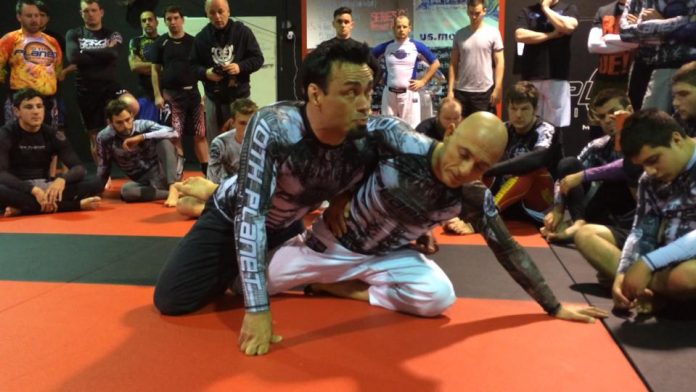
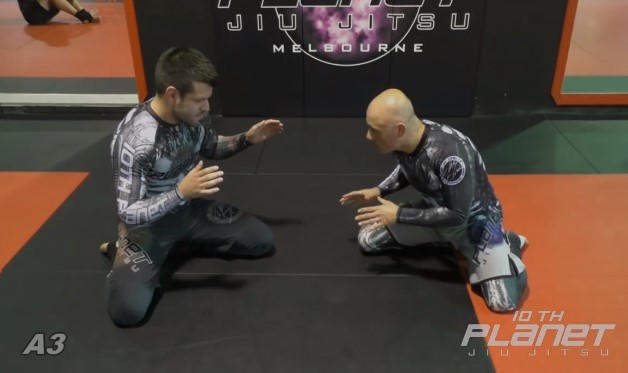
The 10th Planet warm-ups are a series of techniques, done in a drill-like fashion in which both participants need to work. Unlike everyday repetitive drills that focus on just one movement, these scenarios focus on a niche area of Jiu-Jitsu. For example, there’s one sequence that focuses on everything to do with the butterfly guard. However, instead of simply restarting once a butterfly sweep is done, now the other person has the opportunity to train specific mount escapes and so on.

10th Planet Warm Ups 10th Planet Jiu-Jitsu

As Eddie Bravo puts it, these warm-up series are as close to shadow boxing, or bag work as you can get with a grappling martial art. After all, you rarely train jabs only for an hour when you train striking right? The basic concept is that since you can’t train BJJ on your own, you grab a partner. Once you do that though, don’t just do butterfly sweeps, for the duration of a session. It is much better to drill combinations, and that is exactly what you get with these warm-ups.

As far as the 10th Planet Jiu-Jitsu system goes, they focus on the areas they work the most. So they have sequence scenarios that start and/or end in their top positions, many of whom tend to be the same with the most dominant positions in BJJ in general. So when the subject of the class is in one of these areas, 10th Planet practitioners warm up with the appropriate sequence of techniques.

A Different Approach To Drilling

The 10th PLanet warm-ups are organized in a very specific fashion so that they make a lot of sense. Basically here are eight scenarios according to specific areas of BJJ. They are organized by letters so that they’re easy to be assigned to a specific day. The letters so far range from A to H and there are 4 specific sequences within a letter. That puts the total of drill sequences at 32, which is a lot. It took me the better part of a year to memorize them all, and that is without constant changes Bravo’s making.

In terms of areas of focus, the 10th Planet warm-ups pretty much encompass everything. While it might not be apparent from their designated description name, they do go in every possible direction. So, for example when you train The “G” series or “Half Guard Passes” you do not just pass the half guard. Once you pass, you do transitions to the mount or Ashi Garami positions. Once there, you get the opportunity to go for submission before allowing your partner to train an escape and, in most cases, a counter. Some sequences even end with an escape or re-counter on your part.

What these drill sequences bring to the table is first and foremost transitional prowess. While we tend to focus very much on the muscle memory in regard to specific movements in BJJ, we often overlook the need to do so in a transitional sense. The 10th PLanet JIu-Jitsu system is based very much on fluidity, hence the focus on connecting various most often seen situations into complete sequences with multiple possible follow-ups.

https://www.youtube.com/watch?v=eg1g0XeCBJ4

You Don’t Have to Be 10th Planet Jiu-JItsu

For more than a year now, I’ve been drilling a specific 10th Planet sequence at the end of every class. Unlike Bravo, I do not utilize them as warm-ups, but rather as competition-oriented drills. A bunch of purple belts and above competitors gather at the end of class for about 30 additional minutes of drills, based on the 10th Planet warm-ups.

At first, we were pretty much lost. However, with time, we got into it and started building up our efficiency. Suddenly, stuff that we are drilling at the end of the class started working seamlessly during rolls. Mainly, it was in a defensive manner, from tough positions against more skilled training partners. That only made us work more until we realized that even the attacking sequences are easily introduced to any grappler’s style. Furthermore, the sequences can be cut short, or they can be connected so that you go straight to a different one.

The fascination with the 10th Planet warm-ups grew even more after a few of the guys managed to use sequences or parts of them under the pressure of competition. Classical drills never seemed to do the trick before we started connecting everything into logical sequences. That heavy bag for BJJ theory seems to be spot on!

In all honesty, there are parts of the drills and even complete sequences that make no sense at all. Following the 10th Planet, warm-ups don’t mean we do them by the book, beginning to end. We threw some stuff out, replaced other and even added something of our own. What we really learned was the power of connecting everything and begin aware that transitions in and out of positions can also be drilled to great effectiveness.

10th Planet Related Instructionals:

10TH PLANET JIU-JITSU ALL STARS 2 DVD SET
RUBBER GUARD: THE MEATHOOK BY BRANDON MCCAGHREN

10th Planet Drill Videos:

Guy Walked into a 10th Planet Academy and Challenged Black Belt to a Fight

Inside 10th Planet Jiu-Jitsu Grappling Concepts That Work

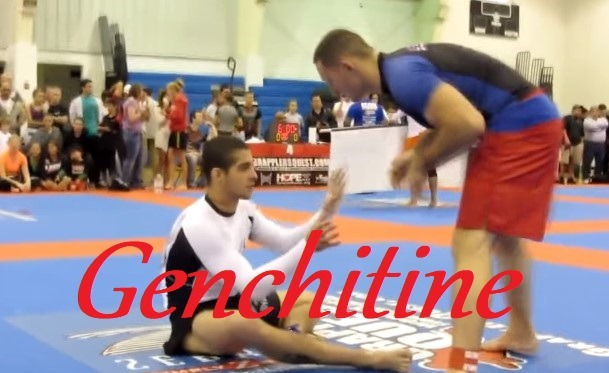
Blue Belt Submits Black Belt with His Guillotine Choke – “Genchitine”

Blue Belt Submits Black Belt with His Guillotine Choke - "Genchitine"

Delvin Genchi executed “his” guillotine choke on a Black Belt in competition in less than a minute.

We can say that Delvin patented it with this submission on a Black Belt. This powerful submission is a mix between the Guillotine choke and the dreaded Crucifix – creating two types of excruciating pressure that will force your opponent to submit.

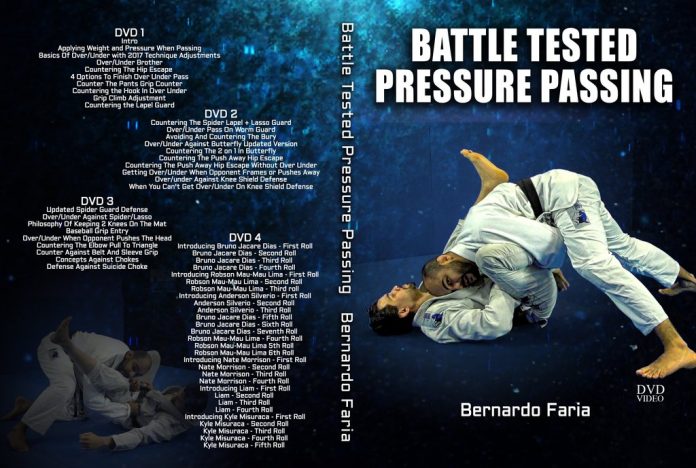
Battle Tested Pressure Passing – Bernardo Faria DVD Review

Bernardo Faria Battle Tester Pressure Passing

When I started BJJ I loved playing the guard game. The closed guard was my first love, after which I discovered open guards and built a whole game around it. Much like most of the people that roll do. During that time though, I never really paid attention to passing the guard. Despite having a strong top position game, my passing, in particular, was horrible. Basically, I did not enjoy passing the guard as much as I did playing it. Until I discovered pressure passing. Seeing Bernardo Faria dominate high-level black belt opposition by slowly destroying their guards with pressure changed the way I see BJJ forever. Finally, I had a passing style that really suited me. Now, all it took was learning it. And there’s no better resource than the “Battle-tested pressure passing” Bernardo Faria DVD.

ON SALE HERE:
Battle Tested Pressure Passing by Bernardo Faria – DVD/DIGITAL/COMBO
Bernardo Faria Battle Tester Pressure Passing

Needless to say, Faria is a black belt that knows what he is talking about. He has multiple world title to his name and a very specific grappling style. He is a half guard magician, particularly from the deep half. Faria is also an impressive pressure passer, the over-under pass being his favorite tool to dismantle people’s guards. Bernardo is basically unstoppable from the top. He has a methodical approach that is now available for everyone to learn. This Bernardo Faria DVD is a true masterpiece that includes all of his latest guard passing tactics and techniques.

What To Expect From A Bernardo Faria DVD Battle Tested Pressure Passing

Bernardo Faria is not one that releases the odd DVD every now and then. He is a regular in the department of creating digital content. What is even more amazing is that he manages to retain a very high quality of content with the high frequency of releasing material.So far he has content on all of his favorite positions, meaning you can develop a very effective grappling style by picking up his products.

For me, the Battle Tested Pressure Passing Bernardo Faria DVD is the one that anybody that grapples need to have. Faria’s approach is as unique as his teaching style. When he passes the guard Bernardo looks to stay completely safe while exerting intolerable pressure on the opponent. Before watching his material I never connected pressure passing with being on your knees.

Bernardo offers a lot of information but everything is easily understandable due to his teaching style. Faria is very easy to listen to and likes to base things on concepts. When he’s explaining the techniques, his immense grappling experience is immediately apparent. He anticipates the questions you might have while watching the material and covers every subject. All little details, from grips to body positioning are covered so that you end up with a complete system.

Be prepared to spend a considerable amount of time, however, on simply going through the material. The material is spread across four discs, each filled to the rims with content. Faria likes to include as much information as possible, as he does, so you can expect a very wide variety of guards. The material is chronologically structured, so jumping straight onto the third volume won’t do you much good. Start at the very beginning and as you get to the end everything is going to be crystal clear.

ON SALE HERE:
Battle Tested Pressure Passing by Bernardo Faria – DVD/DIGITAL/COMBO
Bernardo Faria Battle Tester Pressure Passing

Technical Specifics Of The Battle Tested Pressure Passing DVD

From a technical standpoint, this Bernardo Faria DVD starts by treating everyone watching it as a white belt. Faria explains how weight distribution works in terms of passing the guard. Passing pressure is more dynamic than pressure from mount or side control, as Bernardo explains. From there on, he teaches the over-under pass like nobody else in the world. Honestly, I expected as much, seeing as this is his favorite move to use in competition. When performed correctly, this pressure pass is unstoppable. Even in cases when an opponent might look to escape and re-guard from a distance, Faria has options. I really loved the prevention of escapes concept, because you take away every opportunity from the bottom person.

Furthermore, Bernardo goes over every guard variation you might come up against while rolling or competing. Lapel guards, spider guard, BUtterfly guard, you name it. Whatever guard your opponents decide to play you will have answers based on pressure. Even the dreaded worm guard has a weak point that Bernardo identifies and exploits with his over-under pressure pass. Once again, the focus is as much on counterattacks, or more specifically, preventing them. Faria offers ground-breaking concepts to deal with every escape or counter an opponent might use.

The real value of this Bernardo Faria DVD is in the final volume. In typical Faria fashion, he doesn’t just settle for demonstrating techniques but presents them in real situations. The final volume contains more than 20 rolls with the high-level opposition. During the rolls, Faria focuses on using the material he presents in the release. The rolls are narrated by him as he analyzes every situation that comes up and how to use his pressure passing concepts to deal with it.

ON SALE HERE:
Battle Tested Pressure Passing by Bernardo Faria – DVD/DIGITAL/COMBO
Bernardo Faria Battle Tester Pressure Passing

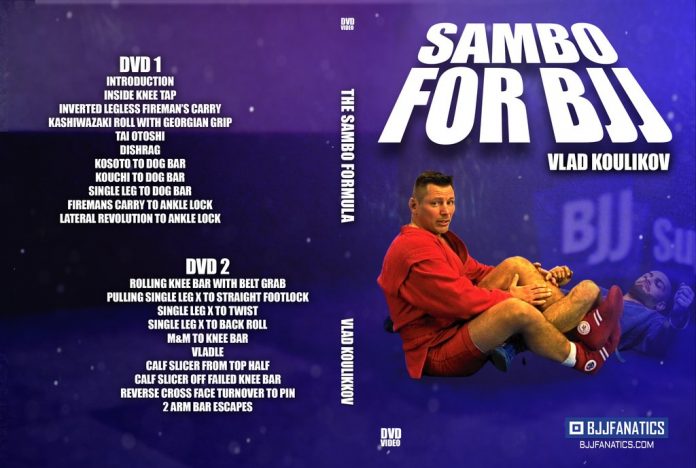
Sambo For BJJ – Vladislav Koulikov DVD Review

Vladislav Koulikov DVD Sambo For BJJ

It turns out that Japenese Jiu-Jitsu and Judo didn’t give birth to just Judo Brazilian Jiu-Jitsu. These ancient Japanese grappling styles also played a huge role in the development of another famous grappling martial art. Russian Sambo has it’s origins in Judo, just like BJJ. Also like BJJ, Sambo developed into a grappling art of its own by merging Japanese techniques with local ones. Today, Sambo is a really effective martial art that is popular worldwide. One great representative of this art is multiple times world champion Vladislav Koulikov. He is not just proficient in Sambo but a highly accomplished grappler overall. AS such, he is the perfect person to teach chosen Sambo principles that are a perfect fit for BJJ. And he has the perfect platform to do so – the Vladislav Koulikov DVD – Sambo For BJJ.

Sambo is a very distinct art that has rules of competition very different from those of BJJ. As such, not every Sambo concept is practical for jIu-Jitsu and vice versa. However, some moves, like the 4/11 and Inside Ashi positions, for example, fit BJJ perfectly. This Vladislav Koulikov DVD brings only the best of the best, taught by a Sambo expert, for the need of BJJ competitors. It is the perfect way to spice up your BJJ game and learn to think in a different grappling direction.

Sambo For BJJ

Sambo stands for self-defense without weapons in Russian. AS mentioned, the roots of Sambo are in Japanese Jiu-Jitsu and Judo, with some Soviet-style wrestling added in between. The conception of Sambo is due to the needs of the Red Army. It was designed to be the best martial art for soldiers in situations of hand to hand combat. Today, Sambo is a recognized Olympic sport that is taught across the globe.

The military application of Sambo is not one suited for sports environments, which prompted the art to further develop into several sub-styles. Nowadays, self-defense Sambo is the closest to the military version, while practitioners can also choose Combat Sambo, Freestyle Sambo, and Sport Sambo. Sambo practitioners wear a Gi jacket that is red or blue, shorts and distinct shoes. It is a very submission-oriented art that especially favors leg locks.

Vladislav Koulikov was born in Russia where he first discovered martial arts. After moving to the USA in the 90s he found a distinct lack of Sambo in the states. So he took it upon his own to spread the art of Sambo. He is a multiple times representative of the USA at the World Sambo Championship. Currently, he runs several academies in the New York area where the teaches a signature hybrid style of Sambo and BJJ. Now, the Vladislav Koulikov DVD is available to everyone in the world, bringing Vlad’s unique grappling blend to everyone.

What Is In This Vladislav Koulikov DVD Sambo For BJJ?

The Sambo For BJJ Vladislav Koulikov DVD is the perfect source of Sambo techniques that work really well for BJJ. Despite not having formal BJJ training, Koulikov spends a lot of time training wrestling and grappling after moving to the USA. He even has a few MMA bouts under his belt, making him more than qualified to know which moves are worth your time.

In terms of cross-training, it is often said that catch wrestling is the perfect art to compliment JIu-Jitsu. Well, you can think of Sambo as catch wrestling on steroids. It is all about finishing a fight in as little time as possible. This DVD is aimed first and foremost about submission artists. People that like to go for the finish are going to benefit immensely from this release. Not that every other grappler won’t learn something new, but do not expect much positional mumbo-jumbo here. What you get in this Vladislav Koulikov DVD are numerous submission options from positions that you already know. It is the perfect tool to take your submission rate in training and competition to a whole different level.

Throws And Takedowns

To begin with, you’ll learn takedowns and lots of them. However, most of these are not your usual takedowns. Due to the Gi and shorts apparel, Sambo has a very specific system of highly efficient takedowns that always end in submissions. A lot of the takedown elements are very similar to Judo, but with an added twist. This makes them perfect for BJJ, seeing as how everything in regards to the standup is borrowed from other arts. Fireman carries, Tai Otoshi, Kouchi Gari and a bunch of other takedowns are covered in-depth and linked with submissions.

True to Sambo’s style, Vlad demonstrates how to land in the perfect position for a leg lock after you execute a throw or takedown. Ankle locks and kneebars are the focus of this volume, but they’re unlike anything you’ve ever seen before. Koulikov’s details on finishing the moves clearly show why Sambo is the premier leg locking art in the world. Furthermore, he stays the course of IBJJF legal submissions, meaning that everything you learn in this DVD you can use on a daily basis.

Submissions, submissions and more submissions!

In BJJ tournaments, people often try to roll through into a kneebar. Well, this move is actually a Sambo move, known as the Victor roll. This Vladislav Koulikov DVD teaches you how to perfectly execute it as a takedown or even from the bottom. Instead of just rolling about, Koulikov outlines the perfect pointers to keep you in control during every moment of the motion.

Next, it’s leg lock galore. Koulikov explores the Single-leg X guard from a Sambo perspective, meaning with extra leg locking options. Of course, the focus is on ankle locks and kneebars, albeit form positions you never considered before. The Vlad is probably the one move you won’t be able to wait to try out. It is brutal, effective and one of Koulikovs own making, so most of your opponents won’t be expecting it. After a few calf slicers, it’s all about escapes, and how to deal with armbars. Koulikov offers a couple of high percentage armbar escapes that’ll leave your opponents confused.