For most healthy athletes, timing and intent matter more than trend-chasing.
Practical play: save cold for specific use-cases; prioritize heat post-lift; know your cardiovascular baseline.
Why “Can Cold Showers Cause Stroke” Is Trending Now
The question can cold showers cause stroke surged after a warning from a Jiu-Jitsu legend who framed icy morning showers as a hidden danger propped up by a booming wellness market.
The narrative hits a nerve: early-morning physiology naturally pushes blood pressure and sympathetic drive upward, and sudden cold can add a jolt on top. That makes for compelling social clips—but a closer look shows the scariest statistics don’t hold up to verification.
For most healthy people, can cold showers cause stroke has a more nuanced answer than a simple yes or no; the realistic risk depends on underlying cardiovascular status and how abruptly you expose yourself to cold.
“Another stroke. 38 years old. Athlete. Healthy diet. Brain destroyed like cloth.” – Renzo Gracie –
What The Evidence Actually Shows On Risk
The sensational numbers in circulation—like claims that most morning strokes happen in bathrooms or that the majority of cases involve cold showers—aren’t supported by high-quality literature.
Physiologically, sudden cold exposure can spike blood pressure and heart rate, particularly in unacclimated people. That’s a reason for caution if you’re already high-risk. But the leap from “stress response exists” to “cold showers cause widespread strokes” isn’t backed by solid population data.
The average, healthy adult asking can cold showers cause stroke, might find current reporting suggests the broad answer is “no”—while still acknowledging edge cases where abrupt cold is a poor idea.
Hot Shower After Training: When Heat Beats Cold
For athletes, the more actionable discussion isn’t fear of a morning collapse; it’s what actually helps adaptation after hard sessions.
Emerging work in strength and neuromuscular recovery points to post-training heating (e.g., a hot bath or hot shower after training) outperforming routine cold immersion when the goal is getting stronger.
Heating supports blood flow and metabolic processes that drive adaptation; chronic post-lift cooling may blunt those signals. Translation: if your priority is strength, warmth after training is a smarter default than an ice bath recovery attempt.
“Cold exposure and contrast therapy cool off your inflammatory system… But under the hood, there’s no recovery going on—actually less.” – Mike Israetel, PhD –
The Cold Exposure Debate, Without The Hype
Cold isn’t useless. For heat stress after endurance work, or to take the edge off soreness, targeted cooling can be helpful—especially 24–48 hours later.
The trap is turning a situational tool into a daily ritual and then attributing outsized recovery or brain-health benefits to it.
If you’re still wondering can cold showers cause stroke, the practical read is to respect the cardiovascular spike from abrupt cold, particularly right after waking, and to scale intensity and timing based on your risk profile and your training goals.
For lifters and grapplers chasing adaptation, keep it boring and effective: prioritize heat post-lift, hydrate, fuel, and sleep. If you enjoy deliberate cold, shift it away from the immediate post-strength window and avoid shock-style morning dunks—especially if you have blood-pressure or cardiac risk.
The wellness influencer economy thrives on extremes; your body usually thrives on gradients, intent, and context.
And to land the original question—can cold showers cause stroke—the most accurate takeaway is: not for most healthy people, but abrupt, high-intensity morning cold is a poor choice for anyone with cardiovascular red flags. Use heat to build; use cold with purpose.
The Jiu-Jitsu University Saulo Ribeiro DVD is a curriculum-style series that mirrors the famous book: each volume focuses on the most important task at a given “belt chapter,” stacking fundamentals in a logical order so you learn what to prioritize now and what can wait until later. The result is a course that feels like being mentored through a clean, no-nonsense Jiu-Jitsu education.
Old School Jiu-Jitsu Works For Everyone
What makes this series stand out is the insistence on positional clarity. Saulo teaches a hierarchy that starts with not getting finished, then safely escaping, then building reliable offense. That progression is perfect for grapplers who struggle with “what should I actually study first?”
Because the volumes align with belt-level priorities, you don’t waste time chasing techniques that don’t yet serve your game. Equally important is the emphasis on repeatable mechanics. Instead of collecting flashy moves, you learn core movements—hip escapes, posture and frames, angles for off-balancing—that scale to Gi or No-Gi.
The pedagogy shines in the Jiu-Jitsu University Saulo Ribeiro DVD: every skill serves a larger system you’ll revisit as your timing improves. If you coach, this structure makes lesson planning easier; if you’re a student, it keeps training focused and measurable.
BJJ Legend Saulo Ribeiro
Saulo Ribeiro is one of the definitive modern teachers of Jiu-Jitsu, known for a pragmatic style that trims away noise and builds athletes for longevity. Alongside his brother, he helped popularize a curriculum-based approach that places survival and escapes before offense, and he has long been associated with methodical training that transfers cleanly to competition or hobbyist goals.
He is also widely recognized for authoring “Jiu-Jitsu University,” a best-selling text that set the tone for belt-by-belt learning. With decades on the mats as an athlete and instructor, Saulo’s coaching voice in this series is seasoned, direct, and anchored in fundamentals rather than trends.
Beyond the mat, Saulo co-developed a global academy network with a curriculum that mirrors his book’s belt-by-belt progression. In practice, that means standardized fundamentals across affiliates, clear expectations for each rank, and coaches who emphasize posture, frames, balance, and pressure over fad-driven techniques.
His seminars and instructor clinics reinforce the same teaching DNA—simple language, repeatable mechanics, and a focus on skills that transfer to both hobbyist training and competition.
Detailed Jiu-Jitsu University Saulo Ribeiro DVD Review
Before diving into each volume of the Jiu-Jitsu University Saulo Ribeiro DVD, a quick note on structure: the series flows from safety to control to finishing, and each lesson assumes you’ve banked the previous one.
Treat the material like a staircase—survival skills set the floor, escapes create space, guard work builds initiative, passing establishes dominance, and submissions close. Watching in order matters; you’ll get more out of each chapter if you’ve drilled the movement patterns from the prior one for a few sessions first.
Volume 1 – White Belt
The first volume is all about staying safe under pressure and making sound decisions when a match turns bad. Expect a heavy focus on survival principles—intelligent framing, correct head-and-hip alignment, and how to buy time without gifting easy transitions.
The teaching goal is simple: if you can’t be finished, you earn the minutes needed to escape. The drills in this opening volume of the Saulo Ribeiro Jiu-Jitsu University are straightforward and designed to build composure so you stop panicking when pinned.
Volume 2 – Blue Belt
Here, the priority shifts from enduring to escaping. You learn how to turn those survival frames into real exits—shrimping pathways, elbow-knee connections, and the timing cues that separate “almost out” from actually out.
The instruction shows how to chain multiple options so you’re never betting your round on a single move. The escapes also end in stable positions—closed guard, half guard, or on top—so you transition from defense to initiative without giving up scrambles.
Volume 3 – Purple Belt
With defense stabilized, the Saulo Ribeiro Jiu-Jitsu University DVD moves to guard development. The focus is on guards you can rely on in live training, emphasizing posture disruption, grip discipline, and kuzushi that leads to sweeps or back takes rather than low-percentage attacks.
Entries are paired with maintenance details, so you don’t just get into guard—you keep it. The volume also highlights when to switch guards proactively, an underrated skill for newer belts.
Volume 4 – Brown Belt
This volume addresses passing with the same no-frills philosophy: win the upper-body battle, manage distance, split the hips, and put your opponent flat.
The instruction leans on pressure and angles instead of pure speed, which is great for consistency across Gi and No-Gi. Expect emphasis on staple sequences—breaking stubborn frames, stapling a leg line, and settling into strong pins—so your passes stick even against flexible guards.
Volume 5 – Black Belt
The final volume of the Jiu-Jitsu University Saulo Ribeiro DVD completes the arc with high-percentage finishes that dovetail with the earlier passing and control work. Rather than a grab bag of submissions, it’s a compact menu built off dominant positions.
Details prioritize control before the finish—elbow lines, shoulder placement, and bite in your grips—so your submissions feel inevitable rather than rushed. The through-line is clear: you survived, escaped, advanced, controlled, and now you close.
An Easy-To-Follow BJJ Roadmap
Treat the Jiu-Jitsu University Saulo Ribeiro DVD like a semester course, not a weekend watch. Pick a single progression—survive → escape from side control, for example—and drill it for a week. Then add the matching guard recovery or sweep as your “next step.”
That stacking approach mirrors the volumes and prevents overwhelm. If you’re a coach, align warmups with the movement patterns of the week (hip escapes, shoulder frames, angle cuts) so your students absorb mechanics before tactics.
For hobbyists, the biggest win is mental: you always know what to study next. White and early blue belts should camp in Volumes 1–2 until escaping feels automatic; purples can invest heavily in guard layers; browns can polish pressure passing; advanced players can tighten finishing details.
Because the instruction is principle-first, you’ll notice gains in both Gi and No-Gi without constantly changing your game.
In short, if you want a long-term plan rather than a random playlist, the Jiu-Jitsu University Saulo Ribeiro DVD fits perfectly:
Beginners (White/Blue): Anyone overwhelmed by options will love the belt-chapter clarity. You get a roadmap that reduces panic and speeds up retention.
Intermediate (Purple): Great for building an active, layered guard and connecting sweeps to top control.
Advanced (Brown/Black): Useful as a refinement course—pressure passing structure, control maintenance, and submission sharpness.
Coaches: A ready-made curriculum you can plug into classes week by week with minimal editing.
Pros & Potential Drawbacks
Pros:
Cohesive, belt-by-belt structure that removes guesswork.
Principle-heavy coaching that translates across Gi and No-Gi.
Strong sequencing from survival to finishes, ideal for lesson planning.
Emphasis on control and fundamentals keeps the game durable over time.
Practical drills that improve timing and composure.
Potential Drawbacks:
Concept-first pacing may feel slower if you’re chasing flashy techniques.
Advanced players seeking niche systems might find the selection intentionally conservative.
Join The Jiu-Jitsu University
This is a rare series that teaches you how to learn Jiu-Jitsu, not just what to copy. By moving from survival to escapes, guard, passing, and then submissions, the Jiu-Jitsu University Saulo Ribeiro DVD builds a clean, durable game with fewer holes.
It’s a thoughtful curriculum for students and a plug-and-play framework for coaches. While technique collectors may crave more variety, the fundamentals-first approach ages better than trends.
A BJJ student breaks police officer’s leg after confronting an off-duty Military Police sergeant he says was filming the student’s wife at a Belo Horizonte gym.
The incident occurred on Thursday night, Nov. 6, 2025, at a fitness center on Avenida Cristiano Machado, Heliópolis.
Police paperwork notes conflicting accounts; the officer denies harassment and says he was using WhatsApp. The officer suffered a fractured right femur; the 29-year-old practitioner was detained.
BJJ Student Breaks Police Officer’s Leg in Belo Horizonte
On the evening of November 6, 2025, inside a gym on Avenida Cristiano Machado in the Heliópolis neighbourhood of Belo Horizonte, tensions erupted in a shared training space.
According to official police documents, a 29-year-old Brazilian Jiu-Jitsu student confronted a 49-year-old off-duty Military Police sergeant after the student alleged the officer was photographing his wife while she performed squats in front of a mirror.
The officer reportedly claimed he was simply using his phone between sets and denied the image capture. Following verbal accusations, the situation escalated physically: the BJJ practitioner executed a takedown that resulted in the officer falling and fracturing his right femur.
“That’s what you get for messing with a jiu-jitsu grappler!” – Eyewitness account –
The officer’s daughter—who was training alongside her father—remained at the scene until paramedics arrived. Surveillance footage from the gym is now central to the investigation, and the student was detained shortly after the incident.
“Faced with the situation, the aggressor told the police officer that she was his wife… The officer reportedly apologized, claiming he didn’t know she was married.” – Itatiaia (translated) –
Conflicting Versions In Early Documents
Initial paperwork captures two competing narratives. The practitioner told officers he believed the sergeant was recording his wife and that a scuffle ensued; he also claimed the man deleted images while on the ground.
The sergeant, who was at the gym with his daughter, denied harassment and said he was simply accessing WhatsApp. Police noted the injury outcome (fractured femur) and documented the off-duty status of the sergeant.
These are preliminary accounts that often evolve as investigators gather surveillance footage and additional witness statements.
“A Jiu-Jitsu fighter was arrested after breaking the leg of a Military Police (PM) sergeant during a riot at a gym in the Northern Region of Belo Horizonte.” – Itatiaia (translated) –
“That’s What you Get for Messing With a Jiu-Jitsu Grappler”
Multiple reports converge on Heliópolis, in the North Region of Belo Horizonte, with the gym identified by vicinity as Avenida Cristiano Machado. The disturbance is recorded for the night of Nov. 6. Those datelines align across local and regional outlets that reference police sources and emergency responses tied to the address.
The officer’s injury is described in records and local coverage as a fracture of the right femur. He was taken to a nearby hospital following the incident.
The 29-year-old practitioner was detained; in at least one follow-up, authorities indicated that his detention was ratified, with transfer to a custodial facility pending further procedures.
Those steps reflect standard protocol in cases involving bodily injury and alleged disorder in a public establishment.
“He fractured the femur in his right leg and was taken to Belo Horizonte Hospital.” – Itatiaia (translated) –
Why The Framing Matters
Because the case sits at the intersection of privacy in shared fitness spaces, an alleged sexual-harassment context, and use-of-force by a trained martial artist against an off-duty police officer that resulted in a broken leg, precise language is essential.
This article uses allegedly, according to police records, and reported where appropriate, and avoids speculation about unseen footage or unannounced prosecutorial decisions.
The core, reported fact—BJJ student breaks police officer’s leg during a confrontation in a Belo Horizonte gym incident—remains the fixed point while authorities sort the rest.
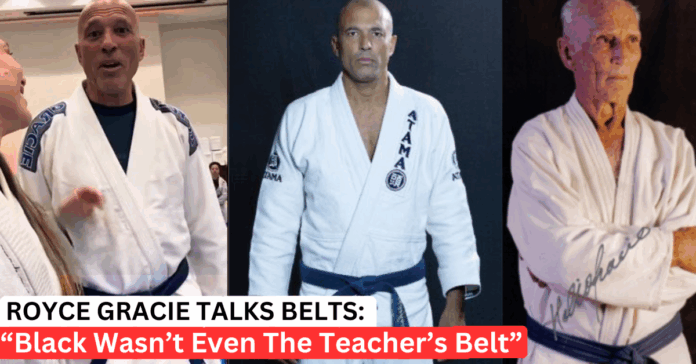
Why Royce Gracie wears a blue belt: he says dark blue signified instructors in early Gracie Jiu-Jitsu; black arrived later with federation standardization.
He refuses to wear a coral belt after Hélio’s death—he’ll accept a family promotion ceremonially, but not tie it on.
Archived community notes echo a light-blue/dark-blue instructor hierarchy long before today’s belt economy.
Why Royce Gracie Wears a Blue Bеlt Instead of Black
Ask fans why Royce Gracie wears a blue belt and you’ll trigger an argument older than most Instagram threads. By modern timelines he’s at coral rank, yet he still ties navy.
The topic flared again after fresh remarks linking his choice to a pre-standardization era—when, he says, instructors wore dark blue and students wore white—and to a vow he made after his father Hélio passed away.
The clash is irresistible: lineage vs. today’s rulebook, symbolism vs. bureaucracy.
“The original was white, light blue, and dark navy blue for the instructor… Back then, it was black-and-white photos, so it looked black, but it wasn’t a black belt; it was the dark blue belt.” – Royce Gracie –
“We Switched To Black In ’67”: The Lineage Claim
Gracie pins the turning point to the late 1960s. In his telling, a formal federation introduced the black belt into the hierarchy and phased out the navy instructor color.
That’s why, for him, why Royce Gracie wears a blue belt isn’t aesthetic—it’s archival. He’s not re-ranking himself beneath black belts; he’s faithfully wearing an earlier instructor color from his family’s system.
“Until ’67, we used the dark blue belt to teach.” – Royce Gracie –
The line rattles modern sensibilities because blue is coded as “beginner” in today’s IBJJF-inflected vocabulary. But taken literally, his claim reframes blue as an instructor designation from an older rule set—one that predates the belt ladder most of the sport grew up with.
Refusing Coral: The Personal Line He Won’t Cross
The second pillar of why Royce Gracie wears a blue belt is personal and immovable. He says every promotion he ever received came from Hélio, and after his father’s death he chose to honor that history rather than continue up the visible ranks.
He’s even said he’d accept a ceremonial family promotion—but hang the belt on the wall instead of wearing it.
“I was always promoted by my father… After he passed, I put on an old blue belt like his, navy blue with his signature, in honor.” – Royce Gracie –
To modern competitors, that sounds like willful non-compliance; to loyalists, it’s a clean line between family tradition and federation optics. Either way, it’s a rare case of a legend choosing symbolism over status.
“If my brother gave me the promotion, I’ll take it—but I’ll put it on the wall. The one I use is my father’s.” – Royce Gracie –
Instructor Blues Before Black—What The Archives Remember
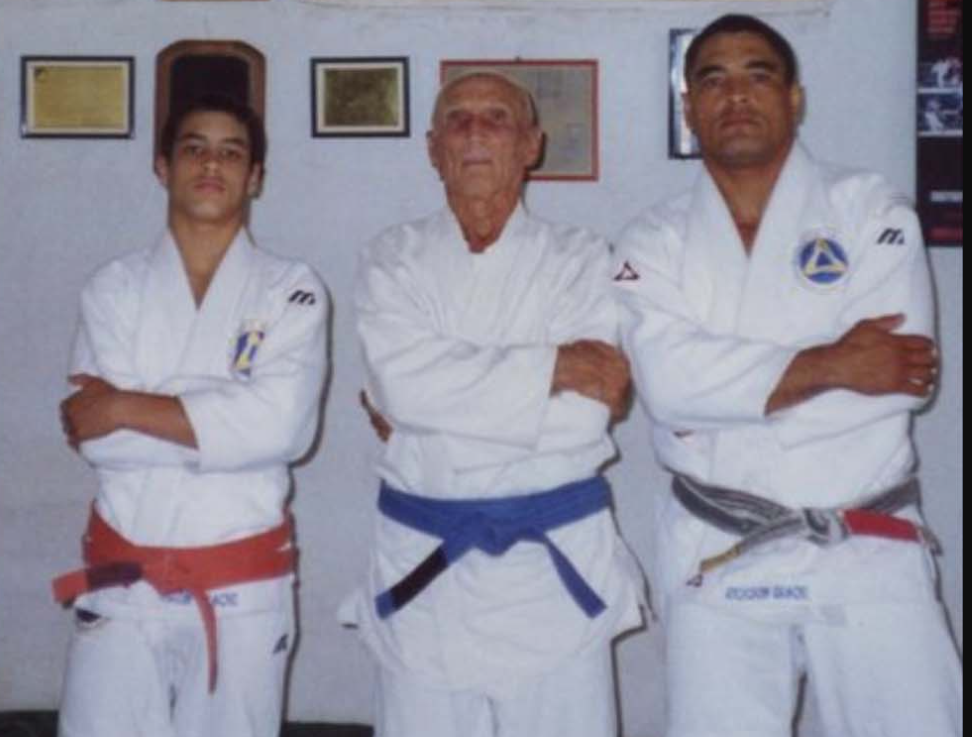
If you’ve been around long enough, you’ve seen the old blurbs and forum screenshots: white for students, light blue for instructors, dark blue for head professors at the Gracie Academy.
While not a universally adopted system across Brazil, those references explain why photos of Hélio and other pioneers often show dark belts that look black in grainy prints but weren’t.
That context is why why Royce Gracie wears a blue belt keeps boomeranging back into the feed. It’s not just a fashion choice; it’s a tug-of-war over which past the sport wants to honor.
Today’s belt structure is standardized, commercialized, and tied to time-in-grade, competition, and pedagogy. Gracie’s stance quietly pokes at all three.
When a founding figure declines to wear coral, it raises awkward questions about what belts measure: tenure, teaching, trophies—or something closer to custodianship of a style?
Gracie’s answer is written around his waist. He’s not rejecting progress so much as choosing an origin story over an org chart.
For gyms that market rank progression, that’s a messaging problem; for traditionalists, it’s a loyalty play. For everyone else, it’s a reminder that belt colors have meant different things at different times—and that the photos we rely on can mislead, especially in monochrome.
So, Why Royce Gracie Wears A Blue Belt—Really?
Strip it to the studs and you get two clear pillars:
A lineage account in which dark blue denoted instructors until a late-’60s federation pivot to black, and
A promise to honor Hélio by wearing the same navy belt he did.
Agree or disagree, that’s why Royce Gracie wears a blue belt—a history lesson tied in a knot—and that’s why the debate won’t die every time he takes a seminar photo or steps onto a mat.
The Leglocks & False Reaps Pawel Jaworski DVD lands with a refreshing aim: turn one of modern Jiu-Jitsu’s most effective entries into a consistent, competition-proof path to inside leg entanglements and finishes.
Pawel keeps the language plain and the steps repeatable, starting from the logic of off-balancing and leg isolation before he worries about breaking mechanics. If you’ve been dabbling in False Reap entries without a full system, this release connects the dots so you can attack with intent instead of hoping the position appears.
The False Reap System
At its core, the Leglocks & False Reaps Pawel Jaworski DVD is a blueprint for turning the False Reap from a one-off trick into a structured pathway.
You see the priorities early: controlling one or both of the opponent’s legs, understanding when to transition from seated to supine, and recognizing how entries from Reverse De La Riva, half-butterfly, and standing all funnel to the same entanglement goals.
This makes the project more than a technique dump; it’s a teachable flow that scales from drilling to live rounds. As a Pawel Jaworski DVD Review, the standouts are clarity and order—each scenario solves a predictable problem, then shows its next branch.
The result is a system you can practice as modular chunks or as a complete sequence, which is exactly what you want when building leg lock offense responsibly.
Polish Leg Lock Specialist Pawel Jaworski
Pawel Jaworski is one of the brightest young leg-lockers in Europe, with a competitive résumé that already includes double-gold runs at major IBJJF events and a 2025 ADCC European Trials victory.
His social channels and Patreon show a steady cadence of training footage, breakdowns, and seminar clips, which mirrors the coaching-first tone of this instructional. You’re getting a competitor who actively shares the “why” behind his positions rather than only highlight-reel finishes.
In 2025, Jaworski’s No-Gi success accelerated, with double gold at the European No-Gi Championships joining earlier medal runs and high-level appearances. The instructional’s focus reflects that rise: a controlled, patient approach to inside leg entanglements that travels well from training to tournaments.
If you follow his updates, you’ll recognize the same emphasis on safe application, incremental control, and repeatable sequences. That makes the Leglocks & False Reaps Pawel Jaworski DVD feel current to the present meta while staying coachable for day-to-day classes.
Detailed Leglocks & False Reaps Pawel Jaworski DVD Review
Before diving into the chapters of the Pawel Jaworski False Reaps DVD, here’s how the series is organized and best used. Each volume builds on the last: you enter and stabilize first, convert to reliable control, then pressure-test the sequences against live reactions.
Watch with a notebook—flag your preferred entry, your go-to control, and one finish you’ll drill this week. That way, the material turns into a repeatable training loop instead of a one-time watch.
Volume 1 — False Reap Concepts
The first volume lays the foundation: what the False Reap is, how to enter it from common guards, and how to keep control long enough to build offense. Pawel opens with an overview and Reverse De La Riva-to-false reap pathway, then refines entry and positioning so your knees and hips do the heavy lifting.
Two critical concept chapters follow—controlling both legs versus controlling one leg—which explain when you should prioritize pinning both limbs and when isolating the target side is enough. From there, he covers standing entries, half-butterfly to false reap, a flexibility-friendly entry, and a practical segment on dealing with smashing (the classic counter to leg entries).
Short scenario chapters round out the disc—split-squat entry, seated-to-supine transitions, seated guard to false reap, plus pathways from X-guard, headquarters, and front headlock. The thread tying it all together is consistency: every entry lands you in familiar control points, which is why this part of the Leglocks & False Reaps Pawel Jaworski DVD is so easy to drill.
Volume 2 — All About Senkaku
Volume 2 shifts to finishing mechanics, especially from sankaku and double trouble. Pawel details the transition from double trouble to sankaku with the leg isolated, then walks through the inside heel hook and outside heel hook finishes from that control.
The highlight is his careful sequencing: stabilize first, then connect your grips and hips before applying rotational force. He also introduces the Z-lock both as a direct option from sankaku and as a follow-up from double trouble, including a second isolation method that gives you another road into the same finish.
The emphasis remains on safety and predictability—valuable for rooms that want advanced leg locks without chaos. As a middle chapter of the Leglocks & False Reaps Pawel Jaworski DVD, it’s the “power conversion” segment: entries become points of control, points of control become high-percentage submissions.
Volume 3 — Entries 7 Setups
The last volume circles back to live-sparring moments and troubleshooting. Pawel uses a knee-to-knee off-balance to create clean entries, counters a half-butterfly guillotine by re-entering the false reap, and shows sankaku control with a single leg isolated after your initial bite.
There’s a set of open-guard and flexible-entry variations, a return to half-butterfly with a guillotine counter, and a split-squat entry with early second-leg control that preempts defenses. The K-guard/False Reap dilemma is a nice touch for players who already thread K-guard into their game, and a Z-lock from double trouble ties the submission tree back to Volume 2.
As a capstone of the Leglocks & False Reaps Pawel Jaworski DVD, this volume feels like the “live look”—the same decisions you’ll face when partners change posture, frames, or tempo mid-roll.
More Than Just A Leg Locking Position
For day-one integration, build a three-stage drill:
Choose one entry (half-butterfly or Reverse De La Riva) and walk through the grips and hip angles;
Freeze at control checkpoints—both-legs pinned vs one-leg isolated—and correct details;
Finish only after two seconds of stability.
This ensures your control habits survive into harder rounds. Pair that with a reaction tree: when the opponent smashes, you have a reset; when they retract the knee line, you chase knee-to-knee off-balances; when they stand, you redirect to the standing entry.
For No-Gi rounds, use the off-balance concepts to force predictable posts, then either sit them into entanglement or convert their reactions into body-lock entries later in the session. This cross-pollination makes the Leglocks & False Reaps Pawel Jaworski DVD useful beyond pure leg-lock hunting.
Blue belts and up will get the most immediate value—especially No-Gi athletes who already know the terms (sankaku, double trouble, Z-lock) and want a safer, more controllable pathway into them. Advanced hobbyists benefit from the consistency of the entries, while active competitors will appreciate the troubleshooting in Volume 3.
Coaches can extract an eight-to-twelve-week mini-curriculum with a weekly entry focus and finish checkpoints. If your room wants a modern leg-lock roadmap without gimmicks, the Leglocks & False Reaps Pawel Jaworski DVD hits the brief—and for cataloging, yes, this is the Pawel Jaworski MILF BJJ DVD by title.
Pros & Potential Drawbacks
Pros:
Systemic progression from entries → control → finishes.
Multiple entry families that all land in repeatable checkpoints.
Clear finishing mechanics with safety cues and sequencing.
Troubleshooting for common defensive reactions and smash attempts.
Coach-friendly structure that converts directly into lesson plans.
Potential Drawbacks:
Beginners may need extra fundamentals before the details “click”.
Heavy focus on False Reap pathways means less time on alternative leg entries.
If your gym limits heel hooks, you’ll need to tailor finishing portions.
Learn to MILF!
With strong conceptual scaffolding and practical scenario work, the Leglocks & False Reaps Pawel Jaworski DVD delivers a coherent roadmap for modern inside-leg attacks:
Volume 1 gets you reliably into the position.
Volume 2 locks in finishing mechanics.
Volume 3 prepares you for messy, real-time resistance.
Minor limitations aside, the clarity and transferability to live rounds justify the score. Final verdict: 8.5/10—a timely resource for intermediate/advanced No-Gi players and coaches, and a smart pick if you’ve been searching for a Pawel Jaworski False Reaps DVD that treats the false reap as a full system rather than a one-off trick.
Ari Emanuel on UFC robot fights started with an on-air tease about staging a card using Elon Musk’s humanoid robots.
The idea slots into Emanuel’s bigger thesis: live, communal spectacles will matter more as AI expands leisure time.
The quote everyone shared is real; additional context from the same conversation points to a strategic, not throwaway, thought experiment.
Sanctioning and brand fit are unresolved—but the signal is clear: Endeavor/TKO is probing the edges of what counts as “combat sports” TV.
A Line That Lit Up Fight X
The headline moment came during an All-In appearance, when the agency mogul recounted visiting Elon Musk’s robotics operation and floated a card built around humanoids in the Octagon.
The phrasing was unambiguous and quotable enough to bounce across MMA feeds within minutes, turning Ari Emanuel on UFC robot fights into a meme and a business story at once.
“I went up to see the robots because I want to do a UFC fight with his robots… The man’s a genius.” – Ari Emanuel –
In the same riff, Emanuel described robots performing kicks and punches with dexterity, and relayed the pitch-deck math that makes robotics compelling to investors: units that can run around the clock at very low marginal cost, scaling toward mass production.
In other words, the clip wasn’t just a gag—it was a window into how the entertainment boss processes “what’s next.”
From Viral Clip To Strategic Context
Take a half-step back and the story becomes broader than one zinger. Emanuel has been pounding a consistent drum: as AI compresses work and creates more free time, demand for communal, high-intensity live events will spike.
That economic framing—more leisure hours, more appetite for IRL spectacle—has underpinned recent deal-making and public comments across interviews and conference stages.
In that light, Ari Emanuel on UFC robot fights reads as a speculative pilot for the “live beats the algorithm” thesis: if people crave novel, sharable experiences, then robots trading blows in a legendary combat-sports brand’s house could be a front-page stress test for audience appetite.
“I saw what he’s creating… I want to do a UFC fight with his robots.” – Ari Emanuel –
Why Robots—And Why The UFC Label?
There are two overlapping rationales. First, novelty: robot combat checks every box for viral clip culture—visual immediacy, meme-ability, and family-room curiosity.
Second, brand gravity: attaching the concept to the UFC—rather than launching an unproven robotics-league from scratch—borrows trust, distribution, and global awareness.
That’s the business judo in Ari Emanuel on UFC robot fights: test a moon-shot concept under a heavyweight banner with built-in broadcast partners, shoulder programming, and shoulder content.
At the same time, that UFC badge is the constraint. The promotion’s identity is built on sanctioned, athlete-first combat.
Swapping humans for machines invites obvious questions: Who writes the ruleset? What’s a “foul” for a robot? How do you sell “fights” without confusing or diluting the core product? These aren’t disqualifiers—they’re the operational checklists that would convert a podcast tease into a pilot.
Could it Really Happen?
If this ever moves from banter to a deck, the most plausible route is adjacency, not replacement.
Imagine a special presentation inside a UFC week—an arena demo or a standalone “showcase” with its own graphics, officials, and commentators—rather than a title-fight main event.
A bespoke ruleset could govern power thresholds, knockdown criteria, and stoppages, while the production leans into engineering theater (think weigh-ins for machines, stats packages for servo torque, backstage tech cams).
That preserves the UFC’s human-competition brand while letting Endeavor/TKO test audience reaction in a low-risk container. For Ari Emanuel on UFC robot fights, that’s the path of least resistance: a pilot that looks and sounds like UFC without being canon.
Beyond novelty, consider the macro pitch Emanuel keeps making: AI expands leisure time (three- or four-day workweeks), and winners will be those who program must-see live experiences across sports, art, and mega-events.
He’s already reorganizing assets and capital around that worldview. If you buy the premise, then experimenting at the bleeding edge of live spectacle—yes, even with robots—fits the portfolio logic.
The audience gets something truly new; partners get a buzzy tentpole with global clip mileage; the company gets data on what next-gen spectacle can convert.
If Not Now, When?
Even if robots never set foot on a UFC canvas, the tease did its job: it made clear where the company’s imagination points. It keeps Endeavor/TKO at the center of the “future of live” conversation, seeds curiosity with networks and brands, and tests the temperature of the fan base.
As a media tactic, Ari Emanuel on UFC robot fights is both a litmus test and a lighthouse—gauging appetite while signaling dominance over the what-ifs of sports entertainment.
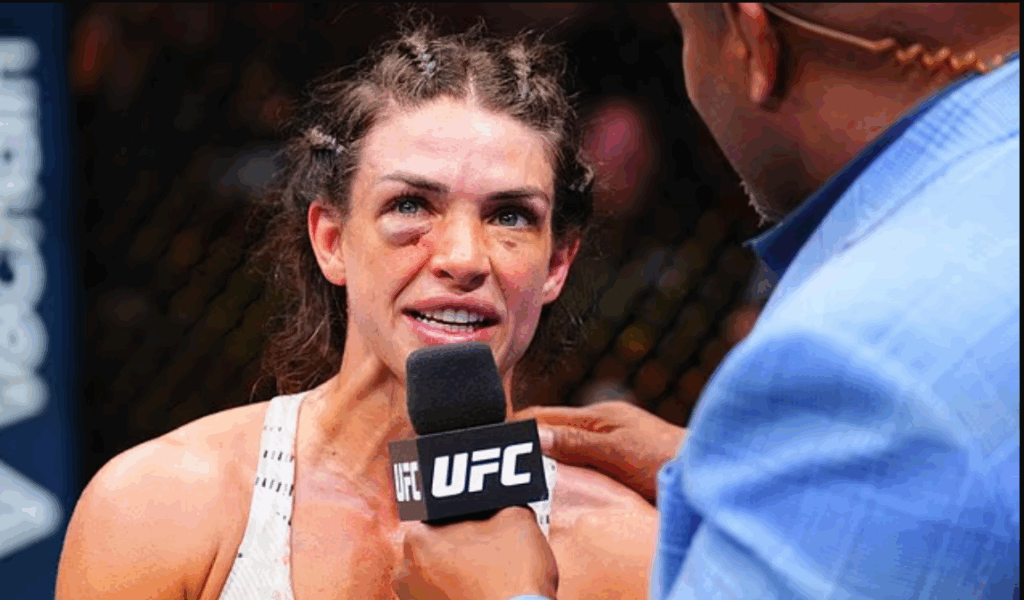
Mackenzie Dern memory problems became a flashpoint after she spoke about recall and cognition changes she attributes to years of head strikes.
A two-year cohort study of MMA athletes reports significant declines in executive functions (processing speed, inhibitory control, cognitive flexibility) and memory among frequent sparrers.
Community reaction amplified the story, while long-form reporting on head trauma has tracked brain-health concerns in combat sports for years.
The evidence base is growing but uneven: strong signals on executive function and processing speed; CTE remains a post-mortem diagnosis, not a clinical label for active fighters.
Mackenzie Dern Memory Problems
The phrase Mackenzie Dern memory problems didn’t trend by accident. In a widely shared interview, the UFC strawweight champion spoke with unusual candor about how repeated head impacts have affected her everyday cognition.
Her comments punctured the sport’s usual euphemisms about “damage,” surfacing a lived experience that many fighters and coaches discuss privately but rarely put on the record.
“I believe my memory has changed quite a bit from taking so many punches to the head… I feel a big difference… Just basic things like that — memory, recollection.” – Mackenzie Dern
Dern also framed how that reality shapes family decisions and career horizon, adding layers to a conversation that often stays abstract.
The admission found instant traction across grappling forums and MMA subreddits, where fans, hobbyists, and professionals debated what her words should mean for the sport’s culture and expectations.
What Longitudinal Research Actually Measures In Fighters
Beyond anecdotes, a recent two-year cohort study in the International Journal of Environmental Research and Public Health tracked competitive MMA athletes (n=26) versus recreational practitioners (n=26).
The authors reported a significant time-by-group interaction: the competitive group experienced progressively worse performance on multiple executive-function domains—mental processing speed, inhibitory control, cognitive flexibility—as well as memory measures across annual retesting.
“The CG experienced greater declines in Mental Processing Speed… Inhibitory control also declined… Cognitive flexibility showed a pronounced reduction… Automatic and controlled processes, as well as direct and indirect memory, also showed significant impairments in CG.” – de Brito et al., 2025 (two-year cohort study) –
Those domains may sound academic, but they map to fight-night realities: processing cues under pressure, switching tactics mid-exchange, inhibiting an impulsive counter, or recalling instructions across rounds.
For readers following Mackenzie Dern memory problems, that lab signal helps explain why fighters often describe “feeling a step slower” or struggling with recall during high stress.
Lived Experience Meets An Emerging Evidence Base
The Mackenzie Dern memory problems clip sits within a broader timeline of reporting and research that has steadily illuminated the risks of repetitive head impacts.
Long-form sports journalism has documented the rise of brain-health anxiety among MMA athletes, while survey work and cohort studies have filled in the chalk outlines with data on processing speed deficits, sub-concussive load, and structural brain changes reported in fighters compared to controls.
A key nuance for the audience: the most alarming diagnosis in public discourse—CTE—is a neuropathological label confirmed post-mortem. Researchers and clinicians caution against flattening every memory lapse or mood change into a CTE narrative.
Yet the repeated finding across fighter cohorts—that heavy sparring and frequent head impacts correlate with measurable cognitive declines over time—anchors the public worry in something more substantial than rumor.
That tension is exactly why Mackenzie Dern memory problems resonated beyond a single news cycle.
What Dern Said—And Why It Matters In Plain Language
In her interview, Dern didn’t reach for medical jargon. She described daily-life changes and a felt sense that “basic things” were harder to recall than before—language that reads as ordinary but is striking when spoken by an active champion.
“Now, MMA — it’s not for sensitive people… it’s very physically demanding… I don’t see myself competing like this for many more years.” – Mackenzie Dern –
Those statements do two things. First, they validate what many veterans have voiced quietly: the accumulation of impacts—not only highlight-reel knockouts—can shape cognition in ways that show up outside the gym.
Second, they complicate the sport’s incentive structure. When a champion says the quiet part out loud, it forces promoters, gyms, and fans to confront the human cost embedded in the spectacle.
A Closer Look At The Numbers (Without Hype)
The two-year cohort identified statistically significant declines in the competitive group at both the one-year and two-year marks, with reported drops in processing speed measured in seconds and executive-function indices reported in arbitrary units.
The authors’ conclusion is direct:
“These findings highlight the detrimental effects of MMA competitions on cognitive function, emphasizing the need for monitoring and interventions to preserve fighters’ health and performance.” – de Brito et al., 2025 –
Methodologically, the comparison with a recreational group matters: it addresses the common pushback that “everyone gets older,” isolating the role of repetitive head strikes and frequent sparring/competition as the drivers of decline beyond age alone.
That mirrors the broader literature that has linked fighters’ histories with slower processing speed and structural differences (e.g., smaller thalamic volumes) compared with non-fighters, lending convergent validity to the pattern reported here.
The Conversation Isn’t New—But The Messenger Is
Fighter brain health has been scrutinized for years; what’s different here is the messenger. When a reigning champion speaks plainly about memory and cognition, the story escapes niche research circles and lands in front of fans who might otherwise scroll past methodological debates.
That visibility explains why Mackenzie Dern memory problems became a banner for a conversation that researchers, ringside physicians, and a subset of coaches have been trying to sustain.
The White Monster Method Declan Moody DVD frames a very specific promise: win exchanges from the top by forcing opponents to carry your weight, then pass as their frames fail.
Across two volumes, the instruction focuses on north–south style pressure, intelligent hand fighting, and a small menu of passes that repeat reliably under resistance. If you prefer systems you can drill Monday and score with on Friday night rolls, this one aims right at that lane.
The production is straightforward, the teaching voice is calm, and the examples are timed to show why each micro-adjustment matters when the bottom player inverts, high-legs, or tries to scissor back to guard.
Pressure Passing to North South
This program is essentially a blueprint for building a pressure identity: shut down the inside knee, deny inside position, and turn guard retention into your opponent’s cardio problem.
The first volume lays out the scaffolding—home base, elbow-inside frames, the bicep ride—and then rotates through knee cuts, leg drags, stacks, and opportunistic back takes.
The second volume switches to rolling breakdowns, where the same concepts repeat under more chaotic conditions. As a White Monster Method Declan Moody DVD review subject, it succeeds by trimming fat: there’s no sprawling encyclopedia, just a few passes that branch depending on the bottom player’s reactions.
That clarity makes it easy to remember, teach, and plug into live training. You won’t find flashy lapel traps or sprawling open-guard trees; the currency here is pressure and patience, paid out over minutes rather than moments.
Declan Moody – A Big Problem for Light-Heavyweighs
Declan Moody is an Australian Jiu-Jitsu competitor who has made his name with a grinding top game and recent elite results. He has trained in Australia and moved to Austin to sharpen his No-Gi focus, spending time with high-level rooms while competing frequently.
In 2025 he captured the WNO Open-Weight Grand Prix title, a marquee achievement that underlines the effectiveness of a measured, pressure-based approach against athletes known for pace and guard retention. Earlier highlights include winning the ADCC Asian–Oceania Trials, which put him on the global map.
That competitive résumé explains the tone of this White Monster Method Declan Moody DVD: deliberate, systematic, and built for long rounds where patience compounds and small advantages become passes.
Complete White Monster Method Declan Moody DVD Review
Before diving into each volume of the The Declan Moody White Monster Method DVD, it helps to set expectations. The structure is intentionally compact: establish north–south style control, win the inside hand and knee battles, and cycle a handful of passes that appear in every round.
Instead of a huge menu, the instruction returns to the same checkpoints, so the system is memorable under fatigue and easy to drill in short sessions.
Volume 1 — The North-South Passing Playbook
The first volume is where the “white monster” personality shows up: calm, heavy, and relentlessly positional. After a short orientation and an explanation of why north–south passing converts fatigue into progress, the curriculum establishes “Homebase Position” and the elbow inside system to begin prying open guard structures.
The biceps ride connects those ideas to hand-fight control, before moving into the meat of the system: the Hip Crossfade stands out from the ton of chapters here.
From there, the DVD turns into reaction answers. If the inside knee sneaks back in, there are clear steps for stopping the inside knee position. When legs pummel high, you can use the scoop grip and head back and around the high leg.
If distance opens, you “throw legs” to re-take inside position, then alternate between a a cool stacking leg drag and a flying leg drag to force the hips flat. Moments that might stall in other systems are converted into momentum with escalations like force stacking to bodylocks and back control.
Importantly, there’s a pocket of quick counters to deal with Choi Bars and late-stage passes. Finishing routes come from control, not surprise: Knee Wedge Back Take and Crab Ride Back Take cap sequences that started with weight and wrist fighting.
Volume 1 of the White Monster Method Declan Moody DVD nails the promise of a small, repeatable decision tree: inside position, deny frames, pass or take the back.
Volume 2 — Rolling Commentary & Analysis
Volume 2 pivots to live-feel breakdowns—rounds against multiple partners with different body types and reactions. You see how the same entries reappear after scrambles: north–south control resets, elbow-inside swims, then the knee cut or stacking leg drag as soon as the bottom player’s frames drift.
The analysis highlights where patience replaces speed. For example, instead of chasing loose torreandos, the instruction shows how a composed hip block and brief head position win the angle that makes the knee cut or leg drag automatic.
When inverts appear, the earlier high-leg defenses re-surface to funnel the hips back under the passer. This second part of the White Monster Method Declan Moody DVD adds confidence—watching identical beats happen in different rounds teaches timing better than a second list of isolated techniques.
Why You Should Always Pass Directly to North South
North–south is a universal stabilizer for pressure passing: it flips wild scrambles into predictable frames, hides your legs from guard recoveries, and gives you safe angles to re-attack the torso without conceding underhooks.
Build a habit of pausing there for a breath—settle your weight through the ribcage, walk the hips to face the legs, and re-win inside hands before choosing knee cut, stack, or leg drag. In live rounds, this “reset to north–south” rhythm lets you pace the match and force the bottom player to spend energy first.
When using this DVD, start by drilling the setup triad—home base, elbow-inside, bicep ride—for two minutes each, switching on a timer.
Then add the “branch pairs”: knee cut ↔ late-stage knee cut, throw-legs ↔ stacking leg drag, and force-stack ↔ body lock.
In positional sparring, begin from your training partner’s frames and make “inside position” the only goal for 30 seconds, resetting when you lose it. After a week, add the back-take triggers (knee wedge, crab ride) whenever the hips turn.
The White Monster Method Declan Moody DVD curriculum should serve you more like a circuit rather than a checklist—rotate through the same few branches every round so the pathways become reflex, not recall.
If you’re a white or blue belt struggling to hold people down long enough to mount offense, this material shows exactly how to make someone carry your weight and stop re-guarding. Purple and brown belts who like to slow the room down will appreciate how the system wins on efficiency, not explosiveness.
Competitors who draw guard players will find the north–south entries pair well with wrestling shots that stall in half guard. Gi specialists can still borrow the structure, but the grips and pacing are clearly tailored to No-Gi.
For those hunting for a White Monster Method Declan Moody DVD review that translates quickly to open mats, this one checks the box—especially if you enjoy “boring to them, fun to you” rounds where pressure does the talking.
Pros & Potential Drawbacks
Pros:
Tight, recyclable decision tree that keeps you in control from first contact.
Clear solutions to common roadblocks: inside knee pummels, high-leg inversions, sticky frames.
Live rounds in Volume 2 reinforce timing and show the method under fatigue.
Back-take integrations (knee wedge, crab ride) reward persistent pressure rather than bursty scrambles.
Coaching tone is calm and precise, with minimal fluff and strong positional language.
Easy to drill in small spaces; perfect for short, focused sessions.
Potential Drawbacks:
Bottom and transitional layers (e.g., re-guarding strategies or guard-pull counters) aren’t a major focus.
Primarily No-Gi oriented; Gi players may need to translate grips.
If you prefer dynamic, movement-heavy passing trees, the pace may feel conservative.
Monster Passing Unlocked
The White Monster Method Declan Moody DVD is a compact, repeatable system that teaches you to make opponents work harder than you do. Volume 1 provides the skeleton—home base, elbow-inside, bicep ride, and a few passes that branch logically—while Volume 2 proves the ideas survive chaos.
It won’t turn you into a whirlwind passer, and it doesn’t try to; instead, it gives you a way to grind, pin, and pick your moment. For top-oriented players from white to brown belt, the value is clear, and the rating reflects how well the method does what it says on the tin.
Dana White says the UFC met twice with the FBI after integrity partner IC360 flagged suspicious betting on Isaac Dulgarian vs. Yadier Del Valle—triggering the UFC fight fixing scandal FBI probe narrative.
Sportsbooks froze markets and later refunded Dulgarian backers after a first-round RNC loss at UFC Vegas; Dulgarian has since been released by the UFC.
White: “It definitely doesn’t look good” for Dulgarian, while stressing there’s no proof—yet. Commissions and integrity monitors are still digging.
The Federal Call
The story moved at whiplash speed. Hours before the fight, IC360—the UFC’s betting integrity watchdog—flagged unusual action as money flooded toward underdog Yadier Del Valle, especially on an early finish.
Markets reacted: some books halted certain props or trimmed exposure. The fight went ahead; Del Valle won by first-round rear-naked choke. Within a news cycle, we had the full arc of a modern gambling scandal: frozen markets, refunds, internal calls—and an FBI escalation that put the UFC fight fixing scandal squarely on front pages.
“We met with the FBI… it definitely doesn’t look good [for Isaac Dulgarian].” – Dana White –
White confirmed that the UFC looped in the FBI immediately after IC360’s alert and that he’d spoken to Dulgarian before the bout—Dulgarian denied any wrongdoing. A
fter the first-round loss, White said Dulgarian was released from the roster, and Nevada regulators could withhold his purse pending review.
The language was blunt enough to set the tone of the week: even while repeating that investigators lack conclusive proof, White’s verdict on optics—“doesn’t look good”—poured gasoline on the UFC fight fixing scandal.
“I’m not saying he’s guilty… there’s no proof he’s done this yet, but… it doesn’t look good.” – Dana White –
Refunds, Red Flags, And A Fighter Cut – The UFC Fight Fixing Scandal
As the clip of the finish bounced around fight media, Caesars and other books told customers they’d refund Dulgarian straight bets—an extraordinary move that underscored how far beyond “odd result” this felt to risk teams.
Add in a dramatic line swing toward an underdog by early stoppage, and you get the exact profile that integrity firms are built to detect.
When the UFC then cut Dulgarian and confirmed multiple FBI touches, the UFC fight fixing scandal stopped being a rumor and became the week’s lead.
“Several sportsbooks… said they would refund bets that users placed on Dulgarian to win.” – Reportage on operator actions –
Promoters and integrity voices have warned this was coming. MMA’s economics—individual athletes, uneven pay scales, and prop-heavy markets (rounds, methods, quick finishes)—create attack surfaces that are harder to police than team sports.
That’s why a veteran exec called the current uproar “inevitable,” a system error baked into the way MMA schedules fighters and sells its lines. The fix isn’t one press release; it’s a tighter mesh: real-time alerts, locker-room access rules, betting blackouts for insiders, steeper penalties, and clear commission coordination the moment suspicious UFC betting pings.
“There’s a fine line between match fixing and matchmaking… this talk was inevitable due to the sport’s ‘system error.’” – Promotion executive assessment –
“No Proof—Yet”
Expect the apparatus to move quickly. IC360 will widen its scrape windows; state commissions can withhold purses and data-share with the FBI; the UFC will likely harden back-of-house protocols (who’s in the room, who uses phones, who places wagers) and throttle access for any camp on investigators’ radar.
If the probe escalates—from interviews to subpoenas to charges—the UFC fight fixing scandal FBI probe will morph from optics crisis into case law, with ripple effects on books and broadcast partners.
Until then, three things remain true: no proof has been made public, refunds signal serious concern from sportsbooks, and the UFC just sent the loudest internal message it can—a roster cut before the investigation is over.
The most infamous Rafiel Torre fake BJJ black belt saga is back in the headlines after a rare on-camera prison interview.
Torre denies a long-told Eddie Bravo confrontation story while the old fabrications (phony BJJ lineage, imaginary 14-0 MMA record, fake SEAL past) and the murder that put him away get re-litigated.
The tape reopens wounds from early MMA: loose credentials, staged optics, and a con that ended with a life sentence.
The Boast, The Belt, The Lie
Before “belt mills” were a meme, there was one man gaming the chaos of early MMA.
He arrived as a supposed Brazilian jiu-jitsu black belt, claimed an “undefeated” record and elite military pedigree, then surfed that invented aura into real opportunities—up to and including a slot at ADCC.
That is the core of the Rafiel Torre fake BJJ black belt story: the room believed the costume long enough for the ruse to meet reality. When it did, the unraveling was public—and fast.
“That guy’s not a black belt… it was like barely it was like a white belt.” – Joe Rogan, recounting Eddie Bravo’s assessment –
From there, everything Torre said seemed to boomerang back with receipts. The ADCC cameo ended in seconds; the posturing collapsed; the community compared notes. The Rafiel Torre fake BJJ black belt label stuck—and it still sticks because of what came next.
From Fakery To Felony
The combustible part of this saga isn’t just the BJJ rank fraud; it’s the crime that followed. After his exposure, Torre’s off-mat life spiraled into what prosecutors would later frame as a murder plot tied to an affair and a life-insurance payout.
He first tried to recruit a former UFC fighter to do the job; when that failed, he lured the victim to a gym and killed him with a rear-naked choke. A jury gave him life without parole.
That’s why the Rafiel Torre fake BJJ black belt mythos isn’t just a cautionary tale—it’s true crime.
Two decades later, the man at the center of it all has reappeared from a California prison with a fresh denial of one of the saga’s most retold chapters: the Eddie Bravo confrontation.
For years, the lore said Bravo confronted him and exposed the rank; in his new account, Torre pushes back—hard.
“Look, I think Eddie is one of the most amazing genius minds in the world, but that conversation never happened… I was not a good person, I did a lot of bad things, but that conversation never happened.” – Rafiel Torre –
The denial doesn’t erase other documented beats—an ADCC collapse, a fixed-fight controversy, a life sentence for murder—but it does sharpen one question: how much of the legend around the Rafiel Torre fake BJJ black belt saga is precise history, and how much is telephone-game embellishment layered onto a verified fraud?
Why The Story Still Bites In 2025
Every generation of BJJ gets its credential scandals. This one still cuts deeper because it proved, in the ugliest way, why lineages and verifications exist.
Torre’s rise glided on trust: event badges, lobby introductions, confident claims. His fall weaponized that same trust—first by rigging optics, then by committing a homicide in a place the community treats as a sanctuary.
That’s why coaches hammer provenance today: rank signals safety as much as skill.
If there’s any constructive use for a resurfaced Rafiel Torre fake BJJ black belt cycle, it’s this: receipts over rumors. Gyms should publish instructor lineages and promotion criteria.
Students should validate claims the way they validate techniques—under pressure. And media should separate the documented from the dramatic, even when the dramatic is tempting.
The new interview complicates the legend without rewriting it. Torre can deny a phone call; he can’t step around the paper trail and the verdict. What he can do—what the community can do—is force a higher bar for proof.
The original sin of the Rafiel Torre fake BJJ black belt era wasn’t one man’s audacity; it was a scene that mistook charisma for credentials. Fix that, and the next con has a shorter runway.