









- Mackenzie Dern memory problems became a flashpoint after she spoke about recall and cognition changes she attributes to years of head strikes.
- A two-year cohort study of MMA athletes reports significant declines in executive functions (processing speed, inhibitory control, cognitive flexibility) and memory among frequent sparrers.
- Community reaction amplified the story, while long-form reporting on head trauma has tracked brain-health concerns in combat sports for years.
- The evidence base is growing but uneven: strong signals on executive function and processing speed; CTE remains a post-mortem diagnosis, not a clinical label for active fighters.
Mackenzie Dern Memory Problems
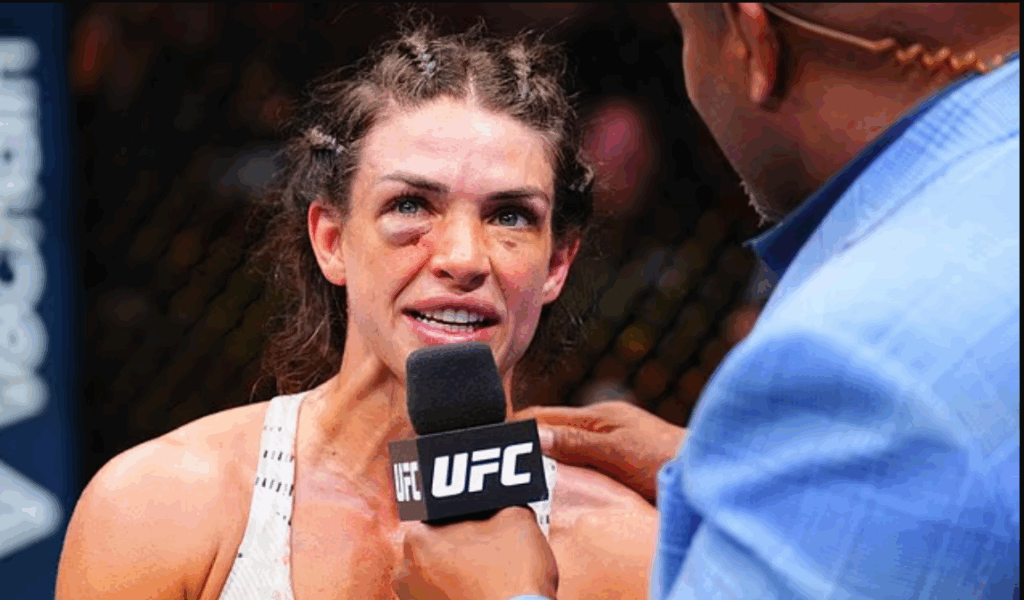
The phrase Mackenzie Dern memory problems didn’t trend by accident. In a widely shared interview, the UFC strawweight champion spoke with unusual candor about how repeated head impacts have affected her everyday cognition.
Her comments punctured the sport’s usual euphemisms about “damage,” surfacing a lived experience that many fighters and coaches discuss privately but rarely put on the record.
“I believe my memory has changed quite a bit from taking so many punches to the head… I feel a big difference… Just basic things like that — memory, recollection.”
– Mackenzie Dern
Dern also framed how that reality shapes family decisions and career horizon, adding layers to a conversation that often stays abstract.
The admission found instant traction across grappling forums and MMA subreddits, where fans, hobbyists, and professionals debated what her words should mean for the sport’s culture and expectations.

What Longitudinal Research Actually Measures In Fighters
Beyond anecdotes, a recent two-year cohort study in the International Journal of Environmental Research and Public Health tracked competitive MMA athletes (n=26) versus recreational practitioners (n=26).
The authors reported a significant time-by-group interaction: the competitive group experienced progressively worse performance on multiple executive-function domains—mental processing speed, inhibitory control, cognitive flexibility—as well as memory measures across annual retesting.
“The CG experienced greater declines in Mental Processing Speed… Inhibitory control also declined… Cognitive flexibility showed a pronounced reduction… Automatic and controlled processes, as well as direct and indirect memory, also showed significant impairments in CG.”
– de Brito et al., 2025 (two-year cohort study) –
Those domains may sound academic, but they map to fight-night realities: processing cues under pressure, switching tactics mid-exchange, inhibiting an impulsive counter, or recalling instructions across rounds.

For readers following Mackenzie Dern memory problems, that lab signal helps explain why fighters often describe “feeling a step slower” or struggling with recall during high stress.
Lived Experience Meets An Emerging Evidence Base
The Mackenzie Dern memory problems clip sits within a broader timeline of reporting and research that has steadily illuminated the risks of repetitive head impacts.
Long-form sports journalism has documented the rise of brain-health anxiety among MMA athletes, while survey work and cohort studies have filled in the chalk outlines with data on processing speed deficits, sub-concussive load, and structural brain changes reported in fighters compared to controls.
A key nuance for the audience: the most alarming diagnosis in public discourse—CTE—is a neuropathological label confirmed post-mortem. Researchers and clinicians caution against flattening every memory lapse or mood change into a CTE narrative.
Yet the repeated finding across fighter cohorts—that heavy sparring and frequent head impacts correlate with measurable cognitive declines over time—anchors the public worry in something more substantial than rumor.
That tension is exactly why Mackenzie Dern memory problems resonated beyond a single news cycle.
What Dern Said—And Why It Matters In Plain Language
In her interview, Dern didn’t reach for medical jargon. She described daily-life changes and a felt sense that “basic things” were harder to recall than before—language that reads as ordinary but is striking when spoken by an active champion.
“Now, MMA — it’s not for sensitive people… it’s very physically demanding… I don’t see myself competing like this for many more years.”
– Mackenzie Dern –
Those statements do two things. First, they validate what many veterans have voiced quietly: the accumulation of impacts—not only highlight-reel knockouts—can shape cognition in ways that show up outside the gym.
Second, they complicate the sport’s incentive structure. When a champion says the quiet part out loud, it forces promoters, gyms, and fans to confront the human cost embedded in the spectacle.
A Closer Look At The Numbers (Without Hype)
The two-year cohort identified statistically significant declines in the competitive group at both the one-year and two-year marks, with reported drops in processing speed measured in seconds and executive-function indices reported in arbitrary units.
The authors’ conclusion is direct:
“These findings highlight the detrimental effects of MMA competitions on cognitive function, emphasizing the need for monitoring and interventions to preserve fighters’ health and performance.”
– de Brito et al., 2025 –
Methodologically, the comparison with a recreational group matters: it addresses the common pushback that “everyone gets older,” isolating the role of repetitive head strikes and frequent sparring/competition as the drivers of decline beyond age alone.
That mirrors the broader literature that has linked fighters’ histories with slower processing speed and structural differences (e.g., smaller thalamic volumes) compared with non-fighters, lending convergent validity to the pattern reported here.
The Conversation Isn’t New—But The Messenger Is
Fighter brain health has been scrutinized for years; what’s different here is the messenger. When a reigning champion speaks plainly about memory and cognition, the story escapes niche research circles and lands in front of fans who might otherwise scroll past methodological debates.
That visibility explains why Mackenzie Dern memory problems became a banner for a conversation that researchers, ringside physicians, and a subset of coaches have been trying to sustain.