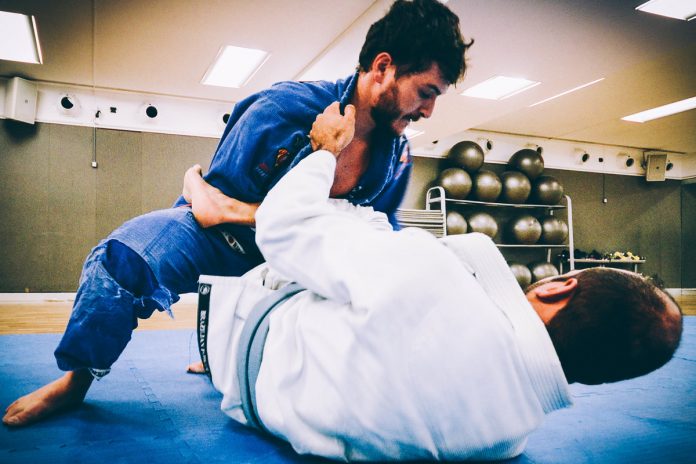
The BJJ Question We Love To Hate: How Did It Go?

Most polarizing BJJ question : how did you do?

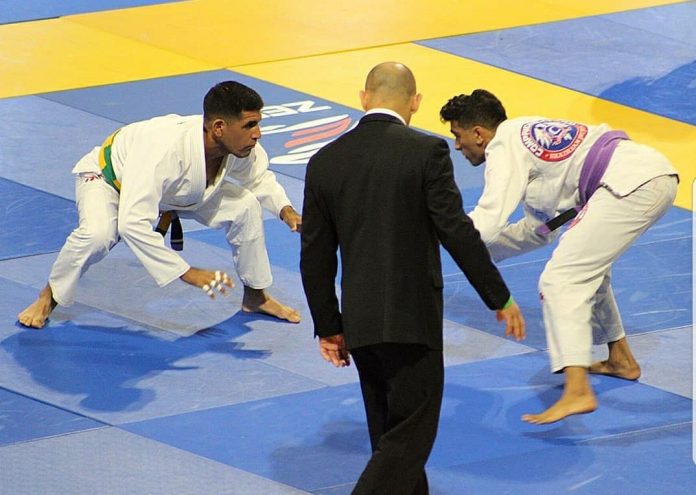
Why do we compete in BJJ? This is a question that will yield many different answers, from the most philosophical to the most practical. However, the bottom line is, every time we go out to a tournament, what we’re aiming for is to win. We want to win every match in the most dominant fashion possible. All the other stuff, learning, experience, fun, etc comes after. Winning is the point of competition and it is ok to admit it. However, we won’t always win, which is another universal truth. However, win or lose, one thing is for certain: afterward, someone will ask the most polarizing BJJ question “How Did It Go?”

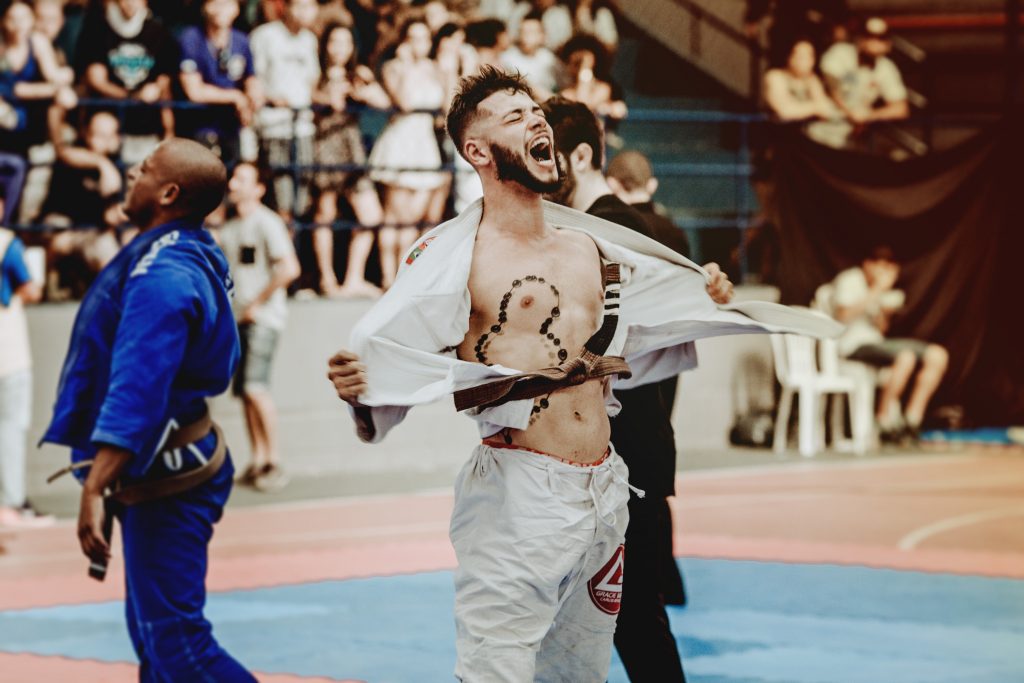
Winning is awesome! That crazy feeling of having your arm raised after a match at a tournament is priceless. Especially if you went about it the hard way, and submitted every one of your opponents. BUT what happens when you inevitably lose? Do you know how to cope with the fact that you’ve lost? If there’s a huge lesson in Brazilian Jiu-Jitsu, for those that compete, it is learning how to deal with the fact that you lost, and that you’ll inevitably lose again in the future. For those that can’t really cope with this fact, the BJJ question “How did it go” strikes a very painful nerve.

The Most Polarizing BJJ Question

It is tournament day. It is what you’ve worked towards for months now. So many sessions on the mats, endless rolls, lifting weight, running, stretching, all the pain of the weight cut led to this moment in time. To be honest, all that preparation just piles more pressure on how you perform, which is already all you can think about thanks to competition anxiety and nerves. And all of that comes to one common denominator – the uncertainty of whether you’ll win or lose.

BJJ question : how did you do?Chael Sonnen once said on the Ultimate Fighter that in competitions you do the same thing you do in training every day. It is the circumstances and the environment that change, and not your objectives. Then why do we fear the outcome of a match so much? In fact, nerves usually afferent our performance much more than anything else, including how good our opponent is.  You don’t feel the same way when you go for a roll in the gym, so why does a tournament make us feel like this? Is it the potential medals that we win? Is it the “glory” that comes with winning or the “shame” that accompanies losing?

It’s nothing of the above. All of them factor in, but what really puts pressure on us whether we admit it or not, is facing everyone afterward, and answering the BJJ question we all love to hate: “How did it go?” It can be the question we most anticipate or the one we like to get out of the way as fast as possible, having already prepared a list of reasons why things didn’t go our way. The thing is, acting in fear of this question not only hinders performance but to undermines the enjoyment of training a competitive combat sport in the first place.

“How Did It Go?”

Just as it is absolutely certain that you’ll have at least one match in a BJJ tournament (bar begin an only competitor in a division), you can bet your life that at least one person will ask you “How did it go?” when you get back from the tournament. And, as you have probably already experienced, the answer to this BJJ question differs a lot, depending on what happened in your tournament.

BJJ question : how did you do i na tournament?One end of the spectrum is the happy proclamation of “I destroyed them all”, when you managed to win your division, or perhaps even the absolute as well. On the other end of the spectrum is the immense list of excuses that you turn to when you lose your first match, always ending in the conclusion that “in BJJ, you either win or you learn.” In the middle, there are unlimited combinations of both, which we usually use when we win a few matches, but miss out on the gold, or any medal for that matter. That’s when we start blaming referees, weight cuts, luck, corners, and everyone else…but for us.

How come we don’t give credit to all of the above (referees, weight cuts, etc.) when we win? That’s because we’re not being honest to ourselves, to begin with. You go out and you win – awesome. You go out and lose immediately – also awesome. And for God’s sake, please stop saying that in BJJ we either win or we learn. As long as people claim that, we’ll always fear the BJJ question of “How did you do?”. Instead, accept that you’ll lose, and be real about why and how you lost. Suddenly that “dreaded” question becomes unimportant and hence, won’t trouble you from the back of your mind the next time you go out to compete. Plus, you’ll be able to satisfy everyone’s curiosity without the urge to shout “why the f&#k do you care?” back at them.

The Questions We Need To Ask Ourselves First

If you want to minimize, or completely eliminate the influence the BJJ question “How did it go?” has on you, then you need to start asking questions of your own. To do so, you have to figure out what actually matters in BJJ, and find a way to focus on that, rather than on the nerve-racking stuff you can never control, like whether you win or not. Of course, you’ll try to, that is the point of stepping on the mats in the first place. However, you don’t have to only ask yourself whether you’ll win or not.

Instead, focus on why you’ve come to compete in the first place. If competing isn’t fun, then maybe you shouldn’t be doing it. After all, people usually love rolling so much because it is fun. Another thing to ask yourself is “am I taking things too seriously?” Usually, the answer to this one is yes, and you should re-adjust your expectation accordingly. Thinking about other stuff like the fact that you’ve made the trip there, that you’re about to give your favorite move a try live, or that you’re going to eat that huge meal afterward are also great ways of not having your brain worry about how you’ll explain your performance to people back home.

BJJ question

The bottom line is, you shouldn’t explain anything to anyone, just say it as it is. When you start feeling the same in answering the polarizing BJJ question “How did it go?” regardless of whether you won or lost, that’s when you’ll be able to step on the mats focusing on what matters the most – performing effectively, with a clear focus in mind to what’s happening at the moment, not what will happen miles away in a few days time.

Closing Thoughts

There’s no need to fear anything in a tournament, except perhaps an injury. Everything else, like winning, losing, not performing to your expectations, or someone else’s expectations are completely and utterly unimportant. Especially when you get rid of the unnecessary pressure piled on by that pesky BJJ question you know is waiting for you back home: “How did you do?”

New Concept – A BJJ Glove To Replace Finger Tape Forever

What to Focus On as a New BJJ White Belt with No Submissions

Fight Canceled: 10 Unusal Reasons MMA & BJJ Fighters Pull Out

Free BJJ Police Training For Offices In Florida

Free BJJ Police Training For Offices In Florida Cover

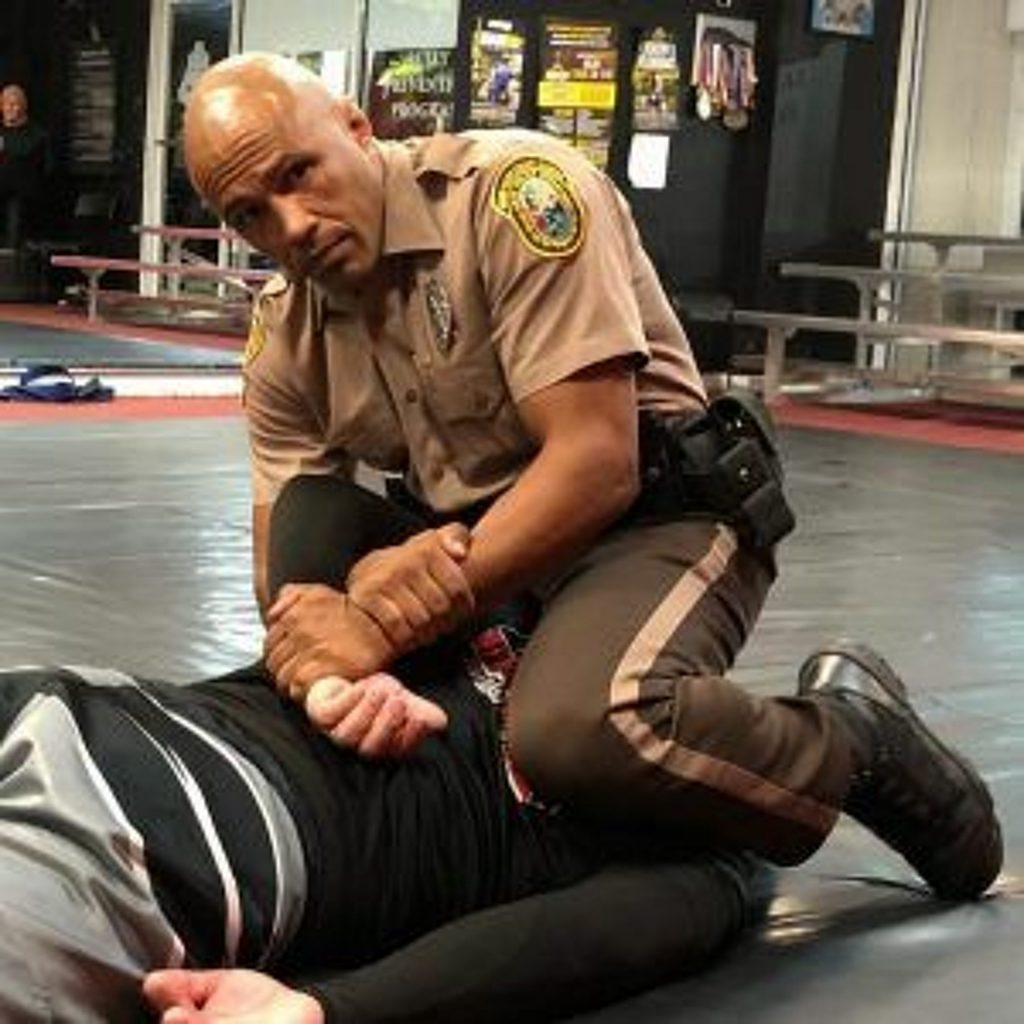
I’ve long said that Brazilian Jiu-Jitsu is the perfect complement to any law enforcement service training regimen. Why mandatory Jiu-Jitsu training is not part of the curriculums of every training system for law enforcement officers all around the world is beyond me. There’s literally no better martial art that will help police officers deal with their daily challenges in a manner that is safe for them, the public, and the suspects they deal with. Finally, it seems, the idea is catching up, although it does come too little too late for some. Still, Florida offering Free BJJ police training for officers seem to be a huge step in the right direction.

In some countries, grappling training is mandatory for anyone looking to be an officer working in the field. Some places which have long traditions in martial arts, like Japan, for example, even go as far as requiring a black belt in Judo for their officers. While a black belt rank might seem excessive, grappling training should be mandatory for anyone that goes through a law enforcement academy, or training regimen. A police chief in Florida creational did the right thing offering free BJJ Police training to his officers, while also securing free classes at a nearby GB gym.

BJJ For Law Enforcement

There’s no valid argument that would support a claim that BJJ is not something police offices absolutely need. There’s simply no better sport/art for the day-to-day needs of law enforcement officers. After all, they’re in a very difficult situation where they rarely have a clear picture of who a perpetrator actually is. That’s where tactics, weapons training, and the rest come into play. However, most of the time, officers are dealing with suspects, which by no means makes the subjects guilty of anything.

Free BJJ Police Training For Offices In FloridaIt is this notion of dealing with people who might be innocent, and like to claim the same, that merits the use of control, rather than force. I won’t claim to understand police work, but I do know a thing or two about controlling people in a physical sense. If only there was some martial art or sport out there that could allow someone to control another person for extended periods of time and in plenty of different situations without actually causing them any harm. Oh, wait, there is – Brazilian Jiu-Jitsu. So why isn’t BJJ Police training a mandatory thing across police forces in the USA, and the entire world, for that manner?

In fact, the ancient samurai crated Japanese Jiu-Jitsu as a means of dealing with enemies on the battlefield when they lost their weapons. Give the armor they carried, strikes would’ve had no impact, to joint locks and throws became the norm. It is more than clear how the modern version that is BJJ is simply a must for any police officer.

Free BJJ Police Training For Officers

The latest news coming in on the subject is very encouraging, though! Local Windermere Police Chief Dave Ogden has now take initiative into his own hands he is not just teaching free BJJ police training to his own officers, but also does it to Central Florida Police agencies.

According to Ogden “I believe Jiu-Jitsu when used appropriately – understanding good leverage and good body mechanics is the key to making sure you secure subjects safely for him and for you.”

He then adds that he likes to see the officers under him have long and blessed careers, which is why he decided to teach them BJJ free of charge. In his own words “I want these young guys to have a long blessed career. I don’t want them to use excessive force. I want them to use the appropriate force.” And he is right, of course.

The initiative will see him provide free BJJ Police training for more than just his officers, and he even has a local Gracie Barra school included in his project. This is a huge step in the right direction but it is now down to the governing body in Florida to make BJJ free for all agencies across the state, and preferably, mandatory. All it takes is one state, and others will follow.

Why BJJ Police Training Is A Necessity

If we had mandatory BJJ police training, lots of incidents would’ve surely been avoided. There have been many examples of situations where officers used inappropriate levels of force because of the lack of proper training to control a situation. These are all things that could’ve easily be avoided.

Free BJJ Police Training For Florida OfficesCurrently, there’s a positive current that sees many gyms, or individuals offer BJJ police training to law enforcement officials. Royce Gracie just recently became a member of the police force, with the goal of sharing his grappling expertise with officers. A Midlands academy from Texas also offers free classes for police offices, as does the Delaware County coach and fourth-degree black belt, Alexandre Quintella.

The one thing that we need to ensure is that this trend continues and BJJ police training becomes not just free, but also mandatory. It would be ideal if police offices could all be at the purple belt level, but that is not a realistic goal, at least for now. There are, however, ways of teaching people fundamental grappling skills in as little as a few weeks, and making the more than competent in dealing with anyone they come across with.

Having officers trained in grappling will not just keep officers safer. It is not just another tool to help them protect themselves against violence. It is a tool that allows them to completely control any situation, and any person they meet, without having to resort to more forceful methods or engage in striking exchanges.

Wrap Up

BJJ police training is something that we shouldn’t even talk about. It is more than obvious that we need to integrate it in law enforcement, but there’s still no sign of this becoming mandatory very soon. Initiatives like Chief Dave Ogden’s in Florida will definitely raise awareness about the usefulness of BJJ for police officers. Let’s just hope this catches on.

Free BJJ – How To Learn From YouTube And Free Resources

Waitress BodySlammed a Guy in a Crowded Restaurant for Groping Her

BJJ Home Workout Series: Gaining Muscle

Academy Explains What Really Happened In The “BJJ Dojo Storm” Incident

“BJJ Dojo Storm” Incident  

Remember the violent BJJ challenge match we shared a few days ago? Trying to be completely fair about it, we did invite the instructor in the video to share his thoughts. Luckily for us, the academy where the “incident” occurred did so, supporting their instructor in full and providing much-needed details for a complete picture about what really happened. As it turns out, it wasn’t a BJJ dojo storm type of thing after all, but rather more of an NHB match, one agreed upon by both parties.

Sometimes things are not what they seem, and I guess we have one of those situations on our hands. Previously, we shared videos of an incident where a martial arts instructor brutally beats up a bodybuilder type of guy who looks like he has no idea what is going on. It seemed like one of the old Gracie challenges, but one that went horribly wrong. However, it was not a BJJ dojo storm challenge after all, and there is a different viewpoint to the entire incident now that the gym where everything happened shared the entire story.

Two Sides (or more) To Every Story

When we concluded in the original article depicting the BJJ challenge, we said that every story has two sides. Luckily, one of those sides has now spoken, and they do bring a lot of context to what happened in that gym. Obviously, there’s a lot more to the story than the videos (part1, part2) which were available.

Before we go into what actually happened, it is prudent to point out that the videos without context really seem disturbing and depict martial arts, and especially BJJ in a way that most people wouldn’t like associated with the art. However, from the comments made at the end by the instructor, there seemed to be a lot more to the story than met the eye. We’re glad that we got the side of the story of the instructor, but, just for the sake of being thorough, even though it’s probably a long shot, we wouldn’t mind hearing the big guy’s side of things as well.

The Original “BJJ Dojo Storm” Incident  

What appeared to happen from the videos was that a big, bodybuilder type of guy went to a martial arts academy and challenged an instructor. Again. These types of things seem to happen from time to time, and we all know how they end. However, in this case, it seemed that the instructor was particularly enraged by the “challenger”, without an apparent reason.

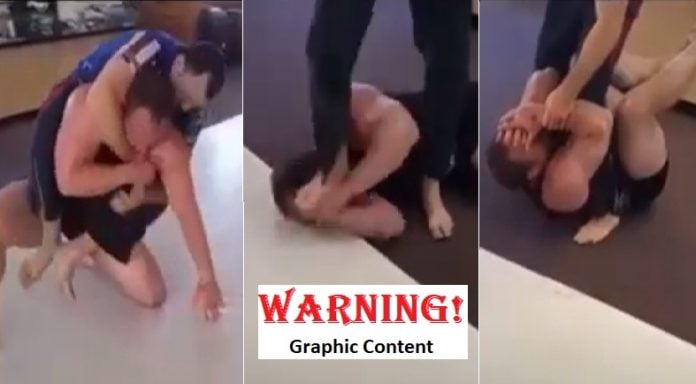
In the two videos, we can see the bodybuilder stuck in side control before the instructor transitions to mount and gets the back. Classic BJJ. He then proceeds to go for a rear-naked choke, which the big guy taps to fairly quickly. What was unusual to see is that his instructor kept choking him, never putting him to sleep but bringing him close, despite the big guy pleading for the instructor to let him go and tapping over and over again.

After choking the guy for a while the instructor let go, leaving him lying face down. However, it doesn’t end there, and the instructor starts punching, hammer fisting, soccer kicking, and stomping the bodybuilder’s head. It seemed (and probably still does) as excessive, particularly when we had no context to the enter situation. The “BJJ Dojo storm challenge” ends with the bodybuilder walking out of the gym, disoriented and pretty beaten up.

The Reply

Shortly after we published the article, we talked to an academy where the incident took place and a reply came in. Chute Boxe really helped clarify that it wasn’t a BJJ dojo storm but rather an incident that started elsewhere and was then brought to be settled in the gym.

As it turns out, the incident began at a supermarket and was instigated by the bodybuilder who punched the martial arts instructor in the back of the head, claiming he thought it was someone else. He then kept insulting the instructor, though, claiming he was a professional MMA fighter and threatening to beat the instructor up.  As per the statement made by the academy, the two people involved had never met each other before.

The instructor then said he was a professional fighter too and that he had a gym nearby where they could settle the challenge, instead of fighting in public. The angry bodybuilder accepted and they went to settle things in the gym where the video was made. As it appears the video only shows the final five or so minutes of the altercation. It turns out the fight started standing, and the two exchanged punches and kicks for 30 minutes before the grappling portion. The fight went to the ground only after the instructor suffered a cut on his face (can be seen in the video) and an injury to his leg. Using his Vale Tudo experience, as per the statement, he took the fight to the ground to avoid further damage.

We all know how the fight ended from there, and the context provided makes the entire story much clearer.

An explanation from a Chute Boxe academy where the incident took place:

“Thank you for giving us the opportunity to add context to this video.

To begin, this incident happened approximately four years ago and at no time was this an “Old School BJJ Challenge”, as suggested in your article.  This was a conflict settled between two consenting adults in a non-public setting.

The incident began while the Jiu-Jitsu professor was leaving a nearby supermarket.  Without warning the aggressor punched the Jiu-Jitsu
professor in the back of the head from behind.  When the instructor confronted the assaultive individual by asking why he punched him, the individual stated that he had mistaken him for someone else.  Then for no apparent reason, the individual started acting belligerent and shouting vulgarities in public.  He then claimed that he was a
professional MMA fighter and began threatening the instructor, saying he was going to beat him up. It is very important to point out that the instructor had never met this individual prior to this encounter.

The Jiu-Jitsu professor informed the individual that he too was a
professional fighter and that he was an MMA instructor at a gym in town.
So as not to disturb the public, the instructor offered to settle this
the issue at the nearby gym and the angry individual accepted the
invitation.

The edited video that was posted on YouTube and shared via various social media platforms only shows the last five minutes of the fight. This altercation however lasted approximately 30 minutes as both professional fighters exchanged kicks and punches from both sides. Although not seen in the video, the individual who originally attacked the Jiu-Jitsu professor landed some hard strikes that injured the instructor, cutting his face and injuring his leg.  As a response, the instructor took the fight to the ground and reverted back to his old training of Vale Tudo fighting with Chute Boxe Brazil.

Surely the viewers of this video will form their own opinion for good or bad as it relates to combative sports. Regardless of any indifference, the Jiu-Jitsu professor shown in the video is a very well-mannered, friendly, and respected practitioner who teaches respect and humility to his students. He is well-liked and continually serves his community in countless ways. This video was never intended for public distribution and was released without consent or permission. Chute Boxe maintains this video is personal property and is subject to copyright rules and regulations.  It is with the respect that we rightfully request this video and all pertaining content be removed from your website.

With appreciation,

Chute Boxe Staff”

In Conclusion

The Chute Box Academy’s statement points that the instructor is a well-mannered, friendly and respected coach and practitioner, and, judging by how he acts towards the guy at the end of the video, we can’t disagree with that.  Whether or not he went too far punishing the bodybuilder is down to personal opinion, but everything does make a bit more sense now that we have important pieces of the puzzle of what we thought was just another BJJ dojo storm incident.


The Manual For Grappling With More Experienced BJJ Training Partners

Training With More Experienced BJJ Training Partners

Oh, now I have your full attention, don’t I? Hello white and blue belts, welcome to the manual for grappling with more experienced training partners. Or, in your case, just training partners. Jokes aside, there’s always going to be someone with more experience in Jiu-Jitsu than you. That doesn’t mean that you shouldn’t train with those people, though. It also doesn’t mean you should get beat up and smashed every time you face them. there are some things you can do, say and communicate that will make these rolls a lot more meaningful to both you, and your more experienced BJJ training partner.

Training partners can sometimes make life miserable for you in the gym. We’ve all had that one training partner that either destroys us technically, physically, mentally, or all of the above. That’s how you grow in BJJ, and even if you’re aware of it, you’re not thinking much about growth when you’re squealing from the wrong side of a cradle. And that’s before I even mention black belts and all the “superpowers” they possess. Rolling with more experienced BJJ Training Partners doesn’t have to be a hassle, though, if you know how to approach them and the roll itself.

How To Train With Experienced BJJ Training Partners (And Not Feel Like Crap)

How to Grapple With More Experienced BJJ Training PartnersBefore we go into the how and why of training with higher-level BJJ training partners, it would be prudent to try and understand how they approach things in general. For one, most upper belts won’t be on a mission to kill you or torture you, unless you present yourself in a way that they seem deserving of such actions. The thing to understand about upper, and especially black belts, is that they roll based on experience rather than a set of techniques. In other words, they don’t go in a roll with expectations of what they will do. They just let things play out and adopt any situation that arises.

Higher belts have their own styles and work on their own things. If you end up rolling with a BJJ training partner that is currently developing some evil-type thing, like the dreaded heel hook or wristlocks, you’ll be in a world of pain regardless of how you approach them. The key here is not taking things personally and trying to learn even if you get tapped 15 times in a round. Most experienced grapplers focus on just one or two aspects of BJJ for the most part, rolling quite freely until they get there.

Which brings us to the things you are doing that might prompt different responses from more experienced BJJ training partners. In most cases, expect higher belts to adapt to you, regretless of what they’re working on. If you roll as if you’ve never rolled before, though, just because they’re more experienced than you, you’re just prodding the beast. For the most part, how a roll with a more experienced training partner goes has to do more with the lower-ranked person, rather than the higher belt.

Body Language

Let’s face it, we’ve all thought “I’ll get that higher belt today” once or twice in our BJJ journey. Well, speaking from the other side now, guess what? the higher belts know what you’re about to do. They can sense it, and, as you know it won’t bide well for you. Your body language says more than you think. Looking to get a piece of someone in training is never smart, but it is something lower belts try to do. A very common scenario is for the white or blue belt competitor to look and get a piece of that high brown belt, trying to prove how good they are.

The truth is, most upper belts like to roll for fun and games. There’s no point in acting like they’re in the final of the Mundials. Moreover, they have a bunch of injuries and aches that they don’t want to aggravate just because a bleu belt is “feeling it” that day. If you want a roll with an experienced BJJ training partner to make sense, try and avoid going after them as your life depends on it.

Pace

Along those lines, you always need to factor in at what pace you’ll roll with more experienced training partners. Rammer that they have a feeling for things and most of them will let you set the pace of roll. If you want to learn, or actually achieve something, make sure you pick a pace that will help you achieve your goal. Going as hard as you can, or having panicky reactions once you get stuck, will only mean the higher belt adopt s to your pace and still beats you at it.

The Manual For Grappling With More Experienced BJJ Training PartnersTuring the pace on a higher belt will most likely send them into defensive mode, one that you can’t breakthrough. Inevitably, you’ll tire out achieving nothing, and they’ll use an opening to turn the tables and then won’t let you move until they submit you or the round ends. All of that when you could’ve had a roll where you actually achieved something technical or learned a thing or two about tactics.

All About The Balance

In a roll, it is all about the delicate balance of two people getting to learn from the exchange. It will only be possible if you let the higher belt actually roll with you. The thing with more experienced BJJ training partners si that they’re usually suspicious of lower belts until they “prove” to be reliable training partners. Look to earn yourself such a name, so that more experienced training partners can not just learn from you, but help teach you things as you roll. There are many things you can learn in a roll, and double the amount in a few minute chat after one.

Don’t Be “Star-struck”

Grappling With More Experienced BJJ Training PartnersA key thing to also remember and that has to do with the balance in a roll with a higher belt is respect. It is one thing to show someone respect, and an entirely different thing to be star-struck. If you approach a roll with a senior training partner with the mindset “I’m going to lose this, he’s a brown/black belt” you’ll get nothing out of the roll, simply because you’re too scared to participate. The same things go for your training partner, who’ll get very little from, someone, too scared to engage and enter grappling exchanges.

Summary

There’s no need to panic! You’ll still halve your peers to go all out Spaz with. However, when it comes to rolling with the most experienced BJJ training partners in the gym, do your best to make those rolls count. One roll with a highly seasoned black belt will teach you more than all the rolls you do on that day with people near your level. Take every chance you have to learn and make rolls with higher belts about learning, rather than about winning. You’ll lose anyway, why not get a lesson out of it?


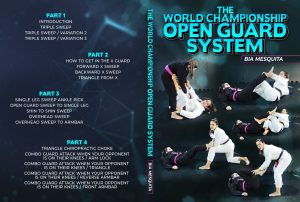
Bia Mesquita DVD Review: World Championship Open Guard System

Bia Mesquita DVD World Championship Open Guard System Review

Bia Mesquita is one of the most exciting female grapples of today,. With plenty of titles behind her, and some crazy performances on the mats. She is also a real wizard in both Gi and NO-Gi, and she is just getting started. AN avid competitor that’s competing as much as possible, she doesn’t seem to have a lot of time left for instructional. However, probably due to the Covid-19 pandemic, it seems Bia has turned finally managed to share some of her World Championship Open Guard secrets. It was about time we saw a high-level Bia Mesquita DVD, and we have the first review!

ON SALE HERE:
Bia Mesquita – World Championship Open Guard

Bia Mesquita DVD World Championship Open Guard System Review
Techniques List

An open guard is a subject that has been beaten to death. To be honest, it is hard to pick an open guard BJJ DVD, given the sheer number of open guards people like to play. So, when in doubt, it is always smart to look in the direction of someone who has a proven open guard system that is not overly complicated. Bia Mesquita fits this description to a “T”. Her World Championship Open Guard System instructional delivers just that and is the Bia Mesquita DVD we’ve all been waiting for.

The Toughest Female Grappler Of Today?

That is quite the claim, I know, but Bia has definitely made a name for herself as a tough grappler that doesn’t give up in Jiu-Jitsu circuits. After all, she did get caught in a very nasty armlock by Ffion Davies in the early rounds of ADCC 2019 and didn’t tap, ending up with a broken arm instead. Tough as nails!

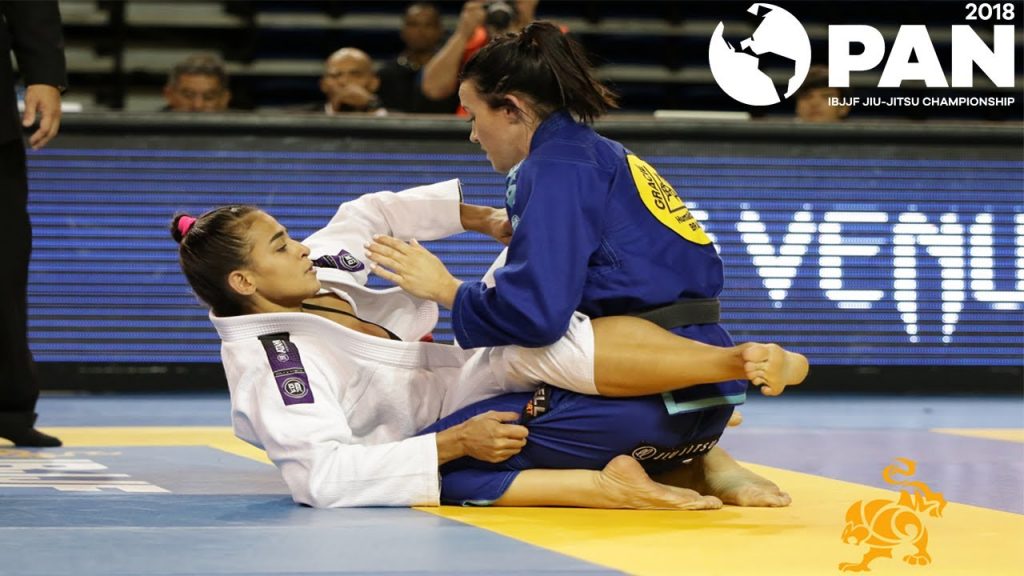
Bia Mesquita DVD Review World Championship Open Guard SystemBia already has 6 Gi world titles, 1 No-Gi World title, and 1 ADCC title to her name at the age of 29. While she is looking towards MMA (understandably) she still has a lot to offer to the BJJ world, be it in the form of instructionals or matches. Bia also has a bunch of other titles, ranging from the Pans and Europeans, through the Abu Dhabi pro all the way to winning the EBI in 2016.

Currently fighting under the Gracie Humaiata banner, Mesquita is extremely well known for her guard game. While her closed guard is pretty formidable, her open guard game is out of this world. Bia started with BJJ early, then switched to Judo, before eventually giving swimming a try. She excelled in all of them, earning national championships with ease. She went back to BJJ later on, under the tutelage of Leticia Ribeiro, who awarded her the black belt in 2011. 9 years later, we finally get to see a Bia Mesquita DVD in the form of her World Championship Open guard System, for Gi Jiu-Jitsu.

World Championship Open Guard

Bia is famous for her guard game. She has one of the most versatile systems of relentless attacking from the bottom that you’ll ever see in BJJ. It is not just about having an open guard that nobody can pass. Bia’s guard is all about attacking, and nobody can find a way past it. After all, the offense is the best defense, isn’t it? Plus, you won’t find as many people that are as well versed in the No-Gi aspects of the guard as they are with the Gi.

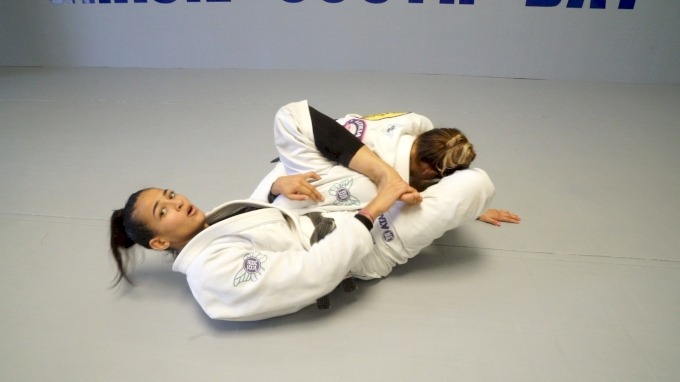
The reason Bia has won so many championships with her guard is that she is able to blend her attacks together. She does not use just one open guard variation, but rather likes to switch, focusing more on the sweeps and submission combinations rather than the guard itself. Whether it is X guard, shin-to-shin, or spider guard it does not matter as you’ll see in the World Championship Open guard Bia Mesquite DVD.

The World Championship Open Guard System Bia Mesquita DVD Review

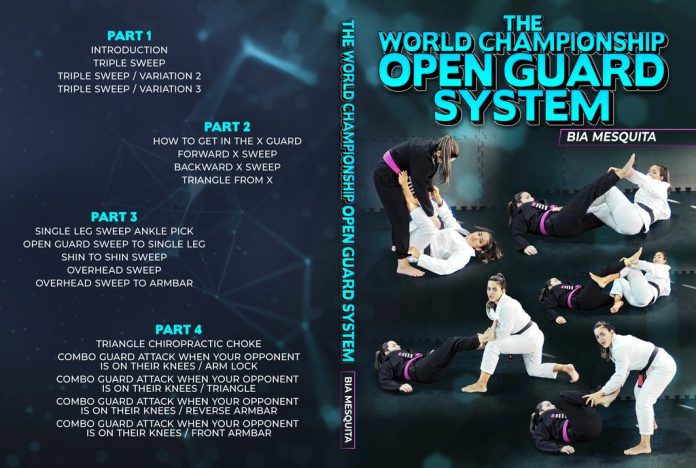
What can you expect to get from this Bia Mesquita DVD? First of all, know that it is a Gi instructional (a NO-Gi version of the same system is coming soon). the DVD has four volumes, just as you would expect from a BJJ DVD instructional nowadays. There’s no real distinction style-wise to what Bia shows, but there is a progression from simpler stuff, towards a volume filled with nothing but crazy open guard combo attacks.

DVD #1

In the first volume Bia starts with an introduction to the open guard in general, and her World Championship Open Guard System. She has a slightly different take on guard, compared to most people, which has a lot to do with her aggressiveness as a fighter. It is also a way of playing open guard that we need to see more in JIu-Jitsu.

Review: Bia Mesquita DVD World Championship Open Guard SystemThe first volume is all about sweeps. There’s an interesting combination of sweeps in here, called the triple sweep that Mesquita likes to use. As you’ll see in the DVD, she doesn’t just do single attacks but rather joins them together in mini-systems that work like a charm. There are three variations of the triple sweep in this volume, meaning you’ll learn more than enough to get people on the ground.

DVD #2

Part two goes a bit deeper into the technical aspects of open guards. The focus here is the X guard, and all of the ways you can use it to set up attacks, like the aforementioned triple sweeps. Bia doesn’t spend too much time on how to stay in the X guard, because she doesn’t stay long in guards anyway. Instead, she offers a few entry options, followed by attacks, attacks, and more attacks.

Those attacks include sweeps in different directions, one going forward, and another one taking the opponent backward. Combining them all but guarantees you’ll get them to the ground. Wrapping up is a very neat triangle setup that was completely new to me when I was watching this Bia Mesquita DVD for the first time. Currently, I’m itching to give it a try on the mats.

DVD #3

This is arguably the most interesting part of the World Championship Open Guard System Bia Mesquita DVD, or at least it was for me. Here, Bia goes into advanced Jiu-Jitsu, demonstrating how you can use open guards to set up takedowns from the knees/bottom that work as sweeps. In other words, she’ll teach you how to sweep with single leg takedowns, ankle picks, and the likes. She uses the shin to shin guard predominantly in this volume and offers, even more, sweeps, particularly going overhead.

It wouldn’t be a complete Bia Mesquita DVD volume If there wasn’t a submission somewhere in it, so a really cool armbar finish off of the overhead shin-to-shin sweep wraps this penultimate volume up.

DVD #4

Bia Mesquita DVD World Championship Open Guard SystemFinally, a bunch of crazy combo attacks from open guards that will provide competitors with a goldmine of ideas. Bia really shares some amazing stuff here, starting with the chiropractic triangle choke which has to be the best-named move on this entire instructional. Next up are combinations to use when an opponent is on their knees, ending up with a neat little armlock. Triangles, armbars, and a front armbar follow suit, al focusing on breaking down, and tapping kneeling opponents. In combination with the X and shin-to-shin guards options before, this gives you a complete system to deal with people trying to pass your guard from any level.

Wrapping Up

The World Championship Open Guard Bia Mesquita DVD is just what the doctor ordered to freshen up the open guard game. In a world of stalling guards and systems that focus on not getting passed, it is a real breath of fresh air to see a system that is focused on nothing but aggressive attacks. There’s something for people of all belt levels and experience in this one, and it does come to work as a complete system once you get through all four volumes of the instructional.

ON SALE HERE:
Bia Mesquita – World Championship Open Guard

Bia Mesquita DVD World Championship Open Guard System Review
Techniques List

Best Kids BJJ Gi Guide And Reviews For 2021

Best Kids BJJ Gi Guide And Reviews 2020 Cover

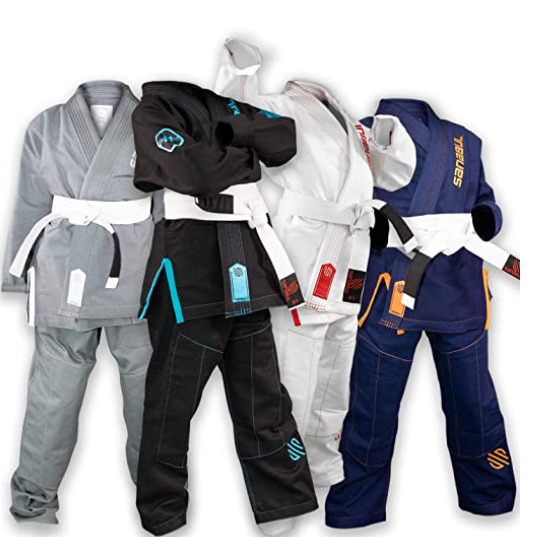
You got your kids into BJJ, and now you’re facing the number one headache – getting a Gi for them. If you’re not training yourself you might be amazed at the prices of some of these Brazilian Jiu-Jitsu Gis for children. Worry not, we got you covered. We provide you with not only the best quality options but also the best possible deals on prices, as well as the absolute best looking kids Gis in existence. There’s no need to look further than our best kids BJJ Gi guide, whether you have a boy or a girl (or both) that are crazy about grappling!

Brazilian Jiu-Jitsu is definitely the number one sport you can enroll your kids into. It provides everything they need for physical mental emotional growth and development. Plus it is extremely fun for them! However, the moment you enroll your kids in a BJJ class, they’ll look at older kids and want the same clothes as them. As a kids’ group coach, I see that on a daily basis. Make sure you keep your sanity and only look at the very best kids BJJ Gi options out there. As a bonus, we made sure to provide the best prices as well, because the little guys are growing, and in no time, you’ll be on the hunt for a new Gi.

Picking Out A Kids BJJ Gi

Let me be clear off the get-go: No, another Gi won’t do the trick. Karate Gis are cheaper for a great reason – they’re paper-thin. They won’t last a young grappler a week, let alone longer. Judo and Aikido Gis are tougher, but they’re too wide in the sleeves and their shape I mismatched for Jiu-Jitsu practice. In short, don’t go looking for anything else but a BJJ Gi.

When trying to pick the best kids BJJ Gi, you need to have a few things in mind. Of course, you can just take our guide for granted, as we did all the leg work for you, however, if you want to know our criteria for choosing the best kids BJJ Gi, it is as follows:

Size. There’s a size chart for every different Gi you look at, and you should be careful when consulting it. With kids Gis, it is always wise to buy a size bigger. There’ll always be some shrinkage due to washing, and give that kids grow really fast, it should last as long as possible. No two Gi manufacturers offer the same sizes, due to variations in material, weave, thickness cut, etc. Always consult the GI chart specific to the manufacturer.

Thickness. The thickness will depend a lot on what a child prefers. Just like with adults, very thick Gis and lightweight Gis are available. While with kids it is usually about color and design, thickness does play a part, especially with competitors. Our best kids BJJ Gi guide includes all thickness options to choose from.

Material. Gis are usually 100% cotton, making t easy to wash and look after them, while at the same time they are not irritant to the skin. Apart from that, it shouldn’t retain odor and is usually in connection with the cut of the Gi and its thickness.

Color. When it comes to Gi colors, kids want to stand out. The thing is, in competition, they’re bound by the same rules as adults-only white, blue, and black Gis are allowed. That doesn’t mean they can’t wear something different for training, though, or if they’re not competing. Once again, we have all options available in our guide.

Cut. The cut of the Gi determines how well it fits the child, which is very important, especially when you’re buying one size larger. A Gi should not be restrictive, but there shouldn’t be excess at the sleeves or the skirt either. One particular to watch out for is the ability for the kid to be able to squat down without restrictions in the Gi pants.

Price. We did our best to provide you with nothing but the most high-quality options available at outstandingly low prices. Some of them are limited deals, though so you might want to hurry up, or even better, stack up on Gis!

The Best Kids BJJ Gi Guide 2020 – Reviews

Below you’ll find several awesome options when it comes to the best kids BJJ Gi available today. Every criterion mentioned above has been taken into account, as well as every original feature that each Gi brand or model inevitably brings along. Kids Gis are a different beast compared to adult Gis, and they do require more tinkering to get things right. The Gis below are awesome options as a first Gi, a regular training Gi or even a competition Gi.

Sanabul Future Legend Kids Brazilian Jiu-Jitsu Gi

Features:

  • Minimal shrinkage
  • Elastic waistband
  • Reinforced double stitching
  • Comfortable and lightweight

Tatami is a brand that is among the most well-known GI manufacturers in the world. They really do have Gis for every occasion, from adult competitors to kids just starting out and ladies looking for an original Gi design. The Kids Dweller BJJ Gi comes in several different colors, all IBJJF approved for competition and a pull-on closure system that’s perfect for kids of all ages.

Sizes: 5 sizes available, K00 – K4.
Thickness:  Santec weave cotton jacket
Material: 100% cotton, lightweight, and very comfortable
Colors: Available in four colors: white, navy, silver, and black
Cut: Athletic
Price range: $$

[amazon fields=”B07NKW1VKT” value=”button”]


Venum Contender Kids BJJ Gi
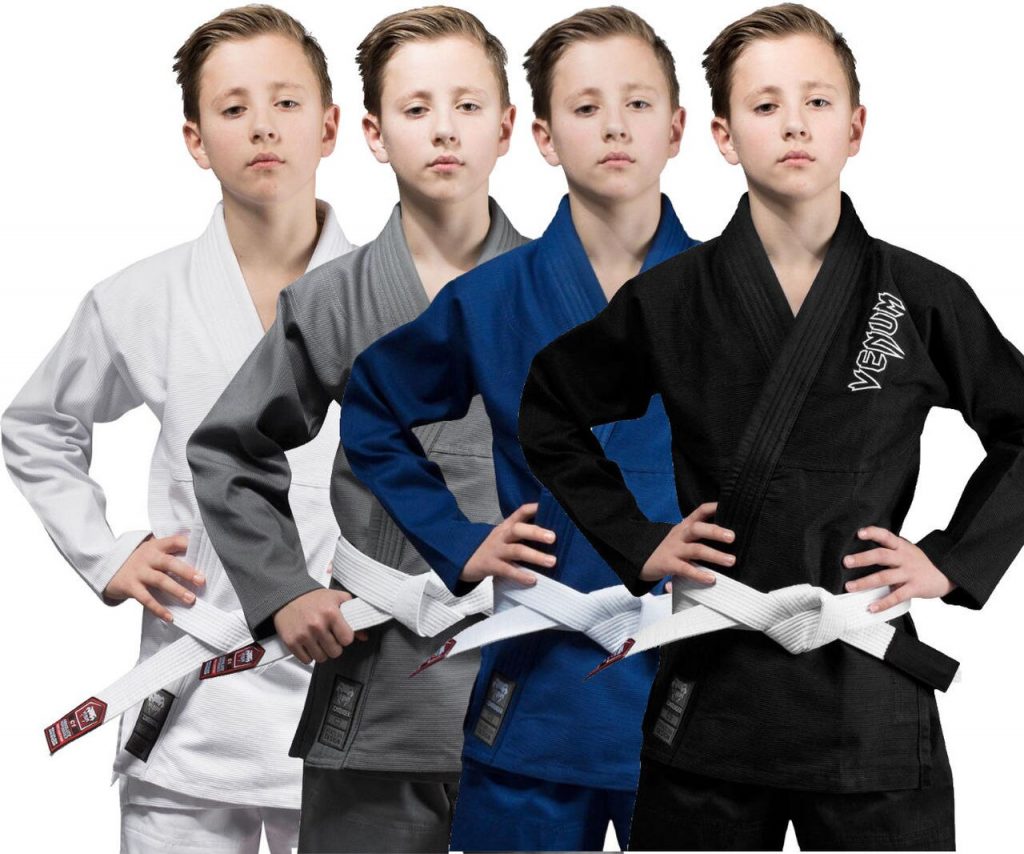
Best Kids BJJ Gi Guide And Reviews : VenumFeatures: 

  • 100% cotton, lightweight
  • Pre-narrowed
  • 3 rows of seams
  • Free white belt
  • IBJJF Approved

Another brand along the lines of Tatami, Venum should be on any grapples’ radar when choosing a new Gi, regardless of age. In fact, they actually have a children’s version of one of their most legendary and highest quality Gis, the Venum Contender. The Gi is available in plenty of colors and sizes and comes with a free white belt as well, The jacket has reinforced slits, designed to be extra durable. More importantly, the Gi comes pre-shrunk.

Sizes: Five available sizes, from C00 to C3
Thickness:  Pearl weave, minimal weight
Material: 100% cotton, extremely comfortable
Colors: Comes in IBJJF approved black, white, and blue, as well as navy blue, and grey.
Cut: Standard
Price range: $$

[amazon fields=”B078T6Y491″ value=”button”]


Fuji Kid’s BJJ Uniform
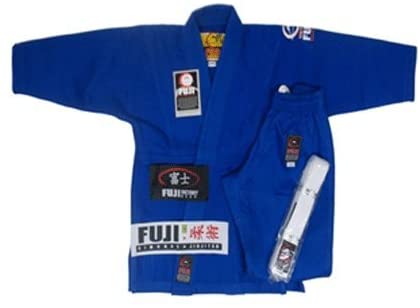
 

Best Kids BJJ Gi Guide And Reviews: FUJIFeatures:

  • Very durable
  • Made from a premium cotton blend
  • Elastic waistband
  • Free white belt and patches
  • IBJJF Approved

Fuji’s kimonos are among the most comfortable ever for BJJ <and they’re often the first choice of world-class competitors. No wonder they find themselves in our best kids BJJ Gi guide. It features a reinforced, thick collar for added comfort and durability. Comes with a free white belt and sew-on patches that can be left out, depending on choice. An elastic waistband on the pants guarantees no hassle when putting the Gi on, or taking it off. Pre-shrunk, but you can’t expect some small shrinkage after the first wash.

Sizes: Five available sizes, from C00 to C3
Thickness: Tear-resistant pants, single weave jacket
Material: Premium cotton blend, mid-weight Gi
Colors: THree: white, blue, and black, all lBJJF approved
Cut: Standard
Price range: $$

[amazon fields=”B00GIHVUJE” value=”button”]


Elite Sports Kids BJJ Gi

Best Kids BJJ Gi Guide And Reviews ELITE

Features:

  • Pre-shrunk
  • Free white belt
  • Strong and durable fabric
  • disperses sweat fast
  • Odor resistant

The Gi comes in as many possible color and size combinations as it is possible. Elite’s Sports Kids BJJ Gi is great for kids of all ages. The Gi is made from special pre-shrunk fabric, making it a very reliable option. The Gi is IBJJF approved, in regard to the three colors that are allowed in official tournaments. A free white belt comes with the Gi made from the same odor-resistant material as the jacket and pants.

Sizes: 6 sizes are available (C000-C3)
Thickness: Ripstop pants, pearl weave
Material: Cotton, very lightweight
Colors: White, blue, black, pink, gray, navy, military green, and premium versions of each
Cut: Standard
Price range: $$

[amazon fields=”B08B394PT6″ value=”button”]


Hawk Kids Brazilian Jiu-Jitsu Gi
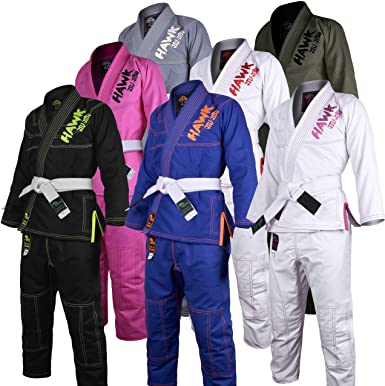
Best Kids BJJ Gi Guide And Reviews: HAWK

Features:

  • Premium fabric
  • Lightweight
  • Free white belt
  • 3-year replacement warranty
  • Durable and comfortable

The Hawk Kids BJJ GI is an anti-microbial preshrunk Gi that features a specially tailored fit. It has triple-stitched seams with a reinforced tape placed at strategic stress points to ensure extreme durability. An elastic waist with rope drawstring makes using the Gi with kids of all ages easy and hassle-free. The Gi complies with IBJJF Regulations. Comes with a 3-year replacement warranty. Comes at a special price in our best kids BJJ Gi guide.

Sizes: K000-K4, a total of 7 different sizes available
Thickness: 10oz Ripstop pants, 350gsm Pearl weave Jacket
Material: 100% cotton, Ultra-Light
Colors: White, blue, black, pink, gray, and green
Cut: Tailored cut fit
Price range: $$

[amazon fields=”B076Q37TZG” value=”button”]


Verus Ultra Light Version Spartacus Kids Jiu-Jitsu Kimono
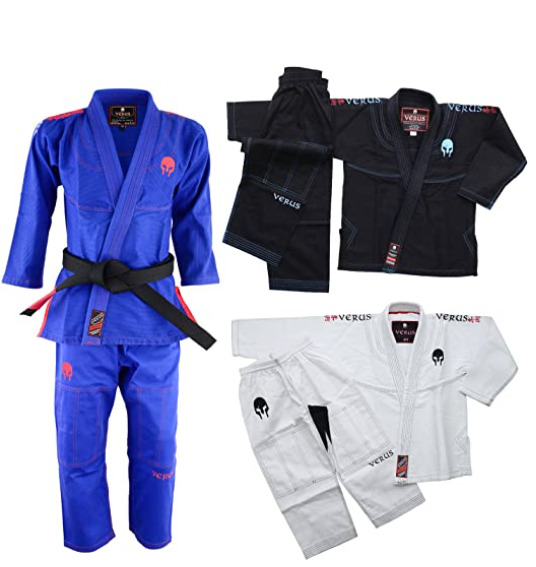
Features:

  • Pre-shrunk
  • Hard-Wearing 100% Cotton
  • Drawstring and elastic waistband
  • Reinforced for durability and comfort
  • IBJJF approved

Another great example of an awesome Gi manufactured by Verus. The design is minimalistic yet stylish, and quite original with a Spartan Kids theme. Each Gi is extremely durable, yet extremely light- in fact, this is one of the slightest weight kids BJJ Gis in existence. that however, does not take way from ti’s durability, nor the fact that this is one of the best competition Gis for kids as well. Dries very quickly.

Sizes: C00-C4, a total of 6 different sizes available
Thickness: Coral Weave Cotton,  reinforced
Material: 100% cotton, Ultra-Light
Colors: White, blue, black
Cut: Tailored cut fit
Price range: $$

[amazon fields=”B01M8GNAQV” value=”button”]


Jayefo Kids Bjj Jiu-Jitsu Lightweight Gi
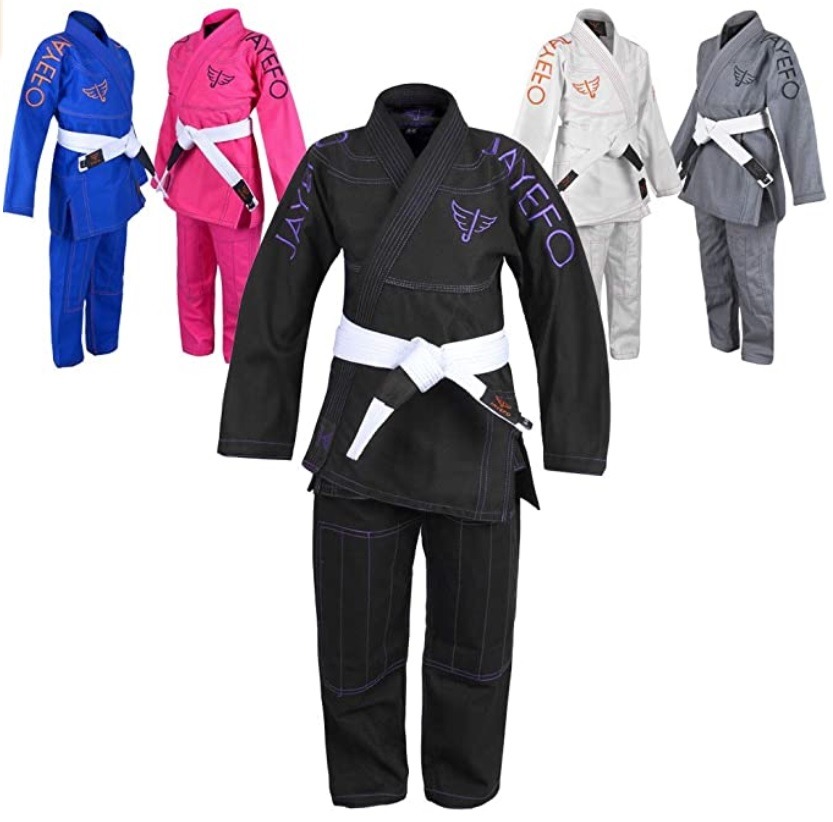
Best Kids BJJ Gi Guide And Reviews: Jayefo

Features:

  • A special collar that prevents skin rash
  • Pre-shrunk
  • Free white belt
  • 2 years warranty
  • IBJJF approved

Another lightweight Gi option for children that had to feature in our best kids BJJ Gi guide. One reason is the design that kids, love, in combination with the available colors, sizes, and the 2-year warranty and 24/7 customer support service. The collar is designed so it prevents rashes, there’s extra strong stitching, and the Gi comes pre-shrunk, meaning you need to factor in just minimal shrinkage. Special ventilated technology means there’s no way the Gi will retain seat odors. IBJJF approved. Best priced item in our best kids BJJ Gi guide!

Sizes: K000 – K0, a total of 3 different sizes available
Thickness: 12oz ripstop pants, 450 gsm Soft Pearl weave
Material: Soft cotton, lightweight
Colors: White, blue, black, pink, and grey
Cut: Tailored fit
Price range: $

[amazon fields=”B07JVKBJMK” value=”button”]


Vector Sports Brazilian Kids BJJ GI
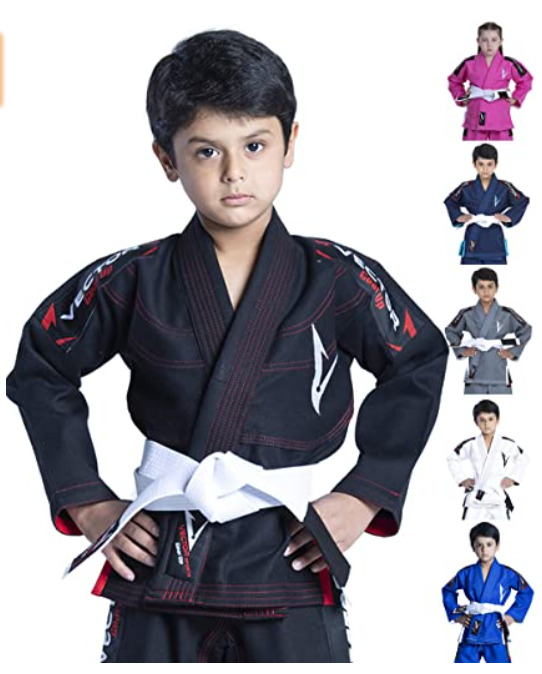
Features:

  • Quadruple-stitching
  • Lightweight
  • Extra strong
  • 100% cotton
  • IBJJF approved

Wrapping up the quest for the best kids BJJ Gi is a real classic among sports brands in the Vector Sports Brazilian Kids BJJ Gi. Made from pearl weave, 100% cotton fabric, and reinforced seams on strategic points all over, it provides extra strength while also being lightweight and comfortable to wear. Firm but not heavy, the perfect kids’ jiu-jitsu kimono for training and competition.

Sizes: six different sizes K00 – K4
Thickness: Reinforced knees and hips, pearl weave jacket
Material: 100% cotton, ultra-lightweight
Colors: White, blue, black, navy, grey, and pink
Cut: Standard
Price: $$

[amazon fields=”B071V9LT9Q” value=”button”]


Frequently Asked Questions

What should kids wear to Jiu-Jitsu?

Most kids’ classes in BJJ gyms are Gi-based, meaning any of the best kids BJJ Gi options above are a perfect fit for the job. In any case, it should be a BJJ Gi, and not a Gi for other martial arts, like karate or taekwondo.

What is the best kids Gi for BJJ?

There are many options out there, but the perfect Gi would be something that your kid likes, is lightweight yet durable, within an acceptable price range and that won’t shrink when washed. All of the options reviewed in our article tick these boxes.

What size Gi should a 7-year-old have? 

Kids BJJ Gi sizes should be measured individually and are not based on age. They might be labeled as C, M, or K  depending on the manufacturer and brand. The letter is usually followed by a number.  However, at the end of the day, it comes down to reading specific size charts for every brand you’re considering. Also, a good piece of advice is to buy a size larger, as not all kids are the same size at the same age.

What color BJJ GIs should I get for my kids?

Unless specifically requested by the BJJ academy your kids train at, you can get them any color of Gi they want. keep in mind, though, that for competition, only white, black and blue Gis are allowed.

How long does a Kids BJJ Gi last?

With any of the best BJJ Kids Gi brands reviewed above, certainly longer than your kid will get to wear it, when we factor in growth. Kids grow quite rapidly, which is why it is smart to buy one size up whenever possible. Apart from that, Gis are designed to last and won’t give in easily., even with very frequent training.

How many Gis should my kid have?

Two is always a great number, given that washing and drying logistics become easier to manage. However, even one will suffice, as long as you wash it after every training. If you go with the one Gi option, also make sure it is white, blue, or black, so they can use it both for training and competition.

How much do kids Jiu-Jitsu kimonos cost?

Kids BJJ Gis costs anywhere between $20 and $60. Most of the time, the cost depends on the brand and has little do to with quality, especially if you pick one of the best BJJ Kids options we reviewed here today. Keep in mind that belts do not come free with certain Gis.

In Conclusion

Picking out the best kids BJJ Gi for your child doesn’t have to be complicated, especially if you’re not training Jiu-Jitsu yourself. There are plenty of options above, and as long as you are clear whether or not your child will compete anytime soon, you can pick the correct Gi color. All other variables are down to your kid’s preferences, or perhaps in consultation with the coach.

Recycling Old School BJJ Moves To Make Modern BJJ More Effective

Old School BJJ Moves For Modern BJJ

What is your favorite BJJ move? Does it work all the time, against everyone? Of course not, such a move does not exist in Brazilian Jiu-Jitsu…yet. What you might enjoy doing will not only have variable success on different training partners/opponents but it will also change after a while. This is the way. Your personal progress and the evolution of BJJ as a whole are only possible if we change our focus from time to time. However, keeping in mind that we want to be effective and win exchanges more than anything else, how can we improve modern BJJ and become more effective? Looking to the past and doing some BJJ archeology is the answer.

Old school BJJ is something we often see as redundant, as Jiu-Jitsu progresses. At first, it wasn’t really difficult to see where the “line” between modern BJJ and old school BJJ was. However, with the rapid expansion of the sport, and the almost daily contributions from grapplers all over the world, it is getting difficult to make this distinction. What exactly is modern BJJ nowadays? You can’t say it is Berimbolos and open guard, because that has died out. Leg locks were all the jazz for a while but the focus is again shifting away from lower limb submissions. As you can see, qualifying something as old school Jiu-Jitsu is not easy.

Old School vs. Modern BJJ

While it is hard to define old school and modern BJJ, there is still stuff that can only be considered to be old school. In that sense, I don’t mean the ideas of BJ Jas a self-defense system as much as I refer to sports BJJ and the moves that defined it when the sports boundaries were first established. Old School Jiu-Jitsu is not about the moves, though, but about the mindset behind using those moves.

Old School BJJ Moves For Effective Modern BJJFirst of all, I have to make a distinction in terms of old school moves and “evergreen” moves. By “evergreen” moves I mean stuff like armbars, rear-naked choke, Kimuras, etc, that we keep on seeing with every new generation of grapplers. Old school BJJ is more about stuff that was popular for a while but then fell out of favor for one reason or another. Examples include the grapefruit choke, straight armlocks, the Anaconda choke, rubber guard, tornado guard, etc. All of these were highly popular in the early days of BJJ in Brazil or the USA, but then, got lost as modern BJJ (whatever that may be) started to develop.
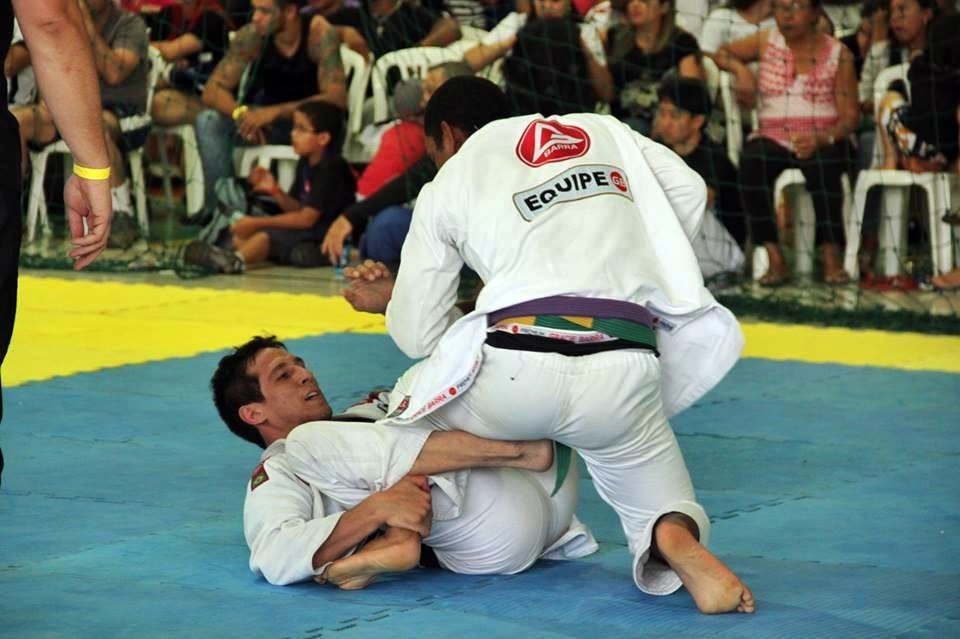
The simplest way of explaining the difference between old school and modern BJJ moves and positions is effectiveness. Old School stuff has stuck around because they’re proven to work. Moreover, grapplers, as impatient as they are, often discard modern moves as ineffective before giving them the chance to prove if they work over time, and against many different opponents. Just like everything else in Jiu-Jitsu it is not so much about a debate of old vs. new, but rather how to improve one by introducing the other.

Recycling Moves To Surprise Opponents

I already wrote about BJJ archeology (a term coined by Matt Thornton) and how it is integral in helping you grow your game. It usually strikes people around purple/brown belt, when they think more about experimenting and understanding as opposed to copying stuff they see. While modern BJJ does involve a lot of information in video format, there’s still the issue of all those moves being too “fresh” to really know if they’ll work or not.

On the opposite side of the spectrum are the old school moves, which is exactly what anyone doing digging should focus on. It may be old BJJ stuff or even Judo/Sambo/Wrestling things that you end up recycling to make your modern BJJ game better. It is the same method employed by many world-class coaches that have changed the landscape of BJJ. Danaher and his leg lock system is the most obvious example.

Looking into old school stuff will give you the chance to introduce something different and unexpected to your modern game. For example, there is plenty of back takes against the turtle position nowadays, or even ways to break the turtle straight into leg locks. However, people are rarely using nelsons or chicken wings to break the turtle down, and they’re moves borrowed from wrestling that have been proven to work in those particular circumstances for decades, if not longer. With a very unorthodox turtle based defense system emerging in Jiu-Jitsu, turning back to recycle some of these moves might just prove to be the only way to beat the turtle.

What Should You Focus On?

Finally, let’s get to the nitty-gritty of old school moves that can improve your modern BJJ game. The Darce choke is a great example, to begin with. Many people nowadays use the choke, mostly looking to utilize it from the front headlock position. However, as other wised up to it, it became difficult to set the choke up. People are now defending it quite early. However, it is extremely rare that I see someone transitioning into the Peruvian necktie from the same position, for example.

Old School BJJ Moves To Improve Modern BJJWhen it comes to positional play, the closed guard is making a comeback, and for a good reason – it plugs a hole left by too much nonsense that comes in the form of open guards that are based on lapels and Berimbolos. Looking into some old school pointers like controlling with your knees instead of the feet, and looking to always have grips on both wrists are great ways of surprising people with something simple, but extremely effective.

The same holds true for standing. In modern BJJ, we see too many attempts at fancy enters and even fancier takedowns, sometimes blended with guard pulls and leg lock rolls that it is impossible to know what is going on. Their percentage of success, though, compared to a solid single or double leg is quite low. Why not explore some alternative ways of getting to the proven moves, like using Russian ties, duck unders and arm drags, starting from upper body ties, for example? They’re extremely effective but have been forgotten somewhere along the away in favor of useless collar and sleeve grips and the likes.

Conclusion

Modern BJJ is whatever is popular in the BJJ world at the moment. It may work, for a while, simply because people have no idea what’s happening., However, once counters start popping up, you’ll most likely look to discard that latest new move. But wait! Why not try and combine it with an old school BJJ move that might just make your modern BJJ game extremely effective, and take you to the next level?


REVIEW: Guard Retention Anthology Lachlan Giles Instructional DVD

REVIEW: Guard Retention Anthology Lachlan Giles Instructional DVD Cover

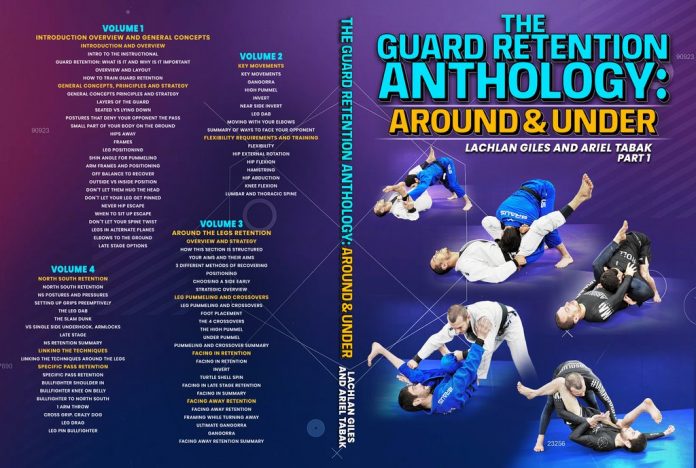
A Lachlan Giles Instructional DVD. Would you buy one just based on that, without knowing what the subject matter is? I would, and I guess most of the people involved in BJJ would do the same as well. Lachlan is just that good, and his instructionals are among the best ever released in the BJJ World. Moreover, they all tackle great subjects that people like to research and experiment with. His latest one, the Guard Retention Anthology DVD is just another one in a long line of anthologies by Giles that have changed the grappling scene forever.

ON SALE HERE:
Lachlan Giles – Guard Retention Anthology

REVIEW: Guard Retention Anthology Lachlan Giles Instructional DVD
Techniques List

So far, I doubt there’s anyone hoarding BJJ DVDs that don’t own at least one Lachlan Giles Instructional DVD. If I had to bet, I’d say that his half guard anthology and 50/50 anthology are the most sought after titles. Until today. The subject of guard retention is not one that has been covered as the main subject of a BJJ DVD. Lachlan not only focused on an area that is the backbone of Brazilian Jiu-Jitsu but also did in his recognizable style – over 8 volumes and more than 10 hours of material. Not only that, but he is the only man that has the ability to make a DVD featuring both Gi and No-GI versions of his concepts and techniques, and have it make sense.

Why Guard Retention Is The Core Of BJJ

What is guard retention? The common answer is not letting people pass your guard. That’s only half correct, though. It is not just bout not letting someone pass your guard, but maintaining to stay in the guard at the same time, and open up options that will turn the tables in your favor. In other words, it is the ultimate skill you need to master off your back, far before you start thinking about sweeps, submissions, and inversions.

The concept of guard retention is simple, but putting it into practice is hard. Stay in your guard, and you’ll be able to get an attacking movement going. that’s all fine when said, but when a 200 +lbs person is trying to pass your legs, throwing you around, things seem very far from easy. The good news is that there are ways of successfully retaining a guard against all type s of opponents, regardless of size and experience. And Lachlan Giles has categorized it all in the best way imaginable.

The arson why guard retention is the core of BJJ is because you can’t launch attacks off your back unless you are in guard. While Jiu-Jitsu has moved past just being the art that has the only system for fighting off the back, there’s still a lot of guard play in the sport. So, in order to use some of the sport’s most efficient positions and attacks, you need to be able to prevent an opponent from breaking the structure of those positions. That is exactly where The Guard Retention Anthology Lachlan Giles Instructional DVD fits into the puzzle.

Why Get A Lachlan Giles Instructional DVD?Guard Retention Anthology Lachlan Giles Instructional DVD review 

This seems to be a redundant question at this point, but still, we’ll answer it, albeit shortly. Lachlan is the man behind Craig Jones and a bunch of other top-level athletes in the sport. While he is an extraordinary coach, he is also an avid competitor, with lots of success under his belt. He is good at both Gi and No-Gi, though he prefers the latter. As expected, leg locks are among his bread and butter techniques, which he proved in the latest ADCC during a legendary run out in the absolute division. And he has the bronze medal to show for it!

Your usual Lachlan Giles Instructional DVD is, well, unusual. He likes to keep a format not many other coaches can, going very deep into subjects and spreading everything over 8 volumes. Moreover, he has categories in each of those volumes which are further subdivided into chapters. In short, the way he organizes instructionals is pristine and done in a way to help you retain as much information as possible. After all, we’re talking about more than 10 hours of top-quality BJJ instructions here. thinking that watching it once will help you master anything is wishful thinking at best.

Another trait of Lachlan is that his DVDs contain Gi and No-Gi information, meaning literally everyone can apply the stuff he shares. He also likes to use narrated rolls to capture the essence of subjects and has ways of connecting everything he demonstrates at the end of every volume. The Guard Retention Anthology is no different, and, given how underappreciated this subject matter is, it may even turn out to be his best work to date.

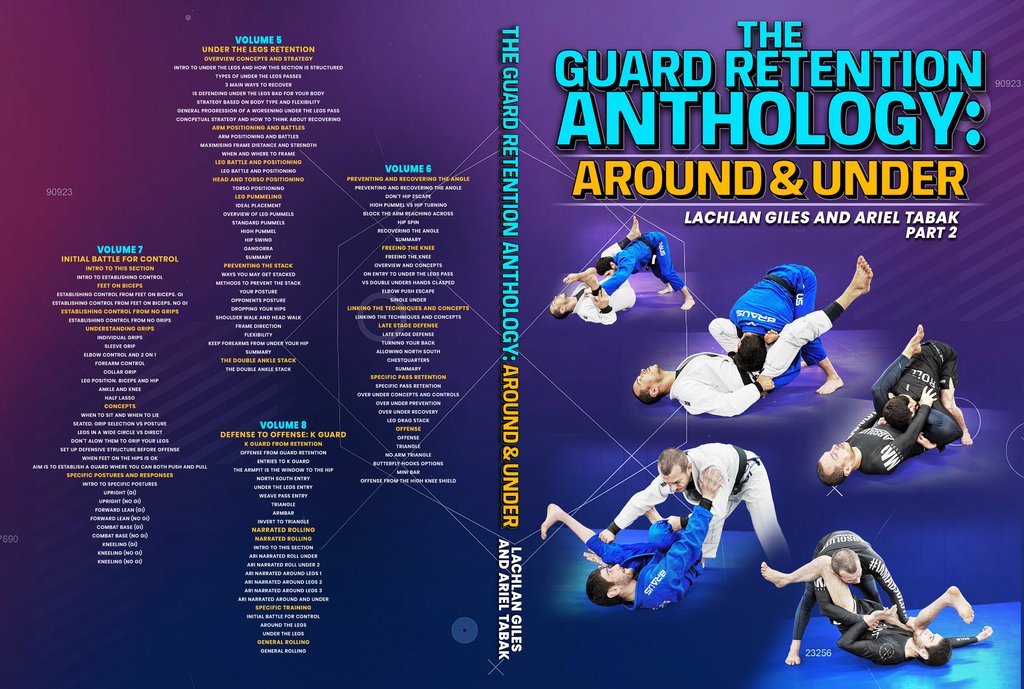
Guard Retention Anthology: Around And Under DVD Review

From what I wrote so far, it is obvious that this is another 8-part DVD. It also means you’ll need to spend a year or so trying to figure where everything fits if you’re dead set on following the DVD’s intended learning path. The beauty is, though, that you can also just use cretin chapters, and connect them with different ones from another DVD if you like that approach more. Lachlan’s organizational system allows for a really interactive way of learning from this instructional.

General Concepts

The Guard Retention  Anthology Lachlan Giles Instructional DVD begins with an introduction and an overview of what is inside the series. In the opening few chapters, Giles covers things like what guard retention is and why it is important. he also shares his advice on how best to use his instructional.

As far as the general concepts go, Giles has several stages that explain how a guard works, and how you can set up to prevent people from breaking through it. He talks about layers of guard, posture, the role of the hips, framing, and all the other things you think you know about guard retention. He also shares the “don’t” of the guard in BJJ: don’t let your opponent hug the head, don’t let them pin your leg, and don’t let them in your inside space. These three alone will change how you approach guard retention for the foreseeable future.

Hip escape variations, leg and arm pummels and some late-stage options wrap the first part of the DVD up.

Key Movements

Guard retention is not a passive thing. Given that you’re only retaining when an opponent is trying to pass, that means you’ll be in motion all the time you’re trying to fend off attacks. It also means your movements need to be purposeful and precise, rather than instinctive. or so Giles claims. To achieve this, he turns to things like pummels, inversions, leg dabs, the gangorra, and elbow movement, among others.

Lachlan also shares the flexibility requirements of guard retention, which is a question often heard in relation to that subject matter. Instead of trying to explain how much flexibility you need, Giles covers the types of motion you need to improve your range of motion, mostly in the hips, knees, and spine.

Around The Legs 1

In terms of how Lachlan likes to retain guard, there are two main directions. one is around the legs, and the other is under them. In the third and fourth volumes of the Guard Retention Anthology, he focuses on retaining guard around the legs. What that means is that you choose a side, or one is chosen by the partner’s means of passing, and you retain guard by staying on the outside of your opponent. Giles suggests choosing a side very early so that you can control the entire exchange.

Leg pummeling and leg crossovers are the main methods of choice here, movement-wise. Lachlan offers 4 different types of crossovers and some interesting pummel options before talking about which way you need to be facing when retaining guard. The options are to face in, towards the opponent, or out. In both cases, there are options that include the aforementioned pummels and crossovers, providing you with an easy to follow the system.

Around The Legs 2

Marking the halfway point of the Lachlan Giles Instructional DVD is another volume with information on training around the legs. Interestingly enough, there’s a portion on North-South retentions here, or better said inverted guard retention tactics.

Giles also focuses a lot on specific pass prevention by going around the legs here. Mostly, he focuses on the bullfighter (Torreando) ass, but he also talks about leg drags, leg pins, arm throws, etc. One of the most interesting aspects is late-stage escapes, in moments when all hope seems lost. In the end, Giles connects everything by explaining how all the information in this DVD so far connects in a system.

Under The Legs 1

As mentioned, the second general direction of Lachlan Giles’ guard retention system is ging under the legs. Once again the strategy and overview of the system comes first, with a look into going under, ways to recover, how much stress this type of retention places on your body, and general progression of the moves and techniques.

There are three types of battles that Giles goes over in this portion of the Guard retention Anthology DVD: Arm battles, leg battles, and head and torso positioning. Whoever wins all there, will definitely get what they’re after. In the case of the bottom person, that would be under the legs retention. Chapters include framing, distancing, using strength,  as well as lots of posture talk and leg angles.

A section on leg pummeling follows, exploring leg placement and the ideal ways of moving your legs so that you maximize the power of pummeling.

The final section is on preventing stack passes. Concluding the fifth volume of the Lachlan Giles Instructional DVD, you’ll learn different ways of avoiding the stack by manipulating your posture and that of the opponents, dropping your hips, walking on shoulders and head, and other interesting things you’ve probably never considered before.

Under The Legs 2

The second portion of the under the legs guard retention puzzle goes deeper into the realm of BJJ techniques. At first, Giles explores the angle which will help you prevent the guard passing and recover the guard with ease. The most important chapter here has to be the one on not hip escaping. Pummels and reach over as are the methods of choice, and it will all make sense once you hear what Lachlan has to say.

A section on freeing the knee follows, which is just as important as anything else you’ll see in this DVD. It has to do with leg drag passes and double and single under passes mostly.

The second half of this portion helps you link everything together. It is all about specific pass prevention, retaining guard against the over under, and leg drag pass. The inevitable and highly useful late-stage defense tactics appear once again, this time in the context of retaining under the legs. Defenses include even turning your back, but that’s something you’ll have to hear and see Lachlan explain.

A few offensive options (triangles, mini bars and butterfly hooks) wrap this volume of the Guard Retention Anthology DVD up.

The Battle For Control

REVIEW: Guard Retention Anthology Lachlan Giles Instructional DVD 1The penultimate portion of the Guard Retention Anthology Lachlan Giles instructional DVD has to do with establishing control over an opponent before guard retention even begins. There are different modalities of establishing control, and Lachlan goes over everything very methodically. From feet on biceps, through a comprehensive section on understanding grips, all the way to key concepts that include when to sit, and when to lie, and prevent key grips for your opponents.

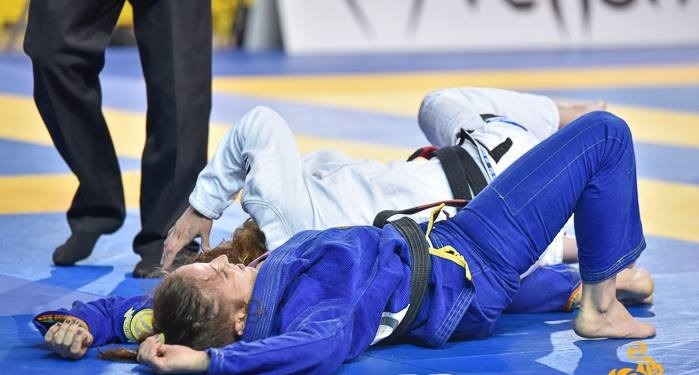
A very important part of the entire instructional is the last portion in this volume, covering specific postures and responses. Lachlan covers being upright, leaning forward, using combat base, and several forms of kneeling and does so in both Gi and No-Gi.

Going On The Offense

Turning defense into offense is why we have the guard in BJJ in the first place .there’d be no point in just retaining guard all day. The guard of choice for Giles to make this transition is the K guard. He demonstrates first how you get it from guard retention practices, and goes into offense straight away. Offensive options covered are triangles and armbars, as well as plenty of ways to get to the guard form different passes.

As usual, the Guard Retention Anthology Lachlan Giles Instructional DVD wraps up with specific training and narrated rolling, organized into rolls according to the methodologies used (under or around the legs).

Final Words

Once again, Lachlan proves why he is one of the best coaches of today, and a man we’ll be looking to of answers for years to come. The Guard Retention Anthology is a real masterpiece, completely deconstructing one of the most fundamental aspects of Brazilian Jiu-Jitsu. This Lachlan Giles Instructional DVD is for everyone, and I mean everyone, given that nobody can do BJJ without understanding guard retention.

ON SALE HERE:
Lachlan Giles – Guard Retention Anthology

REVIEW: Guard Retention Anthology Lachlan Giles Instructional DVD
Techniques List

BJJ Overtraining: How To Know If You’re Grappling Too Much

BJJ Overtraining: When to know you'er doing to much grappling

How much Brazilian Jiu-Jitsu are you training? Is it enough? These are questions you’ve probably asked yourself, your instructor, and most of your teammates. However, it is the question others, mostly in the form of parents and/or significant others are asking that we should really pay attention to. You know what I’m talking about; it’s that pesky “don’t you think you’re training too much?” question. BJJ overtraining is not just possible, it is probable that you’ll experience it on at least several occasions. How do you go recognize it and what can you do to reverse the effects? Read on.

BJJ overtraining is something we barely mention when we train. We don’t like to think that there’s such a thing as too much Brazilian Jiu-Jitsu. Our bodies, though, and after a certain point, our minds, tend to disagree. Sometimes (just sometimes) it is better to take into account what others tell us, especially when more than one person says we’re doing too much work. All jokes aside, overtraining is a real thing, and not something that only weight lifters experience. In fact, BJJ overtraining can be a lot worse on both the body and mind than any other type of physical training.

What The Heck Is BJJ Overtraining?

In terms of athletic overtraining, there are definitions that include a lot of fancy medical talk, like the sympathetic and parasympathetic nervous system, mental burnouts, and the likes. It is all true, but you don’t need to go about learning medicine and psychology in order to figure out if you’re doing too much work. The symptoms, of BJJ overtraining, as similar as they are to those of athletic overtraining, do have some specific aspects that are unique to them.

bjj overtrainingBJJ overtraining doesn’t always have to do with how many times a week your train. You could train every day of the week and never experience overtraining or fatigue symptoms. It also doesn’t have to do with hitting a plateau, at least not always. Mostly it is about intensity, and the type of BJJ classes you’re taking that will define whether you’re overtraining, and more importantly, how far “gone” you are.  Jiu-Jitsu is difficult even if it the only thing you’re doing in a day, let alone if you’re juggling every other aspect of life.
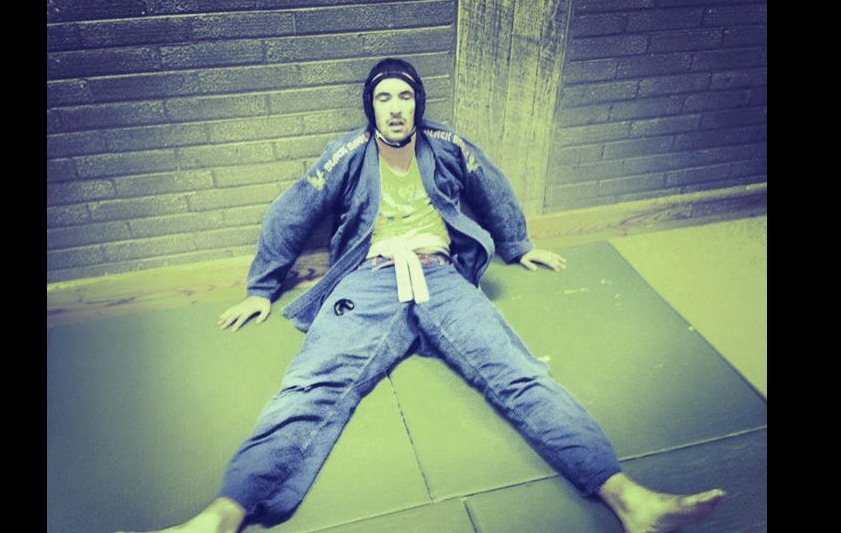
We’ll talk more about the “symptoms” of BJJ overtraining later, but the important thing to know now is that you’ll be the first to notice something not quite right. When others start telling you you’re doing too much Jiu-Jitsu, you’re already in an overtrained state.  Simply put, overtraining has to do with those periods when you’re starting to feel “off” in everything you’re’ doing, from rolling to technical work, and even drills. Timing, selection of responses, your desire to train, the ability to retain knowledge, or communicate to teach will all start to suffer as you’re nearing, and entering burnout.

Recognizing You Need A Break

As a grappler, I can tell you that the hardest thing about BJJ overtraining is not recognizing it. The hardest thing is accepting it, and looking to solve it, even if it involves staying off the mats.  The signs of doing too much grappling can be subtle, or they can be really pronounced. It is different for everyone, but there are common areas in which you’ll notice that hinges aren’t going exactly as planned. Here’s where you’ll start to notice changes first:

System Overload

Are you able to retain knowledge from class? If you’re suffering from an informational overload in terms of technical information, nomenclature, or concepts/ideas, you are most likely trying to take in too much too quickly. Of course, we have to factor in the teaching style and academy approach. However, if you’ve been doing great, and are now finding it more difficult to cope with the information, it is perhaps down to you spending too much time on the mats. Especially if you notice you learn less by spending more hours in the gym, as opposed to before.

Progress Stalling

As expected, if you can’t process information, you won’t be able to add to your game and progress in Jiu-Jitsu. Progress stalling doesn’t always have to do with BJJ overtraining, though, However, when it ties in with other things you notice here, like trouble retailing information, the physical, mental and emotional aspect s of it, you can be sure you’ve crossed the point of diminishing returns.

Aches And Pains

Remember how you felt when you started training Brazilian Jiu-Jitsu? Moreover, all your competitors out there, do you remember how that first competition felt? Well, if you’re experiencing similar aches and pains of unknown original across your body, without any apparent reason, you can chalk it up to overtraining. Even more so, if you’re feeling like that on days off, or during your day when you’re not training, you can safely assume you need a break.

Mental State

bjj overtraining symptomsSomething that clearly going to change when you do too much Jiu-Jitsu will be your mood. Getting cranky, annoyed at teammates, letting your ego emerge during rolls, getting angry about moves not working, failing at escapes because you’re not thinking about what you’re doing, etc. are all things that indicate you need a break. While we might have a bad day on the mat from time to time, the goal is to have fun and feel great about it while we’re training. Having mood swings, and or anything of the symptoms above just means you need to consider overtraining as the cause.
Energy Levels

This is huge. People often attribute nutrition, supplemental training, or even daily activities as the causes of low energy levels on the mats. However, if your energy levels are fine outside the gym, but are going down with no explanation when you’re training, you need to be honest about it with yourself. Spending too much time on the mats can result in you not enjoying training. If you’re overtrained, both your body and your mind will be trying to tell you to stay away from whatever is making them tired, hence no energy to partake in grappling activities.

Mat Performance

Last but not least, mat performance is probably the biggest indicator in terms of BJJ overtraining. If you do too much BJJ you’ll start to think too much in exchanges,. It ties in with system overload and the mental state. The result will be an inability to apply techniques when rolling, and/or missing key moments of technical practice. If you can’t get your favorite submission on anyone anymore, it is not that everyone in the gym progressed at the same time. It is more likely down to you, and your body trying to let you know that you are spending way too much time doing the same thing over and over again.

The Obvious Solution(s)

How do you recover from BJJ overtraining? Easy. Stop with training entirely, A couple of weeks is the least amount of time you should spend away from the mats. Yes it will be hard, yes you’ll have withdrawal symptoms the first few days, but it is absolutely mandatory.

Speaking of taking time off BJJ, I mean taking time off everything BJJ related. No videos and DVDs, no podcasts, no BJJ books, no solo drills at home. Instead, focus on something different you enjoy doing. Maybe hike, try yoga, go to a spa, have fun in a sauna, cook, hike, or simply catch up on every episode you’ve missed on Netflix. Recover doesn’t have to be foam rolling and stretching, especially given that your mind and endocrine system need a break on top of your muscles.

Managing stress, eating well, trying to spend some time outdoors, traveling, spending time with family are all great ways of letting your body “detox” from BJJ for a short while. While you’re at it, try and figure out a training schedule for when you come back that will prevent you from going straight into overtraining again. Instead, schedule days off, try and figure out how to manage intensity, or just drop a class or two you’re taking at the moment. You’ll never learn BJJ anyway, as it is an endless thing that’s too much for a lifetime. Instead, focus on enjoying it as much as you can.

Closing Thoughts

BJJ overtraining is not something you can hope will pass. It is also not something that you can never experience. It is as much a part of the game as injuries, bad days on the mats, and training plateaus are. That just means that you’ll need to manage it correctly so that it doesn’t’ impede your progress in the long term. All it takes is the guts to resist going to training the first few times.


BJJ Challenge Gone Wrong: A Modern Day Gracie Challenge Match Taken Too Far!

Modern day BJJ, Jiu Jitsu Gracie challenge taken too far

Brazilian Jiu-Jitsu is all about respect, great vibes on the mats, people having fun, and looking out for each other even when competing. Until it is not. We all know Jiu-Jitsu is the absolute best option you have for self-defense, as long as you’re not facing multiple attackers. We all know how BJJ actually became popular – The Gracie Challenge match. Nowadays we look at them as entertainment videos, give that such occurrences are not very common. However, every now and then someone thinks they can challenge a BJJ instructor to a match. A BJJ challenge match today will have pretty much the same outcome as before, but how far can a trained grappler go against an untrained one?

Grappling certainly gives us an edge over most other martial artists, but when it comes to facing untrained people, BJJ just makes things completely unfair. Being the aggressor is never smart, and most ripples aren’t really that type of person anyway. However, it would be dumb not to use your skills if they were ever called upon, whether it is the streets or a Gracie challenge match type of situation. That said, a BJJ challenge match and a street fight are two very different things, and turning a challenge into a brawl is not really what Jiu-Jitsu is about… usually.

The Gracie Challenge Legacy

The history of the sport of Brazilian Jiu-Jitsu is a violent one. For that matter, the history of any martial art that is worth mentioning is also a violent one. Some of the oldest martial arts came to be mostly as a result of battlefield requirements. While the Gracies didn’t have to wage war the way the Samurai did when developing Brazilian Jiu-Jitsu, they certainly didn’t go about it in the Aikido style.

What the Gracies did was to use challenge matches to showcase how powerful Brazilian Jiu-Jitsu is. They went about through newspapers, issuing an open challenge to anyone to come and fight them in No Holds Barred type of matches. Given that nobody knew what BJJ was all about, and people had never seen anyone fight off their back. The matches were violent affairs with punches and kicks thrown in between all the grappling that happened. It did help popularize the art throughout Brazil, giving it its first real “boost.”

The second time BJJ Challenge matches came about was when Rorion went to the USA and established his Gracie garage. While he had students training there anyway, the way he went about promoting it was the Gracie challenge match way again. This time, Rorion refrained from actually hurting people, and instructed his students to only slap them with open palms in addition to grappling, with no kicks or punches allowed. His idea was to recruit the defeated challengers as students and it worked like e charm. That is how BJJ became famous in the USA (along with the UFC), and eventually, became the global phenomenon we know today.

A Modern Day BJJ Challenge Gone Very Wrong

In modern times there are a few examples of BJJ challenge matches that took place when folks storm gyms, looking to challenge the instructor. The latest example of this comes from a Checkmat gym, and apart from a couple of videos showing the challenge itself, and the aftermath, there’s not much known on what lead to the challenge.

The story seems to be the usual one – a man, big muscles and all, claiming to be a fighter walks into a BJJ gym and challenges the instructor. The instructor, of course, obliges. There’s nothing at the start of the match (so far) though, as the first video begins with the bulky challenger caught in the bottom of half guard. It just seems like the ordinary BJJ challenge match at that point with the instructor clearly dominating the bottom person with ease. That is when things take a turn for the worse, even by Gracie Challenge match standards.

The mandatory slaps are once again not something we haven’t seen in modern-day BJJ challenges. It is just the way Rorion did it. However, at one point, after begin slapped several times, the bottom person just says to the instructor “I guess you can finish me as well”, at which the instructor replies “no, no, just fight, there’s o backing out”. He then proceeds to put pressure on the guy, who exclaims “I can’t breathe”. Once again, the instructor brushes him off by saying “I don’t care”. Not your typical attitude during such an occasion and things only get worse from there.

  • Getting Hard To Watch

The instructor proceeds to mount and eventually takes the guy’s back, establishing a rear-naked choke with ease. The guy starts tapping, to which the instructor replies “do not tap, we’re not there yet where you tap” and proceeds to torture the guy, whose breathing gets heavier and heavier by the second. With panic all over the man’s face, he turns discretely to his belly, which is a huge mistake. The instructor proceeds to strangle him, never going completely to the end, while the guy taps again. The instructor doesn’t let go.

The video gets really hard to watch after this point The big guy tries to stand up but can’t and all he manages is crawl outside of the mat area, being strangled all the time. He barely manages to utter “please, please please, please stop” as the video ends, and the guy on his back showing no intention of letting him go.

  • Taking Things Way Too Far

But it is far from over. A second video follows the first one, where we can see that the instructor finally letting the “challenger” go, and he is exhausted from being strangled. The instructor then proceeds to strike the guy, but this time it is punches and hammer fists. The guy is clearly out of it and completely unable to defend himself. However, the striking doesn’t stop and more punches are followed by head stomps and soccer kicks. The big guy tries to cover up, but that doesn’t help him much.

At one point, the kicks stop and he is able to barely stand on his feet, trying to find the door that leads out of the gym. The instructor then comes up to him, telling him to get out and throwing what appears to be his stuff out. The guy though, inexplicably actually walks back towards the mats. After resting at an armchair for a while, though, he picks a few more of his things and leaves, although remains seated right outside the gym, as the video indicates.

The instructor accompanies him out and can be heard saying “Another day when you’re a better man, we’ll be best friends”. Later, as the video still goes on, the instructor can be heard talking to the camera guy that the big guy came claiming to be a professional fighter, and actually threw a punch first.

How Far Would You Go?                              

The thing with this BJJ challenge is not that the guy got beat up. That is the point of a challenge match after all. It is how much he got beaten up, and the manner in which it happened. While we haven’t really seen every Gracie challenge match, especially those from the old days, those that we have seen none went into as much violence as this 2020 edition.

The thing is, we have no idea what led up to the beating, because it wasn’t really a match from the get-go, as the guy had no idea what he was doing. It depends a lot on what happened leading up to the match, and there might be justification for the instructor’s actions, but only up to a certain point. Some of those kicks and stomps were really out of order, as was the constant choking that went on for quite some time. I can’t presume to know what it feels like to be in that situation, but the question remains, how far would you take a BJJ challenge match?

Wrapping Up

Every story has two sides to it (at the very least). While it is unclear how and why the guy chose that gym and that instructor to challenge, we’d certainly love to hear the instructor’s side of things. We all love watching modern-day Gracie challenge match style videos like this, but after a certain point, this one gets really hard to watch. Knowing how chill grapplers usually are, the question beckons what prompted the guy to unleash so much rage on the “challenger”? We hope to hear his side of the story, and will update the article as soon as we get it!

Academy Explains What Really Happened In The “BJJ Dojo Storm” Incident