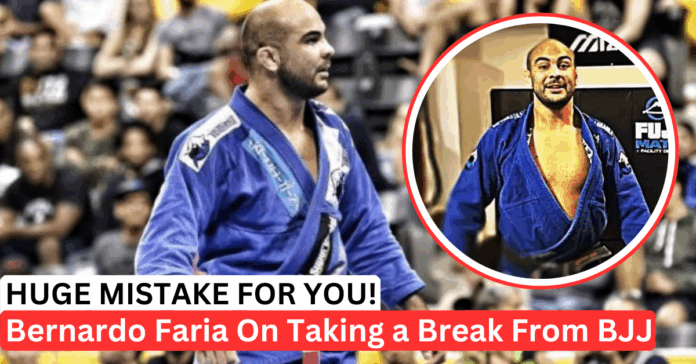
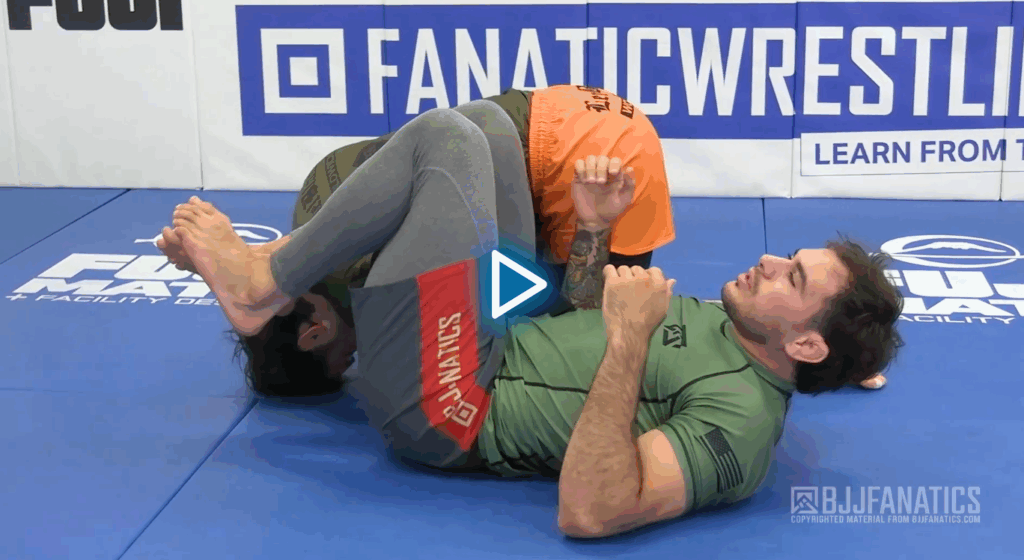
In new clips and posts, Bernardo Faria biggest mistake is to quit BJJ for “a couple of months”—he says short breaks wreck momentum and raise injury risk on return.
The message is resonating across platforms because it’s simple, uncomfortable, and true for hobbyists: consistency beats willpower.
Faria urges students who must pause to keep a “minimum dose” connection so coming back isn’t starting over.
Why Short Breaks Blow Up Your Progress
The heart of the message is brutal in its simplicity: those “I’ll be back after summer” breaks are where progress goes to die.
Faria argues that even a few months off erases timing, dulls reactions, and turns the first sessions back into a shock to the system—exactly when people get discouraged or injured.
That’s why the Bernardo Faria biggest mistake is to quit BJJ line hit like a headline; it names the trap most students fall into when life crowds the calendar.
“In my humble opinion, the biggest mistake in Jiu-Jitsu is ‘quitting’ for a few months or years. I totally understand that sometimes life happens… but when you stop, coming back becomes ten times harder.” – Bernardo Faria –
He doesn’t scold; he diagnoses. You don’t lose “strength” so much as you lose jiu-jitsu-specific movement—hip mobility, connection, frames, the quiet timing that makes techniques safe and efficient.
The first week back feels foreign, your confidence dips, and now the couch is winning.
What Bernardo Actually Says (And Why It’s Hitting Nerves)
Faria’s posts stack two ideas. First: momentum is everything. Second: if you absolutely must step away, don’t sever the cord.
The Bernardo Faria biggest mistake is to quit BJJ refrain lands because it’s not motivation fluff; it’s a career-long data point from someone who’s lived both championship peaks and civilian schedules.
“Sometimes you’ll be forced to take a break from Jiu-Jitsu… but don’t ‘quit’ for months. Keep a tiny connection so you don’t feel like a beginner when you return.” – Bernardo Faria –
In comment sections, you can feel the sting: people who planned a “short pause” describe how two months turned into a year—and a purple belt turned into a ghost. That’s the audience he’s grabbing by the collar.
The Minimum Dose That Saves Your Jiu-Jitsu
Faria’s fix isn’t macho; it’s practical. If work, family, injury, or money forces a slowdown, shrink the session—don’t erase the habit. Keep the neural groove alive so the first week back feels like a continuation, not a restart.
In practice, that means: a 30-minute open mat once a week, a handful of solo movement rounds at home, a short drill list you can run in ten minutes, or a single technical private over two weeks.
The goal isn’t “gains”; it’s friction reduction—making the return easy enough that BJJ consistency reappears on its own.
Tie that to the Bernardo Faria biggest mistake is to quit BJJ thesis and you’ve got a retention plan: less pressure, fewer excuses, and a routine that’s ready to scale when life loosens.
Coaches: Make It Easier Not To Disappear
Rooms can hard-wire this idea. Publish a “busy month” track with shorter classes and drill-only options. Offer return-to-mat on-ramps after layoffs (light positional rounds; no winner-take-all rolls for two weeks).
Encourage partner check-ins for students who vanish and celebrate streaks as loudly as stripes. The signal you want to send is the Bernardo Faria advice: don’t quit—even when you can’t train much.
“If you stop, you lose timing and your body forgets the movements… that’s when people get hurt coming back. Keep touching the mat.” – Bernardo Faria –
It’s not just retention math; it’s safety. Coming back after a layoff, too hard, too cold, is where elbows and ribs pay the bill.
Quit Less, Progress More
Strip away the virality and the takeaway is clean. The Bernardo Faria biggest mistake is to quit BJJ warning isn’t gatekeeping—it’s harm reduction for your goals. A tiny, imperfect cadence beats the perfect plan you never run.
If life clamps down, make the mat smaller, not absent. Keep one class, one drill block, one open mat, one coaching text. Do that, and “I’ll be back after summer” becomes “I never really left.”
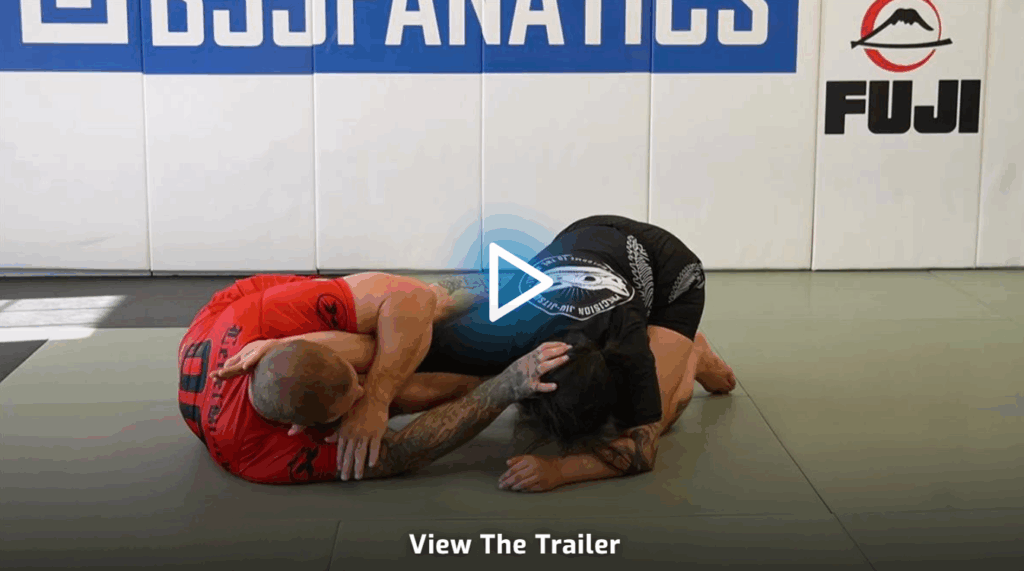
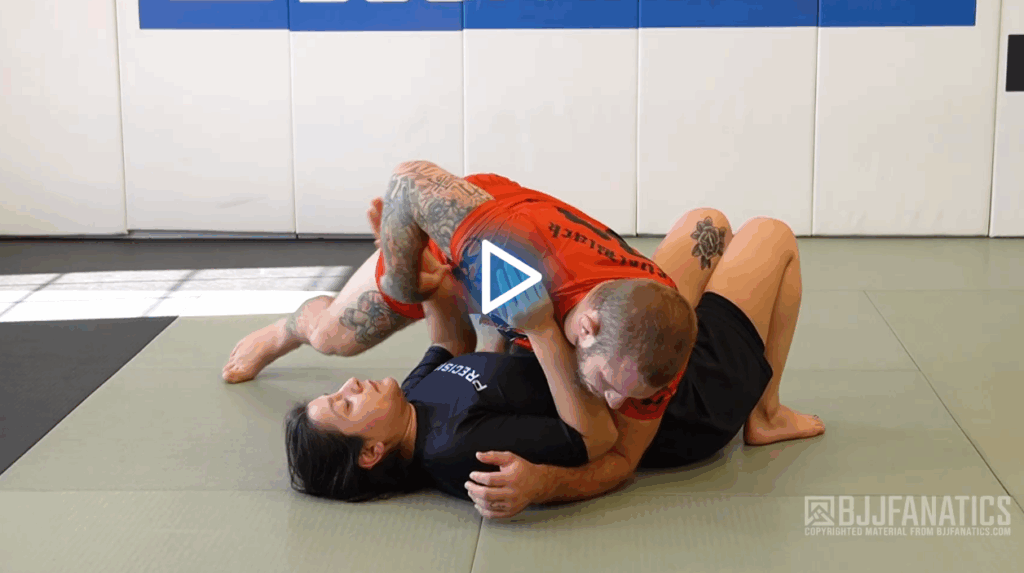
The Precision Top Stuff Shawn Melanson DVD sets out a practical blueprint for building a suffocating, efficient top game. Across two volumes, Shaw organizes Side Control and Mount attacks into clean progressions that connect position, pressure, and finishes.
If you’ve seen his “Air Jail” clips, this instructional explains how he arrives at that kind of stuck-to-you control—and how to reproduce it without being bigger or faster. It’s all about mount and side control, with plenty of options you likely haven’t seen before.
Be on Top, Stay on Top
Top pressure is more than leaning; it’s about angles, frames, and denying escapes before they start. The Precision Top Stuff Shawn Melanson DVD leans into that reality with an approach that prioritizes pin stability and positional awareness first, then adds submissions that appear naturally once the opponent’s hips and shoulders are immobilized.
This is the kind of top game that translates across rulesets, making sense in both Gi and No-Gi. As a Shawn Melanson DVD review target, the big win is structure: you’re not learning one-off techniques—you’re getting a hierarchy of control that anticipates common reactions and routes you toward high-percentage finishes.
Chris Hauterers said it best: be the guy on top and once you’re there, stay on top for as long as possible! It’s a cardinal rule/principle of Jiu-Jitsu that transcends rulesets, whether you’re rolling Gi or No-Gi or competing locally or as a pro.
Shawn Melanson: From BJJ to MMA and Back
Shawn Melanson is the head coach at Precision Jiu-Jitsu in Hudson, New Hampshire. His path into Jiu-Jitsu started young—weekend family gatherings with older cousins who trained meant early exposure to the art. In 2011, he committed to MMA full time, compiling a 3–1 record and earning a #2 regional Featherweight ranking in New England before pivoting to pure Jiu-Jitsu in 2014.
Since then, he’s collected super fights and local titles, establishing himself as one of the region’s respected black belts and an educator with a clear, pressure-first voice. As a coach, Shawn’s emphasis is simple and demanding: deny space, collapse frames, and make top control feel inevitable.
That approach underpins the No-Gi program at Precision Jiu-Jitsu, where he’s focused on building a competition-minded room and passing along lessons from years spent refining “heavy without hurry” mechanics. Away from the mats, he’s a family-first instructor—something his students regularly cite when describing the gym’s tone and culture.
Shawn’s public presence mirrors his teaching priorities. Through a steady stream of short-form videos, he popularized the “Air Jail” concept—clips that highlight micro-adjustments in weight placement and head positioning to neutralize movement.
Complete Precision Top Stuff Shawn Melanson DVD
Before diving into specifics, here’s the roadmap: Volume 1 of the Precision Top Stuff Shawn Melanson DVD establishes Side Control fundamentals and the core pressure cues that collapse frames and open clean lanes to Mount or immediate finishes.
Volume 2 builds on that foundation from Mount, layering head-and-arm mechanics, triangle and ude-gatame pivots, and kimura-family dilemmas to create a reliable checkmate cycle.
Across both volumes, the same grips, head placement, and weight shifts repeat by design—so the movements you drill in part 1 pay off instantly when you transition to the sequences in the second part.
Volume 1 – Side Control Action
Volume 1 builds the Side Control foundation and shows how thoughtful pressure creates submission opportunities without frantic movement. It opens with positional essentials—hand/hip orientation and shoulder control—then moves directly into an armbar sequence.
From there, Shawn layers an armbar to bicep-slicer option when the initial finish stalls, followed by details for closing the armbar efficiently. The middle section introduces ude-gatame (top-side arm lock) in multiple entries: from standard Side Control, via a turn on the near-side arm, and again with a top-side emphasis that keeps your base steady while you isolate the limb.
A key moment in this portion of the Precision Top Stuff Shawn Melanson DVD is the lowdown on pushing the top frame across the body, which collapses defensive frames and exposes the head-and-arm lane or the near-side arm. There’s also a smart no-arm Side Control triangle that punishes elbows-in framing without needing to step around the head.
The chapter closes by linking same-side armbars and a clean transition to Mount—teaching you to treat Side Control as a holding pattern that feeds your Mount attacks rather than a resting point. If you’re implementing the Precision Top Stuff Shawn Melanson DVD step by step, this first volume is your map for getting sticky, killing frames, and funnelling to finishes or Mount without giving escape space.
Volume 2 – The Mount of Doom
Volume 2 capitalizes on the Mount you earned in Volume 1. It starts with the head-and-arm route—how to pin the near-side shoulder, connect your head position, and build pressure patiently until the submission is ready.
From there, the mounted triangle offers a powerful answer to elbow-in defense; the series even covers flowing to ude-gatame when the triangle becomes a control position rather than a finish. A standout chapter is the kimura / straight armlock / Americana dilemma, which lays out a three-way fork that forces the bottom player to concede something.
The S-Mount armbar segment refines knee placement, hips, and angle so you don’t need to dive recklessly. Less common, but very welcome, are the smother choke and a guillotine entry that make sense when opponents turn or reach; these give you immediate punishment for panicked movement.
The back half of the Precision Top Stuff Shawn Melanson DVD addresses transitions: North-South to back exposure, a one-handed kimura that keeps your base under you, and a North-South kimura finish that feels like a natural endpoint after heavy chest-to-chest control.
The volume closes with a tidy summary, leaving you with a connected chain: Mount pressure → dilemmas → finish or back exposure. Practically speaking, this is where the Precision Top Stuff Shawn Melanson DVD turns from “good pressure” into a consistent checkmate machine.
Surfing the Top With Pressure
Implementation is straightforward: dedicate specific rounds to Side Control isolation, then to Mount isolation, and only later blend the two. A useful drill block is three minutes of Side Control where your goal is to pass the elbow line and set ude-gatame or same-side armbar without chasing speed; then reset.
Next, run Mount rounds where you alternate head-and-arm entries with the kimura/straight-arm/Americana fork every thirty seconds. Keep a notebook for cues like “top frame across body,” “hip line higher than their diaphragm,” and “no-space transitions.”
The Precision Top Stuff Shawn Melanson DVD benefits from slow-to-fast layering: learn to hold with micro-adjustments first, then add the submissions. If you teach, the chapter order doubles as a class plan—Side Control controls on day one, follow-ups on day two, then Mount dilemmas and submissions across the week.
White and blue belts will appreciate how the system reduces decision fatigue: establish control, break frames, and progress to Mount before hunting finishes.
Purple and brown belts will get the most from the sequencing—especially the triangle-to-ude-gatame pivots and the North-South links to the back. Black belts will find small gems in weight distribution, head placement, and grip choices that tighten already-good fundamentals.
Competitors who prefer methodical control, as well as coaches who want predictable curricula, will likely get the best return. If your game leans on timing more than explosiveness, the Shawn Melanson Top Stuff DVD fits neatly into your toolkit.
Pros & Potential Drawbacks
Pros:
Clear two-volume progression from Side Control to Mount that you can adopt as a weekly class plan.
Emphasis on weight distribution and frame denial helps smaller athletes impose control.
Multiple finishes from the same setups (e.g., armbar → bicep slicer; triangle → ude-gatame) teach real-world branching.
Practical transitions (North-South to back, S-Mount entries) that maintain pressure rather than gamble on speed.
Good mix of classic fundamentals with a few modern touches (smother choke, one-handed kimura) to keep opponents honest.
Terminology and sequencing translate well between Gi and No-Gi.
Potential Drawbacks:
The focus is mostly on established top-control staples; guard-passing entries are discussed implicitly through pressure rather than as a separate passing system.
If you’re hunting a deep dive on back-take trees or leg entanglements, those are secondary to Side Control/Mount priorities here.
Some chapters assume familiarity with basic Mount maintenance; true beginners may need extra reps before the dilemmas click.
(One more strategic Pro for searchers: the Top Stuff Shawn Melanson DVD structures your study time efficiently—less hunting, more drilling.)
Slice & Smother
This is a cohesive, pressure-first blueprint for turning Side Control and Mount into reliable finishing hubs. The two-volume structure teaches you to break frames methodically, use head-and-arm mechanics to suffocate movement, and branch into armbars, kimuras, triangles, and guillotines without sacrificing control.
It’s not a grand tour of every top option; it’s the core lanes that work across Gi and No-Gi, laid out in an order you can train tomorrow. For grapplers who want to feel inevitable on top—and coaches who need a repeatable plan—the Precision Top Stuff Shawn Melanson DVD delivers. Final word: targeted, efficient, and worth the mat time it will inspire.
In back-to-back posts, Sean Strickland urges parents to hit kids, saying today’s parents “ruined smacking” and that it’s “ok” to hit children.
The Sean Strickland smacking comments triggered an immediate backlash/amplification loop across X and MMA meme pages, reigniting debate over the fighter’s public persona and the sport’s optics.
The rhetoric collides with Strickland’s long, public history discussing childhood violence—raising fresh questions about shock-marketing vs. responsibility for a UFC name.
The Posts That Lit The Fuse
The sequence was short and inflammatory. First came a late-night volley framing corporal punishment as a fix for “asshole” kids, followed by a second post doubling down—this time spelling out that hitting children was “ok.”
Packaging it inside the familiar Strickland patter—casual profanity, sweeping blame, a jab at “my generation”—ensured the lines were built to be screenshotted and shared.
Within minutes, fight accounts and meme pages had clipped the wording and passed it around.
“My generation ruined smacking your kids… Fast forward y’all raising a bunch of assholes because ‘I don’t want to be like my dad’ — hit them f**king kids!!!!!!!!” – Sean Strickland –
As the posts ricocheted, the headline writes itself: Sean Strickland urges parents to hit kids, in his own words and on his official accounts.
My generation ruined smacking your kids…
A lot of us didnt get smacked for being bad kids,we got smacked for a bad day at work
Fast forward yall raising a bunch of assholes because "I dont want to be like my dad" hit them fucking kids!!!!!!!!
On its face, this is another example of Strickland using provocation to keep his name in the feed. But the message lands differently because of who’s saying it. Strickland has repeatedly referenced a violent upbringing, including incidents he has described as abuse.
That autobiographical backdrop is part of why his latest broadside traveled so far, so fast: the dissonance between a UFC fighter who has publicly processed childhood harm and a celebrity now telling parents to hit their kids is glaring, even for a sport calibrated to high-decibel talk.
“The only solution at this point is smacking parents… But seriously hit your kids.. It’s ok…..” – Sean Strickland –
The result is a familiar split. One lane of replies applauds the “old-school” stance and blames “soft parenting” for social decay.
The other rejects the idea outright—on ethics, legality, or simple optics—arguing that a UFC face normalizing violence in a parenting context risks bleeding into the sport’s mainstream image.
From X To Aggregators In Minutes
The mechanics of the blow-up are now routine in fight media. A four-sentence post becomes the day’s discourse because the phrasing is meme-ready and the author is high-profile.
Within an hour, the “Sean Strickland urges parents to hit kids” pull quote was plastered across aggregator timelines, MMA meme hubs, and regional fight pages. Some framed it as “Strickland being Strickland.”
Others paired the text with older clips and captions to suggest a pattern. Either way, the multiplier effect kicked in: every re-post repackaged the story for a slightly different audience, guaranteeing another round of reactions and a fresh surge of reach.
Free Speech, Brand Speech, And The UFC Problem
Every time Strickland detonates a line like this, two conversations run in parallel. The first is about speech—his right to say it, your right to clap back.
The second is about brand stewardship: at what point do a fighter’s off-the-clock messages become a liability for event partners, sponsors, or the promotion itself?
Sean Strickland urges parents to hit kids is the kind of formulation that jumps from fight Twitter to morning radio and back again. It puts broadcast partners and advertisers in the uncomfortable position of fielding questions they didn’t write but now have to answer for.
There’s also the locker room piece. Fighters and coaches tend to shrug off online storms, but youth programs, gym owners, and regional promoters don’t enjoy the same insulation.
When a UFC name validates hitting children, even rhetorically, those lower-tier operators can end up doing real damage control with parents and community partners who don’t separate “persona” from “policy.”
Viral footage shows a limp fighter out cold trapped under a Von Flue choke while the referee ignores unconscious fighter warnings and urges action.
The official can be heard telling athletes to “be more active” before a belated wave-off, sparking panic online and calls for review.
Promoters now face a safety optics crisis: this is the nightmare scenario every sanctioning body trains to prevent.
The Moment Everyone’s Rewatching In Horror
One sequence turned a regional main card into a global talking point. A tight Von Flue choke collapses the bottom fighter’s resistance—arms go slack, legs stop fighting, eyes glaze.
Instead of a dive-in stoppage, the MMA referee ignores unconscious fighter signals and talks through the position, reportedly instructing both athletes to “be more active” as the out continues. Seconds feel like minutes. Only then does the official step in.
<h5 class=”custom-quote”>“Be more active on the ground.”<br>– The referee, moments before the late stoppage –</h5>
The optics are brutal: a textbook finish, a visibly unresponsive athlete, and an official whose commands suggest he hasn’t recognized what the camera—and the crowd—already have.
“He’s out!” – Cage-side shouts captured on the broadcast –
🔒 VON FLUE CHOKE!
Vašek Klimša 🇨🇿 submits Jessy Joaquim in the very first round at middleweight! #OKTAGON79
If you drafted him in #OKTAGONFANTASY, that earned you ➕4️⃣ points!
“Terrifyingly Late”: When A Miss Becomes A Headline
There are late stoppages, and then there are the clips that bend your stomach. This one, at OKTAGON 79 did both. Within hours, fight media packaged the scene under a single, damning frame: referee ignores unconscious fighter during a choke and keeps the action going.
Fans flooded comment sections with the same fear—someone is going to get killed if this level of inattentiveness reaches a worse position or a slower medical response.
“Fans fear referee will get someone killed after terrifyingly late stoppage.” – Headline language circulating with the clip –
The phrase “terrifyingly late” stuck because it fits the tape. You can freeze-frame the limp; you can count the beats. This isn’t a judgment call on a scrambly TKO. It’s Unconscious 101.
Safety 101: The Checks That Should Have Triggered
Every referee course drills the same cues for blood-choke recognition:
Limping limbs or a sudden, total drop in resistance
Fixed, unfocused eyes and absent hand-fighting
Non-defense in a finishing position (no frames, no hips, no peel)
When any two stack, you step in. When all three stack, you run in. In this clip, the tells are stacked like cordwood. That’s why the referee ignores unconscious fighter framing hit so hard: the missed checklist wasn’t obscure—it was the checklist.
“The man is unconscious and the official is asking for more activity?” – On-air incredulity mirrored in fan reactions –
How A Von Flue-Style Trap Hides Danger In Plain Sight
Choke finishes from top—arm-triangle angles, shoulder-pressure “Von Flue” traps—can trick a casual eye. There’s not always flailing, and the defender often looks “calm” right up until they’re gone.
That’s the job: compress the carotids without chaos. It’s also why referees are taught to change vantage points, check the free hand, and touch the defender when vision is blocked. If your ear tells you nothing and your eyes are screened by hips and shoulders, you step around the headline and look at the face.
This is where the sequence failed. The official stayed talky, not tactile—narrating the exchange while the finish did its quiet work. By the time the halt arrived, the discourse had already outrun the event.
“Fix It Before Someone Gets Hurt”
No promotion wants a “how did this not get stopped?” montage on its ledger. Expect the standard responses to an officiating crisis: internal review of the bout, supervisor feedback for the official, and ref assignment changes while retraining happens.
Rules briefings may get sharpened at the next card—especially around face checks on top-side choke finishes and the authority to err on the side of the defender when visibility is compromised.
If one official can’t or won’t read the simple cues, another official needs that assignment. And if a promotion’s briefing allows for coaching-style chatter over hands-on checks, the briefing needs to change.
A single failure can be a warning. A repeated failure becomes a reputation. This time, the fighter went home. Next time, the stakes don’t get to be a headline.
A modern, No-Gi–oriented omoplata system that treats the position as both a submission and a pin for transitions into back takes, armbars, and leg entries.
Five volumes progress from conditions and counters, to layered finishing mechanics, to positional interplay, and finally to auxiliary submissions and entries.
Strong emphasis on solving real defensive reactions (posture, limp-arm, step-over) and maintaining control under scramble pressure.
Best suited to intermediate–advanced grapplers who already invert, heist, and roll with confidence; beginners can still mine it for grips and angles.
The Omoplata Giancarlo Bodoni DVD promises a complete reframe of one of Jiu-Jitsu’s most underused finishes. Instead of treating the omoplata as a hail-Mary from guard, Bodoni builds it into a position you can hold, pressure, and funnel into multiple endings.
If you’ve been burned by opponents slipping the shoulder or “limp-arming” out, this course aims to make those escapes part of your attack tree. It feels like a blueprint for people who want reliable control and an A-to-Z finishing flow in No-Gi.
The Least Used Bent Armlock These Days
In modern No-Gi, the omoplata often gets overshadowed by leg entanglements and back-chase meta. Bodoni’s pitch is simple: treat omoplata like mount—a dominant, repeatable control that exposes finishes everywhere.
When the position becomes your hub, step-overs, posture breaks, and roll-throughs are no longer problems; they’re prompts that send you to the next branch. That’s the conceptual hook that makes the Omoplata Giancarlo Bodoni DVD feel current rather than nostalgic.
The system here reframes the shoulder trap as a hub that converts common reactions into progress: if the opponent posts or tripods, you transition to sit-up or roll-through finishes; if they step over or limp-arm, you clamp, re-angle, or re-enter.
Because the mechanics prioritize hip line control and rotation of the shoulder rather than a single static finish, you can cycle options without relinquishing dominance. In practice, that means fewer resets, more ride time, and cleaner pathways to the back or armbars.
Nice Guy Giancarlo Bodoni
Giancarlo Bodoni is a black belt under Lucas Lepri who later joined John Danaher’s New Wave team in Austin, Texas. He shocked the world by winning the ADCC World Championship in 2022 at 88 kg and repeated the feat in 2024, cementing himself as one of the era’s elite No-Gi champions.
Beyond the medals, he’s become a standard-bearer for structured, principle-first systems that hold up under world-class resistance. That pedigree is the backbone of this course’s rigor and its focus on pressure, sequencing, and problem-solving.
Bodoni trains full-time under John Danaher and Gordon Ryan in Austin. He has been quietly releasing instructional videos constantly, with a tally that could rival his coaches’ endless DVD release mill. Bodoni’s though, are more down to earth, in both price and material.
Detailed Submission Mastery: Omoplata Giancarlo Bodoni DVD Review
The Omoplata Giancarlo Bodoni DVD is organized as a true system rather than a grab-bag of tricks. Think of it as a start-to-finish roadmap, not just a submission demo.
Across five volumes you’ll learn how to establish omoplata control, progress through layered finishes, connect the position to back takes and other pins, add auxiliary submissions when opponents gum up the shoulder line, and enter from scrambles or wrestling exchanges.
Volume 1 — Building the Conditions
The opener sets the scaffolding: how to create omoplata conditions against common base and posture, and how to recognize when to spin up or clamp down. Core problems—posture, limp-arm, and step-over—are addressed head-on, with mechanical answers that keep your hips heavy and your opponent stuck.
This is where the course first sells the omoplata as position, not just a submission. If you’ve ever lost people to a quick shoulder slip, these counters alone are worth the price of admission.
Volume 2 — Finishing Mechanics
Here the system turns lethal. Bodoni layers a standard finish, heisting finish, roll-through, and hybrids like omoplata-crucifix and monoplata, culminating in a figure-4 variation. The sequencing makes sense: you start with base-case control, then escalate to turning finishes when opponents post, roll, or tripod to escape.
This progression is friendly to competitors who must decide in seconds whether to follow, sit up, or spin to break defensive frames. It’s the beating heart of the Omoplata Giancarlo Bodoni DVD.
Volume 3 — Positional Interplay
Volume 3 of the Omoplata Giancarlo Bodoni DVD ties the omoplata to the rest of your game. You’ll connect to near-side roll → side control, mount, re-omoplata sequences, stack-pass counters, and far-side roll → guillotine routes, plus back takes and “going behind.”
This is where guard players who love to chase the back will grin; the omoplata becomes a back-exposure engine without giving up control. It’s also the volume that makes scramble-heavy rolls feel far less chaotic and more like a guided tour.
Volume 4 — Auxiliary Submissions
Arm attacks bloom naturally from trapped shoulders and broken posture. Bodoni rolls out triangle variations, lat juji (belly-down and backside), and sets up a super cool power kimura from the Omoplata base, The shoulder crunch also features, with plenty of new, and Omoplata-related details.
The message lands: omoplata control is a platform, and armbars are the safety-net when opponents clog standard finishes. If your gym meta is slippery or explosive, having these auxiliary lanes keeps your finishing rate high.
Volume 5 — Entries & Transitional Traps
Finally, entries from chaos: triangle entries, answers off a failed ushiro, body lock, failed double-leg, single-leg, and an inside shoulder-roll route that jumps you straight into upper-body entanglements. Wrestlers and scramblers will love these.
They also ensure the system doesn’t rely on a single guard; you can trigger it from scrambles, standing, or mixed passing-guard exchanges. As a capstone, Volume 5 makes the Omoplata Giancarlo Bodoni DVD feel “complete,” not just a guard-player’s toy.
The Omoplata Trap
Start by drilling the posture, limp-arm, and step-over counters from Volume 1 until you can hold the position for full rounds. Then add one finish from Volume 2 (I recommend the heist) and one auxiliary armbar from Volume 4.
Position-sparring ideas: begin already in omoplata control and require either a clean finish or a stable transition to back control. For live rounds, hunt for entries from single-leg and scramble scenarios so you learn to “see” omoplata in motion, not only from closed or open guard.
Structure your training in three passes:
Pass 1 (Control): from closed or seated guard, enter to omoplata and hold for 20–30 seconds while your partner cycles three escapes—posture, step-over, limp-arm. You win by retaining control, not finishing.
Pass 2 (Two-Option Flow): add one primary finish (e.g., sit-up/heist) and one auxiliary armbar; start from omoplata and require either a finish or a stable back take.
Pass 3 (Live Triggers): begin from single-leg, body-lock, or scramble entries and see the shoulder trap in motion.
Track metrics constantly: retention time, conversion rate to finishes, and back-exposure attempts. Be sure to communicate on shoulder pressure and pulse the finish rather than wrenching through resistance.
The grappling folks that will benefit the most from the Omoplata Giancarlo Bodoni DVD are in the list below (practically everyone bar Gi specialists):
Competitors: You’ll appreciate the pressure-first approach that turns common escapes into predictable branches.
Intermediate hobbyists: The positional view reduces chaos and builds a trustworthy control hub.
Beginners: There’s value here, but expect a learning curve around inversions, hip mobility, and timing.
Coaches: The curriculum’s five-part structure is easy to convert into a month-long class plan.
Pros & Potential Drawbacks
Pros:
Clear problem-solution mapping for the three biggest omoplata defenses.
Multiple finishing families with clean decision-rules.
Rich connections into back takes, armbars, and leg entries.
Potential Drawbacks:
The No-Gi emphasis may leave Gi-specialists wantinvg more lapel-specific grips.
Some transitions presume comfort with rolling finishes and shoulder-line inversion.
Less beginner-oriented than the marketing suggests; it truly shines from blue belt up.
Roll For The Omo
“Submission Mastery” delivers exactly what it claims: a modern, competition-tested framework that turns the omoplata into a reliable control hub with finishing off-ramps in every direction.
If your current approach is “hit it or bail,” this system will change that overnight. The Omoplata Giancarlo Bodoni DVD is a smart investment for guard-hunters, back-chase specialists, and anyone who wants to punish posture inside scrambles.
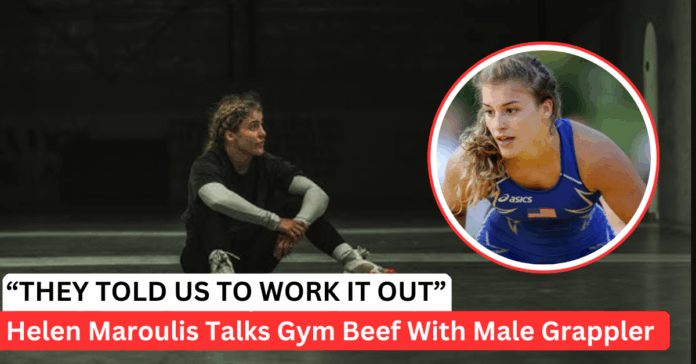
In a Helen Maroulis practice incident, the Olympic champ says a ~152-lb football player got frustrated that he couldn’t escape her pin and then battered her during a live go.
She says coaches told them to “work it out,” and the next exchange escalated beyond a drill.
The account spotlights a live problem in mixed rooms (size/experience gaps, thin boundaries) and the cost when coaches don’t intervene.
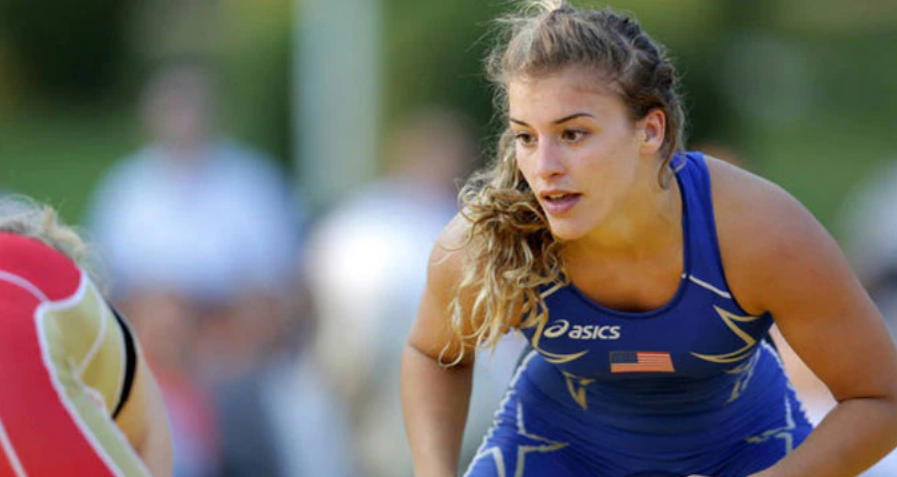
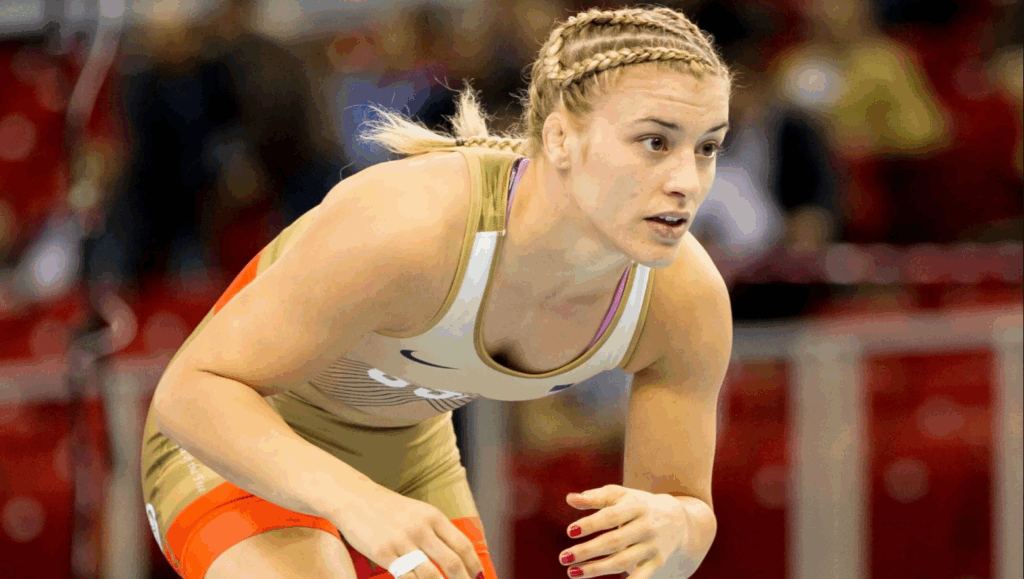
It lands amid Maroulis’s 2025 resurgence after a brief BJJ detour—turning extra scrutiny on training environments for elite women.
“He Couldn’t Get Out—Then He Snapped” — Helen Maroulis Practice Incident
Maroulis’s story isn’t a sparring bruise; it’s a breakdown. In a recent podcast, she recalls pinning a ~152-pound football player in practice, then feeling the switch flip when he couldn’t get free.
“He couldn’t get out [of the pin] and he got mad… the second time he just came at me.” – Helen Maroulis –
Instead of cooling things off or swapping partners, she says coaches told them to “work it out.”
“They told us to work it out.” – Helen Maroulis –
When the round resumed, the energy wasn’t instructional—it was punitive. Maroulis describes a moment no athlete should face in a room designed to protect progress, not pride.
“I saw this pole sticking out of the wall… [after he stood up] I rammed him into it.” – Helen Maroulis –
When “Toughness” Becomes Negligence
Most elite rooms handle flare-ups the same way: stop the round, switch partners, reset the tone. Maroulis’s account describes the opposite—no reset, tacit permission to continue.
For an Olympic champion who’s navigated concussions and surgeries, the cost of one reckless round isn’t abstract; it’s weeks of derailed preparation. The lesson is simple: coach intervention trumps ego. If a partner is angry, the drill ends.
That’s not softness; that’s safeguarding performance.
Crossover partners (football to wrestling) can be great if the rules of engagement are clear.
Pin escape work is supposed to fail safely and teach mechanics, not become a scoreboard for frustration. Size gaps, limited mat IQ, and bruised pride are a dangerous triangle. In the Helen Maroulis practice incident, all three collided.
The fix isn’t to separate women from men—it’s to select partners who can keep the drill’s purpose intact and whose pride won’t hijack the round when it cracks.
Anger Isn’t A Drill – Partner Choice Matters
After a brief jiu-jitsu stint, Maroulis surprised many by returning to wrestling and winning immediately, re-entering world-level conversation.
That comeback puts her practice environment under a spotlight: an athlete with Olympic history and fresh podium form should be training in a room built to protect her progress.
Her account doesn’t just make for a viral clip; it asks if too many rooms still treat conflict as a toughness test instead of a performance risk.
“To be honest, I didn’t want to come back… I love jiu-jitsu… One day, God told me to go back to Phoenix. In a week, I moved and trained full-time.” – Helen Maroulis –
Given that arc—first U.S. women’s Olympic wrestling gold, the injuries, the PTSD, the long climb back—the price of a preventable gym blow-up is obvious. She’s already paid enough.
Fix The Room, Protect The Round
Every great room has a plan for exactly this scenario:
Partner choice is a skill: coaches assign or approve pairings for volatile drills (pins, ride-outs, live goes).
Conflict protocol is explicit: any sign of anger, round stops; partners switch; coach leads the reset.
Reps stay purposeful: if a partner turns a technique segment into a fight, they sit. “Work it out” is not policy—it’s negligence.
The takeaway from the Helen Maroulis practice incident isn’t to soften wrestling. It’s to insist that the hardest wrestling rooms be hard and safe. The point of practice is to build the athlete who shows up on competition day—not to appease a stranger’s pride in the corner of the mat.
Bottom Line
The Helen Maroulis practice incident isn’t just a story about one bad round.
It’s a reminder that culture is measured when it’s hardest to hold. Rooms that stop escalation fast—by swapping partners, resetting tone, and enforcing boundaries—get more healthy training days and better athletes. That’s toughness that wins.
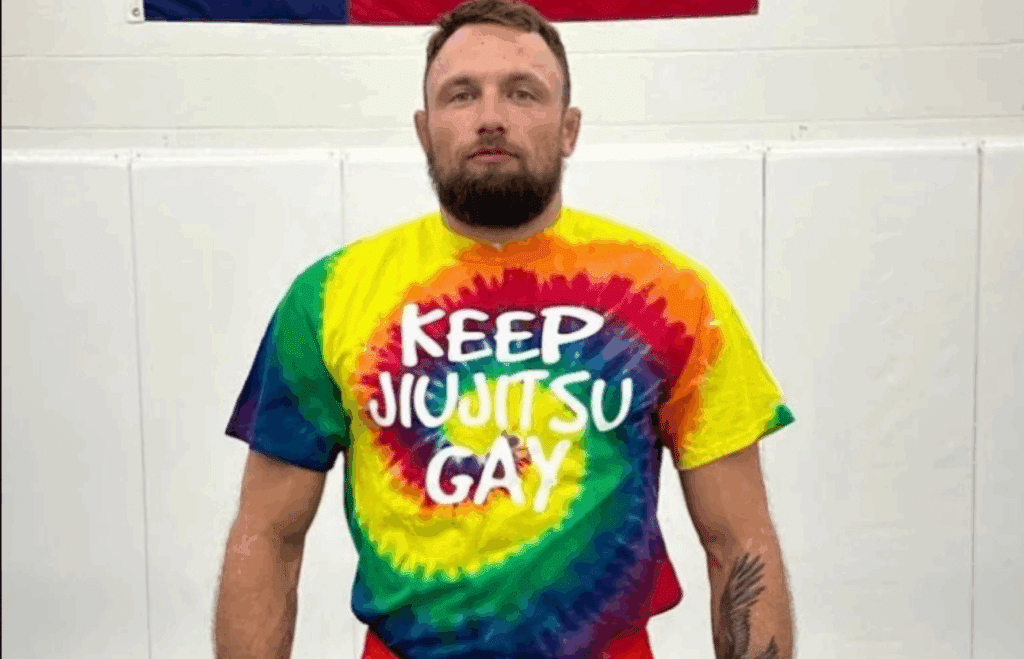
In back-to-back reels, UFC BJJ Champ Mikey Musumeci veers from “BJJ is violent” to the deliberately provocative Mikey Musumeci BJJ is gay line—playing off Craig Jones’ long-running “keep Jiu-Jitsu gay” bit.
He’s not talking orientation; he’s leaning on an in-group meme to spark engagement and frame BJJ’s identity for casuals vs. die-hards.
The toggle—violent one week, “gay” the next—looks less like whiplash and more like a calculated promo cadence aimed at UFC-scale eyeballs.
The reactions split: insiders see a wink; others see a risky line that won’t travel well outside the bubble.
Why Say It Now—And To Whom?
The timing matters. Musumeci’s media run has swung between two poles: first positioning Jiu-Jitsu as dangerous and “violent” to sell jeopardy (a narrative that plays in mainstream MMA).
Then, dropping the Mikey Musumeci BJJ is gay line to re-center an inside-joke identity that’s lived in grappling for years.
He’s speaking to two audiences at once: the UFC-adjacent casual who needs a sharp, simple hook—and the BJJ lifer who responds to community-coded language and long-running memes.
That split explains the tone shift. “Violent” is a broadcast word; it signals risk, stakes, and consequence. “Gay,” used here as a reclaimed/in-joke callback (via Craig Jones’ “keep Jiu-Jitsu gay”), is narrow-cast—a kind of tribal handshake that says “I’m still one of us,” even while courting a bigger stage.
“Paulo’s corner screams, Paulo, stick your toes inside his butt. That’s what that means in Portuguese. So I’m like, wait, did I hear that right?” – Mikey Musumeci –
The reels themselves are short and surgical. Musumeci sets up the provocation, lands it, and lets the comments do the rest.
There’s no policy speech and no moral argument—just a bite-sized provocation built to be clipped, captioned, and reposted.
On the literal level, he says the line; on the strategic level, he invites the crowd to complete the thought in dueling threads, stitching his name to the day’s discourse.
“A lot of people say, oh, Jiu-Jitsu’s gay. And I’m one of the first people to defend against them. You know, like, oh, we’re violent, we’re like harming each other, like, what’s gay about that?” – Mikey Musumeci –
Those nine words—five in one reel, four in the next—are the whole play: compress the message to something anyone can repeat, then rely on the ecosystem to provide the context and the controversy for free.
The Craig Jones Callback: Inside Joke, Outside Risk
None of this lands in a vacuum. Craig Jones has spent years dead-panning the “keep Jiu-Jitsu gay” gag—a mix of locker-room absurdism and brand identity.
When Musumeci echoes it, he’s borrowing that lineage to signal looseness and self-awareness. Inside the sport, many read it as a wink: a reminder that grappling is weird, tactile, and unserious about its own seriousness.
But what scans as a wry callback inside the room can wobble in the wider world. The phrase is still a slur for some audiences; context collapses outside niche channels.
That’s the double-edged part of the Mikey Musumeci BJJ is gay choice: it’s great gasoline for engagement, and it’s a messaging gamble the minute the clip crosses into mainstream feeds or brand decks.
Take a step back and the toggling looks like cadence, not chaos. One week, ratchet peril (“BJJ is violent”) to prime stakes, finishes, and danger—language that pairs with highlight cuts and submission compilations.
The next, reinforce identity (“BJJ is gay”) to keep the core audience feeling seen and “in on it.” The alternation keeps both groups warm: casuals get risk and spectacle; insiders get belonging and in-jokes.
That’s classic fight-week economics in the social era: a short cycle of spikes instead of one long speech. It’s also why the phrase keeps repeating throughout the debate—each repetition refreshes the feed and resets the algorithmic clock with minimal creative lift.
Can The Bit Sell Tickets?
If the goal is to turn grappling into an appointment product, you need hooks that work in seven words or fewer, and you need a face people recognize within two seconds.
Musumeci is building both: ultra-digestible bites and a persona that can swing from monkish technician to mischievous troll without losing recognizability.
The open question is runway. The Mikey Musumeci BJJ is gay clip will over-index on engagement today, but promoters and sponsors live on a longer curve: Can the meme stay funny without becoming fussy?
Can the “violent” pitch keep selling jeopardy without scaring off casuals who prefer skill to blood? And can both messages coexist when the same athlete is booked to sell out an arena card and a family-hour broadcast segment?
Two things tend to follow a spike like this. First, copycats: expect more reels from other names trying the same provocation → explainer pipeline with softer synonyms.
Second, escalation: a back-and-forth with Craig Jones or a stitched riff that reframes the line with a fresh gag.
If Musumeci keeps threading the needle—anchoring the jokes in real matches, real rivalries, and real finishes—he’ll ride the engagement without losing the sport underneath it.
‘Keep Jiu-Jitsu Gay’
The safer bet is that he keeps mixing both identities on purpose. In the next camp or media week, don’t be shocked if you hear the Mikey Musumeci BJJ is gay refrain again—right alongside a sharpened “violent” pitch with fresh clips to prove it.
In the age of short-form fight promotion, controversy is content. The trick is keeping the submissions (and the schedule) loud enough to out-shout the caption.
A clean, concept-first roadmap that links Closed Guard, Half Guard, and Open Guard so you always know your next action rather than hunting random moves.
Emphasis on posture-breaking, lapel control, and back-exposure pathways that scale from white belt drills to black belt problem-solving.
Each guard has a small set of high-percentage sweeps and submissions, with lapel-based transitions that help you connect positions under pressure.
The structure makes it easy to assign roles in training: one round for posture breaks, one round for lapel anchors, one round for back-exposure chains.
The 3 Guards 1 Plan Marcos Tinoco DVD is built around a simple promise: take the three guards most of us hit in rolling—Closed Guard, Half Guard, and Open Guard—and give them one connected language so decisions become automatic.
.Instead of memorizing an ocean of techniques, Tinoco shows how posture breaks, lapel anchors, and back-exposure routes echo from guard to guard. If your training notes feel like scattered islands, this is the bridge that turns them into a map.
This Marcos Tinoco DVD Review focuses on how the structure lands for real students, from day-one fundamentals to competition rounds.
You Only Need Three Guards
Jiu-Jitsu guard work often suffers from “collector’s syndrome”—great techniques learned in isolation that vanish under resistance. The 3 Guards 1 Plan Marcos Tinoco DVD tackles that exact pain point by creating a repeatable decision tree:
Break posture first,
Secure a controlling frame or lapel,
Force either a weight shift for sweeps or a shoulder line for back exposure.
That concept is timeless across Gi training, making it easier to keep your place mid-roll. You’ll notice how lapel mechanics and off-balancing recur in every chapter, which is precisely what helps retention. The result is a guard that feels less like gambling for a moment and more like engineering a series of inevitable reactions.
Alliance Star Marcos Tinoco
Marcos Vinícius da Silva “Lekinho” Tinoco is a Brazilian Jiu-Jitsu black belt under Marcelo Garcia, representing Alliance. Born in Araruama, Rio de Janeiro, he began training at 16 under Juarez Soares and built a strong competitive base before moving to the United States.
In 2014 he had a standout brown-belt year, culminating in world-level gold and a promotion to black belt from Garcia in January 2015. At black belt, Tinoco’s résumé includes IBJJF European titles, Brazilian Nationals gold, multiple Pan No-Gi titles, and World Championship medals in both Gi and No-Gi.
He’s widely associated with crisp lasso-guard mechanics, disciplined posture-breaking, and high-percentage armbars. Beyond competing, he’s a sought-after instructor, having taught in New York under Garcia and now in Massachusetts, where his classes emphasize simple frameworks that scale across experience levels.
That approach—clear structure first, then targeted detail—underpins the pedagogy of this release and explains why his planning-driven DVDs resonate with both hobbyists and active competitors. The 3 Guards 1 Plan Marcos Tinoco DVD is just the latest one of his releases.
Detailed 3 Guards 1 Plan Marcos Tinoco DVD Review
Before diving into the volumes, it’s useful to understand the connective tissue. The 3 Guards 1 Plan Marcos Tinoco DVD cycles the same objectives across guards:
Control posture with grips and leg lines, set a lapel or frame that “locks” the opponent’s reactions, and choose between a sweep that tilts the base or a back-exposure that bypasses the opponent’s strongest frames.
Volume 1 — Closed Guard
Tinoco starts with Closed Guard because it’s where posture-breaking is most teachable. The chapter arc goes from timing closed guard sweeps into an under-the-leg lapel sweep, then leverages those same anchors for a “Lapel Back Take” and a “Cross Grip Half Scissor Back Take.”
Once the hips and shoulders are aligned, he pivots to clean finishes: modified shotgun armbar and a Gi-specific Canto Choke. What stands out isn’t novelty; it’s how each piece strengthens the next. If you fail to off-balance, you transition to the back; if you lose the back, you fall back to the armbar.
Volume 2 — Half Guard
Half Guard gets the “do the simple thing well” treatment: Old School Sweep, knee lever, and half guard back take build a base that’s easier to reproduce against heavier partners. Tinoco then folds in lapel-assists with “Back Take Using The Lapel,” turning stalled underhooks into rear-exposure chances.
The finishers—loop choke and Kimura Trap—reward you for getting elbows away from ribs as the top player fights to free the knee line. The sequencing is what makes this sing; each piece is compatible with the others, so you never have to abandon half guard wholesale.
You’ll also notice the same posture-break-to-tilt rhythm introduced earlier, which keeps decision-making fast.
Volume 3 — Open Guard
Open Guard closes the loop with reactive, distance-based entries: “Tripod Sweep Upper Body Control” and “Modified Sickle Sweep Lower Body Control” teach you to attack whichever base is lighter.
From there, the De La Riva and Shin-To-Shin back takes continue the theme—if your sweep fails but your opponent turns, you seize the back. The finishing layer, ankle lock and triangle, gives you immediate punishment when opponents overcommit weight forward or leave their ankles dangling during resets.
It’s a pragmatic set for rounds where grips break often. The consistency with prior volumes is obvious: posture, anchor, off-balance, then either tilt or take the back.
The 3 Piece Guard Roadmap
If you’re coaching or self-coaching, the fastest way to absorb the 3 Guards 1 Plan Marcos Tinoco DVD is to program your rounds around the decision tree.
Round one: start in closed guard and score at least three posture breaks before any sweep attempts.
Round two: switch to half guard and hunt a knee-lever or Old School tilt every time you win an underhook; if the knee line stalls, immediately chase the lapel back take.
Round three: play open guard and alternate Tripod/Sickle entries based on which leg is light, finishing with the ankle lock if you can’t get the tilt.
This is also where you can pace safety and progression: white and blue belts can limit back-exposure entries until their seat-belt mechanics are consistent, while purple and above can sharpen lapel-based controls to reduce scramble risk.
For a comp-prep cycle, assign a weekly focus—closed > half > open—and finish each session with a two-minute “connect the guards” round that forces transitions on a timer. Do this for a month with the 3 Guards 1 Plan Marcos Tinoco DVD running in parallel, and you’ll feel your reactions stack in the same order they’re taught.
The Marcos Tinoco 3 Guards DVD is ideal for Gi players who want a reliable, repeatable guard framework without memorizing endless variations. If your rolls feel chaotic the moment grips break, you’ll benefit from the decision-tree approach that prioritizes posture control, lapel anchors, and either a base-tilt or back-exposure finish.
White and blue belts get a clean structure for building fundamentals that actually survive resistance. Purple and brown belts can tighten transition timing between closed, half, and open guard without changing their core identity.
Competitors who value high-percentage sequences over novelty will appreciate how the same beats recur across positions, making scouting and game-planning simpler.
Pros & Potential Drawbacks
Pros:
Concept-first roadmap that unifies closed, half, and open guard for faster decisions under pressure.
High-percentage sweeps and back-takes organized around posture breaks and lapel anchors.
Clear progression for beginners; timing and chaining depth for advanced belts.
Consistent terminology and sequencing make coaching and partner drilling straightforward.
Balanced mix of classic fundamentals (Old School, Tripod/Sickle) with clean, modern finishes.
Compact curriculum—easy to review, rewatch, and integrate into weekly training blocks.
Potential Drawbacks:
Gi-grip emphasis means some sequences won’t transfer directly to No-Gi.
Focus on reliability over novelty may feel conservative if you’re seeking a large catalog of variations.
Players with an established lapel-light game might need to adapt grips to fit their preferences.
Master Simplicity
This release delivers exactly what it promises: fewer choices, clearer choices, and choices that repeat across three guards. The strength is structure—you’ll recognize the same beats whether you’re seated, clamped, or playing hooks—which is why the material scales so well. For anyone who wants dependable guard routes in the Gi, the 3 Guards 1 Plan Marcos Tinoco DVD is an excellent investment.
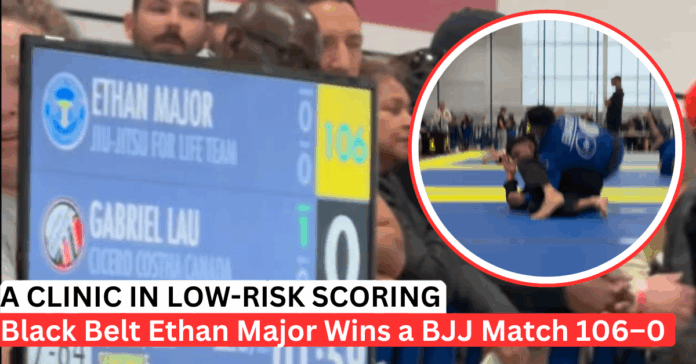
A Canadian black belt, Ethan Major, authored a viral blowout—an Ethan Major 106–0 BJJ match that piled points before the finish (some posts later cite 113–0 at the tap).
The scoring avalanche came from repeatable sequences: takedown → pass → mount/knee-on-belly → reset/control cycles, not reckless sub-chasing.
It happened at a local BJJ tournament in the brown/black bracket; spectacular, but context matters—BJJ has no central “world record” ledger.
The value here isn’t the number, it’s the blueprint competitors can copy: safe pressure, disciplined resets, and “bankable” scoring chains.
Ethan Major 106–0 BJJ Match Victory — Yes, You Read That Right
The viral reel shows a clinic in point stacking—an Ethan Major 106–0 BJJ match built on high-percentage sequences repeated under control.
The pattern is familiar to coaches but rare to see executed at this scale: clean entries to the mat (takedown or snap-down reactions), immediate hip-line control to freeze scrambles, then methodical passes into stable scoring positions.
From there, he cycled between mount, knee-on-belly, and re-established control rather than forcing a low-percentage finish early.
Every cycle added points without opening the door to reversals. That’s why the referee kept the clock moving: no stalling, continuous improvement, continuous scoring.
BJJ doesn’t maintain an official, centralized database of single-match scoring records across all promotions and rulesets.
This Ethan Major 106–0 BJJ match is extraordinary—and it should be celebrated accordingly—but it happened in a local brown/black heat, not on an IBJJF Worlds center mat. Different events score advantages, restarts, and knee-on-belly durations differently.
That variability is why serious analysts label it “viral-record-caliber” rather than “the” world record. The smarter takeaway isn’t a crown; it’s the craft that made triple-digit scoring possible in the first place.
Scoring Discipline Beats Chaos
Three habits jump off the screen and explain how an Ethan Major 106–0 BJJ match exists at all:
Ride before risk. Major prioritized chest-to-hip connection, head position, and underhook frames that kill escapes before they start. You can’t rack points if you’re getting bucked off.
Knee-on-belly cycling with purpose. Short, controlled KOB phases create repeatable scoring ticks while exposing almost no counterplay if your hip line stays heavy and your inside knee tracks the opponent’s near hip.
Submissions as endgame, not coin-flip. He didn’t “hunt” the finish until the opponent’s frames looked taxed and predictable. That’s why the eventual tap felt inevitable, not lucky.
A Replicable Blueprint?
The number is fun; the method is useful. If you’re coaching or competing, here’s how the Ethan Major 106–0 BJJ match scales down to regular rooms:
Script your first two minutes. Pick a high-percentage takedown (snap-down to front headlock, collar-drag to chase) and a Day-1 pass you can hit under fatigue. Memory beats improvisation under adrenaline.
Own the hip line. Your knee nearest the hips is your seatbelt; staple it and the opponent’s escape options shrink to low-yield bridges and side-to-side shrugs you can ride through.
Score in loops. Mount → knee-on-belly → back to mount or side with shoulder pressure. Each loop is small risk, real points.
Delay the heroics. Threaten submissions to force predictable frames, then return to scoring positions when the defense is still sharp. Go for the finish only when the frames slow and the chin/arm path is clean.
Manage optics for refs. Keep advancing, keep grips active, keep hips moving. You’ll get the benefit of the doubt on activity calls and accumulate without warnings.
Why The Finish Arrived Late
Fans ask why he didn’t submit earlier. Because the quickest submission attempts often carry the highest reversal risk.
In a bracket where one scramble can flip a match, stacking an unanswerable lead is the safest path to both outcomes: victory now and preservation for later rounds.
The Ethan Major 106–0 BJJ match shows that “mercy” isn’t the opposite of BJJ scoring—math is. He removed variance first, then closed the show when the margin for error was zero.
As a viral moment, the Ethan Major 106–0 BJJ match is a spectacle. As a lesson plan, it’s a gift: build a round on repeatable, low-risk cycles; keep the ref convinced you’re working; and save the kill shot for when the defense is tired and readable.
Whether or not anyone certifies it as a “record,” the tape already certified the approach.
A new student says a coach pitched a BJJ blue belt after one month—for $800—because the student had a wrestling background.
The student claims he declined and left; the story reignites the belt-mill debate: testing fees vs. selling rank.
We break down why a transactional BJJ blue belt after one month is a red flag, what real first-belt standards look like, and how to vet a gym in a single drop-in.
Wrestler Offered BJJ Blue Belt After One Month for $800
A first-month student says a coach offered him a BJJ blue belt after one month of classes—if he paid $800 up front.
The allegation, shared publicly by the student and picked up by BJJ outlets, has ignited a familiar debate inside jiu-jitsu: where legitimate testing fees end and selling rank begins.
According to the student, the pitch leaned on his past as a wrestler, framing the fee as a fast track beyond the white-belt grind and into a BJJ blue belt after one month. He says he initially laughed, thinking it was a joke, before realizing the offer was serious.
“He told me that given my wrestling background he can just promote me to blue belt if I pay him 800.” – Student account –
Testing Fee Or Rank For Sale?
On paper, jiu-jitsu’s promotion culture varies widely. Some gyms schedule formal evaluations and charge modest administrative fees to cover belts, certificates, and event logistics.
Others promote organically—no test, no fee—when coaches are convinced a student consistently rolls at the target level.
What touched a nerve here is that the outcome, a BJJ blue belt after one month, was allegedly tied to a lump-sum payment and a calendar date rather than demonstrated, BJJ-specific competence.
“At first I laughed… then I realized he was serious. I said no and left.” – Student account –
Coaches who weighed in online were blunt: the distinction between an admin fee and a purchased belt isn’t semantic, it’s structural.
One pays for a process; the other pays for a result. When the result—BJJ blue belt after one month—is promised in advance, the signal that rank is supposed to send to training partners becomes unreliable.
Wrestling Helps. It Doesn’t Replace BJJ.
Part of the controversy is the “wrestler exception.” A strong wrestling base does accelerate certain pieces of jiu-jitsu: entries, balance, top pressure, and pacing under contact.
But blue-belt competency lives in BJJ-only zones—guard work, submission defense, and positional escapes that wrestlers don’t learn by default.
A brand-new wrestler can dominate from top and still gift their arms and neck to basic attacks. That’s why credible programs insist on seeing live rounds that stress BJJ-specific defense before a promotion enters the conversation.
The student at the center of this story echoed that logic himself, saying he didn’t want a shortcut that would crumble the first time he rolled hard with established blues.
“I don’t want a belt I didn’t earn. I want to roll with blues and know I belong there.” – Student account –
What Legit BJJ Promotions Usually Look Like
Talk to a dozen reputable academies and you’ll hear similar themes delivered in different ways. Coaches look for months of consistent mat time, not weeks.
They want to see safe habits—clean taps, no cranking, control under fatigue—alongside technical thresholds: retaining and passing guard on both sides; escaping mount, side, and back with intention; defending common submission chains when tired.
Some gyms formalize that audit on a designated test day; many conduct it informally across regular sessions. Fees, if they exist, are transparent and modest—and never a pay-to-pass gate.
That is why a prepaid, guaranteed BJJ blue belt after one month landed as more than a tacky upsell.
It undercuts the shared trust that lets partners roll hard without hurting each other. If a belt stops meaning “this person reliably operates at X level,” the room gets more dangerous, and the good students leave.
After The Post Went Viral, What Now?
The student says he declined and switched gyms. That’s one way these stories often end: quietly, with a different room and a different set of standards.
The fallout for the original academy—if any—tends to hinge on local reputation. In tight-knit scenes, word travels faster than marketing copy, and “calendar + cash” promotions are hard to hide.
The broader lesson is less about internet outrage and more about due diligence. New students can ask straightforward questions without being combative: how does promotion work here? What do you look for before a blue belt?
If there’s a test, what’s on it? How much is the admin fee, and what does it cover? The answers don’t need to be identical from gym to gym, but they should be anchored in skills rather than schedules.
The Price Of A Shortcut
Even in a sport with wildly different promotion cultures, a guaranteed BJJ blue belt after one month tied to an $800 payment crosses a line most coaches recognize.
Wrestling experience is an asset; it isn’t a substitute for BJJ defense under live pressure. Belts are a trust contract—between the student who wears them and the partners who take the risk of rolling with them.
When a rank can be bought on a timetable, that contract breaks, and so does the room. If you’re ever offered a shortcut like this, the play is simple: decline, walk, and find a mat where rank reflects repeatable reality.
The promotion will come when your jiu-jitsu—under pressure—leaves no doubt.