







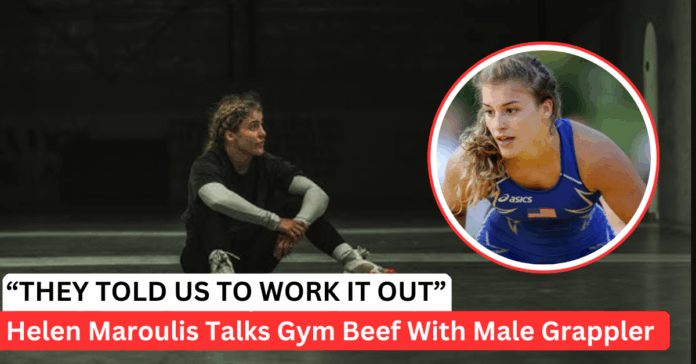

- In a Helen Maroulis practice incident, the Olympic champ says a ~152-lb football player got frustrated that he couldn’t escape her pin and then battered her during a live go.
- She says coaches told them to “work it out,” and the next exchange escalated beyond a drill.
- The account spotlights a live problem in mixed rooms (size/experience gaps, thin boundaries) and the cost when coaches don’t intervene.
- It lands amid Maroulis’s 2025 resurgence after a brief BJJ detour—turning extra scrutiny on training environments for elite women.
“He Couldn’t Get Out—Then He Snapped” — Helen Maroulis Practice Incident
Maroulis’s story isn’t a sparring bruise; it’s a breakdown. In a recent podcast, she recalls pinning a ~152-pound football player in practice, then feeling the switch flip when he couldn’t get free.
“He couldn’t get out [of the pin] and he got mad… the second time he just came at me.”
– Helen Maroulis –
Instead of cooling things off or swapping partners, she says coaches told them to “work it out.”
“They told us to work it out.”
– Helen Maroulis –
When the round resumed, the energy wasn’t instructional—it was punitive. Maroulis describes a moment no athlete should face in a room designed to protect progress, not pride.
“I saw this pole sticking out of the wall… [after he stood up] I rammed him into it.”
– Helen Maroulis –

When “Toughness” Becomes Negligence
Most elite rooms handle flare-ups the same way: stop the round, switch partners, reset the tone. Maroulis’s account describes the opposite—no reset, tacit permission to continue.

For an Olympic champion who’s navigated concussions and surgeries, the cost of one reckless round isn’t abstract; it’s weeks of derailed preparation. The lesson is simple: coach intervention trumps ego. If a partner is angry, the drill ends.
That’s not softness; that’s safeguarding performance.
Crossover partners (football to wrestling) can be great if the rules of engagement are clear.

Pin escape work is supposed to fail safely and teach mechanics, not become a scoreboard for frustration. Size gaps, limited mat IQ, and bruised pride are a dangerous triangle. In the Helen Maroulis practice incident, all three collided.
The fix isn’t to separate women from men—it’s to select partners who can keep the drill’s purpose intact and whose pride won’t hijack the round when it cracks.
Anger Isn’t A Drill – Partner Choice Matters
After a brief jiu-jitsu stint, Maroulis surprised many by returning to wrestling and winning immediately, re-entering world-level conversation.
That comeback puts her practice environment under a spotlight: an athlete with Olympic history and fresh podium form should be training in a room built to protect her progress.
Her account doesn’t just make for a viral clip; it asks if too many rooms still treat conflict as a toughness test instead of a performance risk.
“To be honest, I didn’t want to come back… I love jiu-jitsu… One day, God told me to go back to Phoenix. In a week, I moved and trained full-time.”
– Helen Maroulis –
Given that arc—first U.S. women’s Olympic wrestling gold, the injuries, the PTSD, the long climb back—the price of a preventable gym blow-up is obvious. She’s already paid enough.
Fix The Room, Protect The Round
Every great room has a plan for exactly this scenario:
- Partner choice is a skill: coaches assign or approve pairings for volatile drills (pins, ride-outs, live goes).
- Conflict protocol is explicit: any sign of anger, round stops; partners switch; coach leads the reset.
- Reps stay purposeful: if a partner turns a technique segment into a fight, they sit. “Work it out” is not policy—it’s negligence.
The takeaway from the Helen Maroulis practice incident isn’t to soften wrestling. It’s to insist that the hardest wrestling rooms be hard and safe. The point of practice is to build the athlete who shows up on competition day—not to appease a stranger’s pride in the corner of the mat.
Bottom Line
The Helen Maroulis practice incident isn’t just a story about one bad round.
It’s a reminder that culture is measured when it’s hardest to hold. Rooms that stop escalation fast—by swapping partners, resetting tone, and enforcing boundaries—get more healthy training days and better athletes. That’s toughness that wins.