


Arm Triangle Choke Encyclopedia For Grapplers

Arm Triangle Choke Encyclopedia

Everybody remembers their first. Submission, that is. After many, many taps the first submission I managed to pull off was a choke. Contrary to expectations (mine included) it was not a Rear Naked Choke or a Guillotine Choke. It wasn’t a triangle choke either. The first tap I ever got was due to an Arm Triangle Choke. The feeling that followed was amazing. It was as all those months of tapping out never happened. It didn’t matter that it was against a fellow white belt nor that it probably was full of flaws. I had my first submission and the Arm Triangle Choke went straight into the favorites category. Or at least I thought so. The next time I slapped one of those chokes on somebody was probably a couple of years later when I really decided to work on the Arm Triangle.

The Arm Triangle Choke is a really tight submission that works universally. Gi, No-Gi, MMA, catch wrestling, this submission is everywhere. It is tight, easy to get to, and easy to hold on to. As such it is usually taught at a fundamental level. However, people often tend to disregard it quickly and only come back to it when they advance. The Arm Triangle Choke is easy to combine in a system with guillotines and Brabo chokes, increasing its effectiveness for grappling. It’s a devastating move, one that isn’t easy but is also none too difficult to execute.

The Tightest Arm Triangle Choke

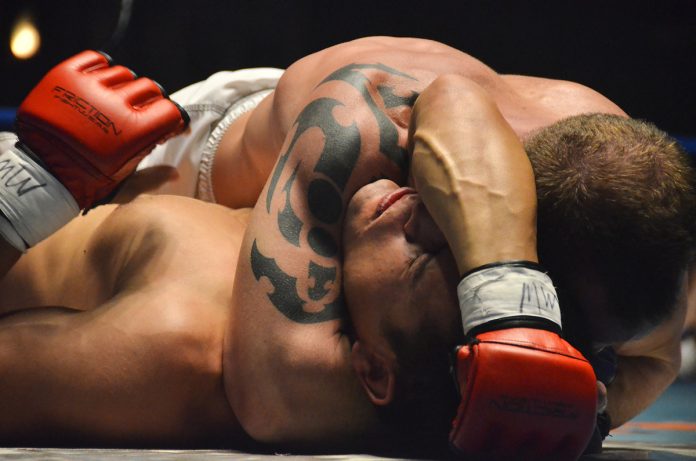
The Arm Triangle Choke is a Blood Choke submission that leaves your opponent strangled between their own shoulder and your arm. Similar to that of the traditional triangle choke, which is performed by the legs.

The choke can also be a side choke. From the side of your opponent, you can use your forearm along with your opponent’s own outstretched arm and shoulder. You will cut off both the air and blood flow to your opponent’s brain. To do this, you need to squeeze your forearm into your opponent’s neck in order to remove any space.

When done effectively, the choke will take just moments to take effect because of its ability to cut off the blood flow on both sides of the neck. With both arteries cut off, it only takes seconds until you get a tap or your opponent falls unconscious. For the most part, the Arm Triangle Choke is usually achieved while having top Side Control on your opponent. However, it is also achievable from the mount position, as well as the half guard position. Furthermore, it can be done from other positions but it takes a lot more effort and knowledge.

Finishing The Arm Triangle Choke

From the half guard, the choke is a little more difficult, because you need to pass the half guard to get into a better position. Ideally, you always want to secure your opponent’s head and arm. When passing the half guard, post your weight on your opponent and be as heavy as possible. The focus point of all that weight should be on top of their neck via your biceps and shoulder. This lands you in a prime position to gain the required leverage and angle to finish the submission.

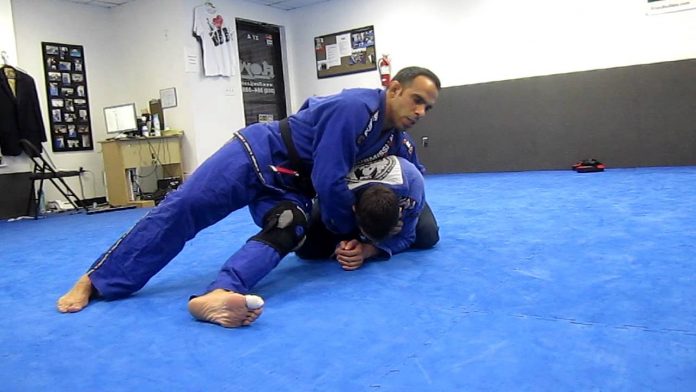
From Top Side Control, the best way to finish the choke is to cut off the angle and walk your body up towards your opponent’s head. The angle that the choke creates will make it progressively tighter as you continue to walk your body up.

When you are in the mount with your palm down, you can also get the arm triangle very easily. Just slide your hand under your opponent’s head. The technique requires your opponent to drive their forearm into your neck to defend. As your opponent does this, ease the pressure briefly, and then push your arm through at the elbow.  Afterward, you’ll need to drop your head trapping the opponent’s arm against his neck. A very common mistake here is not dropping the head low enough. Your head should constantly be driving your opponent’s arm into their neck.

For the finish, grab your own biceps with the palm of the choking arm. A safe place to put your non-choking hand is the back of your head. Next windshield wiper your legs in order to dismount, and then sprawl out. Remember to keep driving forward on your toes to keep the weight focused on their neck. To complete the choke you just need to squeeze your arms.

Unorthodox Bottom Side Setups

In MMMA and self-defense scenarios the Arm Triangle attack from the bottom is useful as an easy way to counter elbows strikes. If you are able to slip to the side of an elbow,  you place yourself in a perfect position. Since their arm is already passed to the side, you just need to wrap your arm around the head.

Attacking from the full guard is a lot trickier than from the top. Eddie Bravo drills it a lot in the 10th Planet System as they stick to their concept of attacking from defensive and neutral positions.

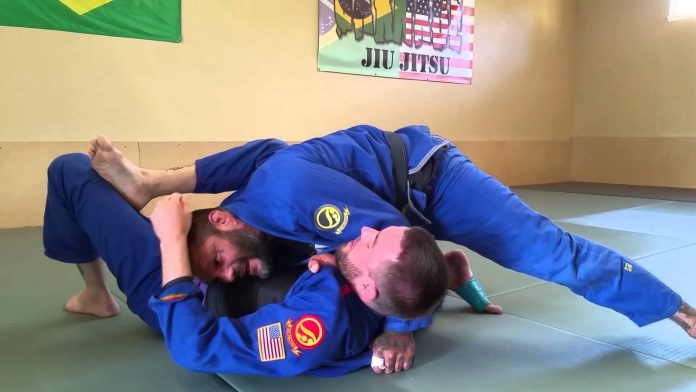
When in your full guard you always want to break down the posture of your opponent. Doing so often puts you in the perfect position for the Arm Triangle Choke. From your full guard, you first need to pass your opponent’s arm to the side. Then you need to trap their upper arm between your head and your biceps.  Your right arm should be fully wrapped around your head and arm, primarily for control purposes.

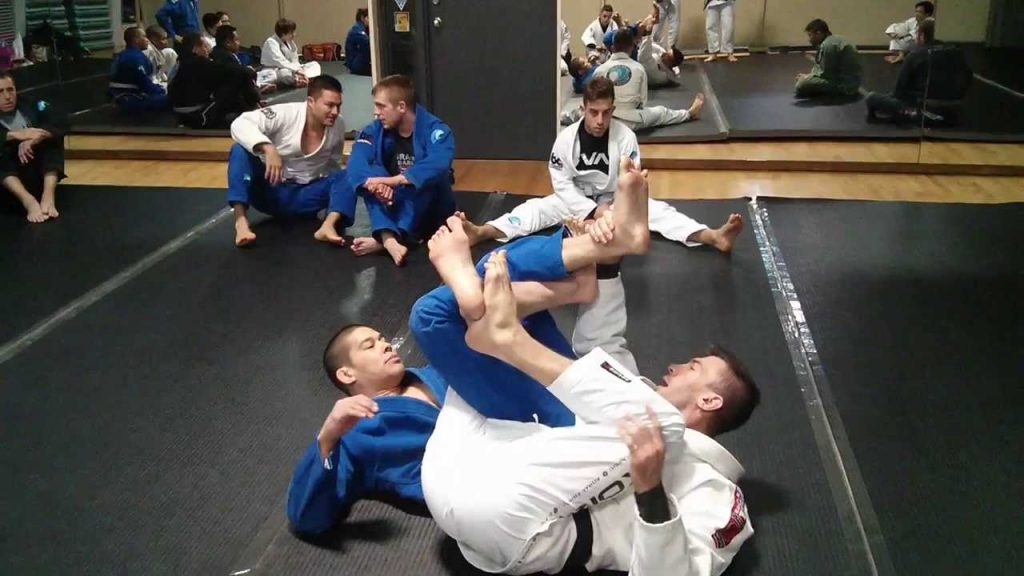
Now, finishing from the guard is the most difficult part. If you can lock in the choke tightly, you can apply the pressure from your upper body. Open your guard up and place your foot on the side of the choke on the hip of your opponent. Push off, creating separation, and use a single butterfly hook to elevate your opponent. Then using your free leg, come over the top of their leg in a scissor motion. If done correctly, you should end up in half guard with the choke in all set to complete. As a bonus, you also get points for the sweep.
Learn the Secrets Of The Reverse Triangle Choke

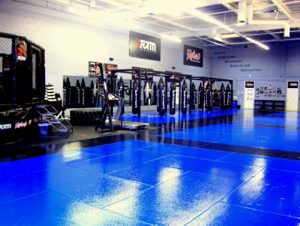
Things To Look For When Choosing A BJJ School

BJJ School Choosing Checklist

During the last decade, BJJ has spread so far that it can be considered a global phenomenon. Today, there are schools in nearly every city in the world. Even more so, most places have more than one BJJ school to choose from. However, the rapid growth of the sport means that not every BJJ school offers the same level of services. Despite the fact that most BJJ schools are legit, there are some precautions you need to take when choosing one to train at. After all, you’re going to spend a lot of time there.

Given the addictive nature of the sport, it is rare that someone that gives BJJ a try, remains in it only recreationally, This doesn’t mean that all of the people go on to be competitors. It is just a testament to the fact that BJJ takes over most of the people and gains a significant value in their lives. Given so, it is easy to see why the choice of a proper school is crucial o one’s BJJ journey. If you take into account how much time a student spends on the mats in a week, only the choice of a significant other tops the importance of choosing the right BJJ school.

Who’s In Charge?

Arguably the most important aspect of a BJJ class is the instructor. Whoever is in charge of a BJJ school bears a huge responsibility. A BJJ instructor should first and foremost, be qualified to teach. In those terms, a black belt instructor is always the best choice. Going further into things, a black belt of good lineage and with decent experience is even better. A black belt with all of the above, plus an extensive competition record is probably the best.

The school’s affiliation is a big pointer to the quality of personnel associated with it. Certain organizations have strict rules as to who gets to be the lead instructor. While the specific crest affiliation doesn’t matter, the selection standards do. Again, go with the proven and make sure you’re becoming part of a renowned BJJ school. This way you’re most likely to end up with a legit instructor.

The instructor’s character and teaching style are traits that often have little to do with their knowledge and technical abilities. Sometimes, a person just isn’t clicking with you for one reason or another. There is no need to force yourself to work with someone unless you actually enjoy their company. Make sure you look at every aspect closely before you enroll.

BJJ School Philosophy

Another major aspect is the school’s philosophy or better-said orientation. as far as BJJ goes, schools can go into three main directions, although two of them are the most prevalent. A BJJ academy can be competition-oriented, self-defense oriented or focused on recreational classes (which is very rare).

Competition-oriented schools often have great athletes that have the accompanying mentality. These schools are based on hard work, lots of drilling and tough sparring rounds. If this is not your forte then you should maybe look for a different school, or maybe a different class group within the same academy. However, be wary that if competition is your goal than self-defense academies should definitely be off your list.

Self-defense academies, although often competitive, have a different aspect of JIu-Jitsu as their main focus. They’re great if you’re looking to learn a way to protect yourself, but probably not your best choice for competitive aspirations. The recreational athlete, though, might find a self-defense oriented BJJ school to be a good fit.

BJJ School

Schedule And Class Structure

Very often the school’s philosophy determines the class structure. This is also often in line with academy affiliation, so make sure you cover your basis.

The first point on your selection checklist should be the number of classes. Are there 3 or more classes per week? How about open mat sessions? Are there Gi only classes or No-Gi training is included as well? Does the time of day fit your requirements?

All of the above questions play a crucial role in the selection of a school to train at. It would be hard to sustain a schedule that doesn’t fit in with your daily duties, so make sure you have a checkmark next to every question stated above.

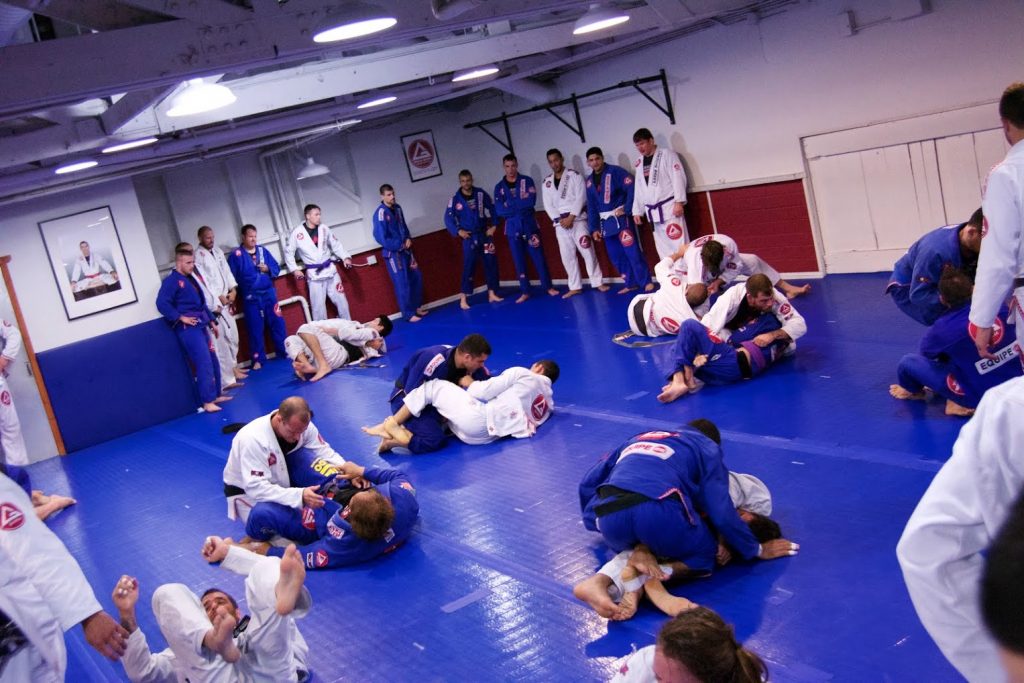
In terms of class structure, you should know that a usual BJJ class is made up of a warm-up, a learning part where new moves are demonstrated, a positional sparring part and a free sparring or rolling part. If a school has a well defined and neatly followed structure than you’re at the right spot.

Hygiene

You wouldn’t want to come back home after a week’s worth of classes with a transferable skin disease, would you? If not, then make sure the cleanliness practices of the school are up to your standard. Now, do not be a diva and presume that a BJJ school is a place of immaculate hygiene. After all, there are all sorts of people coming and going every day.

Good signs of a well organized and clean BJJ school are easy to spot. First, check out the changing rooms. Are they clean or dirty? Is there a foul smell about? Next, take a tour of the facilities. Clean toilets, available showers, and a suitable capacity should seal the deal. Furthermore, really make sure that mat hygiene is at the highest level possible. MOuld on the walls and dump mats are signs that you should run, and run fast. Clean mats and a cleaning schedule mean that you’ve walked in a top class BJJ school.

Although the school itself can have little impact on personal hygiene the manner in which it deals with infarctions speaks volumes. Namely, most schools have a code of conduct and an etiquette outlining rules of behavior. The rules should apply to everyone and be upheld rigorously.

 BJJ School Hygiene

Demographics

This aspect is closely related to the school’s philosophy.  Most BJJ schools tend to be family-friendly, meaning they have a diverse pool of people training. Even if they have professional fighters, they get their own classes apart from the people that are just looking for exercise. After all, there’s no need to go against young studs preparing for MMA fights if you’re in your 40es and just looking to have fun rolling.

Even if there are mixed groups, a good class structure can allow for successful training of different levels at the same time. Such a feat is possible only if there is more than one instructor present. A gym that has all levels training the same things together and pairs up pro competitors with recreational members should not be your first choice.

Legal Mumbo-Jumbo

To cap it off, make sure you’re aware of any legal aspects of your involvement with a BJJ school. Is there a contract that you need to sign? If so, do you understand every point of it? Do you accept all the terms? Make sure you’re clear what you’re signing so that you do not regret it afterward. Pro competition-oriented schools take things much more seriously than your everyday academy. That said, you need to know your goals and your expectations.

Fake BJJ Black Belt Jay Queiroz Teaching and Rolling in the Park! Is it Possible That This Guy is Still Teaching People?

Rener Gracie: We Got Jacked for Over $10,000 by Jiu Jitsu School in Canada

More Convicted Sexual Predators in Rickson Gracie JJGF Federation

5 Mount Escapes for BJJ That You Have to Know

5 Mount Escapes for BJJ That You Have to Know

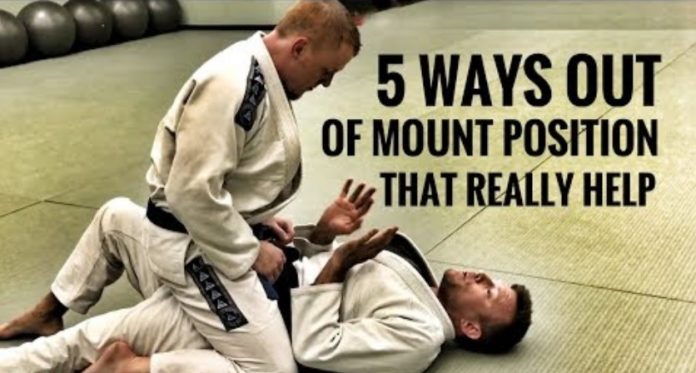
Full mount in BJJ or any other grappling martial art is the ultimate position. The only worse is back mount. So, finding yourself mounted can be a very frustrating situation to deal with. And if you’re training MMA and punches are flying toward your head it’s getting much worse. Check out these five full mount escapes and make sure you learn them.

Everyone who is new to jiu-jitsu will be dealing with full mount a lot. It’s an unavoidable position once you get into BJJ. You will be taken down easily and mounted even easier. It’s not even that bad to be mounted at the start of your BJJ career, but the problem is you’re actually losing time being mounted. You’re just lying there not doing anything. And if you don’t know how to escape it’s such a waste of time. So, you have to learn full mount escapes as fast as possible. You have to learn mount escapes so you can progress faster and that’s the most important thing.

Once you learn and master mount escapes you will do yourself a huge favor. Anyone can screw up and get mounted. It can be due to your opponent’s luck or his skill but escaping from full mount can turn the table pretty fast.

Side Control Escape – The Biggest Mistake That Everyone Does

That being said, if you have good full mount escapes you can stop wasting time, survive and even get your opponent into the position he’s not comfortable in.

It’s not very common but it’s also not impossible that people escape from full mount and win a match after that. If you ever watched Garry Tonon he will even let you full mount him so he can go for your legs.

There are a lot of different ways you can get stuck underneath the full mount. In this video, you’ll be able to see some standard and non-standard ways on how to escape the mount. They’re all valuable and you have to make sure you know them all because there are different conditions in which you can find yourself.


This Is How Stretching For BJJ Should NOT Be Done!

Stretching For BJJ Common MIstakes

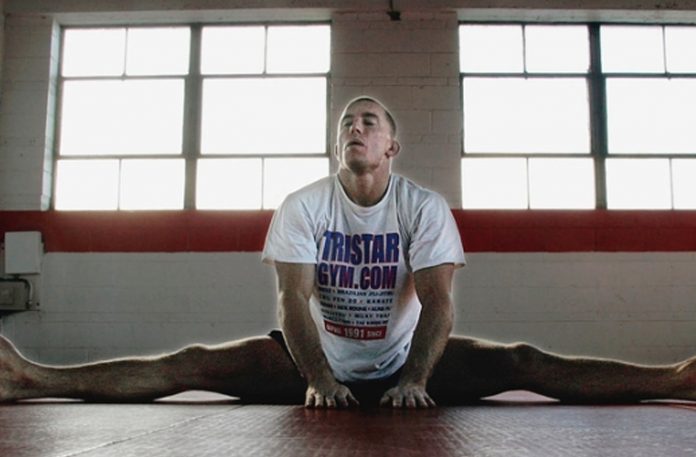
Grapplers around the world usually engage in stretching exercises after they workout. However, most grapplers never give stretching much thought. They look to stretch “by feel” or use stuff they’ve learned in primary school physical culture class. What BJJ people fail to comprehend is that Jiu-Jitsu put the body under very specific stress. As such, recovering from it should also be addressed in a specific manner. MIndless stretching is only going to lead to injuries that often become chronic. Stretching for BJJ is essential for bot ha a long grappling career and a versatile game. Doing it incorrectly, though, is only going to get you into trouble. So, let’s rectify some f the most common stretching mistakes.

To begin with, let’s get the most obvious out of the picture. Stop stretching during your warmup! It is a proven way to cause injury to yourself. Secondly, always make sure you stretch after you finish rolling or doing conditioning. And finally, focus on what is important when you do so. Stretching fro BJJ is as important as technical work. although full body stretching sessions area advisable (think yoga), it is not always possible to fit them into a busy schedule. So, the best thing to do after grappling is stretch those muscle groups that have gotten a real beating. Coincidentally, these are also the muscles every grappler should look to make as flexible as possible.

Increase You Flexibility With Yoga For Jiu-Jitsu: https://bjj-world.com/yoga-for-bjj-benefits/

Stretching For BJJ: Hamstrings

Nothing is more predictable than the sloppy bent-over standing hamstring stretch. People usually lift their foot up onto an elevated surface and round their spine. Then, they look to reach over and grab their toes. Most think they’re doing something healthy and productive. He really is that they’re only opening themselves up to several orthopedic problems, mainly In the lower back area.

A standing hamstring stretch brings about that “feel-good” effect which is why people think they’re doing something good for them.  This feeling is triggered by the muscle responding to the stretching motion it is going through. There’s nothing wrong with feeling good during a stretch, but not at the cost of an injury. When the stretch jeopardizes spinal integrity you’re stretching your way toward pain rather than away from it.

The ability to touch your toes depends on the functional length of the hamstrings, as well as a host of other factors. A major one is the ability to control and stabilize the position of the pelvis. Another important thing to consider is t controllable range of motion at the segments of the spine.

If you suck at the toe touch and have focused on your standing hamstring stretching after BJJ for months with no results, then drop it. Be smarter about the methods you’re using. Don’t worry, you can still get your stretch on, but change your methods. When it comes to stretching for BJJ, the best method is a supine 90-90 active hamstring stretch. This brings you the ability to stabilize both the spine and pelvis in a neutral position against the floor. It is a great way to engage the hamstrings without putting the rest of your body under unnecessary strain.

Hip Flexor Stretches For Grapplers

Chronic sitting turns the front side of our bodies into a functionally shortened mess.  In this mess, the hip is the region that suffers the most. Hip flexors, both the superficial and deep muscular layers are severely affected. Most grapplers are aware they sit too much during the day, and they know their hips are tight as a result. Since hips play an integral part in Jiu-Jitsu, being able to mobilize them is of immense importance. However, looking to stretch a muscle that has been getting progressively tighter for years is the recipe for a disaster. Although it sounds reasonable, stretching the hip flexors is not the way to make them more mobile for grappling.

The most usual position you see people getting into to stretch their flexor after rolling is the half-kneeling position. You know what’s good about this position? Nothing at all!  Forcing the hip into ultra- extension with your shin lodged up against a wall while your spine is smashing itself into hyperextension should not be the goal. Not only does this position hurt (and no that is not a good thing to feel) but it’s ineffective. A high degree of injuries often occurs as a result of this erroneous approach to stretching for BJJ.  Extending the maximal range of motion by the use of compensation from other tissues is dangerous when done repeatedly.

When you stretch, look to maintain a neutral position in the joints and spine. This way,m you’ll be able to isolate the tissues you’re working on. The half-kneeling position should make you achieve centered and neutralized joint positions at the shoulders, hips, and spine. So next time you do this stretch, pay attention at these tips:

Upper Body Stretching For BJJ

If you’ve never had your training partner grab your arms and drive them upward behind your body in a painful way, you can’t consider yourself an athlete. This is a stretch that you see at grappling competitions quite often.

There is a multitude of reasons why this stretch is one you need to skip. First, a manual stretch like this needs to be executed with the utmost caution. This is a passive stretch by nature and there is a complex direction of stress to a complicated joint. The fact that someone else who’s not a professional is doing it to you should be a scary notion. If you’re doing this to improve your shoulder mobility you’re only setting yourself up for serious injuries.

This stretch forces the shoulders into a position that poses huge potential problems. Before going about blindly stretching muscles you need to know what you’re looking for in a stretch. In BJJ, the pecs handle quite the workload every time we roll. As such, you need to understand both the primary and secondary actions of the pec so you can achieve an authentic stretch.

When stretching for BJJ, take your pecs to full stretch by combining a horizontal shoulder abduction, elevation, and external rotation. The problem with the partner pec stretch is the fact that the shoulders fall into internal rotation and extension. This creates some pretty nasty joint stress through the front side of the shoulder. As if your shoulders need more stress after Jiu-Jitsu training!

A simple solution for this is going for a more dynamic method. The dynamic oscillatory stretching of the pecs is a safe method that encompasses all relevant ranges of motion. Still, these are meant to be done with a specific setup, perfect execution, and loads of caution.

How To Develop Mat Awareness For Safe BJJ Rolling

BJJ Rolling Mat Awareness

It is undeniable that the most entertaining aspect of training BJJ is rolling. Most people that show up to class either slack through or try to avoid the warm-up. That is a given. While class is interesting and engaging to some, it is very rare for an instructor to have the utmost attention of everyone present. Even in competition, often times lots of the fun is taken away by anxiety and adrenaline. For everyone training BJJ rolling is the best time of class. This is why open mat is usually just another way to say let’s roll all day.

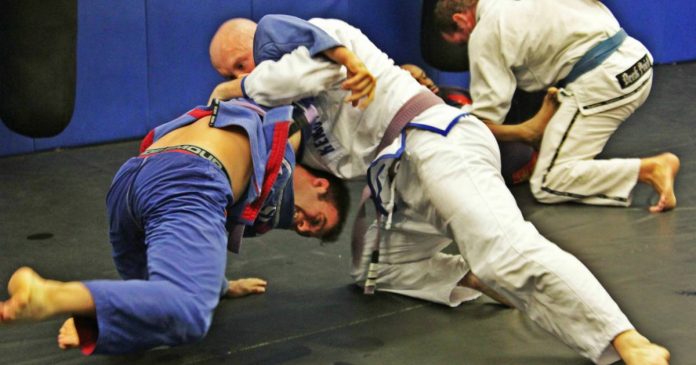
BJJ rolling, however, should not be taken for granted. Whenever we roll with someone it means that we both willingly put our bodies in as collateral. That means that we need to respect the fact that our partner has entrusted us with the most valuable material position one has. Going even further, in BJJ rolling is seldom done by just a pair of grapplers. That means that while in a roll, we’re surrounded by others doing the same. Everyone who has rolled knows how much concentration and focus a roll demands, which often leads to complete lack of spatial awareness. This is one of the top reasons why people end up with black eyes, twisted fingers or even serious injuries.

Developing Mat Awareness For Jiu-Jitsu

Being aware of our surroundings is a trait that slowly gets lost in modern times. The digital age has us looking at screens even as we walk, which means we have the attention span of a peanut. Now imagine how that translates to BJJ rolling when we’re engaged in the proverbial fight to the death. Mat awareness is crucial for every grappler to learn.

Having mat awareness means being able to recognize that you are in a physical proximity to other people or things. A highly developed mat awareness can protect you from the danger that unaware grapplers present. In an ideal Brazilian Jiu-Jitsu academy, pairs of grapplers would train in their own isolated areas.  Honestly, never running into other grappling pairs with errant feet and elbows sounds enticing. It is, however, virtually impossible. As most of us know from painful experience, grapplers rolling are like human billiard balls, rolling and smacking into each other and the walls.

Are You Aware Of All The Unwritten BJJ Rules: https://bjj-world.com/unwritten-bjj-rules/

As such, mat awareness during rolling needs to be addressed as the important subject that it is. Instructors need to make it a point to convey the message repeatedly and clearly until people start to take it in.  It is crucial to understand that this benefits everyone since a  safe rolling environment is one where you could experiment with new techniques without worrying.  It is encouraging to know that you won’t get a heel to your face if you attempt a rolling back take.

BJJ Rolling Awareness

Unwritten Rules Of BJJ Rolling Etiquette

By developing mat awareness, grapplers tend to create more than just a safe environment. Primarily, it leads to better adjustment when we infringe on someone else’s space. Across BJJ schools, training etiquette dictates that when two pairs of grapplers get too close, the higher-ranking pair stays put.  Conversely, the lower-ranking pair needs to move and make space. For example, a brown and purple belt occupying the same space as a couple of purple belts during BJJ rolling, means the two purple belts need to stop and move.

Next to consider is positional complexity. Imagine that two people rolling are deeply entwined in, let’s say, a leg-locking battle. There is imminent danger of another pair, which is in an open guard battle, bumping into them, The open guard is a much simpler position to restart than a 4/11 or truck position. Another situation that arguably merits advantages are scrambles. Scrambles are both extremely difficult to restart and it’s impossible to predict their outcome. The conflict here is what to do when two pairs are in the same or very similar position. If rank is equal who makes space for whom?

Contrary to the respectful behavior that marks the Gentle Art, there are those who refuse to. While this is unacceptable and stupid behavior due to many reasons, a major one is the potential for danger.  Ego can be a dangerous thing in grappling martial arts, and this is a clear example of how and why. Whenever you find yourself in a situation like this ask yourself what is on the line. The likely outcome of stubbornness is an injury to yourself or a partner. Across the scale is losing position or a submission attempt in a roll. For most this is a simple solution, provide that ego is not a factor.

The Experience Factor

When we train BJJ, our technical knowledge of the sport grows exponentially the more time we spend training. While training age has a huge impact on our game, the ability to recognize situations and adapt during a roll, it is not the case in terms of awareness.

To be honest, there seems to be a reverse correlation between the two. Experienced grapplers tend to be more careless during rolling opposed to less experienced ones. This is probably due to the rank factor, with older grapplers expecting others to move out of their way. While this is all fine, it doesn’t apply to the complex position situation. A black belt that is in closed guard should have the decency to move away from a purple belt that has a blue belt in a reverse triangle. It is just common sense an courtesy.

BJJ Rolling Etiquette

This solidifies the importance of competition experience for the well-rounded grappler. Competitors in the heat of battle must learn which stimuli to ignore and which to attend to. Competition experience largely aids grapplers to identify what areas need attention and how to focus on multiple important things at once.

All in all, mat awareness is an integral part of BJJ rolling and training in general. The challenge is in the delivery system. How do we make grapplers conscious of the potential dangers of disregarding the importance of awareness? Should it be taught independently of other Jiu-Jitsu aspects? Whatever the case, for the safety of everyone on the mat, awareness needs to be a regular subject of BJJ academy talks.

Mike Fowler Sexually Harassed a Female Student – He Explained Why

Mike Fowler Sexually Harassed a Female Student - He Explained Why

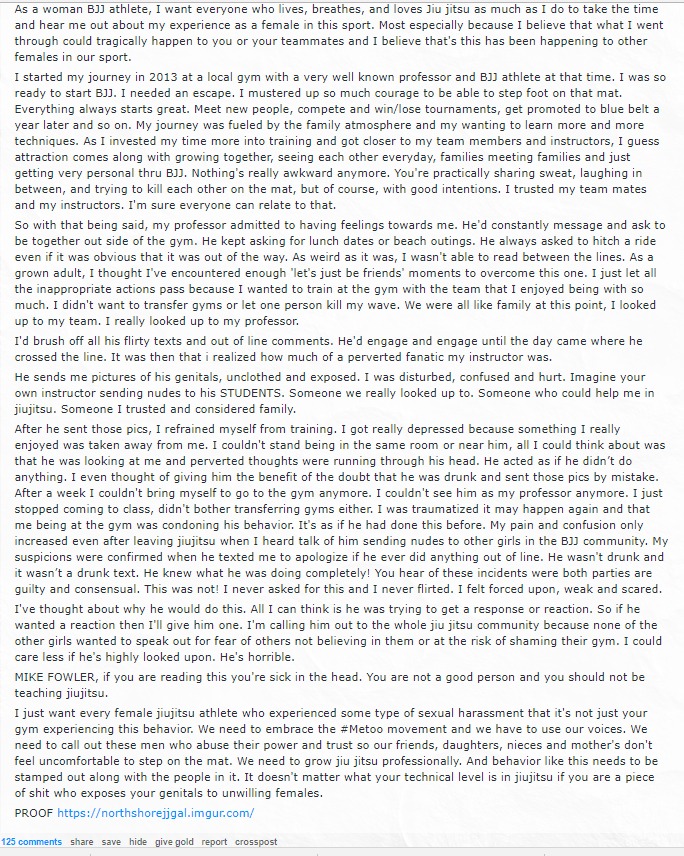
Mike Fowler was accused of sexual harassment of a female BJJ Student. She wrote about it on Reddit and she even put the pictures of a naked Mike Fowler.

Mike Fowler Accused for sexual Harrasing of a female student

Some BJJ sites announced this story now but this is actually a 3 years old thing. This happened back in 2015 and Mike Fowler gave a statement on his Facebook Profile a few hours ago.

There are articles being shared about my behavior. I won’t deny improper conduct back in 2015. No excuses. And those I was wrong too, I apologized. There are two sides to the story, but it doesn’t justify anything. I’m glad my actions were brought out because it made me take a look at myself. That wasn’t who I wanted to be. 
In 2013 I found out I wasn’t the father of my child and he was taken from me, never seen again. I had every thought of suicide to fighting in court to try and be in his life.
I didn’t have the funds to back this. So I left Hawaii with my mind a mess. I didn’t want my role in life so I tried not to be that. I just gave no cares in the world since I felt my own was taken from me. I was hurt. And hurt others in return. Again I have apologized and Attempted to move on by being a better person and staying a positive path. My actions during that time don’t defy me. And I never shied away from my mistakes. All I can do now is be better each day than who I was before.

More Convicted Sexual Predators in Rickson Gracie JJGF Federation

Gracie Black Belt: Rickson is a Fraud for Supporting Child Molester

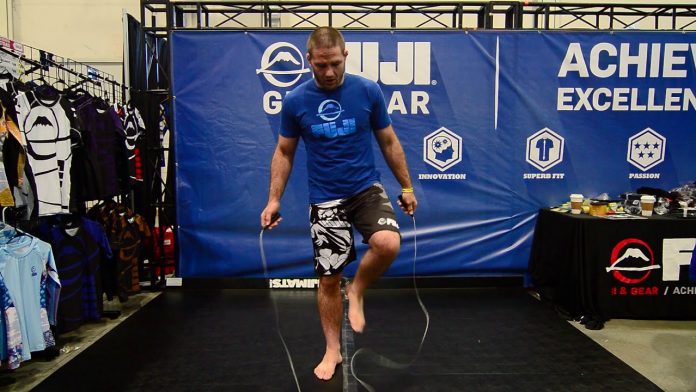
Rope Jumping Progressions For Brazilian Jiu-Jitsu Conditioning

Rope Jumping For Endurance

When it comes to conditioning for Brazilian Jiu-Jitsu and grappling martial arts, in general, a lot of specific work is required. Being in shape to grapple is no easy feat. It requires either lots of experience or lots of athleticism. Having both is going to make you really hard to deal with, which is what most grapplers are after. However, while specific strength and energy system work is a huge part of grappling conditioning, some of the older methods should not be abandoned. Long slow distance running has its benefits, as proven over and over again by boxers, wrestlers and the like. And so does rope jumping.

In today’s world of Bosu ball 1-arm handstands, while juggling sledgehammers with your feet, a step back to basics can only help. While lots of modern methods work, some are just pure speculation and result in more harm than good. Rope jumping is one of those methods that can only help grapplers. One of the reasons why it is often overlooked is the fact hat it is monotonous, similar to jogging. In order ot break up the boredom, we bring you the top rope jumping variations a grappler can do to get in amazing shape!

Why Should Grapplers Jump Rope

Jump rope training can benefit everyone. You can use it for long periods at a low intensity, for high-intensity bursts, or anything in-between. It’s also one of the most portable pieces of gym equipment in existence. It can be done just about anywhere.

The problem with traditional rope jumping, as we said, is boredom. Due to the repetitive motions of the exercise, many people tend to lose patience and abandon it. And grapplers are not known as the most patient athletes in combat sports.  There’s not much excitement in using both feet to repeatedly hop in place. But have you ever watched a skilled boxer train? Their dance with the rope looks anything but boring. Or easy to perform for that matter. Getting to the point where you can swing the rope and move your feet like a boxer will yield great health and performance benefits.

In terms of Jiu-Jitsu conditioning, it is going to improve your cardio and raise your endurance significantly. It also works on abilities like eye-hand coordination, agility, balance, and speed. Rope jumping even results in certain strength benefits, like forearm and ankle tendon strength.

Get In Fighting Shape Fast And Lose Fat Along The Way: https://bjj-world.com/jiu-jitsu-workout-program-to-lose-fat/

 Now, despite being a simple conditioning tool to use, rope jumping, like any other training method, requires correct programming. Even if you learn all variations of skipping, training blindly without a clear progression system is of no use. In that sense, we’re going to offer you various jumping patterns along with appropriate progressions. Read on!

The Basic Rope Jumping Pattern

When a boxer jumps rope, one of his objectives is to mimic the footwork used during a fight. Instead of hopping on both feet with an even amount of weight distribution, they shift the weight from leg to leg with each jump. This allows for more active movement and also puts less strain on the calf muscles. Alternating feet means your calf muscles get a slight rest with every jump, which is helpful, especially for beginners.

With the boxer style of rope jumping, the feet are always slightly offset. This way one leg absorbs slightly more landing force than the other. This provides the ability to move in any direction at any time. It’s also a much more efficient footwork pattern.

Rope jumping in this manner is a great way to prevent shin splints because it produces less impact. It also allows you to conserve energy and jump rope longer. When experimenting with the basic skip, imagine lifting your feet off the ground to create a jump as opposed to pushing them off the ground.

Going Sideways

Even if you’re an absolute beginner and have never trained rope jumping, you still need to do side swings. Side swings are a great way to learn how to correctly jump rope.  They teach you how to coordinate rope and foot speed without the need to actually jump As you advance, you can also use side swings as transitions between different types of swings and footwork.

Your basic side swings begin with a sideways figure-8 pattern. The rope will start to track behind you and loop around to the front on your right side. Then, it continues in the same pattern on the left side. Keep the rope going by continuing this figure-8 motion.

To progress, single-arm side swings are next on the list. The only difference is that you’ll need to hold both handles in the same hand. Practice moving the rope with both the right and left arm.

Transitioning into full skips from swings require you to bring both hands to where they normally are for a single rope turn. Separate the rope as it’s coming around, just before you’d start swinging to the opposite side. You should look to get comfortable with opening the rope up. You’ll soon get used to the timing.

Finally, go for the full side Swings while moving your feet. To do this rope jumping variation, first practice side swinging while moving your feet without trying to jump in. Only, once you’re comfortable, jump in every so often. Before going all in.

No Time? No Problem! Quick Workouts For Busy Grapplers: https://bjj-world.com/quick-jiu-jitsu-conditioning/

Cross Jumping

Being able to criss-cross the jump rope is impressive, but difficult to learn. Crosses are especially challenging to pick up. There’s no point in attempting them before mastering other skipping basics first. These progressions will teach you to cross the rope in no time, provided you already have certain experience in rope jumping.

To start with, place the rope behind you and twirl it over your head as if you were going to start jumping. As the rope passes your head and starts to come down, cross your arms. Don’t even try to skip over it at this point. Just drag the rope into your toes. Step over it and repeat the motion until you’re used to it. You need to be comfortable with the position of your arms before you think about jumping. When crossing, the goal is to completely displace your hands.

The next step is jumping over the as it comes through. Only jump once and don’t worry about what the rope does after. Reset and repeat until you’re familiar with the jump pattern. Later on, you’ll add in a jump over the uncrossed rope as well. You’ll jump over the crossed rope first, and then you’ll jump over it as it is returning. Uncross the rope at exactly the same point as you crossed it (as it’s coming down in front of you).

Stringing together crosses is the final piece of the puzzle.  As long as you’re able to keep a good rhythm with the first and second jump you’re good to go. Keep the rope and your feet going at a consistent rate to maintain the rhythm.

Doubling The Skips

The double-under is a rope jumping technique in which the rope turns two times on a single jump. A double-under cross is a skip in which the rope crosses and uncrosses on a single jump. Both of these variations are more about rope speed than height.

To learn to double-under, begin turning the rope as with the basic jumping pattern. Jump slightly higher on the fifth jump as you turn the wrists twice instead of once. Try to get the rope to pass under your feet twice before landing back. Get familiar with this before you attempt to string double-unders together.

Double-under crosses look much tougher than a regular double-under, but they actually aren’t. The only condition is having the crossing rope jumping technique mastered. Instead of the wrists producing the double rope turn, your arms will control the rope to complete a double-under cross. Learn these the same way you learned the double-unders – on every fifth skip, jump slightly higher, cross, then immediately uncross the rope before landing.

Clock Choke Magic To Deal With Turtled Up Opponents

Clock CHoke Against Turtle

One of the most defensive concepts that a grappler can employ is hurtling up. In a sports context, going into turtle means that you prevent your opponent from both getting points, progressing to a better position or submitting you. If you’ve ever had a Judoka defend all of your attacks just by soundly hurtling up, you know what I mean. Now, depending on rules there are a few foolproof ways to open up the turtle. If leg locks are allowed, going for the feet is going to cause an upset in the structure of the position. When you have to limit yourself due to rules though, it’s best to go for the neck. And, since the neck is buried deep, using the label is the best approach to finishing an opponent. Simple is best here, and it doesn’t get much simpler than a clock choke.

The turtle is a very annoying position to work against. It is one of those Judo positions that is intended to turn you into a rock. And the clock choke is the hammer that breaks the rock. It is one of the simplest, yet least used chokes in BJJ. It is extremely effective, and, as with many things in Jiu-jitsu, offers plenty of variations. Further, in this article, we’ll dissect how the clock choke works and which variations fit which situations. Let’s jump straight into it.

Essentials Of Choking With The Gi: https://bjj-world.com/unorthodox-gi-chokes/

Strangling People With The Clock Choke

As simple as it is, the clock choke is a very detailed BJJ technique. The body positioning is such, that if you don’t get everything spot on, you’re going to create an opening for your opponent. However, when you sink it in tight all you have to do is relax. Really, relaxing the body is essential in closing down all space.

The turtle position is the best spot to hit the clock choke from. Useful, isn’t it?.  The hardest part of a clock choke is getting your grips in. The turtle position is a difficult one to open, but that doesn’t mean that you can’t sneak your arm in.  The first order of business against the turtle is taking away space. This is done by staying very heavy on the back and hips of your opponent. Pressure is crucial in order to look for your grips.

For the clock choke, one arm needs to control the opponent’s far wrist, while your other hand goes on his collar with a thumb-in grip. This collar grip is the crucial one to get. Do not be discouraged if it takes a little while to sink in. As long as you stay heavy, you’ll be fine. Once you have a strong grip on the collar it’s time to break the turtle down. Drive forward, pull your partner’s far arm in and they’ll collapse to the ground. From there, you sit your hips in front of your partner’s shoulder and start walking around the head. Some people are going to tap right there, while for other’s it takes a thug of the collar.

The Occam’s Razor Principle For BJJ

The basic and fundamental BJJ techniques are foundational for a good reason.  They continue to work well on a constant basis and across multiple levels. Even after the latest fad and fancy techniques have disappeared, the basics are still going to work. A great rule of thumb for grappling martial arts is to start and end with the basics.

Since there aren’t that many options for attacking a turtled up opponent, the clock choke is one of those basics. It isn’t nearly as popular as it should be probably because of its simplicity.  If you have ever tapped from a clock choke, then you know how brutal this Gi choke truly is. This choke is one straight for your emergency toolbox.

The key to hitting the clock choke is a strong connection to the hips on both sides.  From one side this is done via the control on their far arm. On the near side, it’s your hips that put pressure on your opponent’s.  Once the arm is controlled and you have the collar grip the hip to hip pressure can be released. However, this doesn’t mean that you completely lose connection with your opponent. You just slide your hips forward so that now they control the opponent’s shoulder.  but not for good, instead it is simply replaced with hip to shoulder and head pressure.

You can even go for a roll from there. All it takes is to releasing the hand that controls their far side arm and pull the opponent up and across your body. This is going to open the neck up, bringing you a devastating finish in seconds.

Check Out The Power OF BJJ Chokes: https://bjj-world.com/bjj-purple-belt-attacked-much-bigger-guy/

Different Clock Chokes For Different Folkes

Distinct Gracie family member Carlson Gracie Jr. has a very simple take on the execution of the clock choke. Carlson Gracie Jr. makes a point to sprawl his hips at the end of the technique. This variation adds some very intense and dominating pressure to help you finish faster.

Many people have had stunning success with this move at the highest stages of Brazilian Jiu-Jitsu competition. From there, certain excellent details have emerged for us to include in our clock choking game. One such detail is moving from the hip to hip pressure to sit on the shoulder with your hips.  you can accentuate this by using what we refer to in BJJ as the fifth limb – your head. IN that sense, you can use your forehead to post so that your hips are lighter and allow for more movement.  It is a great way to maintain pressure while rotating in position to finish.

Jean Jacques showed us how to get a turtled opponent out of their shell and expose theirs for a clock choke. In his modification, Machado simply slides off of the opponent’s back and finishes the strangle.

The similarities between these variations are clear, but it is the individual nuances and tweaks that are important to notice. It is simple really,  the longer you train BJJ, the more important it is to polish your favorite moves. All these variations are great options to add to your existing clock choke game in order to ensure you finish everyone!

Top And Bottom Baseball Choke Setups For Jiu-Jitsu

Baseball Choke Setups

Training Brazilian Jiu-Jitsu with the Gi is unlike training any other grappling martial art. Even in Judo, where the Gi is also a mainstay, there are far fewer opportunities than in Jiu-Jitsu. The various uses of the Jiu-Jitsu Gi certainly outline the creative character of the Gentle art and those training it. From innovative grip sequences to lapel-mediated armlocks and collar chokes, the Gi is an essential tool of the modern grappler. Even those that favor No-gi should cross-train with the Gi, at least occasionally. How else would they discover the hidden power of brutal Gi chokes like the Baseball choke?

The Baseball choke is one of those chokes that either agrees with you from the beginning or they do not. Personally, I like it, but I do not execute it from every position. That doesn’t mean that it is not a viable option, it is just not my first one. From the knee on belly, however, it is right there and there are not a great number of things I’d go for before going for a Baseball choke. IT is tight, it can be set up without the opponent noticing and comes on very quickly. It also gets you ina perfect position (North-South) to keep attacking, in the unlikely case it fails to work. All in all, it is one of those submissions everyone needs in their toolbox, just in case they need it.

Attacking From The North-South Positionhttps://bjj-world.com/bjj-north-south-position-attacks/

How Does The Baseball Choke Work?

The Baseball choke is the brainchild of Magid Hage, a Gracie Barra black belt. The young Brazilian is a huge fan of the sneaky aspect of Jiu-Jitsu, hence his experimentation in those areas. Magid’s “sneaky” research gave birth to one of the tightest chokes in Brazilian Jiu-Jitsu.

The reason the baseball choke is considered to be a sneaky technique is that most people never see it coming. When you position yourself for an armbar from the mount or go for Ashi Garami, people are going to know what to expect. However, when you’re crushing them from the knee on belly position, they won’t suspect you going for the arguably tightest collar choke. What’s more impressive is that you can hit the choke from the bottom, and not just form the guard. The baseball choke is very easy to set up from bottom side control when your opponents really feel safe and in control. That’s not all, however. For all you No-Gi die-hards out there, a variation of the Baseball choke is also applicable without the kimono.

Basically, the Baseball choke is a blood choke, using the collar and your forearms to cut off the blood supply to the brain. The configuration of the choke involves one of your arms gripping the lapel of an opponent very deep. Unlike most Jiu-Jitsu chokes from the front, the Baseball choke doesn’t require a cross collar grip, but rather a same side one. For the grip, four fingers go inside while the thumb goes to the outside. the other grip is placed on the opposite side lapel in an opposite manner (thumb in, four fingers out). The palms of both hands should meet behind the neck, like when holding a baseball bat, hence the name of the choke.

Top Position Baseball Choke

Form the top position the Baseball choke can be set up from two positions. One is the top half guard and the other is knee on belly. The reason why it cannot be sneaked in from classic side control is that it requires space between your body and the torso of your opponent in order to obtain the grips. For that purpose, nothing works better than knee on belly. In terms of setting it up from the half guard, the setup is pretty much the same as from knee on belly. In order to finish, though, you’ll have to pass the guard and rotate towards the North-South position. This is why half guard setups are secondary to knee on belly setups.

Finishing the choke requires you to rotate with your arms as a pivot point. The baseball position of your arms ensures that when you reach the North-South position, the choke is instantly going to be in place. As you rotate, the baseball choke gets tighter and tighter, and in case you need a bit more leverage, once you get to North-South, you can shift your body weight forward towards your opponent’s chest, bending your elbows.

From knee on belly, you need to start by inserting your near side arm into the opponent’s lapel. Be patient and look for a deep grip, the goal being to reach the collar at the back of their neck. once you have that grip in place you can start looking for the second one. It is important to use the first grip both as control and to help you open up space for the second one. Pressure from your knee on their belly/chest is crucial for creating space while keeping the opponent in discomfort.

Sneaky Choke From The Bottom

Now, from the bottom setting up the Baseball choke is the definition of sneaky attacks. This is the most readily available submission from the bottom side control. Which grip goes first depends on the situation you find yourself in. In most cases, it is the grip that goes in second from the top, that is first in order here. It is way easier to establish the thumb in grip with your far side arm.afterwardd the main fight is to sneak the other grip in. Since this is done with the nearside arm, it is not very difficult to do so.

Finishing the baseball choke from the bottom requires a bit of positioning from yourself. once you have the grips in, you do what you’ve been taught never to do from bottom side control – turn away from your opponent. In the case of having Baseball choke grips in, though, the result is going to be a lightning-quick choke. Your opponent can either tap, nap or try and go forward, which is going to bring you in top position where you can still finish the choke.

Alternatively, you can set the choke up from the bottom of half guard. Many opponents are going to allow you to establish the grips without worrying too much. The only trick is that you can’t finish it from half guard. So, you’ll have to let them pass your guard before turning away and instantly making them regret it.

The No-Gi Version

For the No-Gi version of the Baseball choke, the main difference is in the grips. Given the absence of collars, the grip modification includes putting your hands together. The basic idea is simple – connect your hands with an S-rip behind the opponent’s neck. Afterward, the goal is making your elbows cross each other, or at least touch them together. The arms are set up in the same manner as with the Gi, with the first arm being the one that is palm up in the S-grip. The No-Gi Baseball choke is way more effective when done from the bottom.

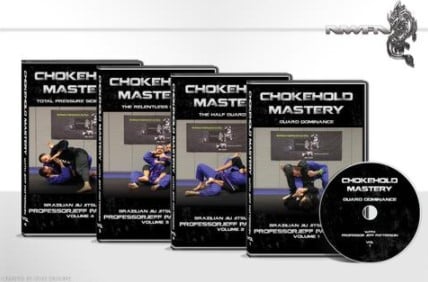
Make sure you check out the Chokehold Mastery Instructional by Jeff Patterson DVD. Jeff Patterson was training with Rigan Machado and Pedro Sauer. He gathered all of their best chokes and put them on his DVD

chokehold Mastery by Jeff patterson
Check out the list of Techniques on newest DVD from Jeff Patterson Chokehold Mastery

The Paleo Diet For A Sustainable BJJ Lifestyle

Paleo Diet For Grappling

Having the energy for Jiu-Jitsu training often requires you to go out of your way in terms of nutrition. In today’s world, there are literally thousands of diets and methods to choose from. What they all have in common is their claim to be better than every other method. Regrettably only a few are functional, and a true reigning champion among diets is yet to be declared. When it comes to grapplers food turns into more than just a way to drop a few pounds. It is a very important fuel that needs to keep our bodies running. the modern day Western diet just won’t cut it. Neither will plenty of the other common dietary approaches. However, among all the ruble there are a few nutritional gems. One of them is the Paleo diet.

Although the Paleo diet has its shortcomings (which we’ll mention later) it does provide grapplers with more benefits than other approaches. For most people, a regular day means early mornings, family, work, and more family obligations on either side of a BJJ class. A day like that requires a lot of energy. In the same time, there’ not a lot of time to go cooking specialized meals that take hours to finish. The reason why the Paleo diet works is because it is simple. And we already know that in BJJ, the simpler the technique, the better it will work. Now let’s dissect the Paleo diet and see how it can be modified t fit a BJJ lifestyle.

The Nuts And Bolts Of The Paleo Diet

‘Paleo’ is short for ‘Paleolithic Diet’,  a dietary approach that tries to mimic the eating habv\its of people from the Paleolithic period. Or at least it claims to do so. Since we don’t exactly know what people ate back then, the Paleo approach is based on guesses. There are, however, nutritionally healthy ones, making this a very viable approach.

This dietary philosophy is in a way an extreme reaction to the modern lifestyle that. There’s no place in for fatty fries, high fructose corn syrup, and lab-grown burger patties. So, the Paleo diet is all about bringing back the eating habits of old. Real food over conventional food.

When we’re talking about Paleolithic age, we are talking about the hunter-gatherer days of humanity. That’s the period everyone ran around wearing fur skins and bashing giant mammoths with clubs. Paleo is a philosophy that encourages humans to eat the foods we have evolved to eat. is Then the main notion is that the foods we have not evolved to eat (processed foods) are damaging our bodies.

The whole point of the Paleo approach is to completely avoid processed foods, which harm our bodies. It also advocates the removal of all grains, which we have not quite evolved to easily digest.

There is actually a whole ‘range’ of Paleo approaches, from a more relaxed Paleo approach to the more hardcore version which completely “outlaws” dairy, legumes and other food types that most people would consider part of a healthy diet. Basically, if your hunter-gather caveman ancestors didn’t eat it, you can’t eat it either.

Paleo Diet

Benefits Of Going Paleo

The Paleo diet is mainly made up of whole foods. Yes, there are some like some condiments and sauces, but the vast majority should be made up of natural, unprocessed food. The main benefit here is that you’re getting rid of preservatives, additives, artificial flavorings sugars, excess sodium, etc. You’ll basically end up cleaning your eating habits by putting good quality fuel into your body.

Avoiding processed foods means that your calorie consumption tends to drop dramatically. People who simply replace processed food with whole foods often lose weight quickly. The reason is that replacing processed foods full of fats and sugars with more nutrient dense food choices reduces your calorie intake. This, in turn,  increases the number of quality nutrients and makes you feel fuller for longer. So, you’ll eat more )quality) by eating less (quantity).

Another great aspect of the Paleo diet is increased protein intake. The Paleo diet emphasizes lots of protein, mostly from free-range animals and non-processed dairy. When you cut out the starchy carbs from dough-based foods, you often tend to make up with more protein and fats. If you think about what you usually eat, a major part of your diet is likely starchy carbs. These are noodles, bread, rice, potatoes, and the like. When you remove these carbs, you have to fill the dietary gap. A major part of that something else tends to be larger protein quantities during meals.

There’s a number of key benefits to increasing the amount of protein in your diet. It helps build and repair muscles. It also takes more energy to digest protein, which is a good thing if you are trying to drop weight.

A Healthier Lifestyle

The first assumption about Paleo people is that the diet is all about protein and fats. While this is true to an extent, a side effect of cutting out complex carbs is that you replace them. Paleo focuses on simple carbs which are more easily processed by the body. Because you get all of your carbs from fruits and vegetables, your micronutrient intake is going to increase significantly.

Often people only look at the basic macronutrients, those being carbohydrates, fats, and proteins. However, the micronutrients (vitamins and minerals) are also very important for keeping your body running smoothly. They’re charged with boosting your immune system and aiding in the processing of macronutrients. Which brings us to digestion.

Paleo Diet

Removing starchy carbs and processed foods can reduce bloating, gas, and increase absorption of nutrients. Processed foods, in particular, cause inflammation in the gut. Celiacs (gluten sensitivity) is one condition that benefits greatly from the Paleo diet Furthermore, exclusion of processed foods and starchy carbs means it’s easier to digest your food. Thanks to this, you’ll likely experience less inflammation in your digestive tract. Fibrous vegetables, drinking lots of water, and minimizing salt content can reduce your stomach bloat and keep your gut microbiome in balance.

Paleo Diet Modifications For BJJ

If you are trying to do a low-carb diet, Paleo makes it particularly easy because you’ve already cut out the majority of starchy carbs. Paleo is not inherently low carb, though you generally eat fewer carbs while on it. In certain cases, this can be an issue for grapplers. The fact that you eat simple carbs in the Paleo diet means that you can’t go into ketosis. This means that you do not gоиng to be really efficient at using fats as a fuel source. This brings us back to carbs, and a way to modify the Paleo approach to suit grappling needs.

There is one modification of the Paleo diet, called the Primal diet. Apart from fruits and vegetables, it also includes some starchy carbs. In terms of Paleo compatibility, grains are still o on the list. In terms of differences, root vegetables like potatoes, sweet potatoes and yams are back on the menu. These are starchy carbs that are essential for keeping up with the demands of everyday life while also rolling in BJJ.

If you are eating a nutritionally unbalanced diet, switching to a diet like Paleo is going to do wonders for you. Body composition, energy, health in general and easier weight cut are just some of the benefits for grapplers. What you are certain to get is a more balanced ratio of proteins, fats, carbs, and micronutrients while also cutting out most of the chemical junk. You ’ll feel better and look better over the long run, that is guaranteed.

Like any dietary approach, though, there is quite a bit of effort involved in maintaining it. And Paleo is a very strict diet indeed — you can pretty much forget about meals-0n-the-go and you better damn well learn how to cook.

Performance Nutrition For Grapplers: 2 Things Everyone Gets Wrong

Top Foods To Help With Fat Loss For BJJ