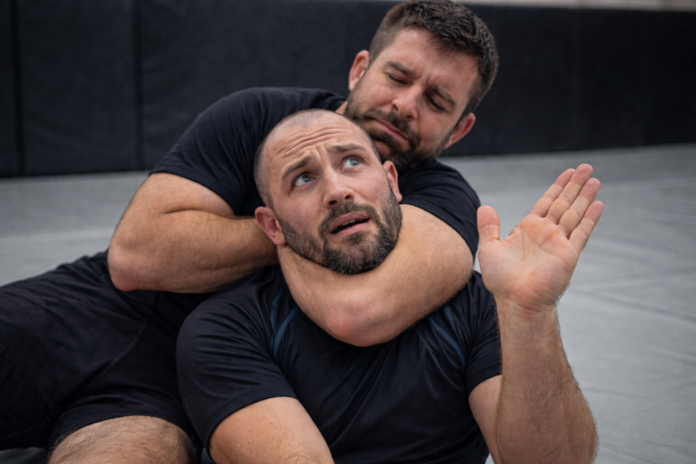




Teen Chokes to Death with Jiu-Jitsu Belt: Mom Sues TikTok After Viral “Blackout Challenge” Goes Wrong

Teen Chokes to Death with Jiu-Jitsu Belt: Mom Sues TikTok After Viral “Blackout Challenge” Goes Wrong
  • Teen chokes to death with Jiu-Jitsu belt while attempting a viral TikTok challenge.
  • Six families are suing TikTok and ByteDance, alleging the app’s recommendation system pushed a dangerous “Blackout Challenge” to minors.
  • The Delaware portion of the case involves Michelle Ortiz, who says her 17-year-old son Jaedon Bovell died in 2020 after attempting the trend using a Jiu-Jitsu belt.
  • Five UK families are tied into the same filing, pushing for “Jools’ Law” to preserve a child’s platform data after a death.
  • TikTok is trying to dismiss the case, setting up a wider legal test around algorithmic recommendations and responsibility.

Mom Sues TikTok After Son Dies Attempting Viral “Blackout Challenge”

A Delaware lawsuit is dragging a grim, very BJJ-adjacent detail into the mainstream: Teen chokes to death with Jiu-Jitsu belt is the headline-level shorthand for what one family says happened after a dangerous “Blackout Challenge” trend surfaced on TikTok.

At the center of the Delaware claim is Michelle Ortiz, who says her son, 17-year-old Jaedon Bovell, died in 2020 after allegedly attempting the challenge.

Five other families from the United Kingdom are part of the same legal action, arguing that platform design and recommendation systems can accelerate risky behavior faster than parents—or even schools—can realistically keep up.

The case is now sitting at a crucial early stage: if the judge allows it to proceed, the families hope the legal process will force disclosure about what content their children were shown, how it was recommended, and what internal safeguards existed (or didn’t) at the time.

What The Lawsuit Claims And Why Jiu-Jitsu Gear Is In The Headline

The families’ core argument isn’t just “dangerous videos exist online.” It’s that the delivery system matters. They claim TikTok’s “For You” feed is engineered to keep users watching—and that, for minors, that can mean being served more extreme material once the algorithm thinks it’s found a hook.

For grapplers, the Jiu-Jitsu belt detail hits differently because it’s familiar household gear: thick cotton, long, and easy to leave in a gym bag or draped over a chair in a bedroom.

No one in Jiu-Jitsu is “responsible” for a viral trend, obviously—but the detail underscores a bigger point: a platform-fueled dare can hijack everyday objects in the worst way possible.

TikTok, for its part, has argued it shouldn’t be held liable for content created by third parties, and has leaned on longstanding legal protections that tech companies often cite in these cases.

The families’ side is pushing the opposite framing: that algorithmic recommendation is not passive hosting—it’s an active product feature with foreseeable consequences. This incident, where a teen chokes to death with Jiu-Jitsu belt is not as isolated as it may seem.

Teen Chokes to Death with Jiu-Jitsu Belt: Mom Sues TikTok

Teen Chokes to Death with Jiu-Jitsu Belt: What Michelle Ortiz Alleges Happened

Ortiz’s claim centers on her son’s death in 2020, and her allegation that TikTok’s design exposed him to a trend with life-or-death stakes. The lawsuit’s broader theme is that minors don’t engage with a neutral library of content—they engage with a system that decides what comes next.

Children make decisions not knowing finality like adults do, and they bank on this.
– Michelle Ortiz –

That idea—kids making impulsive choices inside an environment engineered for compulsion—shows up repeatedly in how families are talking about the case. The parents involved say they’re not only seeking damages; they’re trying to force changes that reduce the chance another family ends up living the same nightmare.

And for BJJ readers, it’s hard to ignore how the phrase Teen chokes to death with Jiu-Jitsu belt lands: it’s not a “martial arts story,” but martial arts equipment is now part of the public conversation around online safety.

The UK Families, “Jools’ Law,” And The Bigger Data Fight

Alongside the Delaware family, five UK families are tied into the filing, with their own painful common thread: they believe an online trend played a role in their children’s deaths, but they say they can’t fully prove what their kids saw because they can’t access the relevant platform data.

That’s where “Jools’ Law” enters the picture—an effort that would require social media companies to preserve a child’s data quickly after a death, rather than letting it vanish behind retention policies, privacy arguments, or jurisdictional roadblocks.

In plain terms: parents are arguing that “we deleted it” shouldn’t be the end of the story when a child dies and a platform may hold the answers.

This is also why the courtroom stage matters. If the case moves into discovery, families hope they’ll finally learn what content was served to their children and why.

TikTok has suggested that, especially for UK-based accounts, the matter should be addressed in the UK rather than in a US court—another layer in a legal battle that’s as much about geography as it is about technology.

TikTok has a For You page that deluges young kids with dangerous material… material they can’t turn away from.
– Matthew Bergman, Attorney For The Families –

Viral “Blackout Challenge” Goes Wrong

What Parents And Coaches Can Do Right Now

While courts argue about liability, families and coaches are stuck dealing with the reality: viral challenges move at the speed of an algorithm.

A few practical takeaways that don’t depend on lawsuits or legislation:

  • Don’t wait for a kid to call it “self-harm.” These trends are framed as “challenges,” “tests,” or “dares”—and that language can lower the perceived risk.
  • Use restrictions, but assume workarounds exist. Time limits and content controls help, yet reposts, coded captions, and reaction clips can slip through.
  • Explain how the feed works. A useful conversation isn’t “don’t do dumb things.” It’s: the app learns what holds your attention and then escalates what it serves you.
  • Make training gear boring and safe at home. If your household has Jiu-Jitsu belts (or anything long and strap-like), don’t treat it like a harmless accessory in a teen’s room. Basic risk reduction beats wishful thinking.
  • For coaches: a 60-second reminder can matter. You don’t need a lecture—just normalize that internet “challenges” are real, and training gear isn’t for messing around.

Because the headline phrase Teen chokes to death with Jiu-Jitsu belt shouldn’t just function as clickbait—it should function as a warning.

This lawsuit is a collision between two realities: parents live in consequences; platforms live in engagement metrics. The families argue that when recommendation systems amplify dangerous trends, harm isn’t a freak accident—it’s a predictable risk of design choices that prioritize watch time.

Whatever the judge decides next, the grappling community will keep seeing these stories for a simple reason: Jiu-Jitsu is mainstream now. Belts, rash guards, and gear are common in homes—especially with teens who train. And as long as viral dares exist, the risk won’t stay “online.”


The Gift Rap 2: A BJJ Black Belt Album That Tells Jiu-Jitsu Stories Through Music

Lear Kirkland The Author of the Git Rap 2

Brazilian Jiu-Jitsu has a strange way of following you outside the gym.
You finish training, take off the gi, get in the car — and the rounds keep going in your head. The mistakes. The small wins. The things you almost hit but didn’t.

For most of us, jiu-jitsu doesn’t stop when class ends.
It becomes part of how you think.

That’s why The Gift Rap 2 stands out.

This isn’t music made by someone looking at jiu-jitsu from the outside. It’s created by someone who has spent years on the mats, competing, teaching, losing, winning, and going through the same mental cycles every long-term grappler knows.
Lear “Learycal” Kirkland is a Brazilian Jiu-Jitsu black belt, and this album feels exactly like something that could only come from that perspective.

Instead of trying to explain jiu-jitsu or sell an image of it, The Gift Rap 2 documents the lived experience — the grind, the mindset shifts, and those quiet moments after training when everything suddenly feels clearer.


A Black Belt Perspective That Actually Matters

Lear has been training Brazilian Jiu-Jitsu for 11 years and received his black belt in January 2024 under Bill Konkel. He trains and teaches at Voyage Jiu Jitsu in Saint Clair Shores, Michigan, and remains an active competitor.
Outside the academy, he’s also the co-owner of For The Art BJJ, a jiu-jitsu apparel and sportswear brand founded in 2024.

That background matters.

In jiu-jitsu, credibility isn’t something you claim — it’s something that builds slowly. A black belt doesn’t just represent technical skill.
It represents years of failure, repetition, ego checks, and learning how to think long-term.

The Gift Rap 2 is Lear’s second BJJ-focused album, following The Gift Rap: Volume 1, released in December 2021. This sequel wasn’t planned as a marketing move. It happened because the first album actually connected with grapplers.

“This is actually my second BJJ rap album,” Lear explains.
“After the first one came out, a lot of people told me how much they enjoyed it and kept asking if there would be another one. I wanted to challenge myself and also give people more music that’s made specifically for grapplers.”

The Gift Rap 2 cover


Why The Gift Rap 2?

The title immediately tells you where this project lives — right between Brazilian Jiu-Jitsu and hip-hop culture.

“The Gift Wrap is a common control position in BJJ,” Lear says.
“Switching ‘Wrap’ for ‘Rap’ felt like a clever crossover between jiu-jitsu culture and hip-hop culture.”

But it’s not just wordplay.

“To me, The Gift Rap is my unique way of giving back to the BJJ community,” he adds.
“I’ve received so many benefits from being involved in the culture that it only felt right to contribute something back.”

That idea — contribution, not promotion — runs through the entire album.
Instead of putting himself on a pedestal, Lear focused on experiences most grapplers recognize immediately.


Music Built Around the Real Rhythm of Jiu-Jitsu

Music already plays a huge role in jiu-jitsu.
Warm-ups. Competition prep. Walkouts. Training clips. Social media edits.
What grapplers put on while warming up before class or walking into competition.

And yet, very little music is made specifically for grapplers.

Lear saw that gap and stepped into it.

One of the standout tracks, “Run It Back,” came straight out of a tough competition loss.

“It was one of those losses that sticks with you,” he explains.
“I was frustrated and disappointed right after, but I decided to take those thoughts and feelings and turn them into something productive.”

The song is about mindset — staying humble, staying hungry, and using losses as feedback instead of letting them define you.

“Losses aren’t fun,” Lear says,
“but if you approach them the right way, they can become some of the best tools for growth.”

Another key track, “Post Tap Clarity,” captures something almost every long-term practitioner knows.
That feeling after a hard session when your body is wrecked, but your mind is sharp.

“It’s that feeling after training where you’re driving home physically exhausted but mentally stimulated,” Lear explains.
“You’re replaying every detail of a roll and breaking things down.”

Instead of anchoring songs to very specific personal moments, Lear wrote from a shared perspective — which is why the album feels relatable whether you’re a white belt or a black belt.

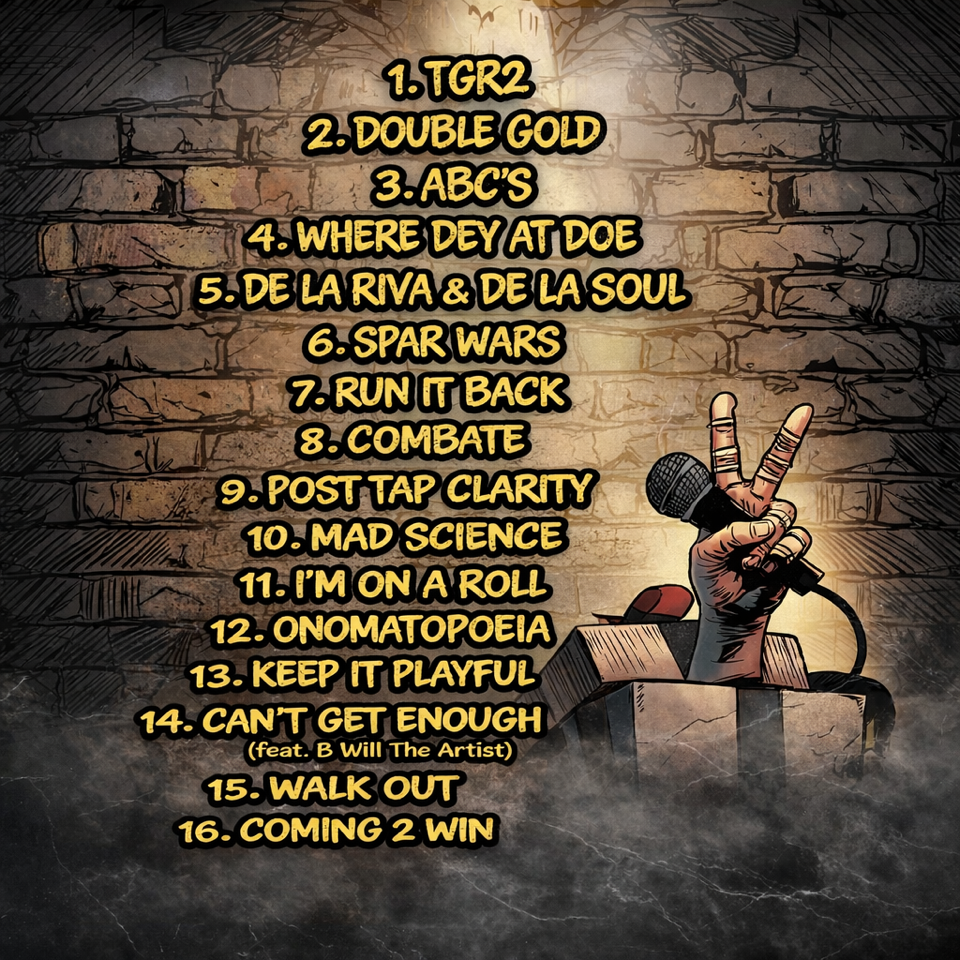
The Gift Rap 2 tracklist by BJJ black belt rapper Learycal


Competition, Humor, and Self-Awareness

The Gift Rap 2 doesn’t take itself too seriously — just like good jiu-jitsu shouldn’t.

  • “Double Gold” captures the confidence and chaos of competition day, framing tournament success like a fast, clean heist for medals.

  • “Keep It Playful” hits on one of the most universal BJJ experiences: agreeing to roll light and realizing 30 seconds later that nobody is actually rolling light.

  • “Walk Out” was written specifically as a walkout track for superfights or MMA bouts — aggressive, focused, and built to flip the switch.

Together, the tracks reflect what jiu-jitsu actually feels like: intense, obsessive, competitive — but also self-aware and, at times, playful.


More Than an Album — A Cultural Snapshot

What makes The Gift Rap 2 work is that it doesn’t try to explain jiu-jitsu to outsiders.
It assumes the listener already understands the culture.

As Brazilian Jiu-Jitsu keeps growing worldwide, projects like this help document what the lifestyle actually feels like, not just how it looks on social media.

Lear’s work outside music follows the same idea. Through For The Art BJJ, he focuses on building things for the community, not selling an image of it. Both projects feel aligned in purpose.


Who This Album Is Really For

The Gift Rap 2 isn’t for everyone — and that’s why it works.

If you’ve ever:

  • sat in your car after training replaying rounds in your head

  • lost a match and quietly adjusted your goals

  • struggled to balance humility with ambition

  • trained for years without external validation

this album will resonate.

It doesn’t exaggerate the jiu-jitsu experience.
It reflects it.

Where to Listen & Follow

The Gift Rap 2 is available on major streaming platforms:

Spotify (Album):
https://open.spotify.com/album/0qpwZjubnhwug2o7Dqu6bR

Apple Music (Album):
https://music.apple.com/us/album/the-gift-rap-2/1864817287

Follow Lear “Learycal” Kirkland:
https://www.instagram.com/kinglearycal/

For The Art BJJ:
https://www.instagram.com/fortheartbjj/

Lear Kirkland
“Learycal”

Unpinable Henry Akins DVD Review [2026]

Unpinable Henry Akins DVD Review

Key Takeaways

  • A four-volume escape-focused instructional built around “hidden” mechanics: denying connection, winning underhooks, and rebuilding posture instead of panic-bridging.
  • Best for grapplers who hate being stuck under pressure—especially smaller athletes, older practitioners, and anyone who wants calmer bottom survival.
  • The strongest value is conceptual: Akins keeps returning to why common escapes fail and what to prioritize before trying to move.
  • Volume 4’s live Q&A helps connect the dots and troubleshoot common “yeah-but-what-if” scenarios.
  • Rating: 9/10

UNPINABLE HENRY AKINS DVD DOWNLOAD HERE

Getting pinned in Jiu-Jitsu isn’t just uncomfortable—it’s where rounds go to die. Even good athletes can look helpless once a crossface settles in, the near-side arm gets stapled, and their “frames” turn into a slow-motion surrender. The promise of the Unpinable Henry Akins DVD is basically the antidote to that feeling: not a highlight-reel escape, but a method for making bottom position manageable again.

Henry Akins’ angle is familiar to anyone who’s followed his “Hidden Jiu-Jitsu” philosophy: stop trying to out-muscle the pin and start removing the mechanical reasons the top player can hold you in the first place. If you’re the person who “knows the escape” but still can’t get out once the pressure is real, this is the kind of instructional that can finally explain what you’re missing.

The Part Nobody Wants to Train 

Most BJJ pin escapes get taught like a recipe: frame here, shrimp there, recover guard, done. The issue is that pins aren’t static. A good top player is constantly re-pinching space closed—walking hips, re-crossfacing, pummeling for the underhook, and reattaching chest-to-chest connection the moment you create a gap.

That’s why people feel like they’re working twice as hard just to stay exactly where they started. Akins’ big reframing (and the tone of the Unpinable Henry Akins DVD) is that the first battle isn’t “moving away.” It’s breaking the pin’s attachment points so movement becomes possible. If the top player owns your near-side shoulder line, your hips can slide all day, and nothing changes.

If they own your head position via crossface, your spine is twisted, and your power disappears. If they can freely pummel for inside control, every escape attempt becomes a trap that feeds them a better pin. There’s also a psychological element that matters: when people feel crushed, they default to explosive bridging and frantic framing.

Sometimes that works for beginners. Against experienced pressure, it often just gives up better angles, exposes the back, or burns your gas tank. The “calm under pressure” theme isn’t motivational fluff—it’s a practical requirement if the system is built around micro-adjustments and timing instead of scrambles.

The Hidden Jiu-Jitsu Genius: Henry Akins

Henry Akins is a long-time Rickson Gracie black belt whose teaching reputation is strongly tied to fundamentals, pressure management, and details that don’t always show up clearly on video—weight distribution, alignment, and the feel of connection. In his broader body of work and branding, he’s consistently pushed the idea that the most valuable Jiu-Jitsu isn’t necessarily the flashiest, but the stuff that holds up when someone is bigger, stronger, or determined to smash.

A key point for this instructional is that Akins isn’t presenting pin escapes as a competition-specific “get out and wrestle up” series. His perspective is closer to classic, survival-first Jiu-Jitsu: preserve your structure, deny the top player the grips/angles that make pressure work, and then rebuild to a position where you can stand, recover guard, or re-engage on your terms.

He’s also well known for coaching and teaching at a high level for years, and for leaning hard into conceptual explanations—what to prioritize, what mistakes to avoid, and how to troubleshoot when the opponent reacts correctly. That teaching style fits the subject perfectly. Pin escapes are one of those areas where a small detail can change everything, but only if someone actually explains what “right” feels like.

The Full Unpinable Henry Akins DVD Review

Across four volumes (three technique volumes plus a live Q&A), Akins targets the specific problems that make pins feel inevitable—connection to the shoulder line, crossface control, knee-on-belly staging, and even the head-and-arm threats that punish sloppy turning.

Volume 1 – The End od Framing

Volume 1 of the Unpinable Henry Akins DVD sets the foundation with a theme that’s going to surprise a lot of people: Akins argues that the typical “framing” approach can be the wrong instinct when someone is passing and settling pressure. Instead of treating your arms like rigid bars you push with, he’s steering you toward hand and elbow placement that guarantees meaningful inside position—especially the underhook battle that decides whether bottom person can build up or just gets flattened.

This volume is also where the “hidden mechanics” framing starts to make sense: he talks about killing connection to the shoulder line, stopping the opponent from pummeling back in, and dealing with common counters like the elbow pluck. In practice, it feels like he’s building a checklist: if you don’t solve these specific problems first, your escape won’t work—because you’ll never be allowed to reassemble posture and hips at the same time.

Volume 2 – Cross Face and Knee On Belly Solutions

The next portion shifts into one of the main pin-killers in modern Jiu-Jitsu: the crossface. Akins doesn’t treat it like an annoying detail; he treats it like the steering wheel of the entire pin. If your head is turned and your shoulders are pinned, you’re basically trying to escape with half a spine.

In the Unpinable Henry Akins DVD, this section is structured around shutting down the crossface, clearing it when it’s already in, and then using that win to get back to your knees—because knees under you changes the whole game. He also splits knee-on-belly into stages: a “preliminary” phase and a later phase where the top player has stabilized. That’s a smart inclusion, because most people only train for the moment the knee lands, not the moment the attacker has already built posture and started hunting transitions.

The final chapters here deal with reactions you’ll recognize immediately in rolling: the top player grabbing legs to prevent your build-up, or staying low to keep you stuck. This is exactly where a lot of escape instruction becomes unrealistic, and it’s good to see those problems addressed directly.

Volume 3 – Underhook & Back Door Escapes

Part 3 is where the material starts acknowledging the price of escaping wrong: head-and-arm control and front headlock-style threats that catch people the moment they turn. Akins opens with shutting down and reversing the Darce, which is a very “real round” problem—especially for anyone who tries a turning side control escape and gets instantly punished.

From there, the Unpinable Henry Akins DVD goes deeper into underhook-based escapes from head-and-arm situations and cross side pressure, plus “back door” style escapes for when the normal route is blocked. Importantly, he also includes a scenario where your elbow is trapped underneath your body—one of the worst feelings in grappling—and a “flattened out” situation where the opponent is holding with both arms near side.

Those are the spots where people usually accept defeat and wait for the round to end, so having dedicated coverage is a big practical win. This volume reads like the “okay, but what if they’re actually good?” answer to the first two volumes.

Volume 4 – Live Q&A

Volume 4 is a live Q&A with Mike Zenga, and it functions like a glue layer. If the first three volumes give you the mechanics, this gives you context: when to choose which solution, what details matter most when the opponent is adapting, and how to troubleshoot when your escape keeps stalling in the same place.

For many instructionals, Q&A is filler. Here, it’s a strong closer because this Unpinable Henry Akins DVD is heavily principle-driven. The questions help reinforce the hierarchy: what to solve first (connection, head control, inside position), what not to do when pressure is mounting, and how to keep the whole system coherent instead of collecting “random escapes” you can’t apply under stress.

Learning How to Actually Escape

If you opt for the Unpinable Henry Akins DVD and try to “remember everything,” you’ll probably stall out. The better approach is to treat it like a pressure-testing project for a few weeks.

Win one battle consistently first. Pick a single priority—like hand placement to secure the underhook, or clearing the crossface—and make the round about that, even if you don’t fully escape. If you can reliably deny the opponent their best attachment point, the rest improves fast.

Add positional sparring with constraints next. Start bottom side control with the top player’s goal being “keep the crossface for 30 seconds” while your goal is “clear it and get to knees.” Then swap. This turns concepts into timing, which is what escapes actually require.

A good idea is to record one common failure and fix it. Maybe you keep getting elbow-plucked. Maybe you get stuck when they grab the legs. Maybe you expose your neck turning in. Use the structure of the instructional to isolate that failure and solve it instead of “trying harder.”

Integrate into full rolling with a clear trigger. For example: the moment you feel the crossface settle, you don’t flail—you go straight to the crossface solution you’ve drilled. The point of this system is that it gives you a calmer default response when you’re under load.

OUT NOW: UNPINABLE HENRY AKINS DVD 

Who Is This For?

The Unpinable Henry Akins DVD is a strong fit for grapplers who regularly get stuck under side control pressure, crossfaces, and long pin chains, and who are tired of doing the “right” escape steps only to get stapled back down.

It’s also ideal if you want an approach that prioritizes efficiency, posture, and those “invisible” mechanics that make pressure work—rather than relying on athletic explosions that don’t always show up when you’re tired or undersized. And whether you train Gi, No-Gi, or both, the concepts carry over cleanly because they revolve around universal problems like connection, head control, and inside position.

In terms of level, solid white belts through blue belts tend to get immediate value if they already understand basic positions and simply need their escapes to stop collapsing once the top player applies real pressure. Purple belts and up will likely appreciate it for a different reason: the “why” behind details you’ve felt for years but couldn’t fully articulate, plus troubleshooting for common counters that experienced opponents use to shut down standard escape sequences.

That said, a couple groups might not squeeze out maximum value right away. Brand-new white belts who still don’t understand what the crossface and shoulder connection are actually doing may need a few months of positional vocabulary before the details click. And pure competition scramblers who prefer to wrestle up and live in chaos might find the pacing more methodical than their style—although the mechanics will still help them survive longer, waste less energy, and choose better moments to explode.

Pros & Potential Drawbacks

Pros:

  • Clear emphasis on mechanics before movement: you learn what actually makes pins work, not just a scripted escape.
  • Strong coverage of high-percentage problems (crossface control, knee-on-belly staging, pummeling battles) that decide real rounds.
  • Underhook-focused approach provides a coherent “spine” to the system, so the material feels connected rather than random.
  • Includes ugly, common realities—like elbow-plucks, leg grabs, getting flattened out—where many instructionals get vague.
  • The Q&A volume adds practical troubleshooting that helps convert concepts into decisions under pressure.

Potential Drawbacks:

  • If you want a big menu of flashy escapes from every pin variation, the Unpinable Henry Akins DVD is more selective and principle-driven than encyclopedic.
  • The “micro-adjustment” style may require patience; people who only trust explosive movement might need time to buy into the method.
  • Some chapters are framed as “what not to do” (like the framing discussion), which can challenge what many academies teach—useful, but it may cause friction if you try to apply it without understanding the underlying goal.

Unpinnable is not a Myth

There are a lot of “pin escape” instructionals that teach you how to move. Unpinable Henry Akins DVD is one of the better ones for teaching you how to stop being controlled, which is the actual problem. The structure makes sense, the chapter selection is realistic, and the system repeatedly points you back to the same handful of priorities that decide whether escapes work: deny connection, neutralize head control, win inside position, and rebuild to your knees with calm intent.

Chris Haueter Dojo Closing: The End Of A Bucket-List Garage Mat Room After 21 Years

Chris Haueter Dojo Closing: The End Of A Bucket-List Garage Mat Room After 21 Years
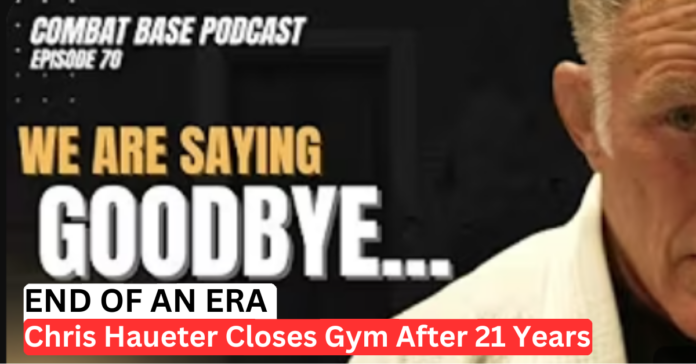
  • Chris Haueter is shutting down the Redondo Beach garage dojo that’s been the home of Combat Base for nearly 21 years, with the final closure expected in February.
  • The reason isn’t burnout or “losing love for Jiu-Jitsu” — it’s coastal economics and the brutal math of turning a small, intimate mat room into a commercial lease.
  • Melissa Haueter laid out what that jump would really cost per month, and why the numbers don’t work without building a completely different kind of academy.
  • The Chris Haueter dojo closing doesn’t mean Combat Base isn’t disappearing: the Haueters plan to keep teaching through their online platform, seminars, and the wider Combat Base network.

The Garage That Became A Grappler’s Bucket List

There are plenty of famous academies in Jiu-Jitsu, but there are only a handful of places that feel like mythology — and Chris Haueter’s Redondo Beach garage dojo has lived in that category for years.

Now, the Chris Haueter dojo closing story is official: after nearly 21 years, Combat Base is shutting the doors on the physical space that many traveling grapplers treated like a must-visit mat room.

The details matter here. This wasn’t a “mega-gym” with a front desk, a retail wall, and a kids program doing the heavy lifting. It was a garage that became a training hub — mats first laid down in 2005 — and it ran on a model that only works when the location itself doesn’t bleed you dry.

That model also shaped the vibe. Combat Base wasn’t built to cram 200 members into a schedule grid. It stayed intimate, with a relatively small group of regulars — reportedly around 20 — and a room heavy on experience rather than bodies.

Chris Haueter Dojo Closing: Breaking Down the Math

If the headline feels emotional, the reason is painfully practical. Haueter framed it as a coastal real estate reality: beach land is finite, and the price of “being near the beach” keeps climbing until it pushes everything else out.

He’s watched the neighborhood shift from rougher, working-class edges into the kind of place where homes can sell for millions. That change doesn’t just raise property values — it changes what “running a gym” means in that zip code.

And that’s where Melissa Haueter steps into the center of the story. She’s not just “the coach’s wife.” She’s a third-degree black belt, a longtime instructor, and the operations manager behind the Haueters’ wider business ecosystem — including their online platform and other projects.

When she broke down the finances, it was less “we’re sad” and more “here’s the spreadsheet reality.”

“We are actually in the hole like $11,000…”
– Melissa Haueter –

That figure came from stacking commercial rent with the income they’d have to give up to make a traditional school model work. In other words, opening a “normal academy” doesn’t just add rent — it can also remove revenue from everything else they do.

That’s why Haueter’s blunt one-liner hit so hard.

“I get paid to work and I will not pay to go to work.”
– Chris Haueter –

It’s not a quote you hear from someone chasing expansion. It’s the quote you hear from someone refusing to turn a lifestyle-driven mat room into a high-stress business machine.

Combat Base Was Never A “Normal Academy”

The Combat Base identity has always been a little anti-template. Even the branding tells you what Haueter values: fundamentals, longevity, and a kind of philosophical approach to grappling that doesn’t fit neatly into “sport-only” or “self-defense-only.”

Haueter is widely known as one of the “BJJ Dirty Dozen” — the early wave of non-Brazilian black belts — and Combat Base has long positioned itself as a place with minimal hierarchy and maximum personal responsibility.

His teaching slogans became their own kind of curriculum: “Think Street. Train Sport. Practice Art.” The “Combat Base” position itself — that one-knee-up, one-knee-down posture — is literally a piece of vocabulary he helped popularize.

This is also why the garage mattered so much. It matched the message. A small room makes it harder to hide behind marketing. The training either works, or it doesn’t. That kind of environment attracts a very specific student: experienced, curious, and usually not looking for belts on a conveyor belt.

It also explains why visiting names mattered. Over the years, the garage hosted seminars and visitors that reinforced its reputation as a pilgrimage spot — the kind of place you drop into once, then talk about forever.

The Haueters’ Influence Includes The Good, The Bad, And The “Please Stop Doing That”

The best way to understand the Haueters is to look at the size of their ripple effect. Chris Haueter isn’t just a coach with a room — he’s one of those figures whose ideas quietly shaped the culture.

Sometimes that influence is unquestionably positive: concepts like longevity, simplicity, and staying functional as you age. Sometimes it’s messier — like the belt promotion gauntlet, a ritual he’s openly said he regrets helping popularize as it spread and escalated in the wider scene.

“Within a year it was viral, and then it got brutal.”
– Chris Haueter –

That honesty is part of the Haueter brand too: not pretending every tradition aged well, and not acting like leadership ends when something leaves your control.


The Garage Doors Close, But The Teaching Doesn’t

The most important thing about the Chris Haueter dojo closing isn’t that Combat Base is “gone.” It’s that the physical room is ending — while the work continues in a form that better fits the Haueters’ actual priorities.

They’ve already built an ecosystem that isn’t dependent on a single address: online instruction, a broader Combat Base network, and a seminar schedule that lets Haueter teach without turning his life into rent-chasing. Haueter’s closing thought on the whole shift makes that point clear:

“I am interested in the art of jiu jitsu, not in running a jiu jitsu academy.”
– Chris Haueter –

For the Redondo Beach regulars, it’s still a gut punch — because mat rooms are communities, not just square footage. But for the bigger Jiu-Jitsu world, the takeaway is sharper: the old-school “legend garage” model is getting squeezed out by modern economics, even when the room is packed with black belts and history.

And that’s the real reason this story is sticking. The Chris Haueter dojo closing isn’t just about one garage. It’s a snapshot of where Jiu-Jitsu is right now — and what it costs to keep things small, pure, and personal in a world that keeps getting more expensive.

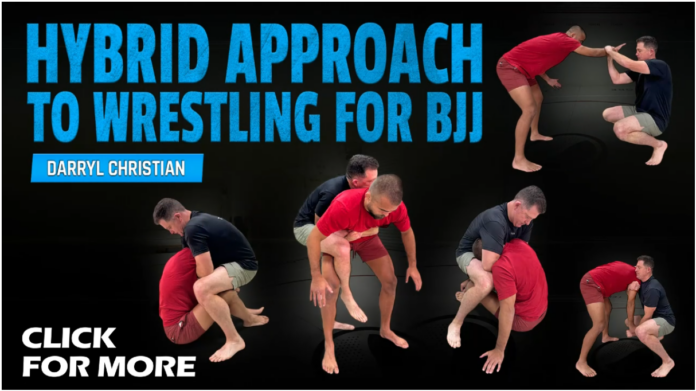
Hybrid Wrestling for BJJ Darryl Christian DVD Review [2026]

Hybrid Wrestling for BJJ Darryl Christian DVD Review

Key Takeaways

  • A compact, wrestling-first stand-up primer that focuses on the exchanges that actually decide most takedowns: hand fighting, underhooks, and off-balancing.
  • The material is organized into four short volumes that move from foundational grips and ties into arm-drag layering, front headlock attacks, and standing breakdowns.
  • Best suited for grapplers who already roll regularly and want a clearer “how do I start the clinch?” roadmap—without drowning in 40 variations per move.
  • It’s streamlined by design, which is a strength for busy people… but also means you’ll want to pair it with live drilling and positional rounds to get full value.
  • Rating: 8.5/10

HYBRID WRESTLING FOR BJJ DARRYL CHRISTIAN DVD DOWNLOAD

Most people don’t “lose takedowns” in Brazilian Jiu-Jitsu—they lose the 5–10 seconds before the takedown. The moment where one person wins inside position, gets an underhook, pulls the head, or forces a reaction that makes the shot (or snapdown) inevitable.

That’s the lane Hybrid Wrestling for BJJ Darryl Christian DVD lives in: simplifying the messy standing phase into repeatable grip fights and movement cues you can actually remember mid-round. Instead of treating wrestling like a separate sport that you’re borrowing from, the instructional leans into the stand-up patterns that show up constantly in grappling: underhooks, arm drags, snapdowns, and front headlock threats that convert into dominant top positions (and a few submissions).

If your current strategy is “reach for something, hope for the best, and pull guard if it gets weird,” this is the kind of short, punchy resource that can give you a plan.

You’ll Never Beat a Wrestler, But…

Wrestling for BJJ isn’t about turning every roll into an NCAA final. It’s about building enough control in the clinch that you can choose what happens next—takedown, snapdown, go-behind, front headlock, or even just forcing a bad stance so you can start passing earlier.

The biggest mistake most Jiu-Jitsu people make standing is hunting “the move” without first winning the connection. You can’t reliably hit an outside trip, a throw-by, or a clean arm drag if your hands are losing every exchange. That’s why the early emphasis on hand fighting and underhook dynamics matters so much: it’s the gateway skill that makes everything else higher percentage.

What I like about the approach here is that it aims at the “middle ground” grapplers actually live in—where the opponent is savvy enough to hand fight back, but not so elite that every grip change becomes a chess match. In other words: your gym, your local comps, your day-to-day training. Hybrid Wrestling for BJJ Darryl Christian DVD is built to give structure to that phase.

Coach Darryl Christian

Darryl Christian has a reputation as a behind-the-scenes wrestling and clinch specialist who has coached high-level MMA talent and worked with well-known names across combat sports. He’s been described as a coach with deep wrestling credentials and a system-oriented approach, with an emphasis on adapting training to the athlete rather than forcing everyone into one template.

Across the available background material, the consistent theme is that Christian’s coaching is less about flashy highlight-reel technique and more about making the clinch predictable for the person who understands it better. That’s a useful lens for a BJJ audience, because grapplers don’t need 200 takedowns—they need a handful of ties and reactions that reliably get them to top position without eating guillotines or giving up the back on bad shots.

In that sense, the topic he’s teaching here is aligned with what he’s known for: clinch mechanics, positioning, and practical sequences that hold up when the other person is resisting.

Detailed Hybrid Wrestling for BJJ Darryl Christian DVD Review

Before the volume-by-volume breakdown, it’s worth noting what the structure communicates: this is a four-volume, condensed instructional. Think “high-signal overview with usable layers,” not an encyclopedia. That’s a plus if you want something you can implement this month. It’s a minus if you expect a deep dive into every common stance, every common counter, and every ruleset nuance.

Still, the organization is smart: Christian starts with hand fighting and underhooks (the foundation), then builds a focused arm-drag module, then transitions into front headlock offense (where grapplers live), and finishes with standing breakdowns that connect the clinch to the mat.

Volume 1 – Top to Bottom

Volume 1 is essentially the “don’t skip this” part of the course: hand fighting, underhook basics, and the movement principles that make the rest of the system work.

The chapter list alone tells you the intent—offensive hand fighting, defensive hand fighting, then a specific emphasis on underhook dynamics, footwork, and body position. That trio (footwork + angle + connection) is what most Jiu-Jitsu players lack when they try to wrestle: they grab an underhook and then stand square, or they pummel once and stop moving.

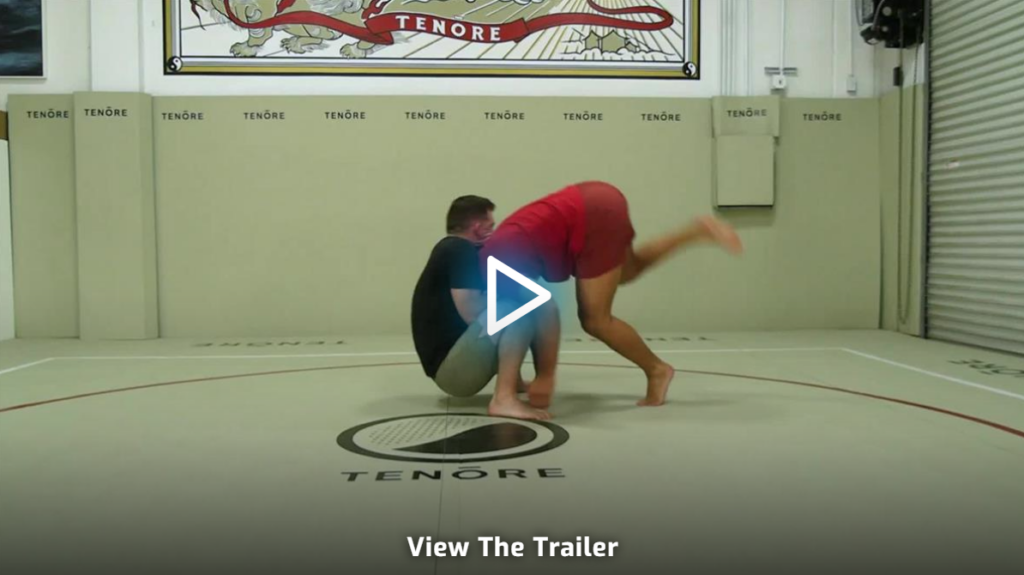
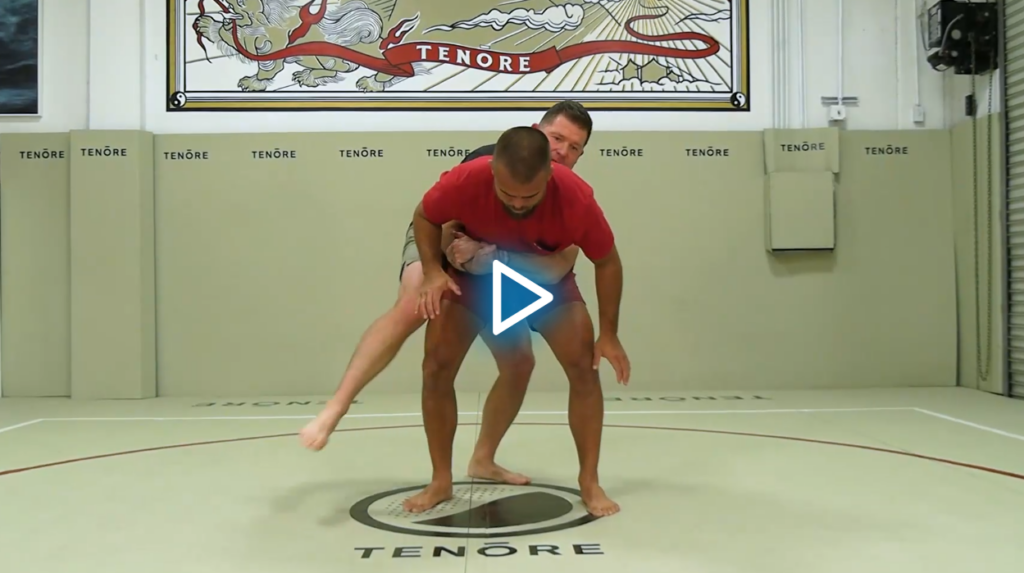
From there, Christian includes snapdowns, off-balancing, and transitional attacks that flow well in grappling contexts: arm drags, cement mixer, throw-by, outside duck, and a cross-body takedown option. You’re getting a “tool belt” of entries, but the real value is the framing—how to create reactions, not just how to perform a move in isolation.

This part is where the Hybrid Wrestling for BJJ Darryl Christian DVD starts paying off for anyone who feels lost in the first grip exchange.

Volume 2 – Arm Drags

Next up, Daryl narrows the focus to arm drags, which is a great choice for BJJ specifically. Arm drags are one of the cleanest bridges between wrestling ties and Jiu-Jitsu outcomes: back exposure, rear body lock, mat returns, or even just forcing the opponent to post so you can start attacking.

The progression starts with wrist control basics and arm drag fundamentals, then builds into variations like the baseball grip and an opposite-side baseball grip version, plus a slingshot option that suggests dynamic pulling mechanics rather than static yanking.

Crucially, the volume includes both offensive and defensive arm-drag material off wrist control. That matters because many people can attempt an arm drag, but they can’t recover position when the opponent squares up, stuffs it, or tries to drag back.

If you want one piece of this instructional to become a signature, this volume has a strong case—because it’s focused, repeatable, and directly compatible with grappling goals. Hybrid Wrestling for BJJ Darryl Christian DVD feels most “BJJ-specific” here.

Volume 3 – Front Headlock

Volume 3 shifts into front headlock offense, and that’s where a lot of grapplers will perk up—because front headlock situations happen constantly: failed shots, snapdowns, bad posture in tie-ups, and scramble moments where someone turtles.

The content centers around “butterfly lock dynamics” in the front headlock and positioning details, then moves into a few classic finishing pathways: a Darce, guillotine options (including a counter to a defensive roll), a standing butterfly guillotine, and a step-over neck crank.

The big win is that it frames the front headlock as a system rather than a single submission. For BJJ, that’s the right way to teach it: even if you don’t finish the choke, the threat forces reactions that create go-behinds, top exposure, or safer transitions into control.

This volume also adds a little “submission gravity” to the wrestling—meaning your opponent has to respect more than just the takedown. That’s a practical synergy for No-Gi heavy rooms in particular, and it’s one of the reasons the overall package earns its rating.

Volume 4 – Blending BJJ and Wrestling

Volume 4 wraps with standing breakdowns—again, a very grappling-relevant choice. A lot of takedown sequences don’t end with a clean blast double; they end with a compromised stance, a bent posture, or a moment where the opponent is technically still standing but functionally already falling.

The volume opens with butterfly breakdowns and a leg-in option off that lock, then revisits off-balancing and finishes with a chapter titled sagging knee shield. That last one is interesting because it hints at connecting standing control to the exact messy half-guard/knee-shield battles that happen right after takedown contact.

In other words, this volume gestures toward the reality that matters most for BJJ: getting them down is only half the job—landing in a usable position is the other half. The material here feels like an attempt to keep the wrestling connected to what happens on the mat, rather than treating takedowns as a separate phase that magically ends in points.

As a closer, it’s brief, but it rounds out the instructional nicely—and it makes Hybrid Wrestling for BJJ Darryl Christian DVD feel more integrated than a pure wrestling tape.

Making it Work

Because the instructional is streamlined, your training plan matters. If you watch it once and then “try to remember it live,” you’ll get a couple of cool moments but not a lasting upgrade.

A better approach is to build a two-week mini-cycle:

  • Week 1: Pick one hand-fighting sequence from Volume 1 and one arm-drag pathway from Volume 2. Start every standing round with the same goal: win wrist control → threaten the drag. Don’t hunt takedowns yet—hunt clean connections.
  • Week 2: Layer in one front headlock threat from Volume 3. Now your opponent has a reason to posture and disengage, which actually makes your underhook and drag entries easier.

Then add a simple constraint: one round per session where you’re not allowed to pull guard until you’ve hit your hand-fighting sequence at least once. You’ll be shocked how quickly you improve—mostly because you stop panicking and start problem-solving.

Used that way, Hybrid Wrestling for BJJ Darryl Christian DVD becomes a “stand-up decision-making upgrade,” not just a technique library.

GET HERE: HYBRID WRESTLING FOR BJJ DARRYL CHRISTIAN DVD

Who Is This For?

This is best for white belts with mat time through purple belts who already roll regularly and want a clearer plan for standing exchanges.

It’s especially useful if you prefer No-Gi or do a lot of No-Gi rounds (hand fighting and front headlock threats show up constantly). You’ll also benefit if you’re looking for back exposure options without overcommitting to risky shots.

You might not want to use this DVD if you’re all about a massive, exhaustive wrestling encyclopedia with deep counters for every position. If you need heavy emphasis on Gi grip-specific stand-up (this is wrestling-structured, not collar-sleeve structured), you’ll also find this instructional lacking.

If you’re in the sweet spot, though, Hybrid Wrestling for BJJ Darryl Christian DVD is the kind of condensed resource that can actually change what your first 30 seconds of sparring looks like.

Pros & Potential Drawbacks

Pros

  • Clear emphasis on the “real” battle: hand fighting. Many stand-up resources skip straight to takedowns; this one starts where rounds are actually decided.
  • Strong underhook and arm-drag focus. Those ties are high-percentage for grapplers and translate directly into back exposure and top position.
  • Front headlock integration. Adding submission threats makes the wrestling more functional for Jiu-Jitsu, even when you don’t finish.
  • Condensed and actionable. The four-volume layout encourages implementation instead of endless collecting.
  • Works well as a training-cycle resource. It’s easy to build two weeks of focused practice around what’s covered.

Potential Drawbacks

  • It’s short. The compact runtime is great for clarity, but advanced wrestlers may want more depth, counters, and variations.
  • Not a complete “standing game” curriculum. You’ll still need to pressure-test these sequences in positional rounds and fill in gaps based on your body type and ruleset.
  • Some topics are implied more than fully expanded. You’ll get the roadmap, but your mat time has to supply the repetition and timing.

Embrace the Chaos

If you want a stand-up instructional that respects how grapplers actually train—short rounds, chaotic ties, and constant front headlock moments—the Hybrid Wrestling for BJJ Darryl Christian DVD delivers a practical framework without drowning you in noise.

The best part is the sequencing: win the hand fight, use underhooks to create reactions, layer arm drags to expose the back, then punish posture with front headlock threats. That’s a coherent game plan, not just a list of moves.

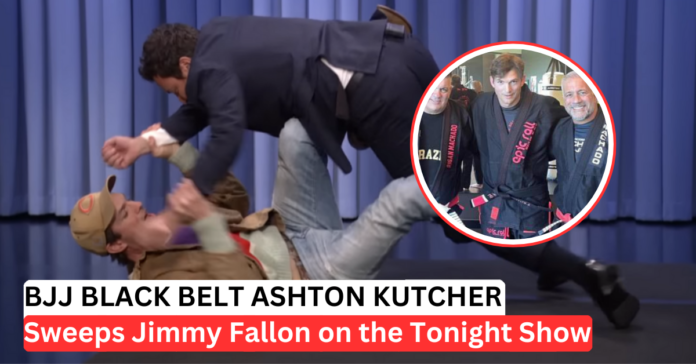
Ashton Kutcher Shows Jimmy Fallon Jiu-Jitsu — Then Hits A Leg-Only Sweep On The Tonight Show

VIDEO: Ashton Kutcher Shows Jimmy Fallon Jiu-Jitsu — Then Hits A Leg-Only Sweep On The Tonight Show
  • Ashton Kutcher brought his Jiu-Jitsu black belt to late-night TV and turned a casual request into a live demo on a mat in the studio.
  • The viral moment: Kutcher used a leg-only sweep to flip Jimmy Fallon, then calmly walked the host through how it works.
  • Fallon sold the chaos perfectly, ultimately waving the white flag mid-segment.
  • Kutcher’s bigger win wasn’t the sweep — it was making Jiu-Jitsu look both practical and accessible in front of a mainstream audience.

The Tonight Show Segment That Turned Into A Sweep

It started with the kind of innocent question that gets people armbarred in gyms worldwide: a late-night host asking a black belt to “show a move.”

Could you maybe show me a jiu-jitsu move?
– Jimmy Fallon –

Within moments, Ashton Kutcher shows Jimmy Fallon Jiu-Jitsu in the most convincing way possible — not with a flashy Hollywood “fight sequence,” but with the kind of clean, positional setup every grappler recognizes.

A mat was rolled out. Kutcher laid down a basic premise. And then he baited Fallon into the exact reaction a lot of untrained people have when they’re “winning” from the top.

The whole thing with jiu-jitsu is most fights go to the ground… so you’re fighting off the ground, right?
– Ashton Kutcher –

Kutcher asked Fallon to push him down and “attack,” setting up the classic lesson: top pressure can look dominant until the bottom player starts building frames, controlling posture, and loading hips.

Fallon leaned in — and Kutcher used only his legs to elevate and tip him over in a simple sweep that looked almost slow-motion… until Fallon hit the mat.

The crowd reaction did what crowds always do when grappling hits the mainstream: a mix of shock, laughter, and that “wait, that actually worked” realization.

Ashton Kutcher Shows Jimmy Fallon Jiu-Jitsu 

The reason the clip plays so well is that it doesn’t feel like a stunt. Ashton Kutcher shows Jimmy Fallon Jiu-Jitsu the way you’d show it to a friend who’s never trained: start with a principle, create a predictable reaction, then demonstrate the solution.

From a technical standpoint, the “magic” is basic Jiu-Jitsu physics:

  • Fallon’s weight comes forward as he tries to control from the top.
  • Kutcher connects his legs and hips to Fallon’s base.
  • Once Kutcher loads the weight and changes the angle, Fallon’s balance is already gone.
  • The finish is just steering — not muscling.

That’s why the move lands with practitioners. It’s not some rare Instagram-only trick. It’s the essence of what sweeping is supposed to be: take someone’s posture, take their base, and let gravity do the heavy lifting.

After the first flip, Fallon did what a lot of people do after their ego gets gently checked: he tried to reset the moment with humor. Kutcher, to his credit, didn’t big-time him.

He checked in, kept it light, and immediately turned the segment into instruction — showing Fallon where to scoot, how to position, and how to avoid landing awkwardly.

Fallon also leaned into the role of “student who wants credit,” celebrating even when he needed a little help getting the mechanics right. That part matters, because it made the demo feel welcoming rather than intimidating — the exact opposite of the “Jiu-Jitsu is only for killers” stereotype.

Rigan Machado, and Kutcher’s Black Belt Journey

Celebrity Jiu-Jitsu can be cringe when it’s just a photo op. This wasn’t that.

Kutcher has trained for years and has been vocal about staying consistent — and he’s credited his coach, Rigan Machado, for steering the whole journey. He even downplayed his own promotion with the kind of self-deprecating line most long-time hobbyists relate to.

This is Rigan Machado… coached me for 15 years… I feel like he gave it to me out of pity.
– Ashton Kutcher –

That joke lands because it’s a real Jiu-Jitsu feeling: the black belt isn’t just a trophy, it’s a timestamp on showing up. And while most practitioners don’t get to demonstrate a sweep under studio lights, the underlying message is familiar — consistency beats hype.

This is also why Ashton Kutcher shows Jimmy Fallon Jiu-Jitsu has more staying power than a random viral clip. It’s not “actor pretends to fight.” It’s “actor who actually trains demonstrates an idea that immediately makes sense.”

And that’s valuable for the sport. Every time a mainstream audience sees Jiu-Jitsu presented as skill and problem-solving — rather than raw toughness — it lowers the barrier for new people to try a class.

Ashton Kutcher Can Really Grapple

The funniest part of the segment might be Fallon’s final surrender, because it mirrors the emotional arc of a first-time roll: confidence, confusion, panic-laughing, and then acceptance.

I give up. I give up.
– Jimmy Fallon –

But the bigger point is that Ashton Kutcher shows Jimmy Fallon Jiu-Jitsu without turning the art into a caricature. The move looked controlled. The teaching was simple. The vibe stayed playful, but the technique stayed real.

That’s the sweet spot for Jiu-Jitsu in pop culture: not oversold as mystical self-defense, not mocked as “rolling around,” just shown as a practical skill with clear cause-and-effect.

If you’re a gym owner, coach, or even just the person in your friend group who won’t shut up about guard retention, this kind of moment helps. Someone will see the clip, laugh, and then ask the most important beginner question of all: “Okay… where do I learn that?”

Placido Santos Black Belt Promotion: The “World’s Most Famous Uke” Just Leveled Up

Placido Santos Black Belt Promotion: The “World’s Most Famous Uke” Just Leveled Up
  • The Plácido Santos black belt promotion finally came!
  • Known to many fans as the “world’s most famous uke,” Santos has spent years as a high-profile training and demo partner in elite rooms.
  • The promotion follows a run of real competitive achievements, including winning IBJJF No-Gi Worlds at brown belt with submissions in every match.
  • In his announcement, Santos thanked his wife Sofia and credited key mentors and teammates, including John Danaher.

The Uke Everyone Recognizes

If you’ve watched enough high-level instructionals, you’ve probably seen Plácido Santos get thrown, folded, leg-locked, strangled, and generally “science-experimented” on camera more times than most people roll in a year.

That’s the funny part of the story — but it’s also the reason this moment is landing so hard. The Placido Santos black belt promotion isn’t just another gym photo and a handshake.

It’s the guy everyone recognizes from the background stepping into the spotlight with the rank that, like it or not, still carries serious weight in Jiu-Jitsu culture.

“Uke” is basically the trusted training partner who helps demonstrate technique — the person taking the reps so the coach can teach. Being a world-famous uke means you’re not just tough; you’re consistent, technically sharp, and good enough to make elite technique look clean under pressure.

Placido Santos Black Belt: More Than A Meme

The easiest version of this story is: “Danaher’s uke got his belt.” The real version is a lot more interesting.

Santos announced the Placido Santos black belt milestone in a heartfelt Instagram post that read like a long list of people who kept him steady through the grind — family first, then coaches, teammates, and the support staff that most fans never think about.

First and foremost, to my lovely bride, Sofia, who has stood by my side through so many of my endeavors, never questioning me as a person – simply trusting and supporting me through injuries, wins, and losses.
– Plácido Santos –

That tone matters. This wasn’t framed as “I did it.” It was framed as “we did it,” which is pretty fitting for someone whose public identity has often been built around helping other people look great.

And when you zoom out, the Placido Santos black belt isn’t arriving out of nowhere. It’s the latest checkpoint in a timeline that’s included steady competition, high-level coaching rooms, and a reputation for being far more than a human grappling dummy.

John Danaher, Kingsway, And The Work Behind The Camera

Santos specifically credited John Danaher as a major figure in his life — not just as a technical coach, but as a mentor during a difficult personal chapter.

To my wonderful coach, John Danaher, who has never asked for anything from me. Instead, he has simply given and given without any expectation of return. He has served as a mentor and, in some ways, a father figure to me since the passing of my own father in 2018. Learning from you has been the honor of a lifetime.
– Plácido Santos –

He also thanked Gordon Ryan and Giancarlo Bodoni — names that signal exactly what kind of room he’s been sharpening himself in.

That context is important because it explains why people have been talking about Santos’ belt progression for a while. When you’re training around the sharpest knives in No-Gi, your level becomes obvious — even if your “main role” to the outside world looks like supporting the stars.

The No-Gi Worlds Run That Made People Recalibrate

Here’s the part that kills the “just an uke” narrative: Santos has been competing — and winning.

In December 2025, he won gold at the IBJJF No-Gi World Championships at brown belt, and not in a “scraped by” way. Every match ended in a submission.

That alone puts his competitive year in rare air, and it gets even wilder when you add the life context around it.

Getting ready for competition is never easy, but being a full-time father of eight definitely makes things more difficult.
– John Danaher –

Yes, father of eight. Preparing for a major championship is hard when you’re sleeping eight hours a night and meal-prepping like a robot. Doing it while running a full household is a completely different type of endurance test — the kind most competitors never even attempt.

So when people see the Placido Santos black belt announcement now, it lands differently. It’s not “Oh wow, he finally got it.” It’s “Yeah… that checks out.”

The Quiet Grinder Steps Into The Spotlight

A lot of belt promotions are meaningful to the people in the room and invisible to everyone else. The Placido Santos black belt moment is the opposite: it’s meaningful because so many people feel like they already know him — and because his story quietly connects with the majority of the sport.

Not everyone can train twice a day. Not everyone can build their entire life around competition. And not everyone wants to. Santos’ public message leaned hard into gratitude, family, and long-term mentorship — the stuff that actually keeps people on the mats for decades.

The joke will always be there: “world’s most famous uke.” But the reality is that being trusted in elite rooms, competing successfully, and doing it while carrying real-world responsibilities is its own kind of black belt energy.

And now he’s got the belt to match.

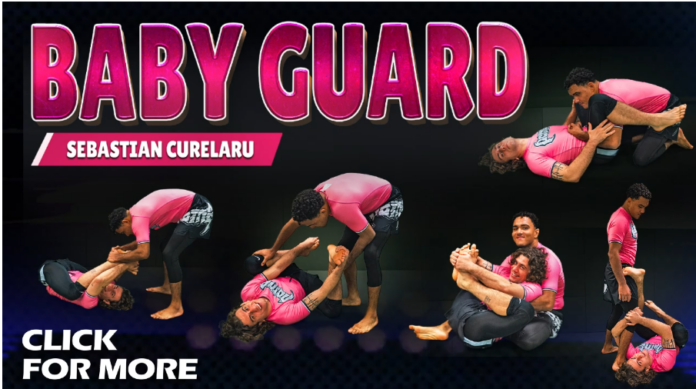
Baby Guard Sebastian Curelaru DVD Review [2026]

Baby Guard Sebastian Curelaru DVD Review

Key Takeaways

  • A compact guard-retention system built specifically for modern, standing pressure passing (split squats, heavy knee-cuts, north-south switches, double-unders).
  • Covers survival first then flips the script into offense with clear transitions into K-Guard and leg entanglement before ending with rolling and match footage.
  • Best suited for No-Gi guard players (or anyone whose open guard keeps getting folded), with a small but real flexibility requirement if you want the attacking layer.
  • Rating: 9/10

AVAILABLE HERE: BABY GUARD SEBASTIAN CURELARU DVD

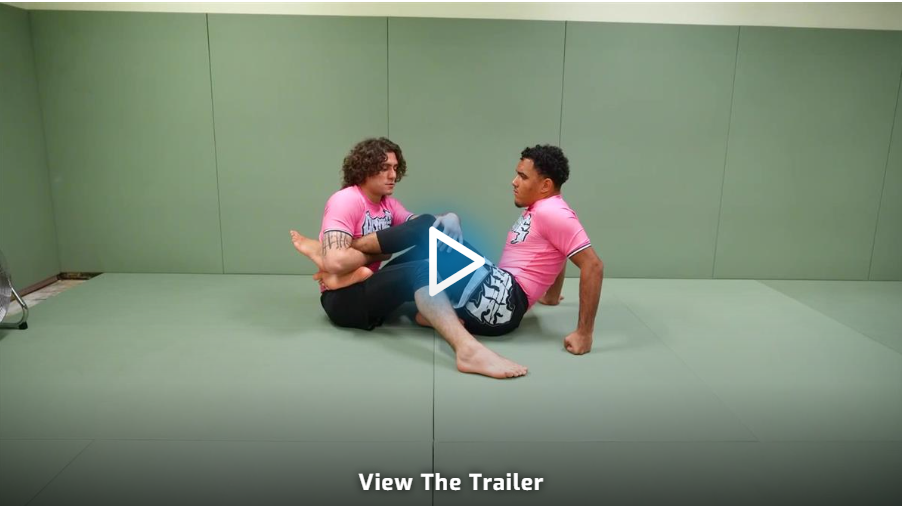
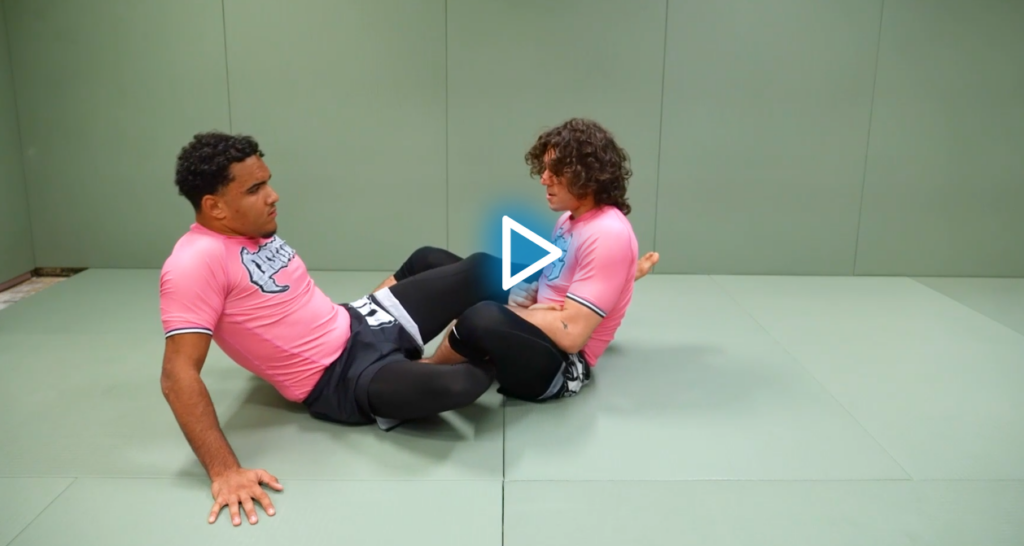
If your guard works until the passer stands up, and then everything collapses into knee-cut pressure, split-squat camping, and that miserable “you’re carrying my bodyweight with your shins” feeling, you’re the target audience for the Baby Guard Sebastian Curelaru DVD.

This instructional is not trying to turn you into a highlight-reel guard player. It’s trying to make you hard to pass—specifically against the kind of modern, upright passing that’s become the default in competitive No-Gi rooms. The promise is simple: build a compact, pressure-proof shell when your legs get compressed, then use it as a launchpad to either recover, re-guard, or counter into meaningful offense.

Having a Guard When You’re Not Suppoed To

A lot of guard instruction falls into two categories: “here’s my favorite guard” or “here are 47 entries into my favorite guard.” Guard retention instruction is rarer, and late-stage retention (when the passer is already standing and folding your knees toward your chest) is rarer still.

Modern passing isn’t only about speed anymore; it’s about geometry and weight placement. Passers use split-squat stances to pin one leg while freeing the other, they hover chest-over-hips to kill your ability to sit up, and they chain knee-cuts into back-steps and north-south switches until your frames break. In that reality, just keeping your knees inside is not a plan—it’s a wish.

A baby guard concept makes sense because it accepts the truth: sometimes you’re going to get compressed. Your job isn’t to pretend that won’t happen; your job is to have a structure that survives the compression and buys you time—time to reinsert frames, time to stop the passer’s hips from fully clearing, and time to force a reaction you can exploit.

When a guard is only defensive, you survive but you don’t improve your position. When it’s only offensive, you get passed while setting up the move. The sweet spot is a defensive shell that naturally feeds into offense—and that’s the lens the Baby Guard Sebastian Curelaru DVD is working through.

Sebastian “Curelao” Curelaru

Sebastian Curelaru presents himself as a competitor-coach whose calling card is guard survival in high-pressure rooms. On his own coaching site, he emphasizes competitive results in both Gi and No-Gi, along with a focus on building game plans through analysis and targeted training rather than random technique collecting.

He also positions his coaching as highly individualized—reviewing footage, diagnosing patterns, and prescribing specific drilling and positional work. A useful detail for context is that his professional profile describes him as someone who trains Brazilian Jiu-Jitsu while also working in fitness and studying toward physiotherapy.

That’s exactly the kind of background that tends to produce instruction with an eye for mechanics, structure, and repeatable problem-solving rather than just “feel.” Put together, Curelao reads as a modern, systems-first instructor: build a framework, give it a name, and make it usable under fatigue and pressure.

That matters here, because guard retention under standing pressure is one of those areas where vague advice is useless. You need clear positional checkpoints, and you need to know what to do when you’re already losing.

Detailed Breakdown: Baby Guard Sebastian Curelaru DVD Review

What stood out immediately is how practical the structure is. The material doesn’t wander through ten different guards, just in case. Instead, it focuses on a very specific problem: surviving and winning the ugly, late-stage passing battles that decide most rounds once someone is already halfway through your frames.

Volume 1 – When To Use Baby Guard

Volume 1 is essentially the emergency room layer of the system. It starts with an intro framed around when to use the Curelao guard, which is an underrated teaching choice. A lot of people fail with defensive positions because they enter too early (and give up opportunities to play normal open guard) or too late (when the passer has already cleared the last meaningful frame). Starting with timing makes the rest of the material easier to apply.

From there, you get targeted answers to the most common pressure-passing scenarios. There are sections on avoiding the split squat (and the half-guard-like compromises that come with it), avoiding J point camping, and direct defense against north-south passing and double-under passing. The closing chapters go into escaping/countering the split squat in two parts, which signals the real focus: this is the battle you’re meant to win.

What I like about this volume is that it doesn’t pretend you’ll always keep perfect distance. It’s built for the messy reality where your legs are pinned and you’re trying to stop the passer from settling into the finish. If you’re the kind of grappler who loses rounds because you get stuck defending late-stage pressure, this first volume alone is valuable.

Volume 2 – K-Guard, Cross Ashi, And The Bear Trap Layer

Part 2 is where the system becomes harder to pass. The chapters are explicitly about turning defense into attacks, starting with getting to K-Guard from the Baby Guard. That transition matters, because K-Guard is one of the most reliable modern hubs for leg-entry offense—especially when your opponent is committed to standing pressure and can’t easily disengage without giving you space.

From K-Guard, the instructional moves into Cross Ashi, then into sequences labeled around a failed reap leading into a bear trap calf slicer, plus a section on switching to the other leg from the bear trap. There’s also an entry into the bear trap from waiter guard, which suggests Curelaru is trying to give you multiple doors into the same attacking room—so you can arrive there even if the initial transition doesn’t land cleanly.

The last chapter in this volume is a flexibility-focused segment. That’s a smart inclusion because it quietly tells you the truth: some of this offensive layer will be easier if your hips and knees can comfortably move through certain ranges.

This volume is the difference between a retention system you use to stall and a retention system you use to score. It’s also where the instructional starts to feel like a complete game plan rather than a collection of defenses.

Volume 3 – Rolling And Match Footage

Volume three is short, but it’s important. It includes several rolling segments (with different partners) and finishes with match footage labeled as a match with Oliver Taza at European Trials. Conceptually, this is where you learn the pacing: when does Baby Guard appear, what triggers it, what does Curelaru prioritize first, and how long does he stay in the shell before transitioning?

In instructionals, narrated rolling is often where the why becomes obvious. Techniques can look clean in demos, but a retention system lives or dies on decision-making: do you accept bottom half for a second to avoid the pass? Do you force a re-guard first? Do you chase the leg entry immediately or stabilize your frames?

Even if you don’t copy exact movements, watching the system show up in live exchanges helps you understand the feel of it. It also gives you something many instructionals lack: evidence of how the material connects when the round isn’t cooperating.

The Value of Weird Guards

If you want the Baby Guard Sebastian Curelaru DVD to change your guard retention, treat it like a positional skill—not like a technique you know.

A simple approach that works:

  • Entries and survival rounds – Start every round in the late-stage scenario you actually lose to (split squat pressure, north-south switch threat, or double-under pressure). Your goal is not to sweep—your goal is to stop the pass and reset to a safe guard state.
  • Add one exit – Pick one escape/counter you can hit reliably. Drill it, then do short positional rounds where you’re only allowed to win by achieving that exit or returning to a stable guard.
  • Layer the offense – Start connecting your survival structure to the K-Guard transition. Don’t force the finish—just hit the transition and stabilize the position.
  • Decision-making rounds – Mix scenarios and allow yourself to either re-guard, sweep, or transition into the leg-entry layer depending on what the passer gives you.

This kind of system rewards consistency more than intensity. Ten minutes of focused positional work after class will do more than trying to “remember everything” and hoping it appears in rolling.

BABY GUARD SEBASTIAN CURELARU DVD DOWNLOAD NOW

Who Is This For?

The Baby Guard Sebastian Curelaru DVD fits best for solid white belts (with basic open guard concepts) through advanced competitors. Beginners can use Volume 1 immediately; Volume 2 will make more sense as your leg-entanglement literacy improves.

Guard players, counter-attackers, and anyone who wins by being hard to pass rather than by constant scrambling will love this instructional. No-Gi competitors will be able to use a new and unexpected weapon in their game.

On the other hand, the DVD is less ideal for if you’re a Gi-only specialists who want lapel-based retention solutions (this is not that kind of system). People who avoid leg entanglements entirely—you can still benefit from Volume 1, but you’ll be leaving points on the table by skipping Volume 2’s attacking layer.

Pros & Potential Drawbacks

Pros

  • Directly addresses modern standing pressure (split squat, north-south switches, double-unders) rather than generic “keep your frames” advice.
  • Clear defensive-to-offensive progression: survive first, then transition into K-Guard and leg entries.
  • Practical chapter organization that mirrors real passing problems you actually face in sparring.
  • Includes rolling and match footage to show timing, decision-making, and how the system appears live.
  • Mobility section is honest and useful—it doesn’t pretend positions are free if your hips can’t access them.

Potential Drawbacks

  • Relatively short runtime, so you’re getting a tight system rather than an encyclopedia of variations.
  • Offensive layer assumes some comfort with leg positions (Cross Ashi / bear trap concepts). If you’re brand new to that world, you’ll need to learn the “language” as you go.
  • Not tailored for Gi-specific grips and layers, so Gi-first players may want a complementary resource.

Time to be a Baby

The Baby Guard Sebastian Curelaru DVD is one of those instructionals that feels designed for real rounds, not highlight clips.  It’s not a complete guard game from every distance. It’s a specialized solution for a specific problem—and that’s exactly why it works. If your guard retention fails once pressure passing begins, this is a high-value, low-fluff study.

Closed Guard Efficiency Rayron Gracie DVD Review [2026]

Closed Guard Efficiency Rayron Gracie DVD Review

Key Takeaways

  • A Gi-focused closed guard blueprint that prioritizes posture control, simple leverage, and repeatable decision-making over “move collecting.”
  • Strong on the unglamorous stuff that actually makes closed guard work: shutting down the inside knee, breaking posture in layers, and re-closing the guard when things get messy.
  • The teaching is concise and structured across six volumes, building from control and posture breaks into sweeps, back takes, and a handful of finishing options.
  • Best for closed guard players who want a clean, competition-friendly “default game” — but the concepts also translate well to hobbyists who just want to stop getting stood up and flattened.
  • Rating: 8/10

CLOSED GUARD EFFICIENCY RAYRON GRACIE DVD AVAILABLE HERE

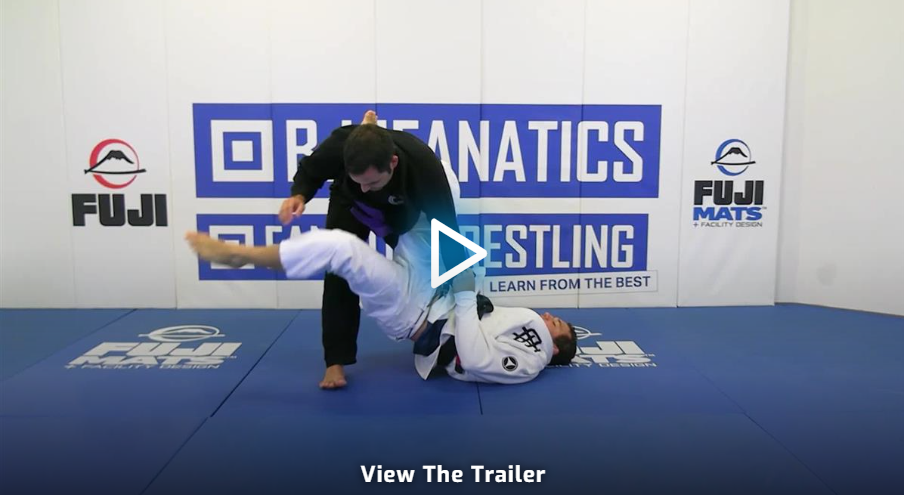
Closed guard is the one position everyone “knows”… right up until someone with solid base, good posture, and a mean knee wedge makes your guard feel like a pair of dead legs. That’s why Closed Guard Efficiency Rayron Gracie DVD is an interesting release: it doesn’t try to sell you a secret guard nobody has seen before.

It’s aiming at something much harder — making classic closed guard feel reliable again against people who actively deny you your favorite grips, angles, and hip movement. The promise here is efficiency: high-percentage grips, posture breaks that don’t require perfect timing, and a clear route from “I’m holding closed guard” to “I’m forcing reactions.”

If you’ve ever had rounds where your closed guard turns into grip-fighting purgatory (and then you get stood up anyway), this Closed Guard Efficiency Rayron Gracie DVD is built for that exact frustration.

The Point of Closed Guard in BJJ

The closed guard has a weird reputation in modern Jiu-Jitsu. On one hand, it’s considered “basic.” On the other, it’s still one of the toughest guards to deal with when the bottom player understands two things: posture management and inside-knee denial.

Closed guard isn’t about having 40 submissions — it’s about running a tight loop of control that makes the top player progressively less stable, less upright, and less free to disengage.

In practical terms, closed guard success usually comes down to a few recurring battles:

  • Posture and head height: If the top player stays tall with their spine stacked, your angles become expensive to create.
  • The inside knee: The moment a knee sneaks into your hip line, you’re defending a pass instead of attacking.
  • Grip quality: You can “grab stuff,” or you can build grips that force predictable reactions.

That’s why a system that starts with posture and knee management tends to scale well. The best Gi closed guard sweeps don’t happen because you memorized them — they happen because your opponent is already compromised when you pull the trigger.

Rayron Gracie – A New Grappling Hope

Rayron Gracie’s credibility for this topic isn’t just Gracie last name marketing. His competition footprint has largely been built in the Gi, and his results at the colored belts are the kind that make people re-watch matches for details.

He’s a member of the 4th generation of the Gracie family who was promoted to black belt by Kyra Gracie in June 2023. They also highlight his activity on the IBJJF circuit, including major podiums and titles at Worlds and Pans across colored-belt divisions.

Rayron positions himself as a multiple-time world champion and leans heavily into the “efficiency, fundamentals, and legacy” framing — which, to be fair, lines up with what the instructional actually delivers.

The main takeaway for buyers: this is someone who’s lived the closed guard in high-level Gi competition, and the material reflects that pressure-tested, points-aware mindset. If you’re specifically looking for a Rayron Gracie closed guard game that doesn’t drift into overly fancy detours, this is very much in his lane.

Detailed Closed Guard Efficiency Rayron Gracie DVD Review

At a structural level, Closed Guard Efficiency Rayron Gracie DVD is split into six volumes, and it feels intentionally paced: control first, attacks later, and plenty of “here’s what to do when they stand” woven throughout. It’s not an encyclopedic closed guard library — it’s more like a tight operating system you can actually run in sparring.

Volume 1 – The Foundations

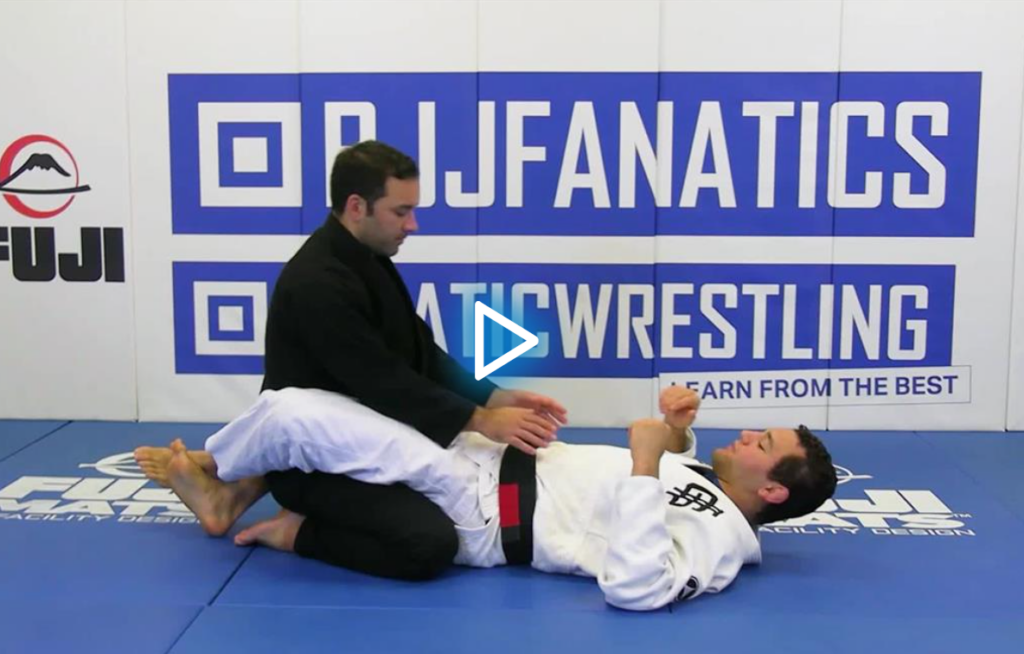
The opening volume sets the tone with the high percentage vs low percentage framing and then immediately gets into the practical guard problems: preventing posture, stopping the inside knee, and hitting posture breaks that don’t require your opponent to cooperate.

This is the stuff people skip because it’s not Instagram-friendly, but it’s the backbone of closed guard competence. What I liked here is that the posture breaks don’t feel like “one magic snap.”

They’re layered: deny posture, deny the knee, then use a sequence of mechanical steps to open angles. If you’ve been guilty of trying to climb too high too early (and getting your guard opened), this volume nudges you back toward being systematic. It’s also where the instructional’s “closed guard posture breaking” theme becomes obvious: Rayron is trying to make posture denial feel automatic.

Volume 2 – Kimura Wrist Locks

Volume 2 of the Closed Guard Efficiency Rayron Gracie DVD shifts into more aggressive control and attack entries, including wrist lock options and a Kimura pathway that connects to the back. The closed guard wrist lock material isn’t presented like a gimmick; it’s more of a compliance tool to force posture reactions and give your upper-body control more bite.

The highlight, for me, is how the volume treats the Kimura as a connector rather than a single submission attempt. The upgraded Kimura details and the transition into Kimura to back feel like the kind of practical escalation you can apply without needing a dramatic off-balance first. If you’re already comfortable controlling posture but struggle to convert that into meaningful movement, this volume is where you start getting answers.

Volume 3 – Omoplatas

The next part leans heavily into grip-breaking and sweep/submission pairing. You get belt and sleeve grip breaks (another sign this is Gi-first), then a sequence that moves into sweeping threats like the Lumber Jack sweep and follow-ups into Omoplata variations.

This is where the instructional becomes more “game-plan-ish.” Instead of isolated moves, you can see a pattern: break the grip that’s stabilizing their base, create a predictable post, then attack the base.

The Omoplata material here is especially useful if you’ve ever felt like you can enter Omoplata but can’t keep it tight long enough to matter. Even when you don’t finish, the follow-ups create productive scrambles where you’re the one choosing the next position.

Volume 4 – Closed Guard Battles

Volume 4 is one of the most practically valuable sections because it deals with a reality: closed guard isn’t always clean. People stand, posture up, and force you into “save the guard” decisions. This volume covers re-gaining closed guard, breaking standing posture, and then moving into sweeps that aim for dominant outcomes — including a route that ends in mount and a back take option.

If you compete (or just roll with pass-first, spazzy people), the emphasis on standing posture problems is a big deal. Too many closed guard instructionals treat standing as a single moment. Here, it’s treated like a phase you need answers for. And if you’re the kind of grappler who gets frustrated when the round turns into they stand, you scramble, they pass, Volume 4 is a stabilizer.

Volume 5 – Sweeps

The penultimate portion of the Closed Guard Efficiency Rayron Gracie DVD tightens the focus to a classic set of attacks: hip bump variations, a knee push sweep, and an armbar sequence, then finishes with training advice. On paper, that might sound “basic,” but that’s kind of the point: these are the attacks you can hit even when your timing isn’t perfect, provided your control work is in place.

The upgraded hip bump content is particularly nice for people who want to attack without constantly opening their guard and gambling. Used correctly, the hip bump threat forces posts and gives you access to follow-up attacks even when the sweep itself doesn’t land. And because the volume ends with tips on how to train, it reinforces the instructional’s biggest strength: it’s trying to make you better at closed guard rather than just more knowledgeable about closed guard.

Volume 6 – Back Takes & Triangles

Finally, the Closed Guard Efficiency Rayron Gracie DVD rounds things out with back take variations and a finishing cluster that includes chest-to-chest and bear hug style chokes, then triangles (including a mount-to-triangle pathway), plus a guard pull and outro.

This is a smart way to finish: you’re not left with “okay I swept them… now what?” Instead, it frames the closed guard as a position that should eventually funnel into the back or a high-control finish. The triangle material is also a good reminder that triangles don’t need to be a complicated web — if your posture control and angle creation are consistent, triangles become a natural consequence rather than a forced event.

A Practical Closed Guard is a Game Changer

If you want to actually absorb Closed Guard Efficiency Rayron Gracie DVD, treat it like a closed guard training cycle, not a one-week binge. The material is straightforward enough to drill, but the real gains come from constraint-based reps: forcing yourself to win the posture-and-knee battle before you “allow” yourself to chase submissions.

Start with control-only rounds. Begin every positional spar from closed guard with one rule: your first goal is posture denial and inside-knee denial. No submissions until you can consistently break posture or force hands to post.

Then, introduce one sweep and one connector. Pick a primary sweep from the set (for example, one of the knee push or Lumber Jack style options) and pair it with one connector (Kimura to back, Omoplata follow-up, or back take pathway).

You can pressure-test the “standing” phase once you’re comfortable. Start rounds with the top player already standing inside your closed guard. Your goal is to re-close, break posture, or sweep — in that order.

The main lesson: efficiency isn’t about doing fewer techniques; it’s about spending less time in neutral. This instructional helps most when you stop treating closed guard like a “submission hunting ground” and start treating it like a control system that earns the attack.

DOWNLOAD THE CLOSED GUARD EFFICIENCY RAYRON GRACIE DVD 

Who Is This For?

This is a strong fit for white belts who already understand basic closed guard mechanics and want a clear “what matters most” roadmap. Also, blue to purple belts who can hold closed guard but struggle to consistently break posture or stop the stand-up sequence.

Gi-focused competitors who want repeatable attacks that don’t rely on athletic scrambles, even though this DVD teaches you how to scramble optimally. Finally, it’s a glove-in fit for those who like a tidy, fundamentals-led approach more than an experimental “new guard” style.

Those that won’t find this DVD helpful include pure No-Gi players looking for a No-Gi-specific closed guard system. You’ll still benefit from posture concepts, but the grip choices and sequences are clearly Gi-leaning.

People who want a massive closed guard encyclopedia will also be disappointed (probably). This is a system, not a library. Oh, and all you brand-new white belts who can’t yet keep their legs connected and their hips active — you may need a little base closed-guard competency first.

Pros & Potential Drawbacks

Pros

  • Clear closed guard priorities. The instructional repeatedly returns to posture, inside-knee denial, and grip quality — the real levers of closed guard success.
  • System feel without over-complication. It’s structured across volumes in a way that feels like a progression, not a random playlist.
  • Practical answers for standing opponents. The “they stand up” phase gets meaningful attention, which is where many closed guard games die in sparring.
  • Strong connectors to dominant outcomes. Back takes, mount, and follow-up submissions are treated as natural endpoints, not lucky bonuses.
  • Training guidance included. The “how to train” section helps turn techniques into habits, which is where efficiency actually comes from.

Potential Drawbacks

  • Gi-first emphasis. If you’re allergic to grips, belt/sleeve ideas, and Gi-based dilemmas, you’ll need to translate more on your own.
  • Not an exhaustive closed guard course. You won’t get every possible entry, reaction tree, or niche submission — by design.
  • Some viewers may want more modern cross-guard blending. If your closed guard game is heavily tied to leg entanglement transitions or modern No-Gi dilemmas, this stays more traditional and linear.

How to Win at Closed Guard

If your closed guard currently feels like hold on and hope, Closed Guard Efficiency Rayron Gracie DVD gives you a more realistic path: win posture, win the inside knee battle, then attack with sweeps and connectors that don’t require perfect conditions. It’s not trying to re-invent closed guard — it’s trying to make it dependable, which is honestly the more valuable goal for most grapplers.

The Gi emphasis is real, and it’s not the most expansive closed guard resource on the market. But the upside is that it stays on-mission: remove fluff, focus on what works, and give you a closed guard you can actually run under pressure.

The Way You Tap in Jiu-Jitsu Reveals How Smart or Stupid You Really Are

The Way You Tap in Jiu-Jitsu Reveals How Smart or Stupid You Really Are

What Brazilian Jiu-Jitsu Reveals About Intelligence, Ego, and Long-Term Survival

Brazilian Jiu-Jitsu isn’t just physical chess.
That comparison gets repeated a lot — usually by people who haven’t been stuck under a heavy crossface for five straight minutes.

The truth is simpler and uglier.

Before BJJ exposes how sloppy your technique is, it exposes something far more uncomfortable:
how you make decisions when things stop going your way.

Spend enough years on the mats, and a pattern becomes impossible to ignore.
When it comes to tapping, people fall into four predictable groups:

  • people who tap randomly
  • people who tap late and feel proud of it
  • people who tap exactly when they should
  • and people who tap on everything – pressure, discomfort, and anything that feels heavy

That one difference quietly decides who keeps improving, who gets injured, and who eventually disappears without much explanation.


The Random Tappers (a.k.a. the Stupid Ones)

Let’s start with the most chaotic group.

These people have no internal calibration system.

Sometimes they tap the moment things feel uncomfortable — not dangerous, just unpleasant. The position looks bad, pressure builds, panic kicks in, and they’re already slapping the mat. Nothing is locked in, nothing is actually threatening, but mentally they’re gone.

Other times, they do the complete opposite.

They refuse to tap while every warning sign is screaming. Grip slipping. Joint compromised. Escape window long closed. They hang on like it’s a test of character — until something pops and they look shocked it happened.

For them, tapping isn’t a decision.
It’s a reflex.

Either fear… or ego.
Never judgment.


The Smart Tappers (and Why They’re Dangerous)

Then there are the “smart” ones.

Good technique. Solid mechanics. High fight IQ.
They understand exactly what’s happening.

And that’s the trap.

They see the setup coming. They recognize the mechanics. They tell themselves:
“I still have an escape.”
“I know what he’s setting up.”
“Just a bit longer and I’ll turn this.”

And a lot of the time — they’re right.

That success trains them to stay longer than they should. To trust their intelligence over probability. To ride the edge because they can.

Until one day, they can’t.

And when smart people get injured, it’s rarely minor.
It’s surgery.
It’s months off.
Sometimes it’s the quiet end of serious training.

Not because they didn’t know, but because they thought knowing was enough.


The Precise Tappers (the Wise Ones)

These guys look boring.

They tap clean. Early. No drama. No emotion.
They don’t fight lost positions. They don’t need pain to confirm reality. They never confuse being tough with being smart.

Their tap happens only when three things line up:

  • escape probability is basically zero
  • they’ve already learned what there was to learn
  • staying longer offers no return

Pain is the most expensive form of feedback.
Wise people don’t buy lessons at full price.


The Instant Tappers (a.k.a the softies)

This subtype deserves its own callout.

You know them.

They don’t tap to submissions.
They tap to pressure.

A tight crossface? Tap.
A heavy top player? Tap.
Someone settling their weight properly? Tap.

These aren’t wise early taps.
They’re fear-based taps.

There’s no analysis, no risk assessment, no learning window — just avoidance.
Discomfort feels like danger, so they exit immediately.

They’ll usually justify it with phrases like:

  • “I’m protecting my body”
  • “I train for longevity”
  • “I don’t need to fight bad positions”

But what they’re really protecting is their comfort.

Pressure is where timing is learned.
Pressure is where judgment is built.

If pressure alone makes you tap, you’re not being smart —
you’re just quitting politely.


You Can See It in Their Style

It always shows up in how they roll:

  • Dumb grapplers: chaotic, brute force, random taps, constant small injuries
  • Smart grapplers: technical, rigid, always flirting with disaster
  • Wise grapplers: efficient, economical, joint-protective, emotionally calm
  • Comfort-first grapplers: tap to pressure, avoid discomfort, stall development, rarely last long

The longest careers don’t belong to the guys who win the most rounds.

They belong to the ones who lose the least — time, health, energy, and ego.


Off the Mats? Same Pattern.

BJJ doesn’t create these traits.
It simply exposes them.

  • The random tappers quit businesses too early — or stay trapped in dead situations far too long, never sure when to pull the plug.
  • The over-smart ones burn out in their 30s, convinced they can always out-think consequences right up until reality disagrees.
  • The soft ones optimize their lives around comfort, tap out early, call it “balance,” and quietly avoid anything that demands real endurance. They mistake avoidance for self-awareness.
  • The wise ones are still training at 45, 50, 55 — and still building, still progressing, still intact. Not because they’re unbeatable. Because they know when enough is enough — and when it isn’t.

Final Thought

If you want to know who’ll still be training in 10–20 years, forget medals and highlight reels.

Just watch how — and when — they tap.

BJJ doesn’t lie.
It doesn’t care about your excuses either.

Stupid reacts.
Smart overthinks.
Wise decides.
The softies just tap.

And the mats don’t lie.