

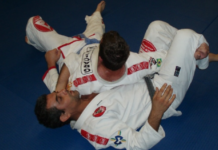








- Chris Haueter is shutting down the Redondo Beach garage dojo that’s been the home of Combat Base for nearly 21 years, with the final closure expected in February.
- The reason isn’t burnout or “losing love for Jiu-Jitsu” — it’s coastal economics and the brutal math of turning a small, intimate mat room into a commercial lease.
- Melissa Haueter laid out what that jump would really cost per month, and why the numbers don’t work without building a completely different kind of academy.
- The Chris Haueter dojo closing doesn’t mean Combat Base isn’t disappearing: the Haueters plan to keep teaching through their online platform, seminars, and the wider Combat Base network.
The Garage That Became A Grappler’s Bucket List
There are plenty of famous academies in Jiu-Jitsu, but there are only a handful of places that feel like mythology — and Chris Haueter’s Redondo Beach garage dojo has lived in that category for years.
Now, the Chris Haueter dojo closing story is official: after nearly 21 years, Combat Base is shutting the doors on the physical space that many traveling grapplers treated like a must-visit mat room.
The details matter here. This wasn’t a “mega-gym” with a front desk, a retail wall, and a kids program doing the heavy lifting. It was a garage that became a training hub — mats first laid down in 2005 — and it ran on a model that only works when the location itself doesn’t bleed you dry.
That model also shaped the vibe. Combat Base wasn’t built to cram 200 members into a schedule grid. It stayed intimate, with a relatively small group of regulars — reportedly around 20 — and a room heavy on experience rather than bodies.
Chris Haueter Dojo Closing: Breaking Down the Math
If the headline feels emotional, the reason is painfully practical. Haueter framed it as a coastal real estate reality: beach land is finite, and the price of “being near the beach” keeps climbing until it pushes everything else out.

He’s watched the neighborhood shift from rougher, working-class edges into the kind of place where homes can sell for millions. That change doesn’t just raise property values — it changes what “running a gym” means in that zip code.
And that’s where Melissa Haueter steps into the center of the story. She’s not just “the coach’s wife.” She’s a third-degree black belt, a longtime instructor, and the operations manager behind the Haueters’ wider business ecosystem — including their online platform and other projects.
When she broke down the finances, it was less “we’re sad” and more “here’s the spreadsheet reality.”

“We are actually in the hole like $11,000…”
– Melissa Haueter –
That figure came from stacking commercial rent with the income they’d have to give up to make a traditional school model work. In other words, opening a “normal academy” doesn’t just add rent — it can also remove revenue from everything else they do.
That’s why Haueter’s blunt one-liner hit so hard.
“I get paid to work and I will not pay to go to work.”
– Chris Haueter –
It’s not a quote you hear from someone chasing expansion. It’s the quote you hear from someone refusing to turn a lifestyle-driven mat room into a high-stress business machine.
Combat Base Was Never A “Normal Academy”
The Combat Base identity has always been a little anti-template. Even the branding tells you what Haueter values: fundamentals, longevity, and a kind of philosophical approach to grappling that doesn’t fit neatly into “sport-only” or “self-defense-only.”
Haueter is widely known as one of the “BJJ Dirty Dozen” — the early wave of non-Brazilian black belts — and Combat Base has long positioned itself as a place with minimal hierarchy and maximum personal responsibility.
His teaching slogans became their own kind of curriculum: “Think Street. Train Sport. Practice Art.” The “Combat Base” position itself — that one-knee-up, one-knee-down posture — is literally a piece of vocabulary he helped popularize.
This is also why the garage mattered so much. It matched the message. A small room makes it harder to hide behind marketing. The training either works, or it doesn’t. That kind of environment attracts a very specific student: experienced, curious, and usually not looking for belts on a conveyor belt.
It also explains why visiting names mattered. Over the years, the garage hosted seminars and visitors that reinforced its reputation as a pilgrimage spot — the kind of place you drop into once, then talk about forever.
The Haueters’ Influence Includes The Good, The Bad, And The “Please Stop Doing That”
The best way to understand the Haueters is to look at the size of their ripple effect. Chris Haueter isn’t just a coach with a room — he’s one of those figures whose ideas quietly shaped the culture.
Sometimes that influence is unquestionably positive: concepts like longevity, simplicity, and staying functional as you age. Sometimes it’s messier — like the belt promotion gauntlet, a ritual he’s openly said he regrets helping popularize as it spread and escalated in the wider scene.
“Within a year it was viral, and then it got brutal.”
– Chris Haueter –
That honesty is part of the Haueter brand too: not pretending every tradition aged well, and not acting like leadership ends when something leaves your control.
The Garage Doors Close, But The Teaching Doesn’t
The most important thing about the Chris Haueter dojo closing isn’t that Combat Base is “gone.” It’s that the physical room is ending — while the work continues in a form that better fits the Haueters’ actual priorities.
They’ve already built an ecosystem that isn’t dependent on a single address: online instruction, a broader Combat Base network, and a seminar schedule that lets Haueter teach without turning his life into rent-chasing. Haueter’s closing thought on the whole shift makes that point clear:
“I am interested in the art of jiu jitsu, not in running a jiu jitsu academy.”
– Chris Haueter –
For the Redondo Beach regulars, it’s still a gut punch — because mat rooms are communities, not just square footage. But for the bigger Jiu-Jitsu world, the takeaway is sharper: the old-school “legend garage” model is getting squeezed out by modern economics, even when the room is packed with black belts and history.
And that’s the real reason this story is sticking. The Chris Haueter dojo closing isn’t just about one garage. It’s a snapshot of where Jiu-Jitsu is right now — and what it costs to keep things small, pure, and personal in a world that keeps getting more expensive.