





- Viral video from Spain captures the moment a Brazilian Black Belt detains thief as a grappler stops a suspected bag-snatcher with calm, positional control.
- Technique matters: a tight, safe jiu-jitsu chokehold and steady transitions kept bystanders out of harm’s way.
- Legal reality: citizen’s arrest in Spain permits limited detention, but the gray areas are where people get hurt—or sued.
- Takeaways for the average person: distance, description, and de-escalation beat heroics unless you’re highly trained.
- Coaches see fundamentals at work—base, frames, and patience—more than brute force.
Brazilian Black Belt Detains Thief in Barcelona, Video Goes Viral
Brothers Gabriel and Gustavo Galindo—both Brazilian Jiu-Jitsu black belts—were vacationing in Barcelona when they heard a man shouting in Portuguese that he’d been robbed.
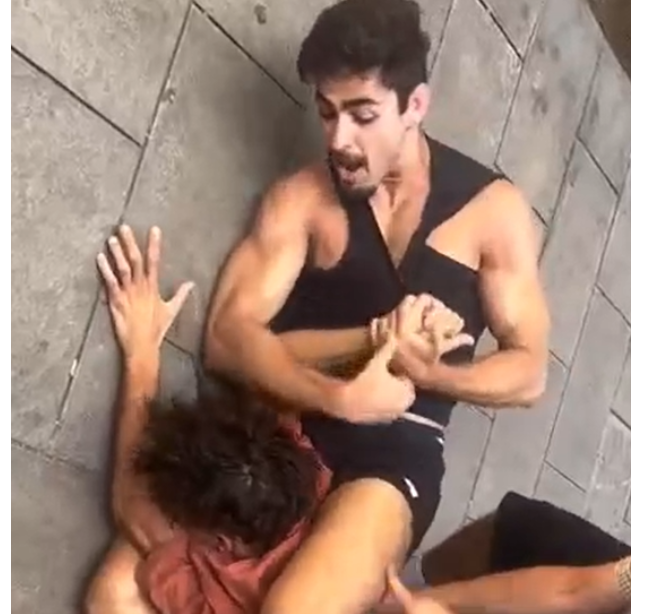
They tracked the suspect down the street, with Gabriel using basic positional control to pin him safely while Gustavo cleared space and alerted bystanders until local police arrived.
The moment was filmed and quickly went viral, highlighting how calmly applied fundamentals can neutralize a chaotic situation without unnecessary force.
The clip is short, but the story isn’t. You see a sprint, a scramble, a clean takedown—and then composure. Brazilian black belt detains thief reads like headline bait, yet the most important beat is the pause after contact.
The grappler scans for accomplices, positions his hips so he can’t be bridged off, and narrows the chaos. That’s textbook risk management: control the space first, the person second.
In the background you hear the spillover of a crowded street, the kind of ambient pressure that makes untrained interventions go sideways. Good grapplers make these moments look simple because they’ve rehearsed them thousands of times at full speed.
The “Barcelona thief video” angle is irresistible, but the mechanics are evergreen. He keeps his knees active, posts when the suspect turns, and never chases a finish at the expense of balance.
Notice the hands: one tethering the torso, the other fighting grips. That detail—two jobs, two hands—prevents the frantic scrambles you usually see in viral street fights.
Where Skill Meets the Law in Spain
Technique is only half the story. The other half is legal. Spain recognizes forms of citizen’s arrest, but the lines are narrow: you can restrain to prevent escape and await authorities, not mete out punishment.
That means the same detail that wins in the gym—measured pressure—wins on the street and in a courtroom. Maintaining control without escalating force is the entire ballgame.
Practical guidance, regardless of jurisdiction: call the police immediately, get witnesses on camera if possible, and maintain a running verbal log—“I’m detaining you until police arrive”—that bystanders can later corroborate.
If a weapon appears, disengagement beats heroics every time. Even with elite skill, the safest win condition is containment and handoff, not conquest. That’s the less glamorous reality behind the headline Brazilian black belt detains thief.
Citizen’s Arrest 101 – What the Video Teaches
The “viral video Barcelona” cycle rewards spectacle, but coaches watch different metrics. They see a checklist: base under fire, calm grip fighting, and the discipline to reset hooks rather than chase applause.
They also clock the invisible skills—breathing cadence, head position against headbutts, peripheral scans for friends of the suspect. The teaching takeaway: fundamentals scale across contexts.
For bystanders and new students, this is a lesson in bystander intervention done right: create a perimeter, assign roles (“you call emergency services,” “you record from there”), and avoid the dogpile.
One trained person controlling the situation is safer than five untrained helpers pulling in five directions. If you must engage physically—and again, it’s rarely plan A—think positional control, not a striking brawl.
The jiu-jitsu chokehold is a tool, not a shortcut; it only works safely when layered over posture, balance, and constant situational awareness.
A final point the internet misses: Brazilian black belt detains thief makes for a thrilling caption, but the win condition was restraint, not domination. He used enough technique to stop the sprint, then just enough pressure to hold the line.
Train Smart, Stay Safe—This Story is the Exception, not Your Blueprint
For most people, the safest contribution is observation and documentation, not entanglement. When force becomes unavoidable, the fundamentals we saw—hips heavy, hooks active, steady breath—are what lower the risk to everyone, including the suspect and the surrounding crowd.
If this clip pushes you toward the mats, good. Seek a reputable academy that teaches control before chaos, positional dominance before submissions, and scenario training that includes voice commands and safe disengagement.
Treat the video as a case study, not a fantasy. Celebrate the composure and the clean mechanics, then remind yourself that Brazilian black belt detains thief stories that go viral precisely because they are outliers.
Build the skills anyway—so that if your ordinary day suddenly demands the extraordinary, you’re ready to choose the safest option available.