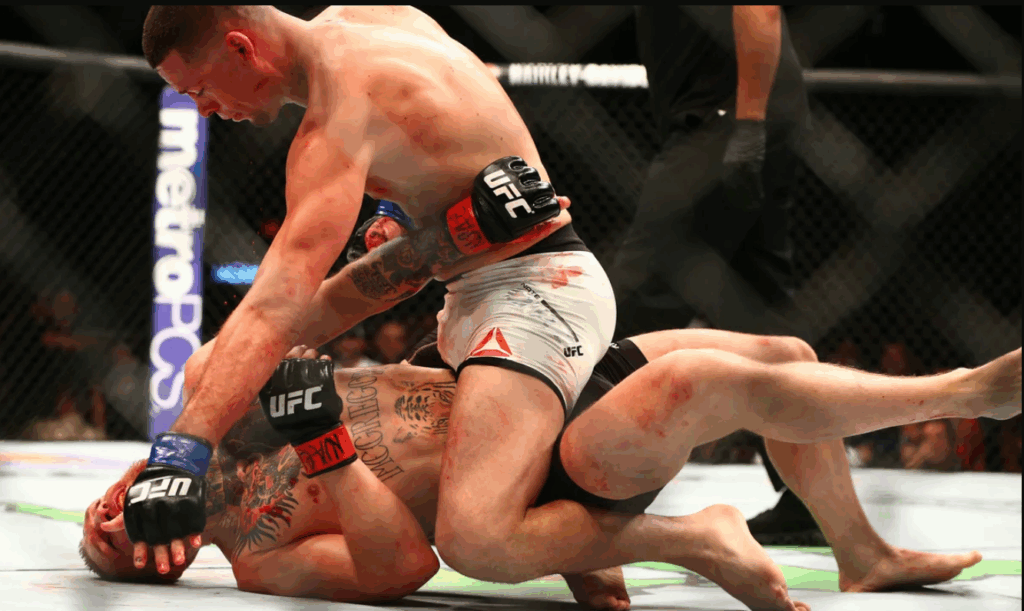
A viral dating-psychology survey on “most and least attractive male hobbies” has spilled into BJJ and MMA, with boxing/MMA flagged as a major red flag.
MMA was ranked among the ugliest hobbies and “d-bag magnets,” pointing to toxic gym culture and mismatched sparring partners.
A Reddit thread tears into the coverage, calling it Reddit drama-chasing, but also describes BJJ and MMA scenes as full of “meatheads,” fascist-adjacent owners, and Rogan-style manosphere politics.
Other posters defend the art, saying good gyms are welcoming, have women and kids’ programs, and very much don’t fit the Jiu-Jitsu least attractive male hobby stereotype.
For BJJ and MMA gyms, the real battle might not be the survey itself, but whether they’re willing to fix the culture that lets those stereotypes stick.
Jiu-Jitsu And MMA Get Dragged Into The “Least Attractive Male Hobbies” War
The internet has a new way to roast men’s hobbies, and somehow Jiu-Jitsu and MMA have ended up in the blast radius.
A dating-psychology survey ranking the “most and least attractive male hobbies” has gone viral, with follow-up coverage now framing MMA as one of the worst red-flag interests a guy can have – and dragging Jiu-Jitsu into the conversation as part of the same culture.
MMA gyms, in particular, have become magnets for toxic personalities, while Reddit’s community fired back with its own war stories – and a lot of skepticism towards the media coverage itself.
Whether Jiu-Jitsu least attractive male hobby is a fair label or not, the debate says a lot about how combat sports are being seen from the outside.
How A Dating Survey Put Jiu-Jitsu On The “Worst Hobbies” Radar
The spark was a study shared by Date Psychology that used a forced-choice survey of 74 male hobbies. Women were asked whether each hobby was “attractive” or “unattractive” for a man, while men had to guess what women would say.
That allowed the authors to compare actual female preferences with male assumptions. According to a Reddit breakdown of the numbers, women generally found far more hobbies attractive than men expected, with reading, learning foreign languages, and travel all ranking extremely high.
The only two hobbies men overestimated women’s attraction to? Riding motorcycles and boxing and MMA.
The full sample was 814 people with equal gender representation, but heavily skewed toward highly educated, mostly white women, 45% of whom held advanced degrees.
In that crowd, MMA landed among the “least attractive male hobbies list,” grouped with things like manosphere content and aggressive online arguing.
That framing is what eventually feeds into the Jiu-Jitsu least attractive male hobby conversation: even though the study is about hobbies in general, combat sports get singled out as a personality red flag, and BJJ gets lumped in by association.
Inside The Date Psychology Hobby Study And The Least Attractive Male Hobbies List
The Date Psychology work isn’t just “MMA bad, books good.” It tries to categorize what women find appealing or off-putting. The three big buckets of turn-offs in the data: addictive behaviors, antisocial activities, and isolating interests.
MMA is presented as ticking multiple boxes at once – especially when it overlaps with manosphere content consumption and a vibe of chronic online conflict.
On the flip side, the study (as described by Reddit users reading it directly) highlights that women are into hobbies that signal curiosity, cultural engagement and personal growth: reading, foreign languages, travel, artistic work.
That contrast – MMA next to doomscrolling manosphere clips versus someone who reads and travels – is exactly the sort of simple narrative that makes Jiu-Jitsu least attractive male hobby style takes spread quickly, even if they flatten all nuance.
Why MMA Is Branded A “D-Bag Magnet” In This Research
The lsit leans on both the study and testimonies from inside combat sports to argue that MMA, more than other martial arts, attracts a specific kind of insecure, ego-driven student.
One commenter quoted in the article sums up the vibe:
As someone who enjoys MMA, I’ve met so many assholes in the sport. – Reddit user –
The harshest criticism comes from a Muay Thai gym owner who describes visitors from MMA gyms flinching at even light contact and “PTSD-like” reactions in women who were used to sparring badly matched 200 lb men who refused to control their power.
That owner says they refuse to add BJJ classes or switch to an MMA format specifically because of the clientele they believe those environments attract.
Both outlets still note that this isn’t universal. BJJ-only academies and more traditional martial arts gyms are described as often more respectful, technical, and culture-focused – another crack in the idea that Jiu-Jitsu least attractive male hobby is some universal truth rather than a reflection of certain gyms and scenes.
BJJ Gym Culture Toxicity, Politics and a Reddit Thread
Once people start talking about BJJ specifically, it gets spicy fast. One commenter writes that BJJ “has a lot of meatheads due to its history and proximity to MMA,” even if they don’t think it’s literally the worst hobby.
Another redditor, who says they’ve tattooed multiple BJJ practitioners, describes them as clones: same ego, same politics, same way of carrying themselves.
There are also accusations about some local BJJ club owners pushing anti-LGBTQ school board takeovers, and about Gracie-branded gyms effectively funding far-right Brazilian politics.
One user bluntly calls BJJ “the fascist brand of martial arts,” while another points out that the sport’s origins are more complicated and that plenty of progressive, women-friendly gyms now exist.
Amid all the culture-war heat, several posters push back against the Jiu-Jitsu least attractive male hobby narrative. One self-described BJJ “meathead” jokes that the sport is really about avoiding pain and tapping early, not proving toughness.
Another user says their base BJJ gym is “super welcoming,” with lots of women and kids’ classes, and argues that good gyms send douchebags packing as soon as they show their true colors.
That tension – toxic stories versus good-gym stories – mirrors what long-time practitioners have been saying for years: the art and the culture are not the same thing.
Can BJJ Shake The Least Attractive Male Hobby Label?
So where does this leave BJJ and MMA?
On paper, the Date Psychology survey is one niche, skewed sample: 814 people, heavily weighted toward highly educated, mostly white women, with its own cultural lens on what counts as an attractive life.
If Jiu-Jitsu wants to avoid being permanently tagged as Jiu-Jitsu least attractive male hobby in the dating-app imagination, it probably won’t be enough for practitioners to grumble that “the study is biased.”
The stories that resonate – traumatized students fleeing MMA gyms, fascist-leaning owners, unchecked egos on the mat – are exactly the ones casual outsiders remember.
The flip side is just as real: welcoming gyms with strong women’s programs, kids’ classes, zero-tolerance policies on creepy behavior, and coaches who actually care about safety and skill over clout. Redditors talk about those rooms as green flags, not red ones.
In other words, the data point might be harsh, but it’s a snapshot, not a life sentence. Whether the label Jiu-Jitsu least attractive male hobby in the long term will come down to what BJJ and MMA gyms choose to reward: loud egos and culture-war cosplay, or the “gentle art” they keep putting on the posters.
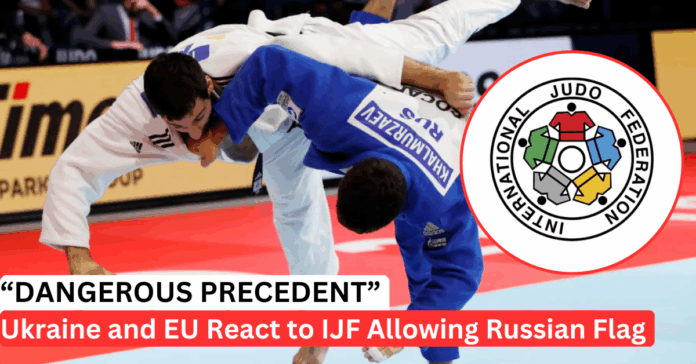
The IJF has restored full flag, anthem, and insignia rights for Russian judokas starting with the 2025 Abu Dhabi Grand Slam.
Ukraine reaction to IJF Russian judo decision includes coordinated protests from its Foreign Ministry, sports ministry, NOC, and Ukrainian Judo Federation.
Kyiv says the move violates IOC guidance on Russian participation and “sets a dangerous precedent for global sport.”
EU Sports Commissioner Glenn Micallef and other officials have also criticized the International Judo Federation decision.
The controversy puts judo at odds with most Olympic sports, where Russians remain limited to neutral status.
Inside The Ukraine Reaction To IJF Russian Judo Decision
When the International Judo Federation (IJF) announced that Russian judokas would once again compete under their national flag, anthem, and colors, it immediately turned a Judo World Tour calendar update into a geopolitical flashpoint.
At the heart of the story is Ukraine reaction to IJF Russian judo decision: a coordinated protest not just from the Ukrainian Judo Federation, but from the country’s Ministry of Youth and Sports, National Olympic Committee (NOC), and Ministry of Foreign Affairs.
Together, they argue that restoring national symbols for Russian and Belarusian athletes in judo contradicts both the Olympic Charter and existing IOC recommendations on how aggressor states should be treated in sport.
For the IJF, the move is framed as a return to “normal” – a way to depoliticize competition and underline that, in their view, athletes shouldn’t be punished for decisions taken in government offices.
What The International Judo Federation Decision Actually Changed
The International Judo Federation decision was taken by its Executive Committee and announced on 27 November 2025.
From the Abu Dhabi Grand Slam onwards (28–30 November), Russian judokas would no longer be listed as neutral athletes under the IJF flag. Instead, they would walk out under the Russian tricolor, with anthem, emblem, and other state symbols restored.
Nineteen Russian judokas were expected to compete in various weight categories at the Mubadala Arena in Abu Dhabi under full national representation.
The federation highlighted Russia’s historic strength on the tatami and its importance to the sport’s competitive depth, presenting the move as a natural step after earlier changes for Belarusian athletes, who had already been cleared to compete under their own flag from June 1, 2025.
The IJF also stressed its broader philosophy in an official statement:
Athletes have no responsibility for the decisions of governments or other national institutions. – International Judo Federation statement –
On the mat, the impact was immediate. At the very same Abu Dhabi Grand Slam, Ayub Bliev became the first Russian judoka in more than two years to win a title under his national flag, taking gold in the under-60 kg division as the anthem played and the flag was raised.
Why Ukraine Says The Move Breaks Olympic Rules
If the IJF describes the call as a values-driven reset, Ukraine reaction to IJF Russian judo decision paints a very different picture.
Ukraine’s Ministry of Youth and Sports, its NOC and the Ukrainian Judo Federation jointly appealed to IJF president Marius Vizer, urging him to reverse the ruling that lets Russian and Belarusian judokas compete under national symbols at international events.
The appeal argues that bringing back those flags “contradicts the fundamental principles of the Olympic Charter” and undermines trust in sport governance.
From the diplomatic side, a joint statement from Ukraine’s Foreign Ministry and sports ministry went even harder, saying the IJF’s call:
demonstrates complete disregard for the reality of Russia’s aggression against Ukraine and undermines the moral foundations of international sport. – Joint statement by Ukraine’s Foreign and Sports Ministries –
Ukraine also took the fight to Lausanne. In a letter to the IOC, the Ukrainian NOC pointed to IOC guidance issued on March 28, 2023, which explicitly recommended that athletes from aggressor states should not compete under their national flag, anthem or symbols.
That same letter warned that the IJF ruling:
sets a dangerous precedent for global sport. – National Olympic Committee of Ukraine –
The Judo Federation of Ukraine has called the decision incompatible with “the fundamental values of world sport” and says it will work with state bodies and partners to use every available legal mechanism to stop the implementation of the rule change and protect Ukrainian athletes’ interests.
Abu Dhabi Grand Slam Judo, EU Pushback, and Judo World Tour Politics
The first real test of the ruling came at Abu Dhabi Grand Slam judo, where Russian competitors were once again visibly part of the field – national colors back on scoreboards and podiums.
For Ukraine and many of its supporters, that visual shift is exactly what they feared: judo becoming a showcase for flags from countries still engaged in full-scale war.
The Ukraine reaction to IJF Russian judo decision sparked more backlash. EU Sports Commissioner Glenn Micallef publicly condemned the move, calling the IJF’s decision to reinstate Russian flag and anthem in competition “regrettable and deeply concerning.”
regrettable and deeply concerning. – Glenn Micallef, EU Sports Commissioner –
He warned that it risks normalizing the actions of states engaged in aggression, and that it reflects a wider trend where some federations seek competitive normality even as fighting continues.
All of this leaves judo out of step with broader Olympic practice. The Russian Olympic Committee remains suspended by the IOC, and Russian athletes at the 2024 Paris Games – and the upcoming Milan-Cortina 2026 Winter Olympics – are limited to competing only as neutral individuals, not under the Russian flag.
In contrast, the IJF now openly lists Russia with full national representation on its website, separating itself from more cautious federations while joining a smaller group, such as the International Boxing Association, that have already gone further in bringing Russian and Belarusian athletes back in from the cold.
What This Means For Judo’s Olympic Cycle Going Forward
For now, Ukraine reaction to IJF Russian judo decision is focused on letters, legal mechanisms and diplomatic pressure.
The Ministry of Youth and Sports, the NOC and the Ukrainian Judo Federation have signalled they expect the wider “judo family” – athletes, national federations and fans – to hold the IJF to what they see as higher moral and governance standards.
How other countries respond will determine whether this remains a political headache or develops into a full-blown split within the sport.
National teams could still choose to skip specific World Tour events where Russian and Belarusian judokas appear under full national symbols, creating uneven competitive fields and complicating Olympic qualification routes.
For the IJF, the gamble is clear: bet that its values-first narrative resonates with enough stakeholders to offset the criticism. In its own framing, reinstating Russian and Belarusian judokas with full symbolism is about unity and the integrity of competition, not geopolitics.
Ukraine and its supporters see exactly the opposite – a federation stepping outside the IOC line and giving a powerful visual platform back to a “flag of war.”
As long as Russia’s invasion of Ukraine continues, every medal ceremony involving Russian and Belarusian judokas will carry more than just ranking points.
Whether the IJF stands firm or is forced into another U-turn may depend on how much traction Ukraine reaction to IJF Russian judo decision gains across the rest of the Olympic movement in the months ahead.
A complete escape blueprint: Pins And Dominant Position Escape Adam Wardzinski DVD gives you a structured, principle-based roadmap for escaping mount, side control, turtle, and back in the Gi.
Battle-tested systems: The material comes straight from one of the most decorated modern Gi competitors, built around what actually worked for him at the highest IBJJF levels.
Principles first, moves second: Each volume starts with big-picture concepts before drilling down into specific escapes and chains, making it easier to adapt to your own style.
Logical progression: The series moves from mount to side control, then to turtle and back control, tying the whole bottom-survival picture together instead of treating each position in isolation.
Best for serious Gi students: Hobbyists, competitors, and coaches who want a reliable, modern escape framework from bad positions in Gi Jiu-Jitsu will get the most value here.
Not a No-Gi or submission-focused set: The emphasis is on survival and reversals from pins in the Gi, not leg locks or trendy No-Gi meta.
This Adam Wardzinski DVD looks at whether this new escape instructional actually helps you survive the worst spots in Jiu-Jitsu, or if it’s just another addition to the already crowded BJJ library.
Modern Jiu-Jitsu tends to glamorize submissions and fancy guards, but most students’ real problem is much simpler: they get stuck and smothered under strong opponents. Pins And Dominant Position Escape Adam Wardzinski DVD is marketed as an answer to that reality – a complete escape “engineering” project built from the matches that earned Adam his IBJJF Super Grand Slam.
In this review, we’ll unpack how the four volumes are structured, where the series shines, and where it might feel limited. We’ll also look at who will benefit the most from spending time (and money) on this material, and why I think an 8/10 rating is appropriate for most Gi-focused grapplers.
Survive, Frame, Escape
Escaping pins is one of the least glamorous but most decisive skill sets in Jiu-Jitsu. Everyone loves to drill new guards and sweeps, but the reality of hard training – and competition – is that you will end up under mount, side control, or back control sooner or later.
What separates seasoned grapplers from frustrated ones is not avoiding those positions forever, but how reliably they can survive and turn the tide once they’re stuck. A resource like Pins and Dominant Position Escape Adam Wardzinski DVD tries to close exactly that gap.
Instead of sprinkling a handful of “get out of jail” moves through various instructionals, this series dedicates all four volumes to the worst spots in the Gi: mount, side control, turtle-style positions, and full back control. Each one is treated as its own mini-system, starting from principles (how to frame, where to hide your arms, how to manage weight and direction) and then working through escape options that can be chained together.
When your opponent switches from grapevine mount to high mount, or from cross-face side control to kesa gatame, you need a mental model that tells you “first survive, then create space, then build a frame, then move your hips.” This is exactly the lens Adam applies throughout the series.
Adam Wardzinski – Engineering Polish Grappling
Adam Wardzinski is one of the defining heavyweight Gi competitors of his generation – and notably, one of the first true European superstars of high-level Jiu-Jitsu. A Polish black belt under Alan “Finfou” do Nascimento, he built his name under the Checkmat banner, becoming known first for a relentless butterfly guard and then for a well-rounded, pressure-heavy top game.
Over the past decade, Wardzinski has put together a résumé that includes IBJJF World titles, major wins at Euros, Pans, and Brasileiro, ultimately completing the IBJJF “Super Grand Slam” – winning all four of those majors in the Gi.
He’s also the first Polish – and first male European – black belt to capture an IBJJF World Championship, a milestone that cemented his place in BJJ history and inspired a whole generation of European grapplers.
Stylistically, he’s often associated with a punishing butterfly guard, tight half guard, and heavy-pressure passing, which made his earlier instructionals on open guard and passing very popular.
But anyone who competes as much as he has also develops serious “survival skills” – the ability to stay calm, defend, and eventually escape from pins against other world-class opponents. BJJ Fanatics’ own description of him emphasizes that these escapes were forged in exactly those environments.
When you see Pins And Dominant Position Escape Adam Wardzinski DVD sold as “battle-tested,” it’s not empty marketing. It reflects a career of solving the same problems most students face – just under brighter lights and against much nastier pressure.
Engineering Pins And Dominant Position Escape Adam Wardziński DVD Review
As an Adam Wardzinski Escape DVD, this one is refreshingly focused. There’s no attempt to cram in guard attacks, leg locks, or trendy lapel systems. Instead, Adam zooms all the way in on escape engineering: how to survive mount, side control, turtle, and back control in the Gi, then how to connect those escapes so you’re never truly “stuck” in any of them.
The four volumes are laid out logically, and the chapter list reads like a checklist of common problems you run into in tough training rounds.
Volume 1 – Mount Escapes
Volume 1 is where Pins and Dominant Position Escape Adam Wardzinski DVD really starts to pay off for everyday grapplers. It’s entirely focused on mount – the position that causes more panicked tapping and bad scrambles than almost anything else.
Adam opens with principles behind his bottom mount game, laying out how he thinks about frames, hip placement, and the opponent’s weight. From there, he immediately addresses a classic problem: being stuck with grapevines. He delivers a step-by-step approach to freeing the hips before you even think about full escapes.
Once your hips are alive, he moves into the classic escape families: shirmping, bridging, and kipping. Rather than presenting them as isolated moves, he caps the volume with chaining mount escapes, tying them together into sequences you can adapt based on how your opponent reacts.
By the end of the first volume, Pins and Dominant Position Escape Adam Wardzinski DVD has already given most students enough structure to feel less helpless in mount and more confident experimenting with combinations instead of praying for a reset.
Volume 2 – Side Control
The second volume of Pins and Dominant Position Escape, Adam Wardzinski DVD shifts the focus to side control and kesa-style pins – positions that feel suffocating in a different way. Where mount often feels vertical, side control is all about cross-face, shoulder pressure, and shutting down your near-side arm.
Adam starts again with the principles of bottom side escapes. A fundamental shrimp escape features first, branching into underhook escapes and allowing you to figure out whether your far arm or near arm is under threat.
He then layers in more dynamic options, like hook escapes and his signature Octopus escape give you ways to disrupt the top player’s base. He also shows how to deal with different Kesa Gatame variations, sharing scarf-hold situations that often feel like dead ends to less experienced students.
Volume 3 – Turtle
Turtle positions are often neglected in standard curricula, and this is where Pins and Dominant Position Escape Adam Wardzinski DVD feels especially modern. Instead of treating turtle as a static, ultra-defensive shell, Adam frames it as a dynamic hub between surviving, standing, and attacking.
He starts with principles (again), then quickly introduces wrestling through the Peterson roll, covering several different scenarios. From there, he moves into the Granby Roll, before sharing a roue from turtle to guard, more precisely Single Leg X. This ties the defensive turtle into an immediate guard-entry threat rather than just a reset to closed guard.
The later chapters round out the volume by covering scenarios where your opponent is starting to secure hooks or chase the back. The consistent theme is that you shouldn’t resign yourself to being “stuck in turtle”; you’re always either getting up, rolling through, or entering a stronger guard.
Volume 4 – Back Escapes
The back-escape material is probably the most “high-pressure” section of Pins And Dominant Position Escape Adam Wardzinski DVD. Here, Adam opens with options for standing up from the back mount, which immediately reframes the back not just as a place you escape from, but as a gateway to standing clinches when you retreat correctly.
He then covers back take prevention, explaining how to manage choking arms, hooks, and hip alignment. From there, he introduces several layered escapes, which are all about turning the usual “stuck with hooks in” nightmare into a sequence of hip movements that either land you in half guard or a more neutral position.
The volume ends with some Adam classics like the corkscrew escape, Gi choke solutions, and beating the body triangle, giving you efficient solutions to the exact threats that usually make people tap from the back.
Where to Start With Escapes
If you want to squeeze real value out of Pins And Dominant Position Escape Adam Wardzinski DVD, you can’t just binge-watch it like a Netflix series. The material is structured to reward deliberate, positional training.
A simple approach is to dedicate one training block (e.g., 3–4 weeks) to each volume. During your warm-ups or specific training rounds, start in the relevant bad positions: fully mounted with grapevines, tight side control with cross-face, deep turtle with front headlock, or fully seated back control.
Your goal isn’t to “win the round”, but to work through the exact sequences Adam lays out – first the survival frames, then the hip movement, then the follow-up reversal or guard entry.
Because the chapters explicitly show how to chain escapes, it’s worth drilling transitions between them. For example, move from a basic shrimp escape to a kipping escape when the opponent switches to high mount, or from a failed Peterson roll to a Granby that lands you in single leg X.
Over time, this approach builds a bottom game that feels layered rather than fragile: instead of hoping your “one escape” works, you have a network of options connected by shared principles.
This series is clearly aimed at Gi-focused grapplers who are tired of feeling helpless under strong top players. Early white belts might find some of the later volumes a bit advanced, but even they can benefit from the fundamental mount and side-control sections as long as they have an instructor to help them prioritize key pieces.
For blue and purple belts, the structure is ideal. You probably already know a handful of basic escapes, but maybe they only work against training partners of your own size. Here, you get a complete picture that includes how to deal with cross-face, lapel control, kesa transitions, and the infamous body triangle.
If you’re the kind of Gi player who already owns big conceptual systems like John Danaher’s pin-escape material and wants something more competition-proven, Pins Escapes Adam Wardzinski Escape DVD slots in as a very logical companion.
Pros & Potential Drawbacks
Pros:
Highly coherent structure: Four volumes that cover mount, side control, turtle, and back in a way that feels like one unified escape system rather than four unrelated mini-courses.
Principle-driven teaching: Each section begins with clear principles before moving into specific techniques, making it easier to adapt the material to your own body type and game.
Battle-tested content: The escapes come directly from a competitor who’s won at the very top of IBJJF Gi Jiu-Jitsu, which gives the material real-world credibility rather than feeling theoretical.
Gi-specific details: Smart use of lapels, sleeve grips, and positional nuances that only exist in the Gi, which many generic “escape” DVDs tend to gloss over.
Great for coaches: The chapter list reads like a ready-made curriculum; you could almost plug volumes straight into a month of “escape focus” classes with minimal adjustment.
Potential Drawback:
Gi-only focus: If your main environment is No-Gi, you’ll have to translate a lot of the grip work yourself, and you won’t find dedicated No-Gi variations here.
Assumes some fundamentals: Total beginners might feel overwhelmed by the number of options; this shines most for students who already know the basic positions and want to systematize their escapes.
Narrow topic scope: You won’t get guard attacks, passing, or submission chains – only escapes and reversals from pins. That’s the promise, but also the limitation, of such a focused project.
Elite-Level Escapes
Pinned on bottom is where you find out whether your Jiu-Jitsu actually works, and that’s exactly the problem this instructional aims to solve. Across four volumes, Adam Wardzinski lays out a clear, principle-driven map for surviving and escaping mount, side control, turtle, and back control in the Gi, with enough detail to keep even experienced grapplers engaged.
The strengths are obvious: coherent structure, battle-tested material, and a very practical balance between fundamentals and modern, movement-based escapes. The Pins and Dominant Position Escape Adam Wardzinski DVD delivers a focused, reliable escape roadmap for serious Gi practitioners.
Greg Souders says John Danaher’s ideas are “not wrong” – but the way they’re applied in training is.
A 2016 conversation with Danaher pushed Souders to trust his own ecological, games-based Jiu-Jitsu methodology.
Souders blasts the copycat culture where coaches parrot Danaher and Gordon Ryan instead of developing their own voice.
He argues massive John Danaher instructionals are “eight hours of method built on 5–20 minutes of principle.”
The real fight isn’t Souders vs Danaher – it’s ecological Jiu-Jitsu training vs traditional, system-first teaching.
Greg Souders Danaher Criticism: Ideas Versus Application
Greg Souders Danaher criticism isn’t a simple hit piece – it’s closer to a philosophical split between two very different visions of how Jiu-Jitsu should be taught.
Souders repeatedly stresses that John Danaher’s concepts are sharp, even foundational, but he thinks the way those ideas get turned into day-to-day training is where things go wrong.
On the Jits and Giggles podcast, Souders boiled his position down to one brutal line:
His ideas are not wrong. His application is wrong – Greg Souders –
He credits Danaher as a major influence and points back to a pivotal 2016 conversation. When Souders asked how Danaher knew his systems were correct, Danaher admitted he relies on trial and error and can spend months going in the wrong direction before adjusting.
That honesty flipped a switch for Souders:
Learn how to be confident and trust your own ideas through the results you get – John Danaher (via Greg Souders) –
According to Souders, that’s what gave him permission to stop being “a coward” about his own ideas and fully commit to his own ecological dynamics-inspired approach at Standard Jiu-Jitsu.
How Ecological Jiu-Jitsu Training Clashes With Traditional Methods
To understand the Greg Souders Danaher criticism, you have to understand the training philosophies underneath it. Souders is known for building a methodology based on ecological dynamics – a science-rooted view of learning that he encountered while researching better ways to coach.
Instead of leaning on long, compliant drilling blocks, he was inspired by a volleyball coach who used games instead of drills, blending “drilling content with games” in what were called “grills”.
That idea – mixing live problems with constraints – became the backbone of his ecological Jiu-Jitsu training at Standard Jiu-Jitsu in Maryland.
By contrast, Souders labels Danaher a traditionalist:
He’s a traditionalist… I understand application better than he understands application – Greg Souders –
He’s not saying Danaher hasn’t pushed the sport forward – he explicitly says Danaher’s work has produced exceptional athletes and advanced Jiu-Jitsu.
What he’s really attacking is practice design: how those big systems and concepts get translated into the actual rounds, games, and problems people face on the mats.
For Souders, ecological dynamics and constraints-led training are about building those problems first and letting technique emerge from interaction – not memorising step-by-step patterns.
The Copycat Culture In BJJ And The Danaher Effect
The Greg Souders Danaher criticism isn’t just about one New York coach in a rashguard. It’s about the ripple effect across the whole coaching scene – what Souders calls a copycat culture in BJJ.
On The Charles Eoghan Experience podcast, he went after this directly, arguing that the biggest issue right now is how many instructors are just doing Danaher cosplay:
The big issue in the jiu-jitsu community right now is literally everyone’s a copy of John Danaher and Gordon Ryan. – Greg Souders –
He points to YouTube and Instagram as proof: the language, the sequencing, even the way techniques are broken down often sound like straight Danaher – passed through another coach, then another.
For Souders, this isn’t just aesthetic. He thinks this copycat culture in BJJ suffocates creativity and stops coaches from developing practice structures that actually fit their own students.
Instead of experimenting with ecological dynamics or other models, gyms cling to a framework built around someone else’s blueprint.
And again, he’s not saying Danaher’s Jiu-Jitsu is bad. He acknowledges the “brilliance” of Danaher’s contributions – but argues that uncritical copying, without truly digesting and adapting, undermines the broader growth of the art.
Are John Danaher Instructionals Helping Or Just Eight-Hour Homework?
Souders saves some of his sharpest lines for John Danaher instructionals – and the instructional market in general.
Talking again about Danaher’s work, he points out that the real value is packed into the beginning:
He essentially gives you the entire eight hours of content in the first 5 to 20 minutes of his introductory speech… it’s eight hours of method built on 5 to 20 minutes of principle. – Greg Souders –
From an ecological dynamics lens, that’s exactly the problem: students binge hours of content, but the crucial principles are front-loaded and then repeated with minor variations.
Souders’ view is that if you train your eye to spot those principles, you don’t need eight hours of examples – you need live situations that stress-test those ideas.
He makes the point crystal clear – and a little savage – with his leg lock example:
Think about this craziness: you watch an 8-hour DVD about leg locks to learn that your feet either go outside, inside, or mixed… I just saved you $400. – Greg Souders –
In the context of Greg Souders Danaher criticism, the message is less “don’t watch instructionals” and more “don’t confuse watching with learning.” For Souders, actual learning happens in constrained, live training – not in stacking more hours of someone else’s method.
Why This John Danaher Coaching Debate Matters For Your Gym
Underneath all the Greg Souders Danaher criticism is a much bigger question: how should we actually train?
On one side, you have Danaher’s system-driven, traditional approach, built on detailed conceptual frameworks, long-form instructionals, and a proven track record of elite athletes.
On the other hand, you have Souders’ Standard Jiu-Jitsu model, rooted in ecological dynamics – games, constraints, and practice environments designed to make athletes solve real problems in real time.
Souders is clear that he still respects Danaher’s mind and impact, even saying he’d love to “engage him intellectually in public.”
But he also believes, bluntly, that he “understands application better,” and that the current Jiu-Jitsu coaching landscape leans too heavily on copying, not problem-solving.
For everyday students and coaches, that’s the real takeaway. The point isn’t to pick a side in a personality clash. It’s to ask whether your gym’s training looks more like eight-hour homework assignments, or like a lab where ideas are constantly being tested, broken, and rebuilt.
If nothing else, the Greg Souders Danaher criticism is a reminder that even the sport’s biggest thinkers don’t have all the answers – and that the bravest move a coach can make might be to stop copying, start experimenting, and trust their own results.
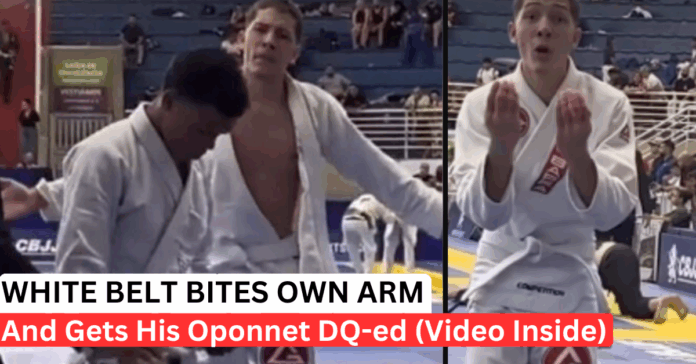
White belt allegedly bites his own arm at Sul Americano to get his opponent disqualified while losing 7–0 with seconds left.
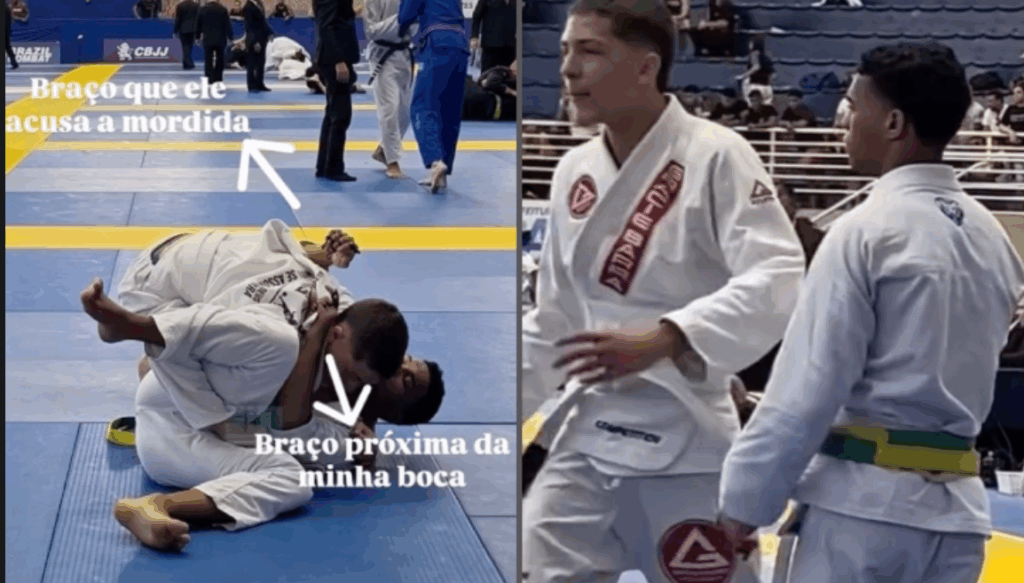
Clear video later shows the self-inflicted bite while stuck under control, turning a routine match into a full-blown cheating scandal.
Victim Davi Garros says it’s not about getting the win back, but about honor, truth, and what Jiu-Jitsu is supposed to stand for.
His mother backs him publicly, calling the video proof of injustice and a blatant dishonor of the kimono and the sport.
The Confederation of Brazilian Jiu-Jitsu is under heavy pressure as the “BJJ white belt bites own arm” clip goes viral and the community demands sanctions.
A routine white belt match at the Sul Americano championship has turned into one of the wildest ethics scandals in recent Jiu-Jitsu memory – all because a BJJ white belt bites own arm in a desperate last-ditch move to steal a win.
With the scoreboard reading 7–0 against him and roughly half a minute left, the competitor suddenly claimed he’d been bitten… and the referee disqualified the wrong man on the spot.
Only later did the footage surface – and it appears to show exactly what the internet is now screaming about: the white belt bending down, biting his own forearm, then flashing the mark to the official and walking away with a tainted hand-raise.
How A Bite Turned A Routine Match Into A BJJ Circus
The match itself, on paper, should have been forgettable. It was a white belt bout at Sul Americano, under the Confederation of Brazilian Jiu-Jitsu, with Davi Garros dominating the scoring and the positional exchanges. He was ahead 7–0, in control, and coasting toward a straightforward victory.
Instead, it turned into a circus.
Video shows the soon-to-be “winner” trapped under control – reports describe it as a clearly disadvantaged, controlled position – before he leans down toward his own arm. A moment later he signals the referee, presents the bite mark, and chaos follows.
The referee, who did not see the alleged foul as it happened, reacts to the mark itself and disqualifies Garros on the spot.
Garros is visibly stunned, protesting that he never bit his opponent. The other athlete, meanwhile, is seen celebrating as if nothing unusual just happened.
It’s the exact kind of scene that makes even casual fans shake their head and ask what’s happening to fair play in modern Jiu-Jitsu.
Inside Davi Garros Sul Americano Nightmare
From Garros’ point of view, this wasn’t just a bad call – it was character assassination in front of the entire tournament.
After tracking down video from the official broadcast, he shared the clip that appears to show his opponent biting himself. Alongside it, he laid out exactly why he isn’t simply asking to have the result reversed, but pushing for something much bigger:
After all the frustration, I got the video that reveals the truth: my opponent bit his own arm to fake a foul. – Davi Garros –
For a family that clearly takes Jiu-Jitsu seriously beyond just medals, the DQ wasn’t a simple bracket mishap – it was a stain on Garros’ reputation until the footage came out.
Next Level Cheating – BJJ White Belt Bites Own Arm
Once the video hit social media, it didn’t stay a local controversy for long.
The sequence – white belt under side control, leaning down, biting his own arm, then instantly “discovering” the mark and accusing his opponent – is so blatant on replay that it became instant meme fuel and a case study in how far someone will go to avoid a clean loss.
That’s how the phrase “BJJ white belt bites own arm” went from a ridiculous headline to a global talking point.
Clips circulated with slow-motion replays and freeze-frames, and community comments were almost universally brutal, branding it one of the dirtiest moves seen in competition Jiu-Jitsu in years.
One especially surreal detail: in another angle from the event, the accused competitor can be heard pleading innocence during the chaos.
<h5 class=”custom-quote”>I swear to God I didn’t bite him. On my mother’s life, I didn’t bite him!<br>– Accused competitor –</h5>
When you then watch the same video where he appears to clearly bite his own arm seconds earlier, it only ramps up the sense of surreal theatre. This isn’t just bad sportsmanship – it’s a full-on performance.
What This Says About BJJ Disqualification Rules And Coaching Culture
The scandal also shines a harsh light on BJJ disqualification rules and the realities of reffing under pressure.
Biting is an automatic DQ in pretty much every Jiu-Jitsu rule set, and for good reason – it’s a deliberate, dangerous act that has no place in grappling.
But this match shows how easily that rule can be weaponised when a referee is forced to make a snap judgment without clear vision of the alleged foul. All it took was a visible bite mark and an accusation, and a dominant, 7–0 performance was thrown out.
Many in the community have questioned how the situation could escalate this far without someone stepping in – not just the referee, but the athlete’s own team.
His reported celebration and initial online defence of the “win” have raised uncomfortable questions about what some coaches are willing to tolerate in the name of a medal. BJJDOC
Beginner divisions are supposed to be where Jiu-Jitsu athletes learn structure, discipline, and respect for the rules. Instead, this white belt cheating scandal risks sending the opposite message: if you can sell the foul, you can steal the result.
Why This White Belt Cheating Story Won’t Go Away
This isn’t a story that will vanish after one news cycle. Practitioners have flooded the Confederation of Brazilian Jiu-Jitsu with tags, comments, and demands for real consequences – not just for the competitor, but also for whatever processes allowed the call to stand in the first place.
The image of a BJJ white belt bites own arm stunt being rewarded with a disqualification win is exactly the kind of viral moment that sticks around as a warning.
It’s already being shared in gyms as a “what not to do,” and as a reminder that videotaped reality will eventually catch up with even the most shameless gamesmanship.
Garros, for his part, has been consistent: he isn’t begging for a retroactive gold medal. He’s demanding justice, coherence with what Jiu-Jitsu claims to represent, and some proof that the system won’t let this kind of scam slide again.
If the Confederation responds decisively – with sanctions, rule clarifications, or stronger video-review protocols – this might go down as the ugly incident that forced positive change.
If they don’t, the lasting legacy of Sul Americano 2025 might simply be a punchline the sport doesn’t want: the night a BJJ white belt bites own arm and gets rewarded for it.
Most people who show up late to BJJ class aren’t being disrespectful – they’re juggling work, traffic, kids, and life.
Some gyms still shame or punish students who arrive late, which can push adults away from training altogether.
High-profile coaches argue you should “choose your battles” instead of humiliating paying students over a few minutes.
Others point out that constant lateness disrupts warmups, safety, and the teacher’s flow.
A healthy answer sits in the middle: clear rules, consistent expectations, and compassion for the realities of adult life.
Ask any instructor about students being late to BJJ class, and you’ll usually get a sigh, a story, and a strong opinion. For some coaches, the rule is simple: bow in on time or don’t train. For others, a few late minutes are part of working with adults who have jobs, families, and commutes that don’t care about class start time.
The real question isn’t whether lateness exists – it always will. The real question is whether the way gyms handle late arrivals builds a stronger room… or quietly drives people away.
Why So Many Students End Up Late To BJJ Class
Before you can judge people who are late to BJJ class, you have to admit how easy it is to end up in that position. A lot of students aren’t teenagers with nothing on their schedule.
They’re parents navigating bedtime, nurses finishing late shifts, or office workers stuck on a tram that always runs five minutes behind.
Training partners who arrive flustered, throw their stuff on the mat, and break the teacher’s flow.
From a coach’s perspective, that matters. Warmups aren’t just burpees; they set the tone and help prevent injuries.
Technique blocks require focus, and a steady trickle of late arrivals can derail the room’s energy and force the instructor to repeat things over and over.
That’s why some traditional schools adopt a hardline stance: door closes at start time, or late students have to wait until sparring or even skip the class entirely.
The intention is discipline and respect – but the impact can feel like a locked gate to anyone whose real life isn’t perfectly aligned with the timetable.
When a veteran coach who runs busy academies says you shouldn’t shame people for being late, it lands differently.
Tom DeBlass has spoken openly about his frustration with schools that post videos of late students doing punishments, or instructors who make public examples out of people walking in a few minutes after bow-in.
His core message is simple: you can expect respect without turning lateness into a power trip. Adults already feel guilty when they rush from work and slip into the room halfway through warmups. Humiliating them doesn’t build discipline; it builds resentment and anxiety.
Instead of barking at them in front of the class, DeBlass’ approach is more about honest conversation and perspective.
If someone is consistently late because they’re taking advantage of the schedule, that’s a private talk about priorities. If a student is doing their best around a chaotic life, the focus should be on helping them train more, not less.
“Choose your battles” in this context means knowing the difference between someone who doesn’t care… and someone who cares enough to show up tired, stressed, and ten minutes behind schedule.
Dan Manasoiu’s “Adults Doing A Hobby” Take On Punishment
ADCC medalist Dan Manasoiu has pushed the conversation even further by questioning the idea of punishing the whole class because a few people are late.
From his point of view, adults paying to do a hobby shouldn’t be treated like kids in detention because of someone else’s time management.
His stance doesn’t excuse chronic disrespect, but it does flip the usual script.
Instead of instructors asking, “How do I make these people take my warmups seriously?”, he asks, “How do I respect the fact that they’re grown-ups choosing to be here at all?”
That mindset doesn’t mean lateness is no longer an issue. Instead, it reframes how you respond:
Talk directly to the people who are always cutting it close.
Set clear expectations about safety and structure.
Stop using group punishments that make everyone resent the latecomer and the instructor.
When you remember that most students are sacrificing sleep, time with family, or even overtime pay to train, the idea of cracking the whip every time someone is late to BJJ class starts to look a lot less heroic and a lot more counterproductive.
Setting Fair BJJ Class Etiquette Around Lateness
So, is it okay to be late? The honest answer is: sometimes yes, sometimes no – and it depends on the culture your gym chooses to build. A healthy approach to BJJ class etiquette around lateness usually includes a few key principles.
1. Set Expectations Clearly
New students should know what happens if they’re late. Can they quietly line up at the edge of the mat and wait to be waved in? Should they warm up on their own before joining drilling? Does the door lock at a certain point for safety reasons? Clarity removes the guesswork and embarrassment.
2. Prioritise Safety and Respect, not Ego
If someone walks straight from the car into live rounds without getting warm, that’s dangerous. If they crash into drilling pairs while tying their belt, that’s disrespectful. Both are legitimate reasons to say, “This isn’t okay.” But the correction can be firm without being humiliating.
3. Treat Chronic Lateness as a One-on-One Problem
When a student is constantly late to BJJ class for weak reasons, that’s a conversation, not a public spectacle. Ask them what’s going on, explain how it affects the room, and agree on a standard – or accept that maybe your schedule doesn’t fit their life.
4. Remember Why People are There
Most BJJ students aren’t chasing world titles. They’re trying to get better, stay sane, and feel part of a community. If your lateness policy turns that community into a source of stress, people with jobs and kids will simply walk away, and the room will slowly fill with only those whose lives are flexible enough to fit your rigidity.
Handled well, lateness becomes an occasional logistical annoyance, not a moral crisis. Handled badly, it becomes one more reason people quit a sport that’s already hard enough on the body and the ego.
A modern, adult academy can demand effort and respect and acknowledge that sometimes, showing up at 7:10 is still a victory.
In the end, being late to BJJ class shouldn’t define anyone’s journey. How coaches respond to it just might.
Lachlan Giles vs Marcelo Garcia is a lightweight submission grappling superfight at ONE Fight Night 38 on December 5, live from Lumpinee Stadium in Bangkok on Prime Video.
Marcelo returns to the global stage at 43, after beating stomach cancer and submitting Masakazu Imanari in his ONE comeback, bringing his classic pressure-and-back-attack Jiu-Jitsu into a new leg-lock era.
Giles, 39, hasn’t competed since ADCC 2022, but his ADCC 2019 “giant killer” run and obsessive leg-entanglement system make him the most dangerous lower-body hunter Marcelo has ever faced.
The big question: can Lachlan Giles vs Marcelo Garcia end with a heel hook or choke, or are these two so defensively sound that even this rule set pushes it to a razor-close judges’ call?
Why Lachlan Giles vs Marcelo Garcia Feels Bigger Than One Superfight
Some matchups feel like normal bookings. Lachlan Giles vs Marcelo Garcia feels like Jiu-Jitsu mythology getting dragged into real life.
On Friday, December 5, at ONE Fight Night 38: Andrade vs Baatarkhuu, Marcelo Garcia returns to elite competition against Australian technician Lachlan Giles in a lightweight submission grappling bout at Bangkok’s historic Lumpinee Stadium.
The event streams in U.S. primetime on Prime Video, giving a true global stage to a matchup hardcore grapplers have argued about online for years.
Both men are known as giant killers. Marcelo built his legend running through heavyweights in ADCC absolutes, while Giles detonated the ADCC 2019 absolute division with a run of heel hooks on much bigger opponents.
But the core question here isn’t just “old school vs new school.” It’s whether Giles’ modern, systemized leg-game can actually finish someone with Marcelo’s problem-solving, defence, and back-attacking threat — especially when the rules are built to reward risk.
Marcelo Garcia’s Classic Game And The Risks Of A Late-Career Charge
For a lot of grapplers, BJJ GOAT Marcelo Garcia is the default answer when you talk about the greatest of all time. Four ADCC titles, five IBJJF World Championships, and a game that turned arm drags, X-guard, and relentless back takes into their own language.
Then he vanished from competition for almost 15 years, becoming the mythic professor in New York while the rest of the sport moved deeper into leg entanglements and hyper-structured guards.
During that time, he quietly fought an even bigger battle, going through multiple rounds of chemotherapy for stomach cancer before reaching remission in 2023.
Instead of staying retired, Marcelo came back under the ONE Championship banner, submitting Masakazu Imanari — a legendary leg-locker in his own right — in his promotion debut at ONE 170 earlier this year.
That win showed that his pressure-heavy passing and choke-centric back game still translates in a modern rule set and against a leg-lock specialist. It also set the stage for Lachaln Giles vs Marcelo Garcia.
The questions now are less about his skill and more about the context:
At 43, how does his body hold up over 12 intense minutes of scrambles with someone who constantly threatens the legs?
After so many years away from the main competitive circuit, how many truly elite, modern K-guard and outside-sankaku entries has he felt in live competition, as opposed to the room?
Marcelo’s style has always thrived on forward pressure, guard splits, and back exposure. Against Giles, that same pressure might be the thing that either smothers entanglements… or walks straight into them.
Lachlan Giles Leg Locks, Coaching Brain, And Where He Can Get Stuck
If Marcelo is the original Jiu-Jitsu giant killer, Lachlan is the modern patch update.
Giles earned cult status at ADCC 2019. Competing as a 77 kg athlete, he jumped into the absolute division and heel-hooked a line of world-class heavyweights — including Kaynan Duarte, Patrick Gaudio, and Mahamed Aly — to take bronze and cement his “Giant Killer” tag.
That run turned his outside sankaku, K-guard and 50/50 leg systems into required study for serious competitors.
Since then, he has been more professor than full-time athlete: running Absolute MMA in Melbourne, raising a family, and building huge instructional catalogues on leg locks, guard retention and passing.
His last major competition was ADCC 2022, before effectively slipping into retirement. That mix cuts both ways here with Lachlan Giles vs Marcelo Garcia looming:
On the plus side, Giles brings one of the most mapped-out leg-entanglement games in the sport. He’s comfortable conceding bottom, creating layers of K-guard and outside-Ashi.
On the minus side, he hasn’t been in a high-stakes ruleset like this since 2022, and he’s known for leaning into guard and leg entries rather than grinding top pressure. That could be a problem if Marcelo blows past his first layer of entanglements and glues himself to Giles’ chest.
Giles has made it clear he’s not coming to Bangkok just to “play for the legs” and survive. He sees a path where he uses his guard to enter leg attacks, but also to wrestle up, pass, and take the back if Marcelo’s defences over-commit to hiding his feet.
The question is whether he’ll actually get those entries often enough before Marcelo pins him down in classic top-and-back territory.
ONE Fight Night 38 Rules for Lachlan Giles vs Marcelo Garcia
The rule set for this bout at ONE Fight Night 38 is designed for chaos in the best way: a single 12-minute round, submission-only.
If nobody taps, judges don’t reward safe positional rides; they score based on real aggression and credible submission attempts.
Yellow cards can be issued for inactivity or even half-hearted guard pulls, and those penalties can swing a close decision.
Both men are built for that environment.
Marcelo has never been a “win by stalling” grappler. His whole style is about sprinting into grips, forcing scrambles, and turning one opening into a chain that ends on the back or in a choke.
Lachlan, meanwhile, built his identity on exposing legs and finishing clean, not gaming advantages. Under a conservative points system, Marcelo might choose to sit a bit more safely in top half-guard or headquarters, prioritising positional dominance over risk.
Under ONE’s rules, that kind of play risks yellow cards and a judges’ verdict going the other way if Giles is the one firing off more leg entries and near-finishes.
It all nudges the match toward the central dilemma: is someone actually getting tapped?
Can Lachlan Giles Really Finish Marcelo Garcia Under These Conditions?
So, under this rule set, can the modern leg-lock scientist finish the legend?
There are clear paths where Lachlan Giles vs Marcelo Garcia ends with Giles raising his hand. If he can create the kind of layered K-guard and outside-sankaku exchanges he used in 2019, Marcelo will be forced into decision-making in leg entanglements he hasn’t truly had to navigate in a live, elite setting for years.
One wrong turn of the knee or late rotation and the heel hook finish is right there. But there are equally convincing scenarios where Marcelo’s pressure makes those entries far harder to set up.
If he can split Giles’ guard early, force him flat, and drag the match into a battle of underhooks, cross-faces, and back exposure, the Australian’s leg attacks become emergency options instead of primary weapons.
From there, the danger flips: Marcelo on your back for minutes at a time, with the clock and the judges on his side. Realistically, the chance of a finish here is higher than in most grappling superfights.
If Marcelo wins, it’s a massive data point for the enduring power of classic pressure-and-back-attack Jiu-Jitsu in the teeth of the modern leg-lock meta. If Giles taps him, it’s the moment a newer system proves it can break even the most legendary defensive and strategic IQ under bright lights.
Either way, Lachlan Giles vs Marcelo Garcia at ONE Fight Night 38 isn’t just another legends bout on a streaming card. It’s a 12-minute lab test on where elite Jiu-Jitsu has been — and where it might be going next.
After Islam Makhachev dominated Jack Della Maddalena at UFC 322, Fedor Emelianenko wants Craig Jones apology for years of mocking Sambo.
Emelianenko says Makhachev’s performance was a “lesson” for people who talk down Sambo as an MMA base.
Craig Jones has spent years joking that Sambo is inferior to Jiu-Jitsu, while coaching high-level MMA fighters.
The clash isn’t just personal beef – it lands right in the middle of the long-running Sambo vs BJJ debate.
The episode may push grappling fans to look past memes and actually respect what both styles bring to modern MMA.
When Islam Makhachev moved up to welterweight and dominated Jack Della Maddalena at UFC 322, it felt like a huge legacy moment on its own. But in the days after the fight, the win kicked off an unexpected side quest: Fedor Emelianenko wants Craig Jones apology for all the Sambo trash talk that’s become part of Jones’ brand over the years.
For the Russian legend, Makhachev’s shutout wasn’t just about another belt. It was proof that Sambo as a base for MMA has been wildly underrated – and that the loudest critics, like Jones, should own their words now that reality has caught up with them.
How UFC 322 Set Up The Fedor Emelianenko Wants Craig Jones Apology Moment
To understand why Fedor Emelianenko wants Craig Jones apology, you have to start with UFC 322. Makhachev, already a dominant lightweight champion, jumped up to welterweight and systematically shut down Della Maddalena over five rounds.
The game plan was no secret: bring a suffocating grappling pressure, lean on his Sambo base, and make a dangerous striker look short on answers.
On the other side stood Craig Jones, serving as Della Maddalena’s grappling coach and cornerman. Craig Jones Sambo mockery has become a running gag – putting the style at the butt of jokes in podcasts, social clips, and live shows.
That made the optics after UFC 322 brutal: the “Sambo isn’t real grappling” guy was in the corner of the man who’d just been mauled by a Sambo-based champion.
Emelianenko seized that narrative. In a recent interview, he pointed to Makhachev’s performance as a direct rebuke to people who “say bad things about Sambo,” and when Jones’ name came up, Fedor didn’t hesitate.
In his view, the Aussie star talked big, the results went the other way, and now an apology is simply the grown-up move.
Craig Jones’ Sambo Trash Talk Finally Meets A Harsh Reality
Craig Jones has built a huge part of his public persona on being funny, irreverent, and often ruthless with his targets.
Sambo has been one of his favourite punching bags – the discipline he jokes about whenever he wants to needle Russian grapplers or poke fun at the “Sambo is better” crowd.
Normally, that’s just part of the entertainment package. Fans know Jones is a showman as much as a technician. But when the same guy becomes the high-profile coach for a fighter facing one of Sambo’s modern standard-bearers, those jokes suddenly feel a lot less abstract.
From Fedor’s perspective, Jones’ comments weren’t just comedy bits – they were public, repeated shots at a style that has produced champions for decades.
When the Sambo fighter then dominates the athlete Jones is guiding, it turns those jokes into a scoreboard.
That’s why the Fedor Emelianenko wants Craig Jones apology storyline resonates: it’s not about hurt feelings, it’s about accountability when your trash talk collides with real-world results.
And unlike the usual social media back-and-forth, this isn’t two mid-carders sniping at each other.
One side is arguably the greatest heavyweight in MMA history; the other is one of the most influential grappling coaches of his generation. The stakes for reputation in the grappling world are real.
Fedor Emelianenko’s Sambo Legacy And Why The Apology Matters
For Fedor, this isn’t just about defending a teammate or a countryman. His entire combat-sports identity is intertwined with Sambo.
Before he became “The Last Emperor” in Pride, he was a decorated Sambo competitor, and for years his highlight reels – hip throws, clinch trips, top pressure – were walking advertisements for the style.
So when someone like Jones repeatedly dunks on Sambo, Fedor hears more than a meme. He hears dismissals of a system that shaped him and many of the athletes he respects.
In his recent comments, he doubled down on a core idea: Sambo has already proved itself as one of the best styles for MMA. In his view, you can argue about details, but you can’t laugh off the track record.
That context explains why Fedor Emelianenko wants Craig Jones apology specifically, and not just a generic “haters were wrong about Sambo” post. Jones isn’t some random blue belt on Reddit; he’s one of the most visible grapplers on the planet, coaching UFC contenders and selling instructionals that shape how thousands of students see the sport.
When that kind of voice repeatedly clowns on Sambo and then gets outclassed by a Sambo-based champion, Fedor sees a chance – maybe even an obligation – to demand a little humility.
The man probably should offer a deep apology, because his words did not hold up. – Fedor Emelianenko on Craig Jones –
That line lands harder coming from someone who’s seen every era of the sport, from early Pride to today’s UFC supercards.
The obvious surface story is simple: Fedor Emelianenko wants Craig Jones apology, and fans are waiting to see if the Aussie will actually respond with something beyond another joke. But underneath that, the moment says a lot about where the Sambo vs BJJ debate is right now.
For years, online arguments painted things in black and white: BJJ is “real grappling” and everything else is secondary, or Sambo and wrestling make Jiu-Jitsu obsolete once punches are involved. UFC 322, and Fedor’s reaction afterward, highlight a more honest picture:
Sambo has produced world-class MMA fighters for decades.
High-level Jiu-Jitsu coaches like Jones clearly add value to elite camps.
The real magic is in how these styles are blended, not which logo wins the meme war.
In that sense, an apology from Jones – even a tongue-in-cheek one – could actually be good for the culture. It would signal that you can talk your talk, be entertaining, and still admit when results on the mat or in the cage prove you wrong.
Whether Jones ever gives him that satisfaction or not, Fedor has already done what legends do: use a single fight to make a bigger point about respect, history, and what really matters once the cage door closes.
And if nothing else, the whole saga might finally push fans to move past “Sambo vs BJJ” as a meme and start seeing it as what the best fighters already know it is – two powerful tools in the same arsenal.
Compact, concept-driven system that turns the knee lever into a universal sweeping and off-balancing tool, not just a single half guard move.
Shows how to connect failures (stuffed sweeps, posts, retreats) to back takes, leg entanglements, and guard recovery so you never feel “stuck” under pressure.
Great for smaller, older, or less explosive grapplers who want reliable leverage-based reversals instead of strength-based scrambles.
Clear Danaher-style structure but in Brian’s more relaxed, approachable teaching voice, with plenty of built-in training ideas and progressions.
The Knee Lever Masterclass Brian Glick DVD is the latest addition to Glick’s growing catalog of carefully structured Jiu-Jitsu systems, this time zeroing in on one of the most underrated sweeps in grappling. In this review, we’ll look at how the material is organized, what makes Glick’s approach to the knee lever different, and where this instructional fits in the broader landscape of modern guard work.
Rather than offering a grab bag of half guard moves, the course builds a clear, repeatable process for understanding and applying the knee lever across positions and levels. If you’ve ever wondered how far you can push a single mechanic, this course offers a clear answer.
The Hardest Easy Half Guard Sweep
The knee lever sits in a sweet spot between classic fundamental sweeps and the more complex modern guard meta. At its core, you are using your shin and knee as a lever to tilt the opponent’s base, disrupt their weight distribution, and create a predictable direction of fall. That basic idea shows up in closed guard, half guard, open guard, 50/50, and even scramble scenarios if you know what to look for.
The Knee Lever Masterclass Brian Glick DVD leans into this universality, treating the knee lever as a study in leverage, kuzushi, and timing rather than a one-off trick you hit once in a while. For Jiu-Jitsu students who came up on older “technique catalogue” style instructionals, it’s refreshing to see the knee lever presented as a concept-driven system.
Once you understand where the opponent’s center of mass is, what posts they’re trying to build, and which leg you can attack as a lever, you can start to recognize knee lever opportunities any time someone steps a leg forward or shifts their hip line.
Modern Mastermind Brian Glick
Brian Glick is a Brazilian Jiu-Jitsu black belt under John Danaher and also a Judo black belt, which already tells you a lot about the lens he brings to sweeps and off-balancing. Over the past two decades, Brian has become a full-time instructor in Brooklyn, known for building systems that regular students can actually retain, not just techniques they watch once and forget.
He is widely described as one of Danaher’s “hidden gems”: a smaller, highly technical grappler who survived the rough early days of the Renzo Gracie academy and emerged with a deep understanding of leverage and positional safety.
If you’ve followed his previous work, you’ll recognize the same calm, precise communication style here: short conceptual frames followed by tightly focused sequences that show where a move fits in the bigger picture. He often speaks to older and less explosive grapplers, encouraging them to slow the game down, solve problems methodically, and build a guard that can last for years.
The Knee Lever Masterclass Brian Glick DVD continues that theme, giving hobbyists and competitors alike a roadmap for using one tool to solve a bunch of common problems from guard and transitional positions.
Detailed Knee Lever Masterclass Brian Glick DVD Review
Before we dive into the individual volumes of the Knee Lever Masterclass Brian Glick DVD, it’s worth pointing out how tightly organized this instructional really is. Instead of scattering knee lever ideas across random positions, Glick builds a clear “zoomed-in to zoomed-out” structure: starting with the core mechanics from classic half guard, then layering in chest-to-chest battles, then moving on to distance-based entries and transitional moments.
Volume 1 – Basic Mechanics
The opening volume of the Knee Lever Masterclass Brian Glick DVD serves as your on-ramp into the system. After a short dedication and introduction, Glick spends time explaining why half guard is such a valuable home base and how the knee lever fits into that landscape.
He breaks down the benefits of working from half guard, emphasizing the balance between safety and attacking potential, then moves into the underlying mechanics of the knee lever itself. He walks through body alignment, where your knee and shin should be, and how to aim the opponent’s weight so the sweep feels light.
A big chunk of Volume 1 is devoted to identifying your biggest obstacles and major objectives. Common problems like a heavy cross-face, a strong post on the far side, or an opponent who is constantly backing their leg away are all framed as puzzles that the knee lever can help solve.
By the end of the opening volume, you have a clear sense of why the Knee Lever Masterclass Brian Glick DVD is built as a system rather than a string of unrelated half guard clips.
Volume 2 – Being Smashed
Part two of the Knee Lever Masterclass Brian Glick DVD shifts the focus to chest-to-chest half guard, where a lot of grapplers feel both safest and most trapped. Glick starts with the overhook knee lever, detailing how to secure chest-to-chest, protect yourself, and still create enough space and angle to load the opponent on top of your shin.
The mechanics and finishing details get a careful breakdown, so you understand not just what to do, but why each element matters when someone is driving hard from the top. From there, the volume really starts to shine when he explores what happens if the initial knee lever doesn’t go as planned.
This is where the failed knee lever sequences become the heart of the Knee Lever Brian Glick DVD. Instead of treating a stuffed sweep as the end of the road, Glick shows how to use the reactions to enter tight waist controls, heist to the back, attack Ashi, recover closed guard, or transition into sumi gaeshi and clamp-style positions. Each follow-up is presented as a natural answer to a common defensive reaction, which makes the system feel very usable in live rolls.
Volume 3 – Working From Distance
With the fundamentals of half guard and chest-to-chest exchanges in place, Volume 3 zooms out to working from distance. Here, Glick looks at situations where the opponent’s knee is on the floor or they are in a split-squat style stance, which opens up a different family of knee lever entries.
He shows how to put the knee on the floor deliberately, when to attack with a double knee lever, and how to use one-on-one grip configurations like double wrist control, wrist-and-scoop, and elbow wrap to line up strong kuzushi angles without sacrificing your own base.
The later chapters of this volume are packed with two-on-one sequences, arm drags, and reactions to common pullback defenses. As the top player tries to retreat or change levels to avoid the sweep, Glick layers in options like forward heisting to a single leg, taking the back off an elbow post, or threatening an arm-in guillotine when their neck becomes exposed.
There is also smart coverage of what to do when your knee lever attempt moves the opponent but doesn’t quite finish the reversal, including follow-ups to double leg takedowns, attacks on the extended leg, counters to over-under passing, and a transition into Te Gatame-style control. It’s here that the Knee Lever Masterclass Brian Glick DVD really sells itself as an “all-position” lever system, not just a bottom-half specialty.
Creating a Fallback Game Plan
On the practical side, this instructional is built to plug straight into regular training. You can easily take one or two ideas from the first volume—such as where to position your knee and how to direct the opponent’s weight—and turn them into a narrow focus for a week of half guard rounds.
As you add in the chest-to-chest and failed-knee-lever sequences, it becomes natural to design specific sparring rounds where you must start under pressure, hit a knee lever, and then chain into back takes or leg attacks depending on your partner’s reaction.
The structure of the Knee Lever Masterclass Brian Glick DVD makes it straightforward to turn chapters into mini training blocks. Because the core concepts are about leverage and timing rather than athleticism, they translate well to both Gi and No-Gi.
Smaller grapplers and older students will appreciate how much emphasis Glick places on making the opponent carry their own weight while you work, rather than exploding through resistance.
Even for stronger, more explosive players, there is a lot of value in learning to rely on clean mechanics, so your game doesn’t fall apart on days when you’re tired, injured, or facing someone who can’t be bullied physically. Over time, the knee lever stops being just a “half guard sweep you know” and becomes a lens for understanding how to tilt and reverse people from almost anywhere.
In terms of audience, this is a very friendly instructional for anyone from late white belt upward. Brand-new students who are still getting crushed in half guard will find the early material on benefits, obstacles, and objectives particularly helpful, since it gives them a clear reason to stay in half guard instead of bailing to closed guard or giving up the pass.
Blue and purple belts who already use the knee lever occasionally will probably get the most immediate value out of the Knee Lever Masterclass Brian Glick DVD, because the course shows exactly how to link their favorite sweep to back takes, leg entanglements, and guard recoveries without rebuilding their guard from scratch.
For higher belts, the biggest draw is seeing how a long-time Danaher black belt thinks about leverage and problem-solving in live guard situations.
Personality-wise, the teaching style is calm, methodical, and free of fluff, which suits students who prefer a more analytic approach to Jiu-Jitsu. If you’ve enjoyed Glick’s previous work on half guard, crucifix, or escapes, this release feels like a natural companion: one more system built on decision trees and clear objectives.
The Knee Lever Masterclass Brian Glick DVD is especially appealing if you’re trying to build a game that will age well; the focus on structure and timing over speed or explosiveness is very much in line with his broader message about longevity on the mats.
Pros & Potential Drawbacks
Pros:
Concept-first structure that explains why the knee lever works before piling on variations, making it easier to remember and actually apply under pressure.
Strong emphasis on “what happens if it fails,” with built-in pathways to tight waist controls, back takes, ashi garami entries, closed guard, and clamp-style positions.
Clear links between close-range half guard work and more distant open guard and split-squat scenarios, so the knee lever becomes a unifying theme across your guard.
Teaching style is precise and down-to-earth, with chapter titles and sequences that make it simple to re-watch specific sections before training.
Great fit for smaller, older, or less explosive grapplers who want a leverage-based answer to heavy top pressure without having to learn an entirely new guard.
Potential Drawbacks:
If you are looking for a broad “all guards” overview or a lapel-heavy modern Gi curriculum, a tightly focused Brian Glick Knee Lever DVD may feel too narrow in scope.
Players who already have a very developed knee lever game might wish for more standing entries or connections to specific meta positions like modern leg entanglement systems.
It’s All About Leverage
Knee lever enthusiasts—and anyone who constantly finds themselves stuck on the bottom half—will get a lot out of this release. The Knee Lever Masterclass Brian Glick DVD carries forward Glick’s broader message about building a smart, sustainable game that doesn’t rely on youth or athleticism.
It’s not a complete guard encyclopedia, and it doesn’t try to be—but as a deep dive on one of the most transferable sweeps in Jiu-Jitsu, it hits the target. If you’re willing to spend a few weeks deliberately drilling and sparring around the concepts, the Knee Lever Masterclass Brian Glick DVD has all the pieces you need to turn a single movement pattern into a core pillar of your bottom game.
The X Guard has been around for a long time, but it rarely gets the kind of complete, modern treatment you find in the X Guard Evolution Andy Murasaki DVD. Instead of being a grab bag of sweeps, this instructional presents X Guard as a real system you can build your open guard around.
Andy’s approach feels very “competition room”: clear concepts, layered options, and techniques that plug directly into how people actually pass and base today. You can also feel that this is a project aimed at long-term improvement, not just short-term novelty.
The material is organized so that you start with familiar guards, learn how to enter X Guard safely, then gradually add control layers, sweeps, back takes, submissions, and finally see everything play out in real World and Pan Championship matches.
X Guard As a Hub
Before getting into the chapters, it’s worth zooming out and asking why X Guard is still so important in modern Jiu-Jitsu. Against standing or kneeling opponents, it gives you direct access to their center of gravity while keeping your hips mobile and your hooks active.
You’re not just hanging under someone hoping for a miracle; you’re constantly tilting their base, forcing them to post, and then chaining those reactions into sweeps or back takes. That makes X Guard a powerful bridge between classic sweep-oriented guard and the newer leg-entanglement meta.
What stands out in the X Guard Evolution Andy Murasaki DVD is how clearly Andy treats X Guard as a hub, not a side quest. The entries come from everywhere people already play: De La Riva, reverse De La Riva, K-guard, knee-shield half guard, spider guard, and sit-up/shin-to-shin style positions.
Because of that, you don’t have to abandon your favorite guards to start using this material; you’re upgrading them with better under-hooking, loading, and off-balancing options that happen to land you in X Guard. The result is a style of bottom game that’s aggressive but still very fundamentally sound in both Gi and No-Gi.
X Guard also rewards smaller or more technical grapplers who like to redirect force instead of fighting strength with strength. From underneath, if your grips and hooks are organized correctly, you can tilt very heavy opponents with relatively small movements.
Atos Star Andy Murasaki
When you’re committing serious mat time to an instructional, it helps to know the instructor has put the ideas to the test. Andy Murasaki is a Brazilian-Japanese Jiu-Jitsu black belt under André and Angelica Galvão, representing Atos.
He was born in Saitama, Japan, to Brazilian parents of Japanese descent, and moved to Brazil as a baby before later relocating to the United States as a teenager to pursue a professional grappling career. His father, Anderson Murasaki, first put him on the mats at age eight and guided his early development, giving Andy a deep technical base from a young age.
Through his colored-belt years, Andy became one of the most decorated competitors of his generation, stacking IBJJF World, Pan, and European titles at juvenile and adult levels. After an important phase of training with Caio Terra, he moved to Atos in San Diego, where his career truly exploded.
As a black belt he has won IBJJF No-Gi Worlds, the IBJJF European Championship, and The Crown, and has been a constant presence in World and Pan finals across several seasons – all in brutally tough divisions. When someone with that résumé builds the X Guard Evolution Andy Murasaki DVD, you’re getting battle-tested sequences, not theory from the sidelines.
Set Ups, Control, Sweeps, Back Attacks and Submissions: X Guard Evolution Andy Murasaki DVD Review
From a structural standpoint, the X Guard Evolution Andy Murasaki DVD is exactly what you want from a position-focused series. Each of the eight volumes has a clear purpose: the early ones are all about entries from common guards, the middle volumes zoom in on control, sweeps, and back takes, and the final disc shows the system operating in live competition.
Nothing feels like filler; you can easily take one volume at a time and build a full week (or more) of classes or focused drilling from it.
Volume 1 – Types Of X Guards
Volume 1 is dedicated to fundamentals and entries, and it does a great job of grounding X Guard in positions people actually play. After a short introduction and a look at the different types of X Guards, Andy dives into De La Riva-based entries.
You get the classic pants-and-collar step-on-the-thigh entry, plus variations using far sleeve and far belt grips when the opponent changes their posture. There’s also an underhook De La Riva entry for when a passer collapses your outside leg.
This volume of the X Guard Evolution Andy Murasaki DVD rounds out with transitions from K-guard into X Guard, and a very practical sequence where you move from sit-up guard to shin-to-shin and then slide underneath. If you’ve ever struggled to find clean, safe in-roads under a strong passer, this first disc alone is worth serious study.
Volume 2 – Entries
Volume 2 stays with entries but focuses on a situation that frustrates a lot of open-guard players: opponents settling into headquarters style positions. Andy shows how to use pants-and-collar grips to off-balance overhead, then switch sides as your partner posts and tries to recover.
When a heavy passer bases hard and drops their weight, he has you adjust to shin grips and sharper angle changes instead of stubbornly forcing the same entry. The shin-on-shin to X Guard material in this volume is especially accessible.
If you already like collar-and-sleeve or classic shin-to-shin sweeps, these sequences will feel like natural extensions rather than brand-new moves. By the end of this part of the X Guard Evolution Andy Murasaki DVD, you have answers to that common open-guard problem where someone kills your De La Riva hooks and just sits on your legs; now, those situations become launchpads into underneath positions.
Volume 3 – Reverse De La X/K Guard
In Volume 3, Andy moves to reverse De La Riva and knee-shield half guard, which are staples in modern Gi Jiu-Jitsu. He uses a reverse De La Riva K-guard style hook to slide under the opponent’s center and connect into X Guard, then layers in collar-and-sleeve control to keep them off-balance.
It’s a very “Atos-looking” set of transitions: tight, technical, and built around forcing predictable reactions. From knee-shield, he focuses on using pants-and-collar grips to “load” the opponent onto your legs rather than hanging out in a static frame battle. That loading action turns a fairly defensive position into a launching platform for one-leg X and X Guard-style entanglements.
There’s also a spider-and-collar path to X Guard, which Gi-focused guard players will appreciate. Together, these lessons make it clear that this system is meant to plug into serious open-guard games, not replace them.
Volume 4 – Distance And Frames
Part four of the X Guard Evolution Andy Murasaki DVD shifts gears into pure control, which is where many people’s X Guard starts to crumble. Andy spends time on how to keep distance and build effective frames from X Guard so you’re not getting your hips smashed or your hooks peeled off.
He talks through different grip configurations – pants and collar, double pants, sleeve variations – and explains how each one sets up different off-balancing directions. The meat of the volume, though, is about solving real resistance. You get clear answers for backsteps, counter angles, and those moments when the passer starts turning your knees away to escape.
Breaking stubborn sleeve grips is another key theme; Andy gives you structured ways to strip grips without losing your own hooks. If your biggest fear in X Guard is “what if I get stacked and passed?”, this is the section that will calm you down.
Volume 5 – X Guard Sweeps
Volume 5 is the sweep buffet. Here Andy strings together a full series of sweeps from X Guard, starting with a pants-and-collar come-up sweep and then layering in multiple double-pants variations.
You learn what to do when they clamp your top leg, how to switch sides efficiently, and when to tip them backward versus launch them overhead. By this point in the X Guard Evolution Andy Murasaki DVD, you’re seeing just how many different ways there are to score while still keeping strong attachment to the legs.
As the volume goes on, the sweeps start feeding directly into saddle entries, both from headquarters-style situations and from one-leg X when the opponent tries to bail out. These transitions make it crystal clear how the “classic” X Guard world and the modern leg-lock world can work together.
Volume 6 – Back Takes
Volume 6 is all about back takes, and it’s one of the most exciting parts of the set. Andy shows how to connect your X Guard off-balancing and sweeps into crab-ride style back takes instead of settling for simple knockdowns.
The crab ride entries feel very natural if you already use them from other guards, and he does a good job of linking them directly to the grips and hooks you’ve been using since Volume 1 of the X Guard Evolution Andy Murasaki DVD.
He then moves into inside- and outside-dominant waiter-style entries to the back, which will resonate with anyone who likes waiter sweeps from single-leg X. The bear trap back take is also in the mix, presented as part of a decision tree instead of a one-off trick.
Volume 7 – Submissions
Volume 7 brings the submission layer. Andy starts with straight ankle locks from standard X Guard entries, then adds inward-turning ankle lock variations that punish opponents who rotate the wrong way.
From there he moves into toe holds, a clean toe-hold-to-kneebar chain, and a triangle that comes directly out of common defensive reactions when people try to posture or step out of your hooks.
What’s nice is that the submissions never feel tacked on. They’re built on top of the same off-balancing and control patterns you already learned in the sweep volumes, which means you’re not abandoning position to “hail Mary” for taps. Instead, you’re following the opponent’s reactions into deeper control and then finishing when they give you the structure you need.
Volume 8 – Match Breakdowns
The final volume of the X Guard Evolution Andy Murasaki DVD is a pure competition breakdown, and it’s where everything clicks. Andy walks you through matches against names like Renan Cruz, Mason Fowler, Leo Lara, Isaque Bahiense, Jackson Sousa, Luiz Paulo, Jaime Canuto, Mauricio Oliveira, and Gabriel Galvão, showing you exactly where the X Guard and one-leg X ideas from earlier volumes appear on the big stage.
He pauses to point out hand fighting, angle changes, and base adjustments that aren’t always obvious on a first watch. You see the system working at IBJJF Worlds, Pans, The Crown, and other major events, under real stress against elite opposition.
Don’t Replace Your Guard Game With the X Guard
In practical terms, this instructional is best treated as a long-term project rather than a weekend binge. If you’re the sort of person typing “X Guard Attacks Andy Murasaki DVD” into search bars, this is exactly the kind of structured, system-level project you probably want anyway.
The smartest way to use the X Guard Evolution Andy Murasaki DVD is to pick a small cluster of entries and pair them with one or two sweeps or back takes, then spend a few weeks deliberately forcing those situations in training.
Working through the material will also sharpen skills that carry over far beyond X Guard itself: better grip selection, improved sensitivity to balance shifts, more disciplined framing, and smarter choices about when to chase the back versus when to finish on top. If you build those habits carefully, you’ll see your overall open guard – not just your X Guard – become much harder to shut down.
This is not a “white belt crash course”, but that doesn’t mean newer students won’t benefit at all. Motivated white belts can absolutely borrow simpler entries and a couple of sweeps, especially from the early volumes.
That said, the sweet spot is really blue to black belt students who already play De La Riva, reverse De La Riva, sit-up guard, or knee-shield and want to tie those pieces together under a unified system. For serious competitors, the X Guard Evolution Andy Murasaki DVD functions like a mini-curriculum you can cycle through every season.
The Andy Murasaki X Guard DVD also works well for hobbyists who train a few times a week, as long as they’re willing to go one slice at a time instead of trying to absorb everything at once.
Coaches will especially appreciate how easy it is to turn each volume into a week or two of lesson plans, giving their students a structured way to learn X Guard instead of collecting random techniques from YouTube.
If your goal is to build a small number of reliable “money positions” rather than constantly chase the latest fad, this instructional fits that mindset perfectly.
Pros & Potential Drawbacks
Pros:
The series is highly conceptually consistent, with every volume reinforcing the same core ideas: connect your existing guards to X Guard, use strong grips and frames to control distance, off-balance with purpose, and then finish with a small set of sweeps, back takes, or submissions.
That unified framework makes the material easier to remember, easier to teach, and simpler to turn into structured training blocks or class plans.
As a flagship release, the X Guard Evolution Andy Murasaki DVD also shines because of its competition footage; seeing the exact same chains work against names like Jackson Sousa and Isaque Bahiense gives the whole system serious credibility.
Potential Drawbacks:
This is a big, in-depth project rather than a quick overview, so some people may find the volume of material overwhelming without a clear training plan, especially lower belts who are still shaky on basic guard retention and might need guidance on which entries and sweeps to prioritize.
The examples and grips are primarily Gi-based, so pure No-Gi specialists may need to adapt certain details, and anyone just looking for a couple of quick X Guard tricks to surprise training partners may find this level of depth more than they actually want.
The X Factor to Your Guard Game
Overall, this is one of the most complete positional instructionals on the market right now. The X Guard Evolution Andy Murasaki DVD gives you a clear roadmap from familiar guard positions into powerful X Guard and one-leg X configurations, then takes you through control, sweeps, back takes, submissions, and real competition footage.
Andy’s credentials as an IBJJF No-Gi World Champion, European Champion, and The Crown winner give the content obvious weight, but it’s the clarity of the teaching and the logical progression that really make the system stand out.