




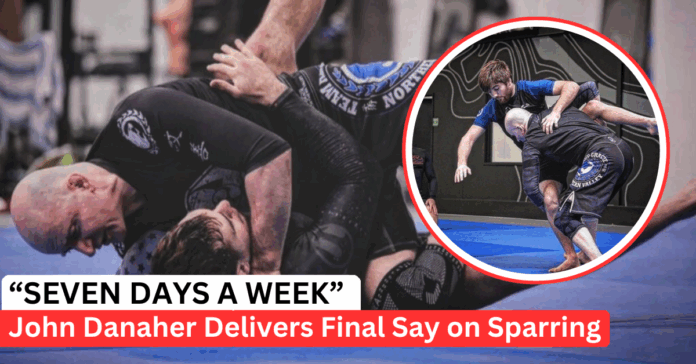
John Danaher Sparring Doctrine: Seven Days A Week Or You’re Pretending

John Danaher Sparring Doctrine: Seven Days A Week Or You’re Pretending
  • John Danaher sparring mantra: only live rounds prove skill.
  • Danaher says he never competed but sparred seven days a week.
  • He insists there’s “no faking” in live rounds—sparring reveals truth instantly.
  • Gordon Ryan’s take on Dagestani grappling dominance in MMA underlines why live resistance wins.

Why ‘John Danaher Sparring’ Became The Proof Standard

In an era obsessed with medals and highlight reels, John Danaher sparring reduces everything to a single, uncomfortable audit: can you do it live?

Danaher is blunt about the credibility question that followed him because he never competed—and just as blunt about how he answered it on the mat.

“I never actually competed, so there was always this credibility question – how do you know he’s any good, having never competed.”
– John Danaher –

The remedy wasn’t a trophy case—it was relentless rounds.

“I would spar with people in class every single day. I used to spar seven days a week and every class I would spar in the classes.”
– John Danaher –

That volume matters. It’s not performative grind; it’s data. Over and over, live rounds force technique to hold up under pressure or break in front of witnesses. That’s why John Danaher sparring resonates beyond fandom: it collapses theory into outcome, quickly.

From Live Rolling To Dagestani Grappling Dominance

It’s easy to chant “train hard.” It’s harder to explain why live resistance at scale flips entire weight classes. Enter Gordon Ryan—whose read on MMA grappling maps perfectly onto Danaher’s thesis.

When he talks about what separates world-class grapplers from “even high-level MMA competitors,” he points to an unforgiving technical gap that only live rolling exposes.

“The level of grappling is just so significant. There’s such a difference in the technical knowledge and application between world-class grapplers and even high-level MMA competitors who haven’t dedicated the same focused attention to ground fighting.”
– Gordon Ryan –

And then there’s the cultural X-factor behind Dagestani grappling dominance: a mindset that prizes the art, not just beating the art.

“[Those who] love jiu-jitsu… [are] far more successful [in MMA] than those who want to ‘beat jiu-jitsu.’ ”
– Gordon Ryan –

Technical superiority plus ruthless consistency produces a vicious math. The better grappler dictates pace while the other guy drowns.

“Their work rate is always three, four, five times as high as mine. Most guys, even at the highest levels, like if you give them the reason to quit, they’ll quit.”
– Gordon Ryan –

When a room is built on John Danaher sparring—rounds, rounds, and more rounds—those mental and technical edges aren’t slogans; they’re measured differences that show up as takedown chains, control rides, mat returns, and finishes under the lights.

BJJ Training Without Alibis

There’s a reason the phrase John Danaher sparring trends every time the sport argues about what “proficiency” means. Drills refine; live rounds define.

Danaher’s seven-days-a-week stretch wasn’t bragging—it was a dare. If skill is real, it survives contact with someone who’s trying to stop you. If it wilts, the belt ranking and gym myths don’t matter.

“There’s a clear sense where when you spar with someone – you can immediately judge their skill level… there’s no faking when you’re sparring… sparring is the clearest means by which you can demonstrate skill level.”
– John Danaher –

So the question isn’t whether competition matters—it does. The question is whether you can replicate your A-game when the other person is actively tearing it down.

In Danaher’s world, the answer lives in the room, not the bio. That’s why his students and admirers cling to the proof standard: John Danaher sparring turns BJJ training into an honesty machine.
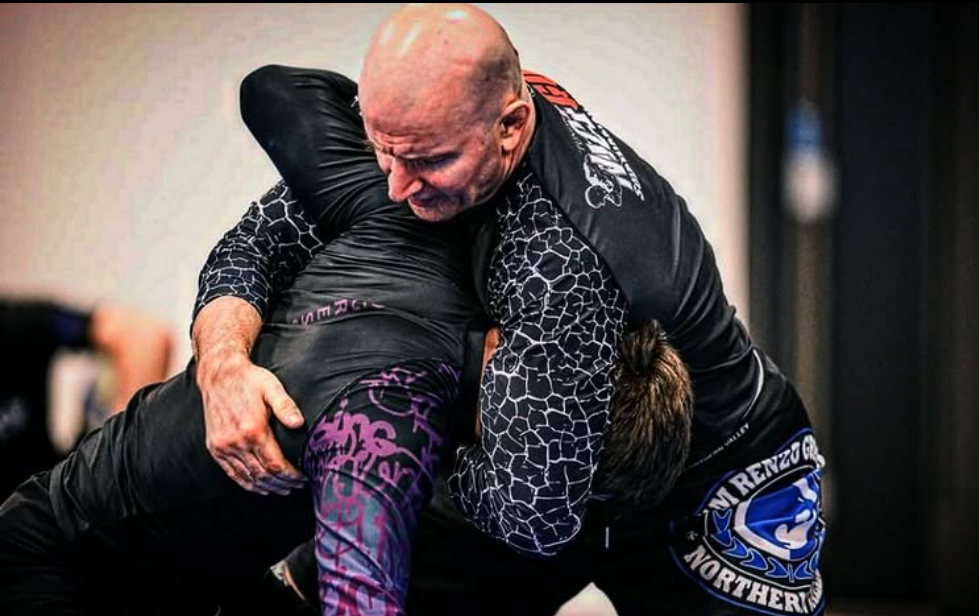
John Danaher Sparring Doctrine: Seven Days A Week Or You’re Pretending

Last Round, Best Round: Put It On The Line

Strip away the romance and this is the sport’s lie detector. When the cage door closes or the gym timer starts, John Danaher sparring is either baked into your game or it isn’t—and the result is merciless.

Ryan’s read on Dagestani grappling dominance isn’t mystical; it’s the inevitable outcome of thousands of hard, resisting reps where technique and mindset are stress-tested daily. If you want the payoff, you have to pay the price where it counts: live rounds.

The verdict is sensational precisely because it’s simple: if your jiu-jitsu can’t cash out against resistance today, it won’t cash out on fight night. And that’s why the final word belongs to the mats. John Danaher sparring isn’t a slogan—it’s the sport’s closing argument.


Gable Steveson Dive Claim Blows Up After CJI 2—And Craig Jones Fires Back

Gable Steveson Dive Claim Blows Up CJI 2—And Craig Jones Fires Back
  • On Ariel Helwani’s show, the Gable Steveson dive claim alleges Craig Jones floated a “work” before their scrapped CJI 2 superfight.
  • Steveson cites “funky stipulations,” turf toe, and says he kept quiet—until now.
  • Jones claps back on Instagram, mocking the logic and dredging up Steveson’s past legal issues.
  • The feud now overshadows CJI 2’s already-tense aftermath and raises match-fixing alarm bells across grappling.

Inside The Gable Steveson Dive Claim

The Gable Steveson dive claim landed like a grenade in the middle of an already chaotic CJI 2 postmortem.

Speaking with Ariel Helwani, the Olympic champion alleged Jones floated the idea of a “work” ahead of their marquee match—one that never happened after Steveson withdrew with turf toe in late August.

He says he kept his head down at first, even while Jones taunted him publicly, but he wasn’t done telling his side.

“I’m going to retire after this match. I don’t want to take this loss. Can you do this for me?”
– Gable Steveson –

Steveson framed it as part of a string of “funky stipulations,” insisting he wanted an “exciting match” and not an exhibition with a pre-written ending. He also jabbed at Jones’ résumé—pointing at losses to Gordon Ryan—and defended his silence after pulling out: “I stayed quiet because I’m a man.”

The Gable Steveson dive claim now sits at the center of a perfect storm: a hyped superfight canceled late, an injury that fans questioned, and a promotion already under the microscope.

Craig Jones Response, Receipts, And The CJI 2 Backdrop

If Steveson poured gasoline, the Craig Jones response struck a match. Jones posted a black-screen note on Instagram and went straight for the logic of the accusation, poking the “work” narrative and reviving Steveson’s off-mat controversies to demolish his credibility.

“So you agreed to a ‘work’? But then got injured and had to pull out of a work. Make that make sense for me?”
– Craig Jones –

Jones’ rebuttal lands at a volatile moment for CJI 2. The event’s $1 million team final already ignited weeks of debate, accusations of bias, and even a now-rescinded promise to pay the runners-up.

Into that noise drops the Gable Steveson dive claim, transforming a canceled main event into something much uglier: a public match-fixing allegation. And it’s not just Jones’ reputation on the line. Promoters, sponsors, and athletes who bet their brand on CJI’s legitimacy are now tied to the fallout.

This is why Jones’ tone is so pointed: if fans believe the “dive” story, it stains the whole enterprise. If they don’t, Steveson looks like a sore no-show whose turf toe became a pretext. Either way, the Gable Steveson dive claim has hijacked the post-event storyline.

What The Timeline Tells Us—And Why The Optics Are Brutal

The timeline is combustible. Steveson exits CJI 2 with a turf toe injury; days later, he wins his pro-MMA debut in 98 seconds at LFA 217. In a news cycle shaped by clips more than context, that juxtaposition is devastating.

Jones capitalizes, framing the injury as convenient and the “work” accusation as incoherent. Steveson, meanwhile, suggests he tried to preserve dignity by staying quiet until Jones needled him one time too many.

“I stayed quiet because I’m a man… I’m not gonna go out there and speak bad about somebody… Maybe he doesn’t because he hasn’t accomplished anything in his field.”
– Gable Steveson –

Strip away the rhetoric and you’re left with two hard facts: the match never happened, and the allegation did.

That’s enough to trigger existential questions for modern grappling, which is fighting to scale into mainstream sports without importing pro-wrestling’s staged-finish stigma. The Gable Steveson dive claim doesn’t just bruise egos; it dents consumer trust at the exact moment elite jiu-jitsu is selling itself as sport, not spectacle.

Aftershocks: Who Wins This PR War, And What’s Next?

In the near term, Jones wins the volume war—screenshots, one-liners, and a feed full of Craig Jones response posts that travel fast. Steveson’s counterpunch is the nuclear allegation itself, and he knows it.

If he sticks to MMA, he can let highlight reels drown out the blowback. Jones, as promoter-in-chief, must keep CJI’s credibility airtight; any whiff of prearranged outcomes is poison. That’s why this isn’t just a spat; it’s a test case.

If the claim fizzles, Jones emerges harder to rattle and CJI 2’s turbulence recedes. If the Gable Steveson dive claim continues to dominate headlines, sponsors and athletes will ask uncomfortable questions about safeguards and transparency.

For now, both men are dug in—and grappling’s reputation is the rope in the tug-of-war.

Gordon Ryan Black Belt Standards Are Through The Roof, Claims Gi Is Less Fun

Gordon Ryan Black Belt Standards Are Through The Roof, Claims Gi Is Less Fun
  • Gordon Ryan black belt standards: he says his bar is so high he wouldn’t award himself the rank.
  • He urges hobbyists to care less about promotions and more about skill—“belts are irrelevant.”
  • On uniforms, he argues gi BJJ is less fun and predicts it will fade at the pro level.
  • The remarks came during recent interviews and clips now ricocheting across grappling feeds.

How the Gordon Ryan Black Belt Standards Reframe The Belt

There’s a clear through-line in the latest clips: the label matters less than the level. Ryan describes a personal bar for Gordon Ryan black belt standards that most practitioners—and, by his own metric, even he—don’t hit.

The message lands because it collapses the distance between online belt debates and what actually decides rounds: timing, mechanics, and problem-solving.

“My standard for a black belt is so unrealistically high that I don’t even have a black belt.”
– Gordon Ryan –

The emphasis is pragmatic. In his view, belts are a lagging indicator; live skill is the leading one.

He also distinguishes between “gym black belts,” who are excellent in their rooms, and the rarer “world-stage” black belts who produce results against elite opposition on demand.

Taken together, it’s a rubric designed to steer attention toward performance outcomes and away from time-in-grade. For anyone tracking the discourse, this is the sharpest articulation yet of Gordon Ryan black belt standards as a skill-first yardstick.

Gordon Ryan Black Belt Standards Are Through The Roof

“Belts Are Irrelevant” — Skill Over Stripes

Ryan’s broadside at rank lore is blunt and built for the algorithm. He argues that the ladder (white to black) is a poor proxy for ability when training volume, partners, and coaching vary wildly.

The claim pairs with his long-standing view that aggressive, well-coached lower belts can—and do—disrupt higher belts in live rounds when the positions and pacing favor them.

“The belts are irrelevant… just focus on getting better at jiu-jitsu.”
– Gordon Ryan –

Under that lens, Gordon Ryan black belt standards become less about time served and more about reproducible outcomes. His advice reframes promotions as a byproduct rather than a target: if the rounds are getting easier against better people, the rank will catch up. If not, the belt color won’t rescue the result.

Gi BJJ Is Less Fun — And On The Clock

The uniform debate is where philosophy meets preference. Ryan says gi BJJ is less fun for him, and he’s unapologetic about training where motivation—and legacy—are highest. He’s also bullish that professional grappling’s center of gravity is shifting away from the gi, a forecast that dovetails with his own No-Gi focus.

“It’s just not as fun for me to train in the Gi. The Gi is pretty much going to be phased out.”
– Gordon Ryan –

To his followers, the takeaway is straightforward: choose the environment that keeps you showing up and improving. The garments and the stripes matter less than the hours of quality work banked over months and years.

The prediction about the Gi’s future may be provocative, but it sits on the same foundation—prioritize the settings that produce skill you can prove, not symbols you can photograph.

Where The Bar Lands Now

Strip the headlines down, and what remains is a checklist: if Gordon Ryan black belt standards are the yardstick, the belt is a milestone, not a guarantee; the Gi is optional if it doesn’t serve the goal; and the only metric that travels is performance.

That framework isn’t only for elite rooms. It scales to busy hobbyists: build a small set of positions you can re-enter under fatigue, measure progress against partners who challenge you, and let promotions arrive as a consequence of consistent results.

If the standards feel “unrealistically high,” that’s the point—they’re meant to drag expectations toward what wins, not what trends.

Roger Gracie on Training Tom Hardy: Champion Simplicity Meets Celebrity Grind

Roger Gracie on Training Tom Hardy: Champion Simplicity Meets Celebrity Grind
  • Roger Gracie on training Tom Hardy is the rare celeb–coach pairing that leans on fundamentals, not flash.
  • The timing rides alongside a Roger Gracie book launch, pushing method over mystique.
  • Hardy’s public mat time keeps celebrity BJJ from feeling like a stunt.
  • Expect structure, discipline, and behind-the-scenes mat work scaled to a film schedule.

Why Roger Gracie on Training Tom Hardy Has People Talking

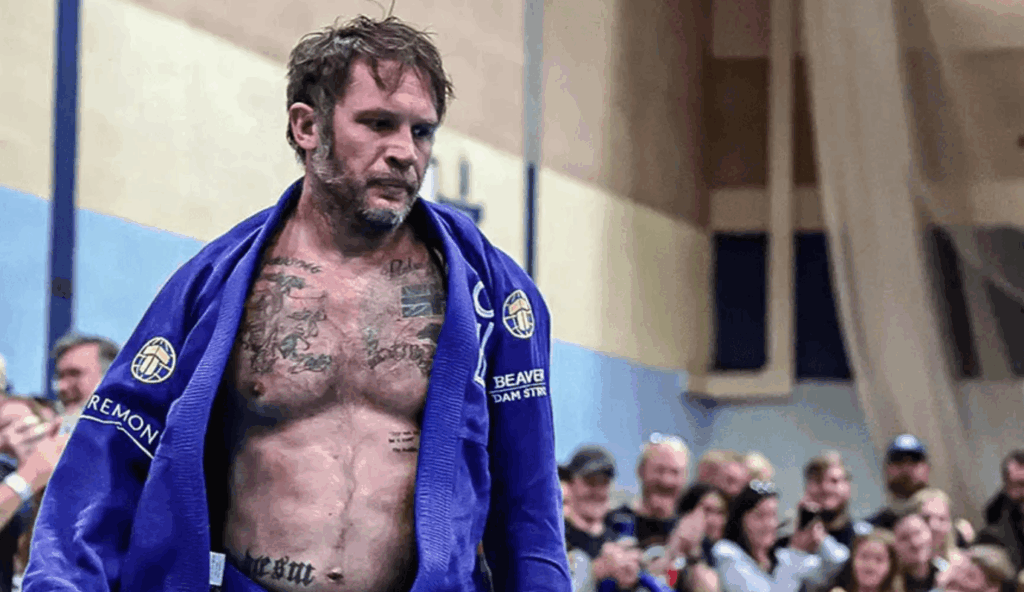
The headline isn’t just that a movie star rolls; it’s that Roger Gracie on training Tom Hardy frames the work like any other serious program. Gracie discussed the collaboration in the run-up to his book—less sizzle, more process—and why that resonates beyond BJJ diehards.

Roger is routinely described as one of the sport’s all-time greats, so attaching his methodology to a household name makes the story travel. Hardy’s visibility spikes the reach; Gracie’s standards give it weight.

That combination is why a typical “celebrity BJJ” post suddenly reads like a legitimate training blueprint, not a set-piece for social media.

Roger Gracie Tom Hardy BJJ

Inside The Sessions: Fundamentals Over Flash

Strip away the spotlight and the training pillars look familiar: posture, frames, pressure, and a steady drilling cadence that holds up when life intervenes.

When you look at Roger Gracie on training Tom Hardy, the structure matters more than the novelty. It’s built so an A-list schedule can pause and resume without diluting fundamentals, with sessions that chase reliability instead of highlight reels.

That is precisely how top-room BJJ scales to non-professionals—fewer exotic sequences, more repeatable mechanics—so conditioning and timing don’t collapse when the calendar gets messy.

Hardy’s own posts and appearances reinforce that this isn’t cosplay; it’s skill-building that shows up on real mats, done quietly until the launch window opens.

The Book Hook And Why It Fits

There’s smart timing at play. A Roger Gracie book landing while he’s discussing Tom Hardy Jiu-Jitsu training turns attention into context: readers see how the principles on the page map onto a famous student’s actual schedule.

Newcomers peeking in through Hardy might witness this as the gateway—practical, no-nonsense coaching that explains why basics outperform trick-chasing over time.

The story works because it’s concrete: short, disciplined sessions; a repeatable framework; and a public case study that makes the method legible to casual fans who might otherwise assume BJJ excellence is all athleticism and chaos.

What “Celebrity BJJ” Looks Like When It’s Done For Real

Most star-powered training posts evaporate after the upload. The story of Roger Gracie on training Tom Hardy has staying power because the inputs are credible and consistently visible.

The interview Roger gave underscores the continuity—Hardy turning up in the room, re-upping time on the mats, keeping the repetitions alive.

Translate that into outcomes, and it’s simple: better positional awareness, cleaner transitions, and fewer energy-wasting scrambles when stakes rise.

That’s the point of behind-the-scenes mat work: it’s quiet until it isn’t, and when the moment arrives—on set, on a charity stage, or at an open mat—the basics hold.

Roger Gracie on Training Tom Hardy

Grappling Energy on the Red Carpet

The lasting takeaway is straightforward. Roger Gracie on training Tom Hardy shows how elite BJJ principles can be taught to busy humans without turning into content cosplay. For fans, it’s a nudge to chase fundamentals; for beginners, proof that useful training can fit around life and still move the needle; for coaches, a reminder that method beats mystique.

However long the book cycle runs or the posts trend, the message outlives the moment: keep it simple, keep it honest, and stack good sessions until the results are boringly dependable. That’s the play—even when the student is Tom Hardy.

Álvaro Borges Neto Becomes First Male BJJ Black Belt With Down Syndrome

Álvaro Borges Neto Becomes First Male BJJ Black Belt With Down Syndrome
  • A Brazilian para-jiu-jitsu standout earned a BJJ black belt with Down syndrome after nearly a decade of training in Salvador.
  • The athlete’s path includes national and Pan-American para-jiu-jitsu competition results and a charity exhibition with UFC heavyweight Jaílton Almeida.
  • Accuracy matters: the first-ever athlete with Down syndrome to earn a BJJ black belt was Rachel Burns in Spokane (2024); this new belt marks the first male to do so.
  • The ceremony unfolded publicly in Salvador, Brazil, underscoring how inclusive development can be built on long, verifiable work.

How A BJJ Black Belt With Down Syndrome Reached The Milestone

The headline moment didn’t arrive overnight. Álvaro Borges Neto (28) trained for close to a decade in Salvador, Brazil, progressing through the ranks under an established coach and competing in para-jiu-jitsu events along the way.

That track record matters: a BJJ black belt with Down syndrome carries weight precisely because it was earned through routine sessions, local tournaments, and structured advancement, not a viral shortcut.

The public ceremony—held at a soccer field in Salvador’s Federação neighborhood—capped a years-long run of mat time that included regional appearances and continental events. The combination of a documented training history and a transparent promotion setting is the foundation of this news, not an afterthought.

Para Jiu-Jitsu Résumé That Stands On Its Own

Before the belt presentation, Álvaro Borges Neto had already built a résumé that traveled beyond the home gym.

Highlights include participation at Brazil’s inaugural national para-jiu-jitsu championship in 2023 and the first Pan-American para-jiu-jitsu championship in 2024, plus a steady cadence of local and state-level competition.

Those stops weren’t trophy-hunting exercises—they were checkpoints that demonstrated pace, pressure management, and positional competence against a broad range of opponents.

Layered on top were showcase rounds with his longtime coach and a widely viewed charity Jailton Almeida exhibition that introduced him to a non-grappling audience. Seen together, the pieces tell a straight story: years of verified training and competition culminating in a black belt earned the ordinary way—slowly.

Spokane Was First—This One Is The First Male

Early headlines around the Brazilian ceremony risked blurring a crucial detail: the first-ever Down syndrome BJJ black belt belongs to Rachel Burns of Spokane, Washington, awarded on October 26, 2024.

Today’s news of Álvaro Borges Neto’s promotion celebrates a different—but equally clear—milestone: the first male athlete with Down syndrome to reach black belt. Being precise about this distinction doesn’t dampen the achievement; it elevates it.

Clean record-keeping gives both stories their due, prevents future confusion, and sets an example for how para-jiu-jitsu milestones should be reported when multiple “firsts” arrive in quick succession.

From Salvador’s Mats To A Wider Stage

Local roots shaped the entire journey. The training base in Salvador, Brazil provided structure and accountability; the para-jiu-jitsu circuit offered stress tests that forced improvement; and the charity spotlight—a playful, good-faith run with Jaílton Almeida—introduced the athlete to viewers who might never have watched a grappling match otherwise.

Crucially, none of those moments replaced the weekly grind. They amplified it. That’s why the promotion resonated across clubs and timelines: it showcased a BJJ black belt with Down syndrome whose skill set was built in public, under standard conditions, with the same expectations applied to every athlete on the mat.

Álvaro Borges Neto  First Male BJJ Black Belt With Down Syndrome

No Limits to Brazilian Jiu-Jitsu

This is the template worth repeating. A BJJ black belt with Down syndrome gains the most meaning when the reporting is accurate (Spokane’s first-ever is acknowledged), the pathway is documented (nearly ten years, specific competitions, identifiable coaching), and the celebration follows from the facts.

The win for para-jiu-jitsu is twofold: one story corrects the record, and the other shows exactly how an athlete—and a community—can build toward a belt that stands up to scrutiny.

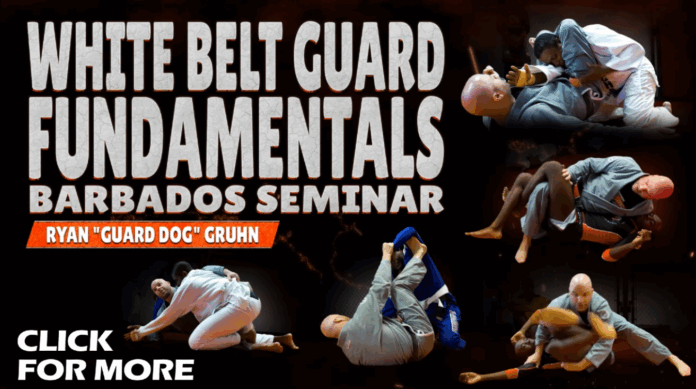
White Belt Guard Fundamentals Ryan Gruhn DVD Review [2025]

White Belt Guard Fundamentals Ryan Gruhn DVD Review

Key Takeaways


  • A BJJ instructional aimed at teaching white belts how to play and deal with the closed guard.

  • Delivers no-nonsense, super-basic options to stay in guard, sweep, and submit, along with the context needed to build a game.

  • Covers passing as well, along with some escaping scenarios involving the mount, and features great drill ideas.

  • BJJ World Expert Rating: 9.5 out of 10.
You’ll hear people talk about the closed guard when you start BJJ. Chances are, you already know what it is because you’ve seen your fair share of UFC fights.

Good start. Once it’s your turn to play the position, though, you’ll quickly find out that pay-per-view doesn’t do the guard, and what it is all about, justice. You’ll never call another grappling-heavy UFC match boring again.

If you want to master it, then be ready to dedicate years and lots of suffering to that goal. It is not unattainable, though, and resources like the White Belt Guard Fundamentals Ryan Gruhn DVD can help greatly to cut that time down significantly. 

WHITE BELT GUARD FUNDAMENTALS RYAN GRUHN DVD GET HERE

White Belt Guard Fundamentals Ryan Gruhn DVD pReview
FULL TRAILER HERE: White Belt Guard Fundamentals Ryan Gruhn DVD

BJJ Starts and Ends with the Guard

If BJJ didn’t have the guard, it would be a weird amalgamation of Judo and wrestling. If there is one thing that sets Brazilian Jiu-Jitsu apart from other grappling martial arts, it is the guard and all that it introduces to the combat sports game.

Understandably, the area of guard is also the area with the highest number of variations, options, and innovations in all of BJJ. A huge part of the addictive beauty of BJJ is the sheer number of options that stem from the opportunity to be offensive while lying with your back to the ground.

This entire story started with the closed guard, which the Gracies took to a whole new level and managed to market to the rest of the martial arts community. This is the one position that you see over and over again, in every gym, in every roll, all around the world.

Just watch any match at any level — you’ll see the closed guard feature, particularly when things get dicey for the bottom player. Even the top modern guard players (I don’t even know what the latest guard craze is) revert to the closed guard when the droppings hit the fan.

The White Belt Guard Fundamentals Ryan Gruhn DVD does the closed guard justice — it paints it as the super reliable position it is for beginners. Moreover, if any non-white-belt decides to give it a shot, I bet they’ll also figure stuff out that they thought only worked at white belt. Go figure.

Ryan ‘Guard Dog’ Gruhn

There is little that Ryan “Guard Dog” Gruhn doesn’t know about martial arts and combat sports. Currently heading the Central PA Mixed Martial Arts gym, he covers striking, grappling, and MMA, as well as specialized women’s kickboxing classes.

The fact that Ryan is an Eric Paulson black belt says a lot about his BJJ — direct, effective, and as close to no mercy as the Gentle Art can get. In other words, his classes and instructionals, such as this Ryan Gruhn Guard for White Belts DVD, are effective and to the point, with zero fluff.

One of Gruhn’s huge accomplishments is founding the Youth Martial Arts system, taught exclusively at his school to kids and youth. It is a mix of everything Ryan has done in his martial arts career, which spans from Filipino Kali and boxing to BJJ and Muay Thai. 

Detailed White Belt Guard Fundamentals Ryan Gruhn DVD Review

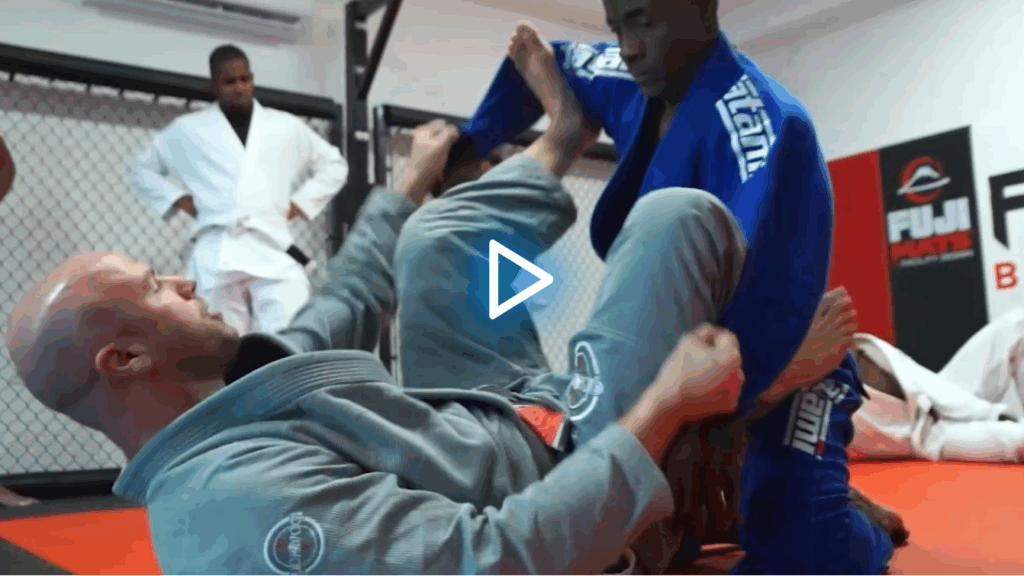
This is a one-volume BJJ DVD — remember, Ryan favors simplicity and directness over anything else. That said, the White Belt Guard Fundamentals Ryan Gruhn DVD delivers just over an hour of top-quality material, mostly demonstrated with the Gi, with some No-Gi options appearing here and there.

Part 1 — Opening the Closed Guard

Ryan sticks to the true basics here, but that just means that this stuff works. White belts, don’t be discouraged if it is hard; stick to it, and I guarantee you’ll still use the same closed guard openings all the way to black belt and beyond.

Gruhn covers both Gi and No-Gi options to open up and pass the closed guard, using simple moves like staple passing. He also offers key drills to stick to, meaning you can measure your progress using his material.

Part 2 — Basic Motions

There’s no white belt instructional DVD in BJJ without some shrimping and bridging, is there? The White Belt Guard Fundamentals Ryan Gruhn DVD is no different, offering key basic movement patterns you’ll find super useful off your back. It also provides motivation to train and safety tips if you decide to try out this stuff unsupervised.

Part 3 — Sweeping

The real action in this White Belt Guard Fundamentals Ryan Gruhn DVD starts halfway through the instructional, when Ryan starts showing sweeps. He uses the closed guard as his main position, but isn’t a complete stickler, throwing in some super useful and intuitive half guard sweeps as well.

The scissor sweep (along with a reverse variation), sit-up sweep, and knee push all feature, topped up with some of Ryan’s own inventions in the area. I particularly enjoyed that he covers the sweep-for-sweep concept as well, bringing context into all the technical demonstrations.

Part 4 — The “Big Three” Submissions 

Wrapping up are the three submissions that, when put together, are the most used finishes in the history of grappling martial arts. Concluding the White Belt Guard Fundamentals Ryan Gruhn DVD in style, Guard Dog offers a slightly unorthodox yet super effective way to tie in the armbar, Omoplata, and triangle together from the Gi closed guard.

The ‘Guard Dog’ Guard Game

There is a beautiful simplicity to the Ryan Gruhn White Belt Guard DVD, which comes down to two main reasons.

First, Ryan picked true fundamental moves that have been proven to work over and over again. They’re not flashy, nor will you catch your black belt instructor in them on day three of training. However, this type of guard game, top and bottom, provides the most stable foundation for building a competitive BJJ game.

Second, Gruhn’s style is direct and no-nonsense, which only makes the already simple fundamentals even easier. He literally strips every move down to bare essentials, only leaving the stuff that will work for everyone after time on the mats and drills.

Let’s not forget to mention his thoughts on rolling etiquette and overall approach to his instructions, which are two things almost no other beginner-oriented BJJ DVD provides. And, if white belts don’t need tons of context, then who does?

DOWNLOAD: WHITE BELT GUARD FUNDAMENTALS RYAN GRUHN DVD

Stick to Guard Newbie! 

No need to look further than the closed guard. Yup, I sound just like your coach, I know. Well, the White Belt Guard Fundamentals Ryan Gruhn DVD is going to tell you the same, so if you’re not already scratching your head thinking “Why does everyone keep talking about the closed guard?” you’ll likely join a Zumba class in the very near future.

Want to avoid that? Pick up the DVD. Follow the instructions. Good luck, newbie!

Judoka Disqualified For Biting — Eurpean Medal On The Line, Match Over

Judoka Disqualified For Biting — Eurpean Medal On The Line, Match Over
  • A European judo event in Skopje ended a bronze-medal bout with a judoka disqualified for biting after video review.
  • The incident involved a Polish athlete and a Spanish opponent; the match was waved off, and the DQ stood.
  • The replay clearly highlighted the bite and triggered a swift video review disqualification.
  • The clip spread rapidly, turning a niche medal match into a headline moment for the Skopje judo tournament.

The Clip Everyone Is Replaying: Judoka Disqualified For Biting

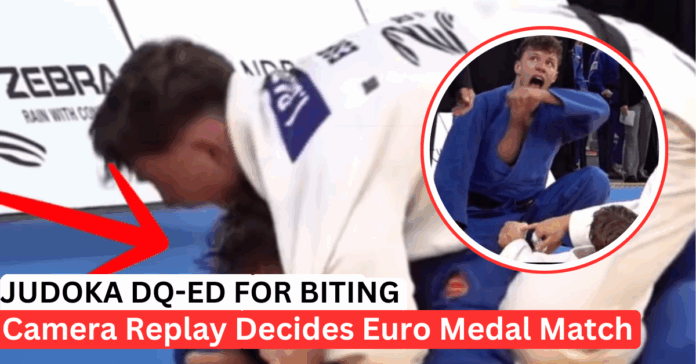
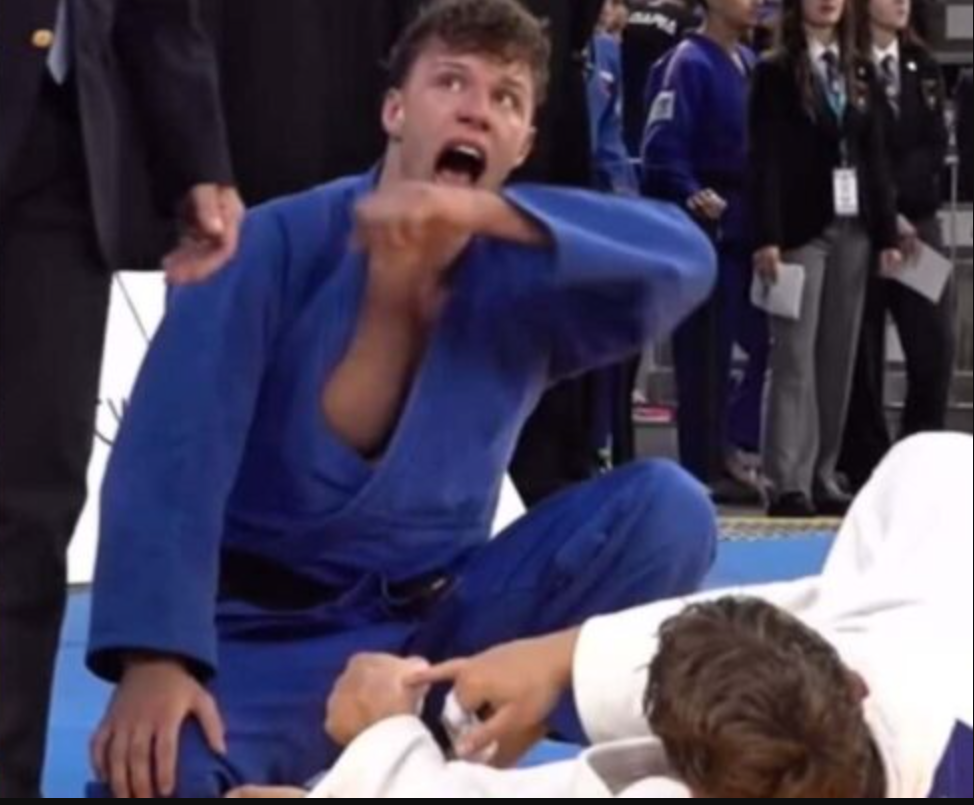
It takes just a few frames for a routine grip battle to cross the line. In a bronze-medal match at a European judo event in Skopje, officials halted action after contact between a Polish athlete and a Spanish opponent led to a judoka disqualified for biting.

The referee team went to the monitors, looked at the sequence, and returned with the decision that ended the bout on the spot. Within hours, the clip ricocheted across social feeds—short, shocking, and unmistakable in slow motion.

Judoka Disqualified For Biting

From Grip Fight To Red Flag: What The Video Review Showed

The sequence begins like countless exchanges: hands fighting for lapels and sleeves, posture breaking, balance checks.

Then the freeze-frame moment arrives. On replay, officials identified a bite during the tangle, and the control table initiated a video review disqualification. In high-level judo, the bar for unsportsmanlike acts is a bright line; biting is an automatic exit.

Once the review team confirmed what the cameras captured, the referee returned, signaled the call, and the bronze-medal match was over—no extra rounds, no second chance, just an abrupt end and a result that leaves no ambiguity.

Bronze-Medal Match At A European Judo Event

Context matters here. This wasn’t an early-round scuffle—it was a bronze-medal match with podium stakes at a European judo event hosted in Skopje. T

he national matchup—Polish vs Spanish judoka—added an extra layer of attention, but the rules application was textbook: confirm the infraction, assign responsibility, and apply the penalty specified by competition regulations. For the Spanish side, the DQ delivered a clean path to the medal.

For the Polish athlete, it turned a winnable opportunity into a viral cautionary tale. The decision also underscored how tournament officiating relies on technology: even when the live angle is crowded by Gis and grips, slow-motion replay can settle the matter in seconds.

Why This One Blew Up Beyond Judo Circles

Plenty of infractions happen out of frame. This one didn’t. The bite is visible in the posted reel, the stoppage is immediate, and the stakes—hardware on the line—are easy for casual viewers to understand.

Add the compact runtime of a vertical clip, and you have the perfect recipe for mass sharing. For the European Junior Championship, that means the highlight package most people saw wasn’t a throw or a slick transition; it was the rare sight of a judoka disqualified for biting at medal time.

That kind of moment travels because it’s both simple and extreme: a bright rule broken in the open, with an outcome that flips a podium spot with a single call.

What Officials Look For In Moments Like This

When referees head to the monitor, they’re not hunting for drama—they’re checking for clear, actionable evidence. In grip-fight scrambles, heads and hands cluster tightly, and angles can mislead.

The advantage of tournament replay is that multiple views can confirm whether contact crossed into prohibited behavior. Here, the standard was met. That’s why the ruling was fast and the restart never came.

The takeaway here is familiar but worth repeating: when the match gets messy, discipline matters more than ever, because the camera will catch what the center referee might miss in real time.

When The Tape Bites Back

Every viral flash leaves an imprint on the event that hosts it. For local organizers, the upside is reach—millions see the tournament tag because of one sensational clip.

As the bracket sheets closed on Skopje, the lasting headline is unavoidably the Polish judoka disqualified for biting, but the institutional message is steadier—technology backs the rulebook, and medal matches will be decided by what the tape shows, not by what anyone insists happened in the blur of a clinch.

Gracie Barra Kicks Out Black Belt For Fraud—And Moves To Cease His Lineage

Gracie Barra Kicks Out Black Belt For Fraud—And Moves To Cease His Lineage
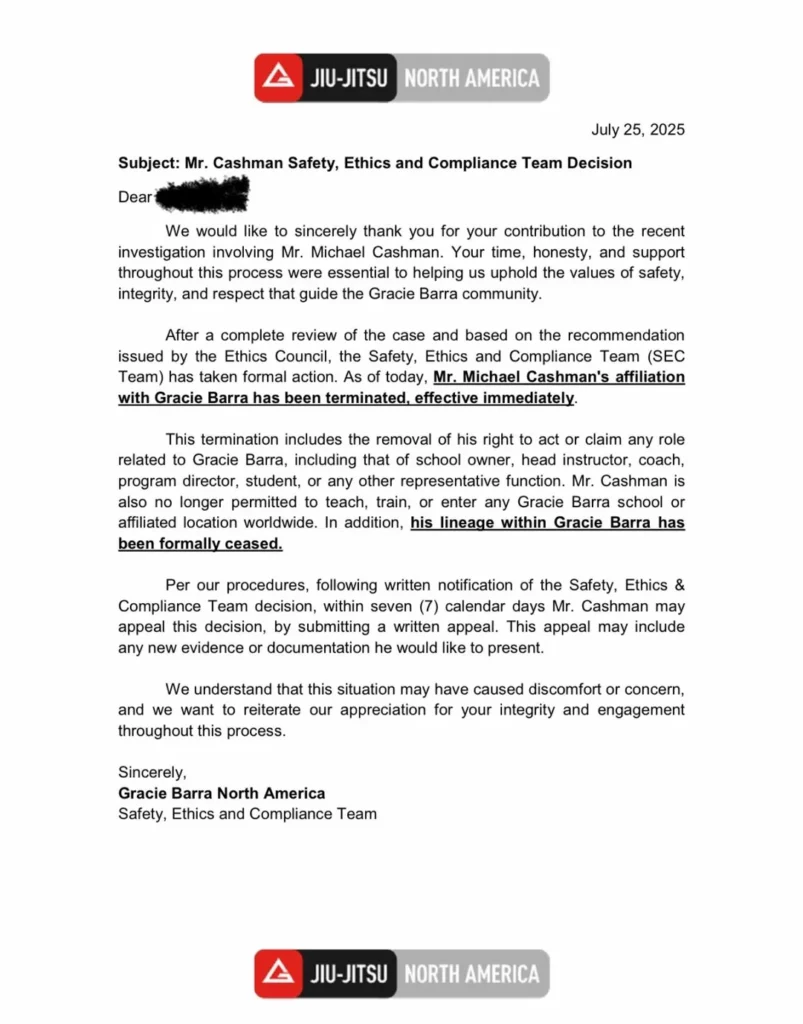
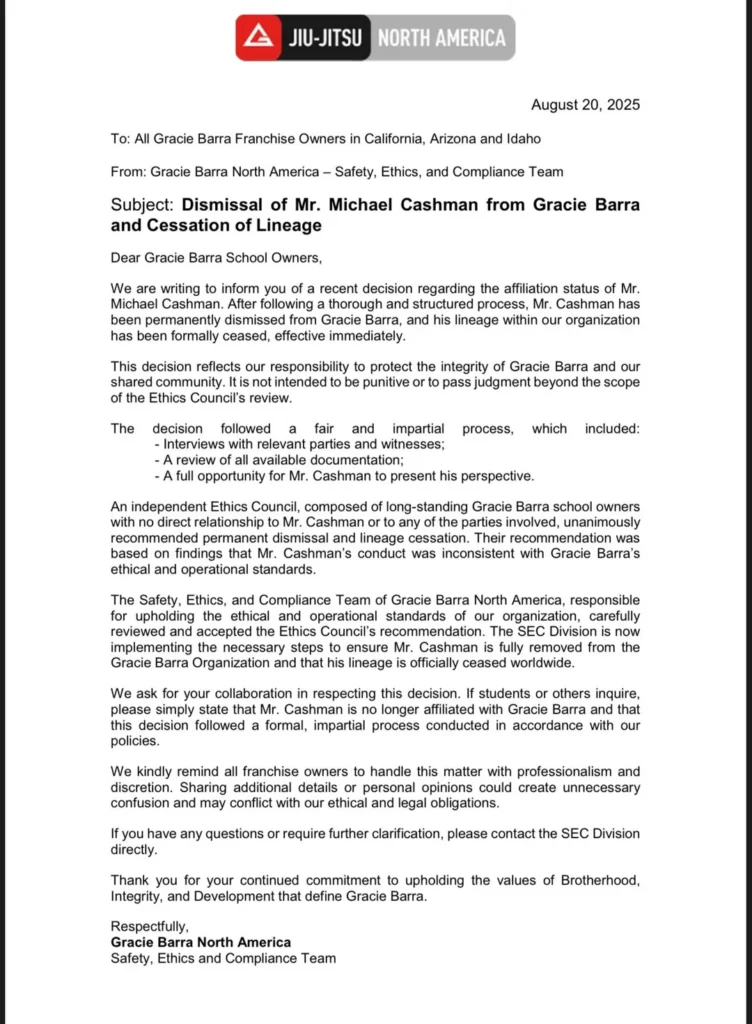
  • Internal memos show Gracie Barra kicks out black belt Michael Cashman and bars him from all GB locations, effective immediately.
  • The letters also state Gracie Barra lineage cessation inside the organization.
  • An internal Safety Ethics and Compliance Team process preceded the decision, including council review and a seven-day appeal window.
  • A franchise owners notice instructs schools how to answer inquiries.

GB Safety Ethics And Compliance Team: The Decision, In Writing

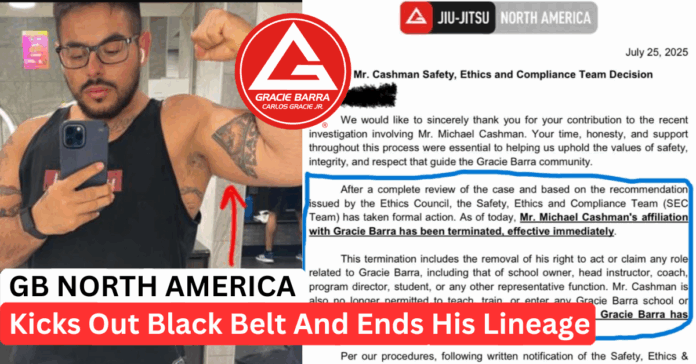
Two official notices from Gracie Barra North America’s Safety Ethics and Compliance Team (SEC) lay out the action in plain terms: affiliation terminated, access revoked, and lineage shut down inside the organization—effective at once.

“Mr. Michael Cashman’s affiliation with Gracie Barra has been terminated, effective immediately.”
– Gracie Barra North America SEC letter, July 25, 2025 –

The follow-up memo confirms the scope is global and adds the internal Gracie Barra lineage cessation.

“Mr. Cashman has been permanently dismissed from Gracie Barra, and his lineage within our organization has been formally ceased, effective immediately.”
– Gracie Barra North America SEC memo, Aug. 20, 2025 –
Gracie Barra Kicks Out Black Belt Michael Cashman For Fraud

Ethics Investigation as Gracie Barra Kicks Out Black Belt

Inside the network, Gracie Barra kicks out black belt doesn’t stop at membership status. It removes facility access, severs internal recognition, and updates rosters and marketing where the instructor’s name or branch appeared.

In a culture where lineage is résumé and identity, the combination of expulsion and Gracie Barra lineage cessation signals a total organizational break rather than a quiet parting.

The August memo describes an ethics investigation culminating in an independent council’s unanimous recommendation. It lists interviews, document review, and an opportunity for the instructor to respond before the decision.

“The decision followed a fair and impartial process… Interviews with relevant parties and witnesses; a review of all available documentation; a full opportunity for Mr. Cashman to present his perspective.”
– Gracie Barra North America SEC memo, Aug. 20, 2025 –

The July letter also sets a seven-day appeal window from written notification.

“Within seven (7) calendar days Mr. Cashman may appeal this decision… This appeal may include any new evidence or documentation he would like to present.”
– Gracie Barra North America SEC letter, July 25, 2025 –

The rationale is framed strictly in policy terms:

“Their recommendation was based on findings that Mr. Cashman’s conduct was inconsistent with Gracie Barra’s ethical and operational standards.”
– Gracie Barra North America SEC memo, Aug. 20, 2025 –

Why Gracie Barra Pulled The Plug

Lineage is the internal family tree that connects students to coaches and mentors. Declaring Gracie Barra lineage cessation for a coach is extraordinary because it affects how current and former students cite their affiliations inside GB.

As Gracie Barra kicks out the black belt over fraud allegations, the messages make clear the brand does not recognize that branch moving forward within its system.

The August memo includes a franchise owners notice to keep messaging consistent across locations: confirm the dismissal, reference the formal process, and avoid editorializing.

“If students or others inquire, please simply state that Mr. Cashman is no longer affiliated with Gracie Barra and that this decision followed a formal, impartial process.”
– Gracie Barra North America SEC memo, Aug. 20, 2025 –

Operationally, that means schedules continue, staff lists are adjusted, and signage or digital materials reflecting prior roles are updated—without local owners adding commentary that could conflict with policy or legal obligations.

Gracie Barra Kicks Out Black Belt And Cuts His Lineage

Gracie Barra Kicks Out Black Belt: Why This Case Stands Out

With the SEC letters in hand, the storyline is documentary, not speculative: Gracie Barra kicks out black belt, enforces a network-wide bar, and initiates Gracie Barra lineage cessation internally.

The memos outline the ethics investigation, the independent review, and the seven-day appeal window—and they give franchisees a uniform script through the franchise owners notice. Until and unless an appeal changes the outcome, the organization is treating the break as complete.

Mackenzie Dern Bodybuilding Ambition: A Candid Podcast Reveal From The UFC Strawweight

Mackenzie Dern Bodybuilding Ambition: A Candid Podcast Reveal From The UFC Strawweight
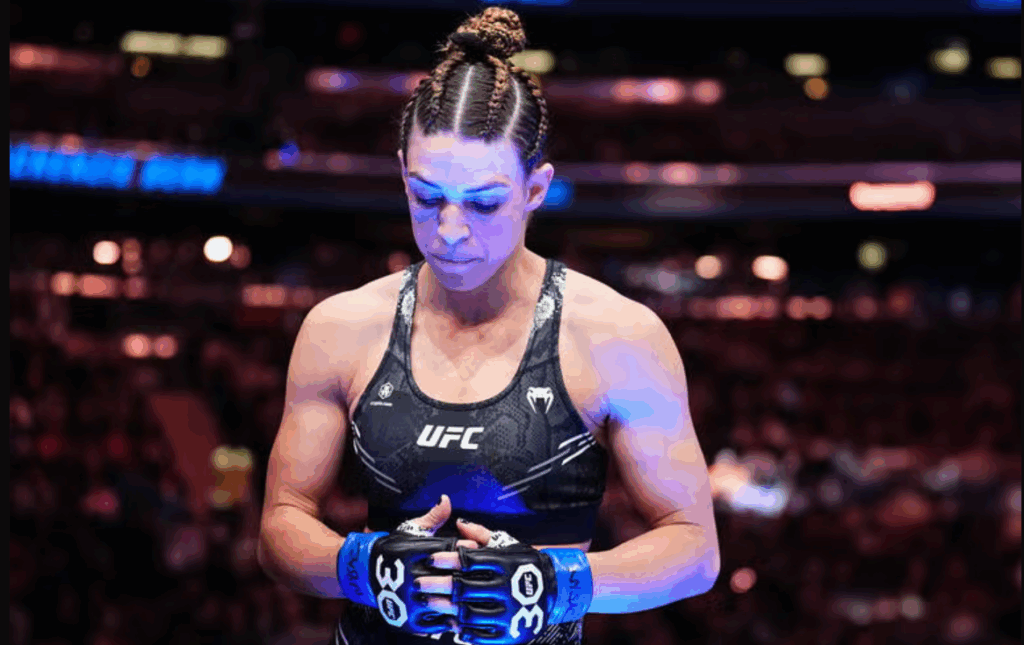
  • Mackenzie Dern bodybuilding plans are for after her MMA career—she’s still an active UFC strawweight.
  • She revealed the idea on the Talk Tuah podcast, describing bodybuilding as a competitive outlet without fight damage.
  • Dern says her current training and nutrition already fit the demands of bodybuilding.
  • No timeline given—Mackenzie Dern bodybuilding talk is about the future, not an immediate switch.

What Sparked The Mackenzie Dern Bodybuilding Talk

On a recent appearance on the Talk Tuah podcast, Mackenzie Dern floated a clear, practical idea for life after fighting: competitive bodybuilding. She emphasized she’s not leaving MMA now—she’s still an active strawweight—but she wants a new arena to channel that competitive drive when the cage door finally closes.

“I would like to go into like bodybuilding like I’m competitive, you know, so I need something to like push myself,”
– Mackenzie Dern, Talk Tuah Podcast –

That line set off a wave of Mackenzie Dern bodybuilding chatter, but the intent was straightforward—this is a post-MMA plan, not a present-tense pivot.

Mackenzie Dern Bodybuilding Ambition After UFC Revealed

Why Bodybuilding Appeals To A Lifelong Competitor

Dern framed the Mackenzie Dern bodybuilding idea as a way to keep score without adding to the mileage she’s accumulated in a decade of high-level combat sports.

Instead of damage, it’s discipline; instead of opponents throwing elbows, it’s judges evaluating symmetry, conditioning, and stage presence.

“It’s still competitive, you know, so you you still need to go up there on on the stage and compete and and test yourself against other people,”
– Mackenzie Dern, Talk Tuah Podcast –

She also explained that bodybuilding gives her a different target: improving on her last look rather than preparing for the next opponent. That’s a meaningful psychological shift for fighters who’ve spent years toggling between camps, weight cuts, and game-plans.

The Base Is Already There: Training, Nutrition, And Routine

One reason the Mackenzie Dern bodybuilding concept makes sense: her current routine already tracks with physique sport fundamentals.

She discussed walking around roughly 20 pounds above her fight weight, leaning on structured meals, and logging heavy time in the weight room—habits that translate neatly into a hypertrophy-focused plan.

“I love to work out, you know, for me like just like lifting weights and you feel the burn,”
– Mackenzie Dern, Talk Tuah Podcast –

Bodybuilding would still demand a new cadence—periodized hypertrophy blocks, meticulous posing practice, and competition-day peaking—but the scaffolding is there.

Mackenzie Dern bodybuilding speculation isn’t about reinventing her athletic life from scratch; it’s an evolution of habits she already owns.

A Fighter’s Competitive Edge, Re-Routed

Fighters often struggle with the “what’s next?” question. Dern’s answer—Mackenzie Dern bodybuilding—suggests she’s thought beyond her next booking.

She talked about documenting the process, potentially building content around training, supplements, and the road to the stage. That’s the rare post-career blueprint that’s both aspirational and executable for a modern athlete with an existing audience.

Crucially, she didn’t frame bodybuilding as a softer lane—only a different one. The grind shifts from sparring rounds to progressive overload; the game-plan shifts from countering punches to perfecting a physique. The competitive engine is the constant.

When The Gloves Come Off, The Spotlight Stays On

Here’s the bottom line: Mackenzie Dern bodybuilding is a future chapter. She hasn’t made the transition and isn’t teasing an imminent departure from the UFC.

She’s identifying a lane that fits her strengths, preserves her health, and keeps the scoreboard on. For now, she remains a UFC strawweight (and Jiu-Jitsu world champion) with fights still ahead—only, when she does close the cage door for good, she already knows where she wants to point that relentless drive next.

And yes, you can expect to keep hearing the phrase Mackenzie Dern bodybuilding as that roadmap matures.

If she follows through, Mackenzie Dern bodybuilding won’t just be a headline—it’ll be the next test for a competitor who has built her career on hard rounds and sharper skills. Same intensity, new arena.

Inside The Rumors: ADCC Match Fixing Allegations From Two Eras Of Grappling

Inside The Rumors: ADCC Match Fixing Allegations From Two Eras Of Grappling
  • Two separate accounts—one from 1999 and one from ADCC 2001—have renewed attention on ADCC match fixing allegations.
  • South African champion Mark Robinson says he was offered $65,000 to lose an ADCC 1999 bout to Sean Alvarez and walked away from the bracket.
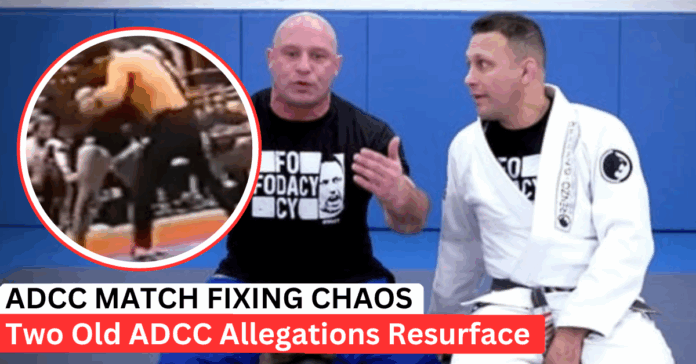
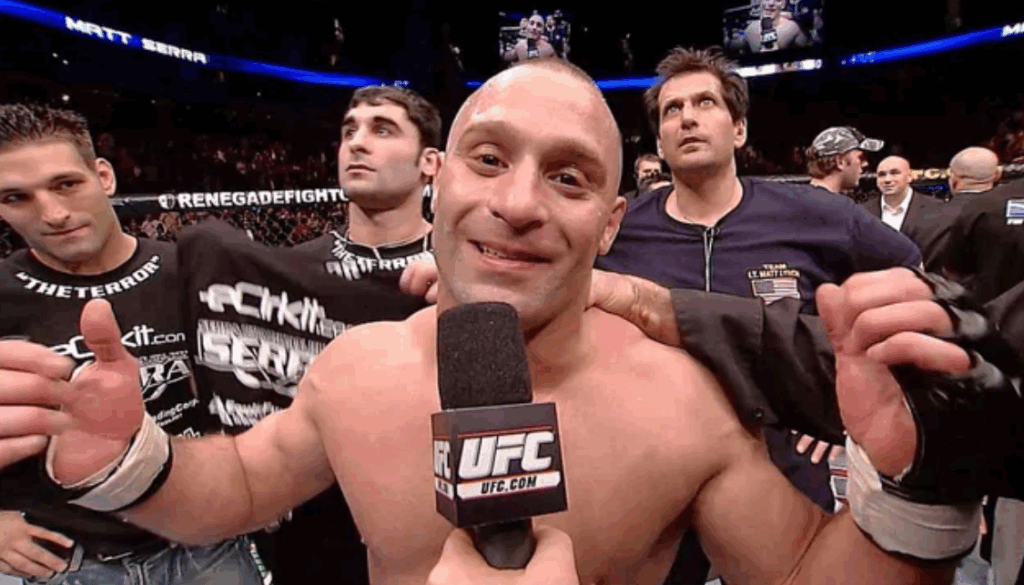
  • Matt Serra says he was told to “take a dive” in the ADCC 2001 -77 kg final against Marcio Feitosa; he forfeited and took silver.
  • The two accounts reignite scrutiny around ADCC match fixing allegatioins and the sport’s uneasy history with behind-the-scenes pressure.

Two Stories, One Shadow Over A Showcase

For a sport that prides itself on meritocracy, few phrases sting like ADCC match fixing allegations. Two accounts—years apart—are driving a new round of soul-searching.

One involves an alleged $65,000 offer in 1999 to throw a bout.

The other centers on ADCC 2001, where Matt Serra has said he was told to take a dive and refused.

Neither episode has resulted in formal findings tied to those editions, yet both persist in the discourse because they challenge the foundational belief that the mats are where truth gets told.

What gives these stories staying power isn’t just the names or the numbers; it’s the reminder that grappling, like any high-stakes arena, has to constantly prove its integrity.

The Matt Serra allegations and the 1999 bribery claim bookend the sport’s transition from niche spectacle to marquee stage. They also underline a simple truth: transparency isn’t a destination—it’s a practice.

Mark Robinson on ADCC Match Fixing

A Veteran Says No: Mark Robinson’s 1999 Walk-Off

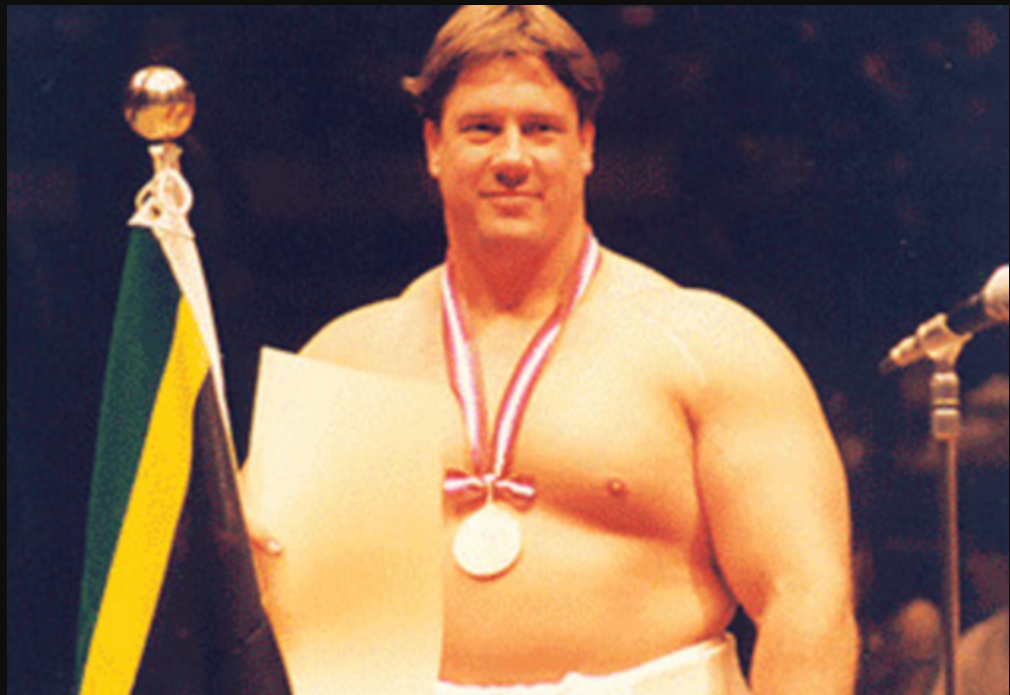
South African grappling great Mark Robinson says his first ADCC run in 1999 derailed the moment a “representative” approached before his scheduled bout with Sean Alvarez.

According to Robinson, the pitch was simple: take the loss, pocket $65,000, and move on. He says he left the warm-up area, furious, and reported it to a liaison—then packed his things and headed back to the hotel.

“One of the Sheikh’s guys came to me and tried to bribe me to lose that fight. Offered me $65,000… This is exactly what happened.”
– Mark Robinson –

What happened next, Robinson claims, only hardened his stance.

“The next morning [the liaison] came to my room with a briefcase with a million dollars in it and said to me ‘here’s $10,000, which is the winning prize money. We’re sorry for what happened.’ … I left, I did not fight.”
– Mark Robinson –

Robinson says the promotion replaced him in the bracket with a previously eliminated athlete. He wouldn’t compete that weekend—choosing to make a stand instead.

The allegation cuts to the core of ADCC match fixing allegations: whether competitive outcomes have ever been steered by influence rather than skill.

From Controversy To Gold: Robinson’s Redemption Arc

Robinson did come back. After returning the following year and again in the early 2000s, he captured the ADCC +99 kg title in 2001, becoming the first—and to date only—South African champion at the world’s most prestigious submission-grappling event.

That achievement sits in sharp relief against his account from 1999, underscoring how his stance against an alleged payoff didn’t derail his career trajectory. If anything, it amplified the legacy: a veteran who refused a back-room deal and still climbed to the top.

“Take The Dive”: Matt Serra On The 2001 Final

The second allegation is from a name familiar to every MMA fan: Matt Serra.

The future UFC champion has said that, ahead of the ADCC 2001 -77 kg final versus Marcio Feitosa, he was instructed by his mentor Renzo Gracie to “take a dive.”

Serra ultimately forfeited—Feitosa took gold, and Serra accepted silver.

“He told me to take a dive.”
– Matt Serra –

Serra’s account revives an older, uncomfortable conversation about intra-team dynamics, unwritten hierarchies, and the line between gym loyalty and competitive integrity.

In a sport that prides itself on meritocracy, the idea that a finalist could be asked to stand down—regardless of the reasons—lands with force. It also adds another modern layer to ongoing media and community scrutiny around ADCC match fixing allegations.

ADCC Match Fixing Allegations

Why ADCC Match Fixing Allegations Still Land Today

Modern ADCC looks nothing like the turn-of-the-century circuit. The show is a stadium-filling, globally streamed event with deep media coverage, greater referee standardization, and a talent pipeline that runs year-round. That evolution raises the bar for credibility.

At the same time, bigger money and visibility can amplify pressure points. That’s why ADCC match fixing allegations—old or new—still punch through.

Three dynamics keep the topic alive:

  • Historical Ambiguity: Early tournaments didn’t benefit from today’s ubiquitous cameras or digital record-keeping, leaving some stories unresolvable.
  • Personality-Driven Narratives: When respected names recall sensitive moments, the discourse doesn’t fade—it multiplies.
  • Guardrails vs. Gray Areas: Invitations, brackets, and matchmaking are cleaner now, but transparency around criteria and oversight will always be scrutinized in a prestige event.

The pragmatic takeaway isn’t to litigate the past by rumor; it’s to recognize that the best antidote to suspicion is radical clarity—clear selection processes, documented rules, and consistent officiating.

That’s how you inoculate a brand against doubts that linger from ADCC 2001 or the 1999 bribery claim.

The Sport Moves Forward Only If It Confronts Its Myths

Every fast-growing sport inherits messy origin stories. Grappling is no different. The way to honor the present is not to pretend the past didn’t happen—it’s to build systems that make repetition impossible.

Whether you believe every detail or not, the renewed spotlight on ADCC match fixing allegations should motivate organizers and athletes alike to prioritize sunlight over whispers, documentation over anecdotes, and accountability over assumptions.