






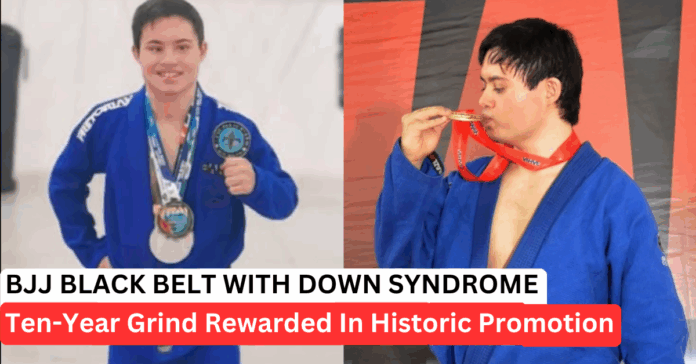

- A Brazilian para-jiu-jitsu standout earned a BJJ black belt with Down syndrome after nearly a decade of training in Salvador.
- The athlete’s path includes national and Pan-American para-jiu-jitsu competition results and a charity exhibition with UFC heavyweight Jaílton Almeida.
- Accuracy matters: the first-ever athlete with Down syndrome to earn a BJJ black belt was Rachel Burns in Spokane (2024); this new belt marks the first male to do so.
- The ceremony unfolded publicly in Salvador, Brazil, underscoring how inclusive development can be built on long, verifiable work.
How A BJJ Black Belt With Down Syndrome Reached The Milestone
The headline moment didn’t arrive overnight. Álvaro Borges Neto (28) trained for close to a decade in Salvador, Brazil, progressing through the ranks under an established coach and competing in para-jiu-jitsu events along the way.
That track record matters: a BJJ black belt with Down syndrome carries weight precisely because it was earned through routine sessions, local tournaments, and structured advancement, not a viral shortcut.
The public ceremony—held at a soccer field in Salvador’s Federação neighborhood—capped a years-long run of mat time that included regional appearances and continental events. The combination of a documented training history and a transparent promotion setting is the foundation of this news, not an afterthought.
Para Jiu-Jitsu Résumé That Stands On Its Own
Before the belt presentation, Álvaro Borges Neto had already built a résumé that traveled beyond the home gym.
Highlights include participation at Brazil’s inaugural national para-jiu-jitsu championship in 2023 and the first Pan-American para-jiu-jitsu championship in 2024, plus a steady cadence of local and state-level competition.

Those stops weren’t trophy-hunting exercises—they were checkpoints that demonstrated pace, pressure management, and positional competence against a broad range of opponents.
Layered on top were showcase rounds with his longtime coach and a widely viewed charity Jailton Almeida exhibition that introduced him to a non-grappling audience. Seen together, the pieces tell a straight story: years of verified training and competition culminating in a black belt earned the ordinary way—slowly.
Spokane Was First—This One Is The First Male
Early headlines around the Brazilian ceremony risked blurring a crucial detail: the first-ever Down syndrome BJJ black belt belongs to Rachel Burns of Spokane, Washington, awarded on October 26, 2024.

Today’s news of Álvaro Borges Neto’s promotion celebrates a different—but equally clear—milestone: the first male athlete with Down syndrome to reach black belt. Being precise about this distinction doesn’t dampen the achievement; it elevates it.
Clean record-keeping gives both stories their due, prevents future confusion, and sets an example for how para-jiu-jitsu milestones should be reported when multiple “firsts” arrive in quick succession.
From Salvador’s Mats To A Wider Stage
Local roots shaped the entire journey. The training base in Salvador, Brazil provided structure and accountability; the para-jiu-jitsu circuit offered stress tests that forced improvement; and the charity spotlight—a playful, good-faith run with Jaílton Almeida—introduced the athlete to viewers who might never have watched a grappling match otherwise.
Crucially, none of those moments replaced the weekly grind. They amplified it. That’s why the promotion resonated across clubs and timelines: it showcased a BJJ black belt with Down syndrome whose skill set was built in public, under standard conditions, with the same expectations applied to every athlete on the mat.

No Limits to Brazilian Jiu-Jitsu
This is the template worth repeating. A BJJ black belt with Down syndrome gains the most meaning when the reporting is accurate (Spokane’s first-ever is acknowledged), the pathway is documented (nearly ten years, specific competitions, identifiable coaching), and the celebration follows from the facts.
The win for para-jiu-jitsu is twofold: one story corrects the record, and the other shows exactly how an athlete—and a community—can build toward a belt that stands up to scrutiny.