




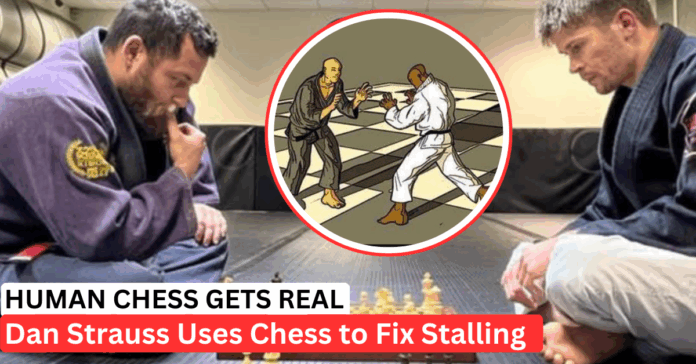

- Chess grappling is Dan Strauss’s new hybrid sport that uses chess performance to determine starting positions in grappling rounds.
- The rules reward strategic board play: material advantage on the chessboard gives a dominant position on the mat, while losses leave you defending in mount or back control.
- The format features nine rounds—five of chess and four of grappling—with victory coming by checkmate, submission, clock forfeit or points.
- Strauss, a black belt under Roger Gracie, has open‑sourced the rules and encourages practitioners worldwide to try chess grappling.
- The broader lesson: BJJ athletes can draw from chess tactics such as gambits, forks and pins to sharpen their mat strategy.
Beyond Human Chess: Why the Mat is Ripe for a New Game
For decades, coaches have compared Brazilian Jiu‑Jitsu to chess. The analogy is compelling—both disciplines reward patience, position and thinking several moves ahead—but it has its limits.
Chess is turn‑based and bound by strict movement patterns, while grappling is a living scramble where speed, strength, and pressure matter as much as calculus. Yet the metaphor persists because it captures the sport’s cerebral side.
When black‑belt coach and competitor Dan Strauss looked at that comparison, he saw an opportunity to go beyond metaphor and create a competition that literally stitches the games together. His answer is chess grappling, and it’s capturing imaginations because it forces grapplers to respect both board and mat.
The concept emerges at a time when hybrid formats are booming. Chessboxing has existed since 2003, alternating chess rounds with boxing rounds, but the punches and pawns never really interacted.
Strauss, who has fought on some of the world’s biggest grappling stages and taught at more than 250 gyms, wanted to fix that disconnect. In his words, the original hybrid format treated each discipline as separate:

“My issue with the chessboxing ruleset was that the chess and boxing were very separate, one didn’t affect the other,”
– Dan Strauss –
Having spent years coaching and competing, he understood that mental effort and physical engagement can and should influence each other. His innovation: make chess mistakes cost you on the mat, and make grappling dominance feed into your board strategy.
That simple idea unlocks strategic depth missing from the human‑chess cliché and invites casual fans to think about Jiu‑Jitsu through a fresh lens.
From Chess Boxing to Chess Grappling
Strauss’s ruleset is precise, and the key details are easy to digest when listed clearly:

- Ten‑minute chess clock for each player, with the game continuing across all chess rounds.
- Nine rounds – five blitz‐style chess rounds (four minutes each) and four grappling rounds (two minutes each), totalling about twenty‑eight minutes.
- Coin toss for White – a single flip decides who takes the first move; a checkmate ends the match on the spot.
- Submissions end grappling rounds – tap at any time, and it’s over.
- No checkmate or submission? The match is decided by time forfeit on the chess clock or by IBJJF points.
- Position ties into the board – round one begins standing; from round two onwards, whoever has a material advantage starts in a more dominant position (side control, then mount, then back control).
- Material matters – losing pieces puts you in worse starting spots, forcing you to manage the board carefully to avoid being smothered on the mat.
Strauss says he developed the format after testing it at camps, where participants loved the interplay:
“I’ve run some matches in this format at various camps and it’s always been a tonne of fun,”
– Dan Strauss –
By openly releasing version 1.0 of the rules, he hopes promoters will experiment and refine the system. The process rewards balanced skill sets: a strong chess player who struggles in grappling can buy precious time by winning material and starting in mount, while a submission specialist may need to sharpen openings to avoid an early back take.
With clear victory conditions—checkmate, submission, clock or points—and a built‑in time limit, the format also avoids the endless stalling that plagues some grappling events. In short, chess grappling turns the metaphor into a dynamic ruleset where intellect and athleticism feed each other.
Grappling Strategy Lessons From 64 Squares?
Beyond the novelty of chess grappling lies a deeper lesson: the strategic principles that chess players hone at the board can improve a grappler’s training and vice versa.
Chess is about creating small advantages—gaining a tempo, controlling a file, forcing a trade to open a path. Brazilian Jiu‑Jitsu thrives on similar micro‑edges: a grip that sets up a guard pass, a hip angle that opens a sweep, a sequence of attacks that hides your true intent.
As one chess‑player‑turned‑grappler wrote, matches between grandmasters often hinge on a few precise victories followed by a series of draws. Great BJJ competitors know how to build a points lead and stall out an opponent in the same way.
The parallels run deeper when you look at specific tactics. Consider the chess tactic known as a gambit—sacrificing a pawn to gain initiative. On the mat, experienced grapplers will give up a dominant position temporarily to bait a transition that leads to a submission.
Another tactic, the discovered attack, involves moving one piece to reveal an attack from another. In BJJ that’s akin to using a seemingly innocuous lapel grip to set up a choke as your opponent reacts.
Forks in chess—attacking two pieces at once—mirror submission chains like threatening both triangle and armbar. Pins and skewers, where a piece is immobilized because a higher‑value piece sits behind it, resemble baiting an opponent into defending a sweep and exposing an arm.
Even the principle of zugzwang, where a player is forced into a losing move, has a BJJ analogue: pressure passing and cross‑face control can force your opponent into awkward escapes that open submission opportunities. For coaches and competitors, studying chess tactics is not a gimmick, but a way to frame the mental game of Jiu‑Jitsu.
Is There a Chance for Chess Grappling to Stick?
Where does chess grappling go from here? Strauss is clear that version 1.0 is a starting point rather than a final product. He released the rules openly—“Take it, play with it, have some fun,” he said—to invite feedback and encourage experimentation.
Already, the format has ignited debates about whether the metaphor of BJJ as human chess should be literal. Some purists bristle at the comparison, arguing that grappling moves can’t be reduced to turn‑based logic. Others see potential in creating a platform that rewards well‑rounded athletes and opens Jiu‑Jitsu to new audiences.
For a generation raised on Jiu‑Jitsu instructionals and chess puzzles, chess grappling could become a niche festival event, a training tool for developing strategic thinking or even a new spectator sport.
At the very least, the format underscores a simple truth: mastery in BJJ is not just about strength or speed but about making good decisions under stress. Whether you ever compete in chess, grappling or not, studying the interplay between positions and plans can make you a smarter grappler.