



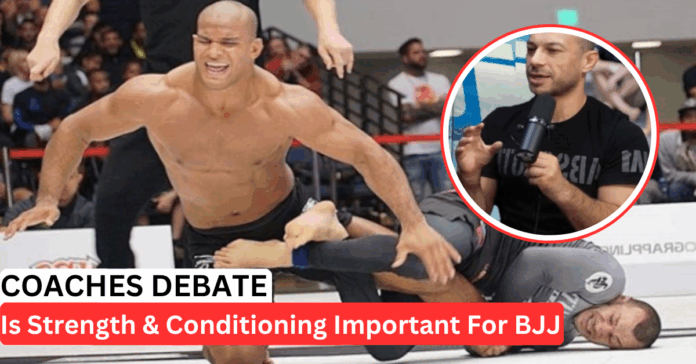

- The core question—is strength and conditioning important for bjj—has a nuanced answer: advantageous for most, not strictly required.
- Lachlan Giles argues success doesn’t depend on S&C if your technical training is elite.
- Marcelo Garcia is a high-profile example of prioritising mat time over weights.
- Modern coaches still point to performance and resilience gains from a smart S&C plan.
- Use minimum-effective doses, schedule around hard rolls, and keep technique king.
What “Strength And Conditioning” Actually Means In Grappling
Before we argue over dogma, define the thing. In BJJ, S&C means building general strength (squats/hinges/presses/pulls), power (speed-strength), and energy-system conditioning (repeat efforts without gassing), plus durability (tendon capacity and tissue tolerance).
Those qualities don’t replace technique; they support it. The real question—is strength and conditioning important for BJJ—hinges on the athlete’s goals, training age, recovery, and how intelligently they schedule gym work around live rounds.
Why Lachlan Giles Says It’s Not A Prerequisite (Lachlan Giles Strength And Conditioning)
Giles’ recent take is simple: world-class results don’t require a barbell programme if your technical training volume and intent are exceptional. He points to champions who won largely on skill, timing, and problem-solving.
The thrust is not “never lift”; it’s that technical excellence and efficient mat time can beat a mediocre plan overloaded with accessory work. For developing competitors, that’s a useful filter: fix the guard pass that fails under pressure before obsessing over your deadlift PR.
In other words, answering is strength and conditioning important for bjj starts with, “it’s helpful—but skill trumps it.”

Marcelo Garcia Training: Rolling As Conditioning (Technique First)
Marcelo remains the clearest counterexample to “must-lift” absolutism, repeatedly emphasising mat time over weight training:
“The main purpose of Jiu-Jitsu is to prove that technique can win over strength. I never took ster*ids and I barely do any weight lifting.”
– Marcelo Garcia –
His philosophy wasn’t anti-athletics; it was pro-specificity. He used hard, smart rolling as his strength and conditioning. Icons can be outliers, but they prove a point: you can structure training so that your rounds become your engine.
That doesn’t invalidate S&C; it reframes it. If you already roll with high quality and intention, is strength and conditioning important for BJJ in your case? Maybe less so—provided your body holds up and your game doesn’t break under bigger athletes.
What Smart S&C Still Adds For Most Grapplers
For the non-Marcelo majority, well-designed S&C offers three pragmatic wins:
- Performance: more grip endurance, better isometric BJJ strength in pins, improved rate-of-force for entries and scrambles.
- Consistency: robustness to handle camp volume, back-to-back matches, and travel without falling apart.
- Longevity: progressive loading for tendons and connective tissue so you can train hard without chronic flare-ups.
Even S&C-forward coaches concede it isn’t strictly “essential.” The sensible middle ground: treat lifting as a support to rolling, not the main course.
That’s also why the real-world answer to is strength and conditioning important for BJJ is: yes, in practice it usually helps—and the further you compete up the pyramid, the more those extra margins matter.
Bottom Line: Is Strength and Conditioning Important for BJJ?
Here’s the clean guidance you can use this season:
- Keep technique king: schedule your heaviest rolls on days you don’t chase heavy lifting.
- Use a minimum-effective dose: Two short full-body sessions/week (push, pull, hinge, squat, carry), 45–60 minutes tops.
- Chase qualities, not exhaustion: crisp sets of 3–6 reps for strength; controlled tempo work for grip/core isometrics; simple intervals for conditioning (e.g., bike/rower).
- Auto-regulate: if elbows, ribs, or lower back bark, reduce load and protect the mat time that actually moves your game.
- Peak sensibly: last 10–14 days before competition, drop heavy fatigue and sharpen speed/positional rounds.
So, is strength and conditioning important for BJJ? For most athletes, yeah: it’s a difference-maker for grappling performance, resilience, and tournament reliability.
But it’s not a passport stamp; with elite-quality mat time (and the right body), you can succeed without it. Build your plan around the mats; let the gym support what wins on them.