





Key Takeaways
- Cross Examination Crucifix Deep Dive DVD — a four-volume, 22-chapter BJJ Fanatics instructional in which Eli Knight and Jared Jessup map entries into the crucifix and finishes from both the back and the top position.
- Two credible teachers: Knight is a 4th-degree black belt with 30-plus years of teaching, and Jessup earned his black belt under Royce Gracie.
- The structure is the selling point — turtle, stockade, cradle, two-on-one butterfly, double-under passing and seated-guard entries all feed a single control-and-submission system.
- The trade-offs are real: the crucifix sacrifices back-control points, offers little to leg-lock players, and only pays off if you can first win the position against resistance.
- BJJ World Expert Rating: 7.5 out of 10.
Cross Examination Crucifix Deep Dive DVD DOWNLOAD
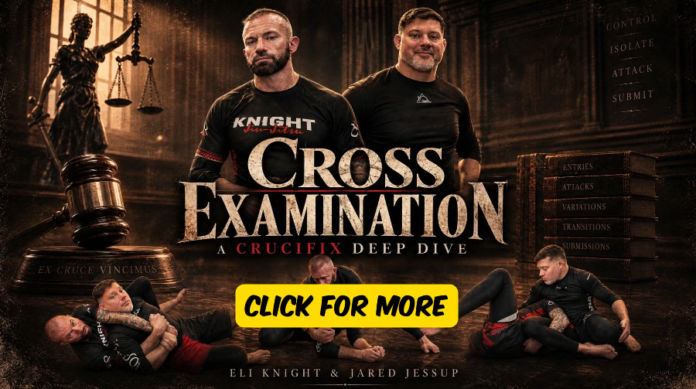
Cross Examination: A Crucifix Deep Dive is a deliberate narrowing of focus. Where most BJJ Fanatics releases try to cover an entire guard or a full passing system, Eli Knight and Jared Jessup spend a little over two hours on a single control position and the submissions that flow from it. The promise is not breadth but depth: learn the handful of routes into the crucifix, hold the position once you have it, and finish from either the back or the top.
That focus is exactly what makes the release worth grading carefully. A crucifix game is a genuine commitment. It trades the conventional scoring path of the back for a leg-and-arm trap that isolates both of the opponent’s arms, and it only pays off if a grappler can reach the position against resistance — which is the hardest part of the whole exchange. Whether Knight and Jessup actually connect those three stages is the question this review tests.
The Best Back Mount For Smaller Grapplers
The crucifix is one of grappling’s strangest positions to grade. On one hand, it is among the most controlling configurations in the sport: one arm is trapped between the legs, the other is controlled with the hands, and the opponent is left unable to defend the neck and the trapped arm at the same time. On the other hand, it is a position that gives something up.
When a grappler has the back and slides into the back crucifix, they are, in most competition rulesets, trading the security of back control — and the four points that come with it — for a submission attempt that scores nothing until it finishes. That tension is the ground this course lives on, and it is the same ground BJJ World has mapped across several other crucifix resources. Gordon Ryan’s systematically attacking the crucifix series treats the position as a control hub with its own attacking logic, while Darragh O’Conaill’s Crucifix Encyclopedia stresses retention and the entries from turtle and the front headlock.
Alexandre Pereira’s release leans on the kimura grip to keep the position, and John Potenza’s catch-wrestling look frames it through a submission-hunting lens. Knight and Jessup sit somewhere in the middle: narrower than Ryan’s sprawling series, but broader than a single technique set, and built explicitly as a route from entry to finish.

Eli Knight & Jared Jessup
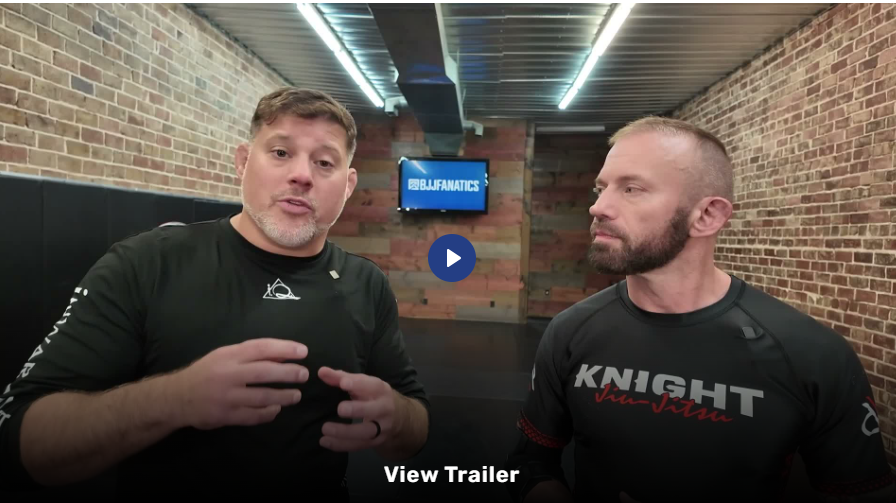
The pairing matters because the two instructors bring different but complementary credibility. Eli Knight is a 4th-degree Brazilian Jiu-Jitsu black belt and the founder of Knight Jiu-Jitsu, with more than 30 years of teaching across sport Jiu-Jitsu and self-defence — including work with law enforcement, SWAT, Secret Service and FBI personnel, and military groups.
He is a long-time BJJ Fanatics instructor with titles such as Compression Locks: Slicers and Sandwiches and Escapes and Attacks From Bottom Side Control, and he has built a YouTube audience of nearly 400,000 subscribers on clear, principle-driven technique.
Jared Jessup is the less public-facing half of the team but no less relevant to the subject. He earned his black belt under Royce Gracie and founded iQ Jiu-Jitsu in Benton, Illinois. The product page positions the two as close students of the crucifix specifically, which is the credential that matters for a course asking you to trust its grip and control details.
Full Cross Examination Crucifix Deep Dive DVD Review: The Four Volumes
Across four volumes — labelled as parts on the live product page — the course runs a little over two hours and 22 chapters, and it is sequenced the way a working system should be: the attacks come first, the control second, and the entries that justify the whole thing are saved for last. That ordering is a statement of intent. Knight and Jessup want you to see the destination before they hand you the road map.
Volume 1: Crucifix Attacks from the Turtle
The opening volume starts with the crucifix already established from the turtle and runs through the core finishing toolkit: a No-Gi clock choke, a rear naked choke from the prone turtle, a straight arm lock, a rolling reverse omoplata, and a reverse triangle. The clock choke is the classic crucifix choke, and the No-Gi label on it is the clearest ruleset signal anywhere on the page — the rest of the material is taught grip-neutral and transfers across both. Volume 1 is the hook: it proves the position can finish before the course asks you to work for it.
Volume 2: Back Crucifix Attacks
From the back crucifix, Knight and Jessup move through rear choke variations and neck cranks before pivoting to the two-way street that makes this volume the most interesting of the four: the arm-in guillotine, top kimura transitions, and the recurring legs-versus-arm problem. The neck crank material is the section that needs the most context — cranks are not legal in every division, and the course frames them within a self-defense and control context rather than as universal competition finishes.
Volume 3: Top Crucifix Submissions and Turtle Entries
The top crucifix is the least-covered half of the position in most instructionals, so its presence here is the course’s biggest point of difference against a standard back-crucifix set. The split series, a reverse-triangle arm crush, and dorsal arm locks from the leg-scissor give the top position its own finishing tree, and the volume closes by looping turtle entries back into the back crucifix.
Volume 4: Entries into the Crucifix
The final volume is where the system earns its name. The stockade and the cradle, butterfly guard entry, and diving entries against the seated guard are jsut some of the routes a grappler actually needs, because establishing the crucifix against resistance is harder than anything done from inside it. Saving these crucifix entries for last is a clear editorial choice — by the time a student reaches them, the destination is familiar enough that the transitions make sense.
Switching to the Crucifix in Training
This is not a plug-and-play instructional. The crucifix is a specialist position, and the realistic path to competence is to pick one entry — most practitioners will find the turtle or stockade route the most accessible — and drill it alongside one or two finishes before widening out.
For a simpler on-ramp into the same position, BJJ World’s breakdown of crucifix attacks from side control is a useful companion. The course’s two-hour runtime is compact enough to work through in a week of focused study, and the entry-to-finish sequencing means a student can build a small, working loop rather than collecting 22 disconnected techniques.
The honest caveat is that the material presupposes you can get to the position. The entries sit in the last volume for a reason: they are the part most dependent on live timing, and no instructional can guarantee the entry under a resisting, well-schooled opponent. The neck crank and self-defense material also needs to be filtered through the ruleset a student actually competes in.
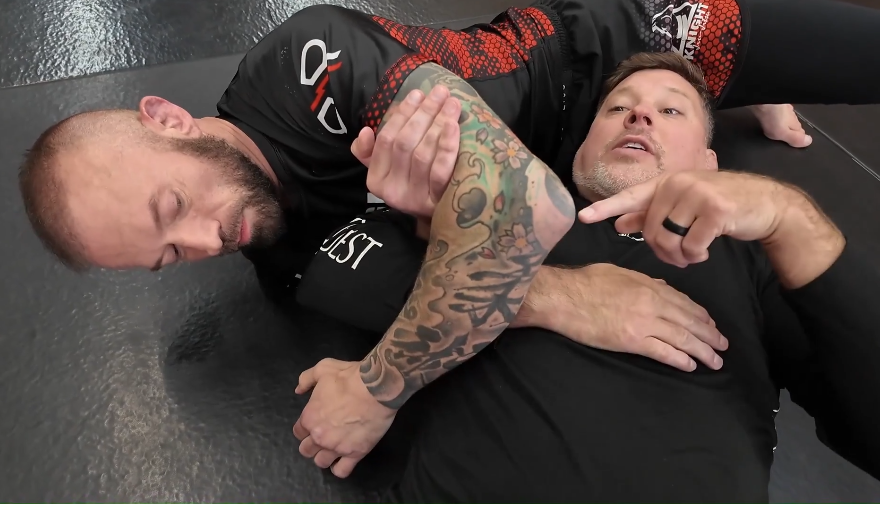
Eli Knight & Jared Jessup: Cross Examination Crucifix Deep Dive DVD HERE
Who Is This For?
The sweet spot is the upper-belt grappler — purple and above — who already has a back-take or turtle-attack game and wants a dedicated crucifix system to layer on top of it, or the No-Gi competitor who wants a submission path that does not concede the back. This is a course for the committed crucifix BJJ player, not the generalist.
Beginners will find too little context on the underlying positions, and leg-lock specialists should look elsewhere: the crucifix actively steers a match away from the legs, so it offers nothing to a player whose A-game is the lower body. Gi competitors who rely on collar grips will also find less to grab, though the clock choke and the arm-control concepts transfer.
Pros And Potential Drawbacks
Pros:
- Entry-to-finish structure. The four-volume layout runs the system end to end, which is rarer than a list of submissions and is the main reason the course holds together.
- Two credible, complementary instructors. Knight’s teaching volume and self-defense background pair with Jessup’s Royce Gracie lineage, so the material is not a one-voice lecture.
- Top crucifix coverage. Most crucifix sets live in the back position; a dedicated top-crucifix split series and dorsal arm locks are a genuine point of difference.
- The entries are treated as a system. Six named entry routes, from the stockade to diving entries on the seated guard, address the actual bottleneck of crucifix position play.
- Clear scope at a clear price. At $79 for a little over two hours, the value is transparent and the position is studied deeply rather than skimmed.
Potential Drawbacks:
- Narrow by design. A two-hour course on one position will not serve a grappler looking for a broader game; it presupposes interest in the crucifix specifically.
- Compact for a deep dive. Two hours is modest next to Gordon Ryan’s multi-volume crucifix series or Darragh O’Conaill’s encyclopedia, so buyers expecting exhaustive depth on every entry may want more.
Your Witness
Cross Examination: A Crucifix Deep Dive DVD delivers what its name promises: a focused study of the position, not a padded tour of it. Knight and Jessup connect the three stages that actually matter — entry, control, and finish — and the top-crucifix material and named entry routes keep it from reading like a re-cut of every other crucifix set. Its limitations are the position’s own: the crucifix concedes the back mount points, ignores the legs, and demands you win the position against resistance before any of the finishing work applies.