






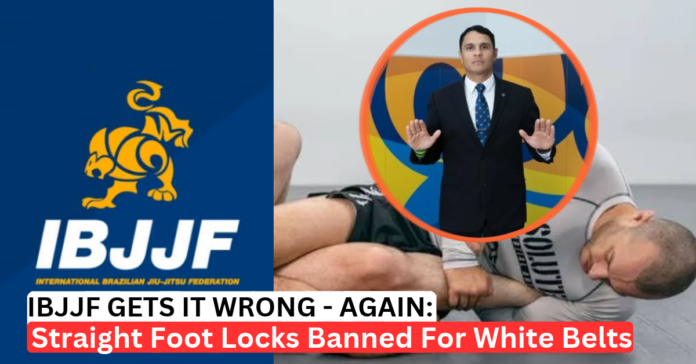

- The IBJJF straight foot lock ban, effective January 1, 2027, removes the straight ankle lock from white belts (Adult through Master 8) and every 16–17-year-old juvenile.
- It strips the safest leg lock in Jiu-Jitsu from the exact athletes who most need a controlled first exposure to the legs.
- The federation’s stated goal is fewer lower-body injuries — but the data points at the knee, not the ankle this rule actually targets.
- ADCC, EBI and submission-only spent a decade opening up the legs; the IBJJF just walked the sport backwards.
What The 2027 Rulebook Actually Changed
The International Brazilian Jiu-Jitsu Federation published its 2027 rule changes in mid-November, and the headline item is the straight foot lock. Under the new illegal-moves table, the straight foot lock becomes illegal for juveniles aged 16 and 17 at every belt, and for white belts from Adult through the new Master 8 division. Until now it was banned only in the 15-and-under divisions; adult and master white belts could still attack it.
The same update gives blue and purple belts a new allowance: they can now turn toward the foot not being attacked while finishing a straight foot lock, a turn brown and black belts could already make.
It also recuts the age divisions — a new Master 8 for competitors 66 and older arrives, while Master 7 becomes 61 to 65 — and turns jumping guard into a severe foul with immediate disqualification, flying triangles and flying armbars included, for white belts of every age and all divisions up to 15.
One thing to keep straight: this is a competition rule, not a training ban. Academies can still teach the straight ankle lock, and competitors can still drill it every night of the week. What changes is what you are allowed to use on an IBJJF mat.
They Banned The Safest Leg Lock In Jiu-Jitsu
The straight foot lock attacks the ankle and the Achilles tendon, not the knee. The finish drives plantarflexion — the foot gets pointed and the Achilles is loaded. That is a categorically different injury profile from a heel hook or a kneebar, which rotate and hyperextend the knee and are where the catastrophic lower-body injuries actually live.

The data says exactly this. A 2026 study led by researcher Michael Piekarski found knee injuries ran 26.5 per 1,000 matches among competitors exposed to the heel hook, against 2.2 per 1,000 where it stayed banned — a relative risk of roughly twelve. Ankle injuries showed no significant difference between the two groups.
Just because straight ankle locks and kneebars are fairly safe submissions, this doesn’t give you permission to apply them ballistically.
–Stephan Kesting, fifth-degree BJJ black belt –
Rehab specialists describe the straight ankle lock as lower-risk than the heel hook for the same reason: it loads the ankle, not the knee. And the IBJJF never gave white belts heel hooks in the first place. The federation reached for the safest tool in the drawer and took it away.
Why The IBJJF Straight Foot Lock Ban Makes Beginners Less Safe, Not More
The IBJJF’s stated rationale is reasonable on its face: it wants to cut lower-body injuries at the beginner end of competition. That is a defensible goal, and it deserves to be engaged with honestly. The problem is the mechanism, not the motive.

The straight ankle lock is the on-ramp to leg locking. It is the first leg attack most students learn precisely because it is the safe one: it teaches the ashi garami entries, the leg pummel, the finishing mechanics and, most importantly, when to tap and how the position feels before anything pops.
Strip that from the white belt divisions and you do not protect beginners — you delay their leg-lock education until blue and purple belt, where they suddenly face opponents who have had years to internalize the position.
A first-year student who has never felt a controlled straight ankle lock is not safer when they meet their first heel hook in a No-Gi ruleset that allows it. Beginners will still get hurt; they will just get hurt by a technique they were never allowed to train under competition pressure.
The Sport Moved Toward Leg Locks — The IBJJF Moved Backwards
Over the last decade, ADCC, EBI and the submission-only circuit built their identities on the legs. Heel hooks went from a fringe specialty to a foundational part of the modern No-Gi game, and leg entanglements now decide matches from bell to bell. Rulemakers everywhere moved toward letting athletes attack the lower body earlier, and under clearer rules.
The IBJJF is the exception, and now it is moving in the opposite direction. It did not merely decline to join the leg-lock wave — it actively removed the one lower-body attack it had made available to its newest competitors. That is a step backwards at exactly the moment the rest of the sport is running forward.
The Belt-Color Logic Doesn’t Hold Up
The IBJJF runs a belt-based safety ladder, and white belts were never given the twisting attacks that show up in the injury data — no heel hooks, no kneebars, no toe holds. They got one leg lock, the straight ankle, because it targets the ankle and is comparatively safe. Banning it by belt color does not follow from any of the evidence the federation is implicitly leaning on.
The belt line also produces strange asymmetries. A 16-year-old blue belt is barred from the straight foot lock, while an adult blue belt can not only use it but now finish it with the newly allowed turn toward the non-attacked foot.
A 16-year-old blue belt can jump guard without the disqualification that hits every white belt, yet that same teenager cannot touch the safest submission in the leg-lock family. Age and belt interact in ways that do not map onto any injury mechanism.
Early reaction on the r/bjj subreddit pushed back on the white-belt change, with commenters describing it as a step backwards for leg locks — individual opinions rather than consensus, but a sign the athletes who actually compete at white belt are not convinced.
What White Belts And 16–17s Can Still Do (And What It Costs Them)
The first question most competitors will ask is simple: are straight foot locks legal for white belts? Under the IBJJF 2027 rules, the answer is no. White belts from Adult through Master 8, and every 16–17-year-old juvenile, lose the straight ankle lock entirely. What they keep is untouched: chokes, arm locks, and the rest of the upper-body game carry on exactly as before.
The real cost is the education gap. The white belt leg locks IBJJF competition will now allow is effectively nothing, so beginners build their leg-lock awareness only in the gym, against training partners, and cannot test it under a referee until they reach blue belt — or until they enter another promotion with a different ruleset.
That is the frustrating part: the straight ankle lock white belt competitors were still allowed to use last season is gone, while the jumping guard IBJJF disqualification now hangs over the divisions most likely to do it out of habit.
For the full picture of what remains legal, the site’s guide to legal leg locks, its leg locks 101 primer, and its breakdown of the BJJ ankle lock are still the right starting points. But the IBJJF leg lock rules have just become the most conservative in the sport, and the IBJJF straight foot lock ban does not make beginners safer — it makes them later. That is protection theater wearing a rulebook, and it is a step backwards for Jiu-Jitsu.