





Key Takeaways
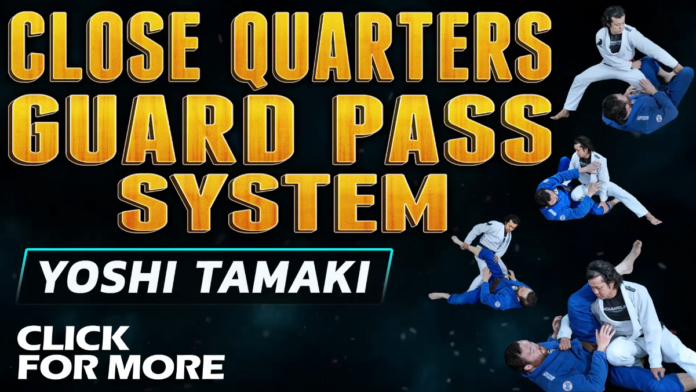
- A comprehensive 5-volume guard passing system from Carpe Diem London head instructor Yoshi Tamaki, built around four primary passes: Toreando, Knee Slice, Leg Drag, and Single Under
- Each pass is taught with stepwork fundamentals, common mistakes, reaction-based counter-attacks, and progressive combination drills
- The system approach means every pass connects to the others — Tamaki shows how to chain passes based on opponent reactions
- Heavy emphasis on pressure passing mechanics and consolidating passing to mount, back take, or knee on belly
- Rating: 8/10
CLOSE QUARTERS GUARD PASS YOSHI TAMAKI DVD FULL DOWNLOAD
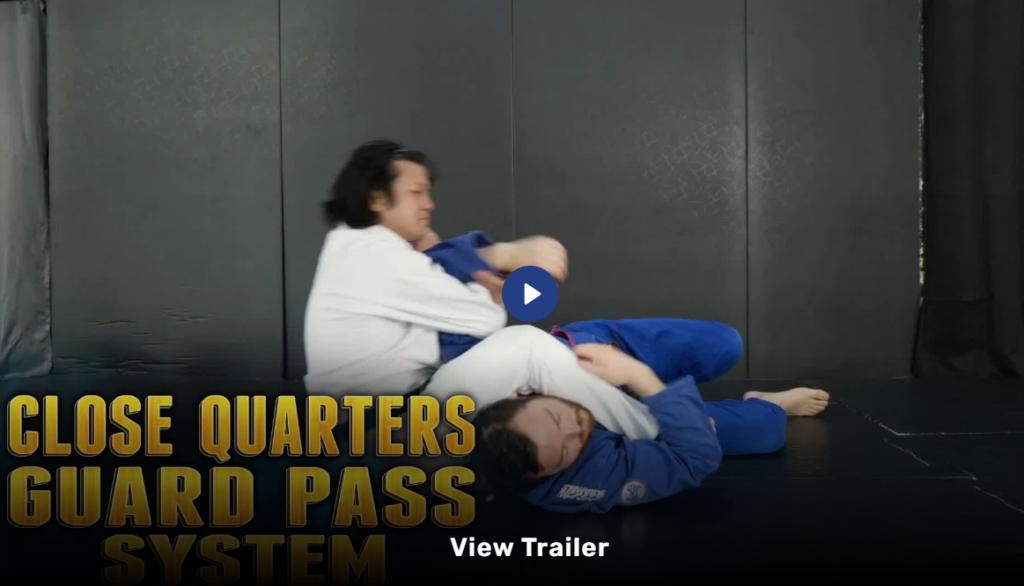
The guard pass is the fundamental problem of Jiu-Jitsu — every grappler must solve it, and every guard player works to prevent it. The Close Quarters Guard Pass Yoshi Tamaki DVD is a 5-volume instructional from a BJJ black belt and former head instructor at Carpe Diem BJJ London. It builds a complete passing framework around four core passes: Toreando, Knee Slice, Leg Drag, and Single Under.
Tamaki brings a pressure passing BJJ approach that prioritizes control over speed. This Close Quarters Guard Pass Yoshi Tamaki review covers why the system approach works and who will benefit most from the Yoshi Tamaki guard passing methodology.
The Closer – The Better
Guard passing instructionals tend to fall into two categories: move collections that show dozens of passes without connecting them, and system-based approaches that treat passing as a web of decisions rather than a linear sequence. The Close Quarters Guard Pass Yoshi Tamaki DVD belongs firmly in the second category.
Instead of presenting passes as isolated techniques, the Toreando pass system shows how each pass sets up the next one based on how the opponent reacts. If the Toreando forces the opponent to raise their guard, the Knee Slice becomes available. If the Knee Slice is countered with a deep half entry, the Leg Drag covers the transition. This interlocking logic is what separates a system from a technique list.
The “Close Quarters” name reflects Tamaki’s emphasis on staying tight through the pass. Rather than creating distance and exploding through, Tamaki teaches close body contact, pressure on the hip line, and passing that never gives the opponent space to recompose guard. This pressure passing BJJ approach is particularly effective against opponents with strong open guards who rely on distance management.

Tsuyoshi “Yoshi” Tamaki
Yoshi Tamaki (Tamaki) is a Brazilian Jiu-Jitsu black belt and the founder of Carpe Diem BJJ London. He originally taught at the Carpe Diem Aoyama location in Tokyo before bringing the Carpe Diem style to the United Kingdom in 2017, opening the first Carpe Diem academy outside of Asia. He led the London school as Director and head coach until August 2025, building a reputation for technical pressure passing and a systematic approach to Jiu-Jitsu. He returned to Japan later that year.
Carpe Diem BJJ was founded in Tokyo in 2013 and has grown into a respected international brand known for producing methodical, pressure-oriented grapplers. Tamaki’s teaching style reflects this philosophy — his instructional content emphasizes positional mechanics, reaction recognition, and drilling with intent. He is also known for his YouTube channel featuring split-screen bird’s eye view instruction that breaks down passing mechanics in detail.
Close Quarters Guard Pass Yoshi Tamaki DVD Review
This guard passing instructional is a top-tier passing instructional for anyone who wants to develop a passing game that adapts to the opponent rather than hoping for a specific entry to work. The Yoshi Tamaki guard pass DVD, rooted in Carpe Diem BJJ London’s pressure-focused philosophy, makes this a standout addition to the passing instructional category.
Volume 1: Toreando Pass
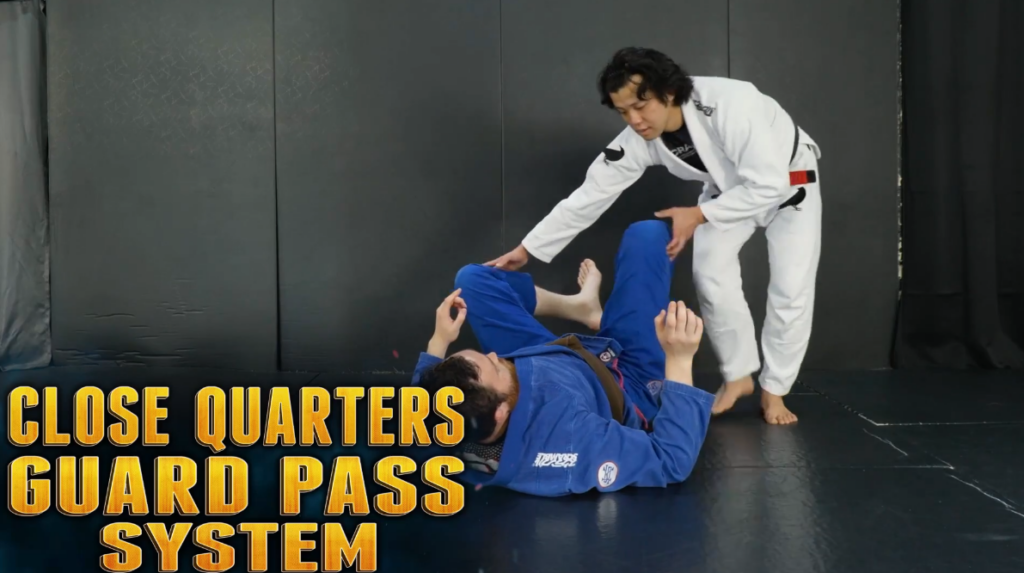
The first volume establishes the Toreando pass as the entry point for the entire system. Tamaki begins with basic stepwork — the footwork patterns that create the angles needed for the pass. He then moves to handling the opponent’s legs, showing how to control the far-side leg while stepping past the near-side guard.
The outside step pass receives particular attention, with Tamaki highlighting common mistakes that stall the pass or expose the passer to sweeps. The section on mistakes is a standout feature — Tamaki shows what goes wrong and how to correct it, not just the ideal version of the technique.
The consolidation phase covers taking knee on belly after the pass and the transition from Toreando to side control. Tamaki also demonstrates how to counter-attack when the opponent reacts — including armbar counters, mount entries, and back takes. The volume closes with combination drills that link Toreando entries with recovery options when the initial pass attempt fails.
Volume 2: Knee Slice Pass
Volume 2 builds on the Toreando with the Knee Slice pass — one of the most common passing techniques in no-gi and gi. Tamaki breaks the Knee Slice into its component parts: getting the underhook, clearing the foot from the hip, and driving through to the far-side hip.
The clearing mechanics are detailed and practical. Tamaki shows how to remove the foot from the hip without leaving yourself open for the omoplata or sweep, and how the angle of your chest determines whether the pass succeeds or stalls.
The combination section shows how to chain the Knee Slice with the Toreando — using the threat of one pass to open the other. Tamaki also covers upright Knee Slice variations for opponents who try to sit up and create frames, along with drills to develop the hip drive needed for effective Knee Slice passing.
Volume 3: Leg Drag Pass
The Leg Drag is a high-value passing technique that applies heavy pressure while leaving the bottom player with limited counter options. Tamaki’s Leg Drag instruction focuses on maintaining upper body control while creating the leg angle needed to clear the guard.
The stepwork section covers the most common entry points, including the cross-step, the back step, and the running the pipe variation. Tamaki also demonstrates upper body control options — the pant grip in gi and the hip control in no-gi — that prevent the opponent from recomposing guard.
The body lock control section adds another layer to the Leg Drag by showing how to transition from a standard Leg Drag to a body lock pass when the opponent defends the initial entry. The counter-attacking section covers the back take from a completed Leg Drag, the Ezekiel choke when the opponent turns away, and the armbar when the opponent posts.
Volume 4: Single Under Pass
The Single Under pass (also known as the over-under or stack pass) is the most pressure-oriented pass in the system. Tamaki teaches the stepwork for entering the Single Under — getting the underhook, controlling the near leg, and driving forward to flatten the opponent.
The sequence drills in this volume are particularly valuable. Tamaki shows how to transition from a failed Single Under into the Toreando or Leg Drag, creating a passing web that covers multiple opponent reactions. The counter-attacking section covers submissions from the stacked position, including the shoulder lock and the breadcutter choke.
Volume 5: Guard Pass System
The final volume ties everything together with progressive sequence drills that combine all four passes. Tamaki shows how to flow from one pass to the next based on opponent reactions, creating what he calls “decision-free passing” — a flow state where your body automatically selects the right pass without conscious thought.
The training partner reaction drills are the highlight. Tamaki demonstrates how to drill with a resisting partner who applies specific reactions, building the recognition skills needed to select the right pass in real time. The volume also covers common transition points where passing sequences break down and how to restart the system.
Passing Made (Fairly) Simple
The five-volume structure of this guard passing instructional review recommendation makes it ideal for progressive study. The Close Quarters Guard Pass Yoshi Tamaki DVD delivers value because each pass is taught with drilling in mind. Start with Volume 1 and drill the Toreando until the stepwork is automatic before adding the Knee Slice. The combination drills at the end of each volume are designed to be drilled with a training partner, making this a system you can work through methodically.
Tamaki’s emphasis on reaction-based passing means this instructional rewards drilling with a live partner who actively resists. The training partner reaction drills in Volume 5 require a training partner who understands how to give appropriate resistance levels.
For gi players, the Yoshi Tamaki guard passing concepts with pant grips and collar controls are directly applicable. For no-gi players, the mechanics translate — hip control, underhooks, and angle management work regardless of grips. The system is especially effective against seated open guards and half guards.
DOWNLOAD HERE: CLOSE QUARTERS GUARD PASS YOSHI TAMAKI DVD
Who Is This For?
This instructional is ideal for intermediate to advanced grapplers (blue belt and above) who have a basic passing game and want to develop a systematic approach. Gi and no-gi players will both benefit, though gi-specific grips are shown throughout.
It is also excellent for coaches looking for a structured passing curriculum. The progressive drill format — from fundamentals to combination drills to reaction training — provides a ready-made framework for teaching guard passing in an academy setting.
Beginners may find the volume count intimidating. The pacing assumes familiarity with basic passing concepts. Purple and brown belts looking to refine their passing mechanics and add system logic to their game will get the most value.
Pros & Potential Drawbacks
Pros:
- True system approach: The four passes are taught as connected pieces of a larger puzzle, not isolated techniques. This makes the instructional greater than the sum of its parts.
- Excellent mistake analysis: Tamaki shows common errors for each pass with corrections, which is more useful than only demonstrating the ideal technique.
- Drill progression is well-designed: The combination drills and reaction drills build real passing skill, not just technique memorization.
- Covers the complete passing cycle: Entry, pass completion, consolidation, and counter-attack are all addressed for each pass.
- Gi and No-Gi applicable: The core mechanics work in both contexts, with grip variations shown for gi.
Potential Drawbacks:
- 5 volumes is a significant time investment: Completing the entire system requires dedicated study time. Grapplers looking for a quick fix may find the volume count off-putting.
- Limited rolling footage: More live sparring examples showing the system in action against resisting opponents would strengthen the instructional.
- Price point: At $79, this is a premium instructional. The depth and structure justify the cost, but casual practitioners may hesitate.
Close Distance Pressure
The Close Quarters Guard Pass Yoshi Tamaki DVD delivers a complete passing curriculum that is rare in its structural depth. The progression from four base passes through combination drills to reaction-based flowing is well-executed, and Tamaki’s teaching style is clear and systematic.