








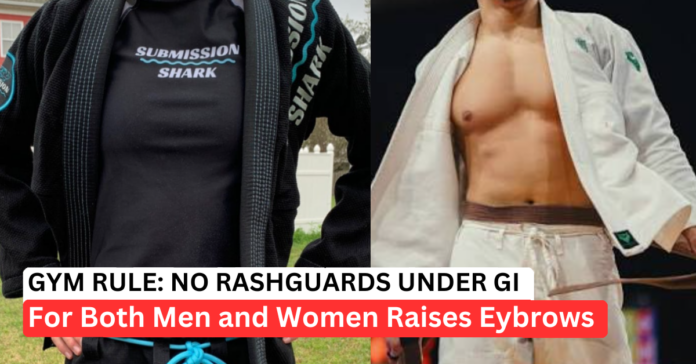

- A BJJ gym in Tennessee allegedly banned rash guards under the gi for both male and female students
- The policy reportedly leaves women training in only a sports bra under their jacket, raising hygiene and modesty concerns
- Mikey Musumeci and Dominyka Obelenyte discussed the story on the Overdogs podcast, questioning the reasoning
- The policy contradicts IBJJF rules, which actually require women to wear a fitted top under the gi in competition
- The gym’s name has not been publicly revealed
This Tennessee BJJ Gym Banned Rashguards Under The Gi Policy Raises Eyebrows
A BJJ gym in Tennessee has come under scrutiny over an unusual dress code policy that allegedly bans students from wearing rash guards under the Gi — for both men and women. The story surfaced during an episode of the Overdogs podcast, where Mikey Musumeci and Dominyka Obelenyte reacted to the claims and questioned the logic behind the rule.
According to the discussion on the podcast, the head instructor at the unnamed Tennessee BJJ gym reportedly implemented a policy prohibiting any type of rash guard or fitted top beneath the Gi jacket. For men, that means training bare-chested under the Gi. For women, the policy would leave them training in only a sports bra beneath the Gi top — a rule that both podcast hosts found deeply problematic.
The fact that a Tennessee BJJ gym banned rashguards under the Gi for both sexes raises questions about the reasoning. Several possible justifications have been suggested in online discussions, including a misinterpretation of IBJJF competition rules.
In IBJJF Gi competition, male competitors do compete bare-chested — the rulebook states that men wear the Gi jacket directly against the skin. However, the IBJJF requires women to wear a “fitted top” (essentially a rash guard or sport top) beneath the Gi jacket.
The Overdogs Podcast Reaction
Mikey Musumeci, the multiple-time IBJJF world champion, and Dominyka Obelenyte, a decorated black belt competitor, did not hold back during the podcast discussion. Both expressed concern that such a policy could make female students uncomfortable and potentially discourage women from training.

The hosts noted that even if the policy was intended to mimic IBJJF Gi competition standards, it fails to account for the basic differences between training and competition environments. In training, hygiene and comfort are primary considerations, and most academies encourage — if not require — rash guards for exactly those reasons.
Musumeci and Obelenyte also highlighted a more troubling dimension: whether the policy extended to underage girls training at the gym. The conversation took place on the Mikey Musumeci Overdogs podcast, where the hosts openly questioned how a Tennessee BJJ gym banned rashguards without considering the implications for younger students.
The podcast hosts questioned the appropriateness of creating an environment where minors would be required to train without appropriate athletic wear beneath their uniforms.

IBJJF Rules Vs. Gym Policy
The IBJJF rulebook presents a complicated picture. Under IBJJF Gi rules for adults, male competitors compete without a shirt under the Gi. Female competitors are required to wear a “fitted top” — which can include a rash guard, sport top, or compression shirt — under the Gi jacket.
In that context, the Tennessee gym’s policy of banning rash guards for women directly contradicts the rules that the policy may have been attempting to follow.
For No-Gi, the IBJJF requires both men and women to wear a rash guard. That makes the ban on rash guards under the Gi even harder to rationalize. If the goal was to prepare students for competition, the policy should be training women with rash guards under the Gi — not banning them.
The broader issue is whether gym rules designed for competition should apply to all students, including hobbyists and beginners who may never compete. The majority of BJJ students train casually, and imposing IBJJF-specific uniform policies on the entire membership is a questionable approach at best.
Hygiene And Practical Concerns
Rash guards serve a practical purpose beyond contest rules. They reduce skin-on-skin friction, prevent mat burn, and provide a barrier against skin infections like ringworm and staph — a constant concern in any grappling environment. Many academies require rash guards under the Gi specifically for hygiene reasons.
Banning rash guards under the Gi runs counter to standard hygiene practices in the sport. Without a rash guard, the Gi absorbs sweat directly against the skin, can accelerate mat burn during drilling, and makes it harder to detect skin infections early. For practitioners who train multiple sessions per day, rash guards also make it easier to train in back-to-back classes by providing a clean layer between the skin and the Gi.
These BJJ hygiene controversies are not new to the sport, but this policy represents an unusual reversal of the standard approach. The Budo Fight Gear article on rash guards in BJJ emphasizes that wearing one under the Gi is a matter of both comfort and safety. Most gyms that do not require rash guards still recommend them, particularly for women who prefer the additional coverage and support.
The Missing Piece: Accountability
The Tennessee gym’s name has not been publicly released — the discussion on the Overdogs podcast did not name the academy, and online speculation has not confirmed which gym is involved.
That anonymity makes it impossible to verify whether the policy is still in place, whether it applied to all students equally, and whether the instructor has responded to the criticism.
What is clear is that the conversation has opened a wider discussion about BJJ Gi dress code policy in academies and the balance between preparing competitors and maintaining a safe, inclusive training environment.
Whether this particular policy was based on competition aesthetics, personal preference, or a misunderstanding of the IBJJF rash guard rules, it has sparked debate about who gym policies are meant to serve and at what cost.
If the goal was to condition students for competition conditions, there are better ways to do it — and most involve education, not blanket bans.