



Key Takeaways
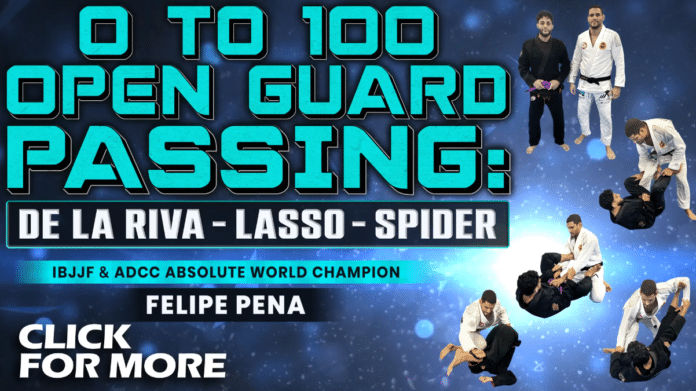
- A Gi-focused passing course built around the most common problem guards you’ll actually see in training: De La Riva, lasso, and spider.
- The structure is refreshingly tight: five volumes, each centered on one guard cluster, with a small set of repeatable passes instead of 40 unrelated options.
- Pena’s big selling point is pressure that ramps up step-by-step—less explode past the legs, more suffocate the frames until the guard breaks.
- Best suited for people who already pass sometimes and want to pass reliably against experienced guard players (solid white belts through black belts).
- Rating: 9/10
0 TO 100 OPEN GUARD PASSING FELIPE PENA DVD GRAB NOW
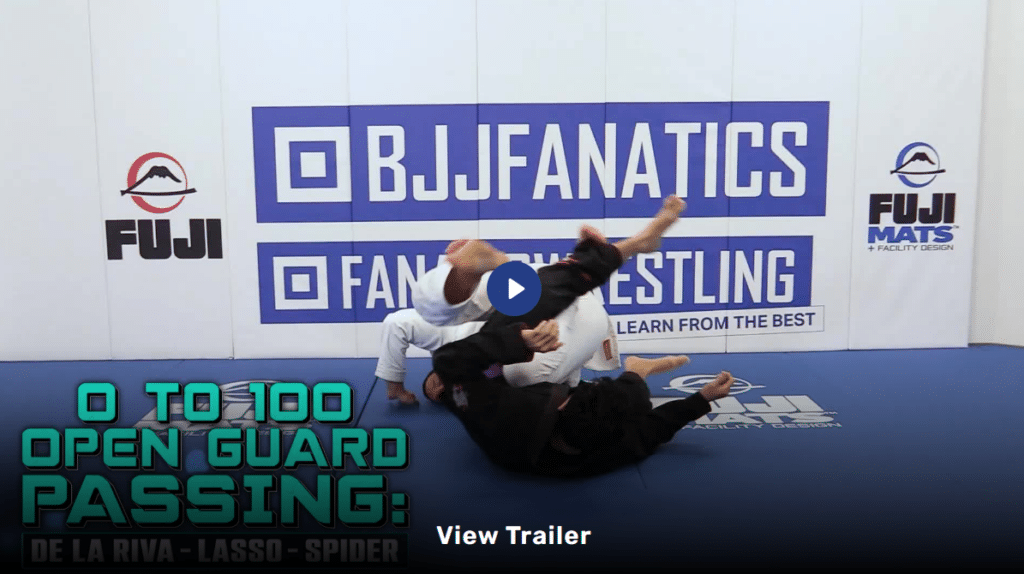
The Open Guard Passing Felipe Pena DVD is one of those instructionals that shows you what elite pressure passing looks like when it’s stripped down to core problems and direct answers. Instead of trying to give you open guard passing in the abstract (which usually turns into a messy grab-bag of techniques), Pena narrows the scope to three guards that routinely stall out even strong top players in the Gi: outside/middle/inside De La Riva, lasso, and spider.
That focus matters, because these guards aren’t just positions—they’re systems of grips, distance, and tempo. If you’re late on one detail, the guard player doesn’t just retain, they start building offense (tilt sweeps, back takes, triangles, omoplatas, and the dreaded slow-motion grip death). Pena’s goal here is to stop the guard from ever feeling comfortable enough to start that chain.
If you’ve been looking for a Felipe Pena instructional review angle in one sentence: this is a pressure passer’s blueprint for turning popular Gi open guards into predictable checkpoints—and then walking through them without rushing.
Open guard passing in the Gi is mostly a battle over attachments. In No-Gi, you can sometimes win with speed, body positioning, and hand-fighting. In the Gi, the bottom player can staple you in place with sleeve grips, collars, and hooks—and once they’ve attached, they get to decide the rhythm.
That’s why the best passers don’t just do a pass. They solve three problems in order:

- Kill the distance (or force the guard player into a distance they don’t want).
- Remove their strongest frame (usually a shin, a lasso, or a spider hook tied to a sleeve).
- Land in a stable checkpoint (quarters/half/side control/mount) where the guard no longer exists.
What I liked about Pena’s approach is that it respects how guards actually work in live rounds. He doesn’t treat De La Riva like a static pose; he treats it like a moving dilemma where your reaction determines whether you end up leg-dragging, knee-slicing, or getting loop-choked while your posture collapses.
And since this is primarily De La Riva guard passing, a big theme is recognizing which De La Riva you’re dealing with (outside, middle, inside) and choosing a compatible solution—rather than forcing your favorite pass into the wrong shape.
Felipe “Preguiça” Pena
Felipe “Preguiça” Pena is one of the era-defining big men in modern Jiu-Jitsu: a heavyweight who can actually play guard, invert when needed, and still apply top pressure like he’s closing a hydraulic press. He’s widely recognized as a multiple-time IBJJF World Champion in the Gi and an ADCC champion, which matters because it proves his game holds up across very different rule sets and styles of resistance.
He’s also the kind of competitor whose passing doesn’t depend on athletic bursts. Pena’s best work tends to look slow until you’re the person under it—then you realize the slowness is the trap. He consistently upgrades position, tightens your hips and shoulders, and turns your guard reactions into predictable openings.
That competitive identity is exactly why a course like this makes sense. Passing De La Riva, lasso, and spider isn’t about memorizing ten techniques per guard—it’s about understanding where pressure goes, which grips matter, and how to keep climbing from a half-pass to a real pass without giving the guard player a reset.
Full Open Guard Passing Felipe Pena DVD Review
The best way to describe this course is: a small passing toolbox applied to five distinct guard scenarios, with Pena showing how he chains pressure forward rather than bouncing between unrelated techniques. You’ll see recurring ideas—leg drags, knee slices, smash passing, stacking—because those are the workhorses. The difference is how he aims them at the specific shape each guard creates.
Volume 1 – Outside De La Riva Passes
Volume 1 is the hello reality section, because outside De La Riva is everywhere in the Gi, and it’s often the first guard people build when they’re not a dedicated spider/lasso player. Pena’s solution set here is compact: he shows a direct pass to side control, then layers in an inverted knee slice option, and finishes by addressing how he handles the transition into quarter guard as the guard player starts to scramble and clamp.
What stands out in the opening portion of the Open Guard Passing Felipe Pena DVD is how he treats outside De La Riva like a posture problem first. The grips and hooks are annoying, but the real danger is that your posture breaks and your hips drift out of alignment—then your legs become available for off-balancing, and your arms become available for lasso/spider upgrades.
Pena’s early answers are designed to stop that spiral before it starts. This is also where the course begins to show its personality: it’s not trying to impress you with novelty, it’s trying to give you a reliable baseline that survives rounds with stubborn training partners.
Volume 2 – Middle De La Riva Passing
Part 2 of the Open Guard Passing Felipe Pena DVD narrows the lens to middle De La Riva and keeps it short and purposeful—exactly how it should be. The main idea revolves around a leg drag from this configuration, with a bonus pass variation to round it out.
I like this organizational choice because middle De La Riva can be a grey zone for many passers: it doesn’t always feel like classic outside De La Riva, but it’s not quite inside De La Riva either. People hesitate, and hesitation is where the bottom player gets their second sleeve grip, starts setting up the lasso, or angles for a tilt.
Pena’s answer is basically: stop treating it like a mystery, treat it like a checkpoint. Get to your preferred alignment, commit to the leg-drag mechanics, and use pressure to prevent the guard player from re-threading their hooks. This is where the 0 to 100 passing system begins to feel very real—small upgrades, constant control, no big leaps.
Volume 3 – Inside De La Riva
Inside De La Riva is where a lot of passers start to panic, because the guard player’s hooks and angles can feel closer to your base, and the off-balancing hits harder. Pena’s solutions here are a knee slice from inside De La Riva, a smash pass option, and then a smash pass route that takes you all the way to mount. He finishes with a practical quarter guard to side control segment—because that’s where a lot of real passing success actually lives.
This volume does a great job of framing success correctly. Passing isn’t always the clean highlight-reel moment; sometimes it’s winning the ugly half-pass and then refusing to give it back. Pena shows how to turn that half-pass into inevitability. The inside De La Riva chapter choices also mesh well with the rest of the course: you can tell he’s steering you toward a consistent top identity rather than creating five different passing personalities.
Volume 4 – Lasso Guard Pass
The fourth volume is where the course becomes a real quality of life upgrade for Gi training, because lasso is one of the easiest guards to stall with—and one of the hardest to look good against if you don’t have a plan. Pena addresses lasso half guard pressure passing first, then adds variations for when the opponent turns and faces you (a common moment where people lose structure). He also includes a steering wheel pressure pass, which fits the overall theme while adding some flair: keep control of the frame, keep your alignment, and keep walking forward.
Then you get the stand-up pass vs the Spider-Lasso, which is an important bridge because good guard players rarely stay in one guard position. They’ll start lassoing, you start to solve it, and they’ll re-thread into spider or vice versa. Finally, he addresses spider guard stack passing as a lead-in to Volume 5, which is smart sequencing. Lasso and spider are cousins; treating them separately is fine, but acknowledging the overlap is crucial.
Volume 5 – Spider Guard Passing
Spider guard is one of those positions where you can know passes and still get nowhere, because the bottom player’s grip and foot connection is what makes everything sticky. Pena’s volume is built around a spider guard stepping pass.
The practical highlight for me is that he doesn’t pretend spider passing is always clean. He includes answers like pinning the legs down and transitioning into stack to double unders—because in real rounds, spider often collapses into a messy in-between where you either secure control or you get re-guarded immediately.
And yes, there’s a specific Spider guard stack pass pathway here that will make heavy-pressure passers happy. If you’re the kind of top player who wants the guard player’s knees pointed the wrong way while you stack and climb, this volume will feel like permission to do what you already want to do—just with cleaner structure.
Not Panicking in Gi Guards
If you want to get full value from the Open Guard Passing Felipe Pena DVD, don’t treat it like a watch once, then freestyle instructional. Treat it like a set of problems you’re going to deliberately hunt in training.
A good way to do it is to pick one guard or a guard player that plays it (outside De La Riva is usually the best start). Try to force that exact situation in sparring, even if it means you lose other passing opportunities. Your goal is repetition, not dominance.
Add the next guard (middle/inside De La Riva). Your job is to identify the variation quickly and choose the correct response without stalling. Start chaining. The key is to train the decision-making, not just the moves. These guards are all about timing and posture.
Also, don’t skip the quarter guard moments. That’s where passes become real. If you learn to stabilize the half-pass and keep progressing, your open guard passing will improve even against people who are “better guards” than you are passers.
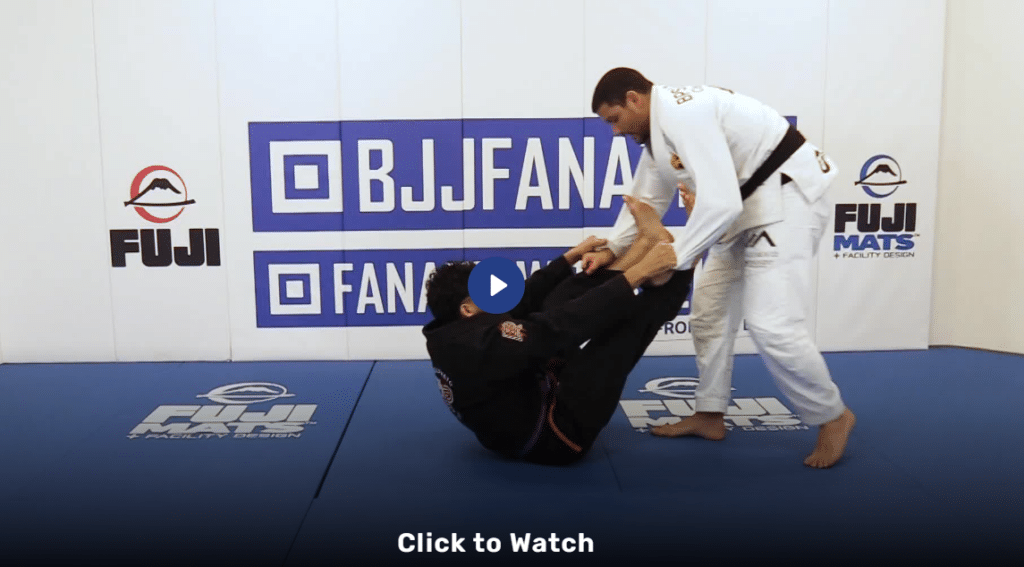
DOWNLOAD THE 0 TO 100 OPEN GUARD PASSING FELIPE PENA DVD
Who Is This For?
This Open Guard Passing Felipe Pena DVD is best for white belts to advanced belts who already understand basic passing posture and want a reliable system for common Gi open guards, pressure passers who like controlling hips, stacking, and upgrading position rather than sprinting around legs and competitors (or serious hobbyists) who keep running into the same guard problems—De La Riva, lasso, spider—and want consistent answers.
Brand-new white belts who still struggle with stance, grips, and maintaining base will aslo struggle with these passes—this DVD assumes you can stay upright long enough to apply the ideas.
Pros & Potential Drawbacks
Pros:
- Clear problem-solving structure: each volume targets one guard family, so you’re not guessing what you’re supposed to learn.
- A coherent pressure identity across all sections—leg drags, knee slices, smash passing, and stacking show up as connected tools.
- Practical handling of messy almost passed situations (quarter guard, half-pass, leg pinning) that actually decide rounds.
- Strong overlap management between lasso and spider, which is how good guard players really behave.
- Techniques are compact enough to drill and then apply quickly, instead of requiring a month of choreography.
Potential Drawbacks:
- The scope is intentionally narrow: if your main problems are collar-sleeve, lapel guards, or modern inversion-heavy guard systems, you’ll need other resources.
- Because it’s pressure-based, lighter passers who rely on mobility might need time to adapt the pacing to their body type and style.
Passing at 100 MPH
As far as Gi passing instructionals go, the Open Guard Passing Felipe Pena DVD hits a sweet spot: narrow enough to be usable, broad enough to matter. The course doesn’t try to teach passing in general. It teaches you how to deal with three of the most common Gi open guards by using a small number of high-percentage answers and building pressure in a predictable way.