




Key Takeaways
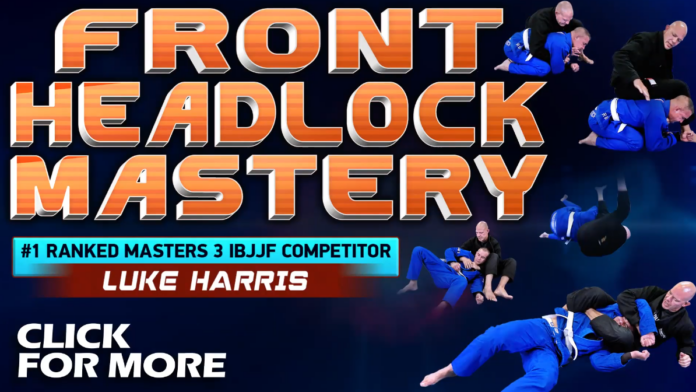
- A focused 4-volume instructional on building a complete front headlock system from a BJJ black belt under Robert Drysdale with a 10-3 pro MMA career
- Covers the full cycle: entries from takedowns, guard passing, and takedown defense, then submissions from front headlock, and transitions to turtle/back attacks
- Includes underrated finishes like the Rodeo choke, Amy choke, Smitty choke, and rolling Judo choke alongside the expected Darce, Anaconda, Peruvian, and guillotine
- Heavy emphasis on chaining submissions and following opponent reactions rather than forcing a single finish
- Rating: 8.5/10
DOWNLOAD DVD FRONT HEADLOCK MASTERY LUKE HARRIS DVD
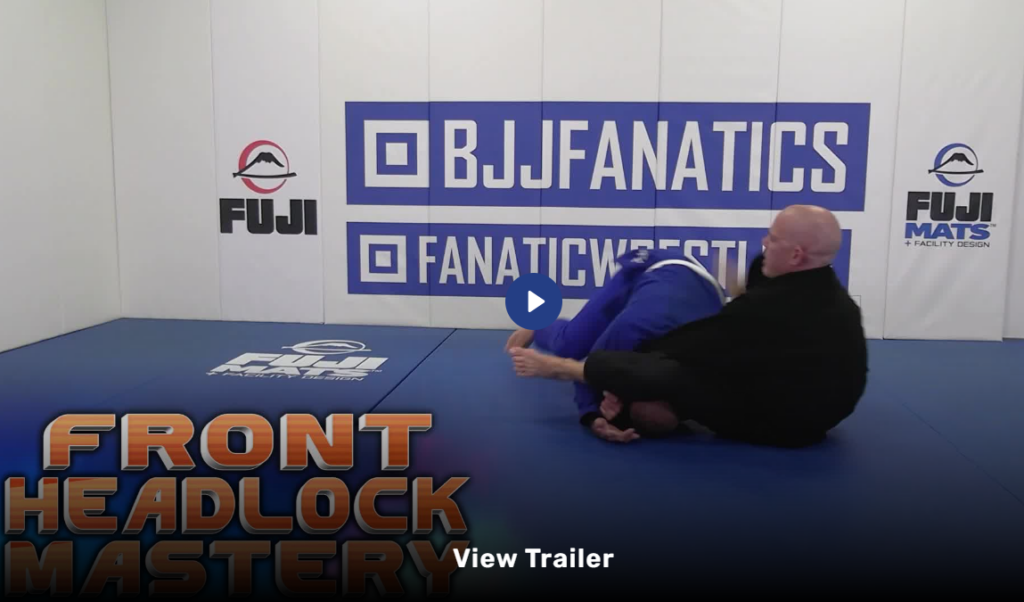
The front headlock is a position straddling wrestling and Jiu-Jitsu — strong enough for takedown sequences, tight enough for submissions. It is also one of the most versatile attacking hubs in the sport, and Luke Harris makes a compelling case for building your game around it.
Luke Harris, a BJJ black belt under Robert Drysdale and owner of Hayabusa Training Center in Alberta, Canada, brings a Front Headlock Mastery Luke Harris DVD that treats the position as a full system rather than a collection of chokes.
Everything You Can Do From A Front Headlock in BJJ
The front headlock lives in the gray area between positions. In wrestling, it is a control position used to snap opponents down and set up go-behinds. In Jiu-Jitsu, it is the entry point for some of the highest percentage submissions in the sport — Darce, Anaconda, guillotine, Peruvian necktie.
But the front headlock can be more than a submission entry. Harris treats it as a hub position: a place you can arrive at from multiple entry points (takedowns, guard passing, takedown defense) and leave from toward multiple destinations (chokes, back takes, turtle attacks).
The key insight in Harris’s approach is that the front headlock is strongest when you enter it without telegraphing your intent. Rather than reaching for the head from distance, he enters through takedown chains — Uchi Mata into front headlock, drop Seoi-nage into duck under into front headlock. These entries disguise the position as something else, which means the opponent reacts to the takedown threat rather than defending their neck.

Judoka Luke Harris
Luke Harris is a Brazilian Jiu-Jitsu black belt under Robert Drysdale, inducted into the ADCC Hall of Fame. He is also a Judo black belt and a multi-time provincial champion and national medalist in Judo. Harris is the owner and head instructor of Hayabusa Training Center in St. Albert, Alberta, Canada — a family-run academy with over 400 members that offers BJJ, Judo, boxing, kickboxing, wrestling, muay thai, and MMA.
On the mats, Harris has medaled at the IBJJF No-Gi World Championships (silver), the American National Championships (gold), and the Pan Jiu-Jitsu Championships. He is a #1-ranked competitor in the Masters 3 division. Outside of submission grappling, Harris has a professional MMA record of 10 wins and 3 losses, with all 10 wins coming by first-round submission. He was also a cast member on The Ultimate Fighter and has cornered fighters in the UFC.
Full Front Headlock Mastery Luke Harris DVD Review
This Front Headlock Mastery Luke Harris DVD review covers the entries, submissions, and transitions that make up the brabo choke instructional approach to what many grapplers treat as a transitional position. It is a strong brabo choke instructional for the grappler who wants to turn the front headlock from a position of possibility into a position of certainty, and a solid addition to the front headlock system literature.

Volume 1: Entries
Harris opens with a critical question: why the front headlock? His answer is that the front headlock offers more finishing potential than any other top position because it combines positional control with direct access to submissions that work against high-level grapplers.
The entry section is where Harris distinguishes his approach. Rather than teaching how to get to front headlock from a scramble, he shows how to arrive there through takedown chains. The Uchi Mata from 2-on-1 grip drags the opponent forward and exposes the head — instead of completing the throw, Harris transitions to front headlock control. The drop Seoi-nage with duck under works similarly: the takedown threat forces the opponent to post and defend, which opens the front headlock entry.
The snap-down front headlock is the most direct entry: snap the opponent’s head down, circle, and lock up the front headlock. Harris also covers entries from single leg defense (sprawling against a shot) and from the knee cut pass — showing that front headlock is available from both standing and top position passing.
Volume 2: Submissions
Part 2 is the submission arsenal. Harris starts with the clock choke — a Gi-specific strangle from the front headlock that attacks from the turtle position. The bulldog choke follows, a tight neck crank that applies rotational pressure rather than trachea compression.
The bow and arrow choke from front headlock is an unexpected but effective transition. Harris shows how to get the lapel deep enough for the bow and arrow while maintaining front headlock control, then transition to the classic finish position. The rodeo choke is a lesser-known option — a strangle that wraps around the opponent’s chin and finishes with rotational pressure — and Harris’s explanation makes it accessible.
The volume closes with a full sequence demonstration: entering front headlock, attacking multiple submissions based on opponent reactions, and transitioning into the next phase when defenses arrive. The live sequence section shows the flow in real-time against a resisting partner.
Volume 3: Transitions and Attacks
The third part moves beyond chokes into positional transitions and unconventional attacks. The reverse omoplata is the first surprise — using the front headlock grip to invert into an omoplata finish. The crucifix from front headlock is equally unexpected: Harris shows how to step over from front headlock into a crucifix body lock, then attack the far arm.
The armbar sections cover both the standard armbar from front headlock and a variation that catches the opponent as they try to escape. The sankaku (triangle) entries are particularly valuable.
Harris demonstrates how to transition from front headlock into a triangle choke — typically a position reserved for bottom players — from top position. The sankaku variations include entries from the front headlock grip, from a same-side wrist grip, and a rolling forward sankaku that catches the opponent during a scramble.
Volume 4: Brabo Chokes and Special Finishes
Volume 4 focuses on what many consider the primary submission family from front headlock: the Darce and its relatives. Harris starts with the Darce from north-south, showing the grip mechanics that make this version high-percentage. The front headlock to side control Darce is a critical transition — as the opponent tries to escape the front headlock by turning in, Harris enters the side control Darce.
The Anaconda choke is covered with attention to the grip fighting that makes it stick against resisting opponents. Harris shows a Darce variation that adjusts for arm length and shoulder mobility — not everyone has the reach to finish a standard Darce, and the variation solves this.
The Peruvian necktie, seatbelt choke, and arm-in guillotine sequence round out the brabo family. Harris also demonstrates two less common finishes: the Amy choke and the Smitty choke (named for his training partners), both of which attack the neck from angles not covered by the standard brabo grips. The rolling Judo choke closes the volume — a submission that catches the opponent as they try to roll out of the front headlock.
Systematising FHL Chokes
The four-volume structure allows logical progression: entries first, submissions second, transitions third, and brabo chokes fourth. For most grapplers, starting with Volume 2 (submissions) and Volume 4 (brabo chokes) will yield the fastest results, then circling back to Volume 1 for entry refinement and Volume 3 for advanced transitions.
The instructional works for both gi and no-gi. The chokes (clock, bow and arrow) are gi-specific, but the Darce, Anaconda, Peruvian necktie, and guillotine sequences translate directly to no-gi. The entry mechanics — using takedowns to disguise the front headlock — are wrestling-derived and work regardless of grip options.
Training partners who can give honest resistance during the sequence drilling will accelerate learning. The live sequence sections in Volume 2 show what the flow looks like against real resistance, which is more valuable than solo drilling.
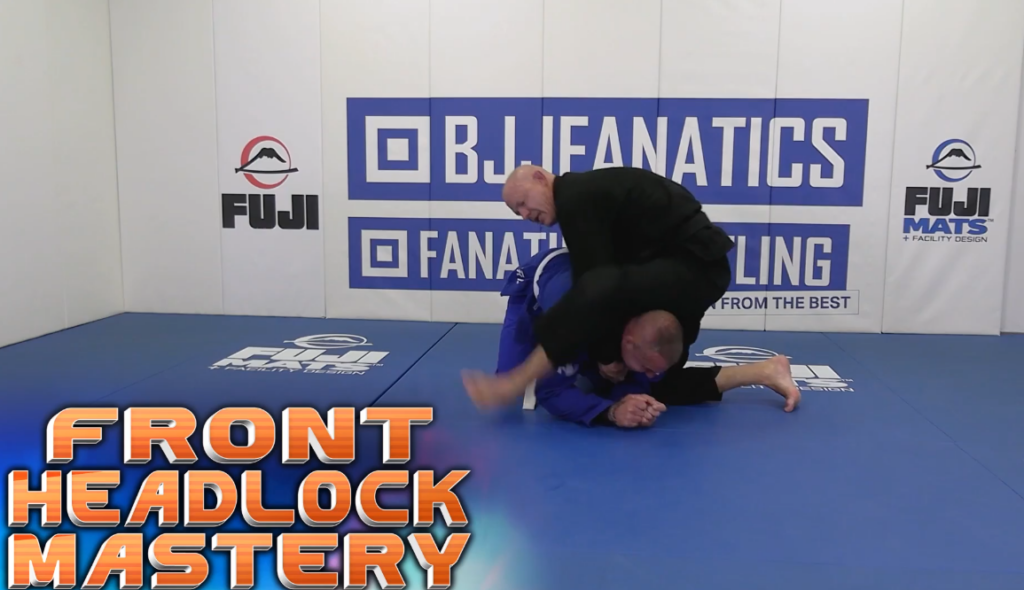
DVD FRONT HEADLOCK MASTERY LUKE HARRIS DVD AVAILABLE HERE
Who Is This For?
This instructional is ideal for intermediate grapplers (blue belt and above) who know the basic front headlock submissions but want a systematic approach. Gi and no-gi grapplers both benefit, though gi players get additional options (clock choke, bow and arrow).
It is particularly valuable for wrestlers transitioning to Jiu-Jitsu who already feel at home in the front headlock position but lack a finishing system. Harris’s take on entries — arriving through takedowns rather than scrambling into front headlock — will resonate with wrestlers who think in chains.
Competitors at any level will find the submission sequences immediately applicable. The Masters division competitor will appreciate the focus on positionally safe attacks that don’t require athletic scrambles. Beginners may find the volume count moderate for a single-position instructional, but the depth justifies the investment.
Pros & Potential Drawbacks
Pros:
- Entry variety is excellent: Arriving through takedown chains instead of reaching from distance is a genuinely better approach than most front headlock instructionals
- Covers underused finishes: The rodeo choke, Amy choke, Smitty choke, and rolling Judo choke add depth beyond the standard brabo family
- Live sequence footage: Volume 2 includes real-time rolling demonstrations that show the system working against resistance
- Gi and No-Gi applicable: Core mechanics work in both contexts, with gi-specific additions in the submission section
- Well-organized progression: Entries → submissions → transitions → brabo family creates a logical learning path
Potential Drawbacks:
- Limited turtle attack depth: While front headlock transitions to the turtle are discussed, more time on what to do when the opponent turtles up would strengthen the system
- Volume 3 is the weakest: The reverse omoplata and sankaku entries, while creative, feel less essential than the core submission material in Volumes 2 and 4
- Pacing can be quick: Some chapters move through mechanics faster than ideal for newer students — rewatching sections is expected
Lock The Neck!
The Front Headlock Mastery Luke Harris DVD delivers a complete front headlock system with emphasis on disguise, entry variety, and submission chains. The Front Headlock Mastery Luke Harris DVD draws from a submission specialist with a 10-3 MMA record and high-level gi achievements, which gives the content credibility across both rule sets.