




Key Takeaways
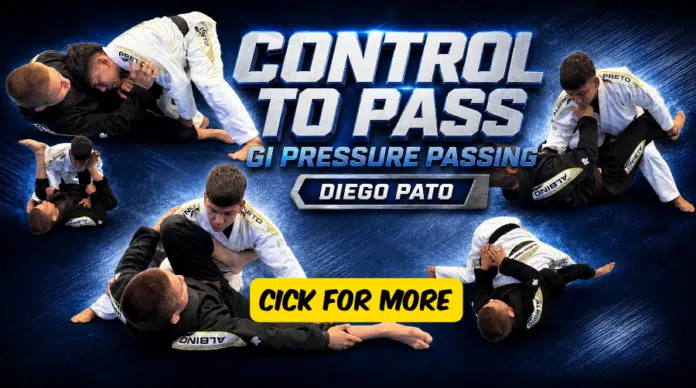
- Control To Pass Gi Pressure Passing Diego Pato DVD Review — a two-volume Gi pressure-passing instructional from Diego “Pato” Oliveira that maps one connected route from approach and hip control to the finished pass against De La Riva, reverse De La Riva, and heavy frames.
- Built around a single recurring idea — take the space away first, force your weight into the hips, then pass — rather than a loose list of disconnected techniques.
- Best for Gi competitors who already understand basic guard passing and want a pressure route through modern open guards; it is not a from-scratch curriculum for raw beginners.
- Tightly Gi-specific: the grip and friction mechanics do not transfer cleanly to No-Gi, even though the underlying space-denial logic does.
- Compact at roughly an hour and a half across ten substantive chapters, which leaves half guard, lasso/spider, and failed-pass recovery untouched.
- BJJ World Expert Rating: 8.5 out of 10.
Control to Pass Gi Pressure Passing Diego Pato DVD DOWNLOAD
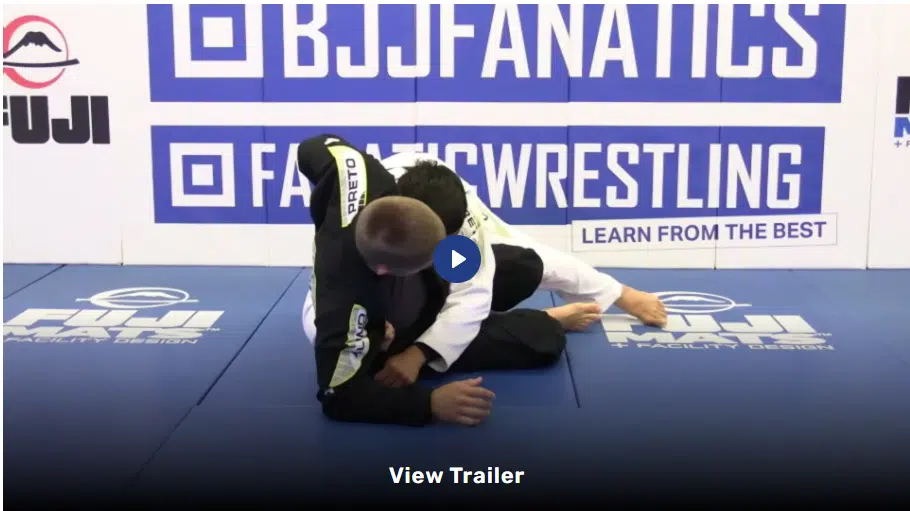
Diego “Pato” Oliveira has built his career on a skill most competitors treat as an afterthought: passing with pressure rather than speed. Control To Pass Gi Pressure Passing by Diego Pato is his attempt to bottle that skill into a two-volume course, and it rests on a deceptively simple thesis — that a pass fails not because the technique is wrong, but because the passer’s weight is in the wrong place before the technique even starts.
The result is a focused, genuinely sequential system aimed at the guards that actually appear in modern Gi competition, rather than a broad guard-passing curriculum. That distinction matters, because it defines both who this course is for and who will walk away underwhelmed.
Why Pressure Passing Needs A System, Not A Highlight Reel
Pressure passing in the Gi is the most reliable way to break a guard player because it removes the one thing a guard cannot function without: space. Open guards such as De La Riva and reverse De La Riva survive on distance management — the guard player uses the hook, the sleeve, and the collar to keep the passer at range, off-balance them, and build attacks before the passer can settle. A pressure system therefore has to solve the entry problem before it can solve the finishing problem, and that is exactly the sequencing Pato builds the course around.
The site has covered this territory before, usually at broader scale. Felipe Pena’s open-guard passing, Marcus “Buchecha” Almeida’s pressure passing, Bernardo Faria’s pressure passing system, and William Dorman’s passing-and-submissions set all take a wider view of the same problem. Pato’s course is deliberately narrower: it does not try to cover every guard, only the ones he actually meets in the light-featherweight meta.
Diego Pato: Why He Is Credible On This Topic
Diego Oliveira Batista — “Pato,” the Portuguese word for “duck,” a nickname his training partners gave him as a young athlete with unusually large feet — is a black belt under Cicero Costha who currently trains out of Art of Jiu-Jitsu in the United States. A Peso Pluma (light featherweight, around 64 kg), he lists pressure passing among his favorite positions, alongside lapel guard and footlocks.

The competitive record makes the credibility argument by itself. Pato is a five-time IBJJF World Champion (2021, 2023, 2024, 2025 and 2026), a two-time IBJJF No-Gi World Champion, a multiple-time Pan Champion, and an ADCC silver medalist in 2024. Pressure passing is not a side interest for him — it is how he beats the best light featherweights in the sport, where opponents are fast, flexible, and hard to pin without clean mechanics. BJJ World has separately reviewed Pato’s No-Gi Ankle Locks To Heel Hooks; this course is a different animal, rooted entirely in the Gi.
Control To Pass Gi Pressure Passing Diego Pato DVD Review: Volume By Volume
The two volumes run roughly 42 and 44 minutes respectively — about an hour and a half in total — and are structured as one continuous argument rather than two independent releases. Volume 1 is the “why your pass fails” layer; Volume 2 is the “how to finish” layer.
Volume 1: Building The Pressure Passing Foundation
The first volume opens with the Side To Side Approach Drill, which teaches weight transfer without committing — the passer shifts side to side to unsettle the guard before stepping in. From there it moves into crowding hips, the entry problem at the heart of the whole course, and then into details on keeping your base and using frames, the longest chapter in either volume at around thirteen minutes. That allocation is telling: the frame fight is where most pressure passes actually die, and Pato spends the most time on it.
The Crazy Dog chapter is the volume’s most distinctive idea — a pass that functions primarily to force a predictable reaction, which then opens the cleaner finishes in Volume 2. The volume closes with a short Live Action Drills segment that shows the concepts under resistance.
Volume 2: Passing Attacks And Beating The Open Guard
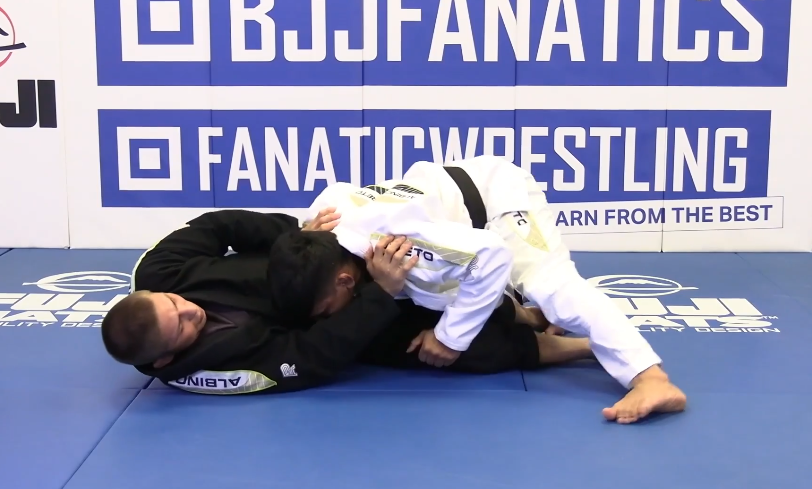
The second volume pivots from establishing pressure to converting it. The knee slice portion is the longest chapter in the entire course at fifteen minutes and doubles as Pato’s answer to reverse De La Riva. Smash passing follows as a heavier finishing option, and once again, addresses the De La Riva.
Inside Pressure Passing focuses on beating the DLR hook directly — how to keep base while the De La Riva player attacks, then pass inside. A brief live action drill sits between them. What makes the material cohere is that every finish is presented as the same problem wearing different clothes: crowd the hips, stay heavy while the opponent moves, create the reaction, then finish. That is a real system, not a grab-bag, and it is the strongest single argument for the course.
What It Actually Takes To Use This Instructional
The live-action drills are short — under four minutes in Volume 1 and under a minute in Volume 2 — so the burden of drilling falls squarely on the viewer. The most portable pieces are the Side To Side Approach Drill and the Crazy Dog reaction work, both of which can be inserted into a passing warm-up immediately.
The frame-fighting material is the slowest to internalize; expect to work the “maintain base while they frame” ideas for weeks before the knee slice and leg smash start to feel like one continuous movement rather than separate techniques.
This is the kind of course that suits a competition camp: a grappler who already passes can spend a focused block sharpening the entry and the reaction game, then return to it before tournaments. It is not a replacement for a general passing foundation, because it assumes one already exists.
GET IT HERE: Control to Pass Gi Pressure Passing Diego Pato DVD
Who Is This For?
The ideal buyer is a Gi competitor at purple belt or above — or an ambitious blue belt who already holds base and passes in principle — who wants a pressure route through modern open guards and is willing to supply the drilling time the short runtime does not hand them. Pressure-style passers and lighter weights who cannot simply out-athlete a flexible guard player will get the most out of it.
It is a poor fit for raw beginners who are still learning to pass at all, for No-Gi-only athletes (the specific grips and friction mechanics are Gi-bound), and for anyone specifically hunting half guard, lasso, or spider guard material. Buyers who measure value in hours-per-dollar will also find it thin next to longer multi-volume passing sets, and the course offers little on failed-pass recovery or re-guard counters.
Pros And Potential Drawbacks
Pros:
- A genuinely connected sequence — approach, hip control, base against frames, reaction, finish — rather than a disconnected list of passes.
- An elite, topic-credible instructor whose pressure passing is his actual competitive game, not a rented specialty.
- Honest Gi specificity: the course knows what it is and does not pretend to be all things to all grapplers.
- The frame-fighting and base chapters are the longest in the set, which is where the real value lives.
- The Crazy Dog and side-to-side approach give usable training tools, not just finished passes.
Potential Drawbacks:
- At roughly an hour and a half, the per-minute price is steep next to longer pressure-passing instructionals with far more breadth.
- Coverage is a bit narrow: no half guard, lasso, or spider guard, and no seated-guard decision-making before the guard is established.
Pressure Your Way Past The Legs
Control To Pass Gi Pressure Passing Diego Pato DVD lands at 8.5 out of 10 — a strong, focused Gi pressure-passing system from a five-time world champion, held back by a short runtime and deliberately narrow guard coverage.
It is not the site’s definitive pressure-passing resource; that broader lane still belongs to longer sets like Buchecha’s and Faria’s. But for the competitor it is aimed at — a Gi player who already passes and wants a connected route through De La Riva, reverse De La Riva, and heavy frames — this is an efficient, unusually coherent buy.
Reviewed by: Ognen Dzabirski, BJJ black belt, full-time coach and gym owner. The views expressed by the author do not necessarily reflect the views of the publication