










- A black belt’s clip argues some academies emphasize Gi training less for “technical development” and more because selling Gis is a reliable revenue stream.
- The BJJ Schools Gi requirement debate quickly spilled into the usual hot zones: Instagram comments, gym group chats, and long Reddit threads about mandatory uniforms.
- Supporters say uniform policies build culture and keep standards consistent; critics call it a stealth tax that can price people out.
- The real fight isn’t Gi vs No-Gi — it’s transparency: are students being told the truth about why the schedule and rules look the way they do?
The Clip That Lit Up The Mat Space
Every few months, Jiu-Jitsu gets a new “mat truth” that hits a nerve because it’s painfully plausible. This week’s version: the idea that a lot of Gi-heavy schedules aren’t about tradition or better learning — they’re about the pro shop.
The spark came from a short clip where black belt Sam Gaier framed Gi training as a business lever, not a technical necessity.
The reason it landed is simple: most students can feel when a policy is about coaching… and when it’s about commerce. And nothing raises eyebrows faster than a rule that seems designed to funnel your money toward one very specific rack of gear.
Sam Gaier’s Blunt Claim: “That’s His Moneymaker”
Gaier didn’t dance around it. He put the suspicion into plain language — the kind that makes people laugh, then immediately check their bank app.
Your coach isn’t having you train in the gi because it’s making you more technical.
– Sam Gaier –
He followed with the punchline that turned the clip into gasoline:

He’s having you train in the gi because that’s his moneymaker at the gym.
– Sam Gaier –
From there, Gaier went a step further — not just “they want to sell you a Gi,” but “they’re designing the entire schedule to attract the kind of students most likely to buy in.”
That’s the part that makes this feel bigger than a gear complaint. It’s not only about fabric — it’s about who gets catered to, who feels welcome, and who quietly disappears when the costs stack up.
BJJ Schools Gi Requirement: Tradition, Control, Or Cash?
To be fair, the BJJ Schools Gi requirement conversation isn’t new. Plenty of gyms have required uniforms for decades, and not every uniform rule is a scam. Some academies want a clean, consistent look.

Some want to limit abrasive materials, weird pockets, or novelty gear that turns training into a costume party. Some have affiliations that standardize uniforms across locations.
And yes — some gyms genuinely believe Gi training develops certain attributes: patience, grip fighting, slower problem-solving, and a different kind of positional control. Even if you disagree, that argument exists in good faith.
But the skepticism arrives when the requirement becomes specific and non-negotiable:
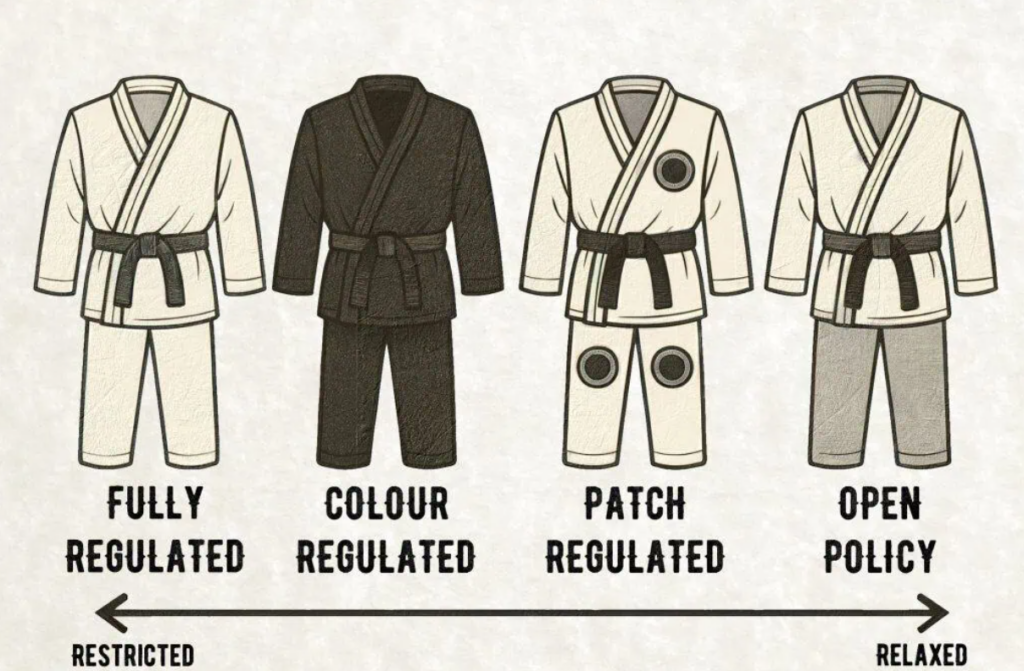
- Not “train in a Gi,” but “train in our Gi.”
- Not “patches are optional,” but “you need these patches.”
- Not “we prefer team gear,” but “you can’t step on the mat without it.”
This is where the vibe shifts from “team culture” to “toll booth.”
Because for most students, the Gi isn’t a one-time purchase. It’s two or three Gis if you train often. It’s replacing a ripped one. It’s upgrading sizes. It’s buying a second set so you’re not washing at midnight like you’re prepping fight kits for a traveling circus.
And if the rule is “only our stuff,” then the pro shop becomes part of your monthly training plan whether you asked for it or not.
Gaier’s bigger point isn’t that gyms shouldn’t sell gear. It’s that students shouldn’t be sold a fairy tale about why certain rules exist.
I’m not faulting them for wanting to run a successful business.
– Sam Gaier –
And then the line that explains why the clip hit so hard:
I will fault them for lying to you and telling you that the gi is making you more technical because they know that it’s not that.
– Sam Gaier –
Whether you agree with his technical take or not, that accusation — “they’re lying” — is what turns a mild gripe into a full-on culture war.
When “Team Uniform” Starts Feeling Like A Tax
The most relatable evidence in this debate isn’t a theory — it’s the endless supply of student stories. One of the most common: the growing kid, the wrong size, the ripped sleeve, the “I can afford a new Gi… just not your new Gi.”
In one popular thread, a teenager described asking to buy a better-fitting Gi elsewhere and being told no — the only solution was purchasing a replacement directly from the academy. The coach’s explanation was that allowing outside Gis would “mix up everyone” and open the door to students showing up in anything.
That’s the perfect example of why this argument never dies. Because even if you accept “uniformity” as a legitimate goal, the student experience can still feel like: pay the fee or don’t train.
And then there’s the other side of the financial squeeze: people selling gear just to keep showing up. Another discussion thread revolved around the idea of selling Gis to cover training costs — and the comments quickly turned into a reality check about how expensive the sport can get when you’re trying to stay consistent.
You don’t need a spreadsheet to see the pattern:
- Tuition goes up.
- Required gear multiplies the cost.
- Students start making “temporary” decisions (selling equipment, skipping classes, training less).
- Eventually, “temporary” becomes “I stopped training.”
That’s the uncomfortable truth behind the BJJ Schools Gi requirement debate: mandatory academy uniforms don’t just affect aesthetics. They shape retention. They decide who can stick around long enough to become good.
If This Is About Money, Students Want Honesty — Not A Lecture
The reason this topic explodes every time is because it’s happening in a sport that sells itself as humbling, character-building, and community-driven. That brand collapses the moment students feel squeezed.
If a gym says, “We require team Gis because it supports the academy, helps us keep the lights on, and keeps the room looking professional,” a lot of students will shrug and accept it — even if they don’t love it.
But if a gym says, “You must buy our Gi because Gi makes you more technical,” while the real engine is merchandise revenue, that’s when people get angry — and they get louder than any marketing pitch.
Gaier’s clip didn’t accuse every coach of running a racket. It did something more dangerous: it gave students a simple question to ask themselves every time a policy “for your development” lines up perfectly with a purchase.
So the story isn’t really Gi vs No-Gi, or even whether the Gi is “dying” or thriving. It’s about whether gyms can be upfront about business realities without hiding behind tradition, technical jargon, or a guilt trip.
Because once students suspect the BJJ Schools Gi requirement is less about coaching and more about cashflow, it’s hard to unsee. And in a sport built on trust — trust in your training partners, trust in your coach, trust that you’re not being played — that’s the kind of doubt that sticks.