






Key Takeaways
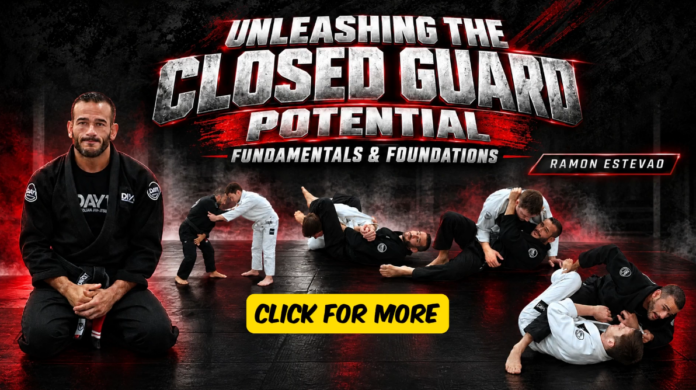
- Closed Guard Potential Ramon Estevao DVD review — a four-part, Gi-specific fundamentals instructional that builds the closed guard from first principles and drills the hip movement behind every technique.
- Estevao is an IBJJF-certified first-degree black belt under Marcos Tinoco and Bernardo Faria, with gold at the 2025 IBJJF Atlanta Open and the 2026 IBJJF New York Open.
- The course covers three ways to pull closed guard from standing, how to respond when the guard gets opened, six submissions, and seven closed guard sweeps.
- The real differentiator is Part 4 — nine hip-movement drills designed to make the sweep and submission mechanics automatic under resistance.
- Roughly an hour and 40 minutes of Gi-only material at $79: a clean beginner system, not a No-Gi or advanced lapel game.
- BJJ World Expert Rating: 8 out of 10.
AVAILABLE HERE: Closed Guard Potential Ramon Estevao DVD
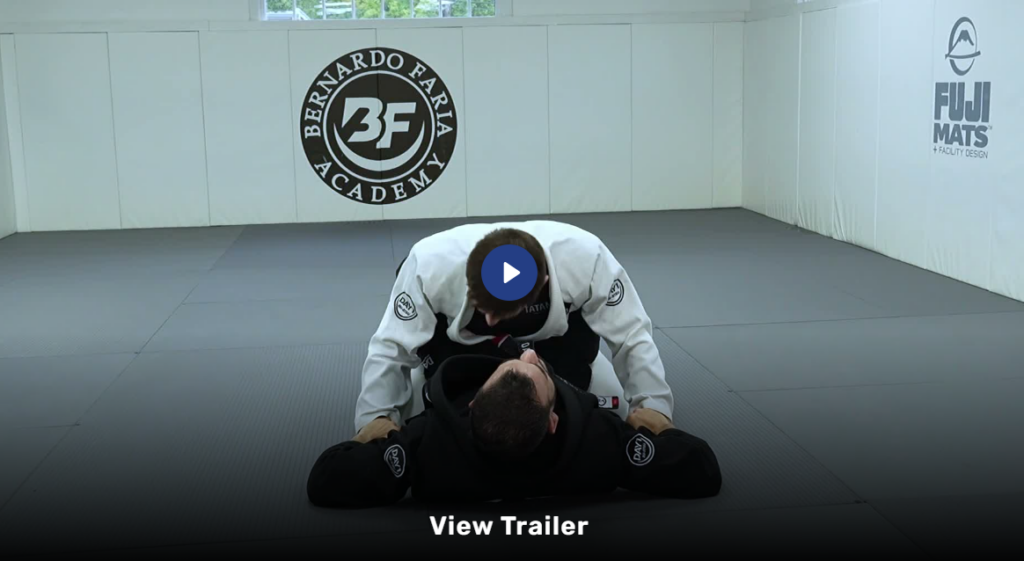
The closed guard is the first guard almost every grappler learns and, just as often, the first one they quietly abandon. Ramon Estevao’s Unleashing The Closed Guard Potential: Fundamentals & Foundations is built on the idea that the problem was never the guard itself — it was the order in which it got taught.
Estevao’s answer is a drills-first structure. Instead of dumping a list of submissions and sweeps and hoping the movement shows up in live rolling, he front-loads the concepts and the hip mechanics, then returns to them at the end with a dedicated drill section. For a beginner, that sequencing matters more than the technique list, because a closed guard that only works against a non-resisting partner is not really a closed guard.
Is the Closed Guard Still a BJJ Classic?
Closed guard is the classic bottom position, and for years it was treated as the natural starting point for every beginner. The problem is that teaching it as a static list of moves — here is the scissor sweep, here is the armbar — produces a guard that falls apart the moment a training partner actually postures and passes. This course exists to fix exactly that, which is why it reads as a teaching system rather than a highlight reel of techniques.
That framing matters because it changes who should buy it. Anyone searching for the best closed guard instructional for their own game is really asking one of two questions. A competitor or an upper belt usually wants a deep, specialised system with an answer to every modern counter. A white or blue belt — or a coach writing a beginner curriculum — wants the opposite: a small number of well-connected fundamentals taught in an order that sticks. This is firmly the second product, and it is honest about being that.
Compared with the closed guard instructionals this site has already reviewed, Estevao occupies the fundamentals slot. Adam Wardzinski’s Closed Guard Reintroduced is a sprawling modern competitive Gi system; Malachy Friedman’s The Closed Guard chains attacks into a system; Craig Jones’s Closet Closed Guard lives entirely in No-Gi; and the Guard System Roger Gracie bundle documents a championship Gi game. Estevao does not try to out-depth any of them. He is the on-ramp.

Who Exactly is Ramon Estevao?
Ramon Estevao is an IBJJF-certified first-degree black belt under Marcos Tinoco and Bernardo Faria. He trains and competes with Day 1 Jiu-Jitsu in Newton, Massachusetts, and holds gold medals at the 2025 IBJJF Atlanta Open and the 2026 IBJJF New York Open.
Day 1 is run by two of the most credentialed figures in the sport — Bernardo Faria, a five-time world champion and the co-founder of BJJ Fanatics, and Marcos Tinoco, a Marcelo Garcia black belt and multiple-time world champion — so Estevao’s teaching comes from a room where fundamentals are treated seriously rather than as a warm-up before the real technique.
None of that makes him a household name yet, and this review reflects that. This is a first fundamentals release from an instructor still building a competitive and coaching profile, and the credibility that matters for the product is the specific kind he does have: an IBJJF black belt who competes actively and teaches beginners daily at a school with a structured curriculum.
Closed Guard Potential Ramon Estevao DVD Review: Detailed Breakdown
The course is four parts, not volumes, and it is a closed guard fundamentals course first and a Gi-specific one throughout. Every submission and sweep is built on collar-and-sleeve grips, which means none of it transfers cleanly to No-Gi. That is a feature of the product rather than a flaw, but it is worth stating plainly before anyone buys it expecting a universal system.
Part 1 — Concepts, Pulling & Opening The Closed Guard
The first part is the conceptual spine. Estevao opens with closed guard concepts before getting to grips, then works through ways to pull closed guard from standing using the foot on the hip, and the collar-and-sleeve grip with the foot on the biceps.
From there he addresses the moment most beginner guards die: what to do when the opponent opens the guard. He covers the responses from the knees, stapling the leg and switching levels and the response vs standing against the toreando pass. Eight chapters in total, and it is the section most buyers will rewatch the most.
Part 2 — Submissions From Guard
The submission section stays in classic closed guard territory. It runs the cross collar choke and its variation, the baseball bat choke, the armbar, the kimura, and the triangles. None of it is exotic, and that is the point: these are the closed guard submissions a beginner should actually be able to hit, taught with the grip and angle details that separate a choke from a squeeze. The cross collar choke from closed guard, in particular, gets the attention it deserves rather than being treated as a throwaway first move.
Part 3 — Sweep-Sub Combos
Part 3 covers four super classic closed guard sweeps: the hip bump, the scissor sweep, the flower sweep, and the pendulum sweep. The section’s title is the giveaway here: these are sweeps taught with an eye toward the submissions they set up, which is the difference between a guard that sweeps in isolation and one that threatens from two directions at once.
Part 4 — Next Level Drills
The final part is what earns the course its drills-first billing. Nine hip-movement drills — from shooting the hip high and crossing the legs, to the kimura drill and the scissor sweep variations — isolate the mechanics from Parts 1 through 3 so they can be rep’d outside live rolling. The logic is sound: a scissor sweep fails in a roll not because the student does not know the steps but because the hip movement is not automatic, and this section is the bridge between knowing and doing.
The Case for (Pulling) Closed Guard
The realistic way to use this is as a two-to-four-week fundamentals block. The material is short enough — about an hour and 40 minutes in total — that a grappler can watch it in one or two sittings, then spend the following weeks drilling the Part 4 movements before each rolling session. Coaches can lift the structure almost directly: teach the concepts, teach the three pulls and the pass responses, layer in the submissions and sweeps, then run the drill section as the finishing work for the unit.
The honest limitation is transfer. Everything is built on Gi grips, so a No-Gi player gets the concepts but not the usable technique, and the drills build closed guard hip movement specifically rather than general athleticism. Expect the benefit to show up in the Gi first, and expect the No-Gi player to have to rebuild the grips from scratch.
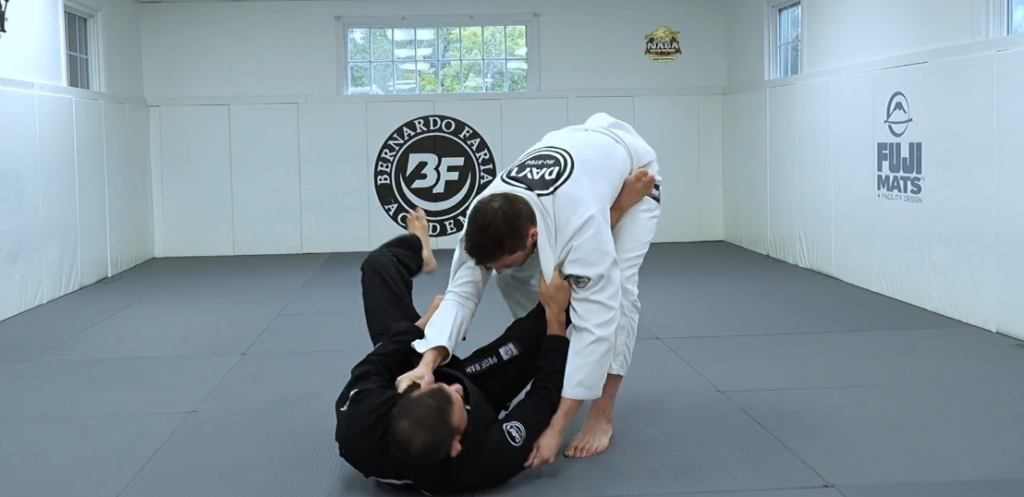
Unleashing The Closed Guard Potential Ramon Estevao DVD DOWNLOAD
Who Is This For?
This is a white belt closed guard course and a blue belt refresher, and it is also a genuinely useful tool for a coach building a beginner curriculum. The grappler who keeps getting stuck on their back with a guard that never threatens anything will get the most out of it, because the concepts and the drills are aimed exactly at that problem.
It is not for everyone. A purple belt or above who already has a working closed guard will find little here they have not seen, and anyone whose game is No-Gi will have to translate every grip. Players looking for an advanced lapel game, or the depth of a six-volume competitive system, should look to one of the other closed guard instructionals reviewed on this site instead. The omission is not a mistake; it is the product’s entire pitch.
Pros And Potential Drawbacks
Pros:
- Genuinely foundational. The concepts-first, drills-last structure is the right order for beginners, and it is rare to see a fundamentals course this deliberate about sequencing.
- Clear Gi fundamentals. The grips are specific, the angles are shown, and the cross collar choke gets the time it deserves.
- The drill section closes the loop. Part 4 is the reason the movements are more likely to stick than they would from a pure technique list.
- Teachable. The four-part structure maps cleanly onto a class or a curriculum block, which makes it an easy recommendation for coaches.
- Honest scope. It does not pretend to be an advanced system, and it is priced and positioned as a fundamentals course.
Potential Drawbacks:
- Gi-only, with no No-Gi translation. Every submission and sweep depends on Gi grips, so No-Gi players get concepts but little directly usable technique.
- Farily standard material. There is nothing new here — it is a well-organised version of classic fundamentals rather than a system with a novel answer.
More Guard Will Make You Better
The Closed Guard Potential Ramon Estevao DVD does exactly what its subtitle promises: it gives a beginner the fundamentals and foundations of the closed guard, and it does so in an order that actually builds. The drills-first structure is its best argument, and the honest Gi-only, fundamentals-only scope is its honest disclaimer. For the white or blue belt — or the coach — who wants a clean starting point rather than another deep system, it is a well-made on-ramp rather than a destination.
Reviewed by: Ognen Dzabirski, BJJ black belt, full-time coach and gym owner. The views expressed by the author do not necessarily reflect the views of the publication