








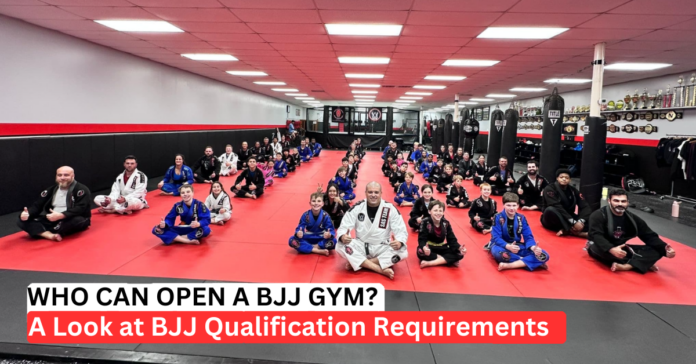

- In most countries, there is no legal requirement to hold a BJJ rank or coaching qualification to open a gym — it is treated like any other small business
- IBJJF academy registration requires a black belt head instructor, background checks, and SafeSport training, but registration is optional and only 1 of many governing options
- The UKBJJA provides a voluntary framework with safeguarding, coaching qualifications, and mandatory background checks — but membership is not legally required
- Insurance providers often act as the real gatekeepers, requiring minimum BJJ Gym qualifications and vetting before covering a gym
- Parents and students should not assume that any oversight or background checks exist — they vary wildly by region and affiliation
The Surprising Answer
In most parts of the world, anyone with enough money to rent a space and buy mats can open a BJJ gym. There is no government-issued coaching license for BJJ, no legally mandated minimum rank, and no universal BJJ background checks requirement. The only barrier is business registration — a process that treats opening a BJJ gym the same as opening a coffee shop or a laundromat. There are no standard BJJ gym qualifications that the law requires you to meet.
This reality surprises many people, especially parents looking for Jiu-Jitsu classes for their children. In regulated activities like school teaching, child care, or even driving instruction, specific certifications and background checks are legally required. For BJJ gyms, none of that applies unless a specific federation or insurer requires it. The question of BJJ gym qualifications is largely left to voluntary systems.
IBJJF Academy Registration: Optional But Structured
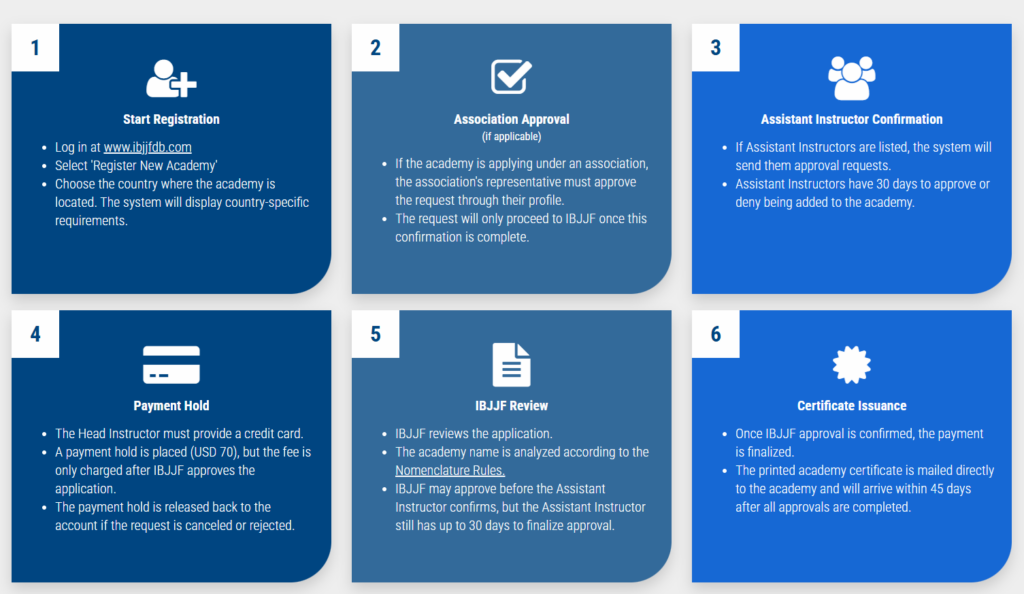
The International Brazilian Jiu-Jitsu Federation offers an academy registration system that many schools use as a signal of legitimacy. The IBJJF gym requirements are straightforward: the head instructor must be a registered IBJJF black belt, background checked within the last 12 months, and SafeSport trained within the last 24 months. The fee is $70 per calendar year.
If the academy operates under an association, the association representative must approve the registration. Assistant instructors listed on the registration must also confirm their inclusion within 30 days. Provisional black belts cannot serve as head instructors but may be listed as assistant instructors.

However, none of this is a license to operate. IBJJF registration is entirely voluntary. A gym can operate perfectly legally without it. The IBJJF does not inspect facilities, verify teaching quality, or enforce coaching standards beyond the rank and background check requirements. For parents asking “does this gym have proper oversight?”, IBJJF registration is one indicator — but its absence does not mean the gym is operating illegally or unsafely.
The UK Model: A Different Approach
The United Kingdom offers a contrasting model through the UKBJJA (UK Brazilian Jiu-Jitsu Association), which has established coaching pathways, insurance frameworks, and mandatory vetting that go well beyond what most US gyms encounter.
UKBJJA coaching qualifications are structured in two levels. The Level 1 Award in Assistant Coaching requires a minimum blue belt rank and covers roles, responsibilities, inclusive coaching practices, and session delivery. The Level 2 Certificate in Coaching allows graduates to lead their own coaching sessions and covers the full coaching toolkit.

These courses are nationally recognized and map to CIMSPA professional standards — the UK’s benchmark for the sport and physical activity sector.
The UKBJJA’s approach to background checks is notably strict. Every instructor, coach, referee, and volunteer must have a clear Enhanced DBS check (England/Wales), PVG (Scotland), or Access NI (Northern Ireland) certificate before membership is accepted.
Such BJJ background checks cost £68 for paid roles and £20 for volunteers, must be renewed every three years, and can be maintained with the DBS Update Service at £13 per year. This level of vetting represents a higher standard of BJJ gym qualifications than what exists in most other countries.
UKBJJA membership provides significant value in return. Individual members receive £5 million member-to-member liability insurance. Club members get £5 million public and product liability insurance, access to first aid and safeguarding training, and support for running their club.
UKBJJA gym standards are enforced through this membership system — not by law, but by the practical reality that operating without insurance is a serious liability risk.
The US Reality: Minimal Oversight
The United States has no equivalent to the UKBJJA. There is no national BJJ governing body, no standard coaching curriculum, and no mandatory background check requirement. The Ronin Athletics article on BJJ’s Olympic absence highlights why: Brazilian Jiu-Jitsu lacks a unified international federation recognized by the IOC. That fragmentation extends to gym oversight.
In the US, what regulates gyms is primarily insurance. Commercial liability insurers require gyms to meet certain standards — staff qualifications, facility safety, and sometimes BJJ background checks — before issuing coverage. But the specific requirements vary by insurer and state. Some require nothing beyond a business license.
BJJ coaching certification standards are non-existent at the national level. This means BJJ coaching certification in the US is entirely at the discretion of the gym owner or affiliation.
Some major affiliations fill part of the gap. Gracie Barra, Alliance, CheckMat, and other large associations have internal quality standards, instructor requirements, and onboarding processes. But these are association policies, not legal requirements. A purple belt with no teaching experience can legally open a BJJ gym and claim any affiliation they choose. That is how minimal BJJ gym qualifications are in practice.
What This Means For Students and Parents
The absence of universal oversight creates an information problem for anyone choosing a gym. Parents enrolling children in BJJ classes cannot assume that the instructor has been background checked, has BJJ coaching certification, or is insured.
These things must be asked about directly. Unlike school sports programs that operate within regulated educational frameworks, private BJJ gyms operate as independent businesses with no external oversight unless they voluntarily submit to it.
The click hook of this article — “parents may assume checks exist that are not necessarily part of the belt system” — captures the issue precisely. A black belt is a measure of Jiu-Jitsu skill, not teaching ability, child safety training, or business competence. The two are entirely separate. BJJ background checks are not tied to belt rank, and BJJ gym qualifications for coaching are not standardized anywhere in the world without voluntary federation membership.
There are BJJ gym safety standards being developed, but progress is uneven. The UKBJJA framework provides a model of what voluntary oversight can look like: structured coaching pathways, mandatory background checks, and insurance-backed accountability. In the US and much of the rest of the world, that level of structure remains aspirational.
The best advice for anyone looking for a gym: ask about background checks. Ask about coaching qualifications. Ask about insurance. If the answers are vague or defensive, that tells you everything you need to know about the BJJ gym qualifications the school prioritizes. The rank on the wall means less than the systems in place to keep students safe.