







- IBJJF bans natural rashguard brand from competition, sparking a debate about material standards
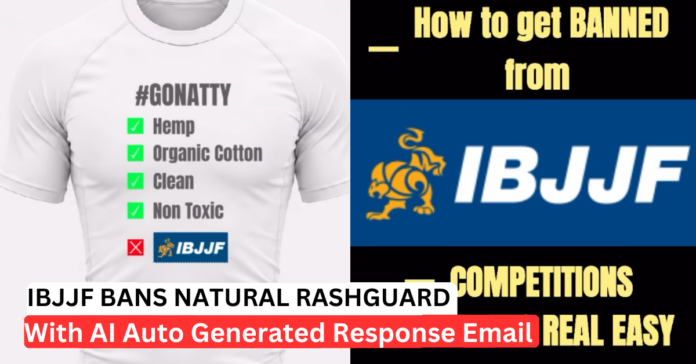
- Natural Rashguard, a small company from Noosaville, Queensland, makes rashguards from 67% organic cotton, 28% hemp, and 5% spandex
- Founder Bryce Flynn sent samples to the IBJJF for testing and received what he describes as an AI-generated response praising polyester
- The IBJJF’s uniform rules require rashguards to be “elastic material (skin tight)” but do not explicitly ban natural fibers
- The rejection adds to ongoing questions about IBJJF’s role in shaping the apparel market
IBJJF Bans Natural Rashguard Brand
The International Brazilian Jiu-Jitsu Federation has denied approval to Natural Rashguard, an Australian brand producing rashguards from organic cotton and hemp, in a decision that has reignited questions about the IBJJF’s material standards.
The Natural Rashguard IBJJF controversy centers on whether the federation’s rejection was based on genuine performance concerns or an arbitrary IBJJF polyester preference. The Natural Rashguard IBJJF case has drawn attention because it involves a natural fiber rashguard made without synthetic materials beyond 5% spandex.
Natural Rashguard, founded by Bryce Flynn in Noosaville, Queensland, produces rashguards made from a blend of 67% organic cotton and 28% hemp with 5% spandex for elasticity. The company sought IBJJF approval for competition use but was denied after a months-long exchange that included sending physical samples to the IBJJF’s Irvine, California office for testing.
The IBJJF’s response, which Flynn characterized as “AI-laden,” reportedly cited polyester as the superior material for athletic wear while rejecting the natural fiber alternative.
The founder made the contents of the exchange public, and the email — with its repetitive sentence structures, randomly bolded words, and textbook descriptions of polyester’s properties — bore the hallmarks of AI-generated text.
The AI-Generated Response
According to Flynn, the rejection email from the IBJJF did more than simply deny approval. It went into lengthy detail about why polyester is the superior material for rashguards, praising its moisture-wicking properties, durability, and elastic characteristics in language that appeared formulaic and automated.
The irony was not lost on the BJJ community. A federation that represents a traditional martial art — Brazilian Jiu-Jitsu — used what appears to be a generative AI response to tell a natural material company that synthetic fabric is better.
The email reportedly contained textbook-style descriptions of polyester with bolded technical terms that seemed pulled from a material science primer rather than a human-written evaluation.

The IBJJF’s own rules governing rashguard approval, found on the IBJJF uniform page, require rashguards to “be made of elastic material (skin tight)” and cover the torso from the shoulders to the waistband.
Rules do not explicitly mandate polyester or ban natural fibers. Flynn argued that the 5% spandex content in his rashguard provides the required elasticity, making the fabric technically compliant.
The Irony of Chemical Concerns
The Natural Rashguard IBJJF ban carries an additional layer of irony. In May 2023, the Center for Environmental Health issued warnings about endocrine-disrupting chemicals found in synthetic workout gear, including polyester-based activewear.
Several major athletic brands have faced lawsuits and consumer pressure to reduce or disclose the chemical content in their synthetic clothing. The IBJJF polyester preference stands in direct contrast to the growing trend toward natural fiber rashguard alternatives in the broader athletic apparel industry.
A hemp and organic cotton rashguard avoids many of those chemical concerns entirely. Hemp is naturally antimicrobial, breathable, and more environmentally sustainable than polyester production. Organic cotton provides comfort without the petroleum-based manufacturing process of synthetic fabrics.
Yet the IBJJF chose polyester — a material linked to potential health concerns — over a natural alternative, citing material superiority.
What This Means For Brands
The IBJJF natural rashguard ban highlights a structural issue for small apparel companies in the BJJ market. The IBJJF’s influence over what is considered “competition legal” shapes purchasing behavior far beyond actual tournament attendance. Many academies and practitioners treat IBJJF approval as a baseline for quality, even if they never compete.
For a small Australian BJJ brand like Natural Rashguard, the rejection means their product cannot be marketed for competition use, narrowing their addressable market significantly. The Bryce Flynn rashguard story has become a case study in how federation gatekeeping affects product innovation in the grappling apparel space.
The IBJJF rashguard rules process itself has come under scrutiny. The requirement to mail physical samples to a single office in California — without clear criteria for what constitutes acceptable material — creates barriers for small companies that larger polyester manufacturers do not face.
Could This Change IBJJF Policy?
The Natural Rashguard IBJJF controversy has prompted discussions in the BJJ community about whether the IBJJF should update its uniform policies to be more transparent about material requirements, and whether the federation should accept natural fiber rashguard alternatives that meet the technical requirements of “elastic material (skin tight).”
The Natural Rashguard IBJJF rejection could serve as a catalyst for a broader conversation about material standards in Jiu-Jitsu apparel.
Without a clear revision to the rules, the current posture suggests that the IBJJF considers polyester and other synthetic fabrics as the only acceptable material for competition rashguards — a position that excludes sustainable alternatives and raises questions about the federation’s criteria for approval.