




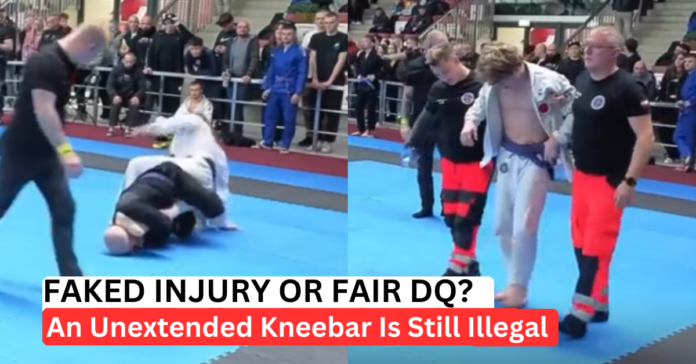

- Controversial Blue Belt DQ in Polish Championships: a 6-0 lead, a leg entanglement, and a referee’s call that ended his tournament in the first match.
- The technique was reportedly ruled an illegal kneebar attempt — a submission banned at blue belt under IBJJF kneebar rules.
- The real question isn’t whether the submission was ever finished. It’s what a referee is supposed to judge: leg placement and apparent intent.
- Prucnal and many commenters allege his opponent faked the injury; footage from the next round shows the same competitor walking out normally.
What Happened: The Disqualification
Patryk Prucnal was six points up and in control of his opening match at the XXII Mistrzostwa Polski BJJ — the Polish BJJ Championships, held November 7 in Grodzisk Mazowiecki — when the referee stopped the bout and awarded it to his opponent. The call: a disqualification for what reporting describes as an illegal kneebar attempt.
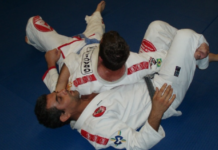
Footage shared by Prucnal shows him entering a leg entanglement and positioning what could be read as a kneebar setup, though the submission was never fully extended. Almost immediately, his opponent grabbed at his own leg and stayed down. Two tournament organizers helped the competitor off the mat, and he appeared unable to put weight on the affected leg.
The match was awarded to Prucnal’s opponent by disqualification. What turned the clip into a story was the next-round video: the same competitor walking onto the mat with no limp and no apparent difficulty.
“Unfortunately, even though I won the match 6-0, I was disqualified and my start at the Polish Championships ended in the first match.”
–Patryk Prucnal, on Instagram –
Why The Kneebar Is Illegal At Blue Belt
This is where most of the early coverage undersold the story. The kneebar is not a banned move across the board — it is one of several leg attacks the IBJJF holds back until a competitor reaches brown belt.
Under IBJJF kneebar rules, the straight kneebar is illegal at white, blue, and purple belt, and only becomes legal at brown and black belt. The straight ankle lock is legal from white belt; the kneebar is not, which is exactly why the kneebar is illegal at blue belt but a routine attack at brown.

The part practitioners argue about is what the referee was actually judging. The offence isn’t “applied a kneebar.” It’s “entered a position with apparent intent to kneebar.” That means “the submission was never extended” is not a defence.
If the leg placement reads as a kneebar attempt — for example, one leg threaded around the opponent’s hip while the other controls the near leg, the classic setup for a straight or lateral kneebar — the referee is expected to stop it, whether or not any pressure ever came on.
There is a reason the rule is written around intent rather than the finish. If a foul only counted once the knee actually hyperextended, lower belts could camp in kneebar positions and simply claim they were “just controlling” whenever a referee intervened.
The restriction is there to keep less experienced competitors out of positions they may not yet know how to defend — so the line has to be drawn at the setup, not the crank. It is why the kneebar sits on the short list of illegal moves in BJJ for lower belts, alongside the toe hold.
Posts from the submissionfighting
community on Reddit
The Two Camps: Competitor Responsibility Vs. Gamesmanship
The disqualification has split opinion, and the two camps are mostly arguing past each other rather than disagreeing on the facts.
Supporters of the call point to competitor responsibility. A blue belt who enters a position that reads as a kneebar is responsible for that position, whether or not he intended to finish the submission.
From this view the referee did exactly what the rulebook asks: he judged leg placement and apparent intent, protected the opponent, and enforced a rule that exists for a reason. Under BJJ disqualification rules, an illegal submission ends the match immediately, whatever the score.
Critics counter that no genuine attack ever happened and that the position was being used for control, not submission. They read the sequence differently: a dramatic reaction on the mat, followed by normal movement in the next round, looks like gamesmanship rather than a real injury — and a referee over-interpreting a superficially similar position.
The strongest version of this view isn’t that the kneebar rule is wrong, but that the call misread what was actually happening.
Both positions hold together. The rule genuinely is about apparent intent, not applied pressure — and a competitor who sells an injury is exploiting a gap the rulebook has no clean answer for, a window for BJJ gamesmanship.
The Injury-Theater Controversial Blue Belt DQ
The two videos are what pushed this past a routine disqualification. Helped off the mat, then walking out for the next round. Prucnal’s caption drove the point home, comparing the display to football’s roll-and-recover routine.
Worse than footballers
– Patryk Prucnal, on Instagram –
It is worth being precise here: the accusation is an allegation, not an established fact. Prucnal and many commenters allege the opponent exaggerated the injury, and the specific accusation of faking injury in BJJ to win a disqualification remains unresolved.
The opponent has not publicly responded, and no response was located by deadline. But the episode exposes a real weakness in competition Jiu-Jitsu — a referee cannot call a bluff on an injury claim in the moment, and the rules offer no penalty for an opponent who sells one.
What We Know Vs. What’s Unconfirmed
What is confirmed: the event, the 6-0 lead, the disqualification, and the two videos. Prucnal, who took silver at the 2025 European No-Gi Championship as a blue belt for Ralph Gracie, shared the footage himself, and the clip drew thousands of reactions.
What is not: the exact technique. Reporting describes the call as an illegal kneebar attempt, but neither Prucnal nor the organizers have publicly confirmed which move led to the disqualification — and his belt and division at this year’s event have not been confirmed either. Whether the injury was genuine is also unresolved.
Until the bracket or the organizers speak, the safest read is that a legal position and an illegal one were separated by a few inches of hip placement — and that is precisely the judgment a referee is paid to make.