



Key Takeaways
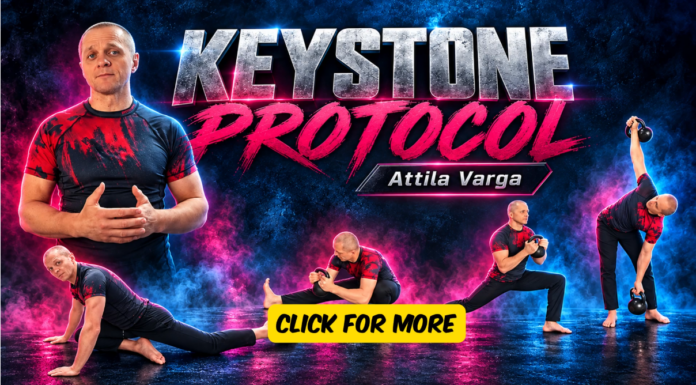
- Keystone Protocol Attila Varga DVD review — a three-module hip-and-pelvis system that moves from mobilizing, to activating, to loading the hips, taught by a Carlson Gracie black belt and StrongFirst kettlebell instructor.
- Who it’s for: the 40-and-over grappler with stiff or injury-prone hips who already owns a kettlebell — not young, already-mobile athletes chasing new technique.
- The differentiator is Module 3. The kettlebell-loaded Cossack squats, windmills and goblet squats build strength in end-range positions, which almost no other hip mobility for BJJ content touches.
- The catch: roughly 98 minutes of footage, no live BJJ application, and a familiar Module 1 — so the $79 price only pays off if you’ll actually run the loaded work.
- BJJ World Expert Rating: 7 out of 10.
Keystone Protocol Attila Varga DVD FULL DOWNLOAD
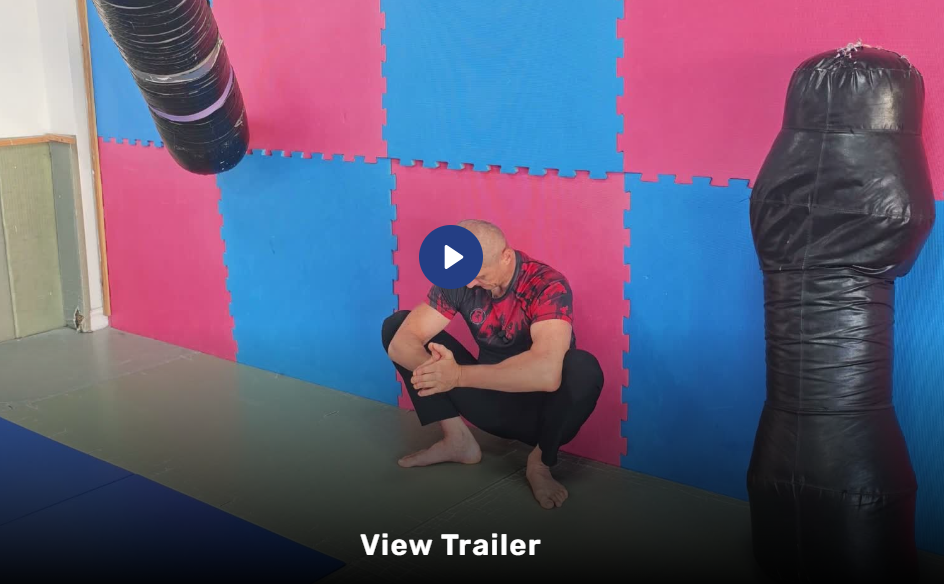
Keystone Protocol by Attila Varga is not a stretching routine, and that distinction is the entire pitch. Varga is a Carlson Gracie Brazilian Jiu-Jitsu black belt who also holds the StrongFirst SFG I and SFG II kettlebell certifications, and he built this three-module course around a simple progression: mobilize the hips to make space, activate the muscles that use that space, then integrate it all under load. It streams on BJJ Fanatics for $79, backed by a 30-day refund guarantee.
The buying question is narrower than “is this good?” It is whether a sub-two-hour, $79 mobility program is worth it when a dozen free hip mobility for BJJ routines already exist online — and whether the loaded third module actually justifies the price over the stretching-only advice the site already covers.
Why Loaded Hip Mobility Matters For Grapplers
Tight hips are one of those problems every grappler claims to train and almost nobody trains well. They shorten a guard player’s range, make a high knee shield and deep triangle setups harder, and bleed into lower-back strain on every bent-over posture and sloppy shot.
The site has covered the stretching side of this before — the Joshua Presley Hip Mobility for Guard Players review and the 7 Exercises For Incredible BJJ Hip Mobility list both live squarely in mobility territory. Neither one touches the loaded side: gaining range and then strengthening the positions you just opened, so the range actually sticks.
That is the gap the Keystone Protocol aims to fill. Varga’s framing — mobilize to make space, activate to use the space, integrate under load — is a strength-and-conditioning progression, not a flexibility course, and it borrows directly from the loaded mobility language of StrongFirst-style training. For the grappler fighting a tight front of the hip, the BJJ hip flexor mobility work is the entry point; the loaded module is what makes it durable.

A Carlson Gracie Black Belt And StrongFirst Kettlebell Instructor
Attila Varga has spent roughly 40 years in combat sports, training since 1986. He is a Brazilian Jiu-Jitsu black belt under the Carlson Gracie banner based in Slough in the UK, and a Muay Thai and boxing trainer. What makes him unusual for a mobility release is the second half of his resume: he holds the StrongFirst SFG I and SFG II kettlebell certifications and runs Thaifight Kettlebell London.
Now over 50, he coaches around durability for veteran athletes — his PowerUp Lifestyle program is aimed at the 40-and-over athlete trying to stay healthy rather than chase peak performance. That crossover, a grappler who is also a strength coach, is the credibility that matters for a course promising strength and mobility at the same time rather than flexibility alone.
Attila Varga Keystone Protocol DVD Review: The Three Modules
The course splits into three clearly labelled modules, each building on the last. The structure is the point: you do not just stretch, you train the new range.
Module 1: Mobilize / Make Space
Module 1 is the make-space phase and the most conventional part of the course. Across sixteen chapters Varga works the glutes, TFL, inner thigh and hip flexors, then moves through pelvis mobility in every direction — side to side, anterior-posterior tilt, and pelvis circles — before landing on familiar positions: the seated spiral, standing frog, figure 4, squat at the wall, pigeon, lizard, standing and kneeling hip flexor, and butterfly.
The sequencing is genuinely useful because each position is matched to the specific restriction it targets and ordered to open the pelvis from every angle, which a random ten-minute routine does not do. But nothing here is new, and anyone who has run a free mobility video has seen most of these shapes.
Module 2: Activate / Use The Space
Module 2 is where the protocol starts to earn its name. Rather than holding the new range passively, Varga has you move into it: the glute bridge, a 90-90 to pigeon transition, standing articular rotations, the Copenhagen plank, and an active frog with hip-opening rotation. The Copenhagen plank is the tell that this is a strength-and-mobility course rather than a stretching one — it is a loaded adductor-holding pattern that builds the exact range the Module 1 inner-thigh work just opened. At six chapters it is the shortest module, and it functions as the hinge between loosening the hips and loading them.
Module 3: Integrate / Add Load
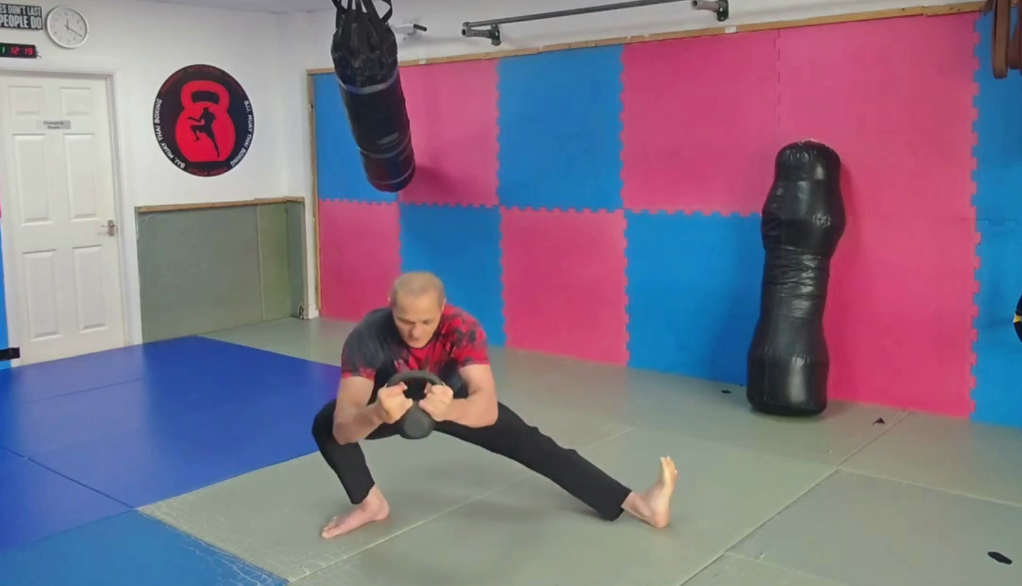
This is the module that justifies the purchase, and the one the site’s existing stretching-only coverage cannot substitute for. Using a kettlebell — or a dumbbell if that is what you own — Varga adds weight to the movements: standing hip flexor flows, Cossack squats taken bodyweight then weighted then flowing, windmills loaded at the bottom hand, top hand and both hands, and the goblet squat.
The Cossack squat mobility work is the clearest demonstration of the whole thesis: a loaded end-range position that stretches and strengthens the groin and hip at the same time. The kettlebell training for BJJ crowd will recognize the StrongFirst influence in the windmills and goblet squats. Skip Module 3 and you have bought a competent stretching video; the loaded module is the product.
How To Run The Protocol
This is not a course you run once. It is built to be cycled: Module 1 as a daily or pre-training mobility block, Module 2 as activation before lifting or rolling, and Module 3 as a short loaded session a couple of times a week. The time investment is low — the three modules run roughly 40, 17 and 41 minutes respectively, about 98 minutes of footage in total, so each routine is short enough to fold into a warm-up or a standalone off-mat day.
The equipment requirement is minimal but real: Module 3 needs a kettlebell or a single dumbbell, so a grappler with no home weights is buying a course that only two-thirds applies to them until they pick one up. For BJJ injury prevention, the practical hook is that a durable hip is a hip strengthened in its end ranges, not just stretched — which is exactly what the loaded module delivers.
STREAM IT HERE: Keystone Protocol Attila Varga DVD
Who Is This For?
The genuine buyer is the 40-and-over grappler with stiff, tight or injury-prone hips who already owns a kettlebell or is willing to get one, and who wants a structured, coach-led progression instead of stitching together free videos. Belt colour matters less than hip history here: a white belt with desk-job hips and a hobbyist black belt twenty years deep will both get something out of it, and it suits anyone who already lifts and wants to bolt a mobility phase onto their strength work.
Who should not buy: young, already-mobile athletes who can sit in a full squat cold and feel no tightness will find Module 1 redundant and the price hard to justify. Anyone expecting BJJ technique or live application footage should look elsewhere — there is no rolling, no guard-specific demonstration, and no on-the-mat transfer shown. And a grappler with no kettlebell or dumbbell and no intention of buying one is paying $79 for two-thirds of a course.
Pros And Potential Drawbacks
Pros:
- A genuinely different angle. The mobilize-to-activate-to-load progression is a strength-and-mobility system, not a stretching routine, and it fills a gap the site’s own hip mobility coverage does not touch.
- A credible crossover instructor. A Carlson Gracie black belt who also holds StrongFirst SFG I and SFG II kettlebell certifications is rare, and the loaded module reflects real strength-coaching experience rather than borrowed ideas.
- Clear, practical sequencing. Three phases with a logical hand-off make the protocol easy to run as a recurring block, not a one-off.
- Minimal equipment. One kettlebell or dumbbell is all Module 3 requires, so the barrier to entry is a single weight rather than a gym membership.
- It targets a real, underserved need. Hip durability for aging grapplers is a genuine problem, and the loaded end-range work addresses the part stretching cannot.
Potential Drawbacks:
- Short for the price. Roughly 98 minutes of footage for $79 is a steep dollars-per-minute ratio, and a chunk of Module 1 is standard mobility available free elsewhere.
- No live BJJ application. The transfer from hip mobility to guard retention, passing and takedowns is asserted rather than demonstrated — there is no rolling or technique footage.
Should You Use It?
This Attila Varga Keystone Protocol DVD lands on a qualified recommendation. The course is short, Module 1 is familiar ground, and the $79 price only makes sense for the right buyer. But the loaded third module — and the strength-coach credibility behind it — delivers something the stretching-only hip mobility advice online simply does not: range a grappler can actually keep. For a 40-and-over grappler with stiff hips, a kettlebell in the corner, and an interest in BJJ injury prevention and long-term hip durability, it is a well-sequenced, genuinely different product. For everyone else, the free routines will do just fine.
Reviewed by: Ognen Dzabirski, BJJ black belt, full-time coach and gym owner. The views expressed by the author do not necessarily reflect the views of the publication