









- BJJ tournament schedule delays are so common that many competitors accept them as normal, but not all delays are equal
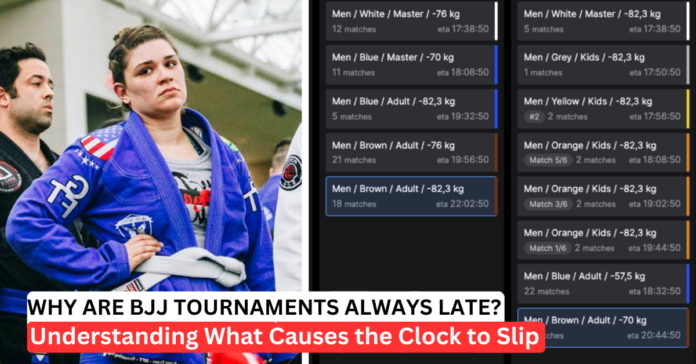
- Estimated match times posted on Smoothcomp are “dynamic” — they shift in real time as brackets progress faster or slower than expected
- The biggest drivers of delay: registration volume, bracket consolidation, athlete no-shows, and the domino effect of overtime matches
- Some delays are unavoidable logistics; others signal poor planning, undersized staff, or venues that were never built for the event size
- Understanding what causes the clock to slip helps competitors plan better and organizers run tighter events
Estimated Match Times: What They Actually Mean
Every BJJ competitor knows the feeling. Division starts at 10 AM. You warm up, stretch, watch the first few matches, check Smoothcomp — and suddenly it’s 12:30 PM and your bracket hasn’t been called yet.
By the time you actually step on the mat, it’s past 1 PM. The estimated match time you saw the night before? It was never a promise. BJJ tournament schedule delays are the sport’s most universal frustration, and understanding them starts with how those estimates are built.
Why BJJ tournaments run late comes down to how platforms like Smoothcomp generate match schedules — based on estimates of competitor count, average match duration, and available mats. The math looks clean on paper. But tournaments don’t run on paper.
The Smoothcomp FAQ for events like Grappling X is candid about this. Estimated times are “dynamic” — they change depending on how fast the tournament is running. Athletes are told to “refresh the Smoothcomp page as often as possible so you do not miss any updated times.”
That’s not a technical limitation; it’s a reflection of how variable live tournament logistics are. Every single unexpected outcome — a submission at fifteen seconds, a five-minute war that goes the distance, a referee call that needs discussion — pushes every subsequent estimate.

The Domino Effect: What Drives The Schedule Off Course
Tournament scheduling is a chain reaction where each match affects the next. BJJ tournament schedule delays often start before the first match is even called. The most common delay drivers fall into a few predictable categories.
- Bracket consolidation drags the start. When registration closes and brackets are built, organizers often need to combine divisions with low turnout. A division with two competitors gets merged into a larger weight class or age bracket. That reshuffling takes time and shifts the entire schedule. Organizers typically build brackets on Thursday or Friday before a weekend event, but late registrations and withdrawals right up to event day force changes.
- No-shows create unpredictable gaps. Competitors who don’t show up for their bracket — which happens more often than most athletes realize — force organizers to rewrite brackets on the fly. Removing a no-show can collapse entire trees, merging groups that were previously separate and delaying the next rounds while the system recalculates.
- Overtime is the silent killer of schedules. Every ruleset handles tied matches differently. Sudden victory, referee decision, or positional overtime — all of them add minutes to a match slot that was budgeted for a specific duration. When multiple brackets hit overtime simultaneously, the delay compounds rapidly across all active mats.
- The double elimination format adds uncertainty. Unlike single elimination where a bracket ends cleanly when one athlete loses, double elimination has a losers’ bracket that keeps half the field alive. A competitor who wins through the losers’ bracket must fight more matches to reach the final than someone who stays undefeated. That means more total matches per bracket and a wider variance in total match count.
Not every delay is a sign of a badly run event. Some delays are baked into the nature of live grappling competition. But there is a clear difference between professional organizers managing unavoidable variables and poorly run events that waste everyone’s time.
Distinguishing normal BJJ tournament schedule delays from organizational failures starts with reading the room:

- Signs of good organization despite delays: Clear communication. Staff visible at table stations. Updated brackets posted promptly. Announcements made when divisions shift. A warm-up area that competitors can actually use. These are the hallmarks of organizers who understand that unpredictability is part of the job and focus on managing expectations.
- Signs of poor organization: No communication about delays. Staff who don’t know which bracket is running next. Tables that sit empty while athletes wait for referees. A single person handling check-in, bracket management, and dispute resolution simultaneously. Venues that cannot physically accommodate the number of competitors registered. These are not logistical hiccups — they are structural failures.
Successful events build flexibility into their systems. They anticipate disruptions and prepare responses in advance, positioning staff to manage transitions, update brackets, and communicate changes clearly.
The goal is not to eliminate unpredictability but to manage it. Managing BJJ tournament schedule delays is a skill that separates professional event organizers from amateur operations.
Experienced organizers know that registration systems, scheduling frameworks, and venue selection must be established early — and that these decisions determine not only how smoothly the tournament runs but how participants experience it. A poorly structured schedule can lead to fatigue and frustration; a well-organized one creates flow.
Understanding the reasons behind BJJ competition scheduling problems lets competitors adjust their approach. The first rule for BJJ competition preparation: never trust the first estimated time as a fixed appointment. Plan to be at the venue ready to compete at least two hours before your estimated start, and bring enough food and water for a full day.
Smoothcomp dynamic times require constant attention. Check the bracket system repeatedly on event day — divisions shift, matches get moved between mats, and times change without notice. Many experienced competitors refresh their bracket page between every match, not just before their own.
Warm up strategically. Warming up too early and cooling down before your actual match call is a common mistake. Learn to time your warm-up based on live bracket progression rather than the initial estimate. Watch the mats and track how fast or slow your division is moving relative to the schedule. Smart BJJ competition preparation means treating the first estimated time as a rough guide, not a guarantee.
The final marker of organizational quality is how the event handles its finals. A well-run tournament will have a clear path to finals staging, with adequate rest periods and communication about when and where medal matches take place. A disorganized event will often rush finalists onto mats with minimal notice, creating an environment where performance suffers.
Making Your Peace With BJJ Tournament Schedule Delays
BJJ tournament schedule delays are so routine that many competitors have stopped questioning them. But grappling event organization has scaled rapidly over the last decade, with events that once drew 200 competitors now handling 800 or more. The organizational infrastructure — venue capacity, staffing models, bracket software integration — has not always kept pace.
The sport’s major promotions handle this scaling differently. IBJJF events, with their deep institutional experience, tend to run tighter schedules but also rely on stricter division cutoffs and less flexibility.
Smaller regional events, especially those run by academies without dedicated competition staff, are more prone to the cascading delays that turn a morning tournament into an evening affair. Neither approach is wrong — they reflect different priorities in the balance between participation volume and schedule discipline.
For the average competitor, knowing the difference between normal adjustment and structural failure makes the tournament experience less frustrating.
The BJJ tournament schedule delays may never disappear entirely, but understanding why they happen — from Smoothcomp dynamic times to bracket consolidation — is the first step to planning around them.
Tournament brackets explained in plain terms: every variable expands the timeline, and successful organizers build room for that into their process.