





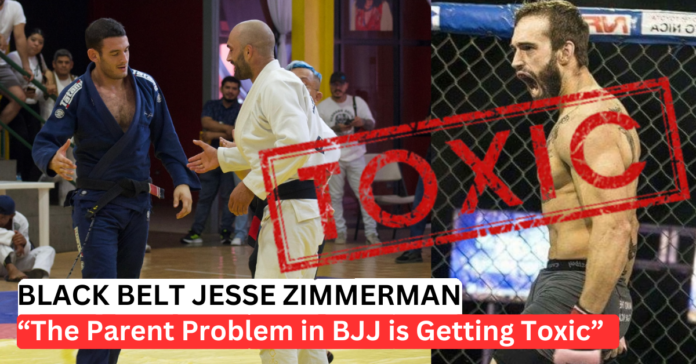

- Black belt Jesse Zimmerman says regional youth tournaments are filling up with adults “posturing” instead of letting kids compete in a healthy atmosphere.
- He warns that ego-driven behavior is pushing the sport away from the humility that once defined many rooms.
- An anthropologist’s “tribal” theory explains why Jiu-Jitsu feels so addictive—and why status games can show up when the “tribe” gets bigger.
Jiu-Jitsu culture turning toxic is usually something you hear after a bad open mat story. But Zimmerman’s frustration didn’t come from internet drama—it came from coaching kids at regional tournaments and seeing the adults turn the venue into a masculinity contest.
Jesse Zimmerman’s Warning From Youth Jiu-Jitsu Tournaments
In a video shared online, Zimmerman described tournament rooms where dads spend all day posturing around the mats, flexing and trying to look like the toughest guy in the building.
It’s a room full of dads… competing for the title of toughest guy in America.
– Jesse Zimmerman –
The setting is what makes the complaint sting. This isn’t a pro bracket with money on the line. It’s youth divisions and local comps—exactly the kind of environment that’s supposed to teach composure, respect, and how to win and lose without melting down.
Zimmerman also pointed to a familiar contradiction: BJJ is supposed to humble you, yet it still attracts people who want the look of being dangerous more than the work of getting good.
When that attitude leaks into kids’ events, it doesn’t just sour the day—it changes what young athletes think Jiu-Jitsu is about.

Jiu-Jitsu Culture Turning Toxic is More Than a Meme
Zimmerman’s clip spread because a lot of practitioners recognized the energy. Not necessarily the exact same tournament, but the same vibe: adults trying to “win” the room, not just support the competitors.
It’s easy to see why Jiu-Jitsu culture turning toxic is a conversation right now. The sport is bigger than ever, and with growth comes more cameras, more highlight culture, and more people treating every moment like content.
That shift can reward the loudest behavior—especially at tournaments where emotions run high and everyone wants their team to look dominant.

Zimmerman framed it as more than annoyance. He hinted at the most serious consequence: families quietly deciding the environment isn’t worth it.
I’m this close to taking my kids out of jiu-jitsu.
– Jesse Zimmerman –
That line is the real hook. It’s not about one cranky black belt complaining. It’s a coach and parent saying, “If this is what the scene is becoming, I’m out.”
Philip Folsom’s “Tribal” Jiu-JItsu Theory Explains The Pull
Around the same time, anthropologist and former elite U.S. Army warrior Philip Folsom offered a useful lens for why Jiu-Jitsu hits people so hard.
In a podcast appearance, he argued that the art’s appeal goes beyond fitness or self-defense—it recreates a tribal “kinship system” built on trust, shared hardship, and accountability.
Jiu-jitsu is popular because it’s a kinship system.
– Philip Folsom –
That idea tracks with what most long-term grapplers feel: the mat is one of the few places where you can’t fake who you are under stress, and where real bonds form because people are literally trusting each other with their bodies.
The Dark Side Of The BJJ Tribe: Posturing, Hierarchy, And Ego
But if Jiu-Jitsu is a tribe, status matters inside the tribe—belts, medals, “who taps who,” and increasingly, who has the biggest online presence. In a healthy room, that status is mostly a byproduct of time, skill, and being a good teammate.
In an unhealthy room, status becomes the point.
That’s where Zimmerman’s tournament warning and Folsom’s “kinship system” concept collide. As the tribe grows, you get more people who show up for community—and more people who show up for the pecking order.
When the pecking order becomes the obsession, you start seeing the tells: sideline theatrics, performative toughness, and a need to dominate the atmosphere even when the match on the mat involves children.
It’s also how Jiu-Jitsu culture turning toxic can creep in quietly. No scandal required—just a steady drift from “learn and improve” to “prove and posture.”
How Gyms Keep The Mat Humble Without Killing The Vibe
The fix isn’t to make Jiu-Jitsu soft. The fix is to aim intensity at development instead of ego.
For youth programs, that can start with clear expectations for parents: what supportive coaching sounds like, what behavior crosses the line, and why.
For adult rooms, it’s the same principle—leaders have to protect the culture they claim to value by rewarding humility, effort, and good training partners, not just the loudest “tough guy” energy.
Because if the sport loses the humility that made it special, people won’t just complain online. They’ll do what Zimmerman hinted at: quietly walk away—especially if Jiu-Jitsu culture turning toxic becomes the normal training reality instead of the occasional bad day.