





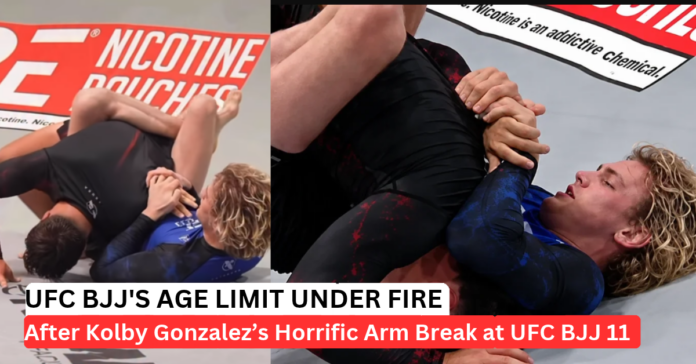

- Daniel Deeder submitted Kolby Gonzalez by Kimura at 2:20 of Round 3 at UFC BJJ 11, leaving the teenage welterweight with a serious-looking arm injury.
- Claudia Gadelha UFC BJJ minors policy is now in question after the promotion’s figurehead admitted the booking may have been “a mistake on our side.”
- It was the first time UFC BJJ has fielded a teenage competitor, and Gadelha said the promotion is reconsidering whether to do it again.
- The real debate is not about technique — Gadelha pointed to decision-making under professional pressure as the risk for youth athletes.
Kolby Gonzalez resisted the Kimura until his left arm bent further than most grapplers would allow. Daniel Deeder kept the grip, the referee stepped in at 2:20 of the third round, and UFC BJJ 11 had its first genuine safety debate — one Claudia Gadelha walked straight into at the post-event press conference.
What Happened To Kolby Gonzalez At UFC BJJ 11?
The official result is not in dispute: Daniel Deeder defeated Kolby Gonzalez by Kimura submission at 2:20 of Round 3 in a welterweight bout on September 24 in Las Vegas. Both men were making their UFC BJJ debuts, with Deeder reaching the card through the Austin UFC BJJ Opens qualifier.
Deeder jumped guard early and hunted a toe hold and an armbar. Gonzalez answered with wrestling, a flying back-take attempt, and stretches of top control, including a look at an arm-triangle choke. In the third round he landed top position again, only for Deeder to isolate the left arm and rotate into the Kimura.
The Daniel Deeder Kimura finish was graphic. UFC BJJ’s social accounts described a “graphic Kimura arm break,” while the official result listed it as a Kimura submission rather than a technical stoppage.
The official write-up noted that Gonzalez didn’t tap, and that Deeder applied more pressure as he appeared to break the arm to force the finish — and the Kolby Gonzalez arm injury has since become the flashpoint for a wider safety debate.

Claudia Gadelha UFC BJJ Minors Policy: ‘A Mistake On Our Side’
Claudia Gadelha did not hold back when the subject came up.
It was nasty. I felt physically sick with that arm breaking. I felt like the submission was there. I didn’t think that Kolby Gonzalez wouldn’t tap and he didn’t tap. He showed how tough he is and he’s so young. I think that’s going to be a good lesson for him.
– Claudia Gadelha –
The conversation moved quickly from the injury itself to the decision that put a teenager on a professional card. Gadelha confirmed it was the first time UFC BJJ had fielded a teenage competitor, and she was blunt.
I personally still disagree a little bit with bringing juvenile athletes to UFC BJJ. This is a professional event and we should be a little bit more cautious with bringing in young athletes that are still learning how to compete.
– Claudia Gadelha –
She went further, describing the booking as “probably a mistake on our side” and saying the promotion would reconsider the decision and “not do it again.”

The Difficult Line Between Elite Youth Technique And Professional Pressure
The policy problem is not technical. As Gadelha pointed out, kids now start training at three or four, work with world-champion coaches, and reach black-belt-level skill by their mid-teens.
By the time you get to 14, 15, 16 years old, you went through every kid’s belt and you are technically a kid that is a black belt, but you’re not an adult yet.
– Claudia Gadelha –
Gonzalez is the awkward proof of that tension. Across three rounds he wrestled, took top position, and defended submissions — he was not outclassed. The question is not whether a teenager can execute or defend a Kimura. It is whether a teenager makes the same tap-or-tough-it-out decision under professional pressure.
Gadelha has framed UFC BJJ as “the closest it gets to a fight without strikes,” and that is exactly the environment in which the minors in professional Jiu-Jitsu question gets harder.
Will UFC BJJ Set A Clearer Minimum Age?
Gadelha announced no rule change. She said the promotion needs time, and pointed to Dana White and Hunter Campbell for direction.
We need to spend some time. Maybe Dana and Hunter will be able to help us with understanding where to go from here.
– Claudia Gadelha –
She gestured toward a possible floor, noting that some fighters reach the UFC at 17 — an age she called reasonable, nearly adult and old enough to start making decisions for themselves — while 14, 15, and 16 remain “still very young” for a professional organization.
That is where the Joslyn Molina question lands. Molina is a 14-year-old prospect Gadelha called “amazing,” and one the promotion has already shown to Dana White. Any UFC BJJ age limit will have to explain where Molina fits.
The Gonzalez Injury Forces UFC BJJ To Define Its Youth-Safety Rules
The result is settled; the policy is not. No minimum-age rule was announced, and Gadelha stopped short of committing to one. What the injury did was drag the promotion’s UFC BJJ youth safety question into the open, where it can no longer be deferred.
The Claudia Gadelha UFC BJJ minors debate now turns on a single question: where does the promotion draw the line, and will it hold that line the next time a teenage black belt is offered a professional debut?