





- Herb Dean’s guidance centers on visible progress, not busywork, as the threshold for referee standups in MMA.
- Resets are warranted when both athletes stall; they’re avoided when the top fighter breaks posture, advances position, or lands meaningful offense.
- Clear cues from the ref—plus smarter corner calls—help prevent dominant positions in MMA from being erased.
- A shared, transparent standard would make referee standups in MMA more consistent across commissions and events.
Herb Dean On Referee Standups In MMA
Herb Dean has long been the lodestar for how officials manage ground exchanges, and his approach to referee standups in MMA is straightforward: if nothing is advancing—no posture breaks, no attempts to pass, no strikes that force reactions—the ref is obligated to intervene.
The point isn’t to punish grapplers; it’s to preserve jeopardy on both sides.
Dean’s philosophy prizes sequences that create dilemmas: a guard opening that threatens a pass, ground-and-pound that compels movement, or a submission chain that forces real defense. When those signals are absent, a reset is the fairest way to restore risk.
The Criteria Behind An MMA Referee Standup
Fans often confuse “activity” with “progress.” Dean draws a harder line. The legendary referee sounded off after the Dricus Du Plessis vs Khamzat Chimaev controversy involving stand-ups.
Light pitter-patter from top isn’t enough if it never breaks guard, and a static closed guard from bottom won’t save the position either. Officials are watching for:

- Posture Control And Guard Opening: Snap the head, win inside ties, and begin a pass—these are obvious green lights to let the exchange continue.
- Positional Advancement: Body-lock pressure that inches to half guard, knee-cut attempts, cross-face to mount, or a back exposure sequence.
- Effective Offense: Elbows and punches that force frames to collapse or create transition windows.
- Continuous Chains: Attempts should connect—break posture → open guard → initiate pass → stabilize. Single, isolated shots read as stalling.
If these markers are visible, Dean’s default is to let the ground work breathe. If they’re not, referee standups in MMA are not only justified—they’re necessary.
When A Reset Helps And When It Hurts
Standups serve their purpose when top control turns into a blanket with no real threats, or when bottom players accept guard purely to burn clock.
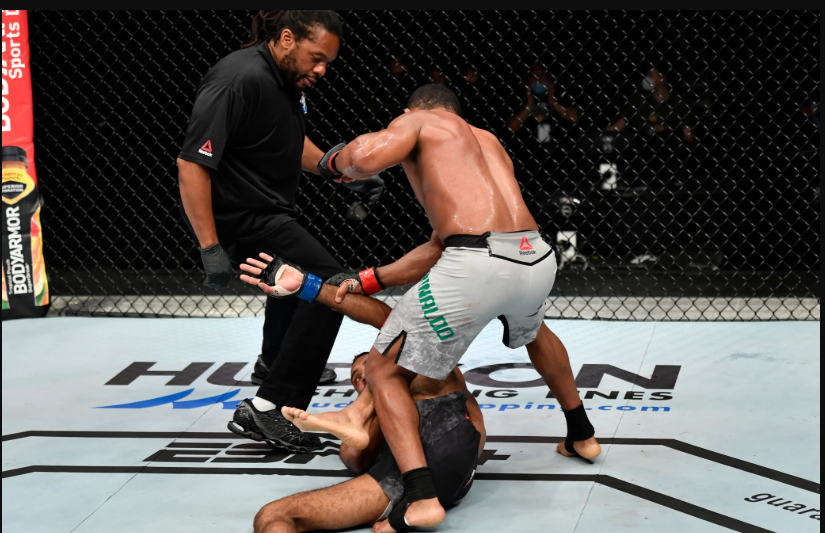
But the flashpoint is a different scenario: a fighter earns the takedown, establishes chest-to-chest pressure, starts to pry the hips open… and then gets stood up just as the pass is materializing.
That’s where Dean’s cadence matters. The best officials give audible cues—“Work,” “Advance,” “Improve”—so the onus is clear before the reset happens. If the athlete responds with visible attempts, the position should be allowed to develop; if not, the referee standup in MMA restores balance and tempo.
Coaching Toward Ref Proof Progress
Fighters can “ref-proof” their ground time by building sequences that an official can recognize at a glance:
- Top Fighters: Prioritize posture-breaking grips immediately after the takedown. Use sharp ground-and-pound as wedges that open guard, not as scorekeepers. Chain your passing: knee-cut stalls? Switch to smash or leg-weave; show back-take threats when mounts fail.
- Bottom Fighters: Either attack (elbow-knee escapes, underhook half, K-guard, leg entries that off-balance) or stand up. Static guard invites restarts; off-balancing creates the progress Dean wants to see.
- Corners: Call concrete steps: “Posture break and slice,” “Pummel inside, knee shield to underhook,” “Frame and stand now.” Specificity helps the fighter—and it telegraphs progress to the ref.
These habits make it easier for Dean and peers to let the action continue instead of calling for referee standups in MMA.
A Better Standard Doesn’t Need New Rules
We don’t need to rewrite the rulebook to reduce controversy. Dean’s template already points the way:
- Publish Video Examples: Short clips that show “let it go” versus “reset” would align athletes, coaches, and fans.
- Micro-Explanations In Big Fights: A brief post-event note for high-profile resets (“no advancement after cues; bottom locked guard”) builds trust.
- Simple Metrics: Track average time-to-standup, position at reset, and outcomes to spot outliers and refine guidance.
The clearer the standard, the fewer arguments about referee standups in MMA—and the more athletes will optimize for visible progress that earns them time on the mat.
Let Grappling Speak—And Make The Referee’s Job Easy
Dean’s through-line is consistency. Reward posture breaks, passes, and genuine threats; penalize static control and lockdown guards. If fighters show sequences the ref can literally “read,” standups become rare and justified—exactly how referee standups in MMA were meant to function.