



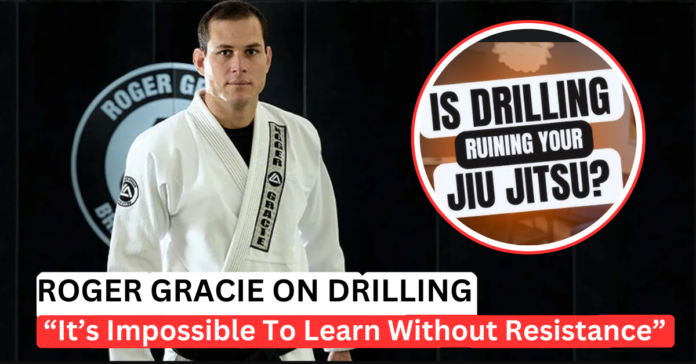

- Roger Gracie has doubled down on his long-held view that drilling is overrated, arguing that ground techniques only really develop under resistance.
- He prefers specific sparring over traditional “repeat the move 1000 times” drilling, saying improvement comes from solving the same live problem again and again.
- His emphasis on resistance, task-based training and problem-solving closely mirrors today’s ecological / constraints-led approach to Jiu-Jitsu.
- The message isn’t “never drill” – it’s “drill just enough to learn the mechanics, then shift quickly to positional sparring and live scenarios”.
- For everyday students, his stance is a strong push to rethink class structure: more specific rounds, fewer zombie reps, and training that looks a lot more like the roll itself.
Roger Gracie Drilling Is Overrated: How His Training Philosophy Mirrors Ecological Jiu-Jitsu
When a ten-time world champion says “I’m not a believer of drilling,” the Jiu-Jitsu world pays attention.
Roger Gracie has been consistent for years: he’ll drill enough to understand the mechanics of a move, but once that’s in place, he believes endless repetitions without resistance are largely a waste of time.
That “Roger Gracie drilling is overrated” stance has resurfaced in a recent conversation with John Danaher and in an IBJJF Q&A clip – and it happens to line up almost perfectly with the modern ecological, constraints-led approach that’s now dominating coaching debates.
Instead of canned sequences, Roger talks about spending most of his mat time in specific sparring, solving live problems from defined positions. For him, that’s where real Jiu-Jitsu skill comes from: exposure, resistance and adaptation, not choreography.
Roger Gracie Drilling Is Overrated
Roger’s starting point is simple and brutally honest: once you understand what a move is supposed to do mechanically, blindly repeating it doesn’t magically turn it into a live skill.

I’m not a believer of drilling.
– Roger Gracie –
In his talks about training, he explains that there is a place for drilling – at the very beginning. You drill to learn the mechanics, to feel the movement and understand where your hips, grips and weight should be.
But once that basic map is clear, he doesn’t see value in running the same sequence a thousand times on a partner who never really fights back.
He often compares this to Judo. Standing throws, with their timing and explosive entries, do benefit from huge amounts of drilling reps.
On the ground, though, he argues that the chaos of real grappling – shifting weight, frames, reactions and scrambles – means you quickly hit a ceiling if your partner stays compliant.
That’s where specific sparring replaces rote drilling. Instead of running an armbar entry from closed guard 50 times, Roger would rather you spend rounds starting in closed guard, actively trying to set up that armbar against someone who is doing everything they can to stop you.
You’re still repeating the situation – but the repetitions are alive.
I don’t drill, but I am a huge fan of specific sparring. For me, specific sparring is where I make the most improvements and refine my technique.
– Roger Gracie –
Specific Sparring, Resistance And Ecological Jiu-Jitsu
In that IBJJF Q&A clip, Roger is introduced with the line: “It’s impossible to learn without resistance.” That one sentence might be the cleanest bridge between his ideas and the ecological Jiu-Jitsu approach everyone is arguing about online right now.
Ecological / constraints-led training basically says this:
- Skills develop best in live, information-rich environments
- You learn by solving problems that look like the real thing
- Coaches should design tasks and constraints, not memorize-this-move scripts
That’s almost a textbook description of how Roger says he built his game. He talks about picking a position – say, escaping side control – and living there:
When you do this specific sparring, it’s the repetition that tells you what you’re doing wrong – even what you’re doing right – because when you go over the same movement over and over again with sparring, then you see… .
– Roger Gracie –
Modern ecological coaches use different language – “attuning to information”, “solving affordances”, “task design” – but the core looks very familiar to any old-school room that spent half the class in positional rounds. Some veterans even argue that ecological Jiu-Jitsu is just a fancy rebranding of how Brazilians used to train before the YouTube and DVD era.
When you put it in that light, the Roger Gracie drilling is overrated idea feels less like a hot take and more like a reminder: resistance and context have always been where real grappling skill lives.
Don’t be afraid to put yourself in tough situations. You learn every time you tap. Let go of your ego and watch your Jiu-Jitsu get better.
– Roger Gracie –
How This Challenges Traditional Jiu-Jitsu Classes
Most students know the classic format: warm-up, technique demo, drilling in pairs, then a few rounds of rolling. In that model, static drilling often eats the biggest chunk of class time.
Roger’s philosophy – and ecological thinking – quietly ask some uncomfortable questions:
- How many of those reps actually transfer to live rolling?
- Are students just memorizing steps, or are they learning to solve problems?
- Could you get better faster by sacrificing some drilling volume for more targeted, resistant rounds?
Crucially, the Roger Gracie drilling philosophy is not saying to delete drilling from the curriculum. He explicitly acknowledges its role in teaching basic mechanics. But he argues that once the move “exists” in your body, the training emphasis should shift fast – away from zombie reps and towards positional sparring and constrained games.
That’s straight out of the constraints-led playbook. Instead of “do this sweep 20 times each”, you get tasks like:
- Start in side control bottom; top’s goal is to hold, bottom’s goal is to escape to guard or turtle.
- Start in triangle; bottom finishes, top’s goal is to posture and escape.
- Start with back control hooks in; one round only finishing, one round only escaping.
Every round becomes a live experiment. The technique you drilled is the hypothesis; specific sparring is the test.
For coaches, this forces a rethink: if Roger Gracie built one of the most efficient, high-percentage games in history with minimal drilling and tons of specific work, maybe the default class template isn’t as sacred as we assume.
What Roger Gracie’s Philosophy Means For Your Training
So what do you actually do with all this as an everyday student who hears that Roger Gracie drilling is overrated but still turns up to a normal class three times a week?
A few practical takeaways:
- Use drilling as a short onboarding phase. When you learn something new, drill just enough that you feel the mechanics and can hit it without thinking – then politely steer your rounds toward that position.
- Ask for or create specific rounds. Even in a traditional gym, you can say: “Can we start in closed guard so I can work this sweep?” or “Let’s do two minutes with you on my back.” That’s Roger’s model in mini-form.
- Judge progress by problem-solving, not repetition count. If you drilled a pass 200 times but still can’t hit it on a resisting blue belt, that’s useful feedback: you need more live reps in that exact situation, not more air-reps.
- Don’t throw out structure for the sake of it. Ecological Jiu-Jitsu isn’t a license to ignore basics or skip learning mechanics. It’s a call to connect those mechanics to resistance as quickly and intelligently as possible.
The deeper message behind Roger’s stance is less about being anti-drilling and more about being pro-results. Whether you call it specific sparring, constraints-led training or ecological Jiu-Jitsu, the core idea is the same: you learn Jiu-Jitsu by playing Jiu-Jitsu under pressure.
If the greatest heavyweight technician of his era is telling you that’s how he built his game, it’s probably worth listening – and maybe reshaping your own mat time around the kind of training that actually made him Roger Gracie.