




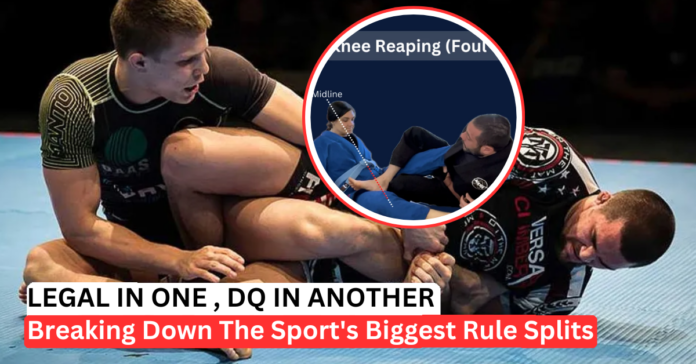

- Heel hooks are legal and expected at ADCC but banned entirely at IBJJF brown belt and below — the same technique that wins a match in one promotion can get you disqualified in another
- BJJ Heel Hook Knee Reaping Rules: Reaping is an automatic DQ under IBJJF rules and a completely neutral position under ADCC
- Slams are a DQ in most IBJJF divisions and a legal escape from submissions under ADCC rules
- Guard pulling is penalized at ADCC and rewarded with points in the IBJJF
- Six different rulesets mean competitors must rebuild their game plan for every event they enter
The same heel hook that wins an ADCC match gets the competitor disqualified under IBJJF rules. The guard pull that scores points at the IBJJF World Championship gets a passivity penalty at ADCC. The slam that stops a match at most IBJJF events is a legal escape under ADCC rules.
BJJ heel hook knee reaping rules are the clearest example of a deeper problem. The same technique is not simply legal or illegal — it depends on which building you are in. The BJJ competition ruleset fragmentation means competitors must master not just technique but regulatory adaptability, and spectators who watch multiple promotions find themselves confused about what is actually allowed.
The BJJ Heel Hook Knee Reaping Rules Split
The ADCC heel hook rules allow them at every level of competition. Competitors enter ADCC trials and the main event knowing that heel hook defense is not optional — it is a survival skill. The ADCC rulebook permits all leg locks and ankle locks, making heel hooks a central part of the modern game at that level.
Under IBJJF rules, heel hooks are banned entirely for brown belt competitors and below. They are only permitted at black belt adult divisions. Any competitor caught in a heel hook attempt below that level is immediately disqualified. The rule exists because heel hooks target the knee ligaments with high torque and low margin for error, and the IBJJF treats them as too dangerous for developing competitors.
This creates a training paradox. A blue belt who only competes in IBJJF events may go years without drilling heel hook defense. That same blue belt entering an ADCC trial faces heel hooks in the first round. Depending on the promotion, the technique is either the most efficient submission in the sport or a guaranteed ejection from the tournament.

What is Knee Reaping?
The knee reaping IBJJF DQ rule is one of the most enforced penalties in competitive BJJ. Under IBJJF rules, reaping is strictly prohibited. If a competitor places their foot across the opponent’s midline while attacking a leg and the opponent’s trapped foot crosses the midline of the attacker’s body — the classic inside heel hook entry — the referee stops the match and the reaping competitor is disqualified. There is no warning.
Under ADCC rules, knee reaping is not illegal. The position is treated as a neutral position, and the competitor in the reap can attack, defend, or escape. The difference is not subtle — it is the difference between losing a tournament and advancing to the next round for the exact same body position.
This rule split has a significant impact on training. Gyms that emphasize IBJJF competition often teach their athletes to immediately abandon any position that could be interpreted as reaping, even in no-gi training. Gyms that focus on ADCC or no-gi competition treat the reap as a primary attacking position. The same guard entry that wins an ADCC match gets a competitor disqualified at an IBJJF event.
The Boogeyman – Slams
The BJJ slam rules comparison is stark. Under ADCC rules, slams are permitted as a method of escaping a submission. If a competitor is caught in a triangle, a guillotine, or an armbar, they may pick up the opponent and slam them to the mat to break the hold. This is a legal, trained counter at the ADCC level.
Under IBJJF rules, slams are prohibited at most belt levels. A competitor who slams an opponent to escape a submission is disqualified. The IBJJF considers slams to carry an unacceptable risk of spinal and head injury, particularly when the opponent is inverted or in a compromised position.
The result is that a competitor trained for ADCC may instinctively slam out of a triangle at an IBJJF event and find the match forfeited. What was a legal escape in one context becomes a competition-ending mistake in another.
A Word On Guard Pulling
The guard pulling penalty ADCC rule penalizes competitors who sit to guard without first attempting a takedown. The ADCC rulebook expects competitors to fight for top position. Repeated guard pulling results in passivity warnings and eventual disqualification. The penalty exists because ADCC was designed as a submission wrestling event that prioritizes takedowns and positional control over guard work.
Under IBJJF rules, guard pulling is a standard part of the game. A competitor can sit to guard immediately at the start of the match, pull the opponent into their guard, and begin attacking from the bottom. This is not penalized.
The difference changes the entire shape of the match. The same decision — sitting to guard — is rewarded by one system and punished by another. An IBJJF competitor who pulls guard without hesitation enters an ADCC match at a disadvantage before the first grip is established.
Overtime Rounds
The IBJJF does not use overtime. Matches are decided by points and advantages, or by referee decision if the score is tied. There is no sudden death, no extra round, no escalation mechanism. The competitor who leads on points when the time expires wins.
ADCC uses an overtime format that depends on the event level. At the ADCC World Championship, if a match ends in a draw after regulation, the winner is determined by a specific overtime procedure where the competitor with the most advantages from regulation chooses to start on offense or defense.
EBI popularized an overtime format where two competitors start in a specific position and alternate between offense and defense. The competitor who escapes or submits wins.
The fragmentation of overtime rules means that a competitor who excels at IBJJF’s point-based scoring may struggle with ADCC’s pressure-based overtime. A competitor who wins consistently under EBI rules may need to learn a completely different approach to match management under IBJJF or ADCC. There is no universal way to win a Jiu-Jitsu match — the definition of winning changes with every promotion.
Understanding Passivity
The enforcement of passivity is the underlying variable that connects all of these differences. Under IBJJF rules, stalling is penalized inconsistently. Some referees warn for stalling quickly, others allow significant inactivity before intervening. The penalty generally results in an advantage for the active competitor.
Under ADCC rules, passivity is penalized more aggressively. The rules explicitly state that guard pulling, fleeing the mat, and avoiding engagement are subject to penalties. A competitor who receives multiple passivity penalties may be disqualified.
Promotions like AJP have their own passivity standards, rewarding positive fighting with their scoring system. The inconsistency of passivity enforcement means that what constitutes “stalling” in one event is “strategic patience” in another. Competitors who understand how a specific promotion enforces passivity gain a significant advantage over those who do not.
What BJJ Ruleset Differences Mean For The Sport
The BJJ heel hook knee reaping rules illustrate why competitive BJJ is not one sport governed by one rulebook. The BJJ competition ruleset fragmentation means different promotions enforce different rules about what is dangerous, what is legal, and what is rewarded.
An athlete who wants to compete across multiple promotions must maintain a flexible game plan that adapts to each rulebook. They must know when heel hooks are available and when they are a DQ. They must know when guard pulling is strategic and when it is a penalty.
They must train multiple overtime formats and understand how passivity is interpreted at each event. The sport presents itself as unified, but the BJJ heel hook knee reaping rules are just the beginning of the fragmentation.